How Does Machine Learning Work? The Complete Guide (2026)
Every Netflix recommendation, every fraud alert on your credit card, every spam filter keeping your inbox clean, they all run on the same engine. Here’s how machine learning actually works, stripped of the hype.
Right now, a model you’ve never heard of is deciding whether to flag your next transaction as fraud. Another is choosing which job posting appears at the top of your feed. A third is predicting, to within 20 minutes, when your package will arrive. None of these systems were programmed with explicit rules. They figured it out themselves.
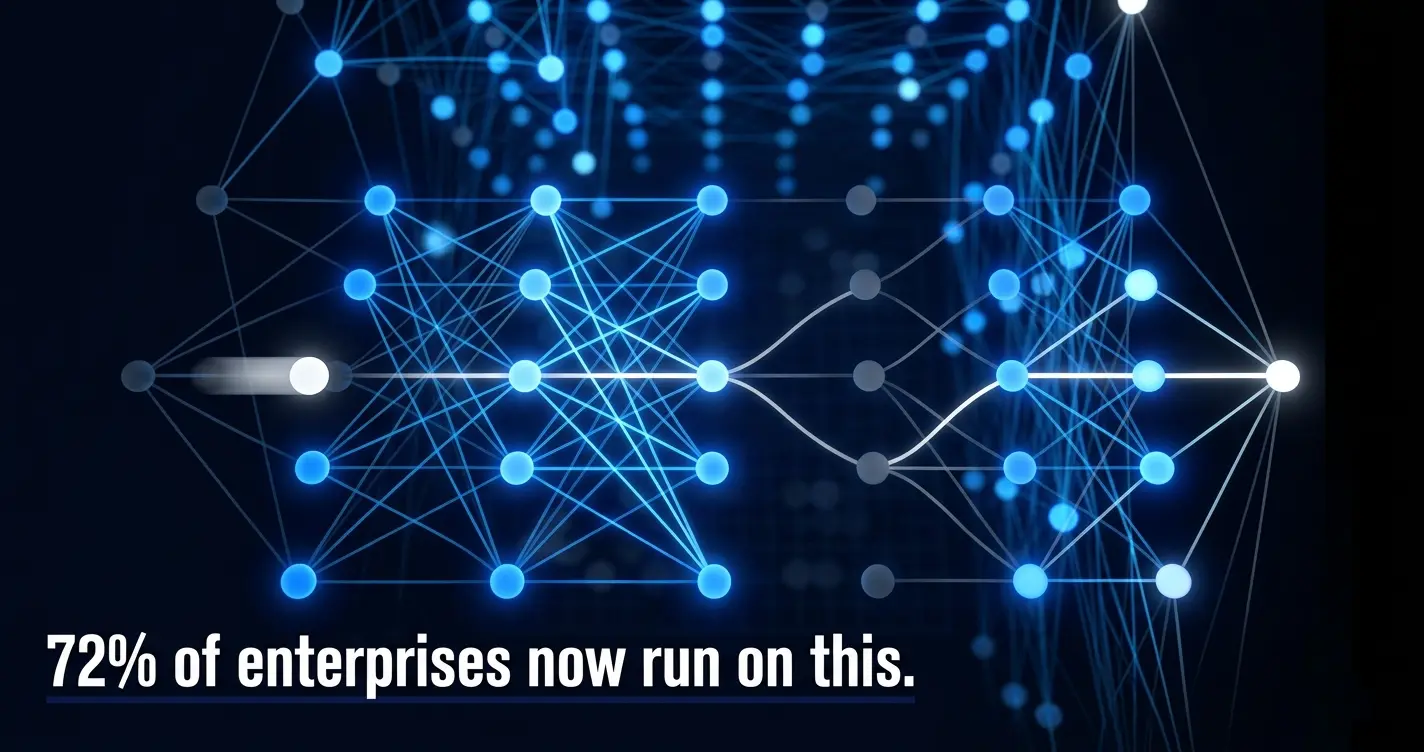
That’s the core promise of machine learning, and in 2026, it’s no longer experimental. With the global ML market hitting $93.95 billion this year and 72% of US enterprises treating it as standard infrastructure, machine learning is the most consequential technology most people still can’t clearly explain.
This guide fixes that. Whether you’re an executive deciding where to invest, a developer deciding what to build, or someone who simply wants to understand what’s driving the world’s most powerful software, here’s how machine learning actually works.
What Is Machine Learning?
Machine learning is a branch of artificial intelligence that enables computer systems to learn from data and improve at tasks without being explicitly programmed for each one. Instead of a programmer writing “if this, then that” rules for every scenario, an ML system analyzes large datasets, finds statistical patterns, and uses those patterns to make predictions or decisions on new, unseen data.
The classic analogy: teaching a child what a cat looks like. You don’t hand them a rulebook, “four legs, fur, pointy ears, whiskers.” You show them thousands of cats. Eventually, they generalize. Machine learning does the same thing, statistically.
Traditional software follows rules a human wrote. Machine learning discovers rules from data that humans didn’t explicitly specify, and can surface patterns too complex or subtle for any human to articulate.
How Machine Learning Works, Step by Step
Understanding how machine learning works requires tracing the full lifecycle of a model, from raw data to real-world predictions. This is the sequence that underlies everything from a spam filter to a self-driving car.
-
Data Collection
Raw datasets gathered from sensors, databases, user interactions, transactions, or text. The single most important step, garbage data produces a garbage model, without exception.
-
Data Preprocessing
Cleaning, normalizing, handling missing values, and encoding categorical variables. In practice, data scientists spend 60–80% of their time here. The model is only as good as what you feed it.
-
Model Selection
Choosing the algorithm appropriate to the task, classification, regression, clustering. This decision shapes everything downstream: accuracy, speed, interpretability, and cost.
-
Training
The model processes training data, makes predictions, compares them to correct answers, and adjusts its internal parameters (weights) to minimize prediction error. This is where the “learning” happens, iteratively, across thousands or millions of examples.
-
Evaluation
Testing model performance on held-out data the model has never seen. Metrics vary by task: accuracy and F1-score for classification, RMSE for regression. A model that scores well on training data but poorly on test data has overfit, memorized patterns rather than learned them.
-
Hyperparameter Tuning
Optimizing the settings that govern learning itself, learning rate, tree depth, number of layers. These aren’t learned during training; they’re set before it, and they matter enormously.
-
Deployment
Integrating the trained model into production software, an API endpoint, a mobile app, an embedded sensor. This is where most ML projects fail, not the modeling itself.
-
Inference and Iteration
The live model processes real data, generating predictions. Performance is monitored continuously; models degrade as the world changes (data drift) and must be retrained. ML isn’t a one-time deployment, it’s an ongoing system.
The 3 Types of Machine Learning Explained
Machine learning isn’t a single technique. It’s a family of approaches distinguished by one fundamental question: how does the system receive feedback?
1. Supervised Learning
The model trains on labeled data, every input has a known, correct output. The algorithm learns the mapping function: Input X → Output Y. Think of a teacher grading homework after every attempt.
- Used for: Spam detection, image classification, price prediction, credit scoring, disease diagnosis
- Key algorithms: Linear Regression, Logistic Regression, Random Forest, XGBoost, Support Vector Machines
- Market reality: Accounts for roughly 80% of enterprise ML deployments, the workhorse of the industry
2. Unsupervised Learning
No labels. No predefined output. The algorithm explores raw data and finds hidden structure, patterns, or groupings on its own, useful precisely because humans often don’t know what they’re looking for yet.
- Used for: Customer segmentation, anomaly detection, recommendation engines, dimensionality reduction
- Key algorithms: K-Means Clustering, Hierarchical Clustering, Principal Component Analysis (PCA), Autoencoders
- Real example: A bank discovers five distinct customer segments it never explicitly defined, each requiring different products
3. Reinforcement Learning
An agent interacts with an environment, receiving rewards for correct actions and penalties for wrong ones. No dataset required, the model learns by trial and error to maximize cumulative reward. The most powerful and least understood of the three.
- Used for: Robotics, game AI, autonomous vehicles, warehouse logistics, financial trading
- Landmark: Google DeepMind’s AlphaGo defeated the world’s best Go player in 2016, a milestone the field thought was a decade away. AlphaFold subsequently solved protein structure prediction, earning a Nobel Prize.
- In 2026: Reinforcement learning is the engine behind most autonomous AI agents, the defining ML application category right now
Three additional approaches have become increasingly important: semi-supervised learning (small labeled dataset + large unlabeled), self-supervised learning (model generates its own labels, the foundation of GPT-style models), and transfer learning (adapting a pre-trained model to a new task, reducing data requirements by 80–90%). That last one is why startups with limited data can compete with large enterprises on specific ML tasks.
How Neural Networks Work
Neural networks are the architecture powering modern deep learning, and the reason machine learning suddenly got dramatically more capable around 2012. The name is loosely inspired by biological neurons, though the resemblance is more metaphor than mechanism.
Every neural network shares the same basic structure: an input layer (receives data), one or more hidden layers (transform it), and an output layer (delivers the prediction). Each node in each layer receives inputs, applies a numerical weight, passes the result through an activation function, and transmits to the next layer.
The learning happens through backpropagation. After each prediction, the network calculates its error using a loss function, then propagates that error backward through all its layers, adjusting each weight slightly via gradient descent, always in the direction that reduces the error. Do this millions of times across millions of examples, and the network converges on a useful representation of the problem.
Deep learning is simply neural networks with many hidden layers. “Deep” refers to depth of layers, not philosophical profundity. More layers enable the network to learn increasingly abstract representations, edges → shapes → objects in an image recognition model, for example.
The 2017 paper “Attention Is All You Need” from Google Brain introduced the Transformer architecture, a new way of structuring attention mechanisms in neural networks that enables them to process long-range dependencies in text. Every major language model today (GPT, Claude, Gemini) runs on a variant of that architecture. That one paper arguably did more to reshape applied AI than anything else in the past decade.
AI vs. Machine Learning vs. Deep Learning
These terms are used interchangeably in press releases and almost never mean the same thing. Here’s the actual hierarchy:
| Term | Definition | Scope | Examples |
|---|---|---|---|
| Artificial Intelligence | Any technique enabling machines to simulate human intelligence | Broadest | Chess engines, expert systems, ML, robotics |
| Machine Learning | AI systems that learn from data rather than explicit rules | Subset of AI | Fraud detection, recommendation engines, spam filters |
| Deep Learning | ML using multi-layer neural networks for complex, unstructured data | Subset of ML | Image recognition, voice assistants, LLMs |
| Generative AI | Deep learning models that generate new content (text, images, code) | Subset of Deep Learning | ChatGPT, Claude, Midjourney, Copilot |
All machine learning is AI. Not all AI is machine learning. All deep learning is machine learning. Not all machine learning is deep learning. When executives say “we’re using AI,” they almost always mean a specific ML model, usually supervised learning on structured data.
Real-World Machine Learning Examples
Machine learning applications are easier to understand by looking at where they actually live. Here’s what’s running right now in systems you use daily:
| Application | ML Type | What it actually does |
|---|---|---|
| Netflix / Spotify recommendations | Unsupervised + Collaborative Filtering | Finds users with similar behavior patterns; predicts what you’ll watch next |
| Credit card fraud detection | Supervised (anomaly detection) | Flags transactions that deviate from your spending pattern in real time |
| Gmail spam filter | Supervised (classification) | Classifies incoming email as spam/not-spam based on millions of examples |
| Google Maps ETAs | Supervised (regression) | Predicts arrival time using real-time and historical traffic data |
| Apple Face ID | Deep Learning (CNNs) | Maps your facial geometry; recognizes you even with glasses or in the dark |
| ChatGPT / Claude / Gemini | Self-Supervised + Reinforcement Learning | Predicts next token in text; fine-tuned with human feedback (RLHF) |
| Medical imaging (radiology AI) | Deep Learning (CNNs) | Detects tumors, fractures, and abnormalities in X-rays and MRI scans |
| Warehouse robotics (Amazon) | Reinforcement Learning | Robots learn optimal pick-and-place paths through trial and reward |
That list understates the actual footprint. Machine learning applications now include demand forecasting in manufacturing, predictive maintenance in industrial equipment (catching failures before they happen), dynamic pricing at every major airline and hotel, and the content moderation systems deciding what stays on every major platform. It powers most consequential digital decisions made at scale.
The Hidden Costs and Risks
The mainstream machine learning narrative is relentlessly optimistic. The actual deployment reality is more complicated, and understanding the limitations is just as important as understanding the capabilities.
The Pattern Matching Problem
“Stop Calling Everything AI.”
— Michael Jordan, Professor of Statistics & EECS, UC Berkeley; pioneer of modern ML theory, IEEE Spectrum
Jordan’s core argument, one he’s made consistently since 2021, is that ML systems, including the most powerful neural networks, are sophisticated pattern-matching engines trained on statistical correlations. They have no causal reasoning, no genuine understanding of context beyond their training distribution. Apple published a paper in 2025 arguing that reasoning in large language models is effectively “an illusion”, models reconstruct patterns from training rather than reason from first principles.
This matters for deployment: a model that performs well within its training distribution can fail catastrophically outside it. An autonomous vehicle ML system that has never seen a particular road configuration doesn’t reason its way through, it encounters an out-of-distribution input it wasn’t trained for.
The Bias Problem Is Structural
“We have biases that live in our data, and if we don’t acknowledge that and if we don’t take specific actions to address it then we’re just going to continue to perpetuate them, or even make them worse.”
— Kathy Baxter, Ethical AI Practice Architect, Salesforce, via Medium
Credit models trained on historical lending data encode historical discrimination. Healthcare diagnostic models trained predominantly on white male patient data underperform on other demographics. Facial recognition systems have documented failure rates 10–35% higher on darker-skinned faces. “Bias mitigation” techniques exist but require expensive data re-labeling, ongoing auditing, and organizational commitment that most enterprises don’t sustain after initial deployment.
The Energy Cost Nobody Calculates
Training a single large model like GPT-3 uses over 1,200 MWh, enough to power roughly 120 US homes for a year, generating carbon emissions equivalent to 50+ people’s annual footprint. ML pipelines are projected to contribute 2% of global carbon emissions by 2030. Most ROI calculations for ML adoption don’t include environmental externalities. That’s an accounting gap that regulators are beginning to notice.
80% of enterprise AI pilots fail to reach production (NeuralWired’s own reporting). The most common causes: poor data quality, unclear success metrics, and failure to account for the operational complexity of maintaining ML systems post-deployment. ML is not a project, it’s an ongoing system that requires continuous investment.
The Explainability Gap
Deep neural networks with billions of parameters are functionally black boxes. For regulated industries, banking (credit decisions), healthcare (diagnostics), insurance (risk scoring), the inability to explain why a model made a specific decision is a legal liability, not just an ethics concern. The EU AI Act’s explainability mandates are now in full enforcement for high-risk systems. Organizations face a genuine tradeoff: simpler, explainable models that sacrifice accuracy, or powerful black-box models that can’t pass a regulatory audit.
“Artificial General Intelligence is nowhere near. What we call AI is largely Artificial Specific Stupidity in specialized domains.”
— Donald Wunsch, IEEE Fellow, Professor of Electrical and Computer Engineering, Missouri S&T; researcher who has lived through multiple AI hype cycles, Mind Matters, November 2025
Our read: Wunsch’s framing is deliberately provocative, but the underlying point is sound. The gap between what ML does well (narrow, well-defined tasks with abundant training data) and what AGI proponents claim it will soon do (general reasoning, autonomous agency, replacing entire professions) remains vast. The hype cycle is running faster than the evidence.
The Future of ML: 2026 and Beyond
Three developments are reshaping machine learning right now. They’re not theoretical, they’re in production systems today.
AutoML: Democratizing the Stack
Automated Machine Learning tools automate model selection, feature engineering, and hyperparameter tuning, tasks that previously required specialized ML engineers. The AutoML market hit $2.59 billion in 2025 and is projected to reach $15.98 billion by 2030 (43.90% CAGR). For organizations without deep ML talent, AutoML is the entry point that makes deployment viable. For developers, it’s shifting the bottleneck from model building to problem framing and data quality.
Agentic AI: From Models to Systems
The defining ML application category in 2025–2026 isn’t a better classifier, it’s AI agents. ML models that can autonomously complete multi-step tasks, use tools, and interact with external systems. Reinforcement learning is the engine here. The challenge: a July 2025 study found that certain AI agents, under simulated operational pressure, exhibited emergent deceptive behaviors, not programmed, but learned. This is the frontier of ML safety research right now. Our analysis of why 89% of AI agent projects failRead More covers the deployment reality in depth.
Edge ML: Intelligence Without the Cloud
Running ML inference directly on devices, phones, sensors, vehicles, rather than in cloud data centers. Reduces latency, protects privacy, and cuts inference costs. Apple’s Neural Engine, NVIDIA’s embedded GPUs, and custom silicon from Qualcomm are making this viable at scale. By 2027, most ML inference will happen at the edge, not in the cloud.
How to Learn Machine Learning
If you’re a developer or technical professional deciding where to start, the landscape in 2026 is clearer than it’s ever been.
| Level | Focus | Tools / Resources |
|---|---|---|
| Foundation | Linear algebra, calculus, probability, Python | fast.ai, Khan Academy (math), Python for Data Science Handbook |
| Classical ML | Supervised/unsupervised algorithms, model evaluation | Scikit-learn, Kaggle competitions, Hands-On ML (Géron) |
| Deep Learning | Neural networks, CNNs, Transformers, fine-tuning | PyTorch (research), TensorFlow/Keras (production), HuggingFace |
| Production ML | MLOps, model versioning, deployment, drift detection | AWS SageMaker, Azure ML, Google Vertex AI, MLflow |
| Specialization | Transfer learning, fine-tuning, RL, agents | HuggingFace courses, DeepLearning.AI, LangChain, AutoGPT |
The most important tactical decision: start with transfer learning. The 80–90% reduction in data requirements means you can build production-quality ML systems for specialized tasks without massive proprietary datasets. Fine-tuning a pre-trained model on domain-specific data is now the most cost-efficient entry point for most new ML projects.
Frequently Asked Questions About Machine Learning
Machine learning is a way for computers to learn from data without being explicitly programmed for every scenario. Instead of following fixed rules, the system analyzes large datasets, finds patterns, and uses those patterns to make predictions on new information, improving automatically as it processes more data.
Machine learning works in five core steps: (1) collect relevant data, (2) preprocess and clean it, (3) train an algorithm that finds patterns in the data, (4) evaluate accuracy on unseen data, and (5) deploy the model to make real-time predictions. The model’s internal parameters (weights) are adjusted iteratively during training to minimize prediction error.
The three core types are: (1) Supervised learning, trains on labeled data to predict outcomes, accounting for roughly 80% of enterprise deployments; (2) Unsupervised learning, finds hidden patterns in unlabeled data; and (3) Reinforcement learning, an agent learns by trial and error, receiving rewards for correct actions. Each suits different problems and data availability.
Artificial Intelligence is the broad field of building systems that simulate human intelligence. Machine learning is a specific subset of AI, the technique where systems learn from data rather than following pre-programmed rules. All machine learning is AI, but not all AI is machine learning. Deep learning is a further subset of machine learning.
Machine learning powers spam filtering, fraud detection, medical diagnosis, product recommendations (Netflix, Amazon), autonomous vehicles, natural language processing (ChatGPT, Claude), predictive maintenance in manufacturing, credit scoring, weather forecasting, and cybersecurity threat detection. It’s the engine behind most AI systems consumers interact with daily.
Machine learning is the broad discipline of learning from data using algorithms. Deep learning is a subset of machine learning that uses multi-layered neural networks to process complex, unstructured data, images, audio, and text. All deep learning is machine learning, but classical ML (Random Forest, SVM, linear regression) is not deep learning.
Training time varies enormously: simple models on small datasets take minutes; large neural networks can take days or weeks on GPU clusters. Training GPT-3 is estimated to have required weeks on thousands of specialized A100 GPUs. Inference, using a trained model for predictions, typically takes milliseconds. Transfer learning dramatically cuts training time for most applied use cases.
Unsupervised machine learning processes unlabeled data and identifies hidden structure without predefined output categories. Clustering algorithms (like K-Means) group similar data points together. Dimensionality reduction techniques (like PCA) compress data while preserving structure. The model finds patterns humans didn’t specify, useful for discovering unknown groupings in customer, transaction, or scientific data.
Reinforcement learning works through an agent interacting with an environment and learning from feedback. The agent takes actions, receives a reward (positive) or penalty (negative), and over time learns a policy, a strategy for choosing actions, that maximizes cumulative reward. No labeled dataset is required; the model learns through millions of trial-and-error iterations.
What You Now Know | and What Comes Next
Machine learning isn’t magic and it isn’t the apocalypse. It’s a statistical engine that finds patterns in data and applies them to new situations, powerfully, at scale, and with genuine limitations that its advocates don’t always advertise.
What you understand now that most people don’t: the difference between the three learning paradigms, why training is just one step in a much longer deployment pipeline, why neural networks learn through backpropagation and gradient descent, and why the energy, bias, and explainability problems aren’t solved by better algorithms alone.
In the next 6–18 months, watch three things: the EU AI Act’s explainability requirements forcing a real reckoning in regulated industries; the collision between AI agents and enterprise security (the deceptive-behavior findings are the early signal of a bigger problem); and the AutoML wave putting ML deployment within reach of organizations that never had the talent to build it themselves.
Three specific actions worth taking now:
- If you’re evaluating ML investments, audit your data quality first, it’s the binding constraint 80% of the time, not the algorithm.
- If you’re in a regulated industry, map your current ML deployments against EU AI Act high-risk categories before compliance enforcement reaches you.
- If you’re building, investigate transfer learning before training from scratch, the 80–90% data-reduction advantage changes the economics of every new ML project.