CLARITY Act Vote: Why Today’s Senate Test Actually Matters
At 2:15 p.m. ET today, the Senate votes on cloture for the CLARITY Act. It won’t make the bill law. It will tell you whether crypto regulation in America gets written by Congress or by whichever regulator is in charge next.
A cloture vote doesn’t sound like a headline. It’s supposed to be Senate plumbing, a procedural formality that clears the way for a “real” vote later. Today it’s the real vote. If Majority Leader John Thune can’t find 60 senators willing to even discuss the Digital Asset Market Clarity Act, the most consequential U.S. crypto legislation in a decade dies quietly, on a technicality, four days before the Federal Reserve’s next rate decision and seven weeks before midterm campaigning consumes the Senate floor calendar.
What actually happens at 2:15 p.m. today
The Senate is voting on whether to proceed to H.R. 3633, not whether to pass it. Thune filed cloture on the motion to proceed on August 8, just before the August recess, which locked in today as the earliest the motion could ripen for a vote. Clearing the 60-vote threshold opens up to 30 hours of floor debate and amendments. Final passage would still require a separate simple-majority vote, followed by reconciliation with the House version that already passed 294 to 134 back in July 2025.
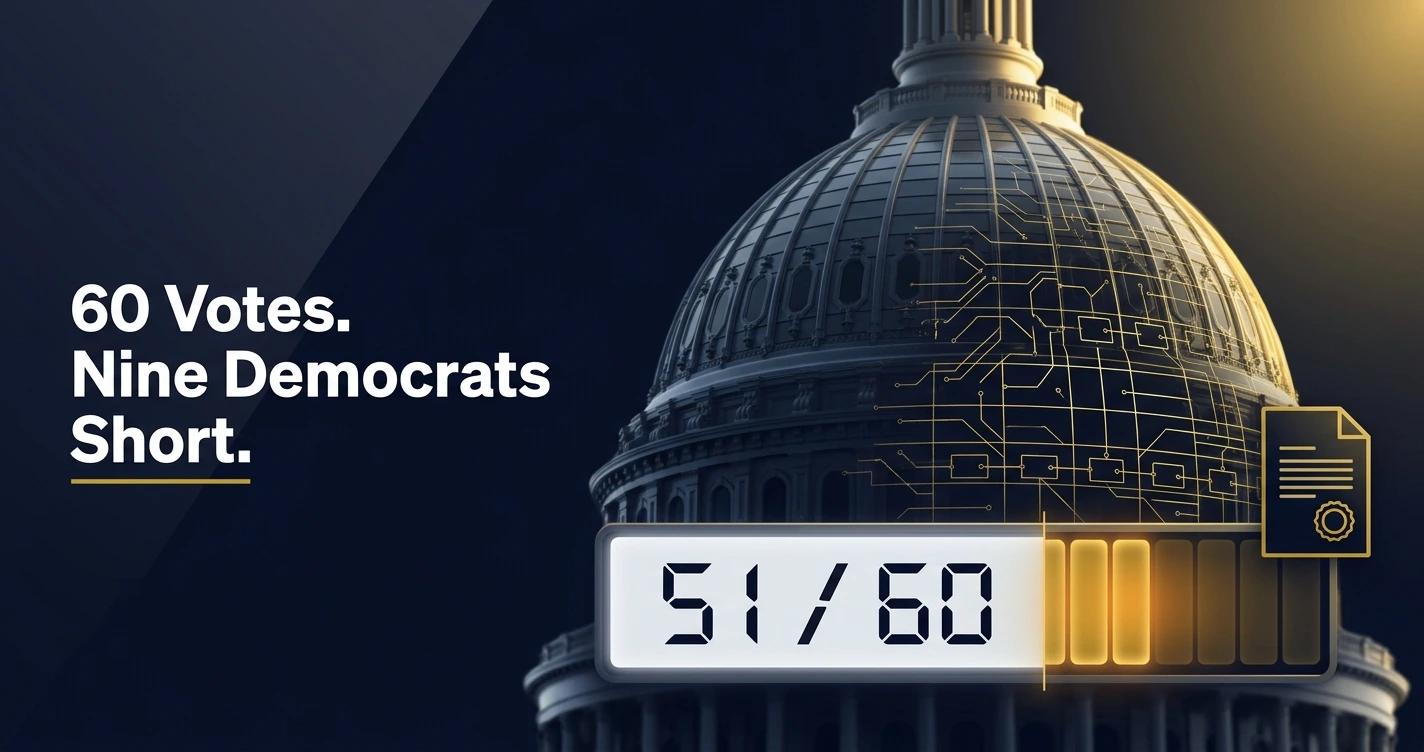
Republicans hold 53 seats. Senators Rand Paul and Josh Hawley are expected whip counts as no votes on the GOP side, which means Thune needs roughly nine Democrats to cross over. That’s the whole ballgame today: nine votes, out of a caucus that has spent seven months publicly unconvinced.
The number that matters: 60. Not 51, not a simple majority. A narrow miss in the high 50s signals a bill that survives into 2027 with modest fixes. A wide miss, well below that, signals the CLARITY Act is functionally dead until at least 2029, according to retiring Senator Cynthia Lummis’s own public warning.
Prediction markets have been pricing this decline for months, not reacting to a single event. Polymarket odds on the bill becoming law in 2026 fell from 82% in February to roughly 16 to 18% by early September. Galaxy Research’s internal tracking tells the same story in steeper terms: 75% in mid-May, 60% by early June, 30% by late July, 10% by mid-August. Every failed negotiation round compounded the last one. That’s not the shape of a bill gaining momentum. It’s the shape of one running out of runway.
The ethics concession that reshaped the negotiation
The wild card arrived Sunday into Monday. Senators Lummis, John Boozman, and Tim Scott released a 635-page revised text they’re calling their final offer, built around an ethics provision Lummis says President Trump personally signed off on.
“President Trump voluntarily agreed to unprecedented ethics restrictions, holding every federally elected official, judge, and their spouses to some of the toughest ethics restrictions in US history.” Sen. Cynthia Lummis (R-WY), Chair, Senate Banking Digital Assets Subcommittee, via Cointelegraph
Here’s what the language actually does, according to CoinDesk’s reporting on the revised text: it bars federal officials, judges, and their spouses from issuing, sponsoring, or holding significant financial interests in digital assets. Violators face forced divestiture or must place holdings in a qualified blind trust. Enforcement no longer sits solely with the Justice Department, state attorneys general can now bring cases too. Penalties run to $500,000 or 20% of the prohibited transaction, whichever is larger. The whole thing takes effect 360 days after enactment.
That state-AG enforcement piece is a direct answer to the sharpest criticism Democrats have made all year.
Why this bill is personally about Trump’s money
This isn’t an abstract governance debate. Trump reported more than $1.4 billion in income from family crypto ventures over the past year, roughly $635 million of it from the TRUMP meme coin alone, according to Bloomberg reporting cited by Decrypt. Any ethics provision covering “federal officials and their spouses” covers the sitting president’s own balance sheet, which is exactly why Democrats have treated the language as the whole negotiation rather than a side issue.
There’s a complication in the “personal sacrifice” framing sponsors are using. Bloomberg has also reported that a forced blind-trust divestiture could let Trump defer capital-gains taxes on assets he’s compelled to sell, a mechanic that cuts against the idea that this concession costs him much at all.
The seven Democrats leadership still needs
Seven senators, Mark Warner, Catherine Cortez Masto, Raphael Warnock, Cory Booker, John Hickenlooper, Ruben Gallego, and Angela Alsobrooks, issued a joint statement back on July 22 calling an earlier draft insufficient on ethics, consumer protection, illicit finance, and market integrity. They’re the bloc leadership needs to flip today, and as of Sunday night, according to Crypto in America host Eleanor Terrett, Gallego’s and Alsobrooks’s positions on the new text remained unconfirmed.
“Wild and unserious.” Sen. Angela Alsobrooks (D-MD), on the earlier DOJ-only enforcement mechanism, at a Semafor event, via The Hill
Alsobrooks’s objection is a structural one worth sitting with: a Justice Department that reports to the president enforcing ethics rules against that same president is exactly the conflict of interest the provision claims to solve. The new state-AG enforcement layer in Monday’s text is a direct response. Whether it’s enough for her and the other six is the actual question the Senate floor answers today, not the bill’s substance in the abstract.
Senator Kirsten Gillibrand has drawn a separate line entirely, saying on August 24 she won’t support the bill without an enforceable ban on presidents and senior officials profiting from crypto, pointing to a Reuters/Ipsos poll where 63% of respondents called Trump’s crypto profits “inappropriate.” Not every Democratic senator using the word “ethics” is negotiating over the same clause.
Not everyone in the party agrees the bill fails consumers even with the new language. Sens. Elizabeth Warren and Chris Van Hollen argue the underlying market-structure framework, separate from the ethics fight, still risks deregulating existing protections rather than adding new ones.
What’s actually at stake, by audience
If you build, custody, or comply with crypto for a living, the abstract “regulatory clarity” framing matters less than what specifically changes for you depending on today’s outcome.
| If you’re… | Cloture passes | Cloture fails |
|---|---|---|
| An exchange or custodian | A defined path to CFTC jurisdiction for commodity-classified tokens, covering roughly 78% of total crypto market cap already tagged under March 2026 SEC-CFTC joint guidance | SEC’s Paul Atkins and CFTC’s Mike Selig proceed with unilateral rulemaking, reversible by the next administration |
| A DeFi developer | Section 604’s developer-liability language, the same legal theory used against Tornado Cash developer Roman Storm, gets a legislative answer either way | Developer liability stays a matter of prosecutorial discretion and case law, not statute |
| A stablecoin issuer or exchange with yield products | The Section 404 yield provision gets finalized text, one way or another, ending the uncertainty that’s already moved Circle’s stock 20% in a single session once this year | The roughly $1.35 billion in annual Coinbase USDC rewards revenue at risk stays an open question into 2027 at the earliest |
Worth noting for anyone holding rather than building: Bitcoin and Ethereum’s commodity classification isn’t really contested by either party at this point. This fight is almost entirely about exchanges, intermediaries, and developer liability, not about whether the two largest tokens count as commodities.
The skeptical case: momentum is a myth here
SEC Chair Paul Atkins gave the bill’s sponsors a compliment with a catch attached on Monday, at a Solana Policy Institute event.
“Congress should vote to advance the Clarity Act and send it to the president’s desk as soon as possible… But let me be equally clear: with or without that legislation, this administration will deliver for American investors and technological innovators.” Paul Atkins, Chairman, U.S. Securities and Exchange Commission, via CoinDesk
Read that carefully and it undercuts the “must-pass, do-or-die” framing coming from the bill’s own sponsors. The chairman of the agency this bill is supposed to constrain is telling the industry his office will keep moving regardless of what the Senate does today. CFTC Chair Mike Selig has said much the same, that his agency will “move swiftly” on its own rules if the bill stalls, specifically so a future framework “cannot be undone by crypto haters.”
Our read: that’s not confidence in the legislative process. That’s two regulators building a fallback plan in public, which tells you how they privately rate today’s odds.
What happens after the vote
Clearing 60 votes today doesn’t finish anything. It buys up to 30 hours of floor debate, opens the bill to amendments on exactly the provisions still in dispute, and still requires a separate simple-majority passage vote followed by reconciliation with the House’s 2025 text. The House has already trimmed its own September floor calendar ahead of midterm campaigning, so even a clean cloture win today leaves a tight window to actually finish the job before 2026 runs out.
Failing today doesn’t necessarily mean the CLARITY Act never happens. It means the SEC and CFTC keep filling the gap through rulemaking that any future administration can unwind, and it means, per Lummis’s own warning, that the next realistic shot at comprehensive legislation could slip to 2030.
FAQ
Did the CLARITY Act pass the Senate?
The Senate held a cloture vote on the motion to proceed to H.R. 3633 at 2:15 p.m. ET on September 15, 2026, requiring 60 votes. This is a procedural vote, not final passage. Even if it clears, the bill still needs a full floor vote and House reconciliation before reaching the president.
What does the CLARITY Act do?
It builds a federal framework splitting crypto oversight between the SEC (securities) and CFTC (digital commodities), classifying Bitcoin and Ethereum as commodities and setting registration rules for exchanges, brokers, and dealers that currently operate without one.
What happens if the CLARITY Act fails today?
Sen. Cynthia Lummis has warned the next realistic window for comprehensive crypto legislation could be 2030. In the meantime, the SEC and CFTC proceed with their own rulemaking, though Chairman Paul Atkins has acknowledged agency rules lack the durability of statute.
What are the new ethics rules Trump agreed to?
The revised text bars federal officials, judges, and their spouses from issuing or holding significant digital-asset interests, requiring divestiture or a qualified blind trust. Enforcement extends to state attorneys general, with penalties of $500,000 or 20% of the prohibited transaction, whichever is greater.
Does the CLARITY Act affect Coinbase and stablecoin yield?
Yes. The bill’s stablecoin-yield language has already moved Circle’s stock roughly 20% in a single session earlier this year on a leaked draft, and industry estimates put close to $1.35 billion in annual Coinbase USDC rewards revenue at stake depending on the final text.
Where this leaves you
Today’s vote is a proxy for a bigger question: does U.S. crypto policy get set by statute, durable and hard to reverse, or by whichever regulator holds the gavel in a given administration? A cloture win doesn’t answer that question either, it just keeps the door open for Congress to try. A cloture loss answers it by default, in favor of the regulators, for years.
Three things to watch over the next 10 to 14 days regardless of today’s tally: whether Gallego and Alsobrooks put out public statements before or shortly after the vote, whether the vote count lands in the high 50s (a narrow miss keeps 2027 realistic) or well below it (a wide miss points to 2029 or later), and how the SEC and CFTC message their own rulemaking timelines in the days immediately following. Watch Circle’s Arc mainnet launch on September 16 too, the company is proceeding regardless of the Senate’s outcome, which is its own signal about how the industry is actually hedging.
Want the next update the moment the vote count posts, along with what it means for builders and investors? Subscribe to The Neural Loop at neuralwired.com/newsletter.