Markets & Infrastructure
AI Data Center Stocks Are Winning. What If the Memory Chip Shortage Never Breaks?
The memory chip shortage 2026 has turned into two stories at once. On one side, AI data center stocks like Micron and SK Hynix are printing record numbers. On the other, big tech balance sheets are quietly absorbing the same shortage as a cost problem, one that shows up in depreciation schedules, off-balance-sheet debt, and hyperscaler capex 2026 guidance that keeps climbing every earnings call. The DRAM shortage AI created didn’t resolve this year. It got worse, and the bill is landing somewhere.
In this article
The Shortage Nobody Priced In
In early September 2026, South Korean outlets Chosun Daily and Sedaily reported something that should have rattled every hyperscaler CFO: combined memory inventories at Samsung and SK Hynix had fallen below 10 days’ supply, according to KB Securities analysis. A healthy buffer sits at 8 to 12 weeks. Ten days is not a buffer. It’s a company running on fumes while demand keeps climbing.
This didn’t happen overnight. SK Hynix told investors on its October 2025 earnings call that HBM, DRAM, and NAND capacity was, in its words, essentially sold out for all of 2026. Samsung followed with a warning of its own: 32GB DDR5 module pricing jumped from $149 to $239, a 60% increase, and DDR5 contract pricing has more than doubled from around $7 to roughly $19.50 per unit within a single year, according to reporting from Network World on comments by Samsung executive Wonjin Lee.
By early September, the spot market told an even more extreme story. A 36GB HBM3E module was trading around $2,100, four to five times the typical $300 to $400 long-term contract price, per Intuition Labs data cited by Motley Fool. That’s not a price adjustment. That’s a market where buyers are paying a panic premium because nobody wants to be the data center operator without chips.
We’ve covered the engineering side of this in detail, including the “memory wall” bottleneck and what infrastructure teams should actually do about it, in our companion piece: Micron Memory Shortage 2026: AI Ate 70% of Chip Supply. This article picks up where that one leaves off: not why the chips ran out, but what running out is doing to the companies buying them by the hundreds of billions.
Why this matters right now: Micron and SK Hynix shares rose roughly 4% and 3% respectively in the first week of September 2026, purely on the inventory-shortage reporting. The market is already pricing this as a supply story. Big Tech’s own disclosures suggest it’s also a debt story.
The Capex Numbers Keep Getting Stranger
Every hyperscaler raised guidance in 2026, and most raised it more than once. Alphabet moved from $185 billion to a $200 to $205 billion range for the year. Amazon went from $200 billion to $220 billion. Microsoft is tracking past $120 billion for its fiscal year, with property and equipment at cost hitting $298.6 billion as of mid-2025, up from $212 billion a year earlier. Meta sits in a $115 to $135 billion range and is issuing new debt specifically to cover it, including a 1GW Ohio data center and a Louisiana site that could eventually scale to 5GW.
| Company | 2026 Capex Guidance | Notable Detail |
|---|---|---|
| Amazon | $220B (raised from $200B) | Largest single raise among hyperscalers |
| Alphabet | $200B–$205B (raised from $185B) | Q2 2026 capex alone: $44.9B, double YoY |
| Meta | $115B–$135B | Funding expansion partly through new debt issuance |
| Microsoft | $120B+ | Property & equipment at cost: $298.6B (up from $212B) |
| Oracle | ~$50B (up 136% YoY) | Backed by $523B in remaining performance obligations |
Add it up and Goldman Sachs puts combined 2026 AI data center capex somewhere between $700 billion and $765 billion, with the broader 2025 to 2027 hyperscaler capex figure projected at $1.15 trillion, more than double the $477 billion spent from 2022 to 2024. UBS goes further, projecting $4.1 trillion in hyperscaler AI infrastructure spend from 2026 to 2028, versus $1.3 trillion across the prior six years combined. On UBS’s math, Amazon, Alphabet, and Microsoft combined are set to spend 102% of their combined cloud revenue on capex in 2026. Not a typo. More than they make.
Some of that spend is being routed around the shortage entirely. Enterprises frustrated with memory-constrained, increasingly expensive cloud inference are pushing more workloads to local hardware, a shift we mapped out in On-Device AI in 2026: The Stack Replacing Cloud APIs. It’s a small release valve, not a fix. The bulk of the spend, and the bulk of the risk, still sits with the hyperscalers.
What’s Actually Sitting Off the Balance Sheet
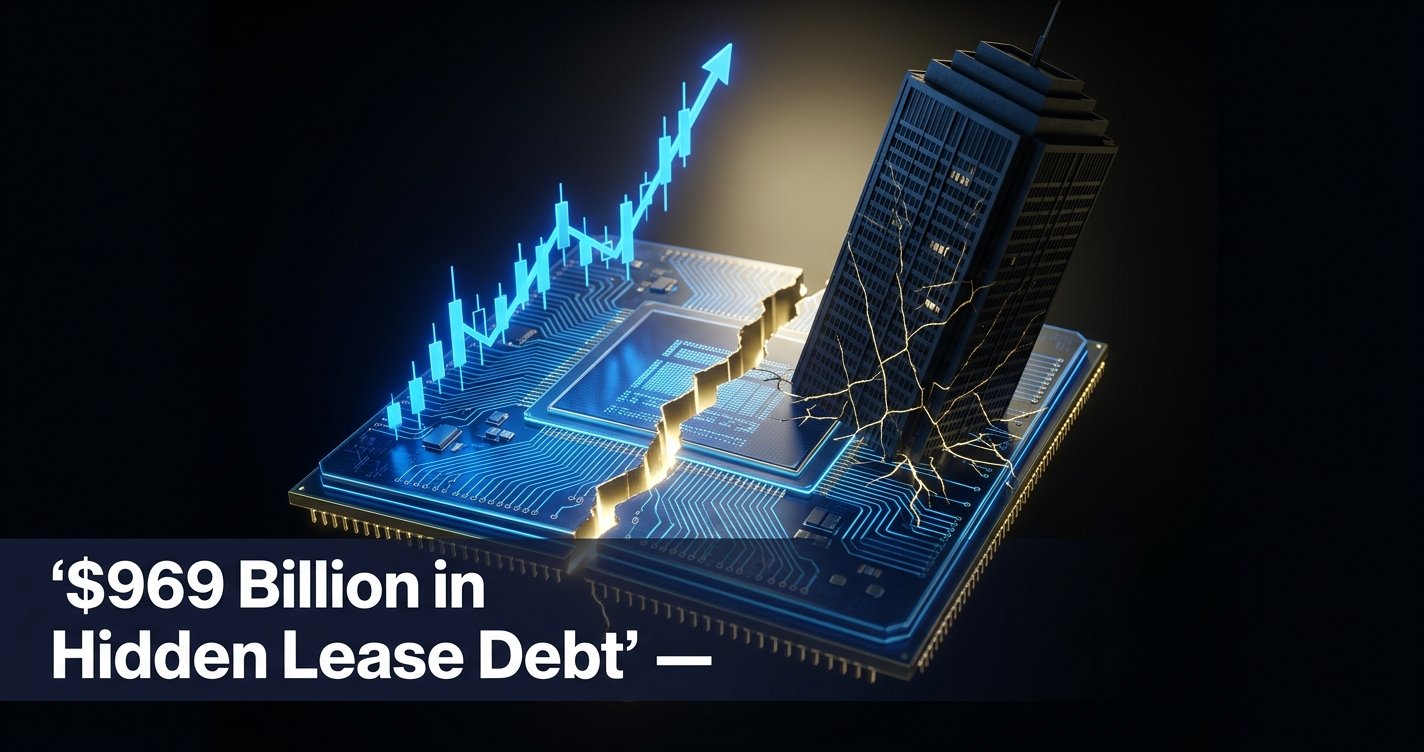
Here’s the part investors keep underweighting. According to Moody’s Ratings, the five biggest hyperscalers, Amazon, Meta, Alphabet, Microsoft, and Oracle, held $969 billion in total undiscounted future lease commitments at the end of 2025. Of that, $662 billion had not yet commenced, which under GAAP means it doesn’t show up on the balance sheet today.
Zoom out further and the picture gets bigger. Nikkei estimated in July 2026 that combined off-balance-sheet AI-related obligations across Alphabet, Meta, Microsoft, Amazon, and Oracle reached roughly $1.65 trillion. A Wall Street Journal analysis from mid-August 2026 put total AI commitments across nine major tech companies near $3 trillion. Meta alone carries an estimated $420 billion in off-balance-sheet AI obligations, nearly three times its $83.7 billion in on-balance-sheet debt.
The mechanism is special purpose vehicles, SPVs, structures like Meta’s Hyperion project with Blue Owl and its $12 billion El Paso financing (internally nicknamed “Beignet”). These keep debt off the parent’s official books while the parent still backstops the project’s value through residual value guarantees. Meta’s own auditor, EY, flagged the Beignet structure as a “critical audit matter” in February 2026, the kind of language auditors reserve for the judgment calls that keep them up at night, even though EY ultimately signed off.
The Bank for International Settlements has noticed too. Its January 2026 bulletin flagged that private-credit loans to AI-related companies exceeded $200 billion by late 2025, up from near zero a decade earlier, warning that SPV structures can mask true leverage across an interconnected web of hyperscalers, chipmakers, and neocloud operators. Nvidia is part of that web directly, having guaranteed up to $105 billion backing SB Energy’s Ohio buildout, a project anchored by OpenAI as tenant that is now pursuing its own Nasdaq IPO under ticker SBE. We covered the concentration risk in that specific deal in SB Energy IPO and Its OpenAI Dependence Risk, and it’s a clean, live example of exactly the fragility this section describes.
The Depreciation Problem Big Tech Doesn’t Want to Talk About
Between 2022 and 2025, Amazon, Alphabet, Microsoft, Meta, and Oracle each stretched the assumed useful life of their server hardware from around four years to five or six. That single accounting choice mechanically lowers reported depreciation expense and lifts net income. Alphabet’s 2023 change alone added $3.0 billion to net income, or $0.24 per share. Meta’s 2025 change added another $2.9 billion.
The catch: Nvidia’s chip generations are turning over roughly every two to three years, not five or six. Investor Michael Burry, of Scion Asset Management, made this the center of his public case against the sector, arguing hyperscalers could be understating depreciation by roughly $176 billion between 2026 and 2028 by using useful lives that don’t match how fast the underlying hardware is actually aging out.
“Burry’s right: depreciation is a fatal blow to the AI bubble.” Seeking Alpha, referencing Michael Burry’s November 2025 analysis of hyperscaler depreciation schedules — Read the analysis
A separate estimate from Footnote Brief puts cumulative suppressed depreciation at roughly $200 billion through 2028, split as $46 billion in 2026, $75 billion in 2027, and $107 billion in 2028. Amazon is the notable outlier here. It actually shortened a subset of useful lives from six years back to five in 2025, explicitly citing the accelerated pace of AI and ML hardware development. Skeptics view that as the cleanest tell in the sector: if one hyperscaler thinks five years is the honest number, the peers still using six are making a more aggressive bet than they’re advertising.
The Bear Case: What Actually Breaks This
Every bull case in this space is also, structurally, a bear case. Rising memory prices are great for Micron’s margins and terrible for whoever’s buying the memory. The question professional investors are now pricing is whether current hyperscaler earnings reflect durable, revenue-generating infrastructure, or profits flattered by aggressive depreciation assumptions and debt that doesn’t show up where it should.
“Over $178.5 billion in data center deals against less than $1 billion in compute revenue.” Ed Zitron, host of Better Offline, describing the gap between AI infrastructure commitments and demonstrated revenue outside the hyperscalers themselves
Zitron’s warning is that a stumble at a major AI lab could trigger what he calls a brutal collapse across the entire AI infrastructure trade. He’s not alone in flagging a demand mismatch. Goldman Sachs strategist Christian Hammond has warned that investors will soon demand tangible near-term earnings evidence rather than continued infrastructure-spending momentum, and that a hyperscaler retreat to 2022-level capex, an admittedly extreme scenario, could erase roughly 30% of the trillion dollars in S&P 500 sales growth projected for 2026.
The market has already shown its nerves once. In June 2026, Samsung and SK Hynix shares both fell 12% in a single morning amid AI-bubble anxiety, with Micron, up nearly 800% over the prior year, dropping 13% alongside them. It reversed quickly, but it’s a preview of what a real demand shock would look like. And Amazon has already taken a partial hit from the depreciation side of this: it recorded $920 million in accelerated depreciation charges in Q4 2024, a small early tremor of the write-off wave Burry and others are warning could eventually hit multiple hyperscalers at once.
When Does the Shortage End?
Not soon, according to the people actually building the fabs. SK Hynix CEO Kwak Noh-Jung told Bloomberg in July 2026 that the memory crunch will probably persist beyond 2030. Synopsys CEO Sassine Ghazi told CNBC the crunch will run through at least 2026 and 2027. SK Hynix’s new Indiana HBM fab, which broke ground on August 27, 2026, with a $4 billion-plus investment, won’t finish its cleanroom until October 2028, and volume HBM output isn’t expected before 2029.
“The earliest we see meaningful new capacity is 2028, but that relief will be partial rather than substantial. We do not anticipate substantial relief before early 2030.” Kushal Fernandes, Partner, Kearney
Part of why this shortage doesn’t self-correct like past ones is margin math. HBM commands three to five times the revenue per wafer of conventional DDR5, so manufacturers have no financial incentive to rebalance toward commodity memory even as shortages spread into consumer electronics. TrendForce’s Avril Wu, who has tracked the memory market for around two decades, put it bluntly to Tom’s Hardware:
“This time really is different… the craziest time ever.” Avril Wu, memory-market analyst, TrendForce — via Tom’s Hardware
That structural reallocation shows up cleanly in the numbers: HBM’s share of the top three suppliers’ DRAM wafer input moved from 18% in 2025 to a projected 22% in 2026 and an estimated 30% by 2027, per TrendForce. Every percentage point that shifts toward HBM is a percentage point that isn’t going toward the DDR5 chips inside laptops, phones, and cars, which is why Apple raised MacBook and iPad prices in 2026 citing memory costs directly, per CNBC’s reporting, and why Elon Musk framed Tesla’s own AI ambitions in January 2026 as a choice between hitting the “chip wall” or building a fab of its own.
What This Means If You’re Investing or Building
If you’re allocating capital, the shortage splits the sector into two camps that behave nothing alike. Micron, SK Hynix, and Samsung have pricing power and are riding it: Micron guided fiscal Q4 2026 revenue to $50 billion, up from $9.3 billion a year earlier, largely on HBM4 pricing, which its Q1 2026 call described as completely sold out for the year. Infrastructure suppliers like Vertiv are along for the same ride, up 61.76% year to date as of late August 2026.
The other camp is the hyperscalers themselves, absorbing the same shortage as a cost that flows into capex, into debt issuance (the five largest issued about $121 billion in bonds in 2025, versus roughly $40 billion in 2020, with Morgan Stanley projecting around $570 billion in global AI-related debt issuance for 2026), and into depreciation assumptions that a growing chorus of analysts thinks are too generous.
Our read: this doesn’t resolve as a single event. It resolves as a slow divergence. The memory makers keep printing record numbers as long as the shortage holds, and the hyperscalers keep getting more scrutiny on earnings quality the longer their capex outpaces their disclosed, on-balance-sheet obligations. Watch depreciation footnotes and SPV disclosures in Q4 2026 earnings as closely as you watch the headline capex number.
Frequently Asked Questions
What is causing the memory chip shortage in 2026?
AI data centers are diverting DRAM and HBM production away from consumer electronics toward GPU training and inference. Samsung, SK Hynix, and Micron have reallocated most advanced capacity to high-margin HBM and server DRAM, with data centers projected to consume roughly 70% of global memory output in 2026, versus 20 to 30% in 2022.
How much AI capex are Big Tech companies spending in 2026?
Alphabet, Amazon, Meta, Microsoft, and Oracle are collectively projected to spend $700 to $765 billion on AI data center infrastructure in 2026, per Goldman Sachs estimates, with Amazon alone guiding to $220 billion and Alphabet to roughly $200 billion, both revised upward multiple times this year.
Are Big Tech companies using debt to fund AI data centers?
Yes. The five largest hyperscalers issued about $121 billion in corporate bonds in 2025, up from roughly $40 billion in 2020. Morgan Stanley projects global AI-related debt issuance will reach approximately $570 billion in 2026, with many deals structured through off-balance-sheet special purpose vehicles.
When will the memory chip shortage end?
No major supplier or analyst firm has committed to a firm end date. SK Hynix’s new Indiana and Korean fabs don’t target full production until 2028 to 2029, and Kearney forecasts no substantial relief before early 2030 if AI demand keeps compounding at its current pace.
Which stocks benefit most from the memory chip shortage?
Micron, SK Hynix, and Samsung are the primary beneficiaries, alongside data center infrastructure suppliers like Vertiv. Micron guided fiscal Q4 2026 revenue to $50 billion, more than five times higher year over year, largely on HBM pricing power.
Is Big Tech’s AI spending sustainable?
It’s contested. Goldman Sachs projects hyperscaler capex could reach $1.15 trillion from 2025 to 2027, and bulls argue this converts into durable cloud and AI revenue. Critics, including investor Michael Burry, argue depreciation accounting understates true costs by tens of billions annually, inflating reported profits.
The Bottom Line
The memory chip shortage 2026 and the hyperscaler capex 2026 story are the same phenomenon viewed from two directions. Look at Micron or SK Hynix and it’s a supply crunch minting record profits for the companies that make the chips. Look at Alphabet, Amazon, Meta, Microsoft, or Oracle and it’s a cost problem being managed through longer depreciation schedules, more debt, and financing structures designed to stay off the main balance sheet. Both readings are correct at the same time, which is exactly why this is one of the more contested trades in the market right now.
Over the next 6 to 18 months, watch three things: whether Q4 2026 and 2027 earnings calls bring more depreciation-life scrutiny from auditors and analysts, whether any major AI lab shows signs of demand deceleration that would strain the SPV-financed data center ecosystem, and whether SK Hynix’s Indiana fab timeline (cleanroom complete October 2028, volume output 2029) holds or slips further. None of those resolve the shortage this quarter. All of them will move both sides of this trade.
Want the next update on this story before it hits your feed? Subscribe to The Neural Loop at neuralwired.com/newsletter.