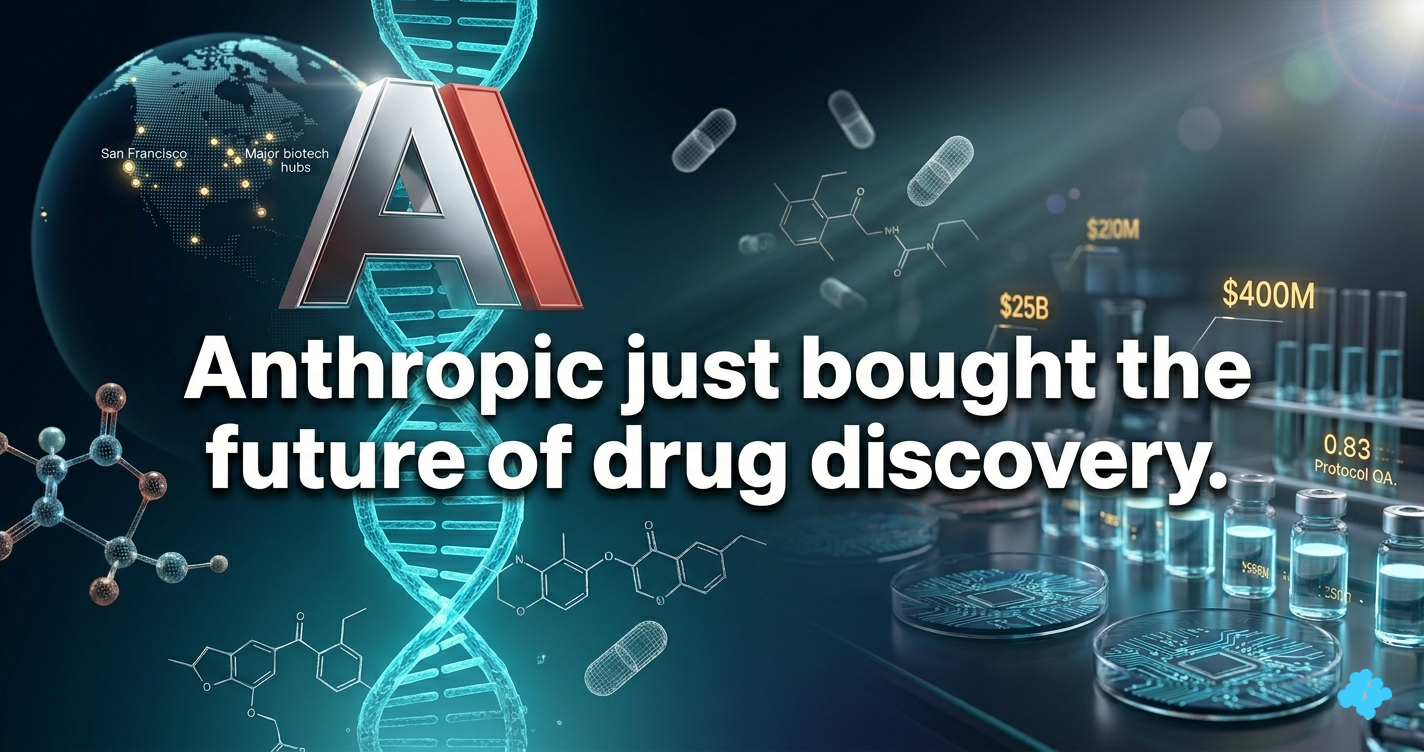
A $400 million all-stock deal for fewer than 10 people and a market projected to hit $25 billion. Here’s what Anthropic’s first major acquisition means for every pharma CTO, biotech founder, and life-sciences investor paying attention.
In This Analysis
What Actually Happened and Why the Timeline Matters
On April 2, 2026, The Information broke the story: Anthropic had acquired Coefficient Bio, a stealth AI biotech startup, in an all-stock transaction worth approximately $400 million. The team, fewer than 10 people, will join Anthropic’s healthcare and life-sciences group to build AI agents for drug discovery, clinical trial planning, and regulatory workflows.
Here’s what the straight news coverage missed: the timing isn’t incidental. Coefficient Bio was founded roughly eight months before the deal closed, a company that barely had time to name its product, let alone ship it to customers. The acquisition came just weeks after Anthropic’s February 2026 Series G closed at a reported ~$380 billion valuation. Put those two facts together: Anthropic is sitting on capital, and it wants to move fast.
Coefficient Bio’s founders aren’t random bio-AI optimists. Nathan C. Frey, the co-founder and CTO, led biological foundation-model work, lab-in-the-loop systems, and NVIDIA BioNeMo collaborations at Genentech’s Prescient Design lab. He took home an ICLR 2024 Outstanding Paper Award for generative modelling applied to drug discovery. This isn’t an acqui-hire of generalists, it’s a targeted grab for one of the tightest niches in applied AI.
“A tiny, high-caliber team with deep expertise from one of the top pharma AI groups got snapped up quickly to supercharge Anthropic’s push into using frontier AI for real biology and science, not just chat or code, but designing molecules, running virtual/physical experiments, and closing the discovery loop faster than traditional methods allow.”
Michael Hochstat, AI practitioner at xAI, LinkedIn commentary, April 2, 2026The deal also represents Anthropic’s first major acquisition. That context is easy to gloss over. Anthropic has, until now, competed on raw model quality and partnership depth. Acquiring a bio-AI team is a different kind of signal, it says the company believes the fastest path to owning regulated science workflows isn’t building domain expertise from scratch inside a general-purpose lab. It’s buying teams who already know where the bodies are buried in a deeply complex, high-stakes field.
What Coefficient Bio Actually Built
Most news coverage described Coefficient as “a stealth AI biotech startup” and moved on. But the platform details matter enormously, because they tell you exactly where Anthropic is pointing Claude’s capabilities next.
According to The Next Web’s reporting, Coefficient built a platform that lets AI models draft drug R&D plans, manage clinical regulatory strategies, and identify new drug candidates across the discovery pipeline. It integrates directly with tools already embedded in biotech workflows: Benchling (the electronic lab notebook standard), PubMed, and 10x Genomics data platforms.
The company described its technical ambitions as “AI foundation models, generative modeling, and autonomous lab-in-the-loop systems specifically for biological research and drug discovery.” That phrase, lab-in-the-loop, deserves unpacking. It means AI doesn’t just analyze data; it actively designs experiments, interprets results, and proposes the next experiment in a tight feedback cycle. Think less “ChatGPT for scientists” and more “robotic research colleague that runs its own follow-up studies.”
Coefficient’s stack sits on top of Claude as the reasoning core. Domain-specific agents orchestrate workflows, protocol drafting, trial planning, regulatory submissions, while MCP connectors route data from Benchling, PubMed, Snowflake, EHRs, and genomics platforms. The result: end-to-end R&D workflow automation, not point-solution chatbots.
Dimension Capital, one of the most sophisticated deep-tech investors in the market, owned approximately half the company. That’s not a detail, it’s a validation signal from people who do this for a living and who had full visibility into what Coefficient was building.
When that team folds into Anthropic’s Claude for Life Sciences stack, which already scores 0.83 on the Protocol QA benchmark, beating the human baseline of 0.79, you get something genuinely new: a frontier language model with deep scientific reasoning and a purpose-built execution layer for the actual workflows that get drugs through to patients.
Why Pay $400M for Fewer Than 10 People?
The obvious skeptic’s response: this is an acqui-hire dressed up as strategy. Ten people, eight months old, no public product. Four hundred million dollars.
It’s the right skepticism to voice. And it’s also, on closer examination, incomplete.
First, the math. Relative to Anthropic’s ~$380 billion post-Series G valuation, this deal represents approximately 0.1% dilution. For a company of Anthropic’s scale, $400M in stock isn’t a bet-the-company move. It’s a rounding error on the balance sheet, but a very targeted one.
Second, the alternative. To build equivalent domain expertise internally, Anthropic would need to recruit a team of computational biologists and drug-discovery AI researchers, wait years for institutional knowledge to develop, and navigate a talent market where Genentech-caliber computational biologists command extraordinary packages. The market for this specific expertise is tiny, and the best people don’t move for just compensation, they move for mission alignment and equity upside. Coefficient’s team had both reasons to join Anthropic.
“Gen AI addresses these pain points by increasing efficiency across the entire clinical-development process, unlocking economic value across three dimensions: up to 50% cost reductions, a 12-plus-month acceleration in trial timelines, and at least a 20% increase in NPV.”
McKinsey & Company, Generative AI in the Pharmaceutical Industry, January 2024Third, the market window. AI-drug discovery is at an inflection. The team that owns the incumbent relationships with pharma CTOs in 2026 will be very hard to dislodge by 2028. DeepMind has Isomorphic Labs. OpenAI is building partnerships. Vertical bio-AI startups are proliferating. Anthropic’s most natural advantage, Claude’s exceptional long-context scientific reasoning, needs a biotech-native execution layer to convert into enterprise contracts. That’s exactly what Coefficient provides.
The $400M isn’t a valuation of what Coefficient built. It’s a price for the speed, the relationships, and the domain credibility that would otherwise take Anthropic three to five years to develop organically.
The Market Anthropic Is Targeting: A $25B Window
Three independent research firms have sized the AI-in-drug-discovery market, and their conclusions vary, which itself is instructive.
| Source | 2025 Baseline | End Forecast | CAGR |
|---|---|---|---|
| Roots Analysis | $6.0B | $25.0B (2035) | 12.6% |
| Precedence Research | $6.93B | $17.81B (2035) | 9.9% |
| Research and Markets | $2.34B | $5.98B (2029) | 26.5% |
The range between estimates is wide, and that’s the honest answer. Early-stage markets are hard to size. But the direction is unambiguous: the market is large, growing fast, and currently dominated by fragmented point solutions.
The broader economic context from McKinsey’s research is even more striking. Their modeling puts generative AI’s potential annual value creation in pharma and medtech at $60 to $110 billion, not as a market cap number, but as actual value delivered through cost reduction, faster timelines, and higher success rates.
To put that in context: the entire AI-drug-discovery software market is smaller than the value McKinsey estimates the tools could create. That gap is where the real prize is. Anthropic isn’t just trying to sell software licenses, it’s trying to own a piece of the value that software creates in a $1.4 trillion global pharmaceutical industry.
Another McKinsey report from June 2025 estimates AI could double the pace of R&D and unlock up to $0.5 trillion annually across R&D-intensive sectors including pharma. That’s the ceiling Anthropic is ultimately reaching for, not the near-term software TAM.
The Competitive Landscape and Where Anthropic Now Fits
Let’s be direct: Anthropic is late to the bio-AI space, and it knows it.
DeepMind spun out Isomorphic Labs, a dedicated AI drug-discovery company, and has published foundational work on protein structure prediction that changed the field. OpenAI has been building life-sciences partnerships and has broader research relationships with top academic medical centers. A generation of vertical bio-AI startups, Recursion Pharmaceuticals, Insilico Medicine, Exscientia, built domain-specific models when general-purpose LLMs were still primitive tools for biology.
So what’s Anthropic’s angle?
The bet is that frontier general reasoning models, paired with domain-specific execution layers, will outcompete narrow vertical tools, not on molecular generation benchmarks, but on the workflow problem. Most of the time in drug development isn’t spent designing molecules. It’s spent writing protocols, drafting regulatory submissions, planning trial sites, interpreting results, and communicating with health authorities. Those tasks are where Claude already outperforms earlier models, and where Coefficient’s agents are designed to execute.
Protocol QA benchmark: Claude Sonnet 4.5 scores 0.83 vs. human baseline 0.79 and prior Sonnet 4’s 0.74. This is a task measuring AI understanding of lab protocols, exactly the kind of reasoning that matters in regulated workflows. Source: Anthropic, October 2025. Note: internal benchmarks should be independently validated before drawing strong conclusions.
Claude in Microsoft Foundry already positions Anthropic inside enterprise pharma IT stacks with HIPAA-aligned deployment, MCP-based connectors to clinical systems, and the compliance credibility that smaller vertical players struggle to establish. Coefficient’s team accelerates the depth of that positioning, from “good general-purpose model with a life-sciences wrapper” to “purpose-built R&D intelligence platform.”
Whether that’s enough to compete with DeepMind’s structural biology expertise or Recursion’s wet-lab data flywheel is still an open question. But Anthropic isn’t trying to win on every dimension. It’s trying to own the reasoning-and-workflow layer that sits above all those specialized systems.
What This Means for Your Organization, by Role
For policy makers and regulators, the integration of frontier models into core R&D and clinical workflows raises immediate questions about explainability, auditability, and acceptable use in regulatory submissions. The FDA and EMA are watching. Proactive guidance on AI-assisted trial design and regulatory interactions, developed now, before widespread deployment, will be far easier than retroactive frameworks imposed after something goes wrong.
The CTO Adoption Framework: 5 Steps Before You Deploy
Based on McKinsey’s clinical IT modernization research and the specific capabilities Anthropic is building with Coefficient, here’s a structured adoption path for pharma and biotech technology leaders:
-
1Map Your Workflow Portfolio (4 to 6 weeks)
Inventory every R&D and clinical workflow by document intensity and data-analysis complexity. Identify which ones touch regulated data and which have measurable time-cost baselines. Your shortlist should be 5 to 10 candidate workflows with current cycle times documented. Don’t skip this, pilots that skip workflow mapping fail to show ROI.
-
2Assess Data and Compliance Readiness (6 to 8 weeks)
Evaluate data standardization against CDISC and HL7 FHIR. Map which datasets can be exposed to Claude-class systems via secure connectors without PHI risk. Define your GxP audit-trail requirements before choosing architecture. Many pilots fail here, not because AI isn’t capable, but because the data pipeline isn’t ready.
-
3Choose Your Architecture (6 to 10 weeks)
Evaluate Claude for Life Sciences against vertical bio-AI vendors and in-house build options. Criteria: integration fit with your existing stack (Benchling, CTMS, safety databases), IP terms, compliance certifications, and deployment model. The best model doesn’t always win, the best-integrated system does.
-
4Run Defined-KPI Pilots (3 to 6 months)
Launch 2 to 3 pilots, protocol drafting and regulatory response generation are natural starting points, with clear before-and-after metrics: time to draft, revision count, reviewer satisfaction. Run true A/B comparisons against your legacy process. McKinsey’s cited 15 to 30% productivity gains from IT modernization are real, but your baseline matters.
-
5Scale with Governance (6 to 12 months)
Integrate AI agents into SOPs with human review checkpoints. Log all prompts and outputs for audit readiness. Establish an AI governance board, this isn’t bureaucracy, it’s the thing that keeps a drug development error from becoming a regulatory crisis. Update your change-management plan: the people dimension kills more AI programs than the technology does.
For a rough ROI estimate: use McKinsey’s upper-bound figures of up to 50% cost reduction in document-heavy processes and 20% NPV uplift as ceiling assumptions, then model your own portfolio’s specifics against conservative 20 to 30% efficiency scenarios. Most mid-size biotech organizations will see payback within 24 months in well-governed deployments.
The Contrarian Take: What Could Go Wrong
Anthropic’s Coefficient Bio acquisition is strategically coherent. It’s also a high-conviction bet in a field where hype regularly outruns outcomes. Here’s the honest risk register:
Poor data governance, inadequate IT infrastructure, and change-management failures are the graveyard of enterprise AI programs. McKinsey finds that organizations without R&D IT modernization can’t unlock the 15 to 30% productivity gains the tools promise.
Claude’s Protocol QA score of 0.83 is impressive, but real-world lab data is messier than benchmarks. Edge cases, ambiguous results, and institutional variation can erode trust fast if outputs aren’t validated carefully.
FDA and EMA are moving toward AI guidance, not away from it. Near-term friction is likely in specific submission contexts, but the direction is accommodation, not prohibition. Transparency and human oversight remain non-negotiable.
DeepMind, OpenAI, and well-funded vertical bio-AI companies won’t cede the market. Anthropic’s window to establish category leadership is real but not indefinite. Execution speed matters more than this deal alone.
The most important limitation to name directly: very few AI-designed drugs have completed late-stage clinical trials or reached approval as of early 2026. The pipeline is filling, dozens of AI-originated molecules are in Phase I and II, but the clinical validation loop is long, expensive, and unforgiving. AI can compress timelines at the front end; it can’t escape the biology at the back end.
The honest timeline: document-heavy workflows (protocol drafts, regulatory letters) will show productivity gains in 1 to 2 years. Deeper integration into experimental design and portfolio decision-making will take 3 to 5 years. Measurable shifts in clinical success rates and asset lifecycles won’t be visible for 5 to 10 years, contingent on adoption, validation, and regulatory adaptation at scale.
Anyone promising faster than that is selling you the hype, not the reality.
Frequently Asked Questions
Answers to the questions professionals are actually asking about the Anthropic Coefficient Bio acquisition.
The Bottom Line on the Anthropic Coefficient Bio Acquisition
Here’s what the market coverage missed: this isn’t a story about $400 million. It’s a story about where the frontier model race goes next. Anthropic and every serious lab watching now understands that general-purpose reasoning alone won’t capture the biggest enterprise value pools. Domain depth wins. Execution infrastructure wins. The team that can actually write the trial protocol, file the regulatory submission, and interpret the omics data, inside a governed, audit-ready workflow, wins the pharma customer.
The Coefficient acquisition gives Anthropic a credible answer to “but can your model actually do drug discovery?” in a way that no benchmark sheet could. It’s imperfect, early-stage, and genuinely uncertain in outcome. But so was every transformative bet in enterprise software before it became obvious in hindsight.
Watch three developments through 2026 and 2027: (1) which pharma enterprises announce Claude-powered R&D workflows in production, not pilots, production; (2) whether competing labs match with their own domain-specific acquisitions; and (3) whether FDA releases formal guidance on AI-assisted clinical submissions. Those three signals will tell you whether this deal was the first domino or just an expensive acqui-hire.
For now, if you’re building in life sciences, the conversation has changed. Frontier models are coming for your R&D stack, and unlike previous waves of “AI for drug discovery,” this time the team behind it knows what a Phase I protocol actually looks like.
Disclaimer: This article is produced for informational and analytical purposes only. NeuralWired does not provide financial, investment, legal, or medical advice. All market projections cited are sourced from third-party research firms and are subject to significant uncertainty. Deal details are based on secondary reporting from The Information and other publications; Anthropic has not publicly confirmed all figures. Readers should conduct independent due diligence before making any investment or business decisions. All hyperlinks open source material in a new tab for verification.