NeuralWired is an elite frontier technology publication decoding the signals that shape tomorrow, for technologists, investors, and executives who need more than headlines. You are reading a Future Tech deep-dive. Every claim is sourced. Every number is verified. No fluff. Visit neuralwired.com
Nvidia’s $4 Trillion AI Tax:
How Long Before the Hyperscalers Stop Paying?
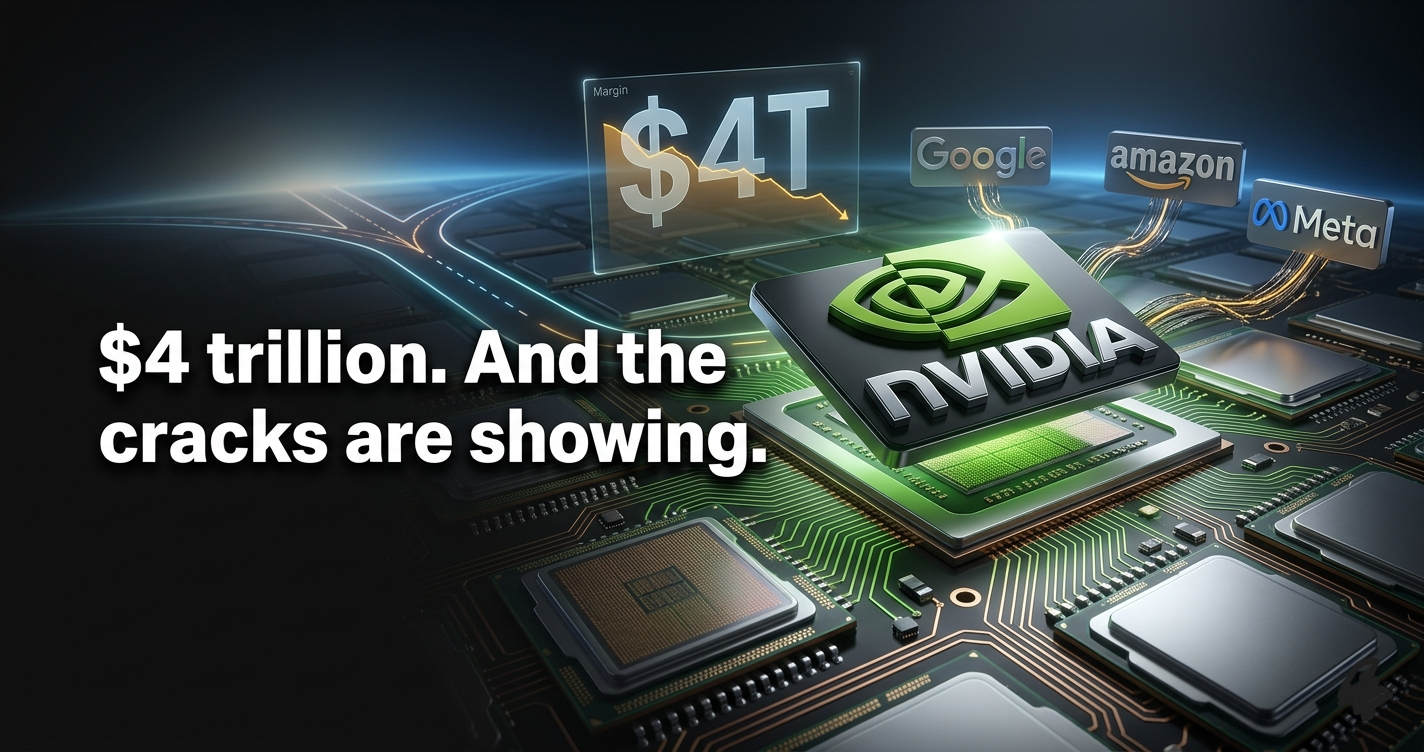
Nvidia controls roughly 85% of the AI accelerator market and just became the most valuable company on Earth. But its biggest customers are quietly building the exit ramp, and the margins are already starting to slide.
Nvidia became the world’s most valuable company not by making the flashiest product, but by owning the one thing every AI company on Earth desperately needs and cannot easily replace. Its AI accelerators power ChatGPT, Google Gemini, Meta’s Llama models, and virtually every frontier AI system running today. The AI accelerator market, which Nvidia controls at roughly 80 to 90 percent, has turned into the most profitable infrastructure position since Microsoft’s Windows dominated enterprise computing.
By early 2026, Nvidia stood alone in a $4 trillion club of its own making. Apple was below that line. Microsoft was below it. Alphabet, Amazon, Meta, all below. For a chip company founded in 1993 to make graphics cards for video games, this is a remarkable place to stand.
But the story doesn’t end there. Nvidia’s biggest customers, Microsoft, Google, Amazon, Meta, are each spending tens of billions of dollars trying to reduce their dependence on it. The margins are already sliding. The regulators are starting to watch. This analysis examines exactly how Nvidia built its dominance, what its real moat looks like, and how fast the hyperscalers can actually build the detour.
The $4 Trillion Tollbooth
Every major AI company, OpenAI, Google DeepMind, Anthropic, xAI, needs massive compute to train and run frontier models. For the past five years, there has been one credible source for that compute at the performance levels frontier AI demands. That’s Nvidia.
Its H100, H200, and Blackwell-series accelerators aren’t merely chips. They’re the atoms of the AI age. Every ChatGPT response, every AI-generated image, every real-time inference running at a hyperscaler almost certainly passed through Nvidia silicon. The hyperscalers have collectively spent hundreds of billions acquiring it.
Nvidia’s data-center revenue grew at rates no megacap company had previously achieved, roughly 69% year-over-year on a multibillion-dollar base. Investors rewarded that with a valuation that now dwarfs companies generating more total revenue. Apple makes more money. Microsoft has more enterprise penetration. Neither is worth more.
“Nvidia didn’t just win the AI hardware market. It became the tax that the entire intelligence economy pays, invisibly, on every inference, on every training run, on every model shipped.”
NeuralWired AnalysisThis is what makes the toll road framing accurate: every byte of AI flowing through the world’s data centers generates, somewhere in its journey, a payment to Nvidia. Unlike Apple, which faces Android, Nvidia has no credible volume alternative at scale. Unlike Microsoft, which competes in software markets with real substitutes, Nvidia sells the hardware layer beneath every competitor’s product. That’s platform-level leverage.
By early 2026, Nvidia stood alone above $4 trillion while Apple, Microsoft, and Alphabet had all slipped back below that mark. It has traded places with Apple and Microsoft repeatedly since 2024, but persistent AI-driven demand has kept it at or near the top.
CUDA: The Moat That Software Built
Nvidia’s 80 to 90 percent AI accelerator market share is extraordinary. But market share alone doesn’t explain its staying power. AMD makes competitive AI GPUs. Intel is investing aggressively. Hyperscalers are building their own chips. So why does Nvidia keep winning?
The answer is CUDA, and the 15 years of developer infrastructure built on top of it.
Launched in 2006, a decade before “AI” became a boardroom priority, CUDA is Nvidia’s parallel computing platform. It allowed researchers and developers to write software that runs on Nvidia GPUs without speaking fluent hardware. Over fifteen years, a vast network of libraries, tools, frameworks, and institutional knowledge accumulated around it. PyTorch runs on CUDA. TensorFlow runs on CUDA. Every major AI research lab has workflows optimized for it.
- 15+ years of accumulated developer tooling, libraries, and institutional knowledge
- Every major AI framework (PyTorch, TensorFlow, JAX) has first-class CUDA support baked in
- Enterprise AI teams have production codebases and pipelines built around Nvidia’s stack
- Competing platforms must match not just silicon performance, but an entire mature software network
- Migration cost in time, risk, and retraining deters switching even when alternatives are technically viable
This structural advantage makes Nvidia’s position resemble Microsoft’s Windows more than any chip company of the past. Competitors don’t just need better silicon. They need a migration path, a comparable library network, and enough market pull to convince developers to invest their time in a new platform. That takes years. Nvidia has used those years well.
The Revolt of the Cloud Giants
Here is the uncomfortable truth Nvidia’s investors must hold alongside the euphoria: the company’s biggest customers are also its most motivated adversaries.
Amazon, Google, Meta, and Microsoft are not passively buying Nvidia chips while accepting permanent dependence. Each is building its own AI silicon. Google’s TPUs have been in production for years and are now sold to external cloud customers. Amazon has Trainium for training and Inferentia for inference. Meta is developing custom training chips. Microsoft is investing in its own AI silicon as well.
The logic is simple. At the scale these companies operate, spending tens of billions annually on AI infrastructure, even a 10% reduction in Nvidia dependency is a multi-billion-dollar annual shift in economics. Every dollar spent on an internal chip that performs comparably is a dollar not paid to Nvidia.
“The hyperscalers are spending generously to build side roads. They’re not trying to destroy the toll road, not yet. They’re trying to make sure they don’t need it exclusively, forever.”
NeuralWired AnalysisAMD is pursuing the same goal from the outside, with its Instinct MI300 and MI350 series chips achieving genuine competitiveness on certain workloads. It’s targeting double-digit AI GPU market share through the late 2020s. The performance gap to Nvidia has narrowed. The software gap, its ROCm platform versus CUDA, remains significant but is closing.
What’s emerging is less a single competitor and more a slow-motion coalition: hyperscalers building custom silicon, AMD investing in CUDA alternatives, and open-source communities working on vendor-neutral AI software stacks. None of these individually threatens Nvidia’s near-term position. Together, over time, they represent the construction of real infrastructure around the toll road.
Where the Risks Are Real
Nvidia’s position is formidable. It is not invincible. Four risk vectors deserve serious attention from anyone evaluating the company at a $4 trillion valuation.
The margin story is the most immediate. In the crypto bust of 2018 and the gaming slowdown of 2022, Nvidia’s margins contracted meaningfully when demand softened. A similar dynamic in AI spending, even a temporary one, could compress earnings in ways a $4 trillion market cap cannot easily absorb.
The regulatory risk is longer-dated but structurally important. What happens when the chip supplier for all of global AI faces antitrust scrutiny similar to what the DOJ brought against Microsoft in the 1990s? Nvidia’s CUDA bundling, its pricing practices, its role as gatekeeper to AI compute, all of it becomes politically reviewable at this level of consequence.
Jensen’s Bet on Permanence
Jensen Huang’s response to competitive pressure is to move faster than competitors can follow, releasing new architectures (Hopper, Blackwell, Rubin) on cadences that force customers to keep buying even as they experiment with alternatives, and expanding Nvidia’s footprint from chips into full-stack AI infrastructure: networking, software, enterprise AI platforms, and robotics.
The thesis Huang is betting on: AI compute demand will expand faster than any alternative infrastructure can be built. If frontier models keep scaling, requiring more parameters, more training compute, more inference capacity, the total market grows even as Nvidia’s share faces pressure. Nvidia doesn’t need to win every dollar. It needs to remain irreplaceable for the highest-stakes workloads.
It’s a credible thesis. It’s also, at $4 trillion, a thesis the market has already priced in. The margin for error at this valuation is historically narrow. Any disappointment in growth, margins, or technology roadmap could trigger an outsized correction.
Frequently Asked Questions
How did Nvidia become the world’s most valuable company?
What is Nvidia’s market share in AI chips?
What is CUDA and why does it give Nvidia a competitive advantage?
Who are Nvidia’s biggest competitors in AI chips?
Why are Nvidia’s margins declining if it dominates the market?
How do export controls affect Nvidia’s business?
Could Nvidia face antitrust action?
What is the risk that AI spending slows and hurts Nvidia?
Can hyperscalers actually replace Nvidia with their own chips?
What is Nvidia’s next major chip architecture?
Verdict and What to Watch
Nvidia is the most important infrastructure company of the AI era and may remain so for the next several years. Its CUDA moat is real. Its execution has been exceptional. The demand for AI compute is not slowing. But the toll road is not eternal.
The hyperscalers are building detours, methodically, expensively, and with serious long-term intent. The margins are already sliding. The regulators are paying attention. The valuation reflects dominance, not growing pressure.
Investors who get this right are the ones who hold both truths simultaneously: durable structural advantage, and gathering competitive pressure. Right now the market prices mostly the first. The second is what’s worth watching.
- Hyperscaler capex disclosures: Watch what fraction of AI infrastructure spending Google, Amazon, and Meta attribute to third-party chips vs. custom silicon. A shift here signals the detour is working.
- AMD’s MI350 traction: If AMD wins a landmark hyperscaler contract at volume, not a pilot but at scale, it validates that the CUDA moat has a credible challenger on both hardware and software.
- Nvidia’s gross margin trajectory: If margins stabilize above 72% through 2026 despite competitive pressure, the moat is holding. If they continue declining, the pricing power story is weakening faster than bulls expect.
For the broader AI infrastructure landscape, this Nvidia story is a template: platform-layer dominance is enormously valuable, right up until the moment the platform’s customers decide the value transfer is no longer worth it. Microsoft learned this with Windows. Intel learned it with x86. Nvidia is the next chapter, and how long its toll road holds will define one of the most important competitive dynamics in technology over the next decade.
Follow NeuralWired’s Future Tech series for ongoing analysis of the power shifts reshaping the AI economy. Subscribe to The Neural Loop for weekly frontier intelligence.
Disclaimer: This article is for informational and editorial purposes only. Nothing published by NeuralWired constitutes financial, investment, or legal advice. All market data and statistics are sourced from third-party publications and are accurate as of publication date. Readers should conduct their own due diligence before making any investment decisions.
- Nvidia AI Accelerator Dominance | How Long Will It Last?
- SpaceX IPO 2026: $1.75T Valuation, 3 Business Lines, and the AI Bet Nobody’s Pricing Right

- Hybrid Quantum-Classical Computing | 5 Reasons It’s Already the Enterprise Standard in 2026