NeuralWired.com , Frontier intelligence for technologists, investors, and decision-makers. This Technology report covers NASA’s Artemis II lunar mission: the first crewed deep-space flight in 53 years, what the engineering data actually shows, and what comes next for the Moon economy.
Artemis II Returns: What 10 Days Around the Moon Actually Proved in 2026
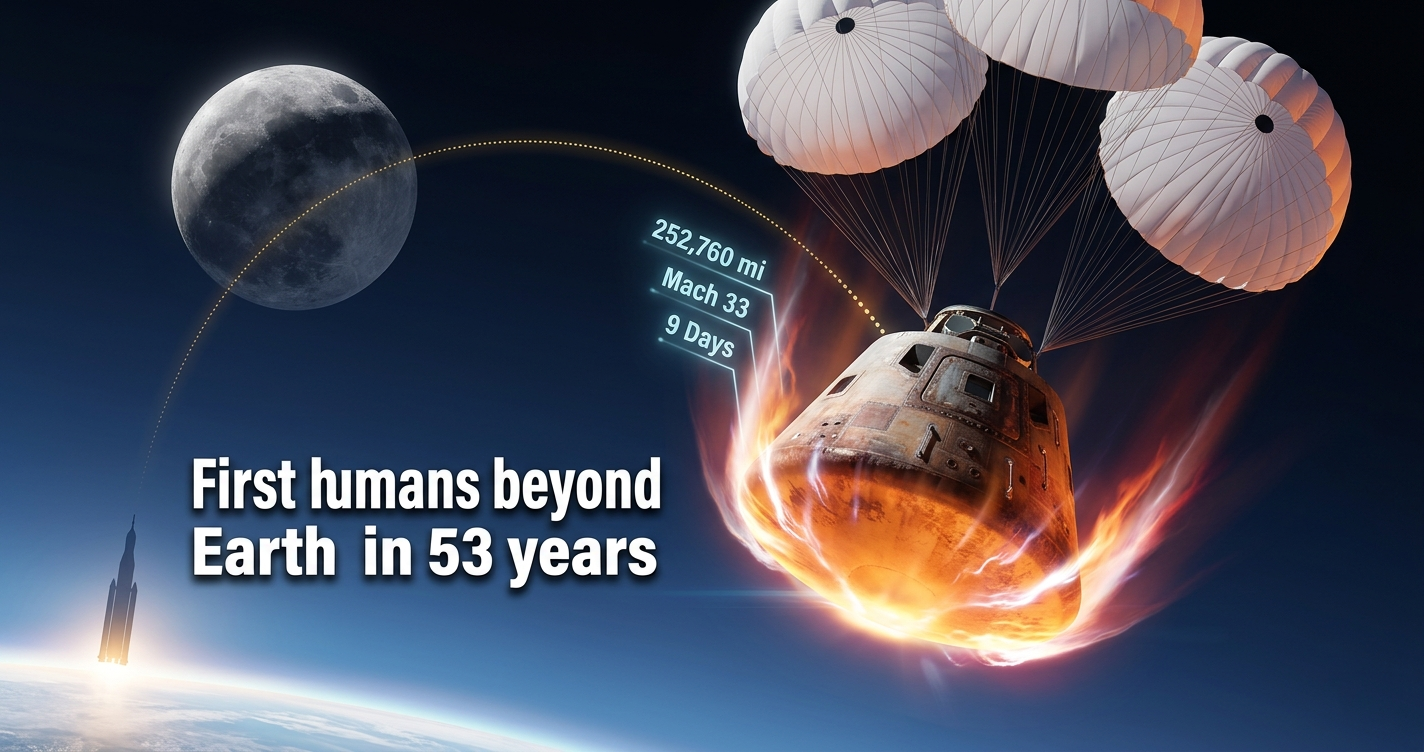
The capsule hit the Pacific at Mach 33. The heat shield held. The crew is fine. But the real story isn’t the splashdown. It’s the 9 days of data NASA just collected that will define human spaceflight for the next 30 years.
At 8:07 p.m. EDT on April 10, 2026, four astronauts splashed down in the Pacific Ocean off San Diego, ending a 9-day, 1-hour journey that took them farther from Earth than any human has traveled since December 1972. Artemis II isn’t just a headline. It’s the first crewed deep-space validation test in over half a century, and the data it produced will either greenlight or delay every crewed Moon landing planned through the 2030s.
This isn’t a mission recap. It’s an engineering post-mortem, a strategic read, and a candid look at what actually worked, what flagged anomalies, and what the glossy NASA press releases glossed over. For every technologist, investor, or decision-maker trying to gauge where the crewed lunar economy is headed, this is the analysis you need.
Why This Mission Is Different From Apollo
Apollo was about planting a flag. Artemis II is about certifying a system. That distinction matters enormously when you’re trying to interpret the results.
NASA’s explicit goal for Artemis II was to validate the Orion crew module and Space Launch System under real crewed conditions, not to land on the Moon, not to conduct science, but to stress-test hardware that will carry humans to the lunar surface on Artemis III. Think of it as a flight acceptance test at 252,760 miles altitude, with four people inside.
That framing changes how you read every piece of data from the mission. The heat shield erosion question, the toilet line ice obstruction, the helium pressurization anomaly, none of these would make headlines on a purely robotic mission. On a crewed test flight, they’re exactly the kind of fidelity NASA needed to collect.
The last time humans traveled beyond low-Earth orbit was December 7 to 19, 1972, aboard Apollo 17. That’s a 53-year gap. Artemis II carried Reid Wiseman, Victor Glover, Christina Koch, and Jeremy Hansen, the first woman and first non-U.S. astronaut to travel around the Moon.
The strategic subtext is geopolitical. China has publicly targeted its own crewed lunar landing around 2030. The Artemis Accords framework, signed by 40+ nations, depends on the U.S. demonstrating credible deep-space capability first. Artemis II either validates that position or quietly acknowledges it’s in jeopardy.
It validated it. Mostly.
The Flight: What Actually Happened, Day by Day
SLS lifted off from Kennedy Space Center on April 1, 2026. What followed was a precisely choreographed sequence of burns, attitude-control checks, and navigation exercises designed to stress every major subsystem.
The mission ran to 9 days, 1 hour, 31 minutes, and 35 seconds, within the planned window. The Orion capsule, nicknamed “Integrity,” performed without any mission-critical failures. That’s the headline. The details are more interesting.
The Heat Shield Problem Nobody’s Talking About
The single most consequential engineering question going into Artemis II wasn’t propulsion or navigation. It was the heat shield.
When Artemis I, the uncrewed 2022 test flight, returned from lunar orbit, NASA discovered more char erosion on the Orion heat shield than computational models had predicted. The agency spent two years investigating. The conclusion: the original skip-reentry profile, which was designed to reduce peak heating by bouncing off the upper atmosphere, was actually causing complex, hard-to-model heating patterns that drove unexpected ablator loss.
“NASA switched from the originally planned skip reentry to a steeper single-pass entry to reduce complex heating patterns after Artemis I erosion findings.”
Wikipedia / Artemis II Engineering RecordThat’s a significant design pivot. A steeper entry means less time at peak heating, but it also means higher peak deceleration forces on the crew, up to roughly 4g. For a 10-day deep-space mission where astronauts are already physiologically stressed, that’s a meaningful tradeoff.
The good news: post-flight inspections so far indicate the revised heat shield design performed as intended. External temperatures peaked around 2,700 to 2,800°C during the 6-minute blackout phase. The ablator did its job. That clears a critical gate for Artemis III.
The full post-flight inspection data won’t be public for weeks. But “performed as intended” from NASA’s own engineers is the signal investors and program managers should watch.
Engineering Data: What Passed, What Flagged
Artemis II was always going to produce anomalies. That’s the point of a test flight. The question is severity and repeatability. Here’s an honest accounting of what the mission data shows:
| System | Status | What Happened | Implication for Artemis III |
|---|---|---|---|
| Heat Shield | PASS | Revised steeper-entry profile; ablator performed as designed at ~2,800°C peak | Clears major certification gate; full inspection pending |
| Parachute System | PASS | All 11 chutes (drogues, pilots, mains) deployed in correct sequence; capsule under 20 mph at splashdown | Deployment software and redundancy logic validated |
| Deep-Space Navigation | PASS | Maintained precise attitude & trajectory at 252,760 miles; GPS-denied environment using star trackers + inertial sensors | Navigation architecture confirmed for lunar landing approach |
| Propulsion / Helium | MINOR ANOMALY | Helium issue in oxidizer tank pressurization system; contained, no mission safety impact | Requires root cause analysis before Artemis III |
| ECLSS / Life Support | MINOR ANOMALY | Wastewater vent line partially obstructed by ice; managed operationally; crew unaffected | Vent design revision likely; valuable condensation/icing telemetry captured |
| Recovery Systems | PASS | Uprighting airbags and flotation gear worked nominally; crew aboard USS John P. Murtha within hours | Informs rough-sea contingency architecture for future missions |
The two anomalies (helium and the toilet vent) are worth context. Both were managed in real time by the crew and flight controllers, which is actually what you want from a crewed test mission. You want to find these failure modes with a crew that can adapt, not on an automated lander touching down at the south pole with no one to improvise.
The propulsion helium issue warrants closer scrutiny before Artemis III. Helium is used to pressurize propellant tanks; if that system behaves unexpectedly on a 10-day flyby, the implications for a mission requiring precision lunar orbit insertion are different in kind, not just degree.
First Humans Beyond LEO in 53 Years: What the Data Shows
The hardware data is important. The human data may be more consequential for the long-term program.
Artemis II is the first mission in over five decades to expose a crew to the complete deep-space environment beyond low-Earth orbit: full galactic cosmic ray flux, solar particle event exposure, extended microgravity, and the psychological weight of being genuinely far from Earth. The ISS, for all its complexity, sits within the Van Allen belts, which provide partial radiation shielding. Orion doesn’t have that luxury.
NASA collected roughly 10 days of medical and physiological telemetry from all four crew members. That dataset, when it’s fully analyzed over the coming months, will be among the most valuable biomedical records in the history of crewed spaceflight. It directly informs crew health protocols, shielding requirements, mission duration limits, and countermeasures for Artemis III’s surface mission and eventual Mars planning.
Christina Koch became the first woman to travel beyond LEO in history. Jeremy Hansen became the first non-U.S. astronaut to travel around the Moon. Both firsts are diplomatically significant: they reinforce the Artemis Accords’ framing of lunar exploration as an international enterprise, not a U.S.-only endeavor, directly countering China’s narrative about its own program.
Crew debriefs will also feed back into Orion’s cockpit and habitability design. Sleeping arrangements, workload distribution, the manual attitude-control interface, the Earthrise viewing windows, all of this gets refined for Artemis III. That might sound like industrial design, but for a mission where crew error during lunar orbit insertion could be fatal, the human-factors data from Artemis II is as mission-critical as the heat shield telemetry.
What Comes Next: When to Believe It
NASA characterized Artemis II as a “textbook mission,” and by the metrics that matter for program continuation, that characterization holds. The heat shield worked. The parachutes worked. Four astronauts are alive and healthy. The program lives.
But the path to Artemis III, the first crewed lunar landing since Apollo 17, is still complicated. Several timelines are in tension:
SpaceX’s Human Landing System. The Starship HLS variant, selected by NASA to land crew on the Moon, is on its own development schedule. Artemis III requires Starship to complete at least one uncrewed lunar landing demonstration before astronauts board it. That demo hasn’t happened yet. Artemis III’s “late 2020s” target is real, but it’s gated by Starship progress as much as Orion’s certification.
Root cause analysis. The helium anomaly and the ECLSS vent issue both require investigation. NASA’s standard process runs 6 to 12 months for flight anomaly resolution. That doesn’t automatically delay Artemis III, but it adds dependencies to an already complex schedule.
Lunar Gateway. Artemis IV and V introduce the Lunar Gateway, a small space station in lunar orbit that will serve as a staging point for surface missions. Gateway components are under construction, but assembly in lunar orbit hasn’t started. The more complex missions depend on it.
“NASA leadership under Administrator Jared Isaacman has publicly argued for increasing the cadence of Artemis missions and streamlining program execution to make regular lunar flights a norm rather than an exception.”
Isaacman public statement, 2026The lunar economy framing matters here for investors. Analysts describe the sector as an emerging multi-trillion-dollar opportunity anchored on resource extraction (specifically polar water ice, which can be electrolyzed into rocket propellant), infrastructure, and advanced propulsion. That economic case depends entirely on mission cadence. One crewed landing per decade doesn’t build an economy. Six per decade might.
Artemis II confirms the hardware can do the mission. What it can’t confirm is whether the institutional and commercial systems surrounding it can sustain the cadence required to make lunar operations economically meaningful.
That’s the question Artemis III has to answer.
Frequently Asked Questions
What was the Artemis II mission?
Did Artemis II land on the Moon?
Who was on the Artemis II crew?
How fast did Artemis II reenter the atmosphere?
Why did NASA change the reentry profile from Artemis I?
What anomalies occurred during Artemis II?
How far did Artemis II travel from Earth?
When is Artemis III launching?
What does Artemis II mean for the lunar economy?
The Bigger Picture
Step back from the engineering details and a clearer pattern emerges. Artemis II proved that the 50-year knowledge gap in human deep-space operations is closeable. The heat shield works. Deep-space navigation works. Eleven parachutes deploy in sequence at Mach 33. Four people can survive 10 days beyond the protection of Earth’s magnetic field and come home healthy. That’s not trivial. That’s foundational.
But here’s the part that gets underplayed: the most important deliverables from Artemis II aren’t the press conference photos. They’re the anomaly reports, the heat shield inspection data, the radiation biotelemetry, and the crew habitability debriefs. These documents won’t be public for months but will quietly determine the design parameters of every crewed lunar vehicle built over the next two decades. The Artemis program’s value isn’t in the missions we see. It’s in the margins those missions define.
Watch for three developments through late 2026: the full heat shield inspection report (the most mission-critical data point for Artemis III greenlight), progress on SpaceX’s Starship uncrewed lunar demonstration (the real gating factor for a crewed landing), and whether NASA maintains or slips the program cadence that Administrator Isaacman has publicly committed to accelerating. The first humans back on the Moon are somewhere in that critical path.
Stay Ahead of Deep-Space Developments
NeuralWired tracks Artemis, commercial space, and the emerging lunar economy every week. Subscribe to The Neural Loop for frontier intelligence delivered to your inbox.
Subscribe to The Neural Loop →Sources & References
NASA: Artemis II Mission Overview · Wikipedia: Artemis II · Space.com: Live Mission Updates · Al Jazeera: Splashdown Coverage · ESA: Artemis II / European Service Module · KACU: Recovery Report · AInvest: Lunar Economy Analysis · Isaacman on Mission Cadence
Disclaimer: This article is based on publicly available information from NASA, ESA, and verified press sources as of April 11, 2026. Full engineering inspection data from the Artemis II mission remains under analysis and has not been officially released by NASA. Nothing in this article constitutes investment advice.