Semiconductors · AI Supply Chain
SK Hynix Crashes on Record Profit as CXMT’s $488B Debut Rattles Chips
NeuralWired.com · July 29, 2026
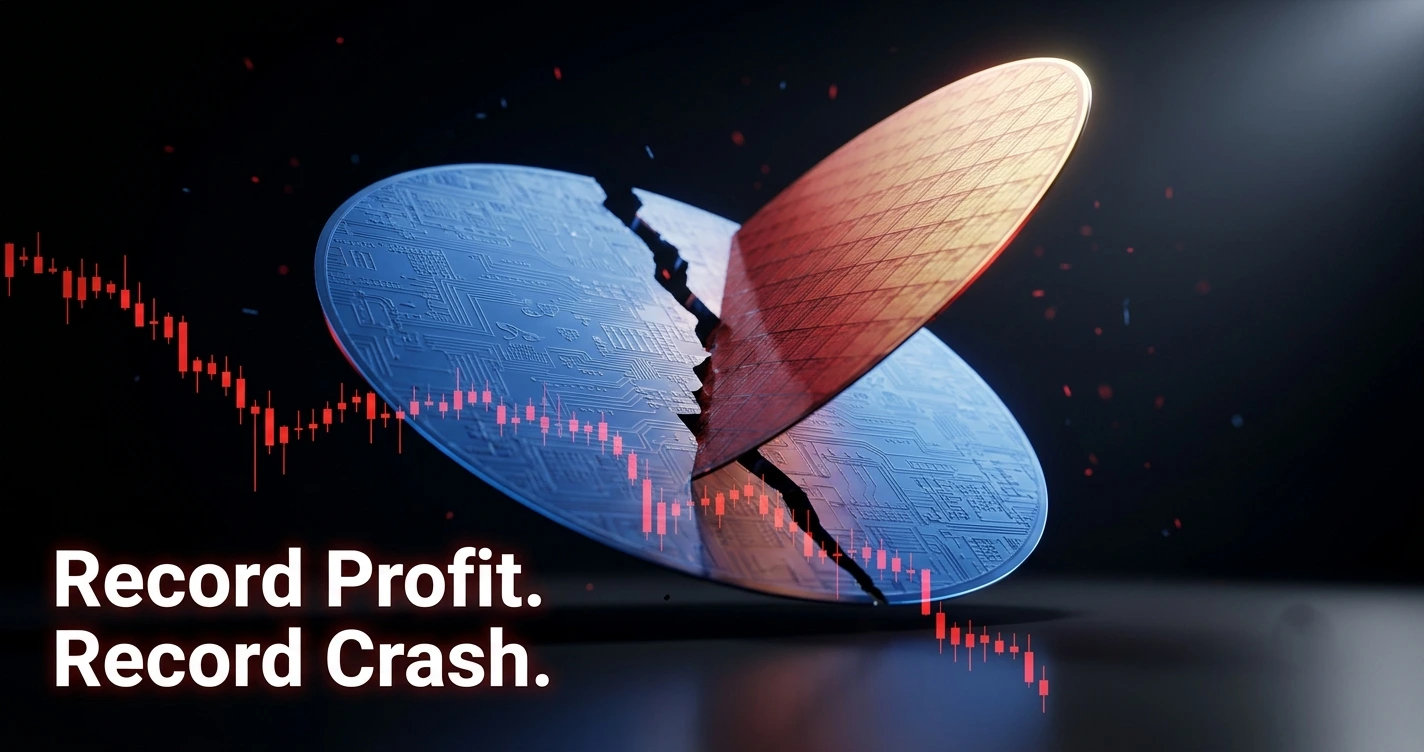
SK Hynix just posted the best quarter in its 43-year history and its stock still cratered. Revenue up 257% year over year. Operating profit up 557%. A 76% operating margin that most software companies would envy. None of it mattered, because a stock chart in Hefei, China, told investors a different story: the memory shortage everyone bet on might not last as long as they thought.
Two days earlier, a little-known Chinese DRAM maker called CXMT had gone public in Shanghai and closed its first trading day worth roughly $488 billion. By the time SK Hynix’s earnings call ended on Wednesday, the Korean company’s Nasdaq-listed shares had fallen to a fresh all-time low. If you buy, spec, or price hardware that depends on DRAM and NAND, that is, essentially, anyone building phones, laptops, servers, or AI infrastructure, this week rewrote your cost model. Here’s the full chain of events, what’s confirmed versus what’s still allegation, and why your next phone purchase is already more expensive because of it.
In this article
The 48 Hours That Rattled Chip Markets
Three separate stories collided in under two days, and most coverage is still treating them as unrelated. They aren’t.
On Monday, July 27, CXMT’s shares closed up 466% from its IPO price, making it China’s most valuable onshore-listed company, ahead of ICBC. The same week, a report from The Information said a Chinese state-backed firm had begun mass-producing domestic deep ultraviolet lithography machines, the exact category of chipmaking tool that Dutch firm ASML has been barred from selling into China. That’s arguably the more direct trigger for what happened next.
On Tuesday, July 28, South Korea’s KOSPI index fell 10.84% to close at 6,023.66, its steepest single session since a 12.06% drop back in March. Trading was halted twice, once by a sidecar mechanism and once by a full circuit breaker. Samsung Electronics lost roughly 13.5% of its value in a single day, its worst showing in nearly two decades. SK Hynix fell 14.7% in Seoul. Foreign investors pulled about $3.4 billion out of Korean equities that day alone.
Then on Wednesday, July 29, SK Hynix reported its results, and the numbers were genuinely record-setting. They still fell short of what analysts had priced in, and the stock kept falling.
The underreported thread
Most coverage treats CXMT’s IPO, the lithography report, and SK Hynix’s earnings miss as three separate news items. Read together, they’re one event: the market repricing how long the AI-driven memory shortage can realistically last, and how much of a moat South Korea’s chipmakers actually have left.
SK Hynix’s Paradox: Record Profit, Record Sell-Off
Here’s the number that should have sent the stock higher: SK Hynix posted ₩79.32 trillion in Q2 2026 revenue, roughly $54.6 billion, up 256.8% from a year earlier. Operating profit hit ₩60.54 trillion, about $41.6 billion, up 557.2% year over year, on a 76% operating margin. Both figures are all-time company records.
Both also missed brokerage consensus, which had penciled in around ₩84 trillion in revenue and ₩64 trillion in operating profit, according to Korea Times‘ coverage of the earnings call.
That gap is the entire story. SK Hynix’s ADR on Nasdaq fell as much as 8.76% to 9% after the release, touching a fresh all-time low near $130. Seoul-listed shares swung from a 3% opening gain to an intraday drop past 11% before settling lower. When a company beats its own history and the market still punishes it, the market isn’t reacting to the past quarter. It’s revising the next four.
SK Hynix CEO Kwak Noh-Jung has been publicly bullish on the supply picture, telling Reuters the industry faces its toughest supply-constrained stretch yet in 2027, with the crunch possibly persisting
“Until the next decade.”Kwak Noh-Jung, CEO, SK Hynix, via Bloomberg
Investors clearly aren’t taking that guidance at face value anymore, not with a Chinese competitor now capitalized at nearly half a trillion dollars and a domestic lithography workaround reportedly moving from lab to production line.
CXMT’s $488B Debut: Real Threat or Thin-Float Mirage
CXMT, formally ChangXin Memory Technologies, is based in Hefei and had been operating largely under the radar in the West before this week. Its IPO raised ¥57.92 billion (about $8.6 billion), the largest mainland Chinese semiconductor offering on record, easily surpassing SMIC’s $7.5 billion Shanghai listing back in 2020. Retail demand was extreme: 9.4 million individual orders totaling ¥7.07 trillion, a subscription rate 212 times the available allocation.
According to CXMT’s own IPO prospectus, the company held roughly 7.67% of the global DRAM market in 2025. That’s a meaningful number for a company most Western hardware buyers had never heard of a week ago, but it’s still a fraction of Samsung’s and SK Hynix’s combined share.
Not every analyst is convinced the valuation reflects reality. Jing Jie Yu, a semiconductor analyst at Morningstar, priced the IPO at roughly one times his firm’s 2027 book-value estimate, a steep discount to the 2.1 to 2.3 times multiple international peers command, and called the opening-day surge overdone. Yuan Yuwei, a fund manager at Trinity Synergy Investments, was blunter, telling Reuters the shares looked overpriced and speculative and that
“It’s hard to say the optimism is sustainable.”Yuan Yuwei, Fund Manager, Trinity Synergy Investments, via Reuters
There’s also a structural reason to discount the pop: only about 6.73% of CXMT’s total shares were actually available to trade at listing, per reporting picked up by Korea JoongAng Daily and other outlets. A thin float amplifies price swings in both directions. A 466% first-day gain on 93% locked-up shares tells you retail sentiment, not fair value.
One claim circulating this week deserves a flag rather than a repeat: an unnamed U.S. federal official reportedly told the New York Post there was suspicion of Communist Party involvement in the stock’s price action. That is an anonymous, single-source allegation, not a confirmed fact, and treating it as established would be irresponsible given how thin the sourcing actually is.
The Memory Tax: Why Your Next Phone Costs More
This is the part that actually reaches your wallet. Google confirmed to 9to5Google that Pixel 11 pricing will rise, and the company’s own VP of Devices and Services, Shakil Barkat, pointed directly at memory costs as the driver. Citing Morgan Stanley analyst Shawn Kim, Barkat noted that RAM pricing per gigabyte jumped from $2.80 in 2025 to $12 in 2026, a roughly sixfold increase in a single year.
Run that through an actual device and the number gets uncomfortable fast. Morgan Stanley’s analysis, cited via TechTimes, put the memory bill-of-materials cost for a 16GB RAM phone at roughly $45 in 2025. In 2026, that same component costs closer to $192. That’s not a rounding error in a spec sheet. That’s real money, and it’s landing on every device Google, and every other OEM, ships this year.
| Metric | 2025 | 2026 |
|---|---|---|
| DRAM cost per GB | $2.80 | $12.00 |
| 16GB memory BOM cost | ~$45 | ~$192 |
| Pixel base price (leaked) | $799 (Pixel 10) | ~$899 (Pixel 11) |
Leaked pricing, cross-confirmed across Android Authority and Android Police as of late July, puts the Pixel 11 base price around $899, up $100 from the Pixel 10. Google has also reportedly dropped the 128GB storage tier entirely, making 256GB the new floor, another quiet way of passing memory costs to the buyer. None of this is official yet. Google’s Made by Google event on August 12, 2026, is where the real numbers land, and it’s worth putting that date in your calendar if you’re planning device procurement around it.
Why is this happening? Because AI hyperscalers redirected a huge slice of global DRAM and NAND capacity toward High-Bandwidth Memory for GPU workloads starting in early 2026, and Q1 contract prices for standard DRAM jumped 90 to 95% quarter over quarter as a direct result. Consumer device makers are now bidding against AI data centers for the same wafers. Google isn’t the outlier here. It’s the first major OEM willing to say the quiet part out loud.
The Skeptics’ Case: Is This a Bubble, Not a Supercycle
Not everyone buys the “shortage until 2030” narrative, and it’s worth taking the skeptics seriously given how this industry has behaved before. William de Gale, a portfolio manager at BlueBox Asset Management, told CNBC earlier this year that the memory business has always run through
“Enormous ups and downs.”William de Gale, Portfolio Manager, BlueBox Asset Management, via CNBCHe’s not describing a one-off. The 2022 to 2023 downcycle saw Samsung post its steepest quarterly revenue decline in over a decade after a nearly identical AI-and-tech capex boom cooled off.
Morningstar’s Jing Jie Yu makes a related point about supply: fresh 2027 to 2028 capacity from SK Hynix, Samsung, and now CXMT is exactly the kind of capital buildout that historically ends shortages and craters pricing power. SK Hynix’s own Q3 guidance calls for roughly 10% quarter-over-quarter growth in DRAM bit shipments. If that materializes and commodity pricing (as opposed to premium HBM) softens even modestly, the entire “memory tax” narrative could look overstated by the time the Pixel 11 actually ships.
Our read: the shortage is real right now, but “real right now” and “structural until 2030” are two different claims, and only one of them is backed by shipped silicon rather than a CEO’s forecast. Han Ji-young, an analyst at Kiwoom Securities, offered a more measured take on the Korean sell-off specifically, telling Korea JoongAng Daily that valuations appear to have reached trough levels even as price and fund-flow volatility peak, a description that reads less like panic and more like a market still figuring out where the floor is.
FAQ
Why did SK Hynix stock fall despite record profit?
SK Hynix posted record Q2 2026 revenue (₩79.32 trillion) and operating profit (₩60.54 trillion, up 557% year over year), but both missed analyst consensus of roughly ₩84 trillion and ₩64 trillion. The stock fell because markets price forward guidance, and the miss signaled AI memory demand may be decelerating from peak expectations.
Is CXMT bigger than Samsung now?
No. CXMT’s roughly $488 billion market cap after its 466% Shanghai debut made it China’s most valuable onshore-listed stock, but it remains far smaller than Samsung Electronics overall and holds only about 7.67% of the global DRAM market versus Samsung’s dominant position.
Will the Pixel 11 be more expensive because of RAM prices?
Very likely. Google has confirmed Pixel 11 pricing will rise, citing Morgan Stanley data showing RAM costs jumped sixfold, from $2.80 to $12 per gigabyte, between 2025 and 2026. Leaked pricing points to a $100 increase, pushing the base Pixel 11 to roughly $899, with official figures confirmed August 12, 2026.
Is the AI chip memory boom a bubble?
Analysts are split. SK Hynix’s CEO expects shortages to persist beyond 2030, while skeptics like Morningstar’s Jing Jie Yu and BlueBox’s William de Gale point to new 2027-2028 capacity and memory’s historical boom-bust pattern as reasons the current supercycle could reverse faster than bulls expect.
Should I buy SK Hynix stock after the crash?
This isn’t financial advice. The facts: SK Hynix shares are down roughly 48% from their June 2026 peak despite record earnings, reflecting a re-rating of forward AI capital-spending expectations rather than a change in current business performance. Analysts remain split between shortage-driven bulls and overcapacity-driven bears.
What to Watch Next
Three dates and data points matter more than anything else in this story over the next two quarters:
- August 12, 2026: Google’s Made by Google event confirms actual Pixel 11 pricing, the first real test of whether the “memory tax” translates into consumer sticker shock or gets partly absorbed by Google’s margins.
- SK Hynix’s Q3 shipment data: If the promised 10% quarter-over-quarter DRAM bit shipment growth shows up and commodity pricing softens, the shortage narrative weakens fast.
- CXMT’s post-lockup float: With less than 7% of shares currently tradable, watch what happens to CXMT’s valuation as more shares unlock. Thin-float pops rarely survive contact with a full float.
What you now understand that you didn’t a week ago: the AI memory shortage isn’t one story, it’s three converging at once, a Chinese state-backed entrant undercutting on price, a lithography breakthrough narrowing China’s tech gap, and record HBM allocation squeezing everything else. Treating any one of those in isolation misses why a company can set an all-time earnings record and still lose a fifth of its market value in the same week.
Sources: SK Hynix Q2 2026 investor presentation; CNBC; Korea Times; Korea JoongAng Daily; SCMP; 9to5Google; Wolf Street. Fact-check note: Pixel 11 pricing remains leak-based pending Google’s official August 12 announcement. The Communist Party involvement claim regarding CXMT is a single anonymous-source allegation and is not independently confirmed.
Want the next chip-market shift before it hits the headlines?
Subscribe to The Neural Loop at neuralwired.com/newsletter