Engineers
CTOs
Investors
Roboticists
Policy
Founders
What Actually Happened on April 7
On Tuesday morning,
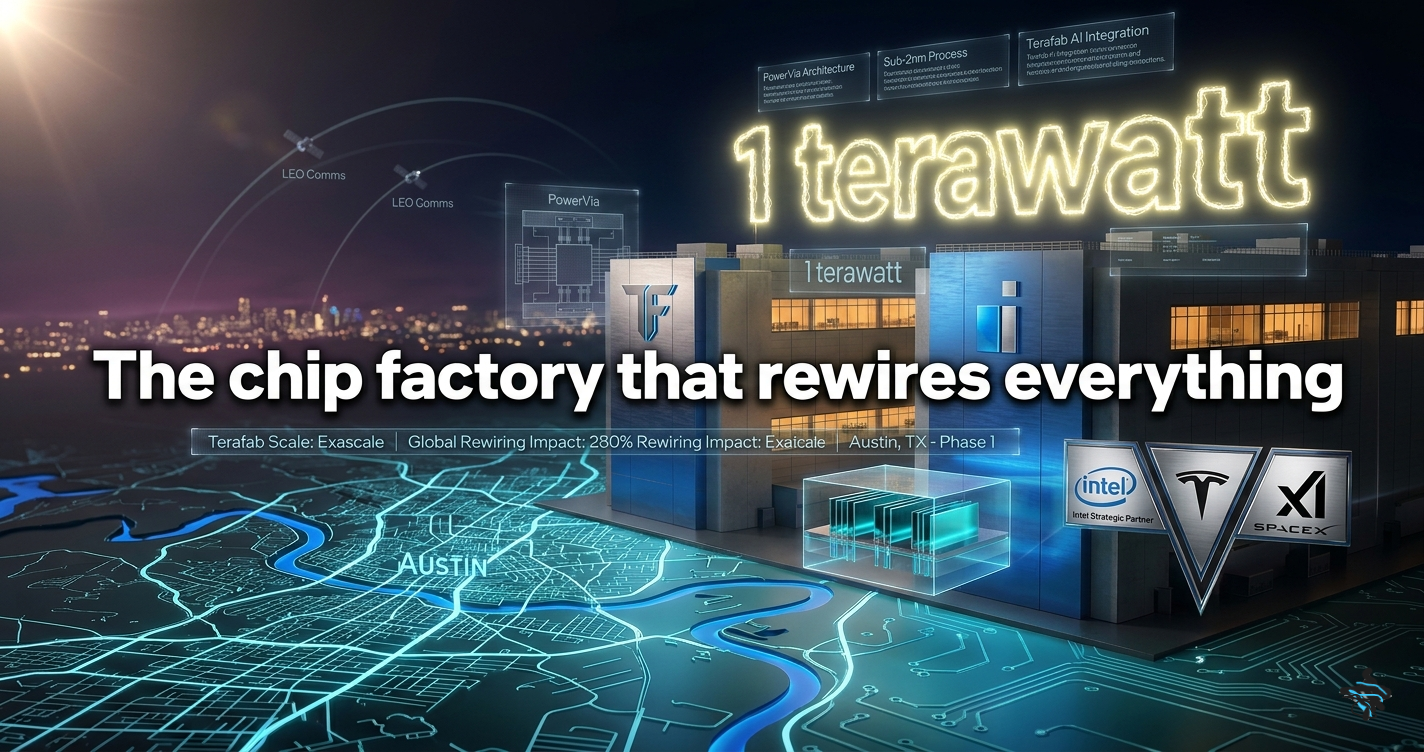
Reuters confirmed that Intel will join Elon Musk’s Terafab project alongside SpaceX, xAI, and Tesla, making the audacious chip-factory announcement from March 21 considerably more credible. Intel shares jumped nearly 3% intraday on the news.
This wasn’t a vague MOU. Intel CEO Lip-Bu Tan posted directly on X:
“Intel is proud to join the Terafab project with SpaceX, xAI, and Tesla to help refactor silicon fab technology.” The statement committed Intel’s full stack — design, fabrication, and packaging, to Terafab’s central goal of producing 1 terawatt of AI compute per year.
That’s not a typo. One terawatt. Per year. From a single facility.
What does that actually mean? And should you restructure your AI infrastructure strategy around it? Those are the questions this analysis answers, with numbers, not hype.
What Is Terafab and Why Did Musk Build It?
Terafab was
formally launched on March 21, 2026 , via livestream from Austin. It’s a planned vertically integrated semiconductor complex that would house chip design, lithography, fabrication, memory production, advanced packaging, and testing under one roof, essentially a TSMC-killer with Musk’s name on the deed.
The facility is anchored in Austin, Texas, near Tesla’s Gigafactory, with two distinct production lines: one for chips powering cars and humanoid robots, another aimed at
AI data centers in space . Yes — orbital compute infrastructure is part of the roadmap.
“We either build the TeraFab, or we don’t have the chips, and we need the chips, so we build the TeraFab.”
Elon Musk, Terafab launch livestream, March 21, 2026
That quote isn’t theater. Musk has claimed — via
Tom’s Hardware’s recap of the launch , that today’s entire global AI compute output of roughly 20 gigawatts per year represents only about 2% of what Tesla, SpaceX, and xAI will eventually need. If you take that math at face value, his companies would require around 1,000 GW/year of compute. The external chip supply chain simply cannot deliver that on anyone’s timeline.
Whether or not that demand projection proves accurate, the underlying strategic logic is sound: if you need a commodity at a scale the market won’t provide in time, you build the factory.
The project carries an estimated price tag of
US$20–25 billion — significant, but comparable to a single TSMC gigafab and within reach for a coalition of companies with Musk’s combined balance sheet.
Intel’s 18A: The Technology That Makes This Plausible
Before Intel’s announcement, Terafab was an interesting bet. After it, the project has a credible process technology backbone.
Intel’s
18A node , featuring RibbonFET gate-all-around transistors and the industry’s first PowerVia backside power delivery, is the most significant process advancement Intel has shipped in a decade. The published specs show 15% better performance per watt and 30% higher chip density compared to Intel’s previous generation node (Intel 3).
PowerVia deserves specific attention for AI applications. Modern AI accelerators run at sustained high current draws, where conventional front-side power delivery causes IR drop and limits clock speeds.
Intel’s own benchmarks show PowerVia improves cell utilization by 5–10% and delivers up to 4% iso-power performance improvement, small numbers in isolation, but meaningful when you’re running hundreds of thousands of chips at sustained load.
18A vs TSMC N2: How Do They Stack Up?
Independent analysis from
Introl’s CES 2026 chip breakdown positions Intel 18A’s transistor density as roughly equivalent to TSMC’s N2 process, expected in late 2026 — with approximately 2.5× the density of Intel 7. This would mark Intel’s first process-node parity or leadership since 2016.
And there’s a roadmap beyond 18A.
SemiWiki’s analysis of the 18A(P) variant (published April 4, 2026) projects an additional 10–15% performance improvement and approximately 10% better energy efficiency compared to base 18A. If Terafab eventually adopts 18A(P) for its high-performance AI chips, the efficiency delta over current-generation Nvidia/TSMC silicon could be substantial.
The North America Angle
Beyond raw performance, 18A carries geopolitical weight. It’s positioned as the
earliest sub-2nm advanced node manufactured in North America , reducing dependency on TSMC in Taiwan and Samsung in South Korea. For any organization, corporate or government, that views AI chip supply concentration as a strategic risk, this matters considerably.
High-volume manufacturing for 18A was targeted for late 2025 / early 2026. That ramp is underway. Intel’s involvement in Terafab isn’t just a partnership announcement, it’s a commitment to deploy its most advanced process at unprecedented scale.
Translating 1 TW/Year Into Something Real
The headline number, 1 terawatt of AI compute per year, is nearly impossible to intuit without a reference point. Here’s how to think about it.
A modern high-performance AI accelerator (think H100-class) draws roughly 400–700 watts under sustained training loads. At a conservative 500W average, 1 terawatt of continuous installed compute power translates to roughly 2 billion watts, equivalent to around 4 million H100-class GPUs running simultaneously. That’s across installed base, not annual production; annual chip output to support that compute density would be a fraction of that number, but the scale remains staggering.
For context:
current U.S. AI compute sits at roughly 0.5 terawatts per year , according to Remio.ai’s detailed breakdown. Terafab’s target would double the entire country’s current AI compute production from a single facility. Musk himself has framed today’s entire global figure at just 20 GW/year, though that estimate is his own and unverified by independent bodies.
⚠ The “50× TSMC/Samsung” Claim Needs Scrutiny
Remio.ai’s analysis characterizes Terafab’s ambition as “50 times the AI chip volume from TSMC and Samsung combined.” Treat this as rhetorical framing, not a verified figure. TSMC’s AI chip production is expanding rapidly, and the comparison depends heavily on which products count as “AI chips.” The number communicates magnitude; it isn’t a bankable projection.
What’s the Terafab capacity trajectory for humanoid robots, specifically? Musk has indicated that 100–200 GW/year of Terafab’s output is earmarked for terrestrial applications, cars and humanoids, with the remainder allocated to space-based AI data centers. That terrestrial slice, if achieved, could significantly reduce the compute cost embedded in each robot’s bill of materials.
Electrek, typically skeptical of Musk’s manufacturing claims,
called Terafab “the largest semiconductor fab ever built, by an absurd margin.” That assessment is probably accurate, which is precisely why the execution risks are non-trivial.
Strategic Implications by Audience
For CTOs and Infrastructure Leaders
Terafab + Intel 18A represents a potential third procurement path for advanced AI silicon, beyond Nvidia/AMD chips made at TSMC or Samsung. You shouldn’t restructure your 2026 roadmap around it, the ramp timeline makes that premature, but you should start mapping it into your 2028–2030 scenarios. If your AI infrastructure strategy has more than 60% concentration in one vendor (Nvidia/TSMC), the existence of a credible domestic alternative changes your negotiating posture today, even if the silicon doesn’t ship to external customers for years.
For Robotics Founders and Product Leaders
The compute-cost trajectory for humanoid robots is about to get interesting. If Terafab delivers even a fraction of its stated scale using 18A-class chips, the AI processing component of a robot’s bill of materials could drop materially over the next 3–5 years.
One fab is explicitly dedicated to cars and humanoids , which means supply prioritization, not just process efficiency. If compute is more than 20% of your robot’s BOM, start modeling scenarios where that cost halves by 2029.
For Institutional Investors
Intel’s ~3% intraday jump signals that markets read the Intel-Terafab link as positive for the foundry narrative — not transformative, but directionally meaningful. Longer-term, the question is whether Terafab creates a durable competitive moat for Musk’s companies (insulating them from GPU scarcity) or whether the fab primarily serves as a signaling mechanism to extract better terms from Nvidia and cloud providers. Both outcomes are plausible; the answer determines whether external fab customers ever see competitive pricing.
For Policy and Regulatory Professionals
A U.S.-located advanced AI fab tied to Intel could reduce foreign semiconductor dependency, a clear win for domestic industrial policy. But it also concentrates cutting-edge AI compute manufacturing within a small cluster of companies, most of them inside Musk’s orbit. That raises legitimate questions around
export controls, antitrust posture, and space-based compute regulation that don’t yet have clear answers in existing law.
The Honest Risk Assessment
Electrek’s framing,
“Battery Day on steroids, and even less realistic” , isn’t dismissible. Tesla’s track record on aggressive manufacturing timelines is uneven. Full Self-Driving dates slipped repeatedly. Battery Day projections took years longer than promised. Terafab is orders of magnitude more complex than either.
Execution Risk
High
Building and ramping the largest integrated fab ever attempted, on a bleeding-edge node, in a compressed timeline. First-of-kind mega-projects routinely run 2–3× over budget and schedule.
Process Node Risk
Medium
Intel’s 18A must hit yield and performance targets in real AI chips. Projected metrics from vendor docs and analysts aren’t the same as measured silicon at volume.
Demand Mismatch
Medium
If Musk’s projections of needing 50× current global compute prove optimistic, utilization risks and stranded capex become serious problems, especially at $25B in upfront investment.
Regulatory / Geopolitical
Medium
Space-based AI data centers raise novel questions around spectrum, data jurisdiction, and military application that regulators will scrutinize. Export control regimes could complicate customer access.
There’s also an organizational risk that rarely gets enough attention: Intel, Tesla, SpaceX, and xAI have genuinely different engineering cultures, risk tolerances, and internal bureaucracies. The history of ambitious cross-company manufacturing ventures is littered with coordination failures. Lip-Bu Tan’s Intel and Musk’s companies have never attempted anything remotely close to this level of integration.
Realistic Timeline to External Access
The most important question for anyone outside the Musk ecosystem: when do external customers actually get access to Terafab chips?
Late 2025 / Early 2026
Intel 18A High-Volume Manufacturing Ramp
18A enters production. This is the foundation Terafab’s process technology is built on.
April 2026 (Now)
Intel Formally Joins Terafab
Partnership confirmed. Design, fabrication, and packaging commitments are made. Austin prototype fabs begin configuration.
2027–2028 (Optimistic)
Initial Terafab Output — Internal Only
Early capacity almost certainly serves Tesla, SpaceX, and xAI first. External customers are unlikely to see meaningful allocation during this phase.
Late 2020s (Conservative)
External Customer Access at Scale
If the fab ramps successfully and demand from internal customers is partially met, third-party access becomes realistic, on a timeline of years, not months.
If you’re planning AI infrastructure for 2026 or 2027, Terafab should not appear on your critical path. If you’re building a five-year compute strategy, it absolutely should appear as a scenario variable, potentially a significant one.
Key Takeaways
Intel’s 18A partnership gives Terafab a credible process foundation, RibbonFET + PowerVia is competitive with TSMC N2.
1 TW/year is genuinely extraordinary scale: roughly 50× current U.S. AI chip output, if projections hold.
Near-term (2026–2027) chip access will flow primarily to Tesla, SpaceX, and xAI — not external customers.
Execution risk is high. This is the most ambitious fab project ever attempted, with no proven precedent at this scale.
For CTOs: use this announcement as a negotiating lever with existing vendors. Don’t restructure procurement around it yet.
For investors: Intel’s stock reaction reflects narrative momentum, long-term value depends entirely on execution.
Frequently Asked Questions
What is Elon Musk’s Terafab AI chip project?
+
Terafab is a planned semiconductor megafactory jointly developed by Tesla, SpaceX, and xAI that aims to produce more than one terawatt of AI compute per year by vertically integrating chip design, fabrication, memory production, advanced packaging, and testing in Austin, Texas. It was formally announced on March 21, 2026, with an estimated cost of
US$20–25 billion .
Why is Intel joining Musk’s Terafab project?
+
Intel is contributing its 18A advanced process node, chip design capabilities, and packaging technology. CEO Lip-Bu Tan
framed the partnership as an opportunity to “refactor silicon fab technology” at unprecedented scale, aligning Intel’s foundry push with a massive guaranteed demand source.
How much compute will Terafab produce each year?
+
What is Intel’s 18A process node and why does it matter for AI chips?
+
Will Terafab affect the cost of humanoid robots?
+
How does Terafab compare to Nvidia and TSMC?
+
Currently, nearly all advanced AI accelerators run on Nvidia chips manufactured at TSMC. Terafab would create a parallel supply chain, U.S.-based, Intel-processed, primarily serving Musk’s companies. It’s a competitive alternative to, not a replacement for, the Nvidia-TSMC stack.
External customers won’t have meaningful access for years .
Where will Terafab be located?
+
Initial operations are in Austin, Texas, adjacent to Tesla’s Giga Texas campus. The facility will house two advanced chip factories: one for terrestrial AI applications (cars and humanoids) and another for chips destined for
space-based AI data centers . A full-scale location for broader expansion hasn’t been finalized.
When can external customers actually access Terafab chips?
+
What are the biggest risks of the Intel Terafab partnership?
+
Four main categories: construction and yield execution on a historically unprecedented scale; Intel 18A performance in real-world AI chips vs. vendor projections; demand overestimation by Musk creating utilization risk on $25B of capex; and regulatory scrutiny around space-based compute and AI chip export controls.
Electrek’s “Battery Day on steroids” comparison is pointed and worth taking seriously.
How should CTOs adjust AI strategy after this announcement?
+
Use Terafab’s existence as a negotiating lever with Nvidia and cloud providers now. Model it as a scenario variable in 2028–2030 infrastructure planning. Don’t restructure near-term procurement around it. Maintain strong relationships with existing vendors, and avoid any critical-path dependency until Terafab shows commercial silicon at scale.
Diversification is the right posture , not substitution.
The Bottom Line
The Intel Terafab partnership does something no amount of Musk enthusiasm could do alone: it gives the project a credible semiconductor technology backbone. Intel’s 18A, with its RibbonFET architecture and PowerVia backside power, is genuinely competitive with TSMC’s best upcoming nodes. That’s not marketing. That’s measured silicon.
But credible technology and operational delivery at 1 TW/year scale are two entirely different things. The history of first-of-kind mega-projects — in semiconductors, in rockets, in gigafactories, is a history of schedules that slipped and costs that climbed. Terafab is the most ambitious fab project ever attempted. The ambition itself is a risk factor.
The right response to this announcement isn’t euphoria or dismissal. It’s strategic patience: acknowledge the shift in the long-range compute landscape, use it to strengthen your negotiating position with current vendors, and build contingency plans that don’t require Terafab to work on any specific timeline.
Watch for three signals in 2026–2027 that will clarify how seriously to take the 1 TW/year target: (1) whether Intel 18A achieves published yield targets in production AI chips, (2) whether Terafab groundbreaking and fab construction stay on announced timelines, and (3) whether any external customers announce formal supply agreements. Each signal will tell you something real about whether this is a permanent shift in the compute landscape, or the most expensive negotiating tactic in semiconductor history.
Either way, the
Intel Musk Terafab AI chip project announcement of April 7, 2026, will be on the list of dates that mattered. The magnitude is still being written.
Disclaimer: This analysis is based on publicly available reporting and third-party analyst estimates as of April 7, 2026. Financial figures, technical specifications, and timeline projections are directional and may change materially. This article does not constitute financial or investment advice. NeuralWired has no commercial relationship with Intel, Tesla, SpaceX, xAI, or Terafab.