Litecoin’s MWEB Zero-Day Forced a 13-Block Reorg That Rewrote 3 Hours of History
A privacy layer exploit on April 25 let attackers drain $600,000 from cross-chain protocols before Litecoin Core developers did what proof-of-work blockchains rarely admit they can do: rewrite the chain.
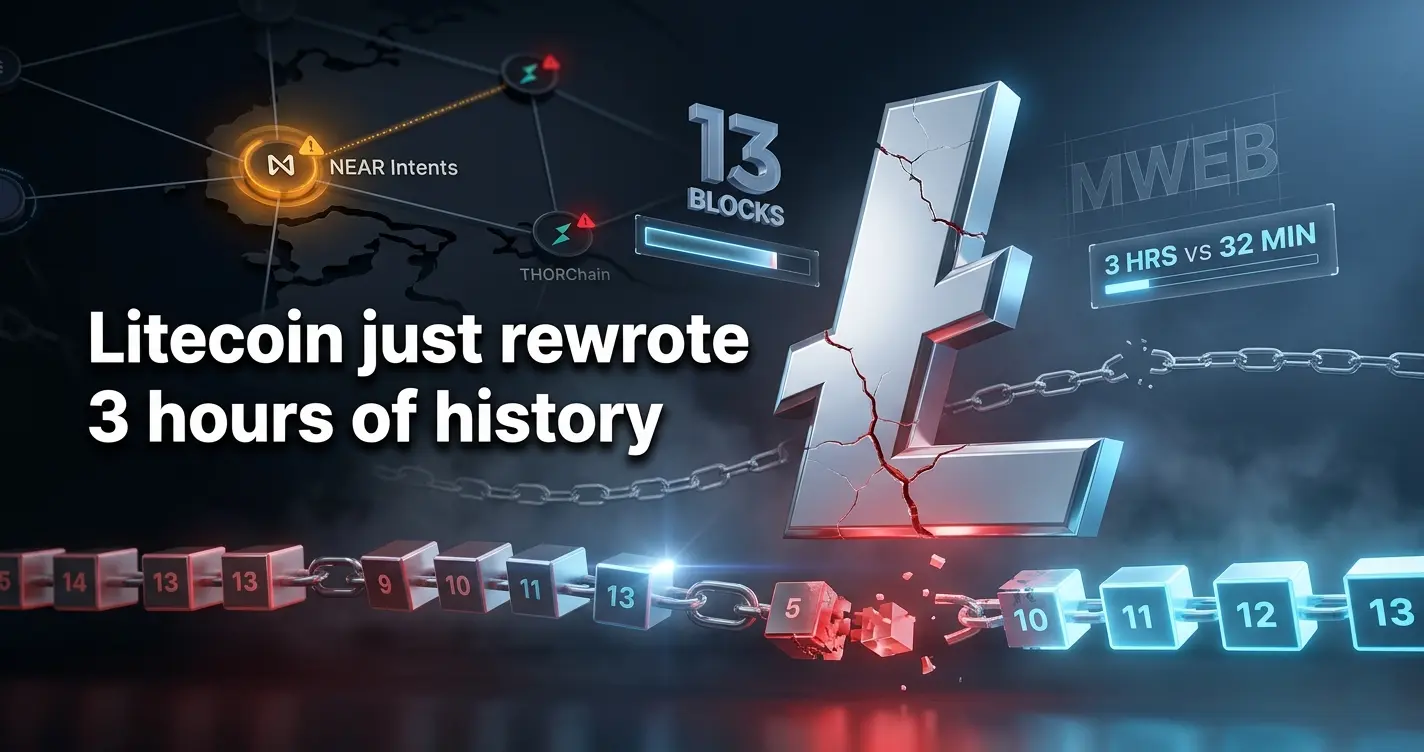
Litecoin just erased three hours of its own history. On April 25, 2026, the Litecoin Foundation confirmed a 13-block chain reorganization triggered by a zero-day vulnerability in its MimbleWimble Extension Block (MWEB) privacy layer. The reorg reversed blocks 3,095,930 through 3,095,943, a stretch that should have taken 32 minutes to produce but instead took more than three hours because a simultaneous denial-of-service attack had hammered major mining pools offline.
The incident is the first major exploit of MWEB since Litecoin activated the privacy upgrade in May 2022. It combined a consensus bug, a coordinated DoS campaign, and fraudulent cross-chain swaps into a single attack sequence that exposed roughly $600,000 in assets on NEAR Intents and caused smaller losses on THORChain. By the evening of April 25, Litecoin Core v0.21.5.4 was out with both fixes applied. The network was declared stable.
But the incident raises questions that a quick patch doesn’t fully answer: about the fragility of opt-in privacy layers, the coordination required to execute a controlled reorg on a live chain, and what it means for “finality” on a proof-of-work network when developers retain the practical ability to roll back history when circumstances demand it.
13Blocks reorganized on Litecoin chain
3 hrsChain history rewritten (normally 32 min)
$600KNEAR Intents exposure from double-spends
~1%LTC price drop after disclosure
What Actually Happened, in Order
The attack began somewhere between midnight and 3:00 AM UTC on April 25. Attackers launched a denial-of-service campaign against major Litecoin mining pools while simultaneously broadcasting invalid MWEB peg-out transactions onto the network. Because a meaningful portion of nodes were running older Litecoin Core versions, those nodes lacked the patched validation logic. They accepted the fraudulent transactions as valid.
This created a chain split. Updated nodes rejected the invalid blocks. Outdated nodes kept building on top of them. The result was a fork in which the “invalid” chain grew for more than three hours, producing 13 blocks at roughly 13.5 minutes per block, about 5.4 times slower than Litecoin’s normal 2.5-minute target. The slowdown itself is a fingerprint of the DoS attack: reduced honest hash power meant fewer miners working on the honest chain, and the invalid chain benefited from the momentary advantage.
Around noon UTC, Aurora Labs CEO Alex Shevchenko flagged the situation publicly. He had spotted what he described as a coordinated attack and had begun tracking the double-spend transactions flowing to cross-chain protocols. At 4:22 PM Eastern (8:22 PM UTC), the Litecoin Foundation posted its official confirmation on X, acknowledging the zero-day bug, the DoS campaign, and the decision to execute a 13-block reorg. Approximately 8 minutes later, Litecoin Core v0.21.5.4 was published.
Official Statement
“All valid operations during this period remain unchanged. The bug has been fully fixed, and the network continues to operate normally.” — Litecoin Foundation, April 25, 2026
The Exploit Mechanics: How MWEB’s Privacy Layer Became an Attack Surface
MWEB is an opt-in privacy layer that uses MimbleWimble cryptography to hide transaction amounts and addresses. Users move LTC from the base chain into extension blocks via a “peg-in” process, transact privately, then exit back to the transparent base chain via “peg-out.” The privacy comes from confidential transactions: amounts are hidden behind cryptographic commitments that nodes verify without seeing the actual values.
The vulnerability lived in the peg-out validation logic. Specifically, a kernel fee overflow error allowed attackers to construct MWEB transactions where input and output commitments summed to zero in a way that appeared valid to unpatched nodes. In practice, this let attackers peg out LTC they hadn’t legitimately pegged in. Invalid coins materialized on the base chain.
The attack had three distinct phases:
| Phase | Attack Vector | Effect | Target |
|---|---|---|---|
| 1. Disruption | DoS against mining pools | Reduced honest hash power; slowed block production | Updated pool operators |
| 2. Injection | Invalid MWEB peg-out transactions | Fraudulent LTC created on base chain, accepted by unpatched nodes | Non-upgraded node operators |
| 3. Extraction | Cross-chain swaps on DEXes | Fraudulent LTC exchanged for ETH and other assets | NEAR Intents, THORChain |
The patch in v0.21.5.4 corrects the input/output accounting, prevents kernel fee overflow during MWEB validation, and instructs miners to exclude MWEB transactions when commitments sum to zero. It also erases block data for mutated blocks to prevent a related miner DoS vector.
Who Got Hit and How Much Was Lost
The clearest loss figure comes from Aurora Labs. Shevchenko publicly stated that NEAR Intents faced exposure of approximately $600,000, identified through on-chain double-spend tracking. His team spotted multiple fraudulent peg-out transactions flowing to cross-chain venues and warned trading platforms in real time.
“We see a lot of double spend transactions.” Alex Shevchenko, CEO, Aurora LabsTHORChain’s losses came in dramatically lower, reportedly around $500, though exact protocol loss disclosures were still being compiled as of April 26. An independent on-chain analyst using the handle Zacodil flagged the reorg earlier in the day, initially interpreting it as a 51% attack before the MWEB exploit vector was identified.LTC’s price reaction was notably subdued. The token traded between $56.33 and $56.36 after the incident went public, a drop of roughly 1%. Twenty-four-hour volume on KuCoin sat at $3.75 million, low by historical standards but consistent with muted market panic. The quick resolution, official communication, and same-day patch appears to have contained confidence erosion.The discrepancy between NEAR Intents’ $600,000 loss and THORChain’s $500 figure warrants attention. It likely reflects different levels of LTC liquidity depth, different MWEB deposit acceptance policies, and the speed at which each protocol’s monitoring systems flagged the anomalous transactions.The “Zero-Day” Dispute: What the GitHub Commits Actually Show
The Litecoin Foundation called this a zero-day exploit. That framing has been challenged by researchers examining the litecoin-project GitHub commit history.A zero-day, by definition, is a vulnerability that developers have zero days to respond to because it’s exploited before they’re aware of it. But the consensus vulnerability that enabled the invalid MWEB peg-out was privately patched between March 19 and March 26, 2026, four weeks before the April 25 attack. The code fix existed. What failed was the deployment: not enough node operators had upgraded in the intervening month.“This isn’t an isolated incident. There have been many of these rollback-and-double-spend attacks against Proof-of-Work-alone blockchains both years ago and recently, including recently against Monero and Grin.” Zooko Wilcox, Founder, Zcash FoundationThe DoS vulnerability was genuinely patched on the morning of April 25, the same day it was exploited. That one arguably qualifies as a true zero-day. But the consensus bug, the one that enabled the fraudulent peg-outs, had a patch sitting in the repository for a month. The Litecoin Foundation rolled both fixes into v0.21.5.4 and announced them together, which contributed to the unified “zero-day” narrative.This distinction matters for attribution and for lessons learned. If the consensus bug had been patched but not deployed, the real failure wasn’t in the vulnerability research pipeline. It was in the upgrade coordination pipeline.Key DistinctionThe consensus bug enabling fraudulent peg-outs had a private patch for four weeks before the attack. The DoS bug was patched the same morning it was used. Calling the entire incident a “zero-day” conflates two separate vulnerability timelines.Reorgs in Historical Context: When Blockchains Rewrite Their Own Rules
The 13-block Litecoin reorg is historically unusual but not unprecedented. In 2013, Bitcoin experienced a 26-block chain fork caused by a database compatibility bug between Bitcoin Core versions 0.7 and 0.8. Developers and miners coordinated to roll back to the older chain. The 2016 Ethereum DAO hard fork was a social consensus decision to override an irreversible theft of approximately $50 million, abandoning “code is law” when the financial stakes demanded it.
Event Year Blocks/Scope Trigger Outcome Bitcoin chain fork 2013 26 blocks Database version incompatibility Coordinated rollback; chain unified Ethereum DAO fork 2016 Hard fork (irreversible) $50M theft via smart contract exploit ETH/ETC chain split; funds returned Monero reorg attacks Recent Multiple PoW double-spend campaigns Ongoing mitigation efforts Grin attacks Recent Multiple MimbleWimble double-spend exploits Protocol patches deployed Litecoin MWEB reorg 2026 13 blocks MWEB peg-out consensus bug + DoS Reorg executed; patch deployed What makes the Litecoin case distinctive is the combination of an optional privacy layer creating divergent node states, and a simultaneous infrastructure attack that bought the attackers time. Zooko Wilcox’s comment about Monero and Grin is worth taking seriously: MimbleWimble-based chains appear to face a recurring pattern of rollback-and-double-spend attacks. Litecoin’s incident is not an outlier. It’s part of a documented category of exploits.The deeper uncomfortable truth: executing a reorg requires social consensus among miners and developers. That consensus exists. It can be mobilized. And that means proof-of-work “finality” is not the absolute guarantee that its proponents often claim.Broader Implications for Cross-Chain Protocols and Privacy Layers
For DeFi operators and cross-chain bridge integrators, April 25 delivered a clear message: LTC settlement confirmations need a rethink. Protocols that accepted MWEB peg-outs as final within the 13-block window got hit. Those with deeper confirmation requirements or real-time anomaly detection survived unscathed or with minimal losses.The incident also exposes a structural tension in opt-in privacy designs. MWEB’s opt-in architecture was praised during its 2022 launch as a way to preserve regulatory compatibility while offering users privacy when they want it. But opt-in means the peg-in/peg-out boundary is where confidential and transparent accounting intersect, and that boundary is exactly where the validation bug lived.Node upgrade coordination is the unglamorous structural problem this incident clarifies. Privacy protocol integrations on live networks create a window where some nodes operate with new validation rules and others don’t. Any consensus-level bug discovered during that window becomes an exploitable asymmetry. Mandatory upgrade enforcement, via hard forks with firm cutoff dates, may be the only reliable solution, but it comes with its own coordination costs and centralization concerns.For the broader crypto industry, DeFi losses in 2026 have already exceeded $750 million through mid-April. The Kelp DAO bridge drain on April 19 alone accounted for $292 million. Litecoin’s incident, with $600,000 in confirmed losses, is comparatively small. But it introduces a category of risk that’s harder to price: chain-level state reversion affecting assets that were considered settled.THORChain and NEAR Intents will both be revisiting their LTC confirmation depth policies. Other cross-chain protocols integrating privacy-enabled chains should treat this incident as a model for pre-exploit security frameworks rather than a post-incident retrospective they file away and forget.Frequently Asked Questions
A blockchain reorg occurs when nodes on a network switch from one version of the chain’s history to a longer or more valid one. Transactions in the discarded blocks are reversed. In proof-of-work networks, reorgs happen naturally at the single-block level but become incidents when they span multiple blocks and reverse confirmed transactions.MWEB stands for MimbleWimble Extension Blocks. Activated on Litecoin in May 2022, it’s an opt-in privacy layer that hides transaction amounts and addresses using confidential transaction cryptography. Users can choose to transact privately or use the transparent base chain. The design was intended to add privacy without forcing all users into confidential transactions.The MWEB peg-out validation had a kernel fee overflow bug. Attackers constructed MWEB transactions where cryptographic commitments summed to zero in a way that bypassed checks on unpatched nodes. This allowed them to exit LTC onto the transparent base chain without having legitimately deposited it, creating coins from nothing that older nodes accepted as valid.It’s significant, not catastrophic. Most exchanges and protocols consider transactions final after 6 confirmations. A 13-block reorg reverses transactions that many recipients considered irreversibly settled. By contrast, Bitcoin’s 2013 fork involved 26 blocks. The Litecoin Foundation’s quick response and same-day patch limited the financial and reputational damage considerably.NEAR Intents reported approximately $600,000 in exposure from double-spend transactions. THORChain reported losses of roughly $500. The Litecoin Foundation stated that all valid operations during the affected period remain unchanged, meaning legitimate user transactions were not reversed. The losses fell on cross-chain protocols that accepted the fraudulent peg-outs as genuine LTC.The Foundation’s statement packaged both vulnerabilities together. The DoS bug was patched the morning of April 25, which qualifies as a genuine zero-day. The consensus bug enabling fake peg-outs had been privately patched in late March, four weeks earlier. Researchers examining GitHub commit history identified this discrepancy. The “zero-day” label accurately describes the DoS component but not the consensus component.Protocols integrating privacy-enabled L1s should increase confirmation depth requirements for MWEB peg-out transactions, implement real-time anomaly detection for unusual block production times, and establish network health monitoring before processing large LTC swaps. Cross-chain bridges should also consider pausing LTC routes when block times deviate significantly from the 2.5-minute target.The market reaction, a roughly 1% price drop to around $56, suggests investors don’t see this as existential. The quick resolution and same-day patch demonstrate that Litecoin Core developers can respond under pressure. The more lasting question is whether MWEB’s privacy architecture will face continued scrutiny as a DeFi integration risk, which could suppress LTC adoption in cross-chain use cases.What Comes Next for Litecoin and the Industry
Litecoin’s MWEB incident is a case study in how layered protocol upgrades create layered attack surfaces. The privacy architecture that MWEB introduced in 2022 was never the conceptual problem. The problem was the inevitable period between patch publication and network-wide deployment, a window during which exploiters knew about the vulnerability and most of the network didn’t. That window lasted four weeks for the consensus bug. That’s four weeks of exposure that a mandatory upgrade mechanism might have eliminated.The reorg itself will be studied in the context of proof-of-work finality for years. Litecoin’s developers and miners coordinated to roll back 13 blocks of history, which is exactly the kind of social consensus mechanism that proponents of “immutability” argue doesn’t exist, or shouldn’t exist. It does. It was used. It worked. And that cuts in two directions: it’s reassuring that the ecosystem can correct catastrophic errors, and it’s unsettling that the correction mechanism is a distributed social negotiation rather than a deterministic protocol rule.For cross-chain integrators, the lesson is operational rather than philosophical. Confirmation depth thresholds need to account for the block production rate, not just block count. When Litecoin’s 2.5-minute target extends to 13.5 minutes per block, a 6-confirmation policy that normally delivers 15 minutes of settlement certainty is delivering a very different risk profile. Monitoring block timing should now be part of any protocol’s LTC integration checklist.Watch for in the Coming Weeks
- Mandatory upgrade enforcement proposals from Litecoin Core developers, including potential hard-fork cutoffs for MWEB privacy layer node versions.
- Cross-chain protocol policy updates at THORChain, NEAR Intents, and other DEXes integrating LTC, particularly around MWEB peg-out confirmation requirements and anomaly detection thresholds.
- Independent security audits of MWEB commissioned by the Litecoin Foundation or third parties, which could surface additional attack vectors in the peg-in/peg-out boundary logic.
Stay current on blockchain security incidents, protocol vulnerabilities, and DeFi risk analysis at NeuralWired. Follow Blockchain Security Coverage