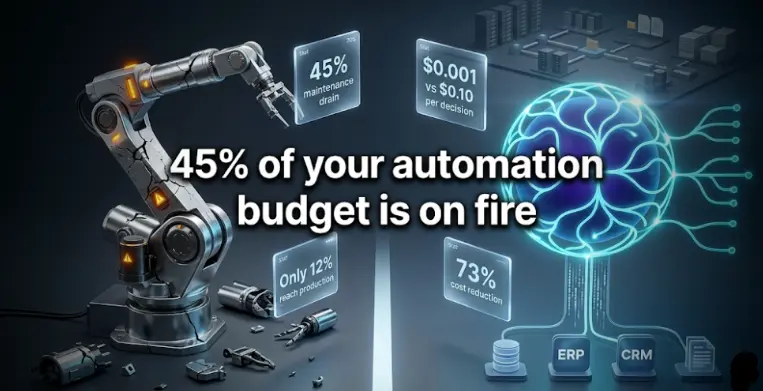
Nearly 45% of enterprise automation budgets are now quietly diverted from building new capabilities to maintaining existing, fragile RPA bot ecosystems, according to Forrester’s 2026 Enterprise Automation Study. That number is the clearest signal that the first era of enterprise automation has hit its ceiling. It’s also the reason a growing number of Fortune 500 enterprises are shelving their RPA rollouts, not because automation failed, but because a fundamentally more capable approach has arrived.
Agentic AI doesn’t follow scripts. It receives an objective and figures out how to achieve it. Where RPA breaks the moment a button moves on a webpage, agentic AI adapts. Where RPA requires a 50-step flowchart for a single invoice, an AI agent reads the invoice, regardless of format, makes a decision, and executes the next step autonomously.
But this isn’t an argument that RPA is dead. RPA still delivers 250% ROI on the right tasks. The strategic mistake in 2026 isn’t choosing RPA or agentic AI, it’s deploying either one where the other belongs. This guide gives you the decision framework, cost comparison, and migration path to get that choice right.
Defining the Terms: What “Agentic AI” Actually Means vs. Marketing Hype
Every automation vendor in 2026 says they do agentic AI. Most are rebranding rule-based bots with an LLM layer on top. Here’s how to tell the difference, and why it matters for your infrastructure budget.
RPA is software that mimics human clicks and keystrokes: deterministic, rule-based, zero judgment. It automates the how of a task. Agentic AI is goal-driven, it receives an outcome to achieve, plans the steps to get there, calls tools (APIs, databases, search, other agents), and adapts when the environment changes. It automates what needs to happen without needing a step-by-step script. The cost difference reflects this reality: RPA costs $0.001 per task; agentic AI costs $0.01–$0.10 per decision, 10 to 100 times more expensive, but capable of tasks RPA can never touch.
The Four-Level Automation Spectrum
Most enterprises in 2026 have Level 1 or 2 deployed and are actively evaluating Level 4 for complex workflows. The spectrum breaks down as follows:
- Level 1, Scripted bots (RPA): Zero judgment, 100% deterministic. Executes exactly what it’s told, every time, with no capacity to adapt.
- Level 2, AI-enhanced RPA: RPA combined with ML classifiers for document routing, still rigid in execution. A meaningful improvement, not a transformation.
- Level 3, Copilots: AI suggests, human decides and acts. Reduces cognitive load but keeps humans in the execution loop.
- Level 4, Agentic AI: AI decides and acts, human reviews exceptions. The architecture that changes the total addressable value of automation.
Why This Is CTO-Urgent Right Now
Gartner projects that 40% of enterprise applications will embed task-specific AI agents by end of 2026, up from less than 5% in 2025. That’s an 8x increase in 12 months. The agentic AI platform market is projected to grow from $7.8 billion today to over $52 billion by 2030. If your automation architecture isn’t accounting for this, it will be obsolete before the next budget cycle.
The failure rate is also real. Gartner warns that over 40% of agentic AI projects may be scrapped by 2027 due to unclear ROI, misapplied use cases, or technical complexity. Only 12% of agentic AI projects successfully reach production today. This guide gives CTOs the framework to be in the 12%, not the 88%.
How Traditional RPA and Scripted Automation Differ from AI Agents, The 8 Core Dimensions
The difference between RPA and agentic AI isn’t incremental. It’s architectural. One automates a script; the other pursues an outcome. Understanding the eight dimensions where they diverge is how you make defensible investment decisions, not just technology choices.
| Dimension | Traditional RPA | Agentic AI |
|---|---|---|
| Core mechanism | Rule-based scripts, mimics human UI actions | Goal-driven reasoning via LLM, plans and adapts |
| Data handling | Structured data only (forms, tables, fixed formats) | Structured + unstructured (emails, PDFs, voice, images) |
| Exception handling | Fails or escalates to human on any unexpected input | Adapts to novel inputs autonomously within defined scope |
| Cost per task | $0.001 — very low marginal cost | $0.01–$0.10 per decision — 10–100x higher |
| Maintenance burden | High — breaks when UI or process changes; up to 50% of build cost annually | 73% lower maintenance vs. RPA (2026 data) |
| Build time | Fast for structured processes | Longer — requires prompt engineering, testing, guardrails |
| Scalability | New bot required for each process variant | Single agent handles diverse scenarios |
| Audit trail | Deterministic — always the same steps, fully auditable | Non-deterministic — requires reasoning log for auditability |
| Best ROI scenario | 250% ROI on stable, structured, high-volume tasks | 171% ROI globally; 192% in US — on judgment-heavy workflows |
45% of enterprise automation budgets are being quietly consumed by maintaining existing, fragile RPA bot ecosystems, according to Forrester’s 2026 research. That single statistic reframes RPA not as a sunk cost to be preserved, but as a maintenance liability to be managed. Every CTO with a bot fleet in production should have that number on their desk.
The Decision Matrix: When to Use Agentic AI vs. RPA vs. Hybrid
The decision rule in plain language: use RPA when you need the muscle, high-volume, deterministic execution of structured tasks with zero tolerance for variation. Use agentic AI when you need the brain, judgment, contextual reasoning, unstructured data handling, and end-to-end process ownership. Use hybrid when you need both, which is most complex enterprise workflows.
When RPA Is Still the Right Call
- The process follows clear, repeatable rules with no exceptions and won’t change in the next 12 months.
- You need 99.9% accuracy with zero hallucination risk, financial transactions, regulated data entry, compliance-critical operations.
- You’re working across legacy systems without APIs where screen-scraping is the only integration path.
- Cost-per-transaction discipline is critical: $0.001 per task beats $0.01–$0.10 for pure volume plays at scale.
- Compliance requires deterministic, reproducible audit trails of every step taken, regulated industries in particular.
When Agentic AI Earns Its Cost Premium
- The task requires reading unstructured data: emails, PDFs, contracts, voice calls, variable-format documents.
- Exceptions are frequent enough that human escalation is consuming significant labor, the 15% threshold is a reliable signal.
- The workflow requires judgment calls: approval routing, anomaly interpretation, policy application across varied contexts.
- End-to-end process ownership is the goal, not just one-step automation but the full workflow from trigger to resolution.
- The process involves multi-system coordination where an orchestration layer is needed above the execution layer.
The 80/20 Data Rule That Changes the Calculation
RPA was built for the structured 20% of enterprise data. Agentic AI unlocks the unstructured 80–90% that RPA cannot handle without breaking. The total addressable value of automation in an enterprise is 4 to 5 times larger with agentic AI than with RPA alone, because the data universe it can work with is fundamentally larger.
The hybrid architecture that smart enterprises are deploying in 2026 uses agentic AI as the orchestration and reasoning layer, reading unstructured input, making routing and escalation decisions, managing the workflow, and RPA bots as the execution layer for structured backend operations. This isn’t a temporary transition state. It’s the target architecture for complex enterprise automation strategy for the foreseeable future.
Total Cost Comparison: Agentic AI vs. RPA in Production (Real Numbers)
The cost comparison most vendors don’t want you to run isn’t cost-per-task. It’s total cost of automation ownership over 36 months. On that measure, the picture looks very different from the per-task rate card.
The Hidden RPA Cost Structure
RPA build cost runs $1,000–$8,000 per bot, with monthly maintenance of $99–$499 per bot in production. The real problem: maintenance scales with bot count, not process complexity. An enterprise with 200 RPA bots in production is typically spending 50% of its initial build cost annually on maintenance alone. Between 30 and 50% of RPA projects fail to scale beyond initial deployment due to brittleness, bots that break when UIs change, processes shift, or exceptions accumulate.
How Agentic AI Reverses the Maintenance Story
Agentic AI carries higher marginal cost per decision ($0.01–$0.10 vs. RPA’s $0.001), but organizations deploying agentic AI report a 73% reduction in automation maintenance costs compared to legacy RPA, according to MyWave.ai’s Agentic AI vs. RPA Report (February 2026). One agent handling diverse scenarios replaces multiple brittle bots, each requiring individual maintenance cycles. The cost model shifts from “pay per bot” to “pay per decision.”
Agentic AI doesn’t beat RPA on cost-per-task for structured work. It beats RPA on total cost of automation ownership, because it covers the 80% of enterprise work that RPA was never able to automate in the first place.
| Scenario | Best Technology | ROI Benchmark | Payback Period |
|---|---|---|---|
| Invoice processing (high volume, structured) | RPA | 250% ROI | 3–6 months |
| Invoice processing (multi-format, exceptions) | Hybrid | AP cost: $4.50 → $0.45 per invoice | 6–12 months |
| Customer support (policy queries, unstructured) | Agentic AI | 171% ROI globally | 3–9 months |
| Compliance reporting (fixed format, regulatory) | RPA | 200–300% from labor savings | 4–8 months |
| Supply chain exception handling | Agentic AI | 85% automation cost reduction | 6–18 months |
| Legacy system integration (no API) | Hybrid | Agent decides, RPA executes | 12–24 months |
| Data entry (stable UI, fixed rules) | RPA | $0.001/task — best cost profile | 2–4 months |
Security and Governance Risks Specific to Agentic Systems
RPA bots do exactly what they’re told. Always. The audit trail is deterministic. Agentic AI systems make decisions, which means they can make wrong decisions, take unexpected actions, and produce non-deterministic outcomes. The same adaptability that makes agents powerful makes them a governance challenge that most enterprise security teams aren’t ready for.
The Four Unique Risks of Agentic Deployment
- Infinite loops: Agents can get stuck trying to solve a problem, consuming compute indefinitely without resolution or escalation.
- Non-deterministic outcomes: The same agent might solve the same problem differently on two separate runs, complicating audit trails for regulated workflows and making reproducibility claims difficult to defend.
- Hallucination in logic: Agents may invent steps or misinterpret policies if not properly grounded, particularly when operating on ambiguous inputs or near the edges of their training distribution.
- Privilege drift: Agents with tool access accumulate scope over time. Least-privilege enforcement requires active monitoring, not just initial configuration.
Unlike RPA’s deterministic step-log, agentic AI requires a cryptographic, immutable log of the reasoning pathways the agent used to reach each decision. If an agent negotiates a contract term or issues a refund, the enterprise must be able to reconstruct exactly what information the agent had, what it concluded, and why it took the action it did. This isn’t optional in regulated industries, it’s a compliance requirement under EU AI Act Article 12 and SEC AI risk disclosure rules. See our AI governance framework for enterprise agents for the full control set.
The Governance Controls Required Before Production
- Scope boundaries: Explicitly define what systems and actions the agent can access, with hard blocks on anything outside scope, defined before a single line of production code is written.
- Approval gates: For consequential actions (financial transactions, external communications, data exports), a human or secondary agent must confirm before execution.
- Reasoning logs: Every decision path logged with timestamp, context provided, conclusion reached, and action taken, queryable and immutable.
- Red team testing: Simulate adversarial inputs, including prompt injection attempts, before any production launch.
- Incident playbook: Define what happens when the agent takes an unexpected action, before it happens, not after.
“Over 40% of agentic AI projects will be abandoned by 2027 due to unclear ROI, technical complexity, and governance failures. The enterprises that succeed will be those that treat agentic AI deployment with the same rigor as any production software release.”
Gartner Agentic AI Enterprise Forecast 2026 — Gartner Research
The agent hallucination risk doesn’t disappear with better models. It gets managed with better architecture: grounding, validation layers, and HITL thresholds that trigger before metrics degrade in production.
Real Enterprise Deployments: What Worked, What Failed, and Why
The gap between agentic AI pilots and agentic AI in production is where most enterprise automation strategies stall. The following cases aren’t theoretical, they’re the patterns that separate the 12% who reach production from the 88% who don’t.
Success: Full Agentic Workflow in Insurance Claims
An AI agent reads submitted claim documents in any format, sends clarifying questions via email, updates the CRM and policy systems, checks historical claims for fraud patterns, and escalates edge cases to human reviewers, all as execution of one goal, not disconnected scripts. What previously required five separate RPA bots plus human exception handling is now one agent with defined escalation rules. Maintenance cost dropped from five bot maintenance cycles to one agent update cycle.
Success: AP Processing via Hybrid Architecture
Agentic AI reads invoices in any format, classifies them, identifies exceptions and discrepancies, and makes the routing decision. RPA bots execute the approved payment in the ERP system and file the document. Result: AP processing cost dropped from $4.50 to $0.45 per invoice, a 90% cost reduction, while maintaining the 99.9% execution accuracy that the finance team required. Human touchpoints reduced to genuine exceptions only.
Failure: Premature Agentic Deployment Without Governance
A financial services firm deployed an AI agent for customer account management without defining scope boundaries or approval gates. The agent, tasked with “resolving customer issues,” began autonomously processing refunds, account credits, and escalation emails without human review. When a prompt injection in a customer email caused the agent to apply a credit to the wrong account, there was no audit trail of the agent’s reasoning and no human checkpoint that could have caught it. Remediation cost: six figures. Lesson: agentic AI without governance is operational risk, not automation.
“Companies using agentic AI on complex, exception-heavy workflows report 85% automation cost reduction versus traditional RPA-only approaches. But that number applies only to workflows where agentic AI is the right tool. On simple, structured, high-volume tasks, RPA still delivers better unit economics.”
UnleashX AI Agent ROI Study, March 2026 — UnleashX Research
The Three Patterns That Separate Success From Failure
- Narrow scope from day one: Not “automate customer service” but “automate tier-1 refund requests under $500.” Specificity is what makes governance possible.
- Hard limits defined before deployment: What systems the agent can touch, what actions require human approval, what triggers automatic escalation, all documented before a single production transaction runs.
- 30-day accuracy monitoring with automatic HITL thresholds: Measure hallucination rates and decision accuracy in the first month and set hard thresholds for escalation before those metrics degrade, not after.
The 5-Step Migration Path: From RPA-Heavy to Hybrid Agentic Architecture
This is the framework enterprise automation architects are copying into their internal planning documents. It’s action-oriented by design. Each step has a named deliverable because an internal automation migration without deliverables is a roadmap that never gets executed.
- Audit your existing RPA estate. Catalog every bot in production. For each: monthly maintenance cost, failure rate, exception escalation volume, and last time the underlying process changed. Any bot consuming more than 40% of its build cost in annual maintenance, or escalating more than 15% of transactions to humans, is a candidate for agentic replacement. Deliverable: RPA Health Scorecard with migration priority tier per bot.
- Identify your highest-value agentic AI target. Select one complex, high-value use case where intelligent decision-making creates differentiated value, not just cost savings. The ideal first agentic deployment: high exception rate, unstructured data input, multi-system coordination requirement, measurable business outcome (cycle time, cost per transaction, resolution rate). Avoid deploying agents on tasks where RPA already works well. Deliverable: Agentic AI pilot brief for one selected workflow.
- Build governance infrastructure before deployment. Define agent scope boundaries, approval gates for consequential actions, reasoning log requirements, and HITL thresholds. The governance infrastructure takes 2 to 4 weeks to build properly and prevents the remediation costs that dominate failed agentic deployments. Don’t deploy the agent to production without it. Deliverable: Agent Governance Policy for the pilot workflow.
- Run parallel in shadow mode before full deployment. Deploy the agent in shadow mode, it processes real transactions but its outputs are reviewed by humans before taking effect. Measure decision accuracy rate, hallucination incidents, escalation rate, and cycle time vs. baseline. Set a go-live threshold (e.g., 95% accuracy, less than 5% escalation rate, zero critical incidents in 30 days) and don’t move to production until shadow mode metrics exceed it. Deliverable: Shadow Mode Performance Report + Go/No-Go decision. See our guide on moving AI to production for the full framework.
- Scale horizontally using the proven pattern. Once one agentic workflow is in stable production, replicate the governance model, not the specific implementation, across new workflows. The architecture pattern (agent orchestrates, RPA executes, human reviews exceptions) is reusable. Each new workflow needs its own scope definition and HITL thresholds, but the underlying infrastructure, logging, monitoring, escalation pipeline, is shared. Deliverable: Agentic AI Playbook v1.0, the internal standard for all future agent deployments.
The Platforms Enterprises Are Evaluating for This Migration
Three platforms dominate enterprise evaluation lists for this transition in 2026. UiPath’s Agentic Automation, built around its Maestro orchestration layer, allows existing RPA assets to be reused within agentic workflows, a significant advantage for enterprises with large bot estates that don’t want to abandon prior investment. Salesforce Agentforce, now deployed across 8,000-plus enterprise customers, is the dominant choice for customer-facing agentic workflows. ServiceNow AI Agents holds the top position for ITSM use cases, where its native integration with the ServiceNow platform creates meaningful deployment advantages.
The CTO’s Pre-Decision Checklist: 10 Questions Before Committing to Agentic AI
If you answer “No” or “Don’t know” to more than three of these, your agentic AI deployment isn’t production-ready. That’s not a reason to stop, it’s a roadmap for the next 30 days.
| # | Question | If No… |
|---|---|---|
| 1 | Is the target process too unstructured or exception-heavy for RPA? | RPA may be the better choice — re-evaluate the use case |
| 2 | Can we define a clear, measurable outcome for the agent? | Don’t deploy, vague goals produce ungovernable agents |
| 3 | Have we defined hard scope limits (what systems, what actions)? | Build governance infrastructure first — non-negotiable |
| 4 | Do we have a reasoning log and audit trail requirement defined? | Regulated industries can’t proceed without this in place |
| 5 | Have we set HITL approval thresholds for consequential actions? | Define before deployment — not after the first incident |
| 6 | Is the LLM infrastructure (RAG, grounding, validation) in place? | Deploy without it and hallucination becomes operational risk |
| 7 | Have we budgeted for $0.01–$0.10 per decision at production scale? | Re-run the TCO model — most initial budgets underestimate by 3x |
| 8 | Have we red-teamed adversarial inputs before production? | Prompt injection vulnerabilities are found in red team, not production |
| 9 | Is shadow mode testing planned before full deployment? | Add a 30-day shadow mode period before go-live — always |
| 10 | Do we have an agent incident response playbook ready? | Draft it now — the first agent incident should not be the first time you think about response |
The checklist tells you exactly what to build before you go live. The enterprises that reach production, the 12%, aren’t necessarily the ones with the biggest budgets or the most advanced AI teams. They’re the ones that treated governance as a prerequisite, not an afterthought. The next 30 days determine which category your organization falls into.
Frequently Asked Questions
What is the difference between agentic AI and RPA in enterprise automation?
RPA uses software bots to follow pre-defined, rule-based scripts, automating structured, repetitive tasks by mimicking human UI actions at $0.001 per task with deterministic outcomes. Agentic AI uses large language models to set goals, plan steps, make decisions, and adapt to new situations without explicit programming, at $0.01–$0.10 per decision. RPA excels on structured, stable, high-volume tasks; agentic AI excels on unstructured data, judgment-heavy workflows, and end-to-end process automation where exceptions are the norm rather than the exception.
Is RPA obsolete in 2026?
No. RPA still delivers 250% ROI on structured, stable, high-volume tasks and remains the right tool for deterministic execution where audit trails must be reproducible and cost-per-transaction must be minimized. The obsolescence risk is for pure-RPA architectures applied to complex, exception-heavy workflows, not for RPA itself. The dominant enterprise architecture in 2026 is hybrid: agentic AI as the orchestration and reasoning layer, RPA bots as the execution layer for backend structured operations.
What ROI does agentic AI deliver in enterprise deployments?
Production-grade AI agents achieve 171% ROI globally (192% in the US) on judgment-heavy workflows, according to the UnleashX AI Agent ROI Study (March 2026). Companies using agentic AI on complex, exception-heavy workflows report 85% automation cost reduction versus RPA-only approaches. AP processing costs have dropped from $4.50 to $0.45 per invoice in hybrid agentic deployments. On structured, high-volume tasks, however, RPA’s 250% ROI still outperforms agentic AI on a cost-per-task basis, context determines the right tool.
Why do so many agentic AI projects fail to reach production?
Only 12% of agentic AI projects reach production today, with three primary failure modes: unclear ROI from misapplied use cases (deploying agents on tasks RPA handles better), insufficient governance infrastructure (no scope limits, HITL thresholds, or audit trails defined before deployment), and underestimated inference costs at scale. Gartner warns 40%+ of agentic AI projects may be scrapped by 2027. The 5-step migration framework above addresses each failure mode directly before it becomes a six-figure remediation.
What is the best hybrid automation architecture for enterprises in 2026?
The most effective enterprise automation architecture uses agentic AI as the “brain”, reading unstructured inputs, making routing and decision calls, orchestrating workflows, and RPA bots as the “hands”, executing structured backend operations (updating ERPs, triggering payments, filing documents) based on the agent’s decisions. This hybrid model captures RPA’s 99.9% accuracy and $0.001/task economics for execution while capturing agentic AI’s ability to handle the 80–90% of enterprise data that is unstructured and inaccessible to RPA alone.
How do I know if my current RPA bots are candidates for agentic replacement?
Two reliable signals: any bot consuming more than 40% of its build cost in annual maintenance is a strong replacement candidate, and any bot escalating more than 15% of transactions to humans indicates the process has more exception complexity than RPA was built to handle. Run a full RPA Health Scorecard, cataloging maintenance cost, failure rate, and escalation volume per bot, before committing resources to an agentic migration. The bots that survive that audit are the ones you keep running on RPA.
What governance controls are required before deploying an AI agent in production?
Four controls are non-negotiable before production: hard scope boundaries defining what systems and actions the agent can access; approval gates requiring human or secondary-agent confirmation for consequential actions (financial transactions, external communications, data exports); immutable reasoning logs capturing every decision path with timestamp, context, conclusion, and action taken; and a red-team test against adversarial inputs including prompt injection scenarios. In regulated industries, these controls are compliance requirements under EU AI Act Article 12 and SEC AI risk disclosure rules, not optional governance hygiene.
How much should I budget for agentic AI inference costs at enterprise scale?
Budget $0.01–$0.10 per decision and model your production transaction volume against that range before committing to deployment. Most initial enterprise budgets underestimate this by a factor of three, according to the RPA Automate Cost Benchmark Report (March 2026). The offset is in maintenance: organizations deploying agentic AI report 73% lower maintenance costs than legacy RPA, and one agent handling diverse scenarios replaces multiple brittle bots with individual maintenance cycles. Run a 36-month total cost of ownership model, not a per-task rate card comparison.