Crypto & Regulation
Crypto ETF Regulation 2026: How Access Changed
NeuralWired.com · Updated July 29, 2026
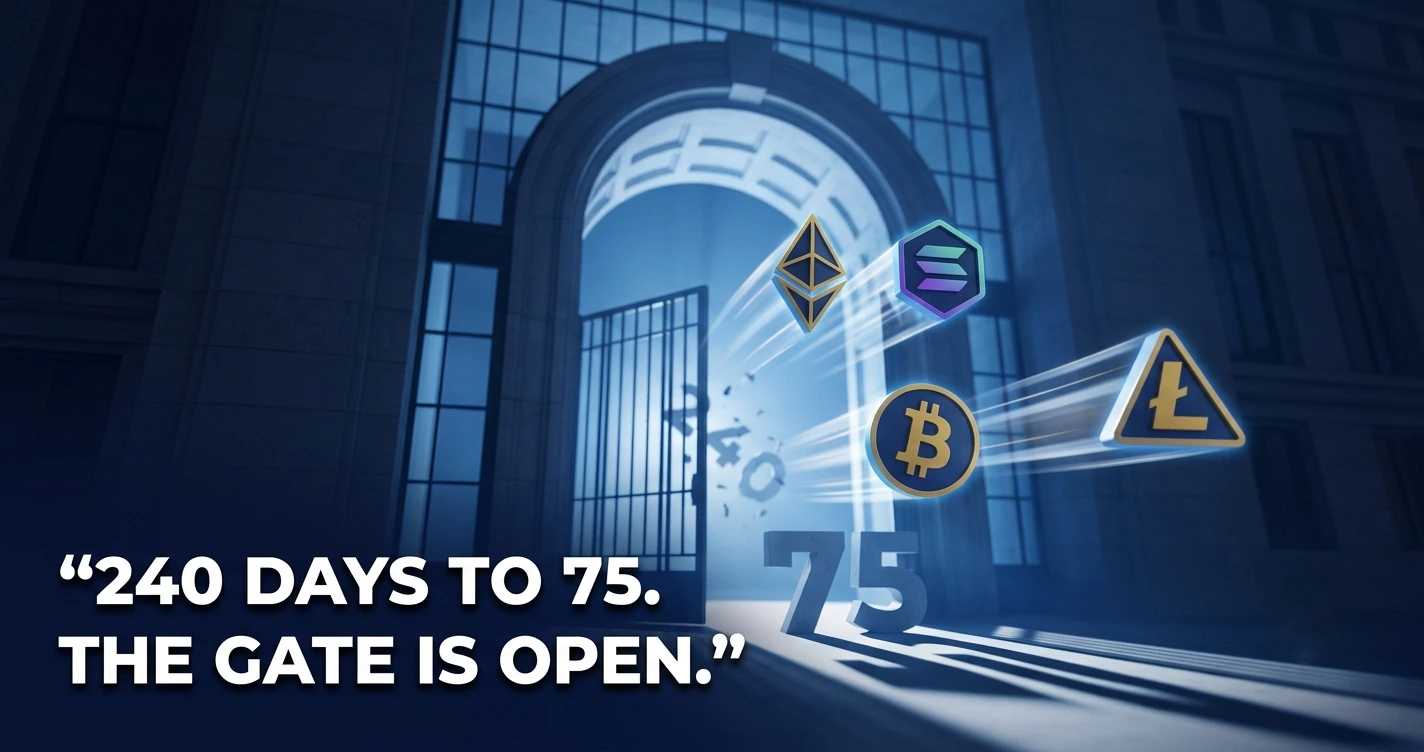
Eighteen months ago, an asset manager wanting to launch a Litecoin ETF faced a review process that could run 240 days and end in a flat denial. Today it can happen in 75. That is the short version of crypto ETF regulation 2026: a September 2025 rule change quietly rewired how every future crypto fund reaches the market, and the SEC just opened a new review that could rewrite the rules again.
If you allocate capital, build ETF products, or advise clients on digital asset exposure, the mechanics of that shift, and what the SEC is reconsidering right now, matter more than the headline approvals ever did.
In this article
What actually changed on September 17, 2025
On September 17, 2025, the SEC voted to approve generic listing standards for commodity-based exchange-traded products, a category that includes crypto ETFs. The order covered rule changes filed jointly by Nasdaq, Cboe BZX, and NYSE Arca.
Before this, every single spot crypto ETP needed its own individual Section 19(b) filing, reviewed one at a time by SEC staff. That process is how Bitcoin ETPs got blocked for close to a decade, until the D.C. Circuit ruled in Grayscale Investments, LLC v. SEC in August 2023 that the agency’s denial was arbitrary. Under the new standard, an exchange can list a qualifying product without asking the SEC first. It just has to publish required disclosures within five business days of launch.
A token qualifies under one of three tests, according to Dechert’s legal analysis of the order:
- It trades on a market that belongs to the Intermarket Surveillance Group (ISG)
- It underlies a U.S.-regulated futures contract that has traded for at least six months
- It’s the reference asset for an existing ETF with at least 40% of its net assets tied to that token
Clear one of those and the exchange listing gate opens. The remaining bottleneck is standard S-1 registration, not a case-by-case SEC vote.
Old process vs. new process
| Factor | Pre-September 2025 | Post-September 2025 |
|---|---|---|
| Review path | Individual 19(b) filing per product | Rules-based eligibility test |
| Maximum timeline | Up to 240 days | As little as 75 days |
| Approval outcome | Case-by-case, historically denial-heavy | Automatic if eligibility criteria are met |
| Who decides | SEC Commission vote | Exchange, using published criteria |
Eric Balchunas, senior ETF analyst at Bloomberg Intelligence, put it bluntly right after the vote. He said the odds of approval for new spot products including Litecoin, Solana, and XRP were now
“100% now.”Eric Balchunas, Bloomberg Intelligence · The Block, September 30, 2025
His reasoning: the old 19b-4 deadlines that issuers used to fight over were now, in his word, meaningless. The eligibility test replaced the negotiation.
The launch wave: Solana, XRP, Litecoin, Hedera
The first products under the new framework hit the market fast, and one detail makes the timeline more remarkable: they launched during a federal government shutdown.
On October 28, 2025, the Bitwise Solana Staking ETF (BSOL) began trading on NYSE, alongside Canary Capital’s spot Litecoin ETF and spot Hedera ETF on Nasdaq, the first of their kind for either token. Because the issuers had already finalized S-1 registration and cleared the generic eligibility bar, they used SEC shutdown-contingency guidance to go effective via Form 8-A without waiting on the government to reopen, according to Sherwood News.
Balchunas called BSOL’s debut “the best ETF launch of 2025 in any asset class.”
Spot XRP ETFs followed in November 2025. Canary Capital’s XRP fund (XRPC) pulled in a reported $250 million on its first day, a record for any 2025 ETF launch. Bitwise, Franklin Templeton, Grayscale, 21Shares, and REX-Osprey each launched competing XRP products within weeks. By late 2025, more than 150 crypto ETF applications covering roughly 35 distinct assets were sitting with the SEC, most expected to route through the generic pathway rather than a fresh 19b-4 fight.
What the inflow numbers actually show
Getting listed is now easy. Gathering assets is a different question, and the mid-2026 data tells a more nuanced story than the launch headlines did.
The numbers, as of late July 2026
U.S. spot Solana ETFs have pulled in roughly $1.14 billion in cumulative inflows since October 2025, with BSOL alone holding about $596 million in assets. Spot XRP ETFs across seven issuers hold a combined $1.2 billion-plus. Bitcoin and Ethereum still dominate in absolute weekly dollars, a combined $152 million flowed into BTC, ETH, SOL, and XRP spot ETFs in one mid-July week, with Bitcoin’s single-day figure ($203.2 million) alone dwarfing Solana’s ($5.8 million) and XRP’s ($5.66 million) that same day.
Here’s the part worth sitting with: during a stretch when flagship Bitcoin ETFs logged an eight-week outflow streak, roughly $4.4 billion left the combined BTC/ETH/SOL/XRP complex over 13 sessions, Solana spot ETFs still closed every U.S. trading session in July 2026 with net inflows. Newer, smaller products showed more consistent daily demand than the market leader during a drawdown. That’s not a detail issuers are putting in their marketing decks, but it’s the kind of signal an allocator evaluating product durability should weigh more heavily than headline AUM.
Our read: access and demand are not the same variable. The generic listing standard solved for access. It did nothing to guarantee that every one of the 150-plus filed products finds durable assets, and The Block’s own reporting notes the industry is explicitly split on scale versus survival heading into the rest of 2026.
The dissent nobody is quoting enough
The September 2025 vote wasn’t unanimous. Commissioner Hester Peirce, long the Commission’s most crypto-friendly voice, supported it. Commissioner Caroline Crenshaw, the Commission’s sole Democrat at the time, cast the lone dissent, and her objection wasn’t really about crypto at all.
“Passing the buck on reviewing these proposals and making the required investor protection findings, in favor of fast tracking these new and arguably unproven products to market.” Caroline A. Crenshaw, SEC Commissioner · The Block, September 18, 2025
Crenshaw’s argument is a process critique, not a valuation call. She’s not arguing crypto ETFs are bad investments. She’s arguing that swapping individualized SEC review for a one-time numeric test removes a specific investor-protection function Congress built into Section 19(b), and that the “ETP” label carries less legal protection than the more familiar “ETF” wrapper implies to retail buyers who won’t parse the difference.
It’s a fair point that shows up in the data already. With multiple issuers launching near-identical single-asset products within weeks of each other, three separate XRP issuers debuted inside the same month, capital splits across competing tickers. A retail investor who buys the wrong low-AUM ticker can face wider bid-ask spreads and NAV premiums that never show up in a fund’s headline expense ratio.
What Peirce says the new rules actually do
Peirce framed the change as replacing unpredictability with structure, not lowering the bar. In her formal statement the same day, she described the new rules as providing “alternative rules-based eligibility criteria for the underlying holdings of commodity-based ETPs, including crypto asset-based ETPs,” and floated that exchanges could later propose additional objective standards to speed things up further.
What’s next: the SEC’s June 2026 review
This is the part of the story most competing coverage is missing, and it’s the most current, actionable fact in the entire regulatory arc.
Still open as of this writing
On June 30, 2026, the SEC issued Release No. 33-11426, opening a 60-day public comment period asking 27 questions about how to regulate “novel” ETFs, explicitly naming crypto-asset funds alongside event-contract and high-leverage products. It is not a proposed rule change, and it does not roll back the September 2025 generic standards. But it signals the registration, disclosure, and Investment Company Act classification questions around crypto ETFs are not permanently settled.
SEC Chair Paul Atkins framed the review around a broader structural point: total U.S.-listed ETFs have roughly tripled since 2019, from about 1,900 funds to more than 4,600 today. “Novel products raise novel questions,” Atkins said in a May 20, 2026 statement, according to Eastern Herald’s coverage of the release.
For allocators building strategies around today’s framework, that 60-day comment window and whatever follows it deserves a place on the calendar. A tightened registration or disclosure standard specifically for crypto ETFs would raise compliance costs for issuers who built 2026 roadmaps assuming the September 2025 rules were the final word.
What this means if you’re allocating or building
Three things worth acting on, not just noting:
- The generic standard is a floor, not a seal of approval. A token clearing the ISG-membership or 40%-NAV test tells you nothing about whether its underlying market has real depth or whether the custody arrangement behind the fund has been stress-tested.
- AUM and average spread matter more than “does a spot ETF exist.” With dozens of near-identical single-asset products live, due diligence now has to include liquidity comparison across competing tickers, not just confirmation that a wrapper is available.
- Watch the comment period, not just the calendar. The June 30, 2026 review could reshape disclosure and classification rules for crypto ETFs specifically. Building a multi-year allocation thesis on the current framework without tracking that process is a planning risk.
For more on how institutional capital is moving into digital assets outside the ETF wrapper, see our coverage of Strategy vs BlackRock’s Bitcoin treasury approach and the MicroStrategy vs Tesla treasury battle. And for the risk side of this market that inflow charts don’t capture, our report on FATF’s record crypto crime data amid the 2026 Bitcoin drawdown is worth reading alongside this piece.
Frequently asked questions
What are the SEC’s generic listing standards for crypto ETFs?
Rules approved September 17, 2025 that let exchanges list qualifying commodity-based ETPs, including crypto funds, without individual SEC pre-approval, provided the underlying asset meets criteria like ISG market listing, six months of regulated futures trading, or 40% NAV linkage to an existing ETF.
How long does it take to approve a crypto ETF now?
Under the generic standards, qualifying products can move from filing to trading in as little as 75 days, down from up to 240 days under the old case-by-case 19(b) review process that governed every spot crypto ETP before September 2025.
Is there a Solana ETF?
Yes. U.S. spot Solana ETFs launched October 28, 2025, led by the Bitwise Solana Staking ETF (BSOL), which held roughly $596 million in assets by mid-2026 and helped drive over $1.14 billion in total Solana ETF inflows.
Is there an XRP ETF?
Yes. Spot XRP ETFs launched in November 2025 under the new generic listing framework. By 2026, seven issuers, including Bitwise, Canary Capital, and Franklin Templeton, offered spot XRP ETFs holding a combined $1.2 billion or more.
Did the SEC approve a Litecoin ETF?
Yes. Canary Capital launched the first spot Litecoin ETF on Nasdaq on October 28, 2025, alongside a spot Hedera ETF, using the new generic listing standards during an active federal government shutdown.
Is the SEC changing crypto ETF rules again in 2026?
Yes. On June 30, 2026, the SEC opened a 60-day public comment period asking 27 questions about regulating “novel” ETFs, explicitly including crypto products, though it has not proposed a specific rule change yet.
Where this leaves us
The September 2025 order didn’t just add more crypto ETFs to the market. It changed who decides which ones get to exist, shifting that call from individual SEC commissioners to a repeatable numeric test. That’s why Solana, XRP, Litecoin, and Hedera products went from filing to trading in months instead of years, and why more than 150 applications are still queued behind them.
Over the next 6 to 18 months, expect three things to define crypto ETF regulation 2026 and beyond: the outcome of the SEC’s 60-day comment period on novel ETFs, a shakeout among the thinnest single-asset products as AUM concentrates around early movers like BSOL, and pressure on issuers to differentiate on cost and liquidity now that regulatory access is no longer the competitive edge it was in 2024.
What to watch: the close of the 60-day comment window in late August 2026, whether any issuer pulls a low-AUM product before year-end, and whether Bitcoin and Ethereum ETFs stabilize their outflow streak or keep ceding relative ground to newer altcoin products.
Want regulatory shifts like this flagged before they hit the mainstream feed?
Subscribe to The Neural Loop at neuralwired.com/newsletter
Subscribe to The Neural Loop at neuralwired.com/newsletter