AI Hardware · Enterprise Analysis
On March 11, Meta rolled out four new MTIA-series chips and locked in $100B worth of GPU deals. For enterprise leaders, the implications go far beyond one company’s hardware roadmap.
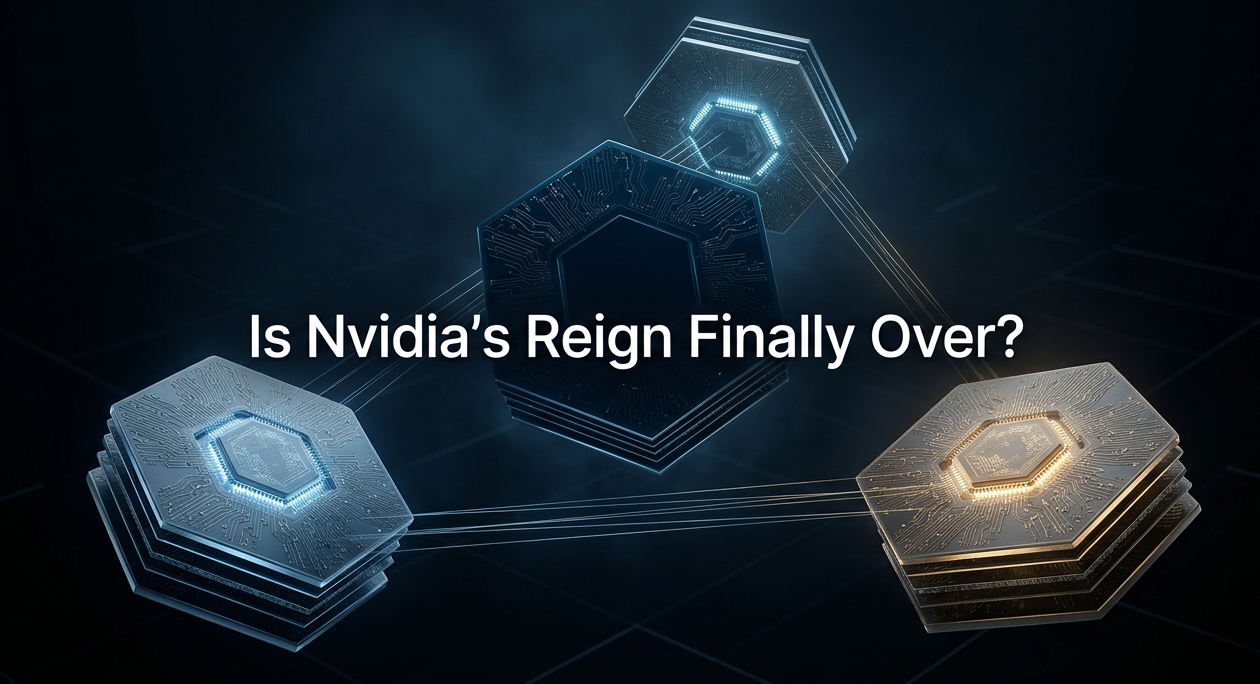
Nvidia controls roughly 80 to 90 percent of the AI accelerator market. That number has been cited so often it feels like a law of physics. Meta just started stress-testing it.
On March 11, 2026, Meta announced four new chips in its Meta Training and Inference Accelerator series, known as MTIA, deploying them across its data centers to handle both training and inference workloads. The announcement came fewer than three weeks after Meta signed a $100 billion, six-gigawatt partnership with AMD for custom MI450 GPUs, and less than a month after locking in a separate multi-year agreement with Nvidia for Blackwell and Rubin GPUs.
The sequence is deliberate. Meta in-house AI chips are the keystone of what analysts at Introl are already calling “the most aggressive multi-vendor GPU strategy in the industry.” For CTOs, CFOs, and infrastructure leaders reassessing their own AI hardware decisions for 2026 and 2027, this is not a spectator-sport moment. The decisions Meta is making now will reshape pricing, supply chains, and procurement strategy across the enterprise market.
This analysis breaks down the full MTIA rollout, the strategic logic behind Meta’s three-chip approach, the real numbers behind the AMD deal, and what a practical decision framework looks like for organizations that won’t be building their own silicon anytime soon.
What Meta Actually Announced: The MTIA Timeline
The chip announcements landing on March 11 didn’t materialize from nowhere. Meta has been building toward custom silicon for years, with the first MTIA version handling inference workloads beginning in 2025. The new generation extends that footprint significantly and adds training to the mandate.
Feb 17, 2026
Meta signs multi-year agreement with Nvidia covering Blackwell and Rubin GPUs alongside Grace CPUs.
Feb 24, 2026
AMD and Meta announce a $100 billion, six-gigawatt strategic partnership built around custom AMD Instinct MI450 GPUs. First one-gigawatt shipment targets H2 2026.
Mar 11, 2026
Meta rolls out four new MTIA-series chips, with some already deployed in data centers and others scheduled through 2026 to 2027. The announcement covers both training and inference use cases on shared infrastructure.
H2 2026 onward
First AMD MI450 gigawatt goes live. MTIA training workloads ramp. Full six-gigawatt AMD deployment follows across a multi-year horizon.
The four MTIA chips include the MTIA 450, which features faster memory bandwidth than its predecessor, and the MTIA 500, which adds expanded memory capacity and speed. Both are purpose-built to optimize Meta’s Llama model family, sharing a common infrastructure to allow seamless hardware upgrades without application-layer rearchitecting.
Yee Jiun Song, Meta’s VP of Engineering, framed the goal plainly: “By developing custom chips, we can enhance performance per dollar across its data center network.” That performance-per-dollar framing is the entire thesis. MTIA chips are not trying to out-FLOP Nvidia’s H100 or B200 in general-purpose tasks. They’re designed to win on a specific metric for a specific set of workloads.
The AMD Deal: Inside the $100B Structure
The AMD partnership deserves its own examination because the headline number, $100 billion, obscures a more interesting structure underneath. This isn’t a purchase order. It’s a multi-year supply commitment with equity-linked incentives that align AMD’s business trajectory with Meta’s infrastructure ambitions.
Deal Mechanics
Total estimated value: $100B over the deal lifetime (Reuters pegged a conservative estimate at $60B; the AMD press release supports the higher figure)
Capacity committed: 6 gigawatts of AMD Instinct MI450 GPUs
First deployment: 1GW scheduled for H2 2026
Equity component: 160 million AMD share warrants at $0.01 per share, vesting up to $600 per share against performance milestones
Fabrication node: AMD MI450 built on TSMC’s 2nm process
Integration architecture: Open Compute Project Helios rack-scale design for plug-and-play multi-vendor deployment
The warrant structure is particularly notable. Meta holds the right to acquire up to 160 million AMD shares at essentially zero cost, with full vesting contingent on AMD hitting performance milestones tied to the deal. That makes Meta a de facto strategic investor in AMD’s success, and it explains why analysts at Nasdaq are treating this as a stock story as much as a hardware story.
“Meta now operates the most aggressive multi-vendor GPU strategy in the industry.”
Introl Analysts, February 27, 2026
The Helios architecture, developed under the Open Compute Project framework, is the technical enabler that makes the multi-vendor strategy practical. By standardizing rack-scale interfaces, Meta can slot Nvidia Blackwell GPUs, AMD MI450s, and its own MTIA chips into the same physical infrastructure without major integration overhead. That’s the real moat here: plug-and-play flexibility at hyperscaler scale.
Meta’s Custom Silicon Strategy: Why It Works for Meta and Maybe Not for You
Meta’s vertical integration play makes sense at its scale. With $115 to $135 billion in 2026 capital expenditure and 6.6 gigawatts of nuclear energy contracted to power data centers, Meta is one of maybe five organizations on the planet that can absorb the fixed costs of custom silicon development and amortize them meaningfully across deployed infrastructure.
The strategic logic runs three ways. First, purpose-built chips for a known workload distribution (Llama inference and training, recommendation models, content ranking) can outperform general-purpose GPUs on the metrics that matter: tokens per second per dollar, memory bandwidth per workload type, thermal efficiency per rack. Second, reducing dependence on any single vendor gives Meta leverage in pricing negotiations and insulation against supply disruptions. Third, owning the full stack from model to accelerator creates a feedback loop: hardware teams optimize chips for specific model behaviors, and model teams design architectures knowing what the hardware favors.
| Chip | Primary Role | Key Advantage | Availability |
|---|---|---|---|
| MTIA 450 | Inference | Higher memory bandwidth vs. prior gen | Deployed, Mar 2026 |
| MTIA 500 | Inference + Training | Expanded memory capacity and speed | 2026 to 2027 |
| AMD MI450 | Inference (custom) | 2nm TSMC node, Helios integration | H2 2026 (1GW) |
| Nvidia Blackwell/Rubin | Training (general) | CUDA ecosystem, broad model support | Multi-year agreement |
What this doesn’t mean is that custom silicon is suddenly viable for enterprises below hyperscaler scale. Chip design cycles run three to five years minimum. Fabrication partnerships with TSMC require committed volume. Toolchain development, driver optimization, and the opportunity cost of diverting engineering talent from application-layer work are all real costs that don’t appear on the chip purchase order.
For everyone outside the Google, Microsoft, Meta tier, the more relevant question is what Meta’s moves do to the market they’re buying into.
What Meta’s In-House AI Chips Mean for Enterprise Procurement
The clearest near-term effect on the broader market is pricing pressure on Nvidia. When a customer representing this volume of GPU spend diversifies to AMD and in-house silicon, Nvidia’s pricing power on future contracts weakens at the margin. That’s good news for any organization currently negotiating for H100 or B200 access.
The second-order effect is AMD’s credibility. The MI450 deal, built on the earlier MI300 deployments that began in 2024, gives AMD a flagship reference customer for its custom GPU program. For CTOs evaluating AMD as a Nvidia alternative, Meta’s commitment removes some of the technology risk argument. If AMD’s silicon can handle Meta’s Llama training workloads at six gigawatt scale, it can handle most enterprise inference deployments.
Enterprise Decision Framework: AI Hardware for 2026 to 2027
- → Training workloads at scale: Nvidia Blackwell and Rubin remain the lowest-risk choice given CUDA ecosystem depth and toolchain maturity. AMD MI450 is a credible alternative for organizations willing to invest in ROCm optimization.
- → Inference at volume: Evaluate AMD MI450 seriously for custom inference deployments. The 2nm fabrication node and Helios-style rack integration reduce long-term TCO for organizations running predictable, high-volume inference.
- → Hybrid strategy: The multi-vendor approach Meta is pioneering reduces supply chain concentration risk. For organizations with procurement leverage, a Nvidia-plus-AMD split across workload types is worth modeling now.
- → Custom silicon: Only realistic for organizations with a five-plus-year horizon, a defined and stable workload distribution, and engineering resources to sustain a dedicated chip team. Don’t mistake Meta’s path for a generalizable template.
- → Negotiating leverage: Meta’s AMD deal and the $100B commitment will ripple through GPU pricing in 2026. Organizations with upcoming contract renewals should push harder on terms. The vendor landscape is more competitive than it was twelve months ago.
The Skeptical View: What Could Go Wrong
A fair analysis of Meta’s in-house AI chips has to include the reasons this might not unfold as cleanly as the March 11 announcements suggest.
Custom silicon has a complicated history at Meta. The original MTIA program encountered setbacks before finding its footing in inference workloads in 2025. Early deployments showed that purpose-built chips sacrifice generality, and Meta’s model mix will continue to evolve. MTIA chips optimized for Llama 4 architectures may require significant re-engineering when Llama 5 arrives with different memory access patterns and operator distributions.
The AMD deal’s $100 billion figure also carries some uncertainty. Reuters reported a more conservative estimate of $60 billion at the time of the February 24 announcement. The higher number appears in the AMD press release and analysis informed by the full warrant structure, but it remains an estimated lifetime value for a multi-year, milestone-linked agreement rather than a hard purchase commitment.
The generalization risk is also real. MTIA’s performance-per-dollar advantages are calibrated for Meta’s specific workloads. The improvements Song cited at the March 11 announcement don’t yet have public benchmark support, such as independent TFLOPS figures, perf-per-watt comparisons against H100, or memory bandwidth measurements under real inference conditions. Until those numbers are available, the TCO case for MTIA outside Meta’s own data centers rests on inference rather than evidence.
Full multi-vendor impact on Nvidia’s market position will take time to manifest. Nvidia’s approximately 80 to 90 percent AI accelerator share won’t shift materially through 2026. The CUDA ecosystem, existing developer tooling, and the sunk-cost dynamics of existing GPU fleets mean Nvidia’s position remains durable in the near term. The more realistic timeline for meaningful share erosion is 2027 and beyond, as AMD MI450 deployments scale and other hyperscalers watch Meta’s results before making their own moves.
What Comes Next
The pattern emerging from Meta’s moves is clear: hyperscalers that once accepted Nvidia’s dominance as a given are now actively engineering around it. That doesn’t mean Nvidia is about to lose its position. It means the conditions that created near-total dependency are being systematically dismantled by the largest buyers in the market, and that process will compress margins, improve alternatives, and change negotiating dynamics for everyone in the procurement chain.
For enterprise leaders, the more immediate significance isn’t in Meta’s custom silicon itself but in what AMD’s $100 billion endorsement and Helios-style rack architecture mean for non-hyperscaler deployments. If AMD delivers on the MI450’s 2nm node performance and Helios integration ships as described, 2026 and 2027 become the first years where a Nvidia-only AI infrastructure strategy has a genuinely competitive alternative at production scale.
Watch for three developments in the months ahead: first, independent benchmark results for the MTIA 450 and MTIA 500 that test the performance-per-dollar claims under real inference loads; second, AMD MI450 deployment milestones as the first gigawatt comes online in H2 2026; and third, whether any other large-scale AI operators, particularly Microsoft or Google, announce comparable multi-vendor shifts after watching Meta’s results. The organizations that build procurement flexibility into their 2026 infrastructure contracts now will be better positioned when that second wave arrives. Those still treating Meta in-house AI chips as a curiosity story will find themselves explaining the decision in their next budget cycle.