Autonomous Supply Chains: Who’s Actually Running Them
Robotics • Competitive Consequence
Autonomous Supply Chains: Who’s Actually Running Them
By NeuralWired Staff | Published July 2026
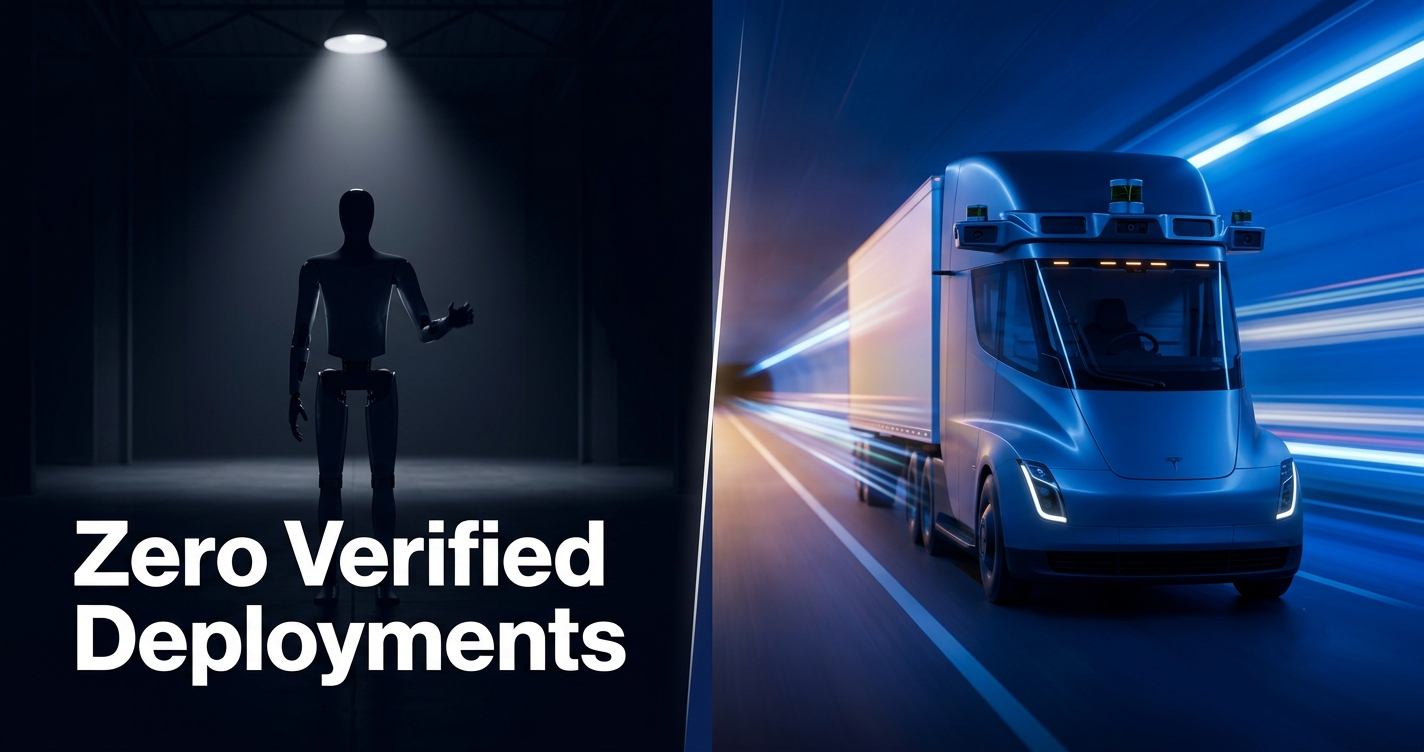
Somewhere in your organization, someone is drafting a board slide with a picture of a Waymo van hauling freight and a Tesla Optimus stacking a shelf. Neither image is true. Waymo exited trucking operations in 2023. Tesla’s own CEO confirmed in January 2026 that existing Optimus units were doing no productive factory work at all. The autonomous supply chain is real and it is already running, just not where the headlines point.
The companies actually moving freight without a driver and putting robots to paid work in warehouses today are Aurora Innovation and Agility Robotics, two names most executive teams have not put in front of the board yet. If you run logistics, supply chain, or operations for an enterprise, that gap between perception and reality is the thing you need to close first, before you write a single line of automation strategy.
The headline correction that matters: Waymo Via paused its own freight operations in 2023 and now only licenses its self-driving stack to Daimler Trucks. It does not haul freight. Tesla’s Optimus has zero verified productive commercial deployments as of the January 2026 earnings call. If your automation roadmap is anchored to either company’s warehouse or freight timeline, it’s anchored to the wrong evidence.
The trucks already driving themselves
Aurora Innovation is the only company running fully driverless commercial trucks, no human behind the wheel, on U.S. public roads today. Since launching on the Dallas to Houston stretch of I-45 in April 2025, Aurora has logged more than 250,000 incident-free driverless miles, and the company is targeting more than 200 trucks running across the Sun Belt by the end of 2026. (Aurora’s CFO disclosed that figure directly, worth noting given the company has an obvious interest in the number sounding impressive.)
The proof this is more than a pilot came on May 6, 2026, when Aurora announced a commercial deal with McLane Company, one of the largest private fleets in the country, to run driverless trucks on that same Dallas to Houston corridor for food distribution. TechCrunch reported that the trucks operate autonomously without a human safety driver able to take over, though Aurora still uses a human observer in the cab under an agreement with OEM partner Paccar. McLane is running a hybrid model: automation for the long middle mile, human drivers for final delivery. That’s the template worth studying if you’re building a network design for 2027.
Aurora isn’t alone. Kodiak Robotics runs the largest driverless Class 8 fleet in the Permian Basin and is targeting highway deployment in the second half of 2026. Gatik was the first company in North America to run fully driverless delivery trucks at commercial scale, with more than 60,000 orders and $600 million in contracted revenue. Bot Auto’s CEO, Xiaodi Hou, put it bluntly: the company built commercial freight on public roads with no human in the cab or remote driving, not a demonstration.
Company
Status, mid 2026
Notable partner or contract
Aurora Innovation
Driverless, commercial, expanding
McLane, Hirschbach (500 trucks ordered)
Kodiak Robotics
Driverless in Permian Basin, highway rollout targeted H2 2026
Oil field logistics
Gatik
Driverless at commercial scale
60,000+ orders, $600M contracted revenue
Bot Auto
Commercial freight, no human in cab
Public road operations
Waymo Via
Paused since 2023, licensing only
Daimler Trucks (technology partner)
Waymo’s absence from the operating column is the point. Its 2020 partnership with Daimler continues, but in a scaled-back, technology-licensing form. Daimler’s own statement confirms Waymo shifted its focus to ride hailing while continuing to support the technical development of Daimler’s autonomous truck platform. Waymo’s real 2026 scale story is robotaxi, not freight.
The robots already earning a paycheck
If there’s a company actually stacking shelves and moving totes for a paycheck, it’s Agility Robotics, not Tesla. Its bipedal robot, Digit, is the only humanoid currently generating revenue from paying commercial customers, according to The Robot Report’s inaugural RBR50 award. Confirmed live deployments include Amazon (testing at a robotics R&D site since 2023), GXO Logistics (a live multi-year deployment for Spanx), Schaeffler Group, and Toyota Motor Manufacturing Canada, which announced a tote loading and unloading deployment in February 2026.
Agility is going public through a SPAC merger with Churchill Capital Corp XI, announced June 24, 2026, which would make it, according to GeekWire’s reporting, the first publicly traded U.S. company dedicated solely to humanoid robots.
Amazon’s own robot fleet, mostly non-humanoid, is the more instructive story for most enterprises. The company’s robot count is approaching parity with its 1.5 million human employees. Sequoia speeds up inventory storage and identification by as much as 75%. Sparrow, a robotic picking arm, can handle roughly 65% of Amazon’s catalog. Notably, Amazon cut more than 100 robotics division staff in March 2026 even while expanding its automation spending, a sign of internal restructuring rather than a clean, linear scale-up.
“Purpose-built warehouse robots accumulate vast operational experience in the environments they are designed to serve. They know the warehouse floor because they have worked it.”
Denis Niezgoda, Chief Commercial Officer, Locus Robotics, in Logistics Business, March 17, 2026 (source)
Where Tesla’s Optimus actually stands
On the January 2026 earnings call, Elon Musk confirmed that existing Optimus units were performing no productive factory work. Production of the next generation, Gen 3, only begins at Fremont in July and August 2026, after Tesla dismantles the Model S and X line to make room. Musk himself said it was literally impossible to predict the 2026 production rate.
An April 2026 deployment tracker from New Market Pitch was direct about it: Tesla Optimus has zero external customers and zero verified productive factory deployments, in contrast to Figure AI, which is running at BMW’s Spartanburg plant with more than 1,250 operational robot hours logged across 30,000 cars produced, and Agility’s Digit, which is already inside Fortune 500 warehouses.
That doesn’t mean humanoids are a dead end. Unitree’s G1 is commercially available now for around $16,000 and shipped roughly 5,500 of the estimated 14,600 humanoid units shipped worldwide in 2025, the largest single share. 1X Technologies’ NEO starts U.S. deliveries in late 2026 at $20,000 or a $499 monthly subscription. China is moving faster on procurement volume than the U.S.: Morgan Stanley raised its 2026 China shipment forecast from 28,000 to 50,000 units, and State Grid alone procured roughly $940 million worth of humanoid, dual-arm, and quadruped robots. If you’re benchmarking competitive pressure, China’s commercial order volume, not Tesla’s marketing calendar, is the number to watch.
How big is this, really
Ask two investment banks how big the humanoid robot market will be and you’ll get numbers 130 times apart, which tells you how immature this forecasting still is. Goldman Sachs projects $38 billion by 2035, revised up sixfold from an earlier $6 billion estimate. Morgan Stanley projects $5 trillion by 2050 for the full humanoid ecosystem, implying roughly one robot for every ten humans on the planet. Neither number should be treated as fact; both should be treated as a range that reflects genuine disagreement about adoption speed, not a settled forecast.
The more grounded number, and arguably the most important one in this entire story, comes from Gartner: only 3 to 5% of warehouses globally currently run fully automated systems. That’s the real headline for a logistics VP. The window for competitive advantage in automation is nowhere near closed. Most of the industry hasn’t started.
Autonomous trucking has a tighter, more credible market picture. The sector reached $2.7 billion in 2024 and is projected to grow at a 32% compound annual rate to $42.6 billion by 2034. Separately, the industry could face a shortage of more than 1.4 million drivers, though that figure comes from an industry market report rather than a government source and should be read as a directional estimate, not a verified count.
The regulatory fight nobody’s briefing the board on
Every driverless freight roadmap assumes uniform legal treatment across states. It doesn’t have that, and the gap is widening. California’s A.B. 316 would bar autonomous trucks over 10,000 pounds from operating without a human on board and freeze CHP and DMV permitting until 2029. Kentucky already passed a law requiring human operators in autonomous trucks over 62,000 pounds through July 2026. Illinois Teamsters, backed by a January 2026 Impact Research poll showing nearly two thirds of Illinois voters oppose driverless cars or trucks on state roads, and 78% specifically oppose driverless heavy trucks, are actively fighting the state’s Autonomous Vehicle Pilot Project Act.
“Hundreds of thousands of Teamsters turn a key for a living, so we are fiercely committed to working with Congress and federal regulators to get AV policy right. Strong federal AV policies must prioritize both workers and safety.”
Sean O’Brien, General President, International Brotherhood of Teamsters (source)
A multi-state logistics network cannot plan around a single national timeline. It has to plan around a patchwork, and that patchwork is being written into law right now, not debated in theory.
The case against moving too fast
Not everyone thinks the humanoid wave is close. Gartner’s research is blunt: current humanoid models don’t have the dexterity, intelligence, or adaptability for day to day warehouse tasks like SKU picking, trailer unloading, or exception handling, and most production deployments over the next couple of years will stay confined to tightly controlled environments. Gartner’s own recommendation is to look at polyfunctional, non-humanoid robots as the nearer-term winner.
Niezgoda’s argument from Locus Robotics cuts the same direction from a competitor’s seat: warehouses are messy, stochastic environments, congestion, mixed SKUs, shifting priorities, human variability, peak swings that don’t show up in lab conditions, and that’s exactly the terrain purpose-built robots have spent years learning while humanoids are still catching up. DHL’s Tim Tetzlaff offers the cleanest test for separating real deployment from demo: innovation is only real when it’s scaled, otherwise it’s just a nice idea. By that test, Aurora and Agility pass. Tesla’s current Optimus program does not, yet.
What logistics leaders should do this quarter
The realistic decision in front of most operators isn’t whether to buy a humanoid robot. It’s whether to pilot a middle-mile driverless freight lane, Aurora, Kodiak, and Gatik style hub-to-hub routes, and narrow, task-specific automation like tote handling and SKU picking, rather than chasing a general-purpose humanoid before the dexterity gap closes.
Study the Aurora-McLane hybrid model before committing capital to a humanoid pilot Gartner says isn’t warehouse-ready.
Map state-by-state regulatory exposure now. California, Illinois, and Kentucky are not edge cases, they’re the pattern.
Separate the freight timeline from the humanoid timeline in every board presentation. Conflating Aurora’s real mileage with Tesla’s production promises is a credibility risk for whoever is presenting.
Korhan Acar, a partner at Kearney and lead author of the 2026 State of Logistics Report, frames the moment this way:
“We have reached a genuine turning point in the autonomous era. The companies that will lead are those combining resilience, intelligent logistics and disciplined execution to protect margins and outperform in an increasingly volatile world.”
Korhan Acar, Partner, Kearney, via FreightWaves
That report also puts U.S. business logistics costs at $2.4 trillion in the most recent year, 7.8% of GDP, down from $2.6 trillion the year before. Enterprise software is already moving to meet this: SAP’s Autonomous Supply Chain Management suite began phased general availability in 2026, embedding agents directly into warehouse and transportation execution.
Frequently asked questions
Is Waymo doing freight or trucking?
Not directly. Waymo paused its own autonomous trucking operations in 2023 to focus on robotaxi service. It remains a technology partner to Daimler Trucks, licensing its self-driving system rather than operating freight itself.
Are Tesla’s robots working in warehouses yet?
No. As of Tesla’s January 2026 earnings call, Elon Musk confirmed existing Optimus units were performing no productive factory work. Production of a new generation only began at Fremont in mid-2026, with meaningful external deployment not expected before 2027.
Which companies actually have driverless trucks on public roads?
Aurora Innovation, Kodiak Robotics, Gatik, and Bot Auto currently operate trucks without a human driver behind the wheel on U.S. public roads, mostly in Texas and the Sun Belt, under commercial contracts with shippers including McLane and Hirschbach.
What percentage of warehouses are fully automated?
Only about 3 to 5% of warehouses globally currently run fully automated systems, according to Gartner data, meaning most of the industry has not yet adopted large-scale robotics despite the attention automation gets in the press.
How big is the humanoid robot market expected to become?
Estimates vary widely. Goldman Sachs projects $38 billion by 2035, while Morgan Stanley projects $5 trillion by 2050 for the full ecosystem including services. The wide gap reflects real uncertainty about how fast adoption will actually move.
Is Amazon using humanoid robots?
Amazon has tested Agility Robotics’ Digit for tote recycling at an R&D facility since 2023, but its primary automation fleet, Sequoia, Sparrow, and Proteus, is non-humanoid. Amazon has not deployed humanoids at full production scale.
Where this goes next
The autonomous supply chain isn’t a future event. It’s running today, on a Dallas to Houston freight lane and inside a handful of Fortune 500 warehouses, just under names that don’t generate headlines the way Waymo and Tesla do. Watch three things over the next 6 to 18 months: whether Aurora hits its 200-truck target without a state regulatory reversal, whether Agility’s public listing brings the transparency (and investor pressure) to prove Digit’s economics at scale, and whether Tesla’s Gen 3 Optimus production run turns into a single verified commercial deployment. Until then, build your roadmap on the companies with logged miles and signed contracts, not the ones with the biggest marketing budget.
Smart Buildings Cost More to Build, Save More to Run | NeuralWiredEnterprise IoT / Building Technology
Smart Buildings Cost More to Build, Save More to Run
The construction premium is real. So are the operating savings. But the numbers making the rounds online are not the ones you should be putting in front of your CFO.
A facilities director at a 400,000 square foot distribution center gets a vendor deck promising a smart building stack that costs 12% more to build and saves 34% on operations. It’s a clean pitch. It’s also a number nobody can source. Here’s what the verified data on smart building ROI actually says, and why the real figures make a stronger capex case than the viral ones.
Enterprise IoT has moved past thermostats and motion sensors. In 2026, a “smart building” means IoT sensors, AI models, digital twins, and centralized automation platforms working together to run HVAC, lighting, access control, and life safety systems as one coordinated system rather than a dozen disconnected ones, according to Cohesion’s 2026 industry outlook. That shift is why CFOs who used to treat this spend as a discretionary nice-to-have are now underwriting it like any other capital project, with a payback period and an IRR attached.
About that 12%/34% number. It’s circulating widely in industry content right now, but we ran it against Turner Construction’s Green Market Barometer, a 2024 Journal of Cleaner Production meta-analysis, USGBC benchmarking data, and half a dozen other primary sources. None of them produce that specific pairing. It appears to be a rounded composite, not a citable finding. The real ranges below are less punchy and considerably more defensible in front of a skeptical CFO.
What It Actually Costs to Build a Smart Building
The honest answer is: it depends almost entirely on whether you’ve done this before.
A 2024 meta-analysis published in the Journal of Cleaner Production, covering dozens of green and smart building projects, put the average construction premium at 1.5% to 8% above conventional construction, with a median of roughly 2.5% for LEED Gold equivalent performance, according to reporting from Sustainability Atlas. That’s a fraction of the 12% figure floating around online.
Experience is the variable that moves the needle. Developers who’ve done multiple certified projects report premiums of 0% to 2%. First-time certifiers, still learning the supply chain and the permitting process, see 5% to 10%. Turner Construction’s 2024 Green Market Barometer backs this up: 69% of respondents reported premiums of 5% or less, and nearly a third reported no premium at all for LEED Silver or equivalent.
Developer profile
Typical construction premium
Repeat, experienced developer
0% to 2%
Average across all projects (meta-analysis median)
~2.5%
First-time certifier
5% to 10%
High-end, full smart-stack integration (upper bound)
up to 10%
So where does 12% come from? Probably nowhere specific, it’s the kind of number that sounds right for a first-time developer doing a platinum-tier build, rounded up for effect. If you’re pitching a project internally, cite the meta-analysis range instead. It survives a fact-check.
What Smart Systems Actually Save
This is where the technology earns its keep, and where the real numbers are, if anything, more interesting than the invented ones.
A 2025 academic review of AI adoption in real estate and facilities management found operational costs dropping 17.6%, maintenance costs down 13.2%, and energy savings around 14%, based on a synthesis of AI tools already deployed across commercial portfolios, per the ScienceDirect study. Lawrence Berkeley National Laboratory research, cited by Albireo Energy, goes further: buildings using analytics platforms have cut energy consumption by up to 50% under favorable conditions, though that figure comes from a secondary citation and hasn’t been traced back to the original LBNL publication, so treat it as a ceiling, not an average.
Occupancy intelligence specifically, the sensors that tell a building who’s actually using which floor and when, has its own separate payoff. Cohesion’s 2026 analysis found that space-utilization insights from occupancy sensors typically reduce real estate space costs by 20% to 35%, and predictive maintenance driven by early fault detection cuts maintenance expenses 10% to 15% while reducing unplanned outages by 20% to 30%.
Add it up and a realistic, source-backed range looks like this: 14% to 30%+ in operating savings depending on how many systems you actually integrate, not a flat 34% regardless of scope. The strongest ROI, per Cohesion, comes from multi-system coordination rather than bolting on a single point solution. Integrated programs typically pay back in two to four years; a standalone smart lighting retrofit can pay back in under 18 months.
The Named Cases That Prove It
Numbers from a meta-analysis are useful. Numbers from a real building with a name on it are more convincing.
Amazon piloted AI-powered building optimization across three grocery fulfillment centers and cut energy use by almost 15%, according to Trane Technologies. Dollar Tree rolled AI-driven HVAC and connected building technology across 600 stores and saved close to 8 million kWh of electricity and more than a million dollars in costs, same source. And 55 Water Street in New York has used continuous AI analysis and automatic HVAC adjustment to cut energy consumption by over 60% since 2010, generating up to $1.5 million in annual utility savings, though that’s a cumulative figure across sixteen years, not a single-year result from one software rollout, so don’t mistake it for an annual run rate.
Then there’s The Edge in Amsterdam, developed by OVG Real Estate, still the flagship case study for this entire category. The 430,000 square foot building uses 70% less energy than a typical office, runs on rooftop solar and aquifer thermal storage, and packs in 30,000 internet-connected sensors for granular occupancy control, according to Sustainability Atlas. Construction premium: 5% to 7%. It reached full occupancy within months and now commands rental premiums around 15% above comparable buildings nearby. That’s the actual shape of the business case, real premium, real payback, real rent uplift, not a headline stat with no source attached.
Who’s Selling This Stack
Three platforms dominate the enterprise conversation right now: Honeywell Forge, Johnson Controls OpenBlue, and Siemens Building X.
Honeywell Forge is the company’s enterprise performance management layer, designed to sit on top of existing building infrastructure and create a continuous loop between data and control, according to Energy Digital. Johnson Controls has taken a different commercial approach with OpenBlue: its “Net Zero Buildings as a Service” model lets owners decarbonize without spending capital upfront, paying instead out of the energy savings the system generates, which is itself a tell that capex approval has historically been the bottleneck in this market.
“AI in buildings is a game-changer.”
Billal Hammoud, President and CEO, Honeywell Building Automation, via Technology Magazine
Kevin Dehoff, Honeywell’s Chief Strategy Officer, frames the shift in similar terms, arguing that building operations are digitalizing at a pace that requires deeper integration between systems that used to run independently. Worth remembering: both executives run business units that profit directly from this exact stack getting adopted, so weigh the enthusiasm accordingly.
The Problem Nobody Puts in the Vendor Deck
Every year the industry pours more money into connected building technology. Every year there’s a gap between the ROI in the pitch and the ROI that shows up on the operating statement. Why does that gap keep reappearing even as the technology improves?
According to Fred Gordy, a building cybersecurity and OT risk expert at KMC Controls who sits on the ISA 99 committee behind the ISA/IEC 62443 standard, the failure usually isn’t technical at all. Speaking on Memoori’s podcast alongside Rob Murchison of Intelligent Buildings, Gordy argued that the actual cause is unmanaged risk, weak governance, and unclear ownership, long before the software has a chance to underperform.
“The real villain is somewhere else entirely.”
Fred Gordy, KMC Controls, ISA 99 Committee, via the Memoori Podcast
Gordy’s diagnostic for any owner considering this spend comes down to three questions: do you know what devices you have, do you know how they’re networked together, and do you know who has access to them. Per the same conversation, most owners can’t answer any of the three. Murchison added that the fix usually isn’t expensive tooling, it’s that nobody in the organization has been assigned to ask those questions in the first place.
That governance gap has real teeth. Roughly 80% to 90% of owners have effectively outsourced OT risk decisions to their vendors by default, according to the same podcast, which means the vendor is making day-to-day security calls the owner never actually authorized. Cohesion’s own 2026 outlook, an optimistic industry source by any measure, still concedes that about a third of operators have experienced security incidents ranging from minor device compromise to major disruptions. More connected systems mean a wider attack surface, full stop. That’s the tradeoff nobody puts on slide one.
Our read: the technology is no longer the bottleneck in this category. The bottleneck is that most organizations buying it haven’t assigned a single person to own the risk questions Gordy is asking. That’s a fixable, unglamorous problem, which is probably why it doesn’t make it into the sales deck.
Frequently Asked Questions
How much does it cost to build a smart building compared to a conventional one?
Verified research puts the construction premium at roughly 1.5% to 10% above conventional construction, with a meta-analysis median near 2.5% for LEED Gold equivalent performance. Premiums run highest for first-time developers (5% to 10%) and lowest for experienced, repeat developers (0% to 2%).
How much can IoT and AI reduce a building’s operating costs?
Documented reductions range from about 14% to 30% for energy costs depending on which systems are integrated, with maintenance costs typically down 10% to 17.6%. Some analytics-driven studies cite savings up to 50% under specific, favorable conditions, though that figure should be treated as a ceiling, not a typical outcome.
What’s the payback period for smart building technology?
Integrated, multi-system smart building programs typically pay back in two to four years. Single point solutions, like standalone smart lighting or occupancy sensors, often pay back in under 18 months. The strongest returns come from coordinating multiple systems rather than upgrading one in isolation.
What’s the biggest risk with smart building technology?
According to building risk experts, the biggest threat to ROI isn’t the technology itself, it’s weak governance: unclear device inventories, unclear network topology, and unclear access control. Most owners can’t fully answer what they own, how it’s connected, or who can reach it.
What This Means Going Forward
The smart building pitch doesn’t need an inflated headline number to work. The real data, a 1.5% to 10% build premium against 14% to 30%+ in ongoing operating savings, backed by named cases like Amazon, Dollar Tree, and The Edge, is already a strong capital allocation case on its own. Lenders and asset managers are starting to price the absence of these systems as a risk factor, not a neutral choice, which tells you where this is headed over the next 18 months.
Three things worth watching: whether “as-a-service” financing models like Johnson Controls’ Net Zero Buildings offering become the default way this gets purchased, whether governance frameworks catch up to the pace of IoT deployment before a major building-security incident forces the issue, and whether the market-size forecasts (which range from $89 billion to $175 billion for 2026 alone, depending on which research firm you ask) start converging as scope definitions standardize.
If you’re the one building the capex model, skip the viral stat. Cite the range, name the source, and let Gordy’s three questions be part of the sign-off checklist, not an afterthought.
RPA vs Intelligent Automation: Why Most Bots Died by 2026
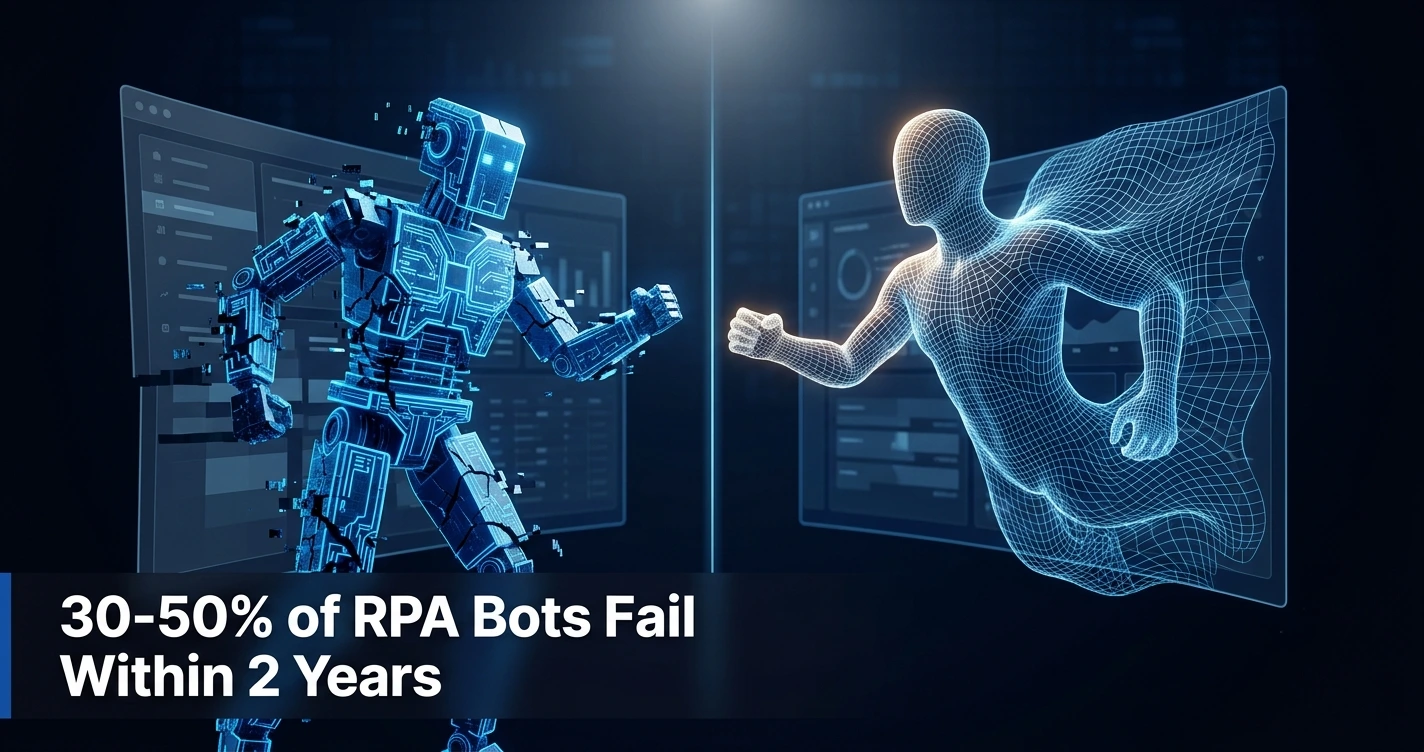
Somewhere in your company right now, an RPA bot is failing silently because a vendor moved a button. It happens to 30 to 50 percent of RPA deployments within roughly two years, according to research widely cited by EY, and it’s the reason “RPA vs intelligent automation” has become the question every automation leader is asking in 2026. The short version: RPA automates clicks, intelligent automation automates judgment, and the gap between those two things is where enterprise budgets are currently bleeding out.
This isn’t a hype piece about agents replacing everything. It’s the opposite. The data on agentic AI’s own failure rate is arguably worse than RPA’s. If you’re a CTO, VP of Automation, or enterprise architect deciding whether to patch, migrate, or kill your existing bot fleet, here’s what the numbers actually say.
What Actually Changed Between RPA and Intelligent Automation
Robotic process automation was built for a world that no longer exists. It emerged in the early 2010s as a way to automate repetitive desktop work without needing API access. Bots clicked buttons and typed into fields exactly where a human would, reading fixed screen coordinates like a script memorized by rote. That worked fine when enterprise software interfaces stayed still for years at a time.
They don’t anymore. SaaS vendors now push UI updates continuously. A single moved button, renamed field, or redesigned login screen can be enough to break a bot that took months to build. Intelligent automation, sometimes bundled under the term “hyperautomation,” layers machine learning, natural language processing, and increasingly agentic reasoning on top of that same automation goal, so a system can interpret unstructured data and adjust when the interface underneath it changes.
Up to 40 percent of agentic projects forecast for cancellation by 2027
Why Do RPA Bots Break So Often?
Because they were never actually reading the software they automated. A traditional bot doesn’t know what a “submit” button is; it knows that a button exists at pixel coordinates 412, 220. Change the layout and the bot is blind. Multiply that fragility across every vendor portal, browser update, and internal application a large enterprise touches, and you get a maintenance problem that scales with how often other people’s software changes, not with how well your team built the bot in the first place.
The number that anchors this whole story: Research cited widely across the automation industry, originating with EY, puts RPA project abandonment at 30 to 50 percent within roughly two years of deployment. It’s the most repeated failure statistic in the category, and it’s the reason “RPA is dead” headlines keep resurfacing every year since 2022.
The Hidden Cost Nobody Budgets For
Here’s the part most vendor pitches leave out. According to HfS Research, software licensing represents only 25 to 30 percent of an RPA program’s total cost of ownership. The remaining 70 to 75 percent goes to implementation, governance, training, and ongoing maintenance, much of it driven directly by the UI-breakage problem described above. Separate industry estimates put annual maintenance alone at 15 to 20 percent of the original investment, every single year, indefinitely, for as long as the bot fleet stays in production.
That’s the real story behind “RPA vs intelligent automation.” It was never really about which technology looks more impressive in a demo. It’s about which one has a cost structure your finance team can actually plan around.
Agent Washing: The Term You Need to Know
Gartner coined a phrase in 2025 that every buyer in this market should know before their next vendor call: agent washing. It describes legacy RPA and chatbot tools getting rebranded as “AI agents” without any genuine planning, reasoning, or autonomous capability behind the label. Gartner’s own estimate suggests only a small fraction of vendors claiming agentic AI, roughly 130 out of thousands making the claim, actually deliver it.
That matters because it means a meaningful share of what enterprises think they bought as “intelligent automation” in 2025 and 2026 is architecturally identical to the RPA they were trying to replace, just with a chat interface bolted on top.
UiPath’s Own Numbers Tell the Real Story
If you want proof that the market leader itself sees this as evolution rather than a clean break, look at UiPath. The company reported fiscal 2026 annual recurring revenue of $1.853 billion, up 11 percent year over year, and followed it with first-quarter fiscal 2027 growth of 12 percent to $1.901 billion. It was also UiPath’s first full fiscal year of GAAP profitability, a sharp turn from a stock that once traded near 50 times revenue at its 2021 IPO peak before resetting to roughly 3 times trailing revenue by early 2026.
“Deterministic automation, agentic AI, and enterprise-grade orchestration together on a single platform… the execution layer enterprises trust to run mission-critical processes in the agentic era.”
Daniel Dines, Founder & CEO, UiPath, Q4 FY2026 earnings release, March 11, 2026
Notice what Dines didn’t say: that agents replace RPA. He described a platform that keeps deterministic (rule-based, RPA-style) automation and adds agentic reasoning on top, which UiPath reinforced by acquiring compliance-focused AI agent vendor WorkFusion in February 2026. That’s the bellwether pattern showing up across the industry: augmentation, not replacement.
The Skeptics: Why Agentic AI Isn’t a Clean Fix Either
This is the part the optimistic version of this story tends to skip. If RPA’s failure rate is the villain, agentic AI’s own numbers should give you pause before you treat it as the hero.
The MIT NANDA initiative’s August 2025 study, based on an analysis of 300 public AI deployments, 150 executive interviews, and a broader employee survey, found that 95 percent of enterprise generative AI pilots fail to deliver measurable profit-and-loss impact. Only around 5 percent make it to production with measurable value. Gartner, separately, forecasts more than 40 percent of agentic AI projects will be cancelled by the end of 2027, citing rising costs, unclear business value, and thin risk controls.
Roughly 80 percent of organizations report AI-driven workforce reductions that have not translated into measurable returns.
Helen Poitevin, Distinguished VP Analyst, Gartner, press release, May 5, 2026
Poitevin’s research, drawn from a Gartner survey of 350 global executives at companies with over $1 billion in revenue, argues that autonomous business initiatives may actually create more work for people over time, not less, partly because of demographic shifts and because trust-dependent customer interactions still need a human behind them. That’s a direct counterweight to any pitch that frames agents as a headcount-reduction shortcut.
Then there’s the researcher who helped build the foundations of this technology in the first place.
Agents are “cognitively lacking” and current agentic output amounts to “slop,” with roughly a decade of work needed before the reliability issues are resolved.
Andrej Karpathy, Co-founder, OpenAI, Dwarkesh Podcast, reported October 2025
Karpathy’s critique lines up with a structural problem in how multi-step agents actually fail. Reliability compounds multiplicatively across steps: an agent that’s 95 percent reliable on any single step only completes a ten-step workflow successfully about 60 percent of the time. Drop per-step reliability to 85 percent, and full-workflow success falls to roughly 20 percent. Forrester’s 2026 research adds another wrinkle, finding that more than half of enterprises experience what it calls “agentic sprawl,” overlapping systems, duplicated work, and unpredictable agent behavior, even when governance frameworks are already in place.
McKinsey’s 2026 AI Trust Maturity survey backs this up from a different angle: 51 percent of organizations have already experienced at least one negative AI consequence, most commonly inaccuracy, and only around 30 percent have reached a mature level of governance over agentic systems. An agent that takes a wrong real-world action is a fundamentally different risk than a chatbot that gives a wrong answer.
What Automation Leaders Should Actually Do in 2026
Given both failure rates, wholesale replacement of one brittle bet with another brittle bet isn’t a strategy. The pattern showing up across 2026 research, and in UiPath’s own product direction, points somewhere more boring and more useful: agents handle judgment and unstructured data, RPA scripts still handle the repetitive execution underneath them.
Audit before you migrate. Separate stable, well-built bots from what one analyst community calls “graveyard bots,” the ones already degraded or half-broken. Don’t spend agentic-AI budget rescuing scripts that were dying anyway.
Demand evidence, not marketing language. Given how common agent washing is, ask vendors for governance certifications such as ISO/IEC 42001 or independent benchmark evidence, not just the word “agentic” in a slide deck.
Budget for maintenance either way. Agentic systems have their own failure modes, hallucination, permission sprawl, multi-step reliability collapse, that are different from RPA’s UI-brittleness, not absent from the category entirely.
Treat this as an architecture decision, not a swap. Gartner’s forecast that AI agent software spending will climb from $86.4 billion in 2025 to $206.5 billion in 2026 and $376.3 billion in 2027 means capital is moving fast. Moving fast is not the same as moving safely.
Gartner’s own Hype Cycle for Agentic AI, published April 2026, places the technology somewhere between the Peak of Inflated Expectations and the Trough of Disillusionment. Translation: this is exactly the phase where over-promised deployments get cancelled before real production maturity shows up. Genuine architectural gains exist for unstructured data and exception handling. A universal, drop-in replacement for RPA on a 2026 timeline does not.
Frequently Asked Questions
What is the difference between RPA and intelligent automation?
RPA uses rule-based bots that click through fixed screen coordinates to mimic human actions, breaking whenever a UI changes. Intelligent automation combines RPA with AI, including machine learning, natural language processing, and increasingly agentic reasoning, so systems can interpret unstructured data and adapt when interfaces or inputs change.
Why do RPA bots break so often?
Traditional RPA bots are scripted against fixed screen coordinates, button positions, and field names. When a vendor updates a UI, even by moving one button, the bot can no longer find the element it needs and fails. That fragility is a major reason 30 to 50 percent of RPA projects get abandoned within about two years.
What percentage of RPA projects fail?
Widely cited industry research puts RPA project abandonment at 30 to 50 percent within roughly two years of deployment. Separately, HfS Research found licensing is only 25 to 30 percent of total RPA cost of ownership, with the rest going to implementation, governance, and maintenance driven largely by UI-breakage fixes.
Is agentic AI replacing RPA in 2026?
Not wholesale. Gartner reports only 17 percent of enterprises had deployed AI agents as of early 2026, and forecasts over 40 percent of agentic AI projects will be cancelled by 2027. Most enterprises are layering agents for judgment and unstructured data on top of existing RPA rather than fully replacing it.
How much does RPA maintenance really cost?
According to HfS Research, software licensing represents only 25 to 30 percent of RPA’s total cost of ownership. The remaining 70 to 75 percent covers implementation, governance, and maintenance, much of it driven by bots breaking when interfaces or vendor portals update. Annual maintenance alone commonly runs 15 to 20 percent of the original investment.
What is agent washing?
Agent washing is Gartner’s term for vendors rebranding existing RPA tools or basic chatbots as AI agents without genuine agentic capability, meaning real planning, reasoning, and autonomous multi-step action. Gartner estimates only a small fraction of vendors claiming agentic AI, roughly 130 out of thousands, actually offer it.
Where This Goes Next
The honest read on RPA vs intelligent automation in 2026 isn’t that one technology won and the other lost. It’s that both have documented, well-measured failure rates, and the enterprises pulling ahead are the ones treating this as portfolio management instead of a technology upgrade. RPA isn’t dead. It’s being absorbed into something larger, the same way UiPath itself absorbed WorkFusion instead of walking away from its own RPA heritage.
Watch three things over the next 6 to 18 months: whether Gartner’s 40-percent agentic-project cancellation forecast actually plays out by 2027, whether more RPA vendors follow UiPath’s earnings pattern toward profitability as they add agentic layers, and whether governance standards like ISO/IEC 42001 become a real purchasing requirement instead of a nice-to-have. The winners in this category won’t be the ones with the flashiest agent demo. They’ll be the ones who can prove, with a paper trail, that their automation actually works in production and not just in a sales pitch.
Want the next research-backed breakdown before it hits the feed? Subscribe to The Neural Loop at neuralwired.com/newsletter.
91% of Enterprises Aren’t Ready for Quantum-Safe Migration
Cybersecurity / Enterprise IT
91% of Enterprises Aren’t Ready for Quantum-Safe Migration
NIST finalized its post-quantum encryption standards two years ago. Government deadlines start hitting in January 2027. And most security teams still haven’t mapped where their own vulnerable encryption lives.
By NeuralWired Staff · Updated July 2026 · 11 min read
Somewhere in your infrastructure right now is a TLS certificate, a VPN tunnel, or a code-signing key protected by encryption that a sufficiently powerful quantum computer will eventually break. You probably don’t know exactly where. Neither does most of the industry.
That’s the uncomfortable starting point for quantum-safe encryption migration, the multi-year project of replacing RSA and elliptic-curve cryptography with algorithms designed to survive an attack from a quantum computer. The National Institute of Standards and Technology (NIST) finalized the first official post-quantum cryptography (PQC) standards back in August 2024. Two years later, the vast majority of enterprises haven’t started implementing them, even as the first hard regulatory deadlines approach.
The number you’ll see everywhere isn’t real. A widely circulated claim that “78% of enterprise IT teams haven’t started migration” doesn’t trace back to any known survey. The closest verified figures: 91% of surveyed cybersecurity professionals say their organization has no roadmap for quantum threats (Trusted Computing Group), and only 5% have actually implemented quantum-safe encryption (DigiCert). Both numbers are arguably worse than 78%, and both are attributable.
On August 13, 2024, NIST released the first three finalized post-quantum cryptography standards, capping an eight-year public evaluation process that started with a 2016 call for proposals. The agency describes them as designed to resist attacks from quantum computers that would otherwise threaten the encryption protecting everything from confidential email to e-commerce transactions.
Three standards, three jobs:
Standard
What it does
Based on
FIPS 203
Key exchange (ML-KEM)
CRYSTALS-Kyber
FIPS 204
Digital signatures (ML-DSA)
CRYSTALS-Dilithium
FIPS 205
Backup signature scheme (SLH-DSA)
SPHINCS+
A fourth algorithm, FALCON, is still working its way toward publication as FIPS 206. NIST added a fifth, HQC, in March 2025 as a non-lattice-based backup, in case a future breakthrough finds a weakness in the lattice math that FIPS 203 and 204 depend on. Redundancy by design, not an afterthought.
Dustin Moody, the mathematician who leads NIST’s PQC project, put the urgency plainly at the time of release:
“We encourage system administrators to start integrating the new standards into their systems immediately, because full integration will take time.”
Dustin Moody, NIST PQC Project Lead, 2024
That quote is now two years old. It hasn’t aged into irrelevance. It’s aged into an indictment.
The readiness gap, in real numbers
Here’s what enterprise quantum readiness actually looks like right now, pulled from the surveys with disclosed methodology and sample size:
91% of surveyed cybersecurity professionals say their organization has no roadmap to defend against quantum threats, according to the Trusted Computing Group’s State of PQC Readiness report, based on 1,500 professionals across the US and Europe.
81% of professionals in the same TCG survey believe their current crypto-libraries and hardware security modules aren’t ready for the migration at all.
46.4% of organizations admit that substantial portions of their encrypted data could be exposed once a cryptographically relevant quantum computer exists.
Across a 2026 internet-wide scan of 32,011 domains, hybrid post-quantum TLS certificate adoption came back at effectively zero, meaning the certificates authenticating most public websites remain entirely classical.
The “actively transitioning” figure you’ll sometimes see quoted at 40% (from a 2026 Entrust/Ponemon study) is technically accurate but softer than it sounds. It includes planning and risk-assessment work, not completed deployment. Don’t let a vendor deck blur that line for you. Assessment isn’t migration.
IBM’s Quantum-Safe Readiness Index, cited widely in industry roundups, puts the average enterprise score at 25 out of 100. Useful directionally. Less useful as a rigorous benchmark, since IBM hasn’t published transparent, peer-reviewable methodology behind that number the way TCG and DigiCert have for theirs.
Why the timeline suddenly feels shorter
Here’s the part that should actually change your planning horizon. Google researchers published work in early 2026, reported by The Register, showing that running Shor’s algorithm against elliptic curve cryptography (ECDLP-256) would require roughly 20 times fewer physical qubits than previous estimates assumed. That doesn’t hand anyone a working quantum computer. It moves the goalposts closer, and it’s a bigger deal than the 2024 NIST finalization itself, because it’s new information rather than a milestone everyone already priced in.
Google also quietly moved up its own internal target for completing its quantum-safe transition to 2029, an acceleration signal from a company with more visibility into the state of quantum hardware than almost anyone outside a national lab.
The deadlines that are actually coming
Regulatory pressure, not abstract risk, is what actually moves budget. Here’s what’s on the calendar:
January 1, 2027: Under the NSA’s CNSA 2.0 framework, all new national security system acquisitions must be CNSA 2.0-compliant by default. If you sell into the defense or intelligence supply chain, this deadline is closer than your last migration cycle took to complete.
2028: The UK’s National Cyber Security Centre wants discovery and cryptographic asset inventory work done by this date, as phase one of a three-phase roadmap.
2035: Both the US (NSM-10) and UK targets converge on full quantum-resistant deployment by this year. The White House has estimated the cost of the federal government’s own migration at roughly $7.1 billion over the 2025 to 2035 decade.
Sector-specific cost estimates make the stakes concrete. Boston Consulting Group figures cited in recent research put automotive manufacturers’ PQC transition costs at $400 to 750 million, driven by the sheer complexity of patching cryptography embedded across vehicle fleets. Manufacturing, utilities, and transportation face a comparatively modest $10 to 20 million. Your industry determines your number more than your headcount does.
Why cryptographers are betting real money against each other
If you want proof that “urgency” isn’t a settled question even among people who build this stuff for a living, look at what happened in April 2026. Cryptography engineer Filippo Valsorda argued that even if quantum computing predictions turn out wrong in a decade, the current probability that they’re right is already too high to ignore. Matthew Green, an applied cryptographer at Johns Hopkins University, publicly disagreed, and then backed it with cash:
“I think this is a good precautionary analysis but I’d bet huge amounts of money against a relevant quantum computer by 2029 or even 2035.”
Matthew Green, Associate Professor of Computer Science, Johns Hopkins University, via The Register
Green and Valsorda formalized it into a $5,000 wager: Green is betting that classical cryptanalysis, not a quantum computer, will break ML-KEM-768 first. That’s not a random internet argument. That’s a specialist who studies exactly this problem, staking real money against the mainstream urgency narrative.
Peter Gutmann, a computer science professor at the University of Auckland, has been even more direct in his skepticism, pointing out in a 2025 interview that quantum computers have yet to factor the number 35, a six-bit problem, while the elliptic curve keys underpinning most of today’s encryption run 256 bits deep. That gap, he argues, isn’t one that recent efficiency papers close on their own.
On the other side, vendors are unambiguous about what to do regardless of the timeline debate. DigiCert’s Kevin Hilscher put it this way in the company’s 2025 readiness report:
“Organizations should already be into the early phases of their quantum readiness plan, starting with asset discovery and risk assessment, with the ultimate goal of crypto-agility.”
Kevin Hilscher, Senior Director of Product Management, DigiCert
Our read: the skeptics aren’t wrong that the exact date is unknowable. They’re arguing about when the threat arrives. Nobody credible is arguing that the migration itself will be fast once it starts. That’s the part that should worry a CISO more than any doomsday date.
What security leaders should do in the next 12 months
This is not a patch cycle. It’s closer to a multi-year infrastructure overhaul, and the planning assumptions bear that out: small organizations are looking at 5 to 7 years for a complete migration, mid-sized enterprises 8 to 12 years, and large distributed enterprises 12 to 15 years or more, according to industry timelines compiled by The Quantum Insider. If your internal plan says “three years, tops,” it’s almost certainly understating the job for anything larger than a small business.
Three things to prioritize now:
1. Build the cryptographic asset inventory you probably don’t have
TLS certificates, VPN configurations, code-signing keys, HSMs, embedded firmware, and third-party vendor dependencies all need to be mapped before you can even scope a migration. Remember that 81% figure from earlier: most security teams believe their own crypto-libraries and HSMs aren’t PQC-ready, and you can’t fix what you haven’t inventoried.
2. Treat “harvest now, decrypt later” as a present-tense problem
Adversaries don’t need a working quantum computer today to benefit from one tomorrow. They can archive your encrypted traffic now and decrypt it later. Any data with a confidentiality requirement longer than roughly a decade, meaning intellectual property, health records, M&A documents, or government contract data, is already exposed under this model. That reframes the whole conversation from a future compliance deadline into a data classification exercise you should be running this quarter.
3. Prioritize crypto-agility over algorithm selection
The specific PQC algorithm you deploy first can be swapped later if your architecture is built correctly now. Betting your entire strategy on picking the “right” algorithm misses the point. Build systems that can change algorithms without a rebuild, and the rest becomes a scheduling problem instead of an existential one.
On budget, 58% of organizations surveyed by TCG plan to allocate 6 to 10% of their IT and security budget to PQC migration. Useful as an internal benchmark if you’re building the business case for headcount or spend.
A caution on the “rush” narrative: Larger key and certificate sizes plus immature implementations have already caused documented performance and interoperability problems in early PQC rollouts. The UK’s NCSC deliberately built its roadmap around a gradual, multi-phase timeline through 2035 rather than a sprint. There’s a real risk in moving faster than your vendors and your own testing can support.
Frequently asked questions
What are NIST’s post-quantum cryptography standards?
NIST finalized three post-quantum cryptography standards on August 13, 2024: FIPS 203 (ML-KEM, for encryption and key exchange), FIPS 204 (ML-DSA, for digital signatures), and FIPS 205 (SLH-DSA, a hash-based backup signature scheme). A fifth algorithm, HQC, was added in March 2025 as an additional non-lattice-based option.
How long does quantum-safe migration take for an enterprise?
Industry planning estimates range from 5 to 7 years for small organizations to 12 to 15 or more years for large, distributed enterprises, depending on infrastructure complexity, legacy dependencies, and vendor readiness.
What percentage of companies have implemented quantum-safe encryption?
A 2025 DigiCert survey found that only 5% of organizations have implemented quantum-safe encryption, despite 69% recognizing quantum computing as a risk to current encryption standards.
What is “harvest now, decrypt later”?
It describes adversaries collecting and storing encrypted data today with the intent of decrypting it once a sufficiently powerful quantum computer exists. Data that needs to stay confidential for a decade or more is already exposed under this model, regardless of when quantum computers actually arrive.
When will quantum computers break current encryption?
There’s no consensus. Estimates range from 10 to 30 years based on current error-correction and qubit-stability hurdles, while recent efficiency research suggests the window may be compressing faster than previously assumed. Experts like Matthew Green and Peter Gutmann remain publicly skeptical of near-term timelines.
Where this goes next
Two things are true at once, and the industry keeps treating them as contradictory when they’re not. Nobody knows exactly when a quantum computer capable of breaking today’s encryption will exist. And the migration required to get ahead of it takes so long that “wait and see” isn’t actually a viable strategy for any organization with data that needs to stay secret past 2035.
Watch three things over the next 6 to 18 months: whether the January 2027 CNSA 2.0 acquisition deadline actually forces national security vendors to demonstrate compliance or slips, whether Google’s 2029 internal target holds as other hyperscalers respond, and whether the Green-Valsorda wager becomes a recurring reference point as more cryptographers stake public positions on timeline.
None of that changes what you should be doing this quarter: inventory your cryptographic assets, classify your long-lived data, and build for crypto-agility before you pick a single algorithm to bet on.
A robot arm that welds car doors doesn’t need to understand what a door is. A humanoid that’s supposed to tidy a warehouse, adapt to a spill, and hand a box to a person does. That gap is why physical AI robots, humanoid systems paired with reasoning foundation models like NVIDIA’s GR00T, are pulling in more enterprise capital than almost anything else in AI right now. If you’re the one signing off on a robotics budget in 2026, the question has quietly changed. It’s no longer “which arm do we buy.” It’s “whose brain is running it.”
The Brain-Body Problem: Why Hardware Alone Never Worked
Industrial robots have been welding, painting, and palletizing for four decades. What they haven’t been able to do is generalize. A pick-and-place arm programmed for one bin geometry breaks the moment the bin changes. That’s the limit hard-coded automation always hit: every new task meant new code, new engineers, new downtime.
Between 2024 and 2026, that limit started to move. Vision-Language-Action (VLA) models, the same transformer architecture family behind large language models, got repurposed to output motor control instead of text. Instead of programming a robot for a task, you train a foundation model on a broad range of tasks and let it generalize the way GPT generalizes across writing styles. Industry shorthand calls this the split between “physical AI” (the hardware) and “cognitive AI” (the reasoning layer on top of it). The body was never the bottleneck. The brain was.
“Humanoid robots will bring physical AI to the world’s largest industries, opening a multitrillion-dollar economic opportunity.”
Jensen Huang, Founder and CEO, NVIDIA, source: NVIDIA Newsroom
Worth remembering: Huang sells the platform this quote is describing. That doesn’t make him wrong, but it’s the kind of incentive an enterprise buyer should weigh before treating vendor keynotes as market research.
Inside NVIDIA’s GR00T Platform: From N1 to the Isaac Reference Robot
NVIDIA announced Project GR00T at GTC 2024 as a foundation-model initiative for humanoid robots, paired with its Jetson Thor compute platform and built alongside partners including Boston Dynamics, Figure AI, Agility Robotics, and Unitree.
The first real release, GR00T N1, runs on a dual-system architecture modeled loosely on human cognition: a fast “System 1” for reflexive motor actions, and a slower “System 2” for deliberate planning. 1X Technologies put N1 to work running autonomous tidying tasks on its NEO Gamma robot.
By GTC Taipei on May 31, 2026, NVIDIA had moved from software release to full reference hardware: the Isaac GR00T Reference Humanoid Robot, combining a Unitree H2 Plus chassis, five-fingered Sharpa hands, Jetson Thor compute, and the Isaac GR00T software stack. Launch partners include Ai2, ETH Zurich, Stanford’s Robotics Center, and UC San Diego’s Advanced Robotics and Controls Laboratory.
“The future of humanoids is about adaptability and learning. NVIDIA’s GR00T N1 provides a significant boost to robot reasoning and skills, advancing our mission of creating robots that are not just tools, but companions.”
Bernt Børnich, CEO, 1X Technologies, source: NVIDIA Newsroom
Numbers worth a caveat: NVIDIA frequently cites a global labor shortage of more than 50 million people as the driver behind generalist robotics demand. That figure comes from NVIDIA itself, not an independent labor economist, so treat it as a vendor framing device rather than a settled statistic when you’re building an internal business case.
The Competitive Field: Helix, Gemini Robotics, and Physical Intelligence’s pi
NVIDIA isn’t operating alone in this space, and neither should your evaluation.
Figure AI’s Helix was the first VLA model to output full upper-body humanoid control, and the first to run simultaneously across two collaborating robots. Figure has since scaled BotQ, its manufacturing line, from one robot a day to one an hour, a 24x throughput jump in under 120 days, with more than 350 third-generation units shipped, according to Figure’s own technical disclosures.
Google DeepMind and Boston Dynamics partnered in January 2026 to run Gemini Robotics foundation models on Atlas, DeepMind’s contribution being the reasoning layer rather than the chassis. Boston Dynamics unveiled an electric Atlas at CES 2026 rated to lift up to 110 pounds, with 2026 fleet deployments already committed to Hyundai and Google DeepMind.
Physical Intelligence, founded out of Berkeley, Stanford, and Google DeepMind alumni, is building the “pi” model family and was reportedly in talks in March 2026 for funding that would value the company above $11 billion, roughly double its valuation four months earlier, per Bloomberg reporting via TechCrunch.
“Think of it like ChatGPT, but for robots.”
Sergey Levine, Co-founder and Chief Scientist, Physical Intelligence, source: TechCrunch, March 2026
GR00T vs. Helix vs. pi: Quick Comparison
Model
Maker
Architecture
Commercial stage
GR00T N1 / Isaac
NVIDIA
Dual-system (fast reflex + slow planning)
Platform, licensed to hardware partners
Helix
Figure AI
Single VLA, full upper-body output
In-house, running on Figure 03 units
pi (π)
Physical Intelligence
General-purpose VLA, hardware-agnostic
Pre-revenue, research-first
Notice what’s missing from that table: nobody has independently benchmarked these three against each other on the same task, same hardware, same environment. Every performance claim you’ll read this year comes from the company that built the model.
The Proof Point: Amazon’s DeepFleet and the ROI Enterprises Can Actually See
Of everything in this space, Amazon’s deployment is the one with real operating data behind it rather than a keynote demo. On July 1, 2025, Amazon announced its one millionth deployed robot and introduced DeepFleet, a generative AI model trained on Amazon SageMaker that coordinates fleet movement across warehouse floors. Amazon reports DeepFleet improves robot travel efficiency by 10 percent, and the fleet now supports more than 75 percent of the company’s global deliveries across 300-plus fulfillment centers.
That 10 percent figure matters more than any humanoid headline in this piece, because it’s the rare number in this space that comes from a company measuring its own production operations, not a lab demo. For a deeper breakdown of what that ROI actually looks like line by line, see our companion piece on Amazon’s DeepFleet efficiency gains.
The Reality Check: China’s Rental Boom and the Autonomy Gap
Here’s where the hype meets the floor. China now has more than 153,000 robot rental businesses in operation, and AGIBOT’s SHAREBOT subsidiary projects that market could hit $1.5 billion by the end of 2026. But CNN’s on-the-ground reporting from inside a state-backed facility found more than 120 humanoids performing single repetitive tasks, sorting packages, scooping popcorn, changing diapers, each one guided in real time by a human operator holding a controller. Not autonomous. Remote-operated.
That’s the gap between the marketing language of “general intelligence” and what’s actually shipping today.
“The current reality is that beyond the hype and exotic expectations, humanoids are nowhere near a public debut, and the costs remain prohibitively high at $100,000 or more.”
Tom Dotan, Technology Journalist, Newcomer
Retail humanoid pricing in China starts around $19,000 for entry models and climbs past $100,000 for advanced units, per CNN. And the long-range forecast getting quoted everywhere, Morgan Stanley’s estimate of one billion humanoids in use by 2050 in a market worth over $5 trillion, comes with a buried caveat: Morgan Stanley itself doesn’t expect adoption to accelerate for at least another decade. That’s a 2050 projection being used to justify 2026 budget requests. Read it that way.
What This Means for Your Procurement Roadmap
If you’re evaluating robotics deployment right now, three things follow from all of this:
Evaluate the model roadmap, not just the spec sheet. Mechanical specs and MTBF used to be the whole conversation. Now you’re also underwriting a software vendor’s training data, update cadence, and long-term model support, exactly like choosing a cloud provider.
Pilot in high-repetition environments first. Packaging, sorting, and fixed-station tasks are where DeepFleet-style gains are documented. General-purpose humanoid autonomy in unstructured environments is not there yet, whatever the demo reel shows.
Price in vendor concentration risk. A small number of foundation-model providers (NVIDIA, Google DeepMind, Physical Intelligence) sit underneath most of the hardware brands. That’s a single point of failure the same way relying on one cloud region is.
Our read: the enterprises winning here in 2026 aren’t the ones with the flashiest humanoid pilot. They’re the ones treating this exactly like the early cloud migration decisions of a decade ago, boring, staged, and reversible.
Frequently Asked Questions
What is physical AI?
Physical AI refers to vision-language-action (VLA) models that let robots perceive, reason about, and act in the real world, combining the language-understanding approach of LLMs with real-time motor control, rather than the rigid, pre-programmed automation used in traditional industrial robotics.
What is NVIDIA GR00T?
GR00T is NVIDIA’s foundation-model platform for humanoid robots. It pairs open VLA models with the Jetson Thor computing chip to give robots generalized reasoning and manipulation skills, and is used by hardware partners including 1X Technologies, Figure AI, and Boston Dynamics.
How many robots does Amazon use?
As of its July 2025 announcement, Amazon operates more than one million robots across 300-plus fulfillment centers, coordinated by its DeepFleet AI model, supporting more than 75 percent of the company’s global deliveries.
Are humanoid robots actually being used by companies yet?
Yes, but in narrow, structured settings. Amazon uses them in logistics, BMW on factory floors, and Figure AI in warehouse pilots. Independent verification of general-purpose autonomy in unstructured environments, like a home or an unpredictable warehouse floor, remains limited.
How much do humanoid robots cost?
Pricing varies widely by capability. Entry-level Chinese humanoid models start around $19,000, while advanced industrial units can exceed $100,000. Figure and other Western manufacturers have not published consistent public pricing, so treat any specific figure outside verified company disclosures with caution.
Where This Goes Next
What you now know that a lot of the coverage on this topic skips: the robot body stopped being the interesting part around 2024. The real competition is happening one layer up, in the foundation models deciding what these machines do with their hands. NVIDIA, Figure AI, Google DeepMind, and Physical Intelligence are all racing to become the default cognitive layer for physical robots, the same land grab that happened with cloud infrastructure and, before that, mobile operating systems.
Over the next six to eighteen months, watch for three things: whether Figure’s manufacturing scale-up holds up under real warehouse conditions rather than staged livestreams, whether Physical Intelligence closes that funding round and what valuation it lands at, and whether any independent lab publishes a head-to-head benchmark of GR00T, Helix, and pi on identical hardware. That third one is the piece of evidence this whole market is currently missing.
Want the next update on this before it hits the wire? Subscribe to The Neural Loop at neuralwired.com/newsletter.
Your warehouse GM just asked for budget to add forty robots next quarter, and the pitch deck on your screen cites Amazon’s fleet size to make the case. Here’s the problem: the number in that deck is probably wrong, the safety statistic backing it up is almost certainly fabricated, and the market-size figure someone pulled from a random report could be off by a factor of six.
If you’re evaluating industrial robotics ROI for 2026 budget planning, the Amazon numbers everyone quotes at you are stale, cherry-picked, or invented. This piece rebuilds the case study from primary sources, including the parts of Amazon’s own record that don’t flatter it, so you can build a business case that survives a skeptical CFO instead of collapsing under one follow-up question.
The Real Number: 1 Million Robots, Not 750,000
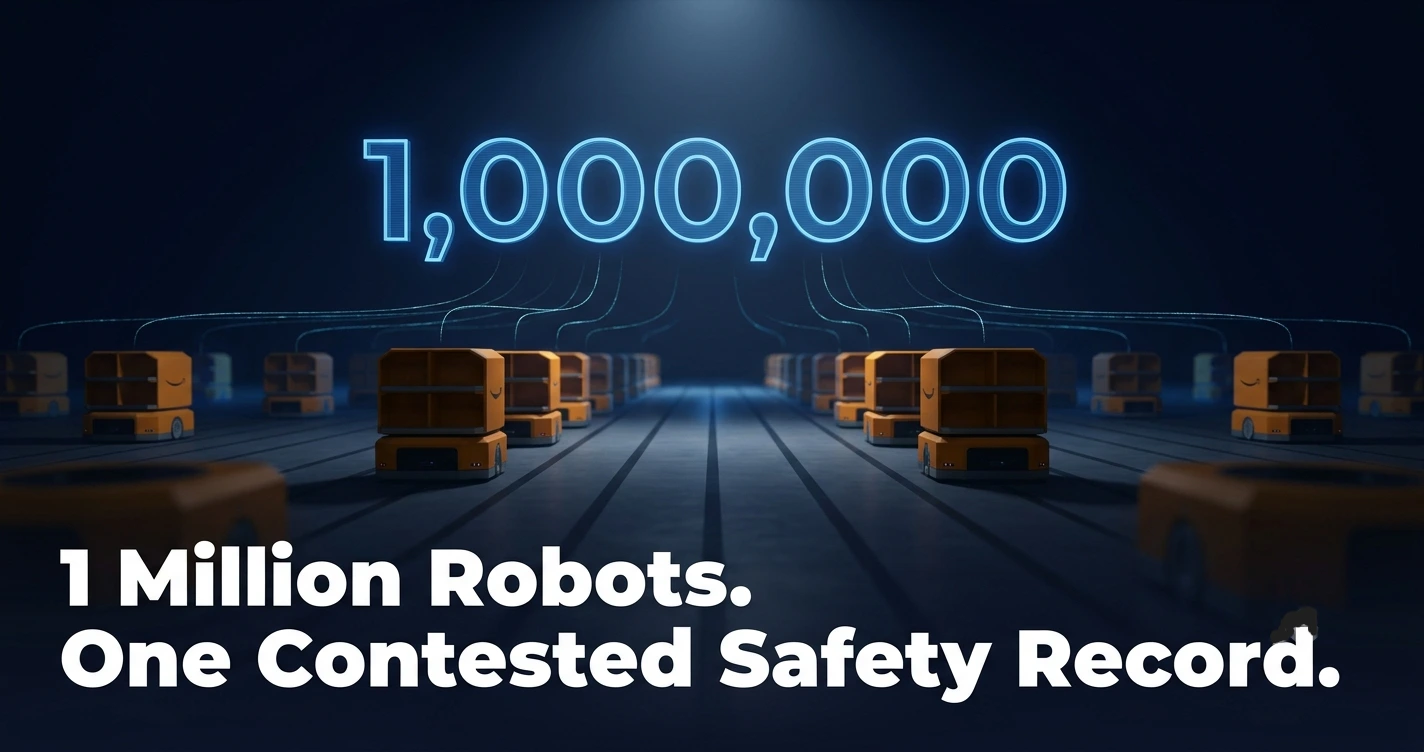
Start with the stat everyone gets wrong. Amazon’s robotics program traces back to the 2012 acquisition of Kiva Systems, and for the last two years, “750,000 robots” has been the go-to headline figure in nearly every trade article. That number is dead. Amazon confirmed in July 2025 that its millionth robot had shipped, to a fulfillment center in Japan, across a network of more than 300 facilities worldwide.
The milestone wasn’t just a bigger headcount. Amazon paired it with the launch of DeepFleet, a generative AI model built to coordinate robot movement across the entire fleet rather than site by site. The company’s mobile fleet now includes named systems most operators outside e-commerce have never heard of: Hercules (moves up to 1,250 lbs of inventory), Pegasus (conveyor handling), Proteus (the first fully autonomous mobile robot cleared to navigate around employees), Cardinal and Sparrow (arm-based sorting), and Vulcan, a touch-sensitive manipulation robot Amazon announced in May 2025.
Reporting since then, including CEO Andy Jassy’s Q1 2026 remarks covered by WWD and Sourcing Journal, puts the fleet meaningfully above 1 million. Leaked internal documents reported by the New York Times in October 2025 describe an internal target to automate 75% of fulfillment operations and replicate Amazon’s Shreveport, Louisiana facility, its automation template, across roughly 40 sites by the end of 2027. That target has not been confirmed by Amazon itself. Treat it as reported, not guidance.
Why this matters for your business case: if you cite 750,000 robots in a 2026 planning document, you’re using a number Amazon’s own newsroom superseded a year ago. Anyone fact-checking your deck against Amazon’s public record will catch it in ten seconds, and it undermines the credibility of everything else in the deck.
The Safety Story Amazon Doesn’t Want You Repeating (Because It’s Complicated)
Somewhere in the automation-sales ecosystem, a claim started circulating that robots cut Amazon’s picker injury rate by 20%. We ran this against Amazon’s own disclosures, OSHA-sourced third-party analyses, and labor-advocacy research. No source, including Amazon’s most favorable self-reporting, supports that figure. It appears to be invented, and it should be retired immediately from anyone’s ROI deck.
What Amazon actually reports, per its 2025 Safety Report published in March 2026, is a 43% improvement in its musculoskeletal disorder rate over six years and a 14% year-over-year gain, alongside a 70% six-year improvement in lost-time incident rate and $2.5 billion invested in workplace safety since 2019. Those are real, sourceable numbers. They’re also self-reported and not independently audited, which matters for what comes next.
A December 2024 Senate HELP Committee investigation found Amazon warehouses recorded 31% more injuries than the industry average in 2023. A May 2025 Strategic Organizing Center analysis of OSHA data put Amazon’s serious injury rate at 5.9 per 100 workers, against 3.0 at competitor warehouses, roughly double. The National Employment Law Project, in a report covered by The Nation, found Amazon accounts for 79% of employment but 86% of injuries among large US warehouses (1,000-plus employees).
NELP researcher Irene Tung has argued that Amazon’s self-reported injury figures likely understate the real incident rate, because the reporting standard only reliably captures injuries serious enough to cause missed work or a job transfer, missing a large share of everyday strain and repetitive-motion harm.
Irene Tung, Researcher, National Employment Law Project, via The Nation
Amazon disputes the comparison, arguing that competitors like Walmart, Target, and Costco log injuries under different OSHA classification codes, which artificially deflates the “industry average” it’s being measured against. Labor advocates counter that Amazon makes up 79% of the employee base in the very warehouse-size bracket used for that comparison, which makes the benchmark somewhat self-referential either way.
Here’s the part that should actually worry anyone pitching robots as a safety upgrade: historically, more robots at Amazon has not clearly meant fewer injuries. Reporting from Reveal, the Center for Investigative Reporting, found injury rates were specifically worse at Amazon’s more heavily robotic facilities as the fleet scaled from 15,000 units in 2014 to 200,000 in 2019, a period when the serious-injury rate rose 33%. The assumption that automation straightforwardly protects workers doesn’t hold up against Amazon’s own history.
Our read: this is a stronger story than the fake 20% stat ever was. “The safety case is contested, and here’s exactly how” is more credible to a skeptical operations audience than a clean number nobody can verify. It’s also a warning: if you’re leaning on “safety” as a justification for a robotics investment, expect the same scrutiny Amazon is getting.
What “The Industrial Robotics Market” Actually Costs
Ask six research firms how big the industrial robotics market will be in 2026 and you’ll get six answers that don’t agree with each other by a wide margin.
Research Firm
2026 Market Size
Projected CAGR
MarketsandMarkets
$15.50B
5.0% to 2032
Business Research Insights
$18.35B
6.2% to 2035
SkyQuest
$21.27B (2025)
13.2% to 2033
IntelMarketResearch
$25.66B
10.7% to 2034
Mordor Intelligence
$54.28B
11.7% to 2031
Future Market Insights
$65.10B
18.1% to 2036
Research and Markets
$89.57B
11.34% to 2032
That’s roughly a six-fold spread on the same question, asked the same year. Mordor Intelligence’s own methodology notes explain why: some firms count only robotic arm hardware, others count entire integrated systems; some price at the factory gate, others at street price; currency conversion timing alone can shift a figure by billions.
The one number in this space that’s methodologically transparent and not trying to sell you a subscription is the International Federation of Robotics’ World Robotics 2025 report. IFR counted 4,664,000 industrial robots in operational use worldwide in 2024, a 9% year-over-year increase, with annual installations of roughly 542,000 units, the second-highest total on record. That’s primary survey data collected directly from manufacturers and national robotics associations across roughly 40 countries, not a modeled forecast.
Outgoing IFR president Takayuki Ito characterized 2024 as the second-highest installation year in the organization’s history, just 2% below the 2022 record, a measured framing rather than a promotional one from the industry’s own trade body.
Takayuki Ito, President, International Federation of Robotics, IFR World Robotics 2025 release
Worth noting for anyone benchmarking against global competition: China’s operational robot stock passed 2 million units in 2024, the largest of any country, accounting for 54% of that year’s global deployments. US installations, meanwhile, rose 11% year-over-year to 38,000 units in 2025 per IFR’s preliminary data, published June 2026. Global installation growth has plateaued near record highs for four straight years even as US adoption accelerates, which means American buyers are now competing for the same integrator capacity and equipment lead times as everyone else scaling up at once.
How to use this in your own board deck: never cite a single market-size figure without naming the firm and the scope. “By one estimate, from Research and Markets, the market could reach $89.57B” reads as rigorous. “The market is worth $89.57B” reads as something an AI search summary will flag against a competing number the moment someone checks.
The ROI Framework That Actually Survives Contact With a P&L
None of the numbers above tell you whether robotics will pay off in your facility. That answer depends almost entirely on one variable most vendors skip: whether your existing process is worth automating in the first place.
Automation World’s February 2026 analysis, citing McKinsey research projecting 10%-plus annual growth in warehouse automation spend through 2030, found that ROI shows up reliably in one narrow category: high-volume, repetitive picking and palletizing tasks, and even there, only when volume, SKU mix, and labor economics line up. Throughput gains of 30 to 40% are achievable, but they’re the ceiling for a specific use case, not a baseline you should expect everywhere.
Is that a disappointing headline number compared to the marketing? Probably. It’s also the honest one, and it points to the single most actionable insight in this entire space: WMS, OMS, and ERP integration quality determines whether robotics amplifies an efficient operation or accelerates a broken one. A facility with messy inventory data and inconsistent SKU handling doesn’t get fixed by adding robots. It gets the same problems, faster and at a higher fixed cost.
A practical sequencing checklist before you sign a robotics contract
Audit process maturity first. If your WMS data is unreliable today, robots will not correct it. They’ll operate on it.
Model against your actual SKU mix and volume, not an industry-average case study from a vendor deck.
Price in integrator lead time. With US installations up 11% year-over-year, integrator capacity is tightening, and that shows up as schedule risk, not just cost risk.
Separate the safety pitch from the productivity pitch. Treat any safety-based ROI claim, yours or a vendor’s, with the same scrutiny applied to Amazon’s above.
Budget for the process-fix work as a line item, not an afterthought. It’s frequently the actual bottleneck.
The Case Against Following Amazon’s Playbook Blindly
Amazon’s scale is not a template most enterprises can copy, and pretending otherwise is where a lot of robotics budgets go to die.
Amazon’s warehouse headcount has grown from roughly 125,000 workers in 2012 to more than 1.5 million today, even as automation scales, though a Wall Street Journal analysis found the average number of human workers per facility (about 670) is now at a 16-year low. Amazon has the balance sheet to absorb integration failures, run parallel automated and manual workflows during transitions, and continue acquiring robotics companies (RIVR for outdoor delivery robots, Fauna Robotics for humanoid systems, both reported by PYMNTS in March 2026) while it works out the kinks.
Mid-market operators generally don’t have that cushion. If you don’t have in-house robotics engineering capacity or the margin to absorb a botched rollout, you’re more exposed to exactly the failure mode Automation World describes: automating a broken process and discovering the problem was never throughput, it was data quality.
Timeline reality check: Amazon’s internal target, 75% of fulfillment automated and roughly 40 Shreveport-style facilities by end of 2027, comes from leaked documents reported by the New York Times, not from an official Amazon roadmap. Build your own planning timeline off confirmed public statements, not leaked internal ambition. The gap between the two is usually where budget overruns live.
Frequently Asked Questions
How many robots does Amazon have in 2026?
Amazon passed 1 million operational robots in mid-2025, up from the 750,000 figure widely cited in 2023 and 2024, spread across more than 300 fulfillment centers worldwide. Reporting since then indicates the fleet has grown meaningfully beyond that milestone.
Did Amazon’s robots reduce warehouse injuries?
Amazon reports a 43% six-year improvement in its musculoskeletal disorder rate, but independent OSHA-data analyses from the Strategic Organizing Center and the National Employment Law Project find Amazon’s overall injury rate remains roughly double that of comparable competitor warehouses.
What’s a realistic ROI payback period for warehouse robots?
Payback varies widely by use case. Industry reporting points to strong ROI mainly in high-volume, repetitive picking and palletizing tasks, with 30 to 40% throughput gains achievable only when volume, SKU mix, and labor economics genuinely align.
How big is the industrial robotics market?
Estimates range from roughly $15.5 billion to $89.6 billion for 2026 depending on the research firm’s methodology and scope. The IFR’s installed-base count, 4.66 million robots operating globally as of 2024, is the most methodologically transparent primary figure available.
What This Means Going Forward
The headline robot count was never the interesting part of this story. The interesting part is that Amazon, the company with the most resources on earth to solve robotics integration cleanly, still has a contested safety record and an unconfirmed internal automation timeline. If Amazon’s own case study is this complicated, treat any vendor’s clean 12-month-payback promise with proportional skepticism.
Over the next 6 to 18 months, watch three things: whether Amazon’s leaked 2027 automation target gets officially confirmed or quietly walked back, whether IFR’s mid-2026 preliminary US installation data (already up 11% year-over-year) holds through a full annual report, and whether independent OSHA-data analyses of Amazon’s newest robotic facilities start closing the gap with its self-reported safety numbers or widening it.
For now, the actionable takeaway for anyone building a 2026 automation budget is simple: fix the process before you automate it, name your sources when you cite market size, and never let a vendor’s safety pitch go unchecked against independent data.
IBM Owns Terraform Now: Inside Pulumi’s 2026 HCL MoveCloud Infrastructure
IBM Owns Terraform Now. So Pulumi Learned Its Language.
A quiet feature launch in January 2026 tells you more about where infrastructure as code is heading than any market share number floating around Google right now.
If you searched “terraform vs pulumi market share 2026” and landed here expecting a clean percentage, you’ve found the same wall we hit. A number like “Terraform owns 72% of the market” is repeated across dozens of sites this year. It’s also attributed to the CNCF’s 2024 survey, which, when you actually open the PDF, contains no IaC market share question at all. It covers Kubernetes, GitOps, and service mesh, not Terraform versus Pulumi versus OpenTofu. That statistic doesn’t exist. It’s a content farm number that got copied enough times to look true.
Here’s what does exist, and it’s a better story anyway: in January 2026, Pulumi started shipping native support for HashiCorp Configuration Language, the actual syntax Terraform users write in. It also began hosting Terraform and OpenTofu state files directly inside Pulumi Cloud, a direct shot at HashiCorp’s own hosted product. That’s not a rumor. That’s a company built on the opposite philosophy from Terraform (write infrastructure in Python or TypeScript, not a config language) deciding the config language was worth absorbing anyway.
Why this matters if you manage infrastructure: You no longer face an all or nothing rewrite to leave Terraform. Pulumi’s bridge means you can keep existing Terraform or OpenTofu state under new governance while migrating components on your own schedule. That changes the calculus for any team stuck deciding what to do about HashiCorp’s licensing shift.
The Real Story: Why Pulumi Started Speaking HCL
Pulumi’s founder and CEO, Joe Duffy, didn’t dress up the reasoning. Asked why a multi-language platform would add support for the one language it was built to avoid, he pointed to demand from Terraform users looking for an exit ramp after HashiCorp’s 2023 licensing change.
“That time has come for HCL.”
Joe Duffy, Founder and CEO, Pulumi, via InfoQ, January 17, 2026
In a separate interview a few weeks later, Duffy went further, saying the Terraform relicense had noticeably pushed existing Terraform users to look at Pulumi (The New Stack, February 2026). Take that with the appropriate grain of salt. He’s the CEO selling the migration story. But the product decision itself, shipping a language Pulumi spent seven years arguing against, is hard evidence regardless of who’s narrating it.
That decision doesn’t happen in a vacuum. It happens because of what came before it.
The Three Shocks That Actually Reshaped IaC
Strip away the SEO noise and this isn’t really a two horse race between Terraform and Pulumi. It’s a three way story, and OpenTofu is the part most “Terraform vs Pulumi” articles conveniently skip.
Event
Date
What actually happened
Terraform relicensed to BSL
August 2023
HashiCorp moved Terraform off the open source MPL 2.0 license onto the Business Source License, restricting competitors from reselling managed Terraform products.
OpenTofu forks Terraform
September 2023
Founded under the Linux Foundation by Spacelift, env0, Harness, Scalr, and others, days after the BSL announcement.
HashiCorp vs OpenTofu dispute
April 2024
A cease and desist alleging code theft was publicly rebutted line by line. Linux Foundation’s Jim Zemlin backed OpenTofu; InfoWorld’s Matt Asay reversed his initial position after reviewing the rebuttal.
IBM acquires HashiCorp
February 27, 2025
A confirmed $6.4 billion deal, per IBM’s own newsroom. Terraform now sits inside IBM’s automation portfolio next to Vault, Consul, and Nomad.
OpenTofu joins CNCF
April 2025
Accepted at the Sandbox tier, giving it vendor neutral governance credibility a single company fork rarely earns this fast.
Pulumi adds native HCL support
January 2026
Announced in private beta, targeting general availability in Q1 2026. Confirm current GA status before assuming it’s fully live.
Notice what’s missing from most coverage: the CLOUD Act and data jurisdiction angle. If your organization stores Terraform state inside HCP Terraform, that platform now sits under IBM, a U.S. company. For teams with GDPR obligations or data residency requirements, that’s worth a conversation with legal, even if it’s not the deciding factor.
The Numbers You Can Actually Check Yourself
Forget the disputed percentages. The most defensible signal in this whole debate is public, live, and anyone can verify it in thirty seconds on GitHub.
Tool
GitHub stars
Trend
Terraform
~48,749
Still the largest, unsurprising given its head start
OpenTofu
~29,000
Roughly doubled from ~22,400 in under two years
Pulumi
~25,378
Now trailing OpenTofu, despite Pulumi being nearly six years older
That last row is the one nobody’s writing about. OpenTofu launched in September 2023. Pulumi launched in 2017. And OpenTofu has already pulled ahead of it on developer mindshare by star count. If you wanted one sentence to summarize where developer attention is actually going, that’s it, and it’s not the sentence most headlines are using.
Two infrastructure orchestration vendors back this up with real usage data, not surveys. Spacelift reports that roughly half its platform deployments now run OpenTofu instead of Terraform. Scalr reports OpenTofu at around 63% of runs and 72% of newly created workspaces, up from about 56% of new workspaces earlier in 2026. That second number matters more than the first: new workspace share reflects fresh decisions being made today, not legacy projects nobody’s touched since 2022.
On the provider ecosystem, the gap that used to favor Terraform by three to one has narrowed sharply. OpenTofu’s registry now lists more than 3,900 providers and 23,600 modules against Terraform’s roughly 4,800 providers, closer to a 20% gap than the old blowout. Pulumi’s native registry is smaller at around 1,800 packages, but its “Any Terraform Provider” bridge lets it generate a typed SDK from essentially any Terraform or OpenTofu provider, which closes that distance more than the raw numbers suggest.
What The People Building These Tools Are Actually Saying
Matt Gowie, founder of the IaC consulting firm Masterpoint and a former Terraform contributor, told TechTarget that starting in January 2026 he began actively steering client work toward OpenTofu over licensing objections. By his account, all but one of roughly eight client engagements that year ended up on OpenTofu.
Sebastian Stadil, CEO of Scalr and an OpenTofu core member, put the licensing contrast bluntly when OpenTofu shipped native state encryption, a feature the open Terraform CLI still lacks. Worth remembering he runs a company that competes directly with HashiCorp’s commercial products, so weigh the framing accordingly.
The Case Against The “Pulumi Is Winning” Narrative
Not everyone buys the displacement story, and the skeptical case deserves real airtime rather than a token paragraph at the bottom.
“I have not seen any of the predicted tsunami of large businesses dumping HashiCorp Terraform for OpenTofu.”
Andi Mann, Global CTO and Founder, Sageable, via TechTarget
Mann’s read, that adoption is real but concentrated in smaller, open source first shops rather than sweeping the enterprise, lines up with a fact most “Terraform is dying” articles leave out: HashiCorp’s last public quarter before the IBM acquisition closed showed revenue up 15% year over year and customer count up 10% among accounts spending six figures. That’s not a company in freefall.
Our read: the loudest part of this story, GitHub stars and vendor platform data, tells you where developer enthusiasm and new project decisions are trending. It does not yet tell you that large regulated enterprises are ripping out production Terraform at scale. Those are two different claims, and a lot of 2026 coverage blurs them into one.
There’s also a small base problem worth flagging directly for anyone quoting a “45% growth” style figure for Pulumi or OpenTofu. A percentage jump looks dramatic against a small starting number. Pulumi’s last verified customer count sits around 2,000 (a 2023 figure, likely stale by now), against HashiCorp’s roughly 4,700 paying customers reported in 2024. Growth rate and absolute scale are not the same story, and reporting on this topic tends to conflate them.
One more open thread: the HashiCorp and OpenTofu legal dispute over alleged code copying was never resolved in public record. It went quiet after OpenTofu’s rebuttal, but “no further communication” isn’t the same as “resolved.” Any team betting heavily on OpenTofu’s long term legal footing should know that history exists.
Quick Answers
Is Terraform still open source?
No, not in the traditional sense. HashiCorp moved Terraform from the open source MPL 2.0 license to the Business Source License 1.1 in August 2023. You can still view, run, and self-host it for free, but competitors can’t resell managed Terraform products without a commercial license.
What’s the actual difference between Terraform and Pulumi?
Terraform uses HCL, a declarative configuration language built specifically for infrastructure. Pulumi lets you write infrastructure in Python, TypeScript, Go, C#, or Java, giving you real loops, functions, and IDE tooling that HCL doesn’t offer.
Is OpenTofu a safe replacement for Terraform?
For most teams, yes. It’s a Linux Foundation governed fork of Terraform 1.6, fully open source under MPL 2.0, and largely drop-in compatible. Most migrations just swap the terraform binary for tofu with no code changes required.
Who owns Terraform now?
IBM. The acquisition closed February 27, 2025, for $6.4 billion. Terraform now sits inside IBM’s automation software lineup alongside Vault, Consul, and Nomad.
Can Pulumi actually use Terraform providers?
Yes. Pulumi’s bridging mechanism lets it use existing Terraform and OpenTofu providers directly, generating a typed Pulumi SDK from any provider already in either registry.
Where This Goes Next
What you now know that most search results won’t tell you straight: the “market share” framing dominating this topic is mostly unverifiable noise traced back to a survey that never asked the question. The real signal is quieter. OpenTofu is pulling developer attention away from both Terraform and Pulumi. Pulumi is responding by absorbing the one thing that used to separate it from Terraform entirely. And IBM’s ownership has turned a licensing dispute into a jurisdiction and governance question that has nothing to do with syntax.
Three things worth watching over the next six to eighteen months: whether Pulumi’s HCL support reaches full general availability and actually moves enterprise workloads, whether HashiCorp’s new capped free tier (effective March 31, 2026) pushes more teams toward OpenTofu, and whether a named enterprise like Fidelity’s reported OpenTofu migration gets an official confirmation rather than staying a secondhand claim.
If you’re deciding what to do with your own Terraform footprint right now, don’t anchor on a percentage you can’t trace back to a source. Anchor on what your team can actually observe: your provider coverage, your state hosting requirements, and how much of your organization’s new work is already quietly running on tofu instead of terraform.
Subscribe to The Neural Loop for the next update on this story, including GA confirmation on Pulumi’s HCL support and fresh registry numbers as they land.
Synthetic Data at Scale: Inside NVIDIA’s 340B Model | NeuralWired
Enterprise AI / Data Strategy
Synthetic Data at Scale: Inside NVIDIA’s 340B Model
Writer trained a frontier-class model for $700,000. A comparable OpenAI model reportedly cost $4.6 million. The difference wasn’t a smarter team. It was synthetic data, and it’s about to change how every enterprise AI budget gets built.
If you’re building a domain-specific model this year, synthetic data is no longer the experimental option. It’s the default line item. NVIDIA has spent well over $320 million buying into it. Microsoft trained part of Phi-4 on 400 billion synthetic tokens. And enterprise buyers evaluating vendors like Mostly AI, Tonic.ai, and Hazy need a clear answer to one question: does this actually work, or does it just get you to a worse model faster?
The honest answer, after digging through the peer-reviewed research, the regulatory filings, and the vendor claims: both. Synthetic data is solving a real, measurable problem. It’s also creating a new one that most vendor pitch decks conveniently skip.
Why synthetic data exists now
Every frontier lab is running into the same wall. Epoch AI estimates there’s roughly 300 trillion tokens of high-quality public text on the entire internet. GPT-4-class models already consume 6 to 13 trillion tokens per training run. Do that math a few more times and the public web runs dry, not in some distant future, but on a timeline that matters for product roadmaps being written right now.
At the same time, real data got more expensive to use, not just to collect. GDPR, the EU AI Act’s phased rollout through 2026 and 2027, HIPAA, and CCPA all raise the cost and legal exposure of training on real customer or patient records. Synthetic data promised a way around both problems at once: manufacture the training signal instead of mining it, and skip the privacy landmine while you’re at it.