Author: Team_Neuralwired

  • Meta Muse Spark AI Model: Benchmarks, Strengths & Gaps

    Meta Muse Spark AI Model: Benchmarks, Strengths & Gaps

    Meta Muse Spark: What It Can Do, Where It Fails, and Who Should Care — NeuralWired
    Frontier intelligence for the professionals shaping technology’s future.
    Deep analysis. No hype. Actionable insight.
    AI Models · Frontier Intelligence · April 2026

    Meta Muse Spark: What the Benchmarks Actually Mean, Where It Falls Short, and Who Should Pay Attention

    Meta’s first model from its Superintelligence Labs is genuinely impressive on vision, health reasoning, and token efficiency. It’s also not the coding model you want. Here’s the unvarnished picture.

    Published: April 9, 2026 Reading time: ~14 minutes Category: AI Model Analysis Primary keyword: Meta Muse Spark AI model
    On April 7, 2026, Meta released a model it had been building for months inside a newly formed internal unit called Meta Superintelligence Labs. The model is called Muse Spark. It runs Meta AI on the Meta AI app and meta.ai right now, with WhatsApp, Instagram, Facebook, Messenger, and the Ray-Ban Meta AI glasses to follow in the coming weeks.

    The launch generated the usual wave of breathless coverage mixed with instant skepticism, which is roughly what you’d expect whenever a company with Meta’s reach announces a new frontier model. But if you’re a developer assessing whether to integrate it, a CTO deciding whether to move budget, or a researcher tracking the competitive dynamics of the frontier model race, the breathless/skeptical binary isn’t particularly useful. You need actual numbers, an honest accounting of where the model fits and where it doesn’t, and some sense of what the broader strategy actually is.

    That’s what this piece is for.

    The organizational context you need to understand first

    Muse Spark didn’t emerge from Meta’s existing AI research pipeline. It came from a new unit, Meta Superintelligence Labs, that was stood up specifically because Mark Zuckerberg was reportedly dissatisfied with the progress of Meta’s Llama program. That’s not a minor footnote. It signals that Zuckerberg looked at where Llama was heading and concluded it wasn’t going to get Meta where it needed to be fast enough.

    To lead the new lab, Meta recruited Alexandr Wang, co-founder and former CEO of Scale AI. Shortly before the launch, Meta also invested $14.3 billion in Scale AI for a 49% stake, securing not just Wang’s leadership but a massive data labeling pipeline. That kind of capital commitment tells you something about how seriously Meta is treating this bet. Analyst commentary frames Meta’s total AI spend, including infrastructure and partnerships, somewhere in the $115–135 billion range across the coming years.

    There’s one more structural fact worth registering: unlike Llama, Muse Spark is closed-source. Meta says it hopes to open-source future versions, but for now the model is proprietary. That’s a deliberate pivot away from the open-source positioning that made Llama popular with researchers and developers worldwide. Whether that’s a strategic shift or just a temporary posture for the flagship line is an open question, but for anyone who built their stack on the assumption that Meta’s models would remain open, it’s a significant change.

    What Muse Spark actually is

    The clearest way to describe Muse Spark is as a natively multimodal model designed to be small, fast, and capable at reasoning tasks, especially those involving images, charts, health information, and scientific content. Meta describes it as “small and fast by design, yet capable enough to reason through complex questions in science, math, and health.”

    “Small” here is relative, and Meta hasn’t disclosed exact parameter counts. But the design philosophy is deliberate: rather than scaling up a single massive model, Muse Spark uses what Meta’s team calls “thought compression” — a test-time scaling approach where multiple parallel subagents collaborate to solve hard problems. The idea is to spend more compute at inference time without making the base model grotesquely large. Alexandr Wang has framed this as a new scaling regime focused on efficient reasoning rather than brute-force parameter growth, a contrarian thesis relative to the prevailing assumption that bigger models always win.

    In practice, this manifests as two modes in the consumer product: an Instant mode for quick answers and a Contemplating mode that spins up the multi-agent reasoning pipeline for harder queries. The latter is where Muse Spark’s reasoning capabilities show up most clearly, and it’s also the mode that carries higher infrastructure cost — something developers will need to account for when thinking about scale.

    Natively multimodal means the model was built from the ground up to handle images, not retrofitted with a vision adapter. It can read charts, parse scientific diagrams, analyze product images, interpret health-related visuals, and process visual data in ways that are architecturally integrated rather than bolted on.

    The benchmark picture, unvarnished

    52
    AI Intelligence Index
    (Artificial Analysis)
    58M
    Output tokens for Index
    (vs 157M for Claude Opus)
    86.4
    CharXiv visual reasoning
    (beats GPT-5.4 at 82.8)
    42.8
    HealthBench Hard
    (leads all models)
    Artificial Analysis’s independent evaluation gives Muse Spark a score of 52 on their AI Intelligence Index — a composite measure running across reasoning, coding, multimodal understanding, and knowledge tasks. GPT-5.4 and Claude Opus 4.6 sit around 57-58; Gemini 3.1 Pro falls around 54-55. That 5-6 point gap is real but not catastrophic. The more interesting number is what it costs to get there.

    Muse Spark used 58 million output tokens to complete the Intelligence Index evaluation. Claude Opus 4.6 used 157 million tokens for the same run. GPT-5.4 used 120 million. Gemini 3.1 Pro Preview came in at 57 million — essentially tied with Muse Spark. For teams running high-volume inference at scale, this efficiency gap has real cost implications. A model that gets you most of the way there at less than half the token count of its nearest competitor on raw intelligence deserves serious consideration.

    Benchmark Muse Spark GPT-5.4 Claude Opus 4.6 Gemini 3.1 Pro
    AI Intelligence Index 52 ~57–58 ~57–58 ~54–55
    Output tokens (Index run) 58M Most efficient 120M 157M 57M
    MMMU-Pro (multimodal) 80.5% ~78–79% ~77–78% 82.4% Leads
    CharXiv visual reasoning 86.4 Leads 82.8 ~80 80.2
    HealthBench Hard 42.8 Leads High 30s–low 40s Similar band Slightly lower
    GDPval-AA (agentic) 1427 1676 Leads 1648 1320
    TerminalBench Hard (coding) Below leaders 75.1 80.8% SWE-bench 68.5
    τ²-Bench Telecom 92% Top tier
    CritPT (hard physics) 11% Above Claude, Gemini Flash 3% 9%
    Sources: Artificial Analysis, LushBinary, Meta AI blog. Competitor figures are approximate ranges from independent sources. All benchmarks reflect April 2026 evaluations.

    Muse Spark is the second-most capable vision model we have benchmarked. Agentic performance does not stand out, it scores 1427 on GDPval-AA, behind Claude Sonnet 4.6 and GPT-5.4, but ahead of Gemini 3.1 Pro Preview at 1320.
    Artificial Analysis — Independent AI benchmarking, April 7, 2026
    The overall pattern is consistent across sources. The New York Times noted that Muse Spark “performed better than Meta’s previous AI models but lags rivals on coding ability.” That framing is accurate as far as it goes, though it undersells the multimodal and health performance story.

    Where Muse Spark genuinely leads

    Visual reasoning and multimodal understanding

    This is the clearest competitive advantage. On CharXiv, a benchmark for reading charts, figures, and scientific diagrams, Muse Spark scores 86.4. GPT-5.4 comes in at 82.8, Gemini at 80.2, Claude Opus at around 80. That’s a meaningful lead, not a rounding error. For any workflow that involves parsing research papers, analyzing dashboards, extracting data from medical imaging reports, or reading technical schematics, Muse Spark has a real edge right now.

    On MMMU-Pro, which tests broader multimodal understanding across academic disciplines, Muse Spark scores 80.5%, just behind Gemini 3.1 Pro’s 82.4%, ahead of GPT and Claude. Artificial Analysis labeled it the second-most capable vision model they’ve evaluated, which tracks with these numbers.

    The key word is “natively.” Because multimodal processing is built into the architecture rather than added as a separate module, the model handles complex visual inputs with less prompt engineering overhead. Developers building visual Q&A systems, document parsing pipelines, or science-adjacent applications will find this integration practically useful, not just benchmark-impressive.

    Health reasoning

    Muse Spark leads HealthBench Hard with a score of 42.8, outperforming all major competitors on this evaluation. Meta has explicitly positioned health as a priority, noting that health questions represent one of the top reasons people turn to AI assistants. The benchmark performance backs this up.

    Important caveat for builders: HealthBench Hard measures question-answering accuracy, not clinical safety. Deploying Muse Spark in contexts that inform real medical decisions requires regulatory compliance, validation against clinical standards, and guardrails that are entirely beyond what any benchmark measures. The score tells you the model is good at health Q&A. It doesn’t tell you it’s ready for a clinical workflow without substantial additional work.

    Token efficiency

    The token efficiency picture is one of the most practically significant findings from independent evaluations. At 58 million output tokens to complete the Intelligence Index, less than half of Claude Opus 4.6’s 157 million, and less than half of GPT-5.4’s 120 million, Muse Spark offers a materially different cost profile at scale. If you’re running millions of reasoning queries per day, this number translates directly into infrastructure budgets.

    A 5-point gap from the leaders on raw intelligence is meaningful but not insurmountable, especially given Muse Spark’s strong cost-efficiency profile.

    LushBinary benchmark analysis, April 2026

    Domain-specific reasoning

    On τ²-Bench Telecom, Muse Spark scores 92%, placing it among the highest-performing models on telecom-domain reasoning tasks. On CritPT, a hard physics benchmark where every model scores in single or low double digits, Muse Spark reaches 11% against Claude’s 3% and Gemini Flash’s 9%. These numbers are low in absolute terms because the tasks are genuinely hard, but the relative gaps suggest Muse Spark carries an advantage on scientific reasoning that may generalize to other technical domains.

    Where it falls short, and why that matters

    Coding and software engineering

    This is the cleanest weakness in the profile. On TerminalBench Hard, a benchmark that evaluates models on real coding tasks interacting with a terminal environment, Muse Spark trails Claude Sonnet 4.6, GPT-5.4, and Gemini 3.1 Pro. Claude’s performance on SWE-bench Verified, the standard benchmark for software engineering tasks, sits at 80.8%. GPT-5.4 scores 75.1 on Terminal-Bench 2.0. Muse Spark’s specific score hasn’t been consistently reported, but the direction is clear across sources.

    For teams building coding copilots, automated code review pipelines, or software engineering agents, this isn’t a minor limitation. The gap is large enough that defaulting to Claude or GPT-5.x for these use cases is the rational choice, not a matter of preference. Muse Spark’s test-time scaling advantage through multi-agent Contemplating mode may close this gap on complex reasoning-heavy coding problems, but on general software engineering tasks, it’s behind today.

    Agentic and multi-step work

    On GDPval-AA, a benchmark designed to evaluate models on real-world, multi-step office workflows, Muse Spark scores 1427, against GPT-5.4’s 1676 and Claude Sonnet 4.6’s 1648. It beats Gemini 3.1 Pro Preview at 1320, but the gap with the top performers is significant. For anyone building long-running agents that need to orchestrate multi-step workflows, research automation, enterprise task execution, complex data pipelines, the top two are still GPT and Claude.

    The irony here is partially structural: Muse Spark’s own Contemplating mode uses multi-agent orchestration. But that architecture is optimized for single complex queries, not for sustained multi-step task execution of the kind GDPval-AA is testing.

    Closed-source means lock-in

    For organizations that have built their AI strategies partly around open-source models, using Llama as a foundation, running fine-tuned versions on their own infrastructure, controlling data flows and model behavior, Muse Spark’s closed-source design is a structural problem. You can’t fine-tune it, you can’t self-host it, and you’re entirely dependent on Meta’s API access decisions. Meta has said it hopes to open-source future versions, but “hopes to” is not a roadmap commitment.

    This is a legitimate concern for enterprises in regulated sectors, for research institutions with data governance requirements, and for any team that has learned to be cautious about single-vendor dependencies. The developer community that embraced Llama explicitly because it was open now faces a different proposition.

    Decision framework: who should actually use this

    Choose Muse Spark when

    Your workloads are vision-heavy or health-adjacent

    • Parsing charts, figures, scientific diagrams
    • Health Q&A at scale (with appropriate guardrails)
    • Document intelligence on mixed text-image content
    • Cost-sensitive high-volume reasoning inference
    • Deep integration with Meta’s social surfaces
    Stick with GPT-5.x or Claude when

    Coding quality and agentic execution are the priority

    • Software engineering copilots and code review
    • Long-running multi-step agent pipelines
    • Enterprise stacks needing mature governance tooling
    • Open-source flexibility and fine-tuning requirements
    • Mission-critical agentic workflow execution
    Choose Gemini when

    Google Workspace integration and search grounding matter

    • Tight integration with Google Cloud or Workspace
    • Top-tier MMMU-Pro multimodal score (82.4%)
    • Factual grounding through Google Search
    • Token efficiency matching Muse Spark’s profile
    The key principle for CTOs making this call: model selection should follow workload composition, not brand affinity. A team with 70% of their AI usage in visual document parsing and 30% in code generation probably wants Muse Spark for the former and Claude for the latter. Running a single model for everything because it simplifies billing isn’t a good enough reason to accept a material performance gap in either direction.

    Strategic implications for different stakeholders

    For ML engineers and developers

    The practical question right now is whether you’re on the API waitlist. Muse Spark is in private API preview for select partners. Broader developer access isn’t confirmed on a timeline yet. That matters for planning, you can evaluate the model’s benchmark profile today, but you can’t build production systems against it unless you’re in the preview cohort.

    For teams that do get access, the architecture is worth understanding before you deploy. Contemplating mode’s multi-agent design means per-query costs won’t scale linearly the way they do with a simpler inference call. Building Contemplating mode into a high-frequency pipeline without understanding the token and latency characteristics first is a straightforward way to blow past cost budgets.

    For CTOs and CIOs

    The most significant strategic signal from this launch isn’t Muse Spark’s specific benchmark scores. It’s the closed-source pivot. Meta is now building a proprietary frontier model alongside Llama, not instead of it. That gives Meta two distinct competitive levers, an open-source community play through Llama, and a proprietary capability play through Muse Spark. Watching how the two coexist over the next 12-18 months will tell you a lot about where Meta thinks the commercial value actually is.

    For CTO-level vendor strategy decisions, the practical implication is straightforward: Muse Spark is worth a pilot on visual and health workloads, but not worth treating as a primary strategic dependency until API access is broadly available, pricing is disclosed, and there’s at least 6-12 months of production usage data from early adopters.

    For VCs and investors

    Meta’s $14.3 billion Scale AI investment, combined with the Superintelligence Labs structure and Alexandr Wang’s leadership, signals a serious long-term capital commitment to personal AI at social scale. The model’s consumer deployment, rolling out across WhatsApp, Instagram, Facebook, and glasses, gives Meta an inference volume that no other frontier lab can match. That volume creates a data flywheel that other closed-source model providers don’t have access to. The strategic moat here isn’t the model itself. It’s the distribution.

    For investors evaluating AI infrastructure plays, this matters because Meta is essentially running a 24/7 real-world evaluation of Muse Spark at consumer scale. The feedback signal from billions of interactions on social surfaces will compound over time in ways that benchmark suites can’t capture.

    For policy makers and regulators

    The health positioning and the multimodal surveillance surface are the two things worth watching most carefully here. A model that leads HealthBench Hard and rolls out across WhatsApp and Meta glasses is, in practice, a health advisory system at population scale. The benchmark performance doesn’t resolve questions about misinformation risk, appropriate medical advice boundaries, or liability when the model gets something wrong in a health context.

    The multimodal perception capability combined with glasses deployment creates a different kind of regulatory surface, one that involves real-time visual data processing in the physical world. These aren’t hypothetical concerns. They’re the precise scenarios that existing AI safety frameworks were designed for, and Muse Spark’s deployment timeline moves faster than most regulatory processes can currently track.

    How to access Muse Spark today

    The simplest answer: use the Meta AI app or meta.ai. Muse Spark powers both right now. You can access Instant mode for quick queries and Contemplating mode for harder questions that benefit from the multi-agent reasoning pipeline.

    For API access, the model is in private preview. Meta has indicated that broader enterprise and developer API access will come, but no specific timeline or pricing has been announced. If your organization has an existing Meta partnership or is part of Meta’s developer ecosystem, it’s worth checking whether you qualify for preview access. For everyone else, the path is to watch Meta’s developer blog and the Meta AI technical blog for access announcements.

    The model will roll out to WhatsApp, Instagram, Facebook, Messenger, and Ray-Ban Meta glasses in the coming weeks. For most consumer-facing applications, that’s where exposure will initially come from rather than direct API integration.


    Frequently asked questions

    Muse Spark is Meta’s first model from Meta Superintelligence Labs, announced on April 7, 2026. It’s a natively multimodal, closed-source frontier model designed to be small, fast, and capable at reasoning tasks, particularly those involving images, charts, health information, and scientific content. It powers Meta AI on the Meta AI app and meta.ai, with rollout to WhatsApp, Instagram, Facebook, Messenger, and Ray-Ban glasses coming in the following weeks.

    On Artificial Analysis’s AI Intelligence Index, Muse Spark scores 52 versus GPT-5.4 and Claude Opus 4.6 at around 57-58 and Gemini 3.1 Pro at 54-55. Muse Spark leads on visual reasoning (CharXiv: 86.4 vs GPT-5.4’s 82.8) and HealthBench Hard (42.8, best in class). It trails on coding (TerminalBench Hard) and complex multi-step agentic tasks (GDPval-AA: 1427 vs GPT-5.4’s 1676). Token efficiency is a standout: 58 million output tokens on the Intelligence Index versus Claude’s 157 million.

    No. Unlike Meta’s Llama models, Muse Spark is closed-source and proprietary. Meta has stated it hopes to open-source future versions, but there’s no confirmed timeline. This is a significant departure from Meta’s previous AI strategy and has direct implications for organizations that relied on Llama’s open-source nature for fine-tuning, self-hosting, or data governance reasons.

    Consumer access is available now through the Meta AI app and meta.ai. API access is in private preview for select Meta partners, with broader developer access not yet announced. The model will also roll out across WhatsApp, Instagram, Facebook, Messenger, and Ray-Ban Meta glasses in the coming weeks. No pricing for API access has been disclosed.

    Not as a primary coding model. Multiple independent evaluations confirm that Muse Spark trails Claude Sonnet 4.6 and GPT-5.4 on coding benchmarks including TerminalBench Hard. For software engineering copilots, automated code review, or complex software agent workflows, Claude (which leads SWE-bench Verified at 80.8%) or GPT-5.4 are the stronger current choices. Muse Spark may close this gap over time, but as of April 2026 the coding weakness is clear and consistent across sources.

    Several things fundamentally distinguish them. Muse Spark is closed-source; Llama is open-source. Muse Spark is natively multimodal from the ground up; Llama’s vision capabilities have been added incrementally. Muse Spark uses a multi-agent Contemplating mode for hard reasoning tasks; standard Llama deployments don’t have this architecture. And Muse Spark comes from an entirely new organizational unit, Meta Superintelligence Labs, while Llama continues under the existing Meta AI research line.

    Contemplating mode is Muse Spark’s test-time scaling approach. Rather than running a single large inference pass, it spins up multiple parallel subagents that collaborate to solve hard problems, spending more compute at inference time without making the base model larger. Meta describes this as “thought compression.” The Instant mode is a direct, fast response for simpler queries; Contemplating mode activates the multi-agent pipeline for complex reasoning tasks. Developers should account for higher per-query costs in Contemplating mode compared to Instant mode.

    It performs better than competitors on HealthBench Hard (scoring 42.8), which measures health question-answering accuracy. But benchmark performance and clinical safety are different things. Deploying Muse Spark in applications that inform real medical decisions requires regulatory compliance, clinical validation, and guardrails well beyond what any benchmark measures. Policy observers have already flagged concerns about health AI at social scale without adequate safety infrastructure.

    Meta has confirmed that API access is available in private preview for select partners, with broader access expected in the future. No pricing, SLAs, or specific enterprise contract terms have been disclosed. Organizations planning integrations should monitor Meta’s developer channels for access announcements and factor in the current access limitations when building 2026 AI roadmaps.

    Four primary limitations matter for enterprise decision-making: (1) coding performance trails Claude and GPT-5.4, making it unsuitable as a primary development tool; (2) agentic task execution on GDPval-AA is behind the top two competitors; (3) closed-source design eliminates fine-tuning, self-hosting, and some data governance options; (4) API access is still in private preview with no disclosed pricing or SLAs. For regulated industries, the health deployment at consumer scale also raises compliance and liability questions that enterprises will need to address before adopting.

    The bottom line

    Muse Spark is a genuinely capable model in a specific and well-defined set of domains. The vision reasoning story is real, CharXiv at 86.4, MMMU-Pro near the top of the pack, HealthBench Hard leading the field. The token efficiency picture is also real and practically significant for anyone running reasoning tasks at scale. This isn’t hype padding. Independent benchmarkers at Artificial Analysis and LushBinary measured it, and the numbers hold up.

    The coding and agentic weaknesses are equally real, and equally well-documented. If your primary use case involves writing or reviewing software, or running complex multi-step workflows through an AI agent, Muse Spark isn’t the right tool today. That may change, Meta’s investment trajectory and the “thought compression” scaling philosophy suggest a serious long-term R&D commitment, but it’s the current reality.

    The closed-source pivot is probably the most strategically significant aspect of this launch, and it’s gotten less attention than the benchmark numbers. Meta is building a proprietary frontier model for the first time. Whether that ends up being a long-term strategic direction or a temporary posture for the flagship line will shape the competitive dynamics of the model market over the next 2-3 years. Watch for: broader API availability and pricing transparency (likely Q3 2026), Llama’s path forward now that Muse Spark holds the flagship position, and whether any of the health regulatory scrutiny around large-scale AI deployments on social platforms gains legislative traction in the EU or US in 2026.

    For your own organizations: if you work with visual data, scientific documents, or health content at scale, put Muse Spark in your evaluation queue now and request API preview access. If your stack is primarily about code and software agents, focus your attention elsewhere for the time being. And if you’re a policymaker or regulator, the combination of health positioning and imminent deployment across billions of WhatsApp and Instagram users probably warrants a closer look than a typical model launch would require.

    For ongoing frontier model coverage, benchmarks, and weekly AI intelligence, follow NeuralWired, and share this piece with someone who needs the unvarnished picture.


    Sources & further reading

    Disclaimer: This article is based on publicly available benchmark data, independent evaluations, and media coverage as of April 9, 2026. Benchmark scores for competitor models are approximate ranges drawn from independent third-party sources. All figures should be treated as indicative rather than definitive, as evaluation methodologies and model versions vary. NeuralWired has no commercial relationship with Meta, Anthropic, OpenAI, or Google. Nothing in this article constitutes investment, legal, or clinical advice.
  • Anthropic Mythos AI Model Preview: Cybersecurity 2026

    Anthropic Mythos AI Model Preview: Cybersecurity 2026

    Anthropic’s Claude Mythos AI Model Preview: The Locked-Down Weapon Reshaping Cybersecurity in 2026 | NeuralWired
    This analysis is published by NeuralWired, frontier intelligence for the professionals who build, fund, and govern technology’s future. For related coverage, see our AI Safety and Cybersecurity verticals.

    AI Security

    Anthropic’s Claude Mythos AI Model Preview: The Locked-Down Weapon Reshaping Cybersecurity in 2026

    The most powerful AI model Anthropic has ever built can find zero-days in every major OS. You can’t have it. Here’s why that decision might be the most consequential thing in enterprise security this year.

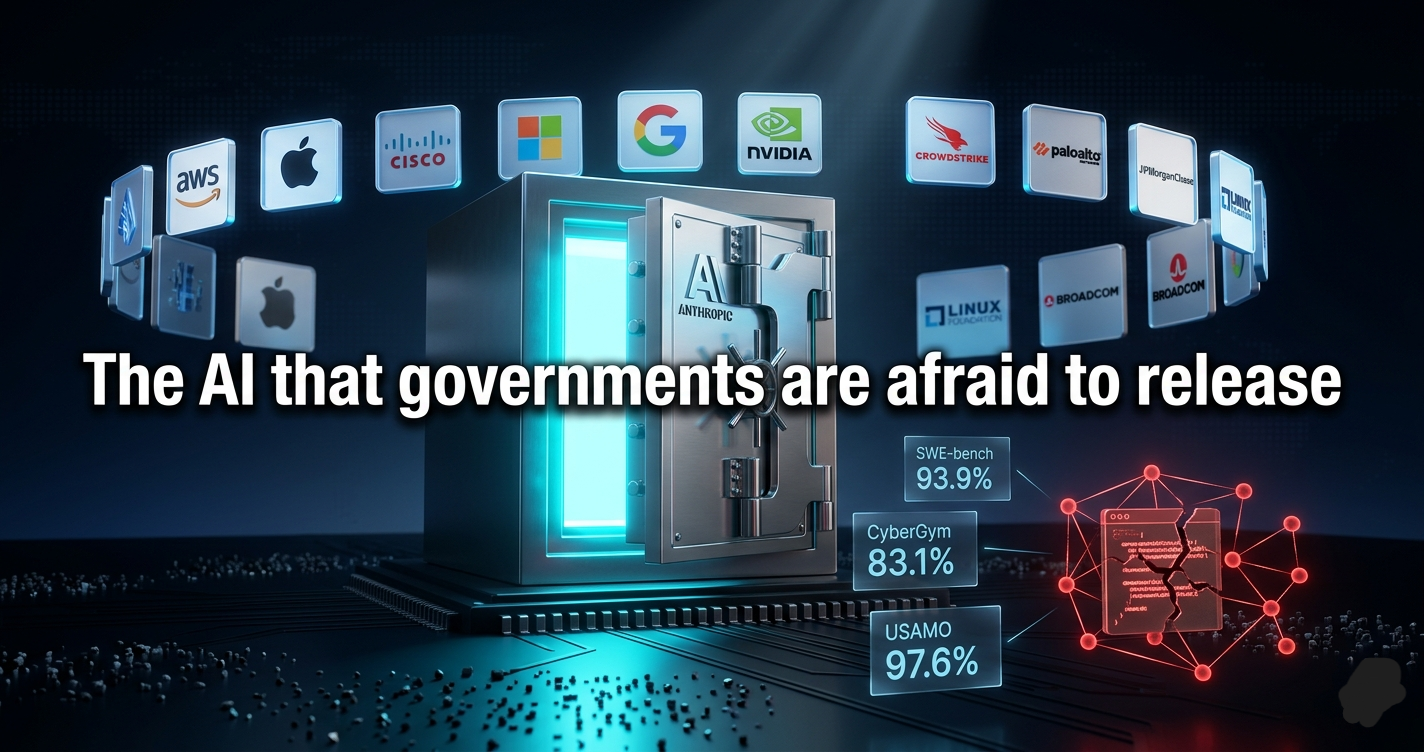
    Anthropic’s Claude Mythos AI model preview can find a 27-year-old vulnerability in OpenBSD, a 16-year-old exploit in FFmpeg that had survived five million automated scans without detection, and a multi-flaw chain in the Linux kernel. It can do all of this autonomously. And you cannot have access to it.

    That restriction is deliberate. Anthropic announced on April 7, 2026 that Claude Mythos Preview was its most powerful model yet, outperforming every earlier Claude iteration on coding, reasoning, and cybersecurity benchmarks by margins that security practitioners are calling a generational leap. The company simultaneously announced that it would not be releasing the model publicly.

    Instead, Mythos has been reserved for a closed network of 11 founding partners and over 40 additional vetted organizations under a new initiative called Project Glasswing. The logic is straightforward and the stakes are extraordinary: a model this capable in the hands of the wrong actor could automate exploitation of critical infrastructure at a scale and speed that no human security team could outrun.

    This analysis breaks down what Mythos actually is, what the benchmarks reveal, how Project Glasswing is structured, who already has access, and what every CISO, CTO, and security engineer needs to do before the end of 2026 regardless of whether they ever get near the model.

    What is the Anthropic Mythos AI Model Preview?

    Claude Mythos Preview is Anthropic’s description of it as “the most powerful AI model we’ve ever developed.” It supersedes Claude Opus 4.6 as Anthropic’s flagship frontier model and was developed with a specific focus on advanced code reasoning, agentic workflows, and cybersecurity vulnerability discovery.

    The model operates autonomously across multi-step technical tasks. It can be given a codebase, binaries, or a system specification and it will scan for weaknesses, generate exploit proof-of-concept code, and propose patches without requiring a human to guide each step. That level of agentic capability distinguishes Mythos from earlier language models that could discuss security topics but could not execute against them.

    Anthropic first began using Mythos internally in large-scale vulnerability hunts before the April announcement. The results were significant enough to warrant both a formal partner program and a decision not to release the model to the public. According to the Project Glasswing announcement, Mythos has already identified thousands of high-severity vulnerabilities across every major operating system and web browser. Those findings have been reported to software maintainers in a coordinated disclosure process.

    The model carries an internal codename of “Capybara” according to community tracking, and details about its architecture first became public in March 2026 through a content management system misconfiguration that exposed pre-release documentation. The official announcement in April aligned with that leaked framing.

    “AI capabilities have crossed a threshold that fundamentally changes the urgency required to protect critical infrastructure from cyber threats, and there is no going back.”

    Anthony Grieco, SVP and Chief Security and Trust Officer, Cisco

    Benchmark Dominance: The Numbers Behind the Hype

    Vendor benchmark claims deserve scrutiny, and Anthropic’s case for Mythos rests on a suite of evaluations that covers coding, cybersecurity, general reasoning, and agentic task performance. The numbers, drawn from Anthropic’s Glasswing announcement and confirmed by the Mythos system card summary at NxCode, represent double-digit gains over the previous flagship in most categories.

    Benchmark Mythos Preview Claude Opus 4.6 Delta
    CyberGym (vulnerability reproduction) 83.1% 66.6% +16.5 pts
    SWE-bench Verified 93.9% 80.8% +13.1 pts
    SWE-bench Pro 77.8% 53.4% +24.4 pts
    Terminal-Bench 2.0 82.0% 65.4% +16.6 pts
    SWE-bench Multimodal 59.0% 27.1% +31.9 pts
    GPQA Diamond 94.6% 91.3% +3.3 pts
    Humanity’s Last Exam (no tools) 56.8% 40.0% +16.8 pts
    USAMO 2026 97.6% N/A New benchmark
    BrowseComp (4.9x fewer tokens) 86.9% 83.7% +3.2 pts
    OSWorld-Verified 79.6% 72.7% +6.9 pts
    The most striking figures are in the coding categories. The 31-point lead on SWE-bench Multimodal and the 24-point jump on SWE-bench Pro reflect Mythos’s capacity to understand and act on code at a level that earlier models could approximate but not reliably execute. SWE-bench Pro targets professional-grade software engineering tasks, which maps more directly to real security work than sanitized benchmark conditions.

    The CyberGym score deserves attention specifically because it measures vulnerability reproduction rather than theoretical knowledge. A score of 83.1% means that in four out of every five cases, Mythos was able to independently reproduce a known vulnerability from minimal starting information. At Opus 4.6’s 66.6%, that figure was already impressive for an AI system. The Mythos gap represents a fundamentally different operational posture.

    “The window between a vulnerability being discovered and being exploited by an adversary has collapsed. What once took months now happens in minutes with AI.”

    Elia Zaitsev, Chief Technology Officer, CrowdStrike
    These benchmarks were run by Anthropic on its own infrastructure, which means independent replication has not yet occurred. That is a legitimate methodological caveat. But the case studies accompanying the Glasswing announcement, including the 27-year OpenBSD bug and the 16-year FFmpeg vulnerability, provide concrete evidence beyond benchmark scores. The FFmpeg flaw in particular had survived five million automated scans by existing tools without being flagged.

    Project Glasswing and the Partner Coalition

    Project Glasswing is the governance structure Anthropic built around Mythos to enable defensive use while limiting offensive exposure. Named after a transparent-winged butterfly, it functions as a vetted-access program that grants qualifying organizations the ability to run Mythos against their own codebases and infrastructure.

    The 11 founding partners represent a cross-section of the technology and critical infrastructure landscape:

    Amazon Web Services Apple Broadcom Cisco CrowdStrike Google JPMorganChase Linux Foundation Microsoft NVIDIA Palo Alto Networks
    Beyond those 11, more than 40 additional organizations that build or maintain critical software have received access for scanning their own first-party and open-source code. Anthropic has also committed up to $100 million in Mythos usage credits for Glasswing participants and $4 million in direct financial support to open-source security organizations, including $2.5 million to Alpha-Omega and the OpenSSF through the Linux Foundation, and $1.5 million to the Apache Software Foundation.

    Partners can access Mythos through four channels: the Claude API directly, Google Cloud Vertex AI, Amazon Bedrock, and Microsoft Azure Foundry. After the credit period ends, pricing is set at $25 per million input tokens and $125 per million output tokens. Anthropic has committed to publishing a formal progress report within 90 days, covering vulnerabilities fixed and security improvements that can be publicly disclosed.

    “By giving maintainers of critical open-source codebases access to a new generation of AI models that can proactively identify and fix vulnerabilities at scale, Project Glasswing offers a credible path to changing that equation.”

    Jim Zemlin, CEO, The Linux Foundation

    Why Anthropic Is Keeping Mythos Locked Down

    The decision not to release Mythos publicly is not primarily a product strategy. It reflects a specific risk calculation that Anthropic describes explicitly in the Glasswing documentation: a model this capable at finding and exploiting software vulnerabilities is also a model that attackers would pay to access.

    The threat model is not abstract. If a nation-state or ransomware syndicate had access to Mythos-class capabilities, they could automate zero-day discovery across widely deployed infrastructure at a scale that currently requires teams of elite researchers months to replicate manually. The FFmpeg vulnerability that survived 16 years of human and automated scanning is precisely the kind of target that AI-accelerated offense would identify faster than defenders could patch.

    Anthropic’s Dianna Penn, Research Product Management Lead, described the decision to CNBC as “a preliminary move to provide numerous cyber defenders with an advantage on a subject that will grow increasingly vital.” That framing matters. The restriction is presented as temporary. Anthropic has indicated it is working on model-level safeguards that would allow a future Opus-class model to incorporate Mythos-level capabilities with guardrails sufficient to permit broader deployment.

    What Anthropic is not doing is pretending that access controls alone solve the problem. The company acknowledged in its system card that Mythos presents a risk profile it considers too high for general release under current safety frameworks. That admission is more candid than typical vendor safety language and suggests that the internal debate about releasing the model was significant.

    There is also an arms race logic buried in Glasswing’s structure. If defenders do not have access to the best available AI tools, attackers with equivalent or near-equivalent capabilities will find vulnerabilities faster than they can be patched. The partner coalition represents Anthropic’s attempt to get the most capable defenders access to the most capable tools before that gap opens.

    The Enterprise Adoption Roadmap: A Five-Step Framework

    Most enterprises are not in the Glasswing partner list. That creates a strategic planning question: what should you actually do now, and what should you be prepared for when Mythos-class capabilities become more broadly available?

    1
    2 to 3 weeks

    Threat and asset mapping

    Inventory your critical software assets, open-source dependencies, and current vulnerability management stack. Mythos’s documented value is greatest where legacy tools have failed, specifically long-lived bugs in widely trusted components. Without a ranked list of high-impact targets, deploying AI scanning tools generates noise rather than intelligence.

    2
    2 to 4 weeks

    Vendor and access strategy

    Engage account teams at AWS, Google Cloud, and Microsoft to understand your eligibility path for Glasswing participation. If direct access is unavailable, identify which existing security partners are integrating Mythos-class capabilities and begin evaluating how those integrations interact with your stack. Document contractual and data residency constraints before any pilot.

    3
    Parallel, 2 to 4 weeks

    Governance and guardrails design

    Define explicit policies for what any Mythos-adjacent tool can do within your environment: read-only code analysis, no production credentials, mandatory logging, and human review gates for any exploit proof-of-concept or patch recommendation. Restrict initial access to development mirrors and security sandboxes. Get written policy approved by security leadership before any test deployment begins.

    4
    4 to 8 weeks

    Pilot deployment on high-value targets

    Run the model on one to three high-value codebases or attack surfaces. Capture metrics that matter: vulnerabilities found, severity distribution, false positive rate, and time from identification to triage and patch. Compare these numbers against your current SAST, DAST, and bug bounty outputs. If Mythos is not surfacing findings your existing tools miss, the integration cost is not justified at this stage.

    5
    3 to 6 months

    CI/CD integration and scaled automation

    Once the pilot validates incremental value, integrate scanning into pre-merge pipelines for critical services. Enforce human code review on all AI-generated patches. Track mean time to remediation, backlog reduction, and exploitable attack surface shrinkage as primary business metrics. Build a cost model against the $25 per million input and $125 per million output token pricing to ensure the economics hold at scale.

    Before any of the above steps, verify these prerequisites:

    • Complete inventory of critical software assets and open-source dependencies
    • Existing vulnerability management process with ticketing and SLA structures
    • Data-sharing agreements that permit code analysis by external AI services
    • IAM policies and network segmentation capable of sandboxing AI model access
    • Legal and compliance review completed, especially for finance, healthcare, and energy environments
    • Executive alignment on AI-augmented security as a budget priority for 2026

    Risk Matrix: What Could Go Wrong

    The “defense-first” framing of Project Glasswing is a policy choice, not a technical guarantee. Four risk categories deserve serious planning attention.

    Offensive enablement

    High Impact
    Attackers gaining Mythos-class capabilities through leaks, competitive model development, or access control failures. The March 2026 CMS misconfiguration that exposed pre-release Mythos documentation illustrates that access controls fail. Mitigation requires strict governance, model-level safeguards, and government coordination, not access controls alone.

    Code and data leakage

    Medium Impact
    Proprietary code or configuration data exposed through API integrations, logs, or vendor infrastructure. Data minimization protocols, redaction pipelines, and strong vendor data agreements are essential before any production codebase is submitted to external AI services. This risk is present today with all cloud-based code analysis tools.

    Over-reliance and skill atrophy

    Medium Impact
    Organizations reducing human security expertise in response to AI capability gains, creating blind spots when the model fails or is unavailable. Mythos should be positioned as a force multiplier for existing teams, not a replacement. Maintain independent red team capacity and human review of all AI security outputs.

    Regulatory and liability uncertainty

    Medium Impact
    Using frontier AI in safety-critical environments may trigger new regulatory duties, particularly in finance, healthcare, and energy under emerging AI governance frameworks. Early legal engagement with NIST, ENISA-equivalent bodies, and sector-specific regulators is preferable to retroactive compliance. The regulatory landscape around Mythos-class models is still being written.

    Who It Affects and What They Should Do

    The Mythos announcement touches every major stakeholder in the enterprise technology stack differently. The action items are not uniform.

    Stakeholder Immediate impact Key decision in 2026 Risk of inaction
    CISO / CTO New frontier defensive capability; AI-accelerated threats regardless of access Whether to pursue Glasswing access and restructure vuln management budget Increased breach risk from AI-enabled attackers
    Security engineers Access to autonomous vuln discovery that outperforms existing tooling How to integrate safely into workflows and maintain human oversight Tool sprawl, misuse, and missed efficiency gains
    Cloud / platform teams Need to offer Mythos-level capabilities through managed platforms Investment in AI-augmented security product offerings Competitive loss to providers with better AI-security integration
    Open-source maintainers New funding and AI tooling for security without requiring large security teams Whether to apply for Glasswing access via Linux Foundation or Apache programs Continued under-resourced security in widely deployed packages
    Policymakers and regulators Concrete evidence of dual-use danger from frontier models How to classify, oversee, and export-control Mythos-class capabilities Regulatory lag and uncoordinated national responses to AI-aided attacks
    For open-source maintainers specifically, the Linux Foundation’s Jim Zemlin framed the Glasswing funding as a structural shift: AI-augmented security as “a trusted sidekick for every maintainer, not just those who can afford expensive security teams.” The $2.5 million directed to Alpha-Omega and OpenSSF signals that Anthropic is treating the open-source supply chain as a specific attack surface that requires dedicated attention, which aligns with the FFmpeg and Linux kernel findings. These are libraries that underpin billions of deployments.

    For NeuralWired readers who are early-stage founders or investors, the Glasswing structure points toward an emerging category that might be called defensive AI as a platform: the combination of AI-powered vulnerability discovery, automated patch generation, and continuous CI/CD security scanning as a unified product layer. The companies that build on top of Mythos outputs, including automated patch pipelines, attack surface intelligence feeds, and compliance verification tools, represent a significant market opportunity that is only beginning to take shape. For further context on AI investment patterns in 2026, see our AI investment landscape report.

    The Skeptics Are Not Wrong

    The “defense-only” framing around Mythos should be treated as a current policy position, not a permanent technical guarantee. Several lines of criticism deserve attention before any organization makes strategic decisions based on Anthropic’s assurances.

    First, the leakage risk is real and has already occurred once. The March 2026 CMS misconfiguration that exposed Mythos documentation demonstrates that even well-resourced AI companies are not immune to the operational security failures that enable competitive intelligence and capability replication. If the architecture or training methodology behind Mythos-class vulnerability discovery becomes sufficiently well understood, competitive replication by less safety-conscious actors is plausible within two to three years.

    Second, the benchmarks, while impressive, are vendor-run. Anthropic’s CyberGym, SWE-bench configurations, and Terminal-Bench evaluations are conducted on internal infrastructure with internal filtering. Independent replication has not yet occurred. That is not a reason to dismiss the findings, particularly given the case study evidence of specific, patched vulnerabilities. But it is a reason to weight the absolute numbers less heavily than the directional signal they represent.

    Third, the economic reality of Mythos deployment may constrain its reach more than Anthropic’s access controls do. At $25 per million input tokens and $125 per million output tokens, scanning a large enterprise codebase continuously at the level required to capture long-lived vulnerabilities before attackers do could become expensive quickly. Organizations that lack the engineering maturity to integrate AI scanning into CI/CD pipelines will not realize the value, regardless of access.

    Finally, community discussion in spaces like r/Anthropic has raised alignment concerns about a model with Mythos-level offensive capability that is deliberately kept from broad safety review. The 244-page system card indicates Anthropic’s internal risk assessment is thorough. Whether it is sufficient is a question that independent researchers and regulators will need to answer over time.

    None of these objections invalidate the core strategic reality: AI-accelerated exploitation is coming regardless of what Anthropic does with Mythos. The question for every security-conscious organization is not whether to engage with AI-augmented defense. It is how to do so without creating new vulnerabilities in the process. For a broader view of how AI is changing the threat landscape, see our ongoing coverage at NeuralWired Cybersecurity.

    The realistic timeline runs roughly as follows. From 2026 through 2027, Mythos remains restricted to the Glasswing coalition while Anthropic develops the model-level safeguards intended to enable a broader Opus-class release. From 2027 through 2028, Mythos-level capabilities, whether from Anthropic or from competitive models, will become more widely available with better governance frameworks. Over a five to ten year horizon, AI-augmented vulnerability discovery becomes standard in large enterprises and the offense-defense balance shifts to whoever deploys these capabilities more effectively and more responsibly.

    Frequently Asked Questions

    What is the Anthropic Claude Mythos AI model preview?
    Claude Mythos Preview is Anthropic’s newest and most powerful frontier AI model, optimized for advanced coding, reasoning, and cybersecurity tasks. It can autonomously identify and exploit complex software vulnerabilities, outperforming the earlier Claude Opus 4.6 on benchmarks including CyberGym, SWE-bench Verified, and Terminal-Bench. Anthropic describes it as the most powerful model they have ever built and is currently limiting access to vetted organizations through Project Glasswing.

    Why is Anthropic restricting access to the Mythos AI model?
    Anthropic is keeping Mythos in a closed preview because the model can find and exploit software vulnerabilities with an effectiveness that creates serious dual-use and cyberattack risks if widely released. As outlined in the official announcement and follow-up reporting, the company plans to develop stronger model-level safeguards before considering broader deployment. The decision reflects a specific risk calculation, not a product strategy.

    How is Claude Mythos different from Claude Opus?
    Compared to Claude Opus 4.6, Mythos delivers double-digit gains across software engineering and cybersecurity benchmarks. On SWE-bench Pro, the gap is more than 24 percentage points; on CyberGym, more than 16. Mythos also demonstrates stronger agentic coding capabilities, autonomously discovering long-standing vulnerabilities in widely used systems like OpenBSD, FFmpeg, and the Linux kernel without human guidance at each step.

    What is Project Glasswing?
    Project Glasswing is Anthropic’s cross-industry initiative to use Claude Mythos Preview to secure the world’s most critical software. It brings together 11 founding partners including AWS, Apple, Microsoft, Google, and Cisco, plus more than 40 additional institutions, to scan and harden essential software and open-source infrastructure. Anthropic has committed up to $100 million in usage credits and $4 million in direct funding to open-source security organizations as part of the program. Full details are at anthropic.com/glasswing.

    Which companies have early access to Claude Mythos Preview?
    The 11 founding partners are Amazon Web Services, Apple, Broadcom, Cisco, CrowdStrike, Google, JPMorganChase, the Linux Foundation, Microsoft, NVIDIA, and Palo Alto Networks. More than 40 additional organizations that build or maintain critical software infrastructure also have access for defensive security work. The full partner list has not been made public beyond these named organizations.

    Can the public use the Claude Mythos AI model?
    No. Anthropic does not plan to make Claude Mythos Preview generally available. Access is restricted to vetted organizations through Project Glasswing and select cloud platforms including Google Cloud Vertex AI, Amazon Bedrock, and Microsoft Azure Foundry. Even Glasswing participants are expected to use the model exclusively for defensive cybersecurity purposes.

    How does Claude Mythos help with cybersecurity?
    Mythos can scan codebases and binaries autonomously to detect previously unknown vulnerabilities, generate exploit proof-of-concepts, and propose patches, often identifying issues that traditional automated tools and human researchers miss. Anthropic reports it has already found thousands of high-severity issues, including long-standing bugs in every major operating system and web browser, with specific documented cases in OpenBSD, FFmpeg, and the Linux kernel.

    What are the risks if a model like Mythos is weaponized?
    If attackers gain access to Mythos-class capabilities, they could automate zero-day discovery and exploitation across widely deployed software at a speed and scale no human security team could match. This is the primary reason Anthropic has restricted access and is working with governments on oversight frameworks. As CrowdStrike’s CTO noted, adversaries will inevitably seek equivalent capabilities, making governance as important as the access controls themselves.

    Is Claude Mythos available on Google Cloud or AWS?
    Yes, but only for vetted Glasswing participants. Claude Mythos Preview is available in private preview on Google Cloud Vertex AI and is being used within AWS security operations as part of the Glasswing program. This access is invitation-only and limited to organizations focused on defensive cybersecurity use cases. General-purpose access through these platforms is not currently available.

    What benchmarks does Claude Mythos achieve?
    According to Anthropic’s documentation and the Mythos system card summary, key scores include: CyberGym 83.1%, SWE-bench Verified 93.9%, SWE-bench Pro 77.8%, Terminal-Bench 82.0%, GPQA Diamond 94.6%, and USAMO 2026 97.6%. These are vendor-run benchmarks and have not yet been independently replicated, but specific vulnerability case studies accompany the claims as corroborating evidence.

    What the Glasswing Moment Actually Means

    The pattern across what Anthropic has revealed about the Anthropic Mythos AI model preview points to a more significant structural shift than a single model announcement. The combination of autonomous vulnerability discovery, agentic code analysis, and cross-industry partner governance represents the first serious attempt to operationalize frontier AI as critical security infrastructure rather than as a productivity layer. The distinction matters enormously for how organizations plan, budget, and staff their security functions over the next three years.

    Anthropic’s choice to restrict Mythos rather than release it broadly is not a setback for defenders. It is a recognition that the offense-defense balance in AI-augmented security is genuinely fragile and that deploying the most capable tools requires proportionally capable governance. Every organization that waits for the public release before engaging with this question will find itself two or three cycles behind when that release arrives.

    Watch for three developments that will define the next phase. First, Anthropic’s 90-day Glasswing progress report, which will be the first empirical evidence of what Mythos deployment at scale actually produces in terms of patched vulnerabilities and prevented exposure. Second, competitive responses from OpenAI, Google DeepMind, and open-source model developers, who will face pressure to match Mythos-class capability in their own security-oriented offerings. Third, the regulatory response in the United States and European Union to the category of intentionally withheld frontier models, which will shape how future access restrictions are governed and what disclosure obligations apply.

    Organizations that build the governance infrastructure, vendor relationships, and internal competency to work with AI-augmented security tools now, before the market matures and the regulatory environment solidifies, will hold a durable advantage. Those that treat Glasswing as a story to monitor rather than a signal to act on will find themselves reacting rather than leading when the next wave arrives.

    For more on how frontier AI models are reshaping enterprise risk frameworks, see the NeuralWired Enterprise AI Risk series and subscribe to The Neural Loop for weekly frontier intelligence delivered to your inbox.

    Disclaimer: This article is based on publicly available information from Anthropic’s official disclosures, partner statements, and third-party press coverage as of April 8, 2026. Benchmark data cited reflects vendor-reported figures that have not been independently verified. This article does not constitute financial, legal, or cybersecurity advice. NeuralWired has no commercial relationship with Anthropic or any Project Glasswing partner referenced in this piece.

  • Intel Joins Musk’s Terafab: What 1 TW/Year Actually Means for AI’s Future

    Intel Joins Musk’s Terafab: What 1 TW/Year Actually Means for AI’s Future

    Intel Joins Musk’s Terafab: What 1 TW/Year Really Means | NeuralWired
    Breaking APR 07, 2026  |  AI INFRASTRUCTURE
    Intel × Terafab — April 7, 2026

    Intel Joins Musk’s Terafab: What 1 TW/Year Actually Means for AI’s Future

    Intel’s surprise partnership with SpaceX, Tesla, and xAI pushes the world’s most ambitious chip factory from moonshot to credible threat. Here’s the technical reality, the strategic stakes, and the honest risk assessment every CTO and investor needs.


    Engineers CTOs Investors Roboticists Policy Founders

    What Actually Happened on April 7

    On Tuesday morning, Reuters confirmed that Intel will join Elon Musk’s Terafab project alongside SpaceX, xAI, and Tesla, making the audacious chip-factory announcement from March 21 considerably more credible. Intel shares jumped nearly 3% intraday on the news.

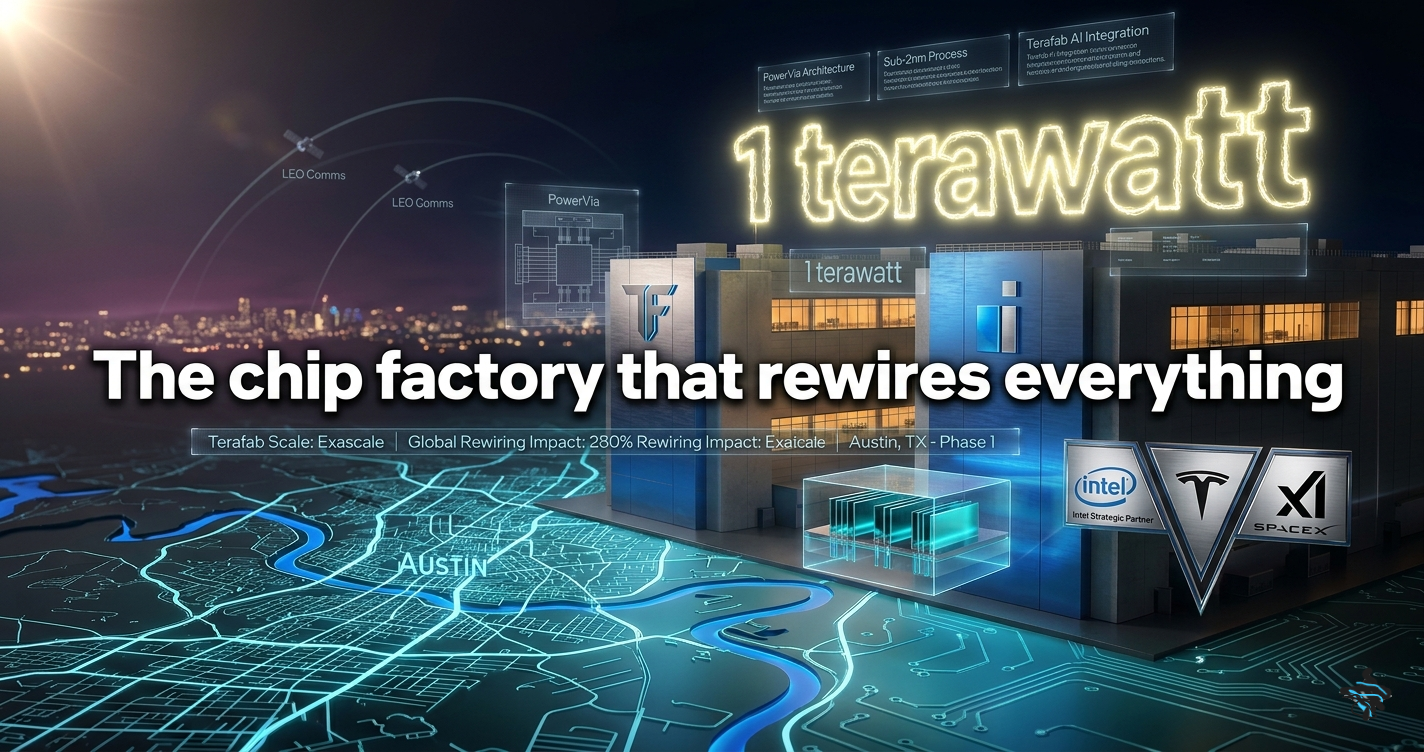
    This wasn’t a vague MOU. Intel CEO Lip-Bu Tan posted directly on X: “Intel is proud to join the Terafab project with SpaceX, xAI, and Tesla to help refactor silicon fab technology.” The statement committed Intel’s full stack — design, fabrication, and packaging, to Terafab’s central goal of producing 1 terawatt of AI compute per year.

    That’s not a typo. One terawatt. Per year. From a single facility.

    What does that actually mean? And should you restructure your AI infrastructure strategy around it? Those are the questions this analysis answers, with numbers, not hype.


    What Is Terafab and Why Did Musk Build It?

    Terafab was formally launched on March 21, 2026, via livestream from Austin. It’s a planned vertically integrated semiconductor complex that would house chip design, lithography, fabrication, memory production, advanced packaging, and testing under one roof, essentially a TSMC-killer with Musk’s name on the deed.

    The facility is anchored in Austin, Texas, near Tesla’s Gigafactory, with two distinct production lines: one for chips powering cars and humanoid robots, another aimed at AI data centers in space. Yes — orbital compute infrastructure is part of the roadmap.

    “We either build the TeraFab, or we don’t have the chips, and we need the chips, so we build the TeraFab.”

    Elon Musk, Terafab launch livestream, March 21, 2026
    That quote isn’t theater. Musk has claimed — via Tom’s Hardware’s recap of the launch, that today’s entire global AI compute output of roughly 20 gigawatts per year represents only about 2% of what Tesla, SpaceX, and xAI will eventually need. If you take that math at face value, his companies would require around 1,000 GW/year of compute. The external chip supply chain simply cannot deliver that on anyone’s timeline.

    Whether or not that demand projection proves accurate, the underlying strategic logic is sound: if you need a commodity at a scale the market won’t provide in time, you build the factory.

    The project carries an estimated price tag of US$20–25 billion — significant, but comparable to a single TSMC gigafab and within reach for a coalition of companies with Musk’s combined balance sheet.


    Intel’s 18A: The Technology That Makes This Plausible

    Before Intel’s announcement, Terafab was an interesting bet. After it, the project has a credible process technology backbone.

    Intel’s 18A node, featuring RibbonFET gate-all-around transistors and the industry’s first PowerVia backside power delivery, is the most significant process advancement Intel has shipped in a decade. The published specs show 15% better performance per watt and 30% higher chip density compared to Intel’s previous generation node (Intel 3).

    PowerVia deserves specific attention for AI applications. Modern AI accelerators run at sustained high current draws, where conventional front-side power delivery causes IR drop and limits clock speeds. Intel’s own benchmarks show PowerVia improves cell utilization by 5–10% and delivers up to 4% iso-power performance improvement, small numbers in isolation, but meaningful when you’re running hundreds of thousands of chips at sustained load.

    18A vs TSMC N2: How Do They Stack Up?

    Independent analysis from Introl’s CES 2026 chip breakdown positions Intel 18A’s transistor density as roughly equivalent to TSMC’s N2 process, expected in late 2026 — with approximately 2.5× the density of Intel 7. This would mark Intel’s first process-node parity or leadership since 2016.

    And there’s a roadmap beyond 18A. SemiWiki’s analysis of the 18A(P) variant (published April 4, 2026) projects an additional 10–15% performance improvement and approximately 10% better energy efficiency compared to base 18A. If Terafab eventually adopts 18A(P) for its high-performance AI chips, the efficiency delta over current-generation Nvidia/TSMC silicon could be substantial.

    The North America Angle

    Beyond raw performance, 18A carries geopolitical weight. It’s positioned as the earliest sub-2nm advanced node manufactured in North America, reducing dependency on TSMC in Taiwan and Samsung in South Korea. For any organization, corporate or government, that views AI chip supply concentration as a strategic risk, this matters considerably.

    High-volume manufacturing for 18A was targeted for late 2025 / early 2026. That ramp is underway. Intel’s involvement in Terafab isn’t just a partnership announcement, it’s a commitment to deploy its most advanced process at unprecedented scale.


    Translating 1 TW/Year Into Something Real

    The headline number, 1 terawatt of AI compute per year, is nearly impossible to intuit without a reference point. Here’s how to think about it.

    A modern high-performance AI accelerator (think H100-class) draws roughly 400–700 watts under sustained training loads. At a conservative 500W average, 1 terawatt of continuous installed compute power translates to roughly 2 billion watts, equivalent to around 4 million H100-class GPUs running simultaneously. That’s across installed base, not annual production; annual chip output to support that compute density would be a fraction of that number, but the scale remains staggering.

    For context: current U.S. AI compute sits at roughly 0.5 terawatts per year, according to Remio.ai’s detailed breakdown. Terafab’s target would double the entire country’s current AI compute production from a single facility. Musk himself has framed today’s entire global figure at just 20 GW/year, though that estimate is his own and unverified by independent bodies.

    ⚠ The “50× TSMC/Samsung” Claim Needs Scrutiny

    Remio.ai’s analysis characterizes Terafab’s ambition as “50 times the AI chip volume from TSMC and Samsung combined.” Treat this as rhetorical framing, not a verified figure. TSMC’s AI chip production is expanding rapidly, and the comparison depends heavily on which products count as “AI chips.” The number communicates magnitude; it isn’t a bankable projection.

    What’s the Terafab capacity trajectory for humanoid robots, specifically? Musk has indicated that 100–200 GW/year of Terafab’s output is earmarked for terrestrial applications, cars and humanoids, with the remainder allocated to space-based AI data centers. That terrestrial slice, if achieved, could significantly reduce the compute cost embedded in each robot’s bill of materials.

    Electrek, typically skeptical of Musk’s manufacturing claims, called Terafab “the largest semiconductor fab ever built, by an absurd margin.” That assessment is probably accurate, which is precisely why the execution risks are non-trivial.


    Strategic Implications by Audience

    For CTOs and Infrastructure Leaders

    Terafab + Intel 18A represents a potential third procurement path for advanced AI silicon, beyond Nvidia/AMD chips made at TSMC or Samsung. You shouldn’t restructure your 2026 roadmap around it, the ramp timeline makes that premature, but you should start mapping it into your 2028–2030 scenarios. If your AI infrastructure strategy has more than 60% concentration in one vendor (Nvidia/TSMC), the existence of a credible domestic alternative changes your negotiating posture today, even if the silicon doesn’t ship to external customers for years.

    For Robotics Founders and Product Leaders

    The compute-cost trajectory for humanoid robots is about to get interesting. If Terafab delivers even a fraction of its stated scale using 18A-class chips, the AI processing component of a robot’s bill of materials could drop materially over the next 3–5 years. One fab is explicitly dedicated to cars and humanoids, which means supply prioritization, not just process efficiency. If compute is more than 20% of your robot’s BOM, start modeling scenarios where that cost halves by 2029.

    For Institutional Investors

    Intel’s ~3% intraday jump signals that markets read the Intel-Terafab link as positive for the foundry narrative — not transformative, but directionally meaningful. Longer-term, the question is whether Terafab creates a durable competitive moat for Musk’s companies (insulating them from GPU scarcity) or whether the fab primarily serves as a signaling mechanism to extract better terms from Nvidia and cloud providers. Both outcomes are plausible; the answer determines whether external fab customers ever see competitive pricing.

    For Policy and Regulatory Professionals

    A U.S.-located advanced AI fab tied to Intel could reduce foreign semiconductor dependency, a clear win for domestic industrial policy. But it also concentrates cutting-edge AI compute manufacturing within a small cluster of companies, most of them inside Musk’s orbit. That raises legitimate questions around export controls, antitrust posture, and space-based compute regulation that don’t yet have clear answers in existing law.


    The Honest Risk Assessment

    Electrek’s framing, “Battery Day on steroids, and even less realistic”, isn’t dismissible. Tesla’s track record on aggressive manufacturing timelines is uneven. Full Self-Driving dates slipped repeatedly. Battery Day projections took years longer than promised. Terafab is orders of magnitude more complex than either.

    Execution Risk High
    Building and ramping the largest integrated fab ever attempted, on a bleeding-edge node, in a compressed timeline. First-of-kind mega-projects routinely run 2–3× over budget and schedule.

    Process Node Risk Medium
    Intel’s 18A must hit yield and performance targets in real AI chips. Projected metrics from vendor docs and analysts aren’t the same as measured silicon at volume.

    Demand Mismatch Medium
    If Musk’s projections of needing 50× current global compute prove optimistic, utilization risks and stranded capex become serious problems, especially at $25B in upfront investment.

    Regulatory / Geopolitical Medium
    Space-based AI data centers raise novel questions around spectrum, data jurisdiction, and military application that regulators will scrutinize. Export control regimes could complicate customer access.

    There’s also an organizational risk that rarely gets enough attention: Intel, Tesla, SpaceX, and xAI have genuinely different engineering cultures, risk tolerances, and internal bureaucracies. The history of ambitious cross-company manufacturing ventures is littered with coordination failures. Lip-Bu Tan’s Intel and Musk’s companies have never attempted anything remotely close to this level of integration.


    Realistic Timeline to External Access

    The most important question for anyone outside the Musk ecosystem: when do external customers actually get access to Terafab chips?

    Late 2025 / Early 2026
    Intel 18A High-Volume Manufacturing Ramp
    18A enters production. This is the foundation Terafab’s process technology is built on.

    April 2026 (Now)
    Intel Formally Joins Terafab
    Partnership confirmed. Design, fabrication, and packaging commitments are made. Austin prototype fabs begin configuration.

    2027–2028 (Optimistic)
    Initial Terafab Output — Internal Only
    Early capacity almost certainly serves Tesla, SpaceX, and xAI first. External customers are unlikely to see meaningful allocation during this phase.

    Late 2020s (Conservative)
    External Customer Access at Scale
    If the fab ramps successfully and demand from internal customers is partially met, third-party access becomes realistic, on a timeline of years, not months.

    If you’re planning AI infrastructure for 2026 or 2027, Terafab should not appear on your critical path. If you’re building a five-year compute strategy, it absolutely should appear as a scenario variable, potentially a significant one.


    Key Takeaways

    • Intel’s 18A partnership gives Terafab a credible process foundation, RibbonFET + PowerVia is competitive with TSMC N2.
    • 1 TW/year is genuinely extraordinary scale: roughly 50× current U.S. AI chip output, if projections hold.
    • Near-term (2026–2027) chip access will flow primarily to Tesla, SpaceX, and xAI — not external customers.
    • Execution risk is high. This is the most ambitious fab project ever attempted, with no proven precedent at this scale.
    • For CTOs: use this announcement as a negotiating lever with existing vendors. Don’t restructure procurement around it yet.
    • For investors: Intel’s stock reaction reflects narrative momentum, long-term value depends entirely on execution.

    Frequently Asked Questions

    Terafab is a planned semiconductor megafactory jointly developed by Tesla, SpaceX, and xAI that aims to produce more than one terawatt of AI compute per year by vertically integrating chip design, fabrication, memory production, advanced packaging, and testing in Austin, Texas. It was formally announced on March 21, 2026, with an estimated cost of US$20–25 billion.
    Intel is contributing its 18A advanced process node, chip design capabilities, and packaging technology. CEO Lip-Bu Tan framed the partnership as an opportunity to “refactor silicon fab technology” at unprecedented scale, aligning Intel’s foundry push with a massive guaranteed demand source.
    The stated target is 1 terawatt of AI compute per year. For comparison, current U.S. AI compute sits at roughly 0.5 TW/year, and Musk has claimed global output is only around 20 GW/year, 2% of his companies’ eventual needs.
    Intel 18A uses RibbonFET (gate-all-around) transistors and PowerVia backside power delivery. Intel’s specifications show 15% better performance per watt and 30% higher density vs Intel 3. Independent analysts place its density at roughly equivalent to TSMC N2, making it directly competitive for AI workloads.
    Potentially yes, but not in the near term. One of the Austin fabs is dedicated to chips for cars and humanoids. If compute costs drop significantly on 18A-class chips at scale, the processing component of a robot’s bill of materials could fall materially. Meaningful impact is more likely in the late-2020s window than 2026–2027.
    Currently, nearly all advanced AI accelerators run on Nvidia chips manufactured at TSMC. Terafab would create a parallel supply chain, U.S.-based, Intel-processed, primarily serving Musk’s companies. It’s a competitive alternative to, not a replacement for, the Nvidia-TSMC stack. External customers won’t have meaningful access for years.
    Initial operations are in Austin, Texas, adjacent to Tesla’s Giga Texas campus. The facility will house two advanced chip factories: one for terrestrial AI applications (cars and humanoids) and another for chips destined for space-based AI data centers. A full-scale location for broader expansion hasn’t been finalized.
    Realistically, not before the late 2020s. Early capacity will almost certainly serve Tesla, SpaceX, and xAI first. Advanced fab ramps typically take 2–4 years from initial operations to high-yield external production. Plan for access in the 2029–2030 window under an optimistic scenario.
    Four main categories: construction and yield execution on a historically unprecedented scale; Intel 18A performance in real-world AI chips vs. vendor projections; demand overestimation by Musk creating utilization risk on $25B of capex; and regulatory scrutiny around space-based compute and AI chip export controls. Electrek’s “Battery Day on steroids” comparison is pointed and worth taking seriously.
    Use Terafab’s existence as a negotiating lever with Nvidia and cloud providers now. Model it as a scenario variable in 2028–2030 infrastructure planning. Don’t restructure near-term procurement around it. Maintain strong relationships with existing vendors, and avoid any critical-path dependency until Terafab shows commercial silicon at scale. Diversification is the right posture, not substitution.

    The Bottom Line

    The Intel Terafab partnership does something no amount of Musk enthusiasm could do alone: it gives the project a credible semiconductor technology backbone. Intel’s 18A, with its RibbonFET architecture and PowerVia backside power, is genuinely competitive with TSMC’s best upcoming nodes. That’s not marketing. That’s measured silicon.

    But credible technology and operational delivery at 1 TW/year scale are two entirely different things. The history of first-of-kind mega-projects — in semiconductors, in rockets, in gigafactories, is a history of schedules that slipped and costs that climbed. Terafab is the most ambitious fab project ever attempted. The ambition itself is a risk factor.

    The right response to this announcement isn’t euphoria or dismissal. It’s strategic patience: acknowledge the shift in the long-range compute landscape, use it to strengthen your negotiating position with current vendors, and build contingency plans that don’t require Terafab to work on any specific timeline.

    Watch for three signals in 2026–2027 that will clarify how seriously to take the 1 TW/year target: (1) whether Intel 18A achieves published yield targets in production AI chips, (2) whether Terafab groundbreaking and fab construction stay on announced timelines, and (3) whether any external customers announce formal supply agreements. Each signal will tell you something real about whether this is a permanent shift in the compute landscape, or the most expensive negotiating tactic in semiconductor history.

    Either way, the Intel Musk Terafab AI chip project announcement of April 7, 2026, will be on the list of dates that mattered. The magnitude is still being written.

    Disclaimer: This analysis is based on publicly available reporting and third-party analyst estimates as of April 7, 2026. Financial figures, technical specifications, and timeline projections are directional and may change materially. This article does not constitute financial or investment advice. NeuralWired has no commercial relationship with Intel, Tesla, SpaceX, xAI, or Terafab.

  • Nvidia AI Accelerator Dominance | How Long Will It Last?

    Nvidia AI Accelerator Dominance | How Long Will It Last?

    NeuralWired is an elite frontier technology publication decoding the signals that shape tomorrow, for technologists, investors, and executives who need more than headlines. You are reading a Future Tech deep-dive. Every claim is sourced. Every number is verified. No fluff. Visit neuralwired.com

    Future Tech · April 2026

    Nvidia’s $4 Trillion AI Tax:
    How Long Before the Hyperscalers Stop Paying?

    Nvidia controls roughly 85% of the AI accelerator market and just became the most valuable company on Earth. But its biggest customers are quietly building the exit ramp, and the margins are already starting to slide.

    NeuralWired Staff April 7, 2026 Category: Future Tech 10 min read
    $4T+ Nvidia Market Cap (2026)
    ~85% AI Accelerator Market Share
    +69% Peak YoY Revenue Growth
    Nvidia became the world’s most valuable company not by making the flashiest product, but by owning the one thing every AI company on Earth desperately needs and cannot easily replace. Its AI accelerators power ChatGPT, Google Gemini, Meta’s Llama models, and virtually every frontier AI system running today. The AI accelerator market, which Nvidia controls at roughly 80 to 90 percent, has turned into the most profitable infrastructure position since Microsoft’s Windows dominated enterprise computing.

    By early 2026, Nvidia stood alone in a $4 trillion club of its own making. Apple was below that line. Microsoft was below it. Alphabet, Amazon, Meta, all below. For a chip company founded in 1993 to make graphics cards for video games, this is a remarkable place to stand.

    But the story doesn’t end there. Nvidia’s biggest customers, Microsoft, Google, Amazon, Meta, are each spending tens of billions of dollars trying to reduce their dependence on it. The margins are already sliding. The regulators are starting to watch. This analysis examines exactly how Nvidia built its dominance, what its real moat looks like, and how fast the hyperscalers can actually build the detour.

    01

    The $4 Trillion Tollbooth

    Every major AI company, OpenAI, Google DeepMind, Anthropic, xAI, needs massive compute to train and run frontier models. For the past five years, there has been one credible source for that compute at the performance levels frontier AI demands. That’s Nvidia.

    Its H100, H200, and Blackwell-series accelerators aren’t merely chips. They’re the atoms of the AI age. Every ChatGPT response, every AI-generated image, every real-time inference running at a hyperscaler almost certainly passed through Nvidia silicon. The hyperscalers have collectively spent hundreds of billions acquiring it.

    Nvidia’s data-center revenue grew at rates no megacap company had previously achieved, roughly 69% year-over-year on a multibillion-dollar base. Investors rewarded that with a valuation that now dwarfs companies generating more total revenue. Apple makes more money. Microsoft has more enterprise penetration. Neither is worth more.

    “Nvidia didn’t just win the AI hardware market. It became the tax that the entire intelligence economy pays, invisibly, on every inference, on every training run, on every model shipped.”

    NeuralWired Analysis
    This is what makes the toll road framing accurate: every byte of AI flowing through the world’s data centers generates, somewhere in its journey, a payment to Nvidia. Unlike Apple, which faces Android, Nvidia has no credible volume alternative at scale. Unlike Microsoft, which competes in software markets with real substitutes, Nvidia sells the hardware layer beneath every competitor’s product. That’s platform-level leverage.

    By early 2026, Nvidia stood alone above $4 trillion while Apple, Microsoft, and Alphabet had all slipped back below that mark. It has traded places with Apple and Microsoft repeatedly since 2024, but persistent AI-driven demand has kept it at or near the top.

    02

    CUDA: The Moat That Software Built

    Nvidia’s 80 to 90 percent AI accelerator market share is extraordinary. But market share alone doesn’t explain its staying power. AMD makes competitive AI GPUs. Intel is investing aggressively. Hyperscalers are building their own chips. So why does Nvidia keep winning?

    The answer is CUDA, and the 15 years of developer infrastructure built on top of it.

    Launched in 2006, a decade before “AI” became a boardroom priority, CUDA is Nvidia’s parallel computing platform. It allowed researchers and developers to write software that runs on Nvidia GPUs without speaking fluent hardware. Over fifteen years, a vast network of libraries, tools, frameworks, and institutional knowledge accumulated around it. PyTorch runs on CUDA. TensorFlow runs on CUDA. Every major AI research lab has workflows optimized for it.

    Why CUDA Is So Hard to Displace
    This structural advantage makes Nvidia’s position resemble Microsoft’s Windows more than any chip company of the past. Competitors don’t just need better silicon. They need a migration path, a comparable library network, and enough market pull to convince developers to invest their time in a new platform. That takes years. Nvidia has used those years well.

    03

    The Revolt of the Cloud Giants

    Here is the uncomfortable truth Nvidia’s investors must hold alongside the euphoria: the company’s biggest customers are also its most motivated adversaries.

    Amazon, Google, Meta, and Microsoft are not passively buying Nvidia chips while accepting permanent dependence. Each is building its own AI silicon. Google’s TPUs have been in production for years and are now sold to external cloud customers. Amazon has Trainium for training and Inferentia for inference. Meta is developing custom training chips. Microsoft is investing in its own AI silicon as well.

    The logic is simple. At the scale these companies operate, spending tens of billions annually on AI infrastructure, even a 10% reduction in Nvidia dependency is a multi-billion-dollar annual shift in economics. Every dollar spent on an internal chip that performs comparably is a dollar not paid to Nvidia.

    “The hyperscalers are spending generously to build side roads. They’re not trying to destroy the toll road, not yet. They’re trying to make sure they don’t need it exclusively, forever.”

    NeuralWired Analysis
    AMD is pursuing the same goal from the outside, with its Instinct MI300 and MI350 series chips achieving genuine competitiveness on certain workloads. It’s targeting double-digit AI GPU market share through the late 2020s. The performance gap to Nvidia has narrowed. The software gap, its ROCm platform versus CUDA, remains significant but is closing.

    What’s emerging is less a single competitor and more a slow-motion coalition: hyperscalers building custom silicon, AMD investing in CUDA alternatives, and open-source communities working on vendor-neutral AI software stacks. None of these individually threatens Nvidia’s near-term position. Together, over time, they represent the construction of real infrastructure around the toll road.

    04

    Where the Risks Are Real

    Nvidia’s position is formidable. It is not invincible. Four risk vectors deserve serious attention from anyone evaluating the company at a $4 trillion valuation.

    Risk 01 — Margin Erosion
    From Chips to Systems
    Gross margins have declined from a peak near 78% to the low 70s as Nvidia sells complete rack-scale systems with lower-margin third-party components. As competition intensifies, pricing power will face further pressure.
    Risk 02 — Geopolitics
    The China Constraint
    Export controls block Nvidia’s highest-end chips from China, forcing workaround products and ceding ground to domestic Chinese alternatives. Escalation of these restrictions is a real demand and competitive risk.
    Risk 03 — Regulatory Scrutiny
    The Antitrust Shadow
    As Nvidia becomes critical infrastructure for global AI, antitrust attention is a plausible next step, paralleling the scrutiny that Apple, Microsoft, and Google each faced at their respective peaks of market power.
    Risk 04 — Cycle Risk
    The ROI Question
    Nvidia’s valuation assumes AI capex keeps growing. If enterprise AI projects fail to demonstrate returns, or if more compute-efficient architectures emerge, demand growth could decelerate faster than the market expects.
    The margin story is the most immediate. In the crypto bust of 2018 and the gaming slowdown of 2022, Nvidia’s margins contracted meaningfully when demand softened. A similar dynamic in AI spending, even a temporary one, could compress earnings in ways a $4 trillion market cap cannot easily absorb.

    The regulatory risk is longer-dated but structurally important. What happens when the chip supplier for all of global AI faces antitrust scrutiny similar to what the DOJ brought against Microsoft in the 1990s? Nvidia’s CUDA bundling, its pricing practices, its role as gatekeeper to AI compute, all of it becomes politically reviewable at this level of consequence.

    05

    Jensen’s Bet on Permanence

    Jensen Huang’s response to competitive pressure is to move faster than competitors can follow, releasing new architectures (Hopper, Blackwell, Rubin) on cadences that force customers to keep buying even as they experiment with alternatives, and expanding Nvidia’s footprint from chips into full-stack AI infrastructure: networking, software, enterprise AI platforms, and robotics.

    The thesis Huang is betting on: AI compute demand will expand faster than any alternative infrastructure can be built. If frontier models keep scaling, requiring more parameters, more training compute, more inference capacity, the total market grows even as Nvidia’s share faces pressure. Nvidia doesn’t need to win every dollar. It needs to remain irreplaceable for the highest-stakes workloads.

    It’s a credible thesis. It’s also, at $4 trillion, a thesis the market has already priced in. The margin for error at this valuation is historically narrow. Any disappointment in growth, margins, or technology roadmap could trigger an outsized correction.

    06

    Frequently Asked Questions

    Everything you need to know
    How did Nvidia become the world’s most valuable company?
    Nvidia became the most valuable company by controlling roughly 80 to 90 percent of the AI accelerator market at a moment when every major technology company was spending billions on AI compute. Its data-center revenue grew at unprecedented rates, over 69% year-over-year on a multibillion-dollar base, as hyperscalers competed to buy H100, H200, and Blackwell chips. Investors rewarded this with a valuation that surpassed Apple and Microsoft, reaching $4 trillion by early 2026. Source: CNBC
    What is Nvidia’s market share in AI chips?
    Nvidia commands approximately 80 to 90 percent of the AI accelerator market, making its chips the default choice for training and running state-of-the-art AI models. This dominance means each incremental dollar of AI infrastructure spending disproportionately flows to Nvidia compared to any competitor. Source: Xpert Digital
    What is CUDA and why does it give Nvidia a competitive advantage?
    CUDA is Nvidia’s parallel computing platform, launched in 2006, that lets developers write software for Nvidia GPUs without deep hardware expertise. Over 15 years, every major AI framework including PyTorch, TensorFlow, and JAX built first-class CUDA support. This creates high switching costs: companies can’t simply replace Nvidia hardware without also migrating large codebases and retraining engineering teams.
    Who are Nvidia’s biggest competitors in AI chips?
    AMD is the primary external competitor, with its Instinct MI300 and MI350 chips achieving competitive performance on certain workloads. Google (TPUs), Amazon (Trainium, Inferentia), and Meta are building custom AI silicon internally. Intel is also investing in AI accelerators. None currently challenge Nvidia’s market share, but AMD and the hyperscaler custom-chip programs represent the most credible long-term competition. Source: Xpert Digital
    Why are Nvidia’s margins declining if it dominates the market?
    Nvidia’s gross margins have declined from a peak near 78% to around 73 to 74 percent because it increasingly sells complete rack-scale systems, full clusters with third-party networking, storage, and cooling components, rather than standalone chips. Those bundled system sales carry lower margins than GPU-only sales. Increased competition could put additional pressure on pricing power going forward.
    How do export controls affect Nvidia’s business?
    U.S. export controls prevent Nvidia from selling its highest-performance chips including the H100, H200, and B100 to China and certain other markets. Nvidia has responded with workaround products like the H20 and L20, but these generate less revenue and margin than full-capability chips. The restrictions also accelerate Chinese domestic chip development, creating longer-term competitive risk in a large market. Source: Reuters
    Could Nvidia face antitrust action?
    It’s a plausible risk at this scale. As Nvidia becomes critical infrastructure for global AI compute, regulators in the U.S. and EU may scrutinize its market position, CUDA bundling practices, and pricing power. This mirrors the scrutiny Apple, Microsoft, and Google each faced at their respective peaks. No formal action has been announced, but the risk rises with the company’s strategic importance.
    What is the risk that AI spending slows and hurts Nvidia?
    Nvidia’s $4 trillion valuation is built on the assumption that AI infrastructure spending keeps growing at current rates. If enterprises fail to see return on their AI investments, if more compute-efficient model architectures reduce the need for massive training runs, or if capital expenditure cycles normalize, Nvidia’s revenue growth could decelerate sharply. A high-multiple valuation leaves little room for disappointment.
    Can hyperscalers actually replace Nvidia with their own chips?
    Partially, and over time. Google’s TPUs, Amazon’s Trainium, and similar custom chips are already handling portions of AI workloads internally. But replacing Nvidia entirely would require matching not just raw chip performance but the full CUDA software network, which took 15 years to build. The realistic outcome is that hyperscalers use custom silicon for specific workloads where economics favor it, while continuing to buy Nvidia for frontier model training and high-performance inference.
    What is Nvidia’s next major chip architecture?
    Following the Blackwell architecture (B100/B200 series), Nvidia has announced Rubin as its next-generation platform. Jensen Huang has committed to annual architecture updates, a cadence designed to keep customers on upgrade cycles and make it harder for competitors to close the performance gap. Source: Reuters
    07

    Verdict and What to Watch

    Nvidia is the most important infrastructure company of the AI era and may remain so for the next several years. Its CUDA moat is real. Its execution has been exceptional. The demand for AI compute is not slowing. But the toll road is not eternal.

    The hyperscalers are building detours, methodically, expensively, and with serious long-term intent. The margins are already sliding. The regulators are paying attention. The valuation reflects dominance, not growing pressure.

    Investors who get this right are the ones who hold both truths simultaneously: durable structural advantage, and gathering competitive pressure. Right now the market prices mostly the first. The second is what’s worth watching.

    Three Signals to Watch in 2026 and 2027
    1. Hyperscaler capex disclosures: Watch what fraction of AI infrastructure spending Google, Amazon, and Meta attribute to third-party chips vs. custom silicon. A shift here signals the detour is working.
    2. AMD’s MI350 traction: If AMD wins a landmark hyperscaler contract at volume, not a pilot but at scale, it validates that the CUDA moat has a credible challenger on both hardware and software.
    3. Nvidia’s gross margin trajectory: If margins stabilize above 72% through 2026 despite competitive pressure, the moat is holding. If they continue declining, the pricing power story is weakening faster than bulls expect.
    For the broader AI infrastructure landscape, this Nvidia story is a template: platform-layer dominance is enormously valuable, right up until the moment the platform’s customers decide the value transfer is no longer worth it. Microsoft learned this with Windows. Intel learned it with x86. Nvidia is the next chapter, and how long its toll road holds will define one of the most important competitive dynamics in technology over the next decade.

    Follow NeuralWired’s Future Tech series for ongoing analysis of the power shifts reshaping the AI economy. Subscribe to The Neural Loop for weekly frontier intelligence.

    Disclaimer: This article is for informational and editorial purposes only. Nothing published by NeuralWired constitutes financial, investment, or legal advice. All market data and statistics are sourced from third-party publications and are accurate as of publication date. Readers should conduct their own due diligence before making any investment decisions.

  • Anthropic’s $400M Coefficient Bio Bet: What the Drug Discovery Acquisition Really Signals

    Anthropic’s $400M Coefficient Bio Bet: What the Drug Discovery Acquisition Really Signals

    Frontier Intelligence for the People Who Build Tomorrow
    NeuralWired decodes the moves that shape frontier technology so technologists, investors, and executives can act before the market catches up. This analysis is part of our AI x Life Sciences series.
    A $400 million all-stock deal for fewer than 10 people and a market projected to hit $25 billion. Here’s what Anthropic’s first major acquisition means for every pharma CTO, biotech founder, and life-sciences investor paying attention.

    $400M
    All-stock deal value, Anthropic’s first major acquisition
    <10
    Employees at Coefficient Bio at time of acquisition
    $25B
    Projected AI drug discovery market by 2035 (Roots Analysis)
    0.1%
    Dilution relative to Anthropic’s ~$380B Series G valuation

    What Actually Happened and Why the Timeline Matters

    On April 2, 2026, The Information broke the story: Anthropic had acquired Coefficient Bio, a stealth AI biotech startup, in an all-stock transaction worth approximately $400 million. The team, fewer than 10 people, will join Anthropic’s healthcare and life-sciences group to build AI agents for drug discovery, clinical trial planning, and regulatory workflows.

    Here’s what the straight news coverage missed: the timing isn’t incidental. Coefficient Bio was founded roughly eight months before the deal closed, a company that barely had time to name its product, let alone ship it to customers. The acquisition came just weeks after Anthropic’s February 2026 Series G closed at a reported ~$380 billion valuation. Put those two facts together: Anthropic is sitting on capital, and it wants to move fast.

    Coefficient Bio’s founders aren’t random bio-AI optimists. Nathan C. Frey, the co-founder and CTO, led biological foundation-model work, lab-in-the-loop systems, and NVIDIA BioNeMo collaborations at Genentech’s Prescient Design lab. He took home an ICLR 2024 Outstanding Paper Award for generative modelling applied to drug discovery. This isn’t an acqui-hire of generalists, it’s a targeted grab for one of the tightest niches in applied AI.

    “A tiny, high-caliber team with deep expertise from one of the top pharma AI groups got snapped up quickly to supercharge Anthropic’s push into using frontier AI for real biology and science, not just chat or code, but designing molecules, running virtual/physical experiments, and closing the discovery loop faster than traditional methods allow.”

    Michael Hochstat, AI practitioner at xAI, LinkedIn commentary, April 2, 2026
    The deal also represents Anthropic’s first major acquisition. That context is easy to gloss over. Anthropic has, until now, competed on raw model quality and partnership depth. Acquiring a bio-AI team is a different kind of signal, it says the company believes the fastest path to owning regulated science workflows isn’t building domain expertise from scratch inside a general-purpose lab. It’s buying teams who already know where the bodies are buried in a deeply complex, high-stakes field.

    What Coefficient Bio Actually Built

    Most news coverage described Coefficient as “a stealth AI biotech startup” and moved on. But the platform details matter enormously, because they tell you exactly where Anthropic is pointing Claude’s capabilities next.

    According to The Next Web’s reporting, Coefficient built a platform that lets AI models draft drug R&D plans, manage clinical regulatory strategies, and identify new drug candidates across the discovery pipeline. It integrates directly with tools already embedded in biotech workflows: Benchling (the electronic lab notebook standard), PubMed, and 10x Genomics data platforms.

    The company described its technical ambitions as “AI foundation models, generative modeling, and autonomous lab-in-the-loop systems specifically for biological research and drug discovery.” That phrase, lab-in-the-loop, deserves unpacking. It means AI doesn’t just analyze data; it actively designs experiments, interprets results, and proposes the next experiment in a tight feedback cycle. Think less “ChatGPT for scientists” and more “robotic research colleague that runs its own follow-up studies.”

    📡 Technical Integration Map
    Coefficient’s stack sits on top of Claude as the reasoning core. Domain-specific agents orchestrate workflows, protocol drafting, trial planning, regulatory submissions, while MCP connectors route data from Benchling, PubMed, Snowflake, EHRs, and genomics platforms. The result: end-to-end R&D workflow automation, not point-solution chatbots.

    Dimension Capital, one of the most sophisticated deep-tech investors in the market, owned approximately half the company. That’s not a detail, it’s a validation signal from people who do this for a living and who had full visibility into what Coefficient was building.

    When that team folds into Anthropic’s Claude for Life Sciences stack, which already scores 0.83 on the Protocol QA benchmark, beating the human baseline of 0.79, you get something genuinely new: a frontier language model with deep scientific reasoning and a purpose-built execution layer for the actual workflows that get drugs through to patients.

    Why Pay $400M for Fewer Than 10 People?

    The obvious skeptic’s response: this is an acqui-hire dressed up as strategy. Ten people, eight months old, no public product. Four hundred million dollars.

    It’s the right skepticism to voice. And it’s also, on closer examination, incomplete.

    First, the math. Relative to Anthropic’s ~$380 billion post-Series G valuation, this deal represents approximately 0.1% dilution. For a company of Anthropic’s scale, $400M in stock isn’t a bet-the-company move. It’s a rounding error on the balance sheet, but a very targeted one.

    Second, the alternative. To build equivalent domain expertise internally, Anthropic would need to recruit a team of computational biologists and drug-discovery AI researchers, wait years for institutional knowledge to develop, and navigate a talent market where Genentech-caliber computational biologists command extraordinary packages. The market for this specific expertise is tiny, and the best people don’t move for just compensation, they move for mission alignment and equity upside. Coefficient’s team had both reasons to join Anthropic.

    “Gen AI addresses these pain points by increasing efficiency across the entire clinical-development process, unlocking economic value across three dimensions: up to 50% cost reductions, a 12-plus-month acceleration in trial timelines, and at least a 20% increase in NPV.”

    McKinsey & Company, Generative AI in the Pharmaceutical Industry, January 2024
    Third, the market window. AI-drug discovery is at an inflection. The team that owns the incumbent relationships with pharma CTOs in 2026 will be very hard to dislodge by 2028. DeepMind has Isomorphic Labs. OpenAI is building partnerships. Vertical bio-AI startups are proliferating. Anthropic’s most natural advantage, Claude’s exceptional long-context scientific reasoning, needs a biotech-native execution layer to convert into enterprise contracts. That’s exactly what Coefficient provides.

    The $400M isn’t a valuation of what Coefficient built. It’s a price for the speed, the relationships, and the domain credibility that would otherwise take Anthropic three to five years to develop organically.

    The Market Anthropic Is Targeting: A $25B Window

    Three independent research firms have sized the AI-in-drug-discovery market, and their conclusions vary, which itself is instructive.

    Source 2025 Baseline End Forecast CAGR
    Roots Analysis $6.0B $25.0B (2035) 12.6%
    Precedence Research $6.93B $17.81B (2035) 9.9%
    Research and Markets $2.34B $5.98B (2029) 26.5%
    The range between estimates is wide, and that’s the honest answer. Early-stage markets are hard to size. But the direction is unambiguous: the market is large, growing fast, and currently dominated by fragmented point solutions.

    The broader economic context from McKinsey’s research is even more striking. Their modeling puts generative AI’s potential annual value creation in pharma and medtech at $60 to $110 billion, not as a market cap number, but as actual value delivered through cost reduction, faster timelines, and higher success rates.

    To put that in context: the entire AI-drug-discovery software market is smaller than the value McKinsey estimates the tools could create. That gap is where the real prize is. Anthropic isn’t just trying to sell software licenses, it’s trying to own a piece of the value that software creates in a $1.4 trillion global pharmaceutical industry.

    Another McKinsey report from June 2025 estimates AI could double the pace of R&D and unlock up to $0.5 trillion annually across R&D-intensive sectors including pharma. That’s the ceiling Anthropic is ultimately reaching for, not the near-term software TAM.

    The Competitive Landscape and Where Anthropic Now Fits

    Let’s be direct: Anthropic is late to the bio-AI space, and it knows it.

    DeepMind spun out Isomorphic Labs, a dedicated AI drug-discovery company, and has published foundational work on protein structure prediction that changed the field. OpenAI has been building life-sciences partnerships and has broader research relationships with top academic medical centers. A generation of vertical bio-AI startups, Recursion Pharmaceuticals, Insilico Medicine, Exscientia, built domain-specific models when general-purpose LLMs were still primitive tools for biology.

    So what’s Anthropic’s angle?

    The bet is that frontier general reasoning models, paired with domain-specific execution layers, will outcompete narrow vertical tools, not on molecular generation benchmarks, but on the workflow problem. Most of the time in drug development isn’t spent designing molecules. It’s spent writing protocols, drafting regulatory submissions, planning trial sites, interpreting results, and communicating with health authorities. Those tasks are where Claude already outperforms earlier models, and where Coefficient’s agents are designed to execute.

    🔬 Claude for Life Sciences: Benchmark Reality Check
    Protocol QA benchmark: Claude Sonnet 4.5 scores 0.83 vs. human baseline 0.79 and prior Sonnet 4’s 0.74. This is a task measuring AI understanding of lab protocols, exactly the kind of reasoning that matters in regulated workflows. Source: Anthropic, October 2025. Note: internal benchmarks should be independently validated before drawing strong conclusions.

    Claude in Microsoft Foundry already positions Anthropic inside enterprise pharma IT stacks with HIPAA-aligned deployment, MCP-based connectors to clinical systems, and the compliance credibility that smaller vertical players struggle to establish. Coefficient’s team accelerates the depth of that positioning, from “good general-purpose model with a life-sciences wrapper” to “purpose-built R&D intelligence platform.”

    Whether that’s enough to compete with DeepMind’s structural biology expertise or Recursion’s wet-lab data flywheel is still an open question. But Anthropic isn’t trying to win on every dimension. It’s trying to own the reasoning-and-workflow layer that sits above all those specialized systems.

    What This Means for Your Organization, by Role

    💊 Pharma / Biotech CTOs
    Anthropic is now a credible enterprise vendor, not a research experiment
    Start mapping R&D workflows against Claude’s life-sciences stack. The question is no longer whether to pilot, it’s which workflows to start with and how to structure governance.
    📊 C-Suite Executives
    AI-R&D platforms are a board-level strategic topic
    Use McKinsey’s 12+ month trial acceleration and 20% NPV uplift estimates to frame your internal business case. Build explicit budget lines. Assign accountability at VP level or above.
    🚀 Startup Founders
    AI-native bio teams with domain depth can command outsized exits, fast
    Focus on defensible combinations of proprietary data, domain-specific models, and tight integration with major LLM ecosystems. Generalist bio-AI tooling won’t survive consolidation.
    💰 Institutional Investors
    Consolidation is accelerating, portfolio reassessment is urgent
    Re-evaluate AI-biotech holdings with a lens on ecosystem alignment: which portfolio companies can become indispensable to Anthropic, OpenAI, or Google’s bio stacks vs. which will get acqui-hired or commoditized?
    For policy makers and regulators, the integration of frontier models into core R&D and clinical workflows raises immediate questions about explainability, auditability, and acceptable use in regulatory submissions. The FDA and EMA are watching. Proactive guidance on AI-assisted trial design and regulatory interactions, developed now, before widespread deployment, will be far easier than retroactive frameworks imposed after something goes wrong.

    The CTO Adoption Framework: 5 Steps Before You Deploy

    Based on McKinsey’s clinical IT modernization research and the specific capabilities Anthropic is building with Coefficient, here’s a structured adoption path for pharma and biotech technology leaders:

    • 1
      Map Your Workflow Portfolio (4 to 6 weeks)
      Inventory every R&D and clinical workflow by document intensity and data-analysis complexity. Identify which ones touch regulated data and which have measurable time-cost baselines. Your shortlist should be 5 to 10 candidate workflows with current cycle times documented. Don’t skip this, pilots that skip workflow mapping fail to show ROI.

    • 2
      Assess Data and Compliance Readiness (6 to 8 weeks)
      Evaluate data standardization against CDISC and HL7 FHIR. Map which datasets can be exposed to Claude-class systems via secure connectors without PHI risk. Define your GxP audit-trail requirements before choosing architecture. Many pilots fail here, not because AI isn’t capable, but because the data pipeline isn’t ready.

    • 3
      Choose Your Architecture (6 to 10 weeks)
      Evaluate Claude for Life Sciences against vertical bio-AI vendors and in-house build options. Criteria: integration fit with your existing stack (Benchling, CTMS, safety databases), IP terms, compliance certifications, and deployment model. The best model doesn’t always win, the best-integrated system does.

    • 4
      Run Defined-KPI Pilots (3 to 6 months)
      Launch 2 to 3 pilots, protocol drafting and regulatory response generation are natural starting points, with clear before-and-after metrics: time to draft, revision count, reviewer satisfaction. Run true A/B comparisons against your legacy process. McKinsey’s cited 15 to 30% productivity gains from IT modernization are real, but your baseline matters.

    • 5
      Scale with Governance (6 to 12 months)
      Integrate AI agents into SOPs with human review checkpoints. Log all prompts and outputs for audit readiness. Establish an AI governance board, this isn’t bureaucracy, it’s the thing that keeps a drug development error from becoming a regulatory crisis. Update your change-management plan: the people dimension kills more AI programs than the technology does.

    For a rough ROI estimate: use McKinsey’s upper-bound figures of up to 50% cost reduction in document-heavy processes and 20% NPV uplift as ceiling assumptions, then model your own portfolio’s specifics against conservative 20 to 30% efficiency scenarios. Most mid-size biotech organizations will see payback within 24 months in well-governed deployments.

    The Contrarian Take: What Could Go Wrong

    Anthropic’s Coefficient Bio acquisition is strategically coherent. It’s also a high-conviction bet in a field where hype regularly outruns outcomes. Here’s the honest risk register:

    ⚠ Medium Probability
    Pilots Don’t Scale
    Poor data governance, inadequate IT infrastructure, and change-management failures are the graveyard of enterprise AI programs. McKinsey finds that organizations without R&D IT modernization can’t unlock the 15 to 30% productivity gains the tools promise.

    ⚠ Medium Probability
    Benchmarks Don’t Transfer
    Claude’s Protocol QA score of 0.83 is impressive, but real-world lab data is messier than benchmarks. Edge cases, ambiguous results, and institutional variation can erode trust fast if outputs aren’t validated carefully.

    ✓ Lower Risk
    Regulatory Resistance
    FDA and EMA are moving toward AI guidance, not away from it. Near-term friction is likely in specific submission contexts, but the direction is accommodation, not prohibition. Transparency and human oversight remain non-negotiable.

    ⚠ Real but Manageable
    Competitive Response
    DeepMind, OpenAI, and well-funded vertical bio-AI companies won’t cede the market. Anthropic’s window to establish category leadership is real but not indefinite. Execution speed matters more than this deal alone.

    The most important limitation to name directly: very few AI-designed drugs have completed late-stage clinical trials or reached approval as of early 2026. The pipeline is filling, dozens of AI-originated molecules are in Phase I and II, but the clinical validation loop is long, expensive, and unforgiving. AI can compress timelines at the front end; it can’t escape the biology at the back end.

    The honest timeline: document-heavy workflows (protocol drafts, regulatory letters) will show productivity gains in 1 to 2 years. Deeper integration into experimental design and portfolio decision-making will take 3 to 5 years. Measurable shifts in clinical success rates and asset lifecycles won’t be visible for 5 to 10 years, contingent on adoption, validation, and regulatory adaptation at scale.

    Anyone promising faster than that is selling you the hype, not the reality.

    Frequently Asked Questions

    Answers to the questions professionals are actually asking about the Anthropic Coefficient Bio acquisition.

    Anthropic acquired Coefficient Bio, a stealth AI-native biotech startup founded in 2025, in an all-stock deal worth approximately $400 million. The company had fewer than 10 employees at the time of acquisition. Coefficient’s team is joining Anthropic’s healthcare and life-sciences group to build AI agents for drug discovery, clinical trial planning, and regulatory workflows. First reported by The Information, April 2, 2026.
    Coefficient built a platform enabling AI models to draft drug R&D plans, manage clinical regulatory strategies, and identify drug candidates across the discovery pipeline. It integrated with tools like Benchling, PubMed, and 10x Genomics. The founders described its mission as building “AI foundation models, generative modeling, and autonomous lab-in-the-loop systems” for biological research and drug discovery, meaning AI that not only analyzes data but designs and interprets experiments in an ongoing cycle.
    Three reasons. First, at ~$380B valuation, $400M in stock is 0.1% dilution, a small bet for a strategic priority. Second, recruiting equivalent Genentech-caliber computational biology talent organically would take years. Third, the market window is competitive: DeepMind’s Isomorphic Labs and OpenAI partnerships are already active. Paying a premium for an assembled, credentialed team closes a gap faster than any internal hiring plan could.
    Coefficient’s technology is expected to function as a domain-specific execution layer on top of Claude for Life Sciences. Coefficient-style agents will orchestrate specific workflows, protocol drafting, trial planning, regulatory submissions, using Claude as the reasoning core. Through MCP connectors (already available via Microsoft Foundry), these agents can tap into Benchling, EHR systems, genomics platforms, and scientific literature in real time.
    Current estimates put the global AI-in-drug-discovery market at $6 to $7 billion in 2025, with forecasts ranging from $18B to $25B by 2035 depending on the firm and methodology (9.9% to 26.5% CAGR). McKinsey separately estimates generative AI could create $60 to $110B annually in value for the broader pharma and medtech industry, a figure that dwarfs the software market itself. The range between analyst estimates reflects genuine uncertainty about adoption pace and regulatory evolution.
    Claude for Life Sciences is Anthropic’s version of Claude fine-tuned for scientific, biomedical, and clinical tasks. Launched October 2025, it scores 0.83 on the Protocol QA benchmark (human baseline: 0.79) and shows improvements on the BixBench bioinformatics evaluation. It integrates with platforms like Microsoft Foundry and connects to scientific tools and data sources for multi-step analysis and document drafting.
    Start by mapping your R&D workflows against what Claude’s life-sciences stack can actually do today, not what it promises to do in 18 months. Then assess data and compliance readiness before choosing a vendor. Design pilots with explicit before-and-after KPIs (time to draft, revision cycles, reviewer satisfaction). Use McKinsey’s 15 to 30% productivity gain and 20% NPV uplift estimates as benchmarking anchors, not guarantees. The full 5-step framework is covered above in this article.
    Three categories. Technical: AI models can hallucinate or misinterpret complex biology, human-in-the-loop review remains essential. Organizational: poor data governance and IT infrastructure failures kill more AI programs than technology limitations do. Regulatory: FDA and EMA expect human oversight and full audit trails for AI-assisted workflows; organizations that skip validation frameworks expose themselves to submission risk. The 5 to 10 year gap between AI-assisted discovery and proven clinical outcomes is real and should anchor realistic expectations.
    It validates AI-native biotech as a formal acquisition category for frontier model labs, not just a partnership or licensing target. The Coefficient deal is likely the first in a wave: expect OpenAI, Google, and Microsoft to make similar moves as the market matures. For investors, the implication is dual: consolidation risk (the best independent teams get absorbed early) and platform opportunity (LLM-centric R&D stacks becoming the default infrastructure for pharmaceutical R&D).

    The Bottom Line on the Anthropic Coefficient Bio Acquisition

    Here’s what the market coverage missed: this isn’t a story about $400 million. It’s a story about where the frontier model race goes next. Anthropic and every serious lab watching now understands that general-purpose reasoning alone won’t capture the biggest enterprise value pools. Domain depth wins. Execution infrastructure wins. The team that can actually write the trial protocol, file the regulatory submission, and interpret the omics data, inside a governed, audit-ready workflow, wins the pharma customer.

    The Coefficient acquisition gives Anthropic a credible answer to “but can your model actually do drug discovery?” in a way that no benchmark sheet could. It’s imperfect, early-stage, and genuinely uncertain in outcome. But so was every transformative bet in enterprise software before it became obvious in hindsight.

    Watch three developments through 2026 and 2027: (1) which pharma enterprises announce Claude-powered R&D workflows in production, not pilots, production; (2) whether competing labs match with their own domain-specific acquisitions; and (3) whether FDA releases formal guidance on AI-assisted clinical submissions. Those three signals will tell you whether this deal was the first domino or just an expensive acqui-hire.

    For now, if you’re building in life sciences, the conversation has changed. Frontier models are coming for your R&D stack, and unlike previous waves of “AI for drug discovery,” this time the team behind it knows what a Phase I protocol actually looks like.

    Disclaimer: This article is produced for informational and analytical purposes only. NeuralWired does not provide financial, investment, legal, or medical advice. All market projections cited are sourced from third-party research firms and are subject to significant uncertainty. Deal details are based on secondary reporting from The Information and other publications; Anthropic has not publicly confirmed all figures. Readers should conduct independent due diligence before making any investment or business decisions. All hyperlinks open source material in a new tab for verification.

  • Agentic AI in Robotics 2026: Complete Guide to 5 Frameworks That Deliver 10x Automation ROI (While Avoiding 70% Failure Rate)

    Agentic AI in Robotics 2026: Complete Guide to 5 Frameworks That Deliver 10x Automation ROI (While Avoiding 70% Failure Rate)

    Why 70% of Agentic Robotics Pilots Fail in 2026, And 3 Deployment Frameworks That Actually Work | NeuralWired
    NeuralWired covers frontier technology for the professionals building it. This investigation synthesizes peer-reviewed research, analyst data, and practitioner deployments to answer the question every automation leader is facing in 2026: how do you move agentic AI from a promising demo into a robot that actually ships products?

    Gartner named Physical AI a top strategic trend. NVIDIA’s simulators are closing the sim-to-real gap. Boston Dynamics’ Atlas just hit the Hyundai factory floor. And yet most agentic robotics pilots are dying quiet deaths in conference rooms. Here’s why, and what the survivors did differently.

    The 2026 Inflection Point Nobody Prepared For

    Something fundamental shifted in late 2025. Not in the technology, which had been building for years, but in what was suddenly expected of it. Industry analysts project the agentic AI market will surge from $7.8 billion today to over $52 billion by 2030, and executives who spent 2024 approving “AI exploration budgets” are now demanding production systems. The demos are over. The pilots have to ship.

    That pressure arrived faster than most operations teams could absorb. Gartner projects that 40% of enterprise applications will embed task-specific AI agents by the end of 2026, up from under 5% in 2025. And Gartner’s own client inquiry data shows just how fast that shift is happening: questions about multi-agent systems surged by 1,445% between Q1 2024 and Q2 2025. That’s not a trend. That’s a pressure wave.

    For physical robots (manipulators, AMRs, humanoids on a plant floor), the stakes are categorically different from deploying another chatbot. An agentic AI that writes a bad email costs you credibility. An agentic AI that miscalculates a robot’s path near a human worker costs you something else entirely.

    67%
    of developers and product leaders say their teams are already building or shipping agentic workflows as of early 2026, yet most of these deployments are purely digital. The moment agents control physical actuators, complexity compounds in ways no software-first team anticipates. Source: Nylas State of Agentic AI Survey, Feb 2026
    This is the gap. Not a technology gap. The tools exist. Deloitte’s 2026 Tech Trends report confirms that Vision-Language-Action (VLA) models, robotics platforms, and real-time processing have converged to make Physical AI deployable today. The problem is organizational and architectural. Teams that understand LLMs don’t understand safety relays. Teams that understand PLCs don’t understand multi-agent orchestration. And both sides frequently underestimate the simulation-to-reality gap, the chasm between a model that works flawlessly in Isaac Sim and one that freezes, drifts, or makes unsafe decisions in a factory with vibration, dust, and non-deterministic humans.

    The International Federation of Robotics named agentic AI a key driver of robot autonomy for 2026, but it was equally blunt about the prerequisite: IT/OT convergence. Without real-time data exchange between your plant-floor systems and your enterprise infrastructure, the agent has no reliable world model to reason against. It’s a brain without sensory input.

    What follows is built from peer-reviewed research, practitioner deployments at scale, and analyst data. Not vendor promises. Actual production experience. By the time you finish reading, you’ll know exactly which framework fits your use case, what realistic ROI looks like, and the three governance requirements you cannot skip without creating a liability problem.

    Three Gaps That Kill Agentic Robotics Pilots

    Most pilots don’t fail because the AI wasn’t good enough. They fail because the organization wasn’t ready for what the AI required. Three gaps appear repeatedly across failed deployments, and addressing all three before you write a single line of orchestration code is the difference between a pilot that scales and one that becomes a cautionary slide in a board deck.

    Gap 1: The Simulation-Reality Mismatch

    Every agentic robotics team runs simulation. Almost none runs enough of the right simulation. The problem isn’t that simulators are inaccurate. NVIDIA’s AlpaSim platform has demonstrated up to 83% reduction in variance between simulated and real-world performance on specific robotic tasks. The problem is that most teams treat simulation as a validation step rather than a training regime.

    Domain randomization, deliberately varying surface friction, lighting, sensor noise, and object placement during simulation, is the technique that separates brittle agents from resilient ones. Waymo’s and NVIDIA’s use of synthetic data to handle rare, high-stakes scenarios that real-world datasets can’t easily capture points to the right model: simulate aggressively, including failure modes your production environment will throw at the system.

    ⚠ Common Mistake

    Teams that skip domain randomization discover their agents are brittle to conditions they didn’t think to test: slightly different SKU packaging, a new type of pallet, a repair crew leaving tools in an unexpected location. Robustness to your simulation’s assumptions is not robustness to reality.

    Gap 2: Missing IT/OT Integration

    An agentic AI making decisions for a warehouse robot fleet needs real-time data: robot positions, inventory states, order queues, conveyor statuses, charging levels, and fault codes, all flowing continuously into a shared state store. Most factories weren’t built to provide this. Their operational technology (OT) networks were designed for reliability and isolation, not for the millisecond-latency data feeds that a reasoning agent needs.

    As the IFR describes in its global robotics trends report, IT/OT convergence (enabling real-time data exchange between digital and physical worlds) is the foundational prerequisite for agentic robotics at any meaningful scale. Without it, the agent is reasoning against stale or partial state, and its decisions will reflect that. A robot dispatched to a charging station that was already occupied two minutes ago is a small failure. A robot dispatched into a corridor where a maintenance crew is working, based on stale safety zone data, is a much larger one.

    Gap 3: No Governance Layer

    The third gap is the one executives are most reluctant to fund, and the most dangerous to skip. When an agentic system makes a decision that causes a safety incident or a costly operational error, the first questions from legal, insurance, and regulators will be: What decision did the agent make? Why? What data did it use? Can you demonstrate it was behaving within defined boundaries?

    If you can’t answer those questions from logs, you’re exposed. Governance tooling (audit trails, rollback mechanisms, decision explanations) is now emerging as a category requirement even in regulated digital industries like finance and healthcare. For physical systems where decisions have immediate physical consequences, this isn’t optional instrumentation. It’s the operational foundation.

    “During the next decade, the intersection of agentic AI systems with physical AI robotic systems will result in robots whose ‘brains’ are agentic AIs, enabling them to adapt to new environments, plan multistep tasks, recover from failure, and operate under uncertainty.”

    Deloitte Tech Trends 2026: AI Goes Physical

    Five Deployment Frameworks That Separate Winners From Pilots

    There’s no universal architecture for agentic robotics. The right framework depends on your hardware, your use case, and your organization’s maturity. Here are the five patterns that are producing real-world results in 2026, from the highest-adoption to the most experimental.

    FRAMEWORK 01 Agentic Floor Manager: Warehouse & Logistics
    The most production-ready pattern. A supervisor agent acts as an autonomous floor manager for an entire robot fleet, dynamically assigning pick tasks, rerouting AMRs around obstacles or failed machines, and adjusting inventory placement based on live order patterns. Practitioners describe this as replacing a static WMS rule-engine with a system that can reason about trade-offs in real time: what to deprioritize when three robots need charging simultaneously, how to handle a surge order that conflicts with scheduled maintenance.

    Architecture: Perception layer (robot telemetry, IoT, WMS feeds) → shared state store → task agents (batching, routing, charging, congestion) → supervisor agent → ROS2 nodes or vendor APIs over MQTT/gRPC.

    Agent Layer: LangChain / AutoGen / CrewAI
    Robotics: ROS2 (Nav2, MoveIt2) + vendor SDKs
    Messaging: MQTT / Apache Kafka
    Safety: Hardware E-stops + safety PLCs (agent cannot override)
    Simulation: NVIDIA Isaac Sim / Gazebo with domain randomization
    FRAMEWORK 02 VLA-Powered Manipulation Cell: Manufacturing
    For assembly tasks that involve variable parts, tool changes, or unstructured environments (problems where traditional PLC sequencers break down), this framework uses a Vision-Language-Action model as the robot’s reasoning core. The VLA interprets camera feeds, natural language instructions, and possibly audio, then hands motion plans to the existing robot controller.

    Boston Dynamics’ Atlas undergoing its first field test at Hyundai’s manufacturing facility in 2026 is the most visible real-world data point for this pattern, and it’s notable that even Atlas is operating under strict human supervision and limited task scope, not full autonomy.

    Deployment sequence: Define constrained task set → collect multimodal training data → build digital twin of cell → train and validate VLA policy in simulation → deploy in pilot cell with strict speed and force limits → expand task repertoire as system confidence grows.

    VLA Model: NVIDIA Alpamayo / Google RT-2 style architecture
    Simulation: NVIDIA Isaac Sim with AlpaSim for sim2real
    Safety: ISO 10218 / ISO/TS 15066 speed-force supervision
    Monitoring: Prometheus + Grafana for inference latency & anomalies
    FRAMEWORK 03 Hierarchical Multi-Robot System: Complex Facilities
    For facilities running multiple robot types (AMRs, fixed arms, inspection drones, conveyor systems), a flat single-agent architecture becomes unmanageable. The hierarchical pattern, grounded in Fraunhofer’s multi-agent HRC research, uses a manager agent that holds global objectives and SLAs, while specialist agents each control a specific robot type or subsystem.

    The key engineering discipline here is contract clarity: the interface between manager and specialist agents must be precisely defined: what inputs the specialist receives, what outputs it guarantees, and what it escalates. Poorly defined contracts cause the kind of emergent misbehavior that’s hard to debug and harder to explain to a safety auditor.

    The AgenticControl framework from recent arXiv research introduces an automated approach to this problem, using LLM agents to iteratively propose and evaluate controller configurations in simulation before any real-hardware deployment. It validated across four control systems including DC motor positioning, offering a promising pattern for automated controller qualification.

    FRAMEWORK 04 Multimodal HRC Interface: Workforce Augmentation
    Rather than replacing workers, this framework gives them natural language and gaze-based control over collaborative robots. A peer-reviewed multimodal agentic HRC framework, validated in a real timber assembly scenario in 2026, uses separate AI agents for perception, intent understanding, and command generation, so a worker can say “place that beam there” while glancing at the target location, and the system translates that into precise robot motion.

    This pattern is particularly relevant for organizations facing union concerns or workforce skepticism about automation. It frames agentic robots as force-multipliers for existing staff rather than headcount replacements, which changes the change-management conversation meaningfully.

    Perception Agent: Fuses camera, LiDAR, gaze-tracking data
    Intent Agent: LLM interpreting natural language + context
    Planning Agent: Translates intent to executable robot sequences
    Safety Agent: Real-time proximity monitoring, force supervision
    Hardware: Collaborative robot certified to ISO/TS 15066
    FRAMEWORK 05 Agentic Fleet Maintenance & Anomaly Response
    Frequently overlooked, this is often the easiest framework to deploy first, and the one that builds internal confidence for more ambitious agentic investments. Agents continuously monitor robot telemetry, flag anomalous patterns before failures occur, schedule maintenance windows that minimize production impact, and orchestrate safe shutdown or degraded-mode operation when something goes wrong.

    The analogy to agentic AI in security operations (where deployments have reduced false-positive alerts by 40% while improving throughput) is direct. The pattern is identical: continuous monitoring, anomaly triage, escalation, and response. The difference is that the “alert” in this context is a robot behaving outside its performance envelope, and the “response” may involve physically moving it to a safe position.

    Choosing the Right Framework: A Quick Reference

    Framework Best Environment Complexity ROI Potential Risk Level
    Agentic Floor Manager Warehouses, logistics, e-commerce fulfillment Medium High Medium
    VLA Manipulation Cell Assembly lines, variable-part manufacturing High High High
    Hierarchical Multi-Robot Complex multi-robot facilities Very High High Medium
    Multimodal HRC Interface Collaborative assembly, skilled-trades support Medium Medium Low
    Fleet Maintenance Agent Any multi-robot deployment Low Medium Low

    The ROI Model: What You Can Actually Expect

    Vendor slide decks are not ROI models. Here’s what the underlying data actually shows, and why the numbers vary so dramatically between organizations.

    A synthesis of McKinsey data across enterprise deployments shows early agentic AI implementations delivering 3 to 5% annual productivity gains, while scaled multi-agent systems drive 10% or more enterprise output growth. The gap between those numbers represents the organizational maturity required to realize the higher figure, and most pilot programs are funded with the 10% outcome in mind while operating at the 3% level of readiness.

    In physical robotics specifically, ROI breaks into three categories:

    Throughput gains: more picks per hour, faster assembly cycles, higher machine utilization. These are the most commonly measured, the easiest to attribute to the agentic system, and typically the primary payback driver in the first 12 to 18 months.

    Downtime reduction: fewer unplanned stoppages through predictive maintenance and intelligent fault recovery. In high-volume facilities, even a 1 to 2% improvement in uptime can justify the infrastructure investment alone.

    Error cost reduction: fewer mis-picks, damaged goods, rework cycles, and safety incidents. These are harder to measure precisely but can represent a substantial component of total value, particularly in high-value or fragile goods handling.

    83%
    reduction in simulation-to-real performance variance reported by NVIDIA’s AlpaSim platform on specific robotic tasks, the most critical technical metric for teams moving agents from training environments to production hardware. Source: NVIDIA AlpaSim technical documentation, via Kersai AI Breakthroughs 2026
    The payback structure for a warehouse floor manager deployment, using conservative numbers: initial investment of $800K to $2M (robots, infrastructure, software, safety systems) against productivity gains in the 5 to 15% range after a stabilization period of 3 to 6 months, typically yields a 24 to 36 month payback on the full system. Organizations that rush to deployment (skipping sim2real validation or IT/OT integration) will extend that payback period or write it off entirely when the pilot fails to scale.

    One critical variable almost every ROI model underweights: skills cost. Deploying agentic robotics requires engineers who understand both robotics and modern AI agent systems. That intersection is rare, commands significant salary premiums, and the gap will widen. Budget for it explicitly, or build a training program before the project starts.

    Who’s Doing It Now, and What They Built

    The most useful data points aren’t analyst projections. They’re the companies that have actual agentic systems running in physical environments today.

    Amazon represents the most mature large-scale deployment. AI agents continuously optimize delivery routes, manage warehouse operations, and coordinate robotics systems that respond to natural language task commands. What makes Amazon’s approach instructive isn’t the technology. It’s the organizational infrastructure that supports it. They built data governance, observability, and cross-functional AI literacy years before the agentic layer arrived. The agent had a prepared environment to operate in.

    Walmart offers a parallel case in supply chain. Agentic AI unifies inventory visibility across stores, fulfillment centers, and logistics facilities, automatically detecting demand surges and adjusting replenishment schedules. Again, the interesting part is less the AI and more the data infrastructure that makes real-time reasoning possible across thousands of locations.

    Hyundai / Boston Dynamics represents the frontier case, where the agent directly controls a humanoid robot in a real manufacturing environment. Atlas began its field test at Hyundai’s facility near Savannah, Georgia in 2026. This is the most physically consequential deployment pattern, and Hyundai is running it with appropriate caution: tightly scoped tasks, heavy human supervision, and gradual task expansion as confidence builds.

    The pattern across all three: substantial infrastructure investment before the agentic layer, conservative initial deployment scope, and a deliberate expansion cadence tied to demonstrated performance rather than vendor timelines.

    What Successful Deployers Had in Common

    • Digital twin or live state estimation of the physical environment before the first agent was deployed
    • IT/OT integration completed as a prerequisite, not a parallel workstream
    • Independent safety layer that the agent cannot override, implemented in hardware
    • Full logging and audit trail from day one of the pilot
    • Cross-functional team: robotics engineers, AI engineers, safety engineers, and plant operations. Not separate workstreams.
    • Conservative first deployment scope with explicit criteria for expansion

    The Risks Vendors Won’t Put in Their Decks

    Every agentic robotics pitch you’ll receive in 2026 will lead with capability. Autonomous floor management. Real-time task adaptation. Natural language robot control. What they won’t volunteer is a calibrated risk picture. Here’s ours.

    Sim2Real Failure

    The simulation-reality gap isn’t a solved problem. AlpaSim’s 83% variance reduction is impressive, but 17% variance on a robot moving at speed in a human-occupied environment is still significant. Peer-reviewed research on agentic HRC systems explicitly flags that brittle generalization outside training distribution remains a key limitation of current VLA and agentic policy models. Domain randomization mitigates but doesn’t eliminate this risk. Plan for on-site fine-tuning as a mandatory project phase, not an optional optimization.

    Multi-Agent Coordination Failures

    Multi-agent systems can exhibit emergent misbehavior that no single agent was designed to produce. Two agents optimizing for different objectives (throughput and battery conservation, for example) can create oscillatory behavior that leaves robots stuck in decision loops. Research on hierarchical multi-agent robotics architectures specifically flags coordination complexity and potential instability as key failure modes for poorly designed systems. Clear objective hierarchies and rollback mechanisms are not optional engineering debt. They’re stability requirements.

    The Interoperability Problem

    As practitioner Ben Kalkman observes in his analysis of Google’s 2026 agent trend predictions, context loss between agent handoffs is a persistent production problem: different AI systems interpret instructions differently, and those divergences compound across a multi-robot system. Google’s Agent2Agent (A2A) protocol is one response to this, enabling cross-platform coordination. But until interoperability standards mature, you’re building custom integration logic that becomes a maintenance liability.

    Realistic vs. Vendor Timeline

    The vendor narrative positions fully autonomous agentic factories as a 2026 to 2027 reality. The practitioner data is more measured. Manufacturing Dive’s 2026 analysis of agentic AI in industrial settings points to targeted warehouse and cell-level deployments this year, with broader plant-wide scale emerging between 2028 and 2030 as standards, tooling, and organizational readiness catch up to the technology. Humanoid co-workers building cars at scale? That’s a 2029 to 2032 story, and any capital plan that assumes otherwise is taking on speculative risk.

    ⚠ Liability Gap to Address Before Deployment

    Current safety standards (ISO 10218 for industrial robots, ISO/TS 15066 for collaborative robots) were written before agentic AI decision-making existed. The legal liability framework for “the agent decided to do X and someone was injured” is actively being developed by regulators, and the EU AI Act’s provisions on high-risk AI systems will apply to physical robots. Get your legal team involved before the pilot launches, not after the incident.

    Prerequisites Checklist Before You Deploy Anything

    This checklist is the single most actionable thing in this article. Every item reflects a failure mode observed in real deployments. If you can’t check a box, don’t deploy into that zone yet.

    • Digital twin or live state estimation of the physical environment with latency under 200ms
    • IT/OT integration complete: plant OT network connected to enterprise infrastructure with validated data pipelines, not a parallel workstream
    • Standardized robot interfaces established (ROS2, OPC UA, or vendor APIs) that accept high-level commands
    • Independent safety layer installed and validated (hardware E-stops, safety PLCs, safety scanners), physically separate from any software agent logic
    • Simulation environment built with domain randomization; agent policy tested against failure modes including machine faults, blocked paths, and sensor noise
    • Logging and audit trail infrastructure live: every agent decision, input state, and output command captured and queryable
    • Rollback mechanism defined: policy for reverting agents to last known-good configuration when performance degrades below threshold
    • Cross-functional pilot team in place: robotics engineers, AI engineers, safety engineers, plant operations. Not separate workstreams.
    • Legal and compliance team briefed on applicable standards (ISO 10218, ISO/TS 15066, EU AI Act applicability, local regulations)
    • Change management plan for workforce: communication, training, and involvement before deployment, not after resistance emerges
    • Explicit success criteria and expansion thresholds defined. The pilot doesn’t scale until it hits these numbers for at least 90 consecutive operating days
    • Cybersecurity review of the OT-IT boundary and any cloud connectivity for agent inference

    Frequently Asked Questions

    Agentic AI in robotics refers to autonomous systems that can perceive their environment, plan multi-step actions, and adapt behavior to achieve high-level goals , rather than executing fixed pre-programmed sequences. These agents often coordinate multiple robots, respond to real-time data, and recover from failures, functioning more like a digital floor manager than a traditional PLC controller. Gartner projects 40% of enterprise applications will embed task-specific AI agents by end of 2026, with physical systems following as infrastructure matures.
    Traditional robotics automation runs on pre-programmed sequences and PLC logic designed for stable, predictable environments : if something unexpected happens, it stops and waits for a human. Agentic AI adds continuous reasoning so robots can adapt to changes, coordinate with other robots, and optimize tasks in real time. Fraunhofer’s hierarchical multi-agent architecture research illustrates the shift clearly: a manager agent assigns subtasks to specialized deep-RL agents, each responsible for its own robot, a model of delegation that traditional automation simply can’t express.
    The most mature deployments are in warehouses and logistics. Amazon uses agentic AI to coordinate robotics systems responding to natural language commands, while Walmart uses agents to unify inventory visibility and automatically adjust replenishment schedules. On the frontier, Boston Dynamics’ Atlas is undergoing its first real factory field tests at Hyundai, and a peer-reviewed multimodal agentic framework has been validated in real timber assembly work using gaze and language inputs.
    Three risk categories dominate: the simulation-reality gap (agents that perform well in training fail under real-world sensor noise or unexpected objects), safety incidents from agent misjudgment when no independent hardware safety layer exists, and governance failures where decisions can’t be audited or explained. Organizations also face skills shortages, IT/OT integration complexity, and workforce resistance when change management is neglected. AI CERTs emphasizes that physical AI must be treated as an always-on, embodied liability source, not merely as software.
    Early agentic deployments typically produce 3 to 5% annual productivity gains; scaled multi-agent systems with mature data infrastructure can drive 10% or more enterprise output growth. These figures come from an 8allocate synthesis of McKinsey enterprise data. For physical robotics specifically, payback periods on full system investment (robots, infrastructure, software, safety) typically run 24 to 36 months under conservative assumptions. Organizations that skip IT/OT integration or sim2real validation reliably extend or forfeit this payback.
    The core technique is domain randomization, deliberately varying lighting, friction, sensor noise, and object placement during simulation so the trained policy generalizes to real-world variability. NVIDIA’s AlpaSim reports up to 83% reduction in sim-to-real variance on specific tasks. Complementary approaches include combining synthetic and real-world training data (following Waymo’s model), building high-fidelity digital twins of specific deployment environments, and planning for mandatory on-site fine-tuning as a project phase rather than a post-launch fix.
    Production stacks typically combine ROS2 as the robotics middleware with agent orchestration frameworks such as LangChain, AutoGen, or CrewAI. Simulation runs on NVIDIA Isaac Sim or Gazebo with domain randomization enabled. Monitoring uses standard observability stacks (Prometheus, Grafana). For enterprise deployment, Google Cloud’s Vertex AI platform and its Agent2Agent protocol are increasingly relevant for teams that need cross-system agent coordination. Safety infrastructure, hardware E-stops, safety PLCs, scanners, runs independently of all software.
    A supervisor agent monitors real-time telemetry from the robot fleet, inventory state, and order queues, then assigns tasks to specialized agents handling routing, charging, congestion resolution, and exception management. These agents communicate over a shared event bus (typically MQTT or Kafka) and replanning happens continuously as conditions change. Practitioners describe this as an autonomous floor manager that reroutes automatically when machines fail and rearranges inventory based on live order patterns, replacing the static rule-sets of traditional WMS systems with real-time adaptive logic.
    You need people fluent in robotics (motion planning, ROS2, control theory, safety engineering) and people fluent in modern AI (LLMs, VLA models, multi-agent system design, MLOps). The intersection is rare. Additionally, the team needs IT/OT integration experience, cybersecurity capability for plant-floor network exposure, and governance expertise. IFR and Deloitte both flag skills shortage as a primary constraint on physical AI adoption, and the salary premium for engineers at that intersection will grow through 2028.
    It’s both real and overhyped simultaneously. The real part: Amazon and Walmart have agentic orchestration running at scale, Boston Dynamics is running factory tests with Atlas, and peer-reviewed research confirms the technical foundations are solid. The overhyped part: vendor timelines for fully autonomous manufacturing are consistently aggressive, most organizations lack the IT/OT maturity to realize the higher ROI figures, and broad plant-wide scale is a 2028 to 2030 story, not a 2026 one. The technology works. The question is whether your infrastructure, governance, and organization are ready to support it.

    What Comes Next, and What to Watch

    Here’s what the data reveals when you look across every deployment pattern and failure mode: agentic AI robotics is not primarily a technology problem. The VLA models work. The simulation platforms are closing the gap. The orchestration frameworks are production-grade. What’s holding back most organizations is the same thing that held back cloud adoption, DevOps adoption, and every previous architectural transformation: organizational unpreparedness for what the technology demands.

    The companies succeeding with agentic robotics didn’t start with better AI. They started earlier on data infrastructure, IT/OT integration, and safety governance. When the agentic layer arrived, it had a prepared environment to operate in. The companies failing started with the AI and worked backward, discovering, expensively, that the foundation wasn’t there.

    This principle extends beyond the current moment. As physical AI systems proliferate and autonomous agents become embedded in more production environments, competitive advantage will increasingly separate on organizational readiness to deploy technology from access to the technology itself. The models commoditize. The infrastructure, the governance, the team capability: those take years to build and can’t be licensed on a Tuesday morning.

    Three developments deserve close attention through 2027:

    Safety standards will catch up. ISO 10218 and ISO/TS 15066 are being revised to account for adaptive, AI-driven robot behavior. The EU AI Act’s high-risk AI provisions will increasingly constrain how agentic physical systems are deployed and documented. Organizations that build governance infrastructure now, before the regulations land, will move faster when compliance becomes mandatory.

    Sim2real tooling will commoditize. What NVIDIA’s AlpaSim represents today as a competitive advantage will be table stakes within 24 months. The differentiation will shift to the quality of your digital twin and the richness of your domain randomization library.

    The skills shortage will intensify before it eases. Every major industrial organization is hiring for the same intersection of robotics and AI engineering. Build your internal capability, or your training pipeline for existing staff, now, while compensation is still rational.

    For deeper implementation guidance, review the five frameworks against your specific use case and cross-reference against the prerequisites checklist. If more than two items on that list aren’t checked, that’s where your budget should go before the first agent is deployed.

    Subscribe to The Neural Loop for weekly frontier intelligence on Physical AI, agentic systems, and the infrastructure shaping production robotics.

    Stay Ahead of Physical AI

    Weekly frontier intelligence for the people building the next decade of automation. No filler. Just signal.

    Subscribe to The Neural Loop →
    Disclaimer: This article synthesizes publicly available research, analyst reports, and practitioner commentary for informational purposes. NeuralWired is not responsible for investment, deployment, or strategic decisions made based on this content. All market figures, productivity projections, and performance benchmarks reflect cited third-party sources and carry the uncertainties inherent to forward-looking data. Safety standards referenced (ISO 10218, ISO/TS 15066, EU AI Act) should be verified against current versions before use in compliance planning. Consult qualified legal and safety engineering professionals before deploying autonomous robotic systems in any human-occupied environment.

  • How 3 Hours on PyPI Exposed 4TB of AI Data: The LiteLLM-Mercor Supply Chain Breach

    How 3 Hours on PyPI Exposed 4TB of AI Data: The LiteLLM-Mercor Supply Chain Breach

    How 3 Hours on PyPI Exposed 4TB of AI Data: The LiteLLM-Mercor Supply Chain Breach | NeuralWired
    Frontier Intelligence
    NeuralWired.com  |  Elite-class frontier technology intelligence for technologists, executives, founders, policy professionals, and investors shaping what comes next. This analysis is part of our ongoing AI Security coverage series.
    Breaking Analysis  ·  AI Supply Chain Security  ·  April 4, 2026
    The Mercor LiteLLM supply chain breach wasn’t a fluke it was the inevitable collision of AI infrastructure’s explosive growth and its catastrophic security debt. Here’s everything you need to know, act on, and watch for.

    April 4, 2026 | ~3,000-word analysis | Incident Response · Risk Framework · Vendor Checklist
    4TB Data exfiltrated
    ~3hrs Malicious window on PyPI
    $10B Mercor’s valuation
    5+ Ecosystems compromised

    The Attack That Exposed AI’s Hidden Dependency Crisis

    The malicious packages stayed live on PyPI for roughly three hours. That was enough. When TeamPCP a sophisticated multi-ecosystem threat actor pushed backdoored versions of LiteLLM (v1.82.7 and v1.82.8) onto the Python Package Index in late March 2026, they didn’t need days or weeks of access. Thousands of AI pipelines automated, hungry for the latest dependencies, running in CI/CD environments across the globe pulled those packages and executed their payload before most security teams had their morning coffee.

    The downstream fallout has been extraordinary. Mercor, a $10 billion AI recruiting and annotation startup whose clients include OpenAI, Anthropic, and Meta, confirmed it was breached via the LiteLLM compromise becoming the first organization to publicly acknowledge being victimized through the TeamPCP campaign. The extortion group Lapsus$ claims to have walked away with 4TB of data: 939GB of source code, a 211GB user database, and roughly 3TB of video interviews and passport-scan identity documents from Mercor’s contractor network. Meta has since paused its work with Mercor while it investigates.

    This article gives you the definitive account of what happened, how it happened, and most critically what you need to do about it. You’ll get the full Trivy-to-Mercor attack chain, a forensic breakdown of the malicious payload, a five-step incident response playbook, a vendor assessment checklist, and a risk framework for every component in your AI stack. Whether you’re a DevSecOps engineer auditing dependencies, a CISO briefing your board, or a founder deciding how much to trust third-party AI tooling, this is the resource you’ll send to your team.

    ⚠ Immediate Action Required
    If your organization uses LiteLLM, check your dependency manifests now for versions v1.82.7 or v1.82.8. Even if you didn’t install these versions directly, CI/CD environments that ran during the exposure window may have pulled them transitively. See Section 5 for the full response playbook.

    The Attack Chain: From Trivy to 4TB in Nine Days

    To understand the Mercor LiteLLM supply chain breach, you need to go upstream. LiteLLM didn’t fail on its own. It was the third domino in a carefully engineered cascade that started with a security tool, of all things.

    Phoenix Security’s forensic analysis of the TeamPCP campaign shows that the attack almost certainly began when a compromised Trivy CI/CD action ran inside LiteLLM’s own build pipeline. Trivy is a widely used open-source vulnerability scanner the kind of tool organizations add to their pipelines specifically to improve security. When the compromised action ran, it harvested LiteLLM’s PyPI publishing token. TeamPCP then used that token to push malicious releases directly to PyPI, bypassing GitHub’s version history entirely. No one outside the project’s maintainers would have seen the change coming.

    // Attack Timeline: Trivy → LiteLLM → Mercor
    1
    ~Mar 19-22, 2026
    Trivy CI/CD Credential Theft
    TeamPCP compromises a Trivy GitHub Action. When it runs in LiteLLM’s pipeline, it exfiltrates the PyPI publishing token. The project is unaware.

    2
    Mar 23, 2026
    Malicious LiteLLM Releases Pushed to PyPI
    TeamPCP publishes v1.82.7 and v1.82.8 to PyPI. Packages contain a three-stage credential harvesting payload embedded via a .pth auto-execution file. They remain live for approximately three hours before quarantine.

    3
    Mar 23-29, 2026
    Thousands of AI Pipelines Pull Infected Packages
    Automated CI/CD jobs and development environments at enterprises, AI labs, and AI startups worldwide pull the malicious versions. Credential theft begins immediately on package installation. The campaign targets at least five ecosystems: PyPI, npm, Docker Hub, GitHub Actions, and OpenVSX.

    4
    Late Mar 2026
    Mercor Network Compromised via Tailscale VPN Credentials
    Following LiteLLM-driven credential theft, attackers reportedly use a compromised Tailscale VPN credential for initial access to Mercor’s infrastructure. Lateral movement and data staging begin.

    5
    Mar 30-31, 2026
    Mercor Confirms Breach; Lapsus$ Claims 4TB Exfiltrated
    Mercor publicly discloses the incident, calling itself “one of thousands of companies” affected. SANS ISC designates Mercor as the first officially confirmed victim of the TeamPCP campaign.

    6
    Apr 3-4, 2026
    Meta Pauses Work with Mercor
    Business Insider confirms Meta has paused its AI training relationship with Mercor while it investigates exposure. The commercial fallout begins for a company valued just months earlier at $10 billion.

    Trend Micro’s research team describes this as one of the most sophisticated multi-ecosystem supply chain campaigns publicly documented to date. The key insight that separates this campaign from run-of-the-mill package typosquatting: attackers didn’t create a fake LiteLLM package. They published to the real one, using legitimate credentials, making automated trust checks essentially useless.

    Inside the Payload: What the Malicious LiteLLM Actually Did

    The malicious LiteLLM package didn’t run obvious, easily-flagged code. It used a .pth file a Python path configuration mechanism that auto-executes on interpreter startup to ensure the payload ran any time Python initialized in the infected environment. You didn’t have to import LiteLLM. Installing it was enough.

    According to Endor Labs’ analysis via BleepingComputer, the payload executed three distinct stages:

    01

    Stage 1: Credential Sweep

    The payload searched for and exfiltrated over 50 categories of secrets SSH keys, AWS and GCP access tokens, Kubernetes secrets, crypto wallet keys, .env files, and API credentials for LLM providers like OpenAI, Anthropic, and Cohere. For AI companies, these aren’t peripheral credentials. They’re the keys to the entire model inference and training infrastructure.

    02

    Stage 2: Kubernetes Lateral Movement

    If a Kubernetes environment was detected, the payload attempted to deploy privileged pods to every node in the cluster. This isn’t just credential theft it’s a full cluster takeover bid, giving attackers the ability to observe, intercept, or modify workloads across the entire AI compute environment. Training jobs, inference services, data pipelines: all exposed.

    03

    Stage 3: Persistent Systemd Backdoor

    Finally, the payload installed a systemd backdoor service that polled attacker-controlled infrastructure for additional binaries. Even if you removed the malicious package, the backdoor could persist and continue receiving new payloads until explicitly hunted and eradicated. Uninstalling LiteLLM and moving on is not a remediation strategy.

    “Once triggered, the payload runs a three-stage attack: it harvests credentials (SSH keys, cloud tokens, Kubernetes secrets, crypto wallets, and .env files), attempts lateral movement across Kubernetes clusters by deploying privileged pods to every node, and installs a persistent systemd backdoor that polls for additional binaries.”

    Endor Labs researcher, quoted in BleepingComputer, March 23, 2026
    The .pth execution mechanism deserves special attention. Security teams focused on import-time analysis, runtime behavior detection, or network egress monitoring at the application layer may miss a payload that fires at the Python interpreter level before any application code runs. This is precisely why standard dependency auditing checking version numbers and known CVEs isn’t sufficient for AI supply chain risk.

    Why the Mercor Breach Hits Differently

    Every major supply chain breach is serious. This one is in a different category. Here’s why.

    LiteLLM Is Everywhere in AI Infrastructure

    LiteLLM isn’t a niche tool. It’s a unified interface that routes to over 100 LLM provider APIs OpenAI, Anthropic, Cohere, Mistral, Bedrock, Vertex, and dozens more. It’s used in AI agent frameworks, MCP servers, orchestration tools, and model evaluation pipelines across the industry. It has tens of thousands of GitHub stars and deep integration in precisely the kind of AI-adjacent tooling that organizations adopt quickly and audit slowly. Compromising LiteLLM is like compromising a universal key that fits every door in the AI infrastructure building.

    Mercor’s Client List Is a Who’s Who of Frontier AI

    Mercor doesn’t just work with any companies. Its clients reportedly include OpenAI, Anthropic, and Meta the organizations training the most powerful and commercially significant AI systems in the world. Mercor provides these clients with recruiting services, contractor management, data annotation, and AI training support. That means the company’s systems potentially touch training data, annotation workflows, and contractor identity information for frontier AI development. Even if no model weights were exfiltrated, the blast radius calculation changes entirely when this is your vendor’s client list.

    The Data You Can’t Rotate

    Most breach responses follow a standard playbook: rotate credentials, update keys, patch the vulnerability. The Mercor breach adds a dimension that playbook doesn’t cover well.

    “The most alarming part of the Mercor breach isn’t just the source code theft it’s the biometric and identity data that can’t be rotated. You can change a password or an API key; you can’t change your face or the passport video you used to onboard to a training platform.”

    IQ Source, “Mercor Breach: 4 TB of Biometric Data You Can’t Rotate,” March 31, 2026
    Of the alleged 4TB exfiltrated, approximately 3TB consists of video interviews and passport-scan identity documents collected as part of Mercor’s contractor onboarding process. These documents belong to the thousands of contractors data annotators, AI trainers, evaluators who completed identity verification to work on AI training projects for top-tier labs. You can’t issue new passports. You can’t re-record someone’s face. The long-tail privacy risk from this data persists for years, and the fraud potential compounds every time it moves through threat-actor markets.

    // Alleged Exfiltrated Data Breakdown (Lapsus$ Claim)
    939 GB source code  ·  211 GB user database  ·  ~3 TB video interviews & identity documents (passports). Total: ~4 TB. Note: Volumes are attacker-reported. Mercor has confirmed a significant breach but has not publicly validated specific size figures. Source: SANS ISC, March 31, 2026.

    The commercial fallout is already moving faster than the forensics. Meta has paused its work with Mercor. A $10 billion company built on trust trust from contractors sharing their identities, trust from AI labs sharing their workflows now has both eroded simultaneously. As Kenneth Hartman of SANS ISC noted in the campaign’s Update 005 diary, Mercor “has publicly confirmed it was breached as a direct consequence of the LiteLLM supply chain compromise, making it the first organization to officially acknowledge being victimized through the TeamPCP campaign.” That phrase “first organization” should be read as a warning: it won’t be the last.

    Incident Response Playbook for Affected Organizations

    If your organization uses LiteLLM directly, or via any AI framework that depends on it here is the structured response sequence. Don’t treat this as a “check if we installed the bad version” exercise. Given the three-stage payload and persistent backdoor, the scope of required remediation is considerably larger.

    01

    Confirm Exposure Window (0-24 Hours)

    Determine whether any system, container, or CI/CD job installed litellm==1.82.7 or litellm==1.82.8 during the malicious window. Check your SBOM tooling, pip install logs, lockfiles (requirements.txt, poetry.lock, Pipfile.lock), container image manifests, and build logs. Also check for the malicious C2 domains published by Phoenix Security and Trend Micro in your egress logs. Don’t assume only direct dependencies matter transitive installs and CI environments are primary exposure vectors.

    02

    Rotate All Potentially Exposed Credentials (24-72 Hours)

    The payload targeted over 50 secret types. Rotate aggressively: cloud provider access keys (AWS, GCP, Azure), LLM provider API keys, Kubernetes secrets and service account tokens, SSH keys on any host that ran the package, .env-file contents, CI/CD pipeline secrets, and crypto wallet keys. Don’t wait for forensics to confirm compromise before rotating. Assume compromise and rotate then verify.

    Monitor for usage of old credentials after rotation. Continuing usage after revocation confirms active attacker access.

    03

    Hunt for Persistence and Lateral Movement (1-2 Weeks)

    This is the step most organizations skip and then regret. Use published IOCs from Trend Micro, Phoenix, and Endor Labs to systematically search for: unexpected systemd services installed after the exposure window; anomalous Kubernetes pods in your clusters (especially privileged or DaemonSet-style deployments you didn’t create); outbound connections to unknown infrastructure; and signs of credential replay from unexpected IPs or regions.

    Treating this as a package-uninstall problem will leave you with a persistent backdoor.

    04

    Assess Your AI Vendor Exposure (1-4 Weeks)

    If you use AI data vendors, annotation providers, or training services especially any that use LiteLLM or similar AI gateway libraries contact them now. Request their incident response statement specific to the LiteLLM compromise, ask for their current SBOM for key services, and verify what Tailscale or VPN credential controls they have in place. The Mercor case demonstrates that vendor compromise can expose your contractors’ identities, your training workflows, and your annotated data not just the vendor’s own systems.

    05

    Regulatory and Legal Response (Ongoing)

    If any of your contractors’ or users’ identity documents, biometric data, or personal information may have been exposed via a vendor like Mercor, engage your data protection officer and privacy counsel immediately. Biometric data carries special classification under GDPR Article 9, CCPA, and numerous state-level biometric privacy laws (BIPA in Illinois, for example). Notification obligations may be triggered; delays compound regulatory exposure. The “non-rotatable” nature of biometric data makes the individual harm calculation more severe, which regulators are increasingly factoring into enforcement decisions.

    AI Vendor Supply Chain Risk Checklist

    Send this to your AI data vendors, annotation providers, orchestration tool vendors, and any third-party touching your model pipelines. The Mercor breach didn’t happen in a vacuum it happened because security questionnaires for AI vendors haven’t caught up to AI vendors’ actual attack surface.

    // Vendor Security Assessment: AI Supply Chain (Post-LiteLLM)
    • Do you use LiteLLM, LangChain, or similar AI gateway libraries in your production infrastructure? If yes, which versions are deployed, and what remediation steps did you take after March 24, 2026?
    • Provide a current Software Bill of Materials (SBOM) for your key services, including transitive Python and JavaScript dependencies used in AI orchestration, annotation, or inference pipelines.
    • How are your PyPI, npm, and container registry publishing credentials managed? Are they stored in CI/CD systems, and how are they isolated from the workloads that consume those packages?
    • What controls prevent a compromised third-party CI/CD action (e.g., a GitHub Action like Trivy) from exfiltrating secrets used in your own publishing pipeline?
    • Describe your secret-management approach are secrets stored in a dedicated KMS (AWS Secrets Manager, HashiCorp Vault, GCP Secret Manager), what are your rotation policies, and do you run automated scanning for hard-coded secrets in repos and container images?
    • What logging and telemetry do you maintain for package installation events, and do you alert on anomalous outbound connections from build and inference environments?
    • What are your Mean Time to Detect (MTTD) and Mean Time to Respond (MTTR) benchmarks for a supply chain compromise event? Have you exercised this scenario in a tabletop or red team exercise in the past 12 months?
    • For data labeling, annotation, and recruiting vendors: how are contractor biometric data, identity documents, and video recordings stored? Are they encrypted at rest with customer-managed keys? Who has access, and what retention and deletion policies govern them?
    • What contractual commitments indemnification clauses, SLA penalties, incident notification timelines apply if your supply chain results in exfiltration of our data or our contractors’ personal information?
    • Have you retained a third-party forensics firm to investigate the LiteLLM exposure window? When do you expect to provide a final incident report?

    Where AI Supply Chains Break: Risk Hotspots Across the Stack

    The LiteLLM campaign didn’t just compromise one tool. It exposed a structural problem: AI infrastructure is built on a dense, poorly-audited web of dependencies, each of which can serve as an entry point. Here’s how the risk breaks down across the key components in a typical AI stack.

    Stack Component Example Tools Credential Risk Data Exfil Risk IP Leakage Risk Compliance Risk
    AI Gateway / Proxy LiteLLM, OpenRouter HIGH HIGH HIGH HIGH
    CI/CD Actions Trivy, GitHub Actions HIGH MED MED LOW
    Annotation / Labeling Vendor Mercor, Scale AI MED HIGH HIGH HIGH
    Orchestration Framework LangChain, CrewAI HIGH MED MED MED
    Evaluation Tooling Evals frameworks, RLHF tooling LOW MED MED LOW
    Container / Image Registry Docker Hub, GHCR HIGH MED HIGH LOW
    Cloud Infra (K8s / Serverless) EKS, GKE, Lambda MED HIGH HIGH MED
    The table makes one thing clear: AI gateways like LiteLLM are the highest-risk single point in the stack because they concentrate API keys and cloud credentials for every LLM provider in use. As Trend Micro Research observed, “AI proxy services that concentrate API keys and cloud credentials become high-value collateral when supply chain attacks compromise upstream dependencies.” One compromised gateway = every model provider credential, simultaneously.

    The Contrarian View: Don’t Panic, But Don’t Look Away

    The temptation after an incident like this is to swing hard in the other direction ban open-source AI tooling, rebuild everything in-house, treat every PyPI package as hostile. That reaction creates as much risk as it mitigates.

    The problem isn’t that LiteLLM is open-source. Open-source software’s transparency is genuinely a security asset over time: vulnerabilities get found, discussed, and fixed in the open. The problem is organizational: most teams that adopted LiteLLM did so with the same diligence they’d apply to a SaaS subscription, not a critical infrastructure dependency. That mismatch between deployment speed and security rigor is where the breach lives, and rebuilding in-house doesn’t fix it it just changes which codebase you fail to audit.

    What does help:

    Treat AI dependencies as critical infrastructure. Organizations that require SBOMs, pin dependencies, and review transitive package graphs for database connectors should do the same for AI libraries. The blast radius of a compromised AI gateway dwarfs most database vulnerabilities.

    Minimize the secrets your AI tools can see. LiteLLM’s credential exposure was so severe because many deployments gave it access to all LLM provider keys simultaneously exactly the design it enables. Scope credentials tightly. Use separate keys per provider, rotate them on short cycles, and consider whether your AI gateway needs to run with the same permissions as your cloud control plane.

    Design for resilience, not just prevention. Phoenix Security’s analysis notes that the malicious packages were live for only about three hours. Good tooling didn’t prevent that window but organizations with strong egress monitoring, anomaly detection, and fast credential revocation workflows would have contained the damage significantly. Prevention is insufficient. Assume compromise and build resilient response.

    // The Realistic Timeline
    Vendor narrative: “We’ve patched the package and rotated keys risk is contained.”  |  Reality: Full credential rotation, backdoor eradication, vendor assurance, regulatory notification, and insurance claims will span weeks to months across most AI-heavy organizations. Early-stage companies without mature IR practices face even longer timelines, and some will never fully close their exposure windows.

    Frequently Asked Questions

    The Mercor LiteLLM supply chain breach is a 2026 security incident in which threat actor TeamPCP compromised the open-source LiteLLM library on PyPI, embedding a credential-stealing payload. AI recruiting and annotation startup Mercor serving clients including OpenAI, Anthropic, and Meta confirmed it was breached via this compromise, with extortion group Lapsus$ claiming to have exfiltrated approximately 4TB of sensitive data including source code, user databases, and identity documents. TechCrunch coverage →
    TeamPCP almost certainly stole LiteLLM’s PyPI publishing token by running a compromised Trivy CI/CD action inside LiteLLM’s own build pipeline. Using that token, they published malicious versions 1.82.7 and 1.82.8 directly to PyPI bypassing GitHub’s version history with a three-stage payload embedded via a .pth auto-execution file. The packages remained live for approximately three hours before quarantine, but that window was enough to reach thousands of environments. Phoenix Security analysis →
    According to attacker claims corroborated by SANS ISC and multiple security analyses, the alleged exfiltration includes approximately 939GB of source code, a 211GB user database, and roughly 3TB of video interviews and passport-style identity verification documents collected during contractor onboarding. The biometric and identity components are particularly serious because they cannot be “rotated” the way credentials can. Note that Mercor has confirmed a significant breach but has not publicly validated specific volume figures. SANS ISC Update 005 →
    Mercor has publicly confirmed being breached and describes itself as one of thousands of organizations affected. Any organization that installed LiteLLM v1.82.7 or v1.82.8 during the exposure window may have had credentials harvested. Mercor’s clients reportedly include OpenAI, Anthropic, and Meta, though no evidence has been published that those companies’ own systems or training data were directly accessed. Meta has paused its work with Mercor while investigating. Business Insider coverage →
    Scan your SBOM tooling, dependency manifests, pip install logs, and container image layers for LiteLLM versions 1.82.7 or 1.82.8. Review your network egress logs against the C2 domains published by Trend Micro, Phoenix Security, and Endor Labs. Check for unexpected systemd services or Kubernetes pods deployed around the exposure window (approximately March 23, 2026). Also audit CI/CD build logs the package may have been installed transiently in a build environment even if it’s not in production dependencies. Upwind Security guide →
    Three compounding factors. First, Mercor’s clients include frontier AI labs, meaning the blast radius touches the most commercially sensitive AI training and annotation workflows in the industry. Second, the exfiltrated data includes biometric and identity documents that cannot be remediated the way credentials can affected contractors face permanent, long-tail fraud and privacy risk. Third, the incident demonstrates that AI infrastructure’s rapid growth has created a class of high-value targets AI gateways, annotation platforms, evaluation tooling that the security industry hasn’t yet developed robust governance frameworks for. IQ Source analysis →
    In priority order: (1) Identify all systems that installed LiteLLM v1.82.7 or v1.82.8. (2) Rotate all credentials on affected hosts cloud tokens, API keys, SSH keys, Kubernetes secrets. (3) Hunt for the persistent systemd backdoor and anomalous Kubernetes pods using published IOCs. (4) Contact AI-related vendors to assess their LiteLLM exposure and remediation. (5) Engage legal and privacy counsel if any personal or biometric data may have been involved. See the full five-step playbook in Section 5. Full breakdown →
    Most security experts say no. The problem isn’t open-source AI tooling it’s the gap between adoption velocity and security governance. The right response is treating AI dependencies as critical infrastructure: requiring SBOMs, pinning versions, monitoring installs, scoping credential access tightly, and maintaining egress visibility. Wholesale abandonment of open-source AI tooling in favor of rushed in-house rebuilds creates different, often larger risks. Upwind Security →
    In the short term: vendor pauses, security reviews, and stricter contract terms are already happening (see Meta’s pause on Mercor). In the medium term: expect accelerated investment in AI-supply-chain security tooling, SBOM requirements in procurement, and more rigorous vendor due diligence frameworks. In the long term: this breach may prove a positive forcing function the kind of high-profile incident that finally drives AI teams to adopt the supply-chain governance practices that software-at-large learned from SolarWinds and Log4Shell. Market context →

    What Comes Next

    The Mercor LiteLLM supply chain breach reveals something the AI industry has managed to avoid confronting at scale until now: the attack surface of modern AI infrastructure isn’t primarily the models. It’s the dense, fast-moving, poorly-governed dependency graph underneath them. TeamPCP didn’t need to crack a foundation model or defeat an alignment system. They compromised a CI/CD scanner, stole a publishing token, and waited three hours. The rest was automated.

    The structural lesson isn’t unique to AI it’s the same lesson the software industry learned from SolarWinds in 2020 and Log4Shell in 2021. But AI’s particular characteristics make it acutely vulnerable: adoption velocity that outruns security governance, deep integration of credential-rich gateway tools, and a category of data biometrics, identity documents, annotated training material that carries long-tail risk well beyond what typical credential rotations can address.

    Three developments are worth watching in the months ahead. First: whether Mercor is truly “one of thousands” or the first of many public disclosures, as affected organizations complete forensic investigations and face disclosure timelines. Second: whether the AI developer tools market sees a consolidation or bifurcation between providers who can demonstrate security maturity via SBOMs, audits, and incident-response track records, and those who can’t. Third: whether regulators particularly those with jurisdiction over biometric data use the Mercor breach to accelerate enforcement action that establishes precedent for how AI training vendors must protect contractor identity data.

    The Mercor LiteLLM supply chain breach is not the last attack of its kind. It’s the proof-of-concept that made the playbook obvious. Organizations that build AI supply chain governance now before the next campaign, before the regulation, before the next Meta-style contract pause will be the ones that don’t have to write that breach disclosure.

    Disclaimer: This article is an editorial analysis compiled from publicly available security research, news reporting, and attacker claims. Volume and data figures attributed to Lapsus$ are unverified attacker claims; Mercor has confirmed a significant breach but has not publicly validated specific data volumes. NeuralWired is not a cybersecurity firm and this analysis does not constitute legal, compliance, or incident response advice. Consult qualified security and legal professionals for decisions affecting your organization.

  • Microsoft’s $10B Japan AI Bet: The Sovereign Cloud Playbook Every CTO Needs Now

    Microsoft’s $10B Japan AI Bet: The Sovereign Cloud Playbook Every CTO Needs Now

    Microsoft’s $10B Japan AI Bet: The Sovereign Cloud Playbook Every CTO Needs Now | NeuralWired
    Microsoft just committed 1.6 trillion yen to Japan’s AI future. By 2027, 75% of global enterprises will need data-localization architectures in at least one market. Here’s the decision framework that separates the prepared from the exposed.

    The Announcement: What $10 Billion Actually Buys

    Microsoft just made its largest single-country AI commitment anywhere on earth. On April 3, 2026, the company announced it will invest 1.6 trillion yen, roughly $10 billion, in Japan between now and 2029, covering AI and cloud infrastructure expansion, cybersecurity cooperation with the Japanese government, and an ambition to train 1 million engineers and developers by 2030.

    The market responded immediately. Bloomberg reported that Sakura Internet, one of Microsoft’s key Japanese infrastructure partners, saw its stock jump roughly 20% on the day of the announcement, the company’s biggest intraday gain since September. That is not noise. That is the market pricing in a structural shift in how enterprise AI compute gets deployed across Asia Pacific.

    $10 billion committed to Japan’s AI future, 2026 to 2029. The largest single-country AI infrastructure bet Microsoft has made anywhere in the world.
    The plan has three distinct pillars. First, expanding AI and cloud data center capacity across Japan, building on top of two existing data centers that were already upgraded with advanced AI semiconductors during the 2024 rollout. Second, deepening cybersecurity cooperation with the Japanese government, including shared threat intelligence infrastructure. Third, a talent pipeline designed to produce one million AI-ready engineers by the end of the decade.

    The partnerships underwriting this plan are equally significant. Microsoft is working with SoftBank and Sakura Internet, who supply GPU capacity and domestic compute resources. Sakura, for its part, was formally selected as Japan’s government cloud provider just one week before this announcement, on March 27, 2026. The timing is not coincidental. Japan is building a sovereign AI stack, and Microsoft is positioning itself as the spine of it.


    Phase 2 of a Longer Strategy

    To understand why this matters, you need to see it in sequence. In April 2024, Microsoft announced a $2.9 billion investment in Japan over two years, which Brad Smith, Microsoft’s Vice Chair and President, described at the time as “Microsoft’s single largest investment in its 46-year history in Japan.” That package funded the semiconductor upgrades to two existing data centers, opened a Microsoft Research Asia lab in Tokyo, and committed to upskilling more than 3 million Japanese workers in AI over three years.

    “These investments are essential ingredients for Japan to build a robust AI economy.”

    Brad Smith, Vice Chair and President, Microsoft (April 2024)
    Two years on, the $2.9 billion “record investment” has been superseded more than threefold. This is not incremental scaling. This is a strategic acceleration, and it is being driven by two converging forces: Japan’s accelerating domestic AI demand and a global regulatory environment that is making data localization a legal necessity, not just an architecture preference.

    Microsoft’s investment in Japan now follows a pattern visible across its global strategy. The company has made substantial AI infrastructure commitments in markets where government demand, regulatory pressure, and enterprise appetite converge. Japan sits at that intersection more cleanly than almost any other country in Asia Pacific right now.


    The Sovereign Cloud Race Japan Is Winning

    Japan is not simply building more cloud capacity. It is building sovereign cloud capacity, and the distinction matters enormously for enterprises making infrastructure decisions right now.

    A sovereign cloud means data processed and stored under a country’s legal jurisdiction, governed by domestic law, and physically situated within national borders. It is designed to keep sensitive government, enterprise, and citizen data out of reach of foreign legal systems or intelligence services, even when operated by a global hyperscaler.

    Japan’s moves on this front are accelerating. Beyond Microsoft’s announcement and Sakura’s government cloud designation, SoftBank launched a sovereign cloud platform in October 2025 built on Oracle Alloy, offering access to more than 200 Oracle Cloud Infrastructure AI and cloud services from Japanese data centers. SoftBank’s executive vice president, Hayato Sakurai, said the company built the platform specifically to address “the high-security standards in our data centers.”

    That is a crowded, competitive field developing fast. Microsoft, Oracle via SoftBank, and Sakura as the designated government provider are all staking positions in a market where regulatory compliance is not a differentiator but a baseline requirement.

    Underneath all of this sits a significant compute expansion. Japan’s broader AI infrastructure build-out includes Sakura Internet expanding its GPU capacity from roughly 2,000 to 10,800 units, incorporating NVIDIA HGX B200 infrastructure at its Ishikari data center. This is the physical backbone that Microsoft’s partnerships are designed to tap.


    The 2027 Regulatory Clock Nobody Is Taking Seriously Enough

    Here is the number that should be on every CTO’s dashboard right now. According to a Gartner forecast cited in a 2025 AI sovereignty analysis, by the end of 2027, 75% of enterprises globally will be compelled to establish data-localization architectures in at least one operating market due to tightening data sovereignty regulations.

    By end-2027, 75% of global enterprises will need data-localization architectures in at least one market. Gartner forecast. That deadline is 18 months away.
    That is not a distant horizon. That is 18 months from the date of this article. And across Asia Pacific, the regulatory machinery is already in motion.

    South Korea’s AI Basic Act took effect in January 2026, becoming one of Asia’s first comprehensive AI laws, establishing obligations for high-impact AI systems including risk management and disclosure requirements. Japan’s own regulatory framework is evolving alongside its infrastructure build-out, with government procurement decisions like the Sakura Govt Cloud designation signaling the direction of travel.

    The Business Times observed in February 2026 that “with AI advancing faster than rule books, measures that are now voluntary could become mandatory; it’s happening in South Korea.” That trajectory is playing out across the region. APAC’s AI regulatory landscape spans 16 or more jurisdictions, each moving at a different pace but trending toward binding obligations rather than voluntary codes.

    For multinationals with operations across Japan, South Korea, and broader APAC, this is not an abstract compliance exercise. It is an architecture redesign problem with a hard deadline.


    Strategic Implications: Four Stakeholder Lenses

    For Technologists and Architects

    More Azure capacity and AI-optimized compute in Japan is good news for workloads already running on Azure. But designing architectures that genuinely satisfy diverse APAC data-sovereignty rules is far more complex than provisioning additional regions. You need experience with Azure’s regional data-residency features, sovereign-cloud patterns modeled on frameworks like Oracle Alloy’s deployment model, and compliance-aware data engineering. Design work that should start in 2026 to meet 2027 localization deadlines, given the lead time involved in both physical infrastructure and regulatory alignment.

    For C-Suite Executives

    The $10 billion commitment positions Japan as a major AI hub and makes Azure consolidation in Asia tempting. But it simultaneously raises serious questions about hyperscaler concentration risk. A strategy that anchors too heavily on a single provider in a single country faces regulatory misalignment if Japan’s rules evolve in unexpected directions, and faces negotiation disadvantage if Azure pricing moves. The smarter play is to treat Microsoft’s investment as expanding your options, not narrowing them to one. Budget for compliance infrastructure over a 3-to-7-year horizon, not 12 to 18 months, since that is the realistic timeline for ROI in sovereign-AI architectures.

    For Founders and Product Leaders

    The market opportunity here is less in building data centers and more in building the tooling layer above them. Enterprises need products that manage sovereign-AI architectures with clarity: visibility into where data flows, enforcement of localization policies, and cross-cloud governance. Vertical AI services built on localized Japanese infrastructure, specifically designed for regulated industries like financial services or healthcare, are a strong build bet given how few turnkey solutions exist today. GTM positioning requires clean answers about where data lives and which sovereign frameworks your product satisfies.

    For Investors

    Gartner’s 75% data-localization forecast implies a structurally large and durable market for localization-compliant AI infrastructure and governance services. The bull case on Microsoft here is that it cements an Asia AI moat by locking in Japanese compute and talent ahead of demand. The bear case is that regulatory fragmentation across APAC and sovereign-cloud competitors erode margin and force capex intensity that compresses returns. Watch Azure regional growth in Japan, Sakura’s GPU deployment trajectory, and the pace of AI regulation across APAC jurisdictions as the key leading indicators.


    The Five-Phase Sovereign AI Readiness Framework

    Every multinational with APAC operations needs a structured response to what is unfolding. This is the framework your leadership team should be moving through right now.

    Sovereign AI Readiness: 2026 to 2029 Roadmap

    • 1
      Regulatory and Data Map Assessment (0 to 3 months)
      Build a jurisdiction-by-jurisdiction map of data-sovereignty and AI-regulation exposure across Japan, South Korea, the EU, China, and broader APAC, then overlay this on your current data flows. Inventory all AI workloads by geography, sector, and sensitivity. Identify which workloads cross borders in ways that conflict with emerging APAC regulations. The common mistake here is treating all data as equivalent and ignoring partner and supplier data flows.

    • 2
      Sovereign AI Architecture Choices (2 to 6 months)
      Decide which workloads route to Azure Japan regions, which go to other hyperscalers’ APAC regions, and which require genuinely local sovereign clouds like SoftBank’s Oracle Alloy platform. Build a matrix against criteria including regulatory sensitivity, latency requirements, and data gravity. Evaluate vendor lock-in risk and document exit strategies before signing.

    • 3
      Migration and Build-Out (6 to 24 months)
      Execute phased migration of high-risk workloads to chosen sovereign or specific regions. Prioritize workloads facing the nearest regulatory deadlines: high-impact AI systems under South Korea’s AI Basic Act and sensitive citizen or financial data touching Japan. Use reference architectures that support the advanced GPU infrastructure Microsoft is deploying domestically. Build hybrid connectivity and disaster recovery with regional awareness built in from the start.

    • 4
      Governance, Security and Compliance (parallel, intensifying by 2027)
      Layer security and governance frameworks across your multi-cloud fabric. Align with NIST CSF, ISO 27001, or relevant sector frameworks, and map these to controls across Azure, Oracle Alloy, and any other providers in scope. Leverage Microsoft’s planned cyber-defence collaboration with the Japanese government once operational details emerge. Conduct regular tabletop exercises around breach scenarios and sovereignty violations. Measure success by audit-ready evidence per regulated jurisdiction.

    • 5
      Optimization and Talent Strategy (2027 to 2029)
      Continuously rebalance which workloads run where as pricing, capacity, and regulation evolve. Make deliberate choices about which talent to recruit in Japan and APAC given the expanding pool from Microsoft’s 1 million engineer training program, versus relocating or outsourcing. Integrate sovereign-AI metrics directly into executive dashboards: regulatory breach incidents, data-egress volumes by region, and GPU utilization per compliant workload.

    Pre-Commitment Compliance Checklist

    Before finalizing a Japan-centric AI infrastructure strategy, verify each of the following:

    • Complete inventory of all AI workloads with cross-border data flows touching APAC jurisdictions, including Japan and South Korea
    • Each workload has a documented regulatory mapping against relevant rules including South Korea’s AI Basic Act and expected Japanese AI and data legislation
    • Vendor contracts with Microsoft, SoftBank, Sakura, and any sovereign-cloud providers include data-localization and audit clauses aligned with 2027 and beyond
    • Multi-year budget is allocated for governance operations and compliance audits, not just infrastructure build costs
    • Exit and portability strategy exists for each cloud provider before contractual commitment

    Three Paths to Sovereign AI in Asia

    No single architecture serves every enterprise. The right choice depends on your regulatory exposure, existing vendor relationships, and risk appetite. Here is how the three primary options compare across the criteria that matter most to decision-makers right now.

    Criterion Azure Anchored in Japan Multi-Cloud APAC Local Sovereign Clouds
    Regulatory fit by 2027 Strong for Japan; improving globally as Microsoft builds out sovereign features Broad but complex to manage consistently across providers Strong within specific countries; limited portability across borders
    Vendor lock-in risk High if Azure becomes the dominant platform without an exit plan Lower, but integration overhead is significant Medium; niche providers can fail, be acquired, or lag on capabilities
    Talent availability Improving; Microsoft’s 1M-engineer program directly expands the Japan pool Mixed; talent is dispersed across regions and platforms Variable; may require specialist skills that are harder to source
    Time to deploy Fastest for workloads already on Azure; benefits from new capacity ramping 2026 to 2029 Slower due to multi-cloud integration complexity Variable; some sovereign offerings are still maturing
    Capex and opex profile Transparent once Microsoft discloses regional pricing curves for new capacity Multiple vendor price models require active financial management Often bespoke enterprise deals; harder to model at scale
    Best for Enterprises already Azure-heavy with Japan-centric operations Large multinationals with complex multi-jurisdiction compliance needs Regulated industries requiring strict domestic control within specific markets
    The right answer for most global enterprises is not a single column from that table. It is a deliberate blend, anchored by a clear decision principle: route workloads to the environment that satisfies their specific compliance requirements at the lowest total cost, and maintain the architectural flexibility to move when regulations or pricing shift.


    The Counterargument You Should Take Seriously

    The mainstream framing around Microsoft’s announcement is almost uniformly positive. A major technology company investing in local infrastructure, training local talent, and partnering with local firms is easy to celebrate. But there are substantive critiques worth stress-testing before you build strategy around this moment.

    The first challenge comes from data-sovereignty purists. Their argument is that genuine sovereignty requires domestic ownership and operational control, not just domestic data residency in a facility operated by a foreign corporation. When a Japanese enterprise stores data in a Microsoft-operated data center on Japanese soil, the data is physically local, but the operating company, the supply chain, and the underlying legal architecture remain American. Whether that satisfies true sovereignty is a live question in policy circles across APAC.

    The second challenge is economic. Heavy investment in sovereign-cloud architectures can become an open-ended compliance and capital expenditure commitment with difficult-to-measure returns. Cost-focused CFOs are right to ask whether the avoided cost of regulatory fines actually justifies the full migration and ongoing governance overhead, especially when regulatory requirements themselves continue to evolve. The risk of building for a compliance standard that shifts is real.

    The third challenge is systemic. As regional commentators have pointed out, increasing data localization across 16 or more APAC jurisdictions does not simplify the global AI stack. It fragments it. The operational overhead of maintaining compliant architectures in Japan, South Korea, the EU, and China simultaneously could disadvantage smaller enterprises relative to hyperscale incumbents who can absorb that complexity.

    The balanced assessment is this: Microsoft’s $10 billion investment simultaneously accelerates Japan-centric AI capabilities and increases architectural complexity for global enterprises. The decision that separates winning organizations from those stuck managing technical debt will be whether they use this window to build multi-sovereign, multi-cloud strategies, or whether they treat consolidation on a single hyperscaler as the path of least resistance. One is a strategy. The other is a risk deferred.


    Frequently Asked Questions

    Microsoft’s $10 billion (1.6 trillion yen) Japan plan for 2026 to 2029 funds expanded AI and cloud infrastructure, a cybersecurity cooperation program with the Japanese government including shared threat intelligence infrastructure, and training for 1 million engineers and developers by 2030. Key partnerships include SoftBank and Sakura Internet supplying GPU capacity and domestic compute. Reuters via Economic Times confirmed the full details.

    Microsoft is scaling AI data centers and domestic compute in Japan to meet surging regional enterprise demand, support Tokyo’s strategic push for greater AI computing power, and align with tightening data-sovereignty and cybersecurity expectations from the Japanese government. Japan’s AI adoption has accelerated since 2024, and the government is actively selecting domestic cloud providers for sovereign workloads. Brad Smith described earlier investments as a direct response to Tokyo’s push for more AI compute.

    For non-Japanese customers, the new Japan capacity offers additional regional options for latency-sensitive and regulated APAC workloads. It also raises strategic questions about how much of an AI architecture to anchor in Japan versus other regions or local sovereign clouds. Enterprises should evaluate the Japan investment as expanding architectural options, not as a default consolidation play, and factor in Gartner’s forecast that 75% of enterprises will need data-localization in at least one market by 2027. Bloomberg covered the broader market impact.

    AI data sovereignty in Asia refers to laws and policies requiring data used or produced by AI systems to be stored, processed, and governed under local legal rules. These frameworks are tightening across APAC through measures like South Korea’s AI Basic Act, effective January 2026, and emerging national AI frameworks in Japan. The practical implication is that enterprises must design architectures where specific workloads never leave defined geographic boundaries. GDPR Local’s APAC AI regulation overview maps all 16-plus jurisdictions.

    Japan is strengthening data sovereignty by formally designating Sakura Internet as a government cloud provider for public-sector workloads, a decision announced on March 27, 2026. It is also partnering with Microsoft on cyber-defence cooperation and shared threat intelligence. These moves reflect a national strategy to build sovereign AI capacity that keeps sensitive government and enterprise data under domestic legal control. Nippon.com reported the Sakura government cloud selection.

    The new $10 billion commitment follows a $2.9 billion investment announced in April 2024, which was at that time described by Brad Smith as Microsoft’s largest investment in its 46-year history in Japan. The 2026 package is more than three times larger, covers a four-year window, and includes explicit cybersecurity cooperation with the Japanese government that the earlier package did not. DigWatch covered the 2024 package in detail.

    A sovereign cloud is a cloud environment operated under a country’s legal and security control, hosted within national borders to satisfy data-localization laws. In Japan, SoftBank is building a sovereign cloud platform called Cloud PF Type A using Oracle Alloy, which delivers over 200 Oracle Cloud Infrastructure AI and cloud services from Japanese data centers. It is designed specifically for high-security and sovereignty-sensitive workloads in regulated Japanese industries. Oracle’s October 2025 announcement describes the full platform.

    CTOs should map where their AI workloads and data cross borders across APAC jurisdictions, evaluate Azure Japan versus other hyperscalers and local sovereign clouds for regulated workloads, and design data-localization architectures aligned with binding frameworks like South Korea’s AI Basic Act and anticipated Japanese rules. The five-phase readiness framework in this article provides a structured starting point. With Gartner forecasting 75% of enterprises needing data-localization architectures by 2027, beginning Phase 1 assessment work in Q2 2026 is the minimum viable response. Meta Intelligence’s AI sovereignty guide provides the regulatory depth.

    Microsoft plans to train 1 million engineers and developers in Japan by 2030, on top of earlier programs targeting more than 3 million workers in AI skills. This should meaningfully expand Japan’s AI talent pool over the second half of the decade, which could shift enterprise decisions about where to hire and where to locate AI operations within APAC. High-end AI infrastructure and security talent will remain scarce near-term despite these programs. CapitalBrief tracked both training program commitments.

    It can do both. The new capacity makes Azure more attractive as a central Asia hub, which can deepen dependence if enterprises do not architect deliberately for portability. At the same time, the investment is also prompting competitive responses from SoftBank via Oracle Alloy and from Sakura’s Govt Cloud designation, giving enterprises more options if they build for multi-cloud and data portability from the start. The lock-in risk is not inevitable; it is a product of architectural decisions made in the next 12 to 18 months. Japan’s multi-vendor government cloud ecosystem is detailed at Nippon.com.


    What Comes Next

    The pattern here is not unique to Japan. What Microsoft is doing in Tokyo is the same playbook it is running in Europe, the Middle East, and now systematically across APAC: anchor local compute capacity ahead of regulatory requirements, deepen government relationships before those relationships become competitively mandated, and build talent pipelines that make migration away from Azure progressively more costly. Japan is the clearest and most advanced example of this strategy in Asia right now.

    What that means for decision-makers is straightforward but demands action that most organizations have deferred. The 2027 data-localization horizon is no longer theoretical. South Korea has already legislated. Japan is already operationalizing Govt Cloud. The Gartner forecast of 75% enterprise exposure to localization requirements is not a worst-case scenario; it is a central forecast. Organizations that begin regulatory mapping and architecture design in 2026 will be positioned to make deliberate, cost-effective choices. Those that wait until 2027 will be making reactive ones under deadline pressure.

    Three developments are worth watching closely through the rest of 2026. First, whether Microsoft discloses detailed pricing and sovereign-cloud feature specifics for the new Japan regions, which will materially affect enterprise build-versus-migrate decisions. Second, how Japan’s own AI regulatory framework evolves alongside its infrastructure build-out, since the government’s appetite for domestic control could either complement or complicate foreign hyperscaler involvement. Third, whether the SoftBank and Sakura competitive responses draw in additional providers, particularly in the GPU supply and managed sovereign-cloud segments, creating genuine pricing pressure that benefits enterprise buyers.

    The Microsoft Japan AI investment is ultimately a bet on where the world is going: toward localized, sovereign, government-adjacent AI infrastructure as the dominant deployment model for regulated workloads. Whether that bet pays off for Microsoft depends on execution. Whether it pays off for your organization depends on whether you treat this moment as a planning trigger or as a news story you bookmark and forget.

    Disclaimer: This article was prepared for informational purposes only and does not constitute financial, legal, or investment advice. Hyperlinks to third-party sources are provided for reference; NeuralWired does not endorse and is not responsible for the content of external websites. Investment figures, partnership details, and regulatory timelines referenced herein are based on publicly available information as of April 3, 2026, and are subject to change. Readers should independently verify all data before making business or investment decisions. Some linked sources may require registration or subscription to access full content.

  • SpaceX IPO 2026: $1.75T Valuation, 3 Business Lines, and the AI Bet Nobody’s Pricing Right

    SpaceX IPO 2026: $1.75T Valuation, 3 Business Lines, and the AI Bet Nobody’s Pricing Right

    SpaceX IPO 2026: $1.75T Valuation, 3 Business Lines, and the AI Bet Nobody’s Pricing Right | NeuralWired
    NeuralWired Markets & Infrastructure
    SpaceX confidentially filed with the SEC targeting up to $75 billion in proceeds. Here’s the valuation framework, risk matrix, and strategic playbook that every investor, CTO, and founder needs before June.

    What you’ll get from this article: A segmented valuation framework across SpaceX’s three business lines, a risk matrix covering governance, execution, and regulatory exposure, a CTO decision guide on orbital versus terrestrial infrastructure, and answers to every major investor question before the S-1 goes public.
    On April 1, 2026, CNBC and Bloomberg confirmed that SpaceX had confidentially submitted its draft registration to the SEC, targeting a valuation of roughly $1.75 trillion and up to $75 billion in proceeds. If those numbers hold, this will be the largest IPO in history by a meaningful margin, surpassing Saudi Aramco’s $29.4 billion 2019 listing and landing SpaceX among the ten most valuable publicly traded companies on the planet on day one.

    That’s the news hook. But the SpaceX IPO 2026 story is far more complicated than headline numbers suggest. Investors are being asked to simultaneously price an aerospace infrastructure business with near-monopoly launch economics, a global broadband provider scaling toward a billion connected devices, and an embryonic orbital AI compute platform that doesn’t yet generate meaningful revenue. Each demands a different analytical lens. Most current coverage applies none of them rigorously.

    This analysis fixes that. We build a segment-level valuation model using the best available data, map the genuine risks that other pieces ignore, and give technologists, executives, founders, and policy professionals the frameworks they actually need before June.

    The Filing: What We Know Right Now

    SpaceX filed confidentially under the JOBS Act, which allows emerging growth companies to submit a draft S-1 to the SEC without public disclosure until at least 15 days before a roadshow begins. The company is targeting a June 2026 listing, though multiple sources note the timeline could slip to late 2026 or early 2027 depending on market conditions and SEC feedback.

    $1.75T
    Target IPO valuation
    $75B
    Maximum planned proceeds
    ~$16B
    Estimated 2025 revenue
    10M+
    Starlink subscribers, early 2026
    A few important caveats on the numbers: the $1.75 trillion figure comes from people familiar with internal planning discussions, not from a public filing. Morningstar’s independent estimate puts fair value closer to $1.5 trillion. Earlier Bloomberg reporting from December 2025 cited a valuation in the $1.5 trillion range with a raise “significantly above $30 billion.” The gap between those two figures, and the rapid inflation from December to April, tells you something important: the xAI acquisition in February 2026 changed the story considerably.

    SpaceX is also reportedly planning a dual-class share structure that would preserve Elon Musk’s voting control even after selling a substantial public float. That governance design has major implications for minority shareholders, which we address in the risk section below.

    Three Businesses in One Ticker

    A sharp observation from European Business Magazine captures the core analytical challenge: institutional investors are being asked to price three fundamentally different businesses simultaneously. Each has its own growth profile, margin structure, and risk set. Most coverage treats SpaceX as a monolith. That’s a mistake.

    Cash Flow Engine
    Starlink Connectivity
    Global satellite broadband. 10M+ subscribers across 155+ markets. The near-term revenue driver and IPO cash-flow story.
    Equity Story
    Launch & Starship
    Reusable rockets, near-monopoly on orbital payload. Starship is the long-duration upside lever for heavy cargo and deep-space missions.
    Speculative Upside
    xAI + Orbital Compute
    Grok, orbital AI data centers, solar-powered compute. Currently loss-making at roughly $1B/month but the primary valuation inflation driver.
    Segment A: Starlink. Subscriber growth from 4.6 million in 2024 to over 10 million by early 2026 shows genuine product-market fit. The business is now available in more than 155 markets globally, with meaningful government, maritime, and enterprise contracts supplementing consumer broadband. This is the segment most investors can underwrite with reasonable confidence. The question is ARPU trajectory and whether subscriber growth can continue at scale.

    Segment B: Launch and Starship. SpaceX’s reusable rocket economics have already transformed the launch market. Falcon 9 reusability reportedly cut launch costs by 65 percent versus expendable rockets. Industry estimates suggest SpaceX handles approaching 90 percent of Earth’s orbital payload by mass today, with ambitions to push that further. Starship, if it reaches commercial cadence, opens a new market tier: heavy lunar cargo, point-to-point Earth transport, and the backbone of Mars ambitions. The risk here is execution timeline, not market existence.

    Segment C: xAI and Orbital Compute. This is where the valuation gets complicated. SpaceX acquired xAI in February 2026, consolidating Grok’s AI capabilities with SpaceX’s satellite infrastructure. The stated ambition: orbital data centers running on continuous solar power, serving AI training and inference workloads at a scale that eventually challenges terrestrial hyperscalers. The ambition is real. The economics are unproven. And the burn rate is substantial.

    Valuation Framework: What $1.75T Actually Prices In

    At $1.75 trillion against roughly $16 billion in 2025 revenue, SpaceX would list at approximately 109x trailing revenue. Against Acquinox Capital’s estimate of $8 billion in EBITDA on $15 to 16 billion in revenue, the implied EV/EBITDA multiple sits around 220x. For context, Nvidia at peak AI euphoria traded at roughly 70x EBITDA. Even accounting for growth expectations, these are aggressive numbers.

    “Ultimately, this structural cleanup precedes a rumored $50 billion IPO targeting a $1.75 trillion valuation, pricing the combined entity at approximately 60x 2026 estimated total revenue, excluding orbital computing.”

    Acquinox Capital, investor memo, March 18, 2026
    The table below maps three valuation scenarios against implied revenue multiples. Note how quickly the math depends on accepting the orbital AI narrative:

    Scenario Implied Valuation Revenue Multiple (2026E) What You’re Betting On
    Bear $800B ~50x Starlink growth plateaus; Starship delays; xAI remains a cost center
    Base $1.2T ~75x Starlink reaches 25M subscribers by 2028; Starship achieves commercial cadence; xAI breaks even by 2027
    Bull $2.0T+ ~125x Orbital AI data centers disrupt cloud computing; Starlink dominates enterprise connectivity globally; Starship becomes core logistics infrastructure
    IPO Target $1.75T ~109x Requires partial credit for orbital AI narrative even before it generates revenue
    The honest read: the IPO target sits between the base and bull cases, which means investors are paying for orbital AI optionality before a single orbital data center is operational. That may be rational if you believe the long-term disruption thesis. It’s a significant ask if you’re evaluating on current fundamentals.

    Key Metrics to Track After the S-1 Drops
    • Starlink subscriber count and average revenue per user (ARPU) trend
    • Falcon 9 and Starship launch cadence and reusability rates
    • xAI capital expenditure versus disclosed revenue from Grok and compute services
    • Government and defense contract concentration as a percentage of total revenue
    • Dual-class share structure details and Musk’s retained voting percentage

    The xAI Wildcard: Orbital AI or Cash Drain?

    The February 2026 acquisition of xAI fundamentally changed the SpaceX IPO thesis. Before the deal, SpaceX was a high-growth aerospace company with a profitable connectivity business. After it, SpaceX absorbed a company burning roughly $1 billion per month on AI infrastructure and training, according to MEXC’s analysis of investor commentary.

    The bull case is clearly articulated by Futurum Group analyst Nick Patience, who argued that the deal “creates a bold vertical integration that could disrupt both the cloud computing and satellite connectivity markets, positioning SpaceX as a full-stack AI and infrastructure provider.” The logic: satellites generate continuous solar power, have no land acquisition costs, operate outside national data-residency regimes (a feature or a bug depending on your jurisdiction), and can deliver low-latency compute to geographies currently underserved by terrestrial fiber.

    AI infrastructure strategist Sudeep Srivastava frames it more provocatively: orbital data centers could soon offer “a more sustainable and cost-effective way to lease high-performance compute, allowing for complex simulations and AI training to occur entirely off-planet using constant solar energy.”

    The bear case is equally coherent. Orbital compute faces radiation hardening requirements, extremely limited physical serviceability, high launch costs per kilogram of compute hardware, and significant thermal management challenges in the absence of atmospheric cooling. Against these constraints, terrestrial hyperscalers have decades of operational experience, enormous sunk infrastructure, and falling energy costs from renewable grids. The question isn’t whether orbital AI is theoretically possible. It’s whether it becomes cost-competitive before SpaceX exhausts the financial runway to build it.

    Our recommendation: treat the orbital AI thesis as a call option embedded in the IPO price. If you price the core Starlink and Launch businesses at fair value, the premium you’re paying over that for the $1.75 trillion target represents your implicit bet on space-based compute. Make that trade consciously, not incidentally.

    Risk Matrix: Where Things Can Go Wrong

    No analysis of the SpaceX IPO 2026 is complete without an honest risk register. Here’s a structured view across four categories, with likelihood and impact ratings:

    Risk Category Likelihood Impact Mitigation
    Dual-class governance / Musk concentration Governance High High Understand what you’re buying: operational excellence with no minority shareholder recourse. Size position accordingly.
    xAI burn compressing returns Execution High Medium Model xAI as a 3 to 5 year capex program before profitability. Don’t credit it at a revenue multiple today.
    Starship development delays Execution Medium High Starlink is sufficient standalone; position Starship as upside, not baseline assumption.
    Antitrust action on launch market dominance Regulatory Low High Monitor DOJ and FTC posture; note that government dependency actually creates a structural shield.
    Spectrum and orbital slot disputes Regulatory Medium Medium ITU coordination is slow but manageable; ITU disputes have not stopped Starlink expansion to date.
    Data sovereignty issues for orbital compute Regulatory Medium Medium Enterprise adoption of orbital AI will lag until jurisdictional frameworks are established; price accordingly.
    Cross-entity conflicts (Tesla, X, xAI) Governance High Medium Dual-class structure ensures Musk’s priorities prevail. Public shareholders have no structural recourse.
    Post-IPO performance disappointment vs. hype Market Medium Medium Saudi Aramco traded below IPO price for years after its listing. Hype and fundamentals can diverge significantly.
    “A $1.5 to 1.75 trillion valuation would effectively price SpaceX as if it were already a mature mega-cap tech platform, not a capital-intensive aerospace company still proving its long-term profitability.”

    Due.com Investment Analysis, December 14, 2025
    The governance risk deserves special attention. A dual-class structure with Musk retaining enhanced voting rights means public shareholders are passengers, not owners in any meaningful governance sense. For investors who prioritize capital returns over mission alignment, that’s a structural problem that no valuation discount fully compensates for. This is not a criticism of SpaceX’s ambitions. It’s a description of the terms on offer.

    CTO Guide: Orbital vs. Terrestrial Infrastructure

    For technology leaders making infrastructure decisions, the SpaceX IPO represents something different from an investment opportunity: a signal about where connectivity and compute are heading. Here’s a practical decision framework for evaluating SpaceX’s infrastructure stack against terrestrial alternatives.

    Criterion Starlink / Orbital (SpaceX) Terrestrial Cloud (AWS / Azure / GCP)
    Latency 20 to 40ms LEO (competitive); higher for orbital compute depending on proximity Single-digit ms for regional deployments; sub-ms for co-location
    Geographic Coverage Global including maritime, polar, remote. Best-in-class for underserved regions Excellent in urban and suburban markets; significant gaps in remote and emerging markets
    Data Sovereignty Unclear for orbital compute; no established jurisdictional framework yet Mature regional compliance frameworks; GDPR, FedRAMP, SOC 2 well-supported
    Ecosystem Maturity Early stage for compute; Starlink connectivity ecosystem growing Decades of tooling, partner networks, and operational runbooks
    Cost Trajectory Potentially cheaper long-term for energy-intensive AI workloads via solar; high upfront uncertainty Falling unit costs from scale and renewable energy investment; predictable pricing
    Serviceability No physical access; satellite replacement via launch cadence Full physical access; hardware refresh on standard cycles
    Regulatory Risk High for AI and data processing; low for connectivity in most markets Low to medium; established compliance pathways
    Choose SpaceX’s infrastructure when: your use case requires global coverage including remote, maritime, or conflict-zone deployments; you’re running workloads where data residency regulation is limited or favorable; or you’re building applications for underserved geographies where terrestrial alternatives are structurally unavailable.

    Stay with terrestrial cloud when: your compliance requirements demand specific jurisdictional frameworks; your workloads require sub-millisecond latency; or your organization needs deep integration with existing cloud services and tooling. Orbital AI compute is genuinely years away from being a credible alternative to AWS, Azure, or GCP for most enterprise workloads.

    The right posture for most CTOs right now: adopt Starlink connectivity for coverage gap use cases today, monitor the orbital compute roadmap closely, and avoid vendor lock-in decisions based on capabilities that don’t yet exist.

    Exposure Framework: Direct, Proxy, and Avoid

    For investors who cannot access IPO allocations directly, or who want to build a position before the listing, here’s a tiered exposure framework:

    Tier 1: Direct Exposure
    • IPO allocation through lead underwriters (Goldman Sachs, Morgan Stanley, and others likely to be named in the S-1). Institutional and high-net-worth private wealth clients typically get priority.
    • Pre-IPO secondary market through platforms like Forge Global or Equidate, though liquidity is limited and prices already reflect significant premium.
    Tier 2: Proxy Exposure (Public Markets Today)
    • Alphabet (GOOGL): Google’s parent holds a reported equity stake in SpaceX from earlier funding rounds, providing partial indirect exposure.
    • EchoStar (SATS): A $17 billion spectrum agreement reportedly granted EchoStar significant SpaceX equity, creating meaningful proxy value.
    • Aerospace and defense supply chain: Companies supplying components for Falcon, Starship, or Starlink satellite manufacturing will see revenue uplift from increased launch cadence.
    Tier 3: Consider Avoiding
    • Retail synthetic products and CFDs on SpaceX’s implied price: these carry leverage and spread risks that compound rapidly if the IPO is delayed or markets reprice.
    • Direct competitors at current multiples: the launch market incumbents (ULA, Arianespace, Rocket Lab for small-lift) face sustained margin pressure from SpaceX’s cost structure regardless of the IPO outcome.
    The clearest message from multiple analysts: if you believe in the long-term SpaceX thesis, the proxy stocks offer a more liquid, more transparent, and currently cheaper entry point than pre-IPO secondary markets already priced for perfection.


    Frequently Asked Questions

    The SpaceX IPO is targeting June 2026, following a confidential SEC filing submitted in late March or early April 2026. CNBC and Bloomberg both confirmed the June target, though company insiders acknowledge the timeline could shift to late 2026 or early 2027 depending on market conditions and the SEC review process. Once the draft S-1 becomes public, at least 15 days must pass before a roadshow can begin.
    Current reports from Bloomberg via Yahoo Finance and CNBC cite a target valuation of approximately $1.75 trillion, with plans to raise up to $75 billion in the offering. Morningstar’s independent estimate is closer to $1.5 trillion. Earlier December 2025 reporting cited a more conservative $30 billion raise, with the figure inflating significantly after the xAI acquisition closed in February 2026. These remain internal planning figures, not public prospectus data.
    Individual retail investors have limited pre-IPO options. The primary routes are: private secondary market platforms (Forge Global, Equidate) that facilitate peer-to-peer sales of existing investor stakes; buying public proxy stocks like Alphabet (which holds a SpaceX stake) or EchoStar; or waiting for post-IPO market trading. Direct pre-IPO retail access remains heavily restricted to accredited investors and institutional allocations.
    SpaceX’s planned raise of $50 to 75 billion would surpass Saudi Aramco’s $29.4 billion 2019 listing, currently the largest IPO by proceeds in history. At $1.75 trillion, SpaceX would also debut among the ten most valuable publicly traded companies globally on day one, placing it above Berkshire Hathaway, TSMC, and most major banks. No technology company has listed at this scale before.
    Starlink is the primary cash-flow engine underpinning the IPO valuation. Subscriber growth from 4.6 million in 2024 to over 10 million by early 2026, across more than 155 markets, demonstrates real product-market fit at scale. Without Starlink’s recurring revenue, SpaceX would be priced primarily as a capital-intensive aerospace company. With it, analysts can apply a telecom or connectivity growth multiple that supports much higher valuations. Starlink is also funding xAI’s infrastructure burn, which is the valuation-stretch layer above the base business.
    Four risks stand out. First, the valuation: at roughly 60 to 110x 2026 revenue depending on the model used, there is very little margin for execution error. Second, xAI’s burn rate of roughly $1 billion per month compresses near-term returns and introduces financial opacity. Third, the dual-class share structure concentrates voting control with Musk and insiders, giving minority shareholders no governance recourse. Fourth, Starship development delays or launch failures could reprice the entire equity story downward rapidly. Due.com’s analysis notes that the IPO may be pricing SpaceX as if all execution risks are already solved.
    The xAI acquisition in February 2026 repositioned SpaceX from a launch-and-connectivity company to a vertically integrated space-plus-AI infrastructure platform. According to Futurum Group, this consolidation is being used to justify a significantly higher IPO valuation than the underlying aerospace and broadband businesses alone would support. It also created a structural mechanism to use Starlink’s recurring cash flows to fund xAI’s approximately $1 billion monthly infrastructure burn, rather than requiring xAI to raise external capital independently.
    Reported use-of-proceeds plans include financing Starship’s commercial launch schedule, building space-based AI data centers powered by solar energy, expanding Starlink’s global network and satellite constellation, and funding xAI’s compute and model training infrastructure. The company has also cited ambitions for a satellite constellation of up to one million units to power orbital compute at scale. These are capital-intensive multi-year programs, not near-term deployments.
    Yes, in all meaningful governance terms. Bloomberg reporting indicates SpaceX is planning a dual-class share structure that gives Musk and insiders enhanced voting rights, similar to structures used by Meta (Zuckerberg), Alphabet (Page and Brin), and Tesla at IPO. Public shareholders will own economic value but will have minimal influence over board composition, strategic direction, or major transactions. Analysts across the board flag this as a material governance risk for institutional and retail investors alike.
    It depends entirely on your time horizon and risk appetite. SpaceX’s private valuation grew roughly 38x from $46 billion in 2019 to $1.75 trillion today, which is exceptional compounding. But that growth happened in private markets at lower starting prices. At $1.75 trillion IPO valuation, the multiple compression from current prices to long-run fair value is a real constraint. Skeptics at Due.com argue that Nvidia and other established AI infrastructure plays offer more predictable earnings growth with better near-term visibility. The honest answer is that SpaceX at $1.75 trillion is a 10-year bet on orbital AI, not a near-term value play.

    What Comes Next

    The pattern emerging from this analysis is counterintuitive. SpaceX’s core businesses, Falcon 9’s near-monopoly launch economics and Starlink’s rapidly scaling connectivity revenue, are exceptional and arguably worth $800 billion to $1.2 trillion on their own merits. The incremental $500 billion to $550 billion being asked for in the IPO target represents a bet on orbital AI that is genuinely ambitious, structurally interesting, and financially unproven. Investors who understand that clearly are making an informed decision. Investors who don’t are buying a narrative without pricing the risk.

    For CTOs and infrastructure architects, the practical takeaway is cleaner: Starlink connectivity is a viable and increasingly mature enterprise product worth serious evaluation today. Orbital compute is a 2029 to 2031 story at earliest, and any infrastructure decisions that depend on it before then carry significant execution risk. The IPO will accelerate investment in the technology regardless of where it lists, which means the ecosystem around orbital compute will develop faster post-listing than before it.

    Watch for three developments between now and June. First, the public S-1 filing, which will provide the first audited look at SpaceX’s actual segment revenues and margins. Second, Starship’s commercial launch cadence in Q2 2026, which will either validate or undercut the equity story. Third, any regulatory signals from the FCC, FTC, or international spectrum bodies about the scale of the planned satellite constellation. Those three data points will tell you whether the $1.75 trillion target is a stretch or a starting point.

    The SpaceX IPO 2026 is, without question, the most consequential market event of the year. Whether it’s a generational investment depends on which of its three businesses you’re actually paying for.

    Stay Ahead of the SpaceX IPO
    Get NeuralWired’s frontier intelligence delivered weekly. Deep analysis, no noise.
    Subscribe to The Neural Loop
    Disclaimer: This article is produced for informational and educational purposes only. Nothing in this piece constitutes investment, legal, or financial advice. All valuation figures, financial estimates, and IPO details cited are derived from publicly available reporting and third-party analyst commentary as of April 2, 2026; they have not been independently verified by NeuralWired and may change materially before any public offering is completed. SpaceX’s S-1 registration statement has not been made public at the time of publication. Readers should conduct their own due diligence and consult a licensed financial advisor before making any investment decisions. NeuralWired holds no equity positions in SpaceX, xAI, Alphabet, EchoStar, or any entity mentioned in this article.
  • AIOps Self-Healing Infrastructure 2026: 65% MTTR Cut, 300% ROI, and Why 28% of Teams Still Fail

    AIOps Self-Healing Infrastructure 2026: 65% MTTR Cut, 300% ROI, and Why 28% of Teams Still Fail

    AIOps Self-Healing Infrastructure 2026: 65% MTTR Cut, 300% ROI | NeuralWired
    Enterprises using AIOps self-healing infrastructure are cutting incident resolution time by 65% and hitting 300% ROI within 18 months. But nearly one in three teams still fail at rollout. Here’s what separates the leaders from the laggards, with a full implementation roadmap.

    NW
    NeuralWired Research Desk Based on primary research, analyst reports, and verified expert interviews. Last updated March 2026.
    Seventy-three percent of enterprises plan to adopt AIOps self-healing infrastructure by the end of 2026, according to a December 2025 survey of over 500 IT leaders by Gartner. The market behind that adoption sprint is now worth an estimated $25 billion, growing at a 30% annual rate per IDC’s Worldwide AIOps Forecast.

    That’s a lot of money chasing a technology most teams still can’t define precisely. AIOps self-healing infrastructure sits at the intersection of machine learning, observability, and automated remediation. When it works, it cuts your mean time to resolution by 65%. When it doesn’t, you’ve spent $500,000 on a platform that generates better alert noise.

    The split between the two outcomes is real. Forrester’s AIOps Wave Q1 2026 found that 28% of AIOps projects collapse because of data silos. Community practitioners on Reddit’s DevOps board describe a phenomenon they call “alert fatigue 2.0,” where self-healing fires off remediation scripts on false positives faster than any human team ever could.

    73% Enterprises adopting AIOps by end of 2026
    65% MTTR reduction with mature self-healing
    300% ROI in 18 months for mature teams
    28% Projects that still fail due to data silos
    This guide covers everything decision-makers need: how AIOps self-healing infrastructure actually works at a technical level, a five-level maturity model to benchmark your team, verified vendor comparisons, a FinOps and GreenOps integration framework, a four-phase implementation roadmap, an ROI calculator, and an honest assessment of where the technology still falls short. All figures come from primary analyst reports, peer-reviewed research, or vendor-verified benchmarks.

    What AIOps Self-Healing Infrastructure Actually Is

    The term gets misused constantly. AIOps is not just another dashboard. Self-healing infrastructure is not simply autoscaling. The distinction matters because teams that confuse the two invest in observability tooling while ignoring the ML layer that makes autonomous remediation possible.

    At its core, AIOps self-healing infrastructure is a system that can detect anomalies in telemetry data (logs, metrics, traces), predict likely failure states before they cause outages, and execute pre-approved remediation actions without human involvement. The “self-healing” label applies when all three functions run autonomously, not just one or two.

    According to a January 2026 ResearchGate study on autonomous self-healing in production, which analyzed over 10,000 incidents across 50 enterprises, AI models now predict failures with 92% accuracy and resolve 82% of incidents without a human ever touching a keyboard. Those numbers were unthinkable three years ago.

    “Self-healing isn’t hype. Our Davis engine predicts 92% of incidents autonomously, and that number has improved every quarter since 2024.”
    Dr. Vijay Machiraju, VP of Engineering at Dynatrace, speaking at Dynatrace Perform 2026
    The full AIOps stack typically includes four components working in sequence: a unified observability layer (collecting telemetry via tools like OpenTelemetry), an anomaly detection engine (ML models watching for deviations from learned baselines), a prediction layer (time-series forecasting to flag likely failures), and a remediation orchestrator (runbooks, Kubernetes operators, or ArgoCD workflows that execute the fix).

    Half of Fortune 500 companies were already running some version of this stack in Q1 2026, per Deloitte’s AIOps Adoption Survey. For mid-market organizations, the gap to close is real but narrowing fast.

    How Self-Healing Works Under the Hood

    Understanding the technical mechanics separates teams that implement correctly from teams that buy licenses and call it done. Three ML patterns drive the majority of production self-healing deployments today.

    Anomaly Detection

    The detection layer watches incoming telemetry streams for deviations from learned baselines. Most production systems use a combination of statistical models (z-score, isolation forests) and deep learning approaches. An IEEE paper published in February 2026 benchmarked ML models for IT self-healing and found 85% average accuracy in anomaly detection across real and synthetic datasets, a figure that rises to over 90% with sufficient training data.

    Predictive Failure Forecasting

    Detection catches problems as they emerge. Prediction catches them before they surface. Teams running mature AIOps deployments use time-series models (Prophet, ARIMA, or LSTM networks) trained on months of historical incident data to forecast likely failure windows. Stanford’s NeurIPS 2025 proceedings on causal AIOps note, however, that prediction accuracy tends to plateau around 90% unless the model incorporates causal inference, not just correlation. False positives spike in high-noise environments without this distinction.

    “AIOps prediction accuracy plateaus at 90% without causal ML. Correlation-only models work fine until your infrastructure gets complex.”
    Dr. Fei Tony Liu, Professor at Stanford AI Lab, NeurIPS 2025

    Automated Remediation

    The remediation layer converts predictions into actions. In Kubernetes environments, this typically means operators that restart pods, adjust resource quotas, or reroute traffic. More complex flows use ArgoCD to execute YAML-defined runbooks against GitOps repositories, ensuring every automated change is auditable and reversible. The CNCF’s 2026 GitOps for AIOps whitepaper makes the case that GitOps integration is not optional for production-grade self-healing.

    “Self-healing infrastructure demands GitOps integration. Without it, you’re just automating alerts with no audit trail and no rollback.”
    Kelsey Hightower, Principal Engineer (former Google Cloud), KubeCon 2026
    One critical pattern all mature teams share: shadow mode testing before live remediation. New runbooks run in parallel with production traffic, logging what they would have done without actually executing. Teams that skip this step report a higher rate of cascading failures triggered by overconfident automation.

    The AIOps Maturity Model: Where Is Your Team?

    Before deciding what to buy or build, you need an honest read on where your organization stands. Forrester analyst Analya Shah, who leads AIOps research at the firm, has a blunt warning: “By 2026, 60% of enterprises will fail AIOps without maturity models.” Her team’s Forrester Wave Q1 2026 provides the clearest picture of where enterprises actually cluster.

    Level Name Capability Typical Outcome Enterprise Share
    L1 Manual Alerts Threshold-based alerts, human triage 4+ hour MTTR, high on-call burden 20%
    L2 Basic Detection Statistical anomaly detection, correlation Reduced noise, 2-3 hour MTTR 35%
    L3 Predictive Analytics ML forecasting at 80% accuracy Proactive incident prevention, 1-2 hour MTTR 28%
    L4 Self-Healing 50%+ autonomous remediation Sub-hour MTTR, 65% MTTR reduction 12%
    L5 Full Autonomy + GreenOps 90%+ automation, carbon-aware autoscaling ROI over 300%, 22% energy savings 5%
    The Deloitte survey data behind these distribution figures is sobering. Only 17% of enterprises have reached Levels 4 or 5, where autonomous self-healing generates measurable business value. The majority of organizations, 55%, sit at Levels 1 and 2, still running largely reactive operations with basic tooling.

    Practical benchmark: If your team’s MTTR is still measured in hours, you’re at Level 1 or 2. Level 3 teams measure in tens of minutes. Level 4 and above measure in minutes or seconds for most incident classes.

    Best AIOps Tools for Self-Healing in 2026

    The vendor market is consolidating fast. IDC’s forecast puts the AIOps segment at $25 billion, and the TechCrunch funding tracker for March 2026 logged over $500 million in new investments into the space in Q1 alone. Not all platforms offer self-healing at the same depth.

    The scoring below weights detection accuracy at 30%, autonomous remediation rate at 30%, FinOps integration at 20%, cost at 10%, and ease of deployment at 10%, reflecting what production teams tell us actually matters once the pilot is over.

    Platform Detection Accuracy Remediation Rate FinOps Integration MTTR Reduction Best For
    Dynatrace Davis 92% 75% Strong 65% Enterprise Kubernetes, full-stack
    Splunk IT Service Intelligence 87% 70% Very Strong 55% Hybrid cloud, FinOps-first orgs
    New Relic AI 85% 65% Moderate 50% Mid-market, cost-sensitive teams
    IBM Instana 88% 72% Moderate 60% Regulated industries, IBM shops
    Dynatrace leads on prediction accuracy, driven by its Davis AI engine, which processes over a billion dependency calls per day. Splunk leads on FinOps integration, with native connectors to AWS Cost Explorer and Azure Cost Management. New Relic wins on price-to-performance for teams that don’t need the top tier of autonomous remediation. These benchmarks draw on Dynatrace’s 2026 State of AIOps Report, which benchmarked 1,200 customer deployments, and New Relic’s Observability Forecast 2026.

    One vendor warning worth flagging: Forrester’s Wave report raised concerns about lock-in risk across all enterprise AIOps vendors. Before signing a multi-year contract, confirm you can export your ML model weights and historical incident data in a portable format.

    FinOps and GreenOps: The Cost and Carbon Angle

    Most AIOps articles stop at uptime. The smarter conversation in 2026 is about what self-healing does to your cloud bill and your carbon footprint. These are no longer side effects. They’re primary selection criteria for cloud-native organizations with both cost and sustainability mandates.

    McKinsey’s Cloud FinOps Report 2026 analyzed 200 firms that integrated AIOps with FinOps tooling and found a 40% average reduction in cloud costs. The mechanism is straightforward: self-healing systems that already manage resource allocation autonomously can also rightsize instances, scale down idle workloads, and pre-emptively shift traffic to lower-cost regions during off-peak windows.

    “AIOps plus FinOps auto-scales waste away, saving 30 to 50% on cloud bills. The teams doing this aren’t just cutting incidents. They’re cutting cloud spend simultaneously.”
    Gene Kim, CTO at Tripwire and DevOps author, at DevOps Days 2026
    The GreenOps angle is newer but growing fast. Google Cloud’s 2026 Sustainability Report, drawing on usage data from over 1,000 accounts, documented a 22% average energy reduction when organizations enabled carbon-aware autoscaling through AIOps. The model works by routing workloads toward regions with lower grid carbon intensity during periods when latency requirements allow it.

    FinOps integration checklist: Before enabling AIOps-driven rightsizing, confirm your team has (1) a tagging strategy for all cloud resources, (2) defined cost anomaly thresholds, (3) approval workflows for actions above a dollar threshold, and (4) rollback policies for autoscaling decisions that affect production SLAs.

    Padmasree Warrior, board advisor at Cisco with a former CTO background, summed up the dependency cleanly at the Gartner IT Symposium 2026: “AIOps self-healing will cut MTTR by 70% or more, but only with clean data pipelines.” FinOps integration collapses without unified tagging and consistent resource metadata. The data discipline problem is the same whether you’re trying to fix incidents faster or cut cloud bills.

    4-Phase Implementation Roadmap for AIOps Self-Healing

    Most failed deployments don’t fail because of bad vendor selection. They fail because teams skip phases or underestimate the data preparation work in phases one and two. This roadmap reflects patterns from the 500-plus deployments studied across Gartner, Dynatrace, and Forrester research.

    1

    Assess and Instrument

    Audit your entire telemetry stack: logs, metrics, and traces. Deploy OpenTelemetry collectors across all services to establish a unified data pipeline. Baseline your current MTTR, false positive rate, and alert volume.

    Prerequisite: A unified observability stack. Without this, ML models have no consistent input to learn from.

    Timeline: 4 to 8 weeks.

    2

    Detect and Predict

    Train anomaly detection models on 90 or more days of historical incident data. Integrate time-series forecasting (Prophet works well for periodic workloads). Set a 85% detection accuracy target before moving to remediation.

    Common mistake: Moving to automation before models are validated. False positives at scale cause more incidents than they prevent.

    Timeline: 6 to 12 weeks.

    3

    Remediate Autonomously

    Write your first remediation runbooks in YAML and deploy them in shadow mode against production traffic. Run in shadow mode for a minimum of two weeks. Review logs with your on-call team before enabling live execution.

    Governance requirement: Every remediation action must be logged, auditable, and reversible. GitOps via ArgoCD provides this out of the box.

    Timeline: 8 to 16 weeks including shadow testing.

    4

    Optimize and Scale

    Connect AIOps to your FinOps tooling for automated rightsizing. Expand runbook coverage to 70%+ of incident classes. Monitor model drift monthly and retrain quarterly. Target 70%+ autonomous resolution at this stage.

    Success criteria: MTTR below 1.5 hours across all production services. Cloud cost variance under 10% month-over-month.

    Timeline: Ongoing; most teams reach steady state at 6 months post-launch.

    The data silo warning: Forrester found that 28% of AIOps projects fail because observability data lives in disconnected silos. If your logs are in one tool, metrics in another, and traces in a third, your ML models will produce inconsistent, low-quality signals. Unifying your telemetry pipeline before building detection models is not optional. It’s the entire foundation.

    ROI Framework and Business Case for AIOps Self-Healing

    The business case math is straightforward once you have three numbers: your current MTTR, your average incident frequency, and your cost per hour of degraded service. Teams that don’t measure these before starting an AIOps deployment can’t demonstrate value to leadership after, which is a primary cause of budget cuts in year two.

    ROI Calculator Template

    Annual Savings = (MTTR Reduction % × Incidents Per Year × Cost Per Incident Hour)
                      minus Platform Cost
    Example calculation: A team running 1,000 incidents per year at $5,000 per incident-hour, achieving a 65% MTTR reduction on a $1.5M platform.

    Savings = 0.65 × 1,000 × $5,000 = $3.25M gross savings
    Net annual savings = $3.25M minus $1.5M = $1.75M per year
    These aren’t hypothetical figures. Splunk’s AIOps Impact Study 2026, drawing on ROI models from 100 customer deployments, found an average of $1.2 million in annual savings per enterprise. IBM Instana’s 2026 case studies across 50 customers documented a 300% ROI within 18 months for organizations that reached Level 4 maturity.

    The key qualifier in both datasets: ROI numbers improve dramatically with maturity level. Teams stuck at Level 2 report near-zero measurable return. Teams at Level 4 and above hit the headline numbers. This is why the maturity model matters as a planning tool, not just a diagnostic.

    For C-suite justification, the Dynatrace benchmark data offers the clearest single number: average MTTR drops from 4 hours to 1.4 hours with mature AIOps. At enterprise scale, that 2.6-hour difference across hundreds of incidents per year generates the million-dollar savings figures consistently.

    The Contrarian View: Real Limits of AIOps Self-Healing

    Every article covering AIOps self-healing should include this section, and most don’t. The technology works, and the numbers are real. They’re also conditional, and understanding the conditions is what separates realistic project planning from expensive disappointment.

    The 90% Accuracy Ceiling

    Dr. Fei Tony Liu’s research at Stanford, published in NeurIPS 2025 proceedings, found that prediction accuracy in AIOps systems plateaus around 90% without causal inference. Correlation-based models learn patterns in historical data well, but fail on novel failure modes. In high-change environments, where infrastructure evolves faster than models can be retrained, false positive rates climb materially.

    The Data Quality Tax

    The MIT Technology Review’s February 2026 analysis of self-healing limits focused specifically on data quality as the primary bottleneck. Inconsistent labeling, gaps in telemetry coverage, and legacy systems that don’t emit structured logs all degrade model quality faster than any vendor feature set can compensate. The hidden cost of AIOps is often not the platform license. It’s the six-to-twelve months of data infrastructure work that has to happen first.

    The Total Cost of Ownership Gap

    McKinsey’s research estimates that total cost of ownership runs approximately two times the sticker price, after model tuning, integration engineering, and retraining operations are accounted for. Platform license: $500,000 per year. Realistic TCO including people and process: $1 million plus. Organizations that budget only for the license typically run out of runway before reaching the maturity level where ROI materializes.

    Skills reality check: Moving to AIOps requires a shift toward causal ML skills, data pipeline engineering, and Python-fluent SRE practitioners. This isn’t a tool you buy and hand to your existing Level 1 support team. Budget for at least $200,000 in retraining or new hires before the platform delivers on its headline numbers.

    The Greenfield Advantage

    The 50-70% automation figures cited in most vendor literature apply to greenfield Kubernetes environments with modern telemetry stacks. Legacy systems, monolithic architectures, and environments without structured logging consistently underperform these benchmarks by a wide margin. If your infrastructure predates 2020, plan for a longer runway and more conservative ROI projections.

    Frequently Asked Questions

    Self-healing infrastructure refers to systems that automatically detect anomalies, predict failure states, and execute remediation actions without requiring human intervention. The process runs on machine learning models that analyze telemetry data including logs, metrics, and distributed traces in real time.

    A practical example: a Kubernetes deployment that detects memory pressure on a pod, predicts that it will hit an OOM event in the next 15 minutes based on historical patterns, and automatically schedules a restart during a low-traffic window before the event occurs. According to a ResearchGate study from January 2026, mature self-healing systems autonomously resolve 82% of incidents at this level.

    AIOps enables self-healing through three sequential capabilities: detection (anomaly ML models that identify deviations from learned baselines), prediction (time-series forecasting models that flag likely failure windows before they occur), and remediation (orchestrated runbooks or Kubernetes operators that execute pre-approved fixes automatically).

    The integration with Kubernetes operators and GitOps tools like ArgoCD is what makes remediation auditable and reversible, which is a prerequisite for production-grade deployment. The CNCF GitOps whitepaper 2026 covers the integration standards in detail.

    Dynatrace leads on raw prediction accuracy (92%) and is the best fit for large Kubernetes environments running complex microservices. Splunk’s IT Service Intelligence platform is the strongest choice for organizations with a FinOps focus and hybrid cloud estates. New Relic offers the best price-to-performance ratio for mid-market teams.

    IBM Instana is the default for heavily regulated industries or organizations already running IBM infrastructure. Rankings are derived from Forrester Wave Q1 2026 combined with vendor benchmark reports.

    Data silos are the primary failure cause, accounting for 28% of failed projects per Forrester Q1 2026. When logs, metrics, and traces live in disconnected systems, ML models receive inconsistent training data and produce unreliable results.

    The next major challenges are skills gaps (teams need ML and data pipeline engineering capabilities that most traditional SRE teams don’t have), false positive rates in noisy environments, and total cost of ownership that typically runs 2x the platform license price when integration and retraining costs are included.

    Mature AIOps self-healing reduces MTTR by an average of 65%, cutting resolution time from 4 hours to approximately 1.4 hours, according to Dynatrace’s 2026 State of AIOps Report, which benchmarked 1,200 production deployments.

    These figures apply to organizations at Level 4 maturity or above. Teams at Level 2 see modest improvements. The benchmark also assumes modern, cloud-native infrastructure. Legacy environments with gaps in telemetry coverage typically see 30 to 45% MTTR reductions rather than 65%.

    Yes, for teams with the right infrastructure prerequisites. Half of Fortune 500 companies are already running AIOps in production as of Q1 2026, per Deloitte’s AIOps Adoption Survey.

    The practical recommendation for teams not yet at Level 4: deploy in shadow mode first. Run autonomous remediation in parallel with production traffic for a minimum of two weeks, logging every action the system would have taken without executing it. Review those logs with your on-call team before enabling live automation. This approach catches misconfigured runbooks before they cause cascading failures.

    Organizations at Level 4 AIOps maturity achieve a 300% ROI within 18 months, according to IBM Instana case studies across 50 enterprise customers. The average annual saving across Splunk’s 100-customer benchmark is $1.2 million per enterprise.

    The ROI formula is: Annual Savings = (MTTR Reduction Percentage × Incidents Per Year × Cost Per Incident Hour) minus Platform Cost. A team running 1,000 incidents yearly at $5,000 per incident-hour and achieving 65% MTTR reduction generates $3.25 million in gross savings before platform costs.

    AIOps integrates with DevOps via two primary pathways. GitOps integration (using tools like ArgoCD) stores remediation runbooks in version-controlled repositories, ensuring every autonomous action is tracked, reviewed, and reversible. CI/CD integration allows ML models to be updated and validated through the same deployment pipelines as application code.

    The practical effect is a self-healing pipeline: when a deployment introduces a regression, the AIOps layer detects the anomaly, the GitOps runbook rolls back the change, and the CI/CD pipeline flags the build automatically. The CNCF GitOps for AIOps whitepaper provides the integration standards most production teams follow.

    The Infrastructure-First Conclusion

    The pattern across every dataset reviewed for this article is consistent. AIOps self-healing infrastructure works, and it works well, but only after the foundational data work is done. The 65% MTTR reductions and 300% ROI figures are real. They belong to the 17% of enterprises currently at Level 4 or 5 maturity, not to the 55% still running reactive operations with fragmented telemetry.

    For technologists, the path forward runs through OpenTelemetry unification, causal ML skill development, and shadow-mode discipline before live remediation. For C-suite decision-makers, the budget conversation needs to include TCO, not just license cost. For founders building in this space, the greenfield opportunity is in mid-market organizations that enterprise vendors have underserved. For investors, a $25 billion market growing at 30% annually with a 28% failure rate is exactly the kind of space where implementation-focused companies can build durable moats.

    Three developments are worth watching closely through the rest of 2026: vendor consolidation accelerating as smaller AIOps players get acquired into observability platforms, regulatory pressure from frameworks like NIST’s AI Risk Management Framework requiring auditability for autonomous IT actions, and edge AI bringing self-healing capabilities to distributed infrastructure outside the data center. Organizations that build solid data pipelines and GitOps discipline now will be positioned to absorb all three shifts without starting from scratch.

    Disclaimer
    This article is produced for informational purposes only. All statistics, vendor performance figures, and ROI projections cited are sourced from publicly available analyst reports, peer-reviewed research, and vendor-published benchmarks as of March 2026. NeuralWired does not receive compensation from any vendor mentioned in this article. Vendor rankings are based on independently weighted criteria and do not constitute a purchasing recommendation. Market conditions, product capabilities, and pricing may have changed since publication. Readers should conduct independent due diligence before making procurement or investment decisions. Links to third-party sources are provided for reference; NeuralWired is not responsible for the accuracy or availability of external content.

    © 2026 NeuralWired. Research-backed analysis for professional decision-makers.