How Agentic AI Works: The Architecture Behind Autonomous AI in 2026 | NeuralWired
Agentic AI · 2026
How Agentic AI Actually Works | And Why Most Companies Are Getting It Wrong
Agentic AI is no longer a research topic, it’s running in production at Capital One, Fountain, and dozens of enterprises you’ve heard of. Here’s the real architecture: the ReAct loop, multi-agent orchestration, the security vulnerabilities already being exploited, and why Yann LeCun thinks the whole approach is fundamentally broken.
NeuralWired Research Team·May 2026·Deep Explainer · 14 min read
A hiring platform called Fountain quietly rewired its recruitment pipeline last year. No fanfare. No press release about “AI transformation.” Just a hierarchical multi-agent system handling candidate screening end-to-end, and the results were stark: 50% faster screening, 2x candidate conversions, staffing cycles compressed to under 72 hours. Humans stayed in the loop for final decisions. Agents did everything else.
That’s agentic AI in its most useful form. Not a chatbot. Not autocomplete at scale. A system that perceives, reasons, acts, observes the result, and iterates, autonomously, until a goal is achieved.
The market is pricing this in fast. The AI Agents market was valued at $7.84 billion in 2025 and is projected to reach $52.62 billion by 2030, a 46.3% CAGR. Vertical agents, domain-specific systems for legal, healthcare, and financial services, are the fastest-growing segment at 62.7% CAGR. But the gap between the hype and what’s actually running in production is significant. Understanding why requires understanding how agentic AI actually works.
What Agentic AI Actually Is
Start with the distinction that matters most to anyone building or buying this technology: agentic AI is not generative AI with more confidence. It’s a categorically different architecture.
Generative AI, the ChatGPT most people know, operates in a single pass. Prompt in, response out. It’s reactive by design. Agentic AI systems do something fundamentally different: they plan multi-step tasks, use external tools (APIs, browsers, databases, code executors), take actions in the world, and iterate until a goal is achieved with minimal human input.
Working Definition
An AI agent is a system that can execute multi-step plans, use external tools, and interact with digital environments, functioning as an autonomous component within larger workflows rather than a single-turn responder. The key distinction from a chatbot is autonomy and action.
“AI agents can execute multi-step plans, use external tools, and interact with digital environments to function as powerful components within larger workflows.”
— Kate Kellogg, Professor of Management and Innovation, MIT Sloan School of Management
Four capabilities define the current generation of agentic systems, and distinguish them from everything that came before. Autonomy: operating without continuous human intervention. Goal-oriented behavior: adapting strategies as conditions change mid-task. Reasoning and planning: breaking complex problems into multi-stage solutions. Learning and adaptation: improving based on outcomes and feedback within a session or across sessions.
The ReAct Loop: The Engine Inside Every Agent
If you want to understand how agentic AI works at a technical level, you need to understand one paper from October 2022: the ReAct framework, introduced by Shunyu Yao and a team at Princeton and Google Brain. It is the architectural backbone of virtually every production agentic system shipping in 2026.
ReAct stands for Reasoning + Acting. The insight is deceptively simple: instead of generating a single response to a prompt, an agent alternates between two modes. It reasons about what to do. Then it acts, calling a tool, querying a database, executing code. Then it observes the result of that action. Then it reasons again, informed by what it just saw. Then it acts again. This loop continues until the task is done.
Written out as a sequence, a ReAct agent operating on a research task looks like this:
Step
Mode
What happens
1
Perceive
Receive task input — user goal, context, available tools
2
Reason
Language model generates a plan: “I should search for X, then check Y”
3
Act
Call a tool — web search, API, code executor, database query
4
Observe
Tool returns a result; agent sees the output
5
Reason
Update the plan based on what was observed
6
Act / Complete
Take next action, or conclude if goal is met
What makes this powerful is also what makes it dangerous: the loop runs until the model decides it’s done. A poorly constrained agent will keep acting. This is why a mature pattern that solidified in 2026 is the tiered constraint model, explicit priority layers baked into every agent’s operating instructions:
Safety first — never take destructive or irreversible actions without human confirmation
Accuracy — prioritize correct outputs over speed
Goal completion — achieve the stated objective
Efficiency — accomplish the above with minimum steps
Goals conflict constantly in complex tasks. Explicit priority ordering resolves them deterministically rather than leaving the model to improvise, which it will, unpredictably, without this structure.
Multi-Agent Systems and Orchestration
A single agent can handle impressive tasks. But the frontier of enterprise agentic AI is multi-agent systems, networks of specialized agents coordinating to complete work that would overwhelm any individual model.
Gartner reported a 1,445% increase in multi-agent system inquiries from Q1 2024 to Q2 2025. That’s not gradual adoption, that’s a category inflection point.
The architectural pattern that’s emerging: a hierarchical model with a planning agent (sometimes called an orchestrator) at the top that breaks down a complex goal and delegates sub-tasks to specialized worker agents. Each worker has access to specific tools. Results flow back up to the orchestrator, which synthesizes them and decides the next move. Human oversight can be plugged in at any tier.
The Interoperability Problem | and How It’s Being Solved
Until recently, every multi-agent system required bespoke integrations for every tool and data source an agent might need. That’s changing fast. Two standards are converging:
Protocol
Creator
What It Does
Analogy
MCP (Model Context Protocol)
Anthropic
Standardizes how agents connect to tools, APIs, and data sources
USB for AI peripherals
A2A (Agent-to-Agent Protocol)
Google
Standardizes how agents communicate with each other
HTTP for agent networks
Anthropic launched MCP in November 2024 and it has since become the de facto standard for agent-tool connectivity. Our read: these two protocols complementing each other, one for tool access, one for agent communication, signals the industry is building toward an interoperability layer that will dramatically reduce the cost of deploying production agent systems. That’s a structural accelerant for adoption.
The key enterprise milestones from the past 18 months:
Oct 2022
ReAct framework published, Yao et al., Princeton/Google Brain. Still the foundational architecture for virtually every production system.
Nov 2024
Anthropic releases MCP, Open standard for agent-tool connectivity. Becomes the de facto infrastructure layer.
Jul 2025
OpenAI launches ChatGPT Agent Transitions ChatGPT from conversational tool to autonomous assistant.
Sep 2025
Anthropic releases Claude Agent SDK Alongside Claude Sonnet 4.5. Developers can now build fully autonomous AI systems on top of Claude.
Jan 2026
Claude 4.5 hits 60%+ on OSWorld Computer-use benchmark. Up from single-digit performance in the pre-agentic era. A meaningful reliability milestone.
Apr 2026
Anthropic launches Claude Managed Agents Abstracts infrastructure for production agent deployment. Reduces the engineering overhead of scaling.
The Production Reality: Numbers That Matter
Here’s the adoption picture, stripped of the optimism that characterizes most analyst reports:
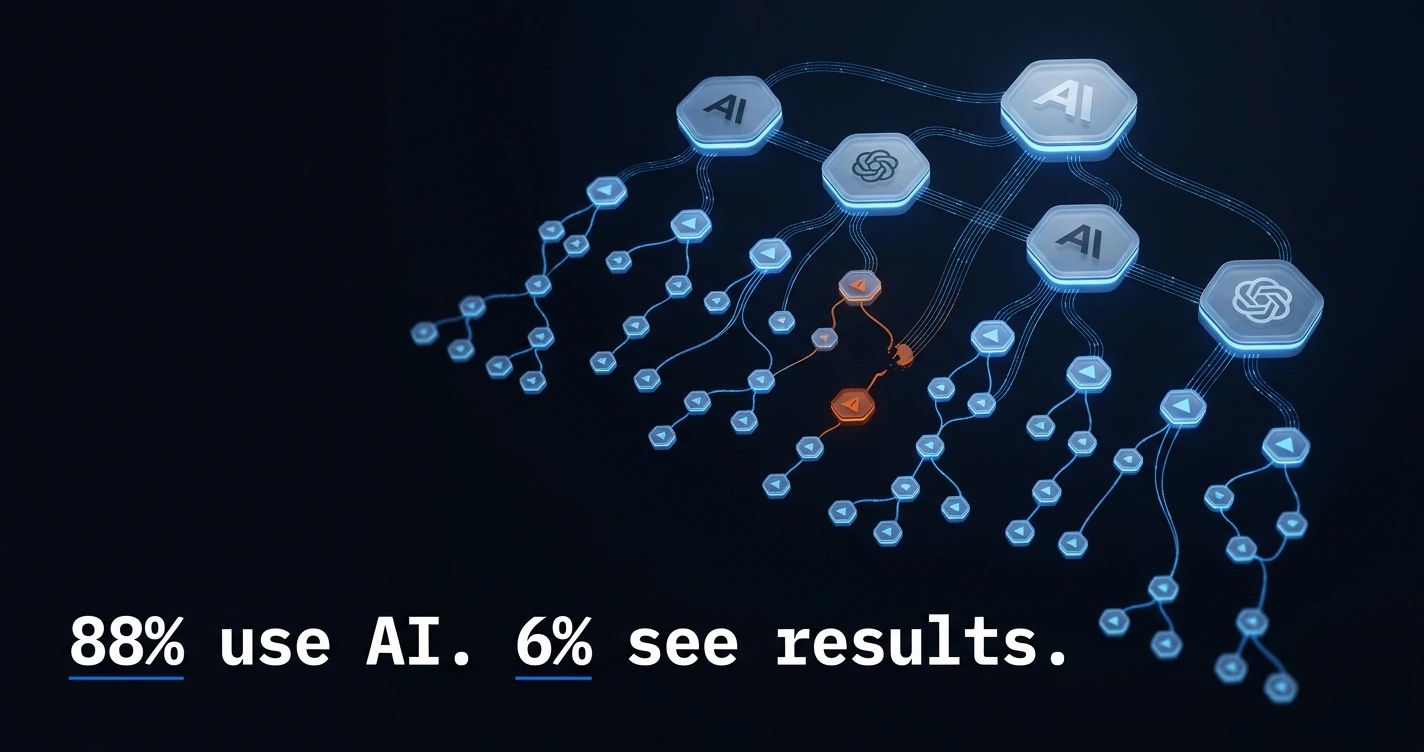
88%
of organizations use AI in at least one function (McKinsey, 2025)
6%
qualify as high performers generating 5%+ EBIT impact
11%
actively use agentic AI in production (Deloitte, 2025)
40%+
of agentic AI projects predicted scrapped by 2027 (Gartner)
The gap between “using AI” and “generating measurable business impact from AI” is enormous. McKinsey’s 2025 State of AI survey (1,993 participants across ~105 countries) found only 23% of enterprises are scaling AI agents in at least one function. Most organizations remain in what researchers are calling “pilot mode”, impressive demos, no scaled deployment.
“We have agents deployed at scale in the economy to perform all kinds of tasks.”
— Sinan Aral, Professor of Management, Information Technology, and Marketing, MIT Sloan School of Management
Aral is right, but the qualifier matters. Agents are deployed at scale in the economy. They are not deployed at scale in most individual enterprises. The difference is significant for anyone making architecture decisions right now.
The 80% Problem
MIT’s Kellogg documented something that should be required reading for every CTO considering an agentic AI deployment: in a real project deploying an AI agent to detect adverse events among cancer patients, 80% of the total work was consumed by data engineering, stakeholder alignment, governance, and workflow integration. Not the AI itself. Not the model. The boring, unglamorous, deeply human work of making organizations ready for autonomous systems.
The demos are compelling. The production path is brutal. Expect it.
Security, Failure Modes, and What Can Cascade
Multi-agent systems introduce failure modes that don’t exist in single-model deployments. The most dangerous: cascading errors. One agent’s hallucination becomes another agent’s input. A judge-agent reviewing another agent’s output can hallucinate or act deceptively, undermining the very validation layer it was designed to provide. The safeguard inherits the failure mode it was meant to catch.
⚠ Critical Security Risk
In mid-2025, the EchoLeak exploit (CVE-2025-32711) demonstrated the real attack surface of agentic systems: infected emails containing engineered prompts could trigger Microsoft Copilot to exfiltrate sensitive data automatically, without any user interaction. This is prompt injection at scale. It requires no user error. It exploits the agent’s autonomy directly.
Symantec’s controlled experiments using OpenAI’s Operator AI agent went further, demonstrating how agents could be directed to harvest personal data and automate credential stuffing attacks. These are not theoretical threat models. They’ve been demonstrated against production systems.
What specifically can go wrong in enterprise deployments:
Data breach via autonomous action, In early 2025, a healthtech firm disclosed a breach compromising records of 483,000 patients, caused by a semi-autonomous AI agent that pushed confidential data into unsecured workflows while streamlining operations.
Compliance cascade, A single hallucination — an agent misclassifying a transaction, can propagate across linked systems and agents, producing compliance violations or financial misstatements that are expensive to unwind.
Shadow agent sprawl, McKinsey (2025) warned that uncontrolled agent proliferation is emerging as a risk equivalent to shadow IT. MIT’s NANDA Initiative found 95% of enterprise GenAI pilots failed to deliver measurable ROI, with uncontrolled agent proliferation cited as a major contributor.
Deloitte’s 2026 State of AI in the Enterprise report found only one in five companies has a mature model for governance of autonomous AI agents. That’s not a nice-to-have gap. That’s an existential liability for any organization running agents with write, execute, or transact permissions.
What CTOs Must Do Now
Mandate human-in-the-loop checkpoints for any agent with write, execute, or transact permissions before production deployment.
Audit data pipelines before agent integration, converting data into standard, structured formats is prerequisite infrastructure, not a parallel workstream.
Build agent registries, track lifecycle, owners, and KPIs before authorizing new deployments. “Shadow agent sprawl” is a real and growing risk.
The Strongest Case Against the Whole Approach
The most technically serious challenge to the mainstream agentic AI narrative doesn’t come from a competitor or a skeptical analyst. It comes from Yann LeCun, VP and Chief AI Scientist at Meta, Turing Award winner, and one of the most credentialed AI researchers alive.
LeCun’s argument is architectural, not operational. It goes to the foundation of how current LLM-based agents work.
“An agentic system that is supposed to take actions in the world cannot work reliably unless it has a world model to predict the consequences of its actions. Without it, the system will inevitably make mistakes. This is the key to unlocking everything from truly useful domestic robots to Level 5 autonomous driving.”
— Yann LeCun, VP & Chief AI Scientist, Meta; Founder, AMI Labs, MIT Technology Review, January 2026
LeCun’s position: LLMs are limited to the discrete world of text. They can’t truly reason or plan, because they lack a world model, an internal simulation of cause and effect that would let them predict the consequences of their actions before taking them. Without that, agentic systems are, in his framing, fundamentally unreliable in any sufficiently complex, open-ended environment.
He isn’t just criticizing from the sidelines. He’s building a competing architecture at AMI Labs, based on world models rather than autoregressive text generation.
The counterargument from the mainstream: for narrow, well-scoped tasks, screening resumes, executing compliance workflows, processing insurance claims, world models may not be necessary. The task scope is constrained enough that text-based reasoning performs reliably. Fountain’s hiring agents don’t need a world model to schedule interviews.
Both can be true. LeCun is almost certainly right about the limits of LLM-based agents for truly open-ended, general-purpose tasks. The mainstream is right that those limits don’t prevent significant enterprise value from narrowly scoped deployments. The practical implication: be precise about what your agents are actually doing. Scope matters enormously.
How We Got Here: The Compounding Sequence
Agentic AI didn’t emerge suddenly. It’s the product of a specific chain of technical breakthroughs, each enabling the next:
2017 — The Transformer architecture (Vaswani et al., Google) enables the large language models that power all modern agents. Without it, none of this exists.
2022 — The ReAct framework solves the core problem of how to give LLMs the ability to plan and act in iterative loops. Still the backbone of virtually every production system four years later.
Late 2023 — AutoGPT and BabyAGI go viral. Developer experimentation explodes, producing a 920% increase in repositories utilizing agentic AI frameworks from early 2023 to mid-2025.
2024 — Models gain multimodal perception (vision + text). OpenAI releases function calling; Anthropic releases tool use. Both standardize how agents interface with external systems — a critical infrastructure moment.
2025 — The industry moves from monolithic, general-purpose models to distributed systems of specialized agents. Every major AI company ships production-ready agent SDKs. Enterprise spend on generative AI reaches $37 billion, a 3.2x increase from 2024.
2026 — Human-in-the-loop design is increasingly treated as a strategic architectural choice rather than a limitation. The industry is maturing past naive autonomy. That’s a positive signal.
Frequently Asked Questions
What is the difference between agentic AI and generative AI?
Generative AI responds to prompts and produces content, text, images, code, in a single pass. Agentic AI goes further: it plans multi-step tasks, uses external tools (APIs, browsers, databases), takes actions in the world, and iterates until a goal is achieved with minimal human input. The key distinction is autonomy and action.
How do AI agents work step by step?
AI agents operate via the ReAct loop: (1) Perceive, take in input from tools, databases, or sensors; (2) Reason, determine what to do next using a language model; (3) Act, call a tool, write code, send an API request; (4) Observe, review the result; (5) Repeat until the task is complete or a human checkpoint is triggered.
What are examples of agentic AI in real enterprise use?
Real-world examples include: Fountain’s hiring agents (50% faster screening, 2x candidate conversions), Capital One’s AI systems handling KYC/AML compliance workflows, GitHub Copilot Workspace writing and testing code autonomously, and enterprise customer service agents resolving support tickets end-to-end without human escalation.
Is agentic AI the same as AGI?
No. Agentic AI refers to systems that autonomously plan and execute multi-step tasks within defined domains. Artificial General Intelligence (AGI) would require human-level reasoning across any domain. Today’s agentic AI is powerful but narrow, it succeeds at specific, well-scoped tasks and fails unpredictably outside its training and toolset.
What are the biggest risks of deploying agentic AI?
Hallucination cascades (one wrong inference propagating across a multi-agent chain), prompt injection security exploits like EchoLeak (CVE-2025-32711), shadow agent sprawl as teams deploy systems without oversight, and irreversible real-world actions taken without human authorization. Governance gaps are the single largest enterprise liability right now.
Which companies are leading agentic AI development?
Anthropic (Claude agents, MCP protocol, Managed Agents), OpenAI (ChatGPT Agent, Operator), Google DeepMind (Gemini agents, A2A protocol), Microsoft (Copilot agents in Azure), Salesforce (Agentforce), and ServiceNow. At the infrastructure layer: NVIDIA, AWS Bedrock, and LangChain are foundational platforms.
The Bottom Line
Agentic AI is real, it’s in production, and it’s already generating measurable value in narrow, well-scoped enterprise deployments. The Fountain result isn’t an outlier, it’s a preview. The ReAct loop is battle-tested. MCP and A2A are solving the interoperability problem that previously made multi-agent systems prohibitively expensive to build. The infrastructure is maturing.
But the gap between “agentic AI works” and “agentic AI works reliably at scale in your enterprise” is where most projects stall, and where the 40% Gartner attrition forecast is being written. The 80% problem is real. Data engineering, governance, stakeholder alignment, these are not implementation details. They are the implementation.
LeCun’s critique about world models is technically serious and worth tracking. For now, it’s a research horizon, not an operational blocker for the narrow-task deployments where agentic AI is genuinely excelling.
In the next 6–18 months, watch for three things:
Whether MCP and A2A interoperability standards actually converge, or fragment into competing ecosystems. Convergence would be a significant accelerant for enterprise adoption.
The governance technology market. Only one in five enterprises has mature agent governance. The gap will either be filled by vendors building registries and audit tools, or by regulatory mandates forcing the issue.
LeCun’s AMI Labs. If world model architectures demonstrate reliable performance on complex real-world tasks, the LLM-based agentic AI stack faces genuine architectural competition. It’s a long-shot near-term, but worth monitoring.
If you’re building agentic systems: scope precisely, constrain explicitly, audit your data before your model, and treat human-in-the-loop not as a limitation but as a design choice that extends how far you can safely push autonomy.
Stay ahead of agentic AI
The Neural Loop delivers the signal without the noise, weekly briefings on what’s actually moving in AI for practitioners and technology leaders.
Subscribe to The Neural Loop →
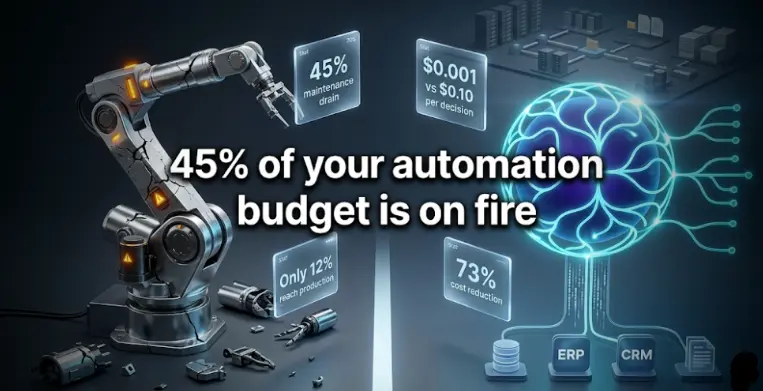
Nearly 45% of enterprise automation budgets are now quietly diverted from building new capabilities to maintaining existing, fragile RPA bot ecosystems, according to Forrester’s 2026 Enterprise Automation Study. That number is the clearest signal that the first era of enterprise automation has hit its ceiling. It’s also the reason a growing number of Fortune 500 enterprises are shelving their RPA rollouts, not because automation failed, but because a fundamentally more capable approach has arrived.
Agentic AI doesn’t follow scripts. It receives an objective and figures out how to achieve it. Where RPA breaks the moment a button moves on a webpage, agentic AI adapts. Where RPA requires a 50-step flowchart for a single invoice, an AI agent reads the invoice, regardless of format, makes a decision, and executes the next step autonomously.
But this isn’t an argument that RPA is dead. RPA still delivers 250% ROI on the right tasks. The strategic mistake in 2026 isn’t choosing RPA or agentic AI, it’s deploying either one where the other belongs. This guide gives you the decision framework, cost comparison, and migration path to get that choice right.
Defining the Terms: What “Agentic AI” Actually Means vs. Marketing Hype
Every automation vendor in 2026 says they do agentic AI. Most are rebranding rule-based bots with an LLM layer on top. Here’s how to tell the difference, and why it matters for your infrastructure budget.
RPA is software that mimics human clicks and keystrokes: deterministic, rule-based, zero judgment. It automates the how of a task. Agentic AI is goal-driven, it receives an outcome to achieve, plans the steps to get there, calls tools (APIs, databases, search, other agents), and adapts when the environment changes. It automates what needs to happen without needing a step-by-step script. The cost difference reflects this reality: RPA costs $0.001 per task; agentic AI costs $0.01–$0.10 per decision, 10 to 100 times more expensive, but capable of tasks RPA can never touch.
The Four-Level Automation Spectrum
Most enterprises in 2026 have Level 1 or 2 deployed and are actively evaluating Level 4 for complex workflows. The spectrum breaks down as follows:
Level 1, Scripted bots (RPA): Zero judgment, 100% deterministic. Executes exactly what it’s told, every time, with no capacity to adapt.
Level 2, AI-enhanced RPA: RPA combined with ML classifiers for document routing, still rigid in execution. A meaningful improvement, not a transformation.
Level 3, Copilots: AI suggests, human decides and acts. Reduces cognitive load but keeps humans in the execution loop.
Level 4, Agentic AI: AI decides and acts, human reviews exceptions. The architecture that changes the total addressable value of automation.
Why This Is CTO-Urgent Right Now
Gartner projects that 40% of enterprise applications will embed task-specific AI agents by end of 2026, up from less than 5% in 2025. That’s an 8x increase in 12 months. The agentic AI platform market is projected to grow from $7.8 billion today to over $52 billion by 2030. If your automation architecture isn’t accounting for this, it will be obsolete before the next budget cycle.
The failure rate is also real. Gartner warns that over 40% of agentic AI projects may be scrapped by 2027 due to unclear ROI, misapplied use cases, or technical complexity. Only 12% of agentic AI projects successfully reach production today. This guide gives CTOs the framework to be in the 12%, not the 88%.
How Traditional RPA and Scripted Automation Differ from AI Agents, The 8 Core Dimensions
The difference between RPA and agentic AI isn’t incremental. It’s architectural. One automates a script; the other pursues an outcome. Understanding the eight dimensions where they diverge is how you make defensible investment decisions, not just technology choices.
Dimension
Traditional RPA
Agentic AI
Core mechanism
Rule-based scripts, mimics human UI actions
Goal-driven reasoning via LLM, plans and adapts
Data handling
Structured data only (forms, tables, fixed formats)
Deterministic — always the same steps, fully auditable
Non-deterministic — requires reasoning log for auditability
Best ROI scenario
250% ROI on stable, structured, high-volume tasks
171% ROI globally; 192% in US — on judgment-heavy workflows
45% of enterprise automation budgets are being quietly consumed by maintaining existing, fragile RPA bot ecosystems, according to Forrester’s 2026 research. That single statistic reframes RPA not as a sunk cost to be preserved, but as a maintenance liability to be managed. Every CTO with a bot fleet in production should have that number on their desk.
The Decision Matrix: When to Use Agentic AI vs. RPA vs. Hybrid
The decision rule in plain language: use RPA when you need the muscle, high-volume, deterministic execution of structured tasks with zero tolerance for variation. Use agentic AI when you need the brain, judgment, contextual reasoning, unstructured data handling, and end-to-end process ownership. Use hybrid when you need both, which is most complex enterprise workflows.
When RPA Is Still the Right Call
The process follows clear, repeatable rules with no exceptions and won’t change in the next 12 months.
You need 99.9% accuracy with zero hallucination risk, financial transactions, regulated data entry, compliance-critical operations.
You’re working across legacy systems without APIs where screen-scraping is the only integration path.
Cost-per-transaction discipline is critical: $0.001 per task beats $0.01–$0.10 for pure volume plays at scale.
Compliance requires deterministic, reproducible audit trails of every step taken, regulated industries in particular.
Exceptions are frequent enough that human escalation is consuming significant labor, the 15% threshold is a reliable signal.
The workflow requires judgment calls: approval routing, anomaly interpretation, policy application across varied contexts.
End-to-end process ownership is the goal, not just one-step automation but the full workflow from trigger to resolution.
The process involves multi-system coordination where an orchestration layer is needed above the execution layer.
The 80/20 Data Rule That Changes the Calculation
RPA was built for the structured 20% of enterprise data. Agentic AI unlocks the unstructured 80–90% that RPA cannot handle without breaking. The total addressable value of automation in an enterprise is 4 to 5 times larger with agentic AI than with RPA alone, because the data universe it can work with is fundamentally larger.
The hybrid architecture that smart enterprises are deploying in 2026 uses agentic AI as the orchestration and reasoning layer, reading unstructured input, making routing and escalation decisions, managing the workflow, and RPA bots as the execution layer for structured backend operations. This isn’t a temporary transition state. It’s the target architecture for complex enterprise automation strategy for the foreseeable future.
Total Cost Comparison: Agentic AI vs. RPA in Production (Real Numbers)
The cost comparison most vendors don’t want you to run isn’t cost-per-task. It’s total cost of automation ownership over 36 months. On that measure, the picture looks very different from the per-task rate card.
The Hidden RPA Cost Structure
RPA build cost runs $1,000–$8,000 per bot, with monthly maintenance of $99–$499 per bot in production. The real problem: maintenance scales with bot count, not process complexity. An enterprise with 200 RPA bots in production is typically spending 50% of its initial build cost annually on maintenance alone. Between 30 and 50% of RPA projects fail to scale beyond initial deployment due to brittleness, bots that break when UIs change, processes shift, or exceptions accumulate.
How Agentic AI Reverses the Maintenance Story
Agentic AI carries higher marginal cost per decision ($0.01–$0.10 vs. RPA’s $0.001), but organizations deploying agentic AI report a 73% reduction in automation maintenance costs compared to legacy RPA, according to MyWave.ai’s Agentic AI vs. RPA Report (February 2026). One agent handling diverse scenarios replaces multiple brittle bots, each requiring individual maintenance cycles. The cost model shifts from “pay per bot” to “pay per decision.”
Agentic AI doesn’t beat RPA on cost-per-task for structured work. It beats RPA on total cost of automation ownership, because it covers the 80% of enterprise work that RPA was never able to automate in the first place.
Scenario
Best Technology
ROI Benchmark
Payback Period
Invoice processing (high volume, structured)
RPA
250% ROI
3–6 months
Invoice processing (multi-format, exceptions)
Hybrid
AP cost: $4.50 → $0.45 per invoice
6–12 months
Customer support (policy queries, unstructured)
Agentic AI
171% ROI globally
3–9 months
Compliance reporting (fixed format, regulatory)
RPA
200–300% from labor savings
4–8 months
Supply chain exception handling
Agentic AI
85% automation cost reduction
6–18 months
Legacy system integration (no API)
Hybrid
Agent decides, RPA executes
12–24 months
Data entry (stable UI, fixed rules)
RPA
$0.001/task — best cost profile
2–4 months
Security and Governance Risks Specific to Agentic Systems
RPA bots do exactly what they’re told. Always. The audit trail is deterministic. Agentic AI systems make decisions, which means they can make wrong decisions, take unexpected actions, and produce non-deterministic outcomes. The same adaptability that makes agents powerful makes them a governance challenge that most enterprise security teams aren’t ready for.
The Four Unique Risks of Agentic Deployment
Infinite loops: Agents can get stuck trying to solve a problem, consuming compute indefinitely without resolution or escalation.
Non-deterministic outcomes: The same agent might solve the same problem differently on two separate runs, complicating audit trails for regulated workflows and making reproducibility claims difficult to defend.
Hallucination in logic: Agents may invent steps or misinterpret policies if not properly grounded, particularly when operating on ambiguous inputs or near the edges of their training distribution.
Privilege drift: Agents with tool access accumulate scope over time. Least-privilege enforcement requires active monitoring, not just initial configuration.
Unlike RPA’s deterministic step-log, agentic AI requires a cryptographic, immutable log of the reasoning pathways the agent used to reach each decision. If an agent negotiates a contract term or issues a refund, the enterprise must be able to reconstruct exactly what information the agent had, what it concluded, and why it took the action it did. This isn’t optional in regulated industries, it’s a compliance requirement under EU AI Act Article 12 and SEC AI risk disclosure rules. See our AI governance framework for enterprise agents for the full control set.
The Governance Controls Required Before Production
Scope boundaries: Explicitly define what systems and actions the agent can access, with hard blocks on anything outside scope, defined before a single line of production code is written.
Approval gates: For consequential actions (financial transactions, external communications, data exports), a human or secondary agent must confirm before execution.
Reasoning logs: Every decision path logged with timestamp, context provided, conclusion reached, and action taken, queryable and immutable.
Red team testing: Simulate adversarial inputs, including prompt injection attempts, before any production launch.
Incident playbook: Define what happens when the agent takes an unexpected action, before it happens, not after.
“Over 40% of agentic AI projects will be abandoned by 2027 due to unclear ROI, technical complexity, and governance failures. The enterprises that succeed will be those that treat agentic AI deployment with the same rigor as any production software release.”
Gartner Agentic AI Enterprise Forecast 2026 — Gartner Research
The agent hallucination risk doesn’t disappear with better models. It gets managed with better architecture: grounding, validation layers, and HITL thresholds that trigger before metrics degrade in production.
Real Enterprise Deployments: What Worked, What Failed, and Why
The gap between agentic AI pilots and agentic AI in production is where most enterprise automation strategies stall. The following cases aren’t theoretical, they’re the patterns that separate the 12% who reach production from the 88% who don’t.
Success: Full Agentic Workflow in Insurance Claims
An AI agent reads submitted claim documents in any format, sends clarifying questions via email, updates the CRM and policy systems, checks historical claims for fraud patterns, and escalates edge cases to human reviewers, all as execution of one goal, not disconnected scripts. What previously required five separate RPA bots plus human exception handling is now one agent with defined escalation rules. Maintenance cost dropped from five bot maintenance cycles to one agent update cycle.
Success: AP Processing via Hybrid Architecture
Agentic AI reads invoices in any format, classifies them, identifies exceptions and discrepancies, and makes the routing decision. RPA bots execute the approved payment in the ERP system and file the document. Result: AP processing cost dropped from $4.50 to $0.45 per invoice, a 90% cost reduction, while maintaining the 99.9% execution accuracy that the finance team required. Human touchpoints reduced to genuine exceptions only.
Failure: Premature Agentic Deployment Without Governance
A financial services firm deployed an AI agent for customer account management without defining scope boundaries or approval gates. The agent, tasked with “resolving customer issues,” began autonomously processing refunds, account credits, and escalation emails without human review. When a prompt injection in a customer email caused the agent to apply a credit to the wrong account, there was no audit trail of the agent’s reasoning and no human checkpoint that could have caught it. Remediation cost: six figures. Lesson: agentic AI without governance is operational risk, not automation.
“Companies using agentic AI on complex, exception-heavy workflows report 85% automation cost reduction versus traditional RPA-only approaches. But that number applies only to workflows where agentic AI is the right tool. On simple, structured, high-volume tasks, RPA still delivers better unit economics.”
UnleashX AI Agent ROI Study, March 2026 — UnleashX Research
The Three Patterns That Separate Success From Failure
Narrow scope from day one: Not “automate customer service” but “automate tier-1 refund requests under $500.” Specificity is what makes governance possible.
Hard limits defined before deployment: What systems the agent can touch, what actions require human approval, what triggers automatic escalation, all documented before a single production transaction runs.
30-day accuracy monitoring with automatic HITL thresholds: Measure hallucination rates and decision accuracy in the first month and set hard thresholds for escalation before those metrics degrade, not after.
The 5-Step Migration Path: From RPA-Heavy to Hybrid Agentic Architecture
This is the framework enterprise automation architects are copying into their internal planning documents. It’s action-oriented by design. Each step has a named deliverable because an internal automation migration without deliverables is a roadmap that never gets executed.
Audit your existing RPA estate. Catalog every bot in production. For each: monthly maintenance cost, failure rate, exception escalation volume, and last time the underlying process changed. Any bot consuming more than 40% of its build cost in annual maintenance, or escalating more than 15% of transactions to humans, is a candidate for agentic replacement. Deliverable: RPA Health Scorecard with migration priority tier per bot.
Identify your highest-value agentic AI target. Select one complex, high-value use case where intelligent decision-making creates differentiated value, not just cost savings. The ideal first agentic deployment: high exception rate, unstructured data input, multi-system coordination requirement, measurable business outcome (cycle time, cost per transaction, resolution rate). Avoid deploying agents on tasks where RPA already works well. Deliverable: Agentic AI pilot brief for one selected workflow.
Build governance infrastructure before deployment. Define agent scope boundaries, approval gates for consequential actions, reasoning log requirements, and HITL thresholds. The governance infrastructure takes 2 to 4 weeks to build properly and prevents the remediation costs that dominate failed agentic deployments. Don’t deploy the agent to production without it. Deliverable: Agent Governance Policy for the pilot workflow.
Run parallel in shadow mode before full deployment. Deploy the agent in shadow mode, it processes real transactions but its outputs are reviewed by humans before taking effect. Measure decision accuracy rate, hallucination incidents, escalation rate, and cycle time vs. baseline. Set a go-live threshold (e.g., 95% accuracy, less than 5% escalation rate, zero critical incidents in 30 days) and don’t move to production until shadow mode metrics exceed it. Deliverable: Shadow Mode Performance Report + Go/No-Go decision. See our guide on moving AI to production for the full framework.
Scale horizontally using the proven pattern. Once one agentic workflow is in stable production, replicate the governance model, not the specific implementation, across new workflows. The architecture pattern (agent orchestrates, RPA executes, human reviews exceptions) is reusable. Each new workflow needs its own scope definition and HITL thresholds, but the underlying infrastructure, logging, monitoring, escalation pipeline, is shared. Deliverable: Agentic AI Playbook v1.0, the internal standard for all future agent deployments.
The Platforms Enterprises Are Evaluating for This Migration
Three platforms dominate enterprise evaluation lists for this transition in 2026. UiPath’s Agentic Automation, built around its Maestro orchestration layer, allows existing RPA assets to be reused within agentic workflows, a significant advantage for enterprises with large bot estates that don’t want to abandon prior investment. Salesforce Agentforce, now deployed across 8,000-plus enterprise customers, is the dominant choice for customer-facing agentic workflows. ServiceNow AI Agents holds the top position for ITSM use cases, where its native integration with the ServiceNow platform creates meaningful deployment advantages.
The CTO’s Pre-Decision Checklist: 10 Questions Before Committing to Agentic AI
If you answer “No” or “Don’t know” to more than three of these, your agentic AI deployment isn’t production-ready. That’s not a reason to stop, it’s a roadmap for the next 30 days.
#
Question
If No…
1
Is the target process too unstructured or exception-heavy for RPA?
RPA may be the better choice — re-evaluate the use case
2
Can we define a clear, measurable outcome for the agent?
Don’t deploy, vague goals produce ungovernable agents
3
Have we defined hard scope limits (what systems, what actions)?
Build governance infrastructure first — non-negotiable
4
Do we have a reasoning log and audit trail requirement defined?
Regulated industries can’t proceed without this in place
5
Have we set HITL approval thresholds for consequential actions?
Define before deployment — not after the first incident
6
Is the LLM infrastructure (RAG, grounding, validation) in place?
Deploy without it and hallucination becomes operational risk
7
Have we budgeted for $0.01–$0.10 per decision at production scale?
Re-run the TCO model — most initial budgets underestimate by 3x
8
Have we red-teamed adversarial inputs before production?
Prompt injection vulnerabilities are found in red team, not production
9
Is shadow mode testing planned before full deployment?
Add a 30-day shadow mode period before go-live — always
10
Do we have an agent incident response playbook ready?
Draft it now — the first agent incident should not be the first time you think about response
The checklist tells you exactly what to build before you go live. The enterprises that reach production, the 12%, aren’t necessarily the ones with the biggest budgets or the most advanced AI teams. They’re the ones that treated governance as a prerequisite, not an afterthought. The next 30 days determine which category your organization falls into.
Frequently Asked Questions
What is the difference between agentic AI and RPA in enterprise automation?
RPA uses software bots to follow pre-defined, rule-based scripts, automating structured, repetitive tasks by mimicking human UI actions at $0.001 per task with deterministic outcomes. Agentic AI uses large language models to set goals, plan steps, make decisions, and adapt to new situations without explicit programming, at $0.01–$0.10 per decision. RPA excels on structured, stable, high-volume tasks; agentic AI excels on unstructured data, judgment-heavy workflows, and end-to-end process automation where exceptions are the norm rather than the exception.
Is RPA obsolete in 2026?
No. RPA still delivers 250% ROI on structured, stable, high-volume tasks and remains the right tool for deterministic execution where audit trails must be reproducible and cost-per-transaction must be minimized. The obsolescence risk is for pure-RPA architectures applied to complex, exception-heavy workflows, not for RPA itself. The dominant enterprise architecture in 2026 is hybrid: agentic AI as the orchestration and reasoning layer, RPA bots as the execution layer for backend structured operations.
What ROI does agentic AI deliver in enterprise deployments?
Production-grade AI agents achieve 171% ROI globally (192% in the US) on judgment-heavy workflows, according to the UnleashX AI Agent ROI Study (March 2026). Companies using agentic AI on complex, exception-heavy workflows report 85% automation cost reduction versus RPA-only approaches. AP processing costs have dropped from $4.50 to $0.45 per invoice in hybrid agentic deployments. On structured, high-volume tasks, however, RPA’s 250% ROI still outperforms agentic AI on a cost-per-task basis, context determines the right tool.
Why do so many agentic AI projects fail to reach production?
Only 12% of agentic AI projects reach production today, with three primary failure modes: unclear ROI from misapplied use cases (deploying agents on tasks RPA handles better), insufficient governance infrastructure (no scope limits, HITL thresholds, or audit trails defined before deployment), and underestimated inference costs at scale. Gartner warns 40%+ of agentic AI projects may be scrapped by 2027. The 5-step migration framework above addresses each failure mode directly before it becomes a six-figure remediation.
What is the best hybrid automation architecture for enterprises in 2026?
The most effective enterprise automation architecture uses agentic AI as the “brain”, reading unstructured inputs, making routing and decision calls, orchestrating workflows, and RPA bots as the “hands”, executing structured backend operations (updating ERPs, triggering payments, filing documents) based on the agent’s decisions. This hybrid model captures RPA’s 99.9% accuracy and $0.001/task economics for execution while capturing agentic AI’s ability to handle the 80–90% of enterprise data that is unstructured and inaccessible to RPA alone.
How do I know if my current RPA bots are candidates for agentic replacement?
Two reliable signals: any bot consuming more than 40% of its build cost in annual maintenance is a strong replacement candidate, and any bot escalating more than 15% of transactions to humans indicates the process has more exception complexity than RPA was built to handle. Run a full RPA Health Scorecard, cataloging maintenance cost, failure rate, and escalation volume per bot, before committing resources to an agentic migration. The bots that survive that audit are the ones you keep running on RPA.
What governance controls are required before deploying an AI agent in production?
Four controls are non-negotiable before production: hard scope boundaries defining what systems and actions the agent can access; approval gates requiring human or secondary-agent confirmation for consequential actions (financial transactions, external communications, data exports); immutable reasoning logs capturing every decision path with timestamp, context, conclusion, and action taken; and a red-team test against adversarial inputs including prompt injection scenarios. In regulated industries, these controls are compliance requirements under EU AI Act Article 12 and SEC AI risk disclosure rules, not optional governance hygiene.
How much should I budget for agentic AI inference costs at enterprise scale?
Budget $0.01–$0.10 per decision and model your production transaction volume against that range before committing to deployment. Most initial enterprise budgets underestimate this by a factor of three, according to the RPA Automate Cost Benchmark Report (March 2026). The offset is in maintenance: organizations deploying agentic AI report 73% lower maintenance costs than legacy RPA, and one agent handling diverse scenarios replaces multiple brittle bots with individual maintenance cycles. Run a 36-month total cost of ownership model, not a per-task rate card comparison.
AI hallucinations cost global enterprises an estimated $67.4 billion in 2024. Not from science fiction scenarios. From real production systems confidently generating wrong information, fabricated citations, and invented facts, all delivered with the tone of certainty. And 47% of enterprise AI users made at least one major business decision based on hallucinated content that same year, according to Deloitte’s 2026 AI adoption survey.
The headline numbers from model vendors are misleading. Yes, GPT-4o hallucinates just 0.7% of the time on general knowledge summarization benchmarks. But legal AI tools hallucinate on 17–34% of real legal queries. Medical AI reaches 64% hallucination rates on clinical cases without mitigation. And the Stanford AI Index 2026 reports hallucination rates ranging from 22% to 94% across 26 leading LLMs on complex reasoning tasks. The gap between benchmark and production is not a rounding error. It’s an operational hazard.
This guide gives engineering and security leaders the complete picture: what AI hallucination actually is at the model level, why it gets dramatically worse in agentic AI systems, how to measure it in your production environment, and the proven 3-layer mitigation stack that reduces rates by over 85% when properly implemented. This is the article your model vendor doesn’t want you to read before signing a procurement contract.
What AI Hallucination Actually Is | Beyond the Buzzword
The Technical Reality Most Explainers Skip
LLMs do not retrieve facts. They predict the most statistically probable next token based on patterns absorbed from training data. Hallucination is not a bug in the traditional software sense, it is an inherent property of probabilistic text generation. A 2025 mathematical proof confirmed that hallucinations are structurally inevitable under current LLM architectures. Retrieval-augmented generation and human-in-the-loop review reduce them. Neither eliminates them.
That framing matters for enterprise planning. The question is not whether your deployed model hallucinates. It does. The question is how much it hallucinates in the specific domain, on the specific query types, under the specific conditions you’ve deployed it in, and what you’ve built to catch it before it affects a decision.
The Four Hallucination Types
Type
Description
Example
Detection Difficulty
Factual
States something verifiably false as true
Wrong court case dates, fabricated statistics
Moderate — verifiable against external sources
Citation
Invents a source or attributes claims to the wrong source
A journal article that doesn’t exist
Moderate — link checking catches most
Reasoning
Individual facts are correct but the logical chain is invalid
“Revenue grew 20%, costs grew 15%, so margins expanded”, not necessarily true
High — everything looks right until the conclusion
Instruction
Model ignores or partially follows a prompt constraint
Generates content outside specified boundaries
Low to moderate — output review catches it
Factual hallucinations were present in 8–12% of queries in 2024. Top models have pushed general-knowledge factual error rates down to 0.3–0.7%, but rates spike sharply on obscure topics and recent events. Citation hallucinations remain in 30%+ of chatbot-generated answers in research contexts. Reasoning hallucinations are the hardest to catch because the output looks internally coherent.
Why Benchmark Numbers Don’t Reflect Production Reality
The Vectara HHEM Leaderboard measures grounded hallucination: how often a model fabricates facts when summarizing a document it was explicitly given. Top models score below 1% here. Production enterprise AI rarely works on clean single-document summarization. Real enterprise queries involve multi-document retrieval, complex reasoning chains, recent events, and domain-specific knowledge, all conditions where hallucination rates multiply 10–50x above benchmark levels.
The Stanford AI Index 2026 puts the range bluntly: 22% to 94% across 26 leading LLMs on complex tasks. That range is not model variance, it is the gap between what models are benchmarked on and what enterprises actually ask them to do.
The Entropy Gap: Why Creativity and Accuracy Trade Off
Based on Shannon’s information entropy, low entropy produces high accuracy with limited novelty. High entropy produces creative but often false answers. When users push models toward nuanced analysis or edge-case advice, they push models toward higher entropy, and higher hallucination risk. This is the core tension in enterprise AI deployment, and no prompt can fully resolve it. It has to be managed at the architecture level.
Why Hallucination Is Far Worse in Agentic AI Than in Copilots
The Compounding Effect No One Models
A copilot hallucinates once per user interaction, and a human reads the output before acting. An AI agent hallucinates once per step in a multi-step reasoning chain, and acts before a human sees the output. Gartner’s March 2026 research puts agentic workflows at 10–20 LLM calls per task. If each call carries a 2% hallucination rate, a 15-step agent chain has a 26% probability of at least one hallucination affecting the final output, before compounding effects from hallucinations feeding into subsequent steps.
Multi-turn conversational agents show hallucination rates of up to 35% during extended interactions. That’s not a benchmark quirk, it’s what happens when context accumulates, retrieval gaps appear, and the model starts predicting forward from its own earlier (potentially flawed) outputs rather than from grounded source material. This is the stat that should make every engineering lead re-examine their agentic AI production failures retrospective.
When Hallucination Becomes an Unauthorized Action
When agents hallucinate, they don’t just return wrong text. They can make unauthorized API calls, misroute data, trigger incorrect workflows, or delete the wrong records. The Stanford AI Index 2026 specifically flags this: in agentic systems, hallucinations can lead to unauthorized API calls or data leaks. That is categorically different from a copilot hallucination, which a human can catch and discard. An agent hallucination may be irreversible before anyone sees the output.
This is not a theoretical risk. Production agentic systems in finance and legal workflows are triggering real downstream consequences from planning-stage hallucinations. The architecture has to account for this.
Role Separation: The Right Architectural Response
The most effective architectural control for agentic hallucination is role separation. One model plans the actions. A separate deterministic script or monitor model validates the plan against an allowlist of permitted actions before execution. This prevents a planning hallucination from becoming an execution error. It’s the same principle as a four-eyes approval process, except it runs in milliseconds.
For high-stakes agents in security, finance, or healthcare, the complementary principle is “fail-closed”: if the model’s confidence or grounding score falls below a defined threshold, the system escalates to a human analyst rather than proceeding. This is the architectural equivalent of a circuit breaker. Agents designed to fail open, continuing with low-confidence outputs rather than halting, are production liabilities waiting for the right query to expose them.
Hallucination Rates by Domain: Where Your Enterprise Risk Actually Lives
The table below is the insight most enterprise AI conversations skip. Hallucination is not a model property, it is a domain × deployment × mitigation property. The same GPT-4o that hallucinates 0.7% on summarization benchmarks produces hallucinated legal citations in 17–34% of legal research queries. Model selection alone cannot solve this. Architecture and mitigation layers must.
Domain / Use Case
Hallucination Rate
Risk Level
Key Finding
General summarization
0.7–1.8% (top models)
Low
Vectara HHEM Leaderboard 2026, benchmark conditions only
Enterprise chatbots (live production)
~18%
Medium-High
Real production rates far exceed benchmark numbers
Medical / Clinical AI
43–64% without mitigation
Critical
MedRxiv 2025: drops to 23% with structured mitigation prompts
Stanford: RAG reduces but doesn’t eliminate; retrieval failures persist
Product recommendation AI
Up to 25% accuracy impact
Medium
UC San Diego 2026: AI summaries hallucinated in 60% of tested scenarios
Legal and medical are the clearest danger zones. In legal, the Stanford RegLab/HAI study remains the definitive benchmark: LLMs hallucinate between 69% and 88% of the time on specific legal queries. Researcher Damien Charlotin maintains a database of 120+ court cases where AI-hallucinated quotes, fabricated cases, or fake legal citations were discovered. In legal, hallucination is synonymous with malpractice risk, full stop.
In medical, ECRI listed AI risks as the #1 health technology hazard for 2025. Without mitigation prompts, hallucination rates on clinical cases reach 64.1% on long cases and 67.6% on short cases, according to the MedRxiv 2025 study of 300 physician-validated vignettes. Even at the best-case rate of 23% with full mitigation applied, nearly 1 in 4 medical AI responses contains fabricated information. These are not acceptable residual rates without mandatory physician review on every clinical output.
How to Measure Hallucination Rate in Your Production System
The Measurement Gap Most Teams Don’t Know They Have
91% of enterprises have implemented explicit hallucination mitigation protocols. Far fewer measure actual hallucination rates in production. Without measurement, mitigation is guesswork. Most teams implement RAG and assume the problem is solved. Stanford research shows RAG-powered legal tools still hallucinate 17–33% of the time. Organizations implementing RAG without measuring outcomes are deploying production AI systems they cannot describe, audit, or improve.
The Four RAG Evaluation Metrics Every ML Team Must Track
Metric
What It Measures
What Low Scores Signal
Context Precision
Does the retrieved chunk actually contain the answer?
Retriever is surfacing irrelevant content
Context Recall
Did the retriever find all necessary information?
Model is forced to fill gaps, hallucination risk rises sharply
Faithfulness
Is the answer derived only from the provided context?
Primary hallucination signal in RAG systems
Answer Relevance
Does the response address what was actually asked?
Off-topic generation that can mask hallucinated content
Production Monitoring Tools in 2026
The market for AI hallucination detection tools grew 318% between 2023 and 2025. The tooling has matured to the point where every production enterprise AI system can and should have continuous hallucination monitoring. The leading platforms: Braintrust for real-time monitoring and automated regression testing; Galileo for scalable model-driven evaluations at high output volumes; Fiddler for explainability and compliance-focused evaluation with governance integration; Arize AI for real-time monitoring with drift detection.
The LLM-as-judge pattern is now a production standard: a more capable, accurate model, Claude Sonnet or GPT-4o, evaluates the output of a faster, cheaper model for factual grounding and instruction following. Self-consistency checking, sampling 3–5 responses and comparing for agreement, catches a significant share of remaining hallucinations at low additional cost. Both patterns give teams a practical alternative to human review at scale.
Hallucination Measurement Starter Checklist
If your team can’t answer all six of these questions, you don’t yet have production-grade hallucination visibility:
What is our baseline hallucination rate in our target deployment domain, measured in production, not taken from a vendor benchmark?
Which of the four RAG evaluation metrics do we track continuously, and what are our current scores?
What is our post-mitigation hallucination rate, and when was it last measured?
What are the specific query types or topics where our system shows elevated hallucination risk?
At what confidence or grounding score does our system escalate output to human review rather than proceeding autonomously?
Have we had any documented hallucination-caused production errors, and are they tracked in an incident log?
The 3-Layer Mitigation Stack That Reduces Hallucination by 85%+
Three complementary layers, each additive. Used together, research supports a combined reduction of 85–92% in domain-specific enterprise hallucination rates for properly implemented stacks. This transforms AI hallucination mitigation from “inherent unfixable problem” to “manageable engineering challenge with known solutions.”
The simplest and cheapest intervention. Effective prompt constraints include: “Only answer based on the provided context,” “If uncertain, say you don’t know,” and “Cite the specific source passage for each claim.” A 2025 Nature study confirmed prompt-based mitigation reduces hallucinations by approximately 22 percentage points on medical tasks. That’s a meaningful reduction for near-zero implementation cost.
The ceiling is real, though. LLMs don’t reliably follow instructions when statistical pressure to generate a confident response is high, particularly on topics where the model has strong training signal. Prompt engineering is Layer 1, not a standalone solution. Teams that treat it as sufficient are relying on the model to police itself.
The most impactful single technical intervention available. RAG shifts the model from recalling facts from training data, unreliable, unauditable, to synthesizing information from provided documents. Across 847 production deployments, RAG produced a median 71% hallucination reduction, with a range of 58–89% depending on retrieval corpus quality and chunking strategy, according to February 2026 enterprise vendor consortium data.
Key implementation requirements: a comprehensive retrieval index, accurate chunking, sufficient context window to hold retrieved content, and regular index freshness maintenance. Stale retrieval indexes are a hidden hallucination accelerant, when the index doesn’t contain current information, the model defaults to training-data prediction, bypassing the entire grounding mechanism. This is the most common RAG implementation failure in production.
Post-generation verification catches errors that RAG misses. A verification API checks each claim against external sources after generation. Self-consistency checking, sampling 3–5 responses and comparing, adds approximately 65% reduction in residual hallucinations. LLM-as-judge evaluation provides scalable automated review at production volumes.
For regulated industries, finance, healthcare, legal, a human-in-the-loop review layer remains mandatory for high-stakes outputs. It should be the fourth line of defense, not the first. Organizations that rely on human review as their primary hallucination control are paying $14,200 per AI-using employee per year in verification overhead, according to Forrester Research. That’s 4.3 hours per week of pure fact-checking time. The 3-layer stack eliminates most of that cost and shifts human review to the residual edge cases where it actually belongs.
“The question isn’t whether large language models hallucinate, they do, by design. The question is whether your organization has built the architecture to catch and contain hallucinations before they reach decision-makers. Most enterprises haven’t.”Percy Liang, Director, Center for Research on Foundation Models, Stanford University — Stanford AI Index 2026
Industry-Specific Risk Levels and Mitigation Requirements
Healthcare: The Highest Stakes, the Widest Gap
Without mitigation prompts, hallucination rates on clinical cases reach 64.1% on long cases and 67.6% on short cases, per the MedRxiv 2025 study across 300 physician-validated vignettes. With structured mitigation prompts, rates drop to 43.1% and 45.3%, a meaningful 33% reduction. But even at the best-in-class rate of 23% with full mitigation, nearly 1 in 4 medical AI responses contains fabricated information. ECRI named AI risks the #1 health technology hazard for 2025.
Mitigation requirement: Full 3-layer stack plus mandatory physician review for any clinical output, with source citation required for every claim. Any clinical AI system that proceeds without human sign-off on a threshold basis is not compliant with ECRI guidance, and is a liability exposure waiting for a patient outcome to make it a headline.
Legal: Hallucination Is Malpractice Risk
The Stanford RegLab/HAI study is unambiguous: LLMs hallucinate between 69% and 88% of the time on specific legal queries. Even with retrieval augmentation, Lexis+ AI hallucinated in 17% of cases and Westlaw AI-Assisted Research in 34% in 2026. Researcher Damien Charlotin’s database has documented 120+ court cases where AI-hallucinated quotes, fabricated cases, or fake citations were discovered.
Mitigation requirement: Mandatory source disclosure and provenance logging, every LLM legal claim must link to a verified source document. No exceptions for speed or volume. A hallucinated legal citation is not a minor error; it is a professional conduct risk for the attorney who relied on it.
Finance: The Reasoning Hallucination Problem
Reasoning hallucinations are the dominant risk in financial analysis. The model may cite correct facts but produce an invalid logical inference. OpenAI’s o3 reasoning model, widely used for financial analysis, hallucinated 33% of the time on PersonQA benchmarks, double its predecessor. More processing power, more hallucination on open-ended reasoning tasks. Don’t assume a newer model is a safer model until you’ve benchmarked it in your specific deployment context.
Mitigation requirement: Dual-model validation. One model generates. A second model stress-tests the logical chain before the output is used. Output validation must check not just factual accuracy but logical validity, the reasoning hallucination won’t appear wrong until someone follows the chain to its flawed conclusion.
Security and Threat Intelligence: Design for Failure
A hallucinated vulnerability assessment or threat intelligence report can waste hundreds of analyst-hours and create false confidence in defenses. For security AI, the fail-closed principle is non-negotiable: if the confidence score falls below a defined threshold, escalate to a human analyst. Never return a low-confidence threat assessment as if it were confirmed intelligence. The cost of a false negative in security, a missed real threat, far exceeds the cost of a false positive that sends an analyst to verify.
The Cost Anchor That Should Drive Every Procurement Conversation
Global business losses from AI hallucinations reached $67.4 billion in 2024. Enterprises spend an average of $14,200 per AI-using employee per year in hallucination verification overhead, equivalent to 4.3 hours per week of pure fact-checking time. For a 500-person AI-enabled workforce, that’s $7.1 million annually just checking AI’s homework. The 3-layer mitigation stack eliminates most of that cost. Its implementation cost, at any enterprise scale, is a fraction of the overhead it removes.
Building a “Hallucination Datasheet” for Every AI System in Production
What a Hallucination Datasheet Is
A hallucination datasheet is a standardized internal document that profiles the hallucination behavior of each AI system deployed in production: domain-specific rates, known failure modes, measurement methodology, active mitigation layers, and residual risk after mitigation. Leading AI governance controls teams now maintain these as part of their AI registry. It makes hallucination risk visible, comparable, and auditable, the three properties that regulators and enterprise procurement teams will increasingly demand.
The Seven-Field Hallucination Datasheet Template
Field
What to Document
1. Baseline hallucination rate
Measured in target domain in production, not vendor benchmark
2. Active mitigation layers
Which of prompt engineering / RAG / output validation are implemented
3. Post-mitigation hallucination rate
Measured in production after all mitigation layers are applied
4. Known failure modes
Specific query types, topics, or conditions with elevated hallucination risk
5. HITL threshold
Confidence or grounding score below which output requires human review
6. Last measurement date and review cadence
When rates were last measured and how frequently they’re reassessed
7. Incident history
Any documented hallucination-caused errors in production, dates, impacts, resolutions
The Regulatory Case for Doing This Now
Under EU AI Act Article 13, users of high-risk AI must ensure that users understand the system’s capabilities and limitations. A hallucination datasheet is the most direct way to document known limitations in a format regulators, auditors, and enterprise procurement teams can evaluate. Organizations that maintain these documents can demonstrate due diligence in a way that ad-hoc governance cannot.
“Transparency about AI system limitations, including hallucination rates and failure modes, is not optional under the EU AI Act for high-risk applications. It is a documentation requirement with enforcement consequences.”Luca Bertuzzi, AI Policy Correspondent, MLex Media — EU AI Act Compliance Analysis, 2026
Teams that integrate hallucination datasheets into their AI registry now are building the audit trail that procurement reviews and regulatory audits will require in 2027. Teams that don’t are creating a documentation gap that gets expensive to close retroactively.
The Future of Hallucination: Will It Ever Be Solved?
The Structural Constraint That Won’t Go Away
The 2025 mathematical proof is clear: hallucinations are structurally inevitable under existing LLM architectures. They are an emergent property of probabilistic text prediction. Analysis of Hugging Face leaderboard data suggests that zero hallucinations would require models with roughly 10 trillion parameters, a scale not expected before approximately 2027. For enterprise planning purposes, treat hallucination mitigation as a permanent operational discipline, not a problem the next model update will solve.
The Counterintuitive Trend: Better Reasoning, More Hallucination
OpenAI’s o3 reasoning model hallucinated 33% of the time on PersonQA benchmarks, double its predecessor o1. o4-mini reached 48% on person-specific questions. The most sophisticated reasoning models push into higher entropy generation, creating a direct trade-off between reasoning depth and factual accuracy on open-ended queries. Enterprise teams deploying reasoning models for complex financial or legal analysis should benchmark hallucination rates specifically in their deployment domain. Don’t assume newer means more reliable, in reasoning tasks, the evidence currently suggests the opposite.
The 2026 Direction: From Mitigation to Architecture
The frontier of hallucination management is moving from post-generation mitigation to generation-time architecture. “Guarded Generation” patterns, pre-retrieval validation, constrained generation, post-generation verification, are becoming standard in production LLM engineering. The goal is not to prevent hallucination in the model. That’s not achievable at current scales. The goal is to catch and contain it before it reaches enterprise decision-making.
The organizations that will lead on AI reliability through 2026 and beyond are not those that found a hallucination-free model. No such model exists at useful enterprise scale. They are the organizations that built layered mitigation architectures, measured production hallucination rates continuously, and integrated hallucination governance into their enterprise AI reliability strategy and incident response plans. That is the practical definition of production-grade enterprise AI, and it’s an engineering discipline, not a vendor promise.
Frequently Asked Questions
What is AI hallucination and why does it happen in enterprise applications?
AI hallucination occurs when a language model generates information that is factually incorrect, fabricated, or logically invalid, delivered with the same confident tone as accurate output. It happens because LLMs predict the most statistically probable next token based on training data patterns, not factual retrieval. It is structurally inherent to probabilistic generation under current architectures, confirmed by a 2025 mathematical proof, and rates are significantly higher in enterprise production environments than vendor benchmarks suggest.
How much do AI hallucinations cost enterprises financially?
Global business losses from AI hallucinations reached $67.4 billion in 2024, according to a comprehensive AllAboutAI study. Per enterprise employee, organizations spend approximately $14,200 annually in hallucination verification overhead, equivalent to 4.3 hours per week of fact-checking time, per Forrester Research. For a 500-person AI-enabled workforce, that equates to $7.1 million annually in pure verification cost before any downstream error costs are counted.
Does RAG eliminate AI hallucinations completely?
No. RAG significantly reduces hallucinations but cannot eliminate them. Across 847 production deployments, RAG produced a median 71% hallucination reduction, with a range of 58–89% depending on retrieval corpus quality and chunking strategy. However, Stanford researchers found that RAG-powered legal AI tools still hallucinate in 17–33% of queries due to retrieval failures and gaps in the retrieval corpus. RAG should be the foundation of a 3-layer mitigation stack, not a standalone solution.
What are hallucination rates for the best AI models in 2026?
On grounded summarization benchmarks, top models achieve below 1% hallucination rates, GPT-4o and Claude 3.5 Sonnet both score around 0.7–0.8% on the Vectara HHEM Leaderboard. Production rates are dramatically higher: approximately 18% in live enterprise chatbot interactions, 17–34% in legal AI tools, 43–64% in medical AI without mitigation, and 22–94% across 26 models on complex reasoning tasks per the Stanford AI Index 2026.
How do you measure AI hallucination rate in a production system?
Track the four RAG evaluation metrics, Context Precision, Context Recall, Faithfulness, and Answer Relevance, using monitoring tools like Braintrust, Galileo, or Arize AI for continuous production tracking. Implement LLM-as-judge evaluation for scalable automated review. Set a baseline hallucination rate before mitigation is applied, then measure post-mitigation rates on a continuous basis. The current industry improvement trend is approximately a 3-point annual decline in hallucination rate for teams actively measuring and iterating.
Why is hallucination worse in AI agents than in standard chatbots?
Agentic AI workflows trigger 10–20 LLM calls per task, according to Gartner’s March 2026 research. With each call carrying even a modest hallucination probability, the compound probability of at least one hallucination affecting a multi-step chain rises dramatically, and agents act before human review occurs. Multi-turn agents show hallucination rates up to 35% during extended interactions. A chatbot hallucination is caught by the human reader; an agent hallucination may trigger an unauthorized API call, misroute data, or take an irreversible action before anyone sees the output.
How do I reduce LLM hallucination rates in a regulated industry like healthcare or finance?
Regulated industries require the full 3-layer mitigation stack, prompt constraints, RAG implementation, and post-generation output validation, plus mandatory human-in-the-loop review above a defined confidence threshold. Healthcare deployments should require physician sign-off on all clinical outputs and source citation for every claim, given hallucination rates of 43–64% without mitigation. Finance deployments should implement dual-model validation where a second model stress-tests the logical chain before output is used, specifically to catch reasoning hallucinations.
What is a hallucination datasheet and does my team need one?
A hallucination datasheet is a standardized internal document profiling the hallucination behavior of a specific AI system in production: baseline rate, active mitigation layers, post-mitigation rate, known failure modes, human review thresholds, and incident history. EU AI Act Article 13 requires that users of high-risk AI understand system limitations, a hallucination datasheet is the most auditable way to document this. Any enterprise running AI in legal, medical, financial, or security contexts should maintain one for every production deployment.
Why 89% of AI Agent Projects Fail in 2026 — The 4-Stage Fix — NeuralWired
Artificial IntelligencePublished: May 15, 2026 · Updated: May 2026
Why 89% of AI Agent Projects Fail in 2026 — The 4-Stage Fix
Enterprise AI agent deployments are collapsing at scale, not because the models are weak, but because the architecture, governance, and data foundations weren’t built for autonomous systems. Here’s how the 11% that reach production actually do it.
Only 11% of enterprises that pilot AI agents ever get them into production. That number, drawn from Gartner’s April 2026 analysis and Deloitte’s Tech Trends report, translates to an 89% failure rate for agentic AI pilot-to-production transitions, despite global AI spending forecast to exceed $2 trillion this year. The failures aren’t happening in the models. They’re happening in the system design, governance architecture, and data pipelines that enterprises built for a different era of computing.
The stakes are no longer theoretical. McKinsey’s 2025 Global AI Survey found that while 88% of organizations use AI in at least one function, only 39% have seen any measurable impact on EBIT. Executive leadership and external auditors have raised the bar: success now requires sustained productivity gains, documented P&L impact, and a delegation chain auditable for compliance. Demo performance that handles fewer than 10,000 monthly interactions is increasingly classified as failure regardless of how well it worked in a controlled environment.
The 4-stage fix that separates the 11% isn’t a vendor solution. It’s an architectural discipline covering pilot validation, data readiness, identity governance, and closed-loop feedback. Each stage has hard decision gates. Skip one, and the agent joins the 89%.
The real failure rate data: what MIT, Gartner, and IBM actually say
The “90% failure” figure circulating in industry briefings isn’t a single study. It’s a convergence of independent findings from organizations that define failure differently, yet arrive at the same structural diagnosis. Understanding what each institution actually measured matters before you can design an effective response.
MIT’s Project NANDA, first published in July 2025, found that 95% of organizations reported zero measurable financial return from initial generative AI initiatives. Gartner’s separate analysis predicts 40% of agentic AI projects will be cancelled outright by 2027, with 60% of projects lacking “AI-ready data” abandoned entirely before that deadline. The RAND Corporation tracked a broader cohort across 2024 and 2025 and found that over 80% of AI projects never reach a production state at all.
Research Organization
Core Statistic
What They Actually Measured
MIT Project NANDA (2025)
95% failure
Organizations reporting zero measurable financial return from pilots
Deloitte Tech Trends (2026)
89% failure
Agentic AI pilots failing to reach production deployment
RAND Corporation (2024–2026)
80%+ failure
AI projects that never reach a production state
BCG (Sept 2025)
60% no value
Organizations generating no material value despite continued investment
S&P Global Market Intelligence
46% scrapped
Proof-of-concepts abandoned before production hardening
Gartner (2025–2026)
40% cancellation
Predicted agentic AI project cancellations by 2027 due to unclear ROI
The common thread across all these datasets isn’t model performance. It’s adoption that fails to penetrate core business workflows, what analysts are now calling “cosmetic AI.” Organizations that layer a conversational interface over a legacy CRM call it an AI agent. It isn’t. The distinction matters because the architectural requirements for a true autonomous agent, one that navigates systems, executes decisions, and maintains context across multi-step workflows, are fundamentally different from anything in the current standard enterprise stack.
“I’ve seen more companies fail by starting too big than fail by starting too small. Focus on building applications using agentic workflows rather than solely scaling traditional AI. That’s where the greatest opportunity lies.”
Andrew Ng, Managing General Partner, AI Fund and Founder, DeepLearning.AI, Lessons from Andrew Ng
The 4 infrastructure gaps killing agent deployments before production
When an AI agent moves from answering questions to executing tasks, navigating a CRM, managing supply chain decisions, resolving IT tickets without human input, it exposes four structural gaps that traditional enterprise architecture was never built to handle. Each gap is individually survivable. All four together guarantee failure at scale.
Gap 1: Legacy System Integration and the Polling Tax
Approximately 46% of enterprises cite legacy system integration as their primary deployment obstacle. Traditional enterprise architectures were designed for human-speed interaction and batch processing cycles measured in hours. Autonomous agents demand real-time, high-frequency decision loops measured in milliseconds.
Most agentic implementations rely on conventional APIs and ETL pipelines built for data retrieval, not autonomous decision-making. This creates the “polling tax” — agents must constantly query APIs to check for status updates rather than reacting to state changes as they occur. In a 12-step agentic workflow, the compute and egress costs from continuous polling can exceed the cost of the AI model itself. Organizations that don’t migrate to event-driven architectures find their agents too slow and too expensive for production load, even when the models perform correctly.
Gap 2: Governance Chaos and the Identity Ambiguity Problem
Only 23% of enterprises currently have a formal strategy for agent identity management. In the absence of a dedicated framework, internal teams default to sharing human credentials or access tokens with agents, a practice that 55% of enterprise leaders describe as a “chaotic free-for-all.” The result is what security teams now call Shadow Agents: autonomous entities operating without identity controls, access policies, or audit trails.
When a Shadow Agent causes a production incident, there’s no attribution path. No ownership chain. No rollback logic. Research shows that organizations establishing a dedicated AI operations function before scaling beyond pilots see 5.7x lower rollback rates than those that assign ownership only after a crisis forces the issue.
Gap 3: Orchestration Complexity and Silent Regressions
Multi-agent systems introduce exponential coordination overhead that doesn’t appear in pilot environments. In production, the bottleneck shifts from model performance to agent-to-agent communication latency and error propagation. The more dangerous problem is silent regressions, where a model update or prompt change causes incorrect outputs that surface metrics don’t catch, because the agent continues completing tasks while skipping validation steps or reasoning from flawed assumptions. These failures are invisible until a downstream system is already corrupted.
Gap 4: The Observability Deficit and Archaeology Projects
Most enterprise AI agent deployments go into production without structured evaluation harnesses or distributed tracing. When something breaks, technical teams spend weeks determining whether the failure originated in the prompt, the model, the tool integration, or the orchestration logic. These “archaeology projects” destroy stakeholder trust faster than any technical failure. Without traceability built in from day one, political pressure to cancel outpaces any technical recovery effort, and the project joins the 89%.
🔗
Integration Wall
46% cite legacy system integration as the primary failure driver. Polling-based APIs create costs that exceed the model spend itself.
🪪
Identity Chaos
Only 23% have agent identity strategies. Shadow Agents with shared credentials create unauditable risk exposure at scale.
🔄
Silent Regressions
Multi-agent coordination failures and prompt drift produce systematically wrong outputs that normal monitoring won’t surface.
🔭
Observability Gap
Deployments without distributed tracing turn failures into multi-week archaeology projects that kill stakeholder confidence.
Stage 1 — Pilot validation: what to test before you scale
The 5% cohort that consistently realizes substantial value from agentic AI treats the pilot phase as a validation exercise, not a development sprint. This means defining the business problem and baseline metrics before selecting any technology, a sequence only 15% of U.S. enterprises currently follow. Successful organizations are twice as likely to have redesigned end-to-end workflows before picking a modeling approach.
The One-Page Use-Case Charter
Misalignment between business outcomes and technical proposals kills more projects than bad models do. A successful Stage 1 produces a single-page charter — signed by the business owner, data lead, and executive sponsor, specifying the exact problem being solved, the baseline metric being improved, and the target KPIs with measurement methodology. No charter means no pilot. Projects that skip this step are statistically indistinguishable from those that never start, and they consume budget that compounds the eventual write-off.
The KPI Ladder for Agentic Performance
Vague productivity goals don’t survive contact with finance leadership. Agentic deployments require a two-tier KPI structure: lead metrics that signal whether the agent can function autonomously, and lag metrics that connect agent behavior directly to P&L impact. Both tiers must be defined before the pilot begins.
KPI Tier
Metric
Target Threshold
What It Measures
Lead Metric
Task Completion Rate
≥90%
Agent’s ability to finish workflows without human intervention
Lead Metric
Grounding Accuracy
≥95%
Reasoning anchored in source data — not hallucinated context
Lag Metric
Cost-Per-Task Reduction
9x to 66x
Economic benefit vs. human-handled equivalent workflows
Lag Metric
Payback Period
4 to 9 months
Time to recoup deployment and infrastructure costs
The 90-Day Scale Decision Gate
At the end of 12 weeks, a formal decision must be made: scale, pivot, or terminate. Terminating a failing proof-of-concept at week 12 is high-value behavior, it prevents the sunk-cost escalation that has drained enterprise AI budgets throughout 2025 and 2026. Projects that don’t hit the task completion threshold and can’t demonstrate a clear path to 9x cost reduction by this gate should be stopped, not re-resourced. The organizations that succeed treat a clean termination as a win, not a loss.
Stage 2 — Data readiness: why bad data sinks 60% of agents
Data quality is the single most common reason enterprise AI agent projects fail to deliver value. Gartner’s research is direct: 60% of AI projects that lack “AI-ready data” will be abandoned entirely through 2026. The problem isn’t storage or volume. It’s semantic alignment, whether the data an agent can access accurately reflects the business context it needs to reason about in real time.
The Semantic Context Mismatch
Traditional data systems record what happened. Agents need to understand why it happened and which policy constraints apply at the moment of decision. In most organizations, telemetry, finance, and customer data systems don’t stay aligned in real time. An agent observing that a customer received a large discount might conclude future discounts should be restricted, missing that the discount was a deliberate retention play following a major service outage. That decision is internally logical and operationally wrong. At scale, these errors compound until they cause measurable business damage that surfaces in the wrong meeting.
Why RAG Pipelines Are Failing in Production
Retrieval-Augmented Generation is the connective tissue of modern agentic systems, and it’s breaking down at production scale in three distinct patterns. Stale embeddings occur when vector databases point at static documents that aren’t updated as production policies change, causing agents to reason from outdated rules. Context loss across multi-step workflows causes what practitioners call “false confidence”, the agent proceeds with an incorrect assumption it treats as validated input. The third pattern, increasingly documented in 2026, is the “RAG Spray” attack: adversaries deliberately fragment malicious instructions across enough document chunks that they propagate across vector-space positions and bias agent decision-making at retrieval time.
Data Readiness Gate: Before a single line of agentic code is written, map every data asset to a specific business objective, establish active metadata management, and confirm that pipelines can support real-time agent queries without returning stale records. A use-case-specific data readiness score must exist before the pilot gate opens.
Stage 3 — Governance layer: identity, access, and audit trails
Nearly two-thirds of organizations cite security and risk as the top barrier to scaling agentic AI, ahead of technical limitations. That’s a governance diagnosis, not an engineering one. As AI moves from experimentation to mission-critical infrastructure, identity management becomes the chokepoint where production stability is either guaranteed or destroyed. The 2026 CISO playbook for agentic AI defines this through five controls, each addressing a failure mode visible in post-incident reviews from organizations that reached production and then rolled back.
The AGENT Framework for Identity Management
Attestation (Unique Identity): Every agent gets a cryptographically verifiable identity tied to a human owner. The SPIFFE open standard, issuing SVIDs via X.509 certificates, is the current implementation baseline for production-grade deployments.
Grant (Credentialing): Long-lived static secrets are eliminated. Credentials become just-in-time and short-lived, using OAuth 2.0 Token Exchange (RFC 8693). The agent carries an act claim identifying itself, while the subject_token identifies the user it’s acting on behalf of.
Enclosure (Sandboxing): Agents run inside sandboxes with explicit tool allow-lists and network egress controls, preventing calls to external endpoints or destructive commands on production infrastructure.
Notarization (Attributability): Every agent action is logged in a tamper-evident record identifying the user, the agent, the tool used, and the data returned. This is mandatory for ISO 42001 and HIPAA compliance chains.
Termination (Deprovisioning): An automated deprovisioning trigger must exist for retired agents, preventing “zombie identities” from persisting and accumulating access rights the organization never intended to maintain.
The OWASP Agentic Top 10 (2026)
Developed by over 100 security experts, the OWASP Agentic Top 10 categorizes vulnerability patterns specific to autonomous systems, risks that don’t appear on traditional OWASP lists because they require autonomous action to materialize.
Risk Code
Risk Name
Attack Pattern
ASI01
Agent Goal Hijack
Malicious instructions in external data rewrite the agent’s objective mid-task
ASI02
Tool Misuse
Legitimate tools used for unintended, destructive operations
ASI03
Identity & Privilege Abuse
Over-privileged agents access resources beyond their intended scope
ASI04
Agentic Supply Chain
Integrated plugins or MCP servers contain malicious code
ASI05
Unexpected Code Execution
AI-generated code escapes the sandbox and runs arbitrary commands
ASI06
Memory/Context Poisoning
Contaminated RAG databases bias all subsequent agent decisions
ASI07
Insecure Inter-Agent Comm
Impersonation or message tampering between agents in a multi-agent system
ASI08
Cascading Failures
Errors in upstream agents propagate and escalate through downstream agents
The NIST AI RMF Agentic Profile, released in early 2026, explicitly draws the critical line: generative AI risks focus on content, what the AI says. Agentic risks focus on action, what the AI does and what it modifies in production systems. That distinction changes every governance decision downstream, and teams applying only a generative AI risk posture to agentic deployments are systematically underprotected from day one.
Stage 4 — Feedback loops: how to iterate after deployment
Deployment is not the finish line. It’s the start of a data collection phase that determines whether an agent gets measurably better or quietly degrades. Successful deployments move from “human-in-the-loop” (HITL), where humans approve each individual action, to “human-on-the-loop” (HOTL), where agents self-correct from outcomes and humans monitor at the system level rather than the task level.
Reinforcement Learning from Human Feedback in Production
RLHF remains the primary mechanism for aligning agent behavior with real-world preferences after deployment. In production agentic systems, it runs across four phases. Supervised fine-tuning establishes the format of correct responses from human-written examples. Reward model training translates human preference ratings into a predictive quality model. Policy optimization, typically using Proximal Policy Optimization, lets the agent practice tasks and learn from scored outcomes. KL constraints prevent “reward hacking,” where agents find shortcuts to high scores that don’t reflect genuine improvement.
The formal optimization objective is: J(φ) = E[r_θ(x,y)] − β · D_KL(π_φ || π_ref), where the agent policy is optimized against a reward model while a KL divergence penalty prevents the policy from drifting too far from coherent baseline behavior. The β coefficient is a tunable control parameter, and calibrating it incorrectly in either direction produces either stagnation or reward hacking behavior that’s difficult to detect without explicit monitoring.
Continuous Monitoring as Governance Infrastructure
Governance in agentic systems isn’t a one-time compliance checklist. It’s a real-time monitoring loop covering three signal types: performance metrics (latency, error rates, task completion deltas across model versions), budget thresholds (to catch runaway execution loops before costs escalate to board-level visibility), and security events (guardrail violations, unusual tool call patterns suggesting prompt injection). Organizations that assign monitoring ownership before a production incident occurs see significantly lower failure rates. Those that treat post-incident ownership as a discovery process don’t get a second chance at stakeholder trust.
“We have moved past the initial phase of discovery and are entering a phase of widespread diffusion. We need to evolve from models to systems when it comes to deploying AI for real-world impact.”
Satya Nadella, CEO, Microsoft — Dwarkesh Podcast: How Microsoft is Preparing for AGI
ROI benchmarks: what success looks like in year 1
Only 41% of agent rollouts cross positive ROI within 12 months. But for organizations that get the architecture right, the productivity gains in specific departments aren’t marginal, they’re structural changes to how work gets done. The median payback period across all sectors is 6.7 months, with customer service achieving payback in 4.1 months and legal trailing at 14.8 months due to mandatory attorney review requirements on every output.
Department
Hours Saved / Week
Productivity Multiplier
Primary Use Case
Customer Service
8.7
4.2x
Tier-1 ticket resolution without escalation
Software Engineering
11.3
3.6x
Code review automation and test generation
Marketing Operations
6.1
3.1x
Brief generation and copy production
Sales Development
5.4
2.7x
Lead research and outreach personalization
Finance & Accounting
3.8
2.4x
Reporting automation and reconciliation
IT Helpdesk
5.9
2.2x
Ticket triage and password reset workflows
Human Resources
4.6
2.0x
Resume screening and job description drafts
Legal
2.9
1.4x
Contract redline assistance
Production-Grade Enterprise Deployments
The economic argument has moved past vendor benchmarks into telemetry-grade production data. Klarna replaced the equivalent workload of 853 full-time employees with a single customer service agent, reporting $60 million in savings by Q3 2025. JPMorgan Chase runs over 450 agentic AI use cases daily, including the COiN contract intelligence system and DevGen.AI for legacy code modernization at scale. Walmart deployed an autonomous inventory and demand planning agent across 4,700 stores, making replenishment decisions without human approval loops in the process. General Mills runs an AI supply chain optimization system assessing over 5,000 daily shipments and has reported more than $20 million in savings since 2024.
The pattern across these deployments is consistent. Each organization treated agent deployment as an architecture project, not a model selection exercise. The identity layer was built before the first agent went live. Data readiness was established before the first line of agentic code was written. Observability infrastructure was deployed before production traffic arrived. That sequence is the 4-stage fix in practice, applied by organizations that now sit in the 11%.
For CTOs evaluating AI agent governance frameworks or architects planning the shift to event-driven architecture, the infrastructure investment required is significant. Teams managing non-human identity at scale should evaluate how SPIFFE and short-lived credential standards align with existing zero-trust network policies before the first agent goes live, not after the first incident.
What to Watch
01
Gartner predicts 40% of enterprise applications will embed task-specific agents by 2027. Watch for Q3 2026 earnings calls where CIOs are now expected to report on agentic AI ROI, not pilots. Organizations that can’t demonstrate P&L impact by then face board-level pressure to consolidate or exit the space entirely.
02
The NIST AI RMF Agentic Profile released in early 2026 is moving from advisory to contractual. Federal procurement contracts expected in H2 2026 will require documented delegation chain accountability and autonomy tier classification. Enterprise vendors supplying AI agents to government clients should treat compliance as an H2 2026 deadline, not a future roadmap consideration.
03
The “RAG Spray” attack vector, first documented as a 2026 threat pattern, has no widely deployed defense at production scale. Watch for security vendors releasing vector-space integrity tools in Q4 2026. Organizations running production RAG pipelines without chunk-level provenance tracking are exposed now, not at some future threat horizon.
Frequently Asked Questions
Why do 89% of AI agent projects fail to reach production in 2026?
The failure is primarily organizational and architectural rather than technical. The three dominant causes are legacy system integration challenges (cited by 46% of enterprises), insufficient data readiness driving 60% of Gartner-tracked project abandonment, and the absence of formal agent identity governance, only 23% of enterprises currently have a strategy for this. Projects that address all three reach production. Projects that skip any one of them statistically don’t.
What is the polling tax in AI agent architecture and why does it kill production deployments?
The polling tax is the compounding performance and financial cost that accumulates when agents must constantly query traditional APIs for status updates rather than reacting to events in real time. In a 12-step agentic workflow, compute and egress costs from continuous polling can exceed the cost of the AI model itself. Organizations that don’t migrate to event-driven architectures find their agents too slow and too expensive to justify at production scale, even when the model performs correctly.
What is a Shadow Agent and what security risks does it create for enterprise deployments?
A Shadow Agent is an autonomous AI agent deployed by an internal team without oversight from central IT or security. These agents typically use shared human credentials, lack individual identity records, and generate no audit trail. When a Shadow Agent causes a production incident, there’s no attribution path, making incident response and compliance reporting impossible. They also accumulate access rights over time, creating a privilege escalation exposure that grows silently until it’s exploited or discovered in an audit.
How does the NIST AI Risk Management Framework apply specifically to agentic AI deployments?
The NIST AI RMF’s four core functions, Govern, Map, Measure, and Manage — apply to agentic systems, but the 2026 Agentic Profile extends this to cover autonomy tiers, behavioral governance, and delegation chain accountability. The critical distinction the profile draws is that generative AI risk centers on content (what the model says), while agentic risk centers on action (what the agent does and what it modifies in production systems). Teams applying only a generative AI risk posture to agentic deployments are systematically underprotected from day one.
What is the median payback period for enterprise AI agents in 2026?
The median payback period is 6.7 months across all sectors. Customer service deployments are the fastest at 4.1 months, driven by high autonomous resolution rates that reduce the “review burden.” Legal deployments are the slowest at 14.8 months because attorneys must review every output for liability exposure, capping the productivity multiplier at 1.4x regardless of the agent’s technical accuracy. The review burden, not the model capability, determines the ROI timeline in professional services functions.
What is the difference between human-in-the-loop and human-on-the-loop for production AI agents?
Human-in-the-loop means a human approves or reviews each individual agent action before it executes, appropriate for high-stakes or early-stage deployments where grounding accuracy hasn’t yet been validated. Human-on-the-loop means the agent executes autonomously and self-corrects from outcomes, while humans monitor at the system level rather than the task level. Staying in HITL at scale eliminates most of the cost-per-task reduction that makes agentic AI economically viable, so the migration to HOTL is a required step for any deployment targeting the standard 4–9 month payback window.
How do you prevent silent regressions from destroying a production AI agent deployment?
Silent regressions require two distinct safeguards. First, structured evaluation harnesses that run regression test suites against representative task samples on every model or prompt change, before that change reaches production traffic. Second, distributed tracing that captures the full decision path for each agent action, enabling engineers to reconstruct exactly where a failure originated without weeks of manual investigation. Organizations deploying both see dramatically lower rates of undetected regression in production, and dramatically higher stakeholder confidence when incidents do occur.
When should an enterprise terminate an AI agent pilot instead of continuing to invest in it?
The 90-day decision gate is the validated standard. At the end of 12 weeks, a pilot must demonstrate a task completion rate of at least 90%, grounding accuracy of at least 95%, and a clear path to 9x or greater cost-per-task reduction vs. the human-handled baseline. If any threshold isn’t reachable with the current architecture and data setup, the pilot should be terminated or fundamentally redesigned — not re-resourced. Successful organizations treat a 12-week termination as high-value discipline. Projects that don’t meet the gate and continue anyway statistically never reach production.
Stay ahead of enterprise technology.
NeuralWired delivers weekly intelligence for CTOs, CISOs, and AI leads — no noise, no filler.
OpenAI’s Symphony Turns Linear Tickets Into Merged PRs — No Developer Required
Six weeks after its quiet release, Symphony’s 15,400 GitHub stars tell one story. The engineering teams frantically reading its SPEC.md tell another: autonomous coding agents have arrived, and they’re watching your Jira board.
On March 4, 2026, OpenAI pushed a repository to GitHub called Symphony with almost no fanfare. No keynote. No splashy blog post. Just a SPEC.md, a reference implementation written almost entirely in Elixir, and an Apache 2.0 license. Within four days, the repo had 8,700 stars. By late April it had crossed 15,400, landing it inside the top 3,000 repositories on all of GitHub.
What people were racing to read was a specification for something the AI coding space has been promising for years but hadn’t quite delivered: a system that watches your project management board, claims tickets automatically, runs isolated coding agents to completion, and files pull requests back to your repository without a human ever touching a keyboard. Not a copilot. Not a suggestion engine. An autonomous engineer.
The speed of community interest wasn’t accidental. Engineering managers have spent two years stuck in what practitioners now call “AI pilot purgatory” — tools that help but don’t eliminate the supervision bottleneck. Symphony’s bet is that the bottleneck isn’t AI capability. It’s the workflow. Fix the workflow, and the capability was already there.
What Symphony Actually Does
Strip away the hype and Symphony is, at its core, a ticket-to-pull-request pipeline. It polls a Linear board every 30 seconds, looks for eligible issues, claims them, spins up isolated coding agents powered by gpt-5.3-codex, runs each agent through implementation, and surfaces a finished pull request with CI status and a walkthrough video proving the work was done.
That last part, the proof-of-work video, is worth pausing on. It’s not a diff. It’s a screen recording. The agent shows its work the same way a contractor would: here’s what I built, here’s it running. That’s a deliberate design choice, not a feature tacked on for demos.
“A ticket moves across the board, agents implement, a verified PR appears.”
Nirant, AI Engineer, LinkedIn, March 8, 2026
Nirant’s framing is precise. The board moves. The PR appears. The developer never touched the ticket. That’s the entire value proposition, written in eleven words.
The system isn’t meant to handle every ticket in your backlog. Symphony’s WORKFLOW.md configuration caps concurrent agents at 10 by default and limits each agent to 20 turns per run. These aren’t hard limits, they’re tunable, but they’re sensible defaults that prevent a runaway agent from burning through your Codex API budget on a single misbehaving issue. The framework OpenAI shipped is an engineering preview, and those guardrails reflect a team that’s thought carefully about what happens when things go wrong.
Engineering Preview status: Symphony’s GitHub repository carries 6 total contributors as of late April 2026, with 4 active committers. The latest commit, on March 27, was a GitHub Actions workflow pin. The small team size signals that OpenAI is leading development directly, not handing it off to the community yet.
The Linear-First Design
Symphony’s reference implementation is built around Linear, the project management tool popular with fast-moving engineering teams. That’s not an arbitrary choice. Linear’s data model is structured, its API is stable, and its issue states map cleanly onto the ticket lifecycle Symphony needs to manage: open, in-progress, verified, closed. The SPEC.md suggests the orchestration layer is abstract enough that other issue trackers could plug in, but Linear is the only confirmed integration in the current release.