Meta’s $18B Teen Safety Deal: The Numbers Behind It
Big Tech / Policy
Meta’s $18B Teen Safety Deal: The Numbers Behind It
Meta just agreed to pay up to $18 billion to settle claims it knowingly built addictive products for teenagers. Read the fine print, and the number looks a lot smaller than the headline. The Meta $18 billion settlement announced on August 26, 2026 resolves a three-year, 51-state legal fight, but the payment structure, the escalation clauses, and Meta’s own quarterly earnings tell a very different story than the press release does.
Trial had already started. Jury selection began August 12, 2026 in the U.S. District Court for the Northern District of California, in front of Judge Yvonne Gonzalez Rogers. A week later, Instagram head Adam Mosseri sat in the witness box and was pressed on why his own team’s access to teen safety data had reportedly been restricted. The next day, Meta settled.
The case, State of California et al. v. Meta Platforms, Inc., began as a 33-state complaint filed October 24, 2023. By the time it reached a courtroom, 51 attorneys general, led by California’s Rob Bonta alongside Colorado, Tennessee, Kentucky, and New Jersey, were on the plaintiff side. Bonta’s office put the guaranteed figure at $17 billion. Meta’s own communications team rounded up to “approximately $18 billion,” a framing picked up by CNBC, CNN Business, and Fortune.
Here’s what that figure actually breaks down into:
Component
Amount
Condition
Guaranteed payment to states
$12.7 billion
Paid over 10 years, annual installments
Contingent payment
$5.3 billion
Only triggers if TikTok, YouTube, and Snap adopt matching rules
Texas (separate deal)
Over $1 billion
Negotiated outside the 51-state group
California’s individual share
$1.5 to $2.1 billion
Part of the guaranteed pool
North Carolina’s individual share
Up to $645.4 million
Part of the guaranteed pool
Nearly a third of the headline number, in other words, isn’t guaranteed at all. It’s a bet on what Meta’s competitors do next, and as of publication, none of them had agreed to anything.
Reporting discrepancy worth flagging: Some state AG releases cite a $12.1 billion guaranteed floor rather than Bonta’s $12.7 billion figure. Fortune noted the inconsistency directly. Treat the exact guaranteed total as still settling, not fully reconciled across all 51 participating jurisdictions.
Not everyone signed on. Florida opted out entirely. Attorney General James Uthmeier told CNN Business the state would rather take its chances at its own trial than accept what it considers an inadequate number.
“The payouts are peanuts compared to the profound harms Meta’s profit-driven addictive features inflicted on kids. We’ll see them at trial.”
James Uthmeier, Attorney General, State of Florida
The new rules for teen accounts
Money aside, the consent judgment forces genuine product changes onto Instagram and Facebook for users under 18. The core commitments, drawn directly from the California DOJ’s official release:
A default two-hour daily time limit, removable only by a parent
A default overnight block from midnight to 6 a.m., removable only by a parent
Notifications silenced from 10 p.m. to 7 a.m., and during school hours (8 a.m. to 3 p.m., mid-August through mid-June)
A requirement to resolve 90% of harmful-content reports within six hours
No more visible like or reaction counts on teen accounts
No cosmetic-surgery style image filters for under-18 users
An opt-in, non-algorithmic feed option
Independent auditor oversight for five years, with product restrictions locked in for five to ten years depending on industry uptake
None of this required Meta to admit anything. Chief Legal Officer C.J. Mahoney told Fortune the company had “reached an agreement with a bipartisan group of state attorneys general from around the country on a new set of rules governing teens’ use of social media.” No admission of wrongdoing, no admission of liability. Just new rules.
The domino clause aimed at TikTok and YouTube
The most interesting part of this deal isn’t what Meta agreed to today. It’s what Meta agreed to if others follow.
Connecticut Attorney General William Tong’s release spells out the escalation: if TikTok, YouTube, and Snap become bound by comparable rules, through settlement, legislation, or audited voluntary compliance, Meta’s own restrictions tighten automatically. The two-hour daily cap drops to one hour. The overnight block widens from six hours to nine, running 10 p.m. to 7 a.m. instead of midnight to 6 a.m.
Legal scholars are already drawing the obvious historical comparison. The Conversation’s analysis lines this structure up against the 1998 tobacco Master Settlement Agreement, where 46 states used financial incentives to pull an entire industry into matching restrictions rather than waiting on legislation state by state.
“They’ve just lost Meta as an ally on their side in lobbying against legislation or in continued litigation. The public sentiment against social media companies is really strong.”
James Grimmelmann, Professor of Law, Cornell University, via Engadget
Cornell’s Grimmelmann has a point worth sitting with. Every day this deal stays unmatched, Meta gets to say publicly that it moved first and its competitors didn’t. That’s not just a legal maneuver. It’s a public relations weapon aimed directly at TikTok, YouTube, and Snap’s boardrooms.
Why $18 billion barely moves Meta’s balance sheet
Numbers only mean something in context. So here’s the context Meta would rather you skip past.
In Q2 2026 alone, Meta reported $60.8 billion in revenue, up 28% year over year, and $15.85 billion in net income even after absorbing a $2.4 billion legal charge and $1.18 billion in severance costs. Spread the $12.7 billion guaranteed payment evenly across its 10-year term, and the annual hit works out to roughly $1.7 billion. That’s about 11% of a single quarter’s net income, not a single year’s.
Forrester analyst Kate Winick estimates Meta pulls in close to $11 billion a year in advertising revenue tied specifically to minors on its platforms.
Meta earns “around $11 billion annually from minors,” but “Meta is a very big business with lots of ways to make up that revenue.”
Kate Winick, Principal Analyst, Forrester
Then there’s the exposure Meta itself disclosed in court filings before settling: a maximum of $1.4 trillion, a figure that nearly matches the company’s own market capitalization. Plaintiffs’ lawyers had floated a “more realistic” estimate closer to $200 billion, according to court filings cited by 24/7 Wall St. Either way, an $17 to $18 billion settlement lands somewhere between 1.2% and 9% of what either side considered the case might actually be worth.
Markets noticed how little this cost Meta. Shares closed up roughly 1% on the day the settlement was announced. That echoes what happened after a March 2026 New Mexico verdict, when Meta lost $942 million in a related case and its stock rose about 5% anyway.
Our read: this signals investors have priced teen safety litigation as a cost of doing business, not a threat to the model. A market that rallies after a nine-figure loss isn’t giving you a reliable signal about regulatory risk. It’s telling you the fine is affordable.
What researchers, critics, and insiders are saying
Not every credentialed voice is popping champagne. The reactions split roughly into three camps: cautiously supportive, structurally skeptical, and openly hostile.
The cautious optimist
Mitch Prinstein, the John Van Seters Distinguished Professor of Psychology and Neuroscience at UNC Chapel Hill and Senior Science Advisor to the American Psychological Association, was set to testify before the case settled. His read is measured.
“We know that about 50% of kids are reporting at least one symptom of clinical dependency on social media.”
Mitch Prinstein, Ph.D., ABPP, UNC Chapel Hill / American Psychological Association, via NPR/WESA
He also flagged the open question everyone’s skipping past: does any of this actually work, or will teenagers just route around it? “We still need research to make sure that these changes are actually helping, and they’re not in some ways making kids worse or kids are finding sneaky ways around them,” he told NPR affiliate WESA.
The structural critics
Josh Golin, Executive Director of children’s online safety nonprofit Fairplay, zeroed in on what the settlement doesn’t touch.
“We are disappointed that the settlement does not turn off by default recommendation algorithms that connect kids to predators and send young people down dangerous rabbit holes.”
Josh Golin, Executive Director, Fairplay, via ABC News
Former Meta engineering director Arturo Béjar, who was scheduled to be the trial’s first witness before it got cut short, made the same point with a sharper analogy.
“You only get like two hours of alcohol or two hours of cigarettes a day.”
Arturo Béjar, former Engineering Director, Meta, via Fortune
His argument is worth sitting with too: a dosed addictive product is still an addictive product. Capping the hours doesn’t touch the design underneath them.
The gaps the settlement doesn’t close
Three things keep this from being the clean win the headlines suggest.
The auditor window is shorter than the commitments. Independent oversight runs five years. Some product restrictions are locked in for ten. That leaves a five-year stretch where nobody outside Meta is verifying compliance.
The domino clause has zero commitments behind it. Engadget reported that Google and TikTok did not respond to requests for comment on the escalation terms, and Snap declined to comment outright. The $5.3 billion contingent payment, and the stricter one-hour cap, may simply never activate.
It’s a US-only deal. Instagram’s daily actives passed 2 billion in June 2026, and the overwhelming majority of that user base sits outside the United States, entirely untouched by any of these new rules.
There’s also a load-bearing assumption underneath the entire agreement: age verification actually works. Béjar’s own earlier trial testimony, referenced in Fortune’s reporting, noted Meta has admitted its AI-based age assurance systems “did not always work.” Every time limit and every night block depends on Meta correctly identifying who’s a minor in the first place. If that system has gaps, so does everything built on top of it.
What happens next
For product and trust-and-safety teams at TikTok, YouTube, Snap, and Roblox, this settlement just became the default legal baseline regulators will point to in the next negotiation. Bonta has already said publicly that other platforms are “next.” Grimmelmann’s read stands: Meta just walked away from the table where these companies used to lobby together.
For investors, the number to actually watch isn’t the $17 to $18 billion headline. It’s whether the $5.3 billion contingent tranche ever gets triggered, since that depends entirely on decisions Meta’s competitors haven’t made yet.
For Florida, and any other state weighing whether to hold out, this settlement is now the floor. Uthmeier’s independent trial will test whether a jury is willing to award something closer to the $200 billion plaintiffs’ lawyers once floated, rather than the roughly 1% of Meta’s disclosed maximum exposure that 51 states just accepted.
Frequently asked questions
How much did Meta agree to pay in the teen safety settlement?
Meta agreed to pay approximately $18 billion total, including $12.7 billion guaranteed to 51 states and territories over 10 years, plus more than $1 billion to Texas separately. An additional $5.3 billion is contingent on TikTok, YouTube, and Snap adopting comparable safety rules.
What are the new Instagram and Facebook rules for teens?
A default two-hour daily time limit, a midnight-to-6 a.m. usage block, silenced notifications from 10 p.m. to 7 a.m. and during school hours, a six-hour response window for 90% of harm reports, and bans on like counts and cosmetic-filter effects for under-18 accounts.
Did Meta admit wrongdoing in the settlement?
No. Meta explicitly did not admit wrongdoing, liability, or any violation of law as part of the consent judgment, and has publicly framed the deal as a new set of rules rather than an admission of harm.
Will TikTok and YouTube face the same restrictions as Meta?
Not automatically. California AG Rob Bonta has said other platforms are “next,” and $5.3 billion of Meta’s own settlement depends on their participation, but as of late August 2026 none of the three companies had publicly committed to matching rules.
Why did Florida not join the Meta settlement?
Florida Attorney General James Uthmeier said the settlement’s payouts were inadequate relative to the alleged harm and chose to proceed toward an independent trial rather than join the 51-state agreement.
The bottom line
Strip away the press release language and what’s left is a company that agreed to pay roughly 11% of one quarter’s profit, annually, for a decade, in exchange for restrictions it had already partially adopted for Instagram Teen Accounts back in September 2024. The genuinely new leverage sits in the domino clause, and that clause is worth exactly nothing until a competitor signs something similar.
Watch three things over the next six to eighteen months: whether TikTok, YouTube, or Snap make any move that could trigger the $5.3 billion tranche, how Florida’s independent trial turns out, and whether Meta’s age verification systems get good enough to actually enforce the rules it just agreed to.
In September 2025, thousands of Oracle E-Business Suite customers got the same email. No encrypted files. No ransom note dropped on their desktop. Just a message from a group calling itself Clop, saying it already had their data, and it wanted to talk about payment.
That single campaign helps explain why global ransomware attacks jumped 32% in 2025, according to Comparitech’s year-end roundup, which counted 7,419 attacks worldwide, up from 5,631 the year before. If you run security for a mid-market or enterprise organization, the number itself matters less than what changed underneath it: attackers increasingly don’t need to touch your endpoints at all. They just need one valid login.
The 32% Number, and Why It’s Only Part of the Story
Start with a caveat, because the headline stat gets thrown around more confidently than it deserves. Comparitech’s 32% figure comes from tracking dark web leak sites, and it’s not the only count out there. GuidePoint Security’s GRIT team put 2025 growth at 58%. NordStellar measured 45%. Same year, wildly different numbers, because each tracker watches a different slice of the leak-site ecosystem and none of them are independently audited.
The one number built on forensic data instead of leak-site scraping tells a related but distinct story. Verizon’s 2025 Data Breach Investigations Report, drawn from 12,195 confirmed breaches across 139 countries, found ransomware present in 44% of confirmed breaches, up from 32% the year before, a 37% jump. That’s not the same metric as attack counts, but it points the same direction: ransomware’s share of the breach landscape is genuinely growing, not just getting louder on Telegram.
Why the disagreement matters
No single tracker should be treated as ground truth here. Leak-site counts capture claimed victims, which isn’t the same as confirmed ones, and Comparitech itself notes only 1,173 of its 7,419 tracked attacks were confirmed directly by the targeted organization. Treat every 2025 ransomware statistic as directionally right and numerically approximate.
The Attack Pattern: Clop’s Oracle Playbook
Here’s where the story gets specific. Mandiant, Google Cloud’s incident response arm, traced Clop’s data theft from Oracle E-Business Suite customers back to August 2025, weeks before any extortion email went out. The vulnerability behind it, CVE-2025-61882, was an unauthenticated remote-code-execution flaw. Oracle had shipped a partial fix in its July 2025 Critical Patch Update, but the real patch for the zero-day didn’t land until early October.
That gap is the whole point. Organizations that patched on schedule were still compromised, because the exploitation happened before the fix that would have stopped it existed.
“Clop has been sending extortion emails to several victims since last Monday. However, please note they may not have attempted to reach out to all victims yet.”
Charles Carmakal, CTO, Mandiant (Google Cloud), Help Net Security
The FBI’s cyber division moved fast on this one, publicly telling organizations to stop everything and patch.
“This is ‘stop-what-you’re-doing-and-patch-immediately’ vulnerability. The bad guys are likely already exploiting in the wild, and the race is on before others identify and target vulnerable systems.”
Brett Leatherman, Assistant Director, FBI Cyber Division, The Record
If this playbook sounds familiar, it should. Clop ran nearly the identical operation against Accellion FTA in 2020 and 2021, Fortra GoAnywhere in 2023, MOVEit Transfer in 2023 (which hit more than 2,600 organizations and over 93 million individuals), and Cleo’s file transfer tools in December 2024. The pattern doesn’t change: find or buy a zero-day in widely used enterprise software, compromise as many instances as possible before anyone notices, exfiltrate data at scale, then skip encryption and extort directly. It’s efficient, it’s repeatable, and apparently it still works.
Why Identity, Not Malware, Is the Real Entry Point
The bigger shift isn’t Oracle specifically. It’s what Coveware, the ransomware negotiation firm now owned by Veeam, is seeing across its entire caseload. In its Q4 2025 report, Coveware found 94% of incidents involved data exfiltration, and framed the shift bluntly: attacks today are “less about persistence and more about speed to impact.”
Translate that out of vendor-speak: attackers aren’t spending weeks quietly living inside your network anymore. They’re grabbing a valid credential, moving fast, pulling data, and leaving. Encryption, once the whole point of a ransomware attack, is turning into an optional add-on rather than the main event.
That shift is also showing up in how fragmented the ransomware “market” has become. GuidePoint’s GRIT team tracked 124 distinct named ransomware groups active in 2025, a 46% jump over 2024 and the most ever recorded in a single year. Check Point counted 85 active extortion groups in just the third quarter. The top 10 groups accounted for 56% of published victims in 2025, down from 71% at the start of the year. Law enforcement takedowns keep knocking out the biggest names, LockBit’s disruption and the BlackSuit takedown in August 2025 among them, but the affiliates behind those groups don’t retire. They just rebrand and reattach to smaller operations, which is why volume keeps climbing even as any one group’s dominance shrinks.
Why Paying Doesn’t Guarantee Recovery
This is the part that gets buried under headline attack counts, and it’s arguably more useful to a CISO than the 32% figure itself.
Sophos surveyed 3,400 IT and cybersecurity leaders across 17 countries who’d been hit by ransomware in the prior 12 months. The result: 97% of organizations that had data encrypted in 2025 eventually got it back through some combination of methods. But only 49% of those who actually paid the ransom received a fully working decryption key in return. Roughly half the organizations that paid still didn’t get clean, usable data back for that payment alone.
Metric (2025)
Figure
Source
Orgs eventually recovering encrypted data (any method)
97%
Sophos
Payers who got a fully working decryption key
49%
Sophos
Victims using backups to recover data
54% (six-year low)
Sophos
Median ransom payment, Q4 2025
$325,000
Coveware / Veeam
Average ransom payment, Q4 2025
$591,988
Coveware / Veeam
Victims refusing to pay outright
64%
Verizon DBIR
Backup-based recovery told a similar story: only 54% of 2025 victims restored data from backups, a six-year low, even as full-blown encryption itself became less common. Put those two numbers together and the picture isn’t “ransomware got easier to survive.” It’s that both traditional recovery paths, paying for a key and restoring from backup, got less reliable at the same time.
Payment amounts tell their own story about who’s still getting squeezed hardest. Coveware’s Q4 2025 data shows the median payment at $325,000 while the average sits at $591,988, a gap that’s widened sharply quarter over quarter. That divergence means a small number of large, carefully chosen targets are paying enormous sums, while broader, lower-value attacks are being priced to close fast. By Q1 2026, the median had eased slightly to $300,750, a modest 7% drop from the prior quarter, per Veeam’s analyst report.
Here’s the mechanism behind all of it. When Coveware says 94% of incidents now involve data exfiltration rather than encryption, that changes what “recovery” even means. There’s no decryption key to test against, no technical proof the attack is over. Recovery becomes a matter of trusting a criminal’s word that stolen data was actually deleted, which by definition can’t be verified. That’s a fundamentally different risk than a locked file server, and it’s why the FBI’s IC3 report logged $32.32 million in 2025 ransomware losses, a 259% jump from 2024’s $12.47 million, while separately noting that figure almost certainly undercounts the real cost once downtime, legal exposure, and reputational damage get factored in.
Who Actually Got Hit Hardest
Manufacturing held its position as the most targeted sector for the second year running, accounting for roughly 19.3% of all recorded 2025 cases by leak-site tracking. But that ranking flips depending on whose data you trust. The FBI’s IC3, working from complaint volume rather than leak-site scraping, found healthcare led critical infrastructure sectors with 460 ransomware reports, ahead of manufacturing, financial services, and IT. Different methodology, different answer, and both are defensible depending on what you’re trying to measure.
Geographically, the US remained the single most targeted country by a wide margin (3,810 tracked attacks), followed by Canada and Germany, the latter up 62% year over year. The most dramatic relative spike came from South Korea, where attacks jumped 540% year over year, largely traced to Qilin’s breach of a shared third-party asset management provider, a reminder that a single well-placed supply-chain compromise can distort a country’s entire annual number.
The Skeptic’s Case
Not everyone buys the “record year” framing at face value, and they have a point worth sitting with.
Check Point Research found leak-site victim disclosures up 126% year over year in Q1 2025 alone, but flagged something uncomfortable underneath that number: certain groups, including Babuk-Bjorka and post-takedown LockBit, have posted fabricated or recycled victim data specifically to inflate their own activity and pressure new targets into paying faster. Some share of “record” attack volume is marketing, not new crime.
There’s a second layer worth questioning too. Vendors have called nearly every year since 2020 a record year for ransomware. Some of that is genuine escalation. Some of it is simply more trackers entering the market and catching incidents that would have gone unreported five years ago. Both things can be true at once, which is exactly why no single annual statistic should be treated as a clean trendline.
And the falling-payment-rate data (64% refusing to pay, per Verizon) shouldn’t be read as pure good news either. It could just as easily mean attackers are deliberately setting lower, more “affordable” demands to get more victims to pay quickly, a volume play rather than evidence that defenses are winning. Coveware’s own average-versus-median gap in Q4 2025 supports that read: sophisticated attackers are still extracting enormous sums from a handful of high-value targets, while everyone else is being priced for a fast close.
Our read
This isn’t a story about ransomware becoming more sophisticated. It’s a story about the same handful of proven techniques, zero-day exploitation of enterprise software and credential-based access, getting run by more groups, in parallel, faster than most incident response plans were built to handle.
What Security Teams Should Actually Do
If your incident response plan still assumes the choice is “restore from backup, or pay for a decryption key,” it needs an update. With 94% of Coveware’s Q4 2025 caseload involving exfiltration rather than pure encryption, most organizations now need a parallel breach-notification and negotiation track that doesn’t assume encryption happens at all.
The Oracle EBS campaign is also a clean argument against treating patch cadence as sufficient on its own. Clop had already stolen data in August using a flaw that wasn’t fully patched until October. Organizations that patched exactly on schedule were still compromised before the fix existed. That’s the case for building compromise assessment into your standing operating rhythm for any internet-facing enterprise software, ERP, file transfer, CRM, rather than something you only do after an alert fires.
And on the budget side: falling payment rates and falling average payouts don’t mean falling risk. They mean attackers are compensating with volume, more groups, more parallel targets, and with exfiltration-based leverage that doesn’t require a successful encryption run to still hurt you. That’s a reasonable argument for shifting security budget conversations away from “ransomware insurance premium” and toward data exfiltration detection and identity hardening, particularly since insurers are already tightening underwriting around MFA, EDR, and documented incident response plans as baseline requirements rather than nice-to-haves.
Yes. Comparitech recorded 7,419 attacks worldwide in 2025, up 32% from 5,631 in 2024. Verizon’s 2025 DBIR separately found ransomware present in 44% of confirmed breaches, up from 32% the year before, a 37% jump based on forensic data across 12,195 breaches.
Does paying a ransom guarantee you get your data back?
No. Sophos’s 2025 survey of 3,400 organizations found 97% eventually recovered encrypted data through some method, but only 49% of those who paid got a fully working decryption key. Payment alone isn’t a reliable recovery method, even when demands are fully met.
What percentage of ransomware victims pay the ransom?
Payment rates keep falling. Verizon’s 2025 DBIR found 64% of victims refused to pay outright, up from 50% two years earlier. Coveware’s direct case data showed payment rates as low as 19 to 23% in individual 2025 quarters for exfiltration-only attacks.
What is the average ransomware payment in 2025?
Coveware’s Q4 2025 data shows a median payment of $325,000, up 132% from Q3, and an average of $591,988, up 57% from Q3, reflecting attackers concentrating on fewer, higher-value targets rather than broad low-value extortion.
How did the Clop ransomware group exploit Oracle in 2025?
Clop exploited CVE-2025-61882, a zero-day remote-code-execution flaw in Oracle E-Business Suite, stealing data from victims starting in August 2025 before sending mass extortion emails in late September, without ever deploying encryption.
Which industry was hit hardest by ransomware in 2025?
Private trackers like Comparitech identify manufacturing as the hardest-hit sector for the second consecutive year. The FBI’s IC3, using complaint data rather than leak-site tracking, instead found healthcare led in reported ransomware complaints among critical infrastructure sectors.
What is the average cost of a ransomware attack in 2025?
Recovery costs excluding any ransom paid averaged $1.53 million in 2025, down 44% from $2.73 million in 2024, according to Sophos. That figure excludes downtime, legal exposure, and reputational damage, which push total incident cost well higher in other estimates.
Where This Goes Next
The number that matters going into 2026 isn’t 32%. It’s 94%, the share of ransomware cases now built around stolen data rather than locked files. That single shift rewrites what recovery means, what insurance should cover, and what an incident response plan is actually supposed to do when the attacker never touches your endpoints at all.
Watch three things over the next 6 to 18 months: whether Q1 2026’s slightly softer median payment ($300,750) holds as a real trend or was a one-quarter blip, whether more RaaS groups follow Clop toward exfiltration-only extortion as the default rather than the exception, and whether regulators start treating “we didn’t confirm data deletion” as a reportable gap in its own right rather than an unresolved footnote.
Want the next Oracle-style campaign flagged before it hits your inbox? Subscribe to The Neural Loop for weekly breakdowns like this one.
Best Agentic AI Coding Tools 2026: Ranked by Real Benchmarks
Agentic AI · Developer Tools
Best Agentic AI Coding Tools 2026: What the Benchmarks Actually Show
By the NeuralWired Engineering Desk · Updated August 28, 2026 · 12 min read
A developer at Intercom hands a bug ticket to an AI agent, walks away for coffee, and comes back to a pull request instead of a blank cursor. That’s the pitch behind every agentic coding tool launched in the last eighteen months. The question worth asking in 2026 isn’t whether that pitch is exciting. It’s whether it’s true, and for which tasks, and at what cost.
This guide ranks the best agentic AI coding tools of 2026 using benchmarks that have survived scrutiny, not the leaderboard numbers vendors put in their launch decks. That distinction matters more than it used to. OpenAI itself has publicly walked back its use of SWE-bench Verified, the benchmark most coding tools still lead with, after finding the majority of its “unsolved” problems were broken tests rather than hard problems. So we built this comparison around SWE-bench Pro, Terminal-Bench 2.1, and the one rigorous randomized controlled trial that exists on real-world developer productivity: METR’s.
Autocomplete tools finish your line. Agentic coding tools finish your ticket. That’s the real dividing line in 2026, and it’s worth being precise about it because the marketing around this category blurs it constantly.
An agentic coding tool plans a task, writes code, runs it, reads the test output, fixes what broke, and repeats that loop with minimal supervision, using real tools: a shell, a file system, version control. According to Sourcegraph’s engineering team, this is what separates agentic coding from “vibe coding,” the rapid, largely unreviewed prompting style Andrej Karpathy popularized in early 2025. Vibe coding produces a prototype. Agentic coding, in theory, produces a mergeable pull request.
Claude Code and OpenAI’s Codex/Symphony line run natively in the terminal and can hold multi-hour, checkpointed sessions on a single task. Cursor’s agent mode stays closer to the IDE, keeping a human in the loop on every edit. Devin, now sold under Cognition’s rebranded Devin Desktop, sits furthest toward full autonomy, assigning itself tickets and reporting back like a junior engineer on a team channel.
The Benchmark Problem: Why SWE-bench Verified Stopped Being Trustworthy
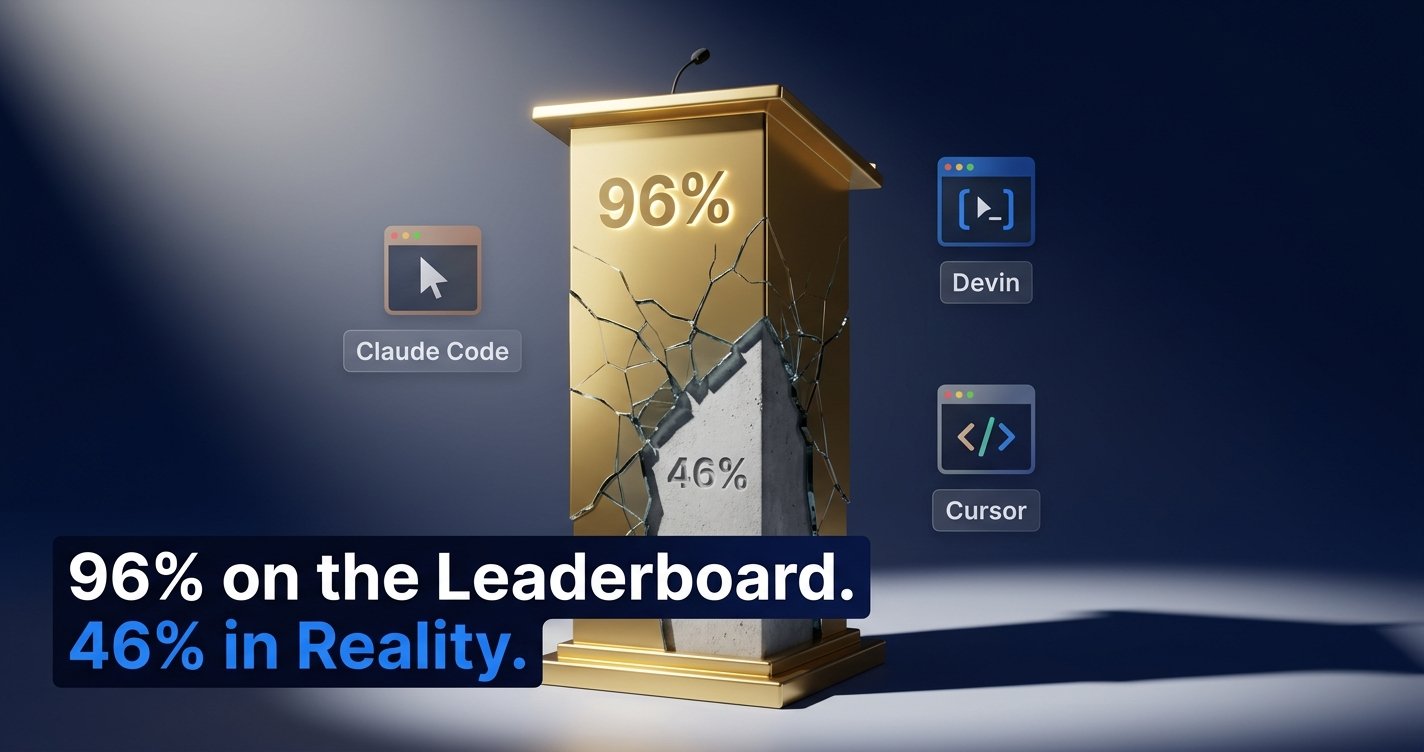
Here’s the number every coding-agent vendor wants on its homepage: as of late August 2026, Claude Opus 5 leads SWE-bench Verified at roughly 96%, with the top five frontier models bunched within about four points of each other. That tight clustering isn’t a sign of a level playing field. It’s a sign the benchmark is maxed out.
OpenAI reached the same conclusion about its own flagship metric. In a February 2026 audit, the company examined 138 SWE-bench Verified problems its own o3 model couldn’t solve consistently and found that most of them weren’t actually hard, they were broken. Roughly 59% contained flawed test design or unclear problem descriptions, and more than a third rejected functionally correct solutions outright because the test cases were too narrow. OpenAI has since stopped leading with Verified scores at all.
Why this matters for you
If a coding tool’s marketing page leads with a SWE-bench Verified score above 90%, treat it as a saturated, partly-contaminated number rather than a real capability signal. Ask for SWE-bench Pro or Terminal-Bench 2.1 results instead.
The cleaner benchmark tells a very different story. On SWE-bench Pro, which uses fresher, less-gameable problems, Claude Opus 4.5’s score drops from 80.9% down to 45.9%, a 35-point collapse on the exact same model, according to data aggregated by CodeAnt.ai from the Scale AI SEAL leaderboard. GPT-5 High shows a comparable fall, from roughly 55% down to 23.3%. That gap is the real state of the category in 2026: genuinely strong on well-scoped repository fixes, still shaky on open-ended, ambiguous engineering work.
Head-to-Head: Claude Code vs. Devin vs. Cursor vs. Codex
No single tool wins across every task type in 2026. That’s not a hedge, it’s the finding of a June 2026 AIDev study covering thousands of agent-proposed fixes across Copilot, Devin, Cursor, and Claude: 46.41% of proposed fixes were rejected overall, and Devin was the only agent with a consistently improving acceptance rate over 32 weeks, yet still didn’t top every category, as reported by New Market Pitch.
IDE-native editing with a human reviewing each step
Medium, human-in-the-loop by design
Tiered credit system
OpenAI Codex / Symphony
Terminal tool-use, competitive with Claude on raw speed
High
Usage/credit-based
On raw tool-use, the gap between the top two is close to nothing. Morphllm’s Terminal-Bench 2.1 leaderboard, updated August 2, 2026, has GPT-5.6 Sol at maximum effort scoring 89.5%, with Claude Opus 5 right behind at 89.1%. If you’re choosing based on a headline percentage point, you’re choosing based on noise.
What actually separates these tools in practice is workflow fit, not benchmark score. Cognition’s enterprise numbers back that up: the company says Devin usage grew more than 10x since January 2026, with roughly 50% month-over-month growth sustained for six straight months, and Cognition’s own reported revenue jumped from $37 million in May 2025 to $492 million a year later. Those are self-disclosed figures, not independently audited, so treat the magnitude with some caution even as the direction is clearly real.
Does Agentic Coding Actually Make You Faster?
This is the question every CTO is quietly asking, and the honest answer in 2026 is: it depends, and the best available evidence says less than you’d assume.
Experienced open-source developers using AI tools took 19% longer to complete real coding tasks than developers working without them, despite predicting beforehand they’d be 24% faster.
METR (Joel Becker, Nate Rush, Beth Barnes, David Rein), metr.org, July 2025
That finding, from a randomized controlled trial with paid participants and 246 real GitHub issues, remains the most methodologically rigorous data point in this entire category. It’s not a survey. It’s not a vendor case study. It’s a controlled experiment, and it found a measurable slowdown.
METR revisited the result in February 2026 after discovering a selection bias: 30 to 50% of developers invited to the original study had declined to participate without AI access, which likely skewed the sample toward people who found AI tools less useful. A larger follow-up cohort of 57 developers across more than 800 tasks produced an estimate somewhere between roughly negative 4% and positive 18%, depending on the analysis, with confidence intervals wide enough that “the slowdown reversed” and “the slowdown persists” are both defensible readings of the same data.
The honest takeaway
There is no rigorous evidence yet that agentic coding tools reliably speed up experienced developers on real production work. There’s early, uncertain evidence the picture may be improving. Plan budgets and timelines around the uncertain version, not the vendor version.
The Security Cost Nobody Puts in the Demo
Speed isn’t the only tradeoff. Security researchers have started quantifying a cost that rarely makes it into a product launch: AI-generated code ships with meaningfully more vulnerabilities than human-written code.
CodeRabbit’s analysis found 2.74 times more security vulnerabilities in AI-generated code compared to code written by people. Separately, Veracode tested more than 100 large language models across 80 coding tasks and found 45% of the AI-generated code introduced a vulnerability class from the OWASP Top 10. Black Duck’s 2026 Open Source Security and Risk Analysis report found known vulnerabilities per codebase rose 107% year-over-year, from an average of 280 up to 581, a trend aggregated in detail by independent analyst Philipp Dubach.
Put plainly: agent-written code needs the same review discipline you’d apply to a junior engineer’s pull request, not less. Some teams are already discovering that the hard way; separate research from Opsera reportedly found AI-authored pull requests wait 4.6 times longer in review than human-authored ones, which quietly erodes the “time-to-merge” speed gains vendors like to advertise.
Pricing, Consolidation, and Platform Risk
The business side of this category moved almost as fast as the technology in 2026. Three shifts matter if you’re planning a team-wide rollout.
Pricing has gone entirely usage-based
Flat per-seat pricing is largely gone. GitHub Copilot moved to AI Credits in June 2026. Cursor runs a tiered credit system. Claude Code uses rolling five-hour usage windows. Cost now scales with how autonomously your team lets agents run, not with headcount, which changes how a rollout should be budgeted.
Consolidation is accelerating
Windsurf was rebranded Devin Desktop on June 2, 2026, after Cognition acquired the product and team, following a collapsed OpenAI acquisition attempt and Google DeepMind hiring away Windsurf’s leadership the prior year. Cursor’s parent company, Anysphere, crossed $2 billion in annualized revenue in March 2026, up from $1 billion just four months earlier, and reportedly gave SpaceX an option in April 2026 to acquire the company for $60 billion. Cognition itself raised $1 billion at a $26 billion valuation, with enterprise customers including Goldman Sachs, Citi, Mercedes-Benz, and units of the US Army and Navy.
Regulatory risk now sits on top of model access
Anthropic’s Claude Fable 5 and Claude Mythos 5 launched June 9, 2026, then were suspended just three days later to comply with US Department of Commerce export controls, before being restored on July 1 once those controls were lifted. Mythos 5 remains limited to approved partners under Anthropic’s Project Glasswing program. For any enterprise betting a workflow on a single frontier model, that three-week gap is a preview of a risk category that didn’t exist in this form two years ago.
The Contrarian View: Why Karpathy Thinks This Is a Decade, Not a Year
Every hype cycle needs a credible skeptic, and in agentic coding, that’s Andrej Karpathy, OpenAI co-founder and the person who coined “vibe coding” in the first place. Speaking on the Dwarkesh Patel podcast in October 2025, Karpathy pushed back on the industry’s framing of 2025 as “the year of agents,” arguing instead that this is closer to the start of a decade-long build-out toward genuinely reliable, employee-like autonomous coding agents, not a problem months from being solved.
His case centers on gaps that benchmarks don’t capture well: limited long-term memory, weak multimodal perception, and no real continual learning between sessions. Those gaps track closely with what METR’s RCT and the SWE-bench Pro collapse both show empirically. Two very different kinds of evidence, one non-vendor researcher and one controlled experiment, are pointing at the same conclusion.
Is that view still fair heading into 2027? Given the revenue growth in this category, it’s tempting to say the skeptics lost. But revenue and reliability are different questions. Cognition’s 13x year-over-year revenue jump proves people are buying agentic coding tools at scale. It doesn’t prove the tools are doing unsupervised production work reliably, and the AIDev rejection-rate data suggests they largely aren’t yet.
How to Actually Choose One
Skip the leaderboard-chasing. Here’s what actually predicts whether an agentic coding tool will work for your team:
Match autonomy to task risk. Let agents run further unsupervised on well-scoped, well-tested internal tools. Keep a tight human loop on anything customer-facing or security-sensitive.
Budget for usage, not seats. Model your costs against how many long, autonomous sessions your team will actually run, not headcount.
Add review capacity, don’t remove it. The security data says agent output needs the same scrutiny as junior-engineer output. Plan reviewer time accordingly, especially given the longer review cycles AI-authored PRs already see.
Avoid single-vendor lock-in on frontier models. The Fable 5/Mythos 5 suspension shows model access itself can become a temporary casualty of policy, independent of anything your team does.
Run more than one tool. With no clear category leader across task types, teams increasingly run two to four agentic tools side by side rather than standardizing on one.
Frequently Asked Questions
What is the difference between agentic coding and vibe coding?
Agentic coding uses an AI agent that plans, edits, tests, and iterates through real tool use (shell, file system, version control) while a human reviews against a defined goal. Vibe coding is faster, looser, largely unreviewed prompting typically used for prototypes, not production code.
Do AI coding agents actually make developers faster?
The evidence is mixed. METR’s 2025 randomized controlled trial found experienced developers were 19% slower using AI tools on real tasks. A 2026 follow-up under a larger, less-biased sample suggested the picture may be improving, but with wide statistical uncertainty either way.
Why did OpenAI stop using SWE-bench Verified?
OpenAI’s own 2026 audit found that most of the benchmark’s hardest “unsolved” problems contained flawed tests or unclear descriptions rather than genuine difficulty, and the company now recommends SWE-bench Pro as a cleaner alternative.
Which AI coding agent has the highest SWE-bench score in 2026?
As of late August 2026, Claude Opus 5 leads SWE-bench Verified at roughly 96%, with the top five frontier models clustered within about four points of each other, a sign the benchmark itself is close to saturated for top-tier models.
Is AI-generated code less secure than human-written code?
Multiple 2026 industry analyses point the same direction: AI-generated code shows meaningfully higher vulnerability rates, including one dataset where nearly half of tested outputs introduced an OWASP Top 10 vulnerability class.
Where This Goes Next
The category is no longer trying to prove agentic coding works. Revenue growth across Claude Code, Cursor, and Devin already answered that question. What’s still unresolved, and what will define the next 6 to 18 months, is whether these tools can close the gap between a 96% saturated leaderboard number and a 46% real-world fix-rejection rate.
Three things worth watching:
Whether SWE-bench Pro and Terminal-Bench 2.1 replace Verified as the default marketing metric across the industry, or whether a new, even harder benchmark emerges once these saturate too.
Whether METR’s next update resolves the productivity question with tighter confidence intervals, or whether the uncertainty itself becomes the permanent, honest answer.
Whether the current wave of consolidation (Devin Desktop, Cursor’s SpaceX option) produces two or three dominant platforms by 2027, raising the stakes on whichever vendor a team picks today.
Our read: the tools are real and the growth is real, but “fully autonomous, human-optional” is still marketing, not measurement. Build your workflow around the tool that fits your review process, not the one with the biggest number on its homepage.
Crypto Exchange Architecture 2026: Compliance Comes First Now
Crypto & Blockchain / Developer Deep Dive
Crypto Exchange Architecture in 2026: Why Compliance Now Comes Before the Trading Engine
By the NeuralWired Crypto Desk · Published August 28, 2026 · 11 min read
A hardware wallet that was supposed to be un-hackable just lost roughly $130 million. Not to a smart contract exploit. Not to a hot wallet slip-up. To a flaw in offline Coldcard devices, drained from the exact place every compliance guide tells founders to put their money for safety. If you’re scoping a crypto exchange architecture build in 2026, that single event tells you everything about why the old build order no longer works.
For years, the playbook was simple: build the matching engine, wire up the wallets, ship a dashboard, and bolt on compliance once regulators come knocking. That sequence is dead. Between MiCA’s hard deadline, a first-ever binding federal token taxonomy from the SEC and CFTC, and a stalled but still-looming U.S. market structure bill, the rules that govern how you onboard a user now dictate how you design your data model before you write a single line of matching-engine code.
Here’s the uncomfortable truth for anyone raising a seed round to build a new venue: founders think they’re buying a trading engine. What they’re actually buying is a compliance operating system with a trading engine attached to it. Three things converged in the same publishing window to make that true, and none of them were optional.
Carlos Martins, Head of Compliance at Currency.com and chairperson of the Gibraltar Association of Compliance Officers, has argued that exchanges embedding auditability and monitoring into their core systems are the ones winning institutional capital, while firms treating compliance as an afterthought face friction and consolidation. His point cuts against a comfortable assumption: that having clear rules on paper is the same thing as being operationally ready to run them. It isn’t.
The Three Regulatory Triggers Forcing the Change
1. MiCA’s deadline already passed
Any Crypto-Asset Service Provider operating in the European Union needed full MiCA authorization by July 1, 2026, with no extension mechanism. If you’re reading this after that date, the question isn’t whether you need MiCA authorization. It’s whether the exchange you’re evaluating, building for, or working at actually has it.
2. The SEC and CFTC drew a line that actually holds
On March 17, 2026, the SEC and CFTC jointly issued a 68-page interpretive release creating the first formal five-category token taxonomy in U.S. history: digital commodities, digital collectibles, digital utilities, stablecoins, and digital securities. Sixteen major cryptocurrencies, including Bitcoin, Ethereum, Solana, and XRP, landed in the “digital commodity” bucket, exempt from securities law. Unlike prior informal staff guidance, this release is binding on both agencies. SEC Chairman Paul S. Atkins built on that framework in an August 18, 2026 statement on fit-for-purpose crypto exemptions.
That classification isn’t academic. It determines which onboarding flow, which reporting obligation, and which disclosure regime attaches to every listed asset on your exchange. Get the token classification wrong in your data model, and you’re not fixing a bug. You’re re-architecting.
3. The CLARITY Act is still hanging
The Digital Asset Market Clarity Act (H.R. 3633) passed the House in July 2025 and cleared Senate Banking Committee 15-9 in May 2026. Then it stalled. The Senate filed a cloture motion in early August 2026 but broke for recess before a floor vote, with a vote reportedly rescheduled for September 15, 2026. If you’re building against U.S. market structure rules right now, you’re designing against a framework that’s binding in parts (the SEC/CFTC interpretation) and still unresolved in parts (comprehensive legislation). Plan for both outcomes.
Why this matters for your build: Compliance and security work, not feature code, is the thing that blows up timelines. Multiple 2026 technical guides identify this as the number one cause of launch delays, ahead of matching-engine performance issues or liquidity partnerships.
What Compliance-First Architecture Actually Looks Like
Forget the old three-layer mental model of matching engine, custody, and liquidity. In 2026, compliance and onboarding function as a fourth load-bearing layer, not a plugin you attach after launch.
Research Snipers put it plainly back in May: teams that treated compliance as an add-on layer, something you slot in once the matching engine, wallets, and dashboard are already built, are now the ones running into walls. That sequencing assumption is what’s obsolete, not any single feature.
The non-negotiable security baseline that shows up across nearly every current technical guide includes:
Cold storage for the large majority of user assets
Multi-signature or MPC-based transaction signing
Withdrawal whitelisting
Independent penetration testing on a recurring cadence
Third-party smart contract audits for any on-chain code
DDoS protection, rate limiting, two-factor authentication, and anomaly detection
Proof of reserves, published and verifiable
Antier’s June 2026 architecture guide frames the critical backend decision as isolating the matching engine from peripheral systems so a breach in one component can’t cascade into the whole platform, a design principle that matters more now given the volume and sophistication of AI-assisted attacks observed through the first half of 2026.
The recommended build sequence for a 2026-native exchange runs: discovery and compliance scoping, then architecture and design, then core engineering (matching engine, wallets, liquidity), then security hardening and audit, then regulatory integration, and only then launch with market-making support. Compliance scoping sits at step one, not step five.
Building One System for Three Regulatory Regimes
If you’re operating across the EU, US, and UK simultaneously, you’re not dealing with one rulebook. You’re dealing with three, and they don’t agree on the basics.
Zyphe’s March 2026 research on cross-border KYC architecture flags the most common operational failure directly: firms build for their primary market first, then patch other regimes onto the existing system afterward. Those patches create inconsistencies, and inconsistencies are exactly what surface during a cross-border regulatory examination. The fix is designing one KYC data model that satisfies all three regimes from day one, rather than running three parallel onboarding stacks that quietly drift apart.
Globally, the Travel Rule is no longer a regional edge case either. Eighty-five of 117 FATF-surveyed jurisdictions, 73 percent, had passed Travel Rule legislation as of March 2026. Enforcement isn’t limited to the U.S. and EU: France issued 14 enforcement notices in a single quarter in late 2025, and Germany’s BaFin blocked access to six offshore exchange domains targeting German users without CASP authorization.
The Coldcard Hack and the Limits of Compliance-by-Design
Compliance architecture reduces risk. It doesn’t eliminate it, and the early-August Coldcard exploit is the proof. Estimates vary by outlet, TechCrunch put the loss at over $130 million, Fortune cited 1,816 BTC across roughly 5,200 addresses, Galaxy Research put the toll near $130 million across more than 7,700 addresses, but every version of the story lands on the same fact: cold storage, the gold-standard control every compliance framework recommends without exception, got drained anyway.
Zoom out and the pattern is stranger than a single bad month. TRM Labs recorded 207 separate hacking incidents in the six months leading into early August 2026, the most ever tracked in any half-year period. Yet total losses came in around $972 million, less than half of the $2.3 billion stolen in the first half of 2025. Attacks are getting more frequent and, on average, less catastrophic per incident. That’s a case for broad architectural hardening across every system, not just a headline-driven custody fix after the next big breach.
Compliance-by-design does not prevent technical exploits. It reduces the odds and limits the blast radius. It does not make catastrophic loss impossible.
NeuralWired analysis, based on TRM Labs and Fortune reporting, August 2026
The Contrarian Case: Is This Narrative Overbuilt?
Every mainstream compliance-first framing deserves a stress test, so here’s the pushback.
Stephen Diehl, an independent software engineer and long-time crypto critic, points to a widening gap between regulatory ambition and regulatory capacity. He’s tracked the CFTC’s enforcement division shrinking from roughly 140 staff to around 105 between 2024 and early 2026, even as the compliance expectations placed on exchanges have gotten more detailed and more demanding. His argument: large, U.S.-connected exchanges are over-investing in compliance architecture that regulators may not have the staff to fully enforce, while offshore venues with weaker jurisdictional ties face comparatively little practical risk.
There’s a data tension worth flagging too. Kroll reported global AML, sanctions, and due-diligence penalties actually fell in 2025, down to $3.8 billion from $4.6 billion in 2024, continuing a decline from $6.6 billion in 2023. That sits awkwardly next to a separate figure showing a 417 percent jump in fine value during the first half of 2025 alone. Both numbers are real. They’re measuring different windows and different scopes, a first-half spike versus a full-year total, and the gap is a reminder to check methodology before treating any single enforcement statistic as the whole picture.
Then there’s the DeFi counter-model. Some builders are designing systems to separate the protocol layer from the interface layer entirely, keeping the settlement layer jurisdiction-neutral while pushing compliance obligations onto the interface layer alone. That’s a genuinely different architecture bet than the compliance-in-the-core approach centralized exchanges are taking, and it has real institutional traction, BlackRock’s BUIDL fund trading on Uniswap being the clearest example on record.
Worth remembering too: several of the loudest voices insisting compliance infrastructure is unavoidable and expensive are exchange-development vendors selling exactly that service. That’s not a reason to dismiss the argument. It’s a reason to read the sourcing carefully.
Frequently Asked Questions
What is the primary factor that distinguishes successful crypto exchanges from those that fail?
Architecture, not user-facing features, is the main differentiator. Exchanges that fail typically bolted compliance and security onto an already-built trading engine. Exchanges built for 2026 embed KYC, AML, cold storage, and audit trails into core infrastructure from the design phase, not after launch.
When did EU crypto exchanges need MiCA authorization?
Any Crypto-Asset Service Provider operating in the EU needed full MiCA authorization by July 1, 2026, with no extension mechanism. Exchanges without it were required to cease EU operations, and MiCA mandates that KYC, AML, and CFT processes be built into onboarding from the start.
What did the SEC and CFTC’s March 2026 guidance actually change?
On March 17, 2026, the SEC and CFTC jointly classified 16 major cryptocurrencies, including Bitcoin, Ethereum, Solana, and XRP, as “digital commodities” exempt from securities law under a new five-category taxonomy. Unlike prior staff guidance, this interpretation is binding on both agencies.
Is the CLARITY Act law yet?
No. As of late August 2026, the Digital Asset Market Clarity Act has passed the House and a Senate committee but hasn’t cleared a full Senate floor vote. A cloture motion was filed August 8, 2026, with a floor vote reportedly scheduled for September 15, 2026.
How much have crypto exchanges been fined for AML violations?
Crypto exchanges paid roughly $927.5 million in AML and CFT penalties in 2025, more than any other sector tracked, according to the Institute for Financial Integrity. The largest single case was OKX’s approximately $504 million DOJ settlement in February 2025.
What to Watch Over the Next 6 to 18 Months
Here’s what you now understand that you didn’t ten minutes ago: the sequencing that used to define an exchange build, matching engine first, compliance later, has inverted. Compliance scoping now happens at step one, not step five, and the regulatory events of 2026 are the reason why.
Three things to track going into Q4 2026 and beyond:
The September 15, 2026 CLARITY Act Senate vote. If it passes, U.S. market structure gets its first comprehensive federal law and every exchange building for the U.S. market will need to check its architecture against the final text.
Post-MiCA enforcement activity. Now that the July 1 deadline has passed, watch for the first wave of enforcement actions against exchanges operating in the EU without authorization.
Whether the Coldcard-style hardware exploit gets replicated. A single vulnerability class draining $130 million from “safe” cold storage should push every exchange to re-audit hardware wallet dependencies, not just software ones.
Our read: the exchanges that treat compliance as core infrastructure rather than a defensive checkbox are the ones that’ll still be operating, and expanding into new regulated markets, when this cycle’s enforcement wave crests. The ones that don’t will be footnotes in next year’s version of this article.
Want this kind of analysis in your inbox? Subscribe to The Neural Loop at neuralwired.com/newsletter for weekly breakdowns of the regulatory and technical shifts reshaping crypto infrastructure.
Nvidia’s $30B Perplexity Bet Isn’t an Investment. It’s a Pattern.
AI Infrastructure / Deal Analysis
Nvidia’s $30B Perplexity Bet Isn’t an Investment. It’s a Pattern.
By the NeuralWired Desk · Published August 25, 2026 · 9 min read
Nvidia is reportedly circling a stake in Perplexity at a valuation north of $30 billion, according to The Information, confirmed to exist (though not independently verified in its specifics) by Reuters on August 23. If you’ve been tracking Nvidia’s deal flow this year, that headline should feel familiar. That’s because it’s the fourth version of the same move since December.
Nvidia earnings land Wednesday, August 26. The Perplexity talks surfaced 72 hours before the call. That timing alone is worth sitting with, and we’ll get to it. But first, the number everyone’s repeating about Perplexity’s revenue doesn’t hold up the way it should.
Start with what’s confirmed and what isn’t, because the two keep getting blended in coverage. Nvidia and Perplexity are reportedly in discussions for Nvidia to join an equity round that would value the AI search company at more than $30 billion. That’s more than 50 percent higher than the roughly $20 billion valuation Perplexity locked in about a year ago.
This isn’t Nvidia’s first involvement with Perplexity. The chipmaker has held a stake since 2023, and in July 2026, Perplexity committed to running its AI agent workloads on Nvidia’s Vera CPUs. The Information also reported that Nvidia had floated a licensing arrangement, or hiring a slice of Perplexity’s team, before settling on a straight equity investment instead.
None of this is closed. It’s a discussion, reported by one outlet and confirmed to exist (not confirmed in detail) by a second. Treat every “Nvidia backs Perplexity at $30B” headline you see this week with that caveat attached.
The $750 million number has a problem
Here’s the part almost nobody’s flagging clearly, and it’s the reason this deal deserves more scrutiny than a routine funding round writeup.
Perplexity’s annualized revenue is widely reported at more than $750 million, up from under $250 million at the start of 2026, with growth credited partly to its “Perplexity Computer” agentic automation product. That figure is getting repeated across outlet after outlet as if it’s settled.
It probably isn’t. Independent estimates from research firms Sacra and Tracxn put Perplexity’s actual annualized revenue closer to $450 million to $500 million as of April 2026, a gap of roughly 40 to 50 percent below the number in circulation. One plausible explanation: the $750 million figure may be conflating revenue with a separate $750 million Microsoft Azure infrastructure commitment Perplexity signed in January 2026. A cloud spending commitment and annual recurring revenue are not the same thing, and if that conflation is what happened, it means a company’s valuation-driving growth story is partly built on mixing up a cost with an income line.
Why this matters: if Perplexity’s real ARR sits closer to $450 to $500 million, a $30 billion valuation implies a revenue multiple in the 60x to 65x range rather than the roughly 40x multiple the $750 million figure would suggest. That’s a meaningfully more aggressive bet, and it’s the kind of detail that belongs in every investor’s model of this deal, not a footnote.
To be fair to Perplexity, growth from under $250 million to somewhere in the $450 million to $750 million range within eight months is still a real story on its own terms. The problem isn’t the growth. It’s that one of the two most-cited numbers behind a $30 billion valuation may not mean what it’s being reported to mean.
Groq, Enfabrica, Poolside: the shape of the pattern
Zoom out and Perplexity stops looking like an isolated headline. It’s the fourth entry in a sequence that’s formed over the past nine months, and each one shares a structural DNA even when the mechanics differ slightly.
License of “Model Factory” software + 109 engineers hired into Nvidia’s Nemotron team, plus separate equity stake
$6B license + $1B equity
August 21, 2026
Perplexity
Straight equity round (no license or hiring component reported so far)
$30B+ valuation
Talks as of August 23, 2026
A Poolside investor letter, first reported by Newcomer, was blunt about how the company wants this framed: “not an acquisition and it is not an acquihire.” That line is worth remembering, because it’s becoming boilerplate. Three deals in nine months have now used some version of that exact disclaimer, and the 109 Poolside engineers are already being folded into Nvidia’s open-weight Nemotron model family, which is functionally a talent acquisition even if the paperwork says otherwise.
Perplexity breaks from the pattern in one respect. It’s reportedly structured as a straight equity round, not a license-plus-hiring deal. But it lands in the same 72-hour news cycle as the Poolside close and just ahead of Nvidia’s earnings, which is exactly why the pattern, not any single deal, is the real story here.
Across Groq, Enfabrica, and Poolside alone, Nvidia has committed roughly $27 billion in these license-and-hire arrangements. Add Perplexity’s reported $30 billion round and broader 2026 commitments that already exceed $540 billion, and you get a company deploying capital at a pace that outstrips almost every historical comparison in tech, semiconductor or otherwise.
“No. OpenAI will pay the lease.”
Jensen Huang, Founder & CEO, Nvidia, pushing back on circular-financing criticism of Nvidia’s broader compute deals, August 17, 2026
Huang’s defense, made in the context of the OpenAI relationship, is the same one he’s likely to repeat when asked about Perplexity on Wednesday’s call: Nvidia’s partners have independent obligations to pay, so the money isn’t just flowing in a circle back to Nvidia’s own revenue line. Not everyone buys that framing.
“The view that the AI ecosystem will take on more leverage is in itself an investment debate, even if Nvidia does not provide the leverage.”
Joseph Moore, Analyst, Morgan Stanley, CNBC, August 11, 2026
“Nvidia guaranteeing more of OpenAI’s data center debt deepens vendor financing that’s already under scrutiny. It’s as much a reminder of funding strain in the AI buildout as it is a demand signal.”
Billy Leung, Analyst, Global X Management
Our read: Huang is technically correct that the money passes through independent contracts. But “technically not circular” and “not creating the appearance of circularity” are different claims, and Nvidia’s stock reaction this week (down almost 3 percent on August 24 amid a broader chip selloff that also hit Micron, AMD and Broadcom) suggests the market is at least a little uneasy about which claim actually holds.
Why regulators are watching, and why nothing’s happened yet
The “not an acquisition” language isn’t just marketing. It’s doing legal work. Deals structured as licensing arrangements or minority equity stakes, rather than outright acquisitions, generally avoid triggering Hart-Scott-Rodino review, the federal process that flags mergers for antitrust scrutiny.
Regulators have noticed. FTC Chair Andrew Ferguson said in January 2026 that the agency would examine whether acquihire-style deals were “being constructed to try to escape Hart-Scott-Rodino review.” Omar Assefi, acting head of the DOJ’s Antitrust Division, went further in April, calling acquihires a “red flag” designed to sidestep merger review. Three Democratic senators sent a formal letter to the FTC and DOJ in February 2026 describing these arrangements as de facto mergers that risk driving up prices and choking off innovation.
Here’s the reality check that most coverage skips: despite all of that rhetoric, no enforcement action has been taken against any of the three prior deals (Groq, Enfabrica, or Poolside) as of this writing. The current administration has generally taken a more permissive posture on technology M&A. The regulatory risk is real as a talking point and currently theoretical as an actual constraint. If you’re a startup founder weighing a similar deal, or counsel advising one, that gap between stated concern and actual enforcement is the single most useful data point in this entire story.
The other half of Wednesday’s earnings call
Nvidia reports Q2 FY2027 results Wednesday, August 26, after market close, with figures expected around 4:20pm ET and the call starting at 5:00pm ET. Guidance calls for roughly $91 billion in revenue (plus or minus 2 percent) and a 75 percent non-GAAP gross margin, built on an assumption of zero China revenue. For context, Q1 FY2027 delivered $81.6 billion, up 85 percent year over year, with data center revenue alone hitting $75.2 billion, over 92 percent of total sales.
Those numbers are the headline everyone’s watching for. But there’s a second act now. Whatever Huang says when he’s inevitably asked about Perplexity, and about the broader shape of these license-and-invest deals, will move the stock almost as much as the revenue print itself. Treat Wednesday as a two-part event: the numbers, and then the fifteen minutes after someone on the call asks about circular financing.
NVDA closed near $212.50 on August 25, giving the company a market cap around $5.23 trillion and a P/E near 32. That’s not a cheap stock pricing in disappointment. It’s a stock pricing in the assumption that both halves of Wednesday go well.
Frequently asked questions
Is Nvidia’s investment in Perplexity confirmed?
No. As of August 25, 2026, it’s a reported discussion from The Information, dated August 23, with Reuters confirming the report’s existence but not the underlying deal terms. Neither company has confirmed a closed round.
What is Perplexity’s valuation in 2026?
Reportedly more than $30 billion in a proposed new round, up from roughly $20 billion secured about a year earlier, a jump of over 50 percent, though unconfirmed and not yet closed.
What is Perplexity’s actual revenue?
Disputed. The widely cited $750 million ARR figure conflicts with independent Sacra and Tracxn data putting actual ARR at $450 million to $500 million as of April 2026. The gap may trace back to confusion with a separate $750 million Microsoft Azure spending commitment.
When does Nvidia report earnings next?
Wednesday, August 26, 2026, after market close, with results near 4:20pm ET and the call at 5:00pm ET, covering fiscal Q2 2027.
What is Nvidia’s circular financing controversy?
Critics argue Nvidia invests in AI companies that then spend that capital on Nvidia chips, creating a closed loop that can inflate the appearance of independent demand. Jensen Huang disputes this, pointing out that partners like OpenAI have separate payment obligations regardless of Nvidia’s investment.
What to watch next
You now know something most coverage of this deal won’t tell you plainly: the revenue number holding up Perplexity’s $30 billion price tag has a real, sourced discrepancy attached to it, and the deal itself hasn’t closed. Here’s where this goes over the next six to eighteen months.
Nvidia’s earnings call, August 26. Watch for any direct question about Perplexity or the license-and-invest pattern, and how carefully Huang distinguishes this deal from the circular financing critique.
Whether Perplexity’s round actually closes, and at what valuation. A discussion isn’t a deal. If the round lands below $30 billion, or with different terms, that itself is a story about how much the “$30B” headline was doing PR work in advance.
Regulatory movement, or the lack of it. If the FTC or DOJ opens a formal inquiry into any of these four deals in the next two quarters, the “not an acquisition” playbook gets a lot more expensive for every startup considering it. If nothing happens, expect more deals shaped exactly like this one.
This is a live story with more disclosure coming inside 48 hours. Follow it, and subscribe to The Neural Loop at neuralwired.com/newsletter for the earnings breakdown the moment Nvidia’s numbers land.
Proof of Reserves for Tokenized Assets: BlackRock’s Playbook
RWA Infrastructure
Proof of Reserves for Tokenized Assets: BlackRock’s Playbook
A developer integrating BlackRock’s BUIDL fund into a lending protocol has one question that matters more than yield: is the collateral actually there? Proof of reserves for tokenized assets is the answer to that question, and in 2026 it stopped being optional. Since Chronicle Protocol wired independently verified holdings data directly into BUIDL’s onchain record, the gap between “we say we hold it” and “you can check it yourself” has become the line separating institutional-grade real-world asset (RWA) products from everything else.
This is not the same thing as the monthly proof-of-reserves snapshots exchanges like MEXC or Binance publish to reassure users their BTC hasn’t vanished. Those prove an exchange is solvent. What we’re covering here proves that a tokenized Treasury fund, a tokenized gold bar, or a tokenized private credit position is backed by what its issuer claims, verifiable on-chain, continuously, by anyone.
Proof of Reserve (PoR) is an automated verification system, usually built on a decentralized oracle network, that checks whether a tokenized asset’s on-chain supply genuinely matches the off-chain or cross-chain collateral backing it. Think of it as a live audit trail instead of a quarterly PDF. When a fund claims to hold $2 billion in Treasuries, PoR infrastructure pulls custody and valuation data from the actual custodian and publishes it on-chain, where a smart contract, a lending protocol, or a curious developer can check it in real time.
The distinction that trips people up: a price oracle tells you what an asset is worth. A reserve oracle tells you whether the asset exists at all, held where the issuer says it’s held. Confusing the two is a real architecture mistake. Protocols that rely solely on a NAV feed without a separate reserve/custody check have historically been exposed to stale-price exploits, where an attacker borrows against a token whose underlying reserve has already quietly moved or shrunk.
BlackRock’s BUIDL and Chronicle’s Proof of Asset
The clearest real-world test case launched on March 26, 2026, when Securitize, BUIDL’s tokenization agent, and Chronicle Protocol announced that BlackRock’s tokenized Treasury fund would carry independently verified, holdings-level data directly on-chain, covering asset composition, valuation, and custody confirmation.
At the time, BUIDL held somewhere between $1.7 billion and $2.1 billion in Treasuries, overnight repos, and cash. By July 2026, rwa.xyz put the fund’s assets under management closer to $2.5 to $2.8 billion, according to CryptoRank’s aggregated RWA.xyz data. That growth happened while the fund was operating under continuous, independently checkable verification instead of investor trust alone.
Chronicle Protocol founder Niklas Kunkel describes the integration as an integrity layer that gives investors and protocols granular, transparent visibility into what’s backing a fund, not just what it’s worth.
Niklas Kunkel, Founder, Chronicle Protocol, via The Block, March 2026
Securitize CEO Carlos Domingo made a similar point in the joint announcement: tokenization only becomes meaningful once investors and protocols can independently verify what’s actually backing the product, rather than taking an issuer’s word for it. That’s the entire thesis of this article compressed into one sentence.
Chainlink Proof of Reserve, the Industry Default
Chainlink’s Proof of Reserve is the most widely deployed system of its kind, comparing on-chain token supply against off-chain or cross-chain custodial reserves through a decentralized oracle network. It’s live across a wide swath of the RWA stack: Backed Finance uses it for its bTokens, and Crypto Finance, part of Deutsche Börse Group, has run it since September 2025 for the physically-backed ETPs behind its nxtAssets product line.
Chainlink secured roughly $3 billion in new RWA oracle contracts during 2026, covering reserve and data feeds for BUIDL, Ondo’s OUSG, and UBS’s tokenized asset products. That figure tells you this isn’t a niche tool anymore. It’s becoming default infrastructure the way TLS became default for web traffic: unglamorous, assumed, and increasingly non-negotiable for anyone handling institutional money.
ERC-3643: The Compliance Layer Underneath It All
Reserve verification answers “does the asset exist.” It doesn’t answer “is this investor allowed to hold it.” That’s where ERC-3643 (formerly known as T-REX) comes in. It’s the dominant compliance-embedded token standard for regulated RWAs, built around an on-chain IdentityRegistry that runs a preTransferCheck before every transfer, confirming KYC status, jurisdiction, and accreditation on the fly.
As of 2026, ERC-3643 has enabled more than $32 billion in tokenized assets across over 200 deployments, according to the ERC3643 Association. If you’re deciding between a plain ERC-20 with bolted-on transfer hooks and a purpose-built standard like this one, the choice is no longer just technical preference. It’s a compliance decision that determines whether institutional counterparties will even talk to you.
Architecture note: A production RWA integration typically needs three layers working together: a compliance-embedded token standard (ERC-3643) to gate who can hold the asset, a reserve oracle (Chainlink PoR or Chronicle Proof of Asset) to confirm the collateral exists, and mint/redeem logic with circuit breakers that halt automatically if the reserve oracle reports a threshold breach. Treating any one of these as optional is how protocols end up exposed.
How the Verification Methods Compare
Method
What It Proves
Update Frequency
Used By
Merkle-tree exchange PoR
Exchange solvency (user balances covered)
Monthly snapshot
MEXC, Binance, Gate, BTCC
Chainlink Proof of Reserve
On-chain supply matches off-chain custody
Continuous, real-time
Backed Finance, Crypto Finance/Deutsche Börse
Chronicle Proof of Asset
Holdings composition, valuation, custody, existence
Continuous, real-time
BlackRock BUIDL
Zero-knowledge PoR
Reserves exceed liabilities, without revealing wallets
Continuous, privacy-preserving
Sygnum Bank (Matter Labs treasury, zkSync)
Why Proof of Reserves Isn’t a Silver Bullet
Here’s the part the optimistic version of this story skips. Proof of reserves confirms that a claimed asset exists at a given moment. It does not confirm off-chain liabilities, whether the asset has been rehypothecated elsewhere, or whether a token holder’s legal claim would actually survive the custodian’s bankruptcy proceedings. Those are separate problems, and no oracle network currently solves them.
The IMF’s April 2026 note on tokenized finance, authored by Financial Counsellor Tobias Adrian, makes a sharper argument still. Faster, more transparent settlement doesn’t just reduce risk, it also removes the time buffer regulators have historically relied on to intervene before a stress event spreads. Adrian frames it as a familiar financial trade-off wearing new technology: what tokenization gains in speed and transparency, it can lose in the window available to stop a problem before it cascades.
Tobias Adrian argues tokenization accelerates the pace at which financial stress can travel through the system, leaving regulators less time to respond than they had in prior market structures.
Tobias Adrian, Financial Counsellor and Director, IMF Monetary and Capital Markets Department, April 2026
MEXC’s Chief Operating Officer Tracy Jin raises a different objection worth sitting with. As long as tokenized assets sit on permissioned chains under the same centralized intermediaries and state regulators as traditional finance, proof of reserves proves solvency, but it does nothing about censorship or confiscation risk. In her view, that keeps tokenization a faster version of the old system rather than a genuinely new one.
Our read: both critiques are correct and neither cancels out the value of PoR. Verification infrastructure solves the FTX problem (is the asset actually there). It was never designed to solve the Celsius problem (can the custodian and issuer collude, or become entangled in the same failing estate) or the structural speed problem Adrian describes. Treat PoR as necessary, not sufficient.
There’s also a quality gap across asset classes that gets flattened in most coverage. Reserve-reporting quality varies most in private credit, where underwriting disclosure is genuinely harder to standardize than it is for Treasuries or allocated gold. Paxos Gold, for comparison, backs its tokens with more than 510,000 troy ounces of allocated gold held in Brink’s London vaults, with monthly attestations, a far cleaner reporting problem than an illiquid loan portfolio.
The Regulatory Gap Nobody’s Talking About
Two pieces of federal legislation are supposed to give this entire category legal certainty. Neither has fully landed.
The GENIUS Act, signed into law in July 2025, is the first federal framework requiring 100 percent stablecoin reserve backing plus monthly PCAOB-audited disclosure. Its implementing rules were due by July 18, 2026. As of this writing, they remain at the proposal stage, the FDIC’s version was still in public-comment status as of April 2026.
The Digital Asset Market Clarity Act, which would clarify SEC and CFTC jurisdiction over most tokenized RWAs, cleared the House in July 2025 and passed Senate Banking Committee markup 15 to 9 in May 2026. Then the Senate recessed in early August without a floor vote, pushing a cloture vote to September 15, 2026.
Correcting the record: Some 2026 industry commentary assumes the CLARITY Act already passed. It has not, as of August 25, 2026. If you’re citing regulatory certainty as a reason RWA tokenization is “settled,” that claim is currently ahead of the actual legislative record.
What This Means If You’re Building
Budget the oracle layer as core infrastructure, not a plugin. Reserve verification needs to be part of your initial architecture, including mint and redeem logic that halts on a reported threshold breach.
Pick your token standard on compliance grounds, not convenience. ERC-3643’s on-chain identity checks are becoming the default institutional counterparties expect.
Separate your price oracle from your reserve oracle. Conflating “what it’s worth” with “does it exist” is the most common mistake in early RWA integrations.
Don’t assume finalized federal rules exist yet. Both GENIUS Act implementing rules and CLARITY Act jurisdictional clarity are still pending as of late August 2026.
Match your verification rigor to the asset class. Treasuries and gold have mature attestation patterns. Private credit does not, yet.
FAQ
What is proof of reserves for tokenized assets?
It’s an automated, typically oracle-based verification system confirming a tokenized asset’s on-chain supply is genuinely backed by the off-chain or cross-chain collateral it claims, for example confirming a tokenized gold or Treasury fund actually holds the reserves shown on its dashboard.
How do blockchain developers verify RWAs are real?
Developers typically pair an oracle-based reserve feed, like Chainlink PoR or Chronicle Proof of Asset, with a compliance-embedded token standard such as ERC-3643, which checks investor eligibility on-chain, alongside off-chain custodian attestations delivered through the oracle network.
Is Chainlink Proof of Reserve the same as an audit?
No. PoR is continuous, automated, real-time monitoring of reserve balances against token supply. A traditional audit is a periodic, manual review by an accounting firm. GENIUS Act stablecoin rules still require monthly PCAOB-registered accounting attestations alongside any on-chain PoR tooling.
How big is the tokenized RWA market in 2026?
Distributed, freely tradable tokenized RWA value, excluding stablecoins, reached roughly $26.7 to $33.5 billion by mid-2026 per RWA.xyz, up from about $11.8 to $14 billion a year earlier. A separate “represented” pipeline figure above $345 billion is often mistaken for this liquid total.
Has the CLARITY Act passed?
Not as of August 25, 2026. It passed the House in July 2025 and cleared Senate Banking Committee markup in May 2026, but the Senate delayed its floor vote to a cloture vote scheduled for September 15, 2026 after recessing in early August.
Where This Goes Next
What you now understand that most coverage skips: proof of reserves for tokenized assets isn’t a single product, it’s a layered stack, oracle verification, compliance-embedded token standards, and custodian attestation working together, and each layer is maturing at a different speed depending on asset class. BUIDL and Chronicle prove the technical pattern works at institutional scale. The regulatory scaffolding underneath it, GENIUS Act implementing rules and CLARITY Act jurisdictional clarity, is still catching up.
Over the next 6 to 18 months, watch three things: whether the CLARITY Act actually clears its September 15 cloture vote, whether private credit issuers adopt reserve-reporting standards anywhere near as rigorous as Treasuries and gold currently enjoy, and whether zero-knowledge proof-of-reserve methods move from Sygnum’s early pilot into broader institutional use as issuers look for ways to verify solvency without exposing counterparty data.
Want the next breakdown like this one delivered straight to your inbox? Subscribe to The Neural Loop at neuralwired.com/newsletter.
Nvidia Hikes AI Server Prices 15%+ as Memory Crisis Bites
AI Infrastructure
Nvidia Hikes AI Server Prices 15%+ as Memory Crisis Bites
By NeuralWired Staff · Published August 23, 2026 · 8 min read
Nvidia just told its biggest customers to expect a bigger bill. Servers built around its flagship Vera Rubin and Grace Blackwell chips are going up more than 15% for systems shipping in early 2027, and the reason has nothing to do with the GPUs themselves. It’s memory, and the shortage behind it is reshaping how every major AI buyer plans its 2027 budget.
The increase, first reported by Bloomberg News on August 22, 2026, lands four days before Nvidia reports Q2 fiscal 2027 earnings, and it confirms something procurement teams have suspected for months: the AI chip price hike isn’t a one-time correction. It’s the visible edge of a memory supercycle that’s already rewritten pricing across the entire semiconductor stack, from data center racks down to the graphics card in a gaming PC.
According to Bloomberg’s reporting, Nvidia has notified some of its largest customers that server prices built around its AI chips will climb more than 15% in many cases, driven by soaring memory chip costs. The increases target systems shipping starting early 2027 and hit both the Vera Rubin and Grace Blackwell platforms, with the exact size depending on chip generation and memory configuration.
The ripple effect is already visible. Contract manufacturers building servers for Microsoft, Alphabet’s Google, and Oracle have started notifying their own customers about the coming increases, according to the report. Nvidia did not respond to requests for comment before publication.
Worth noting: Bloomberg’s sourcing is anonymous, described only as “people familiar with the process.” Reuters said it could not immediately verify the report. Treat this as single-sourced but multiply corroborated, since Fortune, CNBC, and the broader wire picked it up without dispute, and the pattern lines up with independently tracked consumer GPU pricing (more on that below).
Why Memory Chips Are Driving the Increase
Here’s the part that matters for anyone modeling 2027 infrastructure costs: this isn’t Nvidia squeezing more margin out of hyperscalers. It’s a pass-through of a cost shock that started with the companies that make DRAM and HBM, specifically Samsung, SK Hynix, and Micron.
Those suppliers have spent the past year shifting wafer capacity toward high-bandwidth memory for AI accelerators, and that’s left less room for conventional DRAM and NAND used in everything else. The result, according to TrendForce, is one of the sharpest memory price runs on record.
Metric
Figure
Source / Date
DRAM contract price growth, Q1 2026
90% to 95% QoQ
TrendForce, Feb 2026
DRAM contract price forecast, Q3 2026
13% to 18% QoQ
TrendForce, Jul 2026
Combined memory industry revenue, Q1 2026
$97 billion (+81% QoQ)
TrendForce, Jun 2026
Micron fiscal Q3 2026 revenue
$41.46 billion (+346% YoY)
Company earnings, Aug 2026
Memory share of AI system cost (Vera Rubin)
~29%, vs. Nvidia’s 20% target
Wedbush Securities, Jul 2026
That last line is the real story. When memory eats up nearly a third of a system’s cost instead of a fifth, a company with 75% gross margins doesn’t just eat the difference quietly. It redesigns the product and raises the price. Nvidia reportedly cut the capacity of its SOCAMM memory modules in half on the upcoming Vera Rubin platform, a sign the shortage is now shaping hardware decisions, not just invoices.
The Consumer Market Already Felt This
If this all sounds sudden, it isn’t. Enthusiast GPU buyers got hit first. Tom’s Hardware tracked U.S. retail RTX 50-series prices on Newegg and found the median RTX 5070 price jumped 36% between June and August 2026, from $659.99 to $899.99. The RTX 5060 Ti 16GB rose 39% in the same window, and the entry-level RTX 5060 climbed 27%.
Entry-level cards took the biggest hit because they have the least room to absorb a fixed-dollar memory cost increase. Bloomberg’s enterprise-side report is essentially the same story playing out one tier up, on hardware that costs tens of thousands of dollars instead of a few hundred.
Why the Timing Matters: Nvidia’s Q2 Earnings
Nvidia reports Q2 fiscal 2027 earnings on Wednesday, August 26, 2026, after market close, just four days after this pricing story broke. That’s the first moment Jensen Huang and CFO Colette Kress will have to publicly address the increase and what it means for margin.
Nvidia guided Q2 revenue of $91.0 billion, plus or minus 2%, with non-GAAP gross margin around 75.0%. For context, Q1 FY2027 revenue came in at $81.6 billion, up 85% year over year, with the Data Center segment alone hitting $75.2 billion. Analysts on the earnings call will almost certainly push for specifics on how much of the memory cost increase Nvidia is passing through versus absorbing.
What Industry Experts Are Saying
Four voices, four different vantage points on how long this lasts and who’s really driving it.
“Even in 2028, when supply begins to improve gradually, we will see that the demand will continue to be on a robust trajectory as well.”
Sanjay Mehrotra, President and CEO, Micron Technology, earnings call, June 25, 2026 · via NPR
SK Hynix CEO Kwak Noh-jung told Reuters that memory market conditions will get worse in 2027, with demand expected to outstrip supply beyond 2030. Coming from a supplier that benefits directly from tight supply, it’s worth reading as an interested forecast rather than neutral analysis, but it does align with Mehrotra’s timeline.
Matt Bryson, semiconductor analyst at Wedbush Securities, offered the more skeptical read. In a client note reported by Yahoo Finance, Bryson flagged that Nvidia’s decision to halve SOCAMM module capacity on Vera Rubin shows rising memory costs are now shaping product design itself, not just pricing sheets, evidence that the shortage has moved from a supply chain nuisance to an engineering constraint.
James Sanders, an analyst at TechInsights, gave The Register a more measured timeline: DRAM pricing likely won’t peak before 2026, will “settle” somewhat in 2027, then rise again in 2028. He attributed the mismatch to a historically bad three-to-five-year fab buildout cycle colliding head-on with the AI demand surge.
Who This Actually Affects
If you’re a CTO, infrastructure lead, or procurement manager with Vera Rubin or Grace Blackwell orders scheduled for early 2027, this changes your math today, not next quarter.
Re-run your TCO models now. A 15%+ increase on flagship rack pricing is large enough to flip a build-versus-rent decision that looked settled a month ago.
Scale matters more than ever. Hyperscalers with long-term supply agreements can lock in memory allocation. Smaller AI teams without that leverage face both higher prices and lower priority in TrendForce’s documented allocation hierarchy.
This isn’t a 2026 blip. Mehrotra and Kwak, the two executives closest to actual memory supply, both point to tightness lasting through at least 2027 and 2028. Budgeting on 2025-era per-rack costs is no longer defensible.
The Case Against “Shortage Forever”
Not everyone buys the supercycle-forever narrative, and the article would be incomplete without the pushback.
Man Group’s institutional research argues the underlying AI technology is real, but the financial architecture funding it, including circular vendor financing and short-duration assets backed by long-duration debt, is expanding faster than any credible adoption curve justifies. If that thesis is right, today’s scarcity pricing could unwind quickly if hyperscaler capex growth slows.
Morgan Stanley analyst Joseph Moore has also pushed back on how demand is being counted, noting that non-binding “letters of intent” for memory capacity are sometimes conflated with firm orders in market narratives, and that no verified demand destruction has shown up yet despite several macro shocks over the past year.
Our read: this signals Nvidia’s 75% gross margin sits awkwardly next to a “we had no choice” framing. Redesigning Vera Rubin to use fewer memory modules looks a lot like margin protection layered on top of a genuine cost pass-through, not a pure one-to-one transfer of supplier pain.
Frequently Asked Questions
Why is Nvidia raising AI chip prices in 2026?
Nvidia is raising prices on servers containing its Vera Rubin and Grace Blackwell chips by more than 15% because memory chip costs from Samsung, SK Hynix, and Micron have surged amid an AI-driven supply shortage, according to Bloomberg’s August 22, 2026 report.
When will Nvidia’s price increases take effect?
The increases apply to systems shipped starting early 2027 and affect the Vera Rubin and Grace Blackwell platforms, with the exact amount depending on chip generation and memory configuration.