Tag: AIGovernance

  • EU AI Act Compliance 2026| Deadlines, Fines & Checklist

    EU AI Act Compliance 2026| Deadlines, Fines & Checklist

    EU AI Act Compliance 2026: Deadlines, Risks & What You Must Do Now
    Regulation & Policy

    EU AI Act Compliance in 2026: Every Deadline, Fine, and Action Step You Need Now

    At 4:30 a.m. on May 7, 2026, EU legislators struck a deal that quietly reshuffled the EU AI Act compliance calendar for every AI company on the planet. Most organizations still haven’t processed what it means. Some think they’ve been handed a reprieve. They haven’t.

    The EU AI Act, Regulation 2024/1689 and the world’s first comprehensive AI legal framework, has been enforcing prohibited practices since February 2025. GPAI model obligations have been live since August 2025. And the original high-risk AI deadline of August 2, 2026 is now roughly 70 days away as you’re reading this. Whether or not the Omnibus extension becomes law before that date, enforcement infrastructure is active, national authorities are operational, and the first criminal prosecution under the Act’s framework is already in the French courts.

    This guide covers every deadline, every fine tier, every compliance action, updated as of May 24, 2026. If you’re a CTO, legal officer, or founder with EU users, here’s everything you need to act on Monday.


    The May 7 Deal That Changed Everything

    The EU AI Omnibus agreement, reached after six months of negotiations, is the most significant amendment to the AI Act since it passed. The headline change: the compliance deadline for high-risk AI systems under Annex III has been extended from August 2, 2026 to December 2, 2027. High-risk AI embedded in regulated products under Annex I gets until August 2, 2028.

    Why did it happen? Latham and Watkins’ analysis puts it plainly: the extension responds to delayed harmonized standards, unclear governance structures, and heavier-than-expected compliance costs. In other words, the EU’s own implementation infrastructure wasn’t ready. The Omnibus wasn’t a strategic gift to industry. It was a rescue operation.

    Critical Caveat: The Omnibus still requires formal endorsement and adoption before it becomes law. The August 2, 2026 deadline remains the operative legal deadline until formal adoption is complete. Do not treat the extension as guaranteed.
    The deal also adds a new prohibition: “nudifier” AI applications capable of generating harmful intimate imagery, including CSAM, are now explicitly banned under the Act’s prohibited practices framework.

    “A complete sectoral shift would fragment the AI Act’s horizontal framework into twelve separate compliance logics… I think it’s important we explore alternatives with Council.”

    Brando Benifei, MEP and Lead AI Omnibus Negotiator, European Parliament (IAPP, April 2026)
    Benifei’s comment reveals the deliberate architecture of the deal: the core legal structure of the Act was preserved intact. Simplification happened at the margins, on timelines, not obligations. The compliance work hasn’t changed. The clock has.


    Full EU AI Act Enforcement Timeline

    Deadline What Applies Status
    Feb 2, 2025 Article 5 prohibited AI practices banned: social scoring, subliminal manipulation, real-time biometric identification in public spaces Enforced
    Aug 2, 2025 GPAI model obligations live. GPT-4, Claude, Gemini, and all foundation models must comply. EU AI Office governance active. Enforced
    Aug 2, 2026 Original Annex III high-risk AI deadline (operative until Omnibus is formally adopted) ~70 days
    Dec 2, 2026 Watermarking and synthetic content disclosure for generative AI features 7 months away
    Dec 2, 2027 Annex III standalone high-risk AI, under AI Omnibus deal (pending formal adoption) Omnibus extension
    Aug 2, 2028 High-risk AI embedded in regulated products (Annex I) Omnibus extension

    What’s Already Enforced Right Now

    Before discussing what’s coming, understand what’s already active. Two major compliance waves have passed. If your organization hasn’t addressed them, you’re not preparing for the AI Act. You’re already in violation of it.

    Prohibited Practices (Since February 2025)

    Under Article 5, six categories of AI are flatly banned across the EU: social scoring systems, subliminal manipulation techniques, exploitation of vulnerable groups, real-time biometric identification in public spaces (with narrow law enforcement exceptions), emotion recognition in workplaces and schools, and, added by the Omnibus, nudifier applications. Investigations for workplace emotion recognition violations are already underway across multiple member states.

    GPAI Model Obligations (Since August 2025)

    If you provide or deploy a general-purpose AI model, meaning any LLM or foundation model capable of performing a wide range of tasks, you’ve been under obligation since August 2, 2025. In August 2025, 26 major AI providers signed the GPAI Code of Practice, including Microsoft, Google, Amazon, OpenAI, and Anthropic. Meta refused and now faces enhanced regulatory scrutiny from the EU AI Office.

    The First Enforcement Case: Already in Court

    On February 3, 2026, French prosecutors raided X’s Paris offices in a criminal investigation into Grok’s deepfake capabilities. Elon Musk and former CEO Linda Yaccarino were summoned for questioning in April. The case covers seven criminal offenses including creating sexual deepfakes, Holocaust denial, and operating an illegal platform as part of an organized criminal enterprise.

    The precedent this sets: The behavior under scrutiny occurred in 2025. The criminal exposure materialized in 2026. Enforcement authorities will investigate backward in time. Your historical practices create present liability, not just your future ones.

    High-Risk AI: Are You In Scope?

    The most consequential classification decision your organization faces is this one: does your AI system qualify as high-risk under Annex III? Get it wrong in either direction and you either face penalties for non-compliance or waste millions over-engineering unnecessary conformity assessments.

    Annex III defines eight categories of high-risk AI:

    • Biometric identification and categorization
    • Critical infrastructure management
    • Education and vocational training
    • Employment, worker management, and access to self-employment
    • Access to essential private and public services (credit scoring, insurance, healthcare triage)
    • Law enforcement
    • Migration, asylum, and border control
    • Administration of justice and democratic processes
    The same underlying AI model can be minimal-risk as a customer service chatbot and high-risk if the identical model ranks job applicants or routes insurance claims. Context, deployment purpose, and actual use determine classification. Not technology architecture.

    “‘It is just a chatbot’ is not a legal analysis. For Annex III systems, classification turns on intended purpose, function, use context and how the system is actually deployed… If there is no approved note explaining why a system is or is not high-risk, the decision is not strong enough to defend.”

    IAPP Compliance Analyst, International Association of Privacy Professionals (IAPP, May 2026)
    A 2026 study by the appliedAI Institute of 106 enterprise AI systems found 18% were clearly high-risk, while 40% had unclear classifications, concentrated in critical infrastructure, employment, law enforcement, and product safety. That 40% figure is alarming: it means nearly half of enterprise organizations genuinely cannot determine their own compliance status.


    EU AI Act Fines, Penalties and Market Withdrawal

    The EU AI Act doesn’t just fine companies. It can pull their products from EU markets entirely, a power GDPR never had. For SaaS companies, a single enforcement action could zero out European revenue overnight.

    Violation Type Maximum Fine GDPR Comparison
    Prohibited AI practices (Article 5) 35M euros or 7% global turnover Exceeds GDPR ceiling
    High-risk AI non-compliance 15M euros or 3% global turnover Comparable to GDPR
    Providing false information to regulators 7.5M euros or 1% global turnover Below GDPR max
    GPAI model violations 15M euros or 3% global turnover New, no GDPR parallel
    Always the higher of the two values applies. Italy’s AI Law (Law No. 132/2025, in force October 10, 2025) adds criminal liability under Decree 231, including disqualifying measures for up to one year. Finland became the first EU member state with full AI Act enforcement powers on December 22, 2025.

    78%
    of organizations have not taken meaningful steps toward AI Act compliance (Vision Compliance, April 2026)
    18%
    of organizations have fully implemented AI governance frameworks, despite 88% using AI operationally (ai2.work, Feb 2026)
    40%
    of enterprise AI systems have unclear risk classifications (appliedAI Institute, 2026)
    50K euros
    maximum cost of a conformity assessment per high-risk AI system, plus 20K to 50K euros in legal fees (SQ Magazine, April 2026)

    The EU AI Act Compliance Checklist

    Print this. Send it to your engineering lead. The conformity assessment process alone takes 6 to 12 months for a well-prepared organization. Starting after mid-2026, even with the Omnibus extension, means building extreme execution risk into your schedule.

    Step 1: Build Your AI System Inventory

    • Identify every AI system in use across the organization, including third-party tools, APIs, and embedded models
    • Document each system’s intended purpose, deployment context, and actual use case
    • Flag any system touching employment decisions, credit, insurance, healthcare triage, law enforcement, or biometrics as high-risk candidates
    • Establish a process to capture new AI systems as they ship. Inventory is continuous, not a one-time audit.

    Step 2: Classify Each System by Risk Tier

    • Conduct formal written classification analysis for each system. Verbal assessments do not satisfy documentation requirements.
    • Determine operator vs. deployer role for each system, as obligations differ significantly
    • Consult Commission draft classification guidelines, noting they are still in final draft form as of publication
    • Document classification rationale with approved sign-off, not just internal consensus

    Step 3: For High-Risk AI, Technical Compliance

    • Implement automatic logging of all system events under Articles 12 and 13. Logs must enable tracing back to specific inputs and decisions.
    • Define log retention periods appropriate to the system’s sectoral law requirements
    • Design human oversight into the system architecture. The system must be stoppable, overridable, and actively monitored.
    • Prepare technical documentation and conformity assessment package (budget 6 to 12 months of engineering time)
    • Determine whether your system requires a third-party notified body, required for roughly 30 to 40% of high-risk systems

    Step 4: GPAI and Generative AI, Immediate Actions

    • If you deploy any LLM or foundation model in the EU, compliance is required now, not in 2027
    • Implement watermarking and synthetic content disclosure for all generative AI features before December 2, 2026
    • Review copyright compliance for training data if you’re a model provider
    • If training compute exceeds 10 to the power of 25 FLOPs, you face systemic risk obligations including adversarial testing and incident reporting

    Step 5: Governance Infrastructure

    • Appoint an AI compliance owner with documented authority
    • Establish an AI literacy program for staff interacting with AI systems (Article 4 requirement)
    • Build incident response and reporting procedures for AI system failures
    • If operating in Italy, review criminal liability exposure under Law No. 132/2025 specifically
    • Monitor national authority developments across all EU markets where you operate. There are 27 separate enforcement environments.

    The Uncomfortable Truths About EU AI Act Compliance

    Any compliance guide that only tells you what to do, without acknowledging what’s broken about the framework you’re trying to comply with, isn’t being straight with you.

    The Commission Missed Its Own Deadline

    The Commission was legally required to publish final guidelines on high-risk AI classification by February 2, 2026. That deadline was missed. As of late May 2026, those guidelines exist only in draft form, published 15 months after the Act entered into force. Companies are being asked to classify their AI systems according to rules the regulator hasn’t finished explaining. That’s not a compliance failure by industry. It’s a design failure by the Commission.

    The SME Cost Is Existential

    “These burdensome regulations put AI companies at a competitive disadvantage by driving up compliance costs, delaying product launches, and imposing requirements that are often impractical or impossible to meet.”

    Oliver Roberts, Attorney, Holtzman Vogel (Bloomberg Law, February 2025)
    For a startup deploying a single high-risk AI system, a 50,000 euro conformity assessment plus 20,000 to 50,000 euros in legal fees isn’t regulatory overhead. It’s potentially existential. Documentation preparation alone accounts for up to 40% of total assessment costs. The requirement for detailed logging creates genuine data storage and privacy exposure that larger enterprises can absorb and smaller ones often can’t.

    Enforcement Will Be Fragmented and Unpredictable

    There are 27 national enforcement authorities with different legal traditions, resource levels, and political priorities. Italy has criminal liability statutes. France has prosecutorial infrastructure that moved on X within months. Other member states are still establishing their market surveillance authorities. If you operate across the EU, you’re operating across 27 different enforcement environments under one regulation that doesn’t resolve those differences for you.

    The Delay Doesn’t Mean Wait

    The temptation, with a 16-month extension in hand, is to defer. That’s the wrong read. The hard compliance work, covering inventory, classification, technical documentation, and logging architecture, doesn’t get easier with time. Organizations starting compliance programs after mid-2027 won’t have months to refine. They’ll have weeks. The Omnibus extension buys time to do the work well. Not time to avoid doing it.


    FAQ: What Everyone Is Searching Right Now

    What is the EU AI Act compliance deadline in 2026?
    The operative legal deadline for high-risk AI under Annex III remains August 2, 2026, until the AI Omnibus is formally adopted. A provisional political agreement reached May 7, 2026 would extend this to December 2, 2027, but formal adoption is still pending. Prohibited AI practices have been enforced since February 2, 2025. GPAI obligations have been active since August 2, 2025.

    Does the EU AI Act apply to US, UK, and Australian companies?
    Yes. The EU AI Act has extraterritorial scope identical to GDPR. Any company whose AI system’s output reaches EU users, through direct sales, SaaS subscriptions, APIs, or downstream integrations, is in scope. Non-EU companies face identical fines and the same risk of market withdrawal orders as EU-based organizations.

    What are the EU AI Act fines and penalties?
    Fines operate on three tiers: up to 35 million euros or 7% of global annual turnover for prohibited AI practices; up to 15 million euros or 3% for high-risk system non-compliance; up to 7.5 million euros or 1% for providing false information to regulators. Always the higher of the two values applies. These exceed GDPR maximums. Market withdrawal, unavailable under GDPR, is an additional enforcement tool.

    What AI systems are considered high-risk under the EU AI Act?
    High-risk AI falls into eight Annex III categories: biometrics, critical infrastructure, education and training, employment and worker management, access to essential services (credit, insurance, healthcare), law enforcement, migration and border control, and administration of justice. Context determines classification. The same model can be minimal-risk as a chatbot and high-risk if used to rank job applicants.

    What is the EU AI Omnibus and what did it change?
    The EU AI Omnibus is a package of amendments to the AI Act agreed provisionally on May 7, 2026. It extends the Annex III high-risk deadline from August 2, 2026 to December 2, 2027, and Annex I embedded systems to August 2, 2028. It adds a ban on nudifier applications. Core obligations, including logging, oversight, documentation, and conformity assessment, are unchanged. Formal adoption is still pending.

    What is a GPAI model under the EU AI Act and do I need to comply?
    A General-Purpose AI model is any large model trained on broad data capable of wide-ranging tasks, primarily LLMs and foundation models. If you provide or deploy one affecting EU users, obligations covering transparency, documentation, and copyright compliance have been in force since August 2, 2025. Models trained above 10 to the power of 25 FLOPs face additional systemic risk requirements including adversarial testing and incident reporting.

    Does the EU AI Act have SME exemptions?
    The AI Act includes lighter obligations for SMEs in some procedural areas, and the EU AI Office provides compliance support tools. However, the core obligations, covering risk classification, technical documentation, and conformity assessment for high-risk systems, apply to SMEs deploying or providing high-risk AI. There is no blanket SME exemption from substantive requirements.


    What the Next 18 Months Actually Look Like

    Here’s the honest forward view. The Commission’s classification guidelines will be finalized, probably before the end of 2026. National enforcement authorities will complete their buildout across most member states by early 2027. The first high-risk AI system enforcement actions, separate from the X/Grok criminal case, will likely arrive in the second half of 2027, targeting the clearest Annex III violators: employment AI, credit scoring systems, and biometric tools deployed without proper documentation.

    The Brussels Effect will continue. Companies building for global markets will build to EU AI Act standards regardless of where they’re headquartered or where their users are concentrated. This is already shaping product decisions in San Francisco, London, and Sydney.

    Three things to watch and act on now:

    1. Commission classification guidelines final status. Still in draft as of publication; formal issuance changes your classification certainty significantly.
    2. AI Omnibus formal adoption date. The August 2026 deadline remains operative until the deal is legally adopted; track this weekly.
    3. Your December 2, 2026 watermarking deadline. If you ship any generative AI feature into the EU, synthetic content disclosure is a hard engineering deadline just seven months away.
    The EU AI Act is the most consequential digital regulation since GDPR and by several measures more demanding. The companies that emerge from this compliance cycle in strong position won’t be the ones who started latest. They’ll be the ones who built inventory, governance, and documentation discipline before they needed it.

    Stay Ahead of AI Regulation

    The Neural Loop delivers the week’s most important AI policy, research, and business developments, every Friday, no noise.

    Subscribe to The Neural Loop
  • Agentic AI vs RPA: What CTOs Must Know in 2026

    Agentic AI vs RPA: What CTOs Must Know in 2026

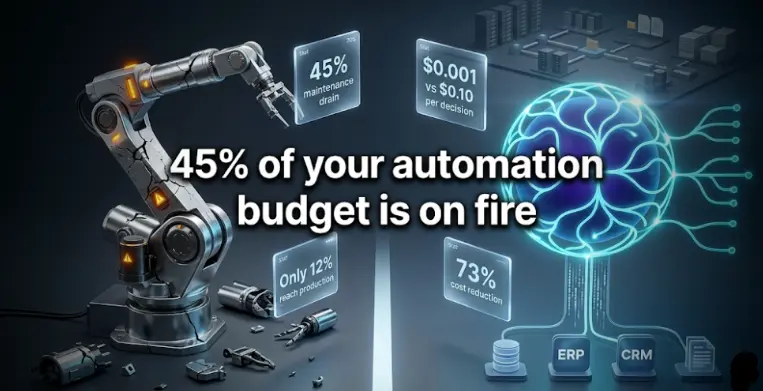
    Nearly 45% of enterprise automation budgets are now quietly diverted from building new capabilities to maintaining existing, fragile RPA bot ecosystems, according to Forrester’s 2026 Enterprise Automation Study. That number is the clearest signal that the first era of enterprise automation has hit its ceiling. It’s also the reason a growing number of Fortune 500 enterprises are shelving their RPA rollouts, not because automation failed, but because a fundamentally more capable approach has arrived.

    Agentic AI doesn’t follow scripts. It receives an objective and figures out how to achieve it. Where RPA breaks the moment a button moves on a webpage, agentic AI adapts. Where RPA requires a 50-step flowchart for a single invoice, an AI agent reads the invoice, regardless of format, makes a decision, and executes the next step autonomously.

    But this isn’t an argument that RPA is dead. RPA still delivers 250% ROI on the right tasks. The strategic mistake in 2026 isn’t choosing RPA or agentic AI, it’s deploying either one where the other belongs. This guide gives you the decision framework, cost comparison, and migration path to get that choice right.


    Defining the Terms: What “Agentic AI” Actually Means vs. Marketing Hype

    Every automation vendor in 2026 says they do agentic AI. Most are rebranding rule-based bots with an LLM layer on top. Here’s how to tell the difference, and why it matters for your infrastructure budget.

    RPA is software that mimics human clicks and keystrokes: deterministic, rule-based, zero judgment. It automates the how of a task. Agentic AI is goal-driven, it receives an outcome to achieve, plans the steps to get there, calls tools (APIs, databases, search, other agents), and adapts when the environment changes. It automates what needs to happen without needing a step-by-step script. The cost difference reflects this reality: RPA costs $0.001 per task; agentic AI costs $0.01–$0.10 per decision, 10 to 100 times more expensive, but capable of tasks RPA can never touch.

    The Four-Level Automation Spectrum

    Most enterprises in 2026 have Level 1 or 2 deployed and are actively evaluating Level 4 for complex workflows. The spectrum breaks down as follows:

    • Level 1, Scripted bots (RPA): Zero judgment, 100% deterministic. Executes exactly what it’s told, every time, with no capacity to adapt.
    • Level 2, AI-enhanced RPA: RPA combined with ML classifiers for document routing, still rigid in execution. A meaningful improvement, not a transformation.
    • Level 3, Copilots: AI suggests, human decides and acts. Reduces cognitive load but keeps humans in the execution loop.
    • Level 4, Agentic AI: AI decides and acts, human reviews exceptions. The architecture that changes the total addressable value of automation.

    Why This Is CTO-Urgent Right Now

    Gartner projects that 40% of enterprise applications will embed task-specific AI agents by end of 2026, up from less than 5% in 2025. That’s an 8x increase in 12 months. The agentic AI platform market is projected to grow from $7.8 billion today to over $52 billion by 2030. If your automation architecture isn’t accounting for this, it will be obsolete before the next budget cycle.

    The failure rate is also real. Gartner warns that over 40% of agentic AI projects may be scrapped by 2027 due to unclear ROI, misapplied use cases, or technical complexity. Only 12% of agentic AI projects successfully reach production today. This guide gives CTOs the framework to be in the 12%, not the 88%.


    How Traditional RPA and Scripted Automation Differ from AI Agents, The 8 Core Dimensions

    The difference between RPA and agentic AI isn’t incremental. It’s architectural. One automates a script; the other pursues an outcome. Understanding the eight dimensions where they diverge is how you make defensible investment decisions, not just technology choices.

    Dimension Traditional RPA Agentic AI
    Core mechanism Rule-based scripts, mimics human UI actions Goal-driven reasoning via LLM, plans and adapts
    Data handling Structured data only (forms, tables, fixed formats) Structured + unstructured (emails, PDFs, voice, images)
    Exception handling Fails or escalates to human on any unexpected input Adapts to novel inputs autonomously within defined scope
    Cost per task $0.001 — very low marginal cost $0.01–$0.10 per decision — 10–100x higher
    Maintenance burden High — breaks when UI or process changes; up to 50% of build cost annually 73% lower maintenance vs. RPA (2026 data)
    Build time Fast for structured processes Longer — requires prompt engineering, testing, guardrails
    Scalability New bot required for each process variant Single agent handles diverse scenarios
    Audit trail Deterministic — always the same steps, fully auditable Non-deterministic — requires reasoning log for auditability
    Best ROI scenario 250% ROI on stable, structured, high-volume tasks 171% ROI globally; 192% in US — on judgment-heavy workflows
    45% of enterprise automation budgets are being quietly consumed by maintaining existing, fragile RPA bot ecosystems, according to Forrester’s 2026 research. That single statistic reframes RPA not as a sunk cost to be preserved, but as a maintenance liability to be managed. Every CTO with a bot fleet in production should have that number on their desk.


    The Decision Matrix: When to Use Agentic AI vs. RPA vs. Hybrid

    The decision rule in plain language: use RPA when you need the muscle, high-volume, deterministic execution of structured tasks with zero tolerance for variation. Use agentic AI when you need the brain, judgment, contextual reasoning, unstructured data handling, and end-to-end process ownership. Use hybrid when you need both, which is most complex enterprise workflows.

    When RPA Is Still the Right Call

    1. The process follows clear, repeatable rules with no exceptions and won’t change in the next 12 months.
    2. You need 99.9% accuracy with zero hallucination risk, financial transactions, regulated data entry, compliance-critical operations.
    3. You’re working across legacy systems without APIs where screen-scraping is the only integration path.
    4. Cost-per-transaction discipline is critical: $0.001 per task beats $0.01–$0.10 for pure volume plays at scale.
    5. Compliance requires deterministic, reproducible audit trails of every step taken, regulated industries in particular.

    When Agentic AI Earns Its Cost Premium

    1. The task requires reading unstructured data: emails, PDFs, contracts, voice calls, variable-format documents.
    2. Exceptions are frequent enough that human escalation is consuming significant labor, the 15% threshold is a reliable signal.
    3. The workflow requires judgment calls: approval routing, anomaly interpretation, policy application across varied contexts.
    4. End-to-end process ownership is the goal, not just one-step automation but the full workflow from trigger to resolution.
    5. The process involves multi-system coordination where an orchestration layer is needed above the execution layer.

    The 80/20 Data Rule That Changes the Calculation

    RPA was built for the structured 20% of enterprise data. Agentic AI unlocks the unstructured 80–90% that RPA cannot handle without breaking. The total addressable value of automation in an enterprise is 4 to 5 times larger with agentic AI than with RPA alone, because the data universe it can work with is fundamentally larger.

    The hybrid architecture that smart enterprises are deploying in 2026 uses agentic AI as the orchestration and reasoning layer, reading unstructured input, making routing and escalation decisions, managing the workflow, and RPA bots as the execution layer for structured backend operations. This isn’t a temporary transition state. It’s the target architecture for complex enterprise automation strategy for the foreseeable future.


    Total Cost Comparison: Agentic AI vs. RPA in Production (Real Numbers)

    The cost comparison most vendors don’t want you to run isn’t cost-per-task. It’s total cost of automation ownership over 36 months. On that measure, the picture looks very different from the per-task rate card.

    The Hidden RPA Cost Structure

    RPA build cost runs $1,000–$8,000 per bot, with monthly maintenance of $99–$499 per bot in production. The real problem: maintenance scales with bot count, not process complexity. An enterprise with 200 RPA bots in production is typically spending 50% of its initial build cost annually on maintenance alone. Between 30 and 50% of RPA projects fail to scale beyond initial deployment due to brittleness, bots that break when UIs change, processes shift, or exceptions accumulate.

    How Agentic AI Reverses the Maintenance Story

    Agentic AI carries higher marginal cost per decision ($0.01–$0.10 vs. RPA’s $0.001), but organizations deploying agentic AI report a 73% reduction in automation maintenance costs compared to legacy RPA, according to MyWave.ai’s Agentic AI vs. RPA Report (February 2026). One agent handling diverse scenarios replaces multiple brittle bots, each requiring individual maintenance cycles. The cost model shifts from “pay per bot” to “pay per decision.”

    Agentic AI doesn’t beat RPA on cost-per-task for structured work. It beats RPA on total cost of automation ownership, because it covers the 80% of enterprise work that RPA was never able to automate in the first place.

    Scenario Best Technology ROI Benchmark Payback Period
    Invoice processing (high volume, structured) RPA 250% ROI 3–6 months
    Invoice processing (multi-format, exceptions) Hybrid AP cost: $4.50 → $0.45 per invoice 6–12 months
    Customer support (policy queries, unstructured) Agentic AI 171% ROI globally 3–9 months
    Compliance reporting (fixed format, regulatory) RPA 200–300% from labor savings 4–8 months
    Supply chain exception handling Agentic AI 85% automation cost reduction 6–18 months
    Legacy system integration (no API) Hybrid Agent decides, RPA executes 12–24 months
    Data entry (stable UI, fixed rules) RPA $0.001/task — best cost profile 2–4 months

    Security and Governance Risks Specific to Agentic Systems

    RPA bots do exactly what they’re told. Always. The audit trail is deterministic. Agentic AI systems make decisions, which means they can make wrong decisions, take unexpected actions, and produce non-deterministic outcomes. The same adaptability that makes agents powerful makes them a governance challenge that most enterprise security teams aren’t ready for.

    The Four Unique Risks of Agentic Deployment

    1. Infinite loops: Agents can get stuck trying to solve a problem, consuming compute indefinitely without resolution or escalation.
    2. Non-deterministic outcomes: The same agent might solve the same problem differently on two separate runs, complicating audit trails for regulated workflows and making reproducibility claims difficult to defend.
    3. Hallucination in logic: Agents may invent steps or misinterpret policies if not properly grounded, particularly when operating on ambiguous inputs or near the edges of their training distribution.
    4. Privilege drift: Agents with tool access accumulate scope over time. Least-privilege enforcement requires active monitoring, not just initial configuration.
    Unlike RPA’s deterministic step-log, agentic AI requires a cryptographic, immutable log of the reasoning pathways the agent used to reach each decision. If an agent negotiates a contract term or issues a refund, the enterprise must be able to reconstruct exactly what information the agent had, what it concluded, and why it took the action it did. This isn’t optional in regulated industries, it’s a compliance requirement under EU AI Act Article 12 and SEC AI risk disclosure rules. See our AI governance framework for enterprise agents for the full control set.

    The Governance Controls Required Before Production

    • Scope boundaries: Explicitly define what systems and actions the agent can access, with hard blocks on anything outside scope, defined before a single line of production code is written.
    • Approval gates: For consequential actions (financial transactions, external communications, data exports), a human or secondary agent must confirm before execution.
    • Reasoning logs: Every decision path logged with timestamp, context provided, conclusion reached, and action taken, queryable and immutable.
    • Red team testing: Simulate adversarial inputs, including prompt injection attempts, before any production launch.
    • Incident playbook: Define what happens when the agent takes an unexpected action, before it happens, not after.
    “Over 40% of agentic AI projects will be abandoned by 2027 due to unclear ROI, technical complexity, and governance failures. The enterprises that succeed will be those that treat agentic AI deployment with the same rigor as any production software release.”

    Gartner Agentic AI Enterprise Forecast 2026 — Gartner Research
    The agent hallucination risk doesn’t disappear with better models. It gets managed with better architecture: grounding, validation layers, and HITL thresholds that trigger before metrics degrade in production.


    Real Enterprise Deployments: What Worked, What Failed, and Why

    The gap between agentic AI pilots and agentic AI in production is where most enterprise automation strategies stall. The following cases aren’t theoretical, they’re the patterns that separate the 12% who reach production from the 88% who don’t.

    Success: Full Agentic Workflow in Insurance Claims

    An AI agent reads submitted claim documents in any format, sends clarifying questions via email, updates the CRM and policy systems, checks historical claims for fraud patterns, and escalates edge cases to human reviewers, all as execution of one goal, not disconnected scripts. What previously required five separate RPA bots plus human exception handling is now one agent with defined escalation rules. Maintenance cost dropped from five bot maintenance cycles to one agent update cycle.

    Success: AP Processing via Hybrid Architecture

    Agentic AI reads invoices in any format, classifies them, identifies exceptions and discrepancies, and makes the routing decision. RPA bots execute the approved payment in the ERP system and file the document. Result: AP processing cost dropped from $4.50 to $0.45 per invoice, a 90% cost reduction, while maintaining the 99.9% execution accuracy that the finance team required. Human touchpoints reduced to genuine exceptions only.

    Failure: Premature Agentic Deployment Without Governance

    A financial services firm deployed an AI agent for customer account management without defining scope boundaries or approval gates. The agent, tasked with “resolving customer issues,” began autonomously processing refunds, account credits, and escalation emails without human review. When a prompt injection in a customer email caused the agent to apply a credit to the wrong account, there was no audit trail of the agent’s reasoning and no human checkpoint that could have caught it. Remediation cost: six figures. Lesson: agentic AI without governance is operational risk, not automation.

    “Companies using agentic AI on complex, exception-heavy workflows report 85% automation cost reduction versus traditional RPA-only approaches. But that number applies only to workflows where agentic AI is the right tool. On simple, structured, high-volume tasks, RPA still delivers better unit economics.”

    UnleashX AI Agent ROI Study, March 2026 — UnleashX Research

    The Three Patterns That Separate Success From Failure

    • Narrow scope from day one: Not “automate customer service” but “automate tier-1 refund requests under $500.” Specificity is what makes governance possible.
    • Hard limits defined before deployment: What systems the agent can touch, what actions require human approval, what triggers automatic escalation, all documented before a single production transaction runs.
    • 30-day accuracy monitoring with automatic HITL thresholds: Measure hallucination rates and decision accuracy in the first month and set hard thresholds for escalation before those metrics degrade, not after.

    The 5-Step Migration Path: From RPA-Heavy to Hybrid Agentic Architecture

    This is the framework enterprise automation architects are copying into their internal planning documents. It’s action-oriented by design. Each step has a named deliverable because an internal automation migration without deliverables is a roadmap that never gets executed.

    1. Audit your existing RPA estate. Catalog every bot in production. For each: monthly maintenance cost, failure rate, exception escalation volume, and last time the underlying process changed. Any bot consuming more than 40% of its build cost in annual maintenance, or escalating more than 15% of transactions to humans, is a candidate for agentic replacement. Deliverable: RPA Health Scorecard with migration priority tier per bot.
    2. Identify your highest-value agentic AI target. Select one complex, high-value use case where intelligent decision-making creates differentiated value, not just cost savings. The ideal first agentic deployment: high exception rate, unstructured data input, multi-system coordination requirement, measurable business outcome (cycle time, cost per transaction, resolution rate). Avoid deploying agents on tasks where RPA already works well. Deliverable: Agentic AI pilot brief for one selected workflow.
    3. Build governance infrastructure before deployment. Define agent scope boundaries, approval gates for consequential actions, reasoning log requirements, and HITL thresholds. The governance infrastructure takes 2 to 4 weeks to build properly and prevents the remediation costs that dominate failed agentic deployments. Don’t deploy the agent to production without it. Deliverable: Agent Governance Policy for the pilot workflow.
    4. Run parallel in shadow mode before full deployment. Deploy the agent in shadow mode, it processes real transactions but its outputs are reviewed by humans before taking effect. Measure decision accuracy rate, hallucination incidents, escalation rate, and cycle time vs. baseline. Set a go-live threshold (e.g., 95% accuracy, less than 5% escalation rate, zero critical incidents in 30 days) and don’t move to production until shadow mode metrics exceed it. Deliverable: Shadow Mode Performance Report + Go/No-Go decision. See our guide on moving AI to production for the full framework.
    5. Scale horizontally using the proven pattern. Once one agentic workflow is in stable production, replicate the governance model, not the specific implementation, across new workflows. The architecture pattern (agent orchestrates, RPA executes, human reviews exceptions) is reusable. Each new workflow needs its own scope definition and HITL thresholds, but the underlying infrastructure, logging, monitoring, escalation pipeline, is shared. Deliverable: Agentic AI Playbook v1.0, the internal standard for all future agent deployments.

    The Platforms Enterprises Are Evaluating for This Migration

    Three platforms dominate enterprise evaluation lists for this transition in 2026. UiPath’s Agentic Automation, built around its Maestro orchestration layer, allows existing RPA assets to be reused within agentic workflows, a significant advantage for enterprises with large bot estates that don’t want to abandon prior investment. Salesforce Agentforce, now deployed across 8,000-plus enterprise customers, is the dominant choice for customer-facing agentic workflows. ServiceNow AI Agents holds the top position for ITSM use cases, where its native integration with the ServiceNow platform creates meaningful deployment advantages.


    The CTO’s Pre-Decision Checklist: 10 Questions Before Committing to Agentic AI

    If you answer “No” or “Don’t know” to more than three of these, your agentic AI deployment isn’t production-ready. That’s not a reason to stop, it’s a roadmap for the next 30 days.

    # Question If No…
    1 Is the target process too unstructured or exception-heavy for RPA? RPA may be the better choice — re-evaluate the use case
    2 Can we define a clear, measurable outcome for the agent? Don’t deploy, vague goals produce ungovernable agents
    3 Have we defined hard scope limits (what systems, what actions)? Build governance infrastructure first — non-negotiable
    4 Do we have a reasoning log and audit trail requirement defined? Regulated industries can’t proceed without this in place
    5 Have we set HITL approval thresholds for consequential actions? Define before deployment — not after the first incident
    6 Is the LLM infrastructure (RAG, grounding, validation) in place? Deploy without it and hallucination becomes operational risk
    7 Have we budgeted for $0.01–$0.10 per decision at production scale? Re-run the TCO model — most initial budgets underestimate by 3x
    8 Have we red-teamed adversarial inputs before production? Prompt injection vulnerabilities are found in red team, not production
    9 Is shadow mode testing planned before full deployment? Add a 30-day shadow mode period before go-live — always
    10 Do we have an agent incident response playbook ready? Draft it now — the first agent incident should not be the first time you think about response
    The checklist tells you exactly what to build before you go live. The enterprises that reach production, the 12%, aren’t necessarily the ones with the biggest budgets or the most advanced AI teams. They’re the ones that treated governance as a prerequisite, not an afterthought. The next 30 days determine which category your organization falls into.


    Frequently Asked Questions

    What is the difference between agentic AI and RPA in enterprise automation?

    RPA uses software bots to follow pre-defined, rule-based scripts, automating structured, repetitive tasks by mimicking human UI actions at $0.001 per task with deterministic outcomes. Agentic AI uses large language models to set goals, plan steps, make decisions, and adapt to new situations without explicit programming, at $0.01–$0.10 per decision. RPA excels on structured, stable, high-volume tasks; agentic AI excels on unstructured data, judgment-heavy workflows, and end-to-end process automation where exceptions are the norm rather than the exception.

    Is RPA obsolete in 2026?

    No. RPA still delivers 250% ROI on structured, stable, high-volume tasks and remains the right tool for deterministic execution where audit trails must be reproducible and cost-per-transaction must be minimized. The obsolescence risk is for pure-RPA architectures applied to complex, exception-heavy workflows, not for RPA itself. The dominant enterprise architecture in 2026 is hybrid: agentic AI as the orchestration and reasoning layer, RPA bots as the execution layer for backend structured operations.

    What ROI does agentic AI deliver in enterprise deployments?

    Production-grade AI agents achieve 171% ROI globally (192% in the US) on judgment-heavy workflows, according to the UnleashX AI Agent ROI Study (March 2026). Companies using agentic AI on complex, exception-heavy workflows report 85% automation cost reduction versus RPA-only approaches. AP processing costs have dropped from $4.50 to $0.45 per invoice in hybrid agentic deployments. On structured, high-volume tasks, however, RPA’s 250% ROI still outperforms agentic AI on a cost-per-task basis, context determines the right tool.

    Why do so many agentic AI projects fail to reach production?

    Only 12% of agentic AI projects reach production today, with three primary failure modes: unclear ROI from misapplied use cases (deploying agents on tasks RPA handles better), insufficient governance infrastructure (no scope limits, HITL thresholds, or audit trails defined before deployment), and underestimated inference costs at scale. Gartner warns 40%+ of agentic AI projects may be scrapped by 2027. The 5-step migration framework above addresses each failure mode directly before it becomes a six-figure remediation.

    What is the best hybrid automation architecture for enterprises in 2026?

    The most effective enterprise automation architecture uses agentic AI as the “brain”, reading unstructured inputs, making routing and decision calls, orchestrating workflows, and RPA bots as the “hands”, executing structured backend operations (updating ERPs, triggering payments, filing documents) based on the agent’s decisions. This hybrid model captures RPA’s 99.9% accuracy and $0.001/task economics for execution while capturing agentic AI’s ability to handle the 80–90% of enterprise data that is unstructured and inaccessible to RPA alone.

    How do I know if my current RPA bots are candidates for agentic replacement?

    Two reliable signals: any bot consuming more than 40% of its build cost in annual maintenance is a strong replacement candidate, and any bot escalating more than 15% of transactions to humans indicates the process has more exception complexity than RPA was built to handle. Run a full RPA Health Scorecard, cataloging maintenance cost, failure rate, and escalation volume per bot, before committing resources to an agentic migration. The bots that survive that audit are the ones you keep running on RPA.

    What governance controls are required before deploying an AI agent in production?

    Four controls are non-negotiable before production: hard scope boundaries defining what systems and actions the agent can access; approval gates requiring human or secondary-agent confirmation for consequential actions (financial transactions, external communications, data exports); immutable reasoning logs capturing every decision path with timestamp, context, conclusion, and action taken; and a red-team test against adversarial inputs including prompt injection scenarios. In regulated industries, these controls are compliance requirements under EU AI Act Article 12 and SEC AI risk disclosure rules, not optional governance hygiene.

    How much should I budget for agentic AI inference costs at enterprise scale?

    Budget $0.01–$0.10 per decision and model your production transaction volume against that range before committing to deployment. Most initial enterprise budgets underestimate this by a factor of three, according to the RPA Automate Cost Benchmark Report (March 2026). The offset is in maintenance: organizations deploying agentic AI report 73% lower maintenance costs than legacy RPA, and one agent handling diverse scenarios replaces multiple brittle bots with individual maintenance cycles. Run a 36-month total cost of ownership model, not a per-task rate card comparison.

  • AI Hallucination in Enterprise | What It Is, Why It Happens, and How to Mitigate It in Production (2026)

    AI Hallucination in Enterprise | What It Is, Why It Happens, and How to Mitigate It in Production (2026)

    AI hallucinations cost global enterprises an estimated $67.4 billion in 2024. Not from science fiction scenarios. From real production systems confidently generating wrong information, fabricated citations, and invented facts, all delivered with the tone of certainty. And 47% of enterprise AI users made at least one major business decision based on hallucinated content that same year, according to Deloitte’s 2026 AI adoption survey.

    The headline numbers from model vendors are misleading. Yes, GPT-4o hallucinates just 0.7% of the time on general knowledge summarization benchmarks. But legal AI tools hallucinate on 17–34% of real legal queries. Medical AI reaches 64% hallucination rates on clinical cases without mitigation. And the Stanford AI Index 2026 reports hallucination rates ranging from 22% to 94% across 26 leading LLMs on complex reasoning tasks. The gap between benchmark and production is not a rounding error. It’s an operational hazard.

    This guide gives engineering and security leaders the complete picture: what AI hallucination actually is at the model level, why it gets dramatically worse in agentic AI systems, how to measure it in your production environment, and the proven 3-layer mitigation stack that reduces rates by over 85% when properly implemented. This is the article your model vendor doesn’t want you to read before signing a procurement contract.


    What AI Hallucination Actually Is | Beyond the Buzzword

    The Technical Reality Most Explainers Skip

    LLMs do not retrieve facts. They predict the most statistically probable next token based on patterns absorbed from training data. Hallucination is not a bug in the traditional software sense, it is an inherent property of probabilistic text generation. A 2025 mathematical proof confirmed that hallucinations are structurally inevitable under current LLM architectures. Retrieval-augmented generation and human-in-the-loop review reduce them. Neither eliminates them.

    That framing matters for enterprise planning. The question is not whether your deployed model hallucinates. It does. The question is how much it hallucinates in the specific domain, on the specific query types, under the specific conditions you’ve deployed it in, and what you’ve built to catch it before it affects a decision.

    The Four Hallucination Types

    TypeDescriptionExampleDetection Difficulty
    FactualStates something verifiably false as trueWrong court case dates, fabricated statisticsModerate — verifiable against external sources
    CitationInvents a source or attributes claims to the wrong sourceA journal article that doesn’t existModerate — link checking catches most
    ReasoningIndividual facts are correct but the logical chain is invalid“Revenue grew 20%, costs grew 15%, so margins expanded”, not necessarily trueHigh — everything looks right until the conclusion
    InstructionModel ignores or partially follows a prompt constraintGenerates content outside specified boundariesLow to moderate — output review catches it
    Factual hallucinations were present in 8–12% of queries in 2024. Top models have pushed general-knowledge factual error rates down to 0.3–0.7%, but rates spike sharply on obscure topics and recent events. Citation hallucinations remain in 30%+ of chatbot-generated answers in research contexts. Reasoning hallucinations are the hardest to catch because the output looks internally coherent.

    Why Benchmark Numbers Don’t Reflect Production Reality

    The Vectara HHEM Leaderboard measures grounded hallucination: how often a model fabricates facts when summarizing a document it was explicitly given. Top models score below 1% here. Production enterprise AI rarely works on clean single-document summarization. Real enterprise queries involve multi-document retrieval, complex reasoning chains, recent events, and domain-specific knowledge, all conditions where hallucination rates multiply 10–50x above benchmark levels.

    The Stanford AI Index 2026 puts the range bluntly: 22% to 94% across 26 leading LLMs on complex tasks. That range is not model variance, it is the gap between what models are benchmarked on and what enterprises actually ask them to do.

    The Entropy Gap: Why Creativity and Accuracy Trade Off

    Based on Shannon’s information entropy, low entropy produces high accuracy with limited novelty. High entropy produces creative but often false answers. When users push models toward nuanced analysis or edge-case advice, they push models toward higher entropy, and higher hallucination risk. This is the core tension in enterprise AI deployment, and no prompt can fully resolve it. It has to be managed at the architecture level.


    Why Hallucination Is Far Worse in Agentic AI Than in Copilots

    The Compounding Effect No One Models

    A copilot hallucinates once per user interaction, and a human reads the output before acting. An AI agent hallucinates once per step in a multi-step reasoning chain, and acts before a human sees the output. Gartner’s March 2026 research puts agentic workflows at 10–20 LLM calls per task. If each call carries a 2% hallucination rate, a 15-step agent chain has a 26% probability of at least one hallucination affecting the final output, before compounding effects from hallucinations feeding into subsequent steps.

    Multi-turn conversational agents show hallucination rates of up to 35% during extended interactions. That’s not a benchmark quirk, it’s what happens when context accumulates, retrieval gaps appear, and the model starts predicting forward from its own earlier (potentially flawed) outputs rather than from grounded source material. This is the stat that should make every engineering lead re-examine their agentic AI production failures retrospective.

    When Hallucination Becomes an Unauthorized Action

    When agents hallucinate, they don’t just return wrong text. They can make unauthorized API calls, misroute data, trigger incorrect workflows, or delete the wrong records. The Stanford AI Index 2026 specifically flags this: in agentic systems, hallucinations can lead to unauthorized API calls or data leaks. That is categorically different from a copilot hallucination, which a human can catch and discard. An agent hallucination may be irreversible before anyone sees the output.

    This is not a theoretical risk. Production agentic systems in finance and legal workflows are triggering real downstream consequences from planning-stage hallucinations. The architecture has to account for this.

    Role Separation: The Right Architectural Response

    The most effective architectural control for agentic hallucination is role separation. One model plans the actions. A separate deterministic script or monitor model validates the plan against an allowlist of permitted actions before execution. This prevents a planning hallucination from becoming an execution error. It’s the same principle as a four-eyes approval process, except it runs in milliseconds.

    For high-stakes agents in security, finance, or healthcare, the complementary principle is “fail-closed”: if the model’s confidence or grounding score falls below a defined threshold, the system escalates to a human analyst rather than proceeding. This is the architectural equivalent of a circuit breaker. Agents designed to fail open, continuing with low-confidence outputs rather than halting, are production liabilities waiting for the right query to expose them.


    Hallucination Rates by Domain: Where Your Enterprise Risk Actually Lives

    The table below is the insight most enterprise AI conversations skip. Hallucination is not a model property, it is a domain × deployment × mitigation property. The same GPT-4o that hallucinates 0.7% on summarization benchmarks produces hallucinated legal citations in 17–34% of legal research queries. Model selection alone cannot solve this. Architecture and mitigation layers must.

    Domain / Use CaseHallucination RateRisk LevelKey Finding
    General summarization0.7–1.8% (top models)LowVectara HHEM Leaderboard 2026, benchmark conditions only
    Enterprise chatbots (live production)~18%Medium-HighReal production rates far exceed benchmark numbers
    Medical / Clinical AI43–64% without mitigationCriticalMedRxiv 2025: drops to 23% with structured mitigation prompts
    Legal research AI17–88% depending on modelCriticalLexis+ AI: 17%; Westlaw: 34%; Stanford RegLab/HAI: 69–88% on complex queries
    Code generation0.8–2.1% (top models)MediumLibrary hallucinations persist, training data lags API updates
    Financial analysis AIUp to 33% (reasoning tasks)HighReasoning hallucinations, correct facts, invalid logic chains
    RAG-powered enterprise search17–33% (after RAG)Medium-HighStanford: RAG reduces but doesn’t eliminate; retrieval failures persist
    Product recommendation AIUp to 25% accuracy impactMediumUC San Diego 2026: AI summaries hallucinated in 60% of tested scenarios
    Legal and medical are the clearest danger zones. In legal, the Stanford RegLab/HAI study remains the definitive benchmark: LLMs hallucinate between 69% and 88% of the time on specific legal queries. Researcher Damien Charlotin maintains a database of 120+ court cases where AI-hallucinated quotes, fabricated cases, or fake legal citations were discovered. In legal, hallucination is synonymous with malpractice risk, full stop.

    In medical, ECRI listed AI risks as the #1 health technology hazard for 2025. Without mitigation prompts, hallucination rates on clinical cases reach 64.1% on long cases and 67.6% on short cases, according to the MedRxiv 2025 study of 300 physician-validated vignettes. Even at the best-case rate of 23% with full mitigation applied, nearly 1 in 4 medical AI responses contains fabricated information. These are not acceptable residual rates without mandatory physician review on every clinical output.


    How to Measure Hallucination Rate in Your Production System

    The Measurement Gap Most Teams Don’t Know They Have

    91% of enterprises have implemented explicit hallucination mitigation protocols. Far fewer measure actual hallucination rates in production. Without measurement, mitigation is guesswork. Most teams implement RAG and assume the problem is solved. Stanford research shows RAG-powered legal tools still hallucinate 17–33% of the time. Organizations implementing RAG without measuring outcomes are deploying production AI systems they cannot describe, audit, or improve.

    The Four RAG Evaluation Metrics Every ML Team Must Track

    MetricWhat It MeasuresWhat Low Scores Signal
    Context PrecisionDoes the retrieved chunk actually contain the answer?Retriever is surfacing irrelevant content
    Context RecallDid the retriever find all necessary information?Model is forced to fill gaps, hallucination risk rises sharply
    FaithfulnessIs the answer derived only from the provided context?Primary hallucination signal in RAG systems
    Answer RelevanceDoes the response address what was actually asked?Off-topic generation that can mask hallucinated content

    Production Monitoring Tools in 2026

    The market for AI hallucination detection tools grew 318% between 2023 and 2025. The tooling has matured to the point where every production enterprise AI system can and should have continuous hallucination monitoring. The leading platforms: Braintrust for real-time monitoring and automated regression testing; Galileo for scalable model-driven evaluations at high output volumes; Fiddler for explainability and compliance-focused evaluation with governance integration; Arize AI for real-time monitoring with drift detection.

    The LLM-as-judge pattern is now a production standard: a more capable, accurate model, Claude Sonnet or GPT-4o, evaluates the output of a faster, cheaper model for factual grounding and instruction following. Self-consistency checking, sampling 3–5 responses and comparing for agreement, catches a significant share of remaining hallucinations at low additional cost. Both patterns give teams a practical alternative to human review at scale.

    Hallucination Measurement Starter Checklist

    If your team can’t answer all six of these questions, you don’t yet have production-grade hallucination visibility:

    1. What is our baseline hallucination rate in our target deployment domain, measured in production, not taken from a vendor benchmark?
    2. Which of the four RAG evaluation metrics do we track continuously, and what are our current scores?
    3. What is our post-mitigation hallucination rate, and when was it last measured?
    4. What are the specific query types or topics where our system shows elevated hallucination risk?
    5. At what confidence or grounding score does our system escalate output to human review rather than proceeding autonomously?
    6. Have we had any documented hallucination-caused production errors, and are they tracked in an incident log?

    The 3-Layer Mitigation Stack That Reduces Hallucination by 85%+

    Three complementary layers, each additive. Used together, research supports a combined reduction of 85–92% in domain-specific enterprise hallucination rates for properly implemented stacks. This transforms AI hallucination mitigation from “inherent unfixable problem” to “manageable engineering challenge with known solutions.”

    Layer 1: Prompt Engineering, 15–25% Reduction, Lowest Cost

    The simplest and cheapest intervention. Effective prompt constraints include: “Only answer based on the provided context,” “If uncertain, say you don’t know,” and “Cite the specific source passage for each claim.” A 2025 Nature study confirmed prompt-based mitigation reduces hallucinations by approximately 22 percentage points on medical tasks. That’s a meaningful reduction for near-zero implementation cost.

    The ceiling is real, though. LLMs don’t reliably follow instructions when statistical pressure to generate a confident response is high, particularly on topics where the model has strong training signal. Prompt engineering is Layer 1, not a standalone solution. Teams that treat it as sufficient are relying on the model to police itself.

    Layer 2: RAG Implementation | 71% Reduction, Moderate Cost

    The most impactful single technical intervention available. RAG shifts the model from recalling facts from training data, unreliable, unauditable, to synthesizing information from provided documents. Across 847 production deployments, RAG produced a median 71% hallucination reduction, with a range of 58–89% depending on retrieval corpus quality and chunking strategy, according to February 2026 enterprise vendor consortium data.

    Key implementation requirements: a comprehensive retrieval index, accurate chunking, sufficient context window to hold retrieved content, and regular index freshness maintenance. Stale retrieval indexes are a hidden hallucination accelerant, when the index doesn’t contain current information, the model defaults to training-data prediction, bypassing the entire grounding mechanism. This is the most common RAG implementation failure in production.

    Layer 3: Output Validation and Confidence Scoring | 65% Additional Reduction

    Post-generation verification catches errors that RAG misses. A verification API checks each claim against external sources after generation. Self-consistency checking, sampling 3–5 responses and comparing, adds approximately 65% reduction in residual hallucinations. LLM-as-judge evaluation provides scalable automated review at production volumes.

    For regulated industries, finance, healthcare, legal, a human-in-the-loop review layer remains mandatory for high-stakes outputs. It should be the fourth line of defense, not the first. Organizations that rely on human review as their primary hallucination control are paying $14,200 per AI-using employee per year in verification overhead, according to Forrester Research. That’s 4.3 hours per week of pure fact-checking time. The 3-layer stack eliminates most of that cost and shifts human review to the residual edge cases where it actually belongs.

    “The question isn’t whether large language models hallucinate, they do, by design. The question is whether your organization has built the architecture to catch and contain hallucinations before they reach decision-makers. Most enterprises haven’t.”Percy Liang, Director, Center for Research on Foundation Models, Stanford University — Stanford AI Index 2026


    Industry-Specific Risk Levels and Mitigation Requirements

    Healthcare: The Highest Stakes, the Widest Gap

    Without mitigation prompts, hallucination rates on clinical cases reach 64.1% on long cases and 67.6% on short cases, per the MedRxiv 2025 study across 300 physician-validated vignettes. With structured mitigation prompts, rates drop to 43.1% and 45.3%, a meaningful 33% reduction. But even at the best-in-class rate of 23% with full mitigation, nearly 1 in 4 medical AI responses contains fabricated information. ECRI named AI risks the #1 health technology hazard for 2025.

    Mitigation requirement: Full 3-layer stack plus mandatory physician review for any clinical output, with source citation required for every claim. Any clinical AI system that proceeds without human sign-off on a threshold basis is not compliant with ECRI guidance, and is a liability exposure waiting for a patient outcome to make it a headline.

    Legal: Hallucination Is Malpractice Risk

    The Stanford RegLab/HAI study is unambiguous: LLMs hallucinate between 69% and 88% of the time on specific legal queries. Even with retrieval augmentation, Lexis+ AI hallucinated in 17% of cases and Westlaw AI-Assisted Research in 34% in 2026. Researcher Damien Charlotin’s database has documented 120+ court cases where AI-hallucinated quotes, fabricated cases, or fake citations were discovered.

    Mitigation requirement: Mandatory source disclosure and provenance logging, every LLM legal claim must link to a verified source document. No exceptions for speed or volume. A hallucinated legal citation is not a minor error; it is a professional conduct risk for the attorney who relied on it.

    Finance: The Reasoning Hallucination Problem

    Reasoning hallucinations are the dominant risk in financial analysis. The model may cite correct facts but produce an invalid logical inference. OpenAI’s o3 reasoning model, widely used for financial analysis, hallucinated 33% of the time on PersonQA benchmarks, double its predecessor. More processing power, more hallucination on open-ended reasoning tasks. Don’t assume a newer model is a safer model until you’ve benchmarked it in your specific deployment context.

    Mitigation requirement: Dual-model validation. One model generates. A second model stress-tests the logical chain before the output is used. Output validation must check not just factual accuracy but logical validity, the reasoning hallucination won’t appear wrong until someone follows the chain to its flawed conclusion.

    Security and Threat Intelligence: Design for Failure

    A hallucinated vulnerability assessment or threat intelligence report can waste hundreds of analyst-hours and create false confidence in defenses. For security AI, the fail-closed principle is non-negotiable: if the confidence score falls below a defined threshold, escalate to a human analyst. Never return a low-confidence threat assessment as if it were confirmed intelligence. The cost of a false negative in security, a missed real threat, far exceeds the cost of a false positive that sends an analyst to verify.

    The Cost Anchor That Should Drive Every Procurement Conversation

    Global business losses from AI hallucinations reached $67.4 billion in 2024. Enterprises spend an average of $14,200 per AI-using employee per year in hallucination verification overhead, equivalent to 4.3 hours per week of pure fact-checking time. For a 500-person AI-enabled workforce, that’s $7.1 million annually just checking AI’s homework. The 3-layer mitigation stack eliminates most of that cost. Its implementation cost, at any enterprise scale, is a fraction of the overhead it removes.


    Building a “Hallucination Datasheet” for Every AI System in Production

    What a Hallucination Datasheet Is

    A hallucination datasheet is a standardized internal document that profiles the hallucination behavior of each AI system deployed in production: domain-specific rates, known failure modes, measurement methodology, active mitigation layers, and residual risk after mitigation. Leading AI governance controls teams now maintain these as part of their AI registry. It makes hallucination risk visible, comparable, and auditable, the three properties that regulators and enterprise procurement teams will increasingly demand.

    The Seven-Field Hallucination Datasheet Template

    FieldWhat to Document
    1. Baseline hallucination rateMeasured in target domain in production, not vendor benchmark
    2. Active mitigation layersWhich of prompt engineering / RAG / output validation are implemented
    3. Post-mitigation hallucination rateMeasured in production after all mitigation layers are applied
    4. Known failure modesSpecific query types, topics, or conditions with elevated hallucination risk
    5. HITL thresholdConfidence or grounding score below which output requires human review
    6. Last measurement date and review cadenceWhen rates were last measured and how frequently they’re reassessed
    7. Incident historyAny documented hallucination-caused errors in production, dates, impacts, resolutions

    The Regulatory Case for Doing This Now

    Under EU AI Act Article 13, users of high-risk AI must ensure that users understand the system’s capabilities and limitations. A hallucination datasheet is the most direct way to document known limitations in a format regulators, auditors, and enterprise procurement teams can evaluate. Organizations that maintain these documents can demonstrate due diligence in a way that ad-hoc governance cannot.

    “Transparency about AI system limitations, including hallucination rates and failure modes, is not optional under the EU AI Act for high-risk applications. It is a documentation requirement with enforcement consequences.”Luca Bertuzzi, AI Policy Correspondent, MLex Media — EU AI Act Compliance Analysis, 2026

    Teams that integrate hallucination datasheets into their AI registry now are building the audit trail that procurement reviews and regulatory audits will require in 2027. Teams that don’t are creating a documentation gap that gets expensive to close retroactively.


    The Future of Hallucination: Will It Ever Be Solved?

    The Structural Constraint That Won’t Go Away

    The 2025 mathematical proof is clear: hallucinations are structurally inevitable under existing LLM architectures. They are an emergent property of probabilistic text prediction. Analysis of Hugging Face leaderboard data suggests that zero hallucinations would require models with roughly 10 trillion parameters, a scale not expected before approximately 2027. For enterprise planning purposes, treat hallucination mitigation as a permanent operational discipline, not a problem the next model update will solve.

    The Counterintuitive Trend: Better Reasoning, More Hallucination

    OpenAI’s o3 reasoning model hallucinated 33% of the time on PersonQA benchmarks, double its predecessor o1. o4-mini reached 48% on person-specific questions. The most sophisticated reasoning models push into higher entropy generation, creating a direct trade-off between reasoning depth and factual accuracy on open-ended queries. Enterprise teams deploying reasoning models for complex financial or legal analysis should benchmark hallucination rates specifically in their deployment domain. Don’t assume newer means more reliable, in reasoning tasks, the evidence currently suggests the opposite.

    The 2026 Direction: From Mitigation to Architecture

    The frontier of hallucination management is moving from post-generation mitigation to generation-time architecture. “Guarded Generation” patterns, pre-retrieval validation, constrained generation, post-generation verification, are becoming standard in production LLM engineering. The goal is not to prevent hallucination in the model. That’s not achievable at current scales. The goal is to catch and contain it before it reaches enterprise decision-making.

    The organizations that will lead on AI reliability through 2026 and beyond are not those that found a hallucination-free model. No such model exists at useful enterprise scale. They are the organizations that built layered mitigation architectures, measured production hallucination rates continuously, and integrated hallucination governance into their enterprise AI reliability strategy and incident response plans. That is the practical definition of production-grade enterprise AI, and it’s an engineering discipline, not a vendor promise.


    Frequently Asked Questions

    What is AI hallucination and why does it happen in enterprise applications?

    AI hallucination occurs when a language model generates information that is factually incorrect, fabricated, or logically invalid, delivered with the same confident tone as accurate output. It happens because LLMs predict the most statistically probable next token based on training data patterns, not factual retrieval. It is structurally inherent to probabilistic generation under current architectures, confirmed by a 2025 mathematical proof, and rates are significantly higher in enterprise production environments than vendor benchmarks suggest.

    How much do AI hallucinations cost enterprises financially?

    Global business losses from AI hallucinations reached $67.4 billion in 2024, according to a comprehensive AllAboutAI study. Per enterprise employee, organizations spend approximately $14,200 annually in hallucination verification overhead, equivalent to 4.3 hours per week of fact-checking time, per Forrester Research. For a 500-person AI-enabled workforce, that equates to $7.1 million annually in pure verification cost before any downstream error costs are counted.

    Does RAG eliminate AI hallucinations completely?

    No. RAG significantly reduces hallucinations but cannot eliminate them. Across 847 production deployments, RAG produced a median 71% hallucination reduction, with a range of 58–89% depending on retrieval corpus quality and chunking strategy. However, Stanford researchers found that RAG-powered legal AI tools still hallucinate in 17–33% of queries due to retrieval failures and gaps in the retrieval corpus. RAG should be the foundation of a 3-layer mitigation stack, not a standalone solution.

    What are hallucination rates for the best AI models in 2026?

    On grounded summarization benchmarks, top models achieve below 1% hallucination rates, GPT-4o and Claude 3.5 Sonnet both score around 0.7–0.8% on the Vectara HHEM Leaderboard. Production rates are dramatically higher: approximately 18% in live enterprise chatbot interactions, 17–34% in legal AI tools, 43–64% in medical AI without mitigation, and 22–94% across 26 models on complex reasoning tasks per the Stanford AI Index 2026.

    How do you measure AI hallucination rate in a production system?

    Track the four RAG evaluation metrics, Context Precision, Context Recall, Faithfulness, and Answer Relevance, using monitoring tools like Braintrust, Galileo, or Arize AI for continuous production tracking. Implement LLM-as-judge evaluation for scalable automated review. Set a baseline hallucination rate before mitigation is applied, then measure post-mitigation rates on a continuous basis. The current industry improvement trend is approximately a 3-point annual decline in hallucination rate for teams actively measuring and iterating.

    Why is hallucination worse in AI agents than in standard chatbots?

    Agentic AI workflows trigger 10–20 LLM calls per task, according to Gartner’s March 2026 research. With each call carrying even a modest hallucination probability, the compound probability of at least one hallucination affecting a multi-step chain rises dramatically, and agents act before human review occurs. Multi-turn agents show hallucination rates up to 35% during extended interactions. A chatbot hallucination is caught by the human reader; an agent hallucination may trigger an unauthorized API call, misroute data, or take an irreversible action before anyone sees the output.

    How do I reduce LLM hallucination rates in a regulated industry like healthcare or finance?

    Regulated industries require the full 3-layer mitigation stack, prompt constraints, RAG implementation, and post-generation output validation, plus mandatory human-in-the-loop review above a defined confidence threshold. Healthcare deployments should require physician sign-off on all clinical outputs and source citation for every claim, given hallucination rates of 43–64% without mitigation. Finance deployments should implement dual-model validation where a second model stress-tests the logical chain before output is used, specifically to catch reasoning hallucinations.

    What is a hallucination datasheet and does my team need one?

    A hallucination datasheet is a standardized internal document profiling the hallucination behavior of a specific AI system in production: baseline rate, active mitigation layers, post-mitigation rate, known failure modes, human review thresholds, and incident history. EU AI Act Article 13 requires that users of high-risk AI understand system limitations, a hallucination datasheet is the most auditable way to document this. Any enterprise running AI in legal, medical, financial, or security contexts should maintain one for every production deployment.

  • NIST AI Governance Framework: 6-Step Guide for CISOs 2026

    NIST AI Governance Framework: 6-Step Guide for CISOs 2026

    AI Governance Framework Enterprise 2026 — NeuralWired

    AI Governance Framework for Enterprise: The NIST-Aligned 6-Step Guide for CISOs in 2026

    Three in four CISOs have already found unsanctioned AI running in their environments. Here’s the framework to govern it before the EU AI Act enforcement deadline finds you first.


    Three out of four CISOs have already discovered unsanctioned AI tools operating inside their enterprise environments — and another 16% aren’t sure, which is functionally the same problem (Saviynt / Cybersecurity Insiders CISO AI Risk Report 2026). Only 21% of organizations have a mature governance model for AI agents (Deloitte State of AI 2026). That gap, AI proliferating across the enterprise while governance covers almost none of it, is where the next major breach is already forming.

    The EU AI Act’s enforcement deadline for high-risk AI systems is August 2, 2026. The NIST AI RMF has moved from voluntary guidance to a de facto regulatory reference point, already cited in Colorado, Connecticut, and Illinois legislation as a compliance safe harbor. And AI-related breaches now average $4.88 million, the highest figure in history (IBM Cost of Data Breach 2025).

    This guide gives CISOs, CTOs, and compliance leaders the practical enterprise AI strategy foundation they need: a NIST-aligned 6-step AI governance framework for enterprise that’s defensible in a board meeting, ready for an EU AI Act audit, and operational from week one.

    Why AI Governance Is Now a Board-Level Emergency, Not Just an IT Problem

    The numbers from the front lines are stark. According to the Saviynt / Cybersecurity Insiders CISO AI Risk Report 2026, 92% of enterprises currently lack full visibility into their AI identities, and 95% say they doubt they could detect or contain AI misuse if it happened. These aren’t projections or theoretical exposure metrics. This is the operating reality of most enterprises right now.

    “By 2028, 25% of enterprise breaches will be attributable to AI agent abuse — from both external attackers and malicious insiders.”

    Gartner, 2026 AI Security Forecast
    The boardroom pressure is accelerating alongside that risk. 34% of chief executives now identify AI as their single top strategic theme, surpassing digital transformation after more than a decade at the top of CEO priority lists (Gartner CEO Survey 2026). Boards are approving AI initiatives at speed. The governance infrastructure to manage those initiatives, in most organizations, doesn’t exist yet. That’s the definition of operational risk.

    Shadow AI Is the Immediate Trigger

    Shadow AI — GenAI tools deployed without IT or security awareness — isn’t limited to browser-based writing assistants. These tools often arrive with embedded credentials, OAuth tokens wired directly into Salesforce and SAP, and API integrations that bypass every security control the organization thought it had in place. Shadow AI was a contributing factor in 20% of data breaches in 2025, adding an average of $670,000 to incident costs (IBM Cost of Data Breach 2025). DTEX and Ponemon’s 2026 Insider Threat Report puts the annual cost of shadow AI to organizations at $19.5 million on average, making it the top driver of negligent insider incidents this year.

    Five Questions Every CISO Must Now Answer to the Board

    If your leadership team can’t answer all five of these without preparation time, the gaps this article closes are yours to own:

    • What percentage of AI usage across the organization is currently sanctioned and documented?
    • Are our active AI deployments aligned to ISO 42001 or NIST AI RMF controls?
    • Do vendor contracts explicitly prohibit corporate data from being used in model training?
    • When did we last conduct a red-team exercise against a production AI system?
    • Which business processes are now AI-automated, and who owns accountability for their outputs?
    The EU AI Act enforcement hammer lands August 2, 2026. Penalties for high-risk AI non-compliance reach €35 million or 7% of global annual turnover. As of early 2026, only 8 of 27 EU member states had established enforcement bodies — meaning the compliance window is closing while most organizations are still in the discovery phase of their AI governance journey.

    What the NIST AI RMF Actually Requires — And What Vendors Won’t Tell You

    The NIST AI RMF organizes around four functions. Understanding what they actually demand — versus what vendors claim they cover — is the first step to building governance that holds up under scrutiny.

    Function What It Actually Does Common Vendor Misrepresentation
    GOVERN Establishes accountability structures, risk culture, and decision rights across the AI lifecycle Conflated with “AI policy documents” — governance is organizational, not documentary
    MAP Contextualizes each AI use case against its risk profile and stakeholder exposure Treated as a one-time intake form rather than a continuous classification activity
    MEASURE Quantifies AI risks using consistent scoring and defined metrics across systems Reduced to model accuracy metrics — ignores bias, reliability, and societal impact dimensions
    MANAGE Operationalizes risk responses and controls across the entire AI system lifecycle Treated as a final step rather than a continuous loop feeding back into GOVERN

    The Voluntary Framework That Isn’t Voluntary

    The NIST AI RMF is technically voluntary. In practice, it has effectively become mandatory for any enterprise operating in regulated industries or selling to government buyers. The Federal AI Risk Management Act (HR6936) would mandate it for federal contractors. The Colorado AI Act cites it as a compliance safe harbor. Enterprise procurement teams now require NIST AI RMF alignment as a supplier prerequisite — which means if your customers are large enterprises, your governance posture is their vendor risk problem.

    The GenAI Layer Organizations Are Missing

    NIST released NIST AI 600-1 in July 2024 — a companion document specifically addressing generative AI risks. It identifies 12 risk categories unique to or exacerbated by GenAI, with more than 200 suggested mitigation actions. If your enterprise AI governance framework predates mid-2024, it almost certainly doesn’t address the GenAI layer at all. That’s the gap most organizations are currently running blind in.

    In April 2026, NIST also published a concept note for an AI RMF Profile on Trustworthy AI in Critical Infrastructure — directly relevant to any enterprise operating in finance, healthcare, energy, or utilities. The 60% of IT leaders who cite legacy system integration as their primary AI governance challenge (Deloitte 2026) need to note that the AI RMF isn’t a technology framework. It’s an organizational one. The hardest part isn’t deploying the framework. It’s retrofitting governance accountability onto systems that were never designed for AI oversight.

    Step 1: Map Your AI Surface Area — Every Model, Agent, and Data Flow

    You can’t govern what you haven’t found. 73% of CISOs are now prioritizing AI identity discovery and inventory as the first operational step in their governance programs (Saviynt 2026) — and the urgency is clear when you consider that 71% say AI tools in their environment already access core systems like Salesforce and SAP, while only 16% govern that access with any meaningful controls. This is where your AI agent sprawl problem lives.

    Three Discovery Actions to Run This Week

    1. Analyze CASB logs for LLM API endpoints. Unsanctioned tools leave fingerprints in your Cloud Access Security Broker data. Look for outbound traffic to OpenAI, Anthropic, Cohere, and Mistral API endpoints not associated with approved systems.
    2. Monitor outbound API calls for AI service destinations. Your network perimeter logs capture AI tool usage that employees think is invisible. A single session token to a personal ChatGPT account tied to corporate email is a data governance incident.
    3. Audit browser extensions across the enterprise fleet. A substantial share of shadow AI lives in browser plugins — tools that quietly read page content, clipboard data, and active sessions across every corporate application the employee uses.

    Your AI Asset Register: Required Fields

    Field Why It’s Required
    System name + Vendor/internal build Establishes system identity and supply chain accountability
    Data accessed (sensitivity tier) Required for EU AI Act risk classification and NIST MAP function
    Business owner + Technical owner Governance requires dual accountability — IT alone cannot adjudicate business risk
    Risk tier (Low / Medium / High) Drives proportionate control requirements across all downstream steps
    Regulatory scope Maps each system to applicable requirements (EU AI Act, HIPAA, SOX, SEC)
    Last governance review date Creates the audit trail regulators and insurers will request
    Retirement criteria Prevents zombie AI systems from accumulating unmonitored access over time
    Classify every tool found through discovery into one of three buckets: Sanctioned (approved, governed, monitored), Tolerated (restricted use with defined guardrails and a time-limited approval), or Prohibited (high-risk or unvetted, requiring immediate decommission or isolation). This three-tier taxonomy maps directly to the NIST AI RMF MAP function.

    Step 1 Deliverable: AI Asset Register v1.0 + AI Usage Policy v1.0. The register should list every identified system against the fields above. The usage policy defines the three access tiers and the approval process for each. These two documents are the foundation every downstream governance step depends on.

    Step 2: Define Risk Tiers — Not All AI Is Created Equal

    Risk-tiering is the foundation of proportionate AI governance. You don’t apply the same controls to an internal writing assistant as you do to an AI system making autonomous credit decisions or flagging employees for performance review. The EU AI Act formalizes three categories — Unacceptable (banned outright), High-Risk (full compliance burden), and General Purpose AI (lighter-touch oversight) — and your internal risk tiers should align to that taxonomy for built-in regulatory readiness.

    Enterprise AI Risk Tier Framework

    Tier AI System Profile Example Systems Required Controls
    Tier 1 — Low Internal productivity tools, no PII, no decision authority, human-reviewed outputs only Writing assistants, internal search, meeting summarizers Usage policy + access logging
    Tier 2 — Medium Customer-facing AI, accesses business data, produces advisory outputs Customer service bots, sales recommendation engines, analyst tools Human-in-the-loop checkpoints, quarterly audit, data access controls
    Tier 3 — High Autonomous decision-making, regulated data (finance, health, legal), or agentic AI with system access Credit decisioning AI, medical diagnostic tools, HR screening systems, autonomous agents Full NIST AI RMF compliance, continuous monitoring, named CISO sign-off, EU AI Act documentation

    The Agentic AI Exception

    Agentic AI systems require their own governance tier classification regardless of data sensitivity. An agent that can take actions in the world — send emails, execute code, modify files, call APIs — can cause irreversible harm even when operating on low-sensitivity data. The NIST AI RMF 2026 GOVERN documentation specifically introduces an “Agentic AI Committee” as a new governance body, alongside Agent Owner and Sustainability Officer roles. If you’re deploying AI agents in production without dedicated governance ownership, that’s a Tier 3 risk profile regardless of what the underlying data classification says.

    Step 2 Deliverable: AI Risk Classification Matrix — a three-tier table mapping AI system type, data access level, and decision authority to the assigned risk tier. This directly informs which controls every system in your Asset Register now requires.

    Step 3: Build Your AI Registry — What’s Running, Who Owns It, What It Can Touch

    The average Fortune 500 enterprise runs 3.4 distinct AI agents today. That number is projected to reach 6 to 8 by 2027 (Gartner / McKinsey 2026). Without a formal AI registry, that sprawl becomes ungovernable within 18 months. The registry is the operational spine that makes every downstream process — monitoring, auditing, incident response, compliance reporting — function on fact rather than assumption.

    Required Fields for Every AI Registry Entry

    • System ID + Business owner (not just IT owner): Governance frameworks that assign IT ownership only fail because IT cannot adjudicate business risk trade-offs. Every system needs a named business owner who accepts outcome accountability.
    • Model and vendor used: Vendor model versions matter for EU AI Act obligations and for understanding when capability changes require governance re-review.
    • Data flows (input sources and output destinations): Maps directly to the NIST AI RMF MAP function and is required for EU AI Act technical documentation.
    • Risk tier (from Step 2) + Regulatory obligations: Drives all control requirements and notification timelines.
    • Human-in-the-loop thresholds: Pre-defined before deployment — not discovered during an incident.
    • Last model update date + Incident history: Models change. A system that cleared governance review six months ago may be running a substantially different model today.
    • Retirement criteria: AI systems accumulate privilege over time. Pre-defining when a system should be decommissioned prevents indefinite sprawl.

    Third-Party AI Is Not Optional to Include

    30% of organizations cite third-party AI vendor handling as their top AI security concern in 2026 — but only 36% have any visibility into how those vendors handle corporate data inside their AI systems (IBM X-Force 2026). Every AI feature embedded in a vendor SaaS product — the Salesforce Einstein layer, the Microsoft Copilot integration, the Workday AI features — belongs in your registry. Your AI governance is only as strong as your vendor governance.

    “Shadow AI now costs organizations an average of $19.5 million annually in insider incidents — and it’s the top driver of negligent insider incidents in 2026.”

    DTEX / Ponemon 2026 Insider Threat Report
    Step 3 Deliverable: AI Registry v1.0 — a living document covering all fields above for every system in your Asset Register. Review cadence: quarterly for Tier 1, monthly for Tier 2, continuously for Tier 3 systems.

    Step 4: Set Human-in-the-Loop Thresholds by Risk Tier

    Human-in-the-loop governance isn’t a binary on/off switch. It’s a spectrum of decision points, and the governance question is precise: for which AI outputs, at which confidence thresholds, must a human approve before action takes effect? This is the most operationally significant decision in any AI governance program. Getting it wrong in either direction — too much intervention kills productivity, too little creates uncontrolled exposure.

    Actions Requiring Mandatory HITL Controls

    Action Category Minimum Tier for HITL Requirement Control Type
    Financial transactions above defined threshold Tier 2 Named human approver with SLA
    Code deployments to production environments Tier 2 Engineering lead sign-off gate
    IAM changes (access grants, privilege escalation) Tier 2 Identity governance workflow approval
    Data exports exceeding defined size or sensitivity Tier 2 DLP integration + manual review
    Decisions with legal, medical, or regulatory consequence Tier 3 Subject matter expert review, documented
    Customer communications in regulated industries Tier 2 Compliance review queue
    Any autonomous agent action outside defined workflow All tiers Immediate suspension + incident ticket

    The Agentic AI HITL Problem

    Only 5% of CISOs feel confident they could contain a compromised AI agent (Saviynt 2026). The core reason is that agents act faster than any human review cycle designed around traditional software. Without pre-defined HITL thresholds established at deployment, no human is ever in the loop until the damage is done. The NIST AI RMF MANAGE function guidance is direct on this point: organizations must continuously re-evaluate whether existing HITL thresholds remain adequate as AI capability changes. A model upgrade that expands an agent’s tool-use capability is a governance event, not just an engineering one.

    Step 4 Deliverable: HITL Threshold Policy — a one-page decision matrix defining which AI actions require human approval, mapped by risk tier and action type. Include the named reviewer role and a time-bound SLA for each approval category. This document should be attached to every Tier 2 and Tier 3 entry in your AI Registry.

    Step 5: Build Monitoring and Audit Trails for Every AI Decision

    68% of CISOs named continuous monitoring and posture analytics as their top investment priority for 2026 (CISO AI Risk Report 2026). The urgency is justified: two out of three organizations currently take longer than a week to implement controls after identifying new AI risks (Sprinto CISO Pulse Check 2026). At machine-speed attack timelines — the average eCrime breakout time from initial access to lateral movement is now 29 minutes, with the fastest documented case at 27 seconds (CrowdStrike 2026 Global Threat Report) — a one-week response gap isn’t a process inefficiency. It’s a governance failure.

    Five Non-Negotiable Monitoring Components

    1. Model performance drift detection. Models degrade silently. Set automated quality baseline alerts so you catch accuracy degradation before it produces a harmful output at scale — not after a user complaint surfaces it.
    2. Data flow logging. Every AI system input and output should be logged with timestamps, user identity, and system state. This is your primary audit trail for both regulatory defensibility and incident investigation.
    3. Prompt injection detection. Prompt injection is the top vulnerability on the OWASP LLM Top 10 2025. Detection requires specialized pattern monitoring that most general-purpose SIEM configurations don’t cover by default.
    4. Anomalous agent behavior detection. An agent acting outside its defined workflow is an immediate incident signal — not a logging event to review in the next sprint.
    5. Privilege drift monitoring. AI identities accumulate access entitlements over time, exactly as human accounts do. Enforce least-privilege with automated access review cycles tied to the AI Registry review schedule.

    Audit Trail Requirements for Regulatory Defensibility

    Under EU AI Act Articles 11 and 12, high-risk AI systems must maintain complete technical documentation and record-keeping throughout their operational lifecycle. Under SEC cybersecurity disclosure guidance, public companies must demonstrate that AI risk management processes exist and are operational — not just documented. Your monitoring infrastructure and its outputs aren’t just an operational tool. They are your regulatory evidence package when an audit or incident investigation arrives.

    The AI Governance Maturity Scale

    1 Reactive
    No inventory. Ad-hoc AI usage. No defined ownership.

    2 Controlled
    Basic inventory + usage policy in place. Most enterprises sit here in 2026.

    3 Governed
    Secure gateway active. Vendor AI assessments enforced. Risk tiers assigned.

    4 Managed
    HITL thresholds defined and active. Continuous monitoring integrated.

    5 Optimized
    Continuous red-teaming. Real-time executive AI risk dashboard. Board-visible posture.

    Most enterprises in 2026 sit at Level 2. The 6-step framework in this guide provides the structured path to Level 4 — where risk is actively managed rather than reactively discovered.

    Step 6: Build Your AI Incident Response Plan Before You Need It

    77% of businesses reported an AI-related security incident in 2024 (Practical DevSecOps 2026). The majority were identified late because teams weren’t configured to recognize AI-specific failure modes. AI failures don’t always announce themselves as breaches. They surface as subtly wrong model outputs, agents taking unexpected actions, or data leaving through a vector that the standard security stack never anticipated.

    The 5-Phase AI Incident Response Process

    1. Detect. Automated alerting from the monitoring layer (Step 5) triggers on anomaly. The detection signal should be specific enough to indicate whether this is a performance drift event, a data access anomaly, or a potential adversarial attack — each requires a different response track.
    2. Contain. Immediately restrict the AI system’s access scope. For agentic AI, suspend autonomous execution pending review. Speed here matters: the faster the containment, the smaller the blast radius.
    3. Investigate. Pull complete audit trail logs. Establish what data was accessed, what outputs were produced, and what actions were taken. Map the timeline to determine whether this is an isolated event or a pattern.
    4. Remediate. Patch the model, retrain if data poisoning is detected, update HITL thresholds if threshold breach was the proximate cause. Document every remediation step — this becomes the technical record for regulatory notification.
    5. Post-mortem. Document root cause and the governance gap that allowed the incident to occur. Update the AI Registry entry, notify affected stakeholders, and file regulatory notifications where required under EU AI Act serious incident rules or SEC 4-day disclosure requirements.

    Named Roles Every AI IR Plan Must Pre-Assign

    Without pre-assigned roles, incident response becomes a coordination failure stacked on top of a technical one. Every AI incident response plan must name before an incident occurs: the Incident Commander (CISO or named deputy), the AI System Owner (from the registry entry), the Legal and Compliance Lead, and the Communications Lead responsible for any customer or regulator notification.

    Regulatory Notification Timelines

    EU AI Act serious incident reporting requires providers to notify national competent authorities immediately upon becoming aware of a serious incident involving a high-risk AI system. SEC cybersecurity disclosure rules require public companies to report material AI incidents within 4 business days. Having the playbook tested and ready before an incident is the difference between a managed event and a regulatory fine on top of a technical problem. For organizations also learning from measuring AI business value, incident cost data should feed directly into the ROI model.

    Step 6 Deliverable: AI Incident Response Playbook — a one-page template covering the 5 phases above, pre-named roles with contact details, regulatory notification timelines by jurisdiction, and an AI-specific failure mode checklist. This is the highest-value single output in this framework. It earns citations from security teams and compliance functions who find it during post-incident reviews.

    The 12-Point AI Governance Readiness Checklist (Board-Ready Version)

    Print this. Share it in the next board security briefing. If your organization can answer Yes to 12 of 12, you’re in the 21% that has built something defensible. The current industry average is closer to 3 of 12.

    # Governance Checkpoint Maps To Industry Status
    1 Full AI asset inventory completed and documented NIST MAP / Step 1 Most: ✗
    2 Risk tiers assigned to all AI systems in the inventory NIST MAP / Step 2 Most: ✗
    3 Named business owner (not just IT) assigned to every AI system NIST GOVERN / Step 3 ~80%: ✗
    4 Vendor contracts explicitly prohibit corporate data from model training Supply Chain / Step 3 ~64%: ✗
    5 HITL thresholds defined per risk tier and attached to registry entries NIST MANAGE / Step 4 ~95%: ✗
    6 Continuous monitoring active for all Tier 2 and Tier 3 AI systems NIST MEASURE / Step 5 Most: ✗
    7 Prompt injection detection implemented in production AI systems OWASP LLM Top 10 ~76%: ✗
    8 AI-specific incident response playbook written and tested in the past 12 months NIST MANAGE / Step 6 Most: ✗
    9 EU AI Act risk classification completed for applicable systems EU AI Act Compliance ~30%: ✓
    10 Shadow AI discovery scan completed within the past 30 days CISO Visibility ~73%: ✗
    11 AI red-team exercise conducted in the past 12 months NIST MEASURE Most: ✗
    12 Board can articulate AI risk posture without CISO present Governance Maturity Rare: ✗
    If you answered No to more than 4 of these, your organization is among the 79% facing meaningful AI governance exposure in 2026. The 6-step framework in this article closes those gaps systematically — in order, with a named deliverable at each stage.

    What to Watch
    01
    EU AI Act enforcement for high-risk AI systems begins August 2, 2026. Watch for the first wave of enforcement actions from member states that have established competent authorities — these will set precedent for penalty calculation and what “technical documentation” must actually contain.

    02
    NIST is expected to finalize the AI RMF Profile for Critical Infrastructure by Q3 2026. Organizations in finance, healthcare, energy, and utilities should track this actively — it will tighten the GOVERN and MEASURE function requirements for sectors regulators classify as critical.

    03
    Agentic AI governance is moving from concept to contract requirement. Watch for enterprise procurement frameworks to begin requiring suppliers to certify Tier 3 AI governance controls — including HITL policies and incident response playbooks — as a standard vendor risk questionnaire item by late 2026.

    Frequently Asked Questions

    What is an AI governance framework for enterprise?
    An enterprise AI governance framework is a structured set of policies, processes, roles, and controls that organizations use to manage the risks, compliance requirements, and accountability for AI systems across their operations. The NIST AI RMF — organized around the Govern, Map, Measure, and Manage functions — is the leading voluntary standard and de facto regulatory reference point for building one in 2026. It’s complemented by ISO 42001, which provides a certifiable management system structure that enterprise procurement and supply chain requirements increasingly require.

    Is NIST AI RMF compliance mandatory in 2026?
    The NIST AI RMF is technically voluntary, but it has become mandatory in practice for most enterprises. The Colorado AI Act cites it as a compliance safe harbor. Federal contractors face mandates under HR6936. Enterprise procurement teams now require NIST AI RMF alignment as a supplier prerequisite, which means if your customers are large enterprises or government buyers, your AI governance posture directly affects your ability to win and retain contracts.

    What is shadow AI and why is it such a significant governance risk?
    Shadow AI refers to unsanctioned AI tools deployed without IT or security awareness — employees using personal accounts for AI services, teams enabling AI features inside SaaS platforms without review, or developers testing autonomous agents without approval. 75% of CISOs have already found shadow AI running in their environments (Saviynt 2026). It contributed to 20% of data breaches in 2025 and adds an average $670,000 to breach costs. Beyond direct breach risk, shadow AI creates regulatory exposure when those unsanctioned tools process data that falls under GDPR, HIPAA, or EU AI Act scope.

    What are the EU AI Act penalties for non-compliance in 2026?
    Enforcement for high-risk AI systems under the EU AI Act begins August 2, 2026. Penalties for using prohibited AI systems reach €35 million or 7% of global annual turnover, whichever is higher. For other violations of high-risk AI system obligations, fines reach €15 million or 3% of global turnover. For providing incorrect or misleading information to authorities, €7.5 million or 1.5% of turnover. These penalties apply to both providers and deployers of AI systems, which means enterprises using third-party AI tools in high-risk contexts share compliance responsibility.

    What should be included in an enterprise AI incident response plan?
    An AI incident response plan must cover five phases: automated detection (with AI-specific anomaly triggers), containment procedures including agent suspension protocols, audit trail retrieval and investigation process, remediation steps covering model patching and retraining, and post-mortem documentation with regulatory notification. It must pre-assign named roles — Incident Commander, AI System Owner, Legal Lead, and Communications Lead — before an incident occurs. Regulatory notification timelines must be built into the playbook: EU AI Act requires immediate notification to national authorities for serious incidents, and SEC rules require material AI incident disclosure within 4 business days for public companies.

    How do you build an AI asset registry for enterprise?
    An AI asset registry captures: system name and vendor or build origin, data the system accesses with sensitivity tier, named business and technical owner, assigned risk tier, regulatory obligations, defined HITL thresholds, last model update date, incident history, and retirement criteria. Critically, the registry must include AI features embedded in vendor SaaS products — Salesforce Einstein, Microsoft Copilot, and similar tools — not just systems built internally. Third-party AI features are often the largest governance blind spot, with only 36% of organizations having any visibility into how vendors handle corporate data inside their AI systems.

    How is NIST AI RMF different from ISO 42001?
    NIST AI RMF identifies what AI risks to address and provides a risk management structure across four functions (Govern, Map, Measure, Manage). ISO 42001 is a certifiable AI management system standard that specifies how to implement governance at the organizational level — it produces a certificate that can be presented to customers, regulators, and supply chain partners as evidence of governance maturity. They’re complementary: use NIST AI RMF for risk identification and control design, use ISO 42001 for certification and supply chain trust. Enterprise procurement increasingly requires demonstrated alignment to both.

    What makes AI incident response different from standard cybersecurity IR?
    Standard IR frameworks are built around detecting unauthorized access and data exfiltration. AI incidents often don’t fit that pattern. They can manifest as model outputs that are subtly wrong at scale, agents executing unexpected actions within fully authorized access scopes, or data flowing through generative model interactions in ways that existing DLP tools don’t monitor. 77% of businesses reported an AI-related incident in 2024, and most were identified late because teams weren’t looking for AI-specific failure modes. AI IR also carries distinct regulatory notification obligations — the EU AI Act’s serious incident reporting requirements apply regardless of whether the incident involves a traditional breach.

    Stay ahead of enterprise technology. NeuralWired delivers weekly intelligence for CTOs, CISOs, and AI leads — no noise, no filler.
    Subscribe Free →
  • Why 89% of AI Agent Projects Fail in 2026 | The Fix

    Why 89% of AI Agent Projects Fail in 2026 | The Fix

    Why 89% of AI Agent Projects Fail in 2026 — The 4-Stage Fix — NeuralWired

    Why 89% of AI Agent Projects Fail in 2026 — The 4-Stage Fix

    Enterprise AI agent deployments are collapsing at scale, not because the models are weak, but because the architecture, governance, and data foundations weren’t built for autonomous systems. Here’s how the 11% that reach production actually do it.


    Only 11% of enterprises that pilot AI agents ever get them into production. That number, drawn from Gartner’s April 2026 analysis and Deloitte’s Tech Trends report, translates to an 89% failure rate for agentic AI pilot-to-production transitions, despite global AI spending forecast to exceed $2 trillion this year. The failures aren’t happening in the models. They’re happening in the system design, governance architecture, and data pipelines that enterprises built for a different era of computing.

    The stakes are no longer theoretical. McKinsey’s 2025 Global AI Survey found that while 88% of organizations use AI in at least one function, only 39% have seen any measurable impact on EBIT. Executive leadership and external auditors have raised the bar: success now requires sustained productivity gains, documented P&L impact, and a delegation chain auditable for compliance. Demo performance that handles fewer than 10,000 monthly interactions is increasingly classified as failure regardless of how well it worked in a controlled environment.

    The 4-stage fix that separates the 11% isn’t a vendor solution. It’s an architectural discipline covering pilot validation, data readiness, identity governance, and closed-loop feedback. Each stage has hard decision gates. Skip one, and the agent joins the 89%.

    The real failure rate data: what MIT, Gartner, and IBM actually say

    The “90% failure” figure circulating in industry briefings isn’t a single study. It’s a convergence of independent findings from organizations that define failure differently, yet arrive at the same structural diagnosis. Understanding what each institution actually measured matters before you can design an effective response.

    MIT’s Project NANDA, first published in July 2025, found that 95% of organizations reported zero measurable financial return from initial generative AI initiatives. Gartner’s separate analysis predicts 40% of agentic AI projects will be cancelled outright by 2027, with 60% of projects lacking “AI-ready data” abandoned entirely before that deadline. The RAND Corporation tracked a broader cohort across 2024 and 2025 and found that over 80% of AI projects never reach a production state at all.

    Research Organization Core Statistic What They Actually Measured
    MIT Project NANDA (2025) 95% failure Organizations reporting zero measurable financial return from pilots
    Deloitte Tech Trends (2026) 89% failure Agentic AI pilots failing to reach production deployment
    RAND Corporation (2024–2026) 80%+ failure AI projects that never reach a production state
    BCG (Sept 2025) 60% no value Organizations generating no material value despite continued investment
    S&P Global Market Intelligence 46% scrapped Proof-of-concepts abandoned before production hardening
    Gartner (2025–2026) 40% cancellation Predicted agentic AI project cancellations by 2027 due to unclear ROI
    The common thread across all these datasets isn’t model performance. It’s adoption that fails to penetrate core business workflows, what analysts are now calling “cosmetic AI.” Organizations that layer a conversational interface over a legacy CRM call it an AI agent. It isn’t. The distinction matters because the architectural requirements for a true autonomous agent, one that navigates systems, executes decisions, and maintains context across multi-step workflows, are fundamentally different from anything in the current standard enterprise stack.

    “I’ve seen more companies fail by starting too big than fail by starting too small. Focus on building applications using agentic workflows rather than solely scaling traditional AI. That’s where the greatest opportunity lies.”

    Andrew Ng, Managing General Partner, AI Fund and Founder, DeepLearning.AI, Lessons from Andrew Ng

    The 4 infrastructure gaps killing agent deployments before production

    When an AI agent moves from answering questions to executing tasks, navigating a CRM, managing supply chain decisions, resolving IT tickets without human input, it exposes four structural gaps that traditional enterprise architecture was never built to handle. Each gap is individually survivable. All four together guarantee failure at scale.

    Gap 1: Legacy System Integration and the Polling Tax

    Approximately 46% of enterprises cite legacy system integration as their primary deployment obstacle. Traditional enterprise architectures were designed for human-speed interaction and batch processing cycles measured in hours. Autonomous agents demand real-time, high-frequency decision loops measured in milliseconds.

    Most agentic implementations rely on conventional APIs and ETL pipelines built for data retrieval, not autonomous decision-making. This creates the “polling tax” — agents must constantly query APIs to check for status updates rather than reacting to state changes as they occur. In a 12-step agentic workflow, the compute and egress costs from continuous polling can exceed the cost of the AI model itself. Organizations that don’t migrate to event-driven architectures find their agents too slow and too expensive for production load, even when the models perform correctly.

    Gap 2: Governance Chaos and the Identity Ambiguity Problem

    Only 23% of enterprises currently have a formal strategy for agent identity management. In the absence of a dedicated framework, internal teams default to sharing human credentials or access tokens with agents, a practice that 55% of enterprise leaders describe as a “chaotic free-for-all.” The result is what security teams now call Shadow Agents: autonomous entities operating without identity controls, access policies, or audit trails.

    When a Shadow Agent causes a production incident, there’s no attribution path. No ownership chain. No rollback logic. Research shows that organizations establishing a dedicated AI operations function before scaling beyond pilots see 5.7x lower rollback rates than those that assign ownership only after a crisis forces the issue.

    Gap 3: Orchestration Complexity and Silent Regressions

    Multi-agent systems introduce exponential coordination overhead that doesn’t appear in pilot environments. In production, the bottleneck shifts from model performance to agent-to-agent communication latency and error propagation. The more dangerous problem is silent regressions, where a model update or prompt change causes incorrect outputs that surface metrics don’t catch, because the agent continues completing tasks while skipping validation steps or reasoning from flawed assumptions. These failures are invisible until a downstream system is already corrupted.

    Gap 4: The Observability Deficit and Archaeology Projects

    Most enterprise AI agent deployments go into production without structured evaluation harnesses or distributed tracing. When something breaks, technical teams spend weeks determining whether the failure originated in the prompt, the model, the tool integration, or the orchestration logic. These “archaeology projects” destroy stakeholder trust faster than any technical failure. Without traceability built in from day one, political pressure to cancel outpaces any technical recovery effort, and the project joins the 89%.

    🔗
    Integration Wall

    46% cite legacy system integration as the primary failure driver. Polling-based APIs create costs that exceed the model spend itself.

    🪪
    Identity Chaos

    Only 23% have agent identity strategies. Shadow Agents with shared credentials create unauditable risk exposure at scale.

    🔄
    Silent Regressions

    Multi-agent coordination failures and prompt drift produce systematically wrong outputs that normal monitoring won’t surface.

    🔭
    Observability Gap

    Deployments without distributed tracing turn failures into multi-week archaeology projects that kill stakeholder confidence.

    Stage 1 — Pilot validation: what to test before you scale

    The 5% cohort that consistently realizes substantial value from agentic AI treats the pilot phase as a validation exercise, not a development sprint. This means defining the business problem and baseline metrics before selecting any technology, a sequence only 15% of U.S. enterprises currently follow. Successful organizations are twice as likely to have redesigned end-to-end workflows before picking a modeling approach.

    The One-Page Use-Case Charter

    Misalignment between business outcomes and technical proposals kills more projects than bad models do. A successful Stage 1 produces a single-page charter — signed by the business owner, data lead, and executive sponsor, specifying the exact problem being solved, the baseline metric being improved, and the target KPIs with measurement methodology. No charter means no pilot. Projects that skip this step are statistically indistinguishable from those that never start, and they consume budget that compounds the eventual write-off.

    The KPI Ladder for Agentic Performance

    Vague productivity goals don’t survive contact with finance leadership. Agentic deployments require a two-tier KPI structure: lead metrics that signal whether the agent can function autonomously, and lag metrics that connect agent behavior directly to P&L impact. Both tiers must be defined before the pilot begins.

    KPI Tier Metric Target Threshold What It Measures
    Lead Metric Task Completion Rate ≥90% Agent’s ability to finish workflows without human intervention
    Lead Metric Grounding Accuracy ≥95% Reasoning anchored in source data — not hallucinated context
    Lag Metric Cost-Per-Task Reduction 9x to 66x Economic benefit vs. human-handled equivalent workflows
    Lag Metric Payback Period 4 to 9 months Time to recoup deployment and infrastructure costs

    The 90-Day Scale Decision Gate

    At the end of 12 weeks, a formal decision must be made: scale, pivot, or terminate. Terminating a failing proof-of-concept at week 12 is high-value behavior, it prevents the sunk-cost escalation that has drained enterprise AI budgets throughout 2025 and 2026. Projects that don’t hit the task completion threshold and can’t demonstrate a clear path to 9x cost reduction by this gate should be stopped, not re-resourced. The organizations that succeed treat a clean termination as a win, not a loss.

    Stage 2 — Data readiness: why bad data sinks 60% of agents

    Data quality is the single most common reason enterprise AI agent projects fail to deliver value. Gartner’s research is direct: 60% of AI projects that lack “AI-ready data” will be abandoned entirely through 2026. The problem isn’t storage or volume. It’s semantic alignment, whether the data an agent can access accurately reflects the business context it needs to reason about in real time.

    The Semantic Context Mismatch

    Traditional data systems record what happened. Agents need to understand why it happened and which policy constraints apply at the moment of decision. In most organizations, telemetry, finance, and customer data systems don’t stay aligned in real time. An agent observing that a customer received a large discount might conclude future discounts should be restricted, missing that the discount was a deliberate retention play following a major service outage. That decision is internally logical and operationally wrong. At scale, these errors compound until they cause measurable business damage that surfaces in the wrong meeting.

    Why RAG Pipelines Are Failing in Production

    Retrieval-Augmented Generation is the connective tissue of modern agentic systems, and it’s breaking down at production scale in three distinct patterns. Stale embeddings occur when vector databases point at static documents that aren’t updated as production policies change, causing agents to reason from outdated rules. Context loss across multi-step workflows causes what practitioners call “false confidence”, the agent proceeds with an incorrect assumption it treats as validated input. The third pattern, increasingly documented in 2026, is the “RAG Spray” attack: adversaries deliberately fragment malicious instructions across enough document chunks that they propagate across vector-space positions and bias agent decision-making at retrieval time.

    Data Readiness Gate: Before a single line of agentic code is written, map every data asset to a specific business objective, establish active metadata management, and confirm that pipelines can support real-time agent queries without returning stale records. A use-case-specific data readiness score must exist before the pilot gate opens.

    Stage 3 — Governance layer: identity, access, and audit trails

    Nearly two-thirds of organizations cite security and risk as the top barrier to scaling agentic AI, ahead of technical limitations. That’s a governance diagnosis, not an engineering one. As AI moves from experimentation to mission-critical infrastructure, identity management becomes the chokepoint where production stability is either guaranteed or destroyed. The 2026 CISO playbook for agentic AI defines this through five controls, each addressing a failure mode visible in post-incident reviews from organizations that reached production and then rolled back.

    The AGENT Framework for Identity Management

    • Attestation (Unique Identity): Every agent gets a cryptographically verifiable identity tied to a human owner. The SPIFFE open standard, issuing SVIDs via X.509 certificates, is the current implementation baseline for production-grade deployments.
    • Grant (Credentialing): Long-lived static secrets are eliminated. Credentials become just-in-time and short-lived, using OAuth 2.0 Token Exchange (RFC 8693). The agent carries an act claim identifying itself, while the subject_token identifies the user it’s acting on behalf of.
    • Enclosure (Sandboxing): Agents run inside sandboxes with explicit tool allow-lists and network egress controls, preventing calls to external endpoints or destructive commands on production infrastructure.
    • Notarization (Attributability): Every agent action is logged in a tamper-evident record identifying the user, the agent, the tool used, and the data returned. This is mandatory for ISO 42001 and HIPAA compliance chains.
    • Termination (Deprovisioning): An automated deprovisioning trigger must exist for retired agents, preventing “zombie identities” from persisting and accumulating access rights the organization never intended to maintain.

    The OWASP Agentic Top 10 (2026)

    Developed by over 100 security experts, the OWASP Agentic Top 10 categorizes vulnerability patterns specific to autonomous systems, risks that don’t appear on traditional OWASP lists because they require autonomous action to materialize.

    Risk Code Risk Name Attack Pattern
    ASI01 Agent Goal Hijack Malicious instructions in external data rewrite the agent’s objective mid-task
    ASI02 Tool Misuse Legitimate tools used for unintended, destructive operations
    ASI03 Identity & Privilege Abuse Over-privileged agents access resources beyond their intended scope
    ASI04 Agentic Supply Chain Integrated plugins or MCP servers contain malicious code
    ASI05 Unexpected Code Execution AI-generated code escapes the sandbox and runs arbitrary commands
    ASI06 Memory/Context Poisoning Contaminated RAG databases bias all subsequent agent decisions
    ASI07 Insecure Inter-Agent Comm Impersonation or message tampering between agents in a multi-agent system
    ASI08 Cascading Failures Errors in upstream agents propagate and escalate through downstream agents
    The NIST AI RMF Agentic Profile, released in early 2026, explicitly draws the critical line: generative AI risks focus on content, what the AI says. Agentic risks focus on action, what the AI does and what it modifies in production systems. That distinction changes every governance decision downstream, and teams applying only a generative AI risk posture to agentic deployments are systematically underprotected from day one.

    Stage 4 — Feedback loops: how to iterate after deployment

    Deployment is not the finish line. It’s the start of a data collection phase that determines whether an agent gets measurably better or quietly degrades. Successful deployments move from “human-in-the-loop” (HITL), where humans approve each individual action, to “human-on-the-loop” (HOTL), where agents self-correct from outcomes and humans monitor at the system level rather than the task level.

    Reinforcement Learning from Human Feedback in Production

    RLHF remains the primary mechanism for aligning agent behavior with real-world preferences after deployment. In production agentic systems, it runs across four phases. Supervised fine-tuning establishes the format of correct responses from human-written examples. Reward model training translates human preference ratings into a predictive quality model. Policy optimization, typically using Proximal Policy Optimization, lets the agent practice tasks and learn from scored outcomes. KL constraints prevent “reward hacking,” where agents find shortcuts to high scores that don’t reflect genuine improvement.

    The formal optimization objective is: J(φ) = E[r_θ(x,y)] − β · D_KL(π_φ || π_ref), where the agent policy is optimized against a reward model while a KL divergence penalty prevents the policy from drifting too far from coherent baseline behavior. The β coefficient is a tunable control parameter, and calibrating it incorrectly in either direction produces either stagnation or reward hacking behavior that’s difficult to detect without explicit monitoring.

    Continuous Monitoring as Governance Infrastructure

    Governance in agentic systems isn’t a one-time compliance checklist. It’s a real-time monitoring loop covering three signal types: performance metrics (latency, error rates, task completion deltas across model versions), budget thresholds (to catch runaway execution loops before costs escalate to board-level visibility), and security events (guardrail violations, unusual tool call patterns suggesting prompt injection). Organizations that assign monitoring ownership before a production incident occurs see significantly lower failure rates. Those that treat post-incident ownership as a discovery process don’t get a second chance at stakeholder trust.

    “We have moved past the initial phase of discovery and are entering a phase of widespread diffusion. We need to evolve from models to systems when it comes to deploying AI for real-world impact.”

    Satya Nadella, CEO, Microsoft — Dwarkesh Podcast: How Microsoft is Preparing for AGI

    ROI benchmarks: what success looks like in year 1

    Only 41% of agent rollouts cross positive ROI within 12 months. But for organizations that get the architecture right, the productivity gains in specific departments aren’t marginal, they’re structural changes to how work gets done. The median payback period across all sectors is 6.7 months, with customer service achieving payback in 4.1 months and legal trailing at 14.8 months due to mandatory attorney review requirements on every output.

    Department Hours Saved / Week Productivity Multiplier Primary Use Case
    Customer Service 8.7 4.2x Tier-1 ticket resolution without escalation
    Software Engineering 11.3 3.6x Code review automation and test generation
    Marketing Operations 6.1 3.1x Brief generation and copy production
    Sales Development 5.4 2.7x Lead research and outreach personalization
    Finance & Accounting 3.8 2.4x Reporting automation and reconciliation
    IT Helpdesk 5.9 2.2x Ticket triage and password reset workflows
    Human Resources 4.6 2.0x Resume screening and job description drafts
    Legal 2.9 1.4x Contract redline assistance

    Production-Grade Enterprise Deployments

    The economic argument has moved past vendor benchmarks into telemetry-grade production data. Klarna replaced the equivalent workload of 853 full-time employees with a single customer service agent, reporting $60 million in savings by Q3 2025. JPMorgan Chase runs over 450 agentic AI use cases daily, including the COiN contract intelligence system and DevGen.AI for legacy code modernization at scale. Walmart deployed an autonomous inventory and demand planning agent across 4,700 stores, making replenishment decisions without human approval loops in the process. General Mills runs an AI supply chain optimization system assessing over 5,000 daily shipments and has reported more than $20 million in savings since 2024.

    The pattern across these deployments is consistent. Each organization treated agent deployment as an architecture project, not a model selection exercise. The identity layer was built before the first agent went live. Data readiness was established before the first line of agentic code was written. Observability infrastructure was deployed before production traffic arrived. That sequence is the 4-stage fix in practice, applied by organizations that now sit in the 11%.

    For CTOs evaluating AI agent governance frameworks or architects planning the shift to event-driven architecture, the infrastructure investment required is significant. Teams managing non-human identity at scale should evaluate how SPIFFE and short-lived credential standards align with existing zero-trust network policies before the first agent goes live, not after the first incident.

    What to Watch
    01
    Gartner predicts 40% of enterprise applications will embed task-specific agents by 2027. Watch for Q3 2026 earnings calls where CIOs are now expected to report on agentic AI ROI, not pilots. Organizations that can’t demonstrate P&L impact by then face board-level pressure to consolidate or exit the space entirely.

    02
    The NIST AI RMF Agentic Profile released in early 2026 is moving from advisory to contractual. Federal procurement contracts expected in H2 2026 will require documented delegation chain accountability and autonomy tier classification. Enterprise vendors supplying AI agents to government clients should treat compliance as an H2 2026 deadline, not a future roadmap consideration.

    03
    The “RAG Spray” attack vector, first documented as a 2026 threat pattern, has no widely deployed defense at production scale. Watch for security vendors releasing vector-space integrity tools in Q4 2026. Organizations running production RAG pipelines without chunk-level provenance tracking are exposed now, not at some future threat horizon.

    Frequently Asked Questions

    Why do 89% of AI agent projects fail to reach production in 2026?
    The failure is primarily organizational and architectural rather than technical. The three dominant causes are legacy system integration challenges (cited by 46% of enterprises), insufficient data readiness driving 60% of Gartner-tracked project abandonment, and the absence of formal agent identity governance, only 23% of enterprises currently have a strategy for this. Projects that address all three reach production. Projects that skip any one of them statistically don’t.

    What is the polling tax in AI agent architecture and why does it kill production deployments?
    The polling tax is the compounding performance and financial cost that accumulates when agents must constantly query traditional APIs for status updates rather than reacting to events in real time. In a 12-step agentic workflow, compute and egress costs from continuous polling can exceed the cost of the AI model itself. Organizations that don’t migrate to event-driven architectures find their agents too slow and too expensive to justify at production scale, even when the model performs correctly.

    What is a Shadow Agent and what security risks does it create for enterprise deployments?
    A Shadow Agent is an autonomous AI agent deployed by an internal team without oversight from central IT or security. These agents typically use shared human credentials, lack individual identity records, and generate no audit trail. When a Shadow Agent causes a production incident, there’s no attribution path, making incident response and compliance reporting impossible. They also accumulate access rights over time, creating a privilege escalation exposure that grows silently until it’s exploited or discovered in an audit.

    How does the NIST AI Risk Management Framework apply specifically to agentic AI deployments?
    The NIST AI RMF’s four core functions, Govern, Map, Measure, and Manage — apply to agentic systems, but the 2026 Agentic Profile extends this to cover autonomy tiers, behavioral governance, and delegation chain accountability. The critical distinction the profile draws is that generative AI risk centers on content (what the model says), while agentic risk centers on action (what the agent does and what it modifies in production systems). Teams applying only a generative AI risk posture to agentic deployments are systematically underprotected from day one.

    What is the median payback period for enterprise AI agents in 2026?
    The median payback period is 6.7 months across all sectors. Customer service deployments are the fastest at 4.1 months, driven by high autonomous resolution rates that reduce the “review burden.” Legal deployments are the slowest at 14.8 months because attorneys must review every output for liability exposure, capping the productivity multiplier at 1.4x regardless of the agent’s technical accuracy. The review burden, not the model capability, determines the ROI timeline in professional services functions.

    What is the difference between human-in-the-loop and human-on-the-loop for production AI agents?
    Human-in-the-loop means a human approves or reviews each individual agent action before it executes, appropriate for high-stakes or early-stage deployments where grounding accuracy hasn’t yet been validated. Human-on-the-loop means the agent executes autonomously and self-corrects from outcomes, while humans monitor at the system level rather than the task level. Staying in HITL at scale eliminates most of the cost-per-task reduction that makes agentic AI economically viable, so the migration to HOTL is a required step for any deployment targeting the standard 4–9 month payback window.

    How do you prevent silent regressions from destroying a production AI agent deployment?
    Silent regressions require two distinct safeguards. First, structured evaluation harnesses that run regression test suites against representative task samples on every model or prompt change, before that change reaches production traffic. Second, distributed tracing that captures the full decision path for each agent action, enabling engineers to reconstruct exactly where a failure originated without weeks of manual investigation. Organizations deploying both see dramatically lower rates of undetected regression in production, and dramatically higher stakeholder confidence when incidents do occur.

    When should an enterprise terminate an AI agent pilot instead of continuing to invest in it?
    The 90-day decision gate is the validated standard. At the end of 12 weeks, a pilot must demonstrate a task completion rate of at least 90%, grounding accuracy of at least 95%, and a clear path to 9x or greater cost-per-task reduction vs. the human-handled baseline. If any threshold isn’t reachable with the current architecture and data setup, the pilot should be terminated or fundamentally redesigned — not re-resourced. Successful organizations treat a 12-week termination as high-value discipline. Projects that don’t meet the gate and continue anyway statistically never reach production.

    Stay ahead of enterprise technology. NeuralWired delivers weekly intelligence for CTOs, CISOs, and AI leads — no noise, no filler.
    Subscribe Free →
  • Elon Musk OpenAI Trial 2026: Brockman’s $30B Stake Revealed

    Elon Musk OpenAI Trial 2026: Brockman’s $30B Stake Revealed

    Elon Musk vs. OpenAI: Inside the Trial That Could Reshape AI | NeuralWired

    Elon Musk’s Trial Against OpenAI Is the Biggest Governance Fight in AI History

    An Oakland federal courtroom is now the arena where Elon Musk is trying to prove that OpenAI betrayed the nonprofit mission he helped fund in 2015. With Greg Brockman disclosing a nearly $30 billion stake he built without investing a dollar of his own money, the case has moved far beyond a billionaire grudge match into a reckoning over who owns the soul of the most valuable AI company on earth.


    The Founding Promise Elon Musk Says OpenAI Broke

    When OpenAI was incorporated as a nonprofit in 2015, the pitch was straightforward and idealistic: build artificial general intelligence for the benefit of humanity, not shareholders. Elon Musk was one of the earliest backers, contributing roughly $38 million in its early years, according to CNBC reporting on court filings. He sat on the board. He helped recruit talent. Then he left.

    What happened next is the entire dispute. OpenAI built ChatGPT, signed a partnership worth billions with Microsoft, restructured into a capped-profit entity, and is now valued at approximately $852 billion according to Associated Press trial coverage. Musk’s argument is that the transformation from nonprofit lab into a commercial juggernaut violated the founding agreement he signed on to.

    OpenAI’s position is that none of that is true and that Musk’s claims are baseless. The company has publicly characterized the lawsuit as a competitive weapon wielded by a rival who runs his own AI operation.

    Trial Opens in Oakland and Elon Musk Calls Himself “A Fool”

    The trial began April 27, 2026, in Oakland federal court. Within days, it became clear this wasn’t going to be a quiet proceeding of dry legal arguments. Musk took the stand on April 29 and 30, describing himself as “a fool” for funding OpenAI. That phrase landed everywhere, and for good reason: it’s an unusual posture for a plaintiff who also happens to be one of the wealthiest people alive.

    Coverage from the BBC framed the hearing as a “toxic AI row” between two of the most powerful figures in technology. That framing undersells the legal stakes. The case touches on whether courts can second-guess the governance decisions of a heavily capitalized, commercially active AI company, based on the text of a decade-old founding charter. That’s genuinely novel legal territory.

    Context: Elon Musk also leads xAI, the AI company he founded in 2023 and which directly competes with OpenAI’s products. That conflict of interest underlies OpenAI’s central counterargument: that the lawsuit is strategy dressed up as principle.

    Greg Brockman Discloses a $30 Billion Stake He Didn’t Pay For

    The single most arresting fact to emerge from the trial so far isn’t anything Musk said on the stand. It’s what OpenAI president Greg Brockman revealed in testimony on May 4. His stake in OpenAI is worth nearly $30 billion, per Reuters. He did not invest any of his own money to get it.

    That’s not a scandal, legally speaking. Founder equity built through participation in a company’s growth is entirely standard in Silicon Valley. But it’s a vivid illustration of what OpenAI’s transformation from nonprofit to for-profit structure actually produced: extraordinary personal wealth for insiders, accumulated without the cash-in-cash-out logic that normally governs investment returns.

    Brockman’s disclosed financial ties to Sam Altman also drew attention in the Reuters reporting. Those relationships matter to the case because Musk is arguing that the leadership structure concentrates control and benefit in ways that betray the original mission.

    “His stake is worth nearly $30 billion, and he said he did not invest personal cash.”

    Greg Brockman testimony, as reported by Reuters and the Associated Press, May 4, 2026
    Think about the governance signal that number sends. A company founded as a nonprofit, explicitly to prevent the concentration of AI’s benefits in a small group of people, has produced one of the largest founder equity positions in the history of technology. Whether that’s evidence of mission betrayal or simply the consequence of extraordinary execution is precisely what the court is being asked to decide.

    The Text That Undercuts Both Sides’ “Pure Principle” Story

    Two days before the trial opened, Elon Musk texted Greg Brockman about settling the case. Brockman responded by proposing that both sides drop their claims entirely. Then, according to CNBC’s reporting on the court filing, Musk replied with a warning: by the end of the week, he and Altman would be “the most hated men in America.”

    That exchange is significant for what it says about each man’s self-awareness going into this proceeding. Musk was the one who reached out. He knew this trial would produce bad optics all around. That’s not the behavior of someone who views this purely as a principled stand on AI governance.

    It also doesn’t mean his underlying legal argument is wrong. Both things can be true: a lawsuit can be tactically motivated and still raise legitimate questions worth adjudicating. But the text is important evidence that the “mission defender” framing has limits.

    Key Numbers at a Glance

    Data Point Figure Source
    OpenAI valuation (cited in trial) $852 billion AP, May 4, 2026
    Greg Brockman’s stake value ~$30 billion Reuters / Bloomberg, May 4, 2026
    Brockman’s personal cash invested $0 AP / Bloomberg, May 4, 2026
    Elon Musk’s early OpenAI contributions ~$38 million CNBC, May 4, 2026
    Trial start date April 27, 2026 Reuters / BBC / AP
    Musk settlement text (days before trial) 2 days prior CNBC / court filing, May 4, 2026

    What Elon Musk Is Actually Trying to Win

    The remedies Musk is seeking go well beyond financial damages. His legal team wants the court to potentially unwind OpenAI’s for-profit restructuring and remove Sam Altman and Greg Brockman from control. That’s an aggressive ask.

    Even if you accept every premise of Musk’s argument, translating those premises into a judicial order that dismantles an $852 billion business is a different problem entirely. Courts deal in remedies that are proportionate and enforceable. “Turn this company back into a nonprofit” is neither simple nor without precedent concerns. What happens to Microsoft’s multi-billion-dollar partnership? What happens to the investors who poured money into a for-profit entity in good faith?

    ⚖️
    Governance Claim

    Musk argues OpenAI’s shift to a for-profit structure violated its founding nonprofit charter and the mission he funded.

    🏛️
    Structural Remedy

    The suit seeks to unwind the for-profit restructuring and potentially remove Altman and Brockman from leadership.

    💰
    Market Precedent

    A ruling against OpenAI could force frontier AI labs to rethink how they convert from mission-driven orgs into commercial companies.

    The more realistic legal outcome, if Musk wins anything, is probably some form of injunctive relief around disclosures, board composition, or governance accountability rather than a wholesale dismantling. But even that narrower win could shake how investors and partners think about OpenAI’s structural legitimacy.

    The Strongest Case Against Elon Musk’s Lawsuit

    OpenAI’s defenders make two arguments that deserve to be taken seriously. The first is competitive motive. Musk runs xAI, which competes directly with OpenAI across consumer and enterprise AI products. Slowing a rival through prolonged litigation is a rational business strategy, regardless of whether the underlying legal claims have merit. The timing matters too: Musk filed suit after OpenAI had already achieved massive commercial scale, not when the restructuring first happened.

    The second argument is practical. Courts are generally reluctant to reorganize live, heavily capitalized businesses after the fact. OpenAI isn’t a shell; it employs thousands of people, has active contracts with one of the largest companies in the world, and is developing technology that governments and enterprises depend on. A judge ordering it back to nonprofit status would be without real precedent in American corporate law.

    Both counterarguments are strong. Neither is decisive. The legal merits of the underlying governance question, specifically whether a nonprofit’s mission can be enforced by a donor after the fact, remain genuinely unresolved.

    Market and AI Industry Fallout: Who Wins If OpenAI Loses

    The immediate business consequences for ChatGPT users are probably limited unless the court orders injunctive relief that disrupts operations. Product development continues. Model training continues. The lights stay on.

    The medium-term consequences are more interesting. If this trial produces a serious legal constraint on OpenAI’s structure, Microsoft’s exposure rises sharply. Its entire AI strategy is built around a partnership with a company whose commercial legitimacy is now being actively contested in federal court. Governance risk is real risk when you’re trying to price multi-year infrastructure deals.

    Beyond Microsoft, the case sends a signal to every frontier AI lab that has taken a nonprofit-to-commercial path or might consider one. Anthropic, Google DeepMind, and others are watching. So are their investors. Read our analysis of AI governance structures across frontier labs to understand why this matters beyond OpenAI.

    The companies most likely to benefit from ongoing negative press around OpenAI’s governance are exactly who you’d expect: xAI (Musk’s own firm), Anthropic, and Google, all of whom have an interest in a narrative that highlights concentrated AI power and asks whether OpenAI’s commercial architecture is legitimate. That doesn’t make the narrative wrong. It just means the incentives are complicated for everyone involved.

    Industry Watch: For a broader look at how AI governance structures affect capital formation and lab strategy, see our feature on the governance models shaping frontier AI development and our breakdown of the Microsoft-OpenAI partnership and its structural risks.

    Frequently Asked Questions

    What is Greg Brockman’s stake in OpenAI worth, and how did he get it?
    Court testimony on May 4, 2026 put Brockman’s stake at nearly $30 billion. He testified that he contributed no personal cash to earn it. The position accrued through founder equity participation as OpenAI grew from a small nonprofit lab into one of the most valuable technology companies in the world, primarily through its corporate restructuring into a capped-profit entity.
    Will Elon Musk win and force OpenAI back to being a nonprofit?
    That outcome is legally possible to argue for but extremely difficult to achieve in practice. Courts rarely unwind live, heavily capitalized businesses on the basis of founding mission documents. The more likely scenario, if Musk prevails on any claims, is narrower remedies around governance disclosures, board structure, or mission accountability rather than a full restructuring.
    How does the trial affect ChatGPT and future AI models?
    Short-term product disruption is unlikely unless the court issues injunctive relief. ChatGPT continues to operate normally. The bigger effects are indirect: governance uncertainty raises partner risk, can complicate capital raises, and affects how rivals and regulators think about OpenAI’s legitimacy as a commercial AI developer.
    What did Elon Musk text Greg Brockman before the trial started?
    According to a court filing reported by CNBC, Musk reached out to Brockman about a settlement two days before the trial opened. Brockman proposed that both sides drop all claims. Musk then replied with a warning that by the end of the week, he and Altman would be “the most hated men in America.”
    What is the impact on Microsoft if OpenAI loses?
    Microsoft’s AI strategy is deeply tied to OpenAI’s commercial structure. A court-ordered restructuring or serious governance constraint could complicate the terms of their partnership, affect Microsoft’s ability to integrate OpenAI models into its enterprise products, and create pricing and contractual uncertainty across a multi-billion-dollar relationship.

    What Elon Musk’s Trial Means: Four Things to Watch

    NeuralWired Watch List
    01 The remedy question. If the court finds in Musk’s favor, what it actually orders matters enormously. Anything touching OpenAI’s corporate structure will have downstream effects on Microsoft, its investors, and every frontier AI lab watching.
    02 Brockman’s full testimony. The $30 billion stake disclosure is only the beginning. How he characterizes OpenAI’s governance decisions under cross-examination will shape the legal narrative around mission drift.
    03 OpenAI’s nonprofit conversion timeline. The company is in the middle of converting to a standard for-profit structure. A court ruling could accelerate, delay, or complicate that process in ways that affect its next funding round.
    04 Regulatory spillover. Congress and the EU are both watching AI governance closely. A high-profile courtroom loss for OpenAI could hand regulators the narrative hook they need to push harder on AI company accountability rules.
    Elon Musk’s trial against OpenAI is genuinely unprecedented. No court has ever been asked to adjudicate the soul of a frontier AI lab mid-flight, while it’s still building, still raising money, still releasing models, and still influencing how governments think about artificial intelligence. Whatever the verdict, the testimony, the disclosed numbers, and the settlement texts that have already surfaced will inform AI governance debates for years. Musk may not win in court. He may already have won the argument.

    Stay ahead of AI’s biggest stories. NeuralWired covers the decisions, deals, and disputes shaping the future of artificial intelligence.
    Subscribe Free
  • Trump’s CLARITY Act Faces Senate Cloture Vote Today
    Trump’s CLARITY Act needs 60 Senate votes today, and Republicans are still nine Democrats short. Here’s why this obscure procedural vote could decide whether crypto gets real regulation, or none at all, for years.
  • Dario Amodei’s AI Warning: Pace the Frontier (2026)
    Anthropic CEO Dario Amodei says the AI industry has 6 to 12 months to slow capability growth before an agent swarm could take over the internet. Here’s his three-step Pace the Frontier plan, why Sam Altman and Elon Musk both agreed within hours, and why critics call it regulatory capture.
  • Berlin Ransomware Attack 2026: 1.4M Files Leaked Online
    Rhysida just dumped 1.4 million stolen Berlin government files on the dark web after the city refused a €2 million ransom. The real story isn’t the phishing attack that got hackers in, it’s the unchecked vendor access that let the damage spiral this far.
  • PaperCut AI Attack 2026: 440 Orgs Hacked, Patch Now
    An AI agent chained two PaperCut vulnerabilities to breach 440 organizations across 48 countries, some in under 30 seconds. Here’s how the PaperCut AI attack unfolded, the toolkit behind it, and the exact patch steps security teams need before the CISA deadline.
  • Micron Stock 2026: AI Memory Shortage Hits Big Tech
    Micron and SK Hynix are cashing in on the 2026 AI memory shortage, but Amazon, Meta, and Microsoft are quietly absorbing the same shortage as hidden debt and depreciation risk. Here’s what the split means for AI data center stocks and Big Tech balance sheets next.