Tag: CryptoRegulation

  • Trump’s CLARITY Act Faces Senate Cloture Vote Today

    Trump’s CLARITY Act Faces Senate Cloture Vote Today

    CLARITY Act Vote: Why Today’s Senate Test Actually Matters
    Crypto & Blockchain / Policy

    CLARITY Act Vote: Why Today’s Senate Test Actually Matters

    At 2:15 p.m. ET today, the Senate votes on cloture for the CLARITY Act. It won’t make the bill law. It will tell you whether crypto regulation in America gets written by Congress or by whichever regulator is in charge next.

    A cloture vote doesn’t sound like a headline. It’s supposed to be Senate plumbing, a procedural formality that clears the way for a “real” vote later. Today it’s the real vote. If Majority Leader John Thune can’t find 60 senators willing to even discuss the Digital Asset Market Clarity Act, the most consequential U.S. crypto legislation in a decade dies quietly, on a technicality, four days before the Federal Reserve’s next rate decision and seven weeks before midterm campaigning consumes the Senate floor calendar.

    What actually happens at 2:15 p.m. today

    The Senate is voting on whether to proceed to H.R. 3633, not whether to pass it. Thune filed cloture on the motion to proceed on August 8, just before the August recess, which locked in today as the earliest the motion could ripen for a vote. Clearing the 60-vote threshold opens up to 30 hours of floor debate and amendments. Final passage would still require a separate simple-majority vote, followed by reconciliation with the House version that already passed 294 to 134 back in July 2025.

    Republicans hold 53 seats. Senators Rand Paul and Josh Hawley are expected whip counts as no votes on the GOP side, which means Thune needs roughly nine Democrats to cross over. That’s the whole ballgame today: nine votes, out of a caucus that has spent seven months publicly unconvinced.

    The number that matters: 60. Not 51, not a simple majority. A narrow miss in the high 50s signals a bill that survives into 2027 with modest fixes. A wide miss, well below that, signals the CLARITY Act is functionally dead until at least 2029, according to retiring Senator Cynthia Lummis’s own public warning.

    Prediction markets have been pricing this decline for months, not reacting to a single event. Polymarket odds on the bill becoming law in 2026 fell from 82% in February to roughly 16 to 18% by early September. Galaxy Research’s internal tracking tells the same story in steeper terms: 75% in mid-May, 60% by early June, 30% by late July, 10% by mid-August. Every failed negotiation round compounded the last one. That’s not the shape of a bill gaining momentum. It’s the shape of one running out of runway.

    The ethics concession that reshaped the negotiation

    The wild card arrived Sunday into Monday. Senators Lummis, John Boozman, and Tim Scott released a 635-page revised text they’re calling their final offer, built around an ethics provision Lummis says President Trump personally signed off on.

    “President Trump voluntarily agreed to unprecedented ethics restrictions, holding every federally elected official, judge, and their spouses to some of the toughest ethics restrictions in US history.” Sen. Cynthia Lummis (R-WY), Chair, Senate Banking Digital Assets Subcommittee, via Cointelegraph

    Here’s what the language actually does, according to CoinDesk’s reporting on the revised text: it bars federal officials, judges, and their spouses from issuing, sponsoring, or holding significant financial interests in digital assets. Violators face forced divestiture or must place holdings in a qualified blind trust. Enforcement no longer sits solely with the Justice Department, state attorneys general can now bring cases too. Penalties run to $500,000 or 20% of the prohibited transaction, whichever is larger. The whole thing takes effect 360 days after enactment.

    That state-AG enforcement piece is a direct answer to the sharpest criticism Democrats have made all year.

    Why this bill is personally about Trump’s money

    This isn’t an abstract governance debate. Trump reported more than $1.4 billion in income from family crypto ventures over the past year, roughly $635 million of it from the TRUMP meme coin alone, according to Bloomberg reporting cited by Decrypt. Any ethics provision covering “federal officials and their spouses” covers the sitting president’s own balance sheet, which is exactly why Democrats have treated the language as the whole negotiation rather than a side issue.

    There’s a complication in the “personal sacrifice” framing sponsors are using. Bloomberg has also reported that a forced blind-trust divestiture could let Trump defer capital-gains taxes on assets he’s compelled to sell, a mechanic that cuts against the idea that this concession costs him much at all.

    The seven Democrats leadership still needs

    Seven senators, Mark Warner, Catherine Cortez Masto, Raphael Warnock, Cory Booker, John Hickenlooper, Ruben Gallego, and Angela Alsobrooks, issued a joint statement back on July 22 calling an earlier draft insufficient on ethics, consumer protection, illicit finance, and market integrity. They’re the bloc leadership needs to flip today, and as of Sunday night, according to Crypto in America host Eleanor Terrett, Gallego’s and Alsobrooks’s positions on the new text remained unconfirmed.

    “Wild and unserious.” Sen. Angela Alsobrooks (D-MD), on the earlier DOJ-only enforcement mechanism, at a Semafor event, via The Hill

    Alsobrooks’s objection is a structural one worth sitting with: a Justice Department that reports to the president enforcing ethics rules against that same president is exactly the conflict of interest the provision claims to solve. The new state-AG enforcement layer in Monday’s text is a direct response. Whether it’s enough for her and the other six is the actual question the Senate floor answers today, not the bill’s substance in the abstract.

    Senator Kirsten Gillibrand has drawn a separate line entirely, saying on August 24 she won’t support the bill without an enforceable ban on presidents and senior officials profiting from crypto, pointing to a Reuters/Ipsos poll where 63% of respondents called Trump’s crypto profits “inappropriate.” Not every Democratic senator using the word “ethics” is negotiating over the same clause.

    Not everyone in the party agrees the bill fails consumers even with the new language. Sens. Elizabeth Warren and Chris Van Hollen argue the underlying market-structure framework, separate from the ethics fight, still risks deregulating existing protections rather than adding new ones.

    What’s actually at stake, by audience

    If you build, custody, or comply with crypto for a living, the abstract “regulatory clarity” framing matters less than what specifically changes for you depending on today’s outcome.

    If you’re…Cloture passesCloture fails
    An exchange or custodianA defined path to CFTC jurisdiction for commodity-classified tokens, covering roughly 78% of total crypto market cap already tagged under March 2026 SEC-CFTC joint guidanceSEC’s Paul Atkins and CFTC’s Mike Selig proceed with unilateral rulemaking, reversible by the next administration
    A DeFi developerSection 604’s developer-liability language, the same legal theory used against Tornado Cash developer Roman Storm, gets a legislative answer either wayDeveloper liability stays a matter of prosecutorial discretion and case law, not statute
    A stablecoin issuer or exchange with yield productsThe Section 404 yield provision gets finalized text, one way or another, ending the uncertainty that’s already moved Circle’s stock 20% in a single session once this yearThe roughly $1.35 billion in annual Coinbase USDC rewards revenue at risk stays an open question into 2027 at the earliest

    Worth noting for anyone holding rather than building: Bitcoin and Ethereum’s commodity classification isn’t really contested by either party at this point. This fight is almost entirely about exchanges, intermediaries, and developer liability, not about whether the two largest tokens count as commodities.

    The skeptical case: momentum is a myth here

    SEC Chair Paul Atkins gave the bill’s sponsors a compliment with a catch attached on Monday, at a Solana Policy Institute event.

    “Congress should vote to advance the Clarity Act and send it to the president’s desk as soon as possible… But let me be equally clear: with or without that legislation, this administration will deliver for American investors and technological innovators.” Paul Atkins, Chairman, U.S. Securities and Exchange Commission, via CoinDesk

    Read that carefully and it undercuts the “must-pass, do-or-die” framing coming from the bill’s own sponsors. The chairman of the agency this bill is supposed to constrain is telling the industry his office will keep moving regardless of what the Senate does today. CFTC Chair Mike Selig has said much the same, that his agency will “move swiftly” on its own rules if the bill stalls, specifically so a future framework “cannot be undone by crypto haters.”

    Our read: that’s not confidence in the legislative process. That’s two regulators building a fallback plan in public, which tells you how they privately rate today’s odds.

    What happens after the vote

    Clearing 60 votes today doesn’t finish anything. It buys up to 30 hours of floor debate, opens the bill to amendments on exactly the provisions still in dispute, and still requires a separate simple-majority passage vote followed by reconciliation with the House’s 2025 text. The House has already trimmed its own September floor calendar ahead of midterm campaigning, so even a clean cloture win today leaves a tight window to actually finish the job before 2026 runs out.

    Failing today doesn’t necessarily mean the CLARITY Act never happens. It means the SEC and CFTC keep filling the gap through rulemaking that any future administration can unwind, and it means, per Lummis’s own warning, that the next realistic shot at comprehensive legislation could slip to 2030.


    FAQ

    Did the CLARITY Act pass the Senate?

    The Senate held a cloture vote on the motion to proceed to H.R. 3633 at 2:15 p.m. ET on September 15, 2026, requiring 60 votes. This is a procedural vote, not final passage. Even if it clears, the bill still needs a full floor vote and House reconciliation before reaching the president.

    What does the CLARITY Act do?

    It builds a federal framework splitting crypto oversight between the SEC (securities) and CFTC (digital commodities), classifying Bitcoin and Ethereum as commodities and setting registration rules for exchanges, brokers, and dealers that currently operate without one.

    What happens if the CLARITY Act fails today?

    Sen. Cynthia Lummis has warned the next realistic window for comprehensive crypto legislation could be 2030. In the meantime, the SEC and CFTC proceed with their own rulemaking, though Chairman Paul Atkins has acknowledged agency rules lack the durability of statute.

    What are the new ethics rules Trump agreed to?

    The revised text bars federal officials, judges, and their spouses from issuing or holding significant digital-asset interests, requiring divestiture or a qualified blind trust. Enforcement extends to state attorneys general, with penalties of $500,000 or 20% of the prohibited transaction, whichever is greater.

    Does the CLARITY Act affect Coinbase and stablecoin yield?

    Yes. The bill’s stablecoin-yield language has already moved Circle’s stock roughly 20% in a single session earlier this year on a leaked draft, and industry estimates put close to $1.35 billion in annual Coinbase USDC rewards revenue at stake depending on the final text.


    Where this leaves you

    Today’s vote is a proxy for a bigger question: does U.S. crypto policy get set by statute, durable and hard to reverse, or by whichever regulator holds the gavel in a given administration? A cloture win doesn’t answer that question either, it just keeps the door open for Congress to try. A cloture loss answers it by default, in favor of the regulators, for years.

    Three things to watch over the next 10 to 14 days regardless of today’s tally: whether Gallego and Alsobrooks put out public statements before or shortly after the vote, whether the vote count lands in the high 50s (a narrow miss keeps 2027 realistic) or well below it (a wide miss points to 2029 or later), and how the SEC and CFTC message their own rulemaking timelines in the days immediately following. Watch Circle’s Arc mainnet launch on September 16 too, the company is proceeding regardless of the Senate’s outcome, which is its own signal about how the industry is actually hedging.

    Want the next update the moment the vote count posts, along with what it means for builders and investors? Subscribe to The Neural Loop at neuralwired.com/newsletter.

  • Iran Crypto Freeze: How Tether Locked $344M in 2026

    Iran Crypto Freeze: How Tether Locked $344M in 2026

    $344M Iran-Linked Crypto Frozen: How Tether Became a Sanctions Weapon | NeuralWired

    $344M Frozen: How Tether Just Became America’s Sharpest Sanctions Weapon

    The U.S. Treasury froze $344 million in USDT tied to Iran’s central bank and the IRGC. The method was precise, fast, and unprecedented. Stablecoin issuers are now doing what traditional banks can’t.

    NW
    NeuralWired Staff
    Crypto & Policy Desk
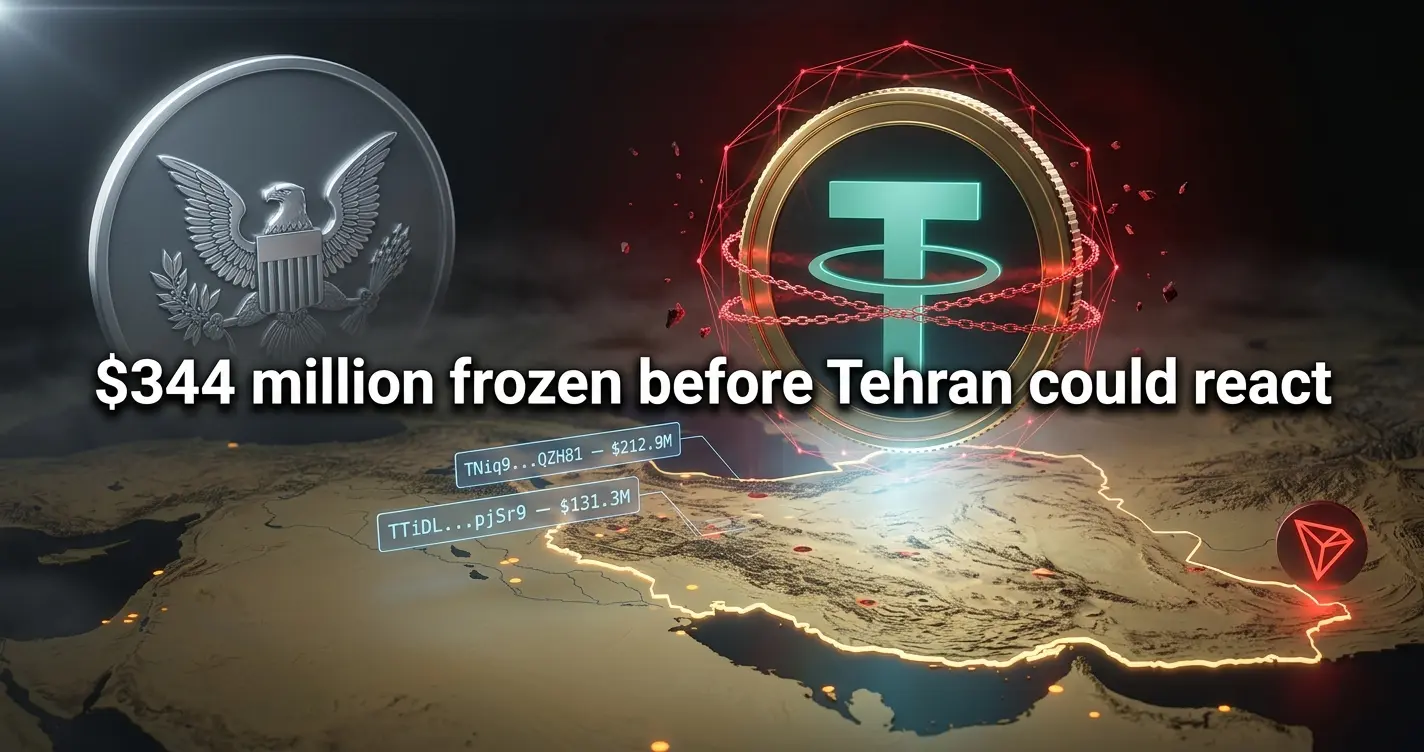
    On the afternoon of April 23, 2026, Tether announced it had frozen $344.2 million in USDT across two Tron blockchain addresses, acting in coordination with the U.S. Treasury’s Office of Foreign Assets Control (OFAC). Hours later, Treasury Secretary Scott Bessent confirmed the action on X, framing it as part of “Operation Economic Fury,” a campaign targeting Iran’s financial infrastructure. By the following morning, blockchain analytics firms had mapped the wallets down to individual transaction flows. The entire operation, from designation to freeze, took less than a day.

    That speed is the story. In traditional finance, asset freezes mean calls to correspondent banks, legal filings across multiple jurisdictions, and weeks of back-and-forth. With centralized stablecoins, a single function call in a smart contract locks $344 million before anyone on the other side can move a dollar. This is a structural advantage traditional sanctions enforcement has never had.

    The action also raises a more uncomfortable question: when a private company based in the British Virgin Islands holds the technical authority to freeze hundreds of millions of dollars on behalf of the U.S. government, what exactly has changed about how financial power works?

    $344M
    Total USDT frozen in one action
    $370M
    Total inflows across ~1,000 transactions since 2021
    $7.78B
    Iran’s 2025 crypto ecosystem value
    $4.4B+
    Tether’s total all-time frozen assets

    Operation Economic Fury: What Actually Happened

    The two wallets at the center of this action had been quietly accumulating funds since March 2021. TRM Labs, which provided the blockchain intelligence supporting the designation, traced roughly $370 million in total inflows across approximately 1,000 transactions over that four-year span. The wallets then went largely dormant by 2023, with minimal outbound transfers. One wallet moved less than $16 million out; the other saw over $228 million in inflows with almost no corresponding exits. These weren’t spending wallets. They were vaults.

    OFAC tied both addresses to the Central Bank of Iran (CBI) and, through transaction graph analysis, to the Islamic Revolutionary Guard Corps (IRGC). A U.S. official speaking to CNN confirmed the connections, describing “substantial ties to the Iranian regime, including verified transactions through intermediary addresses interacting with CBI-associated wallets.” Blockchain analytics firm PeckShield independently confirmed the wallet breakdown: $212.9 million in the first address (Tron address TNiq9…QZH81) and $131.3 million in the second (TTiDL…pjSr9).

    January 2026 had already signaled the escalation was coming. That month, OFAC sanctioned two Iranian cryptocurrency exchanges, Zedcex and Zedxion, marking the first time the U.S. had formally designated Iranian digital asset platforms for IRGC ties. The April action moved from exchange-level designation to sovereign wallet-level targeting. The progression is deliberate.

    “Treasury’s OFAC is sanctioning multiple wallets tied to Iran, resulting in the freeze of $344 million in cryptocurrency. We will follow the money that Tehran is desperately attempting to move outside of the country.”

    Scott Bessent, U.S. Treasury Secretary

    How the Freeze Actually Worked

    The technical mechanics here deserve close attention, because they explain both the power and the limits of this approach. USDT on the Tron blockchain isn’t a bearer asset in the way Bitcoin is. It’s a token governed by a smart contract that Tether controls. That contract includes a blacklist() function. When Tether adds an address to that list, the function blocks any outbound transfers from it. The funds don’t disappear. They sit in the wallet, visible to anyone, completely immovable.

    The sequence for this action ran roughly as follows: OFAC identified the suspicious wallets through blockchain intelligence, shared the designations with Tether, and Tether executed the blacklist update. From announcement to freeze, this happened within hours. Compare that to the 2022 Tornado Cash sanctions, which took months of legal preparation and still faced court challenges because they targeted a protocol rather than specific addresses.

    This isn’t a capability unique to USDT on Tron. Circle’s USDC includes similar administrative controls. But Tether is the dominant stablecoin by circulation at roughly $189 billion, and its willingness to act swiftly has established it as the preferred enforcement partner. The company has now frozen over $4.4 billion in total across 65 countries, working with more than 340 law enforcement agencies on over 2,300 cases.

    Tether Enforcement Track Record
    Action Amount Year Mechanism
    Iran IRGC/CBI wallet freeze $344.2M Apr 2026 OFAC Designation
    Pig butchering fraud (Iran-linked) $225M 2025 DOJ / FBI
    Pig butchering fraud (Iran-linked) $61M 2024 DOJ / FBI
    Total all-time frozen assets $4.4B+ 2014-2026 Multiple agencies
    U.S.-linked frozen assets $2.1B+ 2014-2026 1,200+ U.S. cases

    The Scale of Iran’s Crypto Ecosystem

    To understand why this freeze matters strategically, you need the full picture of how much Iran relies on crypto. Chainalysis estimated Iran’s 2025 crypto ecosystem at $7.78 billion. TRM Labs, in its broader analysis, puts total Iranian crypto transaction volume in the $8 to $10 billion range for the year when combining retail and state-linked activity. That’s not marginal. It’s a significant portion of how a heavily sanctioned economy moves money.

    The IRGC’s role in that ecosystem is dominant and growing. Chainalysis found that IRGC-associated addresses received over $3 billion in 2025, representing roughly half of Iran’s Q4 crypto activity. The IRGC isn’t just tolerating crypto, it’s running a significant portion of Iran’s parallel financial infrastructure through it. Oil revenues, arms transactions, proxy financing: blockchain analytics firms have traced multiple categories of flows through IRGC-linked addresses.

    The $344 million freeze represents roughly 4.4% of Iran’s annual crypto volume. Not a knockout blow. But it’s the first time the U.S. has directly targeted what appear to be CBI-associated sovereign wallets, a qualitatively different kind of pressure than going after private exchanges. And the signal to other custodians and issuers globally is unmistakable.

    Tether as Sanctions Enforcer: The Structural Shift

    Paolo Ardoino, Tether’s CEO, was unambiguous in the company’s statement: “USD₮ is not a safe haven for illicit activity. When credible links to sanctioned entities or criminal networks are identified, we act immediately and decisively.” This framing positions Tether as a proactive compliance partner rather than a reluctant participant. That distinction matters for Tether’s regulatory relationships in Washington, especially as the U.S. moves toward a federal stablecoin framework in 2026.

    But there’s a structural tension here that privacy advocates have been flagging for years. A private company, not a court, not a regulator directly, holds the technical power to freeze funds at the request of a government agency. Tether’s cooperation is voluntary. It acts on what it describes as “credible information” from authorities. There’s no public due process, no appeals mechanism, no notice to wallet holders before the freeze executes. The speed that makes this enforcement tool so effective is the same quality that makes it alarming as a matter of financial rights.

    Tom Robinson, co-founder of blockchain analytics firm Elliptic, had predicted exactly this trajectory in his January 2026 policy outlook: “In 2026, policymakers and regulators will focus on preventing cryptoasset-related sanctions evasion with renewed urgency.” The April action validated that forecast three months in.

    “The asset freeze is significant, but given the extent of sanctions against Iran, I don’t believe it will substantially hinder Iran’s efforts to continue operating amid the current state of conflict.”

    Dr. Alex Tanne, Fellow, Atlantic Council

    Limitations and Likely Workarounds

    Dr. Alex Tanne of the Atlantic Council offered the most grounded assessment of the action’s actual strategic impact. The freeze is significant, he told CNN, but Iran has endured sanctions for decades and has established mechanisms to adapt. His recommendation for more effective pressure: focus on third-party actors, specifically China, UAE, and Turkey, that facilitate Iran’s access to global markets.

    The technical workarounds available to Iran are well-documented. Sanctions evasion through crypto has never relied exclusively on USDT. Bitcoin and Ethereum can’t be frozen by any central party. Monero and other privacy coins offer transactional opacity that blockchain analytics firms can’t easily pierce. Non-U.S. stablecoin issuers, particularly those operating out of jurisdictions outside American reach, have no obligation to comply with OFAC. And the February 2026 analysis from Cambridge’s Centre for Alternative Finance noted that crypto mixers are actively resurging post-2022 sanctions pressure, now operating through compliant-adjacent privacy protocols.

    What the dormant wallet strategy also reveals is that Iran understood this vulnerability. Parking funds in USDT rather than moving them suggests either a belief that USDT offered sufficient security (now disproven) or a deliberate long-term storage play that assumed no U.S. action was imminent. Either way, the strategic calculation will shift. Future Iranian state-linked crypto activity will almost certainly avoid centralized stablecoins for large reserve storage.

    Key limitations of the freeze mechanism

    • Works only for centralized stablecoins like USDT and USDC; Bitcoin and Ethereum have no equivalent freeze mechanism.
    • Requires voluntary cooperation from the issuer; non-U.S. stablecoin providers face no legal obligation to comply with OFAC.
    • Adversaries can shift to privacy coins like Monero, which offer transactional opacity that current analytics tools struggle to trace.
    • Self-custody wallets using non-custodial bridges and cross-chain mixers can circumvent address-level blacklisting.
    • The freeze captures value already stored but can’t stop future flows that avoid designated infrastructure.

    What This Means Going Forward

    The $344 million freeze is not primarily a story about Iran losing $344 million. Iran’s crypto infrastructure will adapt, as it always has. The larger story is about what the U.S. government has demonstrated it can do with a willing stablecoin issuer and a functional blockchain analytics apparatus: it can freeze sovereign-scale assets, in hours, with precision targeting that leaves no collateral damage to the surrounding network.

    That capability has implications well beyond Iran. Any nation-state, sanctioned entity, or large criminal organization currently holding significant USDT balances is now watching this case and reassessing. The assumption that crypto provided geographic and jurisdictional distance from U.S. enforcement has taken a material hit. The public ledger, which crypto advocates once celebrated as a tool for financial transparency and individual freedom, is now also the most detailed transaction record any sanctions enforcement body has ever had access to.

    Blockchain traceability as a sanctions multiplier was always the theoretical upside from an enforcement perspective. April 2026 is when that theory became demonstrated practice at scale. The September 2025 Treasury action targeting crypto-linked oil sale networks, combined with the January 2026 exchange designations and now the April wallet freeze, shows a clear escalation cadence. The U.S. is building out an enforcement playbook, and Tether is currently the most important tool in it.

    Frequently Asked Questions

    What is Operation Economic Fury? +
    Operation Economic Fury is a U.S. Treasury campaign announced by Secretary Scott Bessent in April 2026. It targets Iran’s financial infrastructure through coordinated crypto sanctions, aiming to cut off funding channels linked to the IRGC, Iran’s Central Bank, and affiliated entities operating through digital assets.

    How did Tether freeze $344 million in cryptocurrency? +
    Tether’s USDT smart contract on the Tron blockchain includes a blacklist function that can block outbound transfers from specific addresses. Once OFAC shared the designated wallet addresses, Tether added them to this blacklist, preventing any movement of funds. The process takes minutes to execute and doesn’t require court approval.

    Can Bitcoin or Ethereum be frozen in the same way? +
    No. Bitcoin and Ethereum are decentralized protocols with no central issuer holding administrative control. Unlike USDT, no single entity can modify their smart contracts to block transfers. This is a fundamental architectural difference between decentralized cryptocurrencies and centralized stablecoins like USDT or USDC.

    How much cryptocurrency does Iran use annually? +
    Chainalysis estimated Iran’s 2025 crypto ecosystem at $7.78 billion in on-chain activity. TRM Labs places the broader figure, including state-linked flows, in the $8 to $10 billion range. The IRGC alone accounted for over $3 billion in crypto receipts in 2025, roughly half of Iran’s Q4 2025 digital asset activity.

    Will this freeze significantly impact Iran’s financial operations? +
    Experts are divided. Dr. Alex Tanne of the Atlantic Council argues the freeze won’t substantially hinder Iran, given decades of sanctions adaptation. The $344 million represents roughly 4.4% of Iran’s annual crypto volume. The symbolic and deterrent effect may outweigh the immediate financial disruption.

    What happens to the frozen funds now? +
    The funds remain in the blacklisted wallets, visible on-chain but completely immovable. They can’t be transferred, swapped, or spent. Whether they are eventually seized, forfeited, or remain frozen indefinitely depends on subsequent legal proceedings between the U.S. government and Tether under existing sanctions law.

    What are the broader implications for stablecoin regulation? +
    The action reinforces that centralized stablecoin issuers function as de facto financial intermediaries subject to U.S. sanctions law. As Congress moves toward a federal stablecoin framework in 2026, compliance capabilities, specifically the ability to freeze addresses on government request, will likely become a formal regulatory requirement rather than a voluntary practice.

    Could Iran simply switch to privacy coins or other stablecoins to avoid future freezes? +
    Yes. Privacy coins like Monero, non-U.S. stablecoin issuers, and decentralized exchange protocols present significant challenges for U.S. sanctions enforcement. The Cambridge Centre for Alternative Finance noted a resurgence in crypto mixer activity following 2022 sanctions actions, suggesting sanctioned entities are already shifting toward more opaque tools.

    Conclusion

    What happened on April 23, 2026 was a precision strike, not a financial war. $344 million frozen in hours, traced through a public ledger to a sovereign actor, with surgical accuracy that no correspondent bank network could replicate. The action proved something important: the public blockchain, the same infrastructure marketed as a tool for individual financial freedom, is also the most transparent transaction record a government enforcement body has ever worked with.

    The implications extend in two directions. For U.S. sanctions policy, the Tether cooperation model has just been validated at sovereign-reserve scale. Expect more designations, more freezes, and growing pressure on other stablecoin issuers to build equivalent compliance infrastructure. For adversaries of U.S. financial power, whether state-level or criminal, the message is clear: centralized stablecoins are no longer a safe distance from enforcement reach. The migration to decentralized alternatives, privacy protocols, and non-U.S. financial infrastructure will accelerate.

    Watch For

    1. Secondary sanctions pressure on Chinese and UAE financial actors that facilitate Iranian crypto flows, as Dr. Tanne suggested this is the higher-impact enforcement lever.
    2. A formal stablecoin compliance framework from Congress that codifies OFAC cooperation requirements for all U.S.-licensed issuers, likely referencing this action as precedent.
    3. Increased adoption of Monero and non-USDT stablecoins by IRGC-linked wallets as the state-linked component of Iran’s crypto ecosystem migrates away from freezable infrastructure.
    NeuralWired covers the intersection of technology, policy, and financial infrastructure. For more analysis on crypto regulation and blockchain-based enforcement, follow our dedicated coverage.

    More Crypto & Policy Coverage →