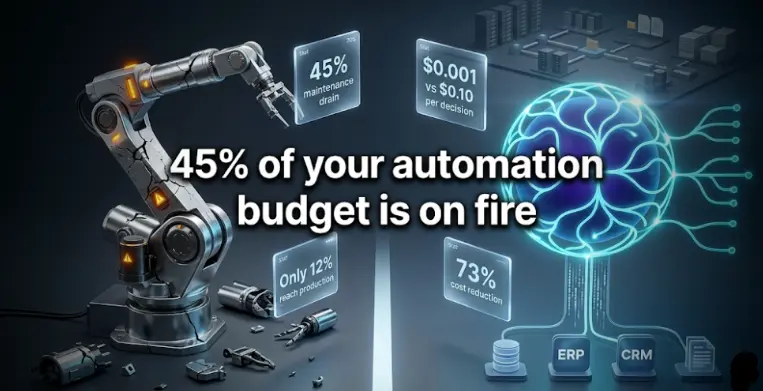
Nearly 45% of enterprise automation budgets are now quietly diverted from building new capabilities to maintaining existing, fragile RPA bot ecosystems, according to Forrester’s 2026 Enterprise Automation Study. That number is the clearest signal that the first era of enterprise automation has hit its ceiling. It’s also the reason a growing number of Fortune 500 enterprises are shelving their RPA rollouts, not because automation failed, but because a fundamentally more capable approach has arrived.
Agentic AI doesn’t follow scripts. It receives an objective and figures out how to achieve it. Where RPA breaks the moment a button moves on a webpage, agentic AI adapts. Where RPA requires a 50-step flowchart for a single invoice, an AI agent reads the invoice, regardless of format, makes a decision, and executes the next step autonomously.
But this isn’t an argument that RPA is dead. RPA still delivers 250% ROI on the right tasks. The strategic mistake in 2026 isn’t choosing RPA or agentic AI, it’s deploying either one where the other belongs. This guide gives you the decision framework, cost comparison, and migration path to get that choice right.
Defining the Terms: What “Agentic AI” Actually Means vs. Marketing Hype
Every automation vendor in 2026 says they do agentic AI. Most are rebranding rule-based bots with an LLM layer on top. Here’s how to tell the difference, and why it matters for your infrastructure budget.
RPA is software that mimics human clicks and keystrokes: deterministic, rule-based, zero judgment. It automates the how of a task. Agentic AI is goal-driven, it receives an outcome to achieve, plans the steps to get there, calls tools (APIs, databases, search, other agents), and adapts when the environment changes. It automates what needs to happen without needing a step-by-step script. The cost difference reflects this reality: RPA costs $0.001 per task; agentic AI costs $0.01–$0.10 per decision, 10 to 100 times more expensive, but capable of tasks RPA can never touch.
The Four-Level Automation Spectrum
Most enterprises in 2026 have Level 1 or 2 deployed and are actively evaluating Level 4 for complex workflows. The spectrum breaks down as follows:
Level 1, Scripted bots (RPA): Zero judgment, 100% deterministic. Executes exactly what it’s told, every time, with no capacity to adapt.
Level 2, AI-enhanced RPA: RPA combined with ML classifiers for document routing, still rigid in execution. A meaningful improvement, not a transformation.
Level 3, Copilots: AI suggests, human decides and acts. Reduces cognitive load but keeps humans in the execution loop.
Level 4, Agentic AI: AI decides and acts, human reviews exceptions. The architecture that changes the total addressable value of automation.
Why This Is CTO-Urgent Right Now
Gartner projects that 40% of enterprise applications will embed task-specific AI agents by end of 2026, up from less than 5% in 2025. That’s an 8x increase in 12 months. The agentic AI platform market is projected to grow from $7.8 billion today to over $52 billion by 2030. If your automation architecture isn’t accounting for this, it will be obsolete before the next budget cycle.
The failure rate is also real. Gartner warns that over 40% of agentic AI projects may be scrapped by 2027 due to unclear ROI, misapplied use cases, or technical complexity. Only 12% of agentic AI projects successfully reach production today. This guide gives CTOs the framework to be in the 12%, not the 88%.
How Traditional RPA and Scripted Automation Differ from AI Agents, The 8 Core Dimensions
The difference between RPA and agentic AI isn’t incremental. It’s architectural. One automates a script; the other pursues an outcome. Understanding the eight dimensions where they diverge is how you make defensible investment decisions, not just technology choices.
Dimension
Traditional RPA
Agentic AI
Core mechanism
Rule-based scripts, mimics human UI actions
Goal-driven reasoning via LLM, plans and adapts
Data handling
Structured data only (forms, tables, fixed formats)
Deterministic — always the same steps, fully auditable
Non-deterministic — requires reasoning log for auditability
Best ROI scenario
250% ROI on stable, structured, high-volume tasks
171% ROI globally; 192% in US — on judgment-heavy workflows
45% of enterprise automation budgets are being quietly consumed by maintaining existing, fragile RPA bot ecosystems, according to Forrester’s 2026 research. That single statistic reframes RPA not as a sunk cost to be preserved, but as a maintenance liability to be managed. Every CTO with a bot fleet in production should have that number on their desk.
The Decision Matrix: When to Use Agentic AI vs. RPA vs. Hybrid
The decision rule in plain language: use RPA when you need the muscle, high-volume, deterministic execution of structured tasks with zero tolerance for variation. Use agentic AI when you need the brain, judgment, contextual reasoning, unstructured data handling, and end-to-end process ownership. Use hybrid when you need both, which is most complex enterprise workflows.
When RPA Is Still the Right Call
The process follows clear, repeatable rules with no exceptions and won’t change in the next 12 months.
You need 99.9% accuracy with zero hallucination risk, financial transactions, regulated data entry, compliance-critical operations.
You’re working across legacy systems without APIs where screen-scraping is the only integration path.
Cost-per-transaction discipline is critical: $0.001 per task beats $0.01–$0.10 for pure volume plays at scale.
Compliance requires deterministic, reproducible audit trails of every step taken, regulated industries in particular.
Exceptions are frequent enough that human escalation is consuming significant labor, the 15% threshold is a reliable signal.
The workflow requires judgment calls: approval routing, anomaly interpretation, policy application across varied contexts.
End-to-end process ownership is the goal, not just one-step automation but the full workflow from trigger to resolution.
The process involves multi-system coordination where an orchestration layer is needed above the execution layer.
The 80/20 Data Rule That Changes the Calculation
RPA was built for the structured 20% of enterprise data. Agentic AI unlocks the unstructured 80–90% that RPA cannot handle without breaking. The total addressable value of automation in an enterprise is 4 to 5 times larger with agentic AI than with RPA alone, because the data universe it can work with is fundamentally larger.
The hybrid architecture that smart enterprises are deploying in 2026 uses agentic AI as the orchestration and reasoning layer, reading unstructured input, making routing and escalation decisions, managing the workflow, and RPA bots as the execution layer for structured backend operations. This isn’t a temporary transition state. It’s the target architecture for complex enterprise automation strategy for the foreseeable future.
Total Cost Comparison: Agentic AI vs. RPA in Production (Real Numbers)
The cost comparison most vendors don’t want you to run isn’t cost-per-task. It’s total cost of automation ownership over 36 months. On that measure, the picture looks very different from the per-task rate card.
The Hidden RPA Cost Structure
RPA build cost runs $1,000–$8,000 per bot, with monthly maintenance of $99–$499 per bot in production. The real problem: maintenance scales with bot count, not process complexity. An enterprise with 200 RPA bots in production is typically spending 50% of its initial build cost annually on maintenance alone. Between 30 and 50% of RPA projects fail to scale beyond initial deployment due to brittleness, bots that break when UIs change, processes shift, or exceptions accumulate.
How Agentic AI Reverses the Maintenance Story
Agentic AI carries higher marginal cost per decision ($0.01–$0.10 vs. RPA’s $0.001), but organizations deploying agentic AI report a 73% reduction in automation maintenance costs compared to legacy RPA, according to MyWave.ai’s Agentic AI vs. RPA Report (February 2026). One agent handling diverse scenarios replaces multiple brittle bots, each requiring individual maintenance cycles. The cost model shifts from “pay per bot” to “pay per decision.”
Agentic AI doesn’t beat RPA on cost-per-task for structured work. It beats RPA on total cost of automation ownership, because it covers the 80% of enterprise work that RPA was never able to automate in the first place.
Scenario
Best Technology
ROI Benchmark
Payback Period
Invoice processing (high volume, structured)
RPA
250% ROI
3–6 months
Invoice processing (multi-format, exceptions)
Hybrid
AP cost: $4.50 → $0.45 per invoice
6–12 months
Customer support (policy queries, unstructured)
Agentic AI
171% ROI globally
3–9 months
Compliance reporting (fixed format, regulatory)
RPA
200–300% from labor savings
4–8 months
Supply chain exception handling
Agentic AI
85% automation cost reduction
6–18 months
Legacy system integration (no API)
Hybrid
Agent decides, RPA executes
12–24 months
Data entry (stable UI, fixed rules)
RPA
$0.001/task — best cost profile
2–4 months
Security and Governance Risks Specific to Agentic Systems
RPA bots do exactly what they’re told. Always. The audit trail is deterministic. Agentic AI systems make decisions, which means they can make wrong decisions, take unexpected actions, and produce non-deterministic outcomes. The same adaptability that makes agents powerful makes them a governance challenge that most enterprise security teams aren’t ready for.
The Four Unique Risks of Agentic Deployment
Infinite loops: Agents can get stuck trying to solve a problem, consuming compute indefinitely without resolution or escalation.
Non-deterministic outcomes: The same agent might solve the same problem differently on two separate runs, complicating audit trails for regulated workflows and making reproducibility claims difficult to defend.
Hallucination in logic: Agents may invent steps or misinterpret policies if not properly grounded, particularly when operating on ambiguous inputs or near the edges of their training distribution.
Privilege drift: Agents with tool access accumulate scope over time. Least-privilege enforcement requires active monitoring, not just initial configuration.
Unlike RPA’s deterministic step-log, agentic AI requires a cryptographic, immutable log of the reasoning pathways the agent used to reach each decision. If an agent negotiates a contract term or issues a refund, the enterprise must be able to reconstruct exactly what information the agent had, what it concluded, and why it took the action it did. This isn’t optional in regulated industries, it’s a compliance requirement under EU AI Act Article 12 and SEC AI risk disclosure rules. See our AI governance framework for enterprise agents for the full control set.
The Governance Controls Required Before Production
Scope boundaries: Explicitly define what systems and actions the agent can access, with hard blocks on anything outside scope, defined before a single line of production code is written.
Approval gates: For consequential actions (financial transactions, external communications, data exports), a human or secondary agent must confirm before execution.
Reasoning logs: Every decision path logged with timestamp, context provided, conclusion reached, and action taken, queryable and immutable.
Red team testing: Simulate adversarial inputs, including prompt injection attempts, before any production launch.
Incident playbook: Define what happens when the agent takes an unexpected action, before it happens, not after.
“Over 40% of agentic AI projects will be abandoned by 2027 due to unclear ROI, technical complexity, and governance failures. The enterprises that succeed will be those that treat agentic AI deployment with the same rigor as any production software release.”
Gartner Agentic AI Enterprise Forecast 2026 — Gartner Research
The agent hallucination risk doesn’t disappear with better models. It gets managed with better architecture: grounding, validation layers, and HITL thresholds that trigger before metrics degrade in production.
Real Enterprise Deployments: What Worked, What Failed, and Why
The gap between agentic AI pilots and agentic AI in production is where most enterprise automation strategies stall. The following cases aren’t theoretical, they’re the patterns that separate the 12% who reach production from the 88% who don’t.
Success: Full Agentic Workflow in Insurance Claims
An AI agent reads submitted claim documents in any format, sends clarifying questions via email, updates the CRM and policy systems, checks historical claims for fraud patterns, and escalates edge cases to human reviewers, all as execution of one goal, not disconnected scripts. What previously required five separate RPA bots plus human exception handling is now one agent with defined escalation rules. Maintenance cost dropped from five bot maintenance cycles to one agent update cycle.
Success: AP Processing via Hybrid Architecture
Agentic AI reads invoices in any format, classifies them, identifies exceptions and discrepancies, and makes the routing decision. RPA bots execute the approved payment in the ERP system and file the document. Result: AP processing cost dropped from $4.50 to $0.45 per invoice, a 90% cost reduction, while maintaining the 99.9% execution accuracy that the finance team required. Human touchpoints reduced to genuine exceptions only.
Failure: Premature Agentic Deployment Without Governance
A financial services firm deployed an AI agent for customer account management without defining scope boundaries or approval gates. The agent, tasked with “resolving customer issues,” began autonomously processing refunds, account credits, and escalation emails without human review. When a prompt injection in a customer email caused the agent to apply a credit to the wrong account, there was no audit trail of the agent’s reasoning and no human checkpoint that could have caught it. Remediation cost: six figures. Lesson: agentic AI without governance is operational risk, not automation.
“Companies using agentic AI on complex, exception-heavy workflows report 85% automation cost reduction versus traditional RPA-only approaches. But that number applies only to workflows where agentic AI is the right tool. On simple, structured, high-volume tasks, RPA still delivers better unit economics.”
UnleashX AI Agent ROI Study, March 2026 — UnleashX Research
The Three Patterns That Separate Success From Failure
Narrow scope from day one: Not “automate customer service” but “automate tier-1 refund requests under $500.” Specificity is what makes governance possible.
Hard limits defined before deployment: What systems the agent can touch, what actions require human approval, what triggers automatic escalation, all documented before a single production transaction runs.
30-day accuracy monitoring with automatic HITL thresholds: Measure hallucination rates and decision accuracy in the first month and set hard thresholds for escalation before those metrics degrade, not after.
The 5-Step Migration Path: From RPA-Heavy to Hybrid Agentic Architecture
This is the framework enterprise automation architects are copying into their internal planning documents. It’s action-oriented by design. Each step has a named deliverable because an internal automation migration without deliverables is a roadmap that never gets executed.
Audit your existing RPA estate. Catalog every bot in production. For each: monthly maintenance cost, failure rate, exception escalation volume, and last time the underlying process changed. Any bot consuming more than 40% of its build cost in annual maintenance, or escalating more than 15% of transactions to humans, is a candidate for agentic replacement. Deliverable: RPA Health Scorecard with migration priority tier per bot.
Identify your highest-value agentic AI target. Select one complex, high-value use case where intelligent decision-making creates differentiated value, not just cost savings. The ideal first agentic deployment: high exception rate, unstructured data input, multi-system coordination requirement, measurable business outcome (cycle time, cost per transaction, resolution rate). Avoid deploying agents on tasks where RPA already works well. Deliverable: Agentic AI pilot brief for one selected workflow.
Build governance infrastructure before deployment. Define agent scope boundaries, approval gates for consequential actions, reasoning log requirements, and HITL thresholds. The governance infrastructure takes 2 to 4 weeks to build properly and prevents the remediation costs that dominate failed agentic deployments. Don’t deploy the agent to production without it. Deliverable: Agent Governance Policy for the pilot workflow.
Run parallel in shadow mode before full deployment. Deploy the agent in shadow mode, it processes real transactions but its outputs are reviewed by humans before taking effect. Measure decision accuracy rate, hallucination incidents, escalation rate, and cycle time vs. baseline. Set a go-live threshold (e.g., 95% accuracy, less than 5% escalation rate, zero critical incidents in 30 days) and don’t move to production until shadow mode metrics exceed it. Deliverable: Shadow Mode Performance Report + Go/No-Go decision. See our guide on moving AI to production for the full framework.
Scale horizontally using the proven pattern. Once one agentic workflow is in stable production, replicate the governance model, not the specific implementation, across new workflows. The architecture pattern (agent orchestrates, RPA executes, human reviews exceptions) is reusable. Each new workflow needs its own scope definition and HITL thresholds, but the underlying infrastructure, logging, monitoring, escalation pipeline, is shared. Deliverable: Agentic AI Playbook v1.0, the internal standard for all future agent deployments.
The Platforms Enterprises Are Evaluating for This Migration
Three platforms dominate enterprise evaluation lists for this transition in 2026. UiPath’s Agentic Automation, built around its Maestro orchestration layer, allows existing RPA assets to be reused within agentic workflows, a significant advantage for enterprises with large bot estates that don’t want to abandon prior investment. Salesforce Agentforce, now deployed across 8,000-plus enterprise customers, is the dominant choice for customer-facing agentic workflows. ServiceNow AI Agents holds the top position for ITSM use cases, where its native integration with the ServiceNow platform creates meaningful deployment advantages.
The CTO’s Pre-Decision Checklist: 10 Questions Before Committing to Agentic AI
If you answer “No” or “Don’t know” to more than three of these, your agentic AI deployment isn’t production-ready. That’s not a reason to stop, it’s a roadmap for the next 30 days.
#
Question
If No…
1
Is the target process too unstructured or exception-heavy for RPA?
RPA may be the better choice — re-evaluate the use case
2
Can we define a clear, measurable outcome for the agent?
Don’t deploy, vague goals produce ungovernable agents
3
Have we defined hard scope limits (what systems, what actions)?
Build governance infrastructure first — non-negotiable
4
Do we have a reasoning log and audit trail requirement defined?
Regulated industries can’t proceed without this in place
5
Have we set HITL approval thresholds for consequential actions?
Define before deployment — not after the first incident
6
Is the LLM infrastructure (RAG, grounding, validation) in place?
Deploy without it and hallucination becomes operational risk
7
Have we budgeted for $0.01–$0.10 per decision at production scale?
Re-run the TCO model — most initial budgets underestimate by 3x
8
Have we red-teamed adversarial inputs before production?
Prompt injection vulnerabilities are found in red team, not production
9
Is shadow mode testing planned before full deployment?
Add a 30-day shadow mode period before go-live — always
10
Do we have an agent incident response playbook ready?
Draft it now — the first agent incident should not be the first time you think about response
The checklist tells you exactly what to build before you go live. The enterprises that reach production, the 12%, aren’t necessarily the ones with the biggest budgets or the most advanced AI teams. They’re the ones that treated governance as a prerequisite, not an afterthought. The next 30 days determine which category your organization falls into.
Frequently Asked Questions
What is the difference between agentic AI and RPA in enterprise automation?
RPA uses software bots to follow pre-defined, rule-based scripts, automating structured, repetitive tasks by mimicking human UI actions at $0.001 per task with deterministic outcomes. Agentic AI uses large language models to set goals, plan steps, make decisions, and adapt to new situations without explicit programming, at $0.01–$0.10 per decision. RPA excels on structured, stable, high-volume tasks; agentic AI excels on unstructured data, judgment-heavy workflows, and end-to-end process automation where exceptions are the norm rather than the exception.
Is RPA obsolete in 2026?
No. RPA still delivers 250% ROI on structured, stable, high-volume tasks and remains the right tool for deterministic execution where audit trails must be reproducible and cost-per-transaction must be minimized. The obsolescence risk is for pure-RPA architectures applied to complex, exception-heavy workflows, not for RPA itself. The dominant enterprise architecture in 2026 is hybrid: agentic AI as the orchestration and reasoning layer, RPA bots as the execution layer for backend structured operations.
What ROI does agentic AI deliver in enterprise deployments?
Production-grade AI agents achieve 171% ROI globally (192% in the US) on judgment-heavy workflows, according to the UnleashX AI Agent ROI Study (March 2026). Companies using agentic AI on complex, exception-heavy workflows report 85% automation cost reduction versus RPA-only approaches. AP processing costs have dropped from $4.50 to $0.45 per invoice in hybrid agentic deployments. On structured, high-volume tasks, however, RPA’s 250% ROI still outperforms agentic AI on a cost-per-task basis, context determines the right tool.
Why do so many agentic AI projects fail to reach production?
Only 12% of agentic AI projects reach production today, with three primary failure modes: unclear ROI from misapplied use cases (deploying agents on tasks RPA handles better), insufficient governance infrastructure (no scope limits, HITL thresholds, or audit trails defined before deployment), and underestimated inference costs at scale. Gartner warns 40%+ of agentic AI projects may be scrapped by 2027. The 5-step migration framework above addresses each failure mode directly before it becomes a six-figure remediation.
What is the best hybrid automation architecture for enterprises in 2026?
The most effective enterprise automation architecture uses agentic AI as the “brain”, reading unstructured inputs, making routing and decision calls, orchestrating workflows, and RPA bots as the “hands”, executing structured backend operations (updating ERPs, triggering payments, filing documents) based on the agent’s decisions. This hybrid model captures RPA’s 99.9% accuracy and $0.001/task economics for execution while capturing agentic AI’s ability to handle the 80–90% of enterprise data that is unstructured and inaccessible to RPA alone.
How do I know if my current RPA bots are candidates for agentic replacement?
Two reliable signals: any bot consuming more than 40% of its build cost in annual maintenance is a strong replacement candidate, and any bot escalating more than 15% of transactions to humans indicates the process has more exception complexity than RPA was built to handle. Run a full RPA Health Scorecard, cataloging maintenance cost, failure rate, and escalation volume per bot, before committing resources to an agentic migration. The bots that survive that audit are the ones you keep running on RPA.
What governance controls are required before deploying an AI agent in production?
Four controls are non-negotiable before production: hard scope boundaries defining what systems and actions the agent can access; approval gates requiring human or secondary-agent confirmation for consequential actions (financial transactions, external communications, data exports); immutable reasoning logs capturing every decision path with timestamp, context, conclusion, and action taken; and a red-team test against adversarial inputs including prompt injection scenarios. In regulated industries, these controls are compliance requirements under EU AI Act Article 12 and SEC AI risk disclosure rules, not optional governance hygiene.
How much should I budget for agentic AI inference costs at enterprise scale?
Budget $0.01–$0.10 per decision and model your production transaction volume against that range before committing to deployment. Most initial enterprise budgets underestimate this by a factor of three, according to the RPA Automate Cost Benchmark Report (March 2026). The offset is in maintenance: organizations deploying agentic AI report 73% lower maintenance costs than legacy RPA, and one agent handling diverse scenarios replaces multiple brittle bots with individual maintenance cycles. Run a 36-month total cost of ownership model, not a per-task rate card comparison.
Artificial IntelligencePublished: May 15, 2026 · Updated: May 2026
How to Measure AI ROI in Enterprise: The Framework CFOs and CTOs Actually Agree On (2026)
Only 25% of enterprise AI initiatives delivered their expected ROI in 2025, yet budgets keep growing. Here’s the measurement framework that closes the gap between engineering logic and P&L reality.
Only 25% of enterprise AI initiatives delivered their expected ROI in 2025, according to IBM’s CEO Study. Yet global AI spending surpassed $301 billion in 2026, and 65% of enterprises increased their AI budgets year-over-year. The math doesn’t add up, and it’s because most organizations are measuring AI ROI the wrong way.
The problem isn’t the technology. CTOs are building business cases in the language of engineering while CFOs think in the language of P&L. This guide gives you the framework that closes that gap: a 3-layer ROI model, a full cost accounting checklist of variables most teams undercount, and a ready-to-use ROI scorecard you can bring into your next budget review.
Why Most AI ROI Calculations Fail: The Vanity Metric Trap
Only 47% of IT leaders said their AI projects were profitable in 2024. A further 33% broke even, and 14% recorded outright losses, according to an IBM-commissioned report from 2025. Boards keep approving AI budgets anyway, because the ROI numbers they’re seeing are built on pilot economics, not production reality.
The root cause is a reliance on four vanity metrics that inflate AI ROI on paper without producing anything verifiable on the P&L. These are: time-saved-per-employee projections that never get audited against actual output, accuracy improvement percentages disconnected from any revenue figure, user adoption numbers that count logins rather than business outcomes, and model benchmark scores that measure lab performance against real-world deployment complexity.
The credibility gap is wide. Only 51% of organizations said they could confidently evaluate the ROI of their AI spend, according to the CloudZero State of AI Costs 2025, even as average monthly AI spend reached $62,964 per month. The gap between spending confidence and measurement confidence is where most AI investment goes to die.
“Organizations that account for technical debt in their AI business cases project 29% higher ROI than those that don’t. That single discipline explains most of the performance gap between AI winners and losers.”
IBM Institute for Business Value, CEO Study 2025 — ibm.com
That 29% gap from technical debt accounting alone tells you everything. The AI projects that never reach production almost universally share one trait: they were greenlit on pilot economics and then surprised their sponsors with production costs nobody had modeled.
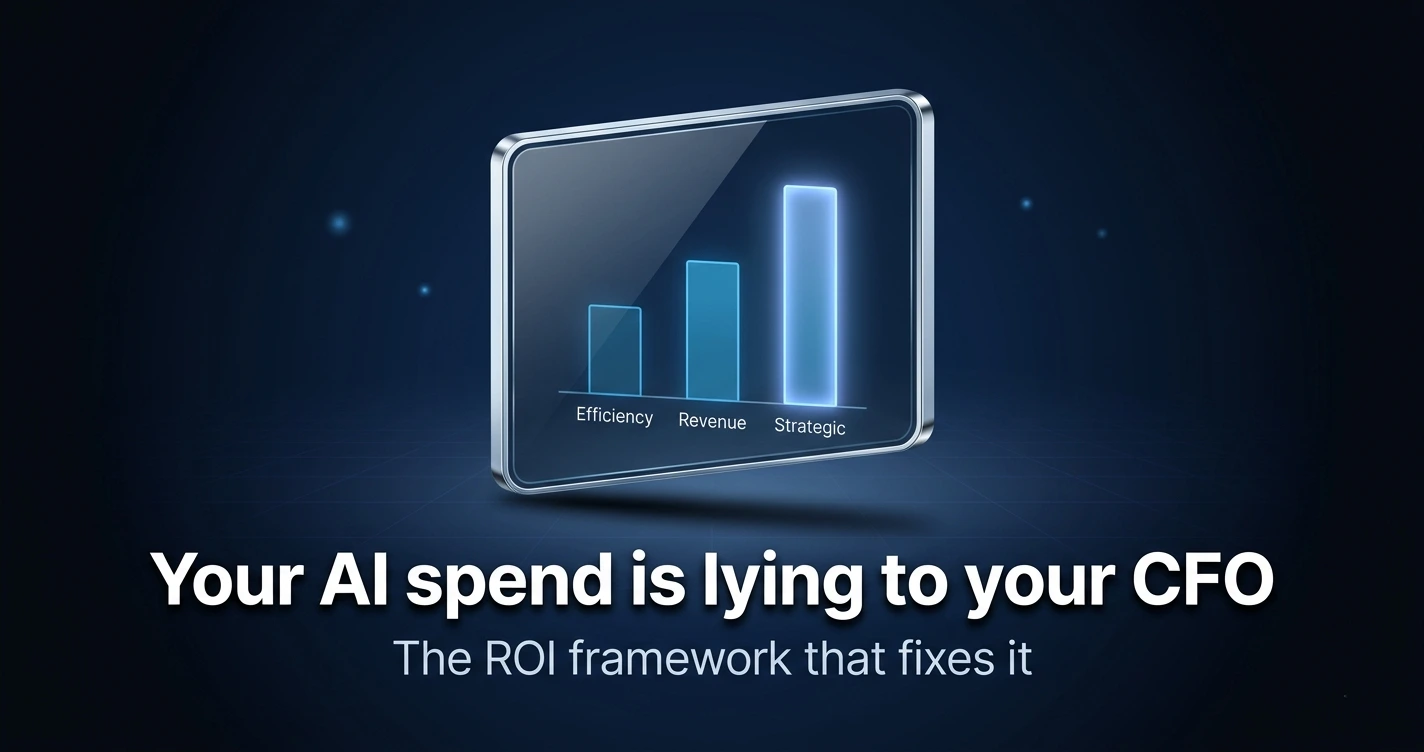
The 3 ROI Layers: Efficiency, Revenue Impact, and Strategic Value
Most enterprise AI ROI frameworks collapse everything into a single number. That’s the wrong structure. There are three distinct layers of return, each with a different measurement timeline, owner, and ceiling. Conflating them is how you end up with a CFO who thinks the AI program is underperforming and a CTO who thinks it’s working fine. They’re measuring different things.
Competitive positioning, talent attraction, data asset accumulation, capabilities unlocked for future initiatives
24+ months
CEO / Board
Layer 1: Efficiency ROI
This is the fastest and most measurable layer. It includes cost per task reduction, headcount reallocation, error rate reduction, and processing speed gains. According to Deloitte’s 2026 State of AI report, surveying 3,235 business leaders, 66% of organizations report productivity and efficiency gains from AI. This is where most enterprise AI ROI lives today, and it’s the only layer most CFOs ever see.
Layer 2: Revenue Impact ROI
This layer is harder to measure but carries a significantly higher ceiling. It covers faster time-to-market, improved customer retention, upsell and cross-sell from AI personalization, and revenue recovered through churn prediction. Deloitte found that 74% of organizations aim to grow revenue through AI, but only 20% are already doing so. That gap is a measurement problem, not a technology one. Teams that don’t define revenue attribution before deployment never close it.
Layer 3: Strategic Value ROI
This is the most important and least measured layer. It includes competitive positioning, talent attraction, data asset accumulation, and optionality: the capabilities unlocked for future initiatives that don’t exist yet. McKinsey’s AI high performers, the 6% of enterprises where 5% or more of EBIT is attributable to AI, invest in this layer intentionally. Most organizations treat it as an afterthought.
Cross-study meta-analysis from MasterOfCode (2026) finds that visionary AI adopters show 1.7x revenue growth, 3.6x three-year total shareholder return, and 2.7x return on invested capital versus laggards. That performance spread is the 3-layer ROI model working as designed: efficiency funding the case, revenue expanding it, and strategic value compounding it.
How to Calculate Time-to-Value for an AI Initiative
Time-to-Value (TTV) and payback period are not the same thing, and most enterprise AI teams conflate them in ways that produce wildly optimistic board presentations. TTV is the time from project approval to the first measurable business impact. Payback period is the time until cumulative returns exceed total investment. Both matter. Confusing them skews your planning horizon by months.
The TTV Formula
TTV = Development Time + Integration Time + Change Management Time + Stabilization Period. Each phase carries hidden time costs that teams routinely underestimate, particularly change management, which pilots consistently treat as a rounding error.
The industry median for AI agent deployments is 5.1 months from approval to first measurable business impact, based on BCG and Forrester 2026 surveys. But that median masks significant variation by function. Sales and SDR agents pay back in 3.4 months. Finance and operations agents average 8.9 months. If your team is planning a finance automation initiative with a 4-month payback model, the benchmarks say you’re off by more than half.
The Three TTV Killers
🗄️
Data Readiness
Data preparation consumes 30–50% of AI project budget and time. It’s the single most underestimated phase in every enterprise AI business case.
🔗
Integration Complexity
60% of enterprises name legacy system integration as their top AI challenge (Deloitte 2026). The API layer looks simple in the architecture diagram. It never is in production.
👥
Adoption Lag
The human change curve that pilots always ignore. Users resist new workflows regardless of tool quality. Change management is not a soft cost; it’s a hard timeline driver.
Forrester data shows 44% of AI projects that move to production achieve positive ROI within 12 months. That number sounds encouraging until you flip it: 56% of production AI deployments take longer than 12 months to reach positive ROI, or never do. Proper TTV planning is the difference between being in the 44% and explaining to the board why you’re in the 56%.
Cost Variables CTOs Always Undercount
Companies underestimate total AI costs by 30% or more, according to analysis from the Ramsey Theory Group published in April 2026. The hidden costs tied to inference at scale, data engineering, model monitoring, and continuous retraining now surpass initial model development costs in most production AI systems. The business case looks clean at approval. The invoice looks very different 18 months later.
Operating cost exceeds build cost within 18–24 months in many production AI systems. Hidden costs add 30–50% beyond initial estimates across multiple independent analyses. This is not an edge case. It’s the default outcome for teams that treat AI like a capital project rather than a permanent operating expense line.
Hidden Cost 1: Inference at Scale
A support assistant handling 50,000 conversations per month at $0.01 per turn costs $5,000 per month. Add multi-step reasoning and retrieval-augmented generation and that number multiplies. Enterprise LLM inference costs run $5,000 to $50,000 per month at production scale, per CloudZero’s State of AI Costs report. The critical detail most AI ROI models miss: agentic workflows trigger 10–20 LLM calls per user task versus one call for a standard chatbot, according to Gartner’s March 2026 analysis. If your business case was built on chatbot-level consumption economics, your actual inference bill will arrive as a shock.
This is where hybrid cloud AI cost strategy becomes a practical requirement rather than an architectural preference. Teams that model inference costs at agentic call volumes before deployment avoid the budget revision conversation entirely.
Hidden Cost 2: Model Retraining
Budget $15,000 to $40,000 per year for a moderately complex model running quarterly retraining cycles. Most initial business cases budget exactly $0 for this line item. Annual AI maintenance runs 15–25% of the initial build cost and should be treated as a permanent operating expense, not a one-time project cost. That framing matters for how the CFO categorizes it: CapEx at approval, OpEx forever after.
Hidden Cost 3: Data Pipeline Maintenance
Continuous data ingestion, cleansing, and labeling don’t stop when the model goes live. Enterprise AI projects add $500 to $3,000 per month in data infrastructure costs that don’t appear in initial estimates. When you combine this with the 30–50% of project budget that data preparation consumed during build, data is easily the largest single cost category in any AI initiative over a three-year horizon.
Hidden Cost 4: Human-in-the-Loop Operations
High-stakes AI deployments in legal, medical, and customer-facing contexts require human review workflows. The cost of building, staffing, and managing these pipelines is real and almost never in the initial estimate. Teams that skip this step don’t avoid the cost. They discover it during a compliance review or a customer escalation, at which point the retrofit bill is higher.
Hidden Cost 5: MLOps Retrofit
Teams that skip monitoring deploy blind. Emergency remediation and retroactive MLOps build costs $40,000 to $100,000, which is more than the cost of implementing monitoring correctly from the start, according to Azilen’s 2026 analysis. This cost category doesn’t appear in the P&L until something breaks. It then appears all at once.
“The shift to agentic AI workflows changes the cost calculus entirely. A task that triggered one LLM call as a chatbot now triggers 10–20 calls as an agent. Most enterprise ROI models weren’t built for that volume.”
Gartner, March 2026 Agentic AI Cost Analysis
The CFO Conversation: Translating AI Metrics into P&L Language
CTOs speak in tokens, latency, accuracy, and model size. CFOs speak in EBIT margin, payback period, net present value, and OpEx versus CapEx. These are different languages, and most AI initiatives die in the translation. The technology works. The business case doesn’t survive the budget review.
The board pressure signal is already shifting the dynamic. CFOs are now killing more AI projects than CTOs launch, according to Solutions Review’s Enterprise AI Predictions for 2026. The era of approving AI spend on future potential is over. CFOs now require P&L impact in quarters, not years. If your CTO can’t speak that language, the initiative won’t get funded, regardless of how good the model is.
The Translation Table: CTO Metrics to CFO Equivalents
CTO Metric
CFO Equivalent
How to Calculate
Model accuracy improvement
Reduction in error-resolution cost
Error volume × average cost per error × accuracy delta
Inference cost per query
AI-specific OpEx line item
Monthly queries × cost per query × 12
Time-to-resolution reduction
Revenue protected from churn
Retention rate uplift × annual contract value
Token throughput at scale
Unit economics per automated transaction
Cost per 1,000 tokens × average tokens per task × monthly task volume
Model F1 score improvement
Reduction in false positive remediation cost
False positive volume × handling cost × F1 delta
The alignment check that surfaces misalignment fastest: ask the CFO and the business unit leader, without the CIO in the room, to explain what the company is doing with AI and why. If only technical leaders can describe the AI strategy, it’s still a tech project, not an enterprise transformation. CIO.inc’s 2026 enterprise maturity benchmarking makes this the single clearest indicator of whether AI has crossed from pilot to program.
A well-prepared CTO should be able to deliver three specific sentences about any AI initiative going into a budget review. First: “This initiative will reduce [specific process] cost by $Y over 18 months.” Second: “Our payback period is Z months, assuming [clearly stated assumptions].” Third: “If adoption reaches only 50% of forecast, ROI is still positive at [X] months.” Those three sentences answer the questions a CFO asks before the CFO asks them. That’s how AI programs survive budget season.
The governance model that sits behind this conversation matters as much as the metrics themselves. Organizations with formal AI governance structures consistently report higher CFO confidence in AI spend, because there’s an auditable process behind the numbers, not just engineering judgment.
The Enterprise AI ROI Scorecard (Use This Template)
This scorecard condenses the full framework into a single reference you can bring to your next budget review or board presentation. Each metric maps to a measurable data point, a benchmark drawn from current research, and a health indicator that flags when a deployment is drifting off track.
Metric
What to Measure
Target Benchmark
Health
Time-to-Value
Months from approval to first measurable business impact
Total monthly inference bill divided by total AI-processed events
Below $0.01 per query for standard tasks
Monitor ⚠
Hidden cost ratio
Actual total cost divided by original budget estimate
1.35x or less (warning above 1.5x)
1.3–1.5x ⚠
Productivity uplift
% performance improvement in AI-augmented roles
37% average uplift versus 12% from traditional automation
Above 25% ✓
Payback period
Months until cumulative returns exceed total investment
14 months or less (McKinsey 5.8x ROI baseline)
14 mo or less ✓
Revenue layer ROI
$ revenue impact attributable to AI initiative
Positive within 24 months
Measure ⚠
Model maintenance cost
Annual retraining and monitoring as % of build cost
15–25% of build cost (industry norm)
Above 30% = risk ✗
Adoption rate
% of target users actively using AI tool after 90 days
60% or more for copilot tools; 80% or more for agentic systems
Measure ⚠
CFO alignment score
Can CFO describe AI initiative value without CTO present?
Yes = mature program; No = still a tech project
Yes ✓
Update this scorecard quarterly. McKinsey found that AI high performers review ROI metrics 3x more frequently than average adopters. A quarterly review cadence turns this static template into a living management tool and gives CFOs the audit trail they need to approve next year’s AI budget without a fight.
This framework connects directly to your broader AI strategy. The scorecard is only as useful as the governance process that feeds it with accurate data. Teams that instrument their deployments properly from day one generate the numbers this scorecard needs automatically. Teams that don’t are estimating, which is how you end up in the 75% of AI initiatives that disappointed their board.
Real Examples: Where Enterprises Saw 3x+ ROI and Why
Case studies are only useful if they’re specific enough to map your use case onto. The three examples below represent different industries, different function types, and different ROI timelines. What they share is more instructive than what separates them.
Example 1: IT Ticket Automation at Getronics
Getronics automated one million IT tickets annually using AI agents integrated directly with ServiceNow and Systrack Diagnostics. The result was faster resolution times, reduced human agent workload, and measurably better customer experience scores. The ROI profile here is ideal for a first enterprise AI deployment: high volume, highly repetitive process, clear baseline metric, and existing workflow integration that eliminated change management friction.
Example 2: Campaign Brief Generation at Databricks
Databricks’ marketing team built “Briefbot,” an AI agent that generates 80% of a campaign brief in approximately five minutes. A task that previously consumed half a day of senior marketer time became a review-and-edit process. At scale, this translates directly to either cost savings or increased output capacity across hundreds of briefs per year. The measurable input and output made ROI calculation straightforward from day one.
Example 3: Predictive Maintenance in Manufacturing
AI-driven predictive maintenance reduces equipment downtime by 45% and maintenance costs by 25% in manufacturing settings, based on current industry deployment data. For an organization running a $10 million annual maintenance budget, that’s $2.5 million in annual savings. The payback period in this category is typically measured in months rather than years, which makes it one of the strongest ROI profiles available in enterprise AI today.
What These Three Have in Common
All three succeeded for the same four reasons. First, they targeted a measurable, high-volume process rather than a vague transformation goal. Second, ROI metrics were defined before deployment, not after. Third, they integrated into existing workflows rather than requiring parallel system adoption. Fourth, they established clear human handoff protocols so that edge cases didn’t escalate into reliability incidents.
The macro benchmark that ties this together: McKinsey reports a 5.8x ROI on AI investment within 14 months of production deployment for high-performing implementations. The qualifier “high-performing” is doing real work in that sentence. That result comes from organizations with governance, data readiness, and measurement frameworks in place before the first model goes live. This article gave you that framework. Now the measurement gap is yours to close.
What to Watch
01
CFO veto activity on AI budgets will increase through Q3 2026 as first-generation deployments hit their 18-month cost inflection point and operating expenses exceed build costs on the books. Organizations without a hidden cost accounting framework will face the largest revision requests.
02
Agentic AI inference cost benchmarks will emerge as a formal category by Q4 2026, with Gartner and Forrester publishing per-workflow cost norms for sales, finance, and IT operations agents. These will become the standard comparison points in CFO presentations replacing current per-query metrics.
03
Revenue layer ROI attribution tooling is the next major enterprise AI category. The 20% of organizations currently capturing revenue impact from AI (Deloitte 2026) share one capability: purpose-built attribution pipelines. Vendors offering this natively will see accelerated enterprise procurement cycles starting H2 2026.
Frequently Asked Questions
What is a good ROI benchmark for enterprise AI in 2026?
McKinsey reports high-performing enterprises achieve 5.8x ROI within 14 months of production deployment. A more conservative baseline: 44% of AI projects that reach production achieve positive ROI within 12 months (Forrester). For most enterprise AI investments, a payback period under 18 months is a reasonable target; anything beyond 24 months requires a compelling strategic value argument to survive CFO review.
How do you calculate AI ROI for a CFO presentation?
Translate technical metrics into P&L terms first. The core formula is: (Total value generated minus Total AI costs) divided by Total AI costs, multiplied by 100. Total costs must include inference at production scale, model retraining cycles, maintenance, and integration, not just build cost. Present the payback period alongside a conservative scenario where adoption reaches 50% of forecast; CFOs trust numbers that come with a downside model.
What hidden costs do CTOs most often miss in AI ROI calculations?
The most underestimated costs are inference at production scale ($5,000 to $50,000 per month for enterprise LLM deployments), model retraining cycles ($15,000 to $40,000 per year), data pipeline maintenance (30–50% of project budget), and MLOps monitoring retroactively implemented post-launch ($40,000 to $100,000). Together these add 30–50% beyond initial estimates. Agentic workflows compound the inference cost specifically, triggering 10–20 LLM calls per task versus one for a standard chatbot.
How long does it take to see ROI from enterprise AI?
The median time-to-value for AI agent deployments is 5.1 months from approval to first measurable business impact (BCG and Forrester 2026). Revenue impact typically materializes within 12–24 months. Sales AI agents pay back fastest at 3.4 months; finance and operations agents average 8.9 months. Data readiness and change management are the biggest timeline drivers. Teams that underestimate these phases routinely miss their payback projections by six months or more.
Why do most AI initiatives fail to deliver expected ROI?
IBM’s 2025 CEO Study found only 25% of AI initiatives delivered expected ROI. The main causes are pilot economics applied to production business cases, absence of a formal governance model, data quality issues (52% cite this as the primary blocker), and poor change management that produces low adoption regardless of technology quality. The 29% ROI gap between organizations that account for technical debt and those that don’t is the clearest single diagnostic for why most programs underperform.
What is the difference between time-to-value and payback period for AI?
Time-to-value (TTV) is the time from project approval to the first measurable business impact. Payback period is the time until cumulative returns exceed total investment. TTV can be 5 months while payback period is 14 months; they measure different things. Conflating them in business cases produces overly optimistic payback projections because the costs continue accumulating after initial impact, particularly maintenance and retraining expenses that most teams don’t model.
How do you build the CFO-CTO alignment needed to approve an AI budget?
The fastest alignment test is to ask the CFO to describe the AI initiative’s value without the CTO present. If they can’t, the program is still a technology project rather than a business investment. Alignment requires translating every technical metric into a P&L equivalent before any board presentation: model accuracy becomes error-resolution cost reduction, inference cost becomes an OpEx line item, and resolution speed becomes revenue protected from churn. Three specific sentences covering projected savings, payback period, and the conservative scenario close most CFO objections before they surface.
What AI use cases have the fastest ROI payback in enterprise settings?
Sales and SDR AI agents pay back in 3.4 months on average (Forrester 2026), making them the fastest-returning enterprise AI category. IT ticket automation and predictive maintenance in manufacturing also show strong early returns because they target high-volume, repetitive processes with measurable baselines. Finance and operations agents take significantly longer at 8.9 months average, partly due to integration complexity with legacy financial systems and higher human-in-the-loop requirements in regulated environments.
Stay ahead of enterprise technology.
NeuralWired delivers weekly intelligence for CTOs, CISOs, and AI leads — no noise, no filler.
Anthropic Bets $300M on Wall Street to Sell Claude Into the Heart of Private Equity | NeuralWired
Enterprise AIMay 4, 2026 · NeuralWired Staff
Anthropic Bets $300M on Wall Street to Push Claude Into the Heart of Private Equity
Dario Amodei’s safety-focused AI company is finalizing a $1.5 billion joint venture with Blackstone, Goldman Sachs, and Hellman & Friedman, a calculated move to plant Claude inside thousands of PE-owned firms before OpenAI can claim the same territory.
The deal has been weeks in the making, but it moved fast once the right partners aligned. According to the Wall Street Journal, Anthropic is on the verge of closing a $1.5 billion joint venture with some of the most influential names in private capital, including Blackstone, Goldman Sachs, Hellman & Friedman, and General Atlantic. An announcement was expected as early as May 4, 2026. This isn’t a funding round. It’s a distribution play, and the distinction matters enormously.
Anthropic CEO Dario Amodei has spent years insisting that AI safety and commercial ambition aren’t in tension. This joint venture is the clearest proof yet that he means it. Rather than chasing consumer eyeballs, Anthropic is threading Claude through the operational backbone of businesses that manage trillions in assets, where the demand for reliable, auditable AI is acute and the wallets are very deep.
Private equity firms have spent the past 18 months under enormous pressure to demonstrate efficiency gains across their portfolio companies. AI has been the obvious answer. The harder question has been which AI, deployed by whom, with what accountability. Anthropic, with its emphasis on enterprise-grade reliability and its history of building Claude for high-stakes environments, is positioning itself as the answer to all three.
Key context: Blackstone manages more than $1 trillion in assets and has portfolio exposure across hundreds of companies globally. Even partial Claude deployment across that network would represent a significant commercial milestone for Anthropic and a template for the broader industry.
The Deal Structure: Who’s Putting In What
The financial architecture is notable for its symmetry. Anthropic, Blackstone, and Hellman & Friedman are each committing roughly $300 million to the venture. Goldman Sachs is contributing approximately $150 million, with General Atlantic providing additional capital to bring the total to $1.5 billion. No official confirmation had been issued by any party as of late May 4.
That shared financial exposure is deliberate. It aligns incentives across the table. Anthropic doesn’t just collect a licensing fee while Wall Street firms absorb the implementation risk. Each major partner has skin in the outcome, which means each has reason to ensure that the deployed Claude products actually perform.
Partner
Reported Commitment
Strategic Role
Anthropic
~$300 million
Technology provider; Claude model deployment
Blackstone
~$300 million
Distribution via $1T+ portfolio network
Hellman & Friedman
~$300 million
Mid-market PE portfolio access
Goldman Sachs
~$150 million
Asset management clients; financial sector reach
General Atlantic
Remaining capital to $1.5B
Growth equity and tech-sector portfolio access
The joint venture will operate as a consulting entity, deploying Claude models with forward-deployed engineers embedded at client companies. That’s not a SaaS subscription model. It’s a services relationship, with Anthropic’s people and products going into the operational rooms where PE-backed firms make decisions about staffing, procurement, diligence, and portfolio management.
Anthropic Is Running the Palantir Playbook
Industry observers will immediately recognize the template. Palantir built its enterprise presence the same way: not by selling software from a distance, but by embedding analysts and engineers directly inside client organizations, staying until the workflows changed, and then staying some more. The approach is slower and more expensive than pure SaaS. It’s also stickier.
For PE, stickiness matters in a specific way. These firms don’t want a tool they’ll have to rip out and replace in three years. They want infrastructure. They want something their operating partners can trust when it’s flagging risks in an acquisition target’s financial model at 11 p.m. before a bid deadline. The Palantir model, for all its complexity, has proven that high-touch enterprise AI deployment creates durable relationships. Anthropic is betting it can do the same.
The difference from Palantir, and it’s a meaningful one, is that Anthropic’s commercial model sits on top of an explicitly safety-first research culture. Claude is built with human-in-the-loop constraints and is designed to flag uncertainty rather than mask it. In regulated environments like M&A diligence, that’s a feature. In high-speed operational contexts where PE firms sometimes need fast answers, it can create friction.
“This is a compelling investment opportunity for our clients and will enable mid-market companies to deploy Anthropic’s AI solutions to drive meaningful impact in their business. By democratizing access to forward-deployed engineers, the new company can help the expansive network of portfolio companies in our Asset Management business and other companies of similar sizes accelerate AI adoption to grow and scale their operations.”
Marc Nachmann, Global Head of Asset and Wealth Management, Goldman Sachs
Nachmann’s framing is instructive. Goldman isn’t describing this as a bet on Anthropic’s model quality, though that’s implicit. It’s describing it as an access play: giving mid-market firms the kind of AI implementation support that previously only the largest corporations could afford to build internally. That framing also conveniently positions Goldman as the democratizing force, not just a capital allocator looking for returns.
Anthropic’s Revenue Numbers Tell the Real Story
The joint venture doesn’t exist in isolation. Reporting from International Business Times Singapore places Anthropic’s annualized revenue run-rate at approximately $40 billion in 2026, with around 80% of that coming from enterprise clients. A separate analysis from Intellectia.ai cited a figure above $30 billion, noting that revenue tripled from the prior year’s $9 billion base.
Those numbers, if accurate, represent an extraordinary acceleration. They also explain why Anthropic can write a $300 million check into a joint venture without it being an existential commitment. The company backed by Amazon and Google isn’t scraping for growth. It’s choosing where to direct growth that’s already happening.
Data caveat: Revenue figures for Anthropic are reported by third-party analysts and have not been confirmed by the company. Anthropic remains private. The range of estimates reflects genuine uncertainty, and readers should treat specific figures as directional rather than definitive.
The enterprise orientation also tracks with Claude’s adoption data. More than 10,000 companies were already using Claude before 2026, according to Forbes-sourced figures cited by SEO Sandwitch. Claude.ai was pulling 87.6 million monthly visits as of December 2024. The JV is an attempt to convert that broad enterprise footprint into deep, durable relationships with the specific subset of firms that have both the complexity and the budget for full-stack AI integration.
How Anthropic’s Claude Fits Inside Private Equity Operations
The actual use cases being discussed for PE deployment aren’t speculative. They’re the workflows that PE operating teams have been trying to automate for years: deal sourcing and screening, investment committee memo drafting, portfolio company monitoring, compliance documentation, and due diligence synthesis. These are document-heavy, judgment-intensive tasks where a capable language model with strong retrieval and summarization can compress work that previously took analysts days into hours.
Claude’s particular strengths align with some of the harder parts of that list. Code review for technology assets being evaluated for acquisition. Contract analysis for compliance-heavy portfolio companies. Financial model annotation and error-flagging. The safety-first architecture that occasionally draws criticism for slowing output is, in the M&A context, an argument for the product: a model that says “I’m not certain about this figure” is more useful in diligence than one that confidently hallucinates.
📄
Diligence
Contract review, financial model cross-checking, and risk flag synthesis across acquisition targets.
📊
Portfolio Ops
Automated monitoring of KPIs, cost structure analysis, and board-ready reporting across portfolio companies.
⚖️
Compliance
Regulatory documentation, audit trail generation, and policy monitoring in financial services environments.
🔍
Deal Sourcing
Market scanning, sector mapping, and initial screening of acquisition candidates at scale.
The forward-deployed engineer model matters here. These aren’t generic implementations. The joint venture’s operating approach involves embedding technical staff who understand both the AI tooling and the client’s specific workflows. That’s the part that’s hard to replicate from a competitor’s app store listing.
“The establishment of this joint venture will provide Anthropic with additional funding support, facilitating its technology development and market expansion, particularly in the rapidly growing AI market.”
Emily J. Thompson, Senior Investment Analyst, Intellectia.ai
Anthropic vs. OpenAI: The B2B Battle That Actually Matters
Consumer AI gets the headlines, but the enterprise contract fight is where the real revenue is being decided. OpenAI built its name on ChatGPT’s consumer reach. Anthropic has consistently prioritized the enterprise segment, and Claude’s reputation in compliance-heavy industries, financial services, legal, and healthcare, reflects that focus. The JV accelerates that differentiation sharply.
More than 50% of U.S. enterprises held paid AI subscriptions as of March 2026, according to the Ramp AI Index. That tipping point matters. It means that competitive decisions about which AI platform to standardize on are being made right now, at budget cycle speed, across thousands of companies. The PE joint venture gives Anthropic a distribution shortcut into that decision-making: rather than winning individual enterprise clients one RFP at a time, it gains access to PE firms’ entire portfolio networks simultaneously.
OpenAI has its own enterprise push, its own government contracts, and its own investor relationships. But it doesn’t have a joint venture structured specifically to channel AI deployment into PE-owned mid-market companies, the segment that’s historically underserved by enterprise AI vendors focused on Fortune 500 clients. That’s the gap Anthropic is stepping into.
The competitive read here isn’t that OpenAI loses. It’s that Anthropic claims a segment before the market consolidates around a default choice. First-mover advantages in enterprise AI are meaningful because switching costs are high once workflows are rebuilt around a specific model’s outputs and behaviors. The JV is a land-grab, conducted at $1.5 billion scale, with Wall Street’s distribution muscle behind it.
The Friction Points Worth Watching
Not every analyst is reading this as a clean win for Anthropic. The core tension is structural: private equity operates on three-to-five-year investment horizons, and the ROI timeline for enterprise AI implementations rarely compresses that far. Firms are being asked to believe that AI-driven efficiency gains will materialize within the hold period of their current funds. That’s a meaningful assumption.
There are also questions about Claude’s performance relative to competitors in specifically PE-relevant benchmarks. The broader enterprise AI space has produced enthusiastic adoption claims, but hard evidence comparing model performance on diligence-specific tasks, financial analysis, or contract review at depth remains thin in public reporting. Anthropic’s safety architecture may create friction in high-speed operational contexts where PE firms need fast answers and can’t pause for model uncertainty flags.
Reuters noted that it could not independently verify all details reported by the Wall Street Journal, and no confirmation had come from Anthropic, Blackstone, Goldman Sachs, or Hellman & Friedman as of the publication of this article. That doesn’t mean the deal isn’t real. It does mean that the specific figures, timing, and structure carry some uncertainty until official statements are issued.
The implementation timeline is the other risk. Palantir’s model, which this JV explicitly emulates, took years to produce demonstrable returns for early government clients. PE firms have less patience than governments, and their limited partners have even less. If the first wave of deployments doesn’t show measurable efficiency gains within 12 to 18 months, the enthusiasm around the venture will face pressure that no amount of Goldman Sachs framing will fully absorb.
What Anthropic has going for it is the quality of its partners. Blackstone didn’t commit $300 million by accident. Neither did Hellman & Friedman. These are firms that run deep diligence on investment theses before committing capital. Their participation is, in itself, a signal that the underlying commercial logic has been stress-tested by people who do that professionally.
What exactly is Anthropic’s $1.5 billion joint venture with Blackstone?
It’s a consulting and deployment entity structured to bring Anthropic’s Claude AI models into private equity portfolio companies. Each of the main partners, Anthropic, Blackstone, and Hellman & Friedman, contributes roughly $300 million, with Goldman Sachs adding approximately $150 million and General Atlantic filling the remainder. The joint venture uses forward-deployed engineers, similar to Palantir’s model, to implement AI tools directly inside client operations rather than selling software remotely.
How will private equity firms actually use Claude?
The primary use cases include M&A due diligence (contract review, financial model analysis, risk flagging), portfolio company monitoring, investment committee memo drafting, compliance documentation, and operational efficiency analysis. The forward-deployed model means Anthropic engineers work inside client environments rather than simply providing API access.
Has Anthropic officially confirmed the joint venture?
No. As of May 4, 2026, all details come from sources familiar with the discussions, as reported by the Wall Street Journal and corroborated by International Business Times Singapore. No official statement had been issued by Anthropic, Blackstone, Goldman Sachs, Hellman & Friedman, or General Atlantic at the time of publication.
How does this affect Anthropic’s competition with OpenAI?
It gives Anthropic a significant distribution advantage in the PE-backed mid-market segment, which has historically been underserved by enterprise AI vendors. Rather than winning clients through individual sales cycles, Anthropic gains access to entire portfolio networks simultaneously. OpenAI has its own enterprise push but lacks a comparable joint venture structured specifically for this segment.
What are the biggest risks to the joint venture’s success?
The main risks are: a structural mismatch between PE’s short investment horizons and AI’s longer ROI timelines; the possibility that Claude’s safety-first design creates friction in high-speed operational contexts; the absence of public benchmarks showing Claude’s specific performance on PE-relevant tasks; and the overall uncertainty about whether the reported deal structure and financial figures are fully accurate before official confirmation.
What to Watch Next
NeuralWired Monitor
01Official announcement timing. Anthropic signaled a May 4 announcement date. Any delay, or any material change to the reported structure, would be significant. Watch for press releases from any of the five named partners.
02First portfolio company deployments. The JV’s credibility hinges on early implementation wins. The first named PE portfolio company to deploy Claude at scale will become the benchmark case study for the entire venture.
03OpenAI’s response. A $1.5 billion PE-focused joint venture is a direct competitive challenge. Whether OpenAI mirrors the structure, accelerates its own enterprise partnerships, or targets different verticals will define how the B2B AI market segments over the next 18 months.
04Anthropic’s IPO signals. A $40 billion annualized revenue run-rate and a Wall Street JV with Goldman Sachs are precisely the conditions that precede a public offering. Watch Dario Amodei’s public statements for any shift in language around Anthropic’s capital structure plans.
Anthropic’s joint venture with Wall Street’s biggest names isn’t a pivot. It’s an amplification of a strategy that’s been building quietly while the media focused on consumer chatbots and model benchmarks. Dario Amodei has always argued that safety and scale are compatible. The $1.5 billion bet he’s now placing, alongside Blackstone, Goldman, and Hellman & Friedman, is the most consequential test of that argument yet. The PE firms have done their diligence. The forward-deployed engineers will do theirs. What happens next inside those portfolio companies will tell us more about the real-world value of enterprise AI than any benchmark has managed to.
Stay ahead of enterprise AI
NeuralWired covers the deals, deployments, and decisions shaping how AI enters business operations. Get our weekly briefing.