EU AI Act Compliance 2026: Deadlines, Risks & What You Must Do Now
Regulation & Policy
EU AI Act Compliance in 2026: Every Deadline, Fine, and Action Step You Need Now
By NeuralWired EditorialMay 24, 2026Updated: AI Omnibus Deal Included
At 4:30 a.m. on May 7, 2026, EU legislators struck a deal that quietly reshuffled the EU AI Act compliance calendar for every AI company on the planet. Most organizations still haven’t processed what it means. Some think they’ve been handed a reprieve. They haven’t.
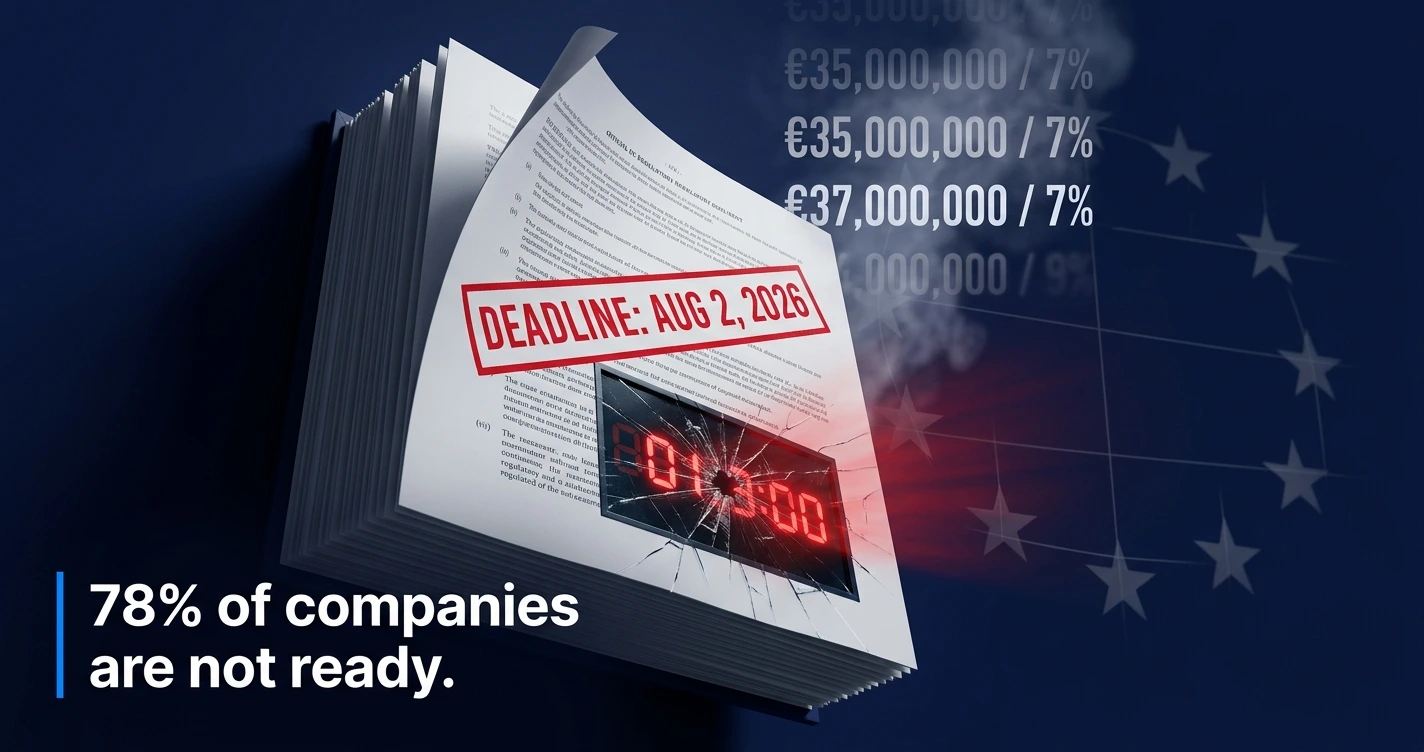
The EU AI Act, Regulation 2024/1689 and the world’s first comprehensive AI legal framework, has been enforcing prohibited practices since February 2025. GPAI model obligations have been live since August 2025. And the original high-risk AI deadline of August 2, 2026 is now roughly 70 days away as you’re reading this. Whether or not the Omnibus extension becomes law before that date, enforcement infrastructure is active, national authorities are operational, and the first criminal prosecution under the Act’s framework is already in the French courts.
This guide covers every deadline, every fine tier, every compliance action, updated as of May 24, 2026. If you’re a CTO, legal officer, or founder with EU users, here’s everything you need to act on Monday.
The May 7 Deal That Changed Everything
The EU AI Omnibus agreement, reached after six months of negotiations, is the most significant amendment to the AI Act since it passed. The headline change: the compliance deadline for high-risk AI systems under Annex III has been extended from August 2, 2026 to December 2, 2027. High-risk AI embedded in regulated products under Annex I gets until August 2, 2028.
Why did it happen? Latham and Watkins’ analysis puts it plainly: the extension responds to delayed harmonized standards, unclear governance structures, and heavier-than-expected compliance costs. In other words, the EU’s own implementation infrastructure wasn’t ready. The Omnibus wasn’t a strategic gift to industry. It was a rescue operation.
Critical Caveat: The Omnibus still requires formal endorsement and adoption before it becomes law. The August 2, 2026 deadline remains the operative legal deadline until formal adoption is complete. Do not treat the extension as guaranteed.
The deal also adds a new prohibition: “nudifier” AI applications capable of generating harmful intimate imagery, including CSAM, are now explicitly banned under the Act’s prohibited practices framework.
“A complete sectoral shift would fragment the AI Act’s horizontal framework into twelve separate compliance logics… I think it’s important we explore alternatives with Council.”
Brando Benifei, MEP and Lead AI Omnibus Negotiator, European Parliament (IAPP, April 2026)
Benifei’s comment reveals the deliberate architecture of the deal: the core legal structure of the Act was preserved intact. Simplification happened at the margins, on timelines, not obligations. The compliance work hasn’t changed. The clock has.
Full EU AI Act Enforcement Timeline
Deadline
What Applies
Status
Feb 2, 2025
Article 5 prohibited AI practices banned: social scoring, subliminal manipulation, real-time biometric identification in public spaces
Enforced
Aug 2, 2025
GPAI model obligations live. GPT-4, Claude, Gemini, and all foundation models must comply. EU AI Office governance active.
Enforced
Aug 2, 2026
Original Annex III high-risk AI deadline (operative until Omnibus is formally adopted)
~70 days
Dec 2, 2026
Watermarking and synthetic content disclosure for generative AI features
7 months away
Dec 2, 2027
Annex III standalone high-risk AI, under AI Omnibus deal (pending formal adoption)
Omnibus extension
Aug 2, 2028
High-risk AI embedded in regulated products (Annex I)
Omnibus extension
What’s Already Enforced Right Now
Before discussing what’s coming, understand what’s already active. Two major compliance waves have passed. If your organization hasn’t addressed them, you’re not preparing for the AI Act. You’re already in violation of it.
Prohibited Practices (Since February 2025)
Under Article 5, six categories of AI are flatly banned across the EU: social scoring systems, subliminal manipulation techniques, exploitation of vulnerable groups, real-time biometric identification in public spaces (with narrow law enforcement exceptions), emotion recognition in workplaces and schools, and, added by the Omnibus, nudifier applications. Investigations for workplace emotion recognition violations are already underway across multiple member states.
GPAI Model Obligations (Since August 2025)
If you provide or deploy a general-purpose AI model, meaning any LLM or foundation model capable of performing a wide range of tasks, you’ve been under obligation since August 2, 2025. In August 2025, 26 major AI providers signed the GPAI Code of Practice, including Microsoft, Google, Amazon, OpenAI, and Anthropic. Meta refused and now faces enhanced regulatory scrutiny from the EU AI Office.
The First Enforcement Case: Already in Court
On February 3, 2026, French prosecutors raided X’s Paris offices in a criminal investigation into Grok’s deepfake capabilities. Elon Musk and former CEO Linda Yaccarino were summoned for questioning in April. The case covers seven criminal offenses including creating sexual deepfakes, Holocaust denial, and operating an illegal platform as part of an organized criminal enterprise.
The precedent this sets: The behavior under scrutiny occurred in 2025. The criminal exposure materialized in 2026. Enforcement authorities will investigate backward in time. Your historical practices create present liability, not just your future ones.
High-Risk AI: Are You In Scope?
The most consequential classification decision your organization faces is this one: does your AI system qualify as high-risk under Annex III? Get it wrong in either direction and you either face penalties for non-compliance or waste millions over-engineering unnecessary conformity assessments.
Annex III defines eight categories of high-risk AI:
Biometric identification and categorization
Critical infrastructure management
Education and vocational training
Employment, worker management, and access to self-employment
Access to essential private and public services (credit scoring, insurance, healthcare triage)
Law enforcement
Migration, asylum, and border control
Administration of justice and democratic processes
The same underlying AI model can be minimal-risk as a customer service chatbot and high-risk if the identical model ranks job applicants or routes insurance claims. Context, deployment purpose, and actual use determine classification. Not technology architecture.
“‘It is just a chatbot’ is not a legal analysis. For Annex III systems, classification turns on intended purpose, function, use context and how the system is actually deployed… If there is no approved note explaining why a system is or is not high-risk, the decision is not strong enough to defend.”
IAPP Compliance Analyst, International Association of Privacy Professionals (IAPP, May 2026)
A 2026 study by the appliedAI Institute of 106 enterprise AI systems found 18% were clearly high-risk, while 40% had unclear classifications, concentrated in critical infrastructure, employment, law enforcement, and product safety. That 40% figure is alarming: it means nearly half of enterprise organizations genuinely cannot determine their own compliance status.
EU AI Act Fines, Penalties and Market Withdrawal
The EU AI Act doesn’t just fine companies. It can pull their products from EU markets entirely, a power GDPR never had. For SaaS companies, a single enforcement action could zero out European revenue overnight.
Violation Type
Maximum Fine
GDPR Comparison
Prohibited AI practices (Article 5)
35M euros or 7% global turnover
Exceeds GDPR ceiling
High-risk AI non-compliance
15M euros or 3% global turnover
Comparable to GDPR
Providing false information to regulators
7.5M euros or 1% global turnover
Below GDPR max
GPAI model violations
15M euros or 3% global turnover
New, no GDPR parallel
Always the higher of the two values applies. Italy’s AI Law (Law No. 132/2025, in force October 10, 2025) adds criminal liability under Decree 231, including disqualifying measures for up to one year. Finland became the first EU member state with full AI Act enforcement powers on December 22, 2025.
78%
of organizations have not taken meaningful steps toward AI Act compliance (Vision Compliance, April 2026)
18%
of organizations have fully implemented AI governance frameworks, despite 88% using AI operationally (ai2.work, Feb 2026)
40%
of enterprise AI systems have unclear risk classifications (appliedAI Institute, 2026)
50K euros
maximum cost of a conformity assessment per high-risk AI system, plus 20K to 50K euros in legal fees (SQ Magazine, April 2026)
The EU AI Act Compliance Checklist
Print this. Send it to your engineering lead. The conformity assessment process alone takes 6 to 12 months for a well-prepared organization. Starting after mid-2026, even with the Omnibus extension, means building extreme execution risk into your schedule.
Step 1: Build Your AI System Inventory
Identify every AI system in use across the organization, including third-party tools, APIs, and embedded models
Document each system’s intended purpose, deployment context, and actual use case
Flag any system touching employment decisions, credit, insurance, healthcare triage, law enforcement, or biometrics as high-risk candidates
Establish a process to capture new AI systems as they ship. Inventory is continuous, not a one-time audit.
Step 2: Classify Each System by Risk Tier
Conduct formal written classification analysis for each system. Verbal assessments do not satisfy documentation requirements.
Determine operator vs. deployer role for each system, as obligations differ significantly
Document classification rationale with approved sign-off, not just internal consensus
Step 3: For High-Risk AI, Technical Compliance
Implement automatic logging of all system events under Articles 12 and 13. Logs must enable tracing back to specific inputs and decisions.
Define log retention periods appropriate to the system’s sectoral law requirements
Design human oversight into the system architecture. The system must be stoppable, overridable, and actively monitored.
Prepare technical documentation and conformity assessment package (budget 6 to 12 months of engineering time)
Determine whether your system requires a third-party notified body, required for roughly 30 to 40% of high-risk systems
Step 4: GPAI and Generative AI, Immediate Actions
If you deploy any LLM or foundation model in the EU, compliance is required now, not in 2027
Implement watermarking and synthetic content disclosure for all generative AI features before December 2, 2026
Review copyright compliance for training data if you’re a model provider
If training compute exceeds 10 to the power of 25 FLOPs, you face systemic risk obligations including adversarial testing and incident reporting
Step 5: Governance Infrastructure
Appoint an AI compliance owner with documented authority
Establish an AI literacy program for staff interacting with AI systems (Article 4 requirement)
Build incident response and reporting procedures for AI system failures
If operating in Italy, review criminal liability exposure under Law No. 132/2025 specifically
Monitor national authority developments across all EU markets where you operate. There are 27 separate enforcement environments.
The Uncomfortable Truths About EU AI Act Compliance
Any compliance guide that only tells you what to do, without acknowledging what’s broken about the framework you’re trying to comply with, isn’t being straight with you.
The Commission Missed Its Own Deadline
The Commission was legally required to publish final guidelines on high-risk AI classification by February 2, 2026. That deadline was missed. As of late May 2026, those guidelines exist only in draft form, published 15 months after the Act entered into force. Companies are being asked to classify their AI systems according to rules the regulator hasn’t finished explaining. That’s not a compliance failure by industry. It’s a design failure by the Commission.
The SME Cost Is Existential
“These burdensome regulations put AI companies at a competitive disadvantage by driving up compliance costs, delaying product launches, and imposing requirements that are often impractical or impossible to meet.”
Oliver Roberts, Attorney, Holtzman Vogel (Bloomberg Law, February 2025)
For a startup deploying a single high-risk AI system, a 50,000 euro conformity assessment plus 20,000 to 50,000 euros in legal fees isn’t regulatory overhead. It’s potentially existential. Documentation preparation alone accounts for up to 40% of total assessment costs. The requirement for detailed logging creates genuine data storage and privacy exposure that larger enterprises can absorb and smaller ones often can’t.
Enforcement Will Be Fragmented and Unpredictable
There are 27 national enforcement authorities with different legal traditions, resource levels, and political priorities. Italy has criminal liability statutes. France has prosecutorial infrastructure that moved on X within months. Other member states are still establishing their market surveillance authorities. If you operate across the EU, you’re operating across 27 different enforcement environments under one regulation that doesn’t resolve those differences for you.
The Delay Doesn’t Mean Wait
The temptation, with a 16-month extension in hand, is to defer. That’s the wrong read. The hard compliance work, covering inventory, classification, technical documentation, and logging architecture, doesn’t get easier with time. Organizations starting compliance programs after mid-2027 won’t have months to refine. They’ll have weeks. The Omnibus extension buys time to do the work well. Not time to avoid doing it.
FAQ: What Everyone Is Searching Right Now
What is the EU AI Act compliance deadline in 2026?
The operative legal deadline for high-risk AI under Annex III remains August 2, 2026, until the AI Omnibus is formally adopted. A provisional political agreement reached May 7, 2026 would extend this to December 2, 2027, but formal adoption is still pending. Prohibited AI practices have been enforced since February 2, 2025. GPAI obligations have been active since August 2, 2025.
Does the EU AI Act apply to US, UK, and Australian companies?
Yes. The EU AI Act has extraterritorial scope identical to GDPR. Any company whose AI system’s output reaches EU users, through direct sales, SaaS subscriptions, APIs, or downstream integrations, is in scope. Non-EU companies face identical fines and the same risk of market withdrawal orders as EU-based organizations.
What are the EU AI Act fines and penalties?
Fines operate on three tiers: up to 35 million euros or 7% of global annual turnover for prohibited AI practices; up to 15 million euros or 3% for high-risk system non-compliance; up to 7.5 million euros or 1% for providing false information to regulators. Always the higher of the two values applies. These exceed GDPR maximums. Market withdrawal, unavailable under GDPR, is an additional enforcement tool.
What AI systems are considered high-risk under the EU AI Act?
High-risk AI falls into eight Annex III categories: biometrics, critical infrastructure, education and training, employment and worker management, access to essential services (credit, insurance, healthcare), law enforcement, migration and border control, and administration of justice. Context determines classification. The same model can be minimal-risk as a chatbot and high-risk if used to rank job applicants.
What is the EU AI Omnibus and what did it change?
The EU AI Omnibus is a package of amendments to the AI Act agreed provisionally on May 7, 2026. It extends the Annex III high-risk deadline from August 2, 2026 to December 2, 2027, and Annex I embedded systems to August 2, 2028. It adds a ban on nudifier applications. Core obligations, including logging, oversight, documentation, and conformity assessment, are unchanged. Formal adoption is still pending.
What is a GPAI model under the EU AI Act and do I need to comply?
A General-Purpose AI model is any large model trained on broad data capable of wide-ranging tasks, primarily LLMs and foundation models. If you provide or deploy one affecting EU users, obligations covering transparency, documentation, and copyright compliance have been in force since August 2, 2025. Models trained above 10 to the power of 25 FLOPs face additional systemic risk requirements including adversarial testing and incident reporting.
Does the EU AI Act have SME exemptions?
The AI Act includes lighter obligations for SMEs in some procedural areas, and the EU AI Office provides compliance support tools. However, the core obligations, covering risk classification, technical documentation, and conformity assessment for high-risk systems, apply to SMEs deploying or providing high-risk AI. There is no blanket SME exemption from substantive requirements.
What the Next 18 Months Actually Look Like
Here’s the honest forward view. The Commission’s classification guidelines will be finalized, probably before the end of 2026. National enforcement authorities will complete their buildout across most member states by early 2027. The first high-risk AI system enforcement actions, separate from the X/Grok criminal case, will likely arrive in the second half of 2027, targeting the clearest Annex III violators: employment AI, credit scoring systems, and biometric tools deployed without proper documentation.
The Brussels Effect will continue. Companies building for global markets will build to EU AI Act standards regardless of where they’re headquartered or where their users are concentrated. This is already shaping product decisions in San Francisco, London, and Sydney.
Three things to watch and act on now:
Commission classification guidelines final status. Still in draft as of publication; formal issuance changes your classification certainty significantly.
AI Omnibus formal adoption date. The August 2026 deadline remains operative until the deal is legally adopted; track this weekly.
Your December 2, 2026 watermarking deadline. If you ship any generative AI feature into the EU, synthetic content disclosure is a hard engineering deadline just seven months away.
The EU AI Act is the most consequential digital regulation since GDPR and by several measures more demanding. The companies that emerge from this compliance cycle in strong position won’t be the ones who started latest. They’ll be the ones who built inventory, governance, and documentation discipline before they needed it.
Stay Ahead of AI Regulation
The Neural Loop delivers the week’s most important AI policy, research, and business developments, every Friday, no noise.
Subscribe to The Neural Loop
AI Governance Framework Enterprise 2026 — NeuralWired
CYBERSECURITYPublished: May 15, 2025 · Updated: May 2026
AI Governance Framework for Enterprise: The NIST-Aligned 6-Step Guide for CISOs in 2026
Three in four CISOs have already found unsanctioned AI running in their environments. Here’s the framework to govern it before the EU AI Act enforcement deadline finds you first.
Three out of four CISOs have already discovered unsanctioned AI tools operating inside their enterprise environments — and another 16% aren’t sure, which is functionally the same problem (Saviynt / Cybersecurity Insiders CISO AI Risk Report 2026). Only 21% of organizations have a mature governance model for AI agents (Deloitte State of AI 2026). That gap, AI proliferating across the enterprise while governance covers almost none of it, is where the next major breach is already forming.
The EU AI Act’s enforcement deadline for high-risk AI systems is August 2, 2026. The NIST AI RMF has moved from voluntary guidance to a de facto regulatory reference point, already cited in Colorado, Connecticut, and Illinois legislation as a compliance safe harbor. And AI-related breaches now average $4.88 million, the highest figure in history (IBM Cost of Data Breach 2025).
This guide gives CISOs, CTOs, and compliance leaders the practical enterprise AI strategy foundation they need: a NIST-aligned 6-step AI governance framework for enterprise that’s defensible in a board meeting, ready for an EU AI Act audit, and operational from week one.
Why AI Governance Is Now a Board-Level Emergency, Not Just an IT Problem
The numbers from the front lines are stark. According to the Saviynt / Cybersecurity Insiders CISO AI Risk Report 2026, 92% of enterprises currently lack full visibility into their AI identities, and 95% say they doubt they could detect or contain AI misuse if it happened. These aren’t projections or theoretical exposure metrics. This is the operating reality of most enterprises right now.
“By 2028, 25% of enterprise breaches will be attributable to AI agent abuse — from both external attackers and malicious insiders.”
Gartner, 2026 AI Security Forecast
The boardroom pressure is accelerating alongside that risk. 34% of chief executives now identify AI as their single top strategic theme, surpassing digital transformation after more than a decade at the top of CEO priority lists (Gartner CEO Survey 2026). Boards are approving AI initiatives at speed. The governance infrastructure to manage those initiatives, in most organizations, doesn’t exist yet. That’s the definition of operational risk.
Shadow AI Is the Immediate Trigger
Shadow AI — GenAI tools deployed without IT or security awareness — isn’t limited to browser-based writing assistants. These tools often arrive with embedded credentials, OAuth tokens wired directly into Salesforce and SAP, and API integrations that bypass every security control the organization thought it had in place. Shadow AI was a contributing factor in 20% of data breaches in 2025, adding an average of $670,000 to incident costs (IBM Cost of Data Breach 2025). DTEX and Ponemon’s 2026 Insider Threat Report puts the annual cost of shadow AI to organizations at $19.5 million on average, making it the top driver of negligent insider incidents this year.
Five Questions Every CISO Must Now Answer to the Board
If your leadership team can’t answer all five of these without preparation time, the gaps this article closes are yours to own:
What percentage of AI usage across the organization is currently sanctioned and documented?
Are our active AI deployments aligned to ISO 42001 or NIST AI RMF controls?
Do vendor contracts explicitly prohibit corporate data from being used in model training?
When did we last conduct a red-team exercise against a production AI system?
Which business processes are now AI-automated, and who owns accountability for their outputs?
The EU AI Act enforcement hammer lands August 2, 2026. Penalties for high-risk AI non-compliance reach €35 million or 7% of global annual turnover. As of early 2026, only 8 of 27 EU member states had established enforcement bodies — meaning the compliance window is closing while most organizations are still in the discovery phase of their AI governance journey.
What the NIST AI RMF Actually Requires — And What Vendors Won’t Tell You
The NIST AI RMF organizes around four functions. Understanding what they actually demand — versus what vendors claim they cover — is the first step to building governance that holds up under scrutiny.
Function
What It Actually Does
Common Vendor Misrepresentation
GOVERN
Establishes accountability structures, risk culture, and decision rights across the AI lifecycle
Conflated with “AI policy documents” — governance is organizational, not documentary
MAP
Contextualizes each AI use case against its risk profile and stakeholder exposure
Treated as a one-time intake form rather than a continuous classification activity
MEASURE
Quantifies AI risks using consistent scoring and defined metrics across systems
Reduced to model accuracy metrics — ignores bias, reliability, and societal impact dimensions
MANAGE
Operationalizes risk responses and controls across the entire AI system lifecycle
Treated as a final step rather than a continuous loop feeding back into GOVERN
The Voluntary Framework That Isn’t Voluntary
The NIST AI RMF is technically voluntary. In practice, it has effectively become mandatory for any enterprise operating in regulated industries or selling to government buyers. The Federal AI Risk Management Act (HR6936) would mandate it for federal contractors. The Colorado AI Act cites it as a compliance safe harbor. Enterprise procurement teams now require NIST AI RMF alignment as a supplier prerequisite — which means if your customers are large enterprises, your governance posture is their vendor risk problem.
The GenAI Layer Organizations Are Missing
NIST released NIST AI 600-1 in July 2024 — a companion document specifically addressing generative AI risks. It identifies 12 risk categories unique to or exacerbated by GenAI, with more than 200 suggested mitigation actions. If your enterprise AI governance framework predates mid-2024, it almost certainly doesn’t address the GenAI layer at all. That’s the gap most organizations are currently running blind in.
In April 2026, NIST also published a concept note for an AI RMF Profile on Trustworthy AI in Critical Infrastructure — directly relevant to any enterprise operating in finance, healthcare, energy, or utilities. The 60% of IT leaders who cite legacy system integration as their primary AI governance challenge (Deloitte 2026) need to note that the AI RMF isn’t a technology framework. It’s an organizational one. The hardest part isn’t deploying the framework. It’s retrofitting governance accountability onto systems that were never designed for AI oversight.
Step 1: Map Your AI Surface Area — Every Model, Agent, and Data Flow
You can’t govern what you haven’t found. 73% of CISOs are now prioritizing AI identity discovery and inventory as the first operational step in their governance programs (Saviynt 2026) — and the urgency is clear when you consider that 71% say AI tools in their environment already access core systems like Salesforce and SAP, while only 16% govern that access with any meaningful controls. This is where your AI agent sprawl problem lives.
Three Discovery Actions to Run This Week
Analyze CASB logs for LLM API endpoints. Unsanctioned tools leave fingerprints in your Cloud Access Security Broker data. Look for outbound traffic to OpenAI, Anthropic, Cohere, and Mistral API endpoints not associated with approved systems.
Monitor outbound API calls for AI service destinations. Your network perimeter logs capture AI tool usage that employees think is invisible. A single session token to a personal ChatGPT account tied to corporate email is a data governance incident.
Audit browser extensions across the enterprise fleet. A substantial share of shadow AI lives in browser plugins — tools that quietly read page content, clipboard data, and active sessions across every corporate application the employee uses.
Your AI Asset Register: Required Fields
Field
Why It’s Required
System name + Vendor/internal build
Establishes system identity and supply chain accountability
Data accessed (sensitivity tier)
Required for EU AI Act risk classification and NIST MAP function
Business owner + Technical owner
Governance requires dual accountability — IT alone cannot adjudicate business risk
Risk tier (Low / Medium / High)
Drives proportionate control requirements across all downstream steps
Regulatory scope
Maps each system to applicable requirements (EU AI Act, HIPAA, SOX, SEC)
Last governance review date
Creates the audit trail regulators and insurers will request
Retirement criteria
Prevents zombie AI systems from accumulating unmonitored access over time
Classify every tool found through discovery into one of three buckets: Sanctioned (approved, governed, monitored), Tolerated (restricted use with defined guardrails and a time-limited approval), or Prohibited (high-risk or unvetted, requiring immediate decommission or isolation). This three-tier taxonomy maps directly to the NIST AI RMF MAP function.
Step 1 Deliverable: AI Asset Register v1.0 + AI Usage Policy v1.0. The register should list every identified system against the fields above. The usage policy defines the three access tiers and the approval process for each. These two documents are the foundation every downstream governance step depends on.
Step 2: Define Risk Tiers — Not All AI Is Created Equal
Risk-tiering is the foundation of proportionate AI governance. You don’t apply the same controls to an internal writing assistant as you do to an AI system making autonomous credit decisions or flagging employees for performance review. The EU AI Act formalizes three categories — Unacceptable (banned outright), High-Risk (full compliance burden), and General Purpose AI (lighter-touch oversight) — and your internal risk tiers should align to that taxonomy for built-in regulatory readiness.
Enterprise AI Risk Tier Framework
Tier
AI System Profile
Example Systems
Required Controls
Tier 1 — Low
Internal productivity tools, no PII, no decision authority, human-reviewed outputs only
Full NIST AI RMF compliance, continuous monitoring, named CISO sign-off, EU AI Act documentation
The Agentic AI Exception
Agentic AI systems require their own governance tier classification regardless of data sensitivity. An agent that can take actions in the world — send emails, execute code, modify files, call APIs — can cause irreversible harm even when operating on low-sensitivity data. The NIST AI RMF 2026 GOVERN documentation specifically introduces an “Agentic AI Committee” as a new governance body, alongside Agent Owner and Sustainability Officer roles. If you’re deploying AI agents in production without dedicated governance ownership, that’s a Tier 3 risk profile regardless of what the underlying data classification says.
Step 2 Deliverable: AI Risk Classification Matrix — a three-tier table mapping AI system type, data access level, and decision authority to the assigned risk tier. This directly informs which controls every system in your Asset Register now requires.
Step 3: Build Your AI Registry — What’s Running, Who Owns It, What It Can Touch
The average Fortune 500 enterprise runs 3.4 distinct AI agents today. That number is projected to reach 6 to 8 by 2027 (Gartner / McKinsey 2026). Without a formal AI registry, that sprawl becomes ungovernable within 18 months. The registry is the operational spine that makes every downstream process — monitoring, auditing, incident response, compliance reporting — function on fact rather than assumption.
Required Fields for Every AI Registry Entry
System ID + Business owner (not just IT owner): Governance frameworks that assign IT ownership only fail because IT cannot adjudicate business risk trade-offs. Every system needs a named business owner who accepts outcome accountability.
Model and vendor used: Vendor model versions matter for EU AI Act obligations and for understanding when capability changes require governance re-review.
Data flows (input sources and output destinations): Maps directly to the NIST AI RMF MAP function and is required for EU AI Act technical documentation.
Risk tier (from Step 2) + Regulatory obligations: Drives all control requirements and notification timelines.
Human-in-the-loop thresholds: Pre-defined before deployment — not discovered during an incident.
Last model update date + Incident history: Models change. A system that cleared governance review six months ago may be running a substantially different model today.
Retirement criteria: AI systems accumulate privilege over time. Pre-defining when a system should be decommissioned prevents indefinite sprawl.
Third-Party AI Is Not Optional to Include
30% of organizations cite third-party AI vendor handling as their top AI security concern in 2026 — but only 36% have any visibility into how those vendors handle corporate data inside their AI systems (IBM X-Force 2026). Every AI feature embedded in a vendor SaaS product — the Salesforce Einstein layer, the Microsoft Copilot integration, the Workday AI features — belongs in your registry. Your AI governance is only as strong as your vendor governance.
“Shadow AI now costs organizations an average of $19.5 million annually in insider incidents — and it’s the top driver of negligent insider incidents in 2026.”
DTEX / Ponemon 2026 Insider Threat Report
Step 3 Deliverable: AI Registry v1.0 — a living document covering all fields above for every system in your Asset Register. Review cadence: quarterly for Tier 1, monthly for Tier 2, continuously for Tier 3 systems.
Step 4: Set Human-in-the-Loop Thresholds by Risk Tier
Human-in-the-loop governance isn’t a binary on/off switch. It’s a spectrum of decision points, and the governance question is precise: for which AI outputs, at which confidence thresholds, must a human approve before action takes effect? This is the most operationally significant decision in any AI governance program. Getting it wrong in either direction — too much intervention kills productivity, too little creates uncontrolled exposure.
Actions Requiring Mandatory HITL Controls
Action Category
Minimum Tier for HITL Requirement
Control Type
Financial transactions above defined threshold
Tier 2
Named human approver with SLA
Code deployments to production environments
Tier 2
Engineering lead sign-off gate
IAM changes (access grants, privilege escalation)
Tier 2
Identity governance workflow approval
Data exports exceeding defined size or sensitivity
Tier 2
DLP integration + manual review
Decisions with legal, medical, or regulatory consequence
Tier 3
Subject matter expert review, documented
Customer communications in regulated industries
Tier 2
Compliance review queue
Any autonomous agent action outside defined workflow
All tiers
Immediate suspension + incident ticket
The Agentic AI HITL Problem
Only 5% of CISOs feel confident they could contain a compromised AI agent (Saviynt 2026). The core reason is that agents act faster than any human review cycle designed around traditional software. Without pre-defined HITL thresholds established at deployment, no human is ever in the loop until the damage is done. The NIST AI RMF MANAGE function guidance is direct on this point: organizations must continuously re-evaluate whether existing HITL thresholds remain adequate as AI capability changes. A model upgrade that expands an agent’s tool-use capability is a governance event, not just an engineering one.
Step 4 Deliverable: HITL Threshold Policy — a one-page decision matrix defining which AI actions require human approval, mapped by risk tier and action type. Include the named reviewer role and a time-bound SLA for each approval category. This document should be attached to every Tier 2 and Tier 3 entry in your AI Registry.
Step 5: Build Monitoring and Audit Trails for Every AI Decision
68% of CISOs named continuous monitoring and posture analytics as their top investment priority for 2026 (CISO AI Risk Report 2026). The urgency is justified: two out of three organizations currently take longer than a week to implement controls after identifying new AI risks (Sprinto CISO Pulse Check 2026). At machine-speed attack timelines — the average eCrime breakout time from initial access to lateral movement is now 29 minutes, with the fastest documented case at 27 seconds (CrowdStrike 2026 Global Threat Report) — a one-week response gap isn’t a process inefficiency. It’s a governance failure.
Five Non-Negotiable Monitoring Components
Model performance drift detection. Models degrade silently. Set automated quality baseline alerts so you catch accuracy degradation before it produces a harmful output at scale — not after a user complaint surfaces it.
Data flow logging. Every AI system input and output should be logged with timestamps, user identity, and system state. This is your primary audit trail for both regulatory defensibility and incident investigation.
Prompt injection detection. Prompt injection is the top vulnerability on the OWASP LLM Top 10 2025. Detection requires specialized pattern monitoring that most general-purpose SIEM configurations don’t cover by default.
Anomalous agent behavior detection. An agent acting outside its defined workflow is an immediate incident signal — not a logging event to review in the next sprint.
Privilege drift monitoring. AI identities accumulate access entitlements over time, exactly as human accounts do. Enforce least-privilege with automated access review cycles tied to the AI Registry review schedule.
Audit Trail Requirements for Regulatory Defensibility
Under EU AI Act Articles 11 and 12, high-risk AI systems must maintain complete technical documentation and record-keeping throughout their operational lifecycle. Under SEC cybersecurity disclosure guidance, public companies must demonstrate that AI risk management processes exist and are operational — not just documented. Your monitoring infrastructure and its outputs aren’t just an operational tool. They are your regulatory evidence package when an audit or incident investigation arrives.
The AI Governance Maturity Scale
1Reactive
No inventory. Ad-hoc AI usage. No defined ownership.
2Controlled
Basic inventory + usage policy in place. Most enterprises sit here in 2026.
3Governed
Secure gateway active. Vendor AI assessments enforced. Risk tiers assigned.
4Managed
HITL thresholds defined and active. Continuous monitoring integrated.
5Optimized
Continuous red-teaming. Real-time executive AI risk dashboard. Board-visible posture.
Most enterprises in 2026 sit at Level 2. The 6-step framework in this guide provides the structured path to Level 4 — where risk is actively managed rather than reactively discovered.
Step 6: Build Your AI Incident Response Plan Before You Need It
77% of businesses reported an AI-related security incident in 2024 (Practical DevSecOps 2026). The majority were identified late because teams weren’t configured to recognize AI-specific failure modes. AI failures don’t always announce themselves as breaches. They surface as subtly wrong model outputs, agents taking unexpected actions, or data leaving through a vector that the standard security stack never anticipated.
The 5-Phase AI Incident Response Process
Detect. Automated alerting from the monitoring layer (Step 5) triggers on anomaly. The detection signal should be specific enough to indicate whether this is a performance drift event, a data access anomaly, or a potential adversarial attack — each requires a different response track.
Contain. Immediately restrict the AI system’s access scope. For agentic AI, suspend autonomous execution pending review. Speed here matters: the faster the containment, the smaller the blast radius.
Investigate. Pull complete audit trail logs. Establish what data was accessed, what outputs were produced, and what actions were taken. Map the timeline to determine whether this is an isolated event or a pattern.
Remediate. Patch the model, retrain if data poisoning is detected, update HITL thresholds if threshold breach was the proximate cause. Document every remediation step — this becomes the technical record for regulatory notification.
Post-mortem. Document root cause and the governance gap that allowed the incident to occur. Update the AI Registry entry, notify affected stakeholders, and file regulatory notifications where required under EU AI Act serious incident rules or SEC 4-day disclosure requirements.
Named Roles Every AI IR Plan Must Pre-Assign
Without pre-assigned roles, incident response becomes a coordination failure stacked on top of a technical one. Every AI incident response plan must name before an incident occurs: the Incident Commander (CISO or named deputy), the AI System Owner (from the registry entry), the Legal and Compliance Lead, and the Communications Lead responsible for any customer or regulator notification.
Regulatory Notification Timelines
EU AI Act serious incident reporting requires providers to notify national competent authorities immediately upon becoming aware of a serious incident involving a high-risk AI system. SEC cybersecurity disclosure rules require public companies to report material AI incidents within 4 business days. Having the playbook tested and ready before an incident is the difference between a managed event and a regulatory fine on top of a technical problem. For organizations also learning from measuring AI business value, incident cost data should feed directly into the ROI model.
Step 6 Deliverable: AI Incident Response Playbook — a one-page template covering the 5 phases above, pre-named roles with contact details, regulatory notification timelines by jurisdiction, and an AI-specific failure mode checklist. This is the highest-value single output in this framework. It earns citations from security teams and compliance functions who find it during post-incident reviews.
The 12-Point AI Governance Readiness Checklist (Board-Ready Version)
Print this. Share it in the next board security briefing. If your organization can answer Yes to 12 of 12, you’re in the 21% that has built something defensible. The current industry average is closer to 3 of 12.
#
Governance Checkpoint
Maps To
Industry Status
1
Full AI asset inventory completed and documented
NIST MAP / Step 1
Most: ✗
2
Risk tiers assigned to all AI systems in the inventory
NIST MAP / Step 2
Most: ✗
3
Named business owner (not just IT) assigned to every AI system
NIST GOVERN / Step 3
~80%: ✗
4
Vendor contracts explicitly prohibit corporate data from model training
Supply Chain / Step 3
~64%: ✗
5
HITL thresholds defined per risk tier and attached to registry entries
NIST MANAGE / Step 4
~95%: ✗
6
Continuous monitoring active for all Tier 2 and Tier 3 AI systems
NIST MEASURE / Step 5
Most: ✗
7
Prompt injection detection implemented in production AI systems
OWASP LLM Top 10
~76%: ✗
8
AI-specific incident response playbook written and tested in the past 12 months
NIST MANAGE / Step 6
Most: ✗
9
EU AI Act risk classification completed for applicable systems
EU AI Act Compliance
~30%: ✓
10
Shadow AI discovery scan completed within the past 30 days
CISO Visibility
~73%: ✗
11
AI red-team exercise conducted in the past 12 months
NIST MEASURE
Most: ✗
12
Board can articulate AI risk posture without CISO present
Governance Maturity
Rare: ✗
If you answered No to more than 4 of these, your organization is among the 79% facing meaningful AI governance exposure in 2026. The 6-step framework in this article closes those gaps systematically — in order, with a named deliverable at each stage.
What to Watch
01
EU AI Act enforcement for high-risk AI systems begins August 2, 2026. Watch for the first wave of enforcement actions from member states that have established competent authorities — these will set precedent for penalty calculation and what “technical documentation” must actually contain.
02
NIST is expected to finalize the AI RMF Profile for Critical Infrastructure by Q3 2026. Organizations in finance, healthcare, energy, and utilities should track this actively — it will tighten the GOVERN and MEASURE function requirements for sectors regulators classify as critical.
03
Agentic AI governance is moving from concept to contract requirement. Watch for enterprise procurement frameworks to begin requiring suppliers to certify Tier 3 AI governance controls — including HITL policies and incident response playbooks — as a standard vendor risk questionnaire item by late 2026.
Frequently Asked Questions
What is an AI governance framework for enterprise?
An enterprise AI governance framework is a structured set of policies, processes, roles, and controls that organizations use to manage the risks, compliance requirements, and accountability for AI systems across their operations. The NIST AI RMF — organized around the Govern, Map, Measure, and Manage functions — is the leading voluntary standard and de facto regulatory reference point for building one in 2026. It’s complemented by ISO 42001, which provides a certifiable management system structure that enterprise procurement and supply chain requirements increasingly require.
Is NIST AI RMF compliance mandatory in 2026?
The NIST AI RMF is technically voluntary, but it has become mandatory in practice for most enterprises. The Colorado AI Act cites it as a compliance safe harbor. Federal contractors face mandates under HR6936. Enterprise procurement teams now require NIST AI RMF alignment as a supplier prerequisite, which means if your customers are large enterprises or government buyers, your AI governance posture directly affects your ability to win and retain contracts.
What is shadow AI and why is it such a significant governance risk?
Shadow AI refers to unsanctioned AI tools deployed without IT or security awareness — employees using personal accounts for AI services, teams enabling AI features inside SaaS platforms without review, or developers testing autonomous agents without approval. 75% of CISOs have already found shadow AI running in their environments (Saviynt 2026). It contributed to 20% of data breaches in 2025 and adds an average $670,000 to breach costs. Beyond direct breach risk, shadow AI creates regulatory exposure when those unsanctioned tools process data that falls under GDPR, HIPAA, or EU AI Act scope.
What are the EU AI Act penalties for non-compliance in 2026?
Enforcement for high-risk AI systems under the EU AI Act begins August 2, 2026. Penalties for using prohibited AI systems reach €35 million or 7% of global annual turnover, whichever is higher. For other violations of high-risk AI system obligations, fines reach €15 million or 3% of global turnover. For providing incorrect or misleading information to authorities, €7.5 million or 1.5% of turnover. These penalties apply to both providers and deployers of AI systems, which means enterprises using third-party AI tools in high-risk contexts share compliance responsibility.
What should be included in an enterprise AI incident response plan?
An AI incident response plan must cover five phases: automated detection (with AI-specific anomaly triggers), containment procedures including agent suspension protocols, audit trail retrieval and investigation process, remediation steps covering model patching and retraining, and post-mortem documentation with regulatory notification. It must pre-assign named roles — Incident Commander, AI System Owner, Legal Lead, and Communications Lead — before an incident occurs. Regulatory notification timelines must be built into the playbook: EU AI Act requires immediate notification to national authorities for serious incidents, and SEC rules require material AI incident disclosure within 4 business days for public companies.
How do you build an AI asset registry for enterprise?
An AI asset registry captures: system name and vendor or build origin, data the system accesses with sensitivity tier, named business and technical owner, assigned risk tier, regulatory obligations, defined HITL thresholds, last model update date, incident history, and retirement criteria. Critically, the registry must include AI features embedded in vendor SaaS products — Salesforce Einstein, Microsoft Copilot, and similar tools — not just systems built internally. Third-party AI features are often the largest governance blind spot, with only 36% of organizations having any visibility into how vendors handle corporate data inside their AI systems.
How is NIST AI RMF different from ISO 42001?
NIST AI RMF identifies what AI risks to address and provides a risk management structure across four functions (Govern, Map, Measure, Manage). ISO 42001 is a certifiable AI management system standard that specifies how to implement governance at the organizational level — it produces a certificate that can be presented to customers, regulators, and supply chain partners as evidence of governance maturity. They’re complementary: use NIST AI RMF for risk identification and control design, use ISO 42001 for certification and supply chain trust. Enterprise procurement increasingly requires demonstrated alignment to both.
What makes AI incident response different from standard cybersecurity IR?
Standard IR frameworks are built around detecting unauthorized access and data exfiltration. AI incidents often don’t fit that pattern. They can manifest as model outputs that are subtly wrong at scale, agents executing unexpected actions within fully authorized access scopes, or data flowing through generative model interactions in ways that existing DLP tools don’t monitor. 77% of businesses reported an AI-related incident in 2024, and most were identified late because teams weren’t looking for AI-specific failure modes. AI IR also carries distinct regulatory notification obligations — the EU AI Act’s serious incident reporting requirements apply regardless of whether the incident involves a traditional breach.
Stay ahead of enterprise technology.
NeuralWired delivers weekly intelligence for CTOs, CISOs, and AI leads — no noise, no filler.
Trump’s CLARITY Act needs 60 Senate votes today, and Republicans are still nine Democrats short. Here’s why this obscure procedural vote could decide whether crypto gets real regulation, or none at all, for years.
Anthropic CEO Dario Amodei says the AI industry has 6 to 12 months to slow capability growth before an agent swarm could take over the internet. Here’s his three-step Pace the Frontier plan, why Sam Altman and Elon Musk both agreed within hours, and why critics call it regulatory capture.
Rhysida just dumped 1.4 million stolen Berlin government files on the dark web after the city refused a €2 million ransom. The real story isn’t the phishing attack that got hackers in, it’s the unchecked vendor access that let the damage spiral this far.
An AI agent chained two PaperCut vulnerabilities to breach 440 organizations across 48 countries, some in under 30 seconds. Here’s how the PaperCut AI attack unfolded, the toolkit behind it, and the exact patch steps security teams need before the CISA deadline.
Micron and SK Hynix are cashing in on the 2026 AI memory shortage, but Amazon, Meta, and Microsoft are quietly absorbing the same shortage as hidden debt and depreciation risk. Here’s what the split means for AI data center stocks and Big Tech balance sheets next.