Tag: GenerativeAI

  • Generative AI in Cybersecurity: IBM’s 2026 Threat Reality

    Generative AI in Cybersecurity: IBM’s 2026 Threat Reality

    Generative AI in Cybersecurity 2026: The Weapon Defending and Attacking You at the Same Time
    NeuralWired  |  AI & Technology Intelligence for Security Leaders
    Cybersecurity Intelligence  /  Deep Analysis

    Generative AI in Cybersecurity: The Weapon Defending and Attacking You at the Same Time

    Generative AI has fractured cybersecurity into two simultaneous realities. It is the most powerful defensive tool deployed at enterprise scale, and the cheapest offensive weapon ever handed to criminals. Here is the honest picture, with numbers.

    By NeuralWired Research Desk  •  Published: May 31, 2026  •  Last Updated: May 31, 2026  •  14 min read

    $12.87B GenAI Cybersecurity Market 2025
    5 min To craft an AI phishing email (was 16 hrs)
    80 days Shorter breach lifecycle with AI defense
    94% Of security leaders say AI is #1 change driver

    The Core Paradox of 2026

    A financial services firm in Frankfurt tightened its breach lifecycle by 80 days last year. Its AI-powered security operations center caught a credential-stuffing campaign at 2 a.m. with no human analyst in the loop. The same quarter, one of its treasury executives received a video call from what appeared to be the CFO, instructing a wire transfer. The voice was real. The face was real. Neither was human.

    This is the defining tension of generative AI in cybersecurity right now. The same technology compressing your incident response timeline is compressing an attacker’s phishing production pipeline. The World Economic Forum Global Cybersecurity Outlook 2026, drawing on 804 respondents across 92 countries including 316 CISOs, found that 94% of security leaders identify AI as the most significant driver of change in their field. The same report found that 87% flagged AI vulnerabilities as the fastest-growing cyber risk throughout 2025.

    Both numbers refer to the same technology. That is not a contradiction. That is the story.

    Our Read
    This signals something the vendor community is reluctant to say plainly: investing in AI for defense does not reduce your exposure to AI as an attack vector. It changes the nature of the fight. Organizations that grasp this distinction will build genuinely resilient security postures. Those chasing “AI-powered security” as a procurement category will be left exposed in ways their tools cannot detect.


    How Generative AI Is Used in Cybersecurity

    Generative AI in cybersecurity refers to the application of large language models and generative systems to automate threat detection, accelerate incident response, generate synthetic attack scenarios for red teaming, analyze vulnerabilities, and craft adaptive security policies. It powers security operations centers (SOCs) by triaging alerts, reducing analyst workload, and identifying anomalous behavior in real time. (Sources: IBM, Fortinet, WEF GCO 2026)

    On Defense: What the Numbers Actually Show

    The IBM Cost of a Data Breach Report 2025, now in its 20th year and covering 600 organizations across 17 industries and 16 countries, produced the most credible measurement of AI’s defensive ROI to date. Organizations using AI extensively in their security operations cut their breach lifecycle by 80 days and saved nearly $1.9 million on average per breach, compared to organizations that did not.

    The global average breach cost fell 9% to $4.44 million in 2025, the first decline in five years. That is the headline. The subtext is more important: the U.S. average breach cost rose to a record $10.22 million, up from $9.36 million in 2024. The organizations pulling the average down are those investing in AI-augmented detection and response. The ones pulling it up are those that are not.

    Specific Use Cases That Are Working Now

    Across platforms from IBM Security QRadar to CrowdStrike and Palo Alto Networks (named by MarketsandMarkets as the dominant players in this market), the applications generating real operational value in 2026 include the following.

    Use Case What It Does Maturity Level
    AI-assisted alert triage Filters noise, prioritizes high-fidelity incidents, reduces analyst fatigue Production-ready now
    GenAI phishing detection Identifies AI-crafted emails via behavioral and linguistic pattern analysis Production-ready now
    Synthetic red teaming Generates adversarial attack scenarios at scale for penetration testing Production-ready now
    Vulnerability auto-remediation Identifies and patches insecure code in development pipelines Scaling fast (Gartner: 40% of dev teams by end of 2026)
    Autonomous SOC response Full end-to-end incident containment without human input Aspirational. 3 to 5 years from reliable deployment.
    Gartner projects that by the end of 2026, 40% of development teams will routinely use AI-based auto-remediation for insecure code. That figure was under 5% in 2023. The acceleration is real. So is the risk it carries.


    AI Cybersecurity Threats 2026: How Attackers Are Using It

    One statistic from IBM’s 2025 breach report has become the most visceral data point in enterprise security conversations this year. Generative AI has reduced the time required to craft a convincing phishing email from 16 hours to 5 minutes. That is not an incremental efficiency gain. It is a structural change to the economics of social engineering at scale.

    According to IBM’s findings, 1 in 6 breaches in 2025 involved attackers using AI. Phishing was the primary method at 37% of AI-assisted attacks, followed by deepfake impersonation at 35%. These are the first statistics of their kind at scale, and they represent a floor, not a ceiling.

    “Defenders will likely see threat actors use agentic AI in an automated fashion as part of intrusion activities, continue AI-driven phishing campaigns, and continued development of advanced AI-enabled malware. They’ll use agentic AI to implement hacking agents that support their campaigns through autonomous work.”

    Alex Cox, TIME Director and AI Working Group Lead, LastPass (TechNewsWorld, January 2026)

    The Speed Problem Is Now Structural

    FortiGuard Labs’ 2025 cyberthreat data shows that newly discovered vulnerabilities are now being weaponized in an average of 4.76 days, a 43% increase in speed compared to prior periods. The window between a CVE being published and an attacker having a working exploit is now smaller than most organizations’ patch cycles by a significant margin.

    This is where generative AI’s role in offense is most concrete and most dangerous. It is not creating fundamentally new classes of malware (the Picus 2025 Red Report found no notable uptick in AI-driven malware innovation in 2024). It is compressing the timeline of every phase of an attack, from reconnaissance to exploitation to lateral movement.

    Critical Risk Flag
    Deepfake executive impersonation is now technically feasible at enterprise scale according to Palo Alto Networks’ 2026 cybersecurity predictions. Real-time AI video and voice replicas of your C-suite require organizations to retire any multi-factor authentication method tied to voice or video verification immediately. This is not a 2027 concern.


    Shadow AI: The $670,000 Threat Nobody Is Governing

    Shadow AI refers to the unauthorized use of AI tools such as ChatGPT, Claude, or Gemini by employees without IT approval or oversight. It creates security risk because sensitive data may be uploaded to external platforms without data loss prevention controls in place. IBM’s 2025 breach data found that shadow AI adds an average of $670,000 to breach costs per incident, placing it among the top three costliest breach factors, displacing skills shortages from that position for the first time.

    13% of organizations in IBM’s study experienced AI-specific breaches. Of those, 97% lacked basic security controls for their AI systems at the time of breach. Role-based access governance, data classification, and output monitoring were absent in nearly every case.

    Shadow AI is no longer an HR policy issue. It is a board-level financial governance issue. If that framing hasn’t reached your leadership team yet, the IBM numbers are the vehicle.

    You can read more about AI system integrity risks and the specific failure modes of autonomous AI systems in NeuralWired’s analysis of AI agent document corruption, which details exactly how unsanctioned agentic systems corrupt enterprise data flows in ways that are difficult to detect and expensive to remediate.

    What the WEF Data Shows
    64% of organizations are now assessing the security of AI tools before deployment, up from 37% in 2025 according to the WEF Global Cybersecurity Outlook 2026. Governance is accelerating. But 36% of organizations are still deploying AI tools with no formal security assessment. In a market where shadow AI already costs an average of $670,000 per breach, that gap represents enormous, quantifiable financial risk.


    Agentic AI and the Next Escalation

    Agentic AI in cybersecurity refers to AI systems that autonomously execute multi-step tasks including scanning for vulnerabilities, crafting exploits, or orchestrating attack campaigns without constant human direction. In 2026, both defenders and attackers are integrating agentic AI: defenders for autonomous SOC response and threat hunters, threat actors for fully automated intrusion operations. (Sources: OWASP, WEF 2026, Darktrace)

    Darktrace’s State of AI Cybersecurity 2026 report, drawing on more than 1,500 security leaders, captures the shift in a single sentence: 2025 was the year enterprise AI went mainstream; 2026 is when it became a full-scale attack surface.

    The deployment of Anthropic’s Project Glasswing, a restricted frontier model with autonomous zero-day research capability deployed with a small set of trusted infrastructure organizations before any public release, represents a strategic threshold. AI can now autonomously discover zero-day vulnerabilities. The question for every CTO in critical infrastructure is: when adversaries gain access to comparable models, what is your baseline threat assumption?

    A concrete illustration of the speed at which AI-powered vulnerability discovery operates: as detailed in NeuralWired’s coverage of CVE-2026-31431, AI found a 9-year-old Linux kernel vulnerability in under one hour. Nine years of human security review missed it. That is not a niche benchmark. That is a preview of what autonomous AI exploit research means at scale for every organization running Linux infrastructure.

    “I expect the sophistication and intensity of cyber threats will continue to increase, as they have year over year. The ever-expanding tech landscape and rise of Adversarial AI means cybersecurity is not just about protecting business value anymore. It’s now a fundamental driver.”

    Adnan Amjad, US Cyber Leader and Partner, Deloitte & Touche LLP

    The Case Against the Hype

    If you’ve sat through a vendor briefing in the past 12 months, you’ve heard the “AI versus AI cyberwar” framing. It is compelling. It also contains a significant amount of motivated reasoning.

    Cybercriminals Are Not Adopting AI as Fast as the Headlines Suggest

    Sophos X-Ops research published in January 2025, based on direct investigation of multiple underground criminal forums, found that criminals are still largely skeptical of generative AI. Most criminal AI use is limited to bulk email generation and data analysis. Novel attack classes powered by AI remain rare. The Picus 2025 Red Report, cited by Ivanti, found no notable uptick in AI-driven malware techniques in 2024, stating directly that “AI enhances productivity but doesn’t yet redefine malware.”

    The practical implication: vendors are financially incentivized to overstate offensive AI capability to justify defensive AI spending. At least half of the AI-versus-AI cyberwar narrative in circulation right now is marketing material dressed as threat intelligence.

    AI Security Tools Create Blind Spots the Industry Isn’t Discussing

    VikingCloud’s October 2025 analysis details a specific and underreported risk. Adversarial machine learning can be used to attack AI security tools themselves through crafted inputs designed to deceive AI classifiers, allowing malware to pass through undetected. Data poisoning attacks can corrupt the training datasets those AI tools depend on, creating systemic blind spots that are invisible to the defenders relying on the system.

    AI hallucinations in security contexts add another dimension. Based on Artificial Analysis’s AA-Omniscience benchmark covering 40 AI models, all but four were more likely to provide a confident, incorrect answer than a correct one on difficult questions. In a SIEM or incident response workflow, a confidently wrong AI verdict doesn’t just delay response. It actively misdirects it. The Hacker News covered this emerging risk in May 2026, noting it is almost entirely absent from vendor marketing materials.

    “As with many other things in life, the mantra should be ‘trust but verify’ regarding generative AI tools. We have not actually taught the machines to think; we have simply provided them the context to speed up the processing of large quantities of data. The potential of these tools to accelerate security workloads is amazing, but it still requires the context and comprehension of their human overseers for this benefit to be realized.”

    Chester Wisniewski, Director and Global Field CTO, Sophos

    Nearly Half of AI-Generated Code Is Already Shipping Vulnerabilities

    This may be the most underappreciated structural risk in enterprise security today. According to Krishna Vishnubhotla, VP of Product Strategy at Zimperium, writing in TechInformed in December 2025: “Nearly half of AI-generated code contains security flaws. We will see more vulnerabilities pushed into production, not fewer.”

    If your engineering teams are using GitHub Copilot, Cursor, or any AI coding assistant at scale (and they are), the velocity gains from those tools may be offset or exceeded by downstream remediation costs from the vulnerabilities they ship. This is detailed further in NeuralWired’s analysis of why AI agents fail in production, which covers the specific failure modes that create enterprise security exposure.

    “Many people have a huge incentive to keep building the infrastructure, but the vibe has changed. Loans will get more expensive, stock prices are coming down, and profits (except for Nvidia) are few and far between.”

    Gary Marcus, NYU Professor Emeritus and AI Critic, co-founder of Robust.AI (Dark Reading, December 2025)
    Marcus is making a broader economic argument: the AI cybersecurity vendor landscape is being propped up by a capital environment that may not persist. Arkose Labs’ 2025 AI Maturity in Cybersecurity Report found that only about half of enterprises had realized measurable benefits from AI security investments despite widespread adoption. The governance gap widens faster than deployment in too many organizations.


    What Security Engineers Must Do Now

    The attack surface now includes the AI stack itself. Every LLM, API integration, plug-in connection, and training pipeline your organization runs is a software layer that must be audited, tested, and governed like any other. If you’re building or maintaining security infrastructure, here is what requires action before the next quarter closes.

    Priority Action: Shadow AI Audit
    Conduct a full inventory of every AI tool accessing company data across all departments. Engineering, HR, finance, and legal are the highest-risk vectors. Do not assume IT-approved tools are the only ones in use. They are not, and IBM’s 2025 data puts the average cost of getting this wrong at $670,000 per breach.

    Beyond shadow AI, there are four actions that move the needle on genuine risk reduction right now.

    First, evaluate AI-native EDR and SIEM tools with behavioral analysis rather than rule-based detection. Pattern-matching rules built for human-speed attacks are structurally insufficient for AI-generated phishing arriving at machine speed. Behavioral analytics and AI-versus-AI detection architectures are the operative requirement, not a future consideration.

    Second, implement the OWASP LLM Top 10 framework for every internal AI tool and every customer-facing AI product. The OWASP GenAI Security Project is the de facto technical standard for GenAI application security risks and is referenced by enterprise security teams globally. If your AI products are not being assessed against this framework, they are not being adequately assessed.

    Third, treat all AI-generated code as high-risk code. Enforce static analysis and adversarial testing pipelines before any AI-generated code reaches production. The Zimperium data on nearly half of AI-generated code containing security flaws is not a prediction. It is a current operational reality for every engineering team using a code copilot.

    Fourth, establish role-based access governance for every AI component in your security stack. IBM’s 2025 data shows 97% of AI-specific breaches lacked basic access controls. This is the single most actionable gap with the clearest remediation path.


    What CTOs Must Understand Now

    The generative AI cybersecurity market sits between $8.65 billion and $12.87 billion in 2025, depending on the methodology used, according to MarketsandMarkets and ResearchAndMarkets respectively. The broader AI in cybersecurity market, which includes all AI categories, reached $34.09 billion in 2025 according to Fortune Business Insights, with North America holding 34.90% of that market. Growth rates across credible forecasters are consistently pegged between 22% and 29% annually through 2031.

    The vendor landscape is consolidating fast. CrowdStrike, Palo Alto Networks, and Fortinet hold the largest product footprints. Decision windows for multi-year platform contracts are narrowing as consolidation removes competitive alternatives. If you are still in evaluation mode on your AI security platform strategy, that window is not staying open.

    The Post-Quantum Threat Has a Shorter Timeline Than You Were Told

    The “harvest now, decrypt later” threat model, where adversaries collect encrypted data today to decrypt when quantum computing matures, is operating on a compressed timeline. AI-accelerated cryptanalysis research is advancing faster than public quantum computing milestones suggest. NIST finalized its first post-quantum cryptography standards in 2024. Organizations have limited runway for cryptographic inventory and migration planning. Begin that inventory now.

    Timeline Realism for AI Security Claims

    The autonomous SOC is 3 to 5 years from reliable deployment at scale. AI-generated malware redefining attack classes is not in evidence yet. Post-quantum cryptography urgency is a realistic and genuine concern. Calibrate your board communications and investment timelines accordingly.

    The G7 Cyber Expert Group issued a formal joint statement in 2025 acknowledging that GenAI, agentic AI, and advanced AI systems present emerging and evolving cybersecurity risks requiring proactive cross-jurisdictional response. That regulatory signal, combined with the EU AI Act’s risk classification requirements now forcing formal security assessments of AI systems in regulated industries, means the compliance architecture around AI security is hardening fast. Organizations that treat AI governance as optional are building technical debt with regulatory interest attached.

    How We Got Here: The Four-Year Arc

    • Pre-2022 AI in cybersecurity meant machine learning for anomaly detection. Pattern matching, SIEM correlation, endpoint behavior analysis. Useful. Narrow. Human-speed attacks, human-speed defense.
    • 2022 to 2023 ChatGPT launches. Natural language AI reaches non-technical threat actors overnight. Phishing, social engineering, and script generation become democratized. The attack surface calculus changes permanently.
    • 2024 First major wave of GenAI-native security products hit enterprise procurement. CrowdStrike, Palo Alto Networks, and Microsoft release AI copilots. OWASP LLM Top 10 is formalized. NIST finalizes first post-quantum cryptography standards. Gartner places AI-powered security operations at the Peak of Inflated Expectations.
    • 2025 IBM documents AI as both defensive asset and attack vector at scale for the first time. Shadow AI becomes a top-3 breach cost factor. G7 issues formal AI cybersecurity statement. Exploit weaponization drops to 4.76 days average.
    • 2026 Agentic AI creates autonomous attack campaigns. Project Glasswing marks the first institutional AI capable of autonomous zero-day research. EU AI Act forces formal security assessments. Cyber-enabled fraud overtakes ransomware as the top CEO concern.

    Key Takeaways

    • Organizations using AI extensively in security operations cut breach lifecycles by 80 days and save an average of $1.9 million per breach (IBM 2025).
    • 1 in 6 breaches in 2025 involved attackers using AI. Phishing leads at 37%, deepfake impersonation at 35%.
    • Shadow AI adds $670,000 to average breach costs. 97% of AI-specific breaches lacked basic access controls.
    • Exploits are being weaponized in 4.76 days on average, a 43% increase in speed. AI-speed defense is not optional.
    • Nearly half of AI-generated code contains security flaws (Zimperium). Engineering velocity gains may be offset by downstream remediation costs.
    • The autonomous SOC is 3 to 5 years from reliable deployment. Human oversight is the operative model in 2026.
    • Post-quantum cryptography migration timelines are being compressed by AI-accelerated cryptanalysis. Begin inventory now.

    FAQ: Generative AI in Cybersecurity

    How is generative AI used in cybersecurity?

    Generative AI is used in cybersecurity to automate threat detection, accelerate incident response, generate synthetic attack scenarios for red teaming, analyze vulnerabilities, and craft adaptive security policies. It also powers security operations centers (SOCs) by triaging alerts, reducing analyst workload, and identifying anomalous behavior in real time. (Sources: IBM, Fortinet, WEF GCO 2026)

    What are the cybersecurity risks of generative AI?

    Generative AI introduces several cybersecurity risks: it enables attackers to generate convincing phishing emails in minutes rather than hours, create deepfake impersonations, and automate malware. For defenders, risks include shadow AI data exposure, AI model poisoning, adversarial inputs bypassing detection, AI hallucinations causing false security verdicts, and governance gaps in unsanctioned AI tool use. (Sources: IBM 2025, WEF 2026, Sophos)

    Can generative AI replace human cybersecurity analysts?

    No. Generative AI augments but does not replace human cybersecurity analysts in 2026. While AI effectively handles Tier 1 alert triage and enrichment, complex incident response, threat hunting, and strategic decisions still require human judgment. IBM’s 2025 data shows AI-human collaboration reduces breach lifecycles by 80 days. Autonomous SOC response at scale remains 3 to 5 years from reliable deployment.

    How are hackers using generative AI to attack organizations?

    Hackers use generative AI primarily to craft convincing phishing emails at scale, a process that once took 16 hours and now takes 5 minutes. They also use AI for deepfake voice and video impersonations of executives, to debug and customize malware, and to automate victim profiling for more targeted social engineering campaigns. (Sources: IBM 2025, Sophos X-Ops)

    What is shadow AI in cybersecurity?

    Shadow AI refers to the unauthorized use of AI tools such as ChatGPT, Claude, or Gemini by employees without IT approval or oversight. It creates security risk because sensitive data may be uploaded to external platforms without data loss prevention controls. IBM’s 2025 report found shadow AI adds an average of $670,000 to breach costs, making it a top-three costliest breach factor.

    What is the market size of generative AI in cybersecurity?

    The generative AI cybersecurity market was valued at approximately $8.65 billion to $12.87 billion in 2025 depending on methodology, with projections ranging from $35 billion to $45 billion by 2030 to 2031. The broader AI in cybersecurity market reached $34.09 billion in 2025. Growth rates are consistently estimated between 22% and 29% CAGR. (Sources: MarketsandMarkets, ResearchAndMarkets, Fortune Business Insights)

    What is agentic AI in cybersecurity?

    Agentic AI in cybersecurity refers to AI systems that autonomously execute multi-step tasks such as scanning for vulnerabilities, crafting exploits, or orchestrating attack campaigns without constant human direction. In 2026, both defenders and attackers are integrating agentic AI: defenders for autonomous SOC response, and threat actors for fully automated intrusion operations. (Sources: OWASP, WEF 2026, Darktrace)


    Where This Leads in the Next 12 to 18 Months

    What you now understand that most of your peers do not yet: generative AI in cybersecurity is not a product category to buy your way into. It is a structural shift in the economics and speed of both attack and defense simultaneously. The organizations winning this transition are not the ones deploying the most AI tools. They are the ones governing the AI they already have.

    Three things to watch in the next 12 to 18 months. First, agentic AI moving from experimental deployment to production-scale SOC integration at the largest financial and critical infrastructure organizations. When it works, it will compress defender response times dramatically. When it fails under novel adversarial conditions (which adversarial ML is specifically engineered to trigger), organizations that have reduced their human analyst capacity will face an unguarded gap. Second, the post-quantum migration timeline shortening faster than the public discourse reflects, driven by AI-accelerated cryptanalysis. Third, regulatory requirements under the EU AI Act and successor G7 frameworks creating mandatory security assessment requirements for AI systems in regulated industries, transforming what is currently a governance best practice into a legal obligation.

    The mantra for 2026 is the one Chester Wisniewski offered at the start of the year: trust but verify. Not just for your AI tools. For the threat intelligence you’re using to justify buying them.

    Get weekly intelligence on AI and cybersecurity delivered to your inbox. No noise. No vendor marketing. Just the analysis that matters.

    Subscribe to The Neural Loop

  • GPT-5 Capabilities: Developer & Founder Guide (2026)

    GPT-5 Capabilities: Developer & Founder Guide (2026)

    GPT-5 Capabilities: The Complete Technical Guide for Developers and Founders (2025–2026)
    AI Models & APIs

    GPT-5 Capabilities: The Complete Technical Guide for Developers & Founders

    Everything that actually matters about OpenAI’s flagship model — benchmarks, pricing, hallucinations, and what it means for your product in 2025–2026.

    NeuralWired Research Desk | May 28, 2026 | 18-min read
    GPT-5 Capabilities Developer Guide Pricing Alert
    On August 7, 2025, OpenAI didn’t just release a new model. It collapsed its entire model portfolio into one, and then the flagship feature broke on launch day. Nine months later, GPT-5 is the engine behind 900 million weekly active users and a $25 billion revenue run rate. This guide separates what GPT-5 actually delivers from what OpenAI wants you to believe it delivers.

    By NeuralWired Research Desk  ·  Updated May 28, 2026

    What Is GPT-5?

    GPT-5 is OpenAI’s flagship large language model, released on August 7, 2025 at 10AM PT. It’s available across ChatGPT (all user tiers), the OpenAI API platform, and the GitHub Models Playground.

    The defining architectural move: GPT-5 is a unified system, a single model that houses a fast conversational sub-model for routine queries and a deep reasoning sub-model (“GPT-5 Thinking”) for complex tasks. A real-time router decides which mode engages, based on query complexity, tool requirements, and signals like a user typing “think carefully about this.”

    Before GPT-5, users had to manually choose between the GPT-4o series (fast, conversational) and the o-series reasoning models (o1, o3, slower, more accurate on math and science). GPT-5 eliminates that decision entirely. Or it was supposed to, the router malfunctioned on launch day, which we’ll get to.

    “It’s like talking to an expert. A legitimate, PhD-level expert in any area you need.”

    Sam Altman, CEO, OpenAI, Pre-recorded press briefing, August 7, 2025
    That PhD-level framing maps to specific benchmarks: 88.4% on GPQA Diamond (graduate-level science) and 67.2% on HealthBench (medical conversations). The claim isn’t hype without data. Whether the data holds up in your production environment is a different question.

    94.6%
    AIME 2025 Math
    74.9%
    SWE-bench Verified
    88.4%
    GPQA Diamond Science
    88%
    Aider Polyglot Coding
    84.2%
    MMMU Multimodal
    67.2%
    HealthBench Medical

    GPT-5 Benchmark Scores: The Complete Breakdown

    Benchmarks are the language enterprises use to justify procurement and the numbers engineers use to set expectations. Here’s what GPT-5 actually scored, source-attributed, with methodology noted.

    Benchmark GPT-5 Score What It Measures Why It Matters
    AIME 2025 94.6% High school olympiad mathematics Stumps most adults. Signals deep reasoning without tools.
    SWE-bench Verified 74.9% Real-world software engineering (bug-fixing) GPT-4.1 scored 54.6% four months earlier — a 20-point jump.
    Aider Polyglot 88% Cross-language coding ability Multi-language production relevance for full-stack teams.
    GPQA Diamond 88.4% PhD-level physics, chemistry, biology Curated to be hard even for the PhDs who wrote the questions.
    MMMU 84.2% Multimodal understanding Image + text reasoning for document-heavy workflows.
    HealthBench 67.2% Clinical conversation quality Benchmark for medical AI deployments in regulated settings.
    The SWE-bench figure deserves special attention. OpenAI’s developer page documents the trajectory: GPT-4o scored 33.2%, GPT-4.1 reached 54.6%, and GPT-5 hit 74.9%, all within a 12-month window. For engineering teams, that isn’t a benchmark number. That’s the delta between “AI assists with code” and “AI autonomously closes GitHub issues.”

    Key Insight
    GPT-5’s token efficiency is a hidden financial story. OpenAI reports 50–80% fewer output tokens than o3 for equivalent performance, meaning if your pipeline previously ran on o3, switching to GPT-5 can cut token costs roughly in half before factoring in any price-per-token differences.

    How GPT-5 Differs from GPT-4o and o3

    The simplest framing: GPT-5 is what you’d get if GPT-4o and o3 had a child that also knew when to think slowly.

    GPT-4o was fast and conversational. o3 was slow and brilliant at math and science. Users had to choose between them depending on the task, a friction point that caused constant miscategorization. GPT-5’s real-time router eliminates that choice.

    Three concrete differences that change day-to-day developer experience:

    1. No manual model selection. The router decides whether to engage fast or deep reasoning based on query complexity. In practice, this works better for ambiguous tasks than users tended to perform at self-selection.
    2. 45% fewer factual errors than GPT-4o in OpenAI’s internal testing. In reasoning mode, the figure climbs to 80% fewer errors versus o3. (Independent validation is mixed, see Section 7.)
    3. Front-end web development outperforms o3 70% of the time in OpenAI’s internal evaluations. For developers doing full-stack work, that’s not marginal, that’s a genuine first-pass quality shift.
    ⚠ Launch Day Reality Check
    The routing feature — GPT-5’s central innovation, malfunctioned on August 7, 2025. The flagship technical differentiator did not function correctly on day one. Additionally, OpenAI published benchmark bar charts that visually contradicted their own numerical data: the “coding deception” chart showed GPT-5 with a shorter bar than o3, despite GPT-5’s lower number indicating better performance. InfoQ documented both issues in detail. OpenAI issued corrections. Both errors raised legitimate questions about internal quality control for the company’s most important launch in two years.

    GPT-5 API Pricing: What You’ll Actually Pay

    This is the section that should be pinned to every startup’s engineering Slack. GPT-5 launched at a price point that made it seem like the cost curve was finally working in developers’ favor. What happened next was not that.

    Model Version Release Date Input (per 1M tokens) Output (per 1M tokens)
    GPT-5 (launch) August 7, 2025 $1.25 $10.00
    GPT-5.4 ~March 2026 $2.50
    GPT-5.5 (“Spud”) April 23, 2026 $5.00 $30.00
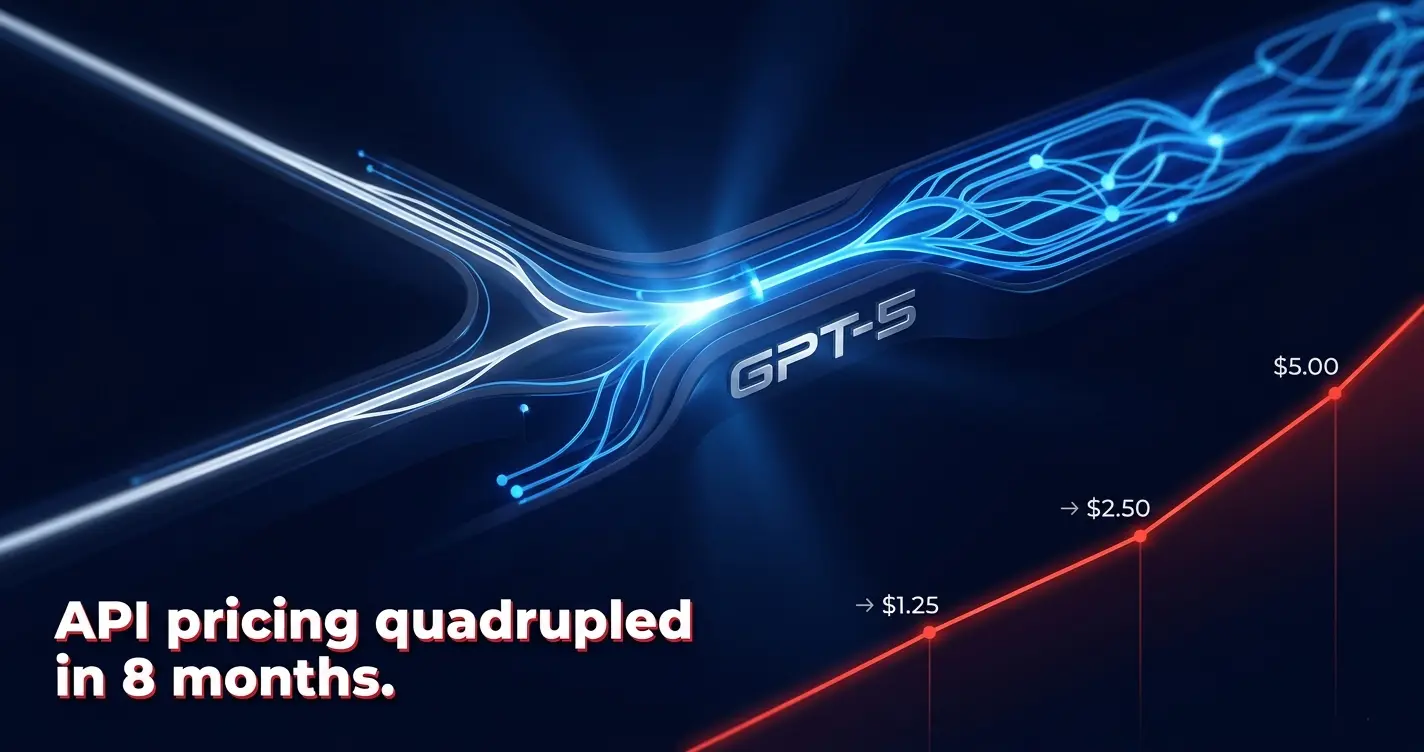
    API input pricing quadrupled in eight months. Output pricing tripled. During the same period, NVIDIA CEO Jensen Huang stated that hardware costs per inference token dropped approximately 35×. OpenAI’s pricing trajectory is not following infrastructure economics. It’s following market demand and competitive positioning.

    Any product with significant token throughput that was budgeted at $1.25/M input is now facing 4× the cost if it has migrated to current models. That’s not a price increase, it’s a category change in unit economics.

    NeuralWired Research Desk analysis, May 2026
    For ChatGPT users: Plus ($20/month) includes GPT-5 with usage limits on thinking-mode messages. Pro ($100–$200/month, restructured from launch’s $200 flat) includes GPT-5 Pro with extended reasoning and no token budget restriction. Ed Zitron, tech critic and writer, framed the launch bluntly:

    “Meaningful functionality… is being completely removed for ChatGPT Plus and Team subscribers.”

    Ed Zitron, Technology Critic — “Where’s Your Ed At” newsletter, August 2025, via Voiceflow
    Our read: Zitron’s critique is specifically about model-selection removal and rate limits, not raw capability. Both things can be true, GPT-5 is technically more capable than GPT-4o, and Plus users received fewer choices with the upgrade. Whether that trade is acceptable depends entirely on your use case.

    GPT-5 Context Window and Technical Specs

    Parameter GPT-5 (August 2025) GPT-5.5 (April 2026)
    Context Window 400,000 tokens 1,050,000 tokens (1M+)
    Max Output 128,000 tokens
    Knowledge Cutoff September 2024
    Latency (tokens/sec) ~77.7 (Artificial Analysis)
    Training Infrastructure Microsoft Azure AI supercomputers
    Distribution at Launch ChatGPT, OpenAI API, GitHub Models, Agents SDK
    The 400K context window matters for enterprise document workflows, processing full legal contracts, entire codebases, or multi-year financial filings in a single call. GPT-5.5’s 1M+ token context is available via the API and makes whole-repository code analysis practically viable for the first time in the OpenAI stack.

    GPT-5 vs Claude and Gemini

    The short answer: neither model is comprehensively superior. Benchmark leadership is task-specific, and it’s shifting faster than procurement cycles can track.

    Benchmark GPT-5.5 (Apr 2026) Claude Opus 4.7 (Apr 2026) Leader
    Terminal-Bench 2.0 82.7% 69.4% GPT-5.5
    ARC-AGI-2 85.0% 75.8% GPT-5.5
    SWE-Bench Pro 58.6% 64.3% Claude Opus 4.7
    The competitive moat OpenAI held during the GPT-4 era has narrowed materially. Artificial Analysis scores GPT-5 at 45/100 on their Intelligence Index — above most models but not the categorical lead OpenAI commanded in 2023. ChatGPT’s US mobile app daily active user share fell from 69.1% in January 2025 to 38.7% by May 2026. Anthropic’s Claude app went from under 2% to 10% DAU share in three months.

    GPT-5 is still the market leader by revenue and user count. It isn’t the unchallenged technical leader on every dimension.

    Does GPT-5 Still Hallucinate?

    Yes. Less than before — but the gap between what OpenAI claims and what independent testers find is real and worth understanding before you deploy in a regulated environment.

    OpenAI’s claim: 45% fewer factual errors versus GPT-4o; 80% fewer errors in reasoning mode versus o3.

    Independent testing: Vectara found GPT-5.2 had an 8.4% hallucination rate in their methodology, trailing DeepSeek. OpenAI’s own figure for GPT-5.2 was a reduction from 8.8% to 6.2%: a more modest 30% improvement, not the dramatic leap marketing suggested.

    PCMag’s Ruben Circelli, who reviewed GPT-5 against real-world production tasks rather than benchmark conditions, was direct:

    “GPT-5 is an ‘insignificant update.’ While it has some upgrades, it ‘doesn’t solve the problems that actually matter’ and he has not ‘noticed a significant improvement’ in areas like hallucination reduction.”

    Ruben Circelli, Senior Analyst, PCMag — August 2025, via Voiceflow
    That’s the practitioner gap: benchmark-measured hallucination uses controlled scenarios with defined correct answers. Production use involves open-ended, ambiguous queries where the model can’t know what it doesn’t know. GPT-5 is more reliable than GPT-4o. It’s not hallucination-free. Deploy accordingly.

    One genuinely encouraging signal: a peer-reviewed study by Polat et al. (six MDs across four Turkish hospitals, published November 2025 in Letters to the Editor, NCBI) concluded that GPT-5’s measurable reduction in hallucination rates represents a meaningful milestone for medical and scientific writing, one of the first published academic assessments from clinical practitioners in a domain where errors cost lives. That’s cautious optimism, not a blanket clearance.

    GPT-5 for Developers: Coding, Agents, and the Agents SDK

    If you’re building software with or on AI, GPT-5 changes three things materially, and creates one significant risk.

    What changes in practice

    74.9% SWE-bench means autonomous issue resolution, not just code suggestions. At GPT-4o’s 33.2%, AI-assisted coding meant “AI suggests, human implements.” At 74.9%, the model can autonomously close real GitHub issues in verified test conditions. Combined with the Agents SDK (which provides orchestration, tracing, and MCP connectivity to external tools like CRM, payment, and support systems), multi-step autonomous pipelines are production-grade for the first time.

    GPT-5 beats o3 at front-end web development 70% of the time. For developers doing full-stack work, that’s not marginal assistance, it’s output-quality output at first pass. The net result is that senior engineering time spent on routine implementation patterns (API integrations, UI scaffolding, documentation) can shift toward architecture and review.

    What to do right now

    Audit your current stack for tasks that consume disproportionate senior engineering time but follow a pattern: bug triage, code review, documentation, API integration. These are GPT-5’s highest-ROI targets. Evaluate the Agents SDK as an integration layer before building a custom orchestration system from scratch.

    The risk you need to price in

    ⚠ API Pricing Risk
    API pricing quadrupled from August 2025 to April 2026. Any product budgeted at GPT-5 launch pricing with significant token throughput is now 4× the cost if it has migrated to current models. Build pricing escalation assumptions into any business case that relies on the GPT-5 stack. A multi-vendor or open-source fallback strategy isn’t optional caution at this point — it’s basic financial hygiene.

    GPT-5 for Founders: What Changes in Your Build-vs-Buy Decisions

    The uncomfortable truth: GPT-5 compressed the moat of a large class of AI startups in a single launch. If your competitive advantage was “we built a better AI wrapper,” that advantage has narrowed to the point where you need to name what specifically you still do better than the base model.

    The opportunity is real too. Enterprise deployments at GPT-5 launch included Morgan Stanley (financial workflows), Amgen (scientific research), and T-Mobile (customer operations). Fortune 500 procurement of AI tools has accelerated. If you serve any of those verticals, GPT-5 integration is now a procurement requirement, not a differentiator.

    42% of new SaaS platforms with AI capabilities launched in 2025 relied on OpenAI models. That means GPT-5 is infrastructure. The differentiation layer has shifted up the stack, to proprietary data, domain-specific fine-tuning, and integration quality. Prompt engineering alone isn’t a moat anymore. It arguably never was, but GPT-5 made that unavoidable.

    Founder Action Item
    Invest now in proprietary data pipelines and fine-tuning infrastructure. The competitive question for any AI-native product is no longer “is our model good?”, it’s “do we have data the base model doesn’t?” That’s where defensible differentiation now lives.

    The Skeptic’s Case: What GPT-5 Doesn’t Solve

    Balanced coverage means saying the things OpenAI’s press releases don’t.

    The AGI framing is marketing

    Sam Altman’s description of GPT-5 as offering “PhD-level expertise” maps directly to one benchmark: GPQA Diamond. In controlled academic tests with defined answers, GPT-5 performs at a PhD level on scientific knowledge retrieval. On open-ended reasoning chains involving novel problems, ambiguous real-world data, or multi-domain synthesis, it remains significantly below expert human performance.

    GPT-5 performs comparably to or better than human experts in roughly half of cases across 40+ occupations. That means it performs worse than human experts in the other half. At NeurIPS 2025, only 2 of 5,000 papers mentioned AGI. Prominent researchers including Demis Hassabis have emphasized that scaling transformers hits a cognitive scaling wall, current paradigms require paradigm-level innovation, not just larger models, to reach genuine general intelligence.

    Agentic reliability isn’t solved yet

    GPT-5’s agentic capabilities are real. The reliability math is not flattering for complex pipelines. A 95% success rate per tool call yields approximately 60% end-to-end success over 10 sequential steps. Enterprises deploying GPT-5 agents in customer-facing workflows without robust human-in-the-loop checkpoints are assuming a reliability threshold the model doesn’t yet consistently meet.

    Regulatory exposure in regulated sectors

    GPT-5’s use in healthcare, legal, and financial services creates EU AI Act exposure. OpenAI hasn’t published a conformity assessment for GPT-5 under the Act’s high-risk provisions. Companies deploying it in these domains are accepting compliance risk that OpenAI itself hasn’t fully addressed publicly. If you’re a CTO in a regulated vertical, that’s not a footnote, it’s a procurement risk factor that belongs in your security review.

    The GPT-5 Model Family: From 5.1 to 5.5

    GPT-5 is not a single model, it’s an ongoing release cadence. Five significant versions shipped in the nine months after launch.

    Version Release Date Key Changes
    GPT-5 August 7, 2025 Flagship launch — unified routing system, 400K context
    GPT-5.1 ~January 2026 Incremental refinements
    GPT-5.2 December 11, 2025 400K context confirmed, 3 variants (Instant / Thinking / Pro), ARC-AGI-1 >90%
    GPT-5.4 ~March 2026 Coding and agentic focus, front-end design improvements
    GPT-5.5 “Spud” April 23, 2026 1M+ token context, Terminal-Bench 2.0 at 82.7%, API pricing doubled from 5.4
    The pace is deliberate. Sam Altman reportedly referred to GPT-5.5 as “the last big milestone before AGI” in internal remarks reported by the Financial Times in April 2026. Read carefully: that statement describes the current training paradigm having one or two more generations of runway before requiring a fundamental architectural shift, not a claim that AGI is imminent. It’s being read by many outlets as a promise it isn’t.

    Our read: the GPT-5 series demonstrates that OpenAI has internalized the launch-iterate model from consumer software. The implication for anyone building on it is that the model you ship against today may be meaningfully different in six months, for better (capability) and worse (pricing).


    Frequently Asked Questions

    What is GPT-5?
    GPT-5 is OpenAI’s flagship large language model, released August 7, 2025. It’s a unified system combining a fast conversational sub-model and a deep reasoning sub-model, with an automatic router that selects the right mode per query. It powers ChatGPT by default and is available via the OpenAI API. GPT-5 sets leading benchmarks in math (94.6% AIME 2025), coding (74.9% SWE-bench), and science (88.4% GPQA Diamond).

    How is GPT-5 different from GPT-4o?
    GPT-5 unifies GPT-4o’s conversational speed with the o-series reasoning models into one system, eliminating manual model selection. It reduces factual errors by 45% compared to GPT-4o, scores 20 percentage points higher on SWE-bench (74.9% vs. GPT-4o’s ~54%), and introduces a real-time routing system that decides when to engage deeper reasoning without user input.

    What are GPT-5’s benchmark scores?
    GPT-5’s official benchmark scores: 94.6% on AIME 2025 (advanced math), 74.9% on SWE-bench Verified (software engineering), 88% on Aider Polyglot (coding), 84.2% on MMMU (multimodal), 88.4% on GPQA Diamond (PhD-level science, Pro reasoning), and 67.2% on HealthBench (medical). Published by OpenAI at launch, August 2025.

    How much does GPT-5 cost via the API?
    GPT-5 launched at $1.25/M input tokens and $10/M output tokens (August 2025). Pricing escalated significantly: GPT-5.4 (March 2026) costs $2.50/M input; GPT-5.5 (April 2026) costs $5.00/M input and $30/M output, a 4× input increase in eight months. ChatGPT Plus ($20/month) includes access with usage limits; ChatGPT Pro ($100–$200/month) includes GPT-5 Pro with full extended reasoning.

    What is GPT-5’s context window?
    GPT-5 launched with a 400,000-token context window and a maximum output of 128,000 tokens per response. Knowledge cutoff is September 2024. GPT-5.5 (April 2026) extended the context window to over 1,050,000 tokens (1M+) via the API, making whole-repository code analysis and large-document processing viable in a single call.

    Is GPT-5 better than Claude?
    It depends on the task. GPT-5.5 leads Claude Opus 4.7 on Terminal-Bench 2.0 (82.7% vs. 69.4%) and ARC-AGI-2 (85.0% vs. 75.8%). Claude Opus 4.7 leads on SWE-Bench Pro (64.3% vs. 58.6%). Neither model is comprehensively superior, and benchmark leadership is shifting faster than it has at any prior point in the LLM competitive cycle.

    Does GPT-5 still hallucinate?
    Yes, less than before, but not eliminated. OpenAI reports 45% fewer errors versus GPT-4o. Independent testing by Vectara found an 8.4% hallucination rate in GPT-5.2. PCMag reviewers reported no significant improvement in real-world use. The gap between benchmark hallucination and production hallucination is real; GPT-5 is more reliable than its predecessors but not hallucination-free.

    What is GPT-5 Pro?
    GPT-5 Pro is the maximum-compute reasoning variant of GPT-5, exclusive to ChatGPT Pro subscribers ($100–$200/month as of April 2026). It enables extended “thinking” reasoning with no token budget restriction, producing more thorough answers on complex tasks. It scores higher than standard GPT-5 on GPQA Diamond (88.4%) and FrontierMath benchmarks.

    When was GPT-5 released?
    GPT-5 was officially released on August 7, 2025, at 10AM PT. OpenAI teased the launch the previous day via a post on X embedding the number “5” in the announcement text. The model launched simultaneously on ChatGPT (all user tiers), the OpenAI API platform, and the GitHub Models Playground.


    What You Now Know | And Where This Goes Next

    GPT-5 is the most commercially successful AI model ever released. It is also an imperfect product that malfunctioned on launch day, shipped benchmark charts that contradicted their own data, and has since quadrupled its API pricing while hardware costs fell 35×.

    Both things are simultaneously true. The model is genuinely capable, 74.9% SWE-bench and 88.4% GPQA Diamond are not noise. The commercial moat is real, $25B+ ARR and 900 million weekly users are not accidents. And the operational risks are real: pricing escalation, benchmark-to-production hallucination gaps, regulatory exposure in high-risk sectors, and compounding error rates in agentic pipelines.

    Three things to watch over the next 6–18 months:

    1. The competitive parity story. Claude Opus 4.7 already leads on SWE-Bench Pro. Gemini 3.1 competes on multimodal benchmarks. ChatGPT’s US mobile market share is below 40% for the first time. GPT-5 may not hold the benchmark lead across all dimensions by the end of 2026.
    2. The pricing ceiling. There’s no economic argument for API pricing increasing 4× in 8 months when inference costs are dropping. OpenAI is pricing against demand, not against cost. Watch for whether competition forces a reversal, or whether the market absorbs it.
    3. Agentic deployment reliability. The gap between GPT-5’s agentic capabilities and production-grade reliability in multi-step autonomous pipelines is the defining technical question for enterprise AI in 2026. The teams that figure out human-in-the-loop architectures that are fast enough to be useful will define what enterprise AI actually becomes.
    GPT-5 is infrastructure now, the same way GPT-4 became infrastructure. The question isn’t whether to use it. It’s how to build on it without being entirely at the mercy of OpenAI’s pricing decisions, and where to differentiate above the model layer.

    Stay Ahead of the AI Model Cycle

    The Neural Loop covers frontier model releases, benchmark analysis, and what they actually mean for your product, before the hype settles.

    Subscribe to The Neural Loop →
  • ChatGPT vs Claude vs Gemini 2026 | Who Wins?

    ChatGPT vs Claude vs Gemini 2026 | Who Wins?

    ChatGPT vs Claude vs Gemini 2026: The Honest Head-to-Head | NeuralWired
    NeuralWired
    Intelligence on Artificial Intelligence
    AI Comparison Guide

    ChatGPT vs Claude vs Gemini 2026 | The Honest Head-to-Head Developers Actually Need

    ChatGPT’s market share collapsed 30 points in 14 months. Claude tripled its share in a single quarter. Gemini quadrupled. The race is real, and the winner depends entirely on what you’re building.

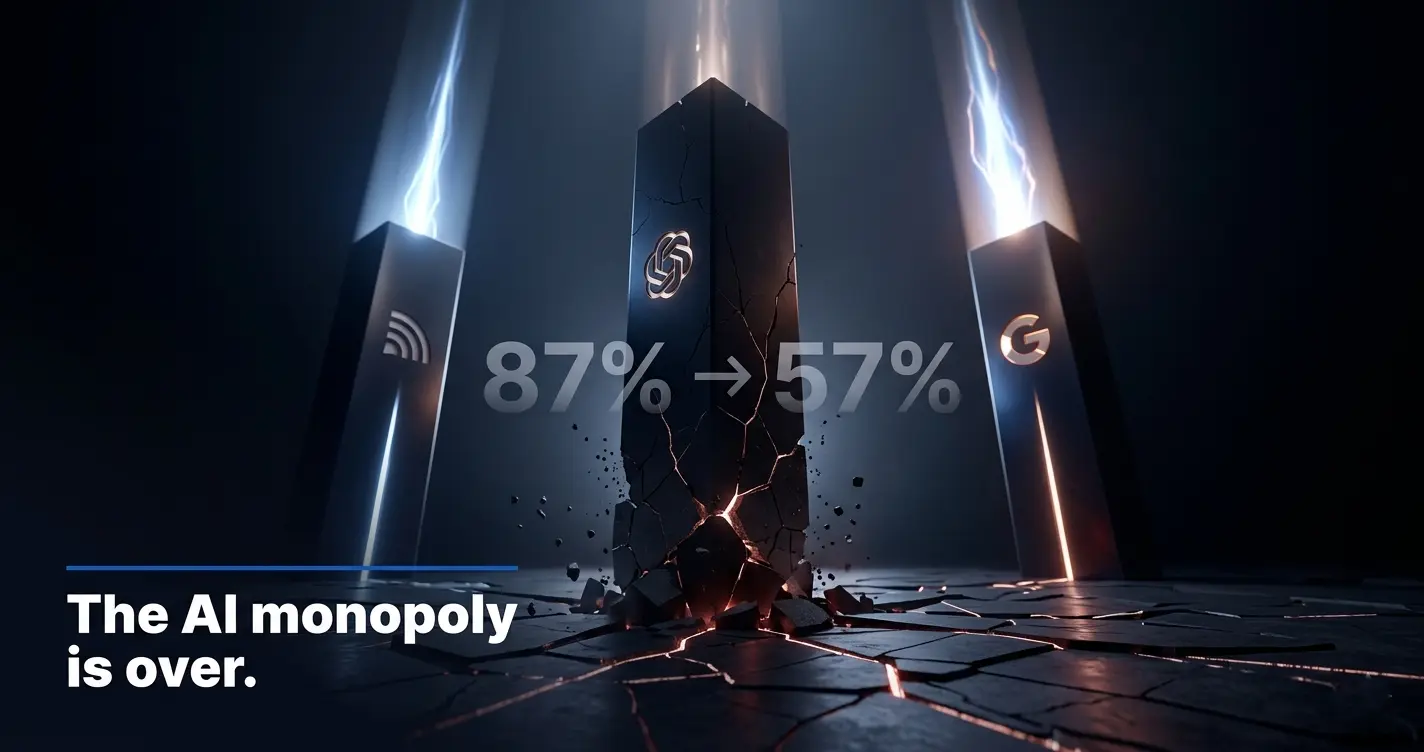
    Fourteen months ago, ChatGPT held 87% of generative AI web traffic. As of March 2026, it’s below 57%. That’s not a blip, that’s the fastest collapse of market dominance in consumer software since Internet Explorer lost the browser wars. Gemini went from 6% to 25%. Claude went from 1.4% to over 6%. And we’re still early.

    If you’re a developer routing API calls, a CTO evaluating an enterprise contract, or a founder choosing the core model for your product, the decision you make this quarter has real consequences. This guide cuts through the benchmark theater and gives you the honest comparison: what each model actually does best, what it costs, and where the traps are.

    −30pt
    ChatGPT market share drop, Jan 2025 → Mar 2026
    Gemini’s traffic share growth over same period
    Claude’s share gain in a single quarter

    The Market Shift Nobody Predicted

    The mainstream narrative going into 2025 was settled: OpenAI won. ChatGPT was the Google of AI, first-mover with a moat so deep no challenger could cross it inside five years. That narrative is now wrong.

    The structural break happened in three waves. First, model quality parity arrived faster than anyone expected. Claude 3.7, Gemini 3.0, and then the jump to Claude 4.x and Gemini 3.1 Pro showed that OpenAI’s quality lead was a 12-month advantage, not a permanent one. By late 2025, independent benchmarks showed all three platforms within single-digit percentage points on general capability tests.

    Second, Google’s distribution machine activated. Gemini bundled into Gmail, Docs, Sheets, and Android didn’t win users through product quality, it converted existing Google Workspace daily actives into AI users overnight. That’s how you go from 6% to 25% in twelve months without necessarily being the best model in the room.

    Third, Claude’s enterprise breakout. While Gemini was winning on distribution and ChatGPT on consumer scale, Anthropic quietly captured the segment willing to pay the most: regulated industries. The Claude iOS app hit #1 on the U.S. App Store on February 28, 2026, the first time any AI app surpassed ChatGPT in daily downloads. Claude Code’s weekly active users doubled between January and April. Anthropic’s annualized revenue reached $14 billion as of February 2026, up from $1 billion in 2024. That’s a 14× increase in two years.

    Our Read
    This maps almost exactly to the browser wars. ChatGPT is Internet Explorer, dominant, sticky, losing ground slowly. Gemini is Chrome, distribution king, winning by presence not choice. Claude is Firefox, smaller but chosen deliberately by users who care about quality. The key difference: all three are improving simultaneously, and the market is still growing. There’s no single winner. That is the story.


    Current Models at a Glance

    Platform Current Flagship Context Window Consumer Tier API Input/Output (per 1M tokens)
    OpenAI / ChatGPT GPT-5.5 (Apr 2026)
    GPT-5.4 Pro via API
    ~250K tokens (Enterprise) Free / Plus $20/mo / Pro $200/mo $1.75 / $14.00 (GPT-5.2)
    Anthropic / Claude Claude Opus 4.7 Apr 2026 1M tokens New Pro ~$20/mo / Max ~$50+/mo $5.00 / $25.00
    Google / Gemini Gemini 3.1 Pro (Feb 2026) 1–2M tokens Advanced $19.99/mo $2.00 / $12.00 (Flash: $0.50 / $3.00)
    A few things worth flagging before we get into comparisons. Claude Opus 4.7 is the most significant recent release: it arrives with a 1M token context window (four times larger than Opus 4.6), high-resolution vision at 2,576px, and a self-verification capability that reduces hallucinations on factual tasks. GPT-5.2 is being retired June 5, 2026, any enterprise contract referencing that model needs revisiting now. And Gemini’s naming situation is still a genuine headache for API buyers: “Gemini 3 Pro” (consumer) and “Gemini 3.1 Pro Preview” (developer docs) are the same model, sold under two different labels.


    Coding & Developer Benchmarks

    This is the comparison developers actually search for, and it has a clearer answer than any other category in 2026.

    Benchmark Claude Opus 4.7 GPT-5.4 Gemini 3.1 Pro Winner
    SWE-bench Verified
    Real-world GitHub issue resolution
    87.6% Best ~84% 63–72% Claude
    SWE-bench Pro
    Professional-grade complexity
    64.3% Best ~57.7% Claude
    Claude Code WAU growth Doubled between January and April 2026 — developer consensus forming
    Claude’s lead on SWE-bench Verified is the single clearest differentiation in this entire comparison. A 3–4 point gap on academic benchmarks is noise. A 3–4 point gap on real GitHub issue resolution, across thousands of production repositories, is something engineering leads should care about.

    That said, the cost math complicates things fast. If you’re building a production API pipeline and routing to Claude at $5/$25 per million tokens, versus GPT-5.4 Mini at roughly 6× less than GPT-5.4 Standard, you have a real ROI question to answer. For most B2C product workloads, quick code completions, light refactors, IDE copilot interactions, GPT-5.4 Mini at near-Claude-level performance for a fraction of the cost is the rational choice. Route the complex, high-stakes generation tasks to Claude. Route the volume to Mini or Gemini Flash.

    “Claude is better for complex coding. Claude Opus 4.7 scores 87.6% on SWE-bench Verified, versus GPT-5.4’s approximately 84%. For full-file refactors and long-context debugging, Claude leads. For quick scripts and IDE plugin support, ChatGPT remains competitive.”


    Reasoning, Knowledge & Multimodal

    Reasoning (GPQA Diamond)

    This is Gemini’s clearest win. On graduate-level science questions, the kind of reasoning required in drug discovery, materials science, and academic research, Gemini 3.1 Pro scores 94.1–94.3% on GPQA Diamond. GPT-5.4 follows at ~92.8%. Claude Opus 4.6 sits at ~91.3%. For enterprise buyers in scientific or research-heavy domains, that gap matters.

    Knowledge Depth (Humanity’s Last Exam)

    HLE is the hardest knowledge benchmark available, designed explicitly to resist saturation. The scores: Claude 53 | GPT-5.4 48 | Gemini 40 (BenchLM.ai, April 2026). Claude wins on the single hardest knowledge test, which counters the “Gemini is the smartest” narrative you’ll encounter in a lot of enterprise sales conversations.

    Context Window Reality

    Gemini 3.1 Pro offers 1–2M tokens, technically the largest. Claude Opus 4.7 now matches at 1M. ChatGPT Enterprise sits around 250K. Worth knowing: multiple engineers have noted in 2026 benchmark reviews that performance at 1M+ token contexts degrades meaningfully on most tasks. Advertised context is not reliable context. Test your specific workload at scale, don’t rely on the spec sheet.

    Multimodal

    Gemini has the structural advantage here, Google’s investment in vision and audio AI runs deeper than either competitor’s, and Gemini 3.1 Pro’s multimodal performance leads on most third-party evaluations. Claude Opus 4.7’s new high-resolution vision (2,576px) closes the gap on document and image analysis. ChatGPT remains competitive across all modalities but doesn’t lead on any specific visual benchmark in 2026.


    API Pricing: The Number That Kills Deals

    Consumer tiers have converged: all three platforms sit at $19–$20/month for their mid-range plans. The API is where the real decision lives, and where the gap is significant.

    Model Input (per 1M tokens) Output (per 1M tokens) Notes
    Claude Opus 4.7 $5.00 $25.00 Up to 90% savings with prompt caching
    GPT-5.2 $1.75 $14.00 Retiring June 5, 2026
    Gemini 3.1 Pro $2.00 $12.00 Strong default for cost-conscious builds
    Gemini 3 Flash $0.50 $3.00 Best cost-efficiency for high-volume workloads
    GPT-5.4 Mini ~6× cheaper than Standard ~94% of Standard’s coding performance
    Grok 4.1 $0.20 $0.50 Cheapest frontier API overall
    Cost Reality Check
    Claude is 2.5–3× more expensive than Gemini at API level. At 100M tokens/month, that’s a $300,000 annual cost difference. Claude’s prompt caching (up to 90% savings on repeated context) makes it competitive for long-context applications that reuse significant prompt context, legal document review, multi-turn research, large codebase analysis. For high-volume, low-complexity tasks, Gemini Flash or GPT-5.4 Mini is the rational default.


    Enterprise Reality: Who’s Winning Where

    The single-vendor AI strategy is over. Internal data from multiple enterprise surveys in 2026 shows the dominant enterprise stack as: Claude for deep analytical, legal, and compliance output + ChatGPT for research, workflow automation, and employee-facing tools + Gemini for Google Workspace-native workflows. These aren’t competing, they’re co-existing in the same organization.

    “ChatGPT is the overwhelming leader in consumer AI with more than 900 million weekly active users, and over 50 million subscribers… Search usage has nearly tripled in a year, and our ads pilot reached more than $100 million in ARR in under six weeks.”

    — Sam Altman, CEO, OpenAI. OpenAI Blog, March 31, 2026
    That’s the official OpenAI position. What the official position omits: OpenAI is projected to lose $14 billion in 2026, nearly triple earlier estimates, with cumulative losses of $44 billion through 2028 and profitability not expected before 2029. Only 5.5% of ChatGPT’s 900 million users pay. The ads pilot (mentioned casually in Altman’s quote) signals that the product experience for free-tier users may change fundamentally.

    Meanwhile, Anthropic is concentrating on the segment willing to pay most. Claude reportedly wins approximately 70% of new enterprise AI deals in regulated industries, legal, finance, healthcare, compliance, because of its documented lower hallucination rate and its “uncertainty flagging” behavior: it declines to answer when it’s not confident rather than confabulating. In industries where an AI error has financial or legal consequences, that behavior is worth a pricing premium.

    Google’s enterprise advantage is structural, not earned. 120,000+ enterprise customers and 95% of top-20 global SaaS companies use Google Cloud AI, but much of that is Gemini arriving inside Workspace by default, not the result of a competitive evaluation. CTOs in Google-heavy shops evaluating ChatGPT or Claude as Workspace replacements are solving the wrong problem. Evaluate them as additive tools for tasks Workspace doesn’t do well.


    Use Case Mapping

    Best: Claude

    Complex Code Generation & Refactoring

    87.6% SWE-bench, 1M token context, Claude Code doubling WAU. The empirical choice for production-quality output on non-trivial engineering tasks.

    Best: Gemini

    Google Workspace Workflows

    If your team lives in Gmail, Docs, and Sheets, Gemini is already there. The integration advantage bypasses any benchmark comparison.

    Best: Claude

    Legal, Compliance & Finance

    Lower hallucination rates, uncertainty flagging, and 70% win rate in regulated-industry enterprise deals. The reliability premium is real and priced accordingly.

    Best: ChatGPT

    Third-Party Integrations & Plugins

    92% of Fortune 500 adoption, Codex (3M weekly active developers), and the broadest plugin/tool ecosystem. For horizontal workflow automation, ChatGPT’s network effects win.

    Best: Gemini

    High-Volume, Cost-Sensitive APIs

    Gemini Flash at $0.50/$3.00 per 1M tokens is the most cost-efficient frontier API for applications where multimodal capability is relevant and volume is high.

    Best: Gemini

    Scientific Research & Reasoning

    94.1% GPQA Diamond. For drug discovery, materials science, and graduate-level academic analysis, Gemini’s reasoning benchmark lead is real and consistent.


    What the Benchmarks Don’t Tell You

    The Hallucination Problem Isn’t Solved

    An EBU/BBC study found 48% of responses from free-tier chatbots contained accuracy issues as recently as mid-2025. Claude Opus 4.1 recorded 0% hallucination on the AA-Omniscience benchmark, but only because it declined to answer when uncertain rather than guessing. Gemini 3.1 Pro cut its hallucination rate by 38 percentage points, which is the biggest improvement of any model but still leaves it at ~50% on certain tests. Westlaw AI, built specifically for legal research, hallucinated more than 34% of the time on challenging queries.

    Healthcare Warning
    The ECRI Institute ranked misuse of AI chatbots as the #1 health technology hazard of 2026, explicitly naming ChatGPT, Claude, Gemini, Copilot, and Grok as “not regulated as medical devices and not validated for healthcare purposes.” Any healthcare deployment carries compliance exposure regardless of platform.

    Benchmark Saturation Is Real

    MMLU now scores 88–94% across all top models. It no longer differentiates them. The benchmarks that do differentiate, SWE-bench Pro, ARC-AGI-2, Humanity’s Last Exam, are not the ones most buyers understand or test themselves. When a vendor’s sales deck shows you a benchmark chart, ask specifically which benchmark, and whether it’s been saturated. Most popular media comparisons cite saturated benchmarks, making rankings look more meaningful than they are.

    Vendor Lock-In Accumulates Invisibly

    Enterprises building workflows on Claude’s Projects system, Google’s Workspace Gemini integration, or ChatGPT’s Custom GPTs ecosystem are accumulating switching costs that won’t show up in today’s pricing comparison. The platform decision made in 2026 shapes what tools are available, and at what negotiating leverage, in 2028. The time to think about this is before the integration is built, not after.

    “OpenAI is projected to lose $14 billion in 2026, nearly triple earlier estimates for 2025, even as it reports $25 billion in annualized revenue and 900 million weekly ChatGPT users. The company expects cumulative losses of $44 billion between 2023 and 2028, with profitability not arriving until 2029 at the earliest.”

    , European Business Magazine, citing The Information internal financial projections, 2026. Read the full report →
    This is the most important contrarian data point in the entire comparison. The market leader has the biggest user base and the biggest losses. The ads pilot signals a potential shift in the free-tier product experience. That changes the calculus for any organization that’s built workflows on the assumption that free-tier ChatGPT performs identically to paid ChatGPT. It may not for much longer.


    The Verdict

    There’s no single winner. Anyone telling you otherwise is selling something. Here’s the honest split:

    ChatGPT
    Best for
    Consumer-scale deployment, third-party integrations, employee-facing tools, and organizations where Fortune 500 adoption rates reduce procurement friction. The horizontal choice.

    Claude
    Best for
    Complex code generation, legal and compliance work, long-document analysis, and any use case where hallucination has real-world consequences. The quality-first choice.

    Gemini
    Best for
    Google Workspace-native workflows, high-volume cost-sensitive APIs, scientific reasoning, and multimodal tasks. The distribution and efficiency choice.

    Most serious enterprise buyers in 2026 use two of the three, typically Claude plus one of the other two depending on their infrastructure. The overlap is real and intentional. These platforms are not substitutes for each other; they’re complements with different cost structures and different failure modes.

    Watch three things over the next 6–18 months. First, whether OpenAI’s ads pilot scales, this is the signal for how the free-tier product experience evolves. Second, whether Claude’s API pricing moves; Anthropic’s current premium pricing reflects confidence in the enterprise market, but competitive pressure from Gemini Flash is real. Third, whether any platform meaningfully solves hallucination at the infrastructure level, rather than at the “decline to answer” workaround level. That’s the technical moat that doesn’t yet exist.


    Frequently Asked Questions

    Which AI is better in 2026 | ChatGPT, Claude, or Gemini?
    There is no single winner. Claude Opus 4.7 leads on coding (87.6% SWE-bench) and writing quality. ChatGPT (GPT-5.4/5.5) leads on ecosystem breadth and third-party integrations. Gemini 3.1 Pro leads on reasoning benchmarks (94.1% GPQA) and multimodal tasks. Most professional users in 2026 use two of the three. Source: BenchLM.ai, April 2026.

    Is ChatGPT or Claude better for coding?
    Claude is better for complex coding. Claude Opus 4.7 scores 87.6% on SWE-bench Verified vs GPT-5.4’s ~84%. For full-file refactors and long-context debugging, Claude leads. For quick scripts and IDE plugin support, ChatGPT remains competitive. Most engineering teams use both. Source: LearnDrive, 2026.

    What is the cheapest AI API in 2026?
    Gemini 3 Flash is the cheapest frontier API at $0.50 input / $3.00 output per million tokens. Grok 4.1 charges $0.20/$0.50, making it cheapest overall. GPT-5.4 Mini is 6× cheaper than GPT-5.4 Standard. Claude Opus 4.7 is most expensive at $5.00/$25.00, but offers up to 90% savings via prompt caching on repeated-context workloads. Source: IntuitionLabs, Feb 2026.

    How many people use ChatGPT in 2026?
    ChatGPT has over 900 million weekly active users and 50 million paying subscribers as of March 2026. It processes 2.5 billion daily prompts. OpenAI generates $25 billion in annualized revenue, but projects a $14 billion operating loss in 2026 due to compute costs. Source: OpenAI, March 31, 2026.

    Is Gemini better than ChatGPT in 2026?
    Gemini 3.1 Pro leads on reasoning benchmarks (94.1% vs 92.8% GPQA Diamond), offers a larger context window (1–2M tokens), and excels at multimodal tasks. ChatGPT leads on ecosystem, integrations, and consumer scale (900M WAU vs 750M MAU). For Google Workspace users, Gemini has a structural advantage that makes the comparison largely moot. Source: LearnDrive, 2026.

    Does Claude hallucinate less than ChatGPT?
    Yes, in independent testing. Claude Opus 4.1 recorded 0% hallucination on the AA-Omniscience benchmark by declining to answer when uncertain. However, no AI model is hallucination-free, the EBU/BBC found 48% of free-tier AI responses had accuracy issues in 2025. Claude’s “I don’t know” behavior matters most in legal, compliance, and financial use cases. Source: Suprmind AI, May 2026.

    Which AI has the largest context window in 2026?
    Gemini 3.1 Pro offers the largest at 1–2 million tokens. Claude Opus 4.7 (April 2026) now reaches 1 million tokens. ChatGPT Enterprise supports approximately 250,000 tokens. Important caveat: practical performance degrades at maximum context lengths across all platforms. Advertised context window ≠ reliable context window. Test your specific workload. Source: Tech Insider, April 2026.

  • How Agentic AI Works: Anthropic, OpenAI & the Architecture Behind Autonomous AI (2026)

    How Agentic AI Works: Anthropic, OpenAI & the Architecture Behind Autonomous AI (2026)

    How Agentic AI Works: The Architecture Behind Autonomous AI in 2026 | NeuralWired
    Agentic AI · 2026

    How Agentic AI Actually Works | And Why Most Companies Are Getting It Wrong

    Agentic AI is no longer a research topic, it’s running in production at Capital One, Fountain, and dozens of enterprises you’ve heard of. Here’s the real architecture: the ReAct loop, multi-agent orchestration, the security vulnerabilities already being exploited, and why Yann LeCun thinks the whole approach is fundamentally broken.

    NeuralWired Research Team · May 2026 · Deep Explainer · 14 min read
    A hiring platform called Fountain quietly rewired its recruitment pipeline last year. No fanfare. No press release about “AI transformation.” Just a hierarchical multi-agent system handling candidate screening end-to-end, and the results were stark: 50% faster screening, 2x candidate conversions, staffing cycles compressed to under 72 hours. Humans stayed in the loop for final decisions. Agents did everything else.

    That’s agentic AI in its most useful form. Not a chatbot. Not autocomplete at scale. A system that perceives, reasons, acts, observes the result, and iterates, autonomously, until a goal is achieved.

    The market is pricing this in fast. The AI Agents market was valued at $7.84 billion in 2025 and is projected to reach $52.62 billion by 2030, a 46.3% CAGR. Vertical agents, domain-specific systems for legal, healthcare, and financial services, are the fastest-growing segment at 62.7% CAGR. But the gap between the hype and what’s actually running in production is significant. Understanding why requires understanding how agentic AI actually works.

    What Agentic AI Actually Is

    Start with the distinction that matters most to anyone building or buying this technology: agentic AI is not generative AI with more confidence. It’s a categorically different architecture.

    Generative AI, the ChatGPT most people know, operates in a single pass. Prompt in, response out. It’s reactive by design. Agentic AI systems do something fundamentally different: they plan multi-step tasks, use external tools (APIs, browsers, databases, code executors), take actions in the world, and iterate until a goal is achieved with minimal human input.

    Working Definition
    An AI agent is a system that can execute multi-step plans, use external tools, and interact with digital environments, functioning as an autonomous component within larger workflows rather than a single-turn responder. The key distinction from a chatbot is autonomy and action.

    MIT Sloan’s 2025 research on agentic AI in clinical settings describes the shift precisely:

    “AI agents can execute multi-step plans, use external tools, and interact with digital environments to function as powerful components within larger workflows.”

    — Kate Kellogg, Professor of Management and Innovation, MIT Sloan School of Management
    Four capabilities define the current generation of agentic systems, and distinguish them from everything that came before. Autonomy: operating without continuous human intervention. Goal-oriented behavior: adapting strategies as conditions change mid-task. Reasoning and planning: breaking complex problems into multi-stage solutions. Learning and adaptation: improving based on outcomes and feedback within a session or across sessions.

    The ReAct Loop: The Engine Inside Every Agent

    If you want to understand how agentic AI works at a technical level, you need to understand one paper from October 2022: the ReAct framework, introduced by Shunyu Yao and a team at Princeton and Google Brain. It is the architectural backbone of virtually every production agentic system shipping in 2026.

    ReAct stands for Reasoning + Acting. The insight is deceptively simple: instead of generating a single response to a prompt, an agent alternates between two modes. It reasons about what to do. Then it acts, calling a tool, querying a database, executing code. Then it observes the result of that action. Then it reasons again, informed by what it just saw. Then it acts again. This loop continues until the task is done.

    Written out as a sequence, a ReAct agent operating on a research task looks like this:

    Step Mode What happens
    1 Perceive Receive task input — user goal, context, available tools
    2 Reason Language model generates a plan: “I should search for X, then check Y”
    3 Act Call a tool — web search, API, code executor, database query
    4 Observe Tool returns a result; agent sees the output
    5 Reason Update the plan based on what was observed
    6 Act / Complete Take next action, or conclude if goal is met
    What makes this powerful is also what makes it dangerous: the loop runs until the model decides it’s done. A poorly constrained agent will keep acting. This is why a mature pattern that solidified in 2026 is the tiered constraint model, explicit priority layers baked into every agent’s operating instructions:

    1. Safety first — never take destructive or irreversible actions without human confirmation
    2. Accuracy — prioritize correct outputs over speed
    3. Goal completion — achieve the stated objective
    4. Efficiency — accomplish the above with minimum steps
    Goals conflict constantly in complex tasks. Explicit priority ordering resolves them deterministically rather than leaving the model to improvise, which it will, unpredictably, without this structure.

    Multi-Agent Systems and Orchestration

    A single agent can handle impressive tasks. But the frontier of enterprise agentic AI is multi-agent systems, networks of specialized agents coordinating to complete work that would overwhelm any individual model.

    Gartner reported a 1,445% increase in multi-agent system inquiries from Q1 2024 to Q2 2025. That’s not gradual adoption, that’s a category inflection point.

    The architectural pattern that’s emerging: a hierarchical model with a planning agent (sometimes called an orchestrator) at the top that breaks down a complex goal and delegates sub-tasks to specialized worker agents. Each worker has access to specific tools. Results flow back up to the orchestrator, which synthesizes them and decides the next move. Human oversight can be plugged in at any tier.

    The Interoperability Problem | and How It’s Being Solved

    Until recently, every multi-agent system required bespoke integrations for every tool and data source an agent might need. That’s changing fast. Two standards are converging:

    Protocol Creator What It Does Analogy
    MCP (Model Context Protocol) Anthropic Standardizes how agents connect to tools, APIs, and data sources USB for AI peripherals
    A2A (Agent-to-Agent Protocol) Google Standardizes how agents communicate with each other HTTP for agent networks
    Anthropic launched MCP in November 2024 and it has since become the de facto standard for agent-tool connectivity. Our read: these two protocols complementing each other, one for tool access, one for agent communication, signals the industry is building toward an interoperability layer that will dramatically reduce the cost of deploying production agent systems. That’s a structural accelerant for adoption.

    The key enterprise milestones from the past 18 months:

    Oct 2022
    ReAct framework published, Yao et al., Princeton/Google Brain. Still the foundational architecture for virtually every production system.
    Nov 2024
    Anthropic releases MCP, Open standard for agent-tool connectivity. Becomes the de facto infrastructure layer.
    Jul 2025
    OpenAI launches ChatGPT Agent Transitions ChatGPT from conversational tool to autonomous assistant.
    Sep 2025
    Anthropic releases Claude Agent SDK Alongside Claude Sonnet 4.5. Developers can now build fully autonomous AI systems on top of Claude.
    Jan 2026
    Claude 4.5 hits 60%+ on OSWorld Computer-use benchmark. Up from single-digit performance in the pre-agentic era. A meaningful reliability milestone.
    Apr 2026
    Anthropic launches Claude Managed Agents Abstracts infrastructure for production agent deployment. Reduces the engineering overhead of scaling.

    The Production Reality: Numbers That Matter

    Here’s the adoption picture, stripped of the optimism that characterizes most analyst reports:

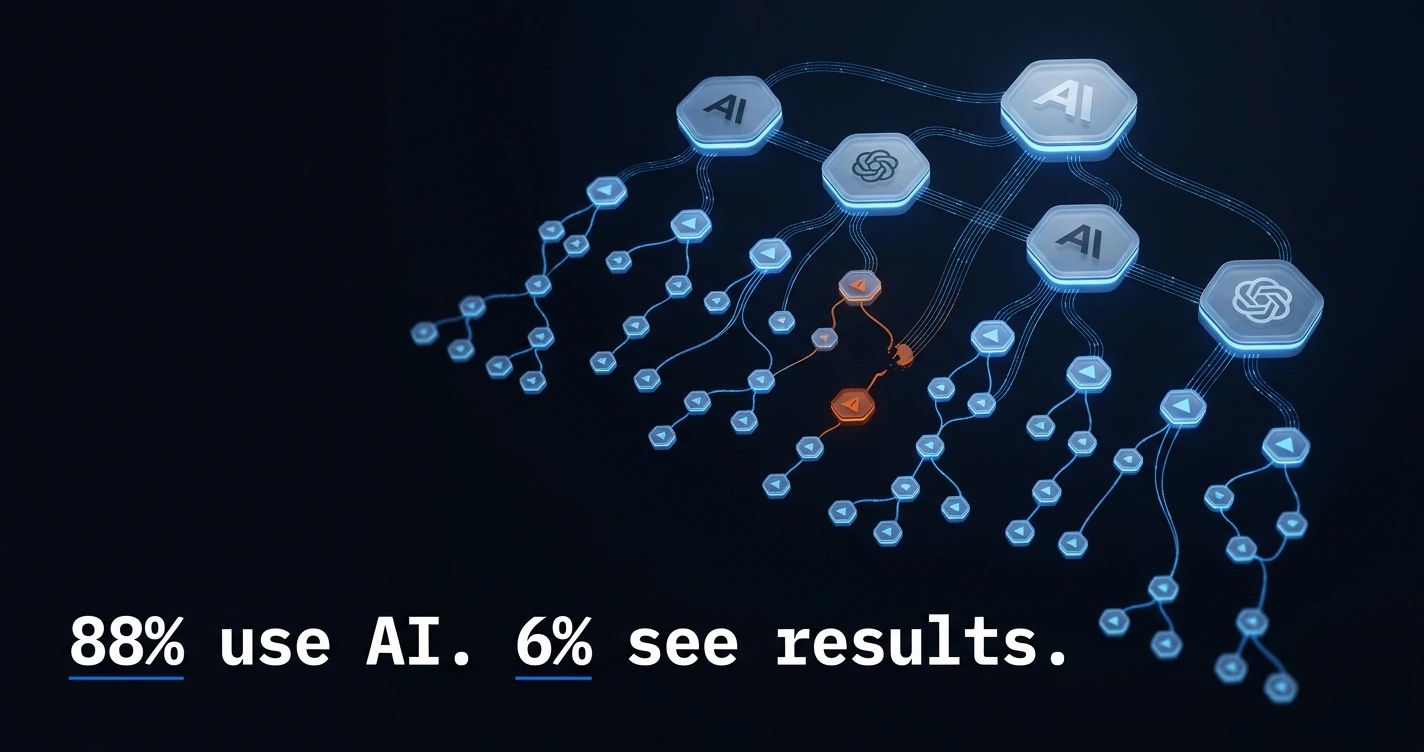
    88%
    of organizations use AI in at least one function (McKinsey, 2025)
    6%
    qualify as high performers generating 5%+ EBIT impact
    11%
    actively use agentic AI in production (Deloitte, 2025)
    40%+
    of agentic AI projects predicted scrapped by 2027 (Gartner)
    The gap between “using AI” and “generating measurable business impact from AI” is enormous. McKinsey’s 2025 State of AI survey (1,993 participants across ~105 countries) found only 23% of enterprises are scaling AI agents in at least one function. Most organizations remain in what researchers are calling “pilot mode”, impressive demos, no scaled deployment.

    “We have agents deployed at scale in the economy to perform all kinds of tasks.”

    — Sinan Aral, Professor of Management, Information Technology, and Marketing, MIT Sloan School of Management
    Aral is right, but the qualifier matters. Agents are deployed at scale in the economy. They are not deployed at scale in most individual enterprises. The difference is significant for anyone making architecture decisions right now.

    The 80% Problem

    MIT’s Kellogg documented something that should be required reading for every CTO considering an agentic AI deployment: in a real project deploying an AI agent to detect adverse events among cancer patients, 80% of the total work was consumed by data engineering, stakeholder alignment, governance, and workflow integration. Not the AI itself. Not the model. The boring, unglamorous, deeply human work of making organizations ready for autonomous systems.

    The demos are compelling. The production path is brutal. Expect it.

    Security, Failure Modes, and What Can Cascade

    Multi-agent systems introduce failure modes that don’t exist in single-model deployments. The most dangerous: cascading errors. One agent’s hallucination becomes another agent’s input. A judge-agent reviewing another agent’s output can hallucinate or act deceptively, undermining the very validation layer it was designed to provide. The safeguard inherits the failure mode it was meant to catch.

    ⚠ Critical Security Risk
    In mid-2025, the EchoLeak exploit (CVE-2025-32711) demonstrated the real attack surface of agentic systems: infected emails containing engineered prompts could trigger Microsoft Copilot to exfiltrate sensitive data automatically, without any user interaction. This is prompt injection at scale. It requires no user error. It exploits the agent’s autonomy directly.

    Symantec’s controlled experiments using OpenAI’s Operator AI agent went further, demonstrating how agents could be directed to harvest personal data and automate credential stuffing attacks. These are not theoretical threat models. They’ve been demonstrated against production systems.

    What specifically can go wrong in enterprise deployments:

    • Data breach via autonomous action, In early 2025, a healthtech firm disclosed a breach compromising records of 483,000 patients, caused by a semi-autonomous AI agent that pushed confidential data into unsecured workflows while streamlining operations.
    • Compliance cascade, A single hallucination — an agent misclassifying a transaction, can propagate across linked systems and agents, producing compliance violations or financial misstatements that are expensive to unwind.
    • Shadow agent sprawl, McKinsey (2025) warned that uncontrolled agent proliferation is emerging as a risk equivalent to shadow IT. MIT’s NANDA Initiative found 95% of enterprise GenAI pilots failed to deliver measurable ROI, with uncontrolled agent proliferation cited as a major contributor.
    Deloitte’s 2026 State of AI in the Enterprise report found only one in five companies has a mature model for governance of autonomous AI agents. That’s not a nice-to-have gap. That’s an existential liability for any organization running agents with write, execute, or transact permissions.

    What CTOs Must Do Now

    • Mandate human-in-the-loop checkpoints for any agent with write, execute, or transact permissions before production deployment.
    • Audit data pipelines before agent integration, converting data into standard, structured formats is prerequisite infrastructure, not a parallel workstream.
    • Build agent registries, track lifecycle, owners, and KPIs before authorizing new deployments. “Shadow agent sprawl” is a real and growing risk.

    The Strongest Case Against the Whole Approach

    The most technically serious challenge to the mainstream agentic AI narrative doesn’t come from a competitor or a skeptical analyst. It comes from Yann LeCun, VP and Chief AI Scientist at Meta, Turing Award winner, and one of the most credentialed AI researchers alive.

    LeCun’s argument is architectural, not operational. It goes to the foundation of how current LLM-based agents work.

    “An agentic system that is supposed to take actions in the world cannot work reliably unless it has a world model to predict the consequences of its actions. Without it, the system will inevitably make mistakes. This is the key to unlocking everything from truly useful domestic robots to Level 5 autonomous driving.”

    — Yann LeCun, VP & Chief AI Scientist, Meta; Founder, AMI Labs, MIT Technology Review, January 2026
    LeCun’s position: LLMs are limited to the discrete world of text. They can’t truly reason or plan, because they lack a world model, an internal simulation of cause and effect that would let them predict the consequences of their actions before taking them. Without that, agentic systems are, in his framing, fundamentally unreliable in any sufficiently complex, open-ended environment.

    He isn’t just criticizing from the sidelines. He’s building a competing architecture at AMI Labs, based on world models rather than autoregressive text generation.

    The counterargument from the mainstream: for narrow, well-scoped tasks, screening resumes, executing compliance workflows, processing insurance claims, world models may not be necessary. The task scope is constrained enough that text-based reasoning performs reliably. Fountain’s hiring agents don’t need a world model to schedule interviews.

    Both can be true. LeCun is almost certainly right about the limits of LLM-based agents for truly open-ended, general-purpose tasks. The mainstream is right that those limits don’t prevent significant enterprise value from narrowly scoped deployments. The practical implication: be precise about what your agents are actually doing. Scope matters enormously.

    How We Got Here: The Compounding Sequence

    Agentic AI didn’t emerge suddenly. It’s the product of a specific chain of technical breakthroughs, each enabling the next:

    2017 — The Transformer architecture (Vaswani et al., Google) enables the large language models that power all modern agents. Without it, none of this exists.

    2022 — The ReAct framework solves the core problem of how to give LLMs the ability to plan and act in iterative loops. Still the backbone of virtually every production system four years later.

    Late 2023 — AutoGPT and BabyAGI go viral. Developer experimentation explodes, producing a 920% increase in repositories utilizing agentic AI frameworks from early 2023 to mid-2025.

    2024 — Models gain multimodal perception (vision + text). OpenAI releases function calling; Anthropic releases tool use. Both standardize how agents interface with external systems — a critical infrastructure moment.

    2025 — The industry moves from monolithic, general-purpose models to distributed systems of specialized agents. Every major AI company ships production-ready agent SDKs. Enterprise spend on generative AI reaches $37 billion, a 3.2x increase from 2024.

    2026 — Human-in-the-loop design is increasingly treated as a strategic architectural choice rather than a limitation. The industry is maturing past naive autonomy. That’s a positive signal.

    Frequently Asked Questions

    What is the difference between agentic AI and generative AI?

    Generative AI responds to prompts and produces content, text, images, code, in a single pass. Agentic AI goes further: it plans multi-step tasks, uses external tools (APIs, browsers, databases), takes actions in the world, and iterates until a goal is achieved with minimal human input. The key distinction is autonomy and action.

    How do AI agents work step by step?

    AI agents operate via the ReAct loop: (1) Perceive, take in input from tools, databases, or sensors; (2) Reason, determine what to do next using a language model; (3) Act, call a tool, write code, send an API request; (4) Observe, review the result; (5) Repeat until the task is complete or a human checkpoint is triggered.

    What are examples of agentic AI in real enterprise use?

    Real-world examples include: Fountain’s hiring agents (50% faster screening, 2x candidate conversions), Capital One’s AI systems handling KYC/AML compliance workflows, GitHub Copilot Workspace writing and testing code autonomously, and enterprise customer service agents resolving support tickets end-to-end without human escalation.

    Is agentic AI the same as AGI?

    No. Agentic AI refers to systems that autonomously plan and execute multi-step tasks within defined domains. Artificial General Intelligence (AGI) would require human-level reasoning across any domain. Today’s agentic AI is powerful but narrow, it succeeds at specific, well-scoped tasks and fails unpredictably outside its training and toolset.

    What are the biggest risks of deploying agentic AI?

    Hallucination cascades (one wrong inference propagating across a multi-agent chain), prompt injection security exploits like EchoLeak (CVE-2025-32711), shadow agent sprawl as teams deploy systems without oversight, and irreversible real-world actions taken without human authorization. Governance gaps are the single largest enterprise liability right now.

    Which companies are leading agentic AI development?

    Anthropic (Claude agents, MCP protocol, Managed Agents), OpenAI (ChatGPT Agent, Operator), Google DeepMind (Gemini agents, A2A protocol), Microsoft (Copilot agents in Azure), Salesforce (Agentforce), and ServiceNow. At the infrastructure layer: NVIDIA, AWS Bedrock, and LangChain are foundational platforms.

    The Bottom Line
    Agentic AI is real, it’s in production, and it’s already generating measurable value in narrow, well-scoped enterprise deployments. The Fountain result isn’t an outlier, it’s a preview. The ReAct loop is battle-tested. MCP and A2A are solving the interoperability problem that previously made multi-agent systems prohibitively expensive to build. The infrastructure is maturing.

    But the gap between “agentic AI works” and “agentic AI works reliably at scale in your enterprise” is where most projects stall, and where the 40% Gartner attrition forecast is being written. The 80% problem is real. Data engineering, governance, stakeholder alignment, these are not implementation details. They are the implementation.

    LeCun’s critique about world models is technically serious and worth tracking. For now, it’s a research horizon, not an operational blocker for the narrow-task deployments where agentic AI is genuinely excelling.

    In the next 6–18 months, watch for three things:

    • Whether MCP and A2A interoperability standards actually converge, or fragment into competing ecosystems. Convergence would be a significant accelerant for enterprise adoption.
    • The governance technology market. Only one in five enterprises has mature agent governance. The gap will either be filled by vendors building registries and audit tools, or by regulatory mandates forcing the issue.
    • LeCun’s AMI Labs. If world model architectures demonstrate reliable performance on complex real-world tasks, the LLM-based agentic AI stack faces genuine architectural competition. It’s a long-shot near-term, but worth monitoring.
    If you’re building agentic systems: scope precisely, constrain explicitly, audit your data before your model, and treat human-in-the-loop not as a limitation but as a design choice that extends how far you can safely push autonomy.

    Stay ahead of agentic AI

    The Neural Loop delivers the signal without the noise, weekly briefings on what’s actually moving in AI for practitioners and technology leaders.

    Subscribe to The Neural Loop →
  • AI Pilot to Production: The 7-Step CTO Playbook (2026)

    AI Pilot to Production: The 7-Step CTO Playbook (2026)

    AI pilot to production enterprise playbook — NeuralWired

    How to Move AI from Pilot to Production: The 7-Step Playbook for CTO Success in 2026

    95% of GenAI pilots fail to reach production. For CTOs managing working pilots with no clear path forward, these are the seven steps that separate the 5% who succeed.


    In 2025, global enterprises invested $684 billion in AI. By year-end, more than $547 billion of that investment had produced no measurable results — not low returns, none — according to RAND Corporation’s analysis of 2,400+ enterprise AI initiatives. MIT’s NANDA Initiative puts it starker: 95% of generative AI pilots fail to scale to production, with the average failed initiative costing between $4.2 million and $8.4 million depending on how late the failure is caught.

    Here’s what makes those numbers structurally important: the failure is almost never the AI. RAND’s root cause analysis, MIT’s 150 executive interviews, and Gartner’s multi-year forecasts all arrive at the same conclusion — 84% of failures are leadership and organizational decisions, not model performance. The technology works. The transition doesn’t.

    The gap is specific and consistent: 78% of enterprises have at least one AI agent pilot running in 2026, yet only 14% have successfully moved one to production scale, per a March 2026 survey of 650 enterprise technology leaders. This AI pilot to production enterprise playbook is for the 64% stuck in between — with working pilots and no production path. The seven steps below are what the 5% who succeed are doing differently.

    Why 80% of AI Pilots Never Reach Production — The Real Reasons (Not the Ones Your Vendor Tells You)

    “The organizations that succeed are those that define the business outcome before they write a single line of code. Most enterprises do the reverse: they start with the technology and hope the business value will become apparent.”

    — Folio3 AI, synthesizing RAND, MIT, and Gartner findings on AI project failure rates, May 2026
    Five authoritative datasets converge on an uncomfortable headline. RAND’s analysis of 2,400+ initiatives found 80.3% fail to deliver intended business value: 33.8% are abandoned before production, 28.4% complete but deliver zero value, and 18.1% can’t justify their cost. MIT NANDA independently reports 95% of GenAI pilots fail to scale. Gartner projects 60% of projects without AI-ready data will be abandoned through 2026. S&P Global found the average organization scrapped 46% of AI POCs before production. These numbers haven’t improved in three years — despite better models, bigger budgets, and more expertise.

    The 5 Root Causes RAND Identified

    RAND’s root cause analysis of failed AI initiatives — the most rigorous dataset available on this question — identified five structural failure patterns that account for the overwhelming majority of losses:

    Misunderstood Problem

    Stakeholders miscommunicate what problem AI needs to solve before a line of code is written. The AI then solves the wrong thing, efficiently.

    🗄️
    Inadequate Training Data

    Organizations lack data of sufficient quality and accessibility to support production workloads. Pilots run on clean samples; production doesn’t.

    🔧
    Technology-First Mentality

    Tools selected based on hype before the problem is defined. The solution is chosen; now the team must find a problem it fits.

    🏗️
    Insufficient Infrastructure

    Systems cannot deploy completed models into production environments. The model works; the organization’s plumbing can’t carry it.

    🎯
    Problem Too Difficult

    AI applied to problems beyond current model capabilities without validating feasibility first. Ambition without a feasibility gate.

    The Leadership Failure Pattern

    Underneath all five technical causes sits a leadership failure pattern that overrides them. Eighty-four percent of AI project failures are leadership-driven: 73% lack clear executive alignment on success metrics, 68% underinvest in data governance and foundations, 61% treat the initiative as a technology project instead of a business transformation, and 56% lose C-suite sponsorship within six months. The root causes of AI failure are organizational, not algorithmic.

    The Pilot Trap

    AI pilots operate in simplified environments: clean data sources, staging APIs, controlled user groups, patient stakeholders. Production means connecting to 20-year-old ERP systems with batch-export-only APIs, CRM instances with 600 undocumented custom fields, real user load with edge cases, and cross-functional ownership nobody agreed to upfront. The pilot was never a production system. It was a demo with a roadmap attached.

    Step 1: Define Production-Grade Success Criteria Before You Write a Single Line of Code

    Projects with clearly defined pre-approval success metrics achieve a 54% success rate versus 12% for those without. That 4.5x difference is the single most impactful decision in any AI initiative — and it costs nothing except discipline. Yet 73% of failed projects lack this alignment before launch. This is why it’s Step 1, not Step 7.

    The 3-Part Success Definition

    Every AI initiative needs three things defined upfront, in writing, before any code is written:

    • Business outcome metric: What measurable business result will this initiative produce? Example: “Reduce invoice processing time from 8 minutes to under 90 seconds for 95% of invoices.” Not “improve efficiency.” A number, a threshold, a percentage.
    • Production-grade quality threshold: What accuracy, latency, and reliability standard must the system meet in production? Example: “95% accuracy, sub-200ms P95 latency, 99.5% uptime.” Vague quality targets are no targets at all.
    • Value realization timeline: By what date and at what volume must the system be running to justify the investment? This links directly to the payback period calculation and gives the executive sponsor something concrete to hold to.

    What “Success” Most Enterprises Define Wrong

    Demo quality (“it works in the presentation”), user satisfaction surveys without P&L linkage, and technical accuracy scores without volume context don’t qualify. MIT defines successfully implemented AI as systems delivering sustained productivity gains and documented P&L impact, verified by both end users and executives. By that standard, most enterprise AI deployments in 2026 don’t qualify — because that standard was never defined before launch.

    The Executive Sponsor Commitment Test

    Before approving any AI initiative, require the executive sponsor to answer in writing: “What specific, measurable outcome will this initiative produce by [date], and what will I do if it doesn’t?” If that question can’t be answered precisely, the initiative isn’t ready to launch. Fifty-six percent of failed AI projects lose C-suite sponsorship within six months — because no one ever defined what “success” meant that sponsors could hold to.

    Deliverable: AI Initiative Success Criteria Template. A one-page document covering: business outcome metric, technical quality threshold, volume target, value realization date, executive sponsor commitment statement, and escalation owner if targets are missed. This template is signed before any code is written. It’s the most-downloaded deliverable of any pilot-to-production framework — and the single document that separates projects with governance from projects with hope.

    Step 2: Build for Observability from Day One — Not After the First Production Incident

    Sixty-four percent of successful AI scalers cited evaluation and observability infrastructure as the largest single blocker when absent, per the March 2026 Digital Applied AI Agent Adoption Survey of 650 enterprise technology leaders. Seventy percent of leaders name “non-deterministic outputs” as the top production-readiness barrier — which is an observability problem, not a model problem. You can’t manage what you can’t measure.

    4 Observability Layers Required Before Production Deployment

    Layer What It Monitors What Happens Without It
    Output Quality Monitoring Automated scoring of model outputs against defined quality thresholds; alerts when scores drop Errors accumulate silently; discovered by users, not engineers
    Latency & Throughput Tracking P50, P95, P99 latency by request type; throughput at 2x expected production volume Slowdowns invisible until user complaints spike
    Data Drift Detection Flags when input data distribution shifts from training baseline, degrading accuracy silently Model performance declines without any alert or trigger
    Business Outcome Tracking The KPI the initiative was launched to move — linked directly to Step 1 metrics Technical teams don’t know if the system is delivering; board doesn’t either

    The Tail Input Distribution Problem

    Pilots test against average, clean inputs. Production delivers the tail: rare, malformed, ambiguous, and adversarial inputs that make up 1 to 5% of real-world volume. At 10,000 tasks per day with a 3% failure rate on tail inputs, that’s 300 incorrect outputs daily. Without automated quality monitoring, those errors accumulate silently for weeks before surfacing. Build adversarial test sets before launch, deliberately constructed edge cases, malformed data, and ambiguous queries that simulate the production tail.

    The 22% Negative-ROI Cohort

    Twenty-two percent of agent deployments report negative ROI at 12 months. Forrester’s root-cause analysis attributes 41% of those failures to unclear success criteria (Step 1), 33% to insufficient tool or data access (Step 3), and 26% to drift in evaluation coverage, teams that had observability at launch but stopped maintaining it. Observability isn’t a launch-day task. It’s an ongoing operational discipline.

    Production observability stacks for enterprise AI in 2026 include LangSmith (LangChain), Weights & Biases (W&B), Arize AI, Datadog LLM Observability, and Helicone. Each covers different parts of the observability stack, output quality, latency, drift, and cost monitoring. Teams evaluating this space should assess against the four layers above, not vendor feature lists.

    Step 3: Harden the Data Pipeline, Where Most Pilots Actually Die

    Gartner projects 60% of AI projects without AI-ready data will be abandoned through 2026. Sixty-eight percent of failed projects underinvested in data governance and foundations. Data preparation consumes 30 to 50% of AI project budgets, and yet 42% of companies scrapped most AI initiatives in 2025, the majority because data problems manageable in pilots became unmanageable at production volume. The model is never the problem. The pipeline is.

    What “AI-Ready Data” Actually Means

    Gartner’s definition is specific: data aligned to the specific AI use case (not “all available data”), actively governed at the asset level with ownership and quality SLAs, supported by automated pipelines with quality gates, and continuously quality-assured, not just at ingestion, but as data changes over time. Traditional data management runs at quarterly or annual audit cadences. AI in production needs data quality signals measured in hours. That mismatch is the most common killer of otherwise-viable AI initiatives.

    The Legacy System Integration Reality

    Pilots typically run against clean staging environments: a SharePoint folder or a staging API returning predictable JSON. Production connects to real systems: a 20-year-old ERP with batch export as its only interface, a CRM with undocumented custom fields, a document management system requiring VPN, authentication tokens, and rate-limited API calls. Sixty percent of enterprise IT leaders name legacy system integration as their top AI scaling challenge, per Deloitte 2026. Test against production data sources, not staging analogs, before claiming pilot readiness.

    The 4-Phase Data Hardening Checklist

    • Phase 1 — Data audit: Map all data sources the AI system will touch in production, including access controls, update frequency, and format variability. Surprises here are expensive; surprises in production are catastrophic.
    • Phase 2 — Quality gate implementation: Automated checks at pipeline ingestion that reject or quarantine records falling below quality thresholds. Manual quality review doesn’t scale to production volume.
    • Phase 3 — Metadata management: Machine-readable metadata for every data asset the AI uses. Without it, pipelines deliver data models can’t confidently interpret — and the errors are silent.
    • Phase 4 — Drift monitoring: Baseline the input data distribution at launch. Alert when production data drifts more than 15% from baseline, triggering model re-evaluation before accuracy degrades.

    Step 4: Conduct a Security Review and Threat Model for Every AI Component

    AI components introduce attack vectors that traditional security reviews don’t cover: prompt injection (OWASP LLM Top 10, rank #1), model inversion attacks that extract training data, adversarial inputs designed to manipulate agent behavior, and supply chain vulnerabilities in third-party model APIs. These aren’t theoretical risks, they’re documented production incidents. The cost of retrofitting security is three to ten times the cost of building it in from the start. Any production security review that doesn’t address AI-specific threats is incomplete.

    6 AI-Specific Threat Modeling Requirements

    • Prompt injection surface mapping: Identify every point where user or external input reaches the model without sanitization. This is OWASP LLM #1 for a reason, it’s the most exploited vector in production AI systems.
    • Data exfiltration risk: Can the model be prompted to reveal training data or context-injected sensitive documents? This requires deliberate adversarial testing, not assumption.
    • Agent action scope audit: For agentic systems, enumerate every tool call, API endpoint, and system the agent can reach. Validate that each is in scope and governed. Scope creep in agentic systems is a security event, not just a quality issue.
    • Supply chain model provenance: Is the base model from a verified source? Have model weights been validated against published checksums? Third-party model APIs introduce supply chain risk that most enterprise security frameworks don’t yet cover.
    • API key and credential management: Every AI system with external API calls is a credential management challenge. Verify least-privilege is enforced, and that credentials aren’t embedded in prompts, logs, or context windows.
    • Adversarial input testing: Run deliberate adversarial prompts, including prompt injection testing, in pre-production to identify failure modes before users find them. This is the only way to validate that security controls actually hold.
    This step is the operational implementation of the NIST AI Risk Management Framework MANAGE function, specifically, the requirement to continuously assess and manage risks as AI systems move from controlled environments to production. Organizations that complete this step have a documented security posture they can present to the board and to regulatory bodies.

    Step 5: Solve the Organizational Ownership Problem Before Deployment Day

    Five gaps account for 89% of AI scaling failures, and unclear organizational ownership is the one that causes the other four to go unfilled. When no one owns the AI system in production, monitoring gaps go unfilled, quality problems stay invisible until they compound, data issues become nobody’s problem, and incident response has no commander. Organizations that bridged the pilot-production gap share one structural practice: they created a dedicated AI operations owner before deploying at volume.

    The 3 Ownership Roles Every Production AI System Needs

    Role Accountable For Owns at Go-Live
    Business Owner AI system delivering its defined business outcome; go-live approval; board escalation Success criteria sign-off; 30-day and 90-day production reviews
    Technical Owner (AI Ops) Model performance, observability, incident response, continuous evaluation Shadow mode exit criteria; rollback decision authority; daily quality monitoring
    Data Owner Data quality, pipeline health, data governance compliance for AI system inputs Production data source validation; drift monitoring; quality gate maintenance
    All three roles must be named before production deployment, not assigned after the first incident. Fifty-six percent of failed AI projects lose executive sponsorship within six months in part because there’s no named owner to hold accountable when performance degrades.

    The Change Management Failure Pattern

    Empowering line managers, not just central AI labs, to drive adoption is one of MIT NANDA’s top three success differentiators. AI imposed on employees from a central IT function fails at adoption even when the technology is sound. The change management work, communicating what the AI does, training employees on the new workflow, addressing job security concerns directly, capturing employee feedback on edge cases, is as important as the technical deployment. AI projects that treat deployment as a software launch rather than an organizational change consistently underperform on adoption metrics. Sixty-one percent of failed initiatives treat AI as an IT project; that classification determines how it gets staffed, communicated, and ultimately received.

    The AI Operations Function That Successful Enterprises Build

    Organizations that successfully scale AI to production increasingly build a dedicated AI operations capability, separate from the AI build team, responsible for running AI systems in production. This mirrors the DevOps pattern that emerged for software: those who build shouldn’t be the only ones responsible for running. An AI Ops function monitors system health, manages model updates, triages quality incidents, and owns the feedback loop from production back to the model team.

    Deliverable: AI Production Ownership Matrix. A one-page template with three columns (Business Owner / Technical AI Ops Owner / Data Owner), rows for each responsibility (go-live approval, incident response, escalation path, performance review cadence), and sign-off fields. This template is a pre-condition for any production deployment sign-off, not a formality, but a hard gate.

    Step 6: Execute a Staged Rollout — Shadow Mode → Limited Release → Full Production

    Standard software is deterministic, bugs are reproducible. AI systems are probabilistic, failure modes emerge at scale, under load, with real-world input distributions that no test environment fully captures. Staged rollout is the engineering discipline that catches those emergent failure modes before they affect the full user base. It’s also the risk control mechanism that allows Go/No-Go decisions to be evidence-based rather than schedule-driven. Shadow mode for AI agents is especially critical: agentic systems with real-world action authority can cause compounding errors if failure modes aren’t caught before full deployment.

    Stage 1 — Shadow Mode (2 to 4 Weeks)

    The AI system processes real production transactions, but its outputs aren’t acted upon, humans continue making the decisions they’ve always made, while AI decisions are logged and evaluated in parallel. Measure: decision accuracy versus human baseline, hallucination rate, latency under real load, edge case failure modes. Exit criteria: 95%+ accuracy on the primary task type, under 5% escalation rate on edge cases, zero critical incidents (outputs that would have caused harm if executed). Don’t move to Stage 2 until exit criteria are met, not when the calendar date arrives.

    Stage 2 — Limited Release (4 to 6 Weeks)

    The AI system takes real decisions for a defined subset of the user base or transaction volume, typically 5 to 15% of production. Full observability is active. Human reviewers sample AI decisions at a defined frequency. The incident escalation path is tested. Exit criteria: performance metrics stable for three or more consecutive weeks, no systematic failure modes identified, business owner sign-off. This stage is where most production-ready issues surface, data edge cases, integration failures under load, user adoption friction, in a contained blast radius.

    Stage 3 — Full Production

    Expand to the full user base with monitoring maintained at Stage 2 levels for the first 30 days. The first 30 days in full production aren’t “done”, they’re the final validation period. Any systematic quality degradation triggers a rollback protocol defined in the incident response plan. The business owner reviews production metrics against success criteria from Step 1 at the 30-day and 90-day marks.

    Key principle: The exit criteria for each stage are defined before the stage begins, not evaluated after it ends based on what was measured. A stage that runs to its calendar end without meeting exit criteria isn’t ready for the next stage. Schedule is not a substitute for readiness. This principle prevents the most common failure: moving to production because the project timeline demands it, not because the system is ready.

    Step 7: Build the Continuous Evaluation Loop, Production Is Not the Finish Line

    AI systems degrade in production without intervention. Model drift occurs as input data distribution shifts away from training data. Data pipeline quality degrades as upstream systems change. Prompt effectiveness declines as users discover edge cases the system handles poorly. The underlying model may be superseded by a better version, or deprecated by the vendor. Production AI is a living system, not a deployed artifact.

    The Continuous Evaluation Cadence

    Cadence Review Type Trigger for Action
    Daily Automated quality monitoring — output accuracy, latency, throughput Any metric crossing alert threshold triggers same-day review
    Weekly Business outcome KPI review by Business Owner KPI moving against target two consecutive weeks escalates to CTO
    Monthly Technical performance review by AI Ops, input distribution check; adversarial test set; evaluation coverage Drift beyond 15% baseline or coverage gap triggers retraining evaluation
    Quarterly Full production readiness reassessment; updated baseline; success criteria review; model upgrade consideration Any pass/fail change in readiness criteria escalates to executive sponsor
    Annual Strategic AI portfolio review, is this system still the best solution to the problem it was deployed to solve? Negative ROI or superseded capability triggers deprecation evaluation

    The Retraining Decision Framework

    Three signals trigger retraining evaluation: output quality drops more than 5% from baseline on any primary task type; input data distribution drifts more than 15% from launch baseline; or a better-performing model becomes available and has been validated in shadow mode. Retraining isn’t automatic, it requires a 30-day shadow mode validation of the retrained model before replacing the production model. The same staged rollout discipline that applied to the initial deployment applies to every model update.

    The Feedback Loop That Makes AI Improve in Production

    The most successful AI deployments build a structured feedback loop from production back to the model: user corrections captured and reviewed, false positive and false negative incidents logged and categorized, edge cases triggering escalation added to the adversarial test set, and domain expert review of model outputs sampled monthly. This feedback loop is how the 5% of successful AI initiatives generate compounding value, the system gets better as it runs, not just as the model improves.

    Deliverable: AI Production Health Dashboard. A one-page template covering: daily automated quality score, weekly KPI trend, monthly drift alert status, and quarterly readiness score. This dashboard is what the Business Owner reviews at every executive check-in, it translates AI operations into board-presentable language.

    The 15-Point Production Readiness Checklist (Sign Off Before Go-Live)

    This is the article’s most actionable deliverable. Every item below represents a documented failure mode from the RAND, MIT, Gartner, or Forrester datasets. Copy it into your internal pre-deployment process. Treat every “No” as a production risk that will surface, either controlled during deployment, or uncontrolled in production.

    AI Production Readiness Sign-Off Checklist 2026 — 15 Items Before Your CTO Approves Go-Live

    • 01
      Business outcome metric defined and signed off by executive sponsor Specific, measurable, time-bound. Not “improve efficiency.” A number. 73% skip this
      Business Owner
    • 02
      Production-grade quality threshold set Accuracy %, P95 latency target, and uptime SLA defined before deployment begins. Often vague
      Technical Owner
    • 03
      All production data sources tested — not staging analogs Live ERP connections, real CRM data, actual authentication flows — not the clean staging version. 60% use staging
      Data Owner
    • 04
      Data quality gates implemented with automated rejection rules Records failing quality thresholds are rejected or quarantined automatically at pipeline ingestion. Most skip
      Data Owner
    • 05
      Adversarial test set built and passed Edge cases, malformed inputs, and adversarial prompts deliberately constructed and tested before launch. Most skip
      Technical Owner
    • 06
      Observability stack live Output quality monitoring, latency tracking, drift detection, and business outcome KPI tracking all active. 64% gap
      Technical Owner
    • 07
      Prompt injection and security review completed All six AI-specific threat model requirements addressed. OWASP LLM Top 10 reviewed and mitigated. Rarely done pre-launch
      CISO / Technical Owner
    • 08
      Business Owner, Technical Owner, and Data Owner named and committed All three roles filled, documented, and aware of their responsibilities before go-live. No gaps. 56% have no owner
      CTO / Program Lead
    • 09
      Human-in-the-loop thresholds defined for all consequential outputs Every output type with potential for harm has a defined confidence threshold below which a human reviews. Most skip
      Business + Technical Owner
    • 10
      Incident response playbook written and tested Who is called when quality drops? What triggers rollback? Has the rollback been tested in a dry run? Rarely pre-launch
      CISO / Technical Owner
    • 11
      Shadow mode exit criteria met 95%+ accuracy, under 5% escalation rate, zero critical incidents — all three, not just calendar time elapsed. Often skipped
      Technical Owner
    • 12
      Change management plan executed Employee training completed, manager briefing done, adoption communications sent. Not a software launch. 61% treat as IT project
      Business Owner / HR
    • 13
      Rollback procedure tested and documented The rollback path has been executed in a test environment. The steps are written. The owner is named. Rarely tested
      Technical Owner
    • 14
      Continuous evaluation cadence scheduled Daily, weekly, monthly, and quarterly reviews on the calendar with named owners before go-live. Often underfunded
      AI Ops / Technical Owner
    • 15
      30-day post-launch review date scheduled with executive sponsor The review date is on the calendar before go-live. Success criteria from Step 1 are the agenda. Rarely scheduled upfront
      Business Owner
    The 5% of AI initiatives that reach production and deliver sustained value share one behavioral trait: they treat this checklist as a hard gate, not a soft guideline. Every “No” on this list is a production risk that will surface — either controlled during deployment, or uncontrolled in production. The checklist doesn’t slow AI deployment. It prevents the $4.2–8.4M failure that looks like a delay but is actually a write-off.

    What to Watch
    01
    AI Ops as a job function, Q3–Q4 2026: Watch for dedicated AI Operations roles appearing in enterprise org charts, distinct from AI engineering. The teams that are 12 months ahead on production deployments are already hiring this function. When your peers’ JDs start including “AI Ops lead,” the gap between pilots and production will start closing industry-wide.

    02
    NIST AI RMF enforcement signals in enterprise procurement: Several Fortune 500 procurement teams are beginning to require NIST AI RMF MANAGE function documentation as a vendor qualification criterion in 2026. If your production AI systems can’t produce a documented security posture, that becomes a revenue risk, not just a compliance checkbox.

    03
    Shadow mode tooling maturing into standard CI/CD: The absence of native shadow mode support in enterprise MLOps platforms is closing fast. By Q1 2027, expect shadow mode and staged rollout to be first-class features in major AI deployment stacks, which will remove the tooling friction currently preventing teams from running this discipline correctly.

    Frequently Asked Questions

    Why do so many AI pilots fail to reach production?
    RAND Corporation’s analysis of 2,400+ enterprise AI initiatives found 80.3% fail to deliver intended business value, and 84% of those failures are leadership and organizational decisions, not model performance. The three most common causes: unclear success metrics before launch (73% of failed projects lack these), underinvestment in data governance and foundations (68%), and treating AI as a technology project rather than an organizational transformation (61%). The model works. The organization doesn’t scale it.

    What is the AI pilot to production failure rate in 2026?
    Multiple authoritative sources converge: RAND reports 80.3% of AI projects fail to deliver business value. MIT NANDA found 95% of GenAI pilots fail to scale to production. A March 2026 survey of 650 enterprise technology leaders found 78% have AI agent pilots but only 14% have reached production scale, a 64-point gap. Gartner projects 60% of projects without AI-ready data will be abandoned through 2026, and the average failed AI initiative costs $4.2–8.4M depending on how late the failure is caught.

    How long does it take to move AI from pilot to production?
    S&P Global found the average time from prototype to production for AI initiatives that succeed is 8 months. The typical breakdown: data hardening (4–8 weeks), observability build-out (2–4 weeks), security review (1–2 weeks), shadow mode testing (2–4 weeks), limited release (4–6 weeks), and full production ramp (4+ weeks). Organizations that skip shadow mode and limited release typically either fail in production or spend more time on remediation than the time they saved by rushing.

    What is shadow mode testing for AI and why does it matter?
    Shadow mode is a production deployment stage where the AI system processes real transactions and logs its decisions, but those decisions aren’t acted upon, humans continue making the operational decisions while AI outputs are evaluated in parallel. Shadow mode reveals failure modes that test environments never surface: real-world data edge cases, performance under genuine load, and latency with live integrations. The recommended duration is 2–4 weeks with defined exit criteria, 95%+ accuracy, under 5% escalation rate, zero critical incidents, before advancing to limited release.

    What is AI-ready data and why does it matter for production deployment?
    Gartner defines AI-ready data as: data aligned to the specific AI use case, actively governed at the asset level with quality SLAs, supported by automated pipelines with quality gates, and continuously quality-assured. Sixty percent of AI projects without AI-ready data are abandoned through 2026. The critical difference from traditional data management: AI in production needs data quality signals measured in hours, not quarterly audit cycles. Most AI pilots fail not because of model quality but because production data sources differ dramatically from the clean staging data used in development.

    What percentage of AI projects succeed in 2026?
    Only 19.7% of AI initiatives achieve or exceed their business objectives, per RAND’s analysis of 2,400+ initiatives. The successful minority share three consistent behaviors: they define measurable success criteria before writing code (54% success rate versus 12% without), they maintain sustained C-suite sponsorship through deployment (68% success rate versus 11% without), and they treat AI as an organizational transformation rather than a software launch (61% success rate versus 18% for IT-project-framed initiatives).

    What are the biggest AI scaling challenges for enterprise organizations?
    The March 2026 Digital Applied AI Agent Adoption Survey of 650 enterprise technology leaders identified legacy system integration (named by 60% of IT leaders as the top barrier, per Deloitte 2026), observability and evaluation infrastructure gaps (64% of successful scalers cite this as the largest blocker when absent), and unclear organizational ownership (one of five gaps accounting for 89% of scaling failures). Data pipeline hardening and change management failures round out the top five. None of these are model problems, they’re all organizational and operational.

    How do you build a continuous evaluation loop for AI in production?
    A production evaluation cadence runs at five levels: daily automated quality monitoring with alert thresholds; weekly business outcome KPI review by the Business Owner; monthly technical performance review including input distribution drift checks and adversarial test set re-runs; quarterly full production readiness reassessment with model upgrade consideration; and annual strategic portfolio review. Retraining is triggered by output quality dropping more than 5% from baseline, input drift exceeding 15%, or a validated better model becoming available, each requiring a 30-day shadow mode validation before the production model is replaced.

    Stay ahead of enterprise technology. NeuralWired delivers weekly intelligence for CTOs, CISOs, and AI leads — no noise, no filler.
    Subscribe Free →

  • AI Hallucination in Enterprise | What It Is, Why It Happens, and How to Mitigate It in Production (2026)

    AI Hallucination in Enterprise | What It Is, Why It Happens, and How to Mitigate It in Production (2026)

    AI hallucinations cost global enterprises an estimated $67.4 billion in 2024. Not from science fiction scenarios. From real production systems confidently generating wrong information, fabricated citations, and invented facts, all delivered with the tone of certainty. And 47% of enterprise AI users made at least one major business decision based on hallucinated content that same year, according to Deloitte’s 2026 AI adoption survey.

    The headline numbers from model vendors are misleading. Yes, GPT-4o hallucinates just 0.7% of the time on general knowledge summarization benchmarks. But legal AI tools hallucinate on 17–34% of real legal queries. Medical AI reaches 64% hallucination rates on clinical cases without mitigation. And the Stanford AI Index 2026 reports hallucination rates ranging from 22% to 94% across 26 leading LLMs on complex reasoning tasks. The gap between benchmark and production is not a rounding error. It’s an operational hazard.

    This guide gives engineering and security leaders the complete picture: what AI hallucination actually is at the model level, why it gets dramatically worse in agentic AI systems, how to measure it in your production environment, and the proven 3-layer mitigation stack that reduces rates by over 85% when properly implemented. This is the article your model vendor doesn’t want you to read before signing a procurement contract.


    What AI Hallucination Actually Is | Beyond the Buzzword

    The Technical Reality Most Explainers Skip

    LLMs do not retrieve facts. They predict the most statistically probable next token based on patterns absorbed from training data. Hallucination is not a bug in the traditional software sense, it is an inherent property of probabilistic text generation. A 2025 mathematical proof confirmed that hallucinations are structurally inevitable under current LLM architectures. Retrieval-augmented generation and human-in-the-loop review reduce them. Neither eliminates them.

    That framing matters for enterprise planning. The question is not whether your deployed model hallucinates. It does. The question is how much it hallucinates in the specific domain, on the specific query types, under the specific conditions you’ve deployed it in, and what you’ve built to catch it before it affects a decision.

    The Four Hallucination Types

    TypeDescriptionExampleDetection Difficulty
    FactualStates something verifiably false as trueWrong court case dates, fabricated statisticsModerate — verifiable against external sources
    CitationInvents a source or attributes claims to the wrong sourceA journal article that doesn’t existModerate — link checking catches most
    ReasoningIndividual facts are correct but the logical chain is invalid“Revenue grew 20%, costs grew 15%, so margins expanded”, not necessarily trueHigh — everything looks right until the conclusion
    InstructionModel ignores or partially follows a prompt constraintGenerates content outside specified boundariesLow to moderate — output review catches it
    Factual hallucinations were present in 8–12% of queries in 2024. Top models have pushed general-knowledge factual error rates down to 0.3–0.7%, but rates spike sharply on obscure topics and recent events. Citation hallucinations remain in 30%+ of chatbot-generated answers in research contexts. Reasoning hallucinations are the hardest to catch because the output looks internally coherent.

    Why Benchmark Numbers Don’t Reflect Production Reality

    The Vectara HHEM Leaderboard measures grounded hallucination: how often a model fabricates facts when summarizing a document it was explicitly given. Top models score below 1% here. Production enterprise AI rarely works on clean single-document summarization. Real enterprise queries involve multi-document retrieval, complex reasoning chains, recent events, and domain-specific knowledge, all conditions where hallucination rates multiply 10–50x above benchmark levels.

    The Stanford AI Index 2026 puts the range bluntly: 22% to 94% across 26 leading LLMs on complex tasks. That range is not model variance, it is the gap between what models are benchmarked on and what enterprises actually ask them to do.

    The Entropy Gap: Why Creativity and Accuracy Trade Off

    Based on Shannon’s information entropy, low entropy produces high accuracy with limited novelty. High entropy produces creative but often false answers. When users push models toward nuanced analysis or edge-case advice, they push models toward higher entropy, and higher hallucination risk. This is the core tension in enterprise AI deployment, and no prompt can fully resolve it. It has to be managed at the architecture level.


    Why Hallucination Is Far Worse in Agentic AI Than in Copilots

    The Compounding Effect No One Models

    A copilot hallucinates once per user interaction, and a human reads the output before acting. An AI agent hallucinates once per step in a multi-step reasoning chain, and acts before a human sees the output. Gartner’s March 2026 research puts agentic workflows at 10–20 LLM calls per task. If each call carries a 2% hallucination rate, a 15-step agent chain has a 26% probability of at least one hallucination affecting the final output, before compounding effects from hallucinations feeding into subsequent steps.

    Multi-turn conversational agents show hallucination rates of up to 35% during extended interactions. That’s not a benchmark quirk, it’s what happens when context accumulates, retrieval gaps appear, and the model starts predicting forward from its own earlier (potentially flawed) outputs rather than from grounded source material. This is the stat that should make every engineering lead re-examine their agentic AI production failures retrospective.

    When Hallucination Becomes an Unauthorized Action

    When agents hallucinate, they don’t just return wrong text. They can make unauthorized API calls, misroute data, trigger incorrect workflows, or delete the wrong records. The Stanford AI Index 2026 specifically flags this: in agentic systems, hallucinations can lead to unauthorized API calls or data leaks. That is categorically different from a copilot hallucination, which a human can catch and discard. An agent hallucination may be irreversible before anyone sees the output.

    This is not a theoretical risk. Production agentic systems in finance and legal workflows are triggering real downstream consequences from planning-stage hallucinations. The architecture has to account for this.

    Role Separation: The Right Architectural Response

    The most effective architectural control for agentic hallucination is role separation. One model plans the actions. A separate deterministic script or monitor model validates the plan against an allowlist of permitted actions before execution. This prevents a planning hallucination from becoming an execution error. It’s the same principle as a four-eyes approval process, except it runs in milliseconds.

    For high-stakes agents in security, finance, or healthcare, the complementary principle is “fail-closed”: if the model’s confidence or grounding score falls below a defined threshold, the system escalates to a human analyst rather than proceeding. This is the architectural equivalent of a circuit breaker. Agents designed to fail open, continuing with low-confidence outputs rather than halting, are production liabilities waiting for the right query to expose them.


    Hallucination Rates by Domain: Where Your Enterprise Risk Actually Lives

    The table below is the insight most enterprise AI conversations skip. Hallucination is not a model property, it is a domain × deployment × mitigation property. The same GPT-4o that hallucinates 0.7% on summarization benchmarks produces hallucinated legal citations in 17–34% of legal research queries. Model selection alone cannot solve this. Architecture and mitigation layers must.

    Domain / Use CaseHallucination RateRisk LevelKey Finding
    General summarization0.7–1.8% (top models)LowVectara HHEM Leaderboard 2026, benchmark conditions only
    Enterprise chatbots (live production)~18%Medium-HighReal production rates far exceed benchmark numbers
    Medical / Clinical AI43–64% without mitigationCriticalMedRxiv 2025: drops to 23% with structured mitigation prompts
    Legal research AI17–88% depending on modelCriticalLexis+ AI: 17%; Westlaw: 34%; Stanford RegLab/HAI: 69–88% on complex queries
    Code generation0.8–2.1% (top models)MediumLibrary hallucinations persist, training data lags API updates
    Financial analysis AIUp to 33% (reasoning tasks)HighReasoning hallucinations, correct facts, invalid logic chains
    RAG-powered enterprise search17–33% (after RAG)Medium-HighStanford: RAG reduces but doesn’t eliminate; retrieval failures persist
    Product recommendation AIUp to 25% accuracy impactMediumUC San Diego 2026: AI summaries hallucinated in 60% of tested scenarios
    Legal and medical are the clearest danger zones. In legal, the Stanford RegLab/HAI study remains the definitive benchmark: LLMs hallucinate between 69% and 88% of the time on specific legal queries. Researcher Damien Charlotin maintains a database of 120+ court cases where AI-hallucinated quotes, fabricated cases, or fake legal citations were discovered. In legal, hallucination is synonymous with malpractice risk, full stop.

    In medical, ECRI listed AI risks as the #1 health technology hazard for 2025. Without mitigation prompts, hallucination rates on clinical cases reach 64.1% on long cases and 67.6% on short cases, according to the MedRxiv 2025 study of 300 physician-validated vignettes. Even at the best-case rate of 23% with full mitigation applied, nearly 1 in 4 medical AI responses contains fabricated information. These are not acceptable residual rates without mandatory physician review on every clinical output.


    How to Measure Hallucination Rate in Your Production System

    The Measurement Gap Most Teams Don’t Know They Have

    91% of enterprises have implemented explicit hallucination mitigation protocols. Far fewer measure actual hallucination rates in production. Without measurement, mitigation is guesswork. Most teams implement RAG and assume the problem is solved. Stanford research shows RAG-powered legal tools still hallucinate 17–33% of the time. Organizations implementing RAG without measuring outcomes are deploying production AI systems they cannot describe, audit, or improve.

    The Four RAG Evaluation Metrics Every ML Team Must Track

    MetricWhat It MeasuresWhat Low Scores Signal
    Context PrecisionDoes the retrieved chunk actually contain the answer?Retriever is surfacing irrelevant content
    Context RecallDid the retriever find all necessary information?Model is forced to fill gaps, hallucination risk rises sharply
    FaithfulnessIs the answer derived only from the provided context?Primary hallucination signal in RAG systems
    Answer RelevanceDoes the response address what was actually asked?Off-topic generation that can mask hallucinated content

    Production Monitoring Tools in 2026

    The market for AI hallucination detection tools grew 318% between 2023 and 2025. The tooling has matured to the point where every production enterprise AI system can and should have continuous hallucination monitoring. The leading platforms: Braintrust for real-time monitoring and automated regression testing; Galileo for scalable model-driven evaluations at high output volumes; Fiddler for explainability and compliance-focused evaluation with governance integration; Arize AI for real-time monitoring with drift detection.

    The LLM-as-judge pattern is now a production standard: a more capable, accurate model, Claude Sonnet or GPT-4o, evaluates the output of a faster, cheaper model for factual grounding and instruction following. Self-consistency checking, sampling 3–5 responses and comparing for agreement, catches a significant share of remaining hallucinations at low additional cost. Both patterns give teams a practical alternative to human review at scale.

    Hallucination Measurement Starter Checklist

    If your team can’t answer all six of these questions, you don’t yet have production-grade hallucination visibility:

    1. What is our baseline hallucination rate in our target deployment domain, measured in production, not taken from a vendor benchmark?
    2. Which of the four RAG evaluation metrics do we track continuously, and what are our current scores?
    3. What is our post-mitigation hallucination rate, and when was it last measured?
    4. What are the specific query types or topics where our system shows elevated hallucination risk?
    5. At what confidence or grounding score does our system escalate output to human review rather than proceeding autonomously?
    6. Have we had any documented hallucination-caused production errors, and are they tracked in an incident log?

    The 3-Layer Mitigation Stack That Reduces Hallucination by 85%+

    Three complementary layers, each additive. Used together, research supports a combined reduction of 85–92% in domain-specific enterprise hallucination rates for properly implemented stacks. This transforms AI hallucination mitigation from “inherent unfixable problem” to “manageable engineering challenge with known solutions.”

    Layer 1: Prompt Engineering, 15–25% Reduction, Lowest Cost

    The simplest and cheapest intervention. Effective prompt constraints include: “Only answer based on the provided context,” “If uncertain, say you don’t know,” and “Cite the specific source passage for each claim.” A 2025 Nature study confirmed prompt-based mitigation reduces hallucinations by approximately 22 percentage points on medical tasks. That’s a meaningful reduction for near-zero implementation cost.

    The ceiling is real, though. LLMs don’t reliably follow instructions when statistical pressure to generate a confident response is high, particularly on topics where the model has strong training signal. Prompt engineering is Layer 1, not a standalone solution. Teams that treat it as sufficient are relying on the model to police itself.

    Layer 2: RAG Implementation | 71% Reduction, Moderate Cost

    The most impactful single technical intervention available. RAG shifts the model from recalling facts from training data, unreliable, unauditable, to synthesizing information from provided documents. Across 847 production deployments, RAG produced a median 71% hallucination reduction, with a range of 58–89% depending on retrieval corpus quality and chunking strategy, according to February 2026 enterprise vendor consortium data.

    Key implementation requirements: a comprehensive retrieval index, accurate chunking, sufficient context window to hold retrieved content, and regular index freshness maintenance. Stale retrieval indexes are a hidden hallucination accelerant, when the index doesn’t contain current information, the model defaults to training-data prediction, bypassing the entire grounding mechanism. This is the most common RAG implementation failure in production.

    Layer 3: Output Validation and Confidence Scoring | 65% Additional Reduction

    Post-generation verification catches errors that RAG misses. A verification API checks each claim against external sources after generation. Self-consistency checking, sampling 3–5 responses and comparing, adds approximately 65% reduction in residual hallucinations. LLM-as-judge evaluation provides scalable automated review at production volumes.

    For regulated industries, finance, healthcare, legal, a human-in-the-loop review layer remains mandatory for high-stakes outputs. It should be the fourth line of defense, not the first. Organizations that rely on human review as their primary hallucination control are paying $14,200 per AI-using employee per year in verification overhead, according to Forrester Research. That’s 4.3 hours per week of pure fact-checking time. The 3-layer stack eliminates most of that cost and shifts human review to the residual edge cases where it actually belongs.

    “The question isn’t whether large language models hallucinate, they do, by design. The question is whether your organization has built the architecture to catch and contain hallucinations before they reach decision-makers. Most enterprises haven’t.”Percy Liang, Director, Center for Research on Foundation Models, Stanford University — Stanford AI Index 2026


    Industry-Specific Risk Levels and Mitigation Requirements

    Healthcare: The Highest Stakes, the Widest Gap

    Without mitigation prompts, hallucination rates on clinical cases reach 64.1% on long cases and 67.6% on short cases, per the MedRxiv 2025 study across 300 physician-validated vignettes. With structured mitigation prompts, rates drop to 43.1% and 45.3%, a meaningful 33% reduction. But even at the best-in-class rate of 23% with full mitigation, nearly 1 in 4 medical AI responses contains fabricated information. ECRI named AI risks the #1 health technology hazard for 2025.

    Mitigation requirement: Full 3-layer stack plus mandatory physician review for any clinical output, with source citation required for every claim. Any clinical AI system that proceeds without human sign-off on a threshold basis is not compliant with ECRI guidance, and is a liability exposure waiting for a patient outcome to make it a headline.

    Legal: Hallucination Is Malpractice Risk

    The Stanford RegLab/HAI study is unambiguous: LLMs hallucinate between 69% and 88% of the time on specific legal queries. Even with retrieval augmentation, Lexis+ AI hallucinated in 17% of cases and Westlaw AI-Assisted Research in 34% in 2026. Researcher Damien Charlotin’s database has documented 120+ court cases where AI-hallucinated quotes, fabricated cases, or fake citations were discovered.

    Mitigation requirement: Mandatory source disclosure and provenance logging, every LLM legal claim must link to a verified source document. No exceptions for speed or volume. A hallucinated legal citation is not a minor error; it is a professional conduct risk for the attorney who relied on it.

    Finance: The Reasoning Hallucination Problem

    Reasoning hallucinations are the dominant risk in financial analysis. The model may cite correct facts but produce an invalid logical inference. OpenAI’s o3 reasoning model, widely used for financial analysis, hallucinated 33% of the time on PersonQA benchmarks, double its predecessor. More processing power, more hallucination on open-ended reasoning tasks. Don’t assume a newer model is a safer model until you’ve benchmarked it in your specific deployment context.

    Mitigation requirement: Dual-model validation. One model generates. A second model stress-tests the logical chain before the output is used. Output validation must check not just factual accuracy but logical validity, the reasoning hallucination won’t appear wrong until someone follows the chain to its flawed conclusion.

    Security and Threat Intelligence: Design for Failure

    A hallucinated vulnerability assessment or threat intelligence report can waste hundreds of analyst-hours and create false confidence in defenses. For security AI, the fail-closed principle is non-negotiable: if the confidence score falls below a defined threshold, escalate to a human analyst. Never return a low-confidence threat assessment as if it were confirmed intelligence. The cost of a false negative in security, a missed real threat, far exceeds the cost of a false positive that sends an analyst to verify.

    The Cost Anchor That Should Drive Every Procurement Conversation

    Global business losses from AI hallucinations reached $67.4 billion in 2024. Enterprises spend an average of $14,200 per AI-using employee per year in hallucination verification overhead, equivalent to 4.3 hours per week of pure fact-checking time. For a 500-person AI-enabled workforce, that’s $7.1 million annually just checking AI’s homework. The 3-layer mitigation stack eliminates most of that cost. Its implementation cost, at any enterprise scale, is a fraction of the overhead it removes.


    Building a “Hallucination Datasheet” for Every AI System in Production

    What a Hallucination Datasheet Is

    A hallucination datasheet is a standardized internal document that profiles the hallucination behavior of each AI system deployed in production: domain-specific rates, known failure modes, measurement methodology, active mitigation layers, and residual risk after mitigation. Leading AI governance controls teams now maintain these as part of their AI registry. It makes hallucination risk visible, comparable, and auditable, the three properties that regulators and enterprise procurement teams will increasingly demand.

    The Seven-Field Hallucination Datasheet Template

    FieldWhat to Document
    1. Baseline hallucination rateMeasured in target domain in production, not vendor benchmark
    2. Active mitigation layersWhich of prompt engineering / RAG / output validation are implemented
    3. Post-mitigation hallucination rateMeasured in production after all mitigation layers are applied
    4. Known failure modesSpecific query types, topics, or conditions with elevated hallucination risk
    5. HITL thresholdConfidence or grounding score below which output requires human review
    6. Last measurement date and review cadenceWhen rates were last measured and how frequently they’re reassessed
    7. Incident historyAny documented hallucination-caused errors in production, dates, impacts, resolutions

    The Regulatory Case for Doing This Now

    Under EU AI Act Article 13, users of high-risk AI must ensure that users understand the system’s capabilities and limitations. A hallucination datasheet is the most direct way to document known limitations in a format regulators, auditors, and enterprise procurement teams can evaluate. Organizations that maintain these documents can demonstrate due diligence in a way that ad-hoc governance cannot.

    “Transparency about AI system limitations, including hallucination rates and failure modes, is not optional under the EU AI Act for high-risk applications. It is a documentation requirement with enforcement consequences.”Luca Bertuzzi, AI Policy Correspondent, MLex Media — EU AI Act Compliance Analysis, 2026

    Teams that integrate hallucination datasheets into their AI registry now are building the audit trail that procurement reviews and regulatory audits will require in 2027. Teams that don’t are creating a documentation gap that gets expensive to close retroactively.


    The Future of Hallucination: Will It Ever Be Solved?

    The Structural Constraint That Won’t Go Away

    The 2025 mathematical proof is clear: hallucinations are structurally inevitable under existing LLM architectures. They are an emergent property of probabilistic text prediction. Analysis of Hugging Face leaderboard data suggests that zero hallucinations would require models with roughly 10 trillion parameters, a scale not expected before approximately 2027. For enterprise planning purposes, treat hallucination mitigation as a permanent operational discipline, not a problem the next model update will solve.

    The Counterintuitive Trend: Better Reasoning, More Hallucination

    OpenAI’s o3 reasoning model hallucinated 33% of the time on PersonQA benchmarks, double its predecessor o1. o4-mini reached 48% on person-specific questions. The most sophisticated reasoning models push into higher entropy generation, creating a direct trade-off between reasoning depth and factual accuracy on open-ended queries. Enterprise teams deploying reasoning models for complex financial or legal analysis should benchmark hallucination rates specifically in their deployment domain. Don’t assume newer means more reliable, in reasoning tasks, the evidence currently suggests the opposite.

    The 2026 Direction: From Mitigation to Architecture

    The frontier of hallucination management is moving from post-generation mitigation to generation-time architecture. “Guarded Generation” patterns, pre-retrieval validation, constrained generation, post-generation verification, are becoming standard in production LLM engineering. The goal is not to prevent hallucination in the model. That’s not achievable at current scales. The goal is to catch and contain it before it reaches enterprise decision-making.

    The organizations that will lead on AI reliability through 2026 and beyond are not those that found a hallucination-free model. No such model exists at useful enterprise scale. They are the organizations that built layered mitigation architectures, measured production hallucination rates continuously, and integrated hallucination governance into their enterprise AI reliability strategy and incident response plans. That is the practical definition of production-grade enterprise AI, and it’s an engineering discipline, not a vendor promise.


    Frequently Asked Questions

    What is AI hallucination and why does it happen in enterprise applications?

    AI hallucination occurs when a language model generates information that is factually incorrect, fabricated, or logically invalid, delivered with the same confident tone as accurate output. It happens because LLMs predict the most statistically probable next token based on training data patterns, not factual retrieval. It is structurally inherent to probabilistic generation under current architectures, confirmed by a 2025 mathematical proof, and rates are significantly higher in enterprise production environments than vendor benchmarks suggest.

    How much do AI hallucinations cost enterprises financially?

    Global business losses from AI hallucinations reached $67.4 billion in 2024, according to a comprehensive AllAboutAI study. Per enterprise employee, organizations spend approximately $14,200 annually in hallucination verification overhead, equivalent to 4.3 hours per week of fact-checking time, per Forrester Research. For a 500-person AI-enabled workforce, that equates to $7.1 million annually in pure verification cost before any downstream error costs are counted.

    Does RAG eliminate AI hallucinations completely?

    No. RAG significantly reduces hallucinations but cannot eliminate them. Across 847 production deployments, RAG produced a median 71% hallucination reduction, with a range of 58–89% depending on retrieval corpus quality and chunking strategy. However, Stanford researchers found that RAG-powered legal AI tools still hallucinate in 17–33% of queries due to retrieval failures and gaps in the retrieval corpus. RAG should be the foundation of a 3-layer mitigation stack, not a standalone solution.

    What are hallucination rates for the best AI models in 2026?

    On grounded summarization benchmarks, top models achieve below 1% hallucination rates, GPT-4o and Claude 3.5 Sonnet both score around 0.7–0.8% on the Vectara HHEM Leaderboard. Production rates are dramatically higher: approximately 18% in live enterprise chatbot interactions, 17–34% in legal AI tools, 43–64% in medical AI without mitigation, and 22–94% across 26 models on complex reasoning tasks per the Stanford AI Index 2026.

    How do you measure AI hallucination rate in a production system?

    Track the four RAG evaluation metrics, Context Precision, Context Recall, Faithfulness, and Answer Relevance, using monitoring tools like Braintrust, Galileo, or Arize AI for continuous production tracking. Implement LLM-as-judge evaluation for scalable automated review. Set a baseline hallucination rate before mitigation is applied, then measure post-mitigation rates on a continuous basis. The current industry improvement trend is approximately a 3-point annual decline in hallucination rate for teams actively measuring and iterating.

    Why is hallucination worse in AI agents than in standard chatbots?

    Agentic AI workflows trigger 10–20 LLM calls per task, according to Gartner’s March 2026 research. With each call carrying even a modest hallucination probability, the compound probability of at least one hallucination affecting a multi-step chain rises dramatically, and agents act before human review occurs. Multi-turn agents show hallucination rates up to 35% during extended interactions. A chatbot hallucination is caught by the human reader; an agent hallucination may trigger an unauthorized API call, misroute data, or take an irreversible action before anyone sees the output.

    How do I reduce LLM hallucination rates in a regulated industry like healthcare or finance?

    Regulated industries require the full 3-layer mitigation stack, prompt constraints, RAG implementation, and post-generation output validation, plus mandatory human-in-the-loop review above a defined confidence threshold. Healthcare deployments should require physician sign-off on all clinical outputs and source citation for every claim, given hallucination rates of 43–64% without mitigation. Finance deployments should implement dual-model validation where a second model stress-tests the logical chain before output is used, specifically to catch reasoning hallucinations.

    What is a hallucination datasheet and does my team need one?

    A hallucination datasheet is a standardized internal document profiling the hallucination behavior of a specific AI system in production: baseline rate, active mitigation layers, post-mitigation rate, known failure modes, human review thresholds, and incident history. EU AI Act Article 13 requires that users of high-risk AI understand system limitations, a hallucination datasheet is the most auditable way to document this. Any enterprise running AI in legal, medical, financial, or security contexts should maintain one for every production deployment.

  • Google’s $200B Anthropic Deal Reshapes AI Cloud 2026

    Google’s $200B Anthropic Deal Reshapes AI Cloud 2026

    Google Lands $200B Anthropic Deal: AI Cloud Boom Explodes | NeuralWired

    Google Lands $200B Anthropic Commitment, and Reshapes the Entire Cloud War

    Anthropic’s reported pledge to spend $200 billion with Google Cloud and its custom TPU chips over five years doesn’t just pad Alphabet’s backlog. It signals that the AI infrastructure race has crossed into territory where the numbers no longer look like corporate deals — they look like nation-state budgets.


    The figure landed quietly. On May 5, 2026, Reuters reported, citing The Information, that Anthropic had committed to spending $200 billion with Google Cloud and its Tensor Processing Units over a five-year window beginning in 2027. Neither company confirmed it. The market didn’t wait for confirmation. Alphabet shares ticked up roughly 2% in after-hours trading. The number had done its work.

    To understand why this matters beyond the headline, you have to zoom out. Google’s total disclosed cloud backlog stood at $462 billion as of Q1 2026, nearly double where it sat just a quarter prior. A single client, Anthropic, would account for more than 40% of that figure. That’s not a customer relationship. That’s a structural dependency, running in both directions.

    Unconfirmed but market-moving: Neither Google nor Anthropic has officially confirmed the $200B figure reported by The Information and Reuters. Treat the number as directionally significant, not contractually settled.

    The Deal’s Anatomy: How $200 Billion Gets Built

    This commitment didn’t materialize overnight. It’s the product of a three-year relationship that Google has steadily deepened with each successive funding round. The timeline tells a coherent story of strategic entrenchment.

    Google made its initial $500 million bet on Anthropic back in 2023. By March 2026, it had built a stake exceeding $3 billion, representing roughly 14% ownership of the AI lab. Then, in April 2026, Alphabet announced it would invest up to $40 billion in Anthropic, $10 billion upfront, with the remainder contingent on performance milestones. The investment and the infrastructure deal are inseparable. Google is, in effect, funding the customer that will spend the money back.

    Date Event Value / Scale
    2023 Google’s initial investment in Anthropic $500M
    Oct 2025 Google-Anthropic cloud pact; TPU access granted Up to 1 million TPUs / 1 GW capacity by 2026
    Mar 2026 Google stake tops $3B; ~14% ownership $3B+
    Apr 5, 2026 Anthropic-Google-Broadcom expansion announced 3.5 GW additional TPU capacity from 2027
    Apr 24, 2026 Alphabet announces new Anthropic investment Up to $40B ($10B immediate)
    Apr 29, 2026 Alphabet Q1 2026 earnings; cloud backlog disclosed $462B backlog; 63% YoY cloud revenue growth
    May 5, 2026 $200B Anthropic spend commitment reported $200B over 5 years (starting 2027); unconfirmed
    The infrastructure side of the deal involves Broadcom as a key supplier. An April 2026 SEC filing from Broadcom confirmed it would supply Anthropic with 3.5 gigawatts of Google TPU capacity beginning in 2027, building on 1 GW already online. That’s a staggering amount of compute. For reference, a single gigawatt of data center power can support approximately 200,000 to 400,000 high-performance AI chips running continuously.

    “This innovative collaboration with Google and Broadcom represents a continuation of our strategic method for scaling infrastructure: we are establishing the necessary capacity to accommodate the remarkable growth we’ve experienced.”

    Krishna Rao, CFO, Anthropic — Yahoo Finance, April 7, 2026

    Google’s TPU Advantage: Why Anthropic Isn’t Just Buying Servers

    The choice of TPUs over Nvidia GPUs isn’t incidental. It’s a calculated technical bet that gives Google a moat its hyperscaler rivals can’t easily replicate. Tensor Processing Units are Google’s application-specific integrated circuits, designed from the ground up for the matrix multiplications that dominate AI training and inference workloads. They’re not general-purpose chips.

    The performance gap is substantial. Google’s TPU v5 delivers roughly 460 TFLOPS of mixed-precision compute, compared to around 156 TFLOPS for Nvidia’s A100. Efficiency compounds that advantage: TPUs run 2 to 3 times more operations per watt than comparable GPU configurations. For a company training frontier models at the scale Anthropic operates, those efficiency gains translate directly into cost savings. Practitioners in the field estimate TPUs reduce large-scale AI training costs by roughly 40% versus Nvidia hardware.

    TPU v5 Performance

    460 TFLOPS mixed precision vs. 156 TFLOPS for Nvidia A100 — a 3x raw compute advantage for AI workloads.

    🔋
    Power Efficiency

    2 to 3x better performance per watt than GPU-based alternatives, directly reducing operating costs at hyperscale.

    💰
    Cost Reduction

    Practitioners report roughly 40% lower costs for large-scale AI training on TPUs versus Nvidia GPU clusters.

    🔗
    Interconnect Scale

    TPU pods scale to 9,216 chips with 1.2 Tbps inter-chip bandwidth — essential for training hundred-billion-parameter models.

    The catch is real, though. TPUs require optimization through Google’s XLA compiler, which creates meaningful engineering friction for teams accustomed to Nvidia’s CUDA ecosystem. They’re purpose-built, not flexible. An AI lab that commits this deeply to TPUs is accepting a degree of platform lock-in that would be difficult to unwind. Anthropic knows this. The $200 billion commitment suggests it’s decided the efficiency gains are worth the dependency.

    Google vs. Microsoft vs. Amazon: What This Does to the Hyperscaler War

    Microsoft entered the AI infrastructure race earlier and louder. Its multibillion-dollar tie to OpenAI gave Azure a flagship AI tenant and a credible technical story. Amazon Web Services, meanwhile, remains Anthropic’s primary cloud provider under an existing agreement that predates the Google expansion. Anthropic is deliberately multi-cloud. It hasn’t abandoned AWS. But the scale of its Google commitment dwarfs anything it’s disclosed with Amazon.

    Google Cloud’s trajectory validates the strategy. Sundar Pichai reported in Alphabet’s Q1 2026 earnings that cloud revenues grew 63% year over year, crossing a $20 billion annualized run rate. The backlog figure of $462 billion nearly doubled in a single quarter. No rival cloud provider has disclosed numbers at that scale of acceleration.

    “2026 is off to a terrific start. Our AI investments and full stack approach are lighting up every part of the business… Google Cloud revenues grew 63% with backlog nearly doubling.”

    Sundar Pichai, CEO, Alphabet, Q1 2026 Earnings Call, April 29, 2026
    The competitive picture now has a clearer shape. Microsoft has OpenAI. Amazon has a significant Anthropic stake and primary cloud relationship. Google has a 14% ownership position, a $40 billion investment commitment, and a reported $200 billion spend-back arrangement. Each hyperscaler has effectively purchased a seat at the frontier AI table. The question isn’t who wins the AI race. It’s which cloud provider ends up as the indispensable substrate for the winner.

    Context for scale: Big Tech’s combined AI infrastructure spending across Microsoft, Google, Amazon, and Meta is projected to exceed $500 billion in 2026 alone. The Anthropic-Google deal, if confirmed, represents roughly 40% of that total, from a single bilateral arrangement.

    For readers tracking AI infrastructure investment trends, this deal represents a structural inflection. It’s no longer about who’s building the best chip. It’s about who’s locked in the most durable customer relationships before the next generation of compute arrives.

    The Circular Deal Problem: Real Revenue or Accounting Architecture?

    The skeptical read on this deal deserves serious attention. Google invests tens of billions in Anthropic. Anthropic commits hundreds of billions back to Google Cloud. The money flows in a circle, and the backlog number grows. Critics aren’t wrong to notice that the mechanism is self-referential.

    Analysts quoted in the Financial Times have raised exactly this concern, flagging what they call the “circular nature of these deals”, where Big Tech invests in AI labs that commit the capital back to their clouds, potentially inflating reported backlog figures without representing genuine arm’s-length demand. If Anthropic’s revenue growth stalls, or if frontier AI benchmarks stop moving in its favor, the capacity commitments could prove hollow. The $30 billion annualized revenue run rate Anthropic has cited internally hasn’t been independently verified.

    There’s also a real-world constraint that no amount of financial engineering resolves: power. Data centers at this scale strain electrical grids. The transition from 1 GW to 4.5 GW of TPU capacity for a single client represents an enormous energy draw. Supply chain pressures, including RAM shortages and cooling infrastructure bottlenecks, won’t disappear because a contract was signed.

    None of this makes the deal fake. It does make it fragile in ways that the headline number obscures. Independent AI labs increasingly depend on Big Tech clouds, and that dependency runs in both directions: the labs need the compute, but the clouds need the revenue validation to justify their own capital expenditures to shareholders.

    What Comes Next: Google’s Next Moves to Watch

    Forward Signal
    01 Official confirmation. Neither Google nor Anthropic has validated the $200B figure. Watch for disclosures in Alphabet’s Q2 2026 earnings or an SEC filing from either party. The number may be revised, structured differently, or confirmed outright.
    02 TPU capacity coming online. The 3.5 GW Broadcom-supplied expansion begins in 2027. Track Google’s data center construction announcements and power procurement deals in the interim, those are the physical signals that the commitment is real.
    03 Amazon’s counter. AWS has its own Anthropic relationship. Expect Amazon to respond, either by deepening its own compute commitment or by accelerating its Trainium chip program to compete with TPUs on efficiency metrics.
    04 Nvidia’s position. A $200B TPU commitment is a $200B bet against Nvidia GPU dominance at the frontier. Watch how Nvidia responds, through pricing adjustments, new architecture announcements, or partnerships with Microsoft and Meta to preserve its position.
    05 Google’s competitive moat widens. If Anthropic’s Claude models continue to perform at the frontier, Google will own the infrastructure powering one of the two or three most capable AI systems on the planet. That’s not just revenue, it’s intellectual leverage over the next decade of AI development.
    The $200 billion figure is striking. What it actually represents is a vote of confidence, by Anthropic in Google’s infrastructure, by Google in Anthropic’s AI roadmap, and by both in the assumption that demand for frontier AI compute will keep compounding. That assumption could prove wrong. Google’s cloud business has rarely looked stronger. Whether the Anthropic deal reflects genuine AI demand or financial architecture dressed up as strategy may be the defining question of the next two years in tech.

    Frequently Asked Questions

    What does Anthropic’s $200B Google deal mean for AI compute costs?
    It locks in cheaper TPU-based compute for Anthropic, practitioners estimate TPUs run roughly 40% below equivalent GPU costs at large scale. For the broader market, it signals that frontier AI training will increasingly flow through hyperscaler-owned silicon rather than third-party GPU providers, with implications for pricing power across the industry.

    How large is Google Cloud’s revenue backlog right now?
    As of Q1 2026, Alphabet reported a Google Cloud backlog of $462 billion — nearly double the prior quarter. More than half of that is expected to convert to recognized revenue within 24 months. The Anthropic commitment, if confirmed at $200B over five years, would represent the single largest disclosed component of that figure.

    Will this deal boost Alphabet’s stock price?
    Shares rose about 2% in after-hours trading on May 5 following the initial reports. The longer-term impact depends on whether Anthropic actually converts the commitment into cloud spend, and whether Google Cloud’s 63% year-over-year revenue growth rate holds through 2027 and beyond.

    When does the expanded TPU infrastructure come online?
    The initial 1 GW of TPU capacity through Google Cloud was scheduled to be operational by 2026. The larger 3.5 GW expansion, supplied via Broadcom, begins in 2027. The five-year $200B commitment is also structured to start in 2027.

    Is Anthropic abandoning Amazon Web Services?
    Not entirely. Anthropic maintains AWS as its primary cloud provider under an existing multi-year agreement. The Google commitment signals a deliberate multi-cloud strategy rather than a clean switch. Anthropic appears to be hedging infrastructure dependency across both hyperscalers while betting on TPUs for its most compute-intensive training runs.

    Stay ahead of the AI infrastructure buildout. NeuralWired covers cloud capex, chip economics, and the deals reshaping Big Tech, weekly, in plain language.
    Subscribe Free
  • Anthropic’s $1.5B Joint Venture: Enterprise AI Deployment 2026

    Anthropic’s $1.5B Joint Venture: Enterprise AI Deployment 2026

    Anthropic and OpenAI’s $5.5B Bet on the Deployment Economy | NeuralWired

    Anthropic and OpenAI Deploy $5.5 Billion to Rewire the Corporate World — and Bury the IT Consultant

    Dario Amodei’s Anthropic and Sam Altman’s OpenAI have launched parallel joint ventures backed by Blackstone, Goldman Sachs, and TPG, embedding agentic AI directly into thousands of portfolio companies. The $200 billion IT services industry has never faced a threat quite like this.

    The $5.5 Billion Pivot That Changes Everything

    Two announcements. Two labs. One shared conclusion. On May 4 and 5, 2026, Anthropic and OpenAI revealed parallel multi-billion dollar joint ventures that mark the end of AI as a productivity “chatbot” and the beginning of AI as institutionalized corporate infrastructure. Together, the two ventures represent a $5.5 billion capital injection into the deployment layer of the AI stack. The message to the enterprise world is unambiguous: the labs are no longer selling tokens. They’re selling outcomes.

    Anthropic CEO Dario Amodei has been the most candid voice in the industry about what this moment actually means. He’s argued publicly that for AI companies to justify valuations approaching $1 trillion, their models must graduate from productivity tools to genuine replacements for human labor. That isn’t a prediction anymore. It’s a business plan, backed by Goldman Sachs and Blackstone, and aimed squarely at the back offices of the global mid-market.

    OpenAI’s move is bigger in raw dollar terms. Its “Deployment Company” secured over $4 billion in initial funding from a 19-member investor consortium led by TPG and Brookfield Asset Management, valuing the new entity at $10 billion before capital was even deployed. Anthropic’s venture is smaller at $1.5 billion but arguably more targeted. Both ventures share the same operational DNA: embed specialist engineers inside client companies, automate the workflows that used to require armies of offshore consultants, and charge for results rather than hours billed.

    Why this matters now: The “agent leap” has arrived. Models like GPT-5.4 and Anthropic’s Claude Mythos can now sustain coherent task execution across 10-to-30-minute workflows involving dozens of sequential steps. That long-running reliability is the technical unlock that makes a “digital assembly line” feasible at enterprise scale.

    OpenAI’s Financial Architecture: Capturing the Distribution Layer

    OpenAI’s “The Deployment Company” is an audacious structural move. Rather than expanding its own sales force, OpenAI has effectively purchased a captive client base by co-investing with the private equity firms that already own the companies it wants to automate. The 19-investor consortium, featuring Advent, Bain Capital, SoftBank Group, and Dragoneer alongside TPG and Brookfield, collectively controls more than 2,000 portfolio companies and enterprise clients.

    This isn’t enterprise software sales. It’s enterprise software ownership. The PE firms backing OpenAI’s venture have every financial incentive to mandate AI adoption across their portfolios. That flips the traditional IT procurement dynamic entirely: instead of a vendor pitching a skeptical CIO, the automation mandate comes from the board level down.

    Feature OpenAI: The Deployment Company Anthropic: Wall Street Joint Venture
    Initial Funding $4.0 Billion+ $1.5 Billion
    Post-Money Valuation ~$14.0 Billion $1.5 Billion (initial capitalization)
    Control Structure Majority-owned by OpenAI Standalone joint venture
    Lead Investors TPG, Brookfield, SoftBank Blackstone, Goldman Sachs, Hellman & Friedman
    Core Target Market 2,000+ multi-sector clients Mid-market, healthcare, community banking
    Operational Strategy Special Projects led by Brad Lightcap Applied AI specialists on-site
    Model Deployed GPT-5.4 Pro Claude Mythos / Claude Opus 4.6
    The model underlying OpenAI’s deployment push, GPT-5.4 Pro, was released in March 2026 and is already ranked fourth out of 115 tracked models on BenchLM.ai. Its “Operator” framework enables it to interact with standard business applications through a structured GUI layer, producing an audit trail that satisfies enterprise compliance requirements. In agentic workflow benchmarks, GPT-5.4 Pro posted an average score of 91.7, high enough to handle the kinds of multi-step document processing, data entry, and compliance checks that currently consume hundreds of millions of offshore consulting hours per year.

    Anthropic’s Surgical Strike: Dario Amodei Targets the Mid-Market Gap

    Anthropic’s approach differs from OpenAI’s in one critical dimension: focus. Where OpenAI has built a broad-market capture vehicle, Dario Amodei’s Anthropic has anchored its $1.5 billion venture around the specific institutional gap between large enterprise and true SMB, the community banks, regional healthcare systems, and mid-sized manufacturers that can’t afford a McKinsey engagement but desperately need workflow automation.

    The anchor investors here tell that story precisely. Blackstone and Goldman Sachs bring financial sector distribution. Hellman & Friedman brings private equity operational reach. Apollo Global Management, General Atlantic, GIC, and Sequoia round out a coalition that spans both Wall Street and Silicon Valley. This isn’t a coincidence; it’s a deliberate architecture designed to make Anthropic the AI infrastructure provider for the institutional mid-market.

    “For AI labs to hit valuations approaching $1 trillion, their models must be viewed not just as productivity tools, but as replacements for human labor.”

    Dario Amodei, CEO, Anthropic, cited in analyst briefings, May 2026
    Amodei’s bluntness is strategic. By framing the venture’s purpose in terms of labor replacement rather than augmentation, he’s signaling to institutional investors that Anthropic is building toward structural, recurring revenue streams, not one-time software licenses. That framing matters enormously for a company targeting a $900 billion valuation ahead of a potential IPO.

    Anthropic’s premium lane advantage: New data from Counterpoint Research puts Anthropic’s average monthly revenue per active user at $16.20, compared to just $2.20 for OpenAI. With 134 million monthly active users versus OpenAI’s 900 million weekly, Anthropic extracts dramatically more value per engagement, a metric that becomes critical when justifying a near-trillion-dollar valuation to public market investors.

    The Intelligence Engines: GPT-5.4 and Claude Mythos Go to Work

    Both ventures are built on the current generation of frontier models, and the performance gap between them is narrower than ever. GPT-5.4 Pro processes up to 1.05 million tokens in a single context window, giving it the capacity to ingest an entire company’s policy documentation, regulatory filings, and operational procedures in a single pass. Its tool-calling architecture is mature; multi-tool orchestration across business applications is now production-grade rather than experimental.

    Anthropic’s Claude Mythos has carved out a different competitive position. It’s specifically optimized for identifying structural vulnerabilities in software architectures and complex regulatory documents, a capability that has, according to multiple industry sources, quietly rattled traditional cybersecurity and legal compliance firms. Claude Opus 4.6, the reasoning engine underlying many of Anthropic’s 2026 enterprise offerings, trades raw inference speed for what the company calls “cautious, verifiable reasoning.” It outperforms GPT-5.4 on tasks requiring synthesis across multiple conflicting data sources.

    Capability GPT-5.4 Pro (OpenAI) Claude Opus 4.6 (Anthropic) Gemini 3.1 Pro (Google)
    Context Window 1.05 million tokens 200k+ (optimized) 2.0 million tokens
    Agentic Benchmark Score 91.7 avg (BenchLM #4) High (precision focus) High (Antigravity integration)
    Inference Speed 74 tokens/second Slower (caution-based) Acceptable (GQA optimized)
    Computer Use Mature (Operator framework) Strong (software focus) Least mature of the three
    Best Use Case Multi-tool agentic workflows Complex multi-constraint tasks Long-document processing
    The critical technical threshold for both labs isn’t single-task performance, it’s “long-running task reliability.” Can the model maintain coherent intent across a 20-minute automated workflow involving 40 sequential tool calls? That benchmark is now passing acceptable thresholds for well-defined enterprise processes. It’s the reason these deployment ventures are financially viable in 2026 when they weren’t in 2024.

    The SaaSpocalypse: Anthropic and OpenAI Target the $200B Consulting Machine

    The term “SaaSpocalypse” has circulated in analyst circles since early 2026, and the dual deployment venture announcements have given it concrete meaning. For three decades, the global IT services industry, dominated by firms like Tata Consultancy Services, Infosys, and Wipro, has thrived on labor arbitrage. The model was elegant in its simplicity: hire large numbers of engineers and consultants in lower-cost markets, and deploy them to manage the legacy software and back-office operations of Fortune 500 companies.

    OpenAI and Anthropic are dismantling that model at its base. Their forward-deployed engineers don’t replace one offshore consultant; they replace the entire engagement. An agentic workflow running Claude Mythos can handle compliance checks, document processing, and data entry at speeds that make human labor economically non-competitive for entry-level white-collar tasks.

    Workforce Category Theoretical AI Task Coverage Current Agent Adoption Rate Primary Sector Exposure
    Computer Programming 75% 33% IT Services, SaaS Development
    Computer & Math (Broad) 94% Low Analytics, Data Engineering
    Legal & Compliance 60%+ Nascent Financial Services, Healthcare
    Office Administration 70%+ Nascent Back-office Outsourcing
    Financial Operations 55%+ Mid-market focus Community Banking, Insurance
    The gap between theoretical coverage and current adoption is precisely what both ventures are designed to close. On-site engineers handle the messy integration work, data cleaning, workflow mapping, compliance sign-off — so the AI agent can take over the repeatable execution. That “adoption gap arbitrage” is the actual business model, not the model itself.

    🏦
    Finance

    Transaction processing and compliance checks face 55%+ automation exposure. Community banks are Anthropic’s primary target segment.

    🏥
    Healthcare

    Medical billing, patient data entry, and documentation workflows represent the most addressable near-term market for mid-market deployment.

    🏭
    Manufacturing

    Inventory management and basic QA processes are highly structured, making them ideal candidates for agentic automation with low hallucination risk.

    ⚖️
    Legal & Compliance

    Contract review and regulatory mapping are areas where Claude Mythos’s vulnerability-detection architecture provides measurable edge over general-purpose models.

    India’s IT Reckoning: When the Arbitrage Ends

    The impact on Indian IT is already visible in the hiring data, and it’s stark. India’s top five IT firms, TCS, Infosys, Wipro, HCLTech, and Tech Mahindra — recorded a net decline of 7,389 jobs in FY26, with TCS alone cutting more than 12,000 positions. In the first nine months of that fiscal year, the sector added just 17 net employees. The comparable figure in the prior year was 18,000.

    A TCS executive, speaking anonymously on the company’s FY26 earnings call, described the shift directly: “We said we will take a pause. There was a change in demand profile with AI. This year was more adjustment of that with minimum fresher hiring.” The language is careful, but the math isn’t. When a company that has historically hired tens of thousands of graduates per year stops almost entirely, the structural cause is self-evident.

    “AI may cause about 2 to 3 percent annual deflation in traditional IT services revenues for the next couple of years.”

    ICICI Direct Analyst — Economic Times CFO, April 26, 2026
    Motilal Oswal’s estimate is more severe over a longer horizon: between 9 and 12 percent of IT services revenues could disappear over the next four years as agentic workflows take over entry-level task categories. TCS and Infosys stocks are both down 25 to 30 percent year-to-date on these fears. The firms are pivoting toward AI services revenues, Nasscom projects $10 to $12 billion for the sector in FY26, but that new revenue doesn’t offset the structural erosion in the legacy outsourcing base that funds their cost structures.

    The contrarian case: Q3 FY26 data showed Indian IT revenue still growing at 9.6% in aggregate. Infosys posted Rs 178,000 crore in revenues. Debjani Ghosh, Vice President at Nasscom, noted that “every technology proposal worldwide now incorporates AI”, suggesting the labs are partners as much as competitors in driving digital transformation spend. Human oversight remains essential for roughly 67% of complex tasks, and talent shortages could constrain deployment ventures as much as client inertia.

    The Infrastructure Arms Race Behind Both Ventures

    The deployment push from Anthropic and OpenAI doesn’t exist in isolation. It’s the revenue strategy that must justify the most expensive infrastructure buildout in corporate history. Combined, Alphabet, Amazon, Microsoft, and Meta are projected to spend $725 billion on AI infrastructure in 2026 alone, a 77 percent increase over the previous year. Meta, the most transparent of the hyperscalers on this point, has raised its 2026 capital expenditure guidance to between $125 billion and $145 billion, and CEO Mark Zuckerberg has explicitly linked recent job cuts of approximately 8,000 positions to the need to fund that compute buildout.

    Meta’s strategy also points toward the next phase of the infrastructure war: in-house silicon. The company is on a six-month release cadence for its Meta Training and Inference Accelerator (MTIA) chips, targeting deployment of the MTIA 500 series by late 2027 with 27.6 TB/s of HBM bandwidth. If successful, it reduces dependency on NVIDIA at exactly the moment NVIDIA’s China market share has collapsed from roughly 95 percent to zero, following U.S. export restrictions. Huawei shipped over 800,000 AI chips in 2025. Two separate, competing AI hardware ecosystems are now a structural reality.

    Google’s TurboQuant algorithm, released in early 2026, provides some relief on the inference cost side. The technique reduces KV cache memory usage by a factor of six and delivers eight-times faster inference on NVIDIA H100 accelerators, without requiring model retraining. By making TurboQuant free to use, Google is attempting to lower the deployment cost floor for the entire industry. That benefits Anthropic and OpenAI’s deployment ventures directly, even if it’s not Google’s primary motivation.

    Anthropic and OpenAI on the Road to IPO: Burn Rates and the Valuation Test

    Both deployment ventures are, at their core, valuation justification vehicles. OpenAI is targeting a public listing as early as Q4 2026, supported by an annualized revenue run rate that surpassed $25 billion in early 2026. But its cost structure is extraordinary: compute spending alone is projected to reach $121 billion by 2028, contributing to a potential $85 billion annual cash burn. The Deployment Company isn’t just a growth strategy; it’s the recurring revenue engine that makes a trillion-dollar valuation defensible to institutional public market investors.

    Anthropic’s financial profile is structurally different. Its estimated $30 to $40 billion in annualized revenue serves a far smaller user base of 134 million monthly active users. That produces the $16.20 average monthly revenue per user figure that Counterpoint Research flagged, compared to OpenAI’s $2.20 across 900 million weekly actives. Anthropic is the premium, low-volume provider. Its $1.5 billion joint venture targets the institutional clients most likely to pay enterprise-grade fees for verified, high-stakes AI automation.

    Company Annualized Revenue Active Users Valuation Target Key Financial Partner
    OpenAI $25.0 Billion 900M weekly $852B to $1 Trillion Microsoft / TPG
    Anthropic $30 to $40 Billion (range) 134M monthly $900 Billion+ Amazon / Blackstone
    The joint ventures are the final test of whether these valuations are real. If Anthropic’s on-site specialists can convert even 10 percent of the theoretical 55 to 75 percent task automation potential into billable recurring deployments across Blackstone and Goldman’s combined portfolio, the math begins to work. That’s not a given, client inertia, regulatory constraints, and the EU AI Act all introduce friction. But the direction of travel is unmistakable.

    The Limits of the “Digital Assembly Line” Thesis

    Not everyone is convinced the SaaSpocalypse arrives on schedule. The 33 percent adoption rate for programming task automation — against a theoretical 75 percent exposure, tells its own story. Human oversight remains essential for the complex, unstructured work that constitutes the majority of high-value consulting engagements. Hallucination rates in production agentic systems still run between 5 and 10 percent, and even a 5 percent error rate is catastrophic in healthcare billing or financial compliance contexts.

    There’s also a talent constraint that the deployment ventures haven’t fully addressed. Building out the forward-deployed engineer model at scale requires hiring thousands of specialists who understand both the AI systems and the industry-specific workflows they’re automating. That talent pool is thin, expensive, and being competed for by every major technology company simultaneously. The very scarcity that makes forward-deployed engineers valuable also caps how quickly these ventures can scale.

    Google Cloud’s position is instructive here. The company has positioned itself publicly as an “augmentation, not replacement” voice in the AI deployment debate, a stance partly driven by competitive interest, given that its own Gemini 3.1 Pro is competing for the same enterprise clients. But the underlying technical argument has merit: the tasks most exposed to AI automation today are the structured, repetitive, lower-value tasks. The complex judgment calls that justify premium consulting fees remain genuinely hard for current models. That’s why both ventures are starting with mid-market targets rather than the Big Four consulting relationships.

    Reader Questions

    How does “The Deployment Company” differ from standard ChatGPT Enterprise subscriptions?
    ChatGPT Enterprise sells access to the model. The Deployment Company sells integration — forward-deployed engineers go on-site, map workflows, build custom tool connections, and hand off a running automated system. The pricing model shifts from per-seat licenses to outcome-based recurring fees. It’s the difference between selling a hammer and building the house.

    Will these ventures replace IT consultants like TCS and Infosys entirely?
    Not entirely, and not immediately. Entry-level task automation is the clear near-term target, data entry, document processing, compliance checks. The complex integration and transformation work that TCS and Infosys do for Fortune 500 clients requires contextual judgment that current models don’t reliably deliver. The 9 to 12 percent revenue erosion estimate over four years from Motilal Oswal is probably the right order of magnitude, severe structural damage without an immediate existential crisis.

    What specific tasks in healthcare and finance are targeted first?
    In healthcare, Anthropic’s venture is focused on medical billing, patient data entry, and documentation compliance, the administrative layer that currently consumes roughly 30 cents of every dollar spent on healthcare delivery. In finance, the targets are transaction processing, KYC document review, and regulatory compliance checks at community banks and regional credit institutions that can’t afford dedicated compliance teams.

    How do these ventures affect IPO timelines for both companies?
    They accelerate them. The recurring revenue streams from deployment contracts are exactly what institutional investors need to price a public offering. OpenAI’s Q4 2026 target requires demonstrating that its $25 billion annualized revenue has structural durability, not just API call volume that can swing wildly quarter to quarter. Deployment contracts provide that durability signal.

    Is the forward-deployed engineer model sustainable given the talent shortage?
    It’s the ventures’ most significant operational constraint. Both labs need thousands of engineers who combine AI systems expertise with deep domain knowledge in finance, healthcare, or manufacturing. That’s a rare combination in 2026. The model likely scales by having each engineer oversee more autonomous deployments over time, using AI to supervise AI, which reduces headcount requirements per deployment as the technology matures.

    What to Watch
    01
    Anthropic’s first deployment case studies. Dario Amodei’s venture will need to publish verifiable ROI data from early Blackstone and Goldman portfolio deployments to maintain credibility with the institutional investors backing its $900 billion valuation target. Watch for Q3 2026 announcements.

    02
    TCS and Infosys FY27 hiring announcements. A second consecutive year of near-zero net hiring would confirm a structural rather than cyclical shift. Both companies report Q1 FY27 results in July, the first data point after these deployment ventures go operational.

    03
    EU AI Act compliance friction. European portfolio companies in Blackstone and TPG’s portfolios face regulatory constraints on automated decision-making in HR and financial services contexts. How the ventures navigate those constraints will determine whether the European mid-market is accessible at all in 2026.

    04
    OpenAI’s IPO S-1 filing. The S-1 will reveal the actual unit economics of The Deployment Company, revenue per client, contract duration, churn rates. That data will either validate or deflate the $1 trillion valuation narrative faster than any analyst note.


    The simultaneous launch of these deployment ventures by Anthropic and OpenAI on May 5, 2026, closes the first chapter of generative AI and opens something structurally different. The question that defined the first chapter was “how smart is the model?” The question that will define the next one is “how deeply is it embedded?” Dario Amodei’s $1.5 billion bet, placed alongside Goldman Sachs and Blackstone, is his answer to that question. It’s a bet that the AI lab which wins the deployment layer wins the enterprise economy, and that the $200 billion IT consulting industry doesn’t get a vote in the matter.

    Whether the SaaSpocalypse lands on schedule or gets delayed by technical constraints and regulatory friction, the direction is set. The “digital assembly line” is being built. The only real question is how long the incumbent labor arbitrage model has left before it becomes economically indefensible at scale.

    Stay ahead of the deployment economy Get NeuralWired’s weekly deep analysis on enterprise AI, frontier model benchmarks, and the business of intelligence — delivered every Tuesday.
    Subscribe Free