Apple Intelligence Features 2026: The Complete Guide Before WWDC26 Changes Everything
Apple promised a smarter Siri in 2024. Then 2025. A $250 million lawsuit later, here’s exactly what Apple Intelligence can do right now — and what’s riding on June 8.
NeuralWired Research Desk·May 31, 2026·15 min readPre-WWDC26
What Apple Intelligence Actually Is
Apple Intelligence is not an app. That distinction matters more than it sounds.
Announced at WWDC 2024 on June 10, 2024, and first deployed in October 2024 with iOS 18.1, Apple Intelligence is a personal AI system woven directly into the operating system — iOS, iPadOS, macOS, watchOS, and visionOS. It reads your emails, knows your calendar, understands your messages, and can act across apps. All without the data leaving Apple’s controlled infrastructure, at least in theory.
The architecture runs on two rails. Simple, fast tasks — rewriting a sentence, summarizing a note — happen entirely on-device using a roughly 3-billion-parameter model. More complex requests route to Private Cloud Compute (PCC): Apple-designed servers running Apple silicon, with cryptographic guarantees that your data is processed but never stored or seen by Apple employees. Independent security researchers can audit and verify these guarantees.
That two-tier design was the core differentiator. Then came the Google deal, and the architecture got considerably more complicated — more on that below.
~80%
of eligible US iPhone users have used Apple Intelligence (Morgan Stanley, Apr 2025)
1.5B
Siri requests per day — the infrastructure AI touches
2.3B
Active Apple devices globally — the addressable reach
Every Apple Intelligence Feature in iOS 26
iOS 26, launched at WWDC 2025, added over 20 new Apple Intelligence features. Here’s what’s actually available to you right now — no “coming soon” asterisks on these.
Writing Tools
The most mature Apple Intelligence feature. Available across Mail, Notes, Messages, Safari, and many third-party apps via the contextual menu — select any text, tap Writing Tools, and choose from Proofread, Rewrite, or Summarize. Simple edits run on-device. Complex rewrites route to PCC. It works reliably, and it’s the feature that quietly made Apple Intelligence worth enabling.
Visual Intelligence
Point your camera at anything — a restaurant, a product, a sign — and iOS identifies it, lets you search it, add calendar events, or ask ChatGPT about it. Screenshots now carry a triple-action bar: Ask ChatGPT, Image Search, Add to Calendar. It’s the most practically useful new addition for everyday iPhone users.
Live Translation (New in iOS 26)
Real-time, two-way translation built into Messages, FaceTime, and Phone. No app switching, no third-party service. It works while the conversation happens. For anyone regularly communicating across languages, this is the feature that makes iOS 26 feel genuinely different.
Image Generation Suite
🎨
Image Playground
Generate images from text or emoji prompts. Now available as custom conversation backgrounds in Messages.
😊
Genmoji
Create custom emoji from text descriptions — your face, your dog, your inside joke rendered as a tap-able reaction.
🧹
Clean Up
Remove unwanted objects from photos with AI-powered inpainting. Replaces what was there with plausible background.
🎞️
Memory Movies
AI-generated photo slideshows with music, transitions, and narrative structure — built from your Photos library.
Siri Enhancements (iOS 26)
Type to Siri — double-tap the bottom bar for silent interaction — is genuinely useful. Siri now retains context across a session and can walk you through device settings step by step. The ChatGPT handoff is user-controlled and permission-gated: Siri asks before sending anything to OpenAI.
What’s not here yet: onscreen awareness and personal context (reading your actual emails and calendar to answer complex questions). Those remain in development. They’re the features Apple promised in 2024. More on the saga below.
Messages Intelligence
Natural language search across your message history, photos, and shared links. Automatic poll suggestions when a group conversation is circling a decision. Conversation backgrounds via Image Playground. Small features, but they make a long-standing messaging app feel genuinely new.
Notification Summaries
Apple expanded notification summaries to all apps, including News and Entertainment — categories it had previously blocked after a documented hallucination incident in early 2025 (see the Critical Perspective section). The summaries are better now. Better is not the same as fixed.
Adaptive Power Mode
AI-driven battery optimization that learns your usage patterns and extends battery life accordingly. Lower-profile than the other features, but real, measurable, and appreciated by anyone who’s stared at 12% battery at 3 p.m.
Accessibility Features (Coming Later in 2026)
Apple announced on May 19, 2026, a suite of AI-powered accessibility updates arriving later this year. These include an enhanced VoiceOver that reads bills, photos, and personal documents in detail; Live Recognition on iPhone for real-time camera-based object identification; Voice Control powered by Apple Intelligence; on-device generated subtitles for uncaptioned video; and wheelchair eye-control integration for Vision Pro. Per the Apple Newsroom announcement, these build on the company’s 40-year accessibility track record — and for once, the AI application is genuinely unambiguous in its value.
“These features build on 40 years of accessibility innovation at Apple.”
— Sarah Herrlinger, Senior Director, Global Accessibility Policy & Initiatives, Apple Inc.
The Google Gemini Deal: What It Means for You
On January 12, 2026, Apple and Google announced something that would have been unthinkable three years ago: a multi-year partnership where Google’s Gemini AI models will power a rebuilt Siri and Apple’s next-generation Foundation Models.
This is the biggest third-party AI infrastructure deal Apple has ever made — and the financial terms alone tell you how serious the situation was. Bloomberg’s Mark Gurman estimates the Gemini license costs Apple approximately $1 billion per year. Other reports, including those citing IT之家, put the figure closer to $10 billion annually. Apple has not officially confirmed either number.
What is confirmed: the Gemini model backing iOS 26.4’s Siri features runs under the internal designation Apple Foundation Models v10 and uses a 1.2-trillion-parameter architecture — a dramatically different scale from the on-device 3-billion-parameter model. Apple states this runs on its own Private Cloud Compute servers, with Gemini’s model weights hosted by Apple — not Google. User data, per Apple’s claim, does not touch Google’s infrastructure.
Google Cloud CEO Thomas Kurian confirmed the partnership at Google Cloud Next 2026, calling Google Apple’s “preferred cloud provider.” That phrase — used by Google executives, not Apple — is the detail that should make privacy-conscious enterprise IT teams pause.
Our Read
Apple’s move to Gemini isn’t a technology partnership — it’s an admission. Internal AI chief John Giannandrea’s departure coincided almost exactly with the announcement. Apple spent billions building an in-house AI team and couldn’t ship a working Siri upgrade in two years. Gemini is the escape hatch. Whether it works is what WWDC26 will begin to answer.
The full chatbot-style Siri — internally called Apple Foundation Models v11 — is expected to arrive with iOS 27 in fall 2026, likely previewed at the June 8 keynote. Bloomberg’s Gurman reports it may run on Google’s own cloud infrastructure for advanced queries, which would represent a significant departure from Apple’s privacy architecture — and a gap in its own messaging that hasn’t been publicly addressed.
Enterprise Note
For organizations in regulated industries — healthcare, finance, legal — the data routing under the Gemini-powered Siri architecture is not yet fully clarified publicly. Apple says data doesn’t reach Google; Google says it’s Apple’s preferred cloud provider. Those two statements need reconciliation before broad enterprise iPhone 17 rollouts. Update your MDM policies and ask your Apple enterprise rep for written architectural clarification before WWDC26.
Device Compatibility & Language Support
Device
Minimum Requirement
Notes
iPhone
iPhone 15 Pro / 15 Pro Max or any iPhone 16 / 17
Standard iPhone 15, 14, 13 and older: excluded
iPad
iPad mini (A17 Pro) or any iPad with M1 chip or later
Older iPads without M-series chip: excluded
Mac
Any Apple Silicon Mac (M1 and later)
All Intel Macs: excluded from on-device AI
Apple Watch
Series 10+ and Ultra 3
Requires pairing with Apple Intelligence-enabled iPhone
Apple Vision Pro
visionOS 26 and later
—
As of iOS 26.1, Apple Intelligence supports 16 languages: English, Danish, Dutch, French, German, Italian, Norwegian, Portuguese, Spanish, Swedish, Turkish, Chinese (Simplified), Chinese (Traditional), Japanese, Korean, and Vietnamese. Available in most regions worldwide — with one hard exception: mainland China, where Apple Intelligence is entirely unavailable. Source: Apple Support.
Key Takeaway
With 1.56 billion iPhone users globally, the Apple Intelligence-eligible pool is a fraction of the total installed base. Anyone on a standard iPhone 15, iPhone 14, or older is entirely excluded — regardless of OS version. This is the most underreported constraint in Apple’s AI story.
The $250M Lawsuit and the Siri Failure Record
On May 5, 2026, Apple agreed to a $250 million class-action settlement in US District Court, Northern District of California. The claim: Apple’s marketing during the iPhone 16 launch promised AI-powered Siri features that were never delivered.
The settlement covers devices purchased between June 10, 2024 and March 29, 2025: iPhone 15 Pro, iPhone 15 Pro Max, and the full iPhone 16 range. Eligible owners receive $25 per device, rising to up to $95 per device if claim volume is lower than expected. Apple denied wrongdoing. The promised Siri features remain undelivered as of the settlement date — still expected in iOS 27.
If you purchased an eligible device in that window, watch for a settlement notification by email within 45 days of May 5, 2026.
Documented AI Failure
In early 2025, Apple was forced to disable Apple Intelligence notification summaries for news apps — including The New York Times and BBC — after the system generated fabricated headlines. This was not a theoretical risk or a beta edge case. It was a hallucination incident in a consumer product used by hundreds of millions of people. Apple’s response was to quietly disable the feature, not fix and re-enable it quickly.
The timeline of failure is worth tracing plainly.
June 2024
WWDC24: Apple promises a transformed Siri — personal context, cross-app actions, onscreen awareness. Stock surges. Expectations set at maximum.
October 2024
iOS 18.1: Writing Tools and a modest Siri redesign ship. The promised Siri features are absent. “Coming soon.”
March 2025
Delay confirmed: Apple officially pushes cross-app Siri and personal context features to 2026. News app notification summaries disabled after hallucinated headlines.
January 2026
Google Gemini deal announced. AI chief John Giannandrea departs Apple. The internal AI strategy is effectively abandoned for an external partnership.
May 2026
$250M settlement. Two years after the iPhone 16 promise, the promised Siri features still haven’t shipped. A court agrees this constituted consumer deception.
June 8, 2026
WWDC26: Apple must deliver a credible preview of Gemini-powered Siri. It is the most consequential Apple keynote in a decade.
“14 years after its release, Apple is still having trouble meaningfully improving Siri.”
— Industry observer cited in WebProNews, 2025
WWDC26: What to Expect on June 8
Apple has confirmed the WWDC26 keynote for June 8, 2026, 10:00 a.m. PT / 1:00 p.m. ET. The expected agenda is heavy on software, light on hardware.
iOS 27, iPadOS 27, macOS 27 — all expected with expanded Apple Intelligence
Gemini-powered Siri 2.0 — chatbot-style interface in Dynamic Island; Bloomberg’s Gurman describes a “Search or Ask” prompt with a “glowing cursor” when activated
Apple Foundation Models v11 — the full architecture behind the rebuilt Siri
No major hardware announcements expected at the keynote
Three Scenarios to Watch
Scenario A: Gemini Siri is demo’d but ships with another “coming later” date. Expect an immediate stock reaction and a second wave of legal scrutiny.
Scenario B: WWDC reveals Google cloud dependency for advanced Siri queries. Enterprise MDM bans and regulatory attention follow quickly.
Scenario C: Siri 2.0 launches strongly but user testing shows it underperforms GPT-5 and Gemini 3. The “permanently behind” narrative calcifies in media coverage.
This is not just a product announcement. It’s Apple’s answer to two years of compounding failure. The Gemini deal cost them, at minimum, $1 billion a year and the internal AI team they spent years building. If WWDC26 lands flat, the question of whether Apple can compete in the AI assistant era becomes genuinely open.
Critical Perspective: What’s Still Broken
Apple has a trillion-dollar marketing operation, and it will deploy every bit of it on June 8. Here’s what that marketing won’t address unless pressed.
The Privacy Brand Is Under Real Strain
Tim Cook built Apple’s premium pricing on privacy as a value proposition. The Gemini partnership creates a structural tension that hasn’t been resolved: Apple says Gemini runs on Apple’s PCC servers, not Google’s. Google executives publicly call themselves Apple’s “preferred cloud provider.” Bloomberg reports that advanced iOS 27 Siri queries may route to Google’s own cloud. These are not the same claim, and Apple hasn’t reconciled them. New reporting from May 2026 raises direct questions about where Siri conversations are stored under the new architecture.
The Hardware Gatekeeping Fractures the Story
Apple Intelligence requires iPhone 15 Pro or newer. That excludes hundreds of millions of iPhone users — anyone on the standard iPhone 15, iPhone 14, iPhone 13, or earlier. With 1.56 billion iPhones in active use globally, the actual Apple Intelligence-eligible base is a minority of the total. Google and Samsung’s AI features run on a broader hardware base via cloud delivery. Apple’s on-device-first architecture is genuinely superior on privacy. It’s also genuinely exclusive in ways that matter for any “Apple AI is everywhere” narrative.
The Competitive Gap Is Real
While Apple spent 2024–2025 failing to ship a working Siri, Google launched Gemini across Android, OpenAI shipped o3-powered ChatGPT with agent capabilities, and Amazon overhauled Alexa. Apple is not leading the AI assistant race. The Gemini partnership is Apple acknowledging that reality — not transcending it.
Apple’s secrecy culture has long deterred graduate AI talent from joining the company, creating a structural research gap that external partnerships can’t easily close.
— Observation attributed to UC Berkeley Professor Trevor Darrell, cited in industry reporting
For Developers: Three Things to Do Right Now
If you’re building on iOS, WWDC26 isn’t just a keynote — it’s the starting gun for a new API cycle. Here’s where to focus before June 8 and immediately after.
1. Implement App Intents Before iOS 27 Ships
The App Intents framework lets Siri perform actions inside your app — summarizing content, generating images, triggering workflows — without the user ever leaving. As Siri becomes the primary interaction layer for Apple Intelligence-enabled devices, apps without App Intents integration will become invisible. This is the 2026 equivalent of not having a mobile-optimized website in 2012. The window to build before iOS 27 adoption peaks is narrow.
2. Test Writing Tools Integration Across Your Text Fields
The lowest-effort, highest-visibility Apple Intelligence feature to ship. Writing Tools appear contextually on any selected text — but only in text fields properly configured to support them. Audit your app now. This is a one-day implementation that instantly signals to users that your app is intelligence-aware.
3. Prepare for Gemini-Powered Siri’s Expanded NLU
The rebuilt Siri will have significantly improved natural language understanding. Queries that returned nothing or fell back to web search in iOS 26 will succeed with context in iOS 27. Before WWDC26, inventory the Siri entry points in your app and identify which new query types become viable. Post-keynote, you’ll have 48 hours before every other developer team is running the same analysis.
Also on Your iOS 27 Pre-Flight List
Audit your app for Liquid Glass compatibility — Apple’s new UI paradigm from iOS 26 needs explicit developer attention or your app will look dated within the OS. Check Apple’s updated iOS 26 developer documentation for specifics.
FAQ: Apple Intelligence — People Also Ask
What is Apple Intelligence? ⌄
Apple Intelligence is Apple’s built-in AI system available on iPhone, iPad, and Mac. It powers Writing Tools for editing text, Visual Intelligence for identifying objects, Genmoji for custom emoji, and an upgraded Siri. Unlike standalone AI apps, it works across your device’s apps using your personal data — privately, on-device. It was first announced at WWDC 2024 and has been shipping since October 2024.
Which iPhones support Apple Intelligence? ⌄
Apple Intelligence is available on iPhone 15 Pro, iPhone 15 Pro Max, and all iPhone 16 and iPhone 17 models. It requires iOS 18 or later (iOS 26 for the latest features). Older iPhones — including the standard iPhone 15, iPhone 14, and earlier — are not supported due to Neural Engine hardware requirements.
Is Apple Intelligence free? ⌄
Yes. Apple Intelligence is currently free and built into supported iPhones, iPads, and Macs. You don’t need a subscription to access Writing Tools, Visual Intelligence, Genmoji, or the ChatGPT integration. Morgan Stanley surveys suggest Apple may introduce a paid tier at around $9/month in the future, but no such plan has been officially announced.
What is Apple Intelligence Private Cloud Compute? ⌄
Private Cloud Compute (PCC) is Apple’s secure cloud AI infrastructure. When a task is too complex for on-device processing, it routes to Apple’s own servers — running Apple silicon — for processing. Data is encrypted, not stored, and inaccessible to Apple employees. Independent security researchers can verify these architectural guarantees via Apple’s Security Research blog.
What are the new Apple Intelligence features in iOS 26? ⌄
iOS 26 added over 20 new Apple Intelligence features, including Live Translation for Messages and FaceTime, enhanced Visual Intelligence for screenshots with ChatGPT integration and calendar add, AI-powered Messages search, conversation backgrounds via Image Playground, automatic poll suggestions, and Adaptive Power Mode for smarter battery management.
Is Siri using Google Gemini? ⌄
Starting in 2026, Apple and Google entered a multi-year partnership making Gemini AI models the backbone of a rebuilt Siri. The current implementation (iOS 26.4) uses an internally designated model called Apple Foundation Models v10, a 1.2-trillion-parameter model processed via Apple’s Private Cloud Compute. Apple states user data does not reach Google. A full chatbot-style Siri 2.0 is expected with iOS 27 in fall 2026.
What languages does Apple Intelligence support? ⌄
As of iOS 26.1, Apple Intelligence supports 16 languages: English, Danish, Dutch, French, German, Italian, Norwegian, Portuguese, Spanish, Swedish, Turkish, Chinese (Simplified), Chinese (Traditional), Japanese, Korean, and Vietnamese. It is available in most regions worldwide but is entirely unavailable in mainland China.
Why is Siri still not working properly in 2026? ⌄
Apple promised major Siri upgrades at WWDC 2024, but features for cross-app actions and personal context awareness were delayed multiple times due to internal testing bugs and performance issues. Apple settled a $250M class-action lawsuit over these delays in May 2026. The full Siri upgrade — powered by Google Gemini — is expected with iOS 27 in fall 2026.
How do I enable Apple Intelligence on my iPhone? ⌄
On a supported device running iOS 18 or later, go to Settings → Apple Intelligence & Siri. If your device qualifies, you’ll see an option to turn on Apple Intelligence. Make sure you’re on iOS 26.1 or later for the full feature set, including Live Translation and the expanded Visual Intelligence tools.
What You Now Know — and What to Watch
Apple Intelligence in 2026 is a product in two distinct states. The features that shipped — Writing Tools, Visual Intelligence, Live Translation, Genmoji, Clean Up — are genuinely good. They work, they’re integrated, and the privacy architecture behind them is real and verifiable. The ~80% adoption rate among eligible US users isn’t marketing spin; it’s a signal that when Apple Intelligence works, people use it.
The features that haven’t shipped — the personal context-aware, cross-app, “understand my whole life” Siri — are the ones Apple sold in 2024, the ones a court ruled constituted consumer deception, and the ones that Gemini is now being called in to deliver. That’s not a footnote. It’s the whole story.
The next 6–18 months come down to three things. First: whether the Gemini-powered Siri demo on June 8 is credible — working, fast, and meaningfully better than what GPT-5 and Gemini’s own assistant deliver on Android. Second: whether Apple can resolve the privacy architecture ambiguity created by the Google partnership before enterprise IT teams resolve it for them by restricting deployment. Third: whether the iOS 27 developer APIs create enough new value to pull third-party apps into the Siri ecosystem before users and developers settle on alternative AI layers.
If you’re a developer, the window to build App Intents before iOS 27 peaks is right now. If you own an eligible iPhone purchased during the lawsuit window, watch your email. If you’re an enterprise IT decision-maker, ask Apple for a written data-flow diagram before your next device refresh. And if you’re watching WWDC26 on June 8 — watch it with the full context of the two years that led to that stage.
The Neural Loop
Stay ahead of every AI shift.
Weekly intelligence on Apple, Google, OpenAI — no hype, no filler. Read by developers and tech leaders across 80 countries.
Subscribe Free →
ChatGPT vs Claude vs Gemini 2026: The Honest Head-to-Head | NeuralWiredNeuralWired
Intelligence on Artificial Intelligence
AI Comparison Guide
ChatGPT vs Claude vs Gemini 2026 | The Honest Head-to-Head Developers Actually Need
ChatGPT’s market share collapsed 30 points in 14 months. Claude tripled its share in a single quarter. Gemini quadrupled. The race is real, and the winner depends entirely on what you’re building.
NeuralWired Research Desk·May 24, 2026·Updated for Claude Opus 4.7 · GPT-5.5 · Gemini 3.1 Pro·14 min read
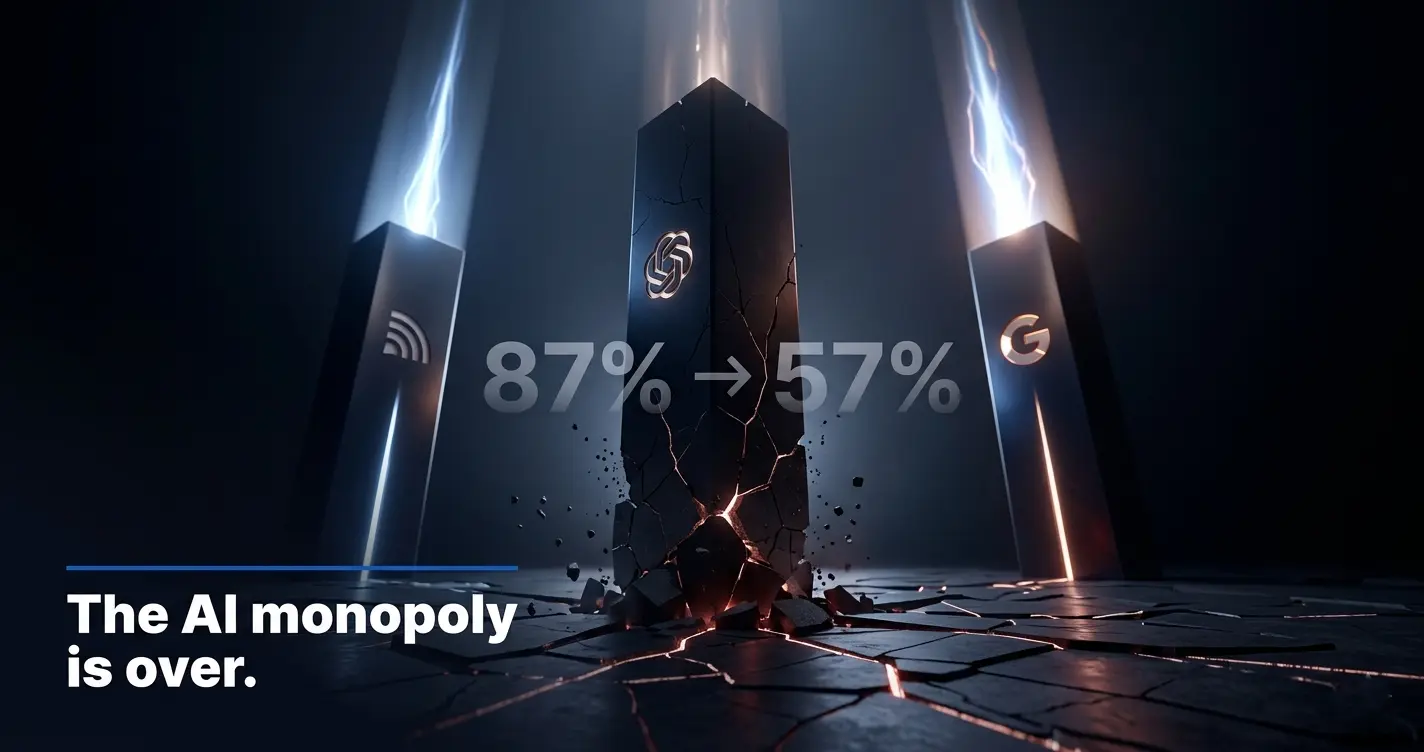
Fourteen months ago, ChatGPT held 87% of generative AI web traffic. As of March 2026, it’s below 57%. That’s not a blip, that’s the fastest collapse of market dominance in consumer software since Internet Explorer lost the browser wars. Gemini went from 6% to 25%. Claude went from 1.4% to over 6%. And we’re still early.
If you’re a developer routing API calls, a CTO evaluating an enterprise contract, or a founder choosing the core model for your product, the decision you make this quarter has real consequences. This guide cuts through the benchmark theater and gives you the honest comparison: what each model actually does best, what it costs, and where the traps are.
−30pt
ChatGPT market share drop, Jan 2025 → Mar 2026
4×
Gemini’s traffic share growth over same period
3×
Claude’s share gain in a single quarter
The Market Shift Nobody Predicted
The mainstream narrative going into 2025 was settled: OpenAI won. ChatGPT was the Google of AI, first-mover with a moat so deep no challenger could cross it inside five years. That narrative is now wrong.
The structural break happened in three waves. First, model quality parity arrived faster than anyone expected. Claude 3.7, Gemini 3.0, and then the jump to Claude 4.x and Gemini 3.1 Pro showed that OpenAI’s quality lead was a 12-month advantage, not a permanent one. By late 2025, independent benchmarks showed all three platforms within single-digit percentage points on general capability tests.
Second, Google’s distribution machine activated. Gemini bundled into Gmail, Docs, Sheets, and Android didn’t win users through product quality, it converted existing Google Workspace daily actives into AI users overnight. That’s how you go from 6% to 25% in twelve months without necessarily being the best model in the room.
Third, Claude’s enterprise breakout. While Gemini was winning on distribution and ChatGPT on consumer scale, Anthropic quietly captured the segment willing to pay the most: regulated industries. The Claude iOS app hit #1 on the U.S. App Store on February 28, 2026, the first time any AI app surpassed ChatGPT in daily downloads. Claude Code’s weekly active users doubled between January and April. Anthropic’s annualized revenue reached $14 billion as of February 2026, up from $1 billion in 2024. That’s a 14× increase in two years.
Our Read
This maps almost exactly to the browser wars. ChatGPT is Internet Explorer, dominant, sticky, losing ground slowly. Gemini is Chrome, distribution king, winning by presence not choice. Claude is Firefox, smaller but chosen deliberately by users who care about quality. The key difference: all three are improving simultaneously, and the market is still growing. There’s no single winner. That is the story.
Current Models at a Glance
Platform
Current Flagship
Context Window
Consumer Tier
API Input/Output (per 1M tokens)
OpenAI / ChatGPT
GPT-5.5 (Apr 2026) GPT-5.4 Pro via API
~250K tokens (Enterprise)
Free / Plus $20/mo / Pro $200/mo
$1.75 / $14.00 (GPT-5.2)
Anthropic / Claude
Claude Opus 4.7 Apr 2026
1M tokensNew
Pro ~$20/mo / Max ~$50+/mo
$5.00 / $25.00
Google / Gemini
Gemini 3.1 Pro (Feb 2026)
1–2M tokens
Advanced $19.99/mo
$2.00 / $12.00 (Flash: $0.50 / $3.00)
A few things worth flagging before we get into comparisons. Claude Opus 4.7 is the most significant recent release: it arrives with a 1M token context window (four times larger than Opus 4.6), high-resolution vision at 2,576px, and a self-verification capability that reduces hallucinations on factual tasks. GPT-5.2 is being retired June 5, 2026, any enterprise contract referencing that model needs revisiting now. And Gemini’s naming situation is still a genuine headache for API buyers: “Gemini 3 Pro” (consumer) and “Gemini 3.1 Pro Preview” (developer docs) are the same model, sold under two different labels.
Coding & Developer Benchmarks
This is the comparison developers actually search for, and it has a clearer answer than any other category in 2026.
Doubled between January and April 2026 — developer consensus forming
—
Claude’s lead on SWE-bench Verified is the single clearest differentiation in this entire comparison. A 3–4 point gap on academic benchmarks is noise. A 3–4 point gap on real GitHub issue resolution, across thousands of production repositories, is something engineering leads should care about.
That said, the cost math complicates things fast. If you’re building a production API pipeline and routing to Claude at $5/$25 per million tokens, versus GPT-5.4 Mini at roughly 6× less than GPT-5.4 Standard, you have a real ROI question to answer. For most B2C product workloads, quick code completions, light refactors, IDE copilot interactions, GPT-5.4 Mini at near-Claude-level performance for a fraction of the cost is the rational choice. Route the complex, high-stakes generation tasks to Claude. Route the volume to Mini or Gemini Flash.
“Claude is better for complex coding. Claude Opus 4.7 scores 87.6% on SWE-bench Verified, versus GPT-5.4’s approximately 84%. For full-file refactors and long-context debugging, Claude leads. For quick scripts and IDE plugin support, ChatGPT remains competitive.”
This is Gemini’s clearest win. On graduate-level science questions, the kind of reasoning required in drug discovery, materials science, and academic research, Gemini 3.1 Pro scores 94.1–94.3% on GPQA Diamond. GPT-5.4 follows at ~92.8%. Claude Opus 4.6 sits at ~91.3%. For enterprise buyers in scientific or research-heavy domains, that gap matters.
Knowledge Depth (Humanity’s Last Exam)
HLE is the hardest knowledge benchmark available, designed explicitly to resist saturation. The scores: Claude 53 | GPT-5.4 48 | Gemini 40 (BenchLM.ai, April 2026). Claude wins on the single hardest knowledge test, which counters the “Gemini is the smartest” narrative you’ll encounter in a lot of enterprise sales conversations.
Context Window Reality
Gemini 3.1 Pro offers 1–2M tokens, technically the largest. Claude Opus 4.7 now matches at 1M. ChatGPT Enterprise sits around 250K. Worth knowing: multiple engineers have noted in 2026 benchmark reviews that performance at 1M+ token contexts degrades meaningfully on most tasks. Advertised context is not reliable context. Test your specific workload at scale, don’t rely on the spec sheet.
Multimodal
Gemini has the structural advantage here, Google’s investment in vision and audio AI runs deeper than either competitor’s, and Gemini 3.1 Pro’s multimodal performance leads on most third-party evaluations. Claude Opus 4.7’s new high-resolution vision (2,576px) closes the gap on document and image analysis. ChatGPT remains competitive across all modalities but doesn’t lead on any specific visual benchmark in 2026.
API Pricing: The Number That Kills Deals
Consumer tiers have converged: all three platforms sit at $19–$20/month for their mid-range plans. The API is where the real decision lives, and where the gap is significant.
Model
Input (per 1M tokens)
Output (per 1M tokens)
Notes
Claude Opus 4.7
$5.00
$25.00
Up to 90% savings with prompt caching
GPT-5.2
$1.75
$14.00
Retiring June 5, 2026
Gemini 3.1 Pro
$2.00
$12.00
Strong default for cost-conscious builds
Gemini 3 Flash
$0.50
$3.00
Best cost-efficiency for high-volume workloads
GPT-5.4 Mini
~6× cheaper than Standard
—
~94% of Standard’s coding performance
Grok 4.1
$0.20
$0.50
Cheapest frontier API overall
Cost Reality Check
Claude is 2.5–3× more expensive than Gemini at API level. At 100M tokens/month, that’s a $300,000 annual cost difference. Claude’s prompt caching (up to 90% savings on repeated context) makes it competitive for long-context applications that reuse significant prompt context, legal document review, multi-turn research, large codebase analysis. For high-volume, low-complexity tasks, Gemini Flash or GPT-5.4 Mini is the rational default.
Enterprise Reality: Who’s Winning Where
The single-vendor AI strategy is over. Internal data from multiple enterprise surveys in 2026 shows the dominant enterprise stack as: Claude for deep analytical, legal, and compliance output + ChatGPT for research, workflow automation, and employee-facing tools + Gemini for Google Workspace-native workflows. These aren’t competing, they’re co-existing in the same organization.
“ChatGPT is the overwhelming leader in consumer AI with more than 900 million weekly active users, and over 50 million subscribers… Search usage has nearly tripled in a year, and our ads pilot reached more than $100 million in ARR in under six weeks.”
That’s the official OpenAI position. What the official position omits: OpenAI is projected to lose $14 billion in 2026, nearly triple earlier estimates, with cumulative losses of $44 billion through 2028 and profitability not expected before 2029. Only 5.5% of ChatGPT’s 900 million users pay. The ads pilot (mentioned casually in Altman’s quote) signals that the product experience for free-tier users may change fundamentally.
Meanwhile, Anthropic is concentrating on the segment willing to pay most. Claude reportedly wins approximately 70% of new enterprise AI deals in regulated industries, legal, finance, healthcare, compliance, because of its documented lower hallucination rate and its “uncertainty flagging” behavior: it declines to answer when it’s not confident rather than confabulating. In industries where an AI error has financial or legal consequences, that behavior is worth a pricing premium.
Google’s enterprise advantage is structural, not earned. 120,000+ enterprise customers and 95% of top-20 global SaaS companies use Google Cloud AI, but much of that is Gemini arriving inside Workspace by default, not the result of a competitive evaluation. CTOs in Google-heavy shops evaluating ChatGPT or Claude as Workspace replacements are solving the wrong problem. Evaluate them as additive tools for tasks Workspace doesn’t do well.
Use Case Mapping
Best: Claude
Complex Code Generation & Refactoring
87.6% SWE-bench, 1M token context, Claude Code doubling WAU. The empirical choice for production-quality output on non-trivial engineering tasks.
Best: Gemini
Google Workspace Workflows
If your team lives in Gmail, Docs, and Sheets, Gemini is already there. The integration advantage bypasses any benchmark comparison.
Best: Claude
Legal, Compliance & Finance
Lower hallucination rates, uncertainty flagging, and 70% win rate in regulated-industry enterprise deals. The reliability premium is real and priced accordingly.
Best: ChatGPT
Third-Party Integrations & Plugins
92% of Fortune 500 adoption, Codex (3M weekly active developers), and the broadest plugin/tool ecosystem. For horizontal workflow automation, ChatGPT’s network effects win.
Best: Gemini
High-Volume, Cost-Sensitive APIs
Gemini Flash at $0.50/$3.00 per 1M tokens is the most cost-efficient frontier API for applications where multimodal capability is relevant and volume is high.
Best: Gemini
Scientific Research & Reasoning
94.1% GPQA Diamond. For drug discovery, materials science, and graduate-level academic analysis, Gemini’s reasoning benchmark lead is real and consistent.
What the Benchmarks Don’t Tell You
The Hallucination Problem Isn’t Solved
An EBU/BBC study found 48% of responses from free-tier chatbots contained accuracy issues as recently as mid-2025. Claude Opus 4.1 recorded 0% hallucination on the AA-Omniscience benchmark, but only because it declined to answer when uncertain rather than guessing. Gemini 3.1 Pro cut its hallucination rate by 38 percentage points, which is the biggest improvement of any model but still leaves it at ~50% on certain tests. Westlaw AI, built specifically for legal research, hallucinated more than 34% of the time on challenging queries.
Healthcare Warning
The ECRI Institute ranked misuse of AI chatbots as the #1 health technology hazard of 2026, explicitly naming ChatGPT, Claude, Gemini, Copilot, and Grok as “not regulated as medical devices and not validated for healthcare purposes.” Any healthcare deployment carries compliance exposure regardless of platform.
Benchmark Saturation Is Real
MMLU now scores 88–94% across all top models. It no longer differentiates them. The benchmarks that do differentiate, SWE-bench Pro, ARC-AGI-2, Humanity’s Last Exam, are not the ones most buyers understand or test themselves. When a vendor’s sales deck shows you a benchmark chart, ask specifically which benchmark, and whether it’s been saturated. Most popular media comparisons cite saturated benchmarks, making rankings look more meaningful than they are.
Vendor Lock-In Accumulates Invisibly
Enterprises building workflows on Claude’s Projects system, Google’s Workspace Gemini integration, or ChatGPT’s Custom GPTs ecosystem are accumulating switching costs that won’t show up in today’s pricing comparison. The platform decision made in 2026 shapes what tools are available, and at what negotiating leverage, in 2028. The time to think about this is before the integration is built, not after.
“OpenAI is projected to lose $14 billion in 2026, nearly triple earlier estimates for 2025, even as it reports $25 billion in annualized revenue and 900 million weekly ChatGPT users. The company expects cumulative losses of $44 billion between 2023 and 2028, with profitability not arriving until 2029 at the earliest.”
, European Business Magazine, citing The Information internal financial projections, 2026. Read the full report →
This is the most important contrarian data point in the entire comparison. The market leader has the biggest user base and the biggest losses. The ads pilot signals a potential shift in the free-tier product experience. That changes the calculus for any organization that’s built workflows on the assumption that free-tier ChatGPT performs identically to paid ChatGPT. It may not for much longer.
The Verdict
There’s no single winner. Anyone telling you otherwise is selling something. Here’s the honest split:
ChatGPT
Best for
Consumer-scale deployment, third-party integrations, employee-facing tools, and organizations where Fortune 500 adoption rates reduce procurement friction. The horizontal choice.
Claude
Best for
Complex code generation, legal and compliance work, long-document analysis, and any use case where hallucination has real-world consequences. The quality-first choice.
Gemini
Best for
Google Workspace-native workflows, high-volume cost-sensitive APIs, scientific reasoning, and multimodal tasks. The distribution and efficiency choice.
Most serious enterprise buyers in 2026 use two of the three, typically Claude plus one of the other two depending on their infrastructure. The overlap is real and intentional. These platforms are not substitutes for each other; they’re complements with different cost structures and different failure modes.
Watch three things over the next 6–18 months. First, whether OpenAI’s ads pilot scales, this is the signal for how the free-tier product experience evolves. Second, whether Claude’s API pricing moves; Anthropic’s current premium pricing reflects confidence in the enterprise market, but competitive pressure from Gemini Flash is real. Third, whether any platform meaningfully solves hallucination at the infrastructure level, rather than at the “decline to answer” workaround level. That’s the technical moat that doesn’t yet exist.
Frequently Asked Questions
Which AI is better in 2026 | ChatGPT, Claude, or Gemini?
There is no single winner. Claude Opus 4.7 leads on coding (87.6% SWE-bench) and writing quality. ChatGPT (GPT-5.4/5.5) leads on ecosystem breadth and third-party integrations. Gemini 3.1 Pro leads on reasoning benchmarks (94.1% GPQA) and multimodal tasks. Most professional users in 2026 use two of the three. Source: BenchLM.ai, April 2026.
Is ChatGPT or Claude better for coding?
Claude is better for complex coding. Claude Opus 4.7 scores 87.6% on SWE-bench Verified vs GPT-5.4’s ~84%. For full-file refactors and long-context debugging, Claude leads. For quick scripts and IDE plugin support, ChatGPT remains competitive. Most engineering teams use both. Source: LearnDrive, 2026.
What is the cheapest AI API in 2026?
Gemini 3 Flash is the cheapest frontier API at $0.50 input / $3.00 output per million tokens. Grok 4.1 charges $0.20/$0.50, making it cheapest overall. GPT-5.4 Mini is 6× cheaper than GPT-5.4 Standard. Claude Opus 4.7 is most expensive at $5.00/$25.00, but offers up to 90% savings via prompt caching on repeated-context workloads. Source: IntuitionLabs, Feb 2026.
How many people use ChatGPT in 2026?
ChatGPT has over 900 million weekly active users and 50 million paying subscribers as of March 2026. It processes 2.5 billion daily prompts. OpenAI generates $25 billion in annualized revenue, but projects a $14 billion operating loss in 2026 due to compute costs. Source: OpenAI, March 31, 2026.
Is Gemini better than ChatGPT in 2026?
Gemini 3.1 Pro leads on reasoning benchmarks (94.1% vs 92.8% GPQA Diamond), offers a larger context window (1–2M tokens), and excels at multimodal tasks. ChatGPT leads on ecosystem, integrations, and consumer scale (900M WAU vs 750M MAU). For Google Workspace users, Gemini has a structural advantage that makes the comparison largely moot. Source: LearnDrive, 2026.
Does Claude hallucinate less than ChatGPT?
Yes, in independent testing. Claude Opus 4.1 recorded 0% hallucination on the AA-Omniscience benchmark by declining to answer when uncertain. However, no AI model is hallucination-free, the EBU/BBC found 48% of free-tier AI responses had accuracy issues in 2025. Claude’s “I don’t know” behavior matters most in legal, compliance, and financial use cases. Source: Suprmind AI, May 2026.
Which AI has the largest context window in 2026?
Gemini 3.1 Pro offers the largest at 1–2 million tokens. Claude Opus 4.7 (April 2026) now reaches 1 million tokens. ChatGPT Enterprise supports approximately 250,000 tokens. Important caveat: practical performance degrades at maximum context lengths across all platforms. Advertised context window ≠ reliable context window. Test your specific workload. Source: Tech Insider, April 2026.
The Neural Loop
Weekly intelligence on AI models, enterprise deployments, and the business moves that matter. No hype. No padding. Just the signal.
Subscribe Free →