Tag: GPT5

  • GPT-5 Capabilities: Developer & Founder Guide (2026)

    GPT-5 Capabilities: Developer & Founder Guide (2026)

    GPT-5 Capabilities: The Complete Technical Guide for Developers and Founders (2025–2026)
    AI Models & APIs

    GPT-5 Capabilities: The Complete Technical Guide for Developers & Founders

    Everything that actually matters about OpenAI’s flagship model — benchmarks, pricing, hallucinations, and what it means for your product in 2025–2026.

    NeuralWired Research Desk | May 28, 2026 | 18-min read
    GPT-5 Capabilities Developer Guide Pricing Alert
    On August 7, 2025, OpenAI didn’t just release a new model. It collapsed its entire model portfolio into one, and then the flagship feature broke on launch day. Nine months later, GPT-5 is the engine behind 900 million weekly active users and a $25 billion revenue run rate. This guide separates what GPT-5 actually delivers from what OpenAI wants you to believe it delivers.

    By NeuralWired Research Desk  ·  Updated May 28, 2026

    What Is GPT-5?

    GPT-5 is OpenAI’s flagship large language model, released on August 7, 2025 at 10AM PT. It’s available across ChatGPT (all user tiers), the OpenAI API platform, and the GitHub Models Playground.

    The defining architectural move: GPT-5 is a unified system, a single model that houses a fast conversational sub-model for routine queries and a deep reasoning sub-model (“GPT-5 Thinking”) for complex tasks. A real-time router decides which mode engages, based on query complexity, tool requirements, and signals like a user typing “think carefully about this.”

    Before GPT-5, users had to manually choose between the GPT-4o series (fast, conversational) and the o-series reasoning models (o1, o3, slower, more accurate on math and science). GPT-5 eliminates that decision entirely. Or it was supposed to, the router malfunctioned on launch day, which we’ll get to.

    “It’s like talking to an expert. A legitimate, PhD-level expert in any area you need.”

    Sam Altman, CEO, OpenAI, Pre-recorded press briefing, August 7, 2025
    That PhD-level framing maps to specific benchmarks: 88.4% on GPQA Diamond (graduate-level science) and 67.2% on HealthBench (medical conversations). The claim isn’t hype without data. Whether the data holds up in your production environment is a different question.

    94.6%
    AIME 2025 Math
    74.9%
    SWE-bench Verified
    88.4%
    GPQA Diamond Science
    88%
    Aider Polyglot Coding
    84.2%
    MMMU Multimodal
    67.2%
    HealthBench Medical

    GPT-5 Benchmark Scores: The Complete Breakdown

    Benchmarks are the language enterprises use to justify procurement and the numbers engineers use to set expectations. Here’s what GPT-5 actually scored, source-attributed, with methodology noted.

    Benchmark GPT-5 Score What It Measures Why It Matters
    AIME 2025 94.6% High school olympiad mathematics Stumps most adults. Signals deep reasoning without tools.
    SWE-bench Verified 74.9% Real-world software engineering (bug-fixing) GPT-4.1 scored 54.6% four months earlier — a 20-point jump.
    Aider Polyglot 88% Cross-language coding ability Multi-language production relevance for full-stack teams.
    GPQA Diamond 88.4% PhD-level physics, chemistry, biology Curated to be hard even for the PhDs who wrote the questions.
    MMMU 84.2% Multimodal understanding Image + text reasoning for document-heavy workflows.
    HealthBench 67.2% Clinical conversation quality Benchmark for medical AI deployments in regulated settings.
    The SWE-bench figure deserves special attention. OpenAI’s developer page documents the trajectory: GPT-4o scored 33.2%, GPT-4.1 reached 54.6%, and GPT-5 hit 74.9%, all within a 12-month window. For engineering teams, that isn’t a benchmark number. That’s the delta between “AI assists with code” and “AI autonomously closes GitHub issues.”

    Key Insight
    GPT-5’s token efficiency is a hidden financial story. OpenAI reports 50–80% fewer output tokens than o3 for equivalent performance, meaning if your pipeline previously ran on o3, switching to GPT-5 can cut token costs roughly in half before factoring in any price-per-token differences.

    How GPT-5 Differs from GPT-4o and o3

    The simplest framing: GPT-5 is what you’d get if GPT-4o and o3 had a child that also knew when to think slowly.

    GPT-4o was fast and conversational. o3 was slow and brilliant at math and science. Users had to choose between them depending on the task, a friction point that caused constant miscategorization. GPT-5’s real-time router eliminates that choice.

    Three concrete differences that change day-to-day developer experience:

    1. No manual model selection. The router decides whether to engage fast or deep reasoning based on query complexity. In practice, this works better for ambiguous tasks than users tended to perform at self-selection.
    2. 45% fewer factual errors than GPT-4o in OpenAI’s internal testing. In reasoning mode, the figure climbs to 80% fewer errors versus o3. (Independent validation is mixed, see Section 7.)
    3. Front-end web development outperforms o3 70% of the time in OpenAI’s internal evaluations. For developers doing full-stack work, that’s not marginal, that’s a genuine first-pass quality shift.
    ⚠ Launch Day Reality Check
    The routing feature — GPT-5’s central innovation, malfunctioned on August 7, 2025. The flagship technical differentiator did not function correctly on day one. Additionally, OpenAI published benchmark bar charts that visually contradicted their own numerical data: the “coding deception” chart showed GPT-5 with a shorter bar than o3, despite GPT-5’s lower number indicating better performance. InfoQ documented both issues in detail. OpenAI issued corrections. Both errors raised legitimate questions about internal quality control for the company’s most important launch in two years.

    GPT-5 API Pricing: What You’ll Actually Pay

    This is the section that should be pinned to every startup’s engineering Slack. GPT-5 launched at a price point that made it seem like the cost curve was finally working in developers’ favor. What happened next was not that.

    Model Version Release Date Input (per 1M tokens) Output (per 1M tokens)
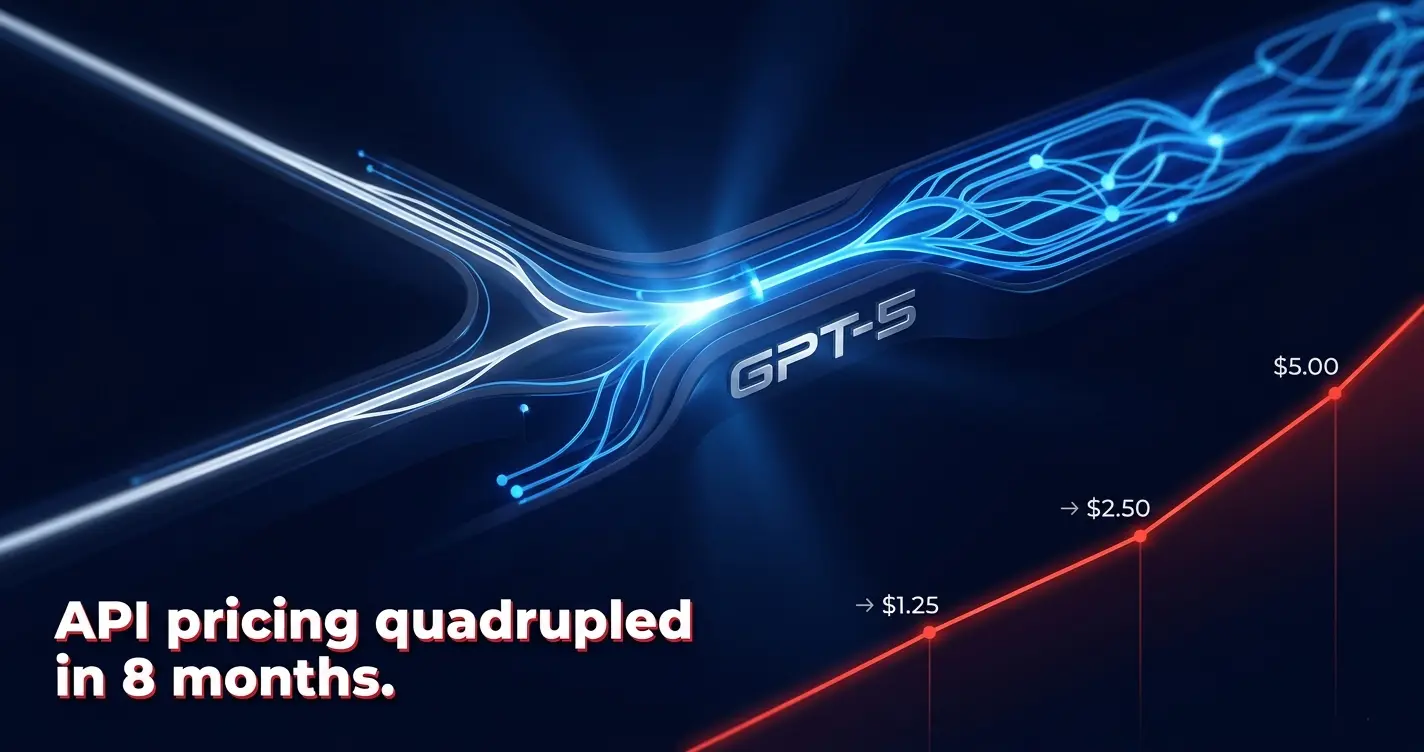
    GPT-5 (launch) August 7, 2025 $1.25 $10.00
    GPT-5.4 ~March 2026 $2.50
    GPT-5.5 (“Spud”) April 23, 2026 $5.00 $30.00
    API input pricing quadrupled in eight months. Output pricing tripled. During the same period, NVIDIA CEO Jensen Huang stated that hardware costs per inference token dropped approximately 35×. OpenAI’s pricing trajectory is not following infrastructure economics. It’s following market demand and competitive positioning.

    Any product with significant token throughput that was budgeted at $1.25/M input is now facing 4× the cost if it has migrated to current models. That’s not a price increase, it’s a category change in unit economics.

    NeuralWired Research Desk analysis, May 2026
    For ChatGPT users: Plus ($20/month) includes GPT-5 with usage limits on thinking-mode messages. Pro ($100–$200/month, restructured from launch’s $200 flat) includes GPT-5 Pro with extended reasoning and no token budget restriction. Ed Zitron, tech critic and writer, framed the launch bluntly:

    “Meaningful functionality… is being completely removed for ChatGPT Plus and Team subscribers.”

    Ed Zitron, Technology Critic — “Where’s Your Ed At” newsletter, August 2025, via Voiceflow
    Our read: Zitron’s critique is specifically about model-selection removal and rate limits, not raw capability. Both things can be true, GPT-5 is technically more capable than GPT-4o, and Plus users received fewer choices with the upgrade. Whether that trade is acceptable depends entirely on your use case.

    GPT-5 Context Window and Technical Specs

    Parameter GPT-5 (August 2025) GPT-5.5 (April 2026)
    Context Window 400,000 tokens 1,050,000 tokens (1M+)
    Max Output 128,000 tokens
    Knowledge Cutoff September 2024
    Latency (tokens/sec) ~77.7 (Artificial Analysis)
    Training Infrastructure Microsoft Azure AI supercomputers
    Distribution at Launch ChatGPT, OpenAI API, GitHub Models, Agents SDK
    The 400K context window matters for enterprise document workflows, processing full legal contracts, entire codebases, or multi-year financial filings in a single call. GPT-5.5’s 1M+ token context is available via the API and makes whole-repository code analysis practically viable for the first time in the OpenAI stack.

    GPT-5 vs Claude and Gemini

    The short answer: neither model is comprehensively superior. Benchmark leadership is task-specific, and it’s shifting faster than procurement cycles can track.

    Benchmark GPT-5.5 (Apr 2026) Claude Opus 4.7 (Apr 2026) Leader
    Terminal-Bench 2.0 82.7% 69.4% GPT-5.5
    ARC-AGI-2 85.0% 75.8% GPT-5.5
    SWE-Bench Pro 58.6% 64.3% Claude Opus 4.7
    The competitive moat OpenAI held during the GPT-4 era has narrowed materially. Artificial Analysis scores GPT-5 at 45/100 on their Intelligence Index — above most models but not the categorical lead OpenAI commanded in 2023. ChatGPT’s US mobile app daily active user share fell from 69.1% in January 2025 to 38.7% by May 2026. Anthropic’s Claude app went from under 2% to 10% DAU share in three months.

    GPT-5 is still the market leader by revenue and user count. It isn’t the unchallenged technical leader on every dimension.

    Does GPT-5 Still Hallucinate?

    Yes. Less than before — but the gap between what OpenAI claims and what independent testers find is real and worth understanding before you deploy in a regulated environment.

    OpenAI’s claim: 45% fewer factual errors versus GPT-4o; 80% fewer errors in reasoning mode versus o3.

    Independent testing: Vectara found GPT-5.2 had an 8.4% hallucination rate in their methodology, trailing DeepSeek. OpenAI’s own figure for GPT-5.2 was a reduction from 8.8% to 6.2%: a more modest 30% improvement, not the dramatic leap marketing suggested.

    PCMag’s Ruben Circelli, who reviewed GPT-5 against real-world production tasks rather than benchmark conditions, was direct:

    “GPT-5 is an ‘insignificant update.’ While it has some upgrades, it ‘doesn’t solve the problems that actually matter’ and he has not ‘noticed a significant improvement’ in areas like hallucination reduction.”

    Ruben Circelli, Senior Analyst, PCMag — August 2025, via Voiceflow
    That’s the practitioner gap: benchmark-measured hallucination uses controlled scenarios with defined correct answers. Production use involves open-ended, ambiguous queries where the model can’t know what it doesn’t know. GPT-5 is more reliable than GPT-4o. It’s not hallucination-free. Deploy accordingly.

    One genuinely encouraging signal: a peer-reviewed study by Polat et al. (six MDs across four Turkish hospitals, published November 2025 in Letters to the Editor, NCBI) concluded that GPT-5’s measurable reduction in hallucination rates represents a meaningful milestone for medical and scientific writing, one of the first published academic assessments from clinical practitioners in a domain where errors cost lives. That’s cautious optimism, not a blanket clearance.

    GPT-5 for Developers: Coding, Agents, and the Agents SDK

    If you’re building software with or on AI, GPT-5 changes three things materially, and creates one significant risk.

    What changes in practice

    74.9% SWE-bench means autonomous issue resolution, not just code suggestions. At GPT-4o’s 33.2%, AI-assisted coding meant “AI suggests, human implements.” At 74.9%, the model can autonomously close real GitHub issues in verified test conditions. Combined with the Agents SDK (which provides orchestration, tracing, and MCP connectivity to external tools like CRM, payment, and support systems), multi-step autonomous pipelines are production-grade for the first time.

    GPT-5 beats o3 at front-end web development 70% of the time. For developers doing full-stack work, that’s not marginal assistance, it’s output-quality output at first pass. The net result is that senior engineering time spent on routine implementation patterns (API integrations, UI scaffolding, documentation) can shift toward architecture and review.

    What to do right now

    Audit your current stack for tasks that consume disproportionate senior engineering time but follow a pattern: bug triage, code review, documentation, API integration. These are GPT-5’s highest-ROI targets. Evaluate the Agents SDK as an integration layer before building a custom orchestration system from scratch.

    The risk you need to price in

    ⚠ API Pricing Risk
    API pricing quadrupled from August 2025 to April 2026. Any product budgeted at GPT-5 launch pricing with significant token throughput is now 4× the cost if it has migrated to current models. Build pricing escalation assumptions into any business case that relies on the GPT-5 stack. A multi-vendor or open-source fallback strategy isn’t optional caution at this point — it’s basic financial hygiene.

    GPT-5 for Founders: What Changes in Your Build-vs-Buy Decisions

    The uncomfortable truth: GPT-5 compressed the moat of a large class of AI startups in a single launch. If your competitive advantage was “we built a better AI wrapper,” that advantage has narrowed to the point where you need to name what specifically you still do better than the base model.

    The opportunity is real too. Enterprise deployments at GPT-5 launch included Morgan Stanley (financial workflows), Amgen (scientific research), and T-Mobile (customer operations). Fortune 500 procurement of AI tools has accelerated. If you serve any of those verticals, GPT-5 integration is now a procurement requirement, not a differentiator.

    42% of new SaaS platforms with AI capabilities launched in 2025 relied on OpenAI models. That means GPT-5 is infrastructure. The differentiation layer has shifted up the stack, to proprietary data, domain-specific fine-tuning, and integration quality. Prompt engineering alone isn’t a moat anymore. It arguably never was, but GPT-5 made that unavoidable.

    Founder Action Item
    Invest now in proprietary data pipelines and fine-tuning infrastructure. The competitive question for any AI-native product is no longer “is our model good?”, it’s “do we have data the base model doesn’t?” That’s where defensible differentiation now lives.

    The Skeptic’s Case: What GPT-5 Doesn’t Solve

    Balanced coverage means saying the things OpenAI’s press releases don’t.

    The AGI framing is marketing

    Sam Altman’s description of GPT-5 as offering “PhD-level expertise” maps directly to one benchmark: GPQA Diamond. In controlled academic tests with defined answers, GPT-5 performs at a PhD level on scientific knowledge retrieval. On open-ended reasoning chains involving novel problems, ambiguous real-world data, or multi-domain synthesis, it remains significantly below expert human performance.

    GPT-5 performs comparably to or better than human experts in roughly half of cases across 40+ occupations. That means it performs worse than human experts in the other half. At NeurIPS 2025, only 2 of 5,000 papers mentioned AGI. Prominent researchers including Demis Hassabis have emphasized that scaling transformers hits a cognitive scaling wall, current paradigms require paradigm-level innovation, not just larger models, to reach genuine general intelligence.

    Agentic reliability isn’t solved yet

    GPT-5’s agentic capabilities are real. The reliability math is not flattering for complex pipelines. A 95% success rate per tool call yields approximately 60% end-to-end success over 10 sequential steps. Enterprises deploying GPT-5 agents in customer-facing workflows without robust human-in-the-loop checkpoints are assuming a reliability threshold the model doesn’t yet consistently meet.

    Regulatory exposure in regulated sectors

    GPT-5’s use in healthcare, legal, and financial services creates EU AI Act exposure. OpenAI hasn’t published a conformity assessment for GPT-5 under the Act’s high-risk provisions. Companies deploying it in these domains are accepting compliance risk that OpenAI itself hasn’t fully addressed publicly. If you’re a CTO in a regulated vertical, that’s not a footnote, it’s a procurement risk factor that belongs in your security review.

    The GPT-5 Model Family: From 5.1 to 5.5

    GPT-5 is not a single model, it’s an ongoing release cadence. Five significant versions shipped in the nine months after launch.

    Version Release Date Key Changes
    GPT-5 August 7, 2025 Flagship launch — unified routing system, 400K context
    GPT-5.1 ~January 2026 Incremental refinements
    GPT-5.2 December 11, 2025 400K context confirmed, 3 variants (Instant / Thinking / Pro), ARC-AGI-1 >90%
    GPT-5.4 ~March 2026 Coding and agentic focus, front-end design improvements
    GPT-5.5 “Spud” April 23, 2026 1M+ token context, Terminal-Bench 2.0 at 82.7%, API pricing doubled from 5.4
    The pace is deliberate. Sam Altman reportedly referred to GPT-5.5 as “the last big milestone before AGI” in internal remarks reported by the Financial Times in April 2026. Read carefully: that statement describes the current training paradigm having one or two more generations of runway before requiring a fundamental architectural shift, not a claim that AGI is imminent. It’s being read by many outlets as a promise it isn’t.

    Our read: the GPT-5 series demonstrates that OpenAI has internalized the launch-iterate model from consumer software. The implication for anyone building on it is that the model you ship against today may be meaningfully different in six months, for better (capability) and worse (pricing).


    Frequently Asked Questions

    What is GPT-5?
    GPT-5 is OpenAI’s flagship large language model, released August 7, 2025. It’s a unified system combining a fast conversational sub-model and a deep reasoning sub-model, with an automatic router that selects the right mode per query. It powers ChatGPT by default and is available via the OpenAI API. GPT-5 sets leading benchmarks in math (94.6% AIME 2025), coding (74.9% SWE-bench), and science (88.4% GPQA Diamond).

    How is GPT-5 different from GPT-4o?
    GPT-5 unifies GPT-4o’s conversational speed with the o-series reasoning models into one system, eliminating manual model selection. It reduces factual errors by 45% compared to GPT-4o, scores 20 percentage points higher on SWE-bench (74.9% vs. GPT-4o’s ~54%), and introduces a real-time routing system that decides when to engage deeper reasoning without user input.

    What are GPT-5’s benchmark scores?
    GPT-5’s official benchmark scores: 94.6% on AIME 2025 (advanced math), 74.9% on SWE-bench Verified (software engineering), 88% on Aider Polyglot (coding), 84.2% on MMMU (multimodal), 88.4% on GPQA Diamond (PhD-level science, Pro reasoning), and 67.2% on HealthBench (medical). Published by OpenAI at launch, August 2025.

    How much does GPT-5 cost via the API?
    GPT-5 launched at $1.25/M input tokens and $10/M output tokens (August 2025). Pricing escalated significantly: GPT-5.4 (March 2026) costs $2.50/M input; GPT-5.5 (April 2026) costs $5.00/M input and $30/M output, a 4× input increase in eight months. ChatGPT Plus ($20/month) includes access with usage limits; ChatGPT Pro ($100–$200/month) includes GPT-5 Pro with full extended reasoning.

    What is GPT-5’s context window?
    GPT-5 launched with a 400,000-token context window and a maximum output of 128,000 tokens per response. Knowledge cutoff is September 2024. GPT-5.5 (April 2026) extended the context window to over 1,050,000 tokens (1M+) via the API, making whole-repository code analysis and large-document processing viable in a single call.

    Is GPT-5 better than Claude?
    It depends on the task. GPT-5.5 leads Claude Opus 4.7 on Terminal-Bench 2.0 (82.7% vs. 69.4%) and ARC-AGI-2 (85.0% vs. 75.8%). Claude Opus 4.7 leads on SWE-Bench Pro (64.3% vs. 58.6%). Neither model is comprehensively superior, and benchmark leadership is shifting faster than it has at any prior point in the LLM competitive cycle.

    Does GPT-5 still hallucinate?
    Yes, less than before, but not eliminated. OpenAI reports 45% fewer errors versus GPT-4o. Independent testing by Vectara found an 8.4% hallucination rate in GPT-5.2. PCMag reviewers reported no significant improvement in real-world use. The gap between benchmark hallucination and production hallucination is real; GPT-5 is more reliable than its predecessors but not hallucination-free.

    What is GPT-5 Pro?
    GPT-5 Pro is the maximum-compute reasoning variant of GPT-5, exclusive to ChatGPT Pro subscribers ($100–$200/month as of April 2026). It enables extended “thinking” reasoning with no token budget restriction, producing more thorough answers on complex tasks. It scores higher than standard GPT-5 on GPQA Diamond (88.4%) and FrontierMath benchmarks.

    When was GPT-5 released?
    GPT-5 was officially released on August 7, 2025, at 10AM PT. OpenAI teased the launch the previous day via a post on X embedding the number “5” in the announcement text. The model launched simultaneously on ChatGPT (all user tiers), the OpenAI API platform, and the GitHub Models Playground.


    What You Now Know | And Where This Goes Next

    GPT-5 is the most commercially successful AI model ever released. It is also an imperfect product that malfunctioned on launch day, shipped benchmark charts that contradicted their own data, and has since quadrupled its API pricing while hardware costs fell 35×.

    Both things are simultaneously true. The model is genuinely capable, 74.9% SWE-bench and 88.4% GPQA Diamond are not noise. The commercial moat is real, $25B+ ARR and 900 million weekly users are not accidents. And the operational risks are real: pricing escalation, benchmark-to-production hallucination gaps, regulatory exposure in high-risk sectors, and compounding error rates in agentic pipelines.

    Three things to watch over the next 6–18 months:

    1. The competitive parity story. Claude Opus 4.7 already leads on SWE-Bench Pro. Gemini 3.1 competes on multimodal benchmarks. ChatGPT’s US mobile market share is below 40% for the first time. GPT-5 may not hold the benchmark lead across all dimensions by the end of 2026.
    2. The pricing ceiling. There’s no economic argument for API pricing increasing 4× in 8 months when inference costs are dropping. OpenAI is pricing against demand, not against cost. Watch for whether competition forces a reversal, or whether the market absorbs it.
    3. Agentic deployment reliability. The gap between GPT-5’s agentic capabilities and production-grade reliability in multi-step autonomous pipelines is the defining technical question for enterprise AI in 2026. The teams that figure out human-in-the-loop architectures that are fast enough to be useful will define what enterprise AI actually becomes.
    GPT-5 is infrastructure now, the same way GPT-4 became infrastructure. The question isn’t whether to use it. It’s how to build on it without being entirely at the mercy of OpenAI’s pricing decisions, and where to differentiate above the model layer.

    Stay Ahead of the AI Model Cycle

    The Neural Loop covers frontier model releases, benchmark analysis, and what they actually mean for your product, before the hype settles.

    Subscribe to The Neural Loop →
  • OpenAI’s $4B Deployment Company: What It Means for Enterprise AI

    OpenAI’s $4B Deployment Company: What It Means for Enterprise AI

    OpenAI’s $4 Billion Deployment Company Signals the End of the AI Hype Era | NeuralWired

    OpenAI’s $4 Billion “Deployment Company” Is the Moment AI Stopped Being a Product

    Sam Altman’s OpenAI and Dario Amodei’s Anthropic have closed parallel multi-billion dollar joint ventures with Wall Street’s biggest names. Together, they’re injecting $5.5 billion into a single, audacious bet: that AI has finally matured enough to run the global enterprise, not just assist it.

    Two announcements. Forty-eight hours apart. And the AI industry will never look quite the same. On May 4, Bloomberg confirmed that OpenAI had closed “The Deployment Company,” a $10 billion Delaware LLC backed by 19 investors including TPG and Brookfield Asset Management, with over $4 billion in committed capital. The following morning, The Wall Street Journal reported that Anthropic had finalized its own $1.5 billion joint venture anchored by Blackstone, Goldman Sachs, and Hellman and Friedman. Both ventures share one defining characteristic that separates them from anything either company has built before: they don’t sell software. They sell outcomes.

    This isn’t a fundraising story. It’s a structural shift in how frontier AI gets deployed, who controls its distribution, and what it actually does inside a company. The combined $5.5 billion commitment from the world’s most conservative allocators of capital, firms that don’t write checks on hype, signals that we’ve crossed a threshold. The era of chatbots and productivity copilots is over. The era of AI as industrial infrastructure has begun.

    OpenAI, now running at $25 billion in annualized revenue and eyeing a public listing as early as Q4 2026, needs a revenue engine that can sustain a valuation approaching $1 trillion. Anthropic, smaller but extracting far more revenue per user, needs a distribution mechanism that reaches beyond the enterprise software buyer. Both have landed on the same answer: embed forward-deployed engineers directly inside private equity portfolio companies, bypass the sales cycle entirely, and automate from the inside out.

    By the Numbers: OpenAI’s Deployment Company targets 2,000+ portfolio companies across finance, healthcare, manufacturing, and logistics. Anthropic’s JV is surgically focused on mid-sized firms, community banks, and regional health systems that lack the internal capacity to deploy frontier models on their own.

    OpenAI and Anthropic Built Two Very Different Financial Machines

    The structural differences between the two ventures are worth examining carefully, because they reveal distinct theories of how AI deployment actually works at scale. OpenAI’s Deployment Company is majority-owned by OpenAI itself, with COO Brad Lightcap overseeing its operations through a “Special Projects” team. The 19-investor coalition, which includes SoftBank Group, Advent, Bain Capital, and Dragoneer Investment Group, gives OpenAI an immediate, captive audience of thousands of companies without a single cold sales call.

    Anthropic’s structure is different. Its $1.5 billion JV operates as a standalone entity, not a subsidiary. The anchor investors, each contributing roughly $300 million, are Blackstone, Hellman and Friedman, and Goldman Sachs, with General Atlantic, Apollo Global Management, GIC, and Sequoia Capital rounding out the consortium. This structure gives Anthropic’s venture a degree of operational independence. It can price, staff, and prioritize without every decision running through Anthropic’s core product organization.

    “The Deployment Company marks our shift from selling tokens to delivering operational outcomes. It aligns OpenAI with PE’s efficiency mandate, turning AI into the OS of mid-market firms.”

    Sam Altman, CEO, OpenAI — Bloomberg, May 4, 2026
    Neither venture is a SaaS play. Both are modeled, explicitly, on the Palantir approach: send technically sophisticated people on-site, map the actual workflows, and build automation that sticks because the engineers who built it are still in the room when something breaks. It’s expensive, labor-intensive, and nearly impossible to scale quickly. But it works.

    OpenAI vs. Anthropic: The 2026 Deployment Venture Comparison

    Feature OpenAI: The Deployment Company Anthropic: Wall Street Joint Venture
    Initial Funding $4.0 billion+ $1.5 billion
    Post-Money Valuation ~$14 billion $1.5 billion (initial capitalization)
    Control Structure Majority-owned by OpenAI Standalone joint venture
    Lead Investors TPG, Brookfield, SoftBank Blackstone, Goldman Sachs, Hellman & Friedman
    Core Target Market 2,000+ multi-sector PE portfolio companies Mid-market, community banking, regional healthcare
    Operational Strategy Special Projects led by Brad Lightcap Applied AI specialists on-site
    Primary Model GPT-5.4 (1M token context, computer-use) Claude Mythos (security-focused, agentic)

    OpenAI’s GPT-5.4 and Anthropic’s Claude Mythos: The Engines Behind the Bet

    These deployment ventures don’t work unless the underlying models actually perform in production. Not on benchmarks. Not in demos. In the messy, exception-heavy, poorly-documented workflows of a mid-sized manufacturing firm or a regional hospital system. That’s a harder test than any eval, and both labs have spent the past several months making the case that their current-generation models can pass it.

    OpenAI’s GPT-5.4, released in March 2026, is built for exactly this environment. Its 1.05 million token context window means it can ingest an entire contract library, cross-reference it against regulatory guidance, and flag discrepancies without losing the thread. Its “Operator” framework, which lets it interact with standard business applications through a structured GUI layer, provides an audit trail that compliance officers can actually follow. On the GDPval professional services benchmark, GPT-5.4 posted an 83% win rate against prior OpenAI models. Its agentic workflow score ranks fourth among 115 tracked models globally.

    “GPT-5.4 sets a new bar for document-heavy legal work at 91% on BigLaw Bench eval, surpassing prior models across the board.”

    Niko Grupen, Head of Applied Research, Harvey — OpenAI, March 5, 2026
    Anthropic’s Claude Mythos takes a different approach. Rather than optimizing for breadth, it’s built for depth in constrained, high-stakes environments, particularly software architecture, cybersecurity, and complex multi-constraint reasoning tasks. Its “cautious, verifiable reasoning” slows inference but tends to outperform GPT-5.4 when tasks require synthesizing disparate context without hallucinating connections that don’t exist. For Anthropic’s target market of community banks and regional health systems, where a wrong answer has legal and regulatory consequences, that trade-off is the right one to make.

    The critical metric for both isn’t speed or accuracy on a leaderboard. It’s long-running task reliability: the ability to maintain coherent intent across a workflow that takes 20 minutes and involves 40 sequential steps. That’s what separates a capable model from an operational one.

    Token Efficiency Note: GPT-5.4 reduces token usage by 47% in tool-heavy workflows when using tool search, compared to workflows without it. Over thousands of daily automated tasks across 2,000 portfolio companies, that efficiency gain becomes a meaningful cost variable.

    OpenAI and Anthropic Are Coming for the IT Services Industry

    There’s a term circulating in consulting circles for what these deployment ventures represent: the SaaSpocalypse. It’s dark humor, but the underlying anxiety is real. For decades, firms like Tata Consultancy Services, Infosys, and Wipro have built enormous businesses on a simple premise: companies in developed markets will pay for skilled labor in lower-cost markets to manage their back-office operations. AI is about to dismantle that arbitrage.

    Anthropic’s CEO Dario Amodei has been unusually direct about this. He’s argued publicly that for AI labs to reach valuations approaching $1 trillion, the models must function not as tools that assist workers, but as substitutes for them at scale. Anthropic’s own research from March 2026 found that computer programmers face 75% task coverage from current AI systems, meaning three-quarters of their daily work could theoretically be handled by an agent today. The broader “computer and math” category sits at 94%.

    “Claude Mythos will displace up to 75% of programming tasks in PE portfolios, justifying our valuation narrative heading toward a trillion-dollar benchmark.”

    Dario Amodei, CEO, Anthropic — Fortune, May 4, 2026
    The gap between theoretical task coverage and actual agent adoption is precisely what the $5.5 billion in new capital is designed to close. Placing engineers on-site, in the workflow, translating model capability into running automation, that’s the bridge. And the private equity firms backing these ventures have every incentive to see it built quickly: their portfolio companies’ margins depend on it.

    AI Task Exposure by Workforce Category (March 2026 Estimates)

    Workforce Category Theoretical Task Coverage Current Agent Adoption Gap
    Computer Programming 75% 33% 42 points
    Computer & Math (Broad) 94% Low Very large
    Legal & Compliance 60%+ Nascent Large
    Office Administration 70%+ Nascent Large
    Financial Operations 55%+ Mid-market focus Moderate
    Not everyone is convinced the math works. Martin Fowler, a widely followed voice in enterprise software architecture, has pushed back on the deployment model’s structural assumptions. His concern isn’t that AI can’t do the work. It’s that the lock-in these ventures create will eventually be weaponized.

    “This deployment model risks lock-in; enterprises may become hostages to AI labs’ pricing and may fail to build any internal capabilities of their own.”

    Martin Fowler, Tech Influencer — Twitter/X, May 5, 2026
    It’s a fair warning, and one that the venture-backed firms pushing this model would prefer you not dwell on. Once a PE portfolio company’s claims processing, loan origination, or inventory management runs through an AI layer managed by an external entity, switching costs become enormous. That’s not a bug in the business model. It’s the point.

    OpenAI and Anthropic’s IPO Race: What These Ventures Actually Prove

    Strip away the strategic framing, and these ventures serve one immediate financial purpose: they justify the numbers that OpenAI and Anthropic need to go public. OpenAI is reportedly targeting a Q4 2026 listing, supported by $25 billion in annualized revenue, though its compute costs, projected to hit $121 billion by 2028, cast a long shadow over its profitability story. Anthropic’s path to its $900 billion valuation target is different: fewer users, but dramatically higher revenue per one.

    According to Counterpoint Research, Anthropic extracts $16.20 in average monthly revenue per active user, compared to OpenAI’s $2.20. That eight-to-one ratio reflects Anthropic’s deliberate focus on the high-end professional market, and it’s what these deployment ventures are designed to scale. By embedding Claude Mythos into the operations of hundreds of mid-market companies through the Blackstone and Goldman Sachs JV, Anthropic is manufacturing a captive, high-revenue user base before the IPO roadshow begins.

    📈
    OpenAI Revenue

    $25 billion annualized as of March 2026, up 17% from $21.4 billion in 2025. IPO target: Q4 2026.

    💼
    Anthropic ARPU

    $16.20 per active user monthly vs. OpenAI’s $2.20. The “premium lane” strategy in numbers.

    🏗️
    PE Portfolio Reach

    2,000+ portfolio companies targeted across finance, healthcare, manufacturing, and logistics.

    🔬
    Compute Cost Ahead

    OpenAI’s compute spend projected at $121 billion by 2028. Revenue must outrun the burn.

    Both companies are racing against a cost structure that is, by any traditional financial standard, extraordinary. Combined hyperscaler infrastructure spending across Alphabet, Amazon, Microsoft, and Meta is expected to hit $725 billion in 2026 alone, a 77% increase year-over-year. The compute costs that underpin GPT-5.4 and Claude Mythos are not declining fast enough to wait for organic enterprise adoption. The deployment ventures are a way to force the adoption curve.

    Frequently Asked Questions

    How does The Deployment Company differ from standard ChatGPT Enterprise subscriptions?
    ChatGPT Enterprise is a SaaS product: you buy seats, you get API access, your team figures out how to use it. The Deployment Company is the opposite model. OpenAI sends its own engineers on-site to map your workflows, build the automation, and manage the integration. You’re not buying tokens; you’re buying a finished, running system. It’s meaningfully more expensive and far stickier.

    Will these ventures replace IT consultants like TCS and Infosys?
    In mid-market and PE portfolio company contexts, the threat is real and near-term. The deployment ventures specifically target the back-office and programming work that Indian IT outsourcing firms have dominated for two decades. Automation targets of 75% for programming tasks and 70% for administrative work would eliminate the labor arbitrage these firms depend on. Large enterprise transformation work, which requires deep change management and organizational knowledge, is more insulated, at least for now.

    What specific tasks in healthcare and finance are targeted first?
    In healthcare: medical coding, prior authorization processing, clinical documentation, and basic diagnostic triage. In financial services: fraud pattern detection, loan document review, trading operations reporting, and regulatory filing preparation. GPT-5.4’s 83% win rate on professional services benchmarks and Claude Mythos’s strength in document-heavy, compliance-sensitive environments make both well-suited to these workflows.

    How do these ventures affect the IPO timelines for OpenAI and Anthropic?
    They accelerate them by manufacturing the revenue certainty that public market investors demand. OpenAI at $852 billion and Anthropic at $900 billion are extraordinary valuations to justify in an S-1. Guaranteed deployment contracts with Blackstone, Goldman, TPG, and Brookfield portfolios provide a captive, recurring revenue base that makes those numbers more defensible to institutional buyers. Both companies are reportedly targeting listings by late 2026 or 2027.

    Is the forward-deployed engineer model sustainable at scale?
    Short-term, yes. The $4 billion-plus in committed capital for OpenAI’s venture and $1.5 billion for Anthropic’s provides enough runway to staff aggressively. Long-term, the model has a ceiling: there are only so many engineers capable of doing this work, and the talent market for senior AI specialists is already extremely tight. By 2028, talent constraints could limit growth more than capital does.

    OpenAI and Anthropic: What to Watch in the Next 90 Days

    NeuralWired Tracker
    01 First deployment case studies. Watch for OpenAI and Anthropic to publish early results from The Deployment Company and the Blackstone JV. The claims about 50%+ workflow automation will face their first real test in Q3 2026, and the numbers they choose to publish, or not, will be telling.
    02 IT services sector response. TCS, Infosys, and Wipro have not been silent about AI, but they haven’t moved at this speed either. Watch for defensive acquisitions, partnership announcements, or direct counter-proposals to PE firms whose portfolios are now in the crosshairs of the deployment ventures.
    03 Regulatory signals on labor displacement. Dario Amodei’s public statements about displacing 75% of programming tasks in PE portfolios are unusual in their directness. Policymakers in the EU and U.S. are watching. A significant regulatory response, particularly in healthcare or financial services, could reshape the deployment timeline faster than any technical bottleneck.
    04 OpenAI and Anthropic S-1 filings. If either company files IPO paperwork in Q3 or Q4 2026, the deployment ventures will feature prominently as the primary evidence of a sustainable, high-margin revenue model. The multiples at which they price will tell us what the public markets actually think this infrastructure layer is worth.

    The simultaneous move by OpenAI and Anthropic to lock in the distribution layer, through the deepest pockets in private equity, is the clearest signal yet that the frontier model race has entered a new phase. Building a better model is no longer enough. What matters now is who has embedded their model into the most workflows, the most companies, and the most portfolios before the IPO window opens. OpenAI’s Deployment Company and Anthropic’s Blackstone and Goldman JV are not just capital raises. They are land grabs. And the land in question is the operational core of the global mid-market economy.

    The question worth sitting with isn’t whether AI will automate a meaningful share of white-collar work over the next three years. On the current trajectory, the evidence suggests it will. The real question is who controls the layer that sits between the model and the worker, who built it, who manages it, who profits from it, and whether the enterprises that sign on are buying a service or renting a dependency they’ll never be able to escape.

    Stay ahead of enterprise AI deployment. NeuralWired covers the intersection of frontier models, capital markets, and the future of work. New analysis published daily.
    Subscribe Free
  • OpenAI Ends Microsoft Exclusivity: AWS & Google Cloud 2026

    OpenAI Ends Microsoft Exclusivity: AWS & Google Cloud 2026

    OpenAI Ends Microsoft Exclusivity: The Deal That Reshapes AI’s Cloud War | NeuralWired

    OpenAI Drops Microsoft Exclusivity, Opens Doors to AWS and Google Cloud

    After seven years, the most consequential partnership in AI history just got a major rewrite — and the ripple effects will touch every enterprise that builds on foundation models.

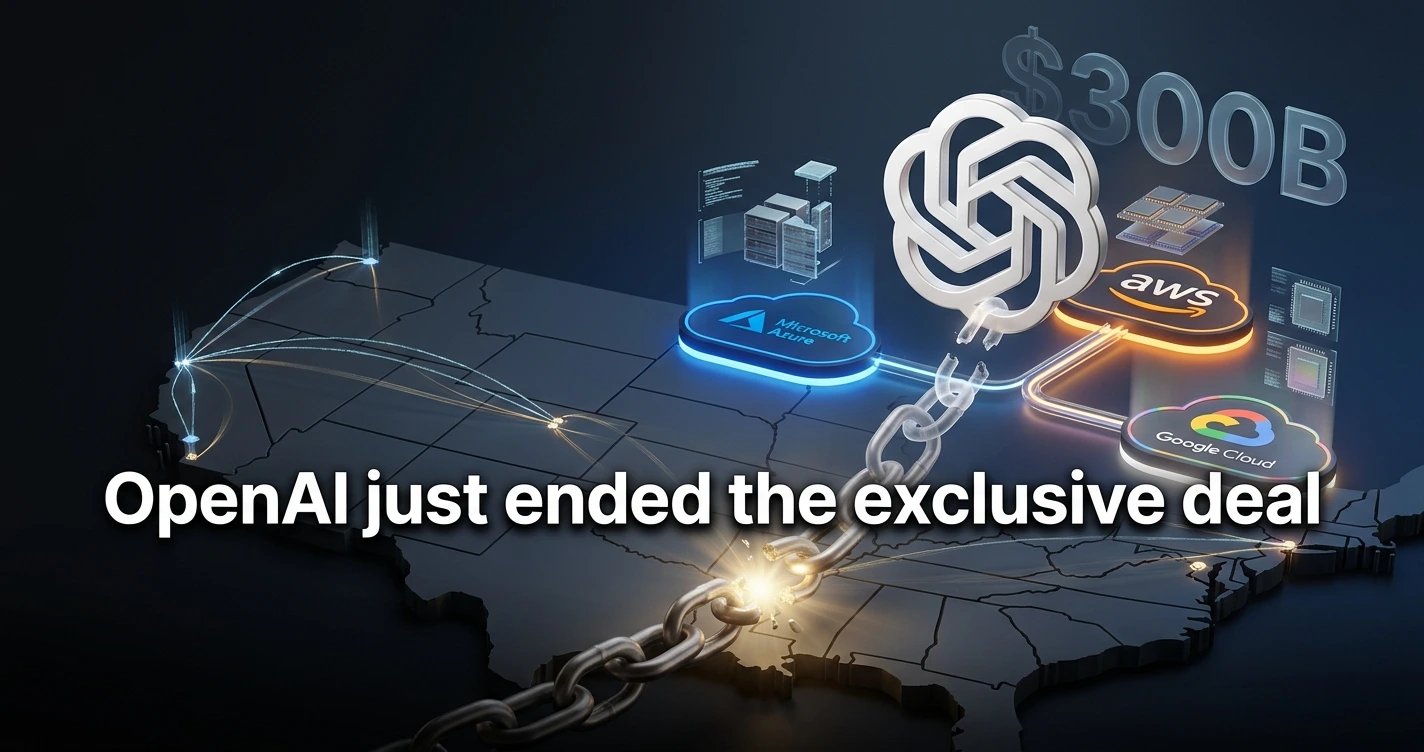
    The deal that made Microsoft the indisputable winner of the first AI gold rush is over. Not the partnership itself — that continues — but the exclusive clause that locked OpenAI’s models to Azure and handed Microsoft a structural advantage no competitor could touch. As of today, OpenAI and Microsoft have announced a revised agreement that strips away that exclusivity, freeing OpenAI to serve its full product portfolio across any cloud platform it chooses.

    That means AWS. That means Google Cloud. The two companies that watched the Azure exclusivity clause with visible frustration for years now have a direct path to OpenAI’s models — and OpenAI, freshly valued at north of $300 billion and accelerating its enterprise push, has every incentive to take it.

    The announcement lands weeks after AWS confirmed a massive OpenAI infrastructure deal and days after OpenAI shipped GPT-5.5 with native agentic capabilities. The timing isn’t coincidental. This is a company executing a deliberate multi-cloud strategy, and today’s announcement is the formal permission slip for what was already being built.


    What Actually Changed — and What Didn’t

    The word “exclusivity” does a lot of work in AI business reporting, and it’s worth being precise about which exclusivity ended and which parts of the relationship remain intact. OpenAI’s products can now be deployed across any cloud provider. Microsoft’s licensing rights to OpenAI’s IP, previously exclusive, are now non-exclusive. That’s the core change.

    What didn’t change: Microsoft remains OpenAI’s primary cloud partner. Per the Microsoft blog post published April 26 detailing the amended terms, OpenAI products will continue to ship first on Azure — unless Microsoft can’t or chooses not to support the required capabilities. Microsoft also retains its 27% ownership stake in OpenAI, currently valued at approximately $135 billion.

    The key structural shift: Microsoft’s license to OpenAI’s models and products runs through 2032, but it’s now non-exclusive. OpenAI continues paying Microsoft a capped revenue share through 2030, independent of any AGI milestone. Microsoft, in turn, stops making revenue-share payments to OpenAI.

    The financial logic cuts both ways. Microsoft trades exclusivity for economic certainty and reduced complexity. OpenAI gains the distribution freedom its enterprise ambitions require. Both companies get to stop arguing about revenue-share math tied to AGI definitions that were always going to be contested.

    “The greater predictability in the amended agreement strengthens our joint ability to build and operate AI platforms at scale while providing both companies the flexibility to pursue new opportunities.”

    Microsoft and OpenAI, Joint Statement — Microsoft Blog, April 27, 2026

    The Revised Terms, Point by Point

    Strip away the diplomatic language and the agreement has five core components. Here’s what each one actually means for the companies involved:

    Term Old Arrangement New Arrangement Who Benefits
    IP License Exclusive Microsoft Non-exclusive through 2032 OpenAI (more distribution)
    Cloud Exclusivity Azure only Azure-first, any cloud allowed OpenAI, AWS, Google Cloud
    Microsoft Revenue Share Active payments to OpenAI Eliminated Microsoft (lower costs)
    OpenAI Revenue Share ~20%, ongoing ~20%, capped, through 2030 Microsoft (cap adds certainty)
    Microsoft Ownership 27% stake 27% stake, unchanged Microsoft (upside preserved)
    AGI-linked clauses Revenue-share tied to AGI Payments independent of AGI Both (removes ambiguity)
    Unconfirmed: The exact dollar cap on OpenAI’s revenue share payments to Microsoft has not been publicly disclosed. The 20% rate has been widely reported since TechMonitor’s May 2025 reporting, but the April 27 announcement did not independently confirm that figure.


    The Amazon Factor: $50 Billion and 2 Gigawatts

    Today’s announcement doesn’t happen in isolation. Two months ago, Amazon Web Services confirmed a strategic OpenAI partnership that includes a staggering 2 gigawatts of compute capacity on AWS infrastructure. The total Amazon investment commitment reaches $50 billion, $15 billion deployed immediately, with an additional $35 billion conditional on performance benchmarks.

    That partnership — announced February 26, confirmed in an AWS blog post March 1, was always going to stress-test the Microsoft exclusivity clause. OpenAI committed to running its Stateful Runtime Environment on Amazon Bedrock. That’s not a minor integration. It’s infrastructure at a scale that effectively required renegotiating the old terms.

    “In exchange for ending that exclusivity, which helped boost Microsoft’s cloud sales in the early years of the AI boom — the world’s largest software maker will no longer pay a revenue share on OpenAI products it resells on its cloud.”

    Associated Press Technology Correspondent, Business Times Singapore, April 27, 2026
    The sequence matters. OpenAI closed its $110 billion funding round in late February, signed the Amazon deal almost simultaneously, and now formalizes the multi-cloud framework with Microsoft. This is a coordinated expansion play, not a reactive one.


    How Markets Read the Move

    Microsoft shares slipped roughly 1% in premarket trading Monday. Amazon dipped less than 1%. Neither reaction suggests panic, or euphoria. Investors appear to be treating this as a clarification of an already-shifting dynamic rather than a sudden change.

    Analyst reaction from the firms that cover Microsoft closely was notably calm. Evercore ISI reiterated its Outperform rating on Microsoft with a $580 price target, implying 38% upside from current levels, within hours of the announcement.

    “At a high level, the new agreement simplifies the relationship, with Microsoft giving up some exclusivity in exchange for greater clarity, flexibility, and economic certainty.”

    Kirk Materne, Senior Technology Analyst, Evercore ISI — Morningstar/MarketWatch, April 27, 2026
    “We do not believe this revised agreement should come as a major surprise to investors at this point. Microsoft has increasingly signalled interest in a broader multi-model strategy, while OpenAI has clear incentives to expand distribution more broadly across the market.”

    Evercore ISI Analyst Team — Morningstar/MarketWatch, April 27, 2026
    The Evercore note crystallizes the bull case for Microsoft’s position. Yes, exclusivity is gone. But Microsoft still gets first-mover access on new OpenAI products, retains the IP license through 2032, holds a 27% stake in a company that could be worth significantly more by the time any real competition from Google or Amazon materializes, and no longer has to subsidize OpenAI’s operations through outbound revenue-share payments.


    GPT-5.5 Lands Four Days Earlier: Why It Matters Here

    The timing of OpenAI’s latest model release — GPT-5.5, shipped April 23isn’t incidental context. It’s directly relevant to why the exclusivity clause needed to go.

    GPT-5.5 isn’t just a better language model. It ships with native agentic capabilities, computer-use, and multi-step workflow execution baked in at the model level. It arrived just six weeks after GPT-5.4. The development cadence is accelerating, and each new release carries new infrastructure requirements, requirements that a single-cloud constraint makes increasingly difficult to meet at the scale OpenAI is now operating.

    Pricing tells its own story. GPT-5.5 standard API access runs $5 per million input tokens and $30 per million output tokens. The Pro tier costs $30/$180. Token costs dropped approximately 35x compared to prior versions, which dramatically expands the addressable enterprise market, and, consequently, the infrastructure demands OpenAI needs to meet.

    🤖
    Agentic by Default

    GPT-5.5 ships with native multi-step execution and computer-use, no wrapper required. A fundamental shift in what “an API call” actually means.

    💰
    35x Cheaper

    Token costs collapsed relative to prior models. Lower prices at scale mean explosive volume growth, and serious infrastructure pressure across any single cloud provider.

    6-Week Release Cycles

    GPT-5.5 followed GPT-5.4 by just six weeks. At this cadence, locking model deployment to one cloud’s approval and provisioning timelines becomes a genuine bottleneck.

    🌐
    Multi-Cloud Imperative

    Enterprise buyers want redundancy, data residency options, and preferred-vendor relationships. OpenAI’s growth path runs through meeting customers where they already operate.


    What Microsoft Actually Keeps

    The framing of this deal as a Microsoft loss deserves scrutiny. The premarket stock dip is real, but the underlying position Microsoft holds after this amendment is more durable than the headlines suggest.

    Consider the full picture of what Microsoft retains:

    • First-access rights to every new OpenAI product on Azure, unless Microsoft explicitly passes
    • Non-exclusive IP license through 2032 — six more years of access to whatever OpenAI builds
    • A 27% ownership stake now worth roughly $135 billion, with no obligation to exit
    • A capped, predictable revenue stream from OpenAI through 2030
    • Elimination of its own outbound revenue-share obligations — a real cost reduction
    • Freedom to pursue a multi-model strategy without being exclusively bound to OpenAI’s roadmap
    That last point is underappreciated. Microsoft has been building relationships with other model providers — Mistral, Phi, others, as a hedge. The old exclusive arrangement implicitly constrained how aggressively Microsoft could position competing models. That constraint is now gone in both directions.

    CNBC’s reporting on the revenue cap frames this as OpenAI taking back control of its commercial destiny. That’s accurate. But it’s not a zero-sum extraction from Microsoft, it’s a restructuring that acknowledges both companies have grown beyond the terms that made sense in 2019.


    The Cloud War: What This Means for AWS and Google

    AWS and Google Cloud have been building toward this moment for two years. Both companies have invested heavily in AI infrastructure, custom silicon, inference optimization, data center buildouts, partly in anticipation of winning OpenAI workloads that were previously locked to Azure.

    The Amazon deal confirmed in March gives AWS the most concrete near-term opportunity. Two gigawatts of committed compute capacity isn’t theoretical, it’s infrastructure being actively provisioned. OpenAI’s Stateful Runtime Environment on Bedrock creates a native integration layer that enterprise developers can build against without treating AWS as a second-class citizen.

    Google Cloud’s path is less defined publicly, but the competitive logic is identical. Google has its own foundation models (Gemini) and its own enterprise AI platform (Vertex AI), which creates an interesting tension: Google is simultaneously a competitor to OpenAI and a potential infrastructure partner. The ending of Microsoft exclusivity doesn’t resolve that tension, but it removes the formal barrier that prevented any serious conversation.

    The enterprise reality: Most large organizations already run on multiple clouds. Procurement, compliance, and vendor risk teams have been pushing back on single-cloud AI dependencies for 18 months. OpenAI’s ability to meet customers on their preferred infrastructure is now a selling point rather than a gap.

    The enterprise AI market is still in formation. Contracts are being signed, platforms are being chosen, and incumbency advantages are being established right now. OpenAI’s multi-cloud freedom changes the competitive dynamics for every vendor in that space, including the hyperscalers themselves, who now compete with each other to be OpenAI’s preferred infrastructure partner while simultaneously competing with OpenAI’s products at the application layer.

    This is the structural tension that will define the next phase of enterprise AI adoption. Reuters noted that the change frees OpenAI’s path to Amazon and Google deals, but framing it purely as pipeline expansion misses the deeper shift. OpenAI is now positioning itself as cloud-neutral infrastructure, not a Microsoft-native product. That’s a different GTM motion entirely, and it puts every other foundation model provider on notice about what “enterprise ready” actually requires.

    The partnership history also bears noting. Microsoft first invested $1 billion in OpenAI in 2019, became its exclusive cloud provider, and followed with an additional $10 billion in 2023. That $13 billion total was the foundation for Azure’s AI advantage. The exclusivity clause was the return Microsoft extracted for that bet. As of today, the bet paid off, and both parties are moving to the next chapter.


    Frequently Asked Questions

    Is Microsoft still partnered with OpenAI after this announcement?
    Yes. Microsoft remains OpenAI’s primary cloud partner. OpenAI products continue to ship first on Azure, Microsoft retains a non-exclusive IP license through 2032, and Microsoft holds a 27% ownership stake in OpenAI. Only the exclusivity clause ended, the partnership itself continues.

    Can OpenAI now deploy models on Google Cloud?
    Yes. The amended agreement allows OpenAI to serve its products across any cloud provider, including Google Cloud and Amazon Web Services. OpenAI still commits to shipping first on Azure when Microsoft can support the required capabilities.

    How much is Microsoft’s stake in OpenAI worth?
    Microsoft holds a 27% stake in OpenAI Group PBC, valued at approximately $135 billion based on OpenAI’s most recent valuation. Microsoft’s total investment since 2019 is approximately $13 billion.

    What is the revenue-share arrangement between OpenAI and Microsoft?
    OpenAI continues paying Microsoft a revenue share, widely reported as approximately 20%, through 2030, subject to a total cap. Microsoft will no longer pay a revenue share to OpenAI. The exact cap amount has not been publicly disclosed.

    What is OpenAI’s deal with Amazon?
    OpenAI and AWS announced a strategic partnership in February 2026 involving a total Amazon investment commitment of up to $50 billion ($15 billion initial, $35 billion conditional). AWS confirmed OpenAI will deploy 2 gigawatts of compute on AWS infrastructure, with OpenAI’s Stateful Runtime Environment available on Amazon Bedrock.

    How did markets react to the announcement?
    Microsoft shares fell approximately 1% in premarket trading on April 27, 2026. Amazon dipped less than 1%. Evercore ISI reiterated its Outperform rating on Microsoft with a $580 price target, implying 38% upside from current levels.

    What is GPT-5.5 and why is it relevant to this deal?
    GPT-5.5, released April 23, 2026, is OpenAI’s latest model with native agentic capabilities, computer-use, and multi-step workflow execution. Its dramatically lower token costs and accelerating release cadence created infrastructure demands that made multi-cloud deployment a practical necessity rather than a strategic preference.

    When does Microsoft’s IP license to OpenAI’s models expire?
    Microsoft’s non-exclusive license to OpenAI’s intellectual property, covering models and products, runs through 2032. The license is no longer exclusive to Microsoft, meaning OpenAI can grant similar rights to other companies, but Microsoft retains access for six more years.


    The Architecture of What Comes Next

    The Microsoft-OpenAI relationship didn’t end today. It matured. Seven years after a $1 billion bet that most observers treated as a curiosity, the partnership produced a paradigm-defining suite of products, handed Microsoft a structural competitive advantage through the entire first phase of enterprise AI adoption, and is now converting from an exclusive arrangement to something more like a preferred-vendor framework with a significant equity component.

    For OpenAI, multi-cloud access isn’t just a distribution play. It’s the precondition for the kind of enterprise scale that justifies its valuation and funds the compute requirements of whatever comes after GPT-5.5. For Microsoft, the clarity of a capped revenue stream and eliminated outbound payments makes the P&L math cleaner while the 27% stake preserves exposure to OpenAI’s continued growth. For AWS and Google Cloud, the door is open, but first-mover advantages on Azure won’t dissolve overnight, and OpenAI’s “Azure-first” commitment ensures Microsoft’s infrastructure remains the default path for new deployments.

    The cloud war for foundation model infrastructure just entered a new phase. The rules changed. The players remain the same.

    Watch For
    01 First confirmed OpenAI production deployments on Google Cloud infrastructure — likely within Q3 2026, signaling the pace at which multi-cloud becomes operational reality rather than contractual possibility.
    02 Microsoft’s multi-model strategy acceleration, now that the exclusive commitment is gone, watch for more aggressive Azure partnerships with Mistral, Cohere, and others as Microsoft defends infrastructure market share.
    03 The cap amount on OpenAI’s revenue share to Microsoft, if and when it becomes public, this single figure will determine how much financial upside Microsoft has actually traded away, and will reshape analyst models significantly.
    Stay ahead of the curve. More on AI business and cloud strategy at NeuralWired.
    Explore AI Business
  • Trump’s CLARITY Act Faces Senate Cloture Vote Today
    Trump’s CLARITY Act needs 60 Senate votes today, and Republicans are still nine Democrats short. Here’s why this obscure procedural vote could decide whether crypto gets real regulation, or none at all, for years.
  • Dario Amodei’s AI Warning: Pace the Frontier (2026)
    Anthropic CEO Dario Amodei says the AI industry has 6 to 12 months to slow capability growth before an agent swarm could take over the internet. Here’s his three-step Pace the Frontier plan, why Sam Altman and Elon Musk both agreed within hours, and why critics call it regulatory capture.
  • Berlin Ransomware Attack 2026: 1.4M Files Leaked Online
    Rhysida just dumped 1.4 million stolen Berlin government files on the dark web after the city refused a €2 million ransom. The real story isn’t the phishing attack that got hackers in, it’s the unchecked vendor access that let the damage spiral this far.
  • PaperCut AI Attack 2026: 440 Orgs Hacked, Patch Now
    An AI agent chained two PaperCut vulnerabilities to breach 440 organizations across 48 countries, some in under 30 seconds. Here’s how the PaperCut AI attack unfolded, the toolkit behind it, and the exact patch steps security teams need before the CISA deadline.
  • Micron Stock 2026: AI Memory Shortage Hits Big Tech
    Micron and SK Hynix are cashing in on the 2026 AI memory shortage, but Amazon, Meta, and Microsoft are quietly absorbing the same shortage as hidden debt and depreciation risk. Here’s what the split means for AI data center stocks and Big Tech balance sheets next.