




Most enterprises are piloting AI agents. Almost none are deploying them at scale. Here is what the data says, what the winners did differently, and how to build an implementation roadmap that actually survives contact with production.
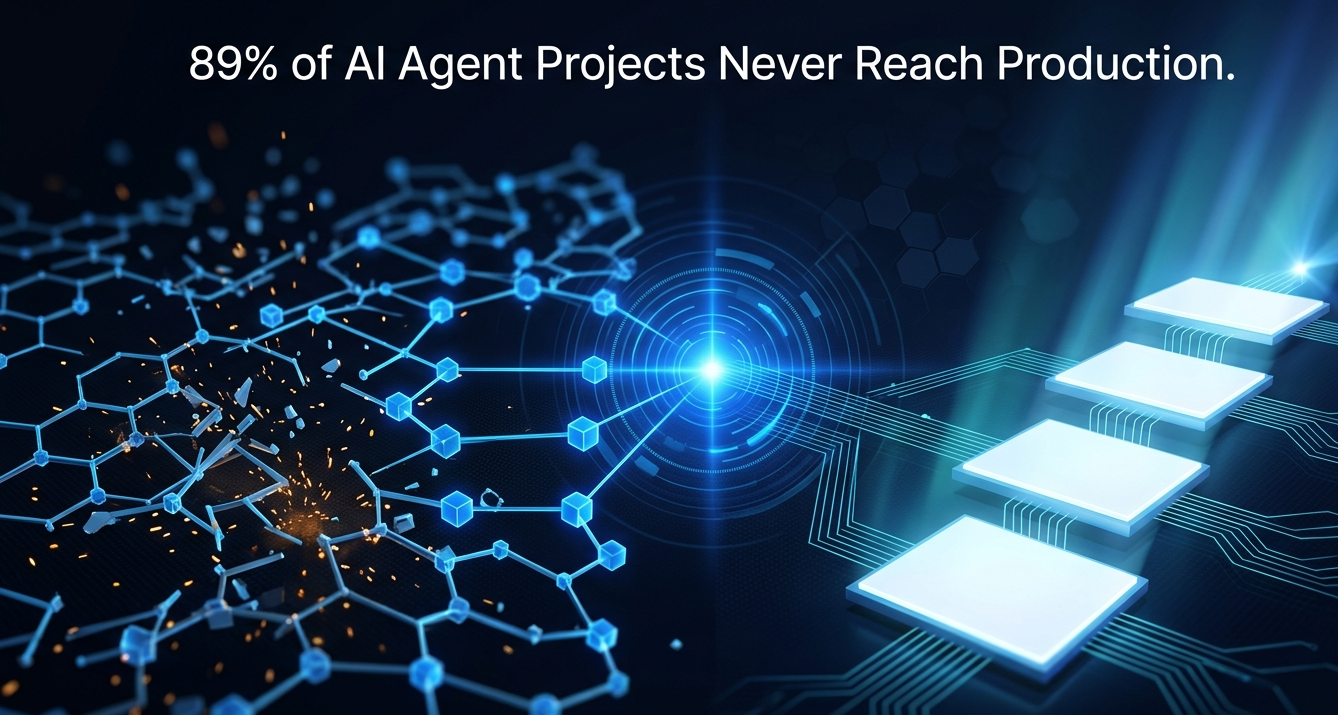
Only 11% of enterprise AI agent projects make it to production. The other 89% stall somewhere between a promising proof-of-concept and the uncomfortable reality of organizational infrastructure, according to a March 2026 deployment analysis by Hendricks.ai.
For CIOs and engineering leaders, this is the defining technology tension of 2026. Analyst forecasts are bullish. Gartner predicts 40% of enterprise applications will embed task-specific AI agents by year’s end, up from less than 5% in 2025. BCG reports that the boldest CEOs are directing over half their AI budgets to agentic systems. Deloitte puts the market at $8.5 billion in 2026, scaling to $45 billion by 2030.
Yet the failure numbers don’t budge. A DigitalOcean adoption report found 90% of pilots fail to reach production scale. The APEX-Agents benchmark clocked AI agents failing 76% of professional tasks on the first attempt. This isn’t a model quality problem. It’s an organizational readiness problem.
This analysis explains what AI agents actually are, why the current deployment gap is so severe, and what the organizations succeeding in 2026 are doing that others aren’t. You’ll leave with a concrete 4-stage implementation framework, a governance checklist, and the ROI benchmarks you need to make the case internally.
What AI Agents Actually Are (And What They Are Not)
Before diagnosing why deployments fail, the definition matters. An AI agent is an autonomous software system that uses a large language model as its reasoning core. It perceives inputs from its environment, forms multi-step plans, calls external tools, and executes actions to complete a goal. The key word is autonomous. Agents don’t just respond; they act.
This separates them from standard LLMs and chatbots. Ask a chatbot a question and it answers. Give an AI agent a goal, say “research this vendor, draft a contract summary, and schedule the review meeting,” and it orchestrates the entire sequence without a human steering each step.
The technical architecture that makes this possible is called tool calling with an observe-plan-act loop. The model receives context, reasons about what action to take, calls an appropriate tool (a database, an API, a browser, a calendar), observes the result, and loops until the task is complete. Multi-agent systems extend this further: specialized agents hand work off to one another like a coordinated team, with an orchestrator managing the overall flow.
“We’re seeing an ‘Agentic Infrastructure Gap’ where promising demos in research labs struggle to translate to enterprise deployment due to security, governance, and orchestration challenges.”Andrew Ng, AI Fund Co-founder and Stanford Adjunct Professor, at VB Transform 2025, via RagAboutIt
The distinction between agents and LLMs isn’t academic. Organizations that treat agent deployments like chatbot rollouts, lightweight and low-infrastructure, are the ones generating the 89% failure statistic. Agents require fundamentally different architectural decisions around memory, state management, observability, and security.
The Real Reasons AI Agent Projects Fail in 2026
A Parallel AI analysis citing MIT and McKinsey research found 95% of generative AI pilots fail or underperform expectations. For AI agents specifically, the failure modes cluster into three categories, none of which are about the models themselves.
Infrastructure Gaps
Enterprise surveys tracking production reliability found 73% of deployments fail reliability standards in the first year. The culprits are insufficient observability tooling, legacy system integration bottlenecks, and token-loop cost explosions that weren’t budgeted. Agents generate far more API calls than static LLM applications. IDC projects agent-related API call loads rising a thousandfold at G2000 companies.
Missing Governance Layer
Agents that can autonomously take actions need guardrails. Most organizations don’t build them before deploying. Role-based access control, audit logs, bias detection frameworks, and security perimeters covering external tool calls are not optional in production environments. They’re the difference between a controlled automation and a liability.
Rushing from Demo to Deploy
The pattern is consistent across the research: an impressive pilot creates organizational momentum, timelines compress, data pipelines aren’t cleaned, and orchestration isn’t stress-tested. Hendricks.ai’s analysis identifies rushing deployment without infrastructure readiness as the single most common cause of the 89% stall rate.
What AI Agents Explained for Business Actually Looks Like
Despite the failure statistics, organizations that deploy with proper frameworks are seeing real results. ROI data from Arcade.dev and Google Cloud puts average returns at 171%, with 74% achieving positive ROI within the first year. OneReach.ai benchmarks show $1 to $6 return per dollar invested in the short term.
The use cases aren’t speculative. They’re running in production now.
| Use Case | Performance Benchmark | Source |
|---|---|---|
| Customer Support Automation | 50 to 65% of inquiries resolved without human intervention; 25 to 40% reduction in time-to-resolution | Gartner / CB Insights |
| Operations and Workflow | 30 to 50% faster processing cycles in finance and procurement | IDC / Joget |
| IT Automation | Autonomous incident triage, reducing Level 1 ticket volume by 40% or more | IBM |
| Financial Forecasting | Multi-agent systems processing structured and unstructured data for faster scenario modeling | PlanetaryLabour |
79% of organizations surveyed by Arcade.dev have deployed AI agents in some form. The question in 2026 isn’t whether to adopt them. It’s whether your infrastructure can carry them past the pilot stage.
The 4-Stage AI Agent Deployment Framework
The following framework is synthesized from deployment analyses by Hendricks.ai, VentureBeat’s enterprise panel at VB Transform 2025, and Agathon’s implementation research. Organizations that follow a structured build consistently outperform on both reliability and ROI.
Foundation: Weeks 1 to 4
Assess organizational readiness. Define success metrics before building anything. Audit data pipelines for completeness and access control. Establish governance including role-based access control, audit logging, bias monitoring, and EU AI Act alignment if applicable. Get explicit executive buy-in. Budget conversations should happen here, not at deployment.
Design and Pilot: Weeks 5 to 8
Build targeted prototypes using ReAct architecture (reason-act loops with tool calling). Choose one high-value, bounded use case. Customer support or finance operations are proven entry points. Integrate observability from day one: latency tracking, error rate dashboards, and token cost monitoring. Do not plan to add observability later. It won’t happen.
Deploy and Scale: Weeks 9 to 12
Staged rollout to a controlled pilot user group. Integrate orchestration layers for multi-agent communication. Implement human-in-the-loop escalation paths, especially for decisions above a defined confidence threshold. Stress-test API call volume against your infrastructure ceiling before expanding scope.
Optimize and Govern: Ongoing
Monitor KPIs weekly: task success rate above 75%, error rate below 20%, and ROI calculated as cost savings minus total costs divided by total costs. Retrain on performance drift. Build a feedback loop with end users. Agent behavior that was acceptable at launch degrades without active maintenance. Target ROI above 100% within 9 months.
Deployment Readiness Checklist
Before committing to a deployment timeline, verify all of the following:
- Executive sponsorship and a confirmed 12-month budget secured
- Data pipelines cleaned, structured, and access-controlled
- Team skills validated: prompt engineering, orchestration architecture, and observability tooling
- Governance framework in place: RBAC, audit logs, and bias detection
- Security perimeter covers external tool calls and all API integrations
- Human-in-the-loop escalation paths designed and tested before go-live
- Observability stack deployed before agents go live, not after
- Realistic first-year expectations set: sub-100% task success rates are normal and expected
The Honest Reckoning: Hype vs. Reality in 2026
Optimism about AI agents is warranted. The ROI data is real. The adoption trajectory is steep. But an honest analysis requires engaging with the limits.
VentureBeat’s coverage of enterprise AI deployment highlights that Forrester expects companies to delay roughly 25% of planned AI spend into 2027, forcing agents to prove measurable business value before budgets release. Gartner separately forecasts that more than 40% of agentic AI projects will be canceled by 2027 due to cost escalation and unproven value.
The hidden cost most marketing doesn’t mention is token economics at scale. Agent loops generate exponentially more LLM calls than static applications. An agent that runs 50 reasoning steps for a complex task might cost 30 to 50 times more per transaction than a standard chatbot interaction. Organizations that don’t model this before deployment discover it in their cloud bills.
“75% of enterprises plan agentic AI deployment within two years, but deployment has surged and retreated as organizations confront the realities of scaling complexity.”Deloitte and KPMG enterprise research, March 2026, cited in Context Engineering for AI Agents, arXiv 2603.09619
The realistic near-term picture: task-specific agents with bounded scope, such as support automation, IT triage, and document processing, are deployable and economical today. Fully autonomous multi-agent systems handling open-ended business processes are a 2 to 5 year trajectory, constrained by reliability infrastructure and organizational skills gaps.
Frequently Asked Questions
The Gap Between Pilot and Production Is Organizational, Not Technical
The throughline across all 2026 deployment data is consistent: AI agent technology is not the constraint. The frontier models are capable. The tool-calling architectures are mature. What fails is the organizational layer underneath, including data governance, security perimeters, observability infrastructure, and the discipline to build readiness before building agents.
Organizations deploying AI agents that achieve 171% average ROI aren’t using better models than the ones that stall. They’re applying a structured build sequence: foundation before design, pilot before scale, governance before automation. The 4-stage framework outlined above reflects what those winning organizations actually did.
Three developments to track through 2026 and into 2027: vendor consolidation around orchestration and governance platforms, making the infrastructure layer easier to buy than build; regulatory pressure, particularly EU AI Act enforcement, that will mandate the observability and audit requirements organizations currently skip; and a growing skills gap in AI agent infrastructure roles that will separate companies who invested in training from those who didn’t. The organizations building that organizational readiness now aren’t just deploying AI agents. They’re building the institutional capability that compounds through the next five years.