NeuralWired
Intelligence for Technical Professionals | Breaking Analysis | April 21, 2026
neuralwired.com
Apple’s Hardware-First CEO Succession: What John Ternus’s Rise Means for AI Silicon Strategy and Developer Roadmaps
The official narrative frames this as a smooth handoff. What it actually signals is Apple’s explicit decision to treat AI as a hardware problem first, and every engineer building on Apple platforms needs to understand the downstream consequences.
What the Press Release Omits
Apple’s official statement reads like continuity theater. Tim Cook will become executive chairman. John Ternus will become CEO on September 1, 2026. Johny Srouji has been promoted to Chief Hardware Officer. The language is measured, the transition orderly. The Apple newsroom post emphasizes 25-year tenure, product stewardship, and a hardware-software integration mandate.
None of that is false. Most of it buries the actual story.
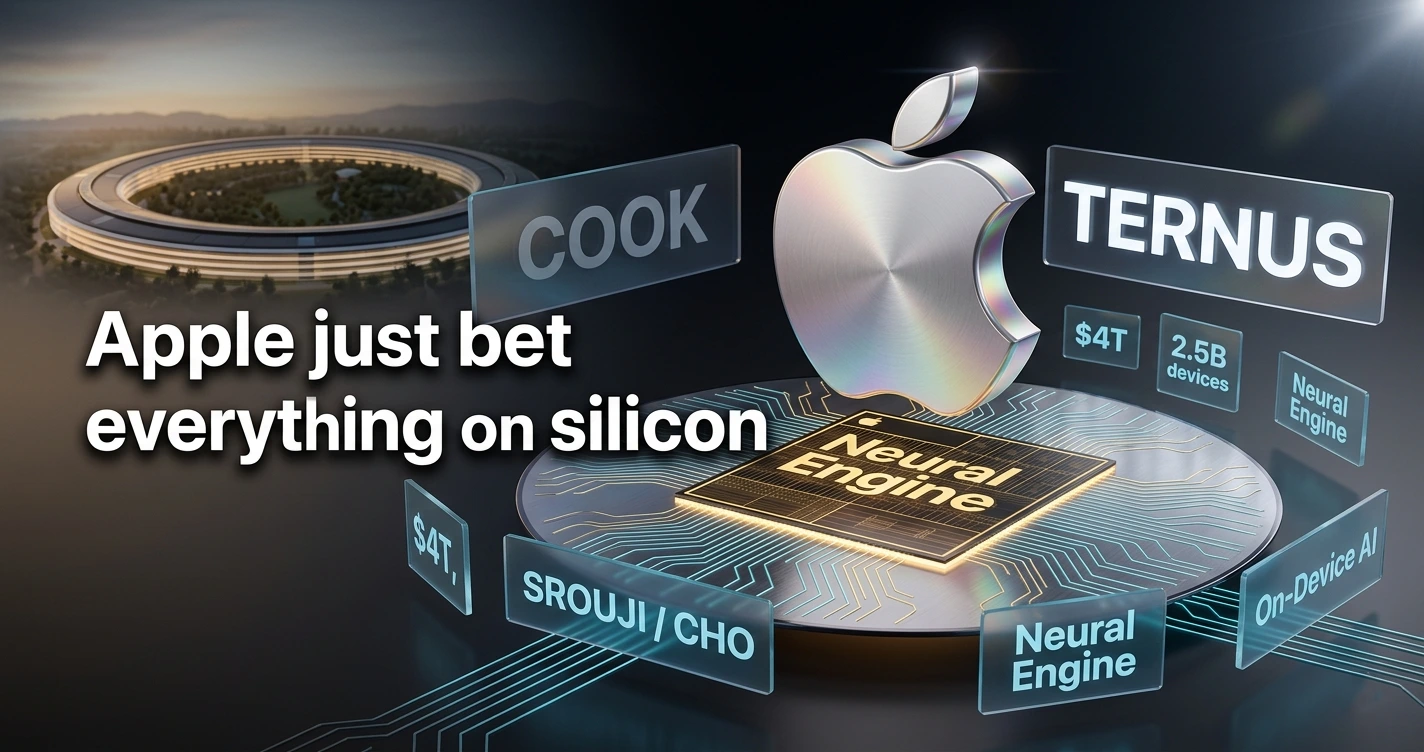
What the announcement doesn’t say: Apple is placing a bet that the next decade of AI competition is won or lost at the silicon level, not the model level. By elevating the executive who led the M-series chip transition, the single most significant hardware engineering achievement in Apple’s post-Jobs era, Apple is signaling it will fight the AI wars with custom silicon rather than third-party model partnerships. That choice has direct consequences for every developer, ML engineer, and CTO currently building on or evaluating Apple platforms.
The real question isn’t who replaces Cook. It’s whether Apple’s next CEO will accelerate on-device AI fast enough to reduce dependence on Google Gemini inside Siri, and what that means for the developer APIs, Core ML roadmaps, and enterprise AI tooling decisions that follow.
What Happened: The Official Record
Apple announced on April 20, 2026, that Tim Cook will step down as CEO effective September 1, 2026, transitioning to executive chairman of the board. John Ternus, currently Senior Vice President of Hardware Engineering and a 25-year Apple veteran who has held the SVP role since 2021, will succeed him. Simultaneously, Johny Srouji, Apple’s head of silicon technologies, received a promotion to Chief Hardware Officer, consolidating the hardware engineering and technologies organizations under a single executive.
Ternus’s product record is concrete. He led the Mac’s transition to Apple Silicon, the redesign of the iPhone lineup, the development of AirPods with active noise cancellation and over-the-counter hearing aid functionality, Apple Watch Ultra, and the iPhone Air, described internally as a radically thin and durable form factor that shipped in the fall 2025 iPhone 17 lineup. Under his watch, the Mac became more popular than at any point in its 40-year history, according to Apple’s own statements.
$4TApple market cap under Cook
$416BFY2025 Revenue
2.5B+Active devices globally
25 yrsTernus at Apple
>100BServices revenue annually
500+Retail stores worldwide
Dan Ives of Wedbush Securities described the timing as “a surprise amid Apple’s AI push” in commentary published by Fox Business. Bloomberg’s Tom Giles and Mandeep Singh analyzed the succession in a live segment, noting Ternus’s hardware focus and 25-year institutional knowledge as key succession factors. Apple stock dipped briefly after the announcement before recovering, a market signal that reads less as alarm and more as investors recalibrating expectations around services growth versus hardware investment priorities.
The Silicon Bet: AI as a Hardware Problem
To understand why the Ternus appointment matters for AI strategy, you need to understand what Apple Silicon actually enabled. The M-series chips, M1 through the current generation — didn’t just improve performance per watt. They embedded a dedicated Neural Engine directly into the SoC, enabling on-device machine learning inference at throughput levels that would have required cloud roundtrips on prior architectures. Core ML inference runs locally. Private data stays private. Latency drops from hundreds of milliseconds to single digits.
That architecture is the foundation of Apple’s current AI positioning, and its current weakness. On-device inference via Neural Engine excels at the kinds of models Apple can fit within power and memory constraints. Larger models, the kind that power Siri’s more capable features, still rely on partnerships. Apple’s deal with Google for Gemini integration in Siri is the clearest example of what the company cannot yet do fully on-device.
Ternus’s elevation changes the organizational logic around that gap. The CEO now directly owns the silicon stack. Srouji’s promotion to Chief Hardware Officer consolidates silicon design and hardware engineering under a structure that reports to Ternus. If Apple intends to accelerate the Neural Engine roadmap, reduce Gemini dependency, and build a credible on-device AI moat, the organizational prerequisite for that acceleration is exactly what this succession creates.
Srouji’s promotion is the tell. Combining silicon and hardware engineering under a Chief Hardware Officer role, with that executive reporting to a CEO who built his reputation on silicon integration, is a structural commitment, not a cosmetic one.
Developer Impact: Core ML, Swift, and the API Roadmap
For software engineers building on Apple platforms, the succession raises one immediate question: what changes, and when? The honest answer is that nothing changes before September 1, and the first meaningful signals will come from WWDC 2027, approximately 12 to 14 months after Ternus formally takes the role. That’s the first developer conference he will own as CEO, and the announcements Apple makes there will reveal the actual direction of Core ML, MLX, Metal Performance Shaders, and Swift concurrency primitives for AI workloads.
What engineers should watch for in the interim: API surface changes around on-device model hosting, tighter integration between Xcode and Core ML model compilation pipelines, and any shift in how Apple’s developer documentation frames the privacy-versus-capability trade-off in AI features. If Ternus pushes to reduce third-party model dependency, developers will see it first as new APIs that reduce the need to call external endpoints for inference.
| Area | Current State | Expected Direction Under Ternus | Timeline |
|---|---|---|---|
| Core ML | Strong for small/mid models; large models routed to cloud | Expanded on-device model size limits via next-gen Neural Engine | 12–18 months |
| MLX Framework | Open-source ML framework for Apple Silicon | Deeper Xcode integration; possible first-class SDK status | WWDC 2027 |
| Siri / LLM Backend | Gemini partnership for advanced queries | Gradual reduction of cloud dependency if silicon roadmap delivers | 18–36 months |
| Swift Concurrency | Async/await for general tasks | AI-specific concurrency primitives for Neural Engine scheduling | WWDC 2027 |
| Metal / GPU | High-performance graphics and compute shaders | Enhanced training support for on-device fine-tuning workflows | 2–3 years |
ML engineers specifically should note that Apple’s MLX framework, an open-source array framework optimized for Apple Silicon, remains understated relative to its actual capability. On M-series hardware, MLX achieves training and inference performance that competes meaningfully with GPU-accelerated workflows for small-to-mid model sizes. A CEO whose institutional identity is hardware-software integration has every incentive to push MLX into the developer mainstream.
Competitive Dynamics: Where Apple Wins and Where It Doesn’t
The competitive map shifts meaningfully under Ternus, but not uniformly in Apple’s favor. Three dynamics are worth tracking.
Against NVIDIA: Apple doesn’t compete with NVIDIA in data center GPU compute, that market belongs to NVIDIA’s H100/H200/Blackwell stack for the foreseeable future. The edge case, literally, is where Apple has structural advantage: on-device inference at sub-watt power envelopes, integrated memory bandwidth that eliminates PCIe bottlenecks, and privacy guarantees that enterprise buyers increasingly require. NVIDIA’s answer to mobile AI is limited by its architecture; Apple’s answer to cloud AI is limited by model size. Neither is going away. The relevant question for enterprises is how the workload splits between them.
Against OpenAI and Anthropic: These companies build AI models. Apple builds hardware to run them. The threat Ternus’s appointment creates for cloud AI providers is not that Apple will out-model them, it almost certainly won’t, but that Apple could reduce the number of queries that reach their APIs. Every on-device inference query that doesn’t hit a cloud endpoint is revenue that doesn’t accrue to OpenAI or Anthropic. At 2.5 billion active devices globally, even a 10% shift in query routing has material implications.
Against Google: The Gemini partnership in Siri is both a revenue stream for Google and an embarrassment for Apple’s AI-first positioning. TechCrunch’s coverage of the succession noted Cook’s legacy on services revenue, which exceeded $100B annually, but missed that Ternus’s mandate almost certainly includes reducing the AI partnerships that make Apple’s own silicon look insufficient. Unwinding the Gemini deal, even partially, would require on-device capabilities that don’t currently exist. Building them is now the CEO’s problem.
Reality Check: The Skeptic’s View
The bullish read on Ternus is seductive. Hardware-first CEO, silicon consolidation, on-device AI moat. But the record contains a harder data point: Vision Pro. The spatial computing headset launched at a price point that guaranteed low adoption, shipped to a market that wasn’t ready for it, and generated the kind of “impressive technology, unclear use case” reviews that define ambitious hardware bets that arrive before their time. Ternus owns Vision Pro. He was SVP of Hardware Engineering when it shipped.
Anonymous former Apple executives, cited in reporting aggregated by Michael Tsai’s blog sourcing from The Information, described Ternus as risk-averse and noted that Apple hardware engineers felt disappointed when he declined to fund more ambitious projects. John Gruber’s commentary, also aggregated by Tsai, hinted at frustration with software decisions made under Ternus’s watch. These are not disqualifying observations, but they complicate the narrative that Ternus will greenlight bold AI silicon bets simply because he now has the CEO title.
The structural reality of on-device AI is also genuinely hard. Running a model large enough to match GPT-4-class capability on a device with 8–16GB of unified memory, at a power envelope measured in watts rather than kilowatts, is not a software problem. It is a physics problem. Apple Silicon’s Neural Engine is exceptional at what it does. What it does is not yet sufficient to replace cloud AI for the tasks users actually care about most. Incremental improvements in chip efficiency buy Apple time. They don’t guarantee the gap closes.
Monitor this signal: If Apple announces next-gen M-series chips with substantially larger Neural Engine die area at WWDC 2026 or its fall hardware event, the on-device AI acceleration thesis is real. If the die area stays flat, the strategy is incremental.
Action Items by Audience
For software engineers and ML engineers building on Apple platforms: Don’t change your Core ML or MLX implementation plans before WWDC 2027. Do start auditing which of your inference workloads currently route to cloud endpoints and could, in principle, run on-device. Build a baseline. When Apple announces new Neural Engine capabilities, you’ll know exactly where the opportunity is. Track the Apple Machine Learning developer portal for any framework updates that ship outside the normal WWDC cycle, those are the signals that something is being accelerated.
For CTOs and tech leaders with Apple-dependent infrastructure: The services-first cost model that Apple built under Cook — app store revenue, iCloud subscriptions, enterprise MDM, is not going away under Ternus. But the capital allocation within Apple will shift toward hardware and silicon engineering. Budget assumptions for Apple ecosystem compliance, developer tooling, and on-device AI integration should account for increased investment in Apple-native capabilities over the next 24 months. If your current architecture relies on cloud AI APIs for features that could run locally, start scoping the migration path now. The privacy and latency advantages of on-device inference are already real; the capability gap is narrowing.
For founders and investors: The clearest near-term opportunity is Apple-native AI tooling: developer tools that accelerate Core ML model optimization, testing frameworks for on-device inference, and vertical applications that use local inference as a privacy differentiation. Fortune’s analysis of the succession noted that stock dipped post-announcement before recovering, the market hasn’t yet priced in the silicon moat scenario. Supply-chain positions in custom silicon manufacturing remain structurally interesting if Apple accelerates its Neural Engine roadmap.
Frequently Asked Questions
John Ternus is replacing Tim Cook as Apple CEO. Cook will transition to executive chairman of the board effective September 1, 2026. Cook has served as CEO since 2011, overseeing Apple’s market cap growth from $350B to $4T. Ternus has been Apple’s Senior Vice President of Hardware Engineering since 2021 and has worked at the company for 25 years.
Apple has not disclosed the specific timing rationale beyond characterizing it as a planned leadership transition. Dan Ives of Wedbush Securities described the timing as “a surprise amid Apple’s AI push,” suggesting external competitive pressure may have accelerated the schedule. Reports from The Information cited via mjtsai.com indicate succession planning discussions were ongoing in late 2025. Cook remains deeply involved as executive chairman.
Ternus joined Apple 25 years ago and has served as SVP of Hardware Engineering since 2021 (VP since 2013). He led the Mac transition to Apple Silicon, the development of M-series chips, the iPhone Air, AirPods with active noise cancellation and over-the-counter hearing aid capability, Apple Watch Ultra, and the MacBook Neo. The Mac became more popular under his hardware leadership than at any point in its 40-year history, per Apple’s own figures. Full leadership profile available at apple.com/leadership.
The most significant expected shift is capital allocation toward custom silicon and on-device AI, away from services growth as the primary strategic focus. Johny Srouji’s promotion to Chief Hardware Officer, consolidating silicon design and hardware engineering, signals accelerated chip roadmap ambitions. Developer-facing changes in Core ML, Swift, and the MLX framework are most likely to appear at WWDC 2027. Ternus’s risk-averse track record, noted by former Apple executives, suggests evolution over disruption rather than dramatic pivots.
No immediate changes to APIs or frameworks. The first concrete developer signals will come from WWDC 2027, approximately 12 to 14 months after Ternus formally becomes CEO. Engineers should audit which of their inference workloads route to cloud endpoints versus on-device, track the Apple Machine Learning developer portal for off-cycle updates, and prepare for tighter Core ML and MLX integration in Xcode. The privacy and latency advantages of on-device inference are already real; capability improvements in the Neural Engine will determine how much of the cloud AI workload can migrate locally.
This is the most consequential open question in Apple’s AI strategy. The Gemini partnership exists because Apple’s current on-device capabilities cannot yet match cloud model performance for advanced Siri tasks. Ternus’s silicon mandate, and Srouji’s consolidated role, creates the organizational structure to accelerate Neural Engine capability. Whether the chip roadmap delivers sufficient on-device performance to reduce Gemini dependency is a 2 to 4 year question. Watch next-gen M-series Neural Engine die area as the leading indicator.
Apple and NVIDIA don’t compete in data center compute; they compete at the edge. Apple’s on-device inference advantage, power efficiency, integrated memory, privacy guarantees, is structurally distinct from NVIDIA’s GPU dominance in training and cloud inference. Against OpenAI and Anthropic, the threat is query displacement: every on-device inference call that doesn’t reach a cloud API reduces those companies’ revenue. At 2.5 billion active Apple devices, even modest shifts in query routing carry significant volume implications. The full competitive analysis is in the Competitive Dynamics section above.
What This Actually Is
Apple’s succession is neither the end of a services era nor the beginning of a radically different company. It is a deliberate organizational alignment: the executive who built Apple’s hardware comeback now runs the company, the executive who built Apple’s silicon capabilities now runs hardware and chips, and both report to a board where Cook remains active as chairman. The structure is designed to accelerate one specific outcome, hardware-software-silicon co-design as Apple’s primary competitive moat against the AI infrastructure buildout happening at Google, Microsoft, NVIDIA, and OpenAI.
The next 18 months will test whether the organizational alignment produces actual capability gains. WWDC 2026 will show Cook’s last developer keynote. WWDC 2027 will show Ternus’s first. The distance between those two events, in Core ML capability, Neural Engine specs, and developer API surface area, will answer the question that Apple’s press release carefully did not: whether this was a smooth succession or a strategic inflection.
Engineers building on Apple platforms should monitor the silicon roadmap more closely than the management transition. CTOs evaluating AI infrastructure should start modeling the scenario where on-device inference becomes sufficient for their top three use cases within 24 months. Investors should watch Neural Engine die area as the most honest signal of strategic seriousness. The announcement happened. The proof comes at WWDC 2027.
Disclaimer: This analysis is based on publicly available information including Apple’s official newsroom announcement, analyst commentary, and reporting from Bloomberg, Fox Business, TechCrunch, Fortune, and The Information as aggregated by independent technology writers. Forward-looking statements about Apple’s AI silicon roadmap, developer tooling, and competitive positioning represent editorial analysis and should not be construed as financial advice. NeuralWired has no financial relationship with Apple, NVIDIA, Google, OpenAI, or Anthropic.