
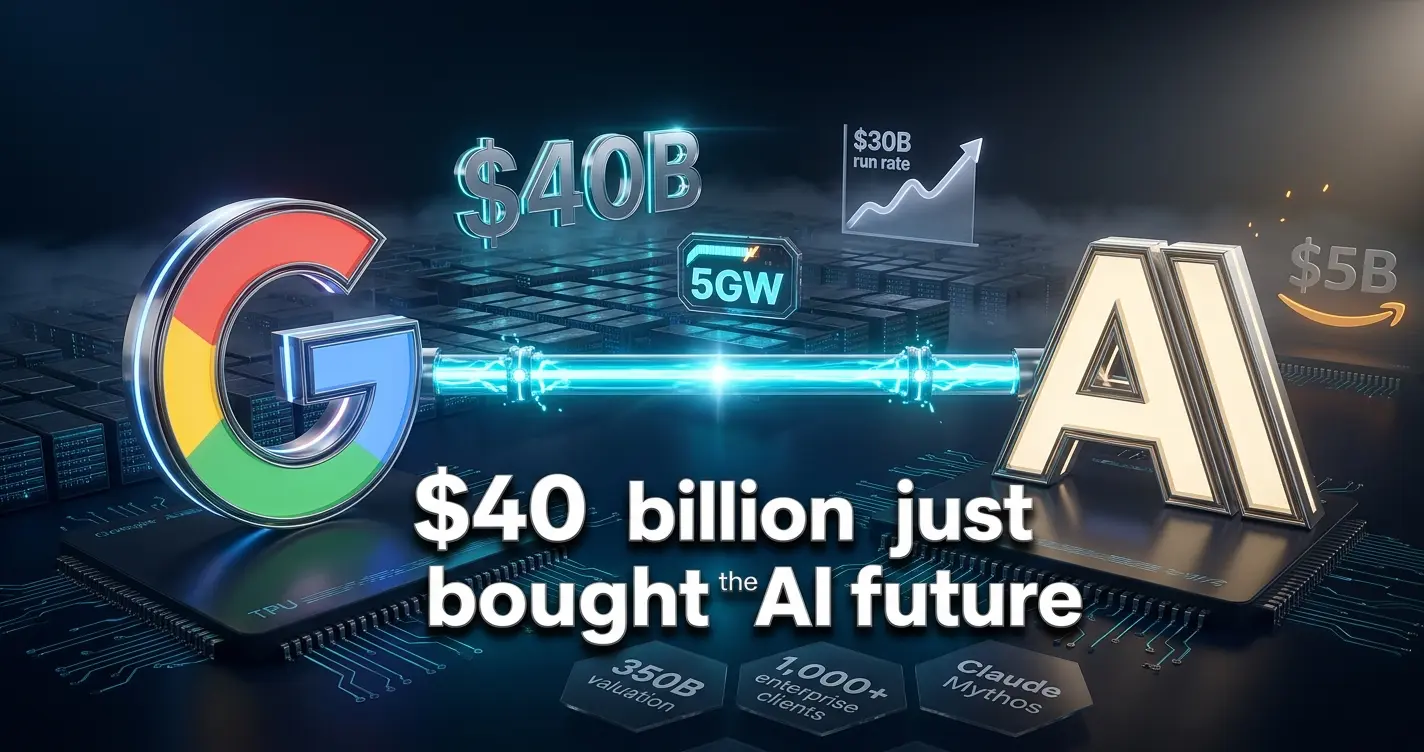
Google’s $40B Anthropic Bet Isn’t About Equity. It’s About 5 Gigawatts of AI Dominance.
Google confirmed a $10 billion upfront investment in Anthropic, with up to $40 billion contingent on performance milestones, at a $350 billion valuation. But the cash almost misses the point. The real story is 5 gigawatts of dedicated TPU compute capacity, and what that means for the frontier AI race.
On April 24, 2026, Google and Anthropic announced a deal that reshapes the financial architecture of frontier AI development. Google will inject $10 billion immediately into the Claude maker, with an additional $30 billion available if Anthropic hits undisclosed performance benchmarks. The post-money valuation lands at $350 billion, matching the price set during Anthropic’s $30 billion Series G round in February.
Those figures alone would make it the largest single hyperscaler investment in any AI lab. But buried alongside the dollar amounts is the provision that may matter more: Google commits 5 gigawatts of Cloud TPU capacity over five years. In an industry where compute access has become the rate-limiting factor for building next-generation models, that’s not a sweetener. It’s arguably the main event.
Anthropic’s revenue run rate hit $30 billion in 2026, up from $9 billion at end-2025. That’s a 3.3x jump in under six months, driven by enterprise demand that has overwhelmed its existing infrastructure. Over 1,000 business customers now spend more than $1 million annually on Claude. The company needed compute. It got a lot of it.
The $40B Deal, Explained
The structure is straightforward on the surface: $10 billion flows immediately, with $30 billion more tied to milestones that neither party has publicly disclosed. Google’s total exposure if all tranches trigger reaches $40 billion, which would represent the company’s single largest external investment.
By the numbers: Google has already invested over $3 billion in Anthropic since 2023, accumulating a 14% ownership stake. The new deal layers on top of that position, deepening a financial relationship that the two companies have been building for three years.
The $350 billion valuation is notable for what it doesn’t say. Secondary market trades have reportedly valued Anthropic at over $800 billion in recent months, meaning Google locked in at what some investors may consider a significant discount. Whether that reflects discipline or deal-making leverage depends on your read of the secondary markets’ reliability as price signals.
The compute component is, in practical terms, inseparable from the financial one. Anthropic already trains Claude models on Google’s custom TPUs. This agreement formalizes and massively scales that relationship. Five gigawatts is not a number that fits neatly into normal infrastructure conversations.
“The investment underscores a shift from pure funding to securing long-term compute, as Anthropic looks to ease capacity constraints.” Network World analyst, NetworkWorld, April 2026From $300M to $40B: A Timeline
Google’s commitment to Anthropic didn’t appear overnight. It’s the product of a three-year relationship that started with an unconventional bet: why would a company building its own frontier AI models invest in a direct competitor?
Date Event Significance 2023 Google invests $300M in Anthropic, acquires ~10% stake Establishes financial relationship alongside Gemini development 2024 Google adds $2B, total stake rises to 14% Deepens compute partnership; Anthropic adopts TPUs for key workloads Jan 2025 Google agrees to $1B+ additional investment Signals continued confidence as Claude gains enterprise traction Feb 2026 Anthropic raises $30B Series G at $380B post-money (GIC, Coatue) Establishes valuation baseline; signals broad investor conviction Apr 6, 2026 Anthropic announces expanded TPU and Broadcom partnership (multiple gigawatts from 2027) Locks in compute supply chain across multiple vendors Apr 7, 2026 Claude Mythos Preview released to 12 tech companies under restricted access Demonstrates frontier model capability; cybersecurity restrictions signal new risk tier Apr 19, 2026 Amazon invests additional $5B; deal includes up to 5GW Trainium capacity Anthropic diversifies hyperscaler relationships; mirrors Google structure Apr 24, 2026 Google confirms $10-40B investment at $350B valuation; 5GW TPU capacity over 5 years Largest hyperscaler AI lab investment on record The pattern here is deliberate. Anthropic isn’t choosing between Google and Amazon, it’s collecting commitments from both. Each hyperscaler brings dedicated silicon, and Anthropic gets diversified infrastructure that no single vendor can hold hostage. It’s a smart negotiating position, and the revenue trajectory justifies the leverage.Why Compute Is the Real Prize
The AI industry talks constantly about models, benchmarks, and capabilities. It talks less openly about the thing that actually determines who gets to build frontier systems: access to the compute needed to train and run them. That access has become scarce, expensive, and increasingly tied to hyperscaler relationships.Training costs tell the story bluntly. GPT-4 cost an estimated $79 to $100 million to train. Google’s Gemini Ultra ran approximately $191 million. Next-generation frontier models are projected to exceed $1 billion per training run. At that scale, who controls compute controls the frontier.Scale check: The four largest U.S. tech companies, Alphabet, Microsoft, Meta, and Amazon, are projected to spend roughly $700 billion on AI infrastructure in 2026. Morgan Stanley Research estimates global data center investment will reach approximately $2.9 trillion through 2028. This isn’t a niche capital cycle. It’s a generational infrastructure build.Anthropic faces this pressure acutely. Its revenue grew 3.3x in months, but that growth created its own constraint: more customers meant more inference demand, which meant more compute, which meant more urgency around locking in supply. The Google deal resolves that bottleneck, at least for five years.“This deal is less about Anthropic becoming a chip company and more about who controls the rate-limiting factor in AI deployment.” Analyst, Futurum Group, Futurum Research, April 2026The broader compute picture for Anthropic now includes commitments from CoreWeave for data center capacity, Amazon’s 5GW Trainium deal, the Broadcom partnership bringing 3.5GW starting 2027, and now Google’s fresh 5GW TPU commitment. That’s a substantial multi-vendor compute stack, and it positions Anthropic to train at scales its competitors may struggle to match without equivalent relationships.Inside Google’s TPU Infrastructure
Not all compute is equal. Google’s Tensor Processing Units are custom AI accelerators built specifically for machine learning workloads, and they carry meaningful differences from the Nvidia GPUs that dominate most training clusters. Understanding those differences helps explain why the 5GW commitment is worth as much as it is.⚡TPU v5eCost-optimized chip designed for inference workloads. Handles high-volume Claude API requests efficiently at lower cost per query.🔬TPU v5pHigh-performance training chip at roughly 459 TFLOPS BF16 per unit. Powers large-scale pre-training and fine-tuning runs.🚀TPU v6 (Upcoming)Next-generation architecture with undisclosed specs. Expected to anchor Claude’s training infrastructure from 2027 onward.🔒Dedicated PoolsAnthropic receives non-shared TPU allocations, guaranteeing priority access that marketplace GPU buyers can’t match.In October 2025, Anthropic announced access to 1 million TPUs valued at tens of billions of dollars. That cluster, already among the world’s largest AI training configurations at the time, combined to exceed 450 exaFLOPS. The new 5GW commitment extends and deepens that foundation.The supply chain argument matters too. Nvidia GPU supply constraints have driven up prices and extended delivery timelines throughout 2025 and 2026. Anthropic’s reliance on TPUs insulates it from that pressure while custom optimization by Google can tune its silicon specifically for Claude’s architectures. That’s a structural advantage that cash alone can’t replicate.Claude Mythos: The Model Driving Demand
The infrastructure investment doesn’t exist in isolation. It’s designed to train and run increasingly powerful models, and Anthropic’s most recent release illustrates exactly how high the capability bar has risen.Claude Mythos Preview launched on April 7, 2026, distributed to just 12 technology companies through Glasswing Ventures. Anthropic restricted broader access immediately, citing the model’s autonomous cybersecurity capabilities as a genuine misuse risk. It isn’t often that an AI lab publicly flags its own model as too dangerous for general release.The capabilities that triggered that decision are significant.
- Mythos identified over 100 high-severity vulnerabilities across every major operating system and web browser during red team evaluations
- The model can locate dormant bugs in decades-old codebases autonomously, without human direction at each step
- It generates working exploits with minimal human input, a capability that previously required specialized expertise
- It outperforms human teams on capture-the-flag cybersecurity challenges, a standard benchmark for offensive security skill
“Mythos Preview represents a step up over previous frontier models in a landscape where cyber performance was already rapidly improving.” AISI Research Team, AI Security Institute (UK Government), April 2026Training a model at Mythos’s capability level requires the kind of compute scale that Google’s commitment makes possible. The infrastructure deal and the model capability aren’t separate stories, they’re the same story told from two angles.Strategic Implications for the Industry
This deal reshapes competitive dynamics across multiple layers of the AI stack, from chip manufacturers down to individual developers. The effects aren’t evenly distributed.For machine learning practitioners
Impact Area Effect Training feasibility Enables longer pre-training runs and larger parameter counts for Anthropic; raises the bar other labs must match Access inequality Creates compute moats that favor incumbents with hyperscaler partnerships over independent researchers Reproducibility Makes independent reproduction of frontier results harder without equivalent infrastructure access Inference costs Scale may reduce per-token costs for Claude API users, but raises barriers for smaller labs entering the space Safety governance Concentrates influence over AI safety standards with the small number of hyperscaler-lab partnerships For competitors
OpenAI and Microsoft face direct pressure. The Azure infrastructure underpinning OpenAI’s training runs must now be positioned against a deepened Google-Anthropic stack, and Microsoft will need to respond with equivalent or greater commitments to maintain parity. Meta’s open-source strategy faces a different kind of challenge: proprietary compute advantages are difficult to replicate without hyperscaler backing, and Meta’s current data center build-out, while substantial, doesn’t yet match the dedicated capacity Anthropic is locking up.For Nvidia, the strategic picture is more complex. Both Google’s TPUs and Amazon’s Trainium chips represent custom silicon alternatives to Nvidia’s GPUs. The more infrastructure that moves to custom accelerators, the more Nvidia’s dominant market position erodes at the frontier. Nvidia’s H100 and Blackwell architectures still dominate the broader market, but the trend line at the frontier is moving away from them.Smaller AI labs face the starkest reality. Without equivalent hyperscaler relationships, survival at the frontier becomes structurally harder. The capital required to train competitive models has moved beyond what venture funding alone can sustain. That concentrates meaningful AI development among an increasingly small number of well-capitalized partnerships.For investors
The valuation dynamics here are worth reading carefully. Anthropic’s $350 billion deal price sits well below the $800 billion-plus figures reportedly circulating in secondary markets. If those secondary valuations reflect genuine conviction, Google locked in at a meaningful discount. If they reflect speculative froth, the $350 billion number anchors expectations closer to reality. An IPO reportedly being considered for as early as October 2026 will provide the first real public test of those competing valuations.The Antitrust Shadow
The deal’s structure raises questions that regulators in both the U.S. and EU are already examining. Google simultaneously invests in Anthropic as a financial stakeholder and supplies its core infrastructure as a cloud provider. Those two roles create competing interests that don’t always resolve cleanly.“The investment creates a financial interest in Anthropic’s success that sits alongside a competitive interest in Gemini’s success. Those two interests are not always aligned.” Competition observer, Remio.ai analysis, April 25, 2026The criticism goes further. Critics characterize large minority investments of this kind as quasi-acquisitions that achieve effective control without triggering formal merger review thresholds. U.S. antitrust authorities have already moved to scrutinize these structures in AI, and the EU AI Act creates additional regulatory surface area for intervention.Regulatory watch: U.S. authorities initially moved to force Google to divest certain assets in related matters. Whether the Anthropic investment faces similar scrutiny, or requires operational firewalls between Google’s cloud infrastructure and its Anthropic-facing business decisions, remains an open question that could reshape the deal’s practical structure.“Critics argue that these massive investments represent a form of quasi-acquisition that circumvents traditional merger review processes.” Regulatory analyst, Intellectia.AI, April 25, 2026Anthropic holds no board seats for Google, and the company retains operational independence. But the scale of financial dependence, $40 billion potential plus infrastructure supply, creates dependencies that make “independence” a more complicated concept than it might appear on paper.Frequently Asked Questions
What is the Google Anthropic investment deal announced in April 2026?
Google confirmed it will invest up to $40 billion in Anthropic, with $10 billion upfront and $30 billion contingent on undisclosed performance milestones, at a $350 billion post-money valuation. The deal also includes 5 gigawatts of Google Cloud TPU compute capacity over five years.How much has Google already invested in Anthropic before this deal?
Prior to the April 2026 announcement, Google had invested over $3 billion in Anthropic since 2023, including an initial $300 million for roughly 10% ownership, followed by additional investments that brought its total stake to 14%.What is Anthropic’s current valuation and revenue run rate?
The Google deal values Anthropic at $350 billion post-money. Anthropic’s revenue run rate reached $30 billion in 2026, up from $9 billion at the end of 2025. Some secondary market transactions have implied valuations exceeding $800 billion.Why is compute capacity more important than cash for AI labs?
Training frontier AI models now costs over $1 billion per run. Access to dedicated compute, such as Google’s TPUs or Amazon’s Trainium chips, determines which labs can train next-generation models. Without guaranteed infrastructure, cash alone can’t buy the capacity needed to stay at the frontier.How does Amazon’s Anthropic investment compare to Google’s?
Amazon invested an additional $5 billion in Anthropic on April 19, 2026, as part of what could reach $20 billion total, paired with up to 5 gigawatts of Trainium chip capacity. Both deals mirror each other structurally: cash plus dedicated silicon, allowing Anthropic to diversify its infrastructure across two major hyperscalers.What is Claude Mythos, and why was its access restricted?
Claude Mythos Preview is Anthropic’s most powerful model as of April 2026, released to only 12 companies. Anthropic restricted broader access because the model can autonomously find vulnerabilities in major operating systems, generate working exploits, and outperform human teams on cybersecurity challenges, creating genuine misuse risk.Does Google control Anthropic after this investment?
Google does not hold board seats and doesn’t control Anthropic’s operations. Its 14% ownership stake is a significant minority position. However, the scale of financial commitment and infrastructure dependency has prompted antitrust observers to question whether the arrangement creates effective influence without formal control.Is Anthropic planning an IPO?
Reports indicate Anthropic is considering an IPO as early as October 2026. No formal filing or official announcement has been made. If it proceeds, the offering would be one of the most significant public market tests of AI company valuations to date.What Comes Next
The Google-Anthropic deal isn’t the endpoint of a funding story. It’s the opening of an infrastructure era in AI. The companies that will define the frontier over the next five years aren’t just those with the best researchers or the most creative architectures. They’re the ones with locked-in compute at a scale that competitors can’t easily replicate. Anthropic has now secured that position twice over, once with Amazon and once with Google.What that means in practice: Anthropic can train larger models, run more inference, and grow its enterprise base without hitting the infrastructure ceilings that have constrained it. That’s a durable competitive advantage, as long as the hyperscaler relationships hold and the milestones that trigger the remaining $30 billion get met.The antitrust questions won’t go away. The closer the financial ties between Google and Anthropic grow, the more regulators will press on whether those ties create structural distortions in the AI market. Whether that leads to operational firewalls, divestiture requirements, or nothing at all remains genuinely uncertain. What isn’t uncertain is the direction of travel: AI infrastructure is consolidating around a small number of well-capitalized partnerships, and everything downstream from chip access to safety governance flows from that consolidation.Watch For01 Anthropic’s IPO timeline: a filing as early as October 2026 would become the first major public test of AI unicorn valuations at scale. Watch for S-1 registration signals and whether the $350B deal price or the $800B+ secondary market figures set the tone with public investors.02 Claude Mythos general availability: the restricted release to 12 companies won’t hold indefinitely. When Anthropic widens access, the cybersecurity capability implications will move from academic to operational, drawing scrutiny from government agencies and enterprise security teams simultaneously.03 Regulatory action on minority investments: U.S. and EU antitrust authorities are building frameworks to examine large minority stakes in AI labs. Any formal action against the Google-Anthropic structure, or Microsoft’s equivalent arrangement with OpenAI, would reset the terms of how hyperscalers back frontier AI companies.04 Microsoft’s countermove: Azure’s compute commitments to OpenAI now look comparatively constrained. Watch for a major Microsoft infrastructure announcement or revised capital commitment within the next two quarters as the company responds to the competitive pressure this deal creates.Stay ahead of the AI infrastructure race. More on AI investment, frontier models, and compute economics at NeuralWired.Explore AI Coverage