Walmart Cut Food Tracing From 7 Days to 2.2 Seconds. Why Is Your Supply Chain Still Running on Excel?
By NeuralWired Research Desk • June 12, 2026 • 14 min read
Quick Answer
Blockchain supply chain management is a distributed ledger technology that creates a tamper-proof, real-time record of every transaction and movement across a supply chain. Walmart used it to reduce food traceability from 7 days to 2.2 seconds. Nestlé projects $47 million in savings over five years. The market hit $5.23 billion in 2026 and is heading to $21.29 billion by 2029. The risk isn’t whether blockchain works. It’s whether your governance model will.
In October 2016, Walmart handed IBM a mango. That’s the simplified version of what actually happened: Walmart partnered with IBM to run a blockchain pilot using Hyperledger Fabric to trace mangoes through its U.S. stores and pork through its Chinese supply chain. The goal was to answer a question that had haunted the food industry for decades: when something goes wrong, how fast can you find the source?
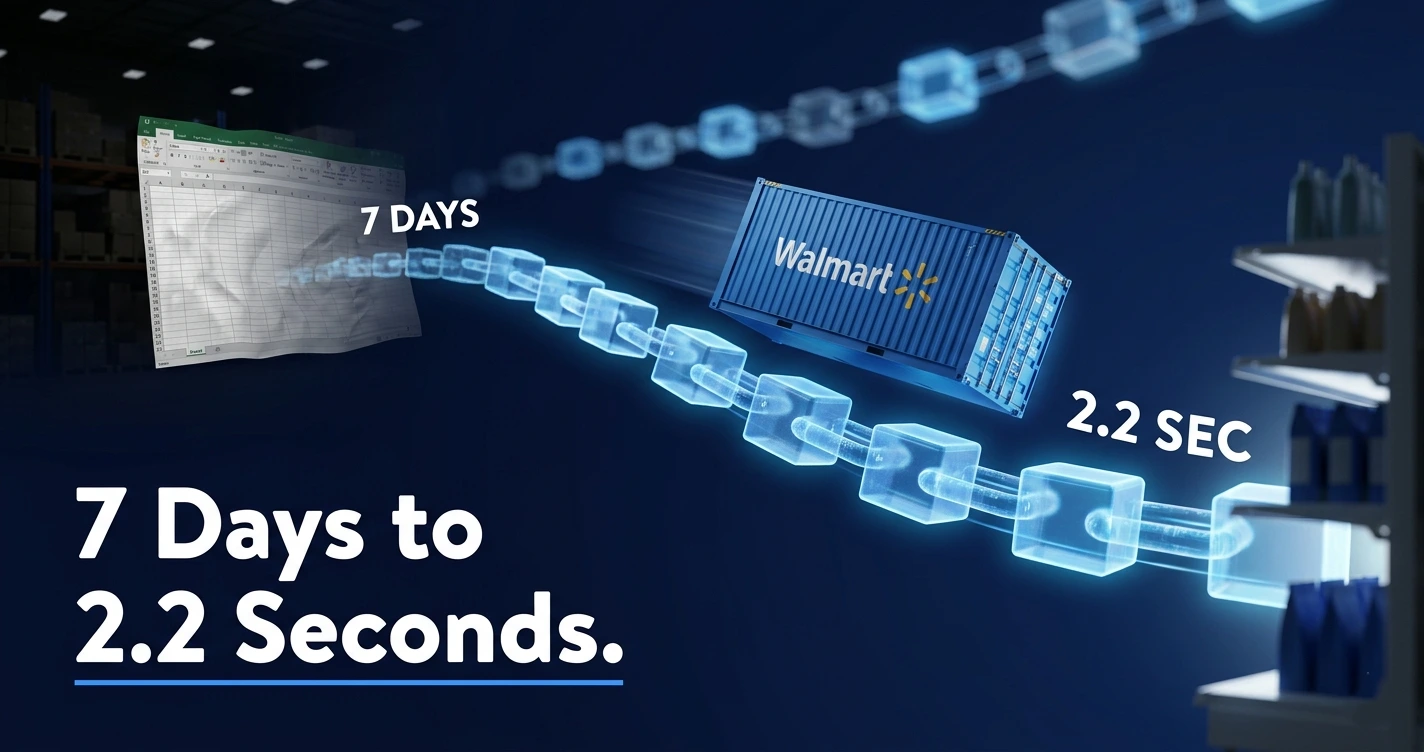
The answer, before blockchain supply chain management, was seven days. That’s how long it took to trace a contaminated item from store shelf back to farm origin. The answer after? 2.2 seconds. Frank Yiannas, then Walmart’s VP of Food Safety, confirmed that number publicly in 2018. It remains the single most cited performance benchmark in enterprise blockchain history.
And yet, as of 2026, 67.4% of supply chain managers still use Excel as their primary management tool. Not as a backup. As the primary tool.
This article exists at the intersection of those two facts. It’s written for CTOs, VP Supply Chain, and enterprise architects who are done with the hype cycle and want to know what blockchain in supply chain actually delivers, what it costs when it fails, and what you need to get right before you spend the first dollar.
Table of Contents
- What Is Blockchain Supply Chain Management?
- The Proof It Works: Walmart, Nestlé, and the Numbers
- Maersk TradeLens: What $21.29B Market Doesn’t Tell You
- Market Reality in 2026: Past Pilots, Into Production
- The Architecture Decision Every CTO Has to Make
- What Can Go Wrong: Four Scenarios That Kill Blockchain Projects
- The AI Convergence: Why 2026 Architecture Choices Are 5-Year Bets
- FAQ: Blockchain Supply Chain Management
- What to Watch in the Next 18 Months
What Is Blockchain Supply Chain Management?
Blockchain supply chain management is the application of distributed ledger technology to record, verify, and share supply chain data across multiple parties in real time. Each transaction, shipment, inspection, or payment is written as a block onto a chain that no single participant can alter retroactively. Every authorized party sees the same version of the data simultaneously.
The core problem it solves isn’t storage. It’s trust. In a traditional supply chain, a manufacturer trusts a distributor’s spreadsheet. A retailer trusts a supplier’s PDF. A regulator trusts a stack of documents that took 7 days to assemble. Blockchain replaces that chain of trust-me-on-this with a chain of cryptographically verified records. The data doesn’t travel by email. It lives on a shared ledger that updates in real time.
Smart contracts extend this further. These are self-executing programs written onto the blockchain that trigger automatically when conditions are met. A shipment clears customs and a payment fires instantly. A temperature threshold is breached in cold chain logistics and a rejection alert goes out without human intervention. In 2025, more than 65,000 smart contracts were executed across logistics and manufacturing use cases, according to the Blockchain Council.
Why this matters right now
In February 2025, U.S. Senators Maria Cantwell, Marsha Blackburn, and Lisa Blunt Rochester introduced S.257, a bipartisan bill requiring the Department of Commerce to analyze U.S. supply chain security using blockchain and AI. Blockchain isn’t waiting for the market to validate it. The regulatory clock has started.
The Proof It Works: Walmart, Nestlé, and the Numbers
The case for blockchain supply chain management isn’t theoretical. It’s documented, named, and sourced. Here’s what the data actually says.
2.2 sec
Time for Walmart to trace a food item from store to farm, after blockchain. Previously: 7 days.
Walmart and IBM Food Trust
The Walmart pilot began with mangoes and pork. By 2018, it had expanded to poultry, berries, yogurt, and leafy greens. Walmart mandated all leafy green suppliers join IBM Food Trust by September 2019. Suppliers who didn’t comply lost the business. IBM Food Trust grew to 188 organizations in its network. The 7-days-to-2.2-seconds traceability result remains uncontested in any published rebuttal.
Nestlé’s $47 Million Projection
Nestlé’s blockchain supply chain deployment projects $47 million in savings over five years, according to case study data compiled by Marketing Scoop. This covers traceability, waste reduction, and supplier audit efficiency. For an enterprise CTO evaluating ROI, this isn’t a pilot curiosity. It’s a named financial case from one of the world’s largest food manufacturers.
The Full ROI Picture
81%
Average drop in trade finance processing time with blockchain
33%
Reduction in operational costs across documented deployments
42%
Lower administrative costs via smart contract automation
82%
Executives reporting positive ROI within two years
These figures come from SQ Magazine’s December 2025 synthesis of 15+ industry studies. They’re not projections from a vendor pitch deck. They’re documented benchmarks from production deployments. If you’re on the fence about whether the economics work, the 82% two-year ROI confidence figure from surveyed executives is the most straightforward answer available.
“Supply chain is no longer a back-office function. It’s central to business, bringing resilience and value in equal measure.” Simon Bailey, VP Analyst, Supply Chain Practice, Gartner — June 2025
In 2025, trade finance platforms running on blockchain processed $24.7 billion in transaction volumes. The market doesn’t care what your spreadsheet says about the maturity of this technology. It’s processing $24.7 billion and growing.
Maersk TradeLens: What the $21.29B Market Doesn’t Tell You
Every honest article about blockchain supply chain management has to spend time here. Because TradeLens is the most important story in enterprise technology that most CTOs still misread.
In 2014, Maersk started exploring blockchain for global trade. By 2018, TradeLens was live: a permissioned blockchain network jointly built by Maersk (51%) and IBM (49%), headquartered in New York. By 2022, it was tracking 67 million containers, had processed over 3.5 billion shipping events, and had onboarded more than 150 organizations, including CMA CGM and Mediterranean Shipping Company.
It also delivered documented results. TradeLens claimed a 20% reduction in documentation costs and a 40% reduction in shipment time. The traditional shipping baseline it improved on was a 34-day transit timeline, with 14 days wasted solely on customs paperwork, across 30-plus organizations per single shipment.
On November 29, 2022, Maersk shut it down.
“While we successfully developed a viable platform, the need for full global industry collaboration has not been achieved. As a result, TradeLens has not reached the level of commercial viability necessary to continue work and meet the financial expectations as an independent business.” Rotem Hershko, Head of Business Platforms, Maersk — November 2022, via CoinTelegraph
Read that quote carefully. Hershko doesn’t say the technology failed. He says the collaboration failed. That distinction is everything.
The Academic Autopsy
In March 2025, researchers from HECF Business School published a peer-reviewed analysis in Frontiers in Blockchain applying Ostrom’s commons theory to TradeLens. Their conclusion: the platform failed because of commons governance failure, not technology failure.
The researchers identified the core structural problem: TradeLens was a shared digital commons built on competitive infrastructure. Maersk and IBM owned the network. Competitors were being asked to put their most sensitive logistics data into a platform run by their largest rival. The incentive structure was broken from day one. The technology tracked 67 million containers. The politics killed it.
This is the lesson every enterprise architect needs to internalize before they start any blockchain supply chain project. The governance question isn’t a secondary concern. It’s the primary risk factor. Who owns the network? Who resolves disputes? What happens when a key participant decides their competitive advantage outweighs the network benefit?
The Consortium Trap
You build a blockchain consortium for your sector. A key competitor refuses to join. The network effect never materializes. The investment becomes stranded infrastructure. TradeLens didn’t fail because Maersk built something that didn’t work. It failed because the shipping industry’s competitive dynamics were incompatible with shared ownership. Map your industry’s dynamics before you map your architecture.
For the record: Maersk hasn’t abandoned blockchain. Their Q4 2024 logistics trend map, based on a Statista survey of 500-plus global logistics decision-makers, still tracks blockchain as an active investment area. They’re just being more careful about governance this time.
Market Reality in 2026: Past Pilots, Into Production
The most important number in the blockchain supply chain story right now isn’t a ROI figure. It’s the year-over-year market growth from 2025 to 2026: $3.27 billion to $5.23 billion. That’s a 60% jump in 12 months, and it’s happening because production deployments are now outnumbering pilots.
| Metric | Figure | Source |
|---|---|---|
| Market size (2026) | $5.23 billion | Blockchain Council, March 2026 |
| Projected market (2029) | $21.29 billion at 59.8% CAGR | The Business Research Company |
| Cloud-hosted networks (market share) | 60.72% | Mordor Intelligence, January 2026 |
| Private blockchain enterprise share | 54.22% | Blockchain Council, March 2026 |
| Smart contracts executed (2025) | 65,000+ in logistics and manufacturing | Blockchain Council, March 2026 |
| Trade finance volume on blockchain (2025) | $24.7 billion | Blockchain Council, March 2026 |
| Supply chain managers using Excel | 67.4% | Adelante SCM Survey, via Supply Chain Dive |
The Excel statistic isn’t rhetorical. It’s a real operational risk. Supply chain disruptions cause an average 62% financial loss according to ISM data, and the companies still running manual reconciliation across multiple spreadsheets are the most exposed. The visibility gap isn’t an inconvenience. It’s a liability.
“Remember that five or six years ago, blockchain was going to change the world.” Mike Dominy, Analyst, Supply Chain Practice, Gartner — December 2024, via TechTarget
Dominy’s comment is worth sitting with. The hype was real. The disappointment was real. But his full statement adds the nuance: “There’s a greater degree of scrutiny by CFOs on digital investments in general and digital supply chain investments, but I don’t see any abandoning yet.” Scrutiny isn’t abandonment. It’s maturity.
Our read: the 2025-to-2026 numbers confirm that blockchain in supply chain has crossed from “are we doing this?” to “how are we doing this?” The CFO scrutiny Dominy describes is now producing better-scoped projects with cleaner ROI cases, not fewer projects.
The Architecture Decision Every CTO Has to Make
Before any blockchain supply chain project starts, one question determines everything else: private, consortium, or hybrid?
Private Blockchain (54% of enterprise deployments)
A private or permissioned blockchain is controlled by a single organization. It’s faster, cheaper per transaction, and keeps sensitive data out of shared infrastructure. This is the dominant model in 2026 for exactly those reasons. The trade-off: you lose the network effects that make blockchain valuable in multi-party workflows. If your goal is internal traceability and process automation, private is the right call. If your goal is cross-industry data sharing, you’ve built an island.
Consortium Blockchain (Shared Governance)
Multiple organizations jointly govern the network. This is the TradeLens model, and the governance risk is real. But done correctly, with neutral stewardship and clear shared incentives, consortium blockchain delivers the full network effect. The Trust Your Supplier platform (supplier onboarding) and IBM Food Trust (188 organizations) both run consortium models that have survived because the governance was built before the technology was deployed.
Hybrid Architecture (The 2026 Answer)
Private for sensitive internal data. Consortium or public for external verification. This is the emerging standard in 2026 deployments: keep your pricing and supplier contracts on a private chain, publish provenance and compliance data to a shared ledger that your customers, regulators, and partners can verify. It’s more complex to build, but it resolves the governance risk without sacrificing network effects. For enterprise decisions between private and public blockchain architecture, the hybrid model is increasingly the answer that avoids both extremes.
| Model | Best For | Key Risk | 2026 Adoption |
|---|---|---|---|
| Private | Internal traceability, automation | No network effect | 54% enterprise share |
| Consortium | Multi-party supply chains | Governance collapse (TradeLens) | Growing post-2025 with neutral models |
| Hybrid | Regulated industries (pharma, food, finance) | Integration complexity | Emerging standard in 2026 |
One underreported consideration: the architecture you choose for blockchain is the architecture you’re choosing for your AI supply chain deployment. Blockchain and AI are converging in every serious 2026 implementation. Your data model, access controls, and ledger structure will determine what your AI can see, predict, and automate. Choosing the wrong blockchain architecture today creates a 5-year knock-on effect on your AI capabilities. This isn’t a separate decision. It’s the same decision.
What Can Go Wrong: Four Scenarios That Kill Blockchain Projects
92% of early blockchain projects failed, according to Supply and Demand Chain Executive (December 2024). That number isn’t a reason to avoid blockchain. It’s a reason to understand exactly which failure modes to avoid. There are four.
1. The Consortium Trap
Already covered above, but worth stating plainly: if your blockchain value proposition depends on competitors sharing data on a platform you own, you’re building TradeLens. Map the incentive structure of every participant before you design the governance model. If you can’t answer “what does the second-biggest player gain by staying in this network when they start losing deals?”, you haven’t finished your architecture.
2. The Legacy Integration Sinkhole
ERP and WMS integration represents 30 to 50% of total blockchain implementation cost. This figure is consistently underestimated in project scoping. A mid-market manufacturer with SAP, a legacy WMS, and five third-party logistics providers is looking at a middleware problem that dwarfs the blockchain implementation itself. The MDPI Applied Sciences review (May 2025) confirms this: integrating blockchain into legacy systems “requires careful API design and middleware development” that is routinely underreported in ROI projections. Budget this before you launch, not after.
3. The Oracle Problem
Blockchain is immutable and auditable. It is not magic. The system records exactly what you put into it. If a supplier scans fraudulent provenance data at the farm gate, the blockchain faithfully preserves that lie forever. The oracle problem is the gap between the physical world and the digital ledger. IoT sensors, physical audits, and verification protocols are the only way to close it. A blockchain without reliable data inputs is a highly sophisticated record of whatever someone decided to type.
4. Regulatory Whiplash: GDPR vs. Immutability
GDPR Article 17, the right to erasure, is structurally incompatible with an immutable ledger. If your supply chain includes EU personal data (supplier employee records, customer-linked shipment data), you have a legal tension that needs to be resolved at the architecture level, not the legal team level. Zero-knowledge proofs and off-chain data storage with on-chain hashes offer partial solutions, but they add significant complexity. Healthcare supply chains face the same conflict with HIPAA. Budget the compliance architecture as a first-class project requirement, not an afterthought. For teams working through smart contract security risks in enterprise deployment, these governance and compliance layers are where the real exposure sits.
The 92% failure rate in context
Most of those failed projects were underfunded pilots with poor governance design, not full enterprise deployments. The distinction matters. A $50,000 proof-of-concept that gets cancelled is a failed project. It’s not the same failure mode as a $50 million TradeLens shutdown. Know which category your project is in before you start.
“The value proposition of harnessing blockchain technology to transform supply chains is not new. But 2024 and 2025 represent the shift from experimentation to execution. Companies reaching a crossroads must decide to scale or fall behind.” Clare Adelgren, Global Head of Blockchain Sales and Operations, EY — December 2024, Supply and Demand Chain Executive
The AI Convergence: Why 2026 Architecture Choices Are 5-Year Bets
The strongest blockchain supply chain deployments in 2025 and 2026 don’t run on blockchain alone. They layer three technologies that solve fundamentally different problems: blockchain for immutable record, IoT for real-world data feeds, and AI for predictive risk, anomaly detection, and dynamic pricing. The combination is more powerful than any single piece.
Blockchain gives AI something it desperately needs: trustworthy historical data. Every AI prediction is only as good as the training data behind it. A supply chain AI trained on blockchain-verified shipment records, temperature logs, customs clearance times, and supplier performance data is making predictions from ground truth. An AI trained on reconciled spreadsheets is making predictions from the best available guess.
Gartner’s March 2025 supply chain tech trends report identifies AI convergence as the defining differentiator for 2025 and 2026. VeChain’s $15 million StarGate program, launched in July 2025 to accelerate enterprise-grade EVM-equivalent applications, is one of the clearest signals that serious capital is flowing into exactly this convergence. AWS Outposts added blockchain support in January 2025. The infrastructure is building itself around this stack.
The implication for enterprise architects is direct: the blockchain architecture decision you make in the next 12 months is simultaneously your AI supply chain architecture decision for the next five years. Your data model, your smart contract structure, and your ledger access controls will determine what your AI can see, predict, and automate in 2028 and beyond. This isn’t a blockchain project. It’s an infrastructure bet.
FAQ: Blockchain Supply Chain Management
How does blockchain improve supply chain management?
Blockchain improves supply chain management by creating a shared, tamper-proof ledger that every participant can access in real time. It eliminates manual reconciliation, reduces document fraud, and enables smart contracts that trigger payments automatically. Walmart used blockchain to cut food traceability time from 7 days to 2.2 seconds. Trade finance processing times drop by an average of 81%.
What are real examples of blockchain in supply chain?
The most cited examples are: Walmart and IBM Food Trust (food traceability, 7 days to 2.2 seconds); Maersk TradeLens (tracked 67 million containers before 2023 shutdown); Nestlé (projected $47 million savings over 5 years); VeChain (luxury goods and pharma provenance); and Trust Your Supplier (supplier onboarding on permissioned blockchain). Sources: Computerworld; Northeastern University; Marketing Scoop.
Why did Maersk’s blockchain fail?
Maersk’s TradeLens blockchain didn’t fail technically. It tracked 67 million containers and cut documentation costs by 20%. It failed because competing carriers refused to share data on a platform Maersk co-owned. Academic research published in Frontiers in Blockchain (March 2025) classifies this as a commons governance failure. The technology worked. The industry politics didn’t.
What is the ROI of blockchain in supply chain?
Industry data shows blockchain in supply chain delivers ROI within 18 to 24 months for most enterprises. Specific benchmarks: 33% reduction in operational costs, 42% lower administrative costs via smart contracts, 81% faster trade finance processing, and 25% reduction in dispute management costs. 82% of executives report positive ROI within two years. Source: SQ Magazine, December 2025.
What percentage of companies use blockchain in supply chain?
Large enterprises captured approximately 73% of blockchain supply chain finance market share in 2024. Deloitte’s 2022 global blockchain survey found 55% of respondents had already adopted blockchain across industries. Blockchain-specific supply chain adoption remains concentrated in food, pharma, and retail, with 43.5% of companies still struggling with logistics partner data-sharing as recently as 2024.
Is blockchain the future of supply chain?
Blockchain is increasingly the present of supply chain, not just the future. The market grew from $3.27 billion in 2025 to $5.23 billion in 2026 and is projected to reach $21.29 billion by 2029. The most advanced 2026 implementations combine blockchain with AI and IoT. The risk isn’t whether blockchain matters. It’s which architecture you choose and whether your governance model survives contact with competitive reality.
What are the challenges of blockchain in supply chain?
Key challenges include scalability (high transaction volumes slow many networks), interoperability with legacy ERP and WMS systems, data privacy tension with GDPR and HIPAA, high implementation costs cited by 60% of small businesses, the oracle problem (blockchain records whatever data is fed into it, accurate or not), and consortium governance failures. Skills shortages affect 58% of supply chain professionals. Source: SQ Magazine; MDPI Applied Sciences, May 2025.
How much does blockchain supply chain implementation cost?
Enterprise blockchain supply chain implementation costs vary widely. Cloud-based Blockchain-as-a-Service from AWS, Azure, or Google Cloud significantly reduces upfront costs compared to on-premises deployments. Integration with legacy systems typically represents 30 to 50% of total project cost. ROI benchmarks suggest cost recovery within 18 to 24 months at scale. 60% of small businesses still cite high implementation costs as the primary barrier to entry.
What to Watch in the Next 18 Months
What you understand now that you probably didn’t before reading this: TradeLens was not a blockchain failure. It was a governance failure that happened to involve blockchain. Walmart’s 2.2-second traceability is not a marketing claim. It’s a verified operational result confirmed by the company’s VP of Food Safety. And the 67.4% of supply chain managers still on Excel are not behind by choice. They’re behind by inertia, and the gap between them and the 82% of executives reporting positive blockchain ROI within two years is widening every quarter.
Three things to watch between now and the end of 2027:
- Regulatory mandates will make adoption non-optional. S.257 is a signal, not an endpoint. EU supply chain due diligence legislation and FDA track-and-trace requirements are creating compliance timelines that remove “wait and see” as a strategy. Companies that haven’t started will face deadlines imposed from outside.
- AI-blockchain hybrid deployments will define the next performance gap. The companies combining immutable blockchain records with AI-driven anomaly detection and predictive logistics in 2026 will have a structural data advantage over competitors running either technology alone. This advantage compounds annually.
- Governance models will make or break the next wave of consortium projects. The Frontiers in Blockchain research (March 2025) gives enterprise architects a rigorous framework for avoiding TradeLens. The projects that succeed in the next 18 months will be the ones that designed governance before they wrote a single line of smart contract code.
The blockchain supply chain management market hit $5.23 billion in 2026. It tracked 65,000+ smart contracts in logistics last year. It processed $24.7 billion in trade finance. The question for your organization isn’t whether this technology works. It’s whether your architecture, governance, and integration plan are ready for it.
Stay Ahead of Enterprise Tech That Actually Moves
The Neural Loop delivers the signal without the noise: verified data, named sources, and decisions that matter to enterprise leaders. No hype. No filler.
Subscribe to The Neural Loop