Enterprise Security & Blockchain Risk
DeFi vs Banks: The Risk Comparison Every CTO Is Already Running (And Every CFO Is Refusing to See)
In This Article
- The Risk Frameworks Are Different Species
- What DeFi Risk Actually Looks Like in 2026
- What Traditional Banking Risk Actually Looks Like
- How the Biggest Institutions Are Managing This Tension
- The Regulatory Gap Enterprises Cannot Ignore
- 5 Questions Every CTO Should Put to Their CFO
- What the Skeptics Get Right
- FAQ: DeFi vs Banks Risk Comparison 2026
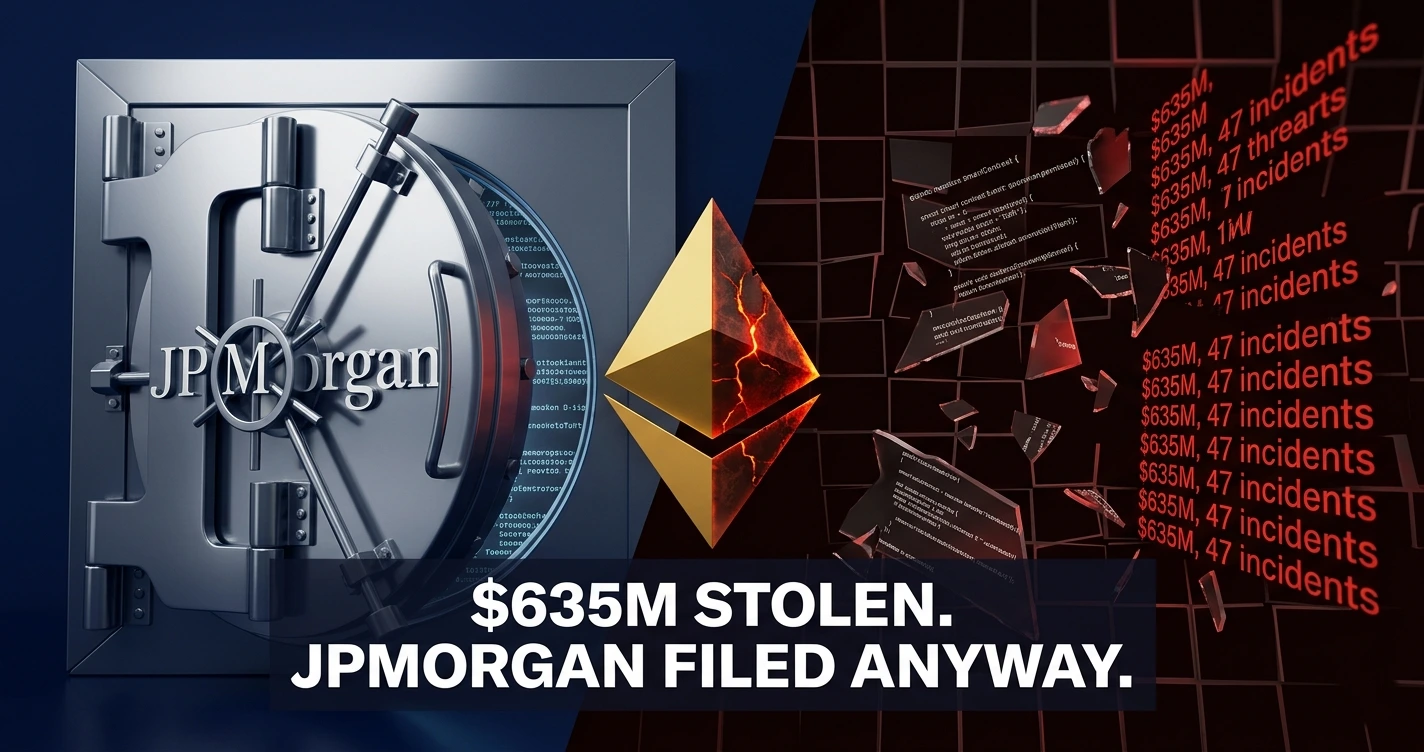
In April 2026, more than $635 million was stolen from DeFi protocols across 30 separate attacks. It was the single worst month in decentralized finance history. Three weeks later, JPMorgan filed for regulatory approval to launch a tokenized U.S. Treasury fund on Ethereum’s public blockchain.
Same industry. Same month. Completely contradictory signals. That is not confusion. That is the actual state of enterprise DeFi risk in 2026, and it is precisely why your CFO is saying no while your CTO is already running pilots.
This article does not tell you DeFi is safe. It does not tell you traditional banking is risk-free either. What it does is map the two risk profiles side by side, with real numbers from the last six months, so that the conversation in your boardroom can be grounded in something other than fear or hype. The DeFi vs traditional finance risk conversation has graduated from theoretical to urgent. Here is what you actually need to know.
The Risk Frameworks Are Not Comparable. They Are Different Species.
The most common mistake in the DeFi vs banks debate is framing it as a spectrum where one end is “risky” and the other is “safe.” That is the wrong mental model entirely. DeFi and traditional banking carry structurally different types of risk, requiring completely different mitigation strategies. A CTO who maps DeFi risk onto their existing enterprise risk register without modification is setting up their organization for a category error with nine-figure consequences.
Here is what each system’s risk profile actually contains:
| Risk Category | Traditional Banking (TradFi) | DeFi |
|---|---|---|
| Counterparty Risk | Bank has legal identity, jurisdiction, regulatory oversight. FDIC insures deposits to $250K. | The protocol is the counterparty. No legal personhood. No jurisdiction. No entity to sue. |
| Operational Risk | Human error, fraud, IT failure backstopped by internal controls and regulators. | Smart contract bugs execute autonomously and irreversibly. Code is law. There is no undo button. |
| Liquidity Risk | Central bank liquidity facilities exist as backstop. Fed window available in crisis. | 50% of liquidity in most DeFi pools is controlled by a small number of large wallets. When they exit, liquidity evaporates in hours, not days. |
| Systemic Risk | Contagion is real (see 2008, 2023), but government intervention can and does occur. | Contagion is faster and has no backstop mechanism. $13 billion fled DeFi in 48 hours after the April 2026 attacks. |
| Regulatory Risk | Fully settled legal framework. Compliance costs are high but predictable. | SEC and CFTC full rulemakings still 12 to 18 months away. Enterprise activity today happens in a legal gap. |
| Smart Contract Risk | Does not exist. | Unique to DeFi. Code vulnerabilities, oracle manipulation, bridge exploits, upgrade governance attacks. Cost $953.2 million in access control flaws alone in 2025. |
Notice that DeFi carries one entire risk category that has no TradFi equivalent. Smart contract risk is not a variation of operational risk. It is a distinct class of exposure with no established enterprise insurance framework, no regulatory backstop, and historically a sub-10% recovery rate when things go wrong.
Our read: the enterprise risk conversation should not be “is DeFi safer than banks?” It should be “which DeFi-adjacent products eliminate smart contract and counterparty recourse risk, and which ones don’t?” That is a solvable question. The binary comparison is not.
What DeFi Risk Actually Looks Like in 2026, With Numbers
If you are a CTO who read about DeFi risks in 2022 and filed it under “crypto volatility,” the 2026 picture requires a significant update. The threat profile has changed. The attack sophistication has changed. And the size of institutional assets at risk has changed.
$840M+
DeFi losses in first 5 months of 2026 across 50+ confirmed incidents
70%
Year-over-year increase in DeFi hack losses vs same window in 2025
52%
DeFi protocols that suffered at least one breach in their first year of operation
April 2026 was not a statistical anomaly. It was the acceleration of a trend. DeFi logged 47 incidents in the first four and a half months of 2026, compared to 28 in the same window in 2025. A 68% year-over-year increase in attack frequency, alongside a 70% increase in losses. These are not the numbers of a maturing security posture. They are the numbers of an industry whose attack surface is expanding faster than its defenses.
The nature of who is doing the attacking matters enormously for enterprise risk teams. According to NFT Plazas, the two Lazarus Group attacks in April 2026 alone accounted for 95% of that month’s total losses. Lazarus Group is a North Korean state-sponsored hacking operation. This is not script-kiddie opportunism. This is nation-state adversary risk operating directly against what will soon be enterprise infrastructure. Your enterprise security team has a playbook for ransomware. The playbook for AI-assisted nation-state attacks targeting on-chain treasury positions is still being written.
Critical Risk Signal
In the 48 hours following the April 2026 exploits, more than $8.4 billion fled Aave, and total DeFi TVL shed over $13 billion. The liquidity exit velocity in a DeFi crisis has no equivalent in traditional banking. There is no orderly resolution. There is no 90-day wind-down period. There is a 48-hour drain.
The Smart Contract Attack Taxonomy CTOs Need to Know
Enterprise CTOs who manage IAM frameworks will recognize the access control problem immediately. CoinLaw’s 2025 security analysis found that access control flaws were responsible for $953.2 million in losses, making it the single largest vulnerability category by dollar value. That is not an exotic protocol-level issue. That is a permissions and authentication problem, and it maps directly to enterprise identity and access management frameworks CTOs already own.
Beyond access control, the four attack vectors that matter at enterprise scale are: code logic vulnerabilities in smart contracts (bugs in business logic that allow fund extraction), oracle manipulation (where external data feeds are poisoned to trigger incorrect on-chain state), cross-chain bridge exploits (the most consistently targeted vector in 2026, and a direct risk to any multi-chain treasury strategy), and upgrade governance attacks (where protocol upgrade votes can be manipulated by coordinated token holders).
Professional smart contract audits cost between $25,000 and $150,000 per contract and are non-optional for enterprise-grade deployment. If your procurement team is not already building audit requirements into DeFi vendor evaluations the same way penetration testing appears in software vendor contracts, that gap needs to close before any capital moves on-chain.
What Traditional Banking Risk Actually Looks Like (The Part CFOs Conveniently Forget)
The CFO’s position is not irrational. It is incomplete. Traditional banking is not zero-risk. Its risk is socialized, backstopped by government intervention, and largely invisible to enterprise finance teams because someone else absorbs the tail risk on their behalf. That invisibility is a policy choice, not a feature of inherent safety.
In March 2023, Silicon Valley Bank and Signature Bank failed within 48 hours of each other. The FDIC estimates total losses at approximately $16.7 billion, recovered through a special assessment levied on other banks. The two failed institutions had combined uninsured deposits of $231.1 billion in 2022. The federal government invoked the systemic risk exception specifically because allowing those depositors to absorb losses would have triggered contagion across the broader banking system.
That is the honest version of TradFi risk. It is real, it is large, and it is managed through a socialization mechanism that enterprises benefit from without bearing the cost. The CFO who says “DeFi is too risky” and “banking is safe” is accurately describing their own firm’s risk exposure under the current regulatory framework. But they are not describing the underlying risk of the banking system itself.
“Such actions will only serve to destroy rather than further confidence in our financial and digital asset markets.” Lynn Turner, Former Chief Accountant, U.S. Securities and Exchange Commission, testifying before the Senate on crypto market structure legislation, January 2026. Source: Thomson ReutersTurner’s warning matters because it represents the regulatory establishment’s current posture, not a fringe view. When the former SEC Chief Accountant tells the Senate that current crypto legislation could “trigger the next FTX,” that is the signal CFOs are reading as fiduciary cover for inaction. It is not wrong to read it that way. It is also not the complete picture.The complete picture is that TradFi and DeFi both carry systemic risk. The difference is who absorbs it when things break. In TradFi, taxpayers and other banks absorb it. In DeFi, you do. That is the actual CFO question: not “is DeFi risky” but “are we prepared to self-insure against the tail risk that TradFi offloads onto the public sector?”
How the Biggest Institutions Are Actually Managing This Tension
The institutions with the most sophisticated risk management teams on the planet are not choosing between DeFi and banking. They are building hybrid infrastructure where tokenized real-world assets and on-chain settlement coexist with regulated custody. Understanding what they are actually doing, rather than the headline version, is the most useful intelligence available to enterprise decision-makers right now.On May 13, 2026, JPMorgan filed for regulatory approval to launch a tokenized U.S. Treasury money-market fund on Ethereum’s public blockchain via its Kinexys platform. This is a direct contradiction of the “DeFi is not enterprise” narrative. The largest bank in the United States is not putting a pilot on a private Ethereum fork. It is filing to put regulated Treasury fund products on public Ethereum. JPMorgan’s move to public Ethereum changes the terms of this debate at the enterprise level.“Vaults are a layer on top of DeFi that allows institutions, fintechs, exchanges — anyone with users or capital that wants to offer financial products — to package up the best of DeFi.” John Zettler, Executive, DeFi Vault Infrastructure, MEXC, 2026BlackRock’s spot Bitcoin ETF (IBIT) reached $75 billion in assets under management by late 2025. Combined spot Bitcoin ETFs exceeded $115 billion. BlackRock, Franklin Templeton, and JPMorgan are all running live tokenized fund products. HSBC announced it will allow clients to move deposits via token around the clock starting in 2026. These are not exploratory pilots. They are production financial products at institutional scale.The critical distinction is between permissioned and permissionless DeFi. The headline hack losses in April 2026 hit permissionless protocols. The institutional products JPMorgan and BlackRock are building sit inside a permissioned, regulated, audited layer on top of blockchain infrastructure. Think of it as the difference between a public highway and a private toll road built on the same asphalt. The underlying infrastructure is shared. The access controls, oversight, and counterparty framework are completely different.Enterprise InsightThe practical enterprise path in 2026 is not permissionless DeFi. It is tokenized Treasuries with regulated custodians, permissioned vault infrastructure, and on-chain settlement rails with identifiable counterparties. The risk profile of this path is materially different from the DeFi that captures headlines when it gets exploited.Enterprise blockchain ROI data shows the market is already pricing this distinction: the enterprise blockchain market was valued at $12.77 billion in 2025 and is projected to reach $29.29 billion by 2033. That growth is not in permissionless DeFi. It is in regulated institutional on-chain infrastructure.
The Regulatory Gap Enterprises Cannot Ignore in 2026
On March 11, 2026, the SEC and CFTC signed a Memorandum of Understanding establishing the first joint coordination framework on crypto asset regulation. Six days later, on March 17, they issued a joint Interpretive Release clarifying how federal securities laws apply to crypto assets. These are genuinely significant developments. They are also explicitly not the end of the regulatory uncertainty period.According to Latham and Watkins’ U.S. Crypto Policy Tracker, full SEC and CFTC rulemakings under the new framework are expected to take up to 18 months, with primary rules likely effective in late 2026 or 2027. That means any enterprise engaging in DeFi activities today is doing so without settled legal guidance on three critical questions: whether smart contract positions create securities exposure for the enterprise, what compliance obligations attach to using decentralized exchanges for treasury operations, and whether enterprise treasury staff carry personal fiduciary liability for on-chain losses.The EU’s MiCA (Markets in Crypto-Assets Regulation) took full effect in 2025, bringing AML and KYC requirements, custody rules, and consumer risk disclosures as baseline requirements across EU member states. For European enterprises, or any U.S. enterprise with EU operations, MiCA compliance is already live. The CLARITY Act passed the U.S. House in summer 2025 but stalled in the Senate, leaving the U.S. framework incomplete heading into the second half of 2026.The gap period matters because it cuts in both directions. An enterprise that engages with tokenized Treasury products today before rules are finalized faces potential reclassification risk if the SEC’s final framework draws lines differently than the current interpretive guidance suggests. But an enterprise that waits for perfect regulatory clarity before starting any evaluation will find itself 18 months behind competitors who are running pilots now inside managed risk boundaries.
5 Questions Every CTO Should Put in Front of Their CFO
The boardroom conversation about enterprise DeFi risks is happening whether the CFO wants it to or not. JPMorgan’s Ethereum filing made “your bank is already on-chain” a factual statement, not a speculative one. These five questions reframe the debate from “should we engage with DeFi” to “what is our actual risk-adjusted position right now.”
- Who is the counterparty, and what happens when they fail at 2am?
In permissionless DeFi, the answer is: the protocol is the counterparty, there is no phone number, and historical recovery rates are below 10%. In institutional DeFi products like tokenized Treasuries through Kinexys or BlackRock BUIDL, the answer changes materially. Define which category any proposed product actually falls into before the capital moves.- What does our on-chain insurance cover, and is it sufficient?
On-chain insurance through platforms like Nexus Mutual exists but is nascent, with coverage capacity far below institutional exposure levels. If your enterprise is holding stablecoin-denominated treasury positions, the question of what insurance covers an exploit is not hypothetical. It needs an answer before entry, not after a loss.- Has every smart contract in our stack been professionally audited in the last 12 months?
52% of DeFi protocols suffered at least one breach in their first year due to inadequate auditing. Professional audits cost $25,000 to $150,000 per contract and should be treated like penetration testing requirements in software vendor procurement. If your CTO cannot produce an audit report for every smart contract your enterprise interacts with, that is the first gap to close.- What is our fiduciary defense if we engage in DeFi today and the SEC reclassifies in 2027?
Former SEC Chief Accountant Lynn Turner specifically warned the Senate about retroactive enforcement exposure. If your enterprise is generating yield from DeFi protocols and the SEC’s 2027 rules classify that activity as unregistered securities activity, the legal and compliance exposure lands on the individuals who authorized the strategy. That exposure needs to be in the legal opinion before the pilot launches.- Are we comparing the right things?
The question is not “DeFi vs. banks.” The question is “which specific on-chain products, with which custody arrangements, custodians, and counterparties, fit inside our existing enterprise risk register?” Tokenized U.S. Treasuries held at a regulated custodian are a categorically different risk profile from a yield farming position in a six-month-old lending protocol. Treating them as the same category is the error that produces bad decisions in both directions.
What the Skeptics Get Right (And Where They Overstate It)
The skeptics are correct on the security point. The headline claim from some DeFi advocates that “blue-chip DeFi platforms have reached parity with traditional banking systems in 2026” is directly contradicted by the April 2026 data. You cannot claim enterprise-grade security parity in the same month your sector logged its worst loss total in history.“DeFi carries layered risks: heavy reliance on crypto collateral for market risk, concentration of liquidity providers creating liquidity risk, and cyber attack exposure.” Tobias Adrian, Financial Counsellor and Director, Monetary and Capital Markets, International Monetary Fund, BIS Annual Conference. Source: BISThe IMF’s Tobias Adrian flagged the liquidity concentration problem years before it became a crisis data point: 50% of liquidity in most DeFi pools is controlled by very few wallets. When those wallets exit, they do not trigger a bank run. They trigger something faster and with no central bank intervention mechanism available.The “code is law” principle is simultaneously DeFi’s core innovation and its greatest enterprise liability. The same feature that eliminates counterparty friction also eliminates fraud recovery infrastructure. When $635 million left DeFi protocols in April 2026, no relationship manager took a call. No SWIFT recall was initiated. No FDIC examiner arrived on Monday morning. The REKT Database shows that of $77.1 billion in total DeFi losses through 2023, only $6.5 billion was ever recovered. That is an 8.4% recovery rate. Traditional banking fraud recovery operates at a fundamentally different order of magnitude.Where the skeptics overstate their case is in conflating permissionless DeFi risks with the institutional on-chain products that are now live. The cross-chain bridge exploit risks that characterize retail DeFi attacks are a different risk profile from a tokenized Treasury fund with regulated custody, a known issuer, and a legal structure. Applying April 2026’s permissionless DeFi security data to JPMorgan’s Kinexys product is like citing the Mt. Gox hack as evidence that online banking is unsafe. The infrastructure has changed. The risk profile has changed. The regulatory wrapper has changed.The honest synthesis is this: permissionless DeFi is not enterprise-grade by default in 2026. Permissioned, audited, institutionally-wrapped on-chain finance is a legitimate and actively-developing enterprise risk category. The two are not the same product, and treating them as equivalent produces bad risk analysis in both directions.
Frequently Asked Questions: DeFi vs Banks Risk Comparison 2026
What are the main risks of DeFi compared to traditional banking?DeFi carries five distinct risk categories absent in traditional banking: smart contract risk (code bugs causing unrecoverable losses), no counterparty recourse (no legal entity to pursue when funds are stolen), regulatory ambiguity (SEC and CFTC full rules still pending as of mid-2026), liquidity concentration risk (a small number of large wallets control most pool liquidity), and full irreversibility of on-chain transactions. Traditional banking carries systemic and counterparty risk, but these are backstopped by FDIC insurance up to $250,000 and central bank liquidity facilities that have no DeFi equivalent.Is DeFi safer than traditional finance?No, not at enterprise scale as of 2026. In the first five months of 2026, DeFi suffered over $840 million in losses across more than 50 confirmed incidents, a 70% year-over-year increase. While traditional banking carries real systemic risk (SVB’s failure cost the banking system $16.7 billion), TradFi risk is covered by government insurance and central bank backstops. DeFi losses are uninsured and typically unrecoverable, with historical recovery rates below 10%.What is the total value locked in DeFi in 2026?Total DeFi TVL across all chains stood at approximately $130 to $140 billion in early 2026, recovering from a post-FTX low near $50 billion. Ethereum accounts for approximately 68% of this total. The 2025 peak reached $171.9 billion in October before a market downturn. The broader DeFi market capitalization, including governance tokens, was valued at $238.54 billion in 2026 according to Mordor Intelligence, with a projected CAGR of 26.43% through 2031.Are enterprises actually using DeFi in 2026?Yes, cautiously. JPMorgan filed to launch a tokenized U.S. Treasury fund on Ethereum in May 2026. BlackRock, Franklin Templeton, and JPMorgan are running live tokenized fund products. 63% of institutional investors express positive interest in tokenized assets. However, institutional participation concentrates in permissioned, regulated on-chain products, including tokenized Treasuries and vault infrastructure, rather than permissionless DeFi. Direct enterprise use of permissionless protocols remains limited due to unresolved regulatory and security exposure.What smart contract risks should enterprises understand?Enterprises face four primary smart contract risks: code vulnerabilities including access control flaws (which caused $953.2 million in losses in 2025 alone), oracle manipulation where external data feeds can be exploited to trigger incorrect on-chain state, upgrade governance risk where protocol votes can be manipulated, and cross-chain bridge vulnerabilities, which were the most frequently targeted vector in 2026. Professional audits cost $25,000 to $150,000 per contract and are non-optional for enterprise deployment.What is the difference between DeFi risk and traditional finance risk?TradFi risk is intermediated and socialized. When a bank fails, the FDIC insures deposits and regulators can invoke systemic risk exceptions for larger failures. The counterparty has legal identity, jurisdiction, and accountability. DeFi risk is self-retained. Smart contracts execute autonomously, there is no FDIC equivalent, and recoveries from hacks average below 10% historically. The two risk profiles are structurally different, requiring different mitigation strategies rather than a simple comparison of which is more or less risky overall.Is JPMorgan using DeFi?JPMorgan is building institutional on-chain infrastructure that interfaces with public blockchain rails. In May 2026, JPMorgan filed to launch a tokenized Treasury fund on Ethereum via its Kinexys platform. JPMorgan also migrated its JPM Coin deposit token to Coinbase’s Base network in late 2025 and runs settlement and collateral management across multiple blockchains. This positions JPMorgan not as a permissionless DeFi participant but as an institutional architect of regulated on-chain finance, a critical distinction for enterprise risk framing.
What Happens Next: 6 to 18 Months Out
The window between now and the expected SEC and CFTC final rulemakings in late 2026 or early 2027 is genuinely consequential. Enterprises that run structured pilots in permissioned on-chain products during this window will have operational experience and internal frameworks ready when regulatory clarity arrives. Enterprises that wait will find themselves starting from zero in a market where JPMorgan, BlackRock, and HSBC already have production infrastructure running.Three things to watch in the next 18 months: first, whether the GENIUS Act’s stablecoin framework passes the U.S. Senate and establishes collateral requirements that reduce the Terra-style collapse risk for enterprise treasury positions. Second, whether the SEC’s final rules classify DeFi yield activity as unregistered securities activity, which would create retroactive enforcement exposure for any enterprise that moved early without a qualified legal opinion. Third, whether Lazarus Group’s AI-assisted attack methodology begins targeting institutional DeFi products specifically, which would force a full re-evaluation of the “permissioned DeFi is safe” thesis that institutions are currently operating on.The risk comparison no CFO wants to do is not really a comparison at all. It is an acknowledgment that the boundary between DeFi risk and banking risk is dissolving in real time, and that every enterprise technology leader now needs a framework for navigating on-chain finance that is more sophisticated than “yes” or “no.” JPMorgan’s Ethereum filing made that framework necessary. April 2026’s hack record made it urgent.Get the Signal, Not the Noise
The Neural Loop delivers enterprise technology intelligence every week. No hype. No padding. Just what your team actually needs to make better decisions. Subscribe to The Neural Loop