Zero-Knowledge Proofs: The Enterprise Privacy Technology Your Regulator Already Understands (But Your Engineering Team Probably Doesn’t)
In This Article
- What a Zero-Knowledge Proof Actually Is
- Why Your Regulator Knows More Than Your CTO
- zk-SNARK vs. zk-STARK: The Enterprise Decision That Matters
- Real Enterprise Use Cases That Are Live Right Now
- What Implementation Actually Costs
- The Case Against Moving Fast on ZKPs
- Frequently Asked Questions
- What to Watch in the Next 18 Months
Here is an uncomfortable fact for enterprise technology leaders: the EU’s eIDAS 2.0 regulation, which entered into force in May 2024, explicitly encodes zero knowledge proof enterprise privacy technology into the architecture of European Digital Identity Wallets. The European Data Protection Board has cited zero-knowledge proofs by name in its guidance on privacy-enhancing technologies for blockchain. FATF has issued guidance on ZKP-compatible Travel Rule solutions.
Meanwhile, most enterprise engineering teams are still debating whether ZKPs are production-ready.
That gap is institutional. It is embarrassing. And it is closing fast, whether you lead that closure or not.
This article is for CTOs, chief compliance officers, and senior architects in finance, healthcare, and any regulated industry where “we collect the data to verify the data” is still the default architecture. Zero-knowledge proofs don’t just improve that architecture. In several jurisdictions, they are becoming the architecture regulators expect.
What a Zero-Knowledge Proof Actually Is
Strip away the cryptography and the concept is almost comically simple. A zero-knowledge proof lets one party (the prover) convince another party (the verifier) that a statement is true, without revealing anything beyond the fact that it is true.
The classic illustration: you want to prove to a bank that your account balance exceeds $10,000 to qualify for a loan. With traditional verification, you hand over your full bank statement. With a ZKP, you generate a cryptographic proof that says “this balance threshold is met” and the bank cryptographically verifies it. Your actual balance, your transaction history, your account number: none of it crosses the wire.
This is not theoretical cleverness. It is a direct technical implementation of GDPR’s data minimisation principle. You prove what needs to be proven and nothing else leaves your possession.
The concept was formalized in a 1985 paper by Goldwasser, Micali, and Rackoff, who won the Turing Award partly for this work. The journey from that mathematical abstraction to production enterprise systems took about four decades. That journey is now complete.
$1.7B
ZKP market size in 2025 (Fact.MR)
22.1%
CAGR projected through 2036
97%
Reduction in exposed user data vs. traditional KYC
$28B+
TVL locked in ZK-based rollups (2025)
Why Your Regulator Knows More Than Your CTO
This isn’t a provocation. It is a description of how policy adoption timelines work. Regulatory bodies run multi-year consultation processes. By the time a technology appears in binding legislation, it has already survived years of scrutiny from government cryptographers, privacy lawyers, and technical advisors. ZKPs cleared that bar some time ago.
The eIDAS 2.0 Regulation (EU 2024/1183) doesn’t mention ZKPs as a future option. It builds them into the required architecture for the European Digital Identity Wallet, which all EU Member States must deploy by end of 2026. The regulation explicitly requires ZKPs to implement GDPR’s data minimisation principle in digital identity transactions. Every enterprise that wants to interoperate with EU digital identity infrastructure needs to be ZKP-compatible. That deadline is not moving.
The FATF Travel Rule, which requires transmission of originator and beneficiary information for virtual asset transfers, creates a structural collision with GDPR on public blockchains. Put raw PII on an immutable ledger and you immediately violate the right to erasure. ZKP-based identity architectures solve this by allowing financial institutions to prove Travel Rule compliance cryptographically without transmitting or storing personally identifiable information. Research published at the IEEE International Symposium on Privacy Enhancing Technologies in Berlin (June 2025) demonstrates this approach in production financial environments.
In the United States, the January 2026 effective dates for comprehensive privacy laws in Indiana, Kentucky, and Rhode Island, combined with California’s expanded CCPA regulations mandating formal risk assessments and cybersecurity audits, have created immediate compliance pressure for any enterprise processing personal data across state lines.
The regulatory timeline is not waiting for your engineering roadmap. eIDAS 2.0 wallets: end of 2026. New US state privacy laws: already in force. EU privacy coin ban enforcement: July 2027. EDPB binding guidance on blockchain GDPR compliance: expected 2027. Each of these creates architectural requirements that a ZKP-ignorant stack will fail to meet.
The FBI reported that 2024 internet crime losses exceeded USD 16 billion. The FTC received 6.5 million consumer reports related to fraud, identity theft, and privacy violations in the same year. These numbers give regulatory bodies the political mandate to enforce hard. An enterprise deploying ZKP-based verification is eliminating the attack surface entirely: you cannot breach data that was never collected.
zk-SNARK vs. zk-STARK: The Enterprise Decision That Matters
Most introductions to ZKPs spend three paragraphs explaining the mathematics and skip the one question your architecture team actually needs to answer. Here it is plainly: do you need quantum resistance or proof size efficiency?
| Property | zk-SNARK | zk-STARK |
|---|---|---|
| Proof size | ~128 bytes (Groth16) | Larger (kilobytes range) |
| Trusted setup | Required (security risk) | Not required |
| Quantum resistance | No (ECC-based) | Yes (hash-based) |
| Proof generation speed | Fast | Faster in benchmarks |
| Primary enterprise use | Consumer DeFi, gas-optimized chains | Enterprise, long-term infrastructure |
| NIST post-quantum alignment | At risk | Aligned |
The trusted setup issue with zk-SNARKs is not theoretical. During the ceremony where cryptographic parameters are generated, if any participating party retains the “toxic waste” from the process, they can forge proofs undetected. Multi-party computation ceremonies have been designed to mitigate this (Zcash’s Powers of Tau involved hundreds of participants), but the attack surface exists. zk-STARKs eliminate it entirely by using public randomness and hash functions.
The quantum question matters more than most enterprise architects currently weigh it. NIST finalized its first three post-quantum cryptography standards in August 2024 (FIPS 203, 204, and 205). zk-SNARKs rely on elliptic curve cryptography, which is vulnerable to quantum computers. NIST has set a 2030 deadline for RSA migration, and that timeline has real teeth. If you’re building infrastructure that will run for a decade, the cryptographic primitive underneath it matters. zk-STARKs use hash functions and are considered quantum-resistant under current NIST frameworks.
Our read: for any enterprise deployment being designed in 2026, the default choice should be zk-STARKs unless you have a specific, justified requirement for the smaller proof sizes zk-SNARKs provide. The security trade-off doesn’t favor legacy choices here.
Real Enterprise Use Cases That Are Live Right Now
EY Nightfall_4: Private Transactions on Public Ethereum
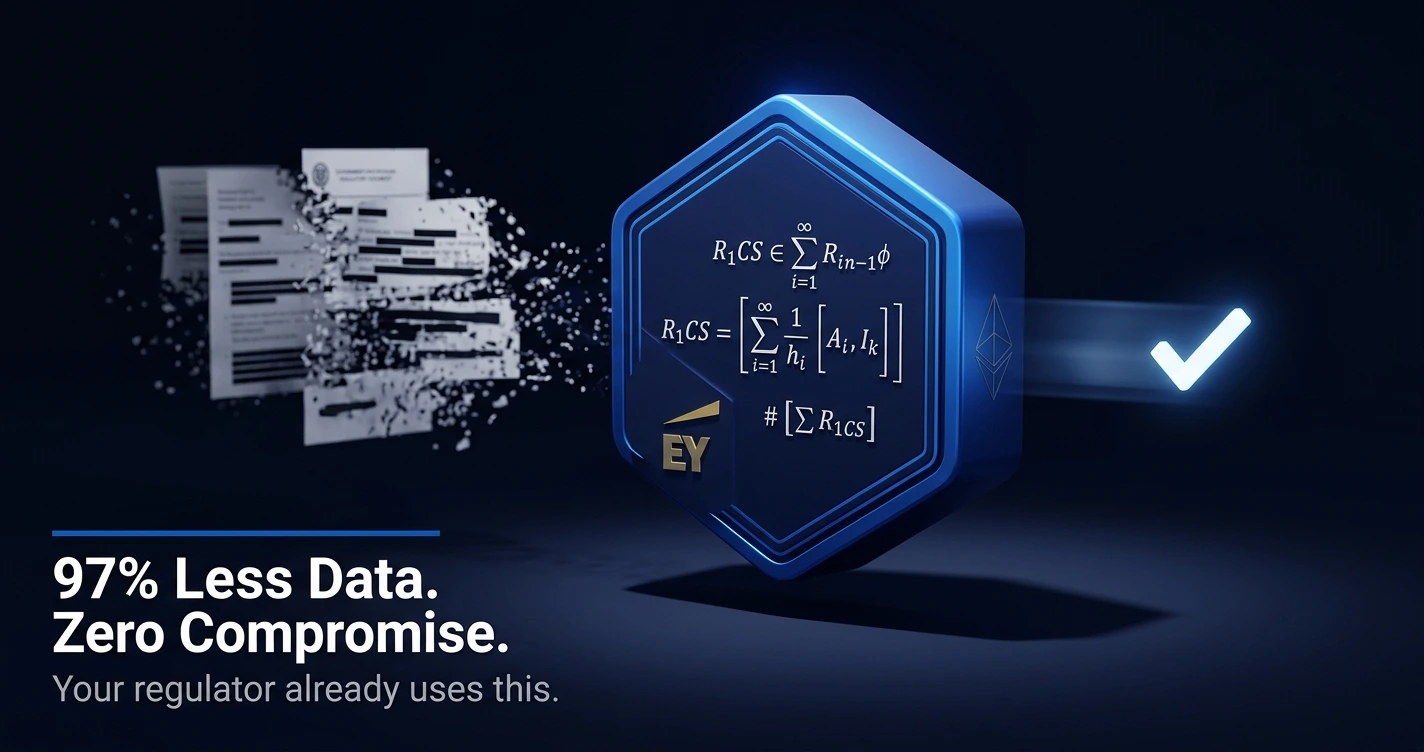
Ernst & Young’s Nightfall program is the most important proof point for enterprise ZKP adoption, precisely because EY is not a crypto startup. In April 2025, EY released Nightfall_4, replacing the prior optimistic rollup with a full ZK version on Ethereum mainnet. The architectural significance: near-instant transaction finality without a challenge period, and institutional-grade privacy on a public chain.
“This update to version 4 represents a major update to Nightfall, providing the same privacy and scaling that version 3 enabled, but now with near-instant finality and a simplified architecture. We believe we will see accelerating adoption of this technology in the coming year by enterprise users.” Paul Brody, Global Blockchain Leader, Ernst & Young. April 2025.
In March 2026, COTI announced it will deploy Nightfall on testnet with mainnet rollout later in 2026, expanding the ZK enterprise privacy infrastructure across Ethereum-compatible networks. As JPMorgan’s pivot toward public Ethereum infrastructure illustrates, the reason institutions are making this move is that ZKPs have made privacy on public chains viable in a way private chains could never deliver interoperability.
“We are really pleased to be working with COTI. Adding the Ethereum Mainnet to the set of networks where Nightfall is available is a huge positive step, and COTI already understands the importance of building infrastructure for privacy for enterprise users.” Clare Adelgren, Global Interim Blockchain Leader, Ernst & Young. March 2026.
Google Wallet: ZKP Age Verification at Consumer Scale
In July 2025, Google open-sourced its “Longfellow” ZKP library in partnership with Sparkasse, Germany’s network of public savings banks. The library enables privacy-preserving age verification using zero-knowledge proofs. Google had already integrated ZKPs into Google Wallet in May 2025, allowing users to verify age for apps without exposing full identity documents.
When Google open-sources production cryptographic infrastructure and partners with a European banking network to deploy it, the technology has cleared the “research curiosity” threshold. Full stop. The signal to enterprise architects is unambiguous.
ZK-KYC: The Compliance Use Case With the Clearest ROI
The ZK-KYC market is projected to grow from USD 83.6 million in 2025 to USD 903.5 million by 2032, at a 40.5% CAGR. That growth rate reflects how directly ZKP-based KYC solves a real regulatory problem that traditional architectures create.
Empirical research published on SSRN in March 2025 by researcher Nicolin Decker, using Monte Carlo simulations and real financial datasets, produced three numbers that compliance teams should put in front of their CFOs:
- ZKP-based KYC verification reduces exposed user data by 97% compared to conventional centralized KYC architectures.
- AI-enhanced ZKP fraud detection achieves 96.7% accuracy, outperforming conventional rule-based AML systems.
- ZKP-based liquidity verification reduces compliance costs by 28% by eliminating redundant data collection, verification overhead, and breach liability exposure.
“ZKP-based KYC verification reduces exposed user data by 97%, while AI-enhanced ZKP fraud detection achieves 96.7% accuracy, significantly outperforming conventional rule-based AML systems.” Nicolin Decker, “Proof Without Exposure,” SSRN Working Paper 5170329, March 2025.
The 28% compliance cost reduction addresses the most common executive objection before it is raised. ZKP adoption is not a cost center. It is a breach liability reduction program that pays for itself.
zkML: Proving AI Decisions Without Revealing the Model
The emerging frontier is zero-knowledge machine learning. In 2025, Lagrange Labs shipped DeepProve-1, described as the first production zkML system to generate cryptographic proofs over a full LLM inference. This means an AI system can prove that a decision was made correctly by its model without revealing the model weights or the input data. For regulated industries where algorithmic accountability is becoming a compliance requirement (finance, healthcare, insurance), this is not a research curiosity. It is the compliance architecture for AI-driven decisions in the next three years.
What Implementation Actually Costs
Enterprise ZKP conversations stall most often at this question. The honest answer is: less than a data breach, more than your team currently budgets for cryptography work.
According to ChainLaunch’s enterprise ZKP implementation analysis (March 2026):
- A focused single-use-case pilot costs between $50,000 and $150,000 depending on complexity.
- Circuit design and implementation requires 2 to 4 months of specialized engineering time.
- Ongoing per-proof compute cost runs approximately $0.01 to $0.10 on standard cloud hardware.
- ZKP engineers command $150,000 to $250,000 in annual compensation, and the supply is severely constrained.
On the performance question (which was the dominant objection through 2022): GPU- and FPGA-accelerated systems now produce basic ZKPs in milliseconds rather than minutes. That is an orders-of-magnitude improvement. Proof generation time is no longer the bottleneck for identity verification, KYC, or single-transaction compliance workflows. It remains a real constraint for complex computational statements, which is addressed in the critical perspective section below.
Integration note for architects: ZKP integration is additive, not a platform replacement. It can be layered onto existing Hyperledger Fabric or Hyperledger Besu deployments without changing consensus mechanisms. If your team is evaluating Layer 2 scaling for enterprise workloads, ZK-rollups are already the dominant scaling mechanism. The decision may already be made for you.
ZKP-as-a-service platforms (Aleo, Aztec Network, StarkWare) have lowered the entry point substantially. You don’t need to hire a cryptographer who can write R1CS constraints from scratch. You need an architect who understands what ZKPs can and cannot prove, and an integration team that can work with existing proving systems. Higher-level ZKP languages like Noir and Circom have reduced the barrier further, though they have not eliminated it.
The Case Against Moving Fast on ZKPs
Any technology briefing that doesn’t present the strongest counterarguments is advocacy dressed as analysis. Here are the five arguments ZKP proponents consistently underweight.
The Incentive Structure Problem
The most underreported barrier is not technical. It is organizational. Companies that monetize data collection have zero economic incentive to adopt ZKPs. Regulatory pressure has not yet reached the level where the cost of non-compliance exceeds the revenue from data harvesting. As CoinDesk’s November 2025 analysis of AI agent identity put it plainly: “companies that profit from collecting data have little incentive to adopt the technology.” ZKP advocates consistently underestimate this structural resistance. The technology’s elegance does not overcome misaligned incentives.
The Regulatory Gray Zone Is Real
The EDPB’s position that blockchain is not GDPR-exempt creates the compliance problem. It does not certify the ZKP solution. No major jurisdiction has issued explicit, binding guidance that a specific ZKP-based compliance architecture satisfies data protection law. An enterprise that deploys ZKP-based KYC and later faces a regulatory challenge needs to defend the cryptographic architecture in court. That gray zone is real and it will exist until EDPB binding guidance arrives, which most analysts expect in 2027.
Developer Talent Scarcity
Circuit design for ZKPs requires expertise in algebraic constraint systems, finite field arithmetic, and proof system internals. This skill set is genuinely rare. Any enterprise timeline that includes “hire a ZKP engineer next quarter” as a dependency is probably wrong. The talent pipeline is limited and compensation expectations are high. Plan for 6 to 9 months of hiring or upskilling time, not 6 to 9 weeks.
Performance Limits at Complex Scale
Proof generation is fast for simple statements (age verification, KYC status, single transaction compliance). For complex computational statements, the cost rises substantially. Full LLM inference verification via Lagrange Labs DeepProve-1 is described as thousands of times slower than unverified computation. Enterprises should scope ZKP use cases carefully. Not everything should be wrapped in a proof, and the performance profile of complex ZKP statements is not solved by current hardware acceleration.
Cross-Chain Identity Remains Unsolved
Current ZKP-based identity systems work robustly within a single-chain environment. Cross-chain identity verification remains an open challenge in academic and practitioner literature as of 2025. For enterprises operating across multiple blockchain networks (which is the real-world architecture for most large financial institutions), this is a meaningful limitation that current product roadmaps have not resolved.
Hannah Garvey, Senior Privacy Counsel at Binance, put the implementation friction in useful terms in her March 2026 regulatory analysis: “the computational overhead remains significant, and integrating them into existing protocols requires substantial development resources.” That assessment is accurate and the ZKP community’s tendency to wave it away with benchmarks for simple use cases does not serve enterprise decision-makers well.
Frequently Asked Questions
What is a zero-knowledge proof in simple terms?
A zero-knowledge proof is a cryptographic method that lets one party prove a statement is true (such as “I am over 18” or “My balance exceeds $10,000”) without revealing the underlying data itself. The verifier learns only that the statement is true, nothing more. No personal data is transmitted or stored.
What is zero-knowledge proof used for in enterprise?
Enterprises use zero-knowledge proofs for KYC and AML compliance without data exposure, privacy-preserving identity verification, private transactions on public blockchains such as EY’s Nightfall on Ethereum, supply chain confidentiality, and satisfying GDPR data minimisation requirements without redesigning existing data architectures.
Are zero-knowledge proofs GDPR compliant?
Zero-knowledge proofs support GDPR compliance by enabling the data minimisation principle. The European Data Protection Board has cited ZKPs as a privacy-enhancing technology. However, no binding regulatory guidance certifies a specific ZKP architecture as definitively GDPR-compliant. Implementation must be assessed case-by-case until EDPB binding guidance arrives, expected in 2027.
What is the difference between zk-SNARK and zk-STARK?
zk-SNARKs produce very small, fast-to-verify proofs but require a trusted setup ceremony that introduces a potential security vulnerability. zk-STARKs require no trusted setup, use hash-based cryptography making them quantum-resistant, and generate proofs faster in benchmarks, but produce larger proof sizes. Enterprises building long-term infrastructure should favour zk-STARKs given the NIST post-quantum timeline.
How do zero-knowledge proofs work with KYC?
In ZKP-based KYC, a trusted identity provider issues a cryptographic credential to a user. The user then proves specific attributes (such as “I am KYC-verified” or “I am not a sanctioned entity”) to a financial institution using a ZKP, without transmitting their passport, address, or date of birth. The institution receives cryptographic proof of compliance, not personal data. Research demonstrates this reduces exposed user data by 97% compared to traditional KYC architectures.
Is zero-knowledge proof the same as blockchain?
No. Zero-knowledge proofs are a cryptographic primitive, a mathematical technique, that can be used with or without blockchain. They are commonly used in blockchain contexts such as ZK-rollups and private transactions, but enterprises also deploy ZKPs for non-blockchain identity verification, database query privacy, and regulatory compliance reporting.
What are the limitations of zero-knowledge proofs?
Key limitations include high computational cost for complex statements, significant developer talent scarcity with ZKP engineers earning $150,000 to $250,000 annually, trusted setup vulnerability in zk-SNARKs, no binding regulatory certification for ZKP compliance architectures, and unresolved cross-chain identity verification for multi-network enterprise deployments.
What to Watch in the Next 18 Months
Zero knowledge proof enterprise privacy adoption is not a 2030 story. The hard deadlines are now. Here is where the inflection points are.
The EU Digital Identity Wallet deployment mandate expires at end of 2026. Every EU member state must have at least one wallet available. Every enterprise system that wants to interoperate with national digital identity infrastructure needs to be ZKP-compatible before that date. This is the most concrete near-term forcing function for enterprise architects outside the crypto sector.
The EU’s privacy coin and anonymous wallet ban is scheduled for enforcement in July 2027. The EDPB binding guidance on GDPR and blockchain is expected around the same window. Together, these represent a 12-month period where the regulatory gray zone narrows considerably. Enterprises that have run ZKP pilots by then will have architecture validation before the rules crystallize. Those that haven’t will be retrofitting under time pressure.
On the technology side, watch zkVM maturation (Risc0, StarkWare’s Cairo VM, early zkEVMs) closely. These allow developers to write ZKP circuits in Rust or Solidity rather than hand-crafted algebraic constraints. As zkVM tooling matures, the developer talent bottleneck loosens. That is the single lever most likely to accelerate enterprise adoption timelines beyond what current hiring constraints would suggest.
Three specific actions for compliance and architecture teams this quarter: evaluate ZKP-as-a-service providers (Aleo, Aztec Network, StarkWare) for your highest-priority compliance use case; run a cost comparison between your current KYC architecture’s breach liability exposure and a ZKP-based alternative using the 97% data reduction figure as your baseline; and confirm whether your enterprise blockchain stack (Fabric, Besu, or any EVM-compatible chain) already supports ZK-rollup integration via existing vendor roadmaps before building a custom procurement process.
The performance objection is obsolete. The talent objection is real but manageable. The regulatory uncertainty is narrowing on a published timeline. The only enterprise ZKP strategy that is clearly wrong right now is waiting for someone else to go first.
Stay ahead of enterprise cryptography and compliance shifts
The Neural Loop delivers NeuralWired’s most important analysis directly to senior technology leaders every week. No noise. No filler.
Subscribe to The Neural Loop