The OpenAI Growth Wall: How a 1B User Miss Is Reshaping a $750B AI Cycle
A leaked internal memo from OpenAI CFO Sarah Friar has set off a chain reaction across the Magnificent Seven, exposing the fragile math behind a $600 billion infrastructure bet and forcing an immediate pivot to agentic commerce as the only viable exit ramp.
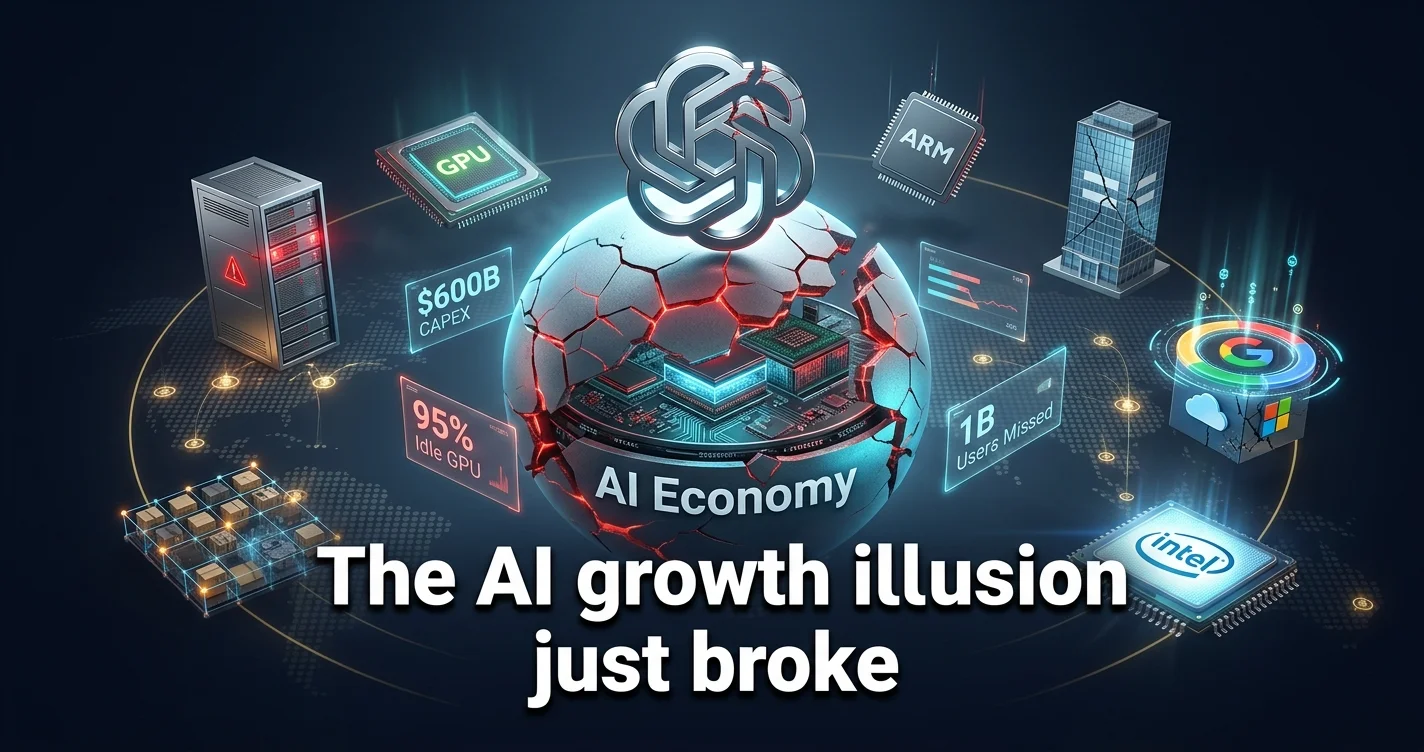
For three years, the market operated on a single comfortable assumption: user growth for large language models would follow an uninterrupted exponential curve. That assumption died on April 28, 2026. An internal report surfaced by The Wall Street Journal revealed that OpenAI had failed to reach 1 billion weekly active users by its own internal deadline and had missed multiple monthly revenue targets. The Nasdaq Composite fell 0.9% within hours of the news breaking.
The damage radiated outward with mechanical precision. Oracle dropped 7% to $161, its $300 billion compute contract with OpenAI suddenly reframed as a liability rather than an anchor. CoreWeave slid 7.4%, SoftBank fell nearly 10% in Tokyo trading, and Arm Holdings dropped 7.7% as investors unwound positions across the AI supply chain. What looked like a company-specific stumble was, in fact, a system-wide repricing of the premise that unlimited AI engagement justifies unlimited infrastructure spending.
Tonight, Alphabet, Microsoft, Meta, and Amazon report earnings against a backdrop of nearly $600 billion in collective AI-related capital committed for 2026. The central question isn’t whether these companies are growing. It’s whether the underlying software can attract and monetize users at the rate their valuations demand. One missed guidance number, one downward revision, and the “OpenAI Slump” stops being a warning shot and becomes a full-scale sector rout. The earnings window opening tonight may be the most consequential 48 hours in the AI super-cycle to date.
The Compute-Revenue Chasm That Wall Street Ignored
The structural fault line at the center of this crisis has a name: the Compute-Revenue Chasm. To maintain its training lead, OpenAI entered into agreements for computing power that assume a revenue trajectory the company hasn’t hit. The five-year, $300 billion deal with Oracle is the clearest example. It was underwritten on the belief that ChatGPT’s user base would grow without friction toward the billion-user mark, generating subscription and API revenue sufficient to cover the monthly burn of GPU clusters at that scale.
When the Sarah Friar memo signaled that those projections weren’t materializing, Oracle’s stock didn’t just react to OpenAI’s bad news. It reacted to the realization that its own data center financing model has a single point of failure. CoreWeave, which recently completed an $11.9 billion infrastructure deal with the startup, faces the same exposure. These companies have effectively “leveraged up” on a growth curve that has now flattened.
“The market is discovering that compute contracts written against infinite growth assumptions become toxic assets the moment the growth assumption breaks. OpenAI didn’t just miss a user target; it invalidated the pricing model for an entire generation of AI infrastructure.” Dan Ives, Senior Equity Analyst, Wedbush Securities — Wedbush Research Note, April 28, 2026The Inference-Utilization Gap: A report from TechNewsWorld indicates that roughly 95% of enterprise GPU capacity currently sits idle. Companies bought hardware for AI projects that aren’t yet production-ready, creating a capital overhang that could suppress new GPU orders well into late 2026.The broader implication is what analysts are calling an “efficiency audit” across enterprise AI. The FOMO-driven GPU buying cycle of 2024 and 2025 has left corporations with hardware they can’t fully use, billed at rates that assumed full utilization. As those utilization reports come in, the pressure on Nvidia and AMD isn’t just competitive; it’s arithmetic.The SoftBank Contagion and the Arm Holdings Margin Call
No entity is more directly exposed to the OpenAI growth wall than Masayoshi Son’s SoftBank Group. The Japanese conglomerate has committed $22.5 billion to OpenAI funding, according to Reuters, and to raise that capital it executed a series of aggressive asset sales including its entire $5.8 billion stake in Nvidia and $4.8 billion of T-Mobile holdings. The logic was sound in a world of infinite AI growth. In a world of finite user engagement, it looks like a concentrated bet on the wrong side of a turning point.The structural risk deepens because of Arm Holdings. SoftBank reportedly tapped undrawn margin loans secured against its Arm stake to fund a portion of the OpenAI obligations. When Arm fell 7.7% on the news, the collateral value of those loans compressed in real time. The result was a near-10% drop in SoftBank’s Tokyo-listed shares. The concern now circulating among institutional investors is clear: if OpenAI’s valuation is revised downward ahead of its targeted late-2026 IPO at a $1 trillion target, the margin call risk on SoftBank’s Arm-backed loans becomes a market event in its own right.
Entity Share Move (Apr 28) Primary Exposure Risk Vector SoftBank Group -9.9% $22.5B OpenAI funding commitment Margin loans against Arm collateral Arm Holdings -7.7% Primary SoftBank loan collateral Collateral compression risk Oracle -7.0% $300B 5-year compute contract Anchor tenant default risk CoreWeave -7.4% $11.9B infrastructure deal Revenue dependency on OpenAI growth AMD -5.3% GPU demand from cloud providers Idle capacity reducing future orders Nvidia -3.8% GPU cluster dominance Agentic shift toward CPU inference The Magnificent Seven Crucible: Four Earnings Reports That Define the Cycle
The selloff of April 28 was a preview. The main event runs tonight. Alphabet, Microsoft, Meta, and Amazon collectively committed roughly $600 billion in AI-related capital for 2026, and each faces a different version of the same pressure: prove that the spending is generating returns at the pace implied by their valuations, or face a re-rating that no amount of forward guidance can easily reverse.Alphabet: The TPU Counter-Narrative
Alphabet enters earnings with a structural advantage its competitors can’t easily replicate. While rivals bid against each other for Nvidia’s H200 and B100 GPUs, Google has been scaling its custom Tensor Processing Unit clusters for years. Google Cloud analysts project a 50% revenue surge to $18.4 billion this quarter, driven in part by enterprise adoption of TPU-powered AI services. That number, if confirmed, would represent the single strongest argument against the “AI monetization is failing” thesis.The real wildcard is “AI Mode.” Google’s new search paradigm integrates directly with the Universal Commerce Protocol to convert conversational queries into transactions. Internal data suggests a 14% to 27% conversion lift versus standard search ads. If Alphabet can show that this lift is translating into revenue per query, it may successfully decouple its valuation from the OpenAI-adjacent selloff entirely.Microsoft: Azure Growth vs. the Workforce Paradox
Microsoft is down 11% year-to-date, its worst start since 2008, and it needs a strong Azure print to stop the bleeding. Analysts expect Azure growth of 37% to 38%, which would be healthy by any historical standard. The optics problem isn’t the revenue; it’s the cost structure. Microsoft is reportedly offering voluntary buyouts to roughly 7% of its U.S. workforce to manage the margin squeeze from its AI capex cycle. This is the efficiency paradox in action: the world’s most profitable software company is cutting headcount to fund the hardware that’s supposed to replace headcount.Investors will also listen for any revision to the renegotiated pact between Microsoft and OpenAI. The recent update to that agreement, which allows OpenAI to forge deals with Microsoft’s direct competitors, signals a cooling of what was once an exclusive partnership. That’s a material shift in Microsoft’s AI moat story.Amazon: The $200 Billion Question
Amazon has guided toward $200 billion in capital expenditure for 2026, the largest in its history and the largest single-company commitment to AI infrastructure the world has ever seen. AWS sales are projected to grow 26%, up from 24% in the prior quarter. The stock is up 25% in April, reflecting investor confidence that Amazon’s retail margin recovery can buffer its AI spending. But the 95% GPU idle-capacity finding complicates that confidence: if LLM training demand plateaus, Amazon may find itself operating the world’s most expensive underutilized asset base.Meta: Efficiency or Attrition?
Meta is guiding for $115 to $135 billion in 2026 infrastructure spending while simultaneously planning to cut another 10% of its workforce next month. Sales growth is expected to hit 31%, the fastest since 2021, but free cash flow is projected to drop to a four-year low of $3.9 billion as AI capex consumes the surplus. Meta’s Llama open-source strategy is central to its long-term positioning, but the near-term math is tight enough that any advertising softness could flip the narrative from “efficiency play” to “margin crisis” overnight.
Company 2026 AI Capex Key Metric to Watch Pre-Earnings Sentiment Amazon ~$200B AWS revenue growth (target: 26%) Bullish (+25% in April) Alphabet $175-$185B Google Cloud growth (target: 50%) Optimistic (+12% YTD) Meta $115-$135B Free cash flow (risk: 4-yr low) Cautious (workforce cuts) Microsoft ~$176B (FY27) Azure growth (target: 37-38%) Bearish (-11% YTD) Google’s Universal Commerce Protocol: The Exit Ramp from the Chatbot Era
The human-to-chatbot interaction model has a ceiling. The industry now knows where it is. What comes next is the question that the Universal Commerce Protocol is designed to answer.Launched by Google in January 2026 and substantially expanded in a major March 2026 update detailed on the Google Developers Blog, the UCP is an open-source standard that gives AI agents a direct channel into merchant backends. It goes beyond surfacing product recommendations; it enables an agent to add items to a cart, apply membership pricing, verify inventory in real time, and complete a checkout transaction, all within the conversational interface. The shift is from AI as advisor to AI as executor.Why this matters for search margins: Google moved UCP-powered ads in “AI Mode” from experimental to primary placement status in April 2026. If the 14% to 27% conversion lift implied by internal data holds at scale, it would represent the most significant uplift in Google’s revenue-per-query metric in over a decade, potentially offsetting the long-term erosion of traditional blue-link search.The March update to the UCP introduced four functional primitives that collectively solve the “cart abandonment” problem that has cost mobile commerce an estimated $400 billion in annual revenue globally.🛒Cart SupportAgents add items from multiple vendors into a single unified basket, enabling one-checkout cross-retailer shopping without leaving the AI interface.🔑Identity LinkingUser loyalty data binds directly to the agent’s identity, guaranteeing member-only pricing and reward points are applied without manual login.📦Live Product CatalogReal-time inventory and pricing pulls from merchant stores, eliminating AI hallucinations about stock availability or variant options.💳Native CheckoutHandles the full payment transaction within the AI interface or the retailer’s own UI, reducing the number of steps between intent and purchase.The UCP’s commercial coalition already includes Shopify, Etsy, Wayfair, Target, and Walmart. By building a vendor-agnostic standard, Google is attempting to create a commerce layer that works across ChatGPT, Copilot, Gemini, or any future agent. The retailers’ primary incentive is maintaining their status as “Merchant of Record,” which preserves direct customer data ownership. For Google, it’s about owning the transaction protocol that captures a slice of global commerce regardless of which AI assistant a consumer chooses to use.OpenAI is pursuing a parallel track. Its own advertising pilot, launched in late March 2026, surpassed $100 million in annualized revenue within six weeks, per The Information. That’s a striking number for a product still in pilot phase, and it underscores how desperately the industry needs revenue streams beyond the $20-per-month subscription model that has defined AI monetization since 2023.Intel’s CPU Renaissance and the End of the GPU Monoculture
The most counterintuitive story of April 28 was Intel surging 20% on a day when the Philadelphia Semiconductor Index had its worst session in a month. The divergence isn’t a market anomaly; it’s a signal about where the next phase of AI compute is heading.The catalysts are structural. First, the Trump administration took a 10% stake in Intel in late 2025 as part of a “Sovereign Silicon” initiative, positioning the chipmaker as the domestic alternative to a GPU supply chain concentrated in Taiwan and dependent on Nvidia’s pricing power. Second, and more fundamentally, the agentic commerce paradigm described by the UCP doesn’t require the same compute profile as training a frontier model.“Agents running on UCP don’t need a supercomputer. They need a very fast, very reliable CPU that can handle context, memory, and transactional logic at scale. That’s a completely different hardware requirement from what drove the GPU boom, and Intel is positioned for exactly that workload.” Patrick Moorhead, Chief Analyst, Moor Insights & Strategy — Moor Insights Research, April 2026The data makes the case starkly. Enterprise GPU clusters are running at roughly 5% average utilization. Intel’s agentic CPU nodes, by contrast, are operating at approximately 85% utilization. The market is bidding Intel up not on hope, but on evidence of actual throughput demand.
Metric GPU Clusters (Training) CPU Clusters (Agentic/Inference) Utilization Rate ~5% (enterprise average) ~85% (Intel/agentic nodes) Primary Supplier Nvidia / AMD Intel / Arm / Google TPU Energy Intensity Extremely high Moderate to high Growth Trend Cooling / oversaturated Surging / undersupplied Geopolitical Profile Taiwan-dependent supply chain Domestically manufacturable (U.S./EU) The integration of the Model Context Protocol (MCP) further accelerates this CPU-centric shift. MCP allows agents to understand a retailer’s business logic without requiring a full technical overhaul of that merchant’s systems, lowering the barrier to entry for smaller participants. The net effect is a more distributed, less compute-intensive AI economy, which is structurally bad for Nvidia’s growth thesis and structurally good for Intel’s.Oil at $115, the Fed’s Final Act, and the Energy Tax on AI
The tech sector’s search for a sustainable monetization model is playing out against a worsening macro backdrop. Crude oil jumped to $115 per barrel on April 29, the highest since June 2022, driven by the ongoing conflict in Iran and compounded by the UAE’s decision to exit the OPEC+ alliance effective May 1, 2026. For the operators of AI data centers, whose energy bills were already rising sharply before this latest spike, these are not rounding errors.Georgia Power’s six rate hikes over the past three years provide a local example of a global trend: the AI Data Center Boom is straining power grids and driving up the operational cost base for every company in this sector. At $115 oil, those energy costs become a measurable drag on the margin story that each Magnificent Seven company will try to tell tonight.Fed risk: Jerome Powell is expected to maintain a “higher for longer” rate posture at this week’s FOMC meeting, partly in response to the oil-driven inflation spike. For high-growth tech stocks priced on discounted future cash flows, a hawkish Fed is the macro equivalent of a headwind at full throttle. The earnings tonight need to be exceptional to overcome the combined drag of OpenAI growth concerns, energy cost inflation, and rising discount rates.There is, however, a security angle that works in the industry’s favor. The FTC’s 2025 annual report on social media fraud found that investment scams on Meta-owned platforms generated more than $1.1 billion in losses, with AI-generated deepfakes playing a growing role. This “security tax” on the digital economy is one of the clearest arguments for agent-based payment systems like the UCP, which uses tokenized payments and verifiable credentials to re-establish transactional trust in an environment where human-to-human digital interaction has become increasingly unreliable.Google’s push for Merkle Tree Certificates in the context of the UCP addresses this directly. These cryptographic structures allow for verification of large datasets without processing the entire data set, providing proof of user consent for every agent-executed transaction. It’s a post-quantum security architecture built into the commerce layer from the start, not bolted on after the fact.Frequently Asked Questions
Did OpenAI really miss its 1 billion weekly active user target?
Yes, according to an internal report first published by The Wall Street Journal on April 28, 2026. OpenAI failed to reach 1 billion weekly active users by the end of 2025, the company’s own internal milestone, and also missed several consecutive monthly revenue targets. The report referenced a memo from CFO Sarah Friar that flagged these shortfalls to senior leadership.How does the OpenAI revenue miss affect Microsoft and Oracle?
Both companies have major financial exposure. Oracle holds a five-year, $300 billion compute contract with OpenAI, which markets are now treating as a credit risk. Microsoft, OpenAI’s largest strategic partner, has committed roughly $176 billion through FY27 and has seen its stock fall 11% year-to-date partly on fears that its OpenAI bet won’t generate expected returns.What is the Universal Commerce Protocol and how does it work?
The Universal Commerce Protocol is an open-source standard developed by Google, launched in January 2026 and expanded in March 2026. It provides a shared language for AI agents and e-commerce merchants, allowing agents to browse live inventory, add items to carts, apply loyalty pricing, and complete transactions automatically. Current partners include Shopify, Walmart, Target, Etsy, and Wayfair.Why did Intel rise 20% while Nvidia and AMD fell on the same day?
Intel’s surge reflects a market rotation from GPU-heavy training workloads toward CPU-optimized inference and agentic computing. Enterprise GPU clusters are running at roughly 5% utilization while Intel’s agentic CPU nodes report 85% utilization. The Trump administration’s 10% stake in Intel under the Sovereign Silicon initiative added further institutional confidence to the stock’s move.Is OpenAI’s $1 trillion IPO valuation still realistic?
It remains the company’s stated target for a late-2026 public offering, but the user growth miss and revenue shortfall have introduced meaningful downside risk to that figure. If the Magnificent Seven earnings tonight confirm a broader AI monetization slowdown, analysts expect OpenAI’s IPO valuation to face a significant downward revision in pre-listing pricing rounds.What is SoftBank’s exposure to an OpenAI valuation cut?
SoftBank has committed $22.5 billion to OpenAI and has reportedly used undrawn margin loans secured against its Arm Holdings stake to fund a portion of that obligation. A downward revision to OpenAI’s valuation would directly compress the collateral value supporting those loans, potentially triggering margin calls that could force SoftBank to sell Arm shares into a declining market.How does $115 oil affect AI data center operators?
Energy costs are one of the largest operational line items for AI data center operators. At $115 per barrel, diesel backup power, heating, cooling logistics, and grid energy prices all rise simultaneously. This creates direct margin pressure on cloud operators like AWS, Google Cloud, and Azure, and accelerates the commercial case for more energy-efficient hardware like Google’s TPUs over power-hungry GPU clusters.What is the Agent Payments Protocol and how does it relate to UCP?
The Agent Payments Protocol (AP2) is a complementary standard being integrated with the Universal Commerce Protocol. It provides tokenized, secure payment handling that keeps the user’s payment instrument separate from the agent’s operational identity. This separation ensures the merchant remains the Merchant of Record for every transaction, avoiding the platform-as-middleman fee structure that has historically squeezed e-commerce margins.The Maturity Verdict: From Hype to Utility
The story of April 29, 2026, is the story of a transition from speculation to accountability. OpenAI’s failure to reach its 1 billion user target isn’t the end of artificial intelligence as a transformative force. It’s the end of its unbounded phase, the period when projections could be written in pencil and market caps could be built on promises.What replaces the chatbot era is not a retreat. The Universal Commerce Protocol, the Intel CPU renaissance, and the pivot to agentic computing represent a more durable, if less spectacular, revenue model. The Magnificent Seven aren’t just software companies any longer; they’re the architects of a new transaction infrastructure. Their success in the next phase will be measured not by how many people opened a chat window, but by what percentage of the $100 trillion global commerce market flows through their protocols.The earnings tonight will draw the first hard lines in this new map. If Amazon confirms 26% AWS growth and Alphabet shows a 50% cloud surge, the growth wall looks like a speed bump. If they miss, the entire capex cycle faces a reckoning that no amount of press releases about agentic futures can defer. Either way, the era of measuring AI success by chat volume is over. The industry is being held to a new standard: show the money, or lose the premium.Watch For01 OpenAI IPO Valuation Revision: Any pre-filing pricing round in Q3 2026 that prices below $750 billion would signal the market has structurally repriced AI exceptionalism, not just OpenAI’s specific miss.02 UCP Merchant Adoption Rate: The number of active retailers transacting via the Universal Commerce Protocol by end of Q2 2026 is the clearest leading indicator for whether agentic commerce can absorb the slack from subscription revenue stagnation.03 Intel Agentic CPU Order Volume: Watch for Q2 earnings guidance from Intel on CPU demand from cloud hyperscalers. A meaningful increase in agentic workload orders would confirm the hardware rotation is structural rather than speculative.04 SoftBank Arm Margin Call Risk: If OpenAI’s private market valuation is cut by 30% or more before year-end, watch SoftBank’s Arm-collateral loan disclosures for signs of forced selling, which would amplify semiconductor sector volatility significantly.Stay ahead of the AI earnings cycle. Full Magnificent Seven coverage and real-time analysis at NeuralWired.Explore Big Tech