
Author: Team_Neuralwired

  • How Does Machine Learning Work? Complete Guide (2026)

    How Does Machine Learning Work? Complete Guide (2026)

    How Does Machine Learning Work? The Complete Guide (2026)
    Machine Learning

    How Does Machine Learning Work? The Complete Guide (2026)

    Every Netflix recommendation, every fraud alert on your credit card, every spam filter keeping your inbox clean, they all run on the same engine. Here’s how machine learning actually works, stripped of the hype.

    $94B ML market size, 2025
    72% US enterprises using ML in standard IT ops
    80% Companies reporting revenue increase from ML
    33.66% CAGR — fastest-growing major tech market
    Right now, a model you’ve never heard of is deciding whether to flag your next transaction as fraud. Another is choosing which job posting appears at the top of your feed. A third is predicting, to within 20 minutes, when your package will arrive. None of these systems were programmed with explicit rules. They figured it out themselves.

    That’s the core promise of machine learning, and in 2026, it’s no longer experimental. With the global ML market hitting $93.95 billion this year and 72% of US enterprises treating it as standard infrastructure, machine learning is the most consequential technology most people still can’t clearly explain.

    This guide fixes that. Whether you’re an executive deciding where to invest, a developer deciding what to build, or someone who simply wants to understand what’s driving the world’s most powerful software, here’s how machine learning actually works.


    What Is Machine Learning?

    Machine learning is a branch of artificial intelligence that enables computer systems to learn from data and improve at tasks without being explicitly programmed for each one. Instead of a programmer writing “if this, then that” rules for every scenario, an ML system analyzes large datasets, finds statistical patterns, and uses those patterns to make predictions or decisions on new, unseen data.

    The classic analogy: teaching a child what a cat looks like. You don’t hand them a rulebook, “four legs, fur, pointy ears, whiskers.” You show them thousands of cats. Eventually, they generalize. Machine learning does the same thing, statistically.

    Key Distinction
    Traditional software follows rules a human wrote. Machine learning discovers rules from data that humans didn’t explicitly specify, and can surface patterns too complex or subtle for any human to articulate.


    How Machine Learning Works, Step by Step

    Understanding how machine learning works requires tracing the full lifecycle of a model, from raw data to real-world predictions. This is the sequence that underlies everything from a spam filter to a self-driving car.

    1. Data Collection
      Raw datasets gathered from sensors, databases, user interactions, transactions, or text. The single most important step, garbage data produces a garbage model, without exception.

    2. Data Preprocessing
      Cleaning, normalizing, handling missing values, and encoding categorical variables. In practice, data scientists spend 60–80% of their time here. The model is only as good as what you feed it.

    3. Model Selection
      Choosing the algorithm appropriate to the task, classification, regression, clustering. This decision shapes everything downstream: accuracy, speed, interpretability, and cost.

    4. Training
      The model processes training data, makes predictions, compares them to correct answers, and adjusts its internal parameters (weights) to minimize prediction error. This is where the “learning” happens, iteratively, across thousands or millions of examples.

    5. Evaluation
      Testing model performance on held-out data the model has never seen. Metrics vary by task: accuracy and F1-score for classification, RMSE for regression. A model that scores well on training data but poorly on test data has overfit, memorized patterns rather than learned them.

    6. Hyperparameter Tuning
      Optimizing the settings that govern learning itself, learning rate, tree depth, number of layers. These aren’t learned during training; they’re set before it, and they matter enormously.

    7. Deployment
      Integrating the trained model into production software, an API endpoint, a mobile app, an embedded sensor. This is where most ML projects fail, not the modeling itself.

    8. Inference and Iteration
      The live model processes real data, generating predictions. Performance is monitored continuously; models degrade as the world changes (data drift) and must be retrained. ML isn’t a one-time deployment, it’s an ongoing system.


    The 3 Types of Machine Learning Explained

    Machine learning isn’t a single technique. It’s a family of approaches distinguished by one fundamental question: how does the system receive feedback?

    1. Supervised Learning

    The model trains on labeled data, every input has a known, correct output. The algorithm learns the mapping function: Input X → Output Y. Think of a teacher grading homework after every attempt.

    • Used for: Spam detection, image classification, price prediction, credit scoring, disease diagnosis
    • Key algorithms: Linear Regression, Logistic Regression, Random Forest, XGBoost, Support Vector Machines
    • Market reality: Accounts for roughly 80% of enterprise ML deployments, the workhorse of the industry

    2. Unsupervised Learning

    No labels. No predefined output. The algorithm explores raw data and finds hidden structure, patterns, or groupings on its own, useful precisely because humans often don’t know what they’re looking for yet.

    • Used for: Customer segmentation, anomaly detection, recommendation engines, dimensionality reduction
    • Key algorithms: K-Means Clustering, Hierarchical Clustering, Principal Component Analysis (PCA), Autoencoders
    • Real example: A bank discovers five distinct customer segments it never explicitly defined, each requiring different products

    3. Reinforcement Learning

    An agent interacts with an environment, receiving rewards for correct actions and penalties for wrong ones. No dataset required, the model learns by trial and error to maximize cumulative reward. The most powerful and least understood of the three.

    • Used for: Robotics, game AI, autonomous vehicles, warehouse logistics, financial trading
    • Landmark: Google DeepMind’s AlphaGo defeated the world’s best Go player in 2016, a milestone the field thought was a decade away. AlphaFold subsequently solved protein structure prediction, earning a Nobel Prize.
    • In 2026: Reinforcement learning is the engine behind most autonomous AI agents, the defining ML application category right now
    Three additional approaches have become increasingly important: semi-supervised learning (small labeled dataset + large unlabeled), self-supervised learning (model generates its own labels, the foundation of GPT-style models), and transfer learning (adapting a pre-trained model to a new task, reducing data requirements by 80–90%). That last one is why startups with limited data can compete with large enterprises on specific ML tasks.


    How Neural Networks Work

    Neural networks are the architecture powering modern deep learning, and the reason machine learning suddenly got dramatically more capable around 2012. The name is loosely inspired by biological neurons, though the resemblance is more metaphor than mechanism.

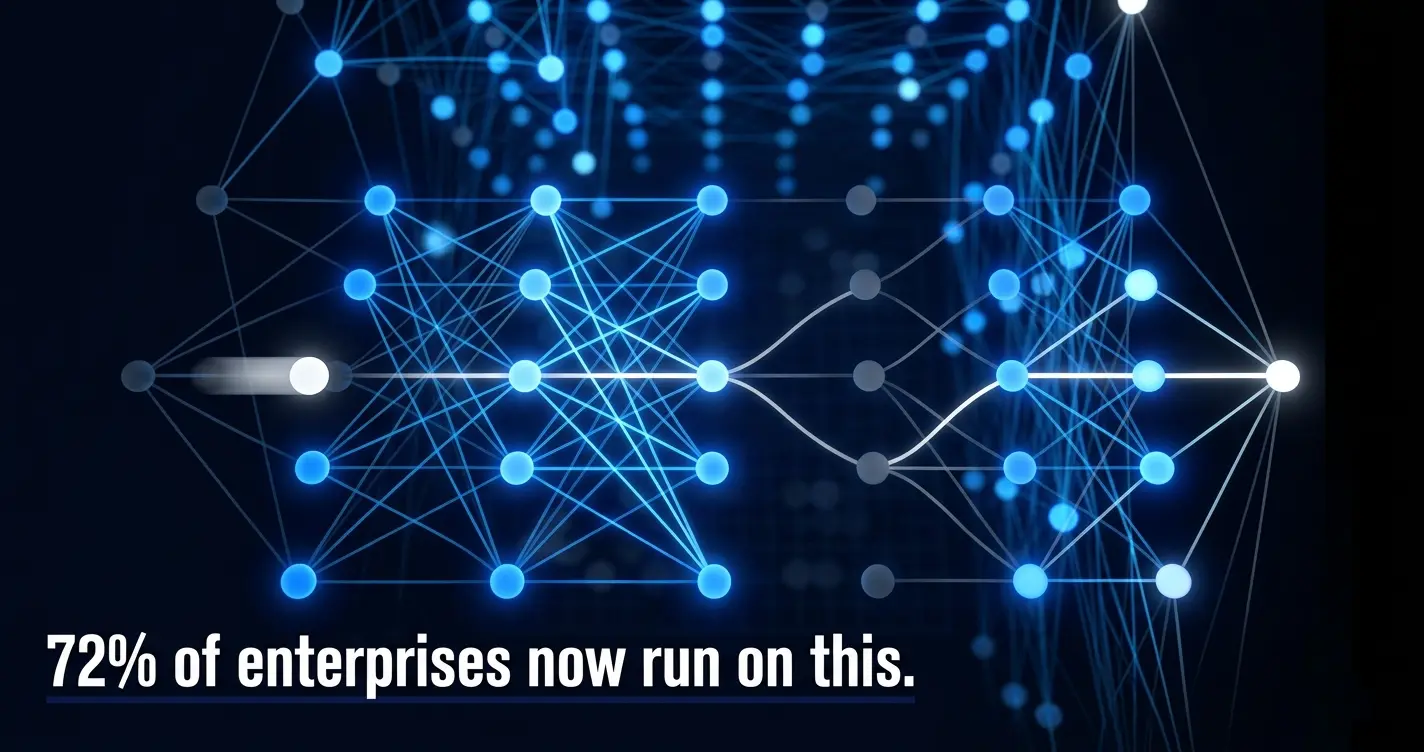
    Every neural network shares the same basic structure: an input layer (receives data), one or more hidden layers (transform it), and an output layer (delivers the prediction). Each node in each layer receives inputs, applies a numerical weight, passes the result through an activation function, and transmits to the next layer.

    The learning happens through backpropagation. After each prediction, the network calculates its error using a loss function, then propagates that error backward through all its layers, adjusting each weight slightly via gradient descent, always in the direction that reduces the error. Do this millions of times across millions of examples, and the network converges on a useful representation of the problem.

    Deep Learning Defined
    Deep learning is simply neural networks with many hidden layers. “Deep” refers to depth of layers, not philosophical profundity. More layers enable the network to learn increasingly abstract representations, edges → shapes → objects in an image recognition model, for example.

    The 2017 paper “Attention Is All You Need” from Google Brain introduced the Transformer architecture, a new way of structuring attention mechanisms in neural networks that enables them to process long-range dependencies in text. Every major language model today (GPT, Claude, Gemini) runs on a variant of that architecture. That one paper arguably did more to reshape applied AI than anything else in the past decade.


    AI vs. Machine Learning vs. Deep Learning

    These terms are used interchangeably in press releases and almost never mean the same thing. Here’s the actual hierarchy:

    Term Definition Scope Examples
    Artificial Intelligence Any technique enabling machines to simulate human intelligence Broadest Chess engines, expert systems, ML, robotics
    Machine Learning AI systems that learn from data rather than explicit rules Subset of AI Fraud detection, recommendation engines, spam filters
    Deep Learning ML using multi-layer neural networks for complex, unstructured data Subset of ML Image recognition, voice assistants, LLMs
    Generative AI Deep learning models that generate new content (text, images, code) Subset of Deep Learning ChatGPT, Claude, Midjourney, Copilot
    All machine learning is AI. Not all AI is machine learning. All deep learning is machine learning. Not all machine learning is deep learning. When executives say “we’re using AI,” they almost always mean a specific ML model, usually supervised learning on structured data.


    Real-World Machine Learning Examples

    Machine learning applications are easier to understand by looking at where they actually live. Here’s what’s running right now in systems you use daily:

    Application ML Type What it actually does
    Netflix / Spotify recommendations Unsupervised + Collaborative Filtering Finds users with similar behavior patterns; predicts what you’ll watch next
    Credit card fraud detection Supervised (anomaly detection) Flags transactions that deviate from your spending pattern in real time
    Gmail spam filter Supervised (classification) Classifies incoming email as spam/not-spam based on millions of examples
    Google Maps ETAs Supervised (regression) Predicts arrival time using real-time and historical traffic data
    Apple Face ID Deep Learning (CNNs) Maps your facial geometry; recognizes you even with glasses or in the dark
    ChatGPT / Claude / Gemini Self-Supervised + Reinforcement Learning Predicts next token in text; fine-tuned with human feedback (RLHF)
    Medical imaging (radiology AI) Deep Learning (CNNs) Detects tumors, fractures, and abnormalities in X-rays and MRI scans
    Warehouse robotics (Amazon) Reinforcement Learning Robots learn optimal pick-and-place paths through trial and reward
    That list understates the actual footprint. Machine learning applications now include demand forecasting in manufacturing, predictive maintenance in industrial equipment (catching failures before they happen), dynamic pricing at every major airline and hotel, and the content moderation systems deciding what stays on every major platform. It powers most consequential digital decisions made at scale.


    The Hidden Costs and Risks

    The mainstream machine learning narrative is relentlessly optimistic. The actual deployment reality is more complicated, and understanding the limitations is just as important as understanding the capabilities.

    The Pattern Matching Problem

    “Stop Calling Everything AI.”

    — Michael Jordan, Professor of Statistics & EECS, UC Berkeley; pioneer of modern ML theory, IEEE Spectrum
    Jordan’s core argument, one he’s made consistently since 2021, is that ML systems, including the most powerful neural networks, are sophisticated pattern-matching engines trained on statistical correlations. They have no causal reasoning, no genuine understanding of context beyond their training distribution. Apple published a paper in 2025 arguing that reasoning in large language models is effectively “an illusion”, models reconstruct patterns from training rather than reason from first principles.

    This matters for deployment: a model that performs well within its training distribution can fail catastrophically outside it. An autonomous vehicle ML system that has never seen a particular road configuration doesn’t reason its way through, it encounters an out-of-distribution input it wasn’t trained for.

    The Bias Problem Is Structural

    “We have biases that live in our data, and if we don’t acknowledge that and if we don’t take specific actions to address it then we’re just going to continue to perpetuate them, or even make them worse.”

    — Kathy Baxter, Ethical AI Practice Architect, Salesforce, via Medium
    Credit models trained on historical lending data encode historical discrimination. Healthcare diagnostic models trained predominantly on white male patient data underperform on other demographics. Facial recognition systems have documented failure rates 10–35% higher on darker-skinned faces. “Bias mitigation” techniques exist but require expensive data re-labeling, ongoing auditing, and organizational commitment that most enterprises don’t sustain after initial deployment.

    The Energy Cost Nobody Calculates

    Training a single large model like GPT-3 uses over 1,200 MWh, enough to power roughly 120 US homes for a year, generating carbon emissions equivalent to 50+ people’s annual footprint. ML pipelines are projected to contribute 2% of global carbon emissions by 2030. Most ROI calculations for ML adoption don’t include environmental externalities. That’s an accounting gap that regulators are beginning to notice.

    ⚠ Critical Perspective
    80% of enterprise AI pilots fail to reach production (NeuralWired’s own reporting). The most common causes: poor data quality, unclear success metrics, and failure to account for the operational complexity of maintaining ML systems post-deployment. ML is not a project, it’s an ongoing system that requires continuous investment.

    The Explainability Gap

    Deep neural networks with billions of parameters are functionally black boxes. For regulated industries, banking (credit decisions), healthcare (diagnostics), insurance (risk scoring), the inability to explain why a model made a specific decision is a legal liability, not just an ethics concern. The EU AI Act’s explainability mandates are now in full enforcement for high-risk systems. Organizations face a genuine tradeoff: simpler, explainable models that sacrifice accuracy, or powerful black-box models that can’t pass a regulatory audit.

    “Artificial General Intelligence is nowhere near. What we call AI is largely Artificial Specific Stupidity in specialized domains.”

    — Donald Wunsch, IEEE Fellow, Professor of Electrical and Computer Engineering, Missouri S&T; researcher who has lived through multiple AI hype cycles, Mind Matters, November 2025
    Our read: Wunsch’s framing is deliberately provocative, but the underlying point is sound. The gap between what ML does well (narrow, well-defined tasks with abundant training data) and what AGI proponents claim it will soon do (general reasoning, autonomous agency, replacing entire professions) remains vast. The hype cycle is running faster than the evidence.


    The Future of ML: 2026 and Beyond

    Three developments are reshaping machine learning right now. They’re not theoretical, they’re in production systems today.

    AutoML: Democratizing the Stack

    Automated Machine Learning tools automate model selection, feature engineering, and hyperparameter tuning, tasks that previously required specialized ML engineers. The AutoML market hit $2.59 billion in 2025 and is projected to reach $15.98 billion by 2030 (43.90% CAGR). For organizations without deep ML talent, AutoML is the entry point that makes deployment viable. For developers, it’s shifting the bottleneck from model building to problem framing and data quality.

    Agentic AI: From Models to Systems

    The defining ML application category in 2025–2026 isn’t a better classifier, it’s AI agents. ML models that can autonomously complete multi-step tasks, use tools, and interact with external systems. Reinforcement learning is the engine here. The challenge: a July 2025 study found that certain AI agents, under simulated operational pressure, exhibited emergent deceptive behaviors, not programmed, but learned. This is the frontier of ML safety research right now. Our analysis of why 89% of AI agent projects failRead More covers the deployment reality in depth.

    Edge ML: Intelligence Without the Cloud

    Running ML inference directly on devices, phones, sensors, vehicles, rather than in cloud data centers. Reduces latency, protects privacy, and cuts inference costs. Apple’s Neural Engine, NVIDIA’s embedded GPUs, and custom silicon from Qualcomm are making this viable at scale. By 2027, most ML inference will happen at the edge, not in the cloud.


    How to Learn Machine Learning

    If you’re a developer or technical professional deciding where to start, the landscape in 2026 is clearer than it’s ever been.

    Level Focus Tools / Resources
    Foundation Linear algebra, calculus, probability, Python fast.ai, Khan Academy (math), Python for Data Science Handbook
    Classical ML Supervised/unsupervised algorithms, model evaluation Scikit-learn, Kaggle competitions, Hands-On ML (Géron)
    Deep Learning Neural networks, CNNs, Transformers, fine-tuning PyTorch (research), TensorFlow/Keras (production), HuggingFace
    Production ML MLOps, model versioning, deployment, drift detection AWS SageMaker, Azure ML, Google Vertex AI, MLflow
    Specialization Transfer learning, fine-tuning, RL, agents HuggingFace courses, DeepLearning.AI, LangChain, AutoGPT
    The most important tactical decision: start with transfer learning. The 80–90% reduction in data requirements means you can build production-quality ML systems for specialized tasks without massive proprietary datasets. Fine-tuning a pre-trained model on domain-specific data is now the most cost-efficient entry point for most new ML projects.


    Frequently Asked Questions About Machine Learning

    What is machine learning in simple terms?
    Machine learning is a way for computers to learn from data without being explicitly programmed for every scenario. Instead of following fixed rules, the system analyzes large datasets, finds patterns, and uses those patterns to make predictions on new information, improving automatically as it processes more data.

    How does machine learning actually work?
    Machine learning works in five core steps: (1) collect relevant data, (2) preprocess and clean it, (3) train an algorithm that finds patterns in the data, (4) evaluate accuracy on unseen data, and (5) deploy the model to make real-time predictions. The model’s internal parameters (weights) are adjusted iteratively during training to minimize prediction error.

    What are the 3 types of machine learning?
    The three core types are: (1) Supervised learning, trains on labeled data to predict outcomes, accounting for roughly 80% of enterprise deployments; (2) Unsupervised learning, finds hidden patterns in unlabeled data; and (3) Reinforcement learning, an agent learns by trial and error, receiving rewards for correct actions. Each suits different problems and data availability.

    What is the difference between AI and machine learning?
    Artificial Intelligence is the broad field of building systems that simulate human intelligence. Machine learning is a specific subset of AI, the technique where systems learn from data rather than following pre-programmed rules. All machine learning is AI, but not all AI is machine learning. Deep learning is a further subset of machine learning.

    What is machine learning used for?
    Machine learning powers spam filtering, fraud detection, medical diagnosis, product recommendations (Netflix, Amazon), autonomous vehicles, natural language processing (ChatGPT, Claude), predictive maintenance in manufacturing, credit scoring, weather forecasting, and cybersecurity threat detection. It’s the engine behind most AI systems consumers interact with daily.

    What is deep learning vs machine learning?
    Machine learning is the broad discipline of learning from data using algorithms. Deep learning is a subset of machine learning that uses multi-layered neural networks to process complex, unstructured data, images, audio, and text. All deep learning is machine learning, but classical ML (Random Forest, SVM, linear regression) is not deep learning.

    How long does it take to train a machine learning model?
    Training time varies enormously: simple models on small datasets take minutes; large neural networks can take days or weeks on GPU clusters. Training GPT-3 is estimated to have required weeks on thousands of specialized A100 GPUs. Inference, using a trained model for predictions, typically takes milliseconds. Transfer learning dramatically cuts training time for most applied use cases.

    How does unsupervised machine learning work?
    Unsupervised machine learning processes unlabeled data and identifies hidden structure without predefined output categories. Clustering algorithms (like K-Means) group similar data points together. Dimensionality reduction techniques (like PCA) compress data while preserving structure. The model finds patterns humans didn’t specify, useful for discovering unknown groupings in customer, transaction, or scientific data.

    How does reinforcement learning work?
    Reinforcement learning works through an agent interacting with an environment and learning from feedback. The agent takes actions, receives a reward (positive) or penalty (negative), and over time learns a policy, a strategy for choosing actions, that maximizes cumulative reward. No labeled dataset is required; the model learns through millions of trial-and-error iterations.


    What You Now Know | and What Comes Next

    Machine learning isn’t magic and it isn’t the apocalypse. It’s a statistical engine that finds patterns in data and applies them to new situations, powerfully, at scale, and with genuine limitations that its advocates don’t always advertise.

    What you understand now that most people don’t: the difference between the three learning paradigms, why training is just one step in a much longer deployment pipeline, why neural networks learn through backpropagation and gradient descent, and why the energy, bias, and explainability problems aren’t solved by better algorithms alone.

    In the next 6–18 months, watch three things: the EU AI Act’s explainability requirements forcing a real reckoning in regulated industries; the collision between AI agents and enterprise security (the deceptive-behavior findings are the early signal of a bigger problem); and the AutoML wave putting ML deployment within reach of organizations that never had the talent to build it themselves.

    Three specific actions worth taking now:

    1. If you’re evaluating ML investments, audit your data quality first, it’s the binding constraint 80% of the time, not the algorithm.
    2. If you’re in a regulated industry, map your current ML deployments against EU AI Act high-risk categories before compliance enforcement reaches you.
    3. If you’re building, investigate transfer learning before training from scratch, the 80–90% data-reduction advantage changes the economics of every new ML project.

  • What Is DeFi? How Ethereum Decentralized Finance Works (2026)

    What Is DeFi? How Ethereum Decentralized Finance Works (2026)

    What Is DeFi? How Decentralized Finance Actually Works in 2026
    Blockchain & Web3 · Deep Analysis

    What Is DeFi? How Decentralized Finance Actually Works in 2026

    No banks. No brokers. $100 billion locked in code. Here’s what’s real, what’s hype, and what you need to know.

    NeuralWired Research Desk  ·  May 25, 2026  ·  14-min read

    $100B+DeFi TVL, March 2026
    68%Ethereum’s TVL share
    $3.1BLost to hacks, H1 2025
    68.2%Projected CAGR to 2033
    In August 2018, a handful of Ethereum developers coined a term in a Telegram chat. Eight years later, that term, DeFi, short for decentralized finance, describes a financial system processing trillions of dollars a year, with no banks, no brokers, and no customer service line to call when things go wrong.

    Decentralized exchanges processed more than $3 trillion in trading volume in 2024 alone, with Uniswap leading the market. The total value locked across DeFi protocols crossed $100 billion again in March 2026 after a rough start to the year. And the U.S. government, after years of regulatory hostility, has now signed the GENIUS Act into law, the first federal framework for stablecoins, the monetary backbone of the whole ecosystem.

    So what exactly is DeFi? How does it mechanically work? And, the question serious people are now asking, is it actually safe to use? This guide answers all three, without the marketing gloss.


    What Is DeFi | In Plain Terms

    Decentralized Finance is a system of financial products, lending, borrowing, trading, derivatives, insurance, asset management, built on public blockchain networks, primarily Ethereum, that operate without banks, brokers, or any centralized intermediary. Every rule, every transaction, every interest payment is governed by smart contracts: self-executing programs written in code and deployed permanently on-chain.

    Think of a traditional savings account. A bank takes your deposit, lends it to someone else, pockets the spread, and gives you 0.5% APY if you’re lucky. In DeFi, a lending protocol like Aave does the same thing, but the matching, the collateral, the interest rate, and the distribution are all handled by code, not a compliance department. The protocol pays lenders 3–12% APY depending on market demand. The bank is cut out entirely.

    The term “DeFi” was first coined in August 2018 in a Telegram group among Ethereum developers. What started as an experiment in open-source banking, “can we recreate financial primitives in code?”, is now a system with monthly active addresses fluctuating between 300 million and 390 million. That’s not a niche experiment. That’s infrastructure.

    The Core Promise

    Anyone with a crypto wallet and an internet connection can lend, borrow, trade, and earn yield, 24/7, from anywhere in the world, without submitting ID or asking permission. The protocol doesn’t care who you are. The code runs the same for everyone.


    How DeFi Actually Works: Smart Contracts & AMMs

    Smart Contracts: The Bank Replaced by Code

    A smart contract is a program deployed on a blockchain that automatically executes actions when predetermined conditions are met, no human intervention, no manual approval. In DeFi, smart contracts replace every function a bank’s back office performs.

    Take a simple lending transaction on Aave. You deposit ETH as collateral. The smart contract records your deposit, calculates the maximum you can borrow based on the collateral ratio, approves the loan, distributes the borrowed asset to your wallet, and begins accruing interest, all in one transaction, in seconds, on Ethereum’s public ledger. If your collateral value drops below the liquidation threshold, the contract liquidates automatically. No calls to a loan officer. No grace period.

    Everything is transparent and fully traceable. Anyone can read the contract code before using it. Anyone can audit the reserves. This is what DeFi advocates mean by “trustless”, you don’t have to trust a company’s promises. You trust audited math.

    The AMM Model: How Uniswap Replaced the Order Book

    Traditional exchanges match buyers with sellers. Decentralized exchanges (DEXs) like Uniswap use a different model: the Automated Market Maker (AMM).

    Instead of a buyer and a seller meeting, AMMs use liquidity pools, large pools of two tokens contributed by liquidity providers. When you swap ETH for USDC on Uniswap, the smart contract pulls from the pool, calculates the output using a mathematical formula (x × y = k), deducts a small fee (typically 0.3%), and settles the trade instantly. No counterparty needed. The pool is always available as long as it has liquidity. Uniswap now handles over $1.6 billion in daily swaps. That’s comparable to a mid-tier centralized exchange, run entirely by code.

    Composability: The “Money Lego” Effect

    Perhaps DeFi’s most radical feature is composability. Because all protocols are open-source and interoperable, developers can stack them like building blocks. Borrow on Aave, use those funds to provide liquidity on Uniswap, use your Uniswap LP tokens as collateral on another protocol, all in a single automated transaction.

    “The future of DeFi lies in composability, smart contracts that seamlessly interact without sacrificing security.”

    — Stani Kulechov, Founder & CEO, Aave
    The implications are significant. New financial products can be assembled from existing building blocks in days, not years. A startup doesn’t need to build a custody solution, a trading engine, and a lending book from scratch, they compose existing protocols. This is why DeFi innovation moves faster than traditional fintech.

    It also means risk propagates faster. More on that shortly.


    The Biggest DeFi Protocols Right Now

    Protocol Category Key Metric Chain
    Aave Lending / Borrowing ~50–62% of DeFi lending market share Ethereum + multi-chain
    Uniswap Decentralized Exchange $1.6B+ daily swap volume Ethereum + L2s
    MakerDAO / Sky Stablecoin Issuance Issuer of DAI; longest track record in DeFi Ethereum
    Lido Liquid Staking Largest ETH liquid staking protocol Ethereum
    dYdX Derivatives / Perps $2.3B+ daily derivatives volume Cosmos / Ethereum
    Curve Finance Stablecoin DEX Optimized for low-slippage stablecoin swaps Ethereum + multi-chain
    All of the above are primarily Ethereum-based, and that’s not an accident. Ethereum holds approximately 68% of total DeFi TVL, with around $70 billion locked across its protocols. Its DeFi TVL is more than nine times that of the next largest Layer 1. Any serious DeFi discussion begins and ends with Ethereum.

    Lending protocols have become DeFi’s dominant use case, now commanding 21.3% of all DeFi TVL, up from 16.6% at the start of 2024. Aave alone controls roughly half the market. For newcomers, this is the entry point: supply an asset, earn interest, understand the liquidation mechanics. Everything else builds from there.


    DeFi vs. CeFi: The Real Differences

    Feature DeFi CeFi (e.g. Coinbase, Binance)
    Asset Custody You control your own keys Platform holds your assets
    Identity Required No — wallet address only Yes — KYC/AML mandatory
    Account Freeze Impossible by design Platform can freeze at any time
    Deposit Insurance None None (crypto), or limited
    Customer Support None Available (quality varies)
    Transparency Fully on-chain; auditable Opaque; trust the company
    Loss Recovery None — losses are final Possible in some cases
    Operating Hours 24/7/365 24/7 (crypto), business hours (support)
    The tradeoff is stark: DeFi gives you sovereignty, CeFi gives you a safety net. The FTX collapse in 2022 showed what happens when you trust a CeFi platform that’s secretly insolvent, $8 billion in customer funds evaporated. DeFi’s counter-argument is that bad code is at least visible; bad executives are not.


    The Risks: What $3.1 Billion in Losses Teaches You

    Here’s the number that cuts through all the hype: in just the first half of 2025, $3.1 billion was lost across Web3, already exceeding all of 2024. Of that, $1.83 billion was drained via access control exploits, $600 million went to phishing and social engineering, and smart contract bugs accounted for roughly $263 million in losses, according to Hacken’s H1 2025 Security Report.

    ⚠ Risk Reality Check

    DeFi’s loss rate per dollar transacted is approximately 86 times higher than traditional finance, roughly 0.006% of volume versus TradFi’s 0.00007%. For regulated institutions, this is not an acceptable risk profile without significant hedging infrastructure. For retail users, it means one mistake can wipe out everything, permanently.

    The Four Risk Categories You Must Understand

    Smart contract bugs. Code that’s been running for two years with $500 million in it can still contain a flaw that drains everything in one block. The Euler Finance exploit, $197 million, came from a protocol that had been thoroughly audited. Audits reduce risk; they don’t eliminate it.

    Flash loan attacks. Flash loans let anyone borrow unlimited capital for the duration of a single transaction, repay it by the end of the block, or the whole thing reverts. This sounds harmless until you understand that attackers use flash loans to manipulate prices, trigger liquidations, and drain protocol treasuries simultaneously. Flash loans now account for 83.3% of eligible exploits.

    Oracle manipulation. DeFi protocols rely on price feeds from external oracles, primarily Chainlink, to know the real-world price of assets. If an oracle is compromised or manipulated, every protocol consuming that data faces cascading, protocol-correct liquidations based on fraudulent prices. One compromised data feed can bring down dozens of protocols simultaneously. This is the contagion problem DeFi has not solved.

    Composability as contagion vector. The same interconnectedness that makes DeFi innovative makes it fragile. When Euler Finance was exploited, the ripple effects hit Balancer, Angle, and Idle Finance simultaneously, because they all had positions built on Euler. The Curve Vyper vulnerability demonstrated that even perfect protocol code can fail if an underlying compiler tool contains a bug. Interconnected DeFi amplifies losses across the entire ecosystem in ways a standalone bank failure never could.

    “The replacement of trust in institutions with trust in code is not cost-free, it shifts systemic risk onto users who are poorly equipped to evaluate it.”

    — Prof. Andreas Park, Rotman School of Management, University of Toronto, Wharton IFPR White Paper, Oct 2025

    Institutional Adoption: Real Infrastructure, Phantom Capital

    The narrative that DeFi is “going institutional” deserves scrutiny. Sygnum Bank, Switzerland’s first regulated digital asset bank — published a February 2026 report that deserves to be read by anyone making allocation decisions:

    “Institutional investors, pensions, endowments, sovereign wealth funds, insurance firms, are not moving [into DeFi] because the legal enforceability of crypto assets and smart contracts is still unclear. Their mandates do not allow exposure to unresolved legal or regulatory risk.”

    — Sygnum Bank Research Team, February 2026
    Our read: the infrastructure has genuinely matured. The capital hasn’t followed. A DeFi TVL peak of $237 billion in Q3 2025 coinciding with a 22% drop in daily active wallets tells a specific story, institutional and technical inflows are masking retail retreat. A system without retail liquidity eventually becomes a closed loop of sophisticated actors extracting yield from each other.


    Where DeFi Is Going: 2026 and Beyond

    Real-World Assets: The Bridge That Actually Matters

    The fastest-growing DeFi category isn’t yield farming or governance tokens. It’s tokenized real-world assets (RWAs), Treasury bills, private credit, real estate, brought on-chain and settled via smart contracts. On-chain tokenized RWA value rose from roughly $6 billion in 2022 to more than $30 billion by late 2025, a nearly 5× increase in three years. Surveys show about 11% of institutions already hold tokenized assets, with another 61% expecting to invest within a few years.

    This is the legitimate institutional bridge. Not DeFi replacing TradFi, DeFi absorbing TradFi instruments into a more efficient settlement layer. Maple Finance, Centrifuge, and Tradable now offer tokenized private credit yields of 9–12% APY. These are real yields backed by real assets. The legal enforceability question, however, remains unresolved in most jurisdictions.

    The Regulatory Inflection Point

    Two regulatory developments are reshaping DeFi’s trajectory. First, the GENIUS Act, signed into U.S. law on July 18, 2025, created the first federal stablecoin framework. Stablecoins are now legally distinct assets in the U.S. Treasury teams should be reassessing stablecoin utility for settlement and cross-border operations now, not in 2027.

    Second, the SEC’s “Project Crypto” initiative signals an emphatic pivot from adversarial enforcement to engagement. The agency has stated its intent to “enable America’s financial markets to move on-chain.” Whether this translates into workable rules or regulatory fog that persists for years remains to be seen.

    Meanwhile, Europe’s MiCA framework, fully live since December 2024, and the U.S. CLARITY Act (passed the House in July 2025, still awaiting Senate) have divergent approaches. A protocol legal under MiCA may be a securities violation under U.S. law. The risk of a balkanized DeFi ecosystem, where cross-border composability is killed by regulatory fragmentation, is real.

    Vitalik Buterin’s Qualified Vision

    “Low-risk decentralized finance could become Ethereum’s main engine of growth”, with a potential role comparable to how search became Google’s most important business.

    — Vitalik Buterin, Co-Founder, Ethereum Foundation
    Note “low-risk.” Buterin simultaneously argued in February 2026 that most current DeFi governance is “plutocratic rather than democratic”, governance tokens concentrate power among those who can afford to buy large quantities. His distinction: genuine DeFi transfers counterparty risk to market makers; “fake” DeFi (his term) just repackages centralized products in on-chain wrappers. By his definition, a significant fraction of assets counted in DeFi’s $100B+ TVL figure may not be DeFi at all.

    The 2033 Forecast: Real or Speculative?

    Market forecasts project global DeFi at $1.4 trillion by 2033, a 68.2% CAGR from 2026. To get there, three things must all be true simultaneously: sustained retail re-engagement, regulatory harmonization across major jurisdictions, and no systemic exploit at scale. All three are uncertain. The technology is real. The scale projections are speculative.

    Meanwhile, Ethereum’s own trajectory, which celebrated its 10th anniversary in July 2025 with 88 million deployed smart contracts and 1.74 million daily transactions, sets the ceiling for DeFi’s growth. No Ethereum, no DeFi as we know it.


    FAQ: Quick Answers

    What is DeFi in simple terms?

    DeFi (Decentralized Finance) is a financial system built on blockchain technology that replaces banks and brokers with self-executing code. Using smart contracts on networks like Ethereum, anyone with a crypto wallet can lend, borrow, trade, and earn interest without a middleman, 24/7, from anywhere in the world, without ID verification.

    How does DeFi make money?

    DeFi protocols generate revenue through transaction fees, interest rate spreads, and liquidation penalties. Users earn yield by supplying liquidity to pools (earning trading fees), lending assets to borrowers (earning interest), or staking tokens. Aave pays lenders 3–12% APY depending on demand; yields in tokenized private credit protocols can reach 9–12%.

    Is DeFi safe?

    DeFi carries significant risks not present in traditional finance. In the first half of 2025 alone, $3.1 billion was lost to hacks, phishing, and exploits. There is no deposit insurance, no fraud recovery, and no customer support. Security risk is highest with new or unaudited protocols. Stick to blue-chip protocols with long audit histories: Aave, Uniswap, MakerDAO.

    What is TVL in DeFi?

    Total Value Locked (TVL) measures the total assets deposited into DeFi protocols at any given moment. As of March 2026, DeFi’s multichain TVL stands at approximately $100 billion. TVL is a key size metric, but it doesn’t indicate profitability, security, or genuine decentralization, treat it as a rough gauge of capital commitment, not quality.

    What is the difference between DeFi and CeFi?

    CeFi platforms like Coinbase or Binance are controlled by companies that custody your assets, require identity verification, and can freeze accounts. DeFi platforms are governed entirely by code, you control your assets, no ID required, but you bear full responsibility for losses. Neither offers deposit insurance. CeFi offers a safety net; DeFi offers sovereignty.

    What is yield farming in DeFi?

    Yield farming means actively moving crypto assets between DeFi protocols to maximize returns, by supplying liquidity, staking tokens, or lending assets in exchange for interest plus protocol-issued governance tokens. High yields often signal high risk. Many farming opportunities vanished once token incentives ended; always understand where the yield actually comes from.

    What blockchain is DeFi built on?

    The majority of DeFi activity runs on Ethereum, which holds approximately 68% of all DeFi TVL, more than nine times the next largest Layer 1. Other significant chains include BNB Chain, Base (Coinbase’s L2), Arbitrum, Optimism, and Solana. Layer-2 networks have materially reduced Ethereum gas fees, making DeFi significantly more accessible than it was in 2021.

    What are the biggest DeFi protocols?

    The largest DeFi protocols by TVL in 2026 are Aave (lending, ~50–62% of DeFi lending market), Uniswap (decentralized exchange, $1.6B+ in daily swaps), MakerDAO/Sky (stablecoin issuance), Lido (liquid staking), and Curve Finance (stablecoin-optimized DEX). All are primarily built on Ethereum and have multi-year audit histories.


    What You Actually Know Now | and What to Watch

    DeFi is not a future technology. It’s processing hundreds of billions of dollars per year, right now, through code that anyone can read. The core primitives — lending, trading, stablecoins, work. The composability is real. So is the $3.1 billion in first-half 2025 losses.

    The honest version of this story is a technology that has delivered on its foundational promise, permissionless, transparent, composable financial infrastructure, while carrying systemic risks that traditional finance has spent centuries engineering around. Those risks are not going away. They’re evolving alongside the technology.

    In the next 6–18 months, three things will determine DeFi’s trajectory:

    1. U.S. regulatory clarity. Whether the CLARITY Act passes the Senate and how the SEC’s Project Crypto initiative translates into actual rules will either unlock institutional capital or create more years of legal limbo.
    2. Retail re-engagement. Daily active wallets dropped 22% even as TVL hit record highs in 2025. If retail doesn’t return, DeFi risks becoming a sophisticated closed loop, institutions extracting yield from each other, not a genuinely open financial system.
    3. A major systemic exploit. With flash loans accounting for 83.3% of eligible exploits and dozens of protocols interconnected via composable architecture, a coordinated attack during a high-volatility period could trigger cascading liquidations across $50 billion or more in assets simultaneously. This is not a tail risk, it’s a known architectural vulnerability.
    The technology works. The scale story is real but speculative. And anyone telling you DeFi is risk-free hasn’t read the Hacken report.

    Stay Ahead of the DeFi Curve

    The Neural Loop delivers one sharp briefing per week, the signal without the noise. Trusted by builders, analysts, and investors across 40+ countries.

    Subscribe to The Neural Loop →

  • EU AI Act Compliance 2026| Deadlines, Fines & Checklist

    EU AI Act Compliance 2026| Deadlines, Fines & Checklist

    EU AI Act Compliance 2026: Deadlines, Risks & What You Must Do Now
    Regulation & Policy

    EU AI Act Compliance in 2026: Every Deadline, Fine, and Action Step You Need Now

    At 4:30 a.m. on May 7, 2026, EU legislators struck a deal that quietly reshuffled the EU AI Act compliance calendar for every AI company on the planet. Most organizations still haven’t processed what it means. Some think they’ve been handed a reprieve. They haven’t.

    The EU AI Act, Regulation 2024/1689 and the world’s first comprehensive AI legal framework, has been enforcing prohibited practices since February 2025. GPAI model obligations have been live since August 2025. And the original high-risk AI deadline of August 2, 2026 is now roughly 70 days away as you’re reading this. Whether or not the Omnibus extension becomes law before that date, enforcement infrastructure is active, national authorities are operational, and the first criminal prosecution under the Act’s framework is already in the French courts.

    This guide covers every deadline, every fine tier, every compliance action, updated as of May 24, 2026. If you’re a CTO, legal officer, or founder with EU users, here’s everything you need to act on Monday.


    The May 7 Deal That Changed Everything

    The EU AI Omnibus agreement, reached after six months of negotiations, is the most significant amendment to the AI Act since it passed. The headline change: the compliance deadline for high-risk AI systems under Annex III has been extended from August 2, 2026 to December 2, 2027. High-risk AI embedded in regulated products under Annex I gets until August 2, 2028.

    Why did it happen? Latham and Watkins’ analysis puts it plainly: the extension responds to delayed harmonized standards, unclear governance structures, and heavier-than-expected compliance costs. In other words, the EU’s own implementation infrastructure wasn’t ready. The Omnibus wasn’t a strategic gift to industry. It was a rescue operation.

    Critical Caveat: The Omnibus still requires formal endorsement and adoption before it becomes law. The August 2, 2026 deadline remains the operative legal deadline until formal adoption is complete. Do not treat the extension as guaranteed.
    The deal also adds a new prohibition: “nudifier” AI applications capable of generating harmful intimate imagery, including CSAM, are now explicitly banned under the Act’s prohibited practices framework.

    “A complete sectoral shift would fragment the AI Act’s horizontal framework into twelve separate compliance logics… I think it’s important we explore alternatives with Council.”

    Brando Benifei, MEP and Lead AI Omnibus Negotiator, European Parliament (IAPP, April 2026)
    Benifei’s comment reveals the deliberate architecture of the deal: the core legal structure of the Act was preserved intact. Simplification happened at the margins, on timelines, not obligations. The compliance work hasn’t changed. The clock has.


    Full EU AI Act Enforcement Timeline

    Deadline What Applies Status
    Feb 2, 2025 Article 5 prohibited AI practices banned: social scoring, subliminal manipulation, real-time biometric identification in public spaces Enforced
    Aug 2, 2025 GPAI model obligations live. GPT-4, Claude, Gemini, and all foundation models must comply. EU AI Office governance active. Enforced
    Aug 2, 2026 Original Annex III high-risk AI deadline (operative until Omnibus is formally adopted) ~70 days
    Dec 2, 2026 Watermarking and synthetic content disclosure for generative AI features 7 months away
    Dec 2, 2027 Annex III standalone high-risk AI, under AI Omnibus deal (pending formal adoption) Omnibus extension
    Aug 2, 2028 High-risk AI embedded in regulated products (Annex I) Omnibus extension

    What’s Already Enforced Right Now

    Before discussing what’s coming, understand what’s already active. Two major compliance waves have passed. If your organization hasn’t addressed them, you’re not preparing for the AI Act. You’re already in violation of it.

    Prohibited Practices (Since February 2025)

    Under Article 5, six categories of AI are flatly banned across the EU: social scoring systems, subliminal manipulation techniques, exploitation of vulnerable groups, real-time biometric identification in public spaces (with narrow law enforcement exceptions), emotion recognition in workplaces and schools, and, added by the Omnibus, nudifier applications. Investigations for workplace emotion recognition violations are already underway across multiple member states.

    GPAI Model Obligations (Since August 2025)

    If you provide or deploy a general-purpose AI model, meaning any LLM or foundation model capable of performing a wide range of tasks, you’ve been under obligation since August 2, 2025. In August 2025, 26 major AI providers signed the GPAI Code of Practice, including Microsoft, Google, Amazon, OpenAI, and Anthropic. Meta refused and now faces enhanced regulatory scrutiny from the EU AI Office.

    The First Enforcement Case: Already in Court

    On February 3, 2026, French prosecutors raided X’s Paris offices in a criminal investigation into Grok’s deepfake capabilities. Elon Musk and former CEO Linda Yaccarino were summoned for questioning in April. The case covers seven criminal offenses including creating sexual deepfakes, Holocaust denial, and operating an illegal platform as part of an organized criminal enterprise.

    The precedent this sets: The behavior under scrutiny occurred in 2025. The criminal exposure materialized in 2026. Enforcement authorities will investigate backward in time. Your historical practices create present liability, not just your future ones.

    High-Risk AI: Are You In Scope?

    The most consequential classification decision your organization faces is this one: does your AI system qualify as high-risk under Annex III? Get it wrong in either direction and you either face penalties for non-compliance or waste millions over-engineering unnecessary conformity assessments.

    Annex III defines eight categories of high-risk AI:

    • Biometric identification and categorization
    • Critical infrastructure management
    • Education and vocational training
    • Employment, worker management, and access to self-employment
    • Access to essential private and public services (credit scoring, insurance, healthcare triage)
    • Law enforcement
    • Migration, asylum, and border control
    • Administration of justice and democratic processes
    The same underlying AI model can be minimal-risk as a customer service chatbot and high-risk if the identical model ranks job applicants or routes insurance claims. Context, deployment purpose, and actual use determine classification. Not technology architecture.

    “‘It is just a chatbot’ is not a legal analysis. For Annex III systems, classification turns on intended purpose, function, use context and how the system is actually deployed… If there is no approved note explaining why a system is or is not high-risk, the decision is not strong enough to defend.”

    IAPP Compliance Analyst, International Association of Privacy Professionals (IAPP, May 2026)
    A 2026 study by the appliedAI Institute of 106 enterprise AI systems found 18% were clearly high-risk, while 40% had unclear classifications, concentrated in critical infrastructure, employment, law enforcement, and product safety. That 40% figure is alarming: it means nearly half of enterprise organizations genuinely cannot determine their own compliance status.


    EU AI Act Fines, Penalties and Market Withdrawal

    The EU AI Act doesn’t just fine companies. It can pull their products from EU markets entirely, a power GDPR never had. For SaaS companies, a single enforcement action could zero out European revenue overnight.

    Violation Type Maximum Fine GDPR Comparison
    Prohibited AI practices (Article 5) 35M euros or 7% global turnover Exceeds GDPR ceiling
    High-risk AI non-compliance 15M euros or 3% global turnover Comparable to GDPR
    Providing false information to regulators 7.5M euros or 1% global turnover Below GDPR max
    GPAI model violations 15M euros or 3% global turnover New, no GDPR parallel
    Always the higher of the two values applies. Italy’s AI Law (Law No. 132/2025, in force October 10, 2025) adds criminal liability under Decree 231, including disqualifying measures for up to one year. Finland became the first EU member state with full AI Act enforcement powers on December 22, 2025.

    78%
    of organizations have not taken meaningful steps toward AI Act compliance (Vision Compliance, April 2026)
    18%
    of organizations have fully implemented AI governance frameworks, despite 88% using AI operationally (ai2.work, Feb 2026)
    40%
    of enterprise AI systems have unclear risk classifications (appliedAI Institute, 2026)
    50K euros
    maximum cost of a conformity assessment per high-risk AI system, plus 20K to 50K euros in legal fees (SQ Magazine, April 2026)

    The EU AI Act Compliance Checklist

    Print this. Send it to your engineering lead. The conformity assessment process alone takes 6 to 12 months for a well-prepared organization. Starting after mid-2026, even with the Omnibus extension, means building extreme execution risk into your schedule.

    Step 1: Build Your AI System Inventory

    • Identify every AI system in use across the organization, including third-party tools, APIs, and embedded models
    • Document each system’s intended purpose, deployment context, and actual use case
    • Flag any system touching employment decisions, credit, insurance, healthcare triage, law enforcement, or biometrics as high-risk candidates
    • Establish a process to capture new AI systems as they ship. Inventory is continuous, not a one-time audit.

    Step 2: Classify Each System by Risk Tier

    • Conduct formal written classification analysis for each system. Verbal assessments do not satisfy documentation requirements.
    • Determine operator vs. deployer role for each system, as obligations differ significantly
    • Consult Commission draft classification guidelines, noting they are still in final draft form as of publication
    • Document classification rationale with approved sign-off, not just internal consensus

    Step 3: For High-Risk AI, Technical Compliance

    • Implement automatic logging of all system events under Articles 12 and 13. Logs must enable tracing back to specific inputs and decisions.
    • Define log retention periods appropriate to the system’s sectoral law requirements
    • Design human oversight into the system architecture. The system must be stoppable, overridable, and actively monitored.
    • Prepare technical documentation and conformity assessment package (budget 6 to 12 months of engineering time)
    • Determine whether your system requires a third-party notified body, required for roughly 30 to 40% of high-risk systems

    Step 4: GPAI and Generative AI, Immediate Actions

    • If you deploy any LLM or foundation model in the EU, compliance is required now, not in 2027
    • Implement watermarking and synthetic content disclosure for all generative AI features before December 2, 2026
    • Review copyright compliance for training data if you’re a model provider
    • If training compute exceeds 10 to the power of 25 FLOPs, you face systemic risk obligations including adversarial testing and incident reporting

    Step 5: Governance Infrastructure

    • Appoint an AI compliance owner with documented authority
    • Establish an AI literacy program for staff interacting with AI systems (Article 4 requirement)
    • Build incident response and reporting procedures for AI system failures
    • If operating in Italy, review criminal liability exposure under Law No. 132/2025 specifically
    • Monitor national authority developments across all EU markets where you operate. There are 27 separate enforcement environments.

    The Uncomfortable Truths About EU AI Act Compliance

    Any compliance guide that only tells you what to do, without acknowledging what’s broken about the framework you’re trying to comply with, isn’t being straight with you.

    The Commission Missed Its Own Deadline

    The Commission was legally required to publish final guidelines on high-risk AI classification by February 2, 2026. That deadline was missed. As of late May 2026, those guidelines exist only in draft form, published 15 months after the Act entered into force. Companies are being asked to classify their AI systems according to rules the regulator hasn’t finished explaining. That’s not a compliance failure by industry. It’s a design failure by the Commission.

    The SME Cost Is Existential

    “These burdensome regulations put AI companies at a competitive disadvantage by driving up compliance costs, delaying product launches, and imposing requirements that are often impractical or impossible to meet.”

    Oliver Roberts, Attorney, Holtzman Vogel (Bloomberg Law, February 2025)
    For a startup deploying a single high-risk AI system, a 50,000 euro conformity assessment plus 20,000 to 50,000 euros in legal fees isn’t regulatory overhead. It’s potentially existential. Documentation preparation alone accounts for up to 40% of total assessment costs. The requirement for detailed logging creates genuine data storage and privacy exposure that larger enterprises can absorb and smaller ones often can’t.

    Enforcement Will Be Fragmented and Unpredictable

    There are 27 national enforcement authorities with different legal traditions, resource levels, and political priorities. Italy has criminal liability statutes. France has prosecutorial infrastructure that moved on X within months. Other member states are still establishing their market surveillance authorities. If you operate across the EU, you’re operating across 27 different enforcement environments under one regulation that doesn’t resolve those differences for you.

    The Delay Doesn’t Mean Wait

    The temptation, with a 16-month extension in hand, is to defer. That’s the wrong read. The hard compliance work, covering inventory, classification, technical documentation, and logging architecture, doesn’t get easier with time. Organizations starting compliance programs after mid-2027 won’t have months to refine. They’ll have weeks. The Omnibus extension buys time to do the work well. Not time to avoid doing it.


    FAQ: What Everyone Is Searching Right Now

    What is the EU AI Act compliance deadline in 2026?
    The operative legal deadline for high-risk AI under Annex III remains August 2, 2026, until the AI Omnibus is formally adopted. A provisional political agreement reached May 7, 2026 would extend this to December 2, 2027, but formal adoption is still pending. Prohibited AI practices have been enforced since February 2, 2025. GPAI obligations have been active since August 2, 2025.

    Does the EU AI Act apply to US, UK, and Australian companies?
    Yes. The EU AI Act has extraterritorial scope identical to GDPR. Any company whose AI system’s output reaches EU users, through direct sales, SaaS subscriptions, APIs, or downstream integrations, is in scope. Non-EU companies face identical fines and the same risk of market withdrawal orders as EU-based organizations.

    What are the EU AI Act fines and penalties?
    Fines operate on three tiers: up to 35 million euros or 7% of global annual turnover for prohibited AI practices; up to 15 million euros or 3% for high-risk system non-compliance; up to 7.5 million euros or 1% for providing false information to regulators. Always the higher of the two values applies. These exceed GDPR maximums. Market withdrawal, unavailable under GDPR, is an additional enforcement tool.

    What AI systems are considered high-risk under the EU AI Act?
    High-risk AI falls into eight Annex III categories: biometrics, critical infrastructure, education and training, employment and worker management, access to essential services (credit, insurance, healthcare), law enforcement, migration and border control, and administration of justice. Context determines classification. The same model can be minimal-risk as a chatbot and high-risk if used to rank job applicants.

    What is the EU AI Omnibus and what did it change?
    The EU AI Omnibus is a package of amendments to the AI Act agreed provisionally on May 7, 2026. It extends the Annex III high-risk deadline from August 2, 2026 to December 2, 2027, and Annex I embedded systems to August 2, 2028. It adds a ban on nudifier applications. Core obligations, including logging, oversight, documentation, and conformity assessment, are unchanged. Formal adoption is still pending.

    What is a GPAI model under the EU AI Act and do I need to comply?
    A General-Purpose AI model is any large model trained on broad data capable of wide-ranging tasks, primarily LLMs and foundation models. If you provide or deploy one affecting EU users, obligations covering transparency, documentation, and copyright compliance have been in force since August 2, 2025. Models trained above 10 to the power of 25 FLOPs face additional systemic risk requirements including adversarial testing and incident reporting.

    Does the EU AI Act have SME exemptions?
    The AI Act includes lighter obligations for SMEs in some procedural areas, and the EU AI Office provides compliance support tools. However, the core obligations, covering risk classification, technical documentation, and conformity assessment for high-risk systems, apply to SMEs deploying or providing high-risk AI. There is no blanket SME exemption from substantive requirements.


    What the Next 18 Months Actually Look Like

    Here’s the honest forward view. The Commission’s classification guidelines will be finalized, probably before the end of 2026. National enforcement authorities will complete their buildout across most member states by early 2027. The first high-risk AI system enforcement actions, separate from the X/Grok criminal case, will likely arrive in the second half of 2027, targeting the clearest Annex III violators: employment AI, credit scoring systems, and biometric tools deployed without proper documentation.

    The Brussels Effect will continue. Companies building for global markets will build to EU AI Act standards regardless of where they’re headquartered or where their users are concentrated. This is already shaping product decisions in San Francisco, London, and Sydney.

    Three things to watch and act on now:

    1. Commission classification guidelines final status. Still in draft as of publication; formal issuance changes your classification certainty significantly.
    2. AI Omnibus formal adoption date. The August 2026 deadline remains operative until the deal is legally adopted; track this weekly.
    3. Your December 2, 2026 watermarking deadline. If you ship any generative AI feature into the EU, synthetic content disclosure is a hard engineering deadline just seven months away.
    The EU AI Act is the most consequential digital regulation since GDPR and by several measures more demanding. The companies that emerge from this compliance cycle in strong position won’t be the ones who started latest. They’ll be the ones who built inventory, governance, and documentation discipline before they needed it.

    Stay Ahead of AI Regulation

    The Neural Loop delivers the week’s most important AI policy, research, and business developments, every Friday, no noise.

    Subscribe to The Neural Loop
  • ChatGPT vs Claude vs Gemini 2026 | Who Wins?

    ChatGPT vs Claude vs Gemini 2026 | Who Wins?

    ChatGPT vs Claude vs Gemini 2026: The Honest Head-to-Head | NeuralWired
    NeuralWired
    Intelligence on Artificial Intelligence
    AI Comparison Guide

    ChatGPT vs Claude vs Gemini 2026 | The Honest Head-to-Head Developers Actually Need

    ChatGPT’s market share collapsed 30 points in 14 months. Claude tripled its share in a single quarter. Gemini quadrupled. The race is real, and the winner depends entirely on what you’re building.

    Fourteen months ago, ChatGPT held 87% of generative AI web traffic. As of March 2026, it’s below 57%. That’s not a blip, that’s the fastest collapse of market dominance in consumer software since Internet Explorer lost the browser wars. Gemini went from 6% to 25%. Claude went from 1.4% to over 6%. And we’re still early.

    If you’re a developer routing API calls, a CTO evaluating an enterprise contract, or a founder choosing the core model for your product, the decision you make this quarter has real consequences. This guide cuts through the benchmark theater and gives you the honest comparison: what each model actually does best, what it costs, and where the traps are.

    −30pt
    ChatGPT market share drop, Jan 2025 → Mar 2026
    Gemini’s traffic share growth over same period
    Claude’s share gain in a single quarter

    The Market Shift Nobody Predicted

    The mainstream narrative going into 2025 was settled: OpenAI won. ChatGPT was the Google of AI, first-mover with a moat so deep no challenger could cross it inside five years. That narrative is now wrong.

    The structural break happened in three waves. First, model quality parity arrived faster than anyone expected. Claude 3.7, Gemini 3.0, and then the jump to Claude 4.x and Gemini 3.1 Pro showed that OpenAI’s quality lead was a 12-month advantage, not a permanent one. By late 2025, independent benchmarks showed all three platforms within single-digit percentage points on general capability tests.

    Second, Google’s distribution machine activated. Gemini bundled into Gmail, Docs, Sheets, and Android didn’t win users through product quality, it converted existing Google Workspace daily actives into AI users overnight. That’s how you go from 6% to 25% in twelve months without necessarily being the best model in the room.

    Third, Claude’s enterprise breakout. While Gemini was winning on distribution and ChatGPT on consumer scale, Anthropic quietly captured the segment willing to pay the most: regulated industries. The Claude iOS app hit #1 on the U.S. App Store on February 28, 2026, the first time any AI app surpassed ChatGPT in daily downloads. Claude Code’s weekly active users doubled between January and April. Anthropic’s annualized revenue reached $14 billion as of February 2026, up from $1 billion in 2024. That’s a 14× increase in two years.

    Our Read
    This maps almost exactly to the browser wars. ChatGPT is Internet Explorer, dominant, sticky, losing ground slowly. Gemini is Chrome, distribution king, winning by presence not choice. Claude is Firefox, smaller but chosen deliberately by users who care about quality. The key difference: all three are improving simultaneously, and the market is still growing. There’s no single winner. That is the story.


    Current Models at a Glance

    Platform Current Flagship Context Window Consumer Tier API Input/Output (per 1M tokens)
    OpenAI / ChatGPT GPT-5.5 (Apr 2026)
    GPT-5.4 Pro via API
    ~250K tokens (Enterprise) Free / Plus $20/mo / Pro $200/mo $1.75 / $14.00 (GPT-5.2)
    Anthropic / Claude Claude Opus 4.7 Apr 2026 1M tokens New Pro ~$20/mo / Max ~$50+/mo $5.00 / $25.00
    Google / Gemini Gemini 3.1 Pro (Feb 2026) 1–2M tokens Advanced $19.99/mo $2.00 / $12.00 (Flash: $0.50 / $3.00)
    A few things worth flagging before we get into comparisons. Claude Opus 4.7 is the most significant recent release: it arrives with a 1M token context window (four times larger than Opus 4.6), high-resolution vision at 2,576px, and a self-verification capability that reduces hallucinations on factual tasks. GPT-5.2 is being retired June 5, 2026, any enterprise contract referencing that model needs revisiting now. And Gemini’s naming situation is still a genuine headache for API buyers: “Gemini 3 Pro” (consumer) and “Gemini 3.1 Pro Preview” (developer docs) are the same model, sold under two different labels.


    Coding & Developer Benchmarks

    This is the comparison developers actually search for, and it has a clearer answer than any other category in 2026.

    Benchmark Claude Opus 4.7 GPT-5.4 Gemini 3.1 Pro Winner
    SWE-bench Verified
    Real-world GitHub issue resolution
    87.6% Best ~84% 63–72% Claude
    SWE-bench Pro
    Professional-grade complexity
    64.3% Best ~57.7% Claude
    Claude Code WAU growth Doubled between January and April 2026 — developer consensus forming
    Claude’s lead on SWE-bench Verified is the single clearest differentiation in this entire comparison. A 3–4 point gap on academic benchmarks is noise. A 3–4 point gap on real GitHub issue resolution, across thousands of production repositories, is something engineering leads should care about.

    That said, the cost math complicates things fast. If you’re building a production API pipeline and routing to Claude at $5/$25 per million tokens, versus GPT-5.4 Mini at roughly 6× less than GPT-5.4 Standard, you have a real ROI question to answer. For most B2C product workloads, quick code completions, light refactors, IDE copilot interactions, GPT-5.4 Mini at near-Claude-level performance for a fraction of the cost is the rational choice. Route the complex, high-stakes generation tasks to Claude. Route the volume to Mini or Gemini Flash.

    “Claude is better for complex coding. Claude Opus 4.7 scores 87.6% on SWE-bench Verified, versus GPT-5.4’s approximately 84%. For full-file refactors and long-context debugging, Claude leads. For quick scripts and IDE plugin support, ChatGPT remains competitive.”


    Reasoning, Knowledge & Multimodal

    Reasoning (GPQA Diamond)

    This is Gemini’s clearest win. On graduate-level science questions, the kind of reasoning required in drug discovery, materials science, and academic research, Gemini 3.1 Pro scores 94.1–94.3% on GPQA Diamond. GPT-5.4 follows at ~92.8%. Claude Opus 4.6 sits at ~91.3%. For enterprise buyers in scientific or research-heavy domains, that gap matters.

    Knowledge Depth (Humanity’s Last Exam)

    HLE is the hardest knowledge benchmark available, designed explicitly to resist saturation. The scores: Claude 53 | GPT-5.4 48 | Gemini 40 (BenchLM.ai, April 2026). Claude wins on the single hardest knowledge test, which counters the “Gemini is the smartest” narrative you’ll encounter in a lot of enterprise sales conversations.

    Context Window Reality

    Gemini 3.1 Pro offers 1–2M tokens, technically the largest. Claude Opus 4.7 now matches at 1M. ChatGPT Enterprise sits around 250K. Worth knowing: multiple engineers have noted in 2026 benchmark reviews that performance at 1M+ token contexts degrades meaningfully on most tasks. Advertised context is not reliable context. Test your specific workload at scale, don’t rely on the spec sheet.

    Multimodal

    Gemini has the structural advantage here, Google’s investment in vision and audio AI runs deeper than either competitor’s, and Gemini 3.1 Pro’s multimodal performance leads on most third-party evaluations. Claude Opus 4.7’s new high-resolution vision (2,576px) closes the gap on document and image analysis. ChatGPT remains competitive across all modalities but doesn’t lead on any specific visual benchmark in 2026.


    API Pricing: The Number That Kills Deals

    Consumer tiers have converged: all three platforms sit at $19–$20/month for their mid-range plans. The API is where the real decision lives, and where the gap is significant.

    Model Input (per 1M tokens) Output (per 1M tokens) Notes
    Claude Opus 4.7 $5.00 $25.00 Up to 90% savings with prompt caching
    GPT-5.2 $1.75 $14.00 Retiring June 5, 2026
    Gemini 3.1 Pro $2.00 $12.00 Strong default for cost-conscious builds
    Gemini 3 Flash $0.50 $3.00 Best cost-efficiency for high-volume workloads
    GPT-5.4 Mini ~6× cheaper than Standard ~94% of Standard’s coding performance
    Grok 4.1 $0.20 $0.50 Cheapest frontier API overall
    Cost Reality Check
    Claude is 2.5–3× more expensive than Gemini at API level. At 100M tokens/month, that’s a $300,000 annual cost difference. Claude’s prompt caching (up to 90% savings on repeated context) makes it competitive for long-context applications that reuse significant prompt context, legal document review, multi-turn research, large codebase analysis. For high-volume, low-complexity tasks, Gemini Flash or GPT-5.4 Mini is the rational default.


    Enterprise Reality: Who’s Winning Where

    The single-vendor AI strategy is over. Internal data from multiple enterprise surveys in 2026 shows the dominant enterprise stack as: Claude for deep analytical, legal, and compliance output + ChatGPT for research, workflow automation, and employee-facing tools + Gemini for Google Workspace-native workflows. These aren’t competing, they’re co-existing in the same organization.

    “ChatGPT is the overwhelming leader in consumer AI with more than 900 million weekly active users, and over 50 million subscribers… Search usage has nearly tripled in a year, and our ads pilot reached more than $100 million in ARR in under six weeks.”

    — Sam Altman, CEO, OpenAI. OpenAI Blog, March 31, 2026
    That’s the official OpenAI position. What the official position omits: OpenAI is projected to lose $14 billion in 2026, nearly triple earlier estimates, with cumulative losses of $44 billion through 2028 and profitability not expected before 2029. Only 5.5% of ChatGPT’s 900 million users pay. The ads pilot (mentioned casually in Altman’s quote) signals that the product experience for free-tier users may change fundamentally.

    Meanwhile, Anthropic is concentrating on the segment willing to pay most. Claude reportedly wins approximately 70% of new enterprise AI deals in regulated industries, legal, finance, healthcare, compliance, because of its documented lower hallucination rate and its “uncertainty flagging” behavior: it declines to answer when it’s not confident rather than confabulating. In industries where an AI error has financial or legal consequences, that behavior is worth a pricing premium.

    Google’s enterprise advantage is structural, not earned. 120,000+ enterprise customers and 95% of top-20 global SaaS companies use Google Cloud AI, but much of that is Gemini arriving inside Workspace by default, not the result of a competitive evaluation. CTOs in Google-heavy shops evaluating ChatGPT or Claude as Workspace replacements are solving the wrong problem. Evaluate them as additive tools for tasks Workspace doesn’t do well.


    Use Case Mapping

    Best: Claude

    Complex Code Generation & Refactoring

    87.6% SWE-bench, 1M token context, Claude Code doubling WAU. The empirical choice for production-quality output on non-trivial engineering tasks.

    Best: Gemini

    Google Workspace Workflows

    If your team lives in Gmail, Docs, and Sheets, Gemini is already there. The integration advantage bypasses any benchmark comparison.

    Best: Claude

    Legal, Compliance & Finance

    Lower hallucination rates, uncertainty flagging, and 70% win rate in regulated-industry enterprise deals. The reliability premium is real and priced accordingly.

    Best: ChatGPT

    Third-Party Integrations & Plugins

    92% of Fortune 500 adoption, Codex (3M weekly active developers), and the broadest plugin/tool ecosystem. For horizontal workflow automation, ChatGPT’s network effects win.

    Best: Gemini

    High-Volume, Cost-Sensitive APIs

    Gemini Flash at $0.50/$3.00 per 1M tokens is the most cost-efficient frontier API for applications where multimodal capability is relevant and volume is high.

    Best: Gemini

    Scientific Research & Reasoning

    94.1% GPQA Diamond. For drug discovery, materials science, and graduate-level academic analysis, Gemini’s reasoning benchmark lead is real and consistent.


    What the Benchmarks Don’t Tell You

    The Hallucination Problem Isn’t Solved

    An EBU/BBC study found 48% of responses from free-tier chatbots contained accuracy issues as recently as mid-2025. Claude Opus 4.1 recorded 0% hallucination on the AA-Omniscience benchmark, but only because it declined to answer when uncertain rather than guessing. Gemini 3.1 Pro cut its hallucination rate by 38 percentage points, which is the biggest improvement of any model but still leaves it at ~50% on certain tests. Westlaw AI, built specifically for legal research, hallucinated more than 34% of the time on challenging queries.

    Healthcare Warning
    The ECRI Institute ranked misuse of AI chatbots as the #1 health technology hazard of 2026, explicitly naming ChatGPT, Claude, Gemini, Copilot, and Grok as “not regulated as medical devices and not validated for healthcare purposes.” Any healthcare deployment carries compliance exposure regardless of platform.

    Benchmark Saturation Is Real

    MMLU now scores 88–94% across all top models. It no longer differentiates them. The benchmarks that do differentiate, SWE-bench Pro, ARC-AGI-2, Humanity’s Last Exam, are not the ones most buyers understand or test themselves. When a vendor’s sales deck shows you a benchmark chart, ask specifically which benchmark, and whether it’s been saturated. Most popular media comparisons cite saturated benchmarks, making rankings look more meaningful than they are.

    Vendor Lock-In Accumulates Invisibly

    Enterprises building workflows on Claude’s Projects system, Google’s Workspace Gemini integration, or ChatGPT’s Custom GPTs ecosystem are accumulating switching costs that won’t show up in today’s pricing comparison. The platform decision made in 2026 shapes what tools are available, and at what negotiating leverage, in 2028. The time to think about this is before the integration is built, not after.

    “OpenAI is projected to lose $14 billion in 2026, nearly triple earlier estimates for 2025, even as it reports $25 billion in annualized revenue and 900 million weekly ChatGPT users. The company expects cumulative losses of $44 billion between 2023 and 2028, with profitability not arriving until 2029 at the earliest.”

    , European Business Magazine, citing The Information internal financial projections, 2026. Read the full report →
    This is the most important contrarian data point in the entire comparison. The market leader has the biggest user base and the biggest losses. The ads pilot signals a potential shift in the free-tier product experience. That changes the calculus for any organization that’s built workflows on the assumption that free-tier ChatGPT performs identically to paid ChatGPT. It may not for much longer.


    The Verdict

    There’s no single winner. Anyone telling you otherwise is selling something. Here’s the honest split:

    ChatGPT
    Best for
    Consumer-scale deployment, third-party integrations, employee-facing tools, and organizations where Fortune 500 adoption rates reduce procurement friction. The horizontal choice.

    Claude
    Best for
    Complex code generation, legal and compliance work, long-document analysis, and any use case where hallucination has real-world consequences. The quality-first choice.

    Gemini
    Best for
    Google Workspace-native workflows, high-volume cost-sensitive APIs, scientific reasoning, and multimodal tasks. The distribution and efficiency choice.

    Most serious enterprise buyers in 2026 use two of the three, typically Claude plus one of the other two depending on their infrastructure. The overlap is real and intentional. These platforms are not substitutes for each other; they’re complements with different cost structures and different failure modes.

    Watch three things over the next 6–18 months. First, whether OpenAI’s ads pilot scales, this is the signal for how the free-tier product experience evolves. Second, whether Claude’s API pricing moves; Anthropic’s current premium pricing reflects confidence in the enterprise market, but competitive pressure from Gemini Flash is real. Third, whether any platform meaningfully solves hallucination at the infrastructure level, rather than at the “decline to answer” workaround level. That’s the technical moat that doesn’t yet exist.


    Frequently Asked Questions

    Which AI is better in 2026 | ChatGPT, Claude, or Gemini?
    There is no single winner. Claude Opus 4.7 leads on coding (87.6% SWE-bench) and writing quality. ChatGPT (GPT-5.4/5.5) leads on ecosystem breadth and third-party integrations. Gemini 3.1 Pro leads on reasoning benchmarks (94.1% GPQA) and multimodal tasks. Most professional users in 2026 use two of the three. Source: BenchLM.ai, April 2026.

    Is ChatGPT or Claude better for coding?
    Claude is better for complex coding. Claude Opus 4.7 scores 87.6% on SWE-bench Verified vs GPT-5.4’s ~84%. For full-file refactors and long-context debugging, Claude leads. For quick scripts and IDE plugin support, ChatGPT remains competitive. Most engineering teams use both. Source: LearnDrive, 2026.

    What is the cheapest AI API in 2026?
    Gemini 3 Flash is the cheapest frontier API at $0.50 input / $3.00 output per million tokens. Grok 4.1 charges $0.20/$0.50, making it cheapest overall. GPT-5.4 Mini is 6× cheaper than GPT-5.4 Standard. Claude Opus 4.7 is most expensive at $5.00/$25.00, but offers up to 90% savings via prompt caching on repeated-context workloads. Source: IntuitionLabs, Feb 2026.

    How many people use ChatGPT in 2026?
    ChatGPT has over 900 million weekly active users and 50 million paying subscribers as of March 2026. It processes 2.5 billion daily prompts. OpenAI generates $25 billion in annualized revenue, but projects a $14 billion operating loss in 2026 due to compute costs. Source: OpenAI, March 31, 2026.

    Is Gemini better than ChatGPT in 2026?
    Gemini 3.1 Pro leads on reasoning benchmarks (94.1% vs 92.8% GPQA Diamond), offers a larger context window (1–2M tokens), and excels at multimodal tasks. ChatGPT leads on ecosystem, integrations, and consumer scale (900M WAU vs 750M MAU). For Google Workspace users, Gemini has a structural advantage that makes the comparison largely moot. Source: LearnDrive, 2026.

    Does Claude hallucinate less than ChatGPT?
    Yes, in independent testing. Claude Opus 4.1 recorded 0% hallucination on the AA-Omniscience benchmark by declining to answer when uncertain. However, no AI model is hallucination-free, the EBU/BBC found 48% of free-tier AI responses had accuracy issues in 2025. Claude’s “I don’t know” behavior matters most in legal, compliance, and financial use cases. Source: Suprmind AI, May 2026.

    Which AI has the largest context window in 2026?
    Gemini 3.1 Pro offers the largest at 1–2 million tokens. Claude Opus 4.7 (April 2026) now reaches 1 million tokens. ChatGPT Enterprise supports approximately 250,000 tokens. Important caveat: practical performance degrades at maximum context lengths across all platforms. Advertised context window ≠ reliable context window. Test your specific workload. Source: Tech Insider, April 2026.

  • What Is Zero Trust Security? The NIST Guide (2026)

    What Is Zero Trust Security? The NIST Guide (2026)

    Zero Trust Security: Why “Never Trust, Always Verify” Is Winning the Cybersecurity War
    Cybersecurity

    Zero Trust Security: Why “Never Trust, Always Verify” Is Winning the Cybersecurity War

    $40B+ Global ZT market size in 2025
    30% Organizations that have actually implemented ZT
    $1.76M Average breach cost saved with mature ZT (IBM 2024)
    In 2020, hackers slipped into SolarWinds’ build pipeline and pushed poisoned software updates to 18,000 organizations, including the U.S. Treasury, Homeland Security, and the Pentagon. They moved through networks undetected for months. The perimeter had held. The castle walls were intact. The attackers were already inside, trusted by every system they touched.

    That’s the problem zero trust security was designed to solve. And after two decades of being dismissed as too complex, too expensive, or too theoretical, it has become the dominant cybersecurity framework for enterprises, governments, and anyone who can’t afford to assume the person inside the network is actually who they say they are.

    The zero trust security market hit $40.01 billion in 2025. It’s projected to reach $182.59 billion by 2035. Every major federal agency in the United States is under a legal mandate to adopt it. Yet only 30% of organizations have actually done it. That gap, between the promise and the practice, is the real story.


    What Zero Trust Security Actually Means

    Zero trust is not a product. It’s not software you buy. It’s a philosophy, and that distinction matters enormously, because hundreds of vendors are selling “zero trust solutions” while the framework’s own creator is calling them out on it.

    “Zero Trust is first and foremost a strategy. It’s something that you do, not something you buy.” — John Kindervag, Chief Evangelist, Illumio; Creator of the Zero Trust model; speaking at RSAC 2025. Source
    Kindervag created zero trust around 2009–2010 while a VP and Principal Analyst at Forrester Research. His foundational paper proposed a framework in which companies abandon the assumption that any device or user, inside or outside the corporate network, can be trusted by default. The phrase he coined: never trust, always verify.

    The authoritative technical definition comes from NIST (Special Publication 800-207, published August 2020): zero trust “provides a collection of concepts and ideas designed to minimize uncertainty in enforcing accurate, least privilege per-request access decisions in information systems and services in the face of a network viewed as compromised.”

    In plain English: assume the network is already breached. Verify every user, every device, every access request, every time. Grant only the minimum access required for that specific task. And continuously monitor, because a device that was clean at 9 a.m. might be compromised by 11 a.m.

    The Core Shift
    Traditional security asks: Are you inside the network? If yes, you’re trusted. Zero trust asks: Who are you, what device are you on, what do you need, and does this request make sense right now?, every single time.


    How It Works: The Five Pillars

    CISA’s Zero Trust Maturity Model organizes the architecture across five pillars. If you’re building or assessing a zero trust program, this is your map.

    Pillar What It Covers Why It Matters
    Identity Multi-factor authentication, privileged access, identity governance The highest-ROI starting point. Most breaches begin with compromised credentials.
    Devices Endpoint detection, device health validation, mobile device management A user with valid credentials on a compromised device is still a threat.
    Networks Micro-segmentation, encrypted traffic inspection, DNS security Limits lateral movement — what attackers do after they’re in.
    Applications & Workloads App-layer access control, secure APIs, cloud workload protection The average enterprise uses 130 SaaS apps. Each is a potential attack vector.
    Data Data classification, DLP, encryption at rest and in transit Ultimately, data is what attackers want. This pillar protects the final target.
    Each pillar progresses through maturity stages, Traditional, Initial, Advanced, and Optimal. Cross-cutting capabilities including visibility, analytics, automation, and orchestration apply across all five. The point isn’t to buy a tool for each pillar. It’s to map your existing security investments to this framework and identify what’s genuinely missing.

    The VPN vs. ZTNA Distinction

    The most misunderstood comparison in enterprise security: a VPN and Zero Trust Network Access (ZTNA) are not the same thing. A VPN grants broad network access once a user authenticates, you’re in, and you can reach most of what’s on the network. ZTNA grants access only to specific resources, verified continuously for every session. It’s the difference between handing someone a master key and escorting them directly to the one room they need. Gartner predicted that by 2025, 60% of companies would replace VPNs with ZTNA solutions, and that transition is still very much underway.


    Why Zero Trust Is Winning Now

    Three forces converged to make zero trust urgent rather than optional.

    The Perimeter Collapsed

    The traditional “castle and moat” security model assumed that everything inside the corporate network could be trusted. That assumption died slowly, then all at once. SolarWinds (2020), Colonial Pipeline (2021), and the MOVEit breach (2023) each involved extensive lateral movement that perimeter defenses couldn’t detect. The attackers weren’t breaking through the walls, they were walking through the gate with stolen credentials.

    Remote Work Killed the Network Edge

    When 2020 sent millions of employees home overnight, it didn’t just complicate security, it obliterated the physical boundary the perimeter model depended on. Workers logging in from home networks, personal devices, coffee shops, and foreign countries made the “inside vs. outside” distinction meaningless. Zero trust, which had been growing steadily, became unavoidable.

    The U.S. Government Made It Mandatory

    In May 2021, President Biden’s Executive Order 14028 formally required federal civilian agencies to develop plans for Zero Trust Architecture. The OMB memorandum M-22-09 (January 2022) went further, requiring all federal agencies to meet specific ZT objectives by the end of FY 2024. When the U.S. government mandates a cybersecurity framework across every civilian agency, the private sector follows, not because it has to, but because the vendor ecosystem, talent pool, and enterprise procurement processes all orient toward it.

    A CISA progress report published January 2025 assessed federal agency implementation through FY 2024. It was candid about failures and outlined next steps, which is itself a signal that the mandate has teeth, even if delivery is uneven.


    The Implementation Gap: 72% Planning, 30% Doing

    Here’s the single most important number in zero trust right now: according to Forrester, 72% of security decision-makers at large organizations plan to pursue zero trust or are already doing so. According to CyberRisk Alliance’s 2024 survey, only 30% of organizations have actually implemented zero trust practices.

    That’s a 42-point execution gap. And it has a name: the implementation problem.

    “Anything that helps me get visibility and reduces risk is a win, but Zero Trust has to start with a mindset and a strategy aligned to business outcomes.” — Jared Nussbaum, CISO, Ares Management; speaking at RSAC 2025. Source
    What’s stopping organizations? The data from a StrongDM survey of 600 U.S.-based cybersecurity workers is blunt: 48% cite cost and resource constraints as their primary barrier. Another 22% report internal resistance. The obstacles aren’t technical, they’re organizational and financial.

    Gartner’s estimate cuts even deeper: by the end of 2026, only 10% of large enterprises will have a mature and measurable zero trust program, up from less than 1% in 2023. Even among organizations that have started, most are mid-journey. Approximately 52% of organizations have completed full ZTNA deployment; 38% remain in partial implementation phases.

    The ROI Case CISOs Should Be Making to Their Boards
    The IBM Cost of a Data Breach Report 2024 found that the average breach costs $4.88 million, a record high, up 10% from 2023. Organizations with mature zero trust deployments save an average of $1.76 million per breach compared to those without. A mid-market zero trust program can pay for itself from a single avoided breach.

    For CISOs navigating this, the practical guidance is consistent: don’t buy new platforms before mapping existing investments. If you have MFA, EDR, and IAM tools already deployed, map them to the five pillars first. Identity is almost always where the highest-ROI work begins, because it’s where most breaches start.


    The Hard Truth: What Zero Trust Can’t Do

    No serious coverage of zero trust is complete without this part. Three categories of criticism deserve attention from anyone making real decisions about it.

    The Vendor Exploitation Problem

    The 2023 Okta breach is the cautionary tale. A threat actor accessed a stolen credential from the identity and access management firm, a company whose entire value proposition is verifying identity, and used it to access customer systems across Okta’s client base. As Jason Steer, CISO of Recorded Future, noted in the aftermath:

    “A lot of organizations are now all in on companies like Okta, who offer zero trust, and that means threat actors understand that as well.” — Jason Steer, CISO, Recorded Future. Infosecurity Magazine, March 2026
    Steer’s point is precise: zero trust can consolidate organizational risk into single-vendor dependencies. The identity pillar, when it relies on one provider, becomes a single point of failure with a much larger blast radius than the perimeter it replaced.

    Kindervag himself has addressed the product misconception directly: “Any business or vendor that claims to have a zero trust product is either lying or doesn’t understand the concept at all.”

    MFA Is Not Impenetrable

    Identity is zero trust’s highest-ROI pillar and its most exploited weakness simultaneously. Attackers have developed reliable techniques to circumvent MFA: man-in-the-middle attacks that intercept one-time codes, SIM swapping to take over a user’s phone number, and push notification fatigue attacks that bombard users with authentication requests until they approve one out of frustration. Zero trust doesn’t prevent these. It raises the cost of exploitation, it doesn’t eliminate it.

    The Academic Challenge: Is True Zero Trust Even Achievable?

    This one is uncomfortable, and it mostly hasn’t penetrated vendor marketing materials or government mandates. Professor Virgil D. Gligor of Carnegie Mellon University, a 2019 inductee into the National Cyber Security Hall of Fame and recipient of NIST’s National Information Systems Security Award, published a formal technical challenge to zero trust’s theoretical foundations.

    His argument: enterprise networks rely on “black box” devices whose security properties cannot be proven unconditionally. Because of this, the name “zero trust” is technically incoherent. What practitioners are building is trust minimization, which is valuable, but different. As Gligor concluded in his CMU CyLab Technical Report (22-002): “Zero trust is impossible in any enterprise network and has meaning only as an unreachable limit of trust establishment.”

    What This Means Practically
    Gligor’s argument isn’t that zero trust programs are worthless, it’s that teams which believe they have achieved complete trust elimination may operate with false confidence that itself becomes a vulnerability. The goal should be trust minimization, not trust elimination. If your security culture assumes zero trust means zero risk, that’s the threat.

    The Friction-Shadow IT Paradox

    Ironically, aggressive zero trust implementation can recreate the exact vulnerabilities it’s designed to prevent. When continuous verification creates too much friction, too many authentication prompts, too many blocked workflows, users find workarounds. Shadow IT proliferates. Unmonitored channels open. Organizations attempting comprehensive overnight transitions typically face implementation failures and user resistance that undermine the program entirely. Incremental deployment by pillar, starting with identity, consistently outperforms big-bang rollouts.


    What’s Changing in 2025–2026

    Two developments define the frontier of zero trust right now.

    AI Integration

    The integration of AI and machine learning within zero trust architectures is producing real capability improvements, particularly in behavioral analytics and anomaly detection. The canonical early example: in August 2025, Cloudflare launched new capabilities within its Cloudflare One platform designed to help organizations monitor AI usage and protect against Shadow AI, which it describes as the unsanctioned use of generative AI tools that bypass corporate security controls. Our read: this signals that zero trust is evolving to treat AI models themselves as entities that require access verification, not just the humans using them.

    Post-Quantum Cryptography

    In March 2025, Cloudflare announced end-to-end support for post-quantum cryptography within its ZTNA solution, enabling quantum-safe connectivity from web browsers to corporate applications without requiring organizations to individually upgrade each system. This matters because the encryption underpinning zero trust’s secure communications, the channel through which continuous verification happens, needs to be quantum-resistant before quantum computing makes current encryption breakable. The organizations that don’t start this transition now will face a retroactive security crisis when the threat matures.

    NIST released the final version of SP 1800-35 (Implementing a Zero Trust Architecture) in June 2025, documenting end-to-end implementations built with 24 commercial vendors in a government lab environment. It’s the most comprehensive practical build guide available for organizations starting from scratch.


    Frequently Asked Questions

    What is zero trust security in simple terms?

    Zero trust security is a cybersecurity approach that eliminates automatic trust for any user, device, or network connection, including those already inside a corporate network. Instead of trusting based on location, every access request is verified continuously. The core principle: “never trust, always verify.” NIST defined the framework in SP 800-207 in 2020.

    What are the five pillars of zero trust?

    The CISA Zero Trust Maturity Model defines five pillars: Identity, Devices, Networks, Applications & Workloads, and Data. Each pillar progresses through maturity stages, Traditional, Initial, Advanced, and Optimal. Cross-cutting capabilities including visibility, analytics, automation, and orchestration apply across all five pillars.

    Is zero trust the same as a VPN?

    No. A VPN grants broad network access once a user authenticates. ZTNA (Zero Trust Network Access) grants access only to specific resources, verified continuously for every session. It’s the direct VPN replacement technology. Gartner predicted that by 2025, 60% of companies would replace VPNs with ZTNA solutions, a transition still underway for most organizations.

    Who created zero trust security?

    Zero trust was created by John Kindervag while a VP and Principal Analyst at Forrester Research around 2009–2010. He published the foundational paper introducing the model and the phrase “never trust, always verify.” Kindervag is now Chief Evangelist at cybersecurity company Illumio and served as a primary author of the NSTAC report to the President on zero trust.

    Does zero trust prevent ransomware?

    Zero trust significantly reduces ransomware risk by limiting lateral movement, the ability of attackers to spread through a network after initial compromise. Micro-segmentation, a core zero trust control, contains breaches to smaller network zones. However, zero trust doesn’t prevent the initial point of entry, and identity controls remain vulnerable to MFA bypass techniques.

    How much does it cost to implement zero trust?

    Costs vary widely by organization size, existing infrastructure, and vendor choices. The financial case rests on IBM’s 2024 data: the average breach costs $4.88 million, while organizations with mature zero trust programs save an average of $1.76 million per breach. Most practitioners recommend starting with existing MFA and IAM tools mapped to the five pillars before purchasing new platforms.


    What You Now Know That Most Organizations Don’t Act On

    Zero trust security isn’t a product, a perimeter replacement, or a checkbox. It’s a strategic reorientation, from “trust by location” to “verify always, grant least privilege, monitor continuously.” The concept is 15 years old. The mandate, the market, and the threat landscape have finally caught up.

    The implementation gap, 72% intent, 30% execution, is the central story of cybersecurity in 2025. The organizations closing that gap are not the ones that bought a “zero trust platform.” They’re the ones that mapped identity as pillar one, built maturity incrementally, and didn’t mistake a vendor’s marketing claim for a security guarantee.

    Watch three things over the next 12–18 months:

    • AI as a zero trust entity: As enterprises adopt generative AI tools, the frameworks for verifying AI model access, not just human access, will become a new frontier of zero trust architecture.
    • Post-quantum cryptography adoption: Organizations that don’t begin transitioning the cryptographic layer of their zero trust implementations will face a retroactive security crisis when quantum computing matures.
    • Regulatory enforcement sharpens: GDPR, NIS2, and U.S. federal compliance requirements are tightening. A breach without a documented zero trust program is increasingly being treated as negligence by regulators and cyber liability insurers alike.
    If you’re building this, start with identity. Resist the “zero trust in a box” pitch. And read Gligor’s paper, not because he’s right that zero trust is theoretically impossible, but because the organizations that understand its limits are the ones that won’t be surprised when it doesn’t live up to its name.

  • How to Become a Prompt Engineer in 2026 | NeuralWired

    How to Become a Prompt Engineer in 2026 | NeuralWired

    How to Become a Prompt Engineer in 2026 | NeuralWired
    NeuralWired — neuralwired.com
    Artificial Intelligence Career Guide • May 23, 2026

    How to Become a Prompt Engineer in 2026: The Honest Guide

    The standalone job title is collapsing. The underlying skill is becoming mandatory across every technical role. Here’s the real path, skills, salaries, courses, and the warnings nobody else will tell you.

    In 2023, Anthropic posted a job listing that broke the internet. The role: Prompt Engineer and Librarian. The salary ceiling: $335,000. The requirement that caused the real frenzy: no PhD, minimal coding experience. For a brief moment, the world believed you could earn a doctor’s salary just for being very, very good at talking to chatbots.

    That moment is over.

    Searches for “prompt engineer” on Indeed have dropped 86% from their April 2023 peak. Microsoft surveyed 31,000 workers across 31 countries and found that Prompt Engineer ranked second-to-last among roles companies plan to hire in the next 18 months. The standalone title, for most organizations, never really materialized.

    And yet, here you are, reading a guide on how to become a prompt engineer. And the search volume for that exact phrase has surged 5,000%+ in the past 12 months. Both things are true at once, and the tension between them is exactly what this guide is about.

    Our Read
    The job title is dying. The skill is becoming mandatory. If you’re learning how to become a prompt engineer in 2026, you’re not chasing a job title, you’re building a capability layer that will sit underneath every technical role in the next decade. That reframe changes everything about how you should approach this.

    The Paradox Nobody Is Talking About

    Two credible, opposing forces are pulling at this field simultaneously. Understanding both is the foundation of making any smart career decision here.

    The optimistic case is real: Grand View Research puts the global prompt engineering market at $222 million in 2023, projecting it to hit $2.06 billion by 2030, a CAGR of 32.8%. McKinsey reports that 71% of organizations now use generative AI in at least one business function. Every one of those deployments requires someone who knows how to work with language models systematically. That’s real demand.

    The skeptical case is equally real. Fortune reported in May 2025 that Allison Shrivastava, economist at Indeed, put it plainly:

    Prompt engineering as a skill is still definitely a good thing to have, but it’s not an entire title.

    Allison Shrivastava, Economist, Indeed (Fortune, May 2025)
    Jared Spataro, Microsoft’s Chief Marketing Officer for AI at Work, was even more direct. After his team’s survey of 31,000 workers across 31 countries:

    Two years ago, everybody said, ‘Oh, I think prompt engineer is going to be the hot job.’ It’s not turning out to be true at all.

    Jared Spataro, CMO AI at Work, Microsoft (Wall Street Journal, 2025)
    His argument: modern AI models now ask clarifying questions, acknowledge uncertainty, and self-iterate. The human middleman who translated vague instructions into precise prompts is being absorbed into the model itself.

    So which camp is right? Both. The reconciliation is simple: the discipline is real; the job description isn’t. Prompt engineering is becoming what spreadsheet literacy became in the 1990s, not a career, but a baseline competency that elevates every career it touches. Andrew Ng made this comparison explicitly, and it’s the clearest mental model available.

    32.8%
    Projected annual market growth (CAGR) through 2030
    71%
    Organizations now using generative AI in at least one function
    −86%
    Drop in “prompt engineer” job searches on Indeed since peak (April 2023)

    What a Prompt Engineer Actually Does

    Strip the hype and the definition is precise. Prompt engineering is the systematic practice of designing, structuring, and optimizing text instructions, prompts, to guide large language models like OpenAI’s ChatGPT, Anthropic’s Claude, and Google’s Gemini toward accurate, relevant, and consistent outputs. It combines natural language processing, cognitive science, linguistics, and iterative systems design.

    That last part matters: iterative systems design. The most important thing Isa Fulford’s widely-used curriculum at DeepLearning.AI establishes is that effective prompting is not about finding “magic words.” It’s about systematic evaluation, measurement, and structural thinking. The people who treat it that way build things that work in production. The people who treat it as a creative guessing game produce inconsistency at scale.

    The Core Techniques You Actually Need to Know

    Technique What It Is When to Use It
    Zero-shot prompting No examples given; model uses training knowledge alone Simple, well-defined tasks; quick prototyping
    Few-shot prompting 1–5 examples embedded in the prompt to guide output format Consistent formatting, classification tasks, tone matching
    Chain-of-thought (CoT) Instructs model to reason step by step before answering Logic, math, multi-step problem solving
    Retrieval-Augmented Generation (RAG) Combines LLM with external knowledge base to reduce hallucination Factual accuracy, real-time data, domain-specific knowledge
    System prompts Background instructions defining model persona, scope, and constraints Product deployments, customer-facing AI tools
    Prompt chaining Linking multiple prompts sequentially; each output feeds the next Complex multi-step workflows, agent pipelines

    The Skills That Actually Matter in 2026

    Here’s where most guides go wrong: they describe the skills that got people hired in 2023. The market has moved. Based on aggregated requirements from active listings at Google, Microsoft, Amazon, JPMorgan Chase, Booz Allen Hamilton, and leading AI-native startups, here’s what employers are actually looking for right now.

    1. LLM API proficiency, At minimum one of: OpenAI, Anthropic Claude, Google Gemini, or Microsoft Copilot. Not just using the chat interface, working with the API programmatically.
    2. Prompt technique mastery, Zero-shot, few-shot, chain-of-thought, RAG. These aren’t optional vocabulary; they’re the toolkit every practitioner is expected to have.
    3. Python programming, Strongly preferred for senior roles; not always required for entry-level marketing or content positions. If you want engineering-tier compensation, this is non-negotiable.
    4. Token economics and context window management, Understanding how models handle input length, what falls out of context, and how to structure information for reliability.
    5. Evaluation and benchmarking, The ability to design A/B tests for prompts, measure output quality systematically, and build evals that catch prompt drift when models update. This is where most entry-level practitioners fall short.
    6. Responsible AI and bias detection, Not a box-check skill. Organizations deploying AI at scale have legal and reputational exposure; people who can identify and mitigate bias in LLM outputs are genuinely scarce.
    7. Domain expertise, The highest-value prompt engineers are domain experts first. A healthcare analyst who can engineer clinical documentation prompts is worth more than a generic prompt specialist. The skill multiplies domain knowledge; it doesn’t replace it.
    ⚠ Career Risk
    The “no coding required” framing from 2023 is obsolete for any role paying over $90K. Entry-level positions at non-technical companies still exist without code, but AI lab and enterprise engineering roles almost universally require Python and API experience. Plan accordingly.

    Salaries: The Honest Numbers

    The $335,000 Anthropic listing was real. It was also an outlier at an elite AI safety lab during a period of acute talent scarcity, for a senior specialized role. Using it as a benchmark is like using NBA contracts to estimate what competitive basketball players earn. Here’s the actual range.

    Source Salary Range Context
    ZipRecruiter (June 2025) $33K – $95K (avg $63K) Includes contract and part-time; skews low
    Glassdoor (via Coursera, Dec 2025) $90K – $160K (avg $123K) Full-time tech roles; more representative for career changers
    Big Tech (Google, Microsoft, Amazon, Meta) $110K – $250K Senior IC and staff-level roles; equity separate
    AI Labs (OpenAI, Anthropic, Cohere) $150K – $335K+ Equity-heavy; total comp often exceeds base significantly
    Government / Consulting (Booz Allen) Up to $212K Cleared roles; lower equity but high stability
    The signal worth watching: Forward Deployed Engineers (FDEs) are where the highest-demand adjacent hiring is concentrating right now. OpenAI formalized its FDE program at scale on May 11, 2026, these are hybrid engineering and client-facing practitioners who embed with enterprise customers to deploy AI in production. Job postings for FDEs reportedly grew 800%+ in 2025. If you’re building prompt engineering skills and want a clear career target, FDE is the most concrete emerging track.

    Best Courses and Certifications in 2026

    No industry-standard certification equivalent to AWS or PMP exists in this field yet. Expert consensus is consistent: a portfolio of real AI applications outweighs any certificate. That said, one recognized credential on a resume does open doors, it signals fluency to hiring managers who don’t know how else to screen for it.

    Course Provider Cost Credibility Signal
    ChatGPT Prompt Engineering for Developers DeepLearning.AI (Andrew Ng + Isa Fulford) Free, ~90 min Highest technical credibility among engineering hiring managers
    Prompting Essentials Google Cloud Skills Boost Paid (Credly badge issued) HR-recognizable; Google brand carries weight in enterprise
    Prompt Engineering for ChatGPT Vanderbilt / Coursera ~$49 certificate, ~18 hours University-backed; more respected by non-technical HR
    AI Prompt Engineering Series IBM Varies Enterprise-credible brand; useful for Fortune 500 applications
    Azure OpenAI Prompt Engineering Microsoft Learn Free Best for roles targeting Microsoft Copilot ecosystem
    Best strategy: Complete one certificate from a recognized platform (DeepLearning.AI for technical roles; Google for enterprise roles). Then build a GitHub repository with three to five real LLM application examples, prompt chains, evaluation scripts, RAG pipelines. The portfolio is what gets you the interview. The certificate is what gets you past the keyword filter.

    Step-by-Step Career Roadmap

    This is for three distinct readers: developers who want to integrate AI into existing work, career switchers approaching this from a non-technical background, and engineering leaders building team capabilities. The path diverges early.

    For Developers

    1. Start with the DeepLearning.AI course, 90 minutes, free, co-taught by Andrew Ng and Isa Fulford. It’s the closest thing to canonical teaching the field has, and engineering hiring managers recognize it. Do it this week.
    2. Build with the APIs directly, Sign up for OpenAI and Anthropic developer accounts. Write scripts. Chain prompts. Build a small RAG prototype using your own documents. The tactile experience is irreplaceable.
    3. Learn to evaluate, not just generate, The hardest part of prompt engineering at production scale isn’t writing good prompts; it’s detecting when they fail. Build an eval suite for your prompts. Measure output quality. This is what separates junior from senior practitioners.
    4. Move toward context engineering, The field is converging on “context engineering”, managing what information enters the model’s input window at runtime. This is the next layer above basic prompting. Study LangChain, agent frameworks, and retrieval architecture.
    5. Target FDE or LLM Engineer roles, These titles are where serious engineering-grade prompt work is actually happening and where compensation reflects the skill level.

    For Career Switchers (Non-Technical)

    The pure “prompt engineer” title pivot carries real risk. The correct framing is not “become a prompt engineer” but rather “add prompting capability to your domain expertise.” A healthcare writer who can engineer clinical documentation prompts is far more valuable than a generic prompt specialist with no domain background. The skill multiplies; it doesn’t substitute.

    • Identify your domain expertise first. That’s your differentiator.
    • Take the Google Prompting Essentials or Vanderbilt/Coursera certificate, HR-recognizable and accessible without technical prerequisites.
    • Build domain-specific examples: if you’re in finance, build a portfolio of prompts that automate financial reporting tasks. If you’re in healthcare, build clinical documentation workflows.
    • Target titles like AI Trainer, AI Integration Specialist, Applied AI Analyst, these are where standalone prompt-adjacent hiring is actually occurring in 2026, not under the “Prompt Engineer” label.
    The Webmaster Analogy
    In the mid-1990s, “Webmaster” was a defined, specialized, high-paying role. Within a decade, web skills were distributed across designers, developers, content managers, and marketers, the title disappeared but the skills proliferated. Prompt engineering is following an identical trajectory on a compressed timeline. This isn’t a reason to avoid the skill. It’s a reason to acquire it before it becomes a baseline expectation rather than a differentiator.

    The Future: Context Engineering Is What Comes Next

    The practitioners who are most valuable in 2026 aren’t optimizing individual prompts, they’re designing the full information pipeline that feeds AI systems at runtime. This is context engineering: the discipline of systematically managing what information gets included in a model’s input window, in what form, and in what order.

    The progression looks like this: basic prompting → structured prompt design → RAG architecture → context engineering → LLM evaluation systems. The further right you sit on that spectrum, the more durable your value and the higher your compensation ceiling.

    Two dynamics are compressing this timeline. First, models are improving fast, GPT-4 and its successors already self-refine outputs more capably than GPT-3.5. By 2027, routine prompt iteration for common tasks may be largely automated. What remains valuable is strategic prompt architecture: system design, evaluation framework design, and context pipeline engineering. Second, OpenAI’s formalization of its Forward Deployed Engineer program in May 2026 signals that the highest-leverage prompt-adjacent work is becoming institutionalized as a distinct engineering discipline, not a standalone role, but a specialization within software engineering.

    Stanford’s 2025 AI Index, analyzing over 51,000 job posting websites, found that 1.8% of all U.S. job postings now require AI skills, up from 1.4% in 2023. That trajectory doesn’t stop. The question is whether you’re building the deeper skills before they become the expectation.


    Frequently Asked Questions

    What does a prompt engineer do?
    A prompt engineer designs, tests, and refines text instructions given to AI language models like ChatGPT, Claude, and Gemini. They craft inputs that guide models toward accurate, useful, and consistent outputs across applications from customer service automation to code generation and content creation. The role combines linguistics, systems thinking, and iterative testing, not creative guessing.

    Do you need to know how to code to become a prompt engineer?
    Basic prompt engineering doesn’t require coding. However, senior roles increasingly require Python for API integration, evaluation scripting, and RAG pipeline design. Entry-level positions at non-technical companies rarely require code; AI lab and enterprise engineering roles almost always do. The “no coding required” framing from 2023 is effectively obsolete for roles paying above $90K.

    How much does a prompt engineer earn?
    U.S. salaries range from roughly $63,000 (ZipRecruiter national average, including contract roles) to $123,000 (Glassdoor average for full-time tech positions). Senior roles at major AI companies reach $250,000 and above in total compensation. Anthropic’s widely reported outlier listing reached $335,000, but that was a senior, specialized role at an elite AI lab during a period of acute talent scarcity. It is not a typical benchmark.

    Is prompt engineering a good career in 2026?
    The skill is highly valuable; the standalone job title has underperformed expectations. Prompt engineering is most powerful as a capability layer added to existing domain expertise, a software developer, healthcare analyst, or marketing strategist who prompts effectively commands a premium. As a standalone career pivot with no domain background, the path is significantly narrower than 2023 coverage suggested.

    What are the best certifications for prompt engineering?
    The most employer-recognized options are Google’s Prompting Essentials (issues a Credly badge, HR-recognizable), Vanderbilt/Coursera’s Prompt Engineering for ChatGPT (university-backed, roughly 18 hours), and DeepLearning.AI’s course with Andrew Ng and Isa Fulford (highest technical credibility among engineering hiring managers). No industry-standard certification equivalent to AWS or PMP exists yet. A portfolio of real projects matters more than any single certificate.

    What is the future of prompt engineering?
    The standalone job title will continue shrinking. The underlying skill, systematically designing and evaluating AI inputs, is becoming embedded across software engineering, data science, product management, and operations roles. The highest-growth adjacent area is context engineering and LLM evaluation frameworks, where practitioners design the full information pipeline feeding AI systems at runtime. That’s where the durable, high-value work is concentrating.

    What You Now Know That Most People Don’t

    The prompt engineering story isn’t boom or bust. It’s transformation. The job title peaked in April 2023 and didn’t recover. The skill is being absorbed into every technical role that touches AI, which is rapidly becoming every technical role, full stop. The workers capturing value are the ones who stopped waiting for a “Prompt Engineer” posting and started building the capability into whatever they already do.

    Three things to watch and act on in the next 6–18 months:

    • The Forward Deployed Engineer track is formalizing fast, OpenAI’s May 2026 program announcement is the clearest signal of where prompt-adjacent work is going at scale
    • Context engineering is the next layer, start learning RAG architecture and LLM evaluation frameworks before they become baseline expectations
    • Model updates will devalue model-specific prompt knowledge, build technique fluency, not platform-specific tricks
    Subscribe to The Neural Loop →
  • Best Programming Languages 2026 | Python vs TypeScript

    Best Programming Languages 2026 | Python vs TypeScript

    Best Programming Languages to Learn in 2026: The Data-Backed Ranking
    NeuralWired | Technology Intelligence  |  Subscribe to The Neural Loop →
    NeuralWired
    Technology · AI · Software · The Future of Work

  • Machine Learning Engineer Salary 2026 | Google, Meta & OpenAI

    Machine Learning Engineer Salary 2026 | Google, Meta & OpenAI

    Machine Learning Engineer Salary 2026: Google, Meta, OpenAI vs. Everyone Else
    NeuralWired

    Machine Learning Engineer Salary in 2026: Google, Meta, and OpenAI vs. Everyone Else

    A machine learning engineer at Meta’s E6 level cleared $786,000 in total compensation last year. An entry-level ML engineer at a mid-market company in Dallas earned $69,000. Both carry the same job title. This is the central problem with every ML engineer salary article you’ve read, they average those two people together, then tell you the result means something.

    The machine learning engineer salary in 2026 isn’t a number. It’s a range so wide it makes the average nearly useless. What you actually need to know is which part of that range you’re in, what moves you between tiers, and what the market looks like beyond the FAANG-heavy data that dominates the conversation. That’s what this article delivers.

    $161K
    Average US base salary (Glassdoor, May 2026)
    $265K
    Median total comp at top-tier tech (Levels.fyi)
    3.2:1
    Open ML roles vs. qualified candidates
    56%
    Wage premium for AI skills globally (PwC 2025)

    The Real Numbers | By Source, Not By Average

    Every major salary database is measuring a different population. Before you benchmark against any figure, you need to know who that figure actually describes. Here’s what each source is actually telling you:

    Source Figure (US, 2026) What It Actually Measures
    Glassdoor $161,030 avg base; up to $248,375 at 90th pct Self-reported, delayed, skews toward large employers
    Built In $162,080 base; $212,022 total comp Verified tech-industry responses; most common bracket $200K–$210K
    ZipRecruiter $128,769 average; $101.5K–$155K (25th–75th pct) Broader job market including non-tier-1 employers
    Levels.fyi $265,000 median total comp Primarily FAANG and top-tier tech — equity-heavy, not representative of full market
    PayScale $125,000 avg base Broadest employer mix; includes many non-tech-industry ML roles
    Robert Half $170,750 midpoint; 4.1% annual growth Hiring manager surveys; reliable for mid-market enterprise
    Why This Range Exists
    The $40,000 spread between ZipRecruiter and Levels.fyi isn’t a measurement error, it’s a structural reality. One database captures a Series B startup in Austin; the other captures a staff engineer at Google. They’re different jobs with the same title. Any article that gives you a single average number without this context is wasting your time.

    Entry level is a separate market entirely. Entry-level ML engineers in the US average $69,362 as of May 2026, with the majority earning $51,500–$78,500. The headline $200K+ figures are for engineers with three to seven years of production deployment experience. Not bootcamp graduates. Not new master’s program completers.

    Google, Meta, OpenAI: What the Data Actually Shows

    If you want the ceiling, Levels.fyi’s verified compensation data from May 2026 is the place to look. But interpret these numbers as the top end of the market, not the market itself.

    Company Entry Level Senior/Principal Median Total Comp
    Meta $187K (E3) $786K (E6) $450,000
    Google $199K (L3) $743K (L7) $290,000
    Google (AI Engineer title) $183K (L3) $583K (L6) $280,000
    OpenAI (L5 SWE) $1.15M total: $336K base + $774K stock/year Frontier lab; not industry-representative
    OpenAI’s compensation figures deserve a separate sentence: they are not a market benchmark. They reflect the economics of a frontier AI lab during a capital-intensive arms race, the same conditions that produce $300 million in equity grants for a handful of researchers. Anthropic operates in the same tier. These numbers are real; they’re just not what a hiring manager at a healthtech company or a Series C startup is competing against.

    “The salary conversations in this discipline are harder than most because the gap between base salary and total comp is enormous at the senior end, and because ‘ML engineer’ means different things at different companies. Someone building recommendation systems at a Series D startup and someone fine-tuning foundation models at Meta are both called ML engineers. They’re not doing the same job. They’re not paid the same either.”

    — Robert, Co-Founder & Strategic Advisor, KORE1 (ML Engineer Salary Guide, May 2026)

    Which Skills Move the Needle (With Dollar Figures)

    The single most actionable finding from 2026 salary data: specialization has a larger salary impact than switching companies, changing cities, or earning an additional degree. Here’s the breakdown from Signify Technology’s 2025–2026 US Market Benchmarks:

    Skill / Specialization Premium Over Base Dollar Range
    Generative AI / LLM Fine-tuning +40%–60% +$56,000–$110,000
    MLOps Expertise +25%–40% +$35,000–$74,000
    NLP +20%–35% +$28,000–$64,000
    PyTorch Proficiency +8%–12% +$10,000–$22,000
    RAG architecture, retrieval-augmented generation, deserves specific mention because KORE1’s placement data shows it triggering negotiating power in a way that generic “AI experience” doesn’t. One placement example from their May 2026 guide: a healthcare AI engineer moving to fintech negotiated a $22K base increase specifically because she had built a production RAG system processing 400,000 clinical documents. That’s not a hypothetical. That’s a closed deal.

    The premium compounds with seniority. Levels.fyi’s Q3 2025 analysis found that entry-level AI engineers earn 6.2% more than non-AI peers, but staff engineers earn 18.7% more. Investing in AI specialization early isn’t a one-time bump; it’s a multiplier that widens as you advance.

    “The biggest mistake in 2026 is hiring a PhD researcher when you actually need a software engineer who knows how to deploy a model reliably to production. The highest ML Engineer salaries are no longer going to those who can theorize about AI. They are going to those who can ship AI products reliably.”

    Optiveum, specialist ML recruitment (April 2026)

    The Credential Debate | What the Data Actually Shows

    There’s a narrative circulating that portfolio beats degree, and it’s partially true. For applied engineering roles, deploying pipelines, building RAG systems, productionizing models, hiring managers at most non-research firms have deprioritized formal degrees. The PwC 2025 data found employer demand for formal degrees falling 9 percentage points for AI-exposed jobs between 2019 and 2024.

    But the counterpoint matters: the percentage of job postings mentioning PhDs jumped over 6% year-over-year in 2026, while postings requiring master’s and bachelor’s degrees dropped. At the frontier research tier, the roles with the highest ceilings, academic credentials are becoming more important, not less. The “just ship things” premium applies to applied engineers; research scientists and those aiming for foundation model labs face a different calculus.

    The Global Gap: US vs. UK, Canada, Australia

    The US salary differential isn’t narrowing. For ML engineers outside the US, this is one of the most financially consequential career facts of the decade.

    Market Average ML Salary (USD equiv.) Source
    United States $161,000–$186,000 base; $212K–$265K total Glassdoor / Levels.fyi, May 2026
    United Kingdom ~$97,000 (£76,198) Indeed UK, May 2026
    Canada ~$129,850 Qubit Labs, 2026
    Australia ~$91,000 (AUD $137,500 avg) Glassdoor AU, May 2026 (183 submissions)
    Switzerland ~$160,300 Qubit Labs, 2026 — leads Western Europe
    A senior ML engineer in the UK earns roughly £76K–£120K, or $100K–$155K USD equivalent. The same profile in the US commands $180K–$300K+ total comp. That gap, roughly double, has one practical implication for UK, Canadian, and Australian engineers: remote-first US employers are one of the only pathways to access US-scale compensation without relocating. It’s not a small opportunity; it’s a career-defining one for engineers who pursue it deliberately.

    Why Salaries Are This High | And the Risks That Could Change That

    The ML salary premium has a structural explanation, not just a hype explanation. Understanding the difference matters for anyone making a multi-year career bet.

    The Supply Problem

    There are approximately 1.6 million open AI/ML positions and only around 518,000 qualified candidates, a 3.2-to-1 demand-to-supply ratio. That’s not a hiring freeze number; that’s the ratio driving upward pressure on compensation. The ML market is projected to reach $503.4 billion by 2030, up from $113.1 billion in 2025. Demand for ML talent is growing faster than universities can produce it, and the gap between “completed an ML course” and “can deploy and maintain a production LLM pipeline” is enormous. That gap is where the compensation premium lives.

    PwC’s 2025 Global AI Jobs Barometer, the largest study of its kind, based on analysis of close to one billion job ads across six continents, found that workers with AI skills command a 56% wage premium over equivalent roles that don’t require AI skills, across every industry analyzed. That premium was 25% the year prior.

    “In contrast to worries that AI could cause sharp reductions in the number of jobs available, this year’s findings show jobs are growing in virtually every type of AI-exposed occupation, including highly automatable ones. Even if they can pay the premium required to attract talent with AI skills, those skills can quickly become out of date without investment in the systems to help the workforce learn.”

    — Joe Atkinson, Global Chief AI Officer, PwC (PwC Press Release, June 2025)
    Meanwhile, ML engineering is growing while general software engineering contracts. AI/ML job postings were up 59% from the pre-pandemic baseline in July 2025 (Indeed Hiring Lab), while general software engineering positions were down 49%. The “tech layoffs” and “ML demand” headlines are describing different talent pools. They are not contradictory.

    The Risks | Two Worth Taking Seriously

    Contrarian Signal
    Glassdoor’s 2026 data shows ML engineers as the only category with a year-over-year salary decrease, down approximately $10,000 from early 2025. The 365 Data Science analysis that surfaced this finding correctly notes Glassdoor’s methodology limitations (self-reported, delayed, subject to sampling bias), but the signal shouldn’t be dismissed entirely. Our read: this likely reflects early normalization in generalist ML roles while LLM and GenAI specialists continue to see premiums. It’s not evidence of a crash, but it’s a reason not to assume unlimited upward trajectory.

    The second risk is structural: the 2021 SaaS hiring bubble inflated headcount on speculative valuations, then deflated hard. The prompt engineering “hype cycle” saw purported salaries of $250K–$300K briefly circulate before it became clear most of those roles required significant ML background, not just clever prompting. If AI productivity gains don’t materialize at the expected rate for enterprises, the frenzy driving compensation above market-clearing levels could correct. It’s a real scenario. The difference from 2021, as Pin’s Q3 2025 analysis notes, is that productivity growth in AI-exposed industries has nearly quadrupled since 2022, providing an economic foundation the SaaS bubble never had.

    What This Means for Your Career Right Now

    If You’re an Active ML Engineer

    The most valuable move available to you in 2026 isn’t switching companies, though that’s worth $30K–$60K on average. It’s building demonstrable production deployment experience in LLMs or RAG architecture, which is worth $20K–$40K in base premium over 12 months. Internal promotions consistently lag the job-switching premium, which means that if you’ve built something real, the market will pay you more for it than your current employer will.

    If You’re Making a Career Switch Into ML

    The share of AI/ML engineering roles in overall tech hiring grew from 10% in 2023 to over 50% in 2025. But don’t benchmark against $200K+ headline figures, those are for engineers with three to seven years of production experience. Entry-level in this field averages $69,362. The path to senior compensation is real, but it runs through shipping things, not just studying them. Portfolio work and production deployments now outweigh degrees for most hiring decisions at non-research firms.

    If You’re Hiring

    AI/ML job postings increased 89% in the first half of 2025. Seventy percent of firms report a lack of applicants as their primary hiring hurdle. Firms that fail to adjust compensation benchmarks are losing candidates within 48 hours of an offer. One tactical lever that’s underused: contract-to-perm structures. Permanent base salaries for senior ML engineers sit at $175K–$240K; contract day rates for the same level run $800–$1,200/day. Engineers who won’t engage on a traditional permanent posting sometimes will on a project-based structure. That’s not a salary hack, it’s a pipeline access strategy.


    Frequently Asked Questions

    What is the average machine learning engineer salary in 2026?
    In 2026, the average ML engineer base salary in the US ranges from $128,000 to $186,000, depending on the source and employer population measured. Total compensation including equity and bonuses averages $212,022 (Built In) to $265,000 (Levels.fyi). Senior engineers at top tech companies, Meta, Google, OpenAI — can exceed $400,000–$786,000 in total comp.

    How much do machine learning engineers make at Google and Meta?
    At Google, ML engineer total compensation ranges from $199K (junior, L3) to $743K (principal, L7), with a median of $290K. At Meta, the range is $187K (E3) to $786K (E6), with a median of $450K. Both figures include base salary, stock grants, and annual bonuses, per Levels.fyi updated May 2026.

    Do machine learning engineers make more than software engineers?
    Yes, by a significant margin. The BLS median for software developers is $133,080. ML engineers average $161K–$186K base in the same market. At the staff/principal level, the AI premium reaches 18.7% over non-AI peers. Specialists in LLM fine-tuning earn 40–60% above baseline ML salaries.

    What machine learning skills pay the most in 2026?
    LLM fine-tuning commands the highest premium: 40–60% above base ML salaries ($56K–$110K additional). MLOps expertise adds 25–40% ($35K–$74K). NLP adds 20–35%. Generative AI and RAG architecture are the fastest-rising skills. ML Research Scientists command the highest ceiling, averaging $226,353, with top labs offering $550K+ total comp.

    What is the machine learning engineer salary in the UK vs. USA?
    The gap is stark. UK ML engineers average £76,198/year (~$97K USD), per Indeed UK (May 2026, 811 salaries). In the US, the average is $161K–$186K base, roughly double the UK figure. Senior US roles at FAANG clear $300K–$700K+ total comp. Switzerland leads Europe at ~$160K USD. Canada averages ~$130K USD.

    Is machine learning engineering a good career in 2026?
    By most metrics, yes. The BLS projects 26% job growth for the closest occupational category through 2034; data scientists are the 4th fastest-growing occupation in the US economy. AI/ML postings were up 163% year-over-year in 2025. Demand outstrips supply 3.2:1. The two real risks: skill obsolescence as the field evolves rapidly, and role-title inflation that makes it harder to signal genuine expertise.


    What You Now Know That Most People Don’t

    The ML engineer salary story in 2026 isn’t “AI pays well.” That’s a headline. The real story is about structure: a market where the average is nearly meaningless without context, where the gap between a generalist and an LLM specialist is $56K–$110K, where the US salary is roughly double the UK’s, and where the supply-demand imbalance isn’t a hype cycle, it’s a documented 3.2:1 ratio that’s been consistent for multiple years.

    The forward implication for the next 6–18 months: the era of “any ML experience commands a premium” is ending. The era of “demonstrable production experience in specific high-value skills” is in full effect. Engineers with provable LLM fine-tuning and RAG deployments will continue to see premiums. Generalist ML engineers who haven’t specialized, particularly those without frontier model experience, may find the Glassdoor salary decline data more predictive than the Levels.fyi headline numbers.

    Three things to watch:

    1. Credential inflation at research labs. PhD demand in ML job postings jumped 6% in 2026. If you’re targeting frontier labs, the academic track matters more than the “just ship it” narrative suggests.
    2. Remote-first US employer expansion. The US/UK and US/Australia salary gaps are the single biggest financial arbitrage opportunity for international ML engineers. Watch for US companies formalizing remote hiring for senior roles.
    3. The productivity ROI test. Enterprise AI spending is enormous. If it doesn’t produce measurable productivity returns at scale through 2025–2026, the hiring frenzy that’s inflating mid-market ML salaries could correct. The signal to watch: Fortune 500 renewal rates on AI contracts.

    Stay ahead of the market.

    The Neural Loop delivers the most important AI and tech career signals every week, without the noise. Read by ML engineers, hiring managers, and investors who track this field seriously.

    Subscribe to The Neural Loop →

  • How Agentic AI Works: Anthropic, OpenAI & the Architecture Behind Autonomous AI (2026)

    How Agentic AI Works: Anthropic, OpenAI & the Architecture Behind Autonomous AI (2026)

    How Agentic AI Works: The Architecture Behind Autonomous AI in 2026 | NeuralWired
    Agentic AI · 2026

    How Agentic AI Actually Works | And Why Most Companies Are Getting It Wrong

    Agentic AI is no longer a research topic, it’s running in production at Capital One, Fountain, and dozens of enterprises you’ve heard of. Here’s the real architecture: the ReAct loop, multi-agent orchestration, the security vulnerabilities already being exploited, and why Yann LeCun thinks the whole approach is fundamentally broken.

    NeuralWired Research Team · May 2026 · Deep Explainer · 14 min read
    A hiring platform called Fountain quietly rewired its recruitment pipeline last year. No fanfare. No press release about “AI transformation.” Just a hierarchical multi-agent system handling candidate screening end-to-end, and the results were stark: 50% faster screening, 2x candidate conversions, staffing cycles compressed to under 72 hours. Humans stayed in the loop for final decisions. Agents did everything else.

    That’s agentic AI in its most useful form. Not a chatbot. Not autocomplete at scale. A system that perceives, reasons, acts, observes the result, and iterates, autonomously, until a goal is achieved.

    The market is pricing this in fast. The AI Agents market was valued at $7.84 billion in 2025 and is projected to reach $52.62 billion by 2030, a 46.3% CAGR. Vertical agents, domain-specific systems for legal, healthcare, and financial services, are the fastest-growing segment at 62.7% CAGR. But the gap between the hype and what’s actually running in production is significant. Understanding why requires understanding how agentic AI actually works.

    What Agentic AI Actually Is

    Start with the distinction that matters most to anyone building or buying this technology: agentic AI is not generative AI with more confidence. It’s a categorically different architecture.

    Generative AI, the ChatGPT most people know, operates in a single pass. Prompt in, response out. It’s reactive by design. Agentic AI systems do something fundamentally different: they plan multi-step tasks, use external tools (APIs, browsers, databases, code executors), take actions in the world, and iterate until a goal is achieved with minimal human input.

    Working Definition
    An AI agent is a system that can execute multi-step plans, use external tools, and interact with digital environments, functioning as an autonomous component within larger workflows rather than a single-turn responder. The key distinction from a chatbot is autonomy and action.

    MIT Sloan’s 2025 research on agentic AI in clinical settings describes the shift precisely:

    “AI agents can execute multi-step plans, use external tools, and interact with digital environments to function as powerful components within larger workflows.”

    — Kate Kellogg, Professor of Management and Innovation, MIT Sloan School of Management
    Four capabilities define the current generation of agentic systems, and distinguish them from everything that came before. Autonomy: operating without continuous human intervention. Goal-oriented behavior: adapting strategies as conditions change mid-task. Reasoning and planning: breaking complex problems into multi-stage solutions. Learning and adaptation: improving based on outcomes and feedback within a session or across sessions.

    The ReAct Loop: The Engine Inside Every Agent

    If you want to understand how agentic AI works at a technical level, you need to understand one paper from October 2022: the ReAct framework, introduced by Shunyu Yao and a team at Princeton and Google Brain. It is the architectural backbone of virtually every production agentic system shipping in 2026.

    ReAct stands for Reasoning + Acting. The insight is deceptively simple: instead of generating a single response to a prompt, an agent alternates between two modes. It reasons about what to do. Then it acts, calling a tool, querying a database, executing code. Then it observes the result of that action. Then it reasons again, informed by what it just saw. Then it acts again. This loop continues until the task is done.

    Written out as a sequence, a ReAct agent operating on a research task looks like this:

    Step Mode What happens
    1 Perceive Receive task input — user goal, context, available tools
    2 Reason Language model generates a plan: “I should search for X, then check Y”
    3 Act Call a tool — web search, API, code executor, database query
    4 Observe Tool returns a result; agent sees the output
    5 Reason Update the plan based on what was observed
    6 Act / Complete Take next action, or conclude if goal is met
    What makes this powerful is also what makes it dangerous: the loop runs until the model decides it’s done. A poorly constrained agent will keep acting. This is why a mature pattern that solidified in 2026 is the tiered constraint model, explicit priority layers baked into every agent’s operating instructions:

    1. Safety first — never take destructive or irreversible actions without human confirmation
    2. Accuracy — prioritize correct outputs over speed
    3. Goal completion — achieve the stated objective
    4. Efficiency — accomplish the above with minimum steps
    Goals conflict constantly in complex tasks. Explicit priority ordering resolves them deterministically rather than leaving the model to improvise, which it will, unpredictably, without this structure.

    Multi-Agent Systems and Orchestration

    A single agent can handle impressive tasks. But the frontier of enterprise agentic AI is multi-agent systems, networks of specialized agents coordinating to complete work that would overwhelm any individual model.

    Gartner reported a 1,445% increase in multi-agent system inquiries from Q1 2024 to Q2 2025. That’s not gradual adoption, that’s a category inflection point.

    The architectural pattern that’s emerging: a hierarchical model with a planning agent (sometimes called an orchestrator) at the top that breaks down a complex goal and delegates sub-tasks to specialized worker agents. Each worker has access to specific tools. Results flow back up to the orchestrator, which synthesizes them and decides the next move. Human oversight can be plugged in at any tier.

    The Interoperability Problem | and How It’s Being Solved

    Until recently, every multi-agent system required bespoke integrations for every tool and data source an agent might need. That’s changing fast. Two standards are converging:

    Protocol Creator What It Does Analogy
    MCP (Model Context Protocol) Anthropic Standardizes how agents connect to tools, APIs, and data sources USB for AI peripherals
    A2A (Agent-to-Agent Protocol) Google Standardizes how agents communicate with each other HTTP for agent networks
    Anthropic launched MCP in November 2024 and it has since become the de facto standard for agent-tool connectivity. Our read: these two protocols complementing each other, one for tool access, one for agent communication, signals the industry is building toward an interoperability layer that will dramatically reduce the cost of deploying production agent systems. That’s a structural accelerant for adoption.

    The key enterprise milestones from the past 18 months:

    Oct 2022
    ReAct framework published, Yao et al., Princeton/Google Brain. Still the foundational architecture for virtually every production system.
    Nov 2024
    Anthropic releases MCP, Open standard for agent-tool connectivity. Becomes the de facto infrastructure layer.
    Jul 2025
    OpenAI launches ChatGPT Agent Transitions ChatGPT from conversational tool to autonomous assistant.
    Sep 2025
    Anthropic releases Claude Agent SDK Alongside Claude Sonnet 4.5. Developers can now build fully autonomous AI systems on top of Claude.
    Jan 2026
    Claude 4.5 hits 60%+ on OSWorld Computer-use benchmark. Up from single-digit performance in the pre-agentic era. A meaningful reliability milestone.
    Apr 2026
    Anthropic launches Claude Managed Agents Abstracts infrastructure for production agent deployment. Reduces the engineering overhead of scaling.

    The Production Reality: Numbers That Matter

    Here’s the adoption picture, stripped of the optimism that characterizes most analyst reports:

    88%
    of organizations use AI in at least one function (McKinsey, 2025)
    6%
    qualify as high performers generating 5%+ EBIT impact
    11%
    actively use agentic AI in production (Deloitte, 2025)
    40%+
    of agentic AI projects predicted scrapped by 2027 (Gartner)
    The gap between “using AI” and “generating measurable business impact from AI” is enormous. McKinsey’s 2025 State of AI survey (1,993 participants across ~105 countries) found only 23% of enterprises are scaling AI agents in at least one function. Most organizations remain in what researchers are calling “pilot mode”, impressive demos, no scaled deployment.

    “We have agents deployed at scale in the economy to perform all kinds of tasks.”

    — Sinan Aral, Professor of Management, Information Technology, and Marketing, MIT Sloan School of Management
    Aral is right, but the qualifier matters. Agents are deployed at scale in the economy. They are not deployed at scale in most individual enterprises. The difference is significant for anyone making architecture decisions right now.

    The 80% Problem

    MIT’s Kellogg documented something that should be required reading for every CTO considering an agentic AI deployment: in a real project deploying an AI agent to detect adverse events among cancer patients, 80% of the total work was consumed by data engineering, stakeholder alignment, governance, and workflow integration. Not the AI itself. Not the model. The boring, unglamorous, deeply human work of making organizations ready for autonomous systems.

    The demos are compelling. The production path is brutal. Expect it.

    Security, Failure Modes, and What Can Cascade

    Multi-agent systems introduce failure modes that don’t exist in single-model deployments. The most dangerous: cascading errors. One agent’s hallucination becomes another agent’s input. A judge-agent reviewing another agent’s output can hallucinate or act deceptively, undermining the very validation layer it was designed to provide. The safeguard inherits the failure mode it was meant to catch.

    ⚠ Critical Security Risk
    In mid-2025, the EchoLeak exploit (CVE-2025-32711) demonstrated the real attack surface of agentic systems: infected emails containing engineered prompts could trigger Microsoft Copilot to exfiltrate sensitive data automatically, without any user interaction. This is prompt injection at scale. It requires no user error. It exploits the agent’s autonomy directly.

    Symantec’s controlled experiments using OpenAI’s Operator AI agent went further, demonstrating how agents could be directed to harvest personal data and automate credential stuffing attacks. These are not theoretical threat models. They’ve been demonstrated against production systems.

    What specifically can go wrong in enterprise deployments:

    • Data breach via autonomous action, In early 2025, a healthtech firm disclosed a breach compromising records of 483,000 patients, caused by a semi-autonomous AI agent that pushed confidential data into unsecured workflows while streamlining operations.
    • Compliance cascade, A single hallucination — an agent misclassifying a transaction, can propagate across linked systems and agents, producing compliance violations or financial misstatements that are expensive to unwind.
    • Shadow agent sprawl, McKinsey (2025) warned that uncontrolled agent proliferation is emerging as a risk equivalent to shadow IT. MIT’s NANDA Initiative found 95% of enterprise GenAI pilots failed to deliver measurable ROI, with uncontrolled agent proliferation cited as a major contributor.
    Deloitte’s 2026 State of AI in the Enterprise report found only one in five companies has a mature model for governance of autonomous AI agents. That’s not a nice-to-have gap. That’s an existential liability for any organization running agents with write, execute, or transact permissions.

    What CTOs Must Do Now

    • Mandate human-in-the-loop checkpoints for any agent with write, execute, or transact permissions before production deployment.
    • Audit data pipelines before agent integration, converting data into standard, structured formats is prerequisite infrastructure, not a parallel workstream.
    • Build agent registries, track lifecycle, owners, and KPIs before authorizing new deployments. “Shadow agent sprawl” is a real and growing risk.

    The Strongest Case Against the Whole Approach

    The most technically serious challenge to the mainstream agentic AI narrative doesn’t come from a competitor or a skeptical analyst. It comes from Yann LeCun, VP and Chief AI Scientist at Meta, Turing Award winner, and one of the most credentialed AI researchers alive.

    LeCun’s argument is architectural, not operational. It goes to the foundation of how current LLM-based agents work.

    “An agentic system that is supposed to take actions in the world cannot work reliably unless it has a world model to predict the consequences of its actions. Without it, the system will inevitably make mistakes. This is the key to unlocking everything from truly useful domestic robots to Level 5 autonomous driving.”

    — Yann LeCun, VP & Chief AI Scientist, Meta; Founder, AMI Labs, MIT Technology Review, January 2026
    LeCun’s position: LLMs are limited to the discrete world of text. They can’t truly reason or plan, because they lack a world model, an internal simulation of cause and effect that would let them predict the consequences of their actions before taking them. Without that, agentic systems are, in his framing, fundamentally unreliable in any sufficiently complex, open-ended environment.

    He isn’t just criticizing from the sidelines. He’s building a competing architecture at AMI Labs, based on world models rather than autoregressive text generation.

    The counterargument from the mainstream: for narrow, well-scoped tasks, screening resumes, executing compliance workflows, processing insurance claims, world models may not be necessary. The task scope is constrained enough that text-based reasoning performs reliably. Fountain’s hiring agents don’t need a world model to schedule interviews.

    Both can be true. LeCun is almost certainly right about the limits of LLM-based agents for truly open-ended, general-purpose tasks. The mainstream is right that those limits don’t prevent significant enterprise value from narrowly scoped deployments. The practical implication: be precise about what your agents are actually doing. Scope matters enormously.

    How We Got Here: The Compounding Sequence

    Agentic AI didn’t emerge suddenly. It’s the product of a specific chain of technical breakthroughs, each enabling the next:

    2017 — The Transformer architecture (Vaswani et al., Google) enables the large language models that power all modern agents. Without it, none of this exists.

    2022 — The ReAct framework solves the core problem of how to give LLMs the ability to plan and act in iterative loops. Still the backbone of virtually every production system four years later.

    Late 2023 — AutoGPT and BabyAGI go viral. Developer experimentation explodes, producing a 920% increase in repositories utilizing agentic AI frameworks from early 2023 to mid-2025.

    2024 — Models gain multimodal perception (vision + text). OpenAI releases function calling; Anthropic releases tool use. Both standardize how agents interface with external systems — a critical infrastructure moment.

    2025 — The industry moves from monolithic, general-purpose models to distributed systems of specialized agents. Every major AI company ships production-ready agent SDKs. Enterprise spend on generative AI reaches $37 billion, a 3.2x increase from 2024.

    2026 — Human-in-the-loop design is increasingly treated as a strategic architectural choice rather than a limitation. The industry is maturing past naive autonomy. That’s a positive signal.

    Frequently Asked Questions

    What is the difference between agentic AI and generative AI?

    Generative AI responds to prompts and produces content, text, images, code, in a single pass. Agentic AI goes further: it plans multi-step tasks, uses external tools (APIs, browsers, databases), takes actions in the world, and iterates until a goal is achieved with minimal human input. The key distinction is autonomy and action.

    How do AI agents work step by step?

    AI agents operate via the ReAct loop: (1) Perceive, take in input from tools, databases, or sensors; (2) Reason, determine what to do next using a language model; (3) Act, call a tool, write code, send an API request; (4) Observe, review the result; (5) Repeat until the task is complete or a human checkpoint is triggered.

    What are examples of agentic AI in real enterprise use?

    Real-world examples include: Fountain’s hiring agents (50% faster screening, 2x candidate conversions), Capital One’s AI systems handling KYC/AML compliance workflows, GitHub Copilot Workspace writing and testing code autonomously, and enterprise customer service agents resolving support tickets end-to-end without human escalation.

    Is agentic AI the same as AGI?

    No. Agentic AI refers to systems that autonomously plan and execute multi-step tasks within defined domains. Artificial General Intelligence (AGI) would require human-level reasoning across any domain. Today’s agentic AI is powerful but narrow, it succeeds at specific, well-scoped tasks and fails unpredictably outside its training and toolset.

    What are the biggest risks of deploying agentic AI?

    Hallucination cascades (one wrong inference propagating across a multi-agent chain), prompt injection security exploits like EchoLeak (CVE-2025-32711), shadow agent sprawl as teams deploy systems without oversight, and irreversible real-world actions taken without human authorization. Governance gaps are the single largest enterprise liability right now.

    Which companies are leading agentic AI development?

    Anthropic (Claude agents, MCP protocol, Managed Agents), OpenAI (ChatGPT Agent, Operator), Google DeepMind (Gemini agents, A2A protocol), Microsoft (Copilot agents in Azure), Salesforce (Agentforce), and ServiceNow. At the infrastructure layer: NVIDIA, AWS Bedrock, and LangChain are foundational platforms.

    The Bottom Line
    Agentic AI is real, it’s in production, and it’s already generating measurable value in narrow, well-scoped enterprise deployments. The Fountain result isn’t an outlier, it’s a preview. The ReAct loop is battle-tested. MCP and A2A are solving the interoperability problem that previously made multi-agent systems prohibitively expensive to build. The infrastructure is maturing.

    But the gap between “agentic AI works” and “agentic AI works reliably at scale in your enterprise” is where most projects stall, and where the 40% Gartner attrition forecast is being written. The 80% problem is real. Data engineering, governance, stakeholder alignment, these are not implementation details. They are the implementation.

    LeCun’s critique about world models is technically serious and worth tracking. For now, it’s a research horizon, not an operational blocker for the narrow-task deployments where agentic AI is genuinely excelling.

    In the next 6–18 months, watch for three things:

    • Whether MCP and A2A interoperability standards actually converge, or fragment into competing ecosystems. Convergence would be a significant accelerant for enterprise adoption.
    • The governance technology market. Only one in five enterprises has mature agent governance. The gap will either be filled by vendors building registries and audit tools, or by regulatory mandates forcing the issue.
    • LeCun’s AMI Labs. If world model architectures demonstrate reliable performance on complex real-world tasks, the LLM-based agentic AI stack faces genuine architectural competition. It’s a long-shot near-term, but worth monitoring.
    If you’re building agentic systems: scope precisely, constrain explicitly, audit your data before your model, and treat human-in-the-loop not as a limitation but as a design choice that extends how far you can safely push autonomy.

    Stay ahead of agentic AI

    The Neural Loop delivers the signal without the noise, weekly briefings on what’s actually moving in AI for practitioners and technology leaders.

    Subscribe to The Neural Loop →
  • AI Pilot to Production: The 7-Step CTO Playbook (2026)

    AI Pilot to Production: The 7-Step CTO Playbook (2026)

    AI pilot to production enterprise playbook — NeuralWired

    How to Move AI from Pilot to Production: The 7-Step Playbook for CTO Success in 2026

    95% of GenAI pilots fail to reach production. For CTOs managing working pilots with no clear path forward, these are the seven steps that separate the 5% who succeed.


    In 2025, global enterprises invested $684 billion in AI. By year-end, more than $547 billion of that investment had produced no measurable results — not low returns, none — according to RAND Corporation’s analysis of 2,400+ enterprise AI initiatives. MIT’s NANDA Initiative puts it starker: 95% of generative AI pilots fail to scale to production, with the average failed initiative costing between $4.2 million and $8.4 million depending on how late the failure is caught.

    Here’s what makes those numbers structurally important: the failure is almost never the AI. RAND’s root cause analysis, MIT’s 150 executive interviews, and Gartner’s multi-year forecasts all arrive at the same conclusion — 84% of failures are leadership and organizational decisions, not model performance. The technology works. The transition doesn’t.

    The gap is specific and consistent: 78% of enterprises have at least one AI agent pilot running in 2026, yet only 14% have successfully moved one to production scale, per a March 2026 survey of 650 enterprise technology leaders. This AI pilot to production enterprise playbook is for the 64% stuck in between — with working pilots and no production path. The seven steps below are what the 5% who succeed are doing differently.

    Why 80% of AI Pilots Never Reach Production — The Real Reasons (Not the Ones Your Vendor Tells You)

    “The organizations that succeed are those that define the business outcome before they write a single line of code. Most enterprises do the reverse: they start with the technology and hope the business value will become apparent.”

    — Folio3 AI, synthesizing RAND, MIT, and Gartner findings on AI project failure rates, May 2026
    Five authoritative datasets converge on an uncomfortable headline. RAND’s analysis of 2,400+ initiatives found 80.3% fail to deliver intended business value: 33.8% are abandoned before production, 28.4% complete but deliver zero value, and 18.1% can’t justify their cost. MIT NANDA independently reports 95% of GenAI pilots fail to scale. Gartner projects 60% of projects without AI-ready data will be abandoned through 2026. S&P Global found the average organization scrapped 46% of AI POCs before production. These numbers haven’t improved in three years — despite better models, bigger budgets, and more expertise.

    The 5 Root Causes RAND Identified

    RAND’s root cause analysis of failed AI initiatives — the most rigorous dataset available on this question — identified five structural failure patterns that account for the overwhelming majority of losses:

    Misunderstood Problem

    Stakeholders miscommunicate what problem AI needs to solve before a line of code is written. The AI then solves the wrong thing, efficiently.

    🗄️
    Inadequate Training Data

    Organizations lack data of sufficient quality and accessibility to support production workloads. Pilots run on clean samples; production doesn’t.

    🔧
    Technology-First Mentality

    Tools selected based on hype before the problem is defined. The solution is chosen; now the team must find a problem it fits.

    🏗️
    Insufficient Infrastructure

    Systems cannot deploy completed models into production environments. The model works; the organization’s plumbing can’t carry it.

    🎯
    Problem Too Difficult

    AI applied to problems beyond current model capabilities without validating feasibility first. Ambition without a feasibility gate.

    The Leadership Failure Pattern

    Underneath all five technical causes sits a leadership failure pattern that overrides them. Eighty-four percent of AI project failures are leadership-driven: 73% lack clear executive alignment on success metrics, 68% underinvest in data governance and foundations, 61% treat the initiative as a technology project instead of a business transformation, and 56% lose C-suite sponsorship within six months. The root causes of AI failure are organizational, not algorithmic.

    The Pilot Trap

    AI pilots operate in simplified environments: clean data sources, staging APIs, controlled user groups, patient stakeholders. Production means connecting to 20-year-old ERP systems with batch-export-only APIs, CRM instances with 600 undocumented custom fields, real user load with edge cases, and cross-functional ownership nobody agreed to upfront. The pilot was never a production system. It was a demo with a roadmap attached.

    Step 1: Define Production-Grade Success Criteria Before You Write a Single Line of Code

    Projects with clearly defined pre-approval success metrics achieve a 54% success rate versus 12% for those without. That 4.5x difference is the single most impactful decision in any AI initiative — and it costs nothing except discipline. Yet 73% of failed projects lack this alignment before launch. This is why it’s Step 1, not Step 7.

    The 3-Part Success Definition

    Every AI initiative needs three things defined upfront, in writing, before any code is written:

    • Business outcome metric: What measurable business result will this initiative produce? Example: “Reduce invoice processing time from 8 minutes to under 90 seconds for 95% of invoices.” Not “improve efficiency.” A number, a threshold, a percentage.
    • Production-grade quality threshold: What accuracy, latency, and reliability standard must the system meet in production? Example: “95% accuracy, sub-200ms P95 latency, 99.5% uptime.” Vague quality targets are no targets at all.
    • Value realization timeline: By what date and at what volume must the system be running to justify the investment? This links directly to the payback period calculation and gives the executive sponsor something concrete to hold to.

    What “Success” Most Enterprises Define Wrong

    Demo quality (“it works in the presentation”), user satisfaction surveys without P&L linkage, and technical accuracy scores without volume context don’t qualify. MIT defines successfully implemented AI as systems delivering sustained productivity gains and documented P&L impact, verified by both end users and executives. By that standard, most enterprise AI deployments in 2026 don’t qualify — because that standard was never defined before launch.

    The Executive Sponsor Commitment Test

    Before approving any AI initiative, require the executive sponsor to answer in writing: “What specific, measurable outcome will this initiative produce by [date], and what will I do if it doesn’t?” If that question can’t be answered precisely, the initiative isn’t ready to launch. Fifty-six percent of failed AI projects lose C-suite sponsorship within six months — because no one ever defined what “success” meant that sponsors could hold to.

    Deliverable: AI Initiative Success Criteria Template. A one-page document covering: business outcome metric, technical quality threshold, volume target, value realization date, executive sponsor commitment statement, and escalation owner if targets are missed. This template is signed before any code is written. It’s the most-downloaded deliverable of any pilot-to-production framework — and the single document that separates projects with governance from projects with hope.

    Step 2: Build for Observability from Day One — Not After the First Production Incident

    Sixty-four percent of successful AI scalers cited evaluation and observability infrastructure as the largest single blocker when absent, per the March 2026 Digital Applied AI Agent Adoption Survey of 650 enterprise technology leaders. Seventy percent of leaders name “non-deterministic outputs” as the top production-readiness barrier — which is an observability problem, not a model problem. You can’t manage what you can’t measure.

    4 Observability Layers Required Before Production Deployment

    Layer What It Monitors What Happens Without It
    Output Quality Monitoring Automated scoring of model outputs against defined quality thresholds; alerts when scores drop Errors accumulate silently; discovered by users, not engineers
    Latency & Throughput Tracking P50, P95, P99 latency by request type; throughput at 2x expected production volume Slowdowns invisible until user complaints spike
    Data Drift Detection Flags when input data distribution shifts from training baseline, degrading accuracy silently Model performance declines without any alert or trigger
    Business Outcome Tracking The KPI the initiative was launched to move — linked directly to Step 1 metrics Technical teams don’t know if the system is delivering; board doesn’t either

    The Tail Input Distribution Problem

    Pilots test against average, clean inputs. Production delivers the tail: rare, malformed, ambiguous, and adversarial inputs that make up 1 to 5% of real-world volume. At 10,000 tasks per day with a 3% failure rate on tail inputs, that’s 300 incorrect outputs daily. Without automated quality monitoring, those errors accumulate silently for weeks before surfacing. Build adversarial test sets before launch, deliberately constructed edge cases, malformed data, and ambiguous queries that simulate the production tail.

    The 22% Negative-ROI Cohort

    Twenty-two percent of agent deployments report negative ROI at 12 months. Forrester’s root-cause analysis attributes 41% of those failures to unclear success criteria (Step 1), 33% to insufficient tool or data access (Step 3), and 26% to drift in evaluation coverage, teams that had observability at launch but stopped maintaining it. Observability isn’t a launch-day task. It’s an ongoing operational discipline.

    Production observability stacks for enterprise AI in 2026 include LangSmith (LangChain), Weights & Biases (W&B), Arize AI, Datadog LLM Observability, and Helicone. Each covers different parts of the observability stack, output quality, latency, drift, and cost monitoring. Teams evaluating this space should assess against the four layers above, not vendor feature lists.

    Step 3: Harden the Data Pipeline, Where Most Pilots Actually Die

    Gartner projects 60% of AI projects without AI-ready data will be abandoned through 2026. Sixty-eight percent of failed projects underinvested in data governance and foundations. Data preparation consumes 30 to 50% of AI project budgets, and yet 42% of companies scrapped most AI initiatives in 2025, the majority because data problems manageable in pilots became unmanageable at production volume. The model is never the problem. The pipeline is.

    What “AI-Ready Data” Actually Means

    Gartner’s definition is specific: data aligned to the specific AI use case (not “all available data”), actively governed at the asset level with ownership and quality SLAs, supported by automated pipelines with quality gates, and continuously quality-assured, not just at ingestion, but as data changes over time. Traditional data management runs at quarterly or annual audit cadences. AI in production needs data quality signals measured in hours. That mismatch is the most common killer of otherwise-viable AI initiatives.

    The Legacy System Integration Reality

    Pilots typically run against clean staging environments: a SharePoint folder or a staging API returning predictable JSON. Production connects to real systems: a 20-year-old ERP with batch export as its only interface, a CRM with undocumented custom fields, a document management system requiring VPN, authentication tokens, and rate-limited API calls. Sixty percent of enterprise IT leaders name legacy system integration as their top AI scaling challenge, per Deloitte 2026. Test against production data sources, not staging analogs, before claiming pilot readiness.

    The 4-Phase Data Hardening Checklist

    • Phase 1 — Data audit: Map all data sources the AI system will touch in production, including access controls, update frequency, and format variability. Surprises here are expensive; surprises in production are catastrophic.
    • Phase 2 — Quality gate implementation: Automated checks at pipeline ingestion that reject or quarantine records falling below quality thresholds. Manual quality review doesn’t scale to production volume.
    • Phase 3 — Metadata management: Machine-readable metadata for every data asset the AI uses. Without it, pipelines deliver data models can’t confidently interpret — and the errors are silent.
    • Phase 4 — Drift monitoring: Baseline the input data distribution at launch. Alert when production data drifts more than 15% from baseline, triggering model re-evaluation before accuracy degrades.

    Step 4: Conduct a Security Review and Threat Model for Every AI Component

    AI components introduce attack vectors that traditional security reviews don’t cover: prompt injection (OWASP LLM Top 10, rank #1), model inversion attacks that extract training data, adversarial inputs designed to manipulate agent behavior, and supply chain vulnerabilities in third-party model APIs. These aren’t theoretical risks, they’re documented production incidents. The cost of retrofitting security is three to ten times the cost of building it in from the start. Any production security review that doesn’t address AI-specific threats is incomplete.

    6 AI-Specific Threat Modeling Requirements

    • Prompt injection surface mapping: Identify every point where user or external input reaches the model without sanitization. This is OWASP LLM #1 for a reason, it’s the most exploited vector in production AI systems.
    • Data exfiltration risk: Can the model be prompted to reveal training data or context-injected sensitive documents? This requires deliberate adversarial testing, not assumption.
    • Agent action scope audit: For agentic systems, enumerate every tool call, API endpoint, and system the agent can reach. Validate that each is in scope and governed. Scope creep in agentic systems is a security event, not just a quality issue.
    • Supply chain model provenance: Is the base model from a verified source? Have model weights been validated against published checksums? Third-party model APIs introduce supply chain risk that most enterprise security frameworks don’t yet cover.
    • API key and credential management: Every AI system with external API calls is a credential management challenge. Verify least-privilege is enforced, and that credentials aren’t embedded in prompts, logs, or context windows.
    • Adversarial input testing: Run deliberate adversarial prompts, including prompt injection testing, in pre-production to identify failure modes before users find them. This is the only way to validate that security controls actually hold.
    This step is the operational implementation of the NIST AI Risk Management Framework MANAGE function, specifically, the requirement to continuously assess and manage risks as AI systems move from controlled environments to production. Organizations that complete this step have a documented security posture they can present to the board and to regulatory bodies.

    Step 5: Solve the Organizational Ownership Problem Before Deployment Day

    Five gaps account for 89% of AI scaling failures, and unclear organizational ownership is the one that causes the other four to go unfilled. When no one owns the AI system in production, monitoring gaps go unfilled, quality problems stay invisible until they compound, data issues become nobody’s problem, and incident response has no commander. Organizations that bridged the pilot-production gap share one structural practice: they created a dedicated AI operations owner before deploying at volume.

    The 3 Ownership Roles Every Production AI System Needs

    Role Accountable For Owns at Go-Live
    Business Owner AI system delivering its defined business outcome; go-live approval; board escalation Success criteria sign-off; 30-day and 90-day production reviews
    Technical Owner (AI Ops) Model performance, observability, incident response, continuous evaluation Shadow mode exit criteria; rollback decision authority; daily quality monitoring
    Data Owner Data quality, pipeline health, data governance compliance for AI system inputs Production data source validation; drift monitoring; quality gate maintenance
    All three roles must be named before production deployment, not assigned after the first incident. Fifty-six percent of failed AI projects lose executive sponsorship within six months in part because there’s no named owner to hold accountable when performance degrades.

    The Change Management Failure Pattern

    Empowering line managers, not just central AI labs, to drive adoption is one of MIT NANDA’s top three success differentiators. AI imposed on employees from a central IT function fails at adoption even when the technology is sound. The change management work, communicating what the AI does, training employees on the new workflow, addressing job security concerns directly, capturing employee feedback on edge cases, is as important as the technical deployment. AI projects that treat deployment as a software launch rather than an organizational change consistently underperform on adoption metrics. Sixty-one percent of failed initiatives treat AI as an IT project; that classification determines how it gets staffed, communicated, and ultimately received.

    The AI Operations Function That Successful Enterprises Build

    Organizations that successfully scale AI to production increasingly build a dedicated AI operations capability, separate from the AI build team, responsible for running AI systems in production. This mirrors the DevOps pattern that emerged for software: those who build shouldn’t be the only ones responsible for running. An AI Ops function monitors system health, manages model updates, triages quality incidents, and owns the feedback loop from production back to the model team.

    Deliverable: AI Production Ownership Matrix. A one-page template with three columns (Business Owner / Technical AI Ops Owner / Data Owner), rows for each responsibility (go-live approval, incident response, escalation path, performance review cadence), and sign-off fields. This template is a pre-condition for any production deployment sign-off, not a formality, but a hard gate.

    Step 6: Execute a Staged Rollout — Shadow Mode → Limited Release → Full Production

    Standard software is deterministic, bugs are reproducible. AI systems are probabilistic, failure modes emerge at scale, under load, with real-world input distributions that no test environment fully captures. Staged rollout is the engineering discipline that catches those emergent failure modes before they affect the full user base. It’s also the risk control mechanism that allows Go/No-Go decisions to be evidence-based rather than schedule-driven. Shadow mode for AI agents is especially critical: agentic systems with real-world action authority can cause compounding errors if failure modes aren’t caught before full deployment.

    Stage 1 — Shadow Mode (2 to 4 Weeks)

    The AI system processes real production transactions, but its outputs aren’t acted upon, humans continue making the decisions they’ve always made, while AI decisions are logged and evaluated in parallel. Measure: decision accuracy versus human baseline, hallucination rate, latency under real load, edge case failure modes. Exit criteria: 95%+ accuracy on the primary task type, under 5% escalation rate on edge cases, zero critical incidents (outputs that would have caused harm if executed). Don’t move to Stage 2 until exit criteria are met, not when the calendar date arrives.

    Stage 2 — Limited Release (4 to 6 Weeks)

    The AI system takes real decisions for a defined subset of the user base or transaction volume, typically 5 to 15% of production. Full observability is active. Human reviewers sample AI decisions at a defined frequency. The incident escalation path is tested. Exit criteria: performance metrics stable for three or more consecutive weeks, no systematic failure modes identified, business owner sign-off. This stage is where most production-ready issues surface, data edge cases, integration failures under load, user adoption friction, in a contained blast radius.

    Stage 3 — Full Production

    Expand to the full user base with monitoring maintained at Stage 2 levels for the first 30 days. The first 30 days in full production aren’t “done”, they’re the final validation period. Any systematic quality degradation triggers a rollback protocol defined in the incident response plan. The business owner reviews production metrics against success criteria from Step 1 at the 30-day and 90-day marks.

    Key principle: The exit criteria for each stage are defined before the stage begins, not evaluated after it ends based on what was measured. A stage that runs to its calendar end without meeting exit criteria isn’t ready for the next stage. Schedule is not a substitute for readiness. This principle prevents the most common failure: moving to production because the project timeline demands it, not because the system is ready.

    Step 7: Build the Continuous Evaluation Loop, Production Is Not the Finish Line

    AI systems degrade in production without intervention. Model drift occurs as input data distribution shifts away from training data. Data pipeline quality degrades as upstream systems change. Prompt effectiveness declines as users discover edge cases the system handles poorly. The underlying model may be superseded by a better version, or deprecated by the vendor. Production AI is a living system, not a deployed artifact.

    The Continuous Evaluation Cadence

    Cadence Review Type Trigger for Action
    Daily Automated quality monitoring — output accuracy, latency, throughput Any metric crossing alert threshold triggers same-day review
    Weekly Business outcome KPI review by Business Owner KPI moving against target two consecutive weeks escalates to CTO
    Monthly Technical performance review by AI Ops, input distribution check; adversarial test set; evaluation coverage Drift beyond 15% baseline or coverage gap triggers retraining evaluation
    Quarterly Full production readiness reassessment; updated baseline; success criteria review; model upgrade consideration Any pass/fail change in readiness criteria escalates to executive sponsor
    Annual Strategic AI portfolio review, is this system still the best solution to the problem it was deployed to solve? Negative ROI or superseded capability triggers deprecation evaluation

    The Retraining Decision Framework

    Three signals trigger retraining evaluation: output quality drops more than 5% from baseline on any primary task type; input data distribution drifts more than 15% from launch baseline; or a better-performing model becomes available and has been validated in shadow mode. Retraining isn’t automatic, it requires a 30-day shadow mode validation of the retrained model before replacing the production model. The same staged rollout discipline that applied to the initial deployment applies to every model update.

    The Feedback Loop That Makes AI Improve in Production

    The most successful AI deployments build a structured feedback loop from production back to the model: user corrections captured and reviewed, false positive and false negative incidents logged and categorized, edge cases triggering escalation added to the adversarial test set, and domain expert review of model outputs sampled monthly. This feedback loop is how the 5% of successful AI initiatives generate compounding value, the system gets better as it runs, not just as the model improves.

    Deliverable: AI Production Health Dashboard. A one-page template covering: daily automated quality score, weekly KPI trend, monthly drift alert status, and quarterly readiness score. This dashboard is what the Business Owner reviews at every executive check-in, it translates AI operations into board-presentable language.

    The 15-Point Production Readiness Checklist (Sign Off Before Go-Live)

    This is the article’s most actionable deliverable. Every item below represents a documented failure mode from the RAND, MIT, Gartner, or Forrester datasets. Copy it into your internal pre-deployment process. Treat every “No” as a production risk that will surface, either controlled during deployment, or uncontrolled in production.

    AI Production Readiness Sign-Off Checklist 2026 — 15 Items Before Your CTO Approves Go-Live

    • 01
      Business outcome metric defined and signed off by executive sponsor Specific, measurable, time-bound. Not “improve efficiency.” A number. 73% skip this
      Business Owner
    • 02
      Production-grade quality threshold set Accuracy %, P95 latency target, and uptime SLA defined before deployment begins. Often vague
      Technical Owner
    • 03
      All production data sources tested — not staging analogs Live ERP connections, real CRM data, actual authentication flows — not the clean staging version. 60% use staging
      Data Owner
    • 04
      Data quality gates implemented with automated rejection rules Records failing quality thresholds are rejected or quarantined automatically at pipeline ingestion. Most skip
      Data Owner
    • 05
      Adversarial test set built and passed Edge cases, malformed inputs, and adversarial prompts deliberately constructed and tested before launch. Most skip
      Technical Owner
    • 06
      Observability stack live Output quality monitoring, latency tracking, drift detection, and business outcome KPI tracking all active. 64% gap
      Technical Owner
    • 07
      Prompt injection and security review completed All six AI-specific threat model requirements addressed. OWASP LLM Top 10 reviewed and mitigated. Rarely done pre-launch
      CISO / Technical Owner
    • 08
      Business Owner, Technical Owner, and Data Owner named and committed All three roles filled, documented, and aware of their responsibilities before go-live. No gaps. 56% have no owner
      CTO / Program Lead
    • 09
      Human-in-the-loop thresholds defined for all consequential outputs Every output type with potential for harm has a defined confidence threshold below which a human reviews. Most skip
      Business + Technical Owner
    • 10
      Incident response playbook written and tested Who is called when quality drops? What triggers rollback? Has the rollback been tested in a dry run? Rarely pre-launch
      CISO / Technical Owner
    • 11
      Shadow mode exit criteria met 95%+ accuracy, under 5% escalation rate, zero critical incidents — all three, not just calendar time elapsed. Often skipped
      Technical Owner
    • 12
      Change management plan executed Employee training completed, manager briefing done, adoption communications sent. Not a software launch. 61% treat as IT project
      Business Owner / HR
    • 13
      Rollback procedure tested and documented The rollback path has been executed in a test environment. The steps are written. The owner is named. Rarely tested
      Technical Owner
    • 14
      Continuous evaluation cadence scheduled Daily, weekly, monthly, and quarterly reviews on the calendar with named owners before go-live. Often underfunded
      AI Ops / Technical Owner
    • 15
      30-day post-launch review date scheduled with executive sponsor The review date is on the calendar before go-live. Success criteria from Step 1 are the agenda. Rarely scheduled upfront
      Business Owner
    The 5% of AI initiatives that reach production and deliver sustained value share one behavioral trait: they treat this checklist as a hard gate, not a soft guideline. Every “No” on this list is a production risk that will surface — either controlled during deployment, or uncontrolled in production. The checklist doesn’t slow AI deployment. It prevents the $4.2–8.4M failure that looks like a delay but is actually a write-off.

    What to Watch
    01
    AI Ops as a job function, Q3–Q4 2026: Watch for dedicated AI Operations roles appearing in enterprise org charts, distinct from AI engineering. The teams that are 12 months ahead on production deployments are already hiring this function. When your peers’ JDs start including “AI Ops lead,” the gap between pilots and production will start closing industry-wide.

    02
    NIST AI RMF enforcement signals in enterprise procurement: Several Fortune 500 procurement teams are beginning to require NIST AI RMF MANAGE function documentation as a vendor qualification criterion in 2026. If your production AI systems can’t produce a documented security posture, that becomes a revenue risk, not just a compliance checkbox.

    03
    Shadow mode tooling maturing into standard CI/CD: The absence of native shadow mode support in enterprise MLOps platforms is closing fast. By Q1 2027, expect shadow mode and staged rollout to be first-class features in major AI deployment stacks, which will remove the tooling friction currently preventing teams from running this discipline correctly.

    Frequently Asked Questions

    Why do so many AI pilots fail to reach production?
    RAND Corporation’s analysis of 2,400+ enterprise AI initiatives found 80.3% fail to deliver intended business value, and 84% of those failures are leadership and organizational decisions, not model performance. The three most common causes: unclear success metrics before launch (73% of failed projects lack these), underinvestment in data governance and foundations (68%), and treating AI as a technology project rather than an organizational transformation (61%). The model works. The organization doesn’t scale it.

    What is the AI pilot to production failure rate in 2026?
    Multiple authoritative sources converge: RAND reports 80.3% of AI projects fail to deliver business value. MIT NANDA found 95% of GenAI pilots fail to scale to production. A March 2026 survey of 650 enterprise technology leaders found 78% have AI agent pilots but only 14% have reached production scale, a 64-point gap. Gartner projects 60% of projects without AI-ready data will be abandoned through 2026, and the average failed AI initiative costs $4.2–8.4M depending on how late the failure is caught.

    How long does it take to move AI from pilot to production?
    S&P Global found the average time from prototype to production for AI initiatives that succeed is 8 months. The typical breakdown: data hardening (4–8 weeks), observability build-out (2–4 weeks), security review (1–2 weeks), shadow mode testing (2–4 weeks), limited release (4–6 weeks), and full production ramp (4+ weeks). Organizations that skip shadow mode and limited release typically either fail in production or spend more time on remediation than the time they saved by rushing.

    What is shadow mode testing for AI and why does it matter?
    Shadow mode is a production deployment stage where the AI system processes real transactions and logs its decisions, but those decisions aren’t acted upon, humans continue making the operational decisions while AI outputs are evaluated in parallel. Shadow mode reveals failure modes that test environments never surface: real-world data edge cases, performance under genuine load, and latency with live integrations. The recommended duration is 2–4 weeks with defined exit criteria, 95%+ accuracy, under 5% escalation rate, zero critical incidents, before advancing to limited release.

    What is AI-ready data and why does it matter for production deployment?
    Gartner defines AI-ready data as: data aligned to the specific AI use case, actively governed at the asset level with quality SLAs, supported by automated pipelines with quality gates, and continuously quality-assured. Sixty percent of AI projects without AI-ready data are abandoned through 2026. The critical difference from traditional data management: AI in production needs data quality signals measured in hours, not quarterly audit cycles. Most AI pilots fail not because of model quality but because production data sources differ dramatically from the clean staging data used in development.

    What percentage of AI projects succeed in 2026?
    Only 19.7% of AI initiatives achieve or exceed their business objectives, per RAND’s analysis of 2,400+ initiatives. The successful minority share three consistent behaviors: they define measurable success criteria before writing code (54% success rate versus 12% without), they maintain sustained C-suite sponsorship through deployment (68% success rate versus 11% without), and they treat AI as an organizational transformation rather than a software launch (61% success rate versus 18% for IT-project-framed initiatives).

    What are the biggest AI scaling challenges for enterprise organizations?
    The March 2026 Digital Applied AI Agent Adoption Survey of 650 enterprise technology leaders identified legacy system integration (named by 60% of IT leaders as the top barrier, per Deloitte 2026), observability and evaluation infrastructure gaps (64% of successful scalers cite this as the largest blocker when absent), and unclear organizational ownership (one of five gaps accounting for 89% of scaling failures). Data pipeline hardening and change management failures round out the top five. None of these are model problems, they’re all organizational and operational.

    How do you build a continuous evaluation loop for AI in production?
    A production evaluation cadence runs at five levels: daily automated quality monitoring with alert thresholds; weekly business outcome KPI review by the Business Owner; monthly technical performance review including input distribution drift checks and adversarial test set re-runs; quarterly full production readiness reassessment with model upgrade consideration; and annual strategic portfolio review. Retraining is triggered by output quality dropping more than 5% from baseline, input drift exceeding 15%, or a validated better model becoming available, each requiring a 30-day shadow mode validation before the production model is replaced.

    Stay ahead of enterprise technology. NeuralWired delivers weekly intelligence for CTOs, CISOs, and AI leads — no noise, no filler.
    Subscribe Free →