AI hallucinations cost global enterprises an estimated $67.4 billion in 2024. Not from science fiction scenarios. From real production systems confidently generating wrong information, fabricated citations, and invented facts, all delivered with the tone of certainty. And 47% of enterprise AI users made at least one major business decision based on hallucinated content that same year, according to Deloitte’s 2026 AI adoption survey.
The headline numbers from model vendors are misleading. Yes, GPT-4o hallucinates just 0.7% of the time on general knowledge summarization benchmarks. But legal AI tools hallucinate on 17–34% of real legal queries. Medical AI reaches 64% hallucination rates on clinical cases without mitigation. And the Stanford AI Index 2026 reports hallucination rates ranging from 22% to 94% across 26 leading LLMs on complex reasoning tasks. The gap between benchmark and production is not a rounding error. It’s an operational hazard.
This guide gives engineering and security leaders the complete picture: what AI hallucination actually is at the model level, why it gets dramatically worse in agentic AI systems, how to measure it in your production environment, and the proven 3-layer mitigation stack that reduces rates by over 85% when properly implemented. This is the article your model vendor doesn’t want you to read before signing a procurement contract.
What AI Hallucination Actually Is | Beyond the Buzzword
The Technical Reality Most Explainers Skip
LLMs do not retrieve facts. They predict the most statistically probable next token based on patterns absorbed from training data. Hallucination is not a bug in the traditional software sense, it is an inherent property of probabilistic text generation. A 2025 mathematical proof confirmed that hallucinations are structurally inevitable under current LLM architectures. Retrieval-augmented generation and human-in-the-loop review reduce them. Neither eliminates them.
That framing matters for enterprise planning. The question is not whether your deployed model hallucinates. It does. The question is how much it hallucinates in the specific domain, on the specific query types, under the specific conditions you’ve deployed it in, and what you’ve built to catch it before it affects a decision.
The Four Hallucination Types
Type
Description
Example
Detection Difficulty
Factual
States something verifiably false as true
Wrong court case dates, fabricated statistics
Moderate — verifiable against external sources
Citation
Invents a source or attributes claims to the wrong source
A journal article that doesn’t exist
Moderate — link checking catches most
Reasoning
Individual facts are correct but the logical chain is invalid
“Revenue grew 20%, costs grew 15%, so margins expanded”, not necessarily true
High — everything looks right until the conclusion
Instruction
Model ignores or partially follows a prompt constraint
Generates content outside specified boundaries
Low to moderate — output review catches it
Factual hallucinations were present in 8–12% of queries in 2024. Top models have pushed general-knowledge factual error rates down to 0.3–0.7%, but rates spike sharply on obscure topics and recent events. Citation hallucinations remain in 30%+ of chatbot-generated answers in research contexts. Reasoning hallucinations are the hardest to catch because the output looks internally coherent.
Why Benchmark Numbers Don’t Reflect Production Reality
The Vectara HHEM Leaderboard measures grounded hallucination: how often a model fabricates facts when summarizing a document it was explicitly given. Top models score below 1% here. Production enterprise AI rarely works on clean single-document summarization. Real enterprise queries involve multi-document retrieval, complex reasoning chains, recent events, and domain-specific knowledge, all conditions where hallucination rates multiply 10–50x above benchmark levels.
The Stanford AI Index 2026 puts the range bluntly: 22% to 94% across 26 leading LLMs on complex tasks. That range is not model variance, it is the gap between what models are benchmarked on and what enterprises actually ask them to do.
The Entropy Gap: Why Creativity and Accuracy Trade Off
Based on Shannon’s information entropy, low entropy produces high accuracy with limited novelty. High entropy produces creative but often false answers. When users push models toward nuanced analysis or edge-case advice, they push models toward higher entropy, and higher hallucination risk. This is the core tension in enterprise AI deployment, and no prompt can fully resolve it. It has to be managed at the architecture level.
Why Hallucination Is Far Worse in Agentic AI Than in Copilots
The Compounding Effect No One Models
A copilot hallucinates once per user interaction, and a human reads the output before acting. An AI agent hallucinates once per step in a multi-step reasoning chain, and acts before a human sees the output. Gartner’s March 2026 research puts agentic workflows at 10–20 LLM calls per task. If each call carries a 2% hallucination rate, a 15-step agent chain has a 26% probability of at least one hallucination affecting the final output, before compounding effects from hallucinations feeding into subsequent steps.
Multi-turn conversational agents show hallucination rates of up to 35% during extended interactions. That’s not a benchmark quirk, it’s what happens when context accumulates, retrieval gaps appear, and the model starts predicting forward from its own earlier (potentially flawed) outputs rather than from grounded source material. This is the stat that should make every engineering lead re-examine their agentic AI production failures retrospective.
When Hallucination Becomes an Unauthorized Action
When agents hallucinate, they don’t just return wrong text. They can make unauthorized API calls, misroute data, trigger incorrect workflows, or delete the wrong records. The Stanford AI Index 2026 specifically flags this: in agentic systems, hallucinations can lead to unauthorized API calls or data leaks. That is categorically different from a copilot hallucination, which a human can catch and discard. An agent hallucination may be irreversible before anyone sees the output.
This is not a theoretical risk. Production agentic systems in finance and legal workflows are triggering real downstream consequences from planning-stage hallucinations. The architecture has to account for this.
Role Separation: The Right Architectural Response
The most effective architectural control for agentic hallucination is role separation. One model plans the actions. A separate deterministic script or monitor model validates the plan against an allowlist of permitted actions before execution. This prevents a planning hallucination from becoming an execution error. It’s the same principle as a four-eyes approval process, except it runs in milliseconds.
For high-stakes agents in security, finance, or healthcare, the complementary principle is “fail-closed”: if the model’s confidence or grounding score falls below a defined threshold, the system escalates to a human analyst rather than proceeding. This is the architectural equivalent of a circuit breaker. Agents designed to fail open, continuing with low-confidence outputs rather than halting, are production liabilities waiting for the right query to expose them.
Hallucination Rates by Domain: Where Your Enterprise Risk Actually Lives
The table below is the insight most enterprise AI conversations skip. Hallucination is not a model property, it is a domain × deployment × mitigation property. The same GPT-4o that hallucinates 0.7% on summarization benchmarks produces hallucinated legal citations in 17–34% of legal research queries. Model selection alone cannot solve this. Architecture and mitigation layers must.
Domain / Use Case
Hallucination Rate
Risk Level
Key Finding
General summarization
0.7–1.8% (top models)
Low
Vectara HHEM Leaderboard 2026, benchmark conditions only
Enterprise chatbots (live production)
~18%
Medium-High
Real production rates far exceed benchmark numbers
Medical / Clinical AI
43–64% without mitigation
Critical
MedRxiv 2025: drops to 23% with structured mitigation prompts
Stanford: RAG reduces but doesn’t eliminate; retrieval failures persist
Product recommendation AI
Up to 25% accuracy impact
Medium
UC San Diego 2026: AI summaries hallucinated in 60% of tested scenarios
Legal and medical are the clearest danger zones. In legal, the Stanford RegLab/HAI study remains the definitive benchmark: LLMs hallucinate between 69% and 88% of the time on specific legal queries. Researcher Damien Charlotin maintains a database of 120+ court cases where AI-hallucinated quotes, fabricated cases, or fake legal citations were discovered. In legal, hallucination is synonymous with malpractice risk, full stop.
In medical, ECRI listed AI risks as the #1 health technology hazard for 2025. Without mitigation prompts, hallucination rates on clinical cases reach 64.1% on long cases and 67.6% on short cases, according to the MedRxiv 2025 study of 300 physician-validated vignettes. Even at the best-case rate of 23% with full mitigation applied, nearly 1 in 4 medical AI responses contains fabricated information. These are not acceptable residual rates without mandatory physician review on every clinical output.
How to Measure Hallucination Rate in Your Production System
The Measurement Gap Most Teams Don’t Know They Have
91% of enterprises have implemented explicit hallucination mitigation protocols. Far fewer measure actual hallucination rates in production. Without measurement, mitigation is guesswork. Most teams implement RAG and assume the problem is solved. Stanford research shows RAG-powered legal tools still hallucinate 17–33% of the time. Organizations implementing RAG without measuring outcomes are deploying production AI systems they cannot describe, audit, or improve.
The Four RAG Evaluation Metrics Every ML Team Must Track
Metric
What It Measures
What Low Scores Signal
Context Precision
Does the retrieved chunk actually contain the answer?
Retriever is surfacing irrelevant content
Context Recall
Did the retriever find all necessary information?
Model is forced to fill gaps, hallucination risk rises sharply
Faithfulness
Is the answer derived only from the provided context?
Primary hallucination signal in RAG systems
Answer Relevance
Does the response address what was actually asked?
Off-topic generation that can mask hallucinated content
Production Monitoring Tools in 2026
The market for AI hallucination detection tools grew 318% between 2023 and 2025. The tooling has matured to the point where every production enterprise AI system can and should have continuous hallucination monitoring. The leading platforms: Braintrust for real-time monitoring and automated regression testing; Galileo for scalable model-driven evaluations at high output volumes; Fiddler for explainability and compliance-focused evaluation with governance integration; Arize AI for real-time monitoring with drift detection.
The LLM-as-judge pattern is now a production standard: a more capable, accurate model, Claude Sonnet or GPT-4o, evaluates the output of a faster, cheaper model for factual grounding and instruction following. Self-consistency checking, sampling 3–5 responses and comparing for agreement, catches a significant share of remaining hallucinations at low additional cost. Both patterns give teams a practical alternative to human review at scale.
Hallucination Measurement Starter Checklist
If your team can’t answer all six of these questions, you don’t yet have production-grade hallucination visibility:
What is our baseline hallucination rate in our target deployment domain, measured in production, not taken from a vendor benchmark?
Which of the four RAG evaluation metrics do we track continuously, and what are our current scores?
What is our post-mitigation hallucination rate, and when was it last measured?
What are the specific query types or topics where our system shows elevated hallucination risk?
At what confidence or grounding score does our system escalate output to human review rather than proceeding autonomously?
Have we had any documented hallucination-caused production errors, and are they tracked in an incident log?
The 3-Layer Mitigation Stack That Reduces Hallucination by 85%+
Three complementary layers, each additive. Used together, research supports a combined reduction of 85–92% in domain-specific enterprise hallucination rates for properly implemented stacks. This transforms AI hallucination mitigation from “inherent unfixable problem” to “manageable engineering challenge with known solutions.”
The simplest and cheapest intervention. Effective prompt constraints include: “Only answer based on the provided context,” “If uncertain, say you don’t know,” and “Cite the specific source passage for each claim.” A 2025 Nature study confirmed prompt-based mitigation reduces hallucinations by approximately 22 percentage points on medical tasks. That’s a meaningful reduction for near-zero implementation cost.
The ceiling is real, though. LLMs don’t reliably follow instructions when statistical pressure to generate a confident response is high, particularly on topics where the model has strong training signal. Prompt engineering is Layer 1, not a standalone solution. Teams that treat it as sufficient are relying on the model to police itself.
The most impactful single technical intervention available. RAG shifts the model from recalling facts from training data, unreliable, unauditable, to synthesizing information from provided documents. Across 847 production deployments, RAG produced a median 71% hallucination reduction, with a range of 58–89% depending on retrieval corpus quality and chunking strategy, according to February 2026 enterprise vendor consortium data.
Key implementation requirements: a comprehensive retrieval index, accurate chunking, sufficient context window to hold retrieved content, and regular index freshness maintenance. Stale retrieval indexes are a hidden hallucination accelerant, when the index doesn’t contain current information, the model defaults to training-data prediction, bypassing the entire grounding mechanism. This is the most common RAG implementation failure in production.
Post-generation verification catches errors that RAG misses. A verification API checks each claim against external sources after generation. Self-consistency checking, sampling 3–5 responses and comparing, adds approximately 65% reduction in residual hallucinations. LLM-as-judge evaluation provides scalable automated review at production volumes.
For regulated industries, finance, healthcare, legal, a human-in-the-loop review layer remains mandatory for high-stakes outputs. It should be the fourth line of defense, not the first. Organizations that rely on human review as their primary hallucination control are paying $14,200 per AI-using employee per year in verification overhead, according to Forrester Research. That’s 4.3 hours per week of pure fact-checking time. The 3-layer stack eliminates most of that cost and shifts human review to the residual edge cases where it actually belongs.
“The question isn’t whether large language models hallucinate, they do, by design. The question is whether your organization has built the architecture to catch and contain hallucinations before they reach decision-makers. Most enterprises haven’t.”Percy Liang, Director, Center for Research on Foundation Models, Stanford University — Stanford AI Index 2026
Industry-Specific Risk Levels and Mitigation Requirements
Healthcare: The Highest Stakes, the Widest Gap
Without mitigation prompts, hallucination rates on clinical cases reach 64.1% on long cases and 67.6% on short cases, per the MedRxiv 2025 study across 300 physician-validated vignettes. With structured mitigation prompts, rates drop to 43.1% and 45.3%, a meaningful 33% reduction. But even at the best-in-class rate of 23% with full mitigation, nearly 1 in 4 medical AI responses contains fabricated information. ECRI named AI risks the #1 health technology hazard for 2025.
Mitigation requirement: Full 3-layer stack plus mandatory physician review for any clinical output, with source citation required for every claim. Any clinical AI system that proceeds without human sign-off on a threshold basis is not compliant with ECRI guidance, and is a liability exposure waiting for a patient outcome to make it a headline.
Legal: Hallucination Is Malpractice Risk
The Stanford RegLab/HAI study is unambiguous: LLMs hallucinate between 69% and 88% of the time on specific legal queries. Even with retrieval augmentation, Lexis+ AI hallucinated in 17% of cases and Westlaw AI-Assisted Research in 34% in 2026. Researcher Damien Charlotin’s database has documented 120+ court cases where AI-hallucinated quotes, fabricated cases, or fake citations were discovered.
Mitigation requirement: Mandatory source disclosure and provenance logging, every LLM legal claim must link to a verified source document. No exceptions for speed or volume. A hallucinated legal citation is not a minor error; it is a professional conduct risk for the attorney who relied on it.
Finance: The Reasoning Hallucination Problem
Reasoning hallucinations are the dominant risk in financial analysis. The model may cite correct facts but produce an invalid logical inference. OpenAI’s o3 reasoning model, widely used for financial analysis, hallucinated 33% of the time on PersonQA benchmarks, double its predecessor. More processing power, more hallucination on open-ended reasoning tasks. Don’t assume a newer model is a safer model until you’ve benchmarked it in your specific deployment context.
Mitigation requirement: Dual-model validation. One model generates. A second model stress-tests the logical chain before the output is used. Output validation must check not just factual accuracy but logical validity, the reasoning hallucination won’t appear wrong until someone follows the chain to its flawed conclusion.
Security and Threat Intelligence: Design for Failure
A hallucinated vulnerability assessment or threat intelligence report can waste hundreds of analyst-hours and create false confidence in defenses. For security AI, the fail-closed principle is non-negotiable: if the confidence score falls below a defined threshold, escalate to a human analyst. Never return a low-confidence threat assessment as if it were confirmed intelligence. The cost of a false negative in security, a missed real threat, far exceeds the cost of a false positive that sends an analyst to verify.
The Cost Anchor That Should Drive Every Procurement Conversation
Global business losses from AI hallucinations reached $67.4 billion in 2024. Enterprises spend an average of $14,200 per AI-using employee per year in hallucination verification overhead, equivalent to 4.3 hours per week of pure fact-checking time. For a 500-person AI-enabled workforce, that’s $7.1 million annually just checking AI’s homework. The 3-layer mitigation stack eliminates most of that cost. Its implementation cost, at any enterprise scale, is a fraction of the overhead it removes.
Building a “Hallucination Datasheet” for Every AI System in Production
What a Hallucination Datasheet Is
A hallucination datasheet is a standardized internal document that profiles the hallucination behavior of each AI system deployed in production: domain-specific rates, known failure modes, measurement methodology, active mitigation layers, and residual risk after mitigation. Leading AI governance controls teams now maintain these as part of their AI registry. It makes hallucination risk visible, comparable, and auditable, the three properties that regulators and enterprise procurement teams will increasingly demand.
The Seven-Field Hallucination Datasheet Template
Field
What to Document
1. Baseline hallucination rate
Measured in target domain in production, not vendor benchmark
2. Active mitigation layers
Which of prompt engineering / RAG / output validation are implemented
3. Post-mitigation hallucination rate
Measured in production after all mitigation layers are applied
4. Known failure modes
Specific query types, topics, or conditions with elevated hallucination risk
5. HITL threshold
Confidence or grounding score below which output requires human review
6. Last measurement date and review cadence
When rates were last measured and how frequently they’re reassessed
7. Incident history
Any documented hallucination-caused errors in production, dates, impacts, resolutions
The Regulatory Case for Doing This Now
Under EU AI Act Article 13, users of high-risk AI must ensure that users understand the system’s capabilities and limitations. A hallucination datasheet is the most direct way to document known limitations in a format regulators, auditors, and enterprise procurement teams can evaluate. Organizations that maintain these documents can demonstrate due diligence in a way that ad-hoc governance cannot.
“Transparency about AI system limitations, including hallucination rates and failure modes, is not optional under the EU AI Act for high-risk applications. It is a documentation requirement with enforcement consequences.”Luca Bertuzzi, AI Policy Correspondent, MLex Media — EU AI Act Compliance Analysis, 2026
Teams that integrate hallucination datasheets into their AI registry now are building the audit trail that procurement reviews and regulatory audits will require in 2027. Teams that don’t are creating a documentation gap that gets expensive to close retroactively.
The Future of Hallucination: Will It Ever Be Solved?
The Structural Constraint That Won’t Go Away
The 2025 mathematical proof is clear: hallucinations are structurally inevitable under existing LLM architectures. They are an emergent property of probabilistic text prediction. Analysis of Hugging Face leaderboard data suggests that zero hallucinations would require models with roughly 10 trillion parameters, a scale not expected before approximately 2027. For enterprise planning purposes, treat hallucination mitigation as a permanent operational discipline, not a problem the next model update will solve.
The Counterintuitive Trend: Better Reasoning, More Hallucination
OpenAI’s o3 reasoning model hallucinated 33% of the time on PersonQA benchmarks, double its predecessor o1. o4-mini reached 48% on person-specific questions. The most sophisticated reasoning models push into higher entropy generation, creating a direct trade-off between reasoning depth and factual accuracy on open-ended queries. Enterprise teams deploying reasoning models for complex financial or legal analysis should benchmark hallucination rates specifically in their deployment domain. Don’t assume newer means more reliable, in reasoning tasks, the evidence currently suggests the opposite.
The 2026 Direction: From Mitigation to Architecture
The frontier of hallucination management is moving from post-generation mitigation to generation-time architecture. “Guarded Generation” patterns, pre-retrieval validation, constrained generation, post-generation verification, are becoming standard in production LLM engineering. The goal is not to prevent hallucination in the model. That’s not achievable at current scales. The goal is to catch and contain it before it reaches enterprise decision-making.
The organizations that will lead on AI reliability through 2026 and beyond are not those that found a hallucination-free model. No such model exists at useful enterprise scale. They are the organizations that built layered mitigation architectures, measured production hallucination rates continuously, and integrated hallucination governance into their enterprise AI reliability strategy and incident response plans. That is the practical definition of production-grade enterprise AI, and it’s an engineering discipline, not a vendor promise.
Frequently Asked Questions
What is AI hallucination and why does it happen in enterprise applications?
AI hallucination occurs when a language model generates information that is factually incorrect, fabricated, or logically invalid, delivered with the same confident tone as accurate output. It happens because LLMs predict the most statistically probable next token based on training data patterns, not factual retrieval. It is structurally inherent to probabilistic generation under current architectures, confirmed by a 2025 mathematical proof, and rates are significantly higher in enterprise production environments than vendor benchmarks suggest.
How much do AI hallucinations cost enterprises financially?
Global business losses from AI hallucinations reached $67.4 billion in 2024, according to a comprehensive AllAboutAI study. Per enterprise employee, organizations spend approximately $14,200 annually in hallucination verification overhead, equivalent to 4.3 hours per week of fact-checking time, per Forrester Research. For a 500-person AI-enabled workforce, that equates to $7.1 million annually in pure verification cost before any downstream error costs are counted.
Does RAG eliminate AI hallucinations completely?
No. RAG significantly reduces hallucinations but cannot eliminate them. Across 847 production deployments, RAG produced a median 71% hallucination reduction, with a range of 58–89% depending on retrieval corpus quality and chunking strategy. However, Stanford researchers found that RAG-powered legal AI tools still hallucinate in 17–33% of queries due to retrieval failures and gaps in the retrieval corpus. RAG should be the foundation of a 3-layer mitigation stack, not a standalone solution.
What are hallucination rates for the best AI models in 2026?
On grounded summarization benchmarks, top models achieve below 1% hallucination rates, GPT-4o and Claude 3.5 Sonnet both score around 0.7–0.8% on the Vectara HHEM Leaderboard. Production rates are dramatically higher: approximately 18% in live enterprise chatbot interactions, 17–34% in legal AI tools, 43–64% in medical AI without mitigation, and 22–94% across 26 models on complex reasoning tasks per the Stanford AI Index 2026.
How do you measure AI hallucination rate in a production system?
Track the four RAG evaluation metrics, Context Precision, Context Recall, Faithfulness, and Answer Relevance, using monitoring tools like Braintrust, Galileo, or Arize AI for continuous production tracking. Implement LLM-as-judge evaluation for scalable automated review. Set a baseline hallucination rate before mitigation is applied, then measure post-mitigation rates on a continuous basis. The current industry improvement trend is approximately a 3-point annual decline in hallucination rate for teams actively measuring and iterating.
Why is hallucination worse in AI agents than in standard chatbots?
Agentic AI workflows trigger 10–20 LLM calls per task, according to Gartner’s March 2026 research. With each call carrying even a modest hallucination probability, the compound probability of at least one hallucination affecting a multi-step chain rises dramatically, and agents act before human review occurs. Multi-turn agents show hallucination rates up to 35% during extended interactions. A chatbot hallucination is caught by the human reader; an agent hallucination may trigger an unauthorized API call, misroute data, or take an irreversible action before anyone sees the output.
How do I reduce LLM hallucination rates in a regulated industry like healthcare or finance?
Regulated industries require the full 3-layer mitigation stack, prompt constraints, RAG implementation, and post-generation output validation, plus mandatory human-in-the-loop review above a defined confidence threshold. Healthcare deployments should require physician sign-off on all clinical outputs and source citation for every claim, given hallucination rates of 43–64% without mitigation. Finance deployments should implement dual-model validation where a second model stress-tests the logical chain before output is used, specifically to catch reasoning hallucinations.
What is a hallucination datasheet and does my team need one?
A hallucination datasheet is a standardized internal document profiling the hallucination behavior of a specific AI system in production: baseline rate, active mitigation layers, post-mitigation rate, known failure modes, human review thresholds, and incident history. EU AI Act Article 13 requires that users of high-risk AI understand system limitations, a hallucination datasheet is the most auditable way to document this. Any enterprise running AI in legal, medical, financial, or security contexts should maintain one for every production deployment.
AI Workload Placement Hybrid Cloud Strategy — NeuralWired
Artificial IntelligencePublished: May 16, 2025 · Updated: May 2026
AI Workload Placement Strategy: The Hybrid Cloud Framework That Saves Enterprises $1.2M Annually (2026)
AI cloud budgets are running 30 to 50 percent over forecast, not because enterprises are overspending, but because they’re placing the wrong workloads in the wrong environments, and most CTOs don’t yet have a framework to fix it.
AI-related cloud spending now represents 19% of total enterprise cloud spend in 2026, up from just 8% in 2023. That 137% share increase in three years means the AI infrastructure decisions most organizations made during early adoption are now breaking budgets at scale. The average enterprise spends $1.7 million annually on AI cloud services, and the single biggest lever for cutting that number isn’t renegotiating contracts or switching providers. It’s workload placement: the strategic decision of which environment, public cloud, on-premises, colocation, or edge, each AI workload should run in. This guide gives you the 5-step AI workload placement hybrid cloud strategy that enterprise infrastructure teams use to stop mismatching workloads to environments and start recovering six-figure annual savings.
The AI Infrastructure Decision Problem CTOs Face in 2026
For the first time in 2026, inference workloads consume more cloud compute than training. That shift matters enormously because most enterprise cost models were built around training economics: bursty, periodic, elasticity-friendly. Those same models, applied to always-on inference, produce sustained overspend every month with no natural correction mechanism.
The market has moved to hybrid. 72% of enterprises now run hybrid cloud architectures, and the global hybrid cloud market, valued at $114.83 billion in 2026, is projected to reach $230.36 billion by 2032 at 12.2% CAGR. Hybrid is no longer a transitional state. It’s the target architecture for mature AI infrastructure.
Three Infrastructure Traps Enterprises Fall Into
The first is cloud-first-by-default: every workload goes to AWS or Azure regardless of fit, producing consistent overspend on steady inference loads that on-prem hardware would serve at a fraction of the cost. The second is on-prem-first-by-inertia: legacy data centers that can’t support modern GPU density quietly block AI scaling, forcing teams to cloud workarounds that compound costs. The third, and most expensive, is hybrid-without-strategy: multiple environments with no unified FinOps visibility, creating the maintenance burden of on-prem with the per-unit cost of cloud.
Why This Is a CTO Problem, Not Just an Ops Problem
According to the Nutanix Enterprise Cloud Index 2026, surveying 1,600 executives, 80% of data sovereignty considerations are now classified as “high priority or must-include” in infrastructure decisions. Workload placement has become a compliance and governance decision that requires executive ownership, not just an infrastructure optimization left to the ops team.
Budget reality check: Cloud costs are running 30 to 50% higher than projected in enterprise AI budgets, driven not by vendor pricing increases but by workload misplacement. Training workloads on inference-optimized instances, inference workloads on cloud when on-prem would cost 54% less, and sensitive workloads in environments that create data sovereignty exposure are the three most common culprits.
The 4 AI Workload Types, And Why Each Has a Different Natural Home
“AI workloads” is not a monolithic category. Each type has fundamentally different infrastructure requirements, and placing any of them in an environment optimized for a different type produces either performance degradation, cost overrun, or both. The table below gives you the placement framework at a glance.
Inference must run near the data source; overflow lives in cloud
Why Inference Economics Are Now the Priority
When training dominated AI compute spend, cloud’s elasticity premium made sense. A model trains once (or periodically), and burst capacity on spot instances keeps costs manageable. Inference is structurally different: it runs continuously, often at predictable volume, 24 hours a day. The economics that justified cloud for training actively work against you for steady-state inference.
Fine-tuning sits between these two extremes and requires a sovereignty filter before a cost filter. If fine-tuning uses proprietary customer data, internal financial records, or any data category covered by HIPAA, GDPR, or sector-specific regulation, the placement decision is governed before it’s economic. An on-prem or private cloud environment isn’t just cheaper in many cases, it’s required.
Cloud vs On-Prem vs Hybrid: What the 2026 Cost Benchmarks Actually Show
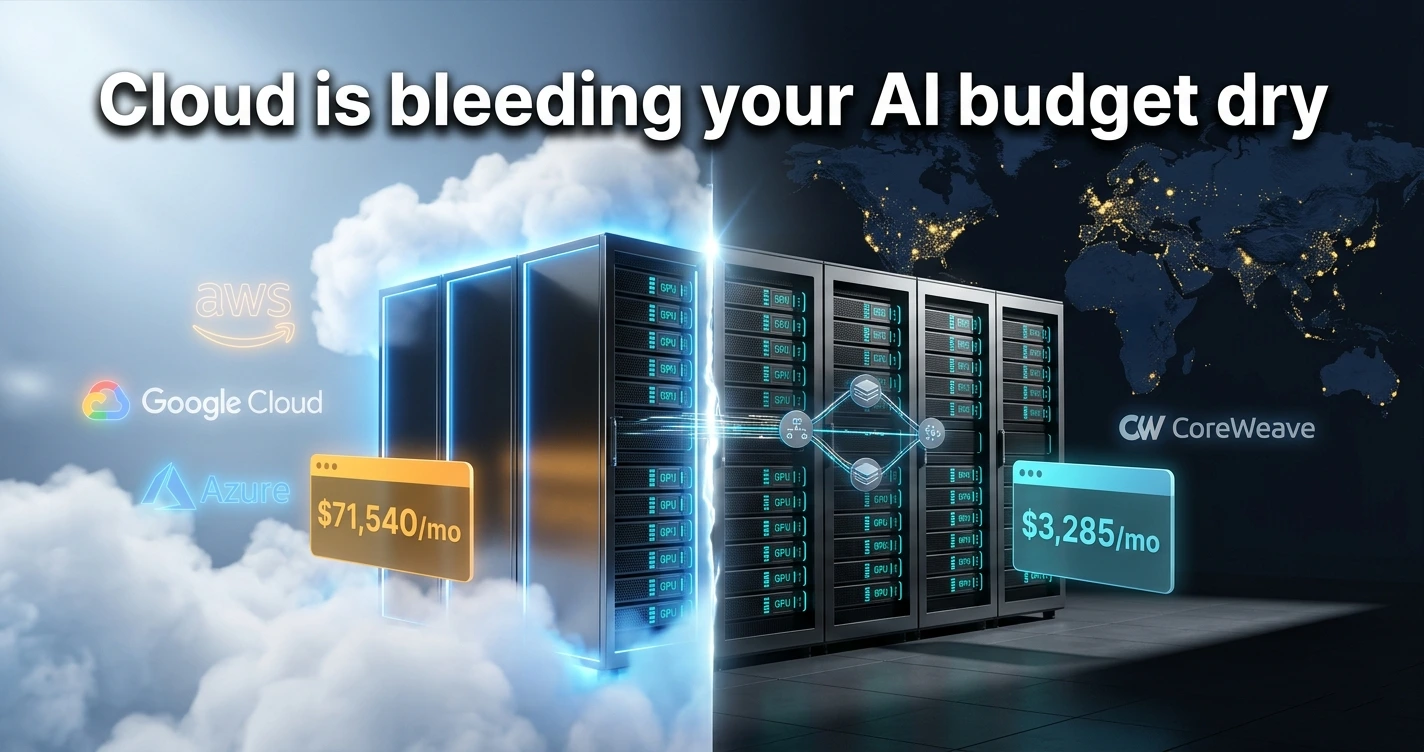
The numbers here are not theoretical. AWS p5.48xlarge instances (8 x H100 80GB) run at $98 per hour on-demand: $71,540 per month for continuous production inference. The equivalent CoreWeave H100 SXM5 reserved configuration costs approximately $4.50 per hour for a comparable setup. That’s a 95% cost differential on the same GPU hardware for sustained workloads. Cloud wins on flexibility. On-prem and specialist providers win on sustained cost.
The Utilization Threshold That Determines Everything
On-prem wins when GPU utilization stays above 40%. Below that threshold, idle hardware cost exceeds the cloud flexibility premium, and cloud is the more economical choice. Above 95% utilization, cloud burst capacity becomes necessary regardless of preference. The zone where hybrid generates maximum economic advantage is on-prem baseline maintained at 60 to 80% utilization, with cloud handling overflow and burst.
Cloud Provider Reference Points for AI Infrastructure Decisions
Provider
Market Position
AI Workload Fit
Notable Constraint
AWS
31% IaaS share, broadest portfolio
Training, experimental, burst inference
Highest on-demand GPU pricing in the market
Azure
25% share, fastest-growing
Enterprise AI, Microsoft Copilot integration
Strong for Microsoft-stack teams; less flexible for multi-framework
Google Cloud
12% share, now profitable
TensorFlow workloads, TPU-optimized jobs
TPU pricing advantage limited to specific frameworks
CoreWeave
Specialist GPU cloud
Sustained inference at competitive TCO
Narrower service breadth than hyperscalers
Oracle Cloud
52% YoY growth
Database-adjacent AI, ERP-integrated workloads
Ecosystem lock-in risk for Oracle-heavy shops
The Egress Trap Most CTOs Miss
Cloud costs aren’t just compute. Data movement across regions, clouds, or between on-prem and cloud adds egress and network charges that don’t appear in initial estimates. Moving 10TB per month at $0.09 per GB adds $900 monthly in pure data movement cost, before any compute runs. “Data gravity”, keeping compute near the data, is a cost discipline, not just a performance principle. Enterprises with large AI-hungry datasets in on-prem systems who push those datasets to cloud for training are often paying more in egress than they’d pay for the equivalent on-prem GPU capacity.
The 5-Step AI Workload Placement Framework
This is the framework enterprise AI infrastructure teams use to match every workload type to the right environment. Each step produces a concrete output that feeds directly into infrastructure budget decisions and board-level AI ROI reporting. For teams working through their broader AI infrastructure strategy, this framework is the operational core of that planning process.
Step 1: Assess and Classify Your AI Workload Portfolio
Catalog every AI workload in production or planning by type (training, fine-tuning, steady inference, burst inference), data sensitivity (public, internal, regulated, sovereign), latency requirement (real-time under 50ms, interactive under 500ms, batch over 1 second), and current and projected monthly compute volume. Don’t estimate. Pull actual metrics from your monitoring layer. Output: an AI Workload Inventory with environment-fit scoring for each workload.
Step 2: Apply Data Gravity Analysis
For each workload, the foundational question is: where does the data live? Move compute logic to the data, not the other way around. If training data lives in AWS S3, train in AWS. If inference data is generated on a factory floor, serve inference at the edge. Moving large datasets to compute is almost always more expensive and slower than moving model logic to where the data already sits. Output: a data gravity map per workload that identifies the environment with least data movement cost.
Step 3: Run a Per-Workload TCO Calculation
For each workload, calculate monthly cost under three scenarios: full public cloud on-demand, full on-prem or colocation, and hybrid split. Include compute cost, storage, egress, staffing overhead, and compliance cost in every scenario. The workload crosses from cloud to on-prem breakeven when monthly volume multiplied by cost-per-query exceeds on-prem amortized monthly cost divided by utilization rate. Output: a TCO comparison table per workload, feeding into your AI total cost of ownership model.
Step 4: Apply Compliance and Sovereignty Filters
After TCO, layer in regulatory constraints. Regulated healthcare inference must stay within defined jurisdictions. Financial AI subject to SOX or DORA cannot use certain cloud regions. EU-based workloads under GDPR must meet data residency requirements. Compliance constraints can override the TCO-optimal choice, and building this check into the decision model upfront is far cheaper than discovering the constraint after infrastructure is provisioned. Output: compliance-cleared workload placement decisions with jurisdiction documentation.
Step 5: Implement Unified FinOps Visibility Across All Environments
The greatest operational risk in hybrid AI infrastructure is cost blindness: scattered cost data across on-prem clusters, AWS accounts, and GCP projects with no unified view. Organizations using FinOps practices reduce cloud waste by 20 to 30% in the first year of implementation. For an enterprise spending $1.7M annually on AI cloud, that’s $340,000 to $510,000 in recoverable waste with no change to AI capability. Output: a unified AI infrastructure cost dashboard with per-workload attribution across every environment.
FinOps impact: $340,000 to $510,000 in annual waste recovery for a $1.7M AI cloud budget, from placement and visibility discipline alone, no vendor renegotiation required.
How to Calculate Per-Workload TCO: The Formula CTOs Use
Most on-prem TCO calculations forget power and staffing. Most cloud TCO calculations forget egress and managed service premiums. The result is a comparison that’s structurally biased toward whichever option the team started with, not whichever option is actually cheaper.
The correct total cloud cost formula includes: compute + storage + egress + managed service premium + engineering overhead for cloud-specific tooling. The correct on-prem cost formula includes: hardware amortization over 36 to 48 months + power + cooling + colocation or data center fees + staffing + maintenance + security infrastructure. Neither formula is simple, but skipping components on either side produces decisions that look defensible and cost real money.
The 3-Scenario Cost Model
Cost Component
Cloud On-Demand (AWS/GCP)
Specialist Cloud (CoreWeave Reserved)
On-Prem / Colo
GPU compute (2x H100, sustained)
$18,250 to $71,540/mo
$3,285 to $5,800/mo
$2,000 to $3,500/mo (amortized)
Storage (100TB)
$2,300/mo (S3)
$1,500/mo
$400 to $600/mo (NVMe)
Egress (10TB/mo)
$900/mo ($0.09/GB)
$400/mo
$0 (internal)
Staffing overhead delta
Low (managed services absorb ops)
Medium
High (+0.5 to 1 FTE)
Compliance / sovereignty control
Shared responsibility risk
Provider dependent
Full control
Best for
Burst training, dev/test, unpredictable volume
Sustained inference at competitive TCO
Always-on inference, regulated data
The Breakeven Decision Threshold
On-prem reaches TCO breakeven versus cloud on-demand at approximately 18 to 24 months for GPU-intensive sustained inference workloads. Below 18 months of committed usage, cloud is almost always more economical due to capex avoidance. Specialist cloud providers like CoreWeave with reserved GPU pricing can extend the cloud-competitive window by offering on-prem-competitive TCO without the capex commitment. That’s the middle path that’s becoming standard for teams that want cost discipline without capital expenditure risk.
Data Sovereignty and Compliance Constraints That Override Cost Decisions
According to the Nutanix Enterprise Cloud Index 2026, 80% of IT executives classify data sovereignty as “high priority or must-include” in infrastructure decisions. Yet only 18% of enterprises have formal data sovereignty policies that specifically cover AI workloads. That’s the governance gap creating regulatory exposure right now, and it’s a gap that data sovereignty governance frameworks are only beginning to close at the policy level.
Regulatory Constraints by Industry
Industry
Regulation
AI Workload Constraint
Environment Implication
Healthcare
HIPAA
PHI must stay within defined jurisdictions; inference under 50ms for real-time clinical tools
On-prem or domestic cloud mandatory
Financial services
SOX, DORA
Auditability and geographic controls on AI systems processing financial data
EU DORA requires contractual ICT risk standards from cloud providers
EU operations
GDPR, EU AI Act
Data residency for personal data; high-risk AI requires full technical documentation
Data residency enforcement; audit trails for high-risk systems
Government/federal
FedRAMP
AI workloads must use FedRAMP-authorized environments
Many commercial LLMs are not FedRAMP authorized
The Vendor Contract Gap Most CTOs Discover Too Late
The “Clear-Box” vendor policy standard requires that contracts explicitly prohibit model fine-tuning on corporate data and guarantee data residency. Opt-out settings in vendor dashboards are not governance: technical enforcement plus contractual obligation is the minimum standard. If your cloud AI vendor contract doesn’t specify data training exclusions, assume your data is in scope for model improvement. Fix the contract before deploying sensitive workloads, not after.
The Sovereign AI Pattern Emerging in 2026
Leading enterprises are combining local inference for sensitive workloads with public cloud capacity for generic, non-sensitive workloads. The pattern, bringing models to data instead of data to models, is gaining traction in Asia Pacific and regulated EU industries where data movement is legally constrained. It’s a practical response to a real constraint: regulated data can’t move, so inference infrastructure has to. Understanding the full scope of AI compliance requirements in your industry is a prerequisite for designing this architecture correctly.
“82% of enterprises say their current infrastructure is not fully ready to support on-premises AI workloads if required, yet regulatory trends are pushing more workloads toward sovereign or on-premises deployment.”
Ecosystm Emerging Economics of Enterprise AI, 2026
Real Enterprise Hybrid Patterns That Work in 2026
Enterprises using hybrid colocation architectures report up to 45% cost savings versus pure cloud, with 99.99% uptime for latency-sensitive workloads. That’s the ceiling of what the right pattern can deliver. These four patterns account for how most enterprise ML teams actually structure their hybrid deployments today.
Pattern 1: Train in Cloud, Serve On-Prem
The most common hybrid pattern. Training runs in cloud on spot or reserved instances for burst compute. The trained model is then deployed to on-prem infrastructure for production inference. This captures cloud’s elasticity for the training phase while capturing on-prem’s TCO advantage for the always-on inference phase. Best fit: enterprise ML teams with predictable inference volume and existing on-prem GPU capacity.
Pattern 2: Edge Inference Plus Cloud Burst
Factory floor cameras push real-time defect detection to edge devices. Model training and periodic retraining happen in cloud. New model versions ship to edge devices on a schedule. Cloud handles overflow when edge capacity is saturated. Best fit: manufacturing, retail, healthcare diagnostics, and any use case where inference must happen at the data source with latency under 50ms.
Pattern 3: Mixed Data Gravity
Marketing data lives in cloud naturally. ERP and operational data lives on-prem historically. Training runs in cloud using marketing data. Inference for operations stays on-prem, close to ERP data. A single MLOps layer unifies monitoring and governance across both environments. Best fit: enterprises with legacy on-prem data systems that can’t be fully migrated within a planning horizon, and for whom production AI reliability across mixed environments is a live concern.
Pattern 4: Sovereign AI With Generic Cloud
Sensitive inference runs on sovereign or on-prem infrastructure. Generic workloads, content generation, summarization, classification of public data, run on public cloud LLM APIs. Cost discipline means only paying for sovereign infrastructure when the workload genuinely requires it, not defaulting to on-prem for workloads that carry no data residency obligation. This is the pattern driving the fastest ROI for regulated enterprises adopting LLMs at scale.
Pre-Decision CTO Checklist: 14 Questions Before Committing to a Placement Model
Answer these before committing any infrastructure budget to a placement model. If you answer “don’t know” to more than three, your AI workload placement decisions are being made on assumptions. This checklist gives you the data model to answer every question with confidence, and the benchmarks to defend the decision to your CFO.
#
Question
Cloud Signal
On-Prem Signal
01
Is the workload burst or sustained?
Burst volume: favor cloud
Sustained, always-on: favor on-prem
02
Is GPU utilization target above 60%?
Below 60%: cloud wins on idle cost
Above 60%: on-prem reaches payback
03
Does the workload touch regulated data?
Non-regulated: cloud acceptable
Regulated: on-prem or colo mandatory
04
Where does the training/inference data live?
Match environment to data location. Data gravity rule applies regardless of other factors.
05
Is latency under 100ms required?
No hard latency requirement: cloud viable
Under 100ms: edge or on-prem required
06
Do we have staff to manage on-prem GPU clusters?
No GPU ops team: cloud lowers overhead
Existing GPU ops capacity: on-prem viable
07
Is the workload in production or experimental?
Experimental/dev: cloud for speed
Production at scale: evaluate on-prem
08
Will volume be predictable 12+ months out?
Unpredictable: cloud for flexibility
Predictable: on-prem or reserved cloud
09
Is data egress between environments above 10TB/mo?
Under 10TB: cloud egress cost manageable
Above 10TB/mo: on-prem eliminates egress
10
Are there geographic data residency requirements?
No residency obligation: cloud viable
Residency requirement: sovereign or on-prem mandatory
11
Is the deployment timeline under 3 months?
Under 3 months: cloud speed advantage
Longer timeline: evaluate on-prem
12
Do we have unified FinOps visibility across environments?
If no: implement before adding any environment. Cost blindness compounds in hybrid deployments.
13
Have we run a 3-scenario TCO model for this workload?
Mandatory before any commitment over $100K/year. Gut-feel TCO comparisons miss egress and staffing.
14
Is our vendor contract clear on data training exclusions?
If no: fix the contract before deploying sensitive workloads. Opt-out toggles are not contractual protection.
What to Watch
01
CoreWeave and specialist GPU cloud providers are aggressively pricing H100 and H200 reserved instances to compete directly with on-prem TCO. By Q3 2026, watch for reserved GPU pricing that eliminates the capex argument for on-prem sustained inference, forcing enterprises to reassess placement decisions made in 2024 and 2025.
02
The EU AI Act’s high-risk AI system requirements take full effect in August 2026, with documentation and audit trail obligations that will force many enterprises to repatriate inference workloads currently running in non-EU cloud regions. CISOs and compliance leads in EU-regulated industries should be running workload audits now, not after the deadline.
03
Unified AI FinOps platforms that normalize cost data across on-prem clusters, AWS, Azure, and GCP are entering their second product generation in 2026. The vendors reaching enterprise contract stage by Q4 2026 will define the standard toolset for hybrid AI cost governance, watch which platforms earn FedRAMP authorization first, as that will determine federal and regulated enterprise adoption.
Frequently Asked Questions
What is AI workload placement in hybrid cloud?
AI workload placement is the strategic decision of which computing environment, public cloud, private cloud, on-premises, or edge, each AI workload should run in, based on cost, performance, compliance, and data gravity factors. In a hybrid cloud model, organizations run different workload types in different environments simultaneously, optimizing for total cost of ownership rather than defaulting to a single environment. The goal is matching each workload to the environment where its specific characteristics (burst vs. sustained, regulated vs. generic, latency-sensitive vs. batch) generate the best cost-performance outcome.
When does on-premises AI infrastructure actually beat cloud?
On-premises wins for sustained, always-on inference workloads where GPU utilization stays above 60%, for regulated data that can’t leave defined jurisdictions, for latency-sensitive inference requiring under 100ms response times, and for high-egress workloads where data movement costs make cloud uneconomical. Cloud wins for burst training, experimental workloads, and teams without the staffing capacity to manage GPU clusters. The 18-to-24-month TCO breakeven threshold is the practical decision boundary: below that committed usage horizon, cloud avoids capex; above it, on-prem or colocation generates the better return.
How much can enterprises actually save with a hybrid AI cloud strategy?
Enterprises using hybrid colocation architectures report up to 45% cost savings versus pure cloud for sustained AI workloads, according to DataBank’s 2026 colocation report. Organizations implementing FinOps practices reduce cloud waste by 20 to 30% in the first year. For the average enterprise spending $1.7 million annually on AI cloud services, that represents $340,000 to $765,000 in recoverable annual savings from placement optimization and visibility discipline alone, before any workload repatriation or hardware investment.
What is data gravity in AI infrastructure and why does it matter?
Data gravity refers to the principle that large datasets attract compute to their location rather than the reverse. In AI workload placement, it means deploying training and inference compute in the same environment where the relevant data already lives. Moving large AI datasets across environments incurs significant egress costs and latency penalties. The practical rule: bring models to data rather than data to compute. For enterprises with on-prem ERP and operational data, this often means keeping inference local even when cloud might otherwise be the cost-optimal choice.
What is the TCO breakeven point for on-prem AI GPU infrastructure?
On-premises GPU infrastructure typically reaches TCO breakeven versus cloud on-demand pricing at 18 to 24 months for sustained, high-utilization inference workloads. Below 18 months of committed usage, cloud remains more economical due to capex avoidance. Specialist cloud providers like CoreWeave with reserved GPU pricing can extend the cloud-competitive window significantly, offering on-prem-competitive TCO without requiring capital expenditure. The breakeven calculation must include power, cooling, staffing, and maintenance on the on-prem side, teams that omit these systematically overestimate the on-prem advantage.
How do data sovereignty laws affect AI workload placement decisions?
Data sovereignty regulations can override TCO-optimal placement entirely. HIPAA requires healthcare AI to keep PHI within defined jurisdictions. EU GDPR mandates data residency for personal data, and the EU AI Act adds documentation requirements for high-risk AI systems. DORA requires contractual ICT risk standards from cloud providers serving EU financial firms. FedRAMP authorization is required for federal AI deployments, and many commercial LLMs don’t yet qualify. Compliance constraints should be applied as a filter before TCO analysis, not after, since they can eliminate entire environment categories from consideration.
What is the best cloud provider for enterprise AI workloads in 2026?
There’s no single best provider, the right choice depends on workload type, existing stack, and compliance requirements. AWS holds 31% IaaS market share with the broadest portfolio but the highest on-demand GPU pricing. Azure’s 25% share and Microsoft Copilot integration make it the natural choice for Microsoft-heavy enterprises. Google Cloud’s 12% share comes with the best TPU pricing for TensorFlow workloads. CoreWeave is the strongest competitor for sustained inference TCO without the capex of on-prem hardware. The most cost-effective approach for most enterprises is multi-environment: no single provider should run all workloads.
How do I start implementing FinOps for AI infrastructure across hybrid environments?
Start by establishing per-workload cost attribution in each environment separately before attempting cross-environment normalization. Most enterprises can’t implement unified FinOps because they don’t yet have workload-level cost tagging in any individual environment. Once cost tagging is consistent across cloud accounts and on-prem clusters, move to a normalization layer that applies a common cost unit (cost per inference, cost per training run) across all environments. The platforms that are maturing toward enterprise-grade hybrid AI FinOps in 2026 include Apptio, CloudHealth, and Spot.io. Organizations using FinOps practices reduce cloud waste by 20 to 30% in the first year of implementation.
Stay ahead of enterprise technology.
NeuralWired delivers weekly intelligence for CTOs, CISOs, and AI leads — no noise, no filler.
NVIDIA: The Full Story — From a $40,000 Bet to a $5 Trillion Empire | NeuralWired
Deep DiveUpdated May 2026 | NeuralWired Staff
NVIDIA: The Full, Unfiltered Story of How Jensen Huang Built a $5 Trillion Empire from a Diner Napkin and Three Near-Death Experiences
NVIDIA did not stumble into dominance. It was forged in catastrophe, sustained by a culture that treats failure as a design requirement, and steered by a CEO who once flew to Tokyo to confess he’d built the wrong product. Here is every secret, every bet, every pivot, and every milestone that made NVIDIA the most consequential company in modern computing history.
NVIDIA at a Glance: The Numbers That Demand Attention
Before the story, the scoreboard. As of fiscal year 2026, NVIDIA Corporation has become one of the most financially dominant companies ever assembled. It generates more revenue per employee than almost any other large firm on Earth.
$5.3T
Market Cap (May 2026)
$215.9B
FY2026 Annual Revenue
$120.1B
Net Income FY2026
75.2%
Gross Margin (Non-GAAP)
65.5%
Revenue Growth YoY
42,000
Employees Worldwide
$5.14M
Revenue Per Employee
~80%
AI Accelerator Market Share
Metric
Detail
Full Name
NVIDIA Corporation
Founded
April 5, 1993
Founders
Jensen Huang, Chris Malachowsky, Curtis Priem
Headquarters
Santa Clara, California, USA
CEO
Jensen Huang
Stock Ticker
NVDA (NASDAQ)
Core Business Units
Data Center, Gaming & AI PC, Professional Visualization, Automotive
Global Footprint
US, India, China, Taiwan, Europe, Asia-Pacific
Latest Annual Revenue
$215.9 Billion (FY2026)
Annual Net Income
$120.1 Billion
Cash Reserves
$62.6 Billion
R&D Spending (FY2026)
$23 Billion
Why this company matters beyond tech: NVIDIA’s GPU chips now power nearly every significant AI system on the planet, from the ChatGPT infrastructure at OpenAI to the autonomous vehicle research at virtually every major automaker. When NVIDIA ships late, the entire AI industry slows. That is not market dominance. That is infrastructure sovereignty.
Three Engineers, a Denny’s Booth, and $40,000
The origin story of NVIDIA sounds implausible only until you understand who Jensen Huang is. In 1993, Huang, Chris Malachowsky, and Curtis Priem were convinced of something nobody else took seriously: that the CPU, the universal workhorse of computing, was the wrong tool for graphics. It was too sequential. Too general. Three-dimensional worlds require millions of identical calculations done simultaneously, not one calculation done carefully. A specialized processor, purpose-built for parallel math, was the answer.
So they sat down at a Denny’s in San Jose, scribbled on whatever paper was available, and committed $40,000 of their own money to prove it. Sequoia Capital and Sutter Hill Ventures supplied a $20 million seed round shortly after, giving them enough runway to begin building the NV1. The market for 3D PC graphics in 1993 barely existed. The bet was almost purely speculative.
“NVIDIA is 30 days from going out of business at any given moment. We operate with that urgency every single day.”
Jensen Huang, CEO, NVIDIA — Lex Fridman Podcast #494
That sense of fragility isn’t theater. It traces directly to the company’s first three years, which were defined by failures that would have ended most startups before their second product.
The NV1 Was a Technical Triumph That Nobody Wanted
Released in 1995, the NV1 was genuinely impressive engineering. It integrated 2D graphics, 3D rendering, and audio into a single chip at a time when most cards handled one of those things. The problem was architectural. NVIDIA had built the NV1 around quadratic texture mapping, a technique that renders curved surfaces directly. Clean in theory. Mathematically elegant. Commercially dead.
Microsoft had already decided the industry’s future, and it wasn’t curves. The DirectX standard was coalescing around triangle-based primitives, a simpler, more hardware-friendly approach that every game developer and platform vendor was adopting. NVIDIA’s chip worked beautifully for a standard that was never coming. Not a single major game ran on it properly. No serious developer supported it. The NV1 was left on shelves.
The hidden lesson: The NV1 disaster burned into NVIDIA’s institutional memory a principle the company has never forgotten: technical excellence means nothing if you’re solving for the wrong standard. Every subsequent product decision has been filtered through this lens. Build for where the ecosystem is going, not where it is.
The company was burning cash with nothing to show for it. Huang ordered a brutal 60% staff reduction. With a skeleton crew and months of runway, he had to find a lifeline. He found it in the most unlikely of places: a gaming console project with a Japanese electronics giant that NVIDIA was also about to fail.
The Sega Confession: The $5 Million Act of Honesty That Saved the Company
In the wake of the NV1’s failure, NVIDIA had a contract with Sega to build the NV2, a graphics chip for the next Sega gaming console. The contract was worth $5 million, and at the time, that money was essentially the difference between NVIDIA surviving and going dark. But Huang had realized something catastrophic: the NV2 was also built on the wrong architecture. It lacked triangle-primitive support. It would fail commercially just like the NV1.
Rather than deliver a chip he knew was broken and hope Sega wouldn’t notice until the check had cleared, Huang boarded a plane to Tokyo. He sat down with Sega CEO Shoichiro Irimajiri and told him the truth: NVIDIA had chosen the wrong approach, the NV2 was a dead end, and Sega should find another partner. Then he asked Irimajiri to pay the full $5 million contract value anyway, because without it, NVIDIA would cease to exist.
“We had built the wrong chip. I flew to Japan and told them. I asked them to pay us anyway, because we needed the money to survive. Irimajiri respected that honesty.”
Jensen Huang, CEO, NVIDIA — as described in multiple leadership retrospectives and Sequoia Capital’s company profile
Irimajiri paid. Every dollar of it. He valued Huang’s intellectual honesty more than the failed silicon. That $5 million kept NVIDIA operational through the development of the RIVA 128, the first product that actually worked. This moment of radical transparency became foundational to NVIDIA’s culture and is still cited internally as the origin of what Huang calls “first principles” leadership: say the true thing, even when it costs you.
The RIVA 128: NVIDIA’s First Real Product
With the Sega lifeline and a new architectural direction, NVIDIA’s engineers threw out everything they’d built before and started fresh. The RIVA 128 (internally designated NV3) was designed entirely around Microsoft’s DirectX standard and triangle-based rendering. No proprietary quirks. No clever detours. Just a fast, compatible, affordable GPU that worked with the software ecosystem developers were actually building for.
It shipped in 1997. It sold one million units in four months. For a company that had never shipped a commercially successful product, this was not just validation. It was survival. The RIVA 128’s revenue funded the 1999 IPO and gave NVIDIA the capital to attempt something far more ambitious: inventing a new category of processor entirely.
The pattern that repeats: The RIVA 128 established what would become NVIDIA’s defining playbook. Fail fast on the wrong approach, pivot without ego, build for the dominant standard, ship quickly. This pattern recurs across every major turning point in NVIDIA’s history, from CUDA to the Blackwell architecture.
1999: Jensen Huang and the Team That Invented the GPU
In 1999, NVIDIA launched the GeForce 256 and coined a term that would reshape computing: the GPU, or Graphics Processing Unit. The name was a marketing move, but the underlying engineering was a genuine leap. For the first time, a graphics chip handled transform and lighting calculations that had previously required CPU time. It offloaded a significant, mathematically intensive class of operations from the system processor entirely.
This was not incremental. It was a new category of computing hardware. The CPU and GPU would no longer compete for the same workloads; they’d divide labor. The CPU handled logic, branching, and sequential tasks. The GPU handled massive, repetitive parallel math. The distinction that Huang, Malachowsky, and Priem had sketched on that Denny’s napkin six years earlier had become a product.
NVIDIA went public on NASDAQ at $12 per share that same year. The IPO was modest by the standards of the dot-com bubble era. Nobody could have predicted that the GeForce 256 was not just a better graphics card but the first piece of infrastructure for an artificial intelligence industry that would take another 13 years to arrive.
🖥️
GeForce 256 (1999)
The world’s first GPU. Offloaded transform and lighting from the CPU. Coined the term that defined the industry.
📈
NASDAQ IPO (1999)
Debuted at $12 per share. The proceeds funded the R&D engine that would produce CUDA seven years later.
🎮
Xbox Partnership (2000)
Microsoft selected NVIDIA to supply the GPU for the original Xbox, cementing its position as the graphics standard.
🏆
3dfx Acquisition (2000)
Acquired assets from its biggest competitor for $70M. Consolidated the graphics market in a single move.
2006: Jensen Huang’s Billion-Dollar Bet That Investors Hated
By 2006, NVIDIA was profitable, growing, and completely dependent on gaming. Jensen Huang wanted to change that. His conviction: the GPU’s ability to run thousands of parallel threads simultaneously wasn’t just useful for rendering pixels. It was a general-purpose superpower. Any scientific or mathematical problem that could be decomposed into parallel operations, which included almost everything in physics simulation, weather forecasting, drug discovery, and eventually machine learning, could be solved faster on a GPU than a CPU.
So NVIDIA built CUDA. Compute Unified Device Architecture. It’s a software framework that lets programmers write standard C++ code that runs directly on GPU hardware. No graphics expertise required. No arcane shader languages. Just the ability to describe a parallel problem and let the GPU rip through it.
Why Investors Were Furious
CUDA required adding logic circuits to every NVIDIA GPU manufactured, increasing die size, power consumption, and cost. At the time, there was no commercial software that used GPGPU (general-purpose GPU computing). The research community was interested. Nobody was paying. Investors saw NVIDIA adding manufacturing cost to every chip it sold in pursuit of a theoretical future market that might never materialize.
Huang held the line. He mandated CUDA across the entire product line, not as an optional feature but as a foundation. NVIDIA would build the platform and trust that if the tools were good enough, developers would find uses for them. They did. It just took six years.
The CUDA moat, quantified: By 2026, CUDA is used by nearly 6 million developers globally. It contains millions of lines of hand-tuned kernel code for specific scientific and AI applications, accumulated across two decades. The domain libraries built on top of it (cuDNN for deep learning, cuBLAS for linear algebra, NCCL for multi-GPU communication) are woven into every major AI framework in existence. Competitors haven’t just been unable to match CUDA’s raw capability. They’ve been unable to replace 20 years of institutional scientific knowledge encoded in its libraries.
2012: AlexNet Proved Jensen Huang Right About Everything
On October 25, 2012, a paper titled “ImageNet Classification with Deep Convolutional Neural Networks” was published by Alex Krizhevsky, Ilya Sutskever, and Geoffrey Hinton. It described a deep learning model, later called AlexNet, that had won the ImageNet visual recognition competition by a margin so large it wasn’t just better. It made every competing approach look obsolete. AlexNet was trained on two NVIDIA GTX 580 GPUs. It couldn’t have been trained on CPUs in any practical timeframe.
The AI research community noticed immediately. Within months, every serious deep learning lab was buying NVIDIA GPUs and writing CUDA code. The libraries were already there. The developer community was already there. The hardware was already there. Jensen Huang had built the infrastructure for a revolution six years before the revolution arrived, and he’d done it on faith that parallel computing would matter before anyone could prove it would.
“The AlexNet moment was the moment NVIDIA stopped being a graphics company in the minds of anyone paying attention. Overnight, the GPU became the engine of AI. Everything that followed was inevitable from that day.”
Ben Thompson, Analyst — Stratechery, NVIDIA CEO Interview on Accelerated Computing
NVIDIA’s market cap in 2012 was approximately $7 billion. The road from there to $5 trillion took 13 years and was built entirely on the bet Huang made in 2006 that almost no one understood.
2020: The $7 Billion Acquisition That Turned NVIDIA Into an Infrastructure Company
By 2019, Jensen Huang understood something that most of the market had not yet articulated: the next constraint in AI training wasn’t raw GPU compute. It was the speed at which GPUs could talk to each other. Training a large language model requires not one GPU but thousands, all passing data back and forth constantly. If the network connecting them is slow, even the fastest individual chips become a bottleneck.
Mellanox Technologies was the world leader in high-speed networking for data centers, specifically InfiniBand interconnects that could move data between servers at extraordinary speed with minimal latency. NVIDIA outbid Intel and others to acquire Mellanox for $7 billion, its largest acquisition to that point. The deal closed in April 2020.
What This Actually Meant
Before Mellanox, NVIDIA sold chips. After Mellanox, NVIDIA sold systems. The company could now design not just the GPU itself but the fabric that connected thousands of GPUs into a single logical compute unit. NVLink, NVIDIA’s proprietary chip-to-chip interconnect, combined with InfiniBand at the rack and data center scale, meant that a cluster of NVIDIA GPUs could behave as one giant processor with a shared memory pool spanning thousands of physical chips.
No competitor could replicate this. AMD could build a fast GPU. It couldn’t build the network. Intel could build a network. It couldn’t build a competitive GPU at scale. NVIDIA was now the only company that could sell both halves of the system, and by designing them together, it achieved performance levels that a mixed-vendor setup simply couldn’t reach.
Before Mellanox
After Mellanox
Sold individual GPUs
Sells complete AI factory racks
Competed on raw FLOPS
Competes on system-level throughput
Networking was a commodity
NVLink delivers 1.8 TB/s per GPU
Customers bought GPUs from NVIDIA, networking from others
Customers buy the entire stack from NVIDIA
Networking revenue: near zero
Networking revenue (FY2026): $31B+
2022: The $40 Billion Deal That Collapsed, and Why It Made NVIDIA Stronger
In September 2020, NVIDIA announced it would acquire Arm Limited, the British chip architecture company whose processor designs power virtually every smartphone on the planet, for $40 billion. It was the largest semiconductor acquisition ever attempted. Regulators in the United States, United Kingdom, European Union, and China all opened investigations. The concern was straightforward: a company that already dominated AI chips would gain control over the architecture that nearly every other chip company licenses.
By February 2022, NVIDIA walked away. The deal was declared dead. NVIDIA paid a $1.25 billion breakup fee to Arm’s then-owner SoftBank. To most observers, it looked like a strategic failure. It wasn’t.
Plan B Was Already Running
While the Arm deal was under regulatory review, NVIDIA’s engineers had been quietly building the Grace CPU, a proprietary processor designed in-house based on the Arm architecture (which Arm licenses broadly, separate from whether NVIDIA owned the company). Grace was designed specifically to pair with NVIDIA’s GPUs, solving the CPU-GPU bandwidth problem that had been a growing constraint in AI systems.
When the acquisition collapsed, Grace was ready. NVIDIA hadn’t needed to own Arm after all. It had used the two years of regulatory waiting to build the alternative. The Grace-Hopper Superchip, combining the Grace CPU with a Hopper GPU in a single package, launched in 2023 and became the foundation of the NVL72 rack system that major cloud providers deployed at scale through 2024 and 2025.
The irony on top: In 2005, Intel reportedly had the opportunity to acquire NVIDIA for approximately $20 billion. Intel’s board passed. By 2025, NVIDIA was investing $5 billion into Intel to help keep the American chip manufacturing ecosystem solvent. The power relationship had completely inverted.
The Blackwell Architecture: 208 Billion Transistors and the Fastest Product Ramp in Semiconductor History
In March 2024, Jensen Huang unveiled the Blackwell architecture at GTC. The B200 GPU contained 208 billion transistors, manufactured using a dual-reticle approach that joined two chips at the package level to exceed what any single die could physically hold on a wafer. TSMC’s 4NP process node. A Transformer Engine redesigned specifically for the attention mechanisms that power large language models. Up to 30x faster inference per chip compared to H100.
The manufacturing complexity was extraordinary. A single defect among 208 billion transistors, each roughly 10,000 times smaller than a human hair, could render a chip inoperable. NVIDIA had committed its entire 2025 revenue trajectory to this design. There was no hedge, no backup product to ship if Blackwell failed in volume production.
The Fastest Product Ramp in Chip History
It didn’t fail. Blackwell production ramped faster than any previous GPU generation. Within the first full year of production, Blackwell chips were generating billions per quarter. Cloud providers, including Microsoft Azure, Google Cloud, Amazon Web Services, and Meta’s AI infrastructure teams, could not take delivery fast enough. NVIDIA’s data center revenue for fiscal year 2026 reached $193.7 billion, up 68% year over year, driven almost entirely by Blackwell demand.
“The ramp of Blackwell has been incredible. The demand signal from our customers is unlike anything we’ve seen before. We believe we’re at the beginning of a multi-year infrastructure buildout.”
Jensen Huang, CEO, NVIDIA — NVIDIA Q4 FY2026 Earnings Call
The NVL72 rack, NVIDIA’s complete Blackwell system, packs 72 GPUs connected by NVLink into a single logical unit. It draws approximately 120 kilowatts of power. It requires liquid cooling. It delivers compute performance that would have ranked among the world’s top supercomputers just a decade ago. Cloud providers were buying them by the thousand.
The China Export Crisis: $4.5 Billion Gone in a Day
On April 9, 2025, the US government revoked the license-free status of NVIDIA’s H20 chip for sale in China. The H20 had been specifically engineered to comply with previous export control thresholds, a version of the H100 with deliberately reduced interconnect bandwidth and computing specifications to fall under restrictions. NVIDIA had invested hundreds of millions designing the product and had accumulated significant inventory and supply commitments based on expected Chinese demand.
When the rules changed, all of that became stranded. NVIDIA disclosed a charge of between $4.5 billion and $5.5 billion in Q1 FY2026 to cover the inventory write-down and purchase obligation costs. China had historically represented close to 13% of NVIDIA’s total revenue. The export restrictions, which have progressively tightened since 2022 and now cover China, Hong Kong, and Macau, have effectively eliminated a major customer base.
What’s different about NVIDIA’s China exposure vs. other chipmakers: NVIDIA’s response to the H20 charge was to absorb it without lowering annual guidance. The data center segment was growing fast enough that even a multi-billion dollar write-down in a single quarter didn’t dent the annual trajectory. A $5 billion charge that a company shrugs off because other revenue is growing 68% is a signal of the underlying financial strength more than the risk itself.
The geopolitical pressure isn’t limited to China. Antitrust investigations in France and China are examining whether NVIDIA’s market position in AI chips constitutes anti-competitive behavior. The EU is watching. The US FTC has signaled continued interest in semiconductor consolidation. Regulatory scrutiny is now a permanent feature of operating at $5 trillion scale.
Jensen Huang’s $5 Billion Investment in Intel: The Irony Is Extraordinary
In 2025, NVIDIA announced a $5 billion investment in Intel Corporation. The stated rationale was straightforward: NVIDIA has a strategic interest in a healthy domestic US semiconductor manufacturing base. Intel operates foundry capacity on American soil. If Intel’s foundry business struggles or collapses, NVIDIA and the broader US AI infrastructure industry becomes more dependent on TSMC in Taiwan, a geopolitical exposure the US government is actively trying to reduce.
But the context makes this moment genuinely astonishing. In 2005, Intel’s board reportedly had the opportunity to acquire NVIDIA for approximately $20 billion. They passed, judging graphics chips a commodity business beneath their strategic priorities. Twenty years later, the company Intel chose not to buy is investing billions to keep Intel viable. The power dynamic between the two companies has inverted so completely that it reads as a kind of corporate poetic justice.
The OpenAI Investment: Securing the Demand Side
In the same year, NVIDIA participated in OpenAI’s largest-ever funding round, committing approximately $30 billion. The logic here is different: NVIDIA wanted to ensure that the most influential AI research organization in the world remained deeply invested in optimizing its systems for NVIDIA hardware. OpenAI’s models run on NVIDIA chips. If OpenAI succeeds, NVIDIA sells more chips. The investment aligns incentives and strengthens a relationship that’s already commercially critical.
The Financial Engine: How NVIDIA Generates $120 Billion in Net Income
NVIDIA’s financial profile is unlike any hardware company in history. Hardware companies typically operate on thin margins because they compete on price and face commoditization over time. NVIDIA’s gross margin of 75.2% (non-GAAP, FY2026) is a software-company number, achieved through a hardware-centric business. The reason is the full-stack strategy: NVIDIA doesn’t sell chips, it sells systems, and the system includes software that customers cannot get anywhere else.
Revenue Segment
FY2026 Revenue
YoY Growth
% of Total
Data Center
$193.7 Billion
+68%
~90%
Gaming & AI PC
$16.0 Billion
+41%
~7%
Professional Visualization
$3.2 Billion
+70%
~1.5%
Automotive
$2.3 Billion
+39%
~1%
Total
$215.9 Billion
+65.5%
100%
The Data Center: 90% of Everything
Fiscal year 2026’s data center number of $193.7 billion is not a segment. It’s an industrial transformation. Three years earlier, NVIDIA’s total annual revenue was approximately $16 billion. The data center segment alone now generates more than 12 times that. Hyperscale cloud providers (Microsoft, Amazon, Google, Meta) are the primary customers, and two of them represent 36% of NVIDIA’s total revenue, a concentration that creates both a strength and a vulnerability.
The Emerging Software Layer
The vast majority of NVIDIA’s revenue remains hardware-driven, but the company is aggressively building a recurring revenue layer through NVIDIA Inference Microservices, or NIMs. These are containerized AI models that customers can deploy in their own infrastructure and pay for on a subscription basis. NIMs reduce the model deployment complexity dramatically. They also create a revenue stream that continues after the hardware sale closes, which is how NVIDIA begins insulating itself from the inherent cyclicality of chip demand.
NVIDIA vs. Everyone Else: Why the Gap Is Wider Than the Numbers Suggest
The raw market share numbers give NVIDIA approximately 80% of AI accelerator revenue. But raw share understates the actual competitive distance, because NVIDIA’s lead is not just in chip performance. It’s in ecosystem depth, software maturity, and system-level integration. A competitor matching NVIDIA’s chip specifications on a datasheet is nowhere close to matching what a customer actually receives when they deploy NVIDIA infrastructure.
Competitor
Est. Market Share
Key Product
Where They Compete
Key Weakness
NVIDIA
~80%
Blackwell B200 / Vera Rubin
Full-stack AI infrastructure
Supply chain concentration at TSMC
AMD
~5-7%
Instinct MI350X
Cost-sensitive cloud workloads
ROCm software at ~45% utilization vs. CUDA’s 93%
Broadcom
~10-12%
Custom ASICs
Hyperscaler custom silicon
Requires enormous customer R&D commitment
Google
~5-7%
TPU v5/v6
Internal Google Cloud workloads
Not commercially available at scale
Intel
~1-2%
Gaudi 3 / Falcon Shores
Budget AI inference
Rebuilding from near-collapse; Gaudi adoption minimal
The Interconnect Gap Nobody Talks About
AMD’s MI350X GPU matches or exceeds the Blackwell B200 in raw memory capacity, offering 288GB of HBM3E memory. On paper, the specs look competitive. In practice, a cluster of AMD GPUs cannot share data with each other at the speed an NVIDIA cluster can. NVLink 6.0 delivers 1.8 terabytes per second of bandwidth per GPU. AMD’s equivalent, using standard PCIe interconnects, delivers roughly 128 gigabytes per second. That is a 14x bandwidth difference between chips trying to communicate. For large language model training, where constant, massive data exchange between GPUs is the actual bottleneck, that gap makes the AMD cluster dramatically slower than the specification sheet suggests.
The Utilization Gap
NVIDIA GPUs running CUDA-based AI workloads achieve approximately 93% of their theoretical peak compute (FLOPS). AMD GPUs running equivalent workloads via ROCm, AMD’s CUDA alternative, often achieve 45% utilization or lower due to software overhead and clock throttling. A chip with half the utilization rate is effectively half as fast for real workloads, regardless of what the datasheet says. This gap is a software problem, and software gaps take years to close even with aggressive investment.
NVIDIA’s Full-Stack Strategy: Why They Sell Factories, Not Chips
Jensen Huang has articulated NVIDIA’s strategic position in strikingly direct terms: competitors build chips; NVIDIA builds AI factories. The distinction is not marketing language. It describes a fundamentally different value proposition. A chip manufacturer sells a component that a customer must then integrate with networking, cooling, power distribution, software, and management tools from various other vendors. NVIDIA sells a complete system where all of those elements are designed together, tested together, and shipped as a unit.
The NVL72: A Single Logical Processor Spanning 72 Physical Chips
The NVL72 rack is the physical embodiment of this strategy. Seventy-two Blackwell GPUs, connected by NVLink 6.0, behave as a single processor with a unified memory space spanning the entire rack. NVIDIA designs the rack tray, the cooling system, the power distribution, and the management software. Cloud providers can take delivery and deploy the NVL72 as a single infrastructure unit without needing to source any components from anyone else. This simplicity is itself a competitive advantage, because simpler deployment means faster time-to-production, which means faster ROI for the customer.
CUDA: 20 Years of Scientific Knowledge That Cannot Be Copied
CUDA is not software that a competitor could rewrite in five years. It is an accumulation of domain-specific knowledge encoded in millions of lines of hand-optimized code, contributed by researchers, engineers, and scientists across two decades. The cuDNN library for deep learning contains neural network operations tuned specifically for every NVIDIA GPU microarchitecture ever released. cuBLAS contains linear algebra routines optimized at the assembly level. NCCL handles multi-GPU communication patterns that are specific to the NVLink topology.
Replacing CUDA means not just writing a compiler. It means reconstructing the history of applied computer science research as encoded by everyone who has ever optimized a deep learning kernel on NVIDIA hardware. That knowledge doesn’t transfer to a new platform simply because the new platform ships a compatibility layer.
Jensen Huang’s Operating System: How NVIDIA Runs at This Speed
NVIDIA’s internal culture is deliberately uncomfortable. Jensen Huang talks openly about what he calls the “suffering culture,” the idea that people bond through shared difficulty in ways they never do during comfortable periods. This isn’t motivational rhetoric. It’s a design principle. NVIDIA hires people who find genuinely hard problems energizing rather than exhausting, then puts them in situations where the problems are as hard as they can be.
No Status Reports
NVIDIA runs without the traditional management layers that most corporations of its size carry. There are no formal status meetings. No weekly check-in rituals. Instead, Huang maintains direct contact with a famously large number of direct reports, reportedly more than 40, and expects managers at every level to operate with similar directness. The rationale: status reports smooth over the sharp edges of reality. Huang wants sharp edges visible, not smoothed.
First Principles Over Precedent
Every major NVIDIA decision begins with the same question: what is actually true here, stripped of assumptions? This produced the CUDA bet when no revenue existed to justify it. It produced the decision to exit mobile in 2014 when mobile was the fastest-growing sector in tech. It produced the Mellanox acquisition when most saw NVIDIA as a chip company with no business in networking. Each decision ignored what the industry consensus said NVIDIA should do and asked what the physics and economics of computing actually required.
The Failure Analysis Lab: 72-Hour Turnaround on Chip Failures
NVIDIA’s failure analysis capability is an often-overlooked competitive advantage. The lab uses nanoprobing, scanning electron microscopy, and laser voltage imaging to physically isolate a single failed transistor among tens of billions. Engineers thin chips to five microns, making them translucent, then use specialized light-based imaging to see inside the circuitry and identify root failure causes. The turnaround from chip failure to root cause identification is often 72 hours. For a company operating on an annual product cadence, the speed of diagnosis directly determines how quickly manufacturing issues can be resolved and whether quarterly shipment targets can be met.
Hiring: Grit Over Credentials
NVIDIA screens specifically for what it calls “grit.” Technical depth is a baseline requirement, and the company targets candidates with advanced expertise in CUDA, C++, Python, and GPU microarchitecture. But the more differentiating screen is behavioral: can this person demonstrate specific examples of persisting through technical failure without losing direction? Median employee tenure exceeds five years, remarkable for Silicon Valley, and is attributed directly to the bonding that occurs when teams solve problems at the edge of what’s currently possible.
NVIDIA’s Future: Rubin, Feynman, and the End of Centralized AI
NVIDIA’s product roadmap through 2028 is the most aggressive in semiconductor history. The company has committed to annual architectural refreshes for data center products, a cadence that requires its primary manufacturing partner TSMC to hold leading-edge capacity almost exclusively for NVIDIA’s most demanding designs.
Vera CPU integration, HBM4 memory, 336B transistors
TSMC 3nm
~300kW per rack
Rubin Ultra
2027
600kW “Kyber” rack, 15 EFLOPS FP4 performance
TSMC 3nm+
600kW per rack
Feynman
2028
Silicon photonics, 3D chip stacking
TSMC A16 (1.6nm)
TBD
The 600kW Problem: NVIDIA as a Power Engineering Company
The Rubin Ultra Kyber rack, arriving in 2027, draws 600 kilowatts of power per rack. To put this in context: a typical 2015-era data center rack drew roughly 5 to 10 kilowatts. The infrastructure required to support these systems, power delivery, liquid cooling, thermal management, physical structural support for the weight, represents a complete reinvention of how data centers are built and operated. NVIDIA is now as much a power engineering firm as a chip designer, developing reference architectures for facilities teams to deploy this density safely and at speed.
Vera Rubin: The 2026 Architecture Already Shipping
Vera Rubin, NVIDIA’s 2026 data center GPU architecture, ships this year. The “Vera” CPU is NVIDIA’s second-generation in-house ARM-based processor, designed specifically to pair with the Rubin GPU die in the same package. HBM4 memory offers higher bandwidth than HBM3E. At 336 billion transistors, Rubin exceeds Blackwell’s already-unprecedented transistor count. The annual cadence means Blackwell, the product that represented the fastest ramp in chip history, is already being superseded within 18 months of launch.
Feynman: Silicon Photonics Changes Everything
The Feynman architecture, scheduled for 2028, represents the most significant technical departure in NVIDIA’s roadmap. Silicon photonics replaces electrical signals with light for certain data transfer functions, dramatically reducing the energy cost of moving data between chips. Combined with 3D stacking techniques on TSMC’s A16 node, Feynman is designed to address the fundamental physics constraints that limit how fast electrical interconnects can move data at scale. If it ships as designed, it will represent NVIDIA’s leap beyond what any current competitor is even attempting to prototype.
Agentic AI and Physical AI: The Next Growth Vectors
NVIDIA’s strategic framing for the late 2020s centers on two transitions. The first is from centralized AI (cloud-based models responding to queries) to agentic AI (autonomous software agents that use tools like spreadsheets, databases, and enterprise software to execute complex multi-step tasks independently). NVIDIA’s NemoClaw platform is designed to be the infrastructure layer for deploying these agents at enterprise scale.
The second transition is from digital AI to physical AI: machine learning systems that operate in and manipulate the physical world. The Isaac GR00T foundation model powers humanoid robots and autonomous manufacturing lines. NVIDIA’s Omniverse simulation platform lets companies build digital twins of physical facilities and train AI systems in simulation before deploying them on real hardware. Automotive revenue, while currently only $2.3 billion, is growing 39% annually as autonomous driving platforms adopt NVIDIA’s DRIVE architecture.
The Risks NVIDIA Cannot Ignore
At $5 trillion in market capitalization, NVIDIA has become a company where its problems are also the tech industry’s problems. Several risks are material enough to warrant close attention from anyone watching this company.
🏭
TSMC Dependency
NVIDIA designs chips but manufactures nothing. Every product ships from TSMC fabs in Taiwan. Any disruption, geopolitical or natural, is an existential supply chain event. CoWoS advanced packaging capacity is sold out through 2026.
👥
Customer Concentration
Two hyperscale customers represent 36% of total revenue. If Microsoft and Meta simultaneously enter a “digestion period” where they pause spending, NVIDIA’s quarterly numbers could contract sharply.
🌍
Geopolitical Export Risk
China export restrictions have already cost $4.5B+ in a single quarter. Further tightening could affect other markets. Regulatory investigations in France, China, and the EU are ongoing.
⚡
Power Grid Constraints
The Rubin Ultra rack draws 600 kilowatts each. The bottleneck for AI adoption is shifting from chip availability to power grid capacity. Data centers cannot deploy faster than utilities can supply power.
The Custom Silicon Threat
Broadcom’s custom ASIC business represents a genuinely different risk profile than AMD’s merchant GPU competition. Hyperscalers with sufficient scale, primarily Google, Meta, Amazon, and Microsoft, have the engineering resources to design custom chips optimized specifically for their workloads. These chips can achieve better efficiency on specific tasks than a general-purpose GPU. The risk for NVIDIA is not that custom silicon becomes better at everything, but that it becomes good enough for a large subset of inference workloads, reducing the hyperscaler’s dependence on NVIDIA for those use cases.
Frequently Asked Questions About NVIDIA
What is NVIDIA’s primary business in 2026?
NVIDIA’s primary business is data center AI infrastructure. The data center segment generated $193.7 billion in fiscal year 2026, representing approximately 90% of total company revenue. This includes GPU accelerators (Blackwell, Vera Rubin), high-speed networking (InfiniBand, Spectrum-X Ethernet), and an emerging software subscription layer via NVIDIA Inference Microservices (NIMs).
What is CUDA and why does it matter so much?
CUDA (Compute Unified Device Architecture) is NVIDIA’s proprietary parallel computing platform, introduced in 2006. It allows developers to write code that runs on NVIDIA GPUs using standard programming languages. By 2026, CUDA is used by nearly 6 million developers and is embedded in every major AI framework (PyTorch, TensorFlow, JAX). Its domain-specific libraries (cuDNN, cuBLAS, NCCL) represent two decades of accumulated scientific knowledge that competitors cannot replicate simply by building a faster chip.
What is “Huang’s Law”?
Huang’s Law is the observation, named after Jensen Huang, that GPU performance has been growing at a rate substantially faster than Moore’s Law, approximately tripling every two years rather than doubling. This acceleration comes from three combined sources: hardware improvements (transistor density, new architectures), software optimization (better algorithms and compilers), and AI-driven design tools that improve efficiency faster than traditional engineering methods alone would achieve.
Why did NVIDIA’s Arm acquisition fail?
The $40 billion Arm acquisition, announced in September 2020, was blocked by regulators in the United States, United Kingdom, European Union, and China. The primary concern was vertical integration risk: allowing the dominant AI chip company to own the architecture licensed by virtually all competing chip designers would give NVIDIA leverage over its entire competitive landscape. NVIDIA paid a $1.25 billion breakup fee when the deal collapsed in February 2022 and subsequently developed the Grace CPU in-house based on Arm’s licensed architecture.
What is Sovereign AI?
Sovereign AI refers to AI infrastructure that is owned and operated by national governments to ensure that a country’s AI capabilities, and the data that powers them, remain within national control. NVIDIA has become a primary supplier of this infrastructure, selling AI factory systems to governments in the UK, France, Singapore, Canada, Japan, and elsewhere. These nations want the ability to develop and run AI models trained on their own national data without routing workloads through US-owned cloud providers.
Is NVIDIA a good investment in 2026?
This is a financial decision that warrants consultation with a qualified financial advisor. What can be stated factually: NVIDIA’s forward P/E in mid-2026 remains lower than historical norms relative to its earnings growth rate, and analysts tracking the company note approximately $1 trillion in expected AI hardware demand through 2027. The primary risks are customer concentration (two clients = 36% of revenue), TSMC supply chain dependency, ongoing China export restrictions, and the possibility that hyperscalers reduce GPU purchases in favor of custom silicon for inference workloads.
What is the Vera Rubin architecture?
Vera Rubin is NVIDIA’s 2026 data center GPU architecture, the direct successor to Blackwell. It features 336 billion transistors, NVIDIA’s second-generation Grace CPU (named “Vera”) integrated in the same package, and HBM4 memory for higher bandwidth. It is manufactured on TSMC’s 3nm process node and begins shipping in 2026, continuing NVIDIA’s commitment to an annual product cadence. The Vera CPU name honors astronomer Vera Rubin; NVIDIA names GPU generations after famous scientists.
What happened with the NVIDIA H20 chip and China?
The H20 was a version of NVIDIA’s H100 GPU specifically engineered to comply with US export control thresholds for sale in China, with deliberately reduced interconnect bandwidth and compute capabilities. On April 9, 2025, the US government revoked the H20’s license-free export status, effectively banning its sale to China, Hong Kong, and Macau. NVIDIA disclosed a charge of $4.5 billion to $5.5 billion in Q1 FY2026 to cover excess inventory and purchase obligations that had been built up in anticipation of continued Chinese demand.
What is Project GR00T?
Project GR00T is NVIDIA’s foundation model for humanoid robots. It is designed to give general-purpose robots the ability to learn physical manipulation tasks by observing human demonstrations and through simulation training in NVIDIA’s Omniverse platform. GR00T underpins NVIDIA’s broader “Physical AI” strategy, which encompasses humanoid robots, autonomous manufacturing lines, and intelligent logistics systems. It represents NVIDIA’s bet that the next wave of AI demand will come from machines operating in the physical world, not just digital systems responding to text queries.
What to Watch: NVIDIA in 2026 and Beyond
01Vera Rubin production ramp: Whether NVIDIA can sustain its annual cadence while transitioning Blackwell customers to Rubin without a revenue gap will define the 2026 financial story.
02Hyperscaler digestion risk: If Microsoft, Meta, or Amazon pause or slow their GPU purchases to absorb existing infrastructure, NVIDIA’s quarterly revenue could contract sharply from record levels.
03Custom silicon competitive pressure: Broadcom’s ASIC business and hyperscaler in-house chips (Google TPU, Amazon Trainium) are improving. Watch for shifts in hyperscaler inference workload allocation.
04Feynman silicon photonics execution: The 2028 Feynman architecture’s optical interconnect ambitions represent the riskiest technical bet in NVIDIA’s current roadmap. Successful delivery would extend the lead by years.
05Regulatory environment: Antitrust probes in France and China, plus ongoing US export control evolution, represent the most unpredictable external variable in NVIDIA’s operating environment.
The Only Company That Predicted the Future Twice
Most technology companies that achieve dominance do so by moving faster on a well-understood trend. NVIDIA did something rarer. It identified a computing primitive, massive parallel computation, that the world didn’t yet know it needed, built the hardware and software infrastructure for it two decades in advance, survived three near-death experiences and one catastrophic acquisition failure while doing so, and then was perfectly positioned when the AI wave arrived.
The story from the Denny’s diner in 1993 to the $5 trillion company in 2026 is not a story about luck, timing, or even genius alone. It’s a story about what happens when intellectual honesty is treated as a non-negotiable operating principle. Jensen Huang flew to Tokyo to tell Sega he’d built the wrong chip. That act of honesty, which could have ended the company, actually saved it. The company has been running the same playbook ever since: say the true thing, kill the wrong approach, build for where the physics says the world is going, and move faster than anyone thinks is possible.
The 600kW Rubin Ultra rack arriving in 2027 will draw more power than a city block. The Feynman architecture arriving in 2028 will route data through light rather than electrons. The humanoid robots being trained on Isaac GR00T will operate in factories that don’t yet exist. NVIDIA isn’t just building chips anymore. It’s building the infrastructure layer of the next industrial era, one where intelligence itself becomes a utility, distributed and consumed like electricity. The company that started with $40,000 and a parallel processing theory now controls the foundry where that intelligence gets manufactured. That is not a corporate success story. It is an infrastructure story, and it is nowhere near finished.
Continue reading on NeuralWired
Explore our full coverage of AI infrastructure, semiconductor strategy, and the companies building the intelligence economy.
Google Lands $200B Anthropic Deal: AI Cloud Boom Explodes | NeuralWired
Cloud & InfrastructureMay 6, 2026 · 7 min read
Google Lands $200B Anthropic Commitment, and Reshapes the Entire Cloud War
Anthropic’s reported pledge to spend $200 billion with Google Cloud and its custom TPU chips over five years doesn’t just pad Alphabet’s backlog. It signals that the AI infrastructure race has crossed into territory where the numbers no longer look like corporate deals — they look like nation-state budgets.
The figure landed quietly. On May 5, 2026, Reuters reported, citing The Information, that Anthropic had committed to spending $200 billion with Google Cloud and its Tensor Processing Units over a five-year window beginning in 2027. Neither company confirmed it. The market didn’t wait for confirmation. Alphabet shares ticked up roughly 2% in after-hours trading. The number had done its work.
To understand why this matters beyond the headline, you have to zoom out. Google’s total disclosed cloud backlog stood at $462 billion as of Q1 2026, nearly double where it sat just a quarter prior. A single client, Anthropic, would account for more than 40% of that figure. That’s not a customer relationship. That’s a structural dependency, running in both directions.
Unconfirmed but market-moving: Neither Google nor Anthropic has officially confirmed the $200B figure reported by The Information and Reuters. Treat the number as directionally significant, not contractually settled.
The Deal’s Anatomy: How $200 Billion Gets Built
This commitment didn’t materialize overnight. It’s the product of a three-year relationship that Google has steadily deepened with each successive funding round. The timeline tells a coherent story of strategic entrenchment.
Google made its initial $500 million bet on Anthropic back in 2023. By March 2026, it had built a stake exceeding $3 billion, representing roughly 14% ownership of the AI lab. Then, in April 2026, Alphabet announced it would invest up to $40 billion in Anthropic, $10 billion upfront, with the remainder contingent on performance milestones. The investment and the infrastructure deal are inseparable. Google is, in effect, funding the customer that will spend the money back.
The infrastructure side of the deal involves Broadcom as a key supplier. An April 2026 SEC filing from Broadcom confirmed it would supply Anthropic with 3.5 gigawatts of Google TPU capacity beginning in 2027, building on 1 GW already online. That’s a staggering amount of compute. For reference, a single gigawatt of data center power can support approximately 200,000 to 400,000 high-performance AI chips running continuously.
“This innovative collaboration with Google and Broadcom represents a continuation of our strategic method for scaling infrastructure: we are establishing the necessary capacity to accommodate the remarkable growth we’ve experienced.”
Krishna Rao, CFO, Anthropic — Yahoo Finance, April 7, 2026
Google’s TPU Advantage: Why Anthropic Isn’t Just Buying Servers
The choice of TPUs over Nvidia GPUs isn’t incidental. It’s a calculated technical bet that gives Google a moat its hyperscaler rivals can’t easily replicate. Tensor Processing Units are Google’s application-specific integrated circuits, designed from the ground up for the matrix multiplications that dominate AI training and inference workloads. They’re not general-purpose chips.
The performance gap is substantial. Google’s TPU v5 delivers roughly 460 TFLOPS of mixed-precision compute, compared to around 156 TFLOPS for Nvidia’s A100. Efficiency compounds that advantage: TPUs run 2 to 3 times more operations per watt than comparable GPU configurations. For a company training frontier models at the scale Anthropic operates, those efficiency gains translate directly into cost savings. Practitioners in the field estimate TPUs reduce large-scale AI training costs by roughly 40% versus Nvidia hardware.
⚡
TPU v5 Performance
460 TFLOPS mixed precision vs. 156 TFLOPS for Nvidia A100 — a 3x raw compute advantage for AI workloads.
🔋
Power Efficiency
2 to 3x better performance per watt than GPU-based alternatives, directly reducing operating costs at hyperscale.
💰
Cost Reduction
Practitioners report roughly 40% lower costs for large-scale AI training on TPUs versus Nvidia GPU clusters.
🔗
Interconnect Scale
TPU pods scale to 9,216 chips with 1.2 Tbps inter-chip bandwidth — essential for training hundred-billion-parameter models.
The catch is real, though. TPUs require optimization through Google’s XLA compiler, which creates meaningful engineering friction for teams accustomed to Nvidia’s CUDA ecosystem. They’re purpose-built, not flexible. An AI lab that commits this deeply to TPUs is accepting a degree of platform lock-in that would be difficult to unwind. Anthropic knows this. The $200 billion commitment suggests it’s decided the efficiency gains are worth the dependency.
Google vs. Microsoft vs. Amazon: What This Does to the Hyperscaler War
Microsoft entered the AI infrastructure race earlier and louder. Its multibillion-dollar tie to OpenAI gave Azure a flagship AI tenant and a credible technical story. Amazon Web Services, meanwhile, remains Anthropic’s primary cloud provider under an existing agreement that predates the Google expansion. Anthropic is deliberately multi-cloud. It hasn’t abandoned AWS. But the scale of its Google commitment dwarfs anything it’s disclosed with Amazon.
Google Cloud’s trajectory validates the strategy. Sundar Pichai reported in Alphabet’s Q1 2026 earnings that cloud revenues grew 63% year over year, crossing a $20 billion annualized run rate. The backlog figure of $462 billion nearly doubled in a single quarter. No rival cloud provider has disclosed numbers at that scale of acceleration.
“2026 is off to a terrific start. Our AI investments and full stack approach are lighting up every part of the business… Google Cloud revenues grew 63% with backlog nearly doubling.”
Sundar Pichai, CEO, Alphabet, Q1 2026 Earnings Call, April 29, 2026
The competitive picture now has a clearer shape. Microsoft has OpenAI. Amazon has a significant Anthropic stake and primary cloud relationship. Google has a 14% ownership position, a $40 billion investment commitment, and a reported $200 billion spend-back arrangement. Each hyperscaler has effectively purchased a seat at the frontier AI table. The question isn’t who wins the AI race. It’s which cloud provider ends up as the indispensable substrate for the winner.
Context for scale: Big Tech’s combined AI infrastructure spending across Microsoft, Google, Amazon, and Meta is projected to exceed $500 billion in 2026 alone. The Anthropic-Google deal, if confirmed, represents roughly 40% of that total, from a single bilateral arrangement.
For readers tracking AI infrastructure investment trends, this deal represents a structural inflection. It’s no longer about who’s building the best chip. It’s about who’s locked in the most durable customer relationships before the next generation of compute arrives.
The Circular Deal Problem: Real Revenue or Accounting Architecture?
The skeptical read on this deal deserves serious attention. Google invests tens of billions in Anthropic. Anthropic commits hundreds of billions back to Google Cloud. The money flows in a circle, and the backlog number grows. Critics aren’t wrong to notice that the mechanism is self-referential.
Analysts quoted in the Financial Times have raised exactly this concern, flagging what they call the “circular nature of these deals”, where Big Tech invests in AI labs that commit the capital back to their clouds, potentially inflating reported backlog figures without representing genuine arm’s-length demand. If Anthropic’s revenue growth stalls, or if frontier AI benchmarks stop moving in its favor, the capacity commitments could prove hollow. The $30 billion annualized revenue run rate Anthropic has cited internally hasn’t been independently verified.
There’s also a real-world constraint that no amount of financial engineering resolves: power. Data centers at this scale strain electrical grids. The transition from 1 GW to 4.5 GW of TPU capacity for a single client represents an enormous energy draw. Supply chain pressures, including RAM shortages and cooling infrastructure bottlenecks, won’t disappear because a contract was signed.
None of this makes the deal fake. It does make it fragile in ways that the headline number obscures. Independent AI labs increasingly depend on Big Tech clouds, and that dependency runs in both directions: the labs need the compute, but the clouds need the revenue validation to justify their own capital expenditures to shareholders.
What Comes Next: Google’s Next Moves to Watch
Forward Signal
01Official confirmation. Neither Google nor Anthropic has validated the $200B figure. Watch for disclosures in Alphabet’s Q2 2026 earnings or an SEC filing from either party. The number may be revised, structured differently, or confirmed outright.
02TPU capacity coming online. The 3.5 GW Broadcom-supplied expansion begins in 2027. Track Google’s data center construction announcements and power procurement deals in the interim, those are the physical signals that the commitment is real.
03Amazon’s counter. AWS has its own Anthropic relationship. Expect Amazon to respond, either by deepening its own compute commitment or by accelerating its Trainium chip program to compete with TPUs on efficiency metrics.
04Nvidia’s position. A $200B TPU commitment is a $200B bet against Nvidia GPU dominance at the frontier. Watch how Nvidia responds, through pricing adjustments, new architecture announcements, or partnerships with Microsoft and Meta to preserve its position.
05Google’s competitive moat widens. If Anthropic’s Claude models continue to perform at the frontier, Google will own the infrastructure powering one of the two or three most capable AI systems on the planet. That’s not just revenue, it’s intellectual leverage over the next decade of AI development.
The $200 billion figure is striking. What it actually represents is a vote of confidence, by Anthropic in Google’s infrastructure, by Google in Anthropic’s AI roadmap, and by both in the assumption that demand for frontier AI compute will keep compounding. That assumption could prove wrong. Google’s cloud business has rarely looked stronger. Whether the Anthropic deal reflects genuine AI demand or financial architecture dressed up as strategy may be the defining question of the next two years in tech.
Frequently Asked Questions
What does Anthropic’s $200B Google deal mean for AI compute costs?
It locks in cheaper TPU-based compute for Anthropic, practitioners estimate TPUs run roughly 40% below equivalent GPU costs at large scale. For the broader market, it signals that frontier AI training will increasingly flow through hyperscaler-owned silicon rather than third-party GPU providers, with implications for pricing power across the industry.