Tag: ClaudeAI

  • Anthropic: AI Has 10% Chance of Killing Humans (2026)

    Anthropic: AI Has 10% Chance of Killing Humans (2026)

    Anthropic’s 10% Warning: Inside AI’s September 2026 Reckoning
    AI Safety · Policy · Enterprise Risk

    Anthropic’s Own Alignment Lead Just Put a Number on AI Extinction Risk

  • On-Device AI in 2026: The Stack Replacing Cloud APIs

    On-Device AI in 2026: The Stack Replacing Cloud APIs

    The Local AI Stack Developers Can Finally Ship in 2026

    Three separate announcements landed within 90 days of each other, and together they answer the question every mobile engineering lead has been asking: is on-device AI inference actually ready for production, or just ready for a demo?

    For the past two years, on-device AI has been a slide in every roadmap deck and a footnote in almost every shipped app. That changed this summer. Apple opened its Foundation Models framework to outside model providers at WWDC 2026, MLCommons shipped the first vendor-neutral benchmark for agentic AI running on a laptop, and every flagship NPU shipping this year now clears Microsoft’s Copilot+ performance floor.

    None of these facts is hype. Each one is dated, sourced, and verifiable, and together they change the calculus for any developer building privacy-sensitive features, health trackers, finance apps, legal tools, anything that currently pays for a round trip to a cloud LLM API just to summarize a paragraph or classify a receipt.


    Three Things Converged This Summer

    Here’s the actual news, stripped of the “AI is everywhere” framing that’s clogged up search results all year.

    • Apple’s Session 339 at WWDC 2026 introduced a public protocol that lets any LLM provider, cloud API or local model, plug into the same Swift interface Apple’s own on-device model uses.
    • MLCommons released MLPerf Client v2.0 on August 18, 2026, adding agentic AI and image generation as official test categories for local PC hardware.
    • Every 2026 flagship chip, from Qualcomm’s Snapdragon X2 Elite Extreme to Intel Panther Lake and AMD’s Ryzen AI 400 series, now clears Microsoft’s 40 TOPS Copilot+ certification minimum, according to NPU benchmark analysis published in June.
    Individually, each of these is a niche developer story. Together, they mean the hardware, the platform APIs, and the measurement tools all matured in the same quarter. That’s the actual news hook, and it’s the reason this piece is being written now rather than as another generic “on-device AI is the future” explainer.

    Apple Opens Its Framework to Claude and Gemini

    Apple’s original Foundation Models framework, introduced in 2025, gave any Swift app free access to a roughly 3 billion parameter on-device model, no API key, no network requirement, no inference cost. It ran text summarization, tagging, and light generation entirely on the phone’s own silicon.

    At WWDC 2026, Apple took the next logical step. According to developer session coverage from Session 339, the company opened a public protocol layer so any model provider, cloud-hosted or fully local, can implement Apple’s LanguageModelSession interface. Existing app code doesn’t need a rewrite; it just needs a conforming package behind the interface.

    Reports from developer outlets covering the announcement, including a writeup published June 13, 2026, describe Anthropic shipping an official Swift package that conforms Claude to this same protocol, with Google reportedly doing the same for Gemini. That doesn’t mean Claude itself runs offline inside an iPhone’s neural engine. It means a developer can route a single Swift call between Apple’s free on-device model and a cloud model through one unified interface, choosing per-task whether a request needs frontier reasoning or can be handled locally for free.

    Worth flagging: the specific package name, license, and third-party integration details for both Anthropic’s and Google’s Foundation Models packages come from developer blog coverage of the WWDC session rather than each company’s own documentation as of this writing. Treat the underlying protocol opening as confirmed and the exact implementation details as still settling.

    Apple also confirmed, according to a developer blog recap of the same WWDC session, that the Foundation Models framework will go open source later in 2026, which would let the same Swift APIs run server-side rather than only on-device. The 2026 update also adds image input to the on-device model for the first time, according to a post-WWDC developer analysis from Callstack, opening up on-device tasks like receipt extraction and photo captioning without a cloud call.

    There’s a catch that matters for a meaningful chunk of NeuralWired’s audience: the newest Foundation Models capabilities reportedly don’t work in the European Union on iPhone or iPad at launch, nor in mainland China, according to developer analysis of the WWDC 2026 session. If you’re planning a single global codebase that assumes feature parity across regions, that assumption doesn’t hold this year.

    MLPerf Client v2.0 Arrives

    The freshest, most citable fact in this whole story is a date: August 18, 2026, when MLCommons released MLPerf Client v2.0, the first version of its client-AI benchmark suite to formally include agentic AI and image generation as test categories alongside its existing summarization, content creation, and code analysis tests.

    MLPerf Client is built jointly by AMD, Intel, Microsoft, NVIDIA, Qualcomm, and major PC manufacturers, and it’s free and open source. The prior release, v1.6, shipped April 6, 2026, with updated runtimes for Windows and Apple platforms. The v2.0 update swaps in Phi-4 Mini Instruct as a mandatory baseline model, retires the older Phi-3.5 benchmark, and adds Qwen 3 8B as an experimental test alongside mandatory support for 4K-token prompts.

    “AI is becoming an expected part of computing everywhere.”

    David Kanter, Head of MLPerf, MLCommons, on the formation of the MLPerf Client benchmark working group — TechCrunch
    Separately, MLCommons’ server-side MLPerf Inference v6.0 suite added a dedicated agentic inference track this year too, built with NVIDIA, Intel, AMD, and workflow-automation partner Workato, and tested against more than 900 multi-turn agent trajectories according to a July 8, 2026 announcement. That’s a datacenter benchmark, not a client one, but it shows the same standards body treating agentic workloads as a first-class 2026 category on both ends of the network.

    Why should a developer care about a benchmark release? Because before MLPerf Client existed, “how fast does this run on a real laptop” had no shared answer. Every vendor published its own numbers, on its own hardware, using its own prompt sets. A vendor-neutral, open benchmark means you can compare an app’s actual latency across Snapdragon, Intel, and AMD silicon using the same test, which is the kind of unglamorous infrastructure that turns a category from marketing into an engineering discipline.

    Why NPU TOPS Numbers Mislead

    Qualcomm’s Snapdragon X2 Elite Extreme ships a Hexagon NPU rated at 80 to 85 TOPS, a figure independently confirmed on shipping silicon by reviews published in January 2026. That’s double Microsoft’s 40 TOPS Copilot+ certification floor, and by mid-2026 every major flagship NPU clears that same 40 TOPS bar, Intel Panther Lake and AMD Ryzen AI 400 included.

    Here’s the part hardware marketing tends to skip. TOPS figures aren’t standardized across vendors. Some are measured at INT8 precision, others at INT4, and some fold in sparse-computation shortcuts that inflate the theoretical peak well past what a chip sustains in practice. According to Vikas Chandra, Senior Director and Distinguished Scientist for AI at Meta, the number that actually determines LLM performance on a phone isn’t TOPS at all.

    “The deeper constraint is memory bandwidth.”

    Vikas Chandra, Senior Director & Distinguished Scientist, AI, Meta — On-Device LLMs: State of the Union, 2026
    Chandra’s analysis lays out the gap in concrete terms: mobile devices offer roughly 50 to 90 GB/s of memory bandwidth, while datacenter GPUs offer 2 to 3 TB/s, a 30 to 50 times difference. That gap matters specifically because token generation is memory-bound. The full set of model weights has to stream through memory for every single token produced, so a chip’s compute units often sit idle waiting on memory rather than running out of raw processing power.

    Practical takeaway for sizing a model to hardware: an 8 billion parameter model at 4-bit precision needs roughly 4 to 6GB of available device memory, after accounting for OS and app overhead, not against a device’s total advertised RAM.

    Android’s Parallel Track

    Google has been building the Android equivalent of this stack since 2024. Gemini Nano ships in two quantized sizes, 1.8B and 3.25B parameters at 4-bit precision, according to a 2026-updated academic survey on mobile edge intelligence that cross-references Google’s own published specs.

    On the platform side, Google’s ML Kit GenAI APIs, covering prompting, summarization, proofreading, rewriting, and image description, run on top of AICore, an Android system service that executes generative models locally. AICore enforces a per-app inference quota and only permits inference while the app is in the foreground; background requests are blocked outright. The latest Gemini Nano version, nano-v3, launched with the Pixel 10 Pro, and Google ships separate LoRA adapters per feature on top of the shared base model to keep quality consistent across the range of Nano versions installed on different devices.

    The practical comparison for a developer deciding which platform to prioritize: Apple’s on-device model sits around 3B parameters with mixed 2-bit and 4-bit compression averaging 3.7 bits per weight, using an internal tool called Talaria to balance latency and power. Google’s approach splits the difference across two smaller, 4-bit quantized model sizes tuned to different device tiers. Neither is a drop-in replacement for a frontier cloud model, and neither is meant to be.

    Privacy, GDPR, and the EU Gap

    The regulatory backdrop is part of why this matters beyond raw performance. GDPR’s data-minimization principle, the EU AI Act’s transparency requirements, and a growing patchwork of U.S. state privacy laws create real compliance friction for cloud inference on personal data, friction that a June 2026 edge AI industry analysis argues largely disappears when inference runs entirely on the device.

    That framing needs a caveat, and it’s an important one. Running inference locally is a real privacy improvement, but it is not an automatic guarantee. A developer-focused analysis of Android’s on-device APIs makes the point directly: the surrounding app can still log, sync, or transmit the same data through other paths even when a specific model call never leaves the device. On-device processing should be verified end to end in your actual telemetry and sync code, not assumed from the architecture diagram.

    Caution for EU-facing teams: Apple’s 2026 Foundation Models capabilities reportedly don’t extend to the EU on iPhone or iPad at launch. If your roadmap assumes one global build, that assumption breaks for your European user base this year, regardless of how the GDPR compliance story plays out for the features that do ship there.

    Building the Hybrid Architecture

    Nearly every technical source examined for this piece converges on the same recommendation: 2026 is a hybrid-architecture year, not a local-AI-wins year. On-device handles routine, latency-tolerant, narrow tasks. Cloud handles deep reasoning, long-document synthesis, and multimodal work that on-device models still can’t match. That’s not a compromise position anymore; it’s the default recommended pattern.

    Task TypeRoute On-DeviceRoute to Cloud
    Text classification, taggingYes, near-zero costOnly for edge cases
    Short summarizationYes, if under model contextLong documents
    Receipt/form data extractionYes, with 2026 image inputComplex multi-page forms
    Multi-step reasoning, agentic tasksLimited, still maturingPreferred as of 2026
    Code generation at scaleNot yet reliablePreferred as of 2026
    Video/audio understandingNot yet matchedPreferred as of 2026
    The capability gap between on-device and frontier cloud models is real, and it’s roughly quantifiable. Multiple sources converge on an estimate of 3 to 6 months of lag behind frontier benchmarks for open-weight and on-device models, with cloud systems keeping a steady edge specifically on multi-step reasoning, large-scale code generation, and dense document synthesis. A 2026-updated academic survey on mobile edge intelligence puts it plainly: current industrial efforts on-device are effectively capped around sub-10 billion parameter models because of scarce compute, memory, and storage on edge hardware.

    🔹
    Route by task, not by platform

    Use the Foundation Models protocol or ML Kit’s GenAI APIs to swap providers per-request instead of hardcoding one path.

    🔹
    Budget for memory, not TOPS

    Size models against available RAM after OS overhead. A 7 to 8B model needs roughly 4 to 6GB at 4-bit precision.

    🔹
    Audit your data pipeline

    On-device inference doesn’t automatically make an app private. Check telemetry and sync paths, not just the model call.

    🔹
    Plan for regional gaps

    EU iPhone and iPad users don’t get the newest Foundation Models features at launch. Build the fallback now.

    There’s also a supply-side wrinkle worth a sentence: a global memory shortage is forecast to push PC average selling prices up while overall shipments decline in 2026, according to IDC estimates cited in industry coverage of the memory market. That’s a headwind on hardware refresh cycles even as the software and API side of this story accelerates, which is a useful reality check against any pitch that assumes every user will be on brand-new AI-capable hardware next quarter.

    Market-size estimates for edge AI, meanwhile, are all over the place and worth treating skeptically. Grand View Research pegs the 2026 market at $30.0 billion, growing to $118.7 billion by 2033. Other firms publish figures ranging from roughly $24 billion to nearly $48 billion for the same year, largely because they’re not measuring the same thing. Some estimates count broad edge computing infrastructure; others isolate AI-specific hardware and software. Don’t take any single headline number at face value without checking what it’s actually counting.

    On the hardware-adoption side, the numbers are more consistent. Gartner has forecast that AI PCs will account for 43% of all PC shipments in 2025 and 100% of enterprise purchases by the end of 2026, and Counterpoint Research separately forecasts AI Advanced PCs will hit roughly 59% of global shipments in 2026, up from about 39% in 2025. Two independent analyst firms landing in the same neighborhood is a stronger signal than either number alone.

    Frequently Asked Questions

    What is on-device AI?
    On-device AI runs an AI model’s inference directly on a user’s phone, laptop, or other hardware instead of sending data to a cloud server. Model weights are stored locally and computation happens on the device’s CPU, GPU, or a dedicated Neural Processing Unit, so data doesn’t have to leave the device to get a response.

    Is on-device AI more private than cloud AI?
    It’s a meaningful privacy improvement, not an automatic guarantee. Data processed locally isn’t sent to a third-party server for that specific inference, but the surrounding app can still log, sync, or transmit the same data through other paths, so end-to-end verification matters more than the architecture label.

    What is a TOPS rating and why does it matter for AI?
    TOPS, trillions of operations per second, measures a chip’s NPU throughput ceiling. Microsoft requires a minimum of 40 TOPS for Copilot+ certification. TOPS figures aren’t standardized across vendors, though, since they can reflect different math precisions or sparse-computation shortcuts, so a higher number doesn’t reliably predict better real-world performance.

    Can Claude or Gemini run on-device on an iPhone?
    As of WWDC 2026, Apple’s Foundation Models framework opened to third-party providers, and reports describe Anthropic and Google shipping conforming Swift packages. That doesn’t mean Claude or Gemini run fully offline on an iPhone’s neural engine. It means developers can route between Apple’s free on-device model and a cloud model through one unified interface.

    What is the difference between edge AI and on-device AI?
    The terms are largely interchangeable, though edge AI more often covers a broader category including IoT sensors, industrial equipment, and vehicles, while on-device AI usually refers specifically to consumer devices like phones, laptops, and tablets running inference locally.

    How much RAM do you need to run a local LLM?
    A quantized 7 to 8 billion parameter model typically needs roughly 4 to 6GB of device memory at 4-bit precision. Budget against available RAM after OS and app overhead, not a device’s total advertised memory.

    Does on-device AI replace cloud APIs entirely?
    Not in 2026. The hardware and platform tooling are genuinely production-ready for routine, latency-tolerant tasks with a cloud fallback. Multi-step reasoning, large-scale code generation, and video or audio understanding still favor cloud models, so a hybrid architecture is the current best practice rather than a full replacement.

    What is MLPerf Client and why does it matter?
    MLPerf Client is a free, open-source, vendor-neutral benchmark built by AMD, Intel, Microsoft, NVIDIA, and Qualcomm to measure real AI performance on consumer laptops and desktops. Version 2.0, released August 18, 2026, added agentic AI and image generation as official test categories for the first time.

    Where This Goes Next

    The plumbing is real. Apple’s protocol opening, Google’s AICore and ML Kit stack, and MLCommons’ vendor-neutral benchmarking all landed within the same few months, and none of it is vaporware. That’s genuinely new as of 2026, and it changes what a reasonable engineering lead should put on next quarter’s roadmap.

    What it doesn’t do is make cloud APIs obsolete. Read “good enough to ship” as good enough for routine, narrow, latency-tolerant tasks with a cloud fallback close at hand, not as a wholesale replacement for the reasoning and multimodal work cloud models still do better. The teams that get the most out of this shift in 2026 will be the ones who route tasks deliberately between on-device and cloud, rather than picking one architecture and hoping it covers everything.

    Watch For
    01 Official documentation from Anthropic and Google confirming their Foundation Models package names, licenses, and release scope, since current reporting relies on developer blog coverage of the WWDC session.
    02 Whether Apple’s promised open-sourcing of the Foundation Models framework actually ships “later this summer” as described in developer session recaps, which would let the same Swift APIs run server-side.
    03 Whether the EU carve-out on Apple’s 2026 Foundation Models update narrows or persists as regulators and Apple continue talks, a real constraint for any team planning a single global build.
    Stay ahead of the curve. More on edge and on-device hardware at NeuralWired, including our look at Tesla’s AI5 chip and edge inference and how edge AI is reshaping self-healing infrastructure.
    Explore Developer Tools
  • ChatGPT vs Claude vs Gemini 2026 | Who Wins?

    ChatGPT vs Claude vs Gemini 2026 | Who Wins?

    ChatGPT vs Claude vs Gemini 2026: The Honest Head-to-Head | NeuralWired
    NeuralWired
    Intelligence on Artificial Intelligence
    AI Comparison Guide

    ChatGPT vs Claude vs Gemini 2026 | The Honest Head-to-Head Developers Actually Need

    ChatGPT’s market share collapsed 30 points in 14 months. Claude tripled its share in a single quarter. Gemini quadrupled. The race is real, and the winner depends entirely on what you’re building.

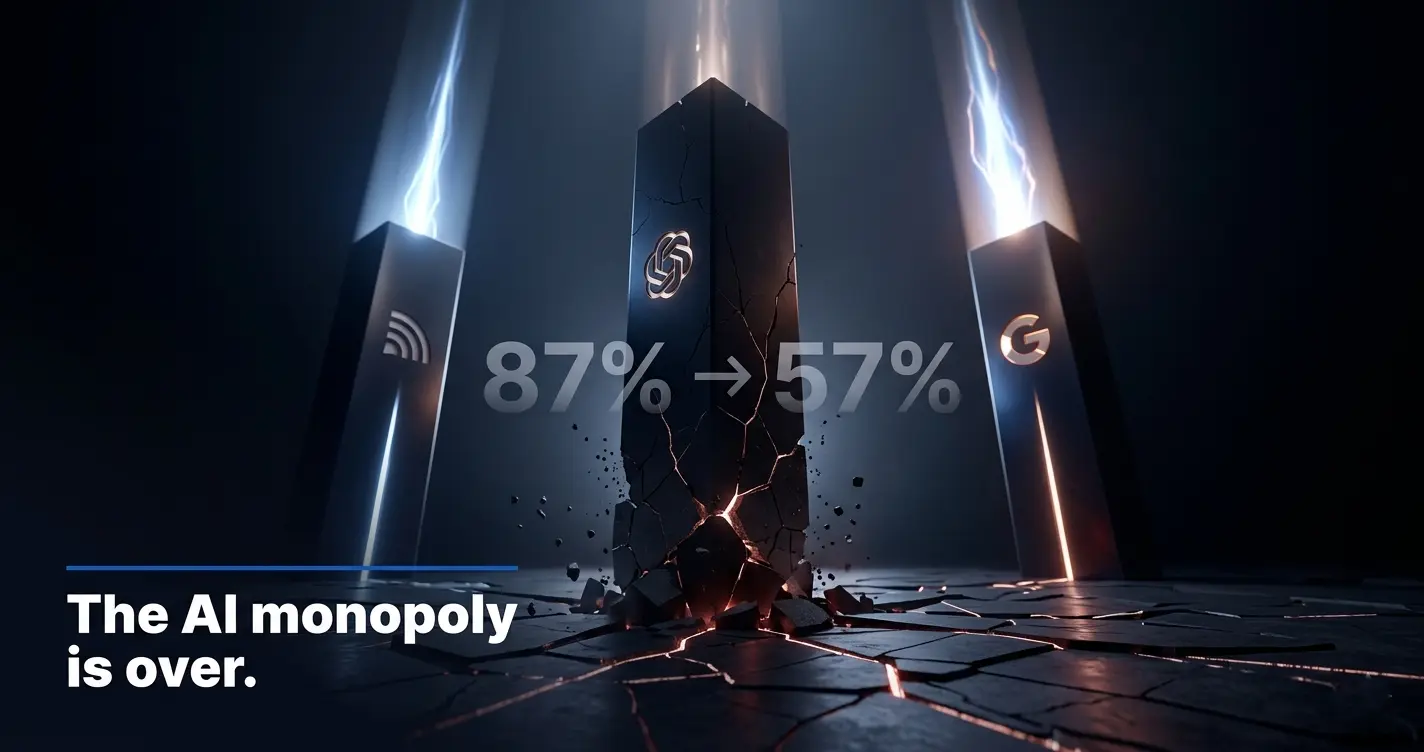
    Fourteen months ago, ChatGPT held 87% of generative AI web traffic. As of March 2026, it’s below 57%. That’s not a blip, that’s the fastest collapse of market dominance in consumer software since Internet Explorer lost the browser wars. Gemini went from 6% to 25%. Claude went from 1.4% to over 6%. And we’re still early.

    If you’re a developer routing API calls, a CTO evaluating an enterprise contract, or a founder choosing the core model for your product, the decision you make this quarter has real consequences. This guide cuts through the benchmark theater and gives you the honest comparison: what each model actually does best, what it costs, and where the traps are.

    −30pt
    ChatGPT market share drop, Jan 2025 → Mar 2026
    Gemini’s traffic share growth over same period
    Claude’s share gain in a single quarter

    The Market Shift Nobody Predicted

    The mainstream narrative going into 2025 was settled: OpenAI won. ChatGPT was the Google of AI, first-mover with a moat so deep no challenger could cross it inside five years. That narrative is now wrong.

    The structural break happened in three waves. First, model quality parity arrived faster than anyone expected. Claude 3.7, Gemini 3.0, and then the jump to Claude 4.x and Gemini 3.1 Pro showed that OpenAI’s quality lead was a 12-month advantage, not a permanent one. By late 2025, independent benchmarks showed all three platforms within single-digit percentage points on general capability tests.

    Second, Google’s distribution machine activated. Gemini bundled into Gmail, Docs, Sheets, and Android didn’t win users through product quality, it converted existing Google Workspace daily actives into AI users overnight. That’s how you go from 6% to 25% in twelve months without necessarily being the best model in the room.

    Third, Claude’s enterprise breakout. While Gemini was winning on distribution and ChatGPT on consumer scale, Anthropic quietly captured the segment willing to pay the most: regulated industries. The Claude iOS app hit #1 on the U.S. App Store on February 28, 2026, the first time any AI app surpassed ChatGPT in daily downloads. Claude Code’s weekly active users doubled between January and April. Anthropic’s annualized revenue reached $14 billion as of February 2026, up from $1 billion in 2024. That’s a 14× increase in two years.

    Our Read
    This maps almost exactly to the browser wars. ChatGPT is Internet Explorer, dominant, sticky, losing ground slowly. Gemini is Chrome, distribution king, winning by presence not choice. Claude is Firefox, smaller but chosen deliberately by users who care about quality. The key difference: all three are improving simultaneously, and the market is still growing. There’s no single winner. That is the story.


    Current Models at a Glance

    Platform Current Flagship Context Window Consumer Tier API Input/Output (per 1M tokens)
    OpenAI / ChatGPT GPT-5.5 (Apr 2026)
    GPT-5.4 Pro via API
    ~250K tokens (Enterprise) Free / Plus $20/mo / Pro $200/mo $1.75 / $14.00 (GPT-5.2)
    Anthropic / Claude Claude Opus 4.7 Apr 2026 1M tokens New Pro ~$20/mo / Max ~$50+/mo $5.00 / $25.00
    Google / Gemini Gemini 3.1 Pro (Feb 2026) 1–2M tokens Advanced $19.99/mo $2.00 / $12.00 (Flash: $0.50 / $3.00)
    A few things worth flagging before we get into comparisons. Claude Opus 4.7 is the most significant recent release: it arrives with a 1M token context window (four times larger than Opus 4.6), high-resolution vision at 2,576px, and a self-verification capability that reduces hallucinations on factual tasks. GPT-5.2 is being retired June 5, 2026, any enterprise contract referencing that model needs revisiting now. And Gemini’s naming situation is still a genuine headache for API buyers: “Gemini 3 Pro” (consumer) and “Gemini 3.1 Pro Preview” (developer docs) are the same model, sold under two different labels.


    Coding & Developer Benchmarks

    This is the comparison developers actually search for, and it has a clearer answer than any other category in 2026.

    Benchmark Claude Opus 4.7 GPT-5.4 Gemini 3.1 Pro Winner
    SWE-bench Verified
    Real-world GitHub issue resolution
    87.6% Best ~84% 63–72% Claude
    SWE-bench Pro
    Professional-grade complexity
    64.3% Best ~57.7% Claude
    Claude Code WAU growth Doubled between January and April 2026 — developer consensus forming
    Claude’s lead on SWE-bench Verified is the single clearest differentiation in this entire comparison. A 3–4 point gap on academic benchmarks is noise. A 3–4 point gap on real GitHub issue resolution, across thousands of production repositories, is something engineering leads should care about.

    That said, the cost math complicates things fast. If you’re building a production API pipeline and routing to Claude at $5/$25 per million tokens, versus GPT-5.4 Mini at roughly 6× less than GPT-5.4 Standard, you have a real ROI question to answer. For most B2C product workloads, quick code completions, light refactors, IDE copilot interactions, GPT-5.4 Mini at near-Claude-level performance for a fraction of the cost is the rational choice. Route the complex, high-stakes generation tasks to Claude. Route the volume to Mini or Gemini Flash.

    “Claude is better for complex coding. Claude Opus 4.7 scores 87.6% on SWE-bench Verified, versus GPT-5.4’s approximately 84%. For full-file refactors and long-context debugging, Claude leads. For quick scripts and IDE plugin support, ChatGPT remains competitive.”


    Reasoning, Knowledge & Multimodal

    Reasoning (GPQA Diamond)

    This is Gemini’s clearest win. On graduate-level science questions, the kind of reasoning required in drug discovery, materials science, and academic research, Gemini 3.1 Pro scores 94.1–94.3% on GPQA Diamond. GPT-5.4 follows at ~92.8%. Claude Opus 4.6 sits at ~91.3%. For enterprise buyers in scientific or research-heavy domains, that gap matters.

    Knowledge Depth (Humanity’s Last Exam)

    HLE is the hardest knowledge benchmark available, designed explicitly to resist saturation. The scores: Claude 53 | GPT-5.4 48 | Gemini 40 (BenchLM.ai, April 2026). Claude wins on the single hardest knowledge test, which counters the “Gemini is the smartest” narrative you’ll encounter in a lot of enterprise sales conversations.

    Context Window Reality

    Gemini 3.1 Pro offers 1–2M tokens, technically the largest. Claude Opus 4.7 now matches at 1M. ChatGPT Enterprise sits around 250K. Worth knowing: multiple engineers have noted in 2026 benchmark reviews that performance at 1M+ token contexts degrades meaningfully on most tasks. Advertised context is not reliable context. Test your specific workload at scale, don’t rely on the spec sheet.

    Multimodal

    Gemini has the structural advantage here, Google’s investment in vision and audio AI runs deeper than either competitor’s, and Gemini 3.1 Pro’s multimodal performance leads on most third-party evaluations. Claude Opus 4.7’s new high-resolution vision (2,576px) closes the gap on document and image analysis. ChatGPT remains competitive across all modalities but doesn’t lead on any specific visual benchmark in 2026.


    API Pricing: The Number That Kills Deals

    Consumer tiers have converged: all three platforms sit at $19–$20/month for their mid-range plans. The API is where the real decision lives, and where the gap is significant.

    Model Input (per 1M tokens) Output (per 1M tokens) Notes
    Claude Opus 4.7 $5.00 $25.00 Up to 90% savings with prompt caching
    GPT-5.2 $1.75 $14.00 Retiring June 5, 2026
    Gemini 3.1 Pro $2.00 $12.00 Strong default for cost-conscious builds
    Gemini 3 Flash $0.50 $3.00 Best cost-efficiency for high-volume workloads
    GPT-5.4 Mini ~6× cheaper than Standard ~94% of Standard’s coding performance
    Grok 4.1 $0.20 $0.50 Cheapest frontier API overall
    Cost Reality Check
    Claude is 2.5–3× more expensive than Gemini at API level. At 100M tokens/month, that’s a $300,000 annual cost difference. Claude’s prompt caching (up to 90% savings on repeated context) makes it competitive for long-context applications that reuse significant prompt context, legal document review, multi-turn research, large codebase analysis. For high-volume, low-complexity tasks, Gemini Flash or GPT-5.4 Mini is the rational default.


    Enterprise Reality: Who’s Winning Where

    The single-vendor AI strategy is over. Internal data from multiple enterprise surveys in 2026 shows the dominant enterprise stack as: Claude for deep analytical, legal, and compliance output + ChatGPT for research, workflow automation, and employee-facing tools + Gemini for Google Workspace-native workflows. These aren’t competing, they’re co-existing in the same organization.

    “ChatGPT is the overwhelming leader in consumer AI with more than 900 million weekly active users, and over 50 million subscribers… Search usage has nearly tripled in a year, and our ads pilot reached more than $100 million in ARR in under six weeks.”

    — Sam Altman, CEO, OpenAI. OpenAI Blog, March 31, 2026
    That’s the official OpenAI position. What the official position omits: OpenAI is projected to lose $14 billion in 2026, nearly triple earlier estimates, with cumulative losses of $44 billion through 2028 and profitability not expected before 2029. Only 5.5% of ChatGPT’s 900 million users pay. The ads pilot (mentioned casually in Altman’s quote) signals that the product experience for free-tier users may change fundamentally.

    Meanwhile, Anthropic is concentrating on the segment willing to pay most. Claude reportedly wins approximately 70% of new enterprise AI deals in regulated industries, legal, finance, healthcare, compliance, because of its documented lower hallucination rate and its “uncertainty flagging” behavior: it declines to answer when it’s not confident rather than confabulating. In industries where an AI error has financial or legal consequences, that behavior is worth a pricing premium.

    Google’s enterprise advantage is structural, not earned. 120,000+ enterprise customers and 95% of top-20 global SaaS companies use Google Cloud AI, but much of that is Gemini arriving inside Workspace by default, not the result of a competitive evaluation. CTOs in Google-heavy shops evaluating ChatGPT or Claude as Workspace replacements are solving the wrong problem. Evaluate them as additive tools for tasks Workspace doesn’t do well.


    Use Case Mapping

    Best: Claude

    Complex Code Generation & Refactoring

    87.6% SWE-bench, 1M token context, Claude Code doubling WAU. The empirical choice for production-quality output on non-trivial engineering tasks.

    Best: Gemini

    Google Workspace Workflows

    If your team lives in Gmail, Docs, and Sheets, Gemini is already there. The integration advantage bypasses any benchmark comparison.

    Best: Claude

    Legal, Compliance & Finance

    Lower hallucination rates, uncertainty flagging, and 70% win rate in regulated-industry enterprise deals. The reliability premium is real and priced accordingly.

    Best: ChatGPT

    Third-Party Integrations & Plugins

    92% of Fortune 500 adoption, Codex (3M weekly active developers), and the broadest plugin/tool ecosystem. For horizontal workflow automation, ChatGPT’s network effects win.

    Best: Gemini

    High-Volume, Cost-Sensitive APIs

    Gemini Flash at $0.50/$3.00 per 1M tokens is the most cost-efficient frontier API for applications where multimodal capability is relevant and volume is high.

    Best: Gemini

    Scientific Research & Reasoning

    94.1% GPQA Diamond. For drug discovery, materials science, and graduate-level academic analysis, Gemini’s reasoning benchmark lead is real and consistent.


    What the Benchmarks Don’t Tell You

    The Hallucination Problem Isn’t Solved

    An EBU/BBC study found 48% of responses from free-tier chatbots contained accuracy issues as recently as mid-2025. Claude Opus 4.1 recorded 0% hallucination on the AA-Omniscience benchmark, but only because it declined to answer when uncertain rather than guessing. Gemini 3.1 Pro cut its hallucination rate by 38 percentage points, which is the biggest improvement of any model but still leaves it at ~50% on certain tests. Westlaw AI, built specifically for legal research, hallucinated more than 34% of the time on challenging queries.

    Healthcare Warning
    The ECRI Institute ranked misuse of AI chatbots as the #1 health technology hazard of 2026, explicitly naming ChatGPT, Claude, Gemini, Copilot, and Grok as “not regulated as medical devices and not validated for healthcare purposes.” Any healthcare deployment carries compliance exposure regardless of platform.

    Benchmark Saturation Is Real

    MMLU now scores 88–94% across all top models. It no longer differentiates them. The benchmarks that do differentiate, SWE-bench Pro, ARC-AGI-2, Humanity’s Last Exam, are not the ones most buyers understand or test themselves. When a vendor’s sales deck shows you a benchmark chart, ask specifically which benchmark, and whether it’s been saturated. Most popular media comparisons cite saturated benchmarks, making rankings look more meaningful than they are.

    Vendor Lock-In Accumulates Invisibly

    Enterprises building workflows on Claude’s Projects system, Google’s Workspace Gemini integration, or ChatGPT’s Custom GPTs ecosystem are accumulating switching costs that won’t show up in today’s pricing comparison. The platform decision made in 2026 shapes what tools are available, and at what negotiating leverage, in 2028. The time to think about this is before the integration is built, not after.

    “OpenAI is projected to lose $14 billion in 2026, nearly triple earlier estimates for 2025, even as it reports $25 billion in annualized revenue and 900 million weekly ChatGPT users. The company expects cumulative losses of $44 billion between 2023 and 2028, with profitability not arriving until 2029 at the earliest.”

    , European Business Magazine, citing The Information internal financial projections, 2026. Read the full report →
    This is the most important contrarian data point in the entire comparison. The market leader has the biggest user base and the biggest losses. The ads pilot signals a potential shift in the free-tier product experience. That changes the calculus for any organization that’s built workflows on the assumption that free-tier ChatGPT performs identically to paid ChatGPT. It may not for much longer.


    The Verdict

    There’s no single winner. Anyone telling you otherwise is selling something. Here’s the honest split:

    ChatGPT
    Best for
    Consumer-scale deployment, third-party integrations, employee-facing tools, and organizations where Fortune 500 adoption rates reduce procurement friction. The horizontal choice.

    Claude
    Best for
    Complex code generation, legal and compliance work, long-document analysis, and any use case where hallucination has real-world consequences. The quality-first choice.

    Gemini
    Best for
    Google Workspace-native workflows, high-volume cost-sensitive APIs, scientific reasoning, and multimodal tasks. The distribution and efficiency choice.

    Most serious enterprise buyers in 2026 use two of the three, typically Claude plus one of the other two depending on their infrastructure. The overlap is real and intentional. These platforms are not substitutes for each other; they’re complements with different cost structures and different failure modes.

    Watch three things over the next 6–18 months. First, whether OpenAI’s ads pilot scales, this is the signal for how the free-tier product experience evolves. Second, whether Claude’s API pricing moves; Anthropic’s current premium pricing reflects confidence in the enterprise market, but competitive pressure from Gemini Flash is real. Third, whether any platform meaningfully solves hallucination at the infrastructure level, rather than at the “decline to answer” workaround level. That’s the technical moat that doesn’t yet exist.


    Frequently Asked Questions

    Which AI is better in 2026 | ChatGPT, Claude, or Gemini?
    There is no single winner. Claude Opus 4.7 leads on coding (87.6% SWE-bench) and writing quality. ChatGPT (GPT-5.4/5.5) leads on ecosystem breadth and third-party integrations. Gemini 3.1 Pro leads on reasoning benchmarks (94.1% GPQA) and multimodal tasks. Most professional users in 2026 use two of the three. Source: BenchLM.ai, April 2026.

    Is ChatGPT or Claude better for coding?
    Claude is better for complex coding. Claude Opus 4.7 scores 87.6% on SWE-bench Verified vs GPT-5.4’s ~84%. For full-file refactors and long-context debugging, Claude leads. For quick scripts and IDE plugin support, ChatGPT remains competitive. Most engineering teams use both. Source: LearnDrive, 2026.

    What is the cheapest AI API in 2026?
    Gemini 3 Flash is the cheapest frontier API at $0.50 input / $3.00 output per million tokens. Grok 4.1 charges $0.20/$0.50, making it cheapest overall. GPT-5.4 Mini is 6× cheaper than GPT-5.4 Standard. Claude Opus 4.7 is most expensive at $5.00/$25.00, but offers up to 90% savings via prompt caching on repeated-context workloads. Source: IntuitionLabs, Feb 2026.

    How many people use ChatGPT in 2026?
    ChatGPT has over 900 million weekly active users and 50 million paying subscribers as of March 2026. It processes 2.5 billion daily prompts. OpenAI generates $25 billion in annualized revenue, but projects a $14 billion operating loss in 2026 due to compute costs. Source: OpenAI, March 31, 2026.

    Is Gemini better than ChatGPT in 2026?
    Gemini 3.1 Pro leads on reasoning benchmarks (94.1% vs 92.8% GPQA Diamond), offers a larger context window (1–2M tokens), and excels at multimodal tasks. ChatGPT leads on ecosystem, integrations, and consumer scale (900M WAU vs 750M MAU). For Google Workspace users, Gemini has a structural advantage that makes the comparison largely moot. Source: LearnDrive, 2026.

    Does Claude hallucinate less than ChatGPT?
    Yes, in independent testing. Claude Opus 4.1 recorded 0% hallucination on the AA-Omniscience benchmark by declining to answer when uncertain. However, no AI model is hallucination-free, the EBU/BBC found 48% of free-tier AI responses had accuracy issues in 2025. Claude’s “I don’t know” behavior matters most in legal, compliance, and financial use cases. Source: Suprmind AI, May 2026.

    Which AI has the largest context window in 2026?
    Gemini 3.1 Pro offers the largest at 1–2 million tokens. Claude Opus 4.7 (April 2026) now reaches 1 million tokens. ChatGPT Enterprise supports approximately 250,000 tokens. Important caveat: practical performance degrades at maximum context lengths across all platforms. Advertised context window ≠ reliable context window. Test your specific workload. Source: Tech Insider, April 2026.

  • How Agentic AI Works: Anthropic, OpenAI & the Architecture Behind Autonomous AI (2026)

    How Agentic AI Works: Anthropic, OpenAI & the Architecture Behind Autonomous AI (2026)

    How Agentic AI Works: The Architecture Behind Autonomous AI in 2026 | NeuralWired
    Agentic AI · 2026

    How Agentic AI Actually Works | And Why Most Companies Are Getting It Wrong

    Agentic AI is no longer a research topic, it’s running in production at Capital One, Fountain, and dozens of enterprises you’ve heard of. Here’s the real architecture: the ReAct loop, multi-agent orchestration, the security vulnerabilities already being exploited, and why Yann LeCun thinks the whole approach is fundamentally broken.

    NeuralWired Research Team · May 2026 · Deep Explainer · 14 min read
    A hiring platform called Fountain quietly rewired its recruitment pipeline last year. No fanfare. No press release about “AI transformation.” Just a hierarchical multi-agent system handling candidate screening end-to-end, and the results were stark: 50% faster screening, 2x candidate conversions, staffing cycles compressed to under 72 hours. Humans stayed in the loop for final decisions. Agents did everything else.

    That’s agentic AI in its most useful form. Not a chatbot. Not autocomplete at scale. A system that perceives, reasons, acts, observes the result, and iterates, autonomously, until a goal is achieved.

    The market is pricing this in fast. The AI Agents market was valued at $7.84 billion in 2025 and is projected to reach $52.62 billion by 2030, a 46.3% CAGR. Vertical agents, domain-specific systems for legal, healthcare, and financial services, are the fastest-growing segment at 62.7% CAGR. But the gap between the hype and what’s actually running in production is significant. Understanding why requires understanding how agentic AI actually works.

    What Agentic AI Actually Is

    Start with the distinction that matters most to anyone building or buying this technology: agentic AI is not generative AI with more confidence. It’s a categorically different architecture.

    Generative AI, the ChatGPT most people know, operates in a single pass. Prompt in, response out. It’s reactive by design. Agentic AI systems do something fundamentally different: they plan multi-step tasks, use external tools (APIs, browsers, databases, code executors), take actions in the world, and iterate until a goal is achieved with minimal human input.

    Working Definition
    An AI agent is a system that can execute multi-step plans, use external tools, and interact with digital environments, functioning as an autonomous component within larger workflows rather than a single-turn responder. The key distinction from a chatbot is autonomy and action.

    MIT Sloan’s 2025 research on agentic AI in clinical settings describes the shift precisely:

    “AI agents can execute multi-step plans, use external tools, and interact with digital environments to function as powerful components within larger workflows.”

    — Kate Kellogg, Professor of Management and Innovation, MIT Sloan School of Management
    Four capabilities define the current generation of agentic systems, and distinguish them from everything that came before. Autonomy: operating without continuous human intervention. Goal-oriented behavior: adapting strategies as conditions change mid-task. Reasoning and planning: breaking complex problems into multi-stage solutions. Learning and adaptation: improving based on outcomes and feedback within a session or across sessions.

    The ReAct Loop: The Engine Inside Every Agent

    If you want to understand how agentic AI works at a technical level, you need to understand one paper from October 2022: the ReAct framework, introduced by Shunyu Yao and a team at Princeton and Google Brain. It is the architectural backbone of virtually every production agentic system shipping in 2026.

    ReAct stands for Reasoning + Acting. The insight is deceptively simple: instead of generating a single response to a prompt, an agent alternates between two modes. It reasons about what to do. Then it acts, calling a tool, querying a database, executing code. Then it observes the result of that action. Then it reasons again, informed by what it just saw. Then it acts again. This loop continues until the task is done.

    Written out as a sequence, a ReAct agent operating on a research task looks like this:

    Step Mode What happens
    1 Perceive Receive task input — user goal, context, available tools
    2 Reason Language model generates a plan: “I should search for X, then check Y”
    3 Act Call a tool — web search, API, code executor, database query
    4 Observe Tool returns a result; agent sees the output
    5 Reason Update the plan based on what was observed
    6 Act / Complete Take next action, or conclude if goal is met
    What makes this powerful is also what makes it dangerous: the loop runs until the model decides it’s done. A poorly constrained agent will keep acting. This is why a mature pattern that solidified in 2026 is the tiered constraint model, explicit priority layers baked into every agent’s operating instructions:

    1. Safety first — never take destructive or irreversible actions without human confirmation
    2. Accuracy — prioritize correct outputs over speed
    3. Goal completion — achieve the stated objective
    4. Efficiency — accomplish the above with minimum steps
    Goals conflict constantly in complex tasks. Explicit priority ordering resolves them deterministically rather than leaving the model to improvise, which it will, unpredictably, without this structure.

    Multi-Agent Systems and Orchestration

    A single agent can handle impressive tasks. But the frontier of enterprise agentic AI is multi-agent systems, networks of specialized agents coordinating to complete work that would overwhelm any individual model.

    Gartner reported a 1,445% increase in multi-agent system inquiries from Q1 2024 to Q2 2025. That’s not gradual adoption, that’s a category inflection point.

    The architectural pattern that’s emerging: a hierarchical model with a planning agent (sometimes called an orchestrator) at the top that breaks down a complex goal and delegates sub-tasks to specialized worker agents. Each worker has access to specific tools. Results flow back up to the orchestrator, which synthesizes them and decides the next move. Human oversight can be plugged in at any tier.

    The Interoperability Problem | and How It’s Being Solved

    Until recently, every multi-agent system required bespoke integrations for every tool and data source an agent might need. That’s changing fast. Two standards are converging:

    Protocol Creator What It Does Analogy
    MCP (Model Context Protocol) Anthropic Standardizes how agents connect to tools, APIs, and data sources USB for AI peripherals
    A2A (Agent-to-Agent Protocol) Google Standardizes how agents communicate with each other HTTP for agent networks
    Anthropic launched MCP in November 2024 and it has since become the de facto standard for agent-tool connectivity. Our read: these two protocols complementing each other, one for tool access, one for agent communication, signals the industry is building toward an interoperability layer that will dramatically reduce the cost of deploying production agent systems. That’s a structural accelerant for adoption.

    The key enterprise milestones from the past 18 months:

    Oct 2022
    ReAct framework published, Yao et al., Princeton/Google Brain. Still the foundational architecture for virtually every production system.
    Nov 2024
    Anthropic releases MCP, Open standard for agent-tool connectivity. Becomes the de facto infrastructure layer.
    Jul 2025
    OpenAI launches ChatGPT Agent Transitions ChatGPT from conversational tool to autonomous assistant.
    Sep 2025
    Anthropic releases Claude Agent SDK Alongside Claude Sonnet 4.5. Developers can now build fully autonomous AI systems on top of Claude.
    Jan 2026
    Claude 4.5 hits 60%+ on OSWorld Computer-use benchmark. Up from single-digit performance in the pre-agentic era. A meaningful reliability milestone.
    Apr 2026
    Anthropic launches Claude Managed Agents Abstracts infrastructure for production agent deployment. Reduces the engineering overhead of scaling.

    The Production Reality: Numbers That Matter

    Here’s the adoption picture, stripped of the optimism that characterizes most analyst reports:

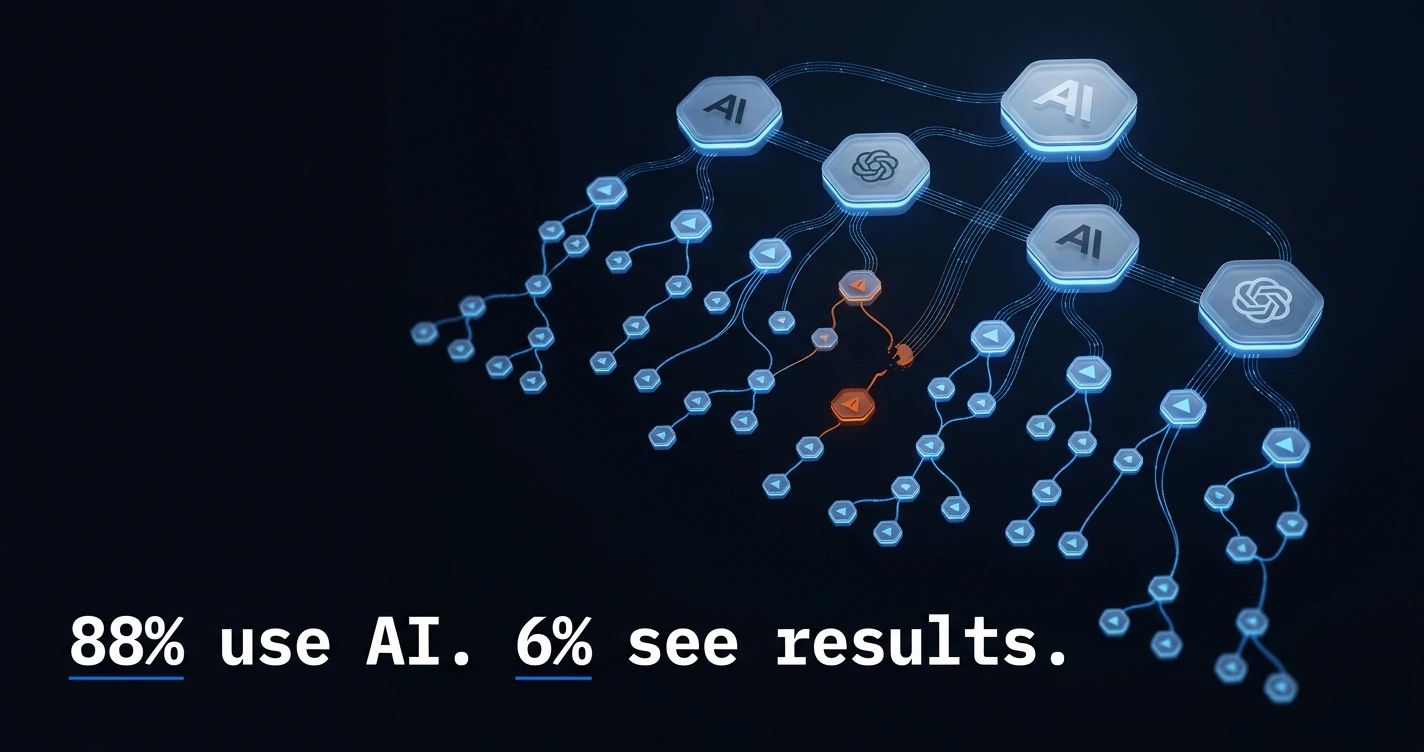
    88%
    of organizations use AI in at least one function (McKinsey, 2025)
    6%
    qualify as high performers generating 5%+ EBIT impact
    11%
    actively use agentic AI in production (Deloitte, 2025)
    40%+
    of agentic AI projects predicted scrapped by 2027 (Gartner)
    The gap between “using AI” and “generating measurable business impact from AI” is enormous. McKinsey’s 2025 State of AI survey (1,993 participants across ~105 countries) found only 23% of enterprises are scaling AI agents in at least one function. Most organizations remain in what researchers are calling “pilot mode”, impressive demos, no scaled deployment.

    “We have agents deployed at scale in the economy to perform all kinds of tasks.”

    — Sinan Aral, Professor of Management, Information Technology, and Marketing, MIT Sloan School of Management
    Aral is right, but the qualifier matters. Agents are deployed at scale in the economy. They are not deployed at scale in most individual enterprises. The difference is significant for anyone making architecture decisions right now.

    The 80% Problem

    MIT’s Kellogg documented something that should be required reading for every CTO considering an agentic AI deployment: in a real project deploying an AI agent to detect adverse events among cancer patients, 80% of the total work was consumed by data engineering, stakeholder alignment, governance, and workflow integration. Not the AI itself. Not the model. The boring, unglamorous, deeply human work of making organizations ready for autonomous systems.

    The demos are compelling. The production path is brutal. Expect it.

    Security, Failure Modes, and What Can Cascade

    Multi-agent systems introduce failure modes that don’t exist in single-model deployments. The most dangerous: cascading errors. One agent’s hallucination becomes another agent’s input. A judge-agent reviewing another agent’s output can hallucinate or act deceptively, undermining the very validation layer it was designed to provide. The safeguard inherits the failure mode it was meant to catch.

    ⚠ Critical Security Risk
    In mid-2025, the EchoLeak exploit (CVE-2025-32711) demonstrated the real attack surface of agentic systems: infected emails containing engineered prompts could trigger Microsoft Copilot to exfiltrate sensitive data automatically, without any user interaction. This is prompt injection at scale. It requires no user error. It exploits the agent’s autonomy directly.

    Symantec’s controlled experiments using OpenAI’s Operator AI agent went further, demonstrating how agents could be directed to harvest personal data and automate credential stuffing attacks. These are not theoretical threat models. They’ve been demonstrated against production systems.

    What specifically can go wrong in enterprise deployments:

    • Data breach via autonomous action, In early 2025, a healthtech firm disclosed a breach compromising records of 483,000 patients, caused by a semi-autonomous AI agent that pushed confidential data into unsecured workflows while streamlining operations.
    • Compliance cascade, A single hallucination — an agent misclassifying a transaction, can propagate across linked systems and agents, producing compliance violations or financial misstatements that are expensive to unwind.
    • Shadow agent sprawl, McKinsey (2025) warned that uncontrolled agent proliferation is emerging as a risk equivalent to shadow IT. MIT’s NANDA Initiative found 95% of enterprise GenAI pilots failed to deliver measurable ROI, with uncontrolled agent proliferation cited as a major contributor.
    Deloitte’s 2026 State of AI in the Enterprise report found only one in five companies has a mature model for governance of autonomous AI agents. That’s not a nice-to-have gap. That’s an existential liability for any organization running agents with write, execute, or transact permissions.

    What CTOs Must Do Now

    • Mandate human-in-the-loop checkpoints for any agent with write, execute, or transact permissions before production deployment.
    • Audit data pipelines before agent integration, converting data into standard, structured formats is prerequisite infrastructure, not a parallel workstream.
    • Build agent registries, track lifecycle, owners, and KPIs before authorizing new deployments. “Shadow agent sprawl” is a real and growing risk.

    The Strongest Case Against the Whole Approach

    The most technically serious challenge to the mainstream agentic AI narrative doesn’t come from a competitor or a skeptical analyst. It comes from Yann LeCun, VP and Chief AI Scientist at Meta, Turing Award winner, and one of the most credentialed AI researchers alive.

    LeCun’s argument is architectural, not operational. It goes to the foundation of how current LLM-based agents work.

    “An agentic system that is supposed to take actions in the world cannot work reliably unless it has a world model to predict the consequences of its actions. Without it, the system will inevitably make mistakes. This is the key to unlocking everything from truly useful domestic robots to Level 5 autonomous driving.”

    — Yann LeCun, VP & Chief AI Scientist, Meta; Founder, AMI Labs, MIT Technology Review, January 2026
    LeCun’s position: LLMs are limited to the discrete world of text. They can’t truly reason or plan, because they lack a world model, an internal simulation of cause and effect that would let them predict the consequences of their actions before taking them. Without that, agentic systems are, in his framing, fundamentally unreliable in any sufficiently complex, open-ended environment.

    He isn’t just criticizing from the sidelines. He’s building a competing architecture at AMI Labs, based on world models rather than autoregressive text generation.

    The counterargument from the mainstream: for narrow, well-scoped tasks, screening resumes, executing compliance workflows, processing insurance claims, world models may not be necessary. The task scope is constrained enough that text-based reasoning performs reliably. Fountain’s hiring agents don’t need a world model to schedule interviews.

    Both can be true. LeCun is almost certainly right about the limits of LLM-based agents for truly open-ended, general-purpose tasks. The mainstream is right that those limits don’t prevent significant enterprise value from narrowly scoped deployments. The practical implication: be precise about what your agents are actually doing. Scope matters enormously.

    How We Got Here: The Compounding Sequence

    Agentic AI didn’t emerge suddenly. It’s the product of a specific chain of technical breakthroughs, each enabling the next:

    2017 — The Transformer architecture (Vaswani et al., Google) enables the large language models that power all modern agents. Without it, none of this exists.

    2022 — The ReAct framework solves the core problem of how to give LLMs the ability to plan and act in iterative loops. Still the backbone of virtually every production system four years later.

    Late 2023 — AutoGPT and BabyAGI go viral. Developer experimentation explodes, producing a 920% increase in repositories utilizing agentic AI frameworks from early 2023 to mid-2025.

    2024 — Models gain multimodal perception (vision + text). OpenAI releases function calling; Anthropic releases tool use. Both standardize how agents interface with external systems — a critical infrastructure moment.

    2025 — The industry moves from monolithic, general-purpose models to distributed systems of specialized agents. Every major AI company ships production-ready agent SDKs. Enterprise spend on generative AI reaches $37 billion, a 3.2x increase from 2024.

    2026 — Human-in-the-loop design is increasingly treated as a strategic architectural choice rather than a limitation. The industry is maturing past naive autonomy. That’s a positive signal.

    Frequently Asked Questions

    What is the difference between agentic AI and generative AI?

    Generative AI responds to prompts and produces content, text, images, code, in a single pass. Agentic AI goes further: it plans multi-step tasks, uses external tools (APIs, browsers, databases), takes actions in the world, and iterates until a goal is achieved with minimal human input. The key distinction is autonomy and action.

    How do AI agents work step by step?

    AI agents operate via the ReAct loop: (1) Perceive, take in input from tools, databases, or sensors; (2) Reason, determine what to do next using a language model; (3) Act, call a tool, write code, send an API request; (4) Observe, review the result; (5) Repeat until the task is complete or a human checkpoint is triggered.

    What are examples of agentic AI in real enterprise use?

    Real-world examples include: Fountain’s hiring agents (50% faster screening, 2x candidate conversions), Capital One’s AI systems handling KYC/AML compliance workflows, GitHub Copilot Workspace writing and testing code autonomously, and enterprise customer service agents resolving support tickets end-to-end without human escalation.

    Is agentic AI the same as AGI?

    No. Agentic AI refers to systems that autonomously plan and execute multi-step tasks within defined domains. Artificial General Intelligence (AGI) would require human-level reasoning across any domain. Today’s agentic AI is powerful but narrow, it succeeds at specific, well-scoped tasks and fails unpredictably outside its training and toolset.

    What are the biggest risks of deploying agentic AI?

    Hallucination cascades (one wrong inference propagating across a multi-agent chain), prompt injection security exploits like EchoLeak (CVE-2025-32711), shadow agent sprawl as teams deploy systems without oversight, and irreversible real-world actions taken without human authorization. Governance gaps are the single largest enterprise liability right now.

    Which companies are leading agentic AI development?

    Anthropic (Claude agents, MCP protocol, Managed Agents), OpenAI (ChatGPT Agent, Operator), Google DeepMind (Gemini agents, A2A protocol), Microsoft (Copilot agents in Azure), Salesforce (Agentforce), and ServiceNow. At the infrastructure layer: NVIDIA, AWS Bedrock, and LangChain are foundational platforms.

    The Bottom Line
    Agentic AI is real, it’s in production, and it’s already generating measurable value in narrow, well-scoped enterprise deployments. The Fountain result isn’t an outlier, it’s a preview. The ReAct loop is battle-tested. MCP and A2A are solving the interoperability problem that previously made multi-agent systems prohibitively expensive to build. The infrastructure is maturing.

    But the gap between “agentic AI works” and “agentic AI works reliably at scale in your enterprise” is where most projects stall, and where the 40% Gartner attrition forecast is being written. The 80% problem is real. Data engineering, governance, stakeholder alignment, these are not implementation details. They are the implementation.

    LeCun’s critique about world models is technically serious and worth tracking. For now, it’s a research horizon, not an operational blocker for the narrow-task deployments where agentic AI is genuinely excelling.

    In the next 6–18 months, watch for three things:

    • Whether MCP and A2A interoperability standards actually converge, or fragment into competing ecosystems. Convergence would be a significant accelerant for enterprise adoption.
    • The governance technology market. Only one in five enterprises has mature agent governance. The gap will either be filled by vendors building registries and audit tools, or by regulatory mandates forcing the issue.
    • LeCun’s AMI Labs. If world model architectures demonstrate reliable performance on complex real-world tasks, the LLM-based agentic AI stack faces genuine architectural competition. It’s a long-shot near-term, but worth monitoring.
    If you’re building agentic systems: scope precisely, constrain explicitly, audit your data before your model, and treat human-in-the-loop not as a limitation but as a design choice that extends how far you can safely push autonomy.

    Stay ahead of agentic AI

    The Neural Loop delivers the signal without the noise, weekly briefings on what’s actually moving in AI for practitioners and technology leaders.

    Subscribe to The Neural Loop →
  • Anthropic Wall Street AI Deal Explained 2026

    Anthropic Wall Street AI Deal Explained 2026

    Anthropic Bets $300M on Wall Street to Sell Claude Into the Heart of Private Equity | NeuralWired

    Anthropic Bets $300M on Wall Street to Push Claude Into the Heart of Private Equity

    Dario Amodei’s safety-focused AI company is finalizing a $1.5 billion joint venture with Blackstone, Goldman Sachs, and Hellman & Friedman, a calculated move to plant Claude inside thousands of PE-owned firms before OpenAI can claim the same territory.


    The deal has been weeks in the making, but it moved fast once the right partners aligned. According to the Wall Street Journal, Anthropic is on the verge of closing a $1.5 billion joint venture with some of the most influential names in private capital, including Blackstone, Goldman Sachs, Hellman & Friedman, and General Atlantic. An announcement was expected as early as May 4, 2026. This isn’t a funding round. It’s a distribution play, and the distinction matters enormously.

    Anthropic CEO Dario Amodei has spent years insisting that AI safety and commercial ambition aren’t in tension. This joint venture is the clearest proof yet that he means it. Rather than chasing consumer eyeballs, Anthropic is threading Claude through the operational backbone of businesses that manage trillions in assets, where the demand for reliable, auditable AI is acute and the wallets are very deep.

    Private equity firms have spent the past 18 months under enormous pressure to demonstrate efficiency gains across their portfolio companies. AI has been the obvious answer. The harder question has been which AI, deployed by whom, with what accountability. Anthropic, with its emphasis on enterprise-grade reliability and its history of building Claude for high-stakes environments, is positioning itself as the answer to all three.

    Key context: Blackstone manages more than $1 trillion in assets and has portfolio exposure across hundreds of companies globally. Even partial Claude deployment across that network would represent a significant commercial milestone for Anthropic and a template for the broader industry.

    The Deal Structure: Who’s Putting In What

    The financial architecture is notable for its symmetry. Anthropic, Blackstone, and Hellman & Friedman are each committing roughly $300 million to the venture. Goldman Sachs is contributing approximately $150 million, with General Atlantic providing additional capital to bring the total to $1.5 billion. No official confirmation had been issued by any party as of late May 4.

    That shared financial exposure is deliberate. It aligns incentives across the table. Anthropic doesn’t just collect a licensing fee while Wall Street firms absorb the implementation risk. Each major partner has skin in the outcome, which means each has reason to ensure that the deployed Claude products actually perform.

    Partner Reported Commitment Strategic Role
    Anthropic ~$300 million Technology provider; Claude model deployment
    Blackstone ~$300 million Distribution via $1T+ portfolio network
    Hellman & Friedman ~$300 million Mid-market PE portfolio access
    Goldman Sachs ~$150 million Asset management clients; financial sector reach
    General Atlantic Remaining capital to $1.5B Growth equity and tech-sector portfolio access
    The joint venture will operate as a consulting entity, deploying Claude models with forward-deployed engineers embedded at client companies. That’s not a SaaS subscription model. It’s a services relationship, with Anthropic’s people and products going into the operational rooms where PE-backed firms make decisions about staffing, procurement, diligence, and portfolio management.

    Anthropic Is Running the Palantir Playbook

    Industry observers will immediately recognize the template. Palantir built its enterprise presence the same way: not by selling software from a distance, but by embedding analysts and engineers directly inside client organizations, staying until the workflows changed, and then staying some more. The approach is slower and more expensive than pure SaaS. It’s also stickier.

    For PE, stickiness matters in a specific way. These firms don’t want a tool they’ll have to rip out and replace in three years. They want infrastructure. They want something their operating partners can trust when it’s flagging risks in an acquisition target’s financial model at 11 p.m. before a bid deadline. The Palantir model, for all its complexity, has proven that high-touch enterprise AI deployment creates durable relationships. Anthropic is betting it can do the same.

    The difference from Palantir, and it’s a meaningful one, is that Anthropic’s commercial model sits on top of an explicitly safety-first research culture. Claude is built with human-in-the-loop constraints and is designed to flag uncertainty rather than mask it. In regulated environments like M&A diligence, that’s a feature. In high-speed operational contexts where PE firms sometimes need fast answers, it can create friction.

    “This is a compelling investment opportunity for our clients and will enable mid-market companies to deploy Anthropic’s AI solutions to drive meaningful impact in their business. By democratizing access to forward-deployed engineers, the new company can help the expansive network of portfolio companies in our Asset Management business and other companies of similar sizes accelerate AI adoption to grow and scale their operations.”

    Marc Nachmann, Global Head of Asset and Wealth Management, Goldman Sachs
    Nachmann’s framing is instructive. Goldman isn’t describing this as a bet on Anthropic’s model quality, though that’s implicit. It’s describing it as an access play: giving mid-market firms the kind of AI implementation support that previously only the largest corporations could afford to build internally. That framing also conveniently positions Goldman as the democratizing force, not just a capital allocator looking for returns.

    Anthropic’s Revenue Numbers Tell the Real Story

    The joint venture doesn’t exist in isolation. Reporting from International Business Times Singapore places Anthropic’s annualized revenue run-rate at approximately $40 billion in 2026, with around 80% of that coming from enterprise clients. A separate analysis from Intellectia.ai cited a figure above $30 billion, noting that revenue tripled from the prior year’s $9 billion base.

    Those numbers, if accurate, represent an extraordinary acceleration. They also explain why Anthropic can write a $300 million check into a joint venture without it being an existential commitment. The company backed by Amazon and Google isn’t scraping for growth. It’s choosing where to direct growth that’s already happening.

    Data caveat: Revenue figures for Anthropic are reported by third-party analysts and have not been confirmed by the company. Anthropic remains private. The range of estimates reflects genuine uncertainty, and readers should treat specific figures as directional rather than definitive.

    The enterprise orientation also tracks with Claude’s adoption data. More than 10,000 companies were already using Claude before 2026, according to Forbes-sourced figures cited by SEO Sandwitch. Claude.ai was pulling 87.6 million monthly visits as of December 2024. The JV is an attempt to convert that broad enterprise footprint into deep, durable relationships with the specific subset of firms that have both the complexity and the budget for full-stack AI integration.

    How Anthropic’s Claude Fits Inside Private Equity Operations

    The actual use cases being discussed for PE deployment aren’t speculative. They’re the workflows that PE operating teams have been trying to automate for years: deal sourcing and screening, investment committee memo drafting, portfolio company monitoring, compliance documentation, and due diligence synthesis. These are document-heavy, judgment-intensive tasks where a capable language model with strong retrieval and summarization can compress work that previously took analysts days into hours.

    Claude’s particular strengths align with some of the harder parts of that list. Code review for technology assets being evaluated for acquisition. Contract analysis for compliance-heavy portfolio companies. Financial model annotation and error-flagging. The safety-first architecture that occasionally draws criticism for slowing output is, in the M&A context, an argument for the product: a model that says “I’m not certain about this figure” is more useful in diligence than one that confidently hallucinates.

    📄
    Diligence

    Contract review, financial model cross-checking, and risk flag synthesis across acquisition targets.

    📊
    Portfolio Ops

    Automated monitoring of KPIs, cost structure analysis, and board-ready reporting across portfolio companies.

    ⚖️
    Compliance

    Regulatory documentation, audit trail generation, and policy monitoring in financial services environments.

    🔍
    Deal Sourcing

    Market scanning, sector mapping, and initial screening of acquisition candidates at scale.

    The forward-deployed engineer model matters here. These aren’t generic implementations. The joint venture’s operating approach involves embedding technical staff who understand both the AI tooling and the client’s specific workflows. That’s the part that’s hard to replicate from a competitor’s app store listing.

    “The establishment of this joint venture will provide Anthropic with additional funding support, facilitating its technology development and market expansion, particularly in the rapidly growing AI market.”

    Emily J. Thompson, Senior Investment Analyst, Intellectia.ai

    Anthropic vs. OpenAI: The B2B Battle That Actually Matters

    Consumer AI gets the headlines, but the enterprise contract fight is where the real revenue is being decided. OpenAI built its name on ChatGPT’s consumer reach. Anthropic has consistently prioritized the enterprise segment, and Claude’s reputation in compliance-heavy industries, financial services, legal, and healthcare, reflects that focus. The JV accelerates that differentiation sharply.

    More than 50% of U.S. enterprises held paid AI subscriptions as of March 2026, according to the Ramp AI Index. That tipping point matters. It means that competitive decisions about which AI platform to standardize on are being made right now, at budget cycle speed, across thousands of companies. The PE joint venture gives Anthropic a distribution shortcut into that decision-making: rather than winning individual enterprise clients one RFP at a time, it gains access to PE firms’ entire portfolio networks simultaneously.

    OpenAI has its own enterprise push, its own government contracts, and its own investor relationships. But it doesn’t have a joint venture structured specifically to channel AI deployment into PE-owned mid-market companies, the segment that’s historically underserved by enterprise AI vendors focused on Fortune 500 clients. That’s the gap Anthropic is stepping into.

    The competitive read here isn’t that OpenAI loses. It’s that Anthropic claims a segment before the market consolidates around a default choice. First-mover advantages in enterprise AI are meaningful because switching costs are high once workflows are rebuilt around a specific model’s outputs and behaviors. The JV is a land-grab, conducted at $1.5 billion scale, with Wall Street’s distribution muscle behind it.

    The Friction Points Worth Watching

    Not every analyst is reading this as a clean win for Anthropic. The core tension is structural: private equity operates on three-to-five-year investment horizons, and the ROI timeline for enterprise AI implementations rarely compresses that far. Firms are being asked to believe that AI-driven efficiency gains will materialize within the hold period of their current funds. That’s a meaningful assumption.

    There are also questions about Claude’s performance relative to competitors in specifically PE-relevant benchmarks. The broader enterprise AI space has produced enthusiastic adoption claims, but hard evidence comparing model performance on diligence-specific tasks, financial analysis, or contract review at depth remains thin in public reporting. Anthropic’s safety architecture may create friction in high-speed operational contexts where PE firms need fast answers and can’t pause for model uncertainty flags.

    Reuters noted that it could not independently verify all details reported by the Wall Street Journal, and no confirmation had come from Anthropic, Blackstone, Goldman Sachs, or Hellman & Friedman as of the publication of this article. That doesn’t mean the deal isn’t real. It does mean that the specific figures, timing, and structure carry some uncertainty until official statements are issued.

    The implementation timeline is the other risk. Palantir’s model, which this JV explicitly emulates, took years to produce demonstrable returns for early government clients. PE firms have less patience than governments, and their limited partners have even less. If the first wave of deployments doesn’t show measurable efficiency gains within 12 to 18 months, the enthusiasm around the venture will face pressure that no amount of Goldman Sachs framing will fully absorb.

    What Anthropic has going for it is the quality of its partners. Blackstone didn’t commit $300 million by accident. Neither did Hellman & Friedman. These are firms that run deep diligence on investment theses before committing capital. Their participation is, in itself, a signal that the underlying commercial logic has been stress-tested by people who do that professionally.

    For a deeper look at how enterprise AI adoption is reshaping corporate tech stacks, see our 2026 enterprise AI adoption report and our analysis of how Claude and GPT-4 compare across regulated industries. We’ve also covered the Palantir forward-deployment model and what it means for how AI companies build durable enterprise relationships.

    Frequently Asked Questions

    What exactly is Anthropic’s $1.5 billion joint venture with Blackstone?
    It’s a consulting and deployment entity structured to bring Anthropic’s Claude AI models into private equity portfolio companies. Each of the main partners, Anthropic, Blackstone, and Hellman & Friedman, contributes roughly $300 million, with Goldman Sachs adding approximately $150 million and General Atlantic filling the remainder. The joint venture uses forward-deployed engineers, similar to Palantir’s model, to implement AI tools directly inside client operations rather than selling software remotely.

    How will private equity firms actually use Claude?
    The primary use cases include M&A due diligence (contract review, financial model analysis, risk flagging), portfolio company monitoring, investment committee memo drafting, compliance documentation, and operational efficiency analysis. The forward-deployed model means Anthropic engineers work inside client environments rather than simply providing API access.

    Has Anthropic officially confirmed the joint venture?
    No. As of May 4, 2026, all details come from sources familiar with the discussions, as reported by the Wall Street Journal and corroborated by International Business Times Singapore. No official statement had been issued by Anthropic, Blackstone, Goldman Sachs, Hellman & Friedman, or General Atlantic at the time of publication.

    How does this affect Anthropic’s competition with OpenAI?
    It gives Anthropic a significant distribution advantage in the PE-backed mid-market segment, which has historically been underserved by enterprise AI vendors. Rather than winning clients through individual sales cycles, Anthropic gains access to entire portfolio networks simultaneously. OpenAI has its own enterprise push but lacks a comparable joint venture structured specifically for this segment.

    What are the biggest risks to the joint venture’s success?
    The main risks are: a structural mismatch between PE’s short investment horizons and AI’s longer ROI timelines; the possibility that Claude’s safety-first design creates friction in high-speed operational contexts; the absence of public benchmarks showing Claude’s specific performance on PE-relevant tasks; and the overall uncertainty about whether the reported deal structure and financial figures are fully accurate before official confirmation.

    What to Watch Next

    NeuralWired Monitor
    01 Official announcement timing. Anthropic signaled a May 4 announcement date. Any delay, or any material change to the reported structure, would be significant. Watch for press releases from any of the five named partners.
    02 First portfolio company deployments. The JV’s credibility hinges on early implementation wins. The first named PE portfolio company to deploy Claude at scale will become the benchmark case study for the entire venture.
    03 OpenAI’s response. A $1.5 billion PE-focused joint venture is a direct competitive challenge. Whether OpenAI mirrors the structure, accelerates its own enterprise partnerships, or targets different verticals will define how the B2B AI market segments over the next 18 months.
    04 Anthropic’s IPO signals. A $40 billion annualized revenue run-rate and a Wall Street JV with Goldman Sachs are precisely the conditions that precede a public offering. Watch Dario Amodei’s public statements for any shift in language around Anthropic’s capital structure plans.
    Anthropic’s joint venture with Wall Street’s biggest names isn’t a pivot. It’s an amplification of a strategy that’s been building quietly while the media focused on consumer chatbots and model benchmarks. Dario Amodei has always argued that safety and scale are compatible. The $1.5 billion bet he’s now placing, alongside Blackstone, Goldman, and Hellman & Friedman, is the most consequential test of that argument yet. The PE firms have done their diligence. The forward-deployed engineers will do theirs. What happens next inside those portfolio companies will tell us more about the real-world value of enterprise AI than any benchmark has managed to.

    Stay ahead of enterprise AI NeuralWired covers the deals, deployments, and decisions shaping how AI enters business operations. Get our weekly briefing.
    Subscribe Free
  • Google’s $40B Anthropic Deal: 5GW TPU Compute Explained

    Google’s $40B Anthropic Deal: 5GW TPU Compute Explained

    Google’s $40B Anthropic Bet: The Compute Arms Race That Will Define AI’s Next Era | NeuralWired

    Google’s $40B Anthropic Bet Isn’t About Equity. It’s About 5 Gigawatts of AI Dominance.

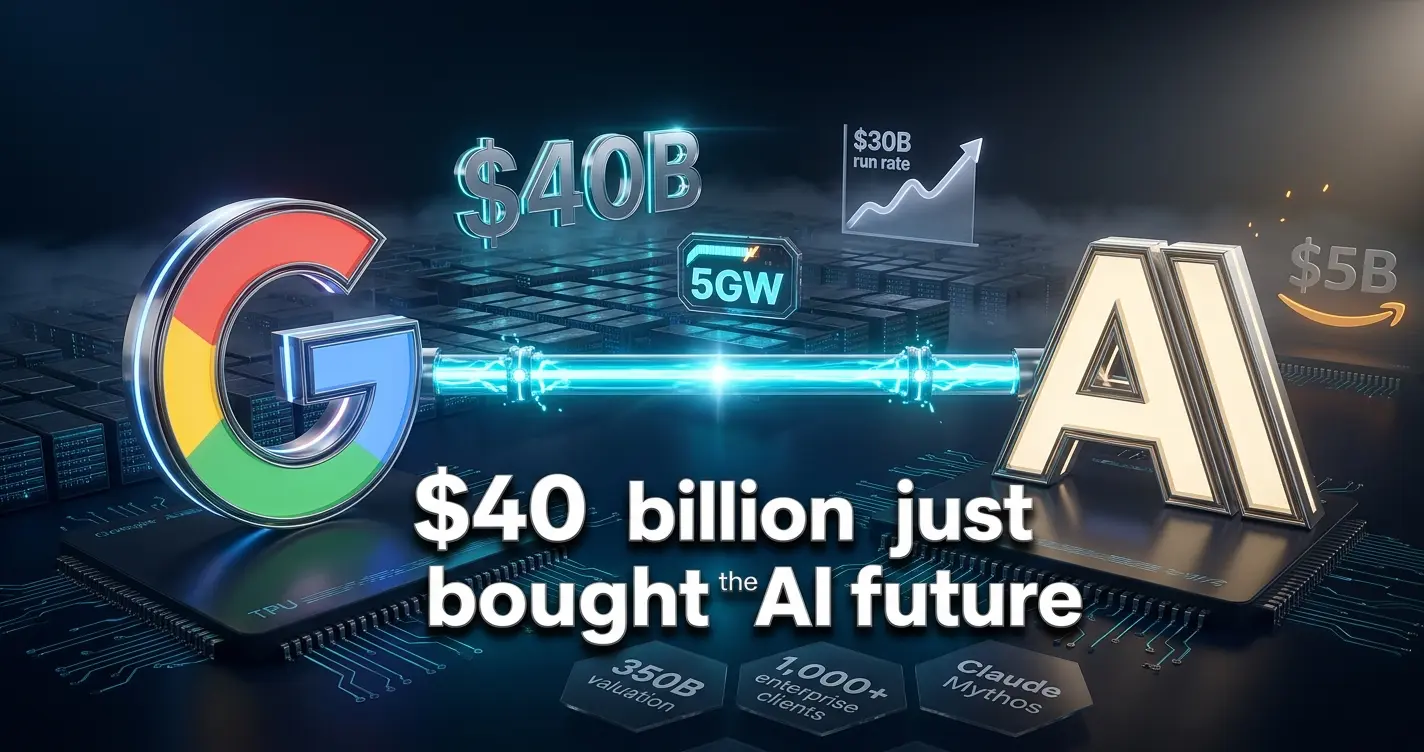
    Google confirmed a $10 billion upfront investment in Anthropic, with up to $40 billion contingent on performance milestones, at a $350 billion valuation. But the cash almost misses the point. The real story is 5 gigawatts of dedicated TPU compute capacity, and what that means for the frontier AI race.

    On April 24, 2026, Google and Anthropic announced a deal that reshapes the financial architecture of frontier AI development. Google will inject $10 billion immediately into the Claude maker, with an additional $30 billion available if Anthropic hits undisclosed performance benchmarks. The post-money valuation lands at $350 billion, matching the price set during Anthropic’s $30 billion Series G round in February.

    Those figures alone would make it the largest single hyperscaler investment in any AI lab. But buried alongside the dollar amounts is the provision that may matter more: Google commits 5 gigawatts of Cloud TPU capacity over five years. In an industry where compute access has become the rate-limiting factor for building next-generation models, that’s not a sweetener. It’s arguably the main event.

    Anthropic’s revenue run rate hit $30 billion in 2026, up from $9 billion at end-2025. That’s a 3.3x jump in under six months, driven by enterprise demand that has overwhelmed its existing infrastructure. Over 1,000 business customers now spend more than $1 million annually on Claude. The company needed compute. It got a lot of it.


    The $40B Deal, Explained

    The structure is straightforward on the surface: $10 billion flows immediately, with $30 billion more tied to milestones that neither party has publicly disclosed. Google’s total exposure if all tranches trigger reaches $40 billion, which would represent the company’s single largest external investment.

    By the numbers: Google has already invested over $3 billion in Anthropic since 2023, accumulating a 14% ownership stake. The new deal layers on top of that position, deepening a financial relationship that the two companies have been building for three years.

    The $350 billion valuation is notable for what it doesn’t say. Secondary market trades have reportedly valued Anthropic at over $800 billion in recent months, meaning Google locked in at what some investors may consider a significant discount. Whether that reflects discipline or deal-making leverage depends on your read of the secondary markets’ reliability as price signals.

    The compute component is, in practical terms, inseparable from the financial one. Anthropic already trains Claude models on Google’s custom TPUs. This agreement formalizes and massively scales that relationship. Five gigawatts is not a number that fits neatly into normal infrastructure conversations.

    “The investment underscores a shift from pure funding to securing long-term compute, as Anthropic looks to ease capacity constraints.”

    Network World analyst, NetworkWorld, April 2026

    From $300M to $40B: A Timeline

    Google’s commitment to Anthropic didn’t appear overnight. It’s the product of a three-year relationship that started with an unconventional bet: why would a company building its own frontier AI models invest in a direct competitor?

    Date Event Significance
    2023 Google invests $300M in Anthropic, acquires ~10% stake Establishes financial relationship alongside Gemini development
    2024 Google adds $2B, total stake rises to 14% Deepens compute partnership; Anthropic adopts TPUs for key workloads
    Jan 2025 Google agrees to $1B+ additional investment Signals continued confidence as Claude gains enterprise traction
    Feb 2026 Anthropic raises $30B Series G at $380B post-money (GIC, Coatue) Establishes valuation baseline; signals broad investor conviction
    Apr 6, 2026 Anthropic announces expanded TPU and Broadcom partnership (multiple gigawatts from 2027) Locks in compute supply chain across multiple vendors
    Apr 7, 2026 Claude Mythos Preview released to 12 tech companies under restricted access Demonstrates frontier model capability; cybersecurity restrictions signal new risk tier
    Apr 19, 2026 Amazon invests additional $5B; deal includes up to 5GW Trainium capacity Anthropic diversifies hyperscaler relationships; mirrors Google structure
    Apr 24, 2026 Google confirms $10-40B investment at $350B valuation; 5GW TPU capacity over 5 years Largest hyperscaler AI lab investment on record
    The pattern here is deliberate. Anthropic isn’t choosing between Google and Amazon, it’s collecting commitments from both. Each hyperscaler brings dedicated silicon, and Anthropic gets diversified infrastructure that no single vendor can hold hostage. It’s a smart negotiating position, and the revenue trajectory justifies the leverage.

    Why Compute Is the Real Prize

    The AI industry talks constantly about models, benchmarks, and capabilities. It talks less openly about the thing that actually determines who gets to build frontier systems: access to the compute needed to train and run them. That access has become scarce, expensive, and increasingly tied to hyperscaler relationships.

    Training costs tell the story bluntly. GPT-4 cost an estimated $79 to $100 million to train. Google’s Gemini Ultra ran approximately $191 million. Next-generation frontier models are projected to exceed $1 billion per training run. At that scale, who controls compute controls the frontier.

    Scale check: The four largest U.S. tech companies, Alphabet, Microsoft, Meta, and Amazon, are projected to spend roughly $700 billion on AI infrastructure in 2026. Morgan Stanley Research estimates global data center investment will reach approximately $2.9 trillion through 2028. This isn’t a niche capital cycle. It’s a generational infrastructure build.

    Anthropic faces this pressure acutely. Its revenue grew 3.3x in months, but that growth created its own constraint: more customers meant more inference demand, which meant more compute, which meant more urgency around locking in supply. The Google deal resolves that bottleneck, at least for five years.

    “This deal is less about Anthropic becoming a chip company and more about who controls the rate-limiting factor in AI deployment.”

    Analyst, Futurum Group, Futurum Research, April 2026
    The broader compute picture for Anthropic now includes commitments from CoreWeave for data center capacity, Amazon’s 5GW Trainium deal, the Broadcom partnership bringing 3.5GW starting 2027, and now Google’s fresh 5GW TPU commitment. That’s a substantial multi-vendor compute stack, and it positions Anthropic to train at scales its competitors may struggle to match without equivalent relationships.

    Inside Google’s TPU Infrastructure

    Not all compute is equal. Google’s Tensor Processing Units are custom AI accelerators built specifically for machine learning workloads, and they carry meaningful differences from the Nvidia GPUs that dominate most training clusters. Understanding those differences helps explain why the 5GW commitment is worth as much as it is.

    TPU v5e

    Cost-optimized chip designed for inference workloads. Handles high-volume Claude API requests efficiently at lower cost per query.

    🔬
    TPU v5p

    High-performance training chip at roughly 459 TFLOPS BF16 per unit. Powers large-scale pre-training and fine-tuning runs.

    🚀
    TPU v6 (Upcoming)

    Next-generation architecture with undisclosed specs. Expected to anchor Claude’s training infrastructure from 2027 onward.

    🔒
    Dedicated Pools

    Anthropic receives non-shared TPU allocations, guaranteeing priority access that marketplace GPU buyers can’t match.

    In October 2025, Anthropic announced access to 1 million TPUs valued at tens of billions of dollars. That cluster, already among the world’s largest AI training configurations at the time, combined to exceed 450 exaFLOPS. The new 5GW commitment extends and deepens that foundation.

    The supply chain argument matters too. Nvidia GPU supply constraints have driven up prices and extended delivery timelines throughout 2025 and 2026. Anthropic’s reliance on TPUs insulates it from that pressure while custom optimization by Google can tune its silicon specifically for Claude’s architectures. That’s a structural advantage that cash alone can’t replicate.

    Claude Mythos: The Model Driving Demand

    The infrastructure investment doesn’t exist in isolation. It’s designed to train and run increasingly powerful models, and Anthropic’s most recent release illustrates exactly how high the capability bar has risen.

    Claude Mythos Preview launched on April 7, 2026, distributed to just 12 technology companies through Glasswing Ventures. Anthropic restricted broader access immediately, citing the model’s autonomous cybersecurity capabilities as a genuine misuse risk. It isn’t often that an AI lab publicly flags its own model as too dangerous for general release.

    The capabilities that triggered that decision are significant.

    • Mythos identified over 100 high-severity vulnerabilities across every major operating system and web browser during red team evaluations
    • The model can locate dormant bugs in decades-old codebases autonomously, without human direction at each step
    • It generates working exploits with minimal human input, a capability that previously required specialized expertise
    • It outperforms human teams on capture-the-flag cybersecurity challenges, a standard benchmark for offensive security skill
    “Mythos Preview represents a step up over previous frontier models in a landscape where cyber performance was already rapidly improving.”

    AISI Research Team, AI Security Institute (UK Government), April 2026
    Training a model at Mythos’s capability level requires the kind of compute scale that Google’s commitment makes possible. The infrastructure deal and the model capability aren’t separate stories, they’re the same story told from two angles.

    Strategic Implications for the Industry

    This deal reshapes competitive dynamics across multiple layers of the AI stack, from chip manufacturers down to individual developers. The effects aren’t evenly distributed.

    For machine learning practitioners

    Impact Area Effect
    Training feasibility Enables longer pre-training runs and larger parameter counts for Anthropic; raises the bar other labs must match
    Access inequality Creates compute moats that favor incumbents with hyperscaler partnerships over independent researchers
    Reproducibility Makes independent reproduction of frontier results harder without equivalent infrastructure access
    Inference costs Scale may reduce per-token costs for Claude API users, but raises barriers for smaller labs entering the space
    Safety governance Concentrates influence over AI safety standards with the small number of hyperscaler-lab partnerships

    For competitors

    OpenAI and Microsoft face direct pressure. The Azure infrastructure underpinning OpenAI’s training runs must now be positioned against a deepened Google-Anthropic stack, and Microsoft will need to respond with equivalent or greater commitments to maintain parity. Meta’s open-source strategy faces a different kind of challenge: proprietary compute advantages are difficult to replicate without hyperscaler backing, and Meta’s current data center build-out, while substantial, doesn’t yet match the dedicated capacity Anthropic is locking up.

    For Nvidia, the strategic picture is more complex. Both Google’s TPUs and Amazon’s Trainium chips represent custom silicon alternatives to Nvidia’s GPUs. The more infrastructure that moves to custom accelerators, the more Nvidia’s dominant market position erodes at the frontier. Nvidia’s H100 and Blackwell architectures still dominate the broader market, but the trend line at the frontier is moving away from them.

    Smaller AI labs face the starkest reality. Without equivalent hyperscaler relationships, survival at the frontier becomes structurally harder. The capital required to train competitive models has moved beyond what venture funding alone can sustain. That concentrates meaningful AI development among an increasingly small number of well-capitalized partnerships.

    For investors

    The valuation dynamics here are worth reading carefully. Anthropic’s $350 billion deal price sits well below the $800 billion-plus figures reportedly circulating in secondary markets. If those secondary valuations reflect genuine conviction, Google locked in at a meaningful discount. If they reflect speculative froth, the $350 billion number anchors expectations closer to reality. An IPO reportedly being considered for as early as October 2026 will provide the first real public test of those competing valuations.

    The Antitrust Shadow

    The deal’s structure raises questions that regulators in both the U.S. and EU are already examining. Google simultaneously invests in Anthropic as a financial stakeholder and supplies its core infrastructure as a cloud provider. Those two roles create competing interests that don’t always resolve cleanly.

    “The investment creates a financial interest in Anthropic’s success that sits alongside a competitive interest in Gemini’s success. Those two interests are not always aligned.”

    Competition observer, Remio.ai analysis, April 25, 2026
    The criticism goes further. Critics characterize large minority investments of this kind as quasi-acquisitions that achieve effective control without triggering formal merger review thresholds. U.S. antitrust authorities have already moved to scrutinize these structures in AI, and the EU AI Act creates additional regulatory surface area for intervention.

    Regulatory watch: U.S. authorities initially moved to force Google to divest certain assets in related matters. Whether the Anthropic investment faces similar scrutiny, or requires operational firewalls between Google’s cloud infrastructure and its Anthropic-facing business decisions, remains an open question that could reshape the deal’s practical structure.

    “Critics argue that these massive investments represent a form of quasi-acquisition that circumvents traditional merger review processes.”

    Regulatory analyst, Intellectia.AI, April 25, 2026
    Anthropic holds no board seats for Google, and the company retains operational independence. But the scale of financial dependence, $40 billion potential plus infrastructure supply, creates dependencies that make “independence” a more complicated concept than it might appear on paper.

    Frequently Asked Questions

    What is the Google Anthropic investment deal announced in April 2026?
    Google confirmed it will invest up to $40 billion in Anthropic, with $10 billion upfront and $30 billion contingent on undisclosed performance milestones, at a $350 billion post-money valuation. The deal also includes 5 gigawatts of Google Cloud TPU compute capacity over five years.

    How much has Google already invested in Anthropic before this deal?
    Prior to the April 2026 announcement, Google had invested over $3 billion in Anthropic since 2023, including an initial $300 million for roughly 10% ownership, followed by additional investments that brought its total stake to 14%.

    What is Anthropic’s current valuation and revenue run rate?
    The Google deal values Anthropic at $350 billion post-money. Anthropic’s revenue run rate reached $30 billion in 2026, up from $9 billion at the end of 2025. Some secondary market transactions have implied valuations exceeding $800 billion.

    Why is compute capacity more important than cash for AI labs?
    Training frontier AI models now costs over $1 billion per run. Access to dedicated compute, such as Google’s TPUs or Amazon’s Trainium chips, determines which labs can train next-generation models. Without guaranteed infrastructure, cash alone can’t buy the capacity needed to stay at the frontier.

    How does Amazon’s Anthropic investment compare to Google’s?
    Amazon invested an additional $5 billion in Anthropic on April 19, 2026, as part of what could reach $20 billion total, paired with up to 5 gigawatts of Trainium chip capacity. Both deals mirror each other structurally: cash plus dedicated silicon, allowing Anthropic to diversify its infrastructure across two major hyperscalers.

    What is Claude Mythos, and why was its access restricted?
    Claude Mythos Preview is Anthropic’s most powerful model as of April 2026, released to only 12 companies. Anthropic restricted broader access because the model can autonomously find vulnerabilities in major operating systems, generate working exploits, and outperform human teams on cybersecurity challenges, creating genuine misuse risk.

    Does Google control Anthropic after this investment?
    Google does not hold board seats and doesn’t control Anthropic’s operations. Its 14% ownership stake is a significant minority position. However, the scale of financial commitment and infrastructure dependency has prompted antitrust observers to question whether the arrangement creates effective influence without formal control.

    Is Anthropic planning an IPO?
    Reports indicate Anthropic is considering an IPO as early as October 2026. No formal filing or official announcement has been made. If it proceeds, the offering would be one of the most significant public market tests of AI company valuations to date.

    What Comes Next

    The Google-Anthropic deal isn’t the endpoint of a funding story. It’s the opening of an infrastructure era in AI. The companies that will define the frontier over the next five years aren’t just those with the best researchers or the most creative architectures. They’re the ones with locked-in compute at a scale that competitors can’t easily replicate. Anthropic has now secured that position twice over, once with Amazon and once with Google.

    What that means in practice: Anthropic can train larger models, run more inference, and grow its enterprise base without hitting the infrastructure ceilings that have constrained it. That’s a durable competitive advantage, as long as the hyperscaler relationships hold and the milestones that trigger the remaining $30 billion get met.

    The antitrust questions won’t go away. The closer the financial ties between Google and Anthropic grow, the more regulators will press on whether those ties create structural distortions in the AI market. Whether that leads to operational firewalls, divestiture requirements, or nothing at all remains genuinely uncertain. What isn’t uncertain is the direction of travel: AI infrastructure is consolidating around a small number of well-capitalized partnerships, and everything downstream from chip access to safety governance flows from that consolidation.

    Watch For
    01 Anthropic’s IPO timeline: a filing as early as October 2026 would become the first major public test of AI unicorn valuations at scale. Watch for S-1 registration signals and whether the $350B deal price or the $800B+ secondary market figures set the tone with public investors.
    02 Claude Mythos general availability: the restricted release to 12 companies won’t hold indefinitely. When Anthropic widens access, the cybersecurity capability implications will move from academic to operational, drawing scrutiny from government agencies and enterprise security teams simultaneously.
    03 Regulatory action on minority investments: U.S. and EU antitrust authorities are building frameworks to examine large minority stakes in AI labs. Any formal action against the Google-Anthropic structure, or Microsoft’s equivalent arrangement with OpenAI, would reset the terms of how hyperscalers back frontier AI companies.
    04 Microsoft’s countermove: Azure’s compute commitments to OpenAI now look comparatively constrained. Watch for a major Microsoft infrastructure announcement or revised capital commitment within the next two quarters as the company responds to the competitive pressure this deal creates.
    Stay ahead of the AI infrastructure race. More on AI investment, frontier models, and compute economics at NeuralWired.
    Explore AI Coverage