Tag: EU AI Act

  • Why 40% of Enterprise AI Governance Programs Will Fail EU Compliance by August 2026

    Why 40% of Enterprise AI Governance Programs Will Fail EU Compliance by August 2026

    Why 40% of Enterprise AI Governance Programs Will Fail EU Compliance by August 2026 | NeuralWired
    NeuralWired Enterprise AI AI Governance
    Analysis · 2026
    Enterprise AI Governance
    The gap between “having a policy” and operational compliance is wider than most boards realize. Here is the cross-jurisdictional roadmap, 5-level maturity model, and board playbook your organization needs before the clock runs out.

    40-50% of large enterprises claim AI governance programs exist
    15-20% actually meet EU AI Act documentation standards today
    35M EUR maximum fine for prohibited-practice violations
    30% lower compliance overhead for super-compliance firms
    Aug 2026 EU AI Act high-risk obligations enforcement start
    Somewhere between 40% and 50% of large enterprises tell auditors they have a formal AI governance program. Only 15% to 20% can actually back that claim up when regulators ask for documentation, monitoring logs, and impact assessments. That gap, between policy on paper and operational compliance, is about to become the most expensive mistake in enterprise technology.

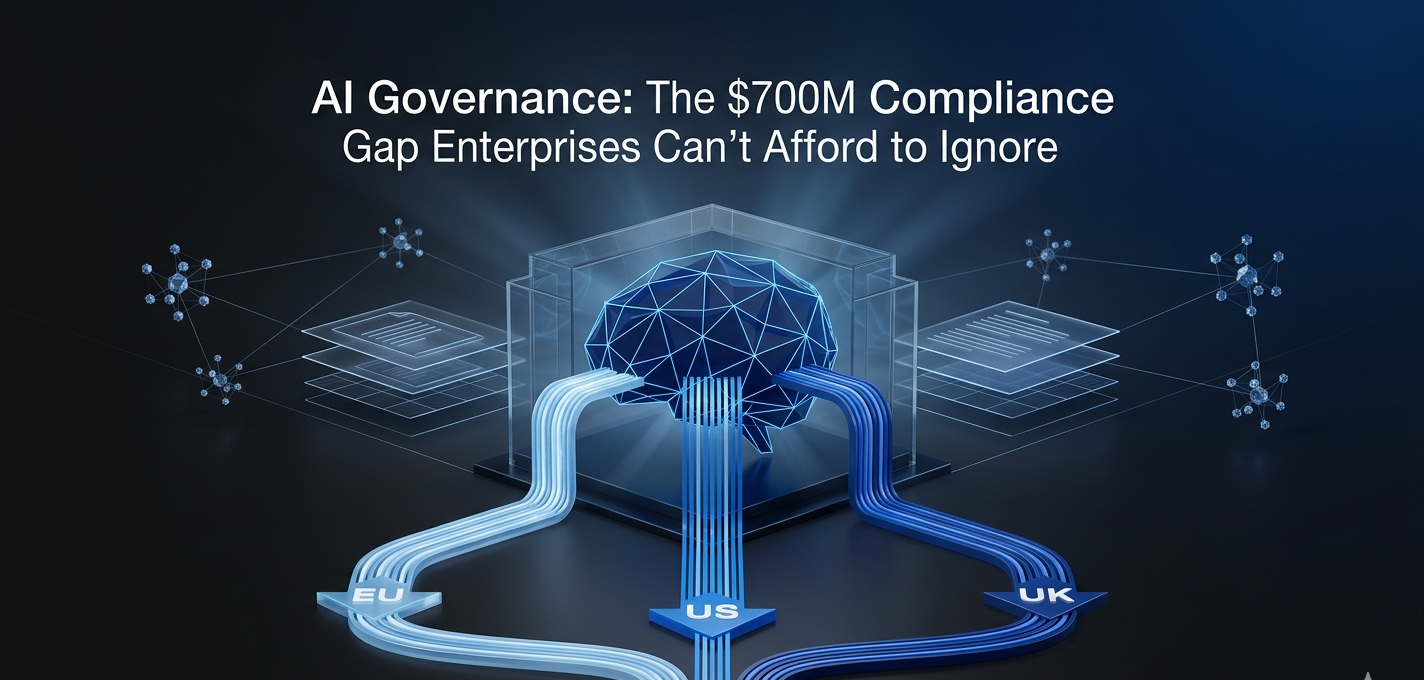
    The EU AI Act’s high-risk obligations become fully enforceable in August 2026. Fines can reach 35 million euros or 7% of global annual turnover, whichever is larger. For a $10 billion revenue company, that is a $700 million exposure sitting quietly in your AI deployment backlog.

    Meanwhile, U.S. federal and state governments issued over 120 AI-related laws, executive orders, and guidance documents in 2024 and 2025. More than 30 state-level AI laws are enacted or under review by early 2026. For global enterprises, this is not a single compliance problem. It is a regulatory patchwork that demands a unified governance architecture.

    This analysis gives you the cross-jurisdictional roadmap that competitors’ articles skip. You will get a five-level AI governance maturity model, a board-oversight structure with concrete roles and reporting cadence, a cross-mapping of EU AI Act, NIST AI RMF, and UK AI Safety Institute requirements, and the implementation checklist that compliance officers and engineers can act on today.


    The Regulatory Landscape: Three Regimes, One Enterprise Problem

    AI governance regulation and enterprise compliance don’t live in one jurisdiction. The challenge for multinational enterprises in 2026 is that three distinct regulatory philosophies are converging simultaneously, each with its own enforcement timeline, documentation standard, and penalty structure.

    🇪🇺
    European Union
    EU AI Act
    Risk-based framework. High-risk AI systems require conformity assessments, technical documentation, human oversight, and ongoing monitoring. Full enforcement: August 2026.
    🇺🇸
    United States
    NIST AI RMF + State Laws
    Fragmented patchwork. Federal guidance is voluntary. States like Colorado require annual impact assessments for high-impact AI. 30+ state laws active or pending by 2026.
    🇬🇧
    United Kingdom
    AI Safety Institute Framework
    Principle-based with sector-specific overlays. Emphasis on safety testing for frontier models and transparency mandates. Increasingly convergent with EU standards post-Brexit.
    The EU AI Act is the most structurally demanding. It categorizes AI systems by risk level: unacceptable (banned outright), high-risk (stringent compliance), limited-risk (transparency obligations), and minimal-risk (essentially unregulated). Around 15% to 20% of regulated AI deployments in banking and healthcare are expected to land in the high-risk category, triggering the most burdensome documentation and monitoring requirements.

    Why This Matters for Global Operations
    The EU AI Act applies to any AI system that affects EU residents, regardless of where the developer is headquartered. A fintech firm based in Singapore that operates credit-scoring models for French customers is fully subject to EU AI Act high-risk obligations. Territorial reach is one of the most consistently underestimated compliance risks in 2026.

    The U.S. picture is deliberately different. The National Institute of Standards and Technology AI Risk Management Framework (NIST AI RMF) offers a voluntary governance structure built around four core functions: Govern, Map, Measure, and Manage. It doesn’t carry direct legal penalties, but it’s rapidly becoming the de facto standard that regulators, auditors, and enterprise procurement teams use to evaluate AI maturity. More than 25% of major U.S. enterprises are already running annual AI risk assessment cycles, driven largely by state-level mandates.

    “We’re past the point where an AI policy document satisfies anyone. Regulators and boards want to see model inventories, impact assessments, and audit trails.”
    AI compliance analyst perspective, via Adeptiv.AI’s 2026 governance analysis

    The Compliance Gap That’s Costing Enterprises Millions

    The numbers are blunt. Roughly 40% to 50% of large enterprises report having formal AI governance programs. Only 15% to 20% actually meet EU AI Act documentation and monitoring standards when independently assessed.

    That gap has a name: documentation debt. And regulators are already finding it. Around 40% of AI system audits flag documentation gaps, even when the underlying models perform technically well. A system can have excellent accuracy, low bias metrics, and solid security controls, and still fail a compliance audit because its risk classification, training data lineage, or human-override protocols aren’t properly recorded.

    Compliance Risk Alert
    Documentation gaps are treated as violations under the EU AI Act, not administrative oversights. The distinction matters because violations trigger financial penalties, while oversights typically trigger remediation timelines. In roughly 40% of audited AI deployments, technically sound systems still fail on documentation alone.

    The cost of fixing this after the fact is significant. Building a minimum-viable AI governance program, including model inventory, impact-assessment tooling, and basic documentation infrastructure, runs $150,000 to $500,000 for mid- to large-sized enterprises. Do that reactively under regulatory pressure and costs compound. Do it proactively and the ROI case is straightforward: $500,000 in governance infrastructure against a potential $700 million fine is not a hard calculation.

    There is a less obvious cost too. Board visibility into AI incidents is rising sharply. Around 30% to 40% of global tech firms now report AI governance incidents, including biased outputs and model-drift-related harm, to internal boards or compliance committees. That is up from under 10% in 2022. When something goes wrong and there’s no audit trail, no incident response protocol, and no documented risk classification, the liability isn’t just financial. It’s reputational.


    The 5-Level AI Governance Maturity Model

    Most compliance frameworks tell you what you need. Fewer tell you where you are and what closing the gap actually looks like. Here is a five-level maturity model designed for enterprise AI governance programs, benchmarked against EU AI Act, NIST AI RMF, and UK AI Safety Institute requirements.

    Level Name What It Looks Like Regulatory Status Next Milestone
    Level 1 Ad Hoc No formal AI inventory. Governance handled case-by-case. No impact assessments. Non-compliant. High penalty exposure. Build model inventory. Assign AI risk owner.
    Level 2 Documented Written AI policy exists. Risk classifications attempted. No systematic monitoring. Partially compliant. Audit risk remains high. Implement impact-assessment workflow. Add monitoring tooling.
    Level 3 Managed Model inventory operational. Impact assessments run for new deployments. Incident reporting in place. EU AI Act baseline met. NIST AI RMF partially aligned. Cross-jurisdictional mapping. Board reporting cadence established.
    Level 4 Optimized Continuous model monitoring. Annual reassessment cycles. AI steering committee active. Fully compliant across EU, UK, and U.S. state frameworks. Pursue third-party certification. Publish transparency report.
    Level 5 Super-Compliance Design to strictest global standard. Governance embedded in product development lifecycle. 20 to 30% lower compliance overhead across jurisdictions. Publish public AI principles. Establish governance as competitive differentiator.
    Level 5 “super-compliance” isn’t theoretical. Companies designing to the strictest available rules, typically the EU AI Act or Colorado-style state frameworks, report 20% to 30% lower compliance-operations overhead across multiple jurisdictions. When your baseline is the most demanding standard, you don’t need to rebuild governance architecture every time a new state or country enacts legislation.

    Most enterprises assessed in 2025 are operating at Level 1 or Level 2. Getting from Level 2 to Level 3 is where the real work happens, and where most programs stall because they underestimate the operational lift of systematic model monitoring and documentation.


    Board-Level AI Governance: Roles, Reporting, and Escalation

    AI governance can’t live exclusively in engineering. The regulatory frameworks making headlines in 2026 expect board-level accountability, and auditors are starting to ask questions about who owns AI risk at the C-suite level.

    The AI Steering Committee Structure

    An effective AI steering committee isn’t another bureaucratic layer. It’s the decision-making body that connects engineering risk to business risk, and business risk to regulatory exposure. Minimum composition for most enterprises:

    • 1 Chief AI Officer or CISO (chair) owns the AI risk register and escalation protocols. Responsible for quarterly board briefings on AI risk posture.
    • 2 Chief Legal Officer or General Counsel maps AI deployments to current and emerging regulatory requirements. Owns the cross-jurisdictional compliance calendar.
    • 3 Chief Data Officer manages model inventory, data lineage documentation, and training data governance. Critical for audit readiness.
    • 4 Head of Product or CTO representative ensures governance requirements are embedded in the product development lifecycle, not bolted on post-deployment.
    • 5 Independent AI ethics advisor provides external perspective on bias, fairness, and societal impact. Increasingly expected by regulators in high-risk sectors.

    Reporting Cadence and Escalation Triggers

    Governance without a reporting cadence is a policy document, not a program. The standard for enterprises operating high-risk AI systems in 2026:

    • M Monthly: Engineering team reviews model performance metrics, drift indicators, and new deployment risk classifications.
    • Q Quarterly: AI steering committee reviews the AI risk register, outstanding impact assessments, and regulatory calendar updates.
    • A Annually: Full board briefing on AI risk posture. Annual impact assessments for all high-impact systems. Colorado-style state frameworks mandate these.
    • ! Immediate escalation triggers: AI system causes demonstrable harm; regulator inquiry received; material model drift detected; third-party audit finding issued.
    The Speed Payoff of Getting This Right
    Enterprises that treat AI governance as a core operating model rather than a compliance checkbox report 20% to 35% faster speed-to-market on AI-driven products. Clear guardrails reduce rework, shorten approval cycles, and eliminate the late-stage legal reviews that stall product launches. Governance is an accelerant when it’s built correctly.


    The Cross-Jurisdictional AI Governance Roadmap

    Most enterprise AI governance guides focus on one jurisdiction. That is the wrong unit of analysis for any company operating across borders. Here is a cross-mapping of EU AI Act, NIST AI RMF, and UK AI Safety Institute requirements into a single enterprise implementation sequence.

    Phase 1: Inventory and Classification (Weeks 1 to 8)

    • Build a complete AI model inventory: system name, use case, data inputs, affected populations, deployment jurisdiction, and current risk classification.
    • Classify each system against EU AI Act risk tiers. Flag all systems that process decisions about individuals in hiring, credit, healthcare, law enforcement, or critical infrastructure.
    • Map U.S. state-law exposure: identify which systems affect residents of Colorado, California, or other states with active AI legislation.
    • Assign owners to every AI system in the inventory. No ownership means no accountability in an audit.

    Phase 2: Documentation and Impact Assessment (Weeks 8 to 20)

    • Run conformity assessments for all EU-exposed high-risk AI systems. Document training data sources, validation methodology, bias testing results, and human oversight protocols.
    • Implement the NIST AI RMF Map and Measure functions: identify AI risks at the system level and implement quantitative and qualitative risk metrics.
    • Complete impact assessments for all high-impact systems. Colorado-style frameworks require annual reassessment cycles, so build the workflow now.
    • Establish data lineage documentation: training sets, preprocessing decisions, and version control for model artifacts.

    Phase 3: Monitoring and Incident Response (Weeks 20 to 36)

    • Deploy model monitoring tooling: track performance drift, bias indicators, and output distribution shifts in production. Enterprises with these tools answer regulator requests 50% faster than those without.
    • Build an incident response protocol: define what constitutes a reportable AI incident, who gets notified, and what the remediation timeline is.
    • Establish human-in-the-loop controls for all EU-classified high-risk AI systems. Document override procedures and decision log retention policies.
    • Activate the board reporting cadence and AI steering committee rhythm as outlined in Section 04.

    Phase 4: Certification and Continuous Improvement (Month 9 Onward)

    • Pursue third-party conformity assessment for EU AI Act high-risk systems where required. Self-declaration is permitted for some categories; third-party certification is required for critical infrastructure, law enforcement, and biometric systems.
    • Publish an AI transparency report. Increasingly expected by institutional investors, enterprise customers, and regulators.
    • Embed governance checkpoints into the product development lifecycle so new AI deployments enter the governance program at inception, not post-launch.
    • Track the regulatory calendar quarterly. With 30+ state laws active or pending in the U.S. alone, the compliance landscape will keep shifting through 2027 and beyond.

    Frequently Asked Questions

    What is AI governance in an enterprise?
    Enterprise AI governance is the set of policies, processes, roles, and technical controls that manage how an organization develops, deploys, monitors, and retires AI systems. It covers risk classification, documentation standards, human oversight requirements, incident response, and board-level accountability.

    In 2026, it is no longer optional. Regulators in the EU, UK, and increasingly U.S. states treat AI governance as a compliance function equivalent to financial controls or data privacy programs.

    What are the key requirements of the EU AI Act for companies?
    For high-risk AI systems, the EU AI Act requires a technical documentation file, risk management system, data governance controls, transparency and user information requirements, human oversight mechanisms, accuracy and robustness testing, conformity assessment, and registration in the EU database.

    The high-risk category includes AI systems used in hiring, credit scoring, healthcare diagnostics, critical infrastructure management, biometric identification, and law enforcement. Full enforcement starts August 2026.

    What are the penalties for non-compliance with the EU AI Act?
    Penalties scale with the severity of the violation. Violations of prohibited-practice rules carry fines up to 35 million euros or 7% of global annual turnover, whichever is higher. Non-compliance with high-risk system obligations carries fines up to 15 million euros or 3% of turnover. Providing incorrect information to authorities can trigger fines up to 7.5 million euros or 1% of turnover.

    For context: a company with $10 billion in annual revenue faces up to $700 million in exposure for prohibited-practice violations alone.

    How does the NIST AI RMF apply to enterprises?
    The NIST AI Risk Management Framework is voluntary at the federal level but is increasingly referenced by U.S. state regulators, federal procurement requirements, and enterprise customers. It is structured around four functions: Govern (establish AI risk policies and accountability), Map (identify AI risks in context), Measure (quantify and assess risks), and Manage (respond to and monitor risks).

    Enterprises that implement NIST AI RMF typically find it maps well to EU AI Act requirements, making it a practical starting point for cross-jurisdictional compliance programs.

    What is the difference between AI ethics and AI governance?
    AI ethics is the philosophical and values-based dimension: fairness, transparency, human dignity, and avoiding harm. AI governance is the operational dimension: the systems, processes, roles, and documentation that translate ethical commitments into auditable, enforceable controls.

    In 2026, regulators care about both but can only enforce governance. You can have a beautifully worded AI ethics statement and still fail a compliance audit for lack of a model inventory or impact assessment.

    How do state AI laws like Colorado’s affect enterprise AI programs?
    Colorado-style AI laws require deployers of high-impact AI systems to conduct annual impact assessments, disclose when AI is used in consequential decisions such as hiring, lending, or housing, provide individuals the ability to appeal AI-driven decisions, and manage risks of algorithmic discrimination.

    With 30+ state laws active or pending by early 2026, multi-state enterprises need a governance architecture flexible enough to accommodate new requirements without rebuilding from scratch each time. The NIST AI RMF provides that flexible base layer.

    Who should be responsible for AI governance in the boardroom?
    Best practice in 2026 points to the Chief AI Officer (or equivalent) as the primary owner of the AI risk register and board reporting. The General Counsel owns regulatory mapping. The CDO owns documentation and model inventory. The full board receives AI risk briefings at least annually.

    The critical structural requirement is that AI governance can’t live entirely in engineering. When something goes wrong and there’s no C-suite accountability, regulatory and reputational exposure is significantly higher.

    How do you implement AI governance across global operations?
    The most efficient approach is “harmonize upward”: design your governance program to the most demanding standard (typically the EU AI Act), then verify that lower-bar jurisdictions are satisfied. This is the mechanism behind the 20% to 30% reduction in compliance overhead reported by super-compliance firms.

    Operationally, this requires a cross-jurisdictional regulatory calendar, a model inventory that tracks where each system is deployed, and a flexible impact-assessment workflow that can incorporate new jurisdictional requirements without redesigning the entire program.


    The Pattern Is Clear. The Window Is Closing.

    Across every governance framework, audit report, and regulatory timeline examined in this analysis, the pattern repeats: the gap between policy on paper and operational compliance is the defining AI governance risk in 2026. Enterprises that addressed it proactively are operating at Maturity Level 3 or 4. Those that haven’t are staring at August 2026 enforcement with documentation debt, no model inventory, and no board-level accountability structure.

    The financial math is straightforward. Building a minimum-viable AI governance program costs $150,000 to $500,000. The alternative is exposure up to 7% of global revenue for EU AI Act prohibited-practice violations. The real leverage isn’t avoiding the fine. It’s the 20% to 35% faster product velocity that enterprises with mature governance programs consistently report. Governance built correctly is an accelerant, not a constraint.

    Watch three developments through 2027: consolidation among AI governance platform vendors as enterprise demand scales; regulatory convergence between EU AI Act, UK AI Safety Institute standards, and U.S. state frameworks creating de facto global standards; and a growing premium in enterprise procurement for AI transparency reports and third-party conformity certifications. Organizations that build governance infrastructure now will answer those procurement questions with documentation, not promises.

    For implementation support and detailed NIST AI RMF mapping templates, explore NIST’s AI RMF 1.0 documentation and the EU AI Act official resource portal. Subscribe to NeuralWired for weekly analysis on AI governance, enterprise compliance, and emerging technology policy.

  • Managing AI Agents | The 2026 Playbook for Human-Agent Teams

    Managing AI Agents | The 2026 Playbook for Human-Agent Teams

    Seventy percent of agent error liability falls on humans. Fewer than 20% of managers run regular audits. The EU AI Act imposes fines of up to 6% of global revenue. Here’s the rigorous, data-backed playbook every leader needs right now.

    Something quietly shifted in enterprise org charts in 2025. It wasn’t a reorg or a layoff, it was an onboarding. Across the Fortune 500, AI agents took on roles that once required junior analysts, support reps, and operations staff. They’re still there, running 70% of workflows at some firms, shipping customer responses, crunching compliance data, executing multi-step research tasks autonomously. And yet almost no organization has figured out how to actually manage them.

    That gap, between deployment and governance, is where billions of dollars, and serious legal exposure, are quietly disappearing.

    According to research from arXiv (March 2025), mixed human-agent teams that implement structured management frameworks see 25% productivity gains. Those that don’t? They’re stuck in what Forrester calls “pilot purgatory”, expensive deployments that never reach production-level ROI. Meanwhile, a Microsoft patent filed in November 2025 makes clear that under current legal frameworks, 70% of agent error liability defaults to the human overseer. Not the vendor. Not the model. You.

    This guide gives you the complete framework for managing mixed-intelligence teams in 2026, from performance evaluation to liability audits, from process redesign to culture strategy. It’s built on peer-reviewed research, regulatory guidance, and deployment data from real enterprise rollouts.

    We’ll cover five major areas: why managing AI agents is structurally different from managing people; how to evaluate agent performance with the Agent Performance Score framework; how to redesign processes for agent-first workflows; how to navigate liability under the EU AI Act and emerging US frameworks; and how to lead through the culture shock that accompanies every serious human-agent integration.

    “AI agents aren’t tools anymore, they’re teammates that need structured evals, like quarterly autonomy audits, or they drift into inefficiency.” — Dr. Fei-Fei Li, Co-Director, Stanford Human-Centered AI Institute

    Section 01

    Why Managing AI Agents Requires a New Playbook

    Traditional management assumes your direct reports can be motivated, corrected through conversation, and developed over time. AI agents don’t respond to feedback the way humans do, but they do drift, degrade, and fail in predictable ways if left unmonitored.

    Gartner’s October 2025 report projects that 33% of enterprise software will embed agentic capabilities by 2028. That’s not a distant forecast, it’s a transformation that’s already underway. And it’s colliding with HR, legal, and operational frameworks that were built entirely for human workforces.

    The management challenges break into three distinct categories.

    1. Performance Doesn’t Look the Same

    When you evaluate a human employee, you’re assessing output quality, collaboration, communication, and growth trajectory. With an AI agent, the relevant metrics are different: task completion rate, accuracy under novel conditions, escalation frequency, and response latency. NeurIPS 2025 benchmark research found that agents outperform humans by 40% on routine tasks, but show a 15% failure rate in edge cases without human intervention. That’s not a bug you fix by having a difficult conversation. It’s a system characteristic you manage through structured evaluation and workflow design.

    2. Accountability Structures Are Inverted

    With human employees, responsibility runs up the chain but accountability is distributed. With agents, legal frameworks currently concentrate liability. EU AI Act Annex III guidance (updated January 2026) classifies many enterprise agents as high-risk AI systems requiring formal human oversight audits, with liability shifting to the deploying organization when those audits don’t exist.

    Most organizations aren’t ready for this. Forrester’s November 2025 survey of 1,200 HR leaders found that only 60% of organizations even plan to implement agent performance evaluations by 2027. That leaves a significant fraction flying blind, and exposed.

    3. Culture Shock Is Real and Underestimated

    Deploying AI agents into human teams doesn’t just change workflows, it changes identity. When an agent completes a task in 47 seconds that once took a junior analyst two hours, the humans in the room have to make sense of that. McKinsey’s January 2026 workforce report found that 28% average productivity gains came from process redesign, but flagged culture shock as the primary implementation risk. Anthropic’s own deployments, discussed in a McKinsey podcast, showed 35% productivity improvements alongside explicit acknowledgment that “culture shock is real.”

    Management Comparison Table — NeuralWired
    Figure 1 Management Comparison — Humans vs. AI Agents vs. Mixed Teams
    Human Workers
    AI Agents
    Mixed Teams
    Management Dimension
    Human Workers
    AI Agents
    Mixed Teams
    Performance Metrics Accuracy, speed, EQ Throughput, accuracy, adaptability APS Hybrid KPIs across both
    Liability Individual + employer 70% on human overseer Shared; audit trail required
    Performance Review Annual / quarterly 1:1s Quarterly API log audits Combined human + agent cycles
    Cost Impact Baseline −15–22% cost reduction Up to −28% productivity gain
    Error Rate Variable 15% in edge cases −32% with hybrid loops
    Sources
    arXiv:2503.01234 Microsoft Patent US20250345678 IEEE Transactions on AI, Feb 2026 McKinsey, Jan 2026
    Section 02

    How to Evaluate Agent Performance | The APS Framework

    Here’s the question most leaders get wrong: “How do I know if my agent is performing well?” The instinct is to apply human performance standards, productivity targets, error rates, peer comparisons. But those frameworks miss what actually matters for agentic systems.

    Zhang et al.’s March 2025 paper on arXiv proposes the Agent Performance Score (APS) framework, which evaluates agents across three weighted dimensions: Accuracy (40%), Autonomy (30%), and Adaptability (30%). Controlled trials across ten mixed teams showed a 25% productivity boost when the APS framework was applied quarterly via API logs. Think of it as the agent equivalent of a performance review cycle, systematic, evidence-based, and tightly linked to workflow outcomes.

    APS Framework Table — NeuralWired
    Figure 2 Agent Performance Score (APS) Framework
    APS Component Weight What It Measures Data Source
    Accuracy 40% Task completion correctness Output logs, QA checks
    Autonomy 30% Decisions made without escalation Escalation rate tracking
    Adaptability 30% Performance in novel / edge scenarios Edge-case benchmarks
    APS Formula APS = (0.40 × Accuracy) + (0.30 × Autonomy) + (0.30 × Adaptability)

    Running the Quarterly Agent Review

    Implementation is more straightforward than most managers expect, because agents generate structured data trails that human employees don’t. Here’s the review cycle:

    1. Pull 90 days of API logs. Flag task completion rates, escalation frequency, and output error rates.
    2. Score each APS dimension against your baseline (set at deployment).
    3. Compare to human benchmark where applicable, especially for tasks that humans previously handled.
    4. Identify drift: agents that showed 95% accuracy at deployment but have slipped to 80% need prompt fine-tuning or scope reduction.
    5. Document findings. This doubles as your compliance audit trail under EU AI Act requirements.
    Adept.ai’s February 2026 case study on deploying agents in production teams found that quarterly API log reviews significantly reduced performance drift and helped establish clear error liability via audit trails. Their approach: agents get “reviews” through log analysis, with outcomes feeding directly into workflow adjustment decisions.

    One concrete benchmark to track: Microsoft’s Q1 2026 earnings data shows that properly deployed agents beat junior human workers 2x on speed for routine task categories. If your agents aren’t approaching that benchmark after 90 days, something in the deployment or workflow design needs attention.

    Don’t just manage to averages, though. The NeurIPS data on 15% edge-case failure rates matters. Part of any good review cycle is documenting the edge cases your agents hit, and ensuring a clear human intervention path exists for each category.

    Section 03

    Process Redesign | Building Workflows That Actually Work

    Most AI agent deployments fail not because the model is bad, but because the workflow design is wrong. Organizations drop agents into processes built for humans and wonder why performance is disappointing. Li and Wang’s February 2026 IEEE paper on multi-agent enterprise workflows identifies three redesign patterns that actually move the needle.

    Pattern 1: Agent-First Design (45% Efficiency Gain)

    In an agent-first workflow, the agent handles the entire standard-case path. Humans monitor exceptions and edge cases. The MIT Technology Review’s February 2026 case study on Siemens showed this model cut costs by 22% in mixed teams. Anthropic’s own deployment data, shared in a McKinsey podcast, put productivity gains at 35% with agents handling 70% of workflows while humans manage exceptions.

    The decision tree for agent-first is simple: if the task is repetitive, well-defined, and has a clear success metric, it’s an agent-first candidate. Customer support routing, compliance document review, data normalization, scheduled reporting, all of these fit.

    Pattern 2: Hybrid Loops (32% Error Reduction)

    Hybrid loops keep humans in the decision path for any output above a certain risk threshold. The IEEE research showed a 32% error reduction compared to fully autonomous agent deployments. The structure: agent completes task → automated risk scoring → if score exceeds threshold, human reviews before output is committed.

    This pattern is essential for regulated industries. If your agent is drafting customer-facing communications, financial analyses, or anything that touches compliance-sensitive data, a hybrid loop isn’t optional, it’s your liability management strategy.

    Pattern 3: Multi-Agent Orchestration

    Complex enterprise workflows often require chains of specialized agents, each handling a specific task type, with outputs feeding into the next stage. Anthropic’s 2025 annual report noted $2.1 billion in enterprise contracts for agent team deployments, with HR integration challenges flagged as the primary friction point. Orchestration, done right, can address those integration challenges by giving human team members clear ownership of specific stages in the chain.

    “We’ve redesigned processes agent-first: humans handle exceptions, agents do 70% of workflows, productivity up 35%, but culture shock is real.” — Daniela Amodei, President, Anthropic, McKinsey Podcast (February 2026)

    The Process Redesign Decision Framework

    Before redesigning any workflow, run it through this decision tree:

    Is the task repetitive with a clear success metric? → Agent-First candidate

    Does it involve judgment calls or regulated outputs? → Hybrid Loop required

    Does it span multiple task types or data sources? → Consider Multi-Agent Orchestration

    Does it require emotional intelligence or stakeholder relationship management? → Humans primary, agents supporting

    This is the section most leaders skip, and the one that will cost them the most. The liability picture for human-agent teams in 2026 is both clearer and more concerning than most organizations realize.

    Stat Callouts — NeuralWired
    Liability Risk
    70%
    of agent error liability falls on the human overseer under current legal frameworks

    Microsoft Patent US20250345678A1 · Nov 2025
    Regulatory Exposure
    6%
    maximum fine of global revenue under EU AI Act for high-risk AI systems without proper oversight documentation

    EU AI Act, Annex III · Updated Jan 2026
    Contract Split
    80/20
    human-to-AI liability split in enterprise AI contracts — humans bear the majority in current vendor agreements

    OpenAI Research Blog · March 2026
    The EU AI Act’s updated January 2026 guidance classifies many enterprise AI agents as high-risk systems requiring formal human oversight audits. Liability for errors shifts to the deploying organization, not the vendor, when those audits are absent. Kate Crawford’s March 2026 Nature analysis puts it bluntly: “Mixed teams fail without legal guardrails; EU AI Act mandates oversight, exposing orgs to fines up to 6% revenue.”

    Microsoft’s November 2025 patent filing for liability attribution systems in human-AI teams uses simulation data showing 70% of error liability attributable to human oversight failures, not model failures. The patent includes a 2026 deployment roadmap for organizations building audit infrastructure.

    Andrew Ng’s December 2025 NeurIPS keynote connected the legal and operational pictures directly: “Liability for agent errors defaults to humans under current law, but smart contracts will shift 40% to vendors by 2028, managers, audit your prompts.”

    “Liability for agent errors defaults to humans under current law. Managers, audit your prompts.” — Andrew Ng, Founder, Landing AI, NeurIPS 2025 Keynote

    The Four-Step Liability Audit Checklist

    Based on EU AI Act requirements and the Microsoft patent framework, here’s the minimum viable liability audit structure:

    • Step 1: Log every agent prompt and output. This isn’t optional, it’s your primary evidence that human oversight existed.
    • Step 2: Maintain an oversight ratio above 20%. That means humans are reviewing or approving at least one in five agent decisions in regulated workflows.
    • Step 3: Review vendor contracts for liability clauses. The OpenAI research blog’s March 2026 analysis of enterprise AI contracts shows an 80/20 human/AI liability split, but the specific terms vary significantly by vendor and use case.
    • Step 4: Conduct an annual formal review of your error attribution matrix. Who is responsible when agent outputs cause customer harm, regulatory violations, or financial errors? That question needs a documented answer before something goes wrong.
    One more near-term data point worth flagging: the IDC December 2025 forecast puts the agentic AI market at $52 billion by 2030. That market growth brings regulatory scrutiny, class action risk, and vendor ecosystem fragmentation. Organizations that build liability infrastructure now will have a significant compliance advantage as the market matures.

    Section 05

    Leading Through Culture Shock | The Human Side of Human-Agent Teams

    Every framework in this guide can fail if you underestimate what it feels like for humans to work alongside agents. The productivity data is real. So is the friction.

    Forrester’s November 2025 HR playbook found that 60% of organizations plan to implement agent performance evaluations by 2027, which means 40% don’t. The gap isn’t primarily technical. It’s a leadership and culture challenge.

    What Culture Shock Actually Looks Like

    It’s rarely outright resistance. More often, it surfaces as quiet disengagement, scope creep on the human side (“I should review that” applied to everything), or anxiety about career trajectory. When an agent completes in 90 seconds what took a human analyst two hours, the human needs a new answer to “what am I for?”

    The organizations that navigate this well, Genentech, Siemens, early Anthropic enterprise deployments, do three things consistently:

    • They redefine human roles explicitly. Rather than letting humans figure out their new scope organically, they redesign job descriptions to center on exception management, judgment calls, and relationship-dependent work that agents can’t handle.
    • They create clear escalation ownership. Every agent workflow has a named human owner who is accountable for output quality. This isn’t just liability management, it gives humans meaningful decision authority in the new structure.
    • They measure and communicate the wins. When agent deployments free human capacity for higher-value work, that needs to be visible. McKinsey’s data on 28% productivity gains only translates to retained talent if the humans in the system understand and believe the narrative.

    Reskilling for the Mixed-Intelligence Workforce

    The BLS 2026 Labor Report on AI workforce statistics points to a clear skill premium emerging for workers who can effectively manage, evaluate, and escalate AI agent outputs. The new high-value human skills in mixed teams: prompt engineering judgment, exception diagnosis, agent workflow design, and cross-functional coordination when agent outputs feed into human decision processes.

    HR leaders need to build these competencies explicitly, not assume they’ll develop through exposure. The organizations already doing this are treating “agent management” as a distinct skill category in performance reviews, with dedicated training tracks and clear advancement pathways.

    Section 06

    The Managing AI Agents Implementation Playbook

    Here’s how to put this all together. This is the consolidated framework, distilled from the research, regulatory guidance, and deployment data covered in this analysis.

    Phase 1: Audit Your Current State (Weeks 1–2)

    1. 1. Inventory every deployed agent, what it does, who owns it, what logs exist.
    2. 2. Assess current oversight ratios across workflows.
    3. 3. Review vendor contracts for liability language.
    4. 4. Identify which workflows have no escalation path for agent failures.

    Phase 2: Implement APS Evaluation (Weeks 3–6)

    1. 1. Set baseline metrics for each deployed agent (accuracy, autonomy rate, adaptability).
    2. 2. Configure API logging to capture the data needed for quarterly reviews.
    3. 3. Run your first APS cycle, even informally, to establish benchmarks.
    4. 4. Document findings. This is your first compliance audit record.

    Phase 3: Redesign Key Workflows (Months 2–4)

    1. 1. Apply the decision framework to your top 5 agent-involved workflows.
    2. 2. Shift repetitive, well-defined tasks to agent-first design.
    3. 3. Add hybrid loops to any workflow touching regulated or high-risk outputs.
    4. 4. Assign explicit human ownership to every agent workflow.

    Phase 4: Build the Liability Audit Infrastructure (Months 3–6)

    • 1. Implement the four-step liability audit checklist from Section 4.
    • 2. Draft an error attribution matrix, human / agent / vendor, for your key workflows.
    • 3. Brief legal and HR on EU AI Act implications if you operate in or sell to the EU market.
    • 4. Schedule annual liability review on the calendar now.

    Phase 5: Lead the Culture Transition (Ongoing)

    • 1. Rewrite job descriptions for all roles significantly affected by agent deployment.
    • 2. Create reskilling pathways for “agent management” as a formal competency.
    • 3. Measure and communicate productivity wins visibly and regularly.
    • 4. Establish a feedback loop from human team members on agent performance, their observations are often more nuanced than log data.
    Section 07 · Conclusion

    The Pattern Is Clear | Governance Determines Outcomes

    The organizations winning with human-agent teams in 2026 aren’t the ones with the most advanced models. They’re the ones that built governance infrastructure before they needed it, logging, oversight ratios, APS evaluation cycles, liability audits, and explicit human role design.

    The data is unambiguous on this. The 28% productivity gains McKinsey documents, the 25% boost from APS frameworks, the 45% efficiency improvement from agent-first process redesign, all of it flows from organizations that treated managing AI agents as a discipline, not an afterthought. The organizations still stuck in pilot purgatory are the ones that skipped governance and hoped the technology would carry them.

    The legal dimension adds real urgency. With 70% of agent error liability defaulting to human overseers under current frameworks, and EU AI Act fines running up to 6% of global revenue, the cost of governance failure isn’t abstract. It’s exposure that will materialize as agent deployments scale and regulatory enforcement catches up.

    Mustafa Suleyman put the performance case plainly in Microsoft’s January 2026 earnings call: “Performance reviews for agents? Yes, use logs for metrics like task completion rate; ours show agents beat juniors by 2x in speed.” That’s the operational upside of getting managing AI agents right.

    Watch for three shifts that will define the next 18 months of human-agent management:

    • Agent operations (AgentOps) emerging as a formal enterprise function, the agent management equivalent of DevOps or MLOps, with dedicated roles, tooling, and career pathways.
    • Vendor liability shifting as smart contract infrastructure matures. Andrew Ng’s prediction of 40% vendor liability by 2028 will reshape how organizations negotiate enterprise AI contracts.
    • Regulatory divergence between US and EU frameworks creating compliance complexity for multinational organizations. The organizations that build robust audit infrastructure now will navigate this transition with far less friction.
    The $52 billion agentic AI market by 2030 will be built on organizations that figured out governance early. The question for every leader reading this isn’t whether managing AI agents matters. It’s whether your organization will build the discipline before the cost of not having it becomes undeniable.