Open Source AI Models 2026: The Definitive List (20 Frontier Models Ranked)NeuralWired
Machine Learning · Open Source AI
Open Source AI Models 2026: The Definitive Ranked List (20 Frontier Models)
🔥 Updated May 29, 2026By NeuralWired Research Team14 min readBenchmarks verified · Licenses confirmed
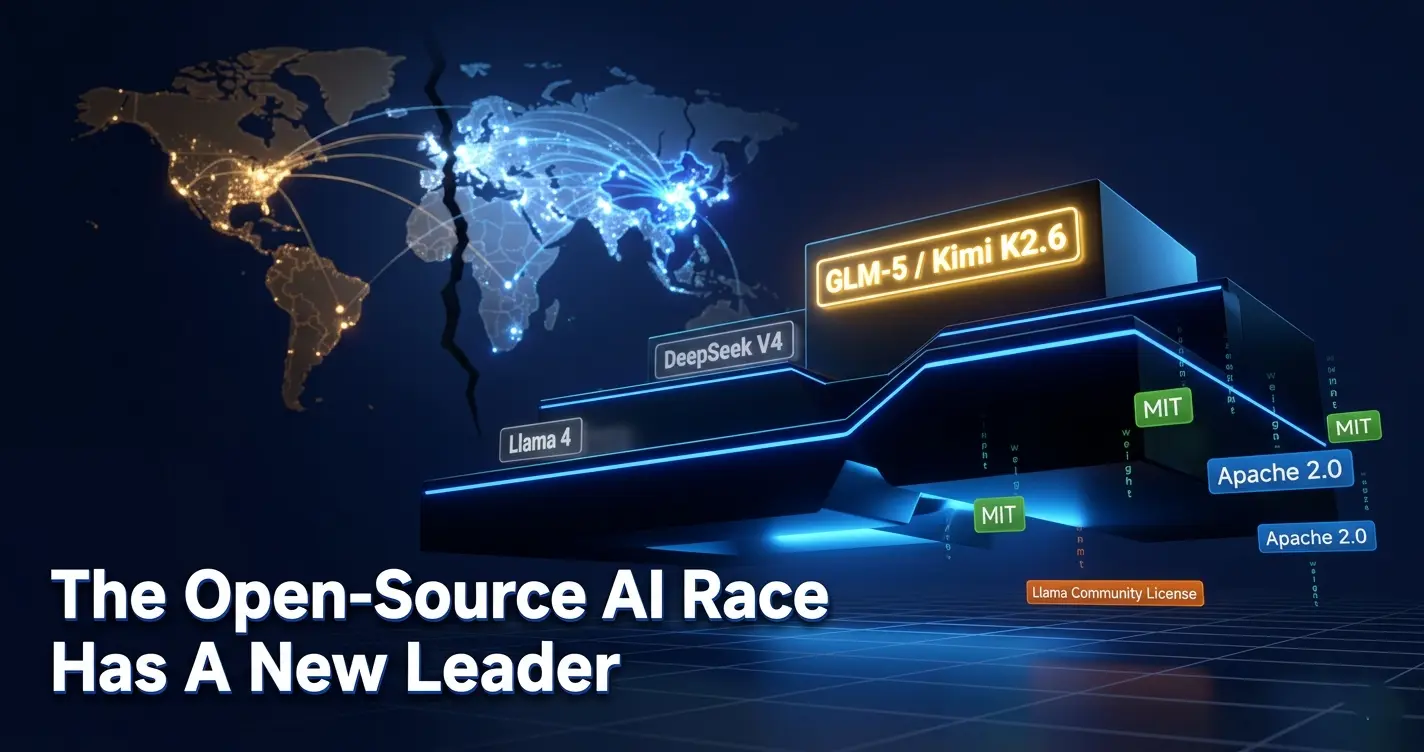
The dominant assumption, that the most powerful AI models were locked behind corporate paywalls, structurally collapsed in 2026. Today, developers worldwide can download frontier-grade open source AI models, run them on their own hardware, and ship products without paying per token. The race isn’t closed vs. open anymore. It’s about which open model fits your stack.
This is the complete, ranked list of the best open source AI models in 2026, every entry verified against live benchmarks, with real architecture specs, confirmed licenses, and practical guidance on how to run each one.
2.2M+
Models on Hugging Face
41%
HF downloads from Chinese labs
~3 mo
Open vs. closed frontier lag
62.8%
Open models’ market share
How the Open-Source Gap Closed | and Then Vanished
At the end of 2023, the best closed AI model scored roughly 88% on MMLU while the best open model managed about 70.5%. A real gap. Real consequences for developers choosing their stack. By early 2026, Epoch AI’s analysis found that open-weight models now trail the state-of-the-art by roughly three months on average, down from nearly a year in late 2024.
The inflection point was January 2025. DeepSeek R1 dropped, went viral globally, and demonstrated that a Chinese lab could match GPT-4-class performance at a fraction of the training cost. It triggered a cascade: Chinese labs, Alibaba, Moonshot, MiniMax, Xiaomi, Ant Group, started open-sourcing at scale. What followed was the most concentrated release window in AI history: between January and May 2026, at least eight frontier-class open models shipped in a single six-week period.
This changes who can build products, who owns their data pipeline, and how organizations think about vendor risk. If you’re still defaulting to a closed-source API because “the open options aren’t good enough,” you’re working from 2024 assumptions.
Tier 1: Frontier Open-Weight Models (May 2026)
These are the models competing directly with GPT-4o, Gemini 2.5 Pro, and Claude Sonnet, not in a “for open source” category, but overall. Ranked by the Artificial Analysis Intelligence Index where available, cross-referenced with SWE-bench Verified for engineering tasks.
GLM-5 is the highest-ranked open-weight model as of April 2026, the first to reach a score of 50 on the Artificial Analysis Intelligence Index. Its 77.8% SWE-bench Verified result is the strongest open-model coding result on record. Notably, it was trained entirely on Huawei Ascend chips with zero Nvidia dependency, which matters for any org tracking hardware supply chain risk.
Best for: Enterprise agentic engineering, long-horizon coding pipelines
Kimi K2.6 tops the neutral Artificial Analysis Index at 54 among open models, placing it fourth globally including closed models. It uses Multi-head Latent Attention (MLA) for efficient long-context handling and sets a new open-source bar on complex, end-to-end agentic coding. For multi-agent pipelines where you need a capable orchestrator without paying per-token, this is currently the strongest option.
Best for: Agent swarms, agentic workflows, complex multi-step coding
DeepSeek V4 Pro leads raw coding benchmarks at 83.7% SWE-bench Verified, matching the closed frontier. V4 Flash brings that capability down to $0.14 input / $0.28 output per million tokens, among the cheapest frontier-class inference available anywhere. The 1M token context window makes it the practical choice for full-codebase analysis without chunking. (Training code is not fully public, so treat it as open-weight, not fully open-source.)
Best for: Million-token agent traces, cost-sensitive production, software engineering tasks
Llama 4 Scout / Maverick Meta AI
Llama 4 Community License
109B MoE10M token context windowNative multimodal
Ten million tokens. While closed-source models are celebrating 1M context windows, Meta’s Llama 4 Scout ships with a 10M token context window, making it the only model where you can analyze an entire codebase or a decade of financial reports in a single pass. Maverick handles multimodal tasks natively. The catch: the Llama 4 Community License restricts commercial use above 700M monthly active users and prohibits training competing models. Most developers are unaffected, but read it before deploying at scale.
Best for: Ultra-long context, multimodal tasks, large codebase analysis
Qwen 3.5 / Qwen3-Coder Alibaba
Apache 2.0
397B total · 17B active201 languages1M token contextQwen3-Coder: 480B MoE
Qwen 3.5 (released February 2026) is a native vision-language model supporting 201 languages, the broadest language coverage of any open-weight frontier model. The Qwen family has crossed 700 million downloads on Hugging Face and spawned over 113,000 derivative models, creating what is effectively the Linux base layer of open AI. Qwen3-Coder, a 480B MoE model with 35B active parameters, is the specialist variant built for agentic coding pipelines.
Gemma 4 is the sole Western entry in the top tier of open-weight models by benchmark performance as of April 2026. Built on the same underlying research as Gemini 3, it adds native function calling, structured JSON output, and system instruction support, the full toolkit for building local AI agents that interact with external APIs without touching a cloud. The Apache 2.0 license removes every commercial restriction. For developers who need frontier capability on-device or at the edge, Gemma 4 31B is the safest commercial bet available.
Best for: Local deployment, edge devices, mobile developers, commercial use
Mistral Small 4 / Medium 3.5 Mistral AI
Apache 2.0
Function callingJSON outputReasoning modeEU sovereign AI
For European organizations navigating data sovereignty requirements or the EU AI Act’s August 2026 enforcement window, Mistral remains the primary answer. Both models run with full production-grade function calling and JSON output under Apache 2.0. Medium 3.5 adds a reasoning mode for tasks requiring multi-step inference.
Best for: Production agents, European sovereign AI deployments, regulated industries
MiMo-V2.5-Pro & MiniMax-M2.7 Xiaomi · MiniMax
Apache 2.0
MiMo: AA Index 54MiniMax: 10B activeCheapest frontier inference
MiMo-V2.5-Pro from Xiaomi ties Kimi K2.6 at an Artificial Analysis Index score of 54 with a cleaner Apache 2.0 license, a direct alternative for teams with legal requirements that exclude MIT-licensed models. MiniMax-M2.7 is open-weighted on Hugging Face and offers among the cheapest frontier-class inference of any model in this list, making it a strong pick for cost-sensitive high-volume deployments.
Best for: Cost-sensitive production, high-volume inference, teams requiring Apache 2.0
R1 dominates MATH-500 at 97.3%, near-perfect mathematical reasoning from an open-weight model. The chain-of-thought architecture makes every intermediate step visible, which matters for research workflows where you need to audit reasoning, not just results. The 7B and 32B variants run on consumer hardware; the 671B version requires serious infrastructure but delivers closed-frontier-equivalent reasoning.
Best for: Chain-of-thought reasoning, math, scientific research, auditable inference
Full Comparison: Open Source AI Models 2026
Model
Lab
License
AA Index
SWE-bench
Context
Best Use
GLM-5.1
Zhipu / Z.ai
MIT
50
77.8%
128K
Agentic coding
Kimi K2.6
Moonshot AI
MIT
54
58.6%
1M+
Agent swarms
DeepSeek V4 Pro
DeepSeek
MIT
—
83.7%
1M
Coding, long-context
Llama 4 Scout
Meta
Community
—
—
10M
Ultra-long context
Qwen 3.5
Alibaba
Apache 2.0
—
—
1M
Multilingual
Gemma 4 31B
Google DM
Apache 2.0
—
—
128K
Local / edge
MiMo-V2.5-Pro
Xiaomi
Apache 2.0
54
—
—
Commercial agents
MiniMax-M2.7
MiniMax
Apache 2.0
—
—
—
Low-cost inference
DeepSeek R1 671B
DeepSeek
MIT
—
—
128K
Math / reasoning
Phi-4-mini
Microsoft
MIT
—
—
16K
Edge / low VRAM
Mistral Medium 3.5
Mistral AI
Apache 2.0
—
—
128K
EU sovereign AI
Ring-2.6-1T
Ant Group
—
—
—
—
Enterprise (China)
Specialized & Domain-Specific Models
Frontier general-purpose models aren’t always the right tool. These models own specific domains:
Qwen3-Coder-480B-A35B, The dedicated agentic coding specialist. 480B MoE, 35B active, 256K native context. Strongest single-purpose coding architecture available open-weight.
DeepSeek V3.2-Speciale, Achieved gold-medal performance at IMO 2025 and IOI 2025. If your workload involves competition-level mathematical or algorithmic reasoning, nothing else comes close.
Sarvam 30B / 105B (Sarvam AI), Trained from scratch in India, Apache 2.0, built specifically for Indian language workloads. Critical for any India-focused deployment.
OLMo 2 (Allen Institute for AI), The transparency benchmark. Fully open-source: weights, data, training code, and evaluation regime are all public. Use this when reproducibility and auditability matter more than raw performance.
GPT-OSS (OpenAI), OpenAI’s first Apache 2.0 open-source model. Historically significant; positioned as the US lab response to Chinese open-weight dominance.
SmolLM3-3B (Hugging Face), Sub-3B efficiency leader. Runs on CPU. The pick for embedded, offline, or constrained-resource deployments.
Llama 3.3 70B, Enterprise instruction-following workhorse. Proven at scale, well-documented, strong ecosystem of fine-tunes and tooling.
The Licensing Reality: “Open Source” Is Not One Thing
“If you keep using ‘open source’ as a single binary label, you will make bad procurement decisions, bad architecture decisions, and occasionally a bad legal decision that you discover only after you have traction. In AI, openness is multi-layered, the trained parameters, data mixture, training pipeline, evaluation regime, even system prompts, and different layers create different freedoms and different risks.”
— Turing Post, “Mastering Open Source AI in 2026”
This is the most important critical point in this entire article. Most models on this list are open-weight, not open-source. The parameters are downloadable, but training data, recipes, and safety evaluations are closed. The distinction has real legal and operational consequences.
OSI-Compliant Frontier Models (as of May 2026)
If your legal team mandates fully OSI-approved licenses, your shortlist is now substantial, clean licensing is no longer a reason to default to closed-source APIs:
✅ Clean License Shortlist
MIT: DeepSeek V4, DeepSeek R1, GLM-5.1, Kimi K2.6, Phi-4-mini
Apache 2.0: MiMo-V2.5-Pro, MiniMax-M2.7, Qwen 3.5, Qwen3-Coder, Gemma 4, Mistral Small 4, Mistral Medium 3.5, Sarvam 30B/105B, OLMo 2, GPT-OSS
Restricted (read before deploying): Llama 4 (Community License, 700M MAU cap, no competing model training)
The Benchmark Problem: Read This Before You Trust Any Score
“MMLU and MMLU-Pro are functionally saturated above 88% for frontier AI models, making score differences at the top statistically meaningless. Enterprise agentic AI systems show a 37% gap between lab benchmark scores and real-world deployment performance, with 50x cost variation for similar accuracy.”
— Kili Technology, AI Benchmarks Guide 2026
Every benchmark score in this article should carry an asterisk. Kili Technology’s 2026 analysis documents data contamination, benchmark gaming, and annotation error rates above 50% at the frontier. A model scoring #1 on SWE-bench today may underperform a #5-ranked model on your specific production workload.
The safety research organization METR adds a more fundamental warning:
“Benchmarks run without live human interaction can cause models to fail at tasks they could complete with minimal human guidance, making benchmarks unreliable proxies for real capability.”
— METR (Model Evaluation & Threat Research), Experienced Developer Study, July 2025
⚠️ The 37% Rule
Enterprise agentic AI systems show a 37% gap between lab benchmark scores and real-world deployment performance. Before committing to any model for production, benchmark it on your workload, not the published leaderboard numbers.
How to Run Open Source AI Models Locally
Late 2025 was when local inference tooling reached production-grade stability. Ollama, LM Studio, and llama.cpp are now reliable enough for serious workloads. The cost argument is blunt: running a local 13B model costs approximately $0 in compute per day versus $30–60/month for an equivalent cloud API.
Single-command local deployment (Ollama)
# Qwen 3.5 8B — runs on a 24GB consumer GPU
ollama run qwen3:8b

# Gemma 4 26B MoE — strong multimodal, runs on single 4090
ollama run gemma4:26b

# DeepSeek R1 32B — chain-of-thought reasoning
ollama run deepseek-r1:32b

# Phi-4-mini — CPU-only friendly, sub-4GB RAM
ollama run phi4-mini
Hardware requirements at a glance
Model Size
Min VRAM
Recommended Hardware
Example Models
1B–4B
4GB
Any modern GPU / CPU
SmolLM3-3B, Phi-4-mini
7B–8B
8GB
RTX 3060 / M2 Mac
Qwen3:8B, Llama 3.3 8B
13B–27B
16–24GB
RTX 4090 / A100
Gemma 4 26B, DeepSeek R1 32B
70B
80GB
2× A100
Llama 3.3 70B
400B–1T MoE
Multi-node
4–8× H100
DeepSeek V4, Kimi K2.6
For the frontier MoE models (DeepSeek V4, Kimi K2.6, GLM-5), the practical option for most teams is hosted inference via providers like Fireworks AI, Together AI, or the model labs’ own APIs, at dramatically lower cost than equivalent closed-source options.
The Geopolitical Dimension: Four of Five Top Models Are Chinese
The most striking pattern in 2026: GLM-5, Kimi K2.6, DeepSeek V4, Qwen 3.5, MiMo-V2.5-Pro, MiniMax-M2.7, Ring-2.6-1T, four of the five top-ranked open-weight models come from Chinese labs. Chinese organizations now account for 41% of all downloads on Hugging Face, with Baidu going from zero releases to over 100 in 2025, and ByteDance and Tencent each increasing releases eight to nine times.
This is a reversal from 2024, when Meta’s Llama 3.1 405B was the clear open-weight leader. Google’s Gemma 4 is the sole Western entry in the current top tier. OpenAI’s GPT-OSS, AI2’s OLMo, and Meta’s Llama are the visible Western responses, but the gap is real and current.
🌐 Supply Chain Risk to Track
GLM-5’s training on Huawei Ascend chips illustrates the hardware dimension of this shift. Developers building on Chinese open-weight models face potential export control, data sovereignty, and supply chain risks that didn’t exist in the 2023–2024 open-source landscape. The EU AI Act’s August 2026 phased enforcement adds a compliance layer for European deployments. This doesn’t disqualify any model, but it belongs in your architecture review.
Our read: the geographic rebalancing is likely to accelerate. The competitive pressure is driving significant Western investment in open alternatives, which benefits everyone building on open-weight infrastructure.
Frequently Asked Questions
What is the best open source AI model in 2026?
As of May 2026, Kimi K2.6 (Moonshot AI) ranks #1 among open-weight models on the Artificial Analysis Intelligence Index with a score of 54, placing it #4 globally including closed models. For coding specifically, DeepSeek V4 Pro leads with 83.7% on SWE-bench Verified. For local deployment with clean licensing, Google’s Gemma 4 under Apache 2.0 is the top commercial-safe choice. The right answer depends on your use case, this article’s comparison table maps each model to its strongest application.
What is the difference between open source and open weight AI models?
Open-source AI means the model’s code, weights, training data, and methodology are all publicly available, like OLMo 2 from Allen AI. Open-weight models only release the trained parameters for download; training data and pipeline remain proprietary. Most models marketed as “open source” in 2026, including Llama 4 and DeepSeek, are technically open-weight. The distinction matters for compliance, reproducibility, and legal risk. Using it as a single binary label leads to bad procurement decisions.
Can I run open source LLMs locally in 2026?
Yes. Models up to 13B parameters run on a single consumer GPU with 24GB VRAM using Ollama or LM Studio. Gemma 4 26B and Qwen3:8B deploy with a single command. Sub-8B models including Phi-4-mini run on CPU-only systems. The cost argument is direct: running a local 13B model costs approximately $0 in daily compute versus $30–60/month for equivalent cloud API access. Frontier MoE models (DeepSeek V4, Kimi K2.6) require multi-GPU infrastructure or hosted inference.
Is DeepSeek open source?
Yes and no. DeepSeek V4 and R1 are released under the MIT license with no usage restrictions, freely downloadable and commercially usable. DeepSeek V4 supports a 1M token context window. However, the training code and data are not fully public, making it technically open-weight rather than fully open-source under the OSI definition. For most developer use cases, the distinction is irrelevant. For research reproducibility, it matters.
Is Llama 4 fully open source?
No. Meta’s Llama 4 uses the Llama 4 Community License, which restricts commercial use above 700M monthly active users and prohibits using the model to train competing AI systems. The weights are freely downloadable for most use cases, but it is not open-source under the OSI definition. For unrestricted commercial deployment, Apache 2.0 alternatives like Gemma 4, Qwen 3.5, or Mistral are cleaner choices.
Which open source AI model is best for coding in 2026?
For enterprise agentic coding: DeepSeek V4 Pro (83.7% SWE-bench Verified) and GLM-5 (77.8%) lead all open-weight models. For agent orchestration: Kimi K2.6. For local single-GPU coding: Qwen3.6-35B-A3B. For clean Apache 2.0 licensing with strong coding: Gemma 4 31B. Always benchmark on your actual workload, the 37% gap between leaderboard scores and real-world performance is documented and significant.
What open source AI models can run without a GPU?
Sub-8B models, including Phi-4-mini-instruct, SmolLM3-3B, and Qwen3:8B, run on CPU-only systems at usable latency. For faster CPU-only performance, quantized GGUF builds via llama.cpp reduce memory requirements significantly. Expect slower response times than GPU inference, but fully functional for moderate workloads like document analysis, summarization, or local chat.
What to Watch: The Next 6–18 Months
The open-source AI models list in 2026 represents a structural shift, not a trend. The capability gap with closed models has closed to roughly three months. Clean licensing covers the frontier. Local inference is viable on consumer hardware. The cost argument for closed APIs has narrowed to convenience, not capability.
Here’s what changes next:
EU AI Act enforcement (August 2026), High-risk open-weight deployments in healthcare, finance, and HR face immediate compliance requirements for audit trails and explainability. If you’re building in those domains, the EU AI Act compliance deadline is not abstract.
The 10M-context inflection, Llama 4 Scout’s 10M token window is a preview of where the entire tier moves. Full-organization knowledge retrieval, decade-scale document analysis, and end-to-end codebase reasoning without chunking will be baseline capability by late 2026.
Western lab responses, GPT-OSS, OLMo 2’s next iteration, and increased Gemma investment are responding directly to Chinese open-weight dominance. The competitive pressure is real and likely to accelerate open-model quality across all labs.
Three specific actions to take this week:
Run ollama run qwen3:8b or ollama run gemma4:26b locally and benchmark it on one real task from your current workflow.
Read your model’s license beyond the headline label, especially if you’re using Llama 4 or building a product with traction.
For any agentic pipeline decision: test Kimi K2.6 and DeepSeek V4 Pro head-to-head on SWE-bench Pro with your actual prompts before committing to an architecture.
Stay Ahead of the Next Wave
Get the Neural Loop — NeuralWired’s weekly briefing on AI models, research, and what it means for developers building right now.
Subscribe to The Neural Loop →
GPT-5 Capabilities: The Complete Technical Guide for Developers & Founders
Everything that actually matters about OpenAI’s flagship model — benchmarks, pricing, hallucinations, and what it means for your product in 2025–2026.
NeuralWired Research Desk
|
May 28, 2026
|
18-min read
GPT-5 CapabilitiesDeveloper GuidePricing Alert
On August 7, 2025, OpenAI didn’t just release a new model. It collapsed its entire model portfolio into one, and then the flagship feature broke on launch day. Nine months later, GPT-5 is the engine behind 900 million weekly active users and a $25 billion revenue run rate. This guide separates what GPT-5 actually delivers from what OpenAI wants you to believe it delivers.
By NeuralWired Research Desk · Updated May 28, 2026
What Is GPT-5?
GPT-5 is OpenAI’s flagship large language model, released on August 7, 2025 at 10AM PT. It’s available across ChatGPT (all user tiers), the OpenAI API platform, and the GitHub Models Playground.
The defining architectural move: GPT-5 is a unified system, a single model that houses a fast conversational sub-model for routine queries and a deep reasoning sub-model (“GPT-5 Thinking”) for complex tasks. A real-time router decides which mode engages, based on query complexity, tool requirements, and signals like a user typing “think carefully about this.”
Before GPT-5, users had to manually choose between the GPT-4o series (fast, conversational) and the o-series reasoning models (o1, o3, slower, more accurate on math and science). GPT-5 eliminates that decision entirely. Or it was supposed to, the router malfunctioned on launch day, which we’ll get to.
“It’s like talking to an expert. A legitimate, PhD-level expert in any area you need.”
Sam Altman, CEO, OpenAI, Pre-recorded press briefing, August 7, 2025
That PhD-level framing maps to specific benchmarks: 88.4% on GPQA Diamond (graduate-level science) and 67.2% on HealthBench (medical conversations). The claim isn’t hype without data. Whether the data holds up in your production environment is a different question.
94.6%
AIME 2025 Math
74.9%
SWE-bench Verified
88.4%
GPQA Diamond Science
88%
Aider Polyglot Coding
84.2%
MMMU Multimodal
67.2%
HealthBench Medical
GPT-5 Benchmark Scores: The Complete Breakdown
Benchmarks are the language enterprises use to justify procurement and the numbers engineers use to set expectations. Here’s what GPT-5 actually scored, source-attributed, with methodology noted.
Benchmark
GPT-5 Score
What It Measures
Why It Matters
AIME 2025
94.6%
High school olympiad mathematics
Stumps most adults. Signals deep reasoning without tools.
SWE-bench Verified
74.9%
Real-world software engineering (bug-fixing)
GPT-4.1 scored 54.6% four months earlier — a 20-point jump.
Aider Polyglot
88%
Cross-language coding ability
Multi-language production relevance for full-stack teams.
GPQA Diamond
88.4%
PhD-level physics, chemistry, biology
Curated to be hard even for the PhDs who wrote the questions.
MMMU
84.2%
Multimodal understanding
Image + text reasoning for document-heavy workflows.
HealthBench
67.2%
Clinical conversation quality
Benchmark for medical AI deployments in regulated settings.
The SWE-bench figure deserves special attention. OpenAI’s developer page documents the trajectory: GPT-4o scored 33.2%, GPT-4.1 reached 54.6%, and GPT-5 hit 74.9%, all within a 12-month window. For engineering teams, that isn’t a benchmark number. That’s the delta between “AI assists with code” and “AI autonomously closes GitHub issues.”
Key Insight
GPT-5’s token efficiency is a hidden financial story. OpenAI reports 50–80% fewer output tokens than o3 for equivalent performance, meaning if your pipeline previously ran on o3, switching to GPT-5 can cut token costs roughly in half before factoring in any price-per-token differences.
How GPT-5 Differs from GPT-4o and o3
The simplest framing: GPT-5 is what you’d get if GPT-4o and o3 had a child that also knew when to think slowly.
GPT-4o was fast and conversational. o3 was slow and brilliant at math and science. Users had to choose between them depending on the task, a friction point that caused constant miscategorization. GPT-5’s real-time router eliminates that choice.
Three concrete differences that change day-to-day developer experience:
No manual model selection. The router decides whether to engage fast or deep reasoning based on query complexity. In practice, this works better for ambiguous tasks than users tended to perform at self-selection.
45% fewer factual errors than GPT-4o in OpenAI’s internal testing. In reasoning mode, the figure climbs to 80% fewer errors versus o3. (Independent validation is mixed, see Section 7.)
Front-end web development outperforms o3 70% of the time in OpenAI’s internal evaluations. For developers doing full-stack work, that’s not marginal, that’s a genuine first-pass quality shift.
⚠ Launch Day Reality Check
The routing feature — GPT-5’s central innovation, malfunctioned on August 7, 2025. The flagship technical differentiator did not function correctly on day one. Additionally, OpenAI published benchmark bar charts that visually contradicted their own numerical data: the “coding deception” chart showed GPT-5 with a shorter bar than o3, despite GPT-5’s lower number indicating better performance. InfoQ documented both issues in detail. OpenAI issued corrections. Both errors raised legitimate questions about internal quality control for the company’s most important launch in two years.
GPT-5 API Pricing: What You’ll Actually Pay
This is the section that should be pinned to every startup’s engineering Slack. GPT-5 launched at a price point that made it seem like the cost curve was finally working in developers’ favor. What happened next was not that.
Model Version
Release Date
Input (per 1M tokens)
Output (per 1M tokens)
GPT-5 (launch)
August 7, 2025
$1.25
$10.00
GPT-5.4
~March 2026
$2.50
—
GPT-5.5 (“Spud”)
April 23, 2026
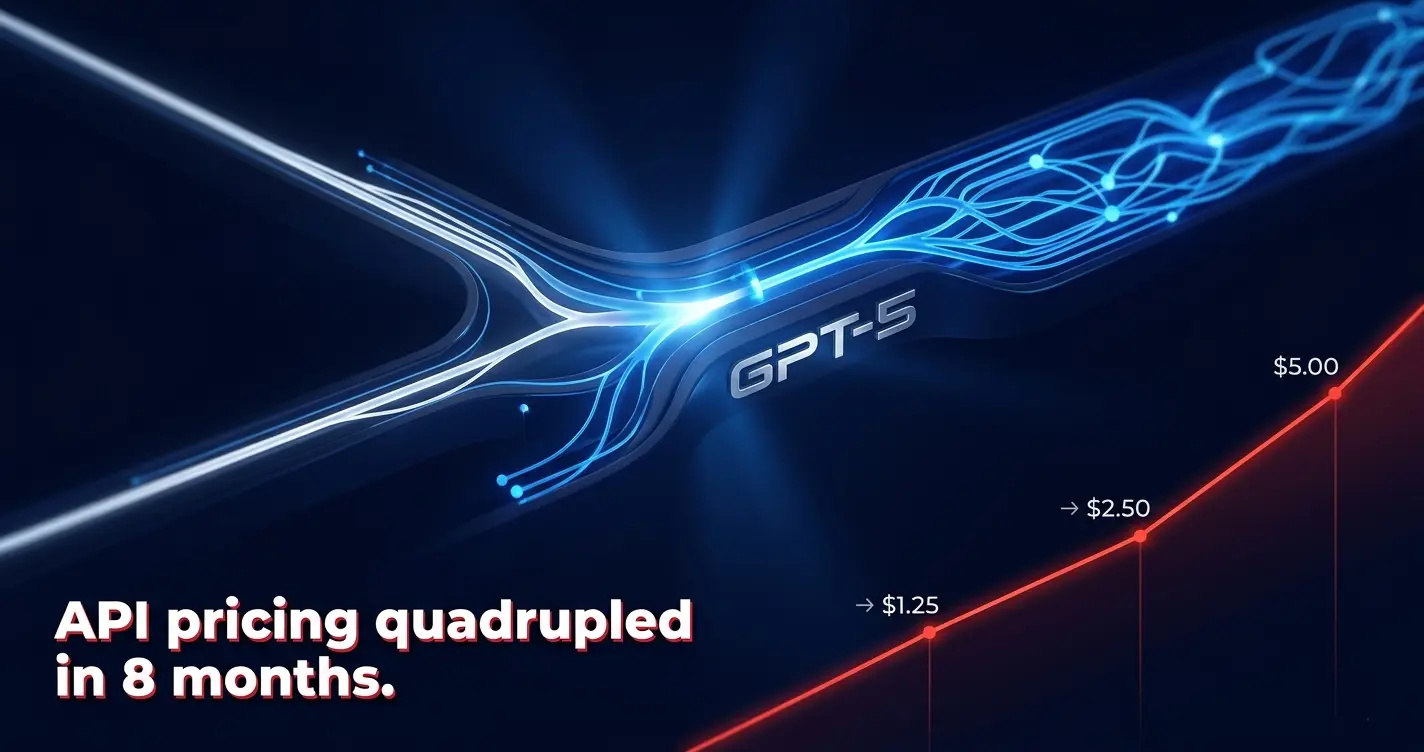
$5.00
$30.00
API input pricing quadrupled in eight months. Output pricing tripled. During the same period, NVIDIA CEO Jensen Huang stated that hardware costs per inference token dropped approximately 35×. OpenAI’s pricing trajectory is not following infrastructure economics. It’s following market demand and competitive positioning.
Any product with significant token throughput that was budgeted at $1.25/M input is now facing 4× the cost if it has migrated to current models. That’s not a price increase, it’s a category change in unit economics.
NeuralWired Research Desk analysis, May 2026
For ChatGPT users: Plus ($20/month) includes GPT-5 with usage limits on thinking-mode messages. Pro ($100–$200/month, restructured from launch’s $200 flat) includes GPT-5 Pro with extended reasoning and no token budget restriction. Ed Zitron, tech critic and writer, framed the launch bluntly:
“Meaningful functionality… is being completely removed for ChatGPT Plus and Team subscribers.”
Ed Zitron, Technology Critic — “Where’s Your Ed At” newsletter, August 2025, via Voiceflow
Our read: Zitron’s critique is specifically about model-selection removal and rate limits, not raw capability. Both things can be true, GPT-5 is technically more capable than GPT-4o, and Plus users received fewer choices with the upgrade. Whether that trade is acceptable depends entirely on your use case.
GPT-5 Context Window and Technical Specs
Parameter
GPT-5 (August 2025)
GPT-5.5 (April 2026)
Context Window
400,000 tokens
1,050,000 tokens (1M+)
Max Output
128,000 tokens
—
Knowledge Cutoff
September 2024
—
Latency (tokens/sec)
~77.7 (Artificial Analysis)
—
Training Infrastructure
Microsoft Azure AI supercomputers
Distribution at Launch
ChatGPT, OpenAI API, GitHub Models, Agents SDK
The 400K context window matters for enterprise document workflows, processing full legal contracts, entire codebases, or multi-year financial filings in a single call. GPT-5.5’s 1M+ token context is available via the API and makes whole-repository code analysis practically viable for the first time in the OpenAI stack.
GPT-5 vs Claude and Gemini
The short answer: neither model is comprehensively superior. Benchmark leadership is task-specific, and it’s shifting faster than procurement cycles can track.
Benchmark
GPT-5.5 (Apr 2026)
Claude Opus 4.7 (Apr 2026)
Leader
Terminal-Bench 2.0
82.7%
69.4%
GPT-5.5
ARC-AGI-2
85.0%
75.8%
GPT-5.5
SWE-Bench Pro
58.6%
64.3%
Claude Opus 4.7
The competitive moat OpenAI held during the GPT-4 era has narrowed materially. Artificial Analysis scores GPT-5 at 45/100 on their Intelligence Index — above most models but not the categorical lead OpenAI commanded in 2023. ChatGPT’s US mobile app daily active user share fell from 69.1% in January 2025 to 38.7% by May 2026. Anthropic’s Claude app went from under 2% to 10% DAU share in three months.
GPT-5 is still the market leader by revenue and user count. It isn’t the unchallenged technical leader on every dimension.
Does GPT-5 Still Hallucinate?
Yes. Less than before — but the gap between what OpenAI claims and what independent testers find is real and worth understanding before you deploy in a regulated environment.
OpenAI’s claim: 45% fewer factual errors versus GPT-4o; 80% fewer errors in reasoning mode versus o3.
Independent testing: Vectara found GPT-5.2 had an 8.4% hallucination rate in their methodology, trailing DeepSeek. OpenAI’s own figure for GPT-5.2 was a reduction from 8.8% to 6.2%: a more modest 30% improvement, not the dramatic leap marketing suggested.
PCMag’s Ruben Circelli, who reviewed GPT-5 against real-world production tasks rather than benchmark conditions, was direct:
“GPT-5 is an ‘insignificant update.’ While it has some upgrades, it ‘doesn’t solve the problems that actually matter’ and he has not ‘noticed a significant improvement’ in areas like hallucination reduction.”
Ruben Circelli, Senior Analyst, PCMag — August 2025, via Voiceflow
That’s the practitioner gap: benchmark-measured hallucination uses controlled scenarios with defined correct answers. Production use involves open-ended, ambiguous queries where the model can’t know what it doesn’t know. GPT-5 is more reliable than GPT-4o. It’s not hallucination-free. Deploy accordingly.
One genuinely encouraging signal: a peer-reviewed study by Polat et al. (six MDs across four Turkish hospitals, published November 2025 in Letters to the Editor, NCBI) concluded that GPT-5’s measurable reduction in hallucination rates represents a meaningful milestone for medical and scientific writing, one of the first published academic assessments from clinical practitioners in a domain where errors cost lives. That’s cautious optimism, not a blanket clearance.
GPT-5 for Developers: Coding, Agents, and the Agents SDK
If you’re building software with or on AI, GPT-5 changes three things materially, and creates one significant risk.
What changes in practice
74.9% SWE-bench means autonomous issue resolution, not just code suggestions. At GPT-4o’s 33.2%, AI-assisted coding meant “AI suggests, human implements.” At 74.9%, the model can autonomously close real GitHub issues in verified test conditions. Combined with the Agents SDK (which provides orchestration, tracing, and MCP connectivity to external tools like CRM, payment, and support systems), multi-step autonomous pipelines are production-grade for the first time.
GPT-5 beats o3 at front-end web development 70% of the time. For developers doing full-stack work, that’s not marginal assistance, it’s output-quality output at first pass. The net result is that senior engineering time spent on routine implementation patterns (API integrations, UI scaffolding, documentation) can shift toward architecture and review.
What to do right now
Audit your current stack for tasks that consume disproportionate senior engineering time but follow a pattern: bug triage, code review, documentation, API integration. These are GPT-5’s highest-ROI targets. Evaluate the Agents SDK as an integration layer before building a custom orchestration system from scratch.
The risk you need to price in
⚠ API Pricing Risk
API pricing quadrupled from August 2025 to April 2026. Any product budgeted at GPT-5 launch pricing with significant token throughput is now 4× the cost if it has migrated to current models. Build pricing escalation assumptions into any business case that relies on the GPT-5 stack. A multi-vendor or open-source fallback strategy isn’t optional caution at this point — it’s basic financial hygiene.
GPT-5 for Founders: What Changes in Your Build-vs-Buy Decisions
The uncomfortable truth: GPT-5 compressed the moat of a large class of AI startups in a single launch. If your competitive advantage was “we built a better AI wrapper,” that advantage has narrowed to the point where you need to name what specifically you still do better than the base model.
The opportunity is real too. Enterprise deployments at GPT-5 launch included Morgan Stanley (financial workflows), Amgen (scientific research), and T-Mobile (customer operations). Fortune 500 procurement of AI tools has accelerated. If you serve any of those verticals, GPT-5 integration is now a procurement requirement, not a differentiator.
42% of new SaaS platforms with AI capabilities launched in 2025 relied on OpenAI models. That means GPT-5 is infrastructure. The differentiation layer has shifted up the stack, to proprietary data, domain-specific fine-tuning, and integration quality. Prompt engineering alone isn’t a moat anymore. It arguably never was, but GPT-5 made that unavoidable.
Founder Action Item
Invest now in proprietary data pipelines and fine-tuning infrastructure. The competitive question for any AI-native product is no longer “is our model good?”, it’s “do we have data the base model doesn’t?” That’s where defensible differentiation now lives.
The Skeptic’s Case: What GPT-5 Doesn’t Solve
Balanced coverage means saying the things OpenAI’s press releases don’t.
The AGI framing is marketing
Sam Altman’s description of GPT-5 as offering “PhD-level expertise” maps directly to one benchmark: GPQA Diamond. In controlled academic tests with defined answers, GPT-5 performs at a PhD level on scientific knowledge retrieval. On open-ended reasoning chains involving novel problems, ambiguous real-world data, or multi-domain synthesis, it remains significantly below expert human performance.
GPT-5 performs comparably to or better than human experts in roughly half of cases across 40+ occupations. That means it performs worse than human experts in the other half. At NeurIPS 2025, only 2 of 5,000 papers mentioned AGI. Prominent researchers including Demis Hassabis have emphasized that scaling transformers hits a cognitive scaling wall, current paradigms require paradigm-level innovation, not just larger models, to reach genuine general intelligence.
Agentic reliability isn’t solved yet
GPT-5’s agentic capabilities are real. The reliability math is not flattering for complex pipelines. A 95% success rate per tool call yields approximately 60% end-to-end success over 10 sequential steps. Enterprises deploying GPT-5 agents in customer-facing workflows without robust human-in-the-loop checkpoints are assuming a reliability threshold the model doesn’t yet consistently meet.
Regulatory exposure in regulated sectors
GPT-5’s use in healthcare, legal, and financial services creates EU AI Act exposure. OpenAI hasn’t published a conformity assessment for GPT-5 under the Act’s high-risk provisions. Companies deploying it in these domains are accepting compliance risk that OpenAI itself hasn’t fully addressed publicly. If you’re a CTO in a regulated vertical, that’s not a footnote, it’s a procurement risk factor that belongs in your security review.
The GPT-5 Model Family: From 5.1 to 5.5
GPT-5 is not a single model, it’s an ongoing release cadence. Five significant versions shipped in the nine months after launch.
Coding and agentic focus, front-end design improvements
GPT-5.5 “Spud”
April 23, 2026
1M+ token context, Terminal-Bench 2.0 at 82.7%, API pricing doubled from 5.4
The pace is deliberate. Sam Altman reportedly referred to GPT-5.5 as “the last big milestone before AGI” in internal remarks reported by the Financial Times in April 2026. Read carefully: that statement describes the current training paradigm having one or two more generations of runway before requiring a fundamental architectural shift, not a claim that AGI is imminent. It’s being read by many outlets as a promise it isn’t.
Our read: the GPT-5 series demonstrates that OpenAI has internalized the launch-iterate model from consumer software. The implication for anyone building on it is that the model you ship against today may be meaningfully different in six months, for better (capability) and worse (pricing).
Frequently Asked Questions
What is GPT-5?
GPT-5 is OpenAI’s flagship large language model, released August 7, 2025. It’s a unified system combining a fast conversational sub-model and a deep reasoning sub-model, with an automatic router that selects the right mode per query. It powers ChatGPT by default and is available via the OpenAI API. GPT-5 sets leading benchmarks in math (94.6% AIME 2025), coding (74.9% SWE-bench), and science (88.4% GPQA Diamond).
How is GPT-5 different from GPT-4o?
GPT-5 unifies GPT-4o’s conversational speed with the o-series reasoning models into one system, eliminating manual model selection. It reduces factual errors by 45% compared to GPT-4o, scores 20 percentage points higher on SWE-bench (74.9% vs. GPT-4o’s ~54%), and introduces a real-time routing system that decides when to engage deeper reasoning without user input.
What are GPT-5’s benchmark scores?
GPT-5’s official benchmark scores: 94.6% on AIME 2025 (advanced math), 74.9% on SWE-bench Verified (software engineering), 88% on Aider Polyglot (coding), 84.2% on MMMU (multimodal), 88.4% on GPQA Diamond (PhD-level science, Pro reasoning), and 67.2% on HealthBench (medical). Published by OpenAI at launch, August 2025.
How much does GPT-5 cost via the API?
GPT-5 launched at $1.25/M input tokens and $10/M output tokens (August 2025). Pricing escalated significantly: GPT-5.4 (March 2026) costs $2.50/M input; GPT-5.5 (April 2026) costs $5.00/M input and $30/M output, a 4× input increase in eight months. ChatGPT Plus ($20/month) includes access with usage limits; ChatGPT Pro ($100–$200/month) includes GPT-5 Pro with full extended reasoning.
What is GPT-5’s context window?
GPT-5 launched with a 400,000-token context window and a maximum output of 128,000 tokens per response. Knowledge cutoff is September 2024. GPT-5.5 (April 2026) extended the context window to over 1,050,000 tokens (1M+) via the API, making whole-repository code analysis and large-document processing viable in a single call.
Is GPT-5 better than Claude?
It depends on the task. GPT-5.5 leads Claude Opus 4.7 on Terminal-Bench 2.0 (82.7% vs. 69.4%) and ARC-AGI-2 (85.0% vs. 75.8%). Claude Opus 4.7 leads on SWE-Bench Pro (64.3% vs. 58.6%). Neither model is comprehensively superior, and benchmark leadership is shifting faster than it has at any prior point in the LLM competitive cycle.
Does GPT-5 still hallucinate?
Yes, less than before, but not eliminated. OpenAI reports 45% fewer errors versus GPT-4o. Independent testing by Vectara found an 8.4% hallucination rate in GPT-5.2. PCMag reviewers reported no significant improvement in real-world use. The gap between benchmark hallucination and production hallucination is real; GPT-5 is more reliable than its predecessors but not hallucination-free.
What is GPT-5 Pro?
GPT-5 Pro is the maximum-compute reasoning variant of GPT-5, exclusive to ChatGPT Pro subscribers ($100–$200/month as of April 2026). It enables extended “thinking” reasoning with no token budget restriction, producing more thorough answers on complex tasks. It scores higher than standard GPT-5 on GPQA Diamond (88.4%) and FrontierMath benchmarks.
When was GPT-5 released?
GPT-5 was officially released on August 7, 2025, at 10AM PT. OpenAI teased the launch the previous day via a post on X embedding the number “5” in the announcement text. The model launched simultaneously on ChatGPT (all user tiers), the OpenAI API platform, and the GitHub Models Playground.
What You Now Know | And Where This Goes Next
GPT-5 is the most commercially successful AI model ever released. It is also an imperfect product that malfunctioned on launch day, shipped benchmark charts that contradicted their own data, and has since quadrupled its API pricing while hardware costs fell 35×.
Both things are simultaneously true. The model is genuinely capable, 74.9% SWE-bench and 88.4% GPQA Diamond are not noise. The commercial moat is real, $25B+ ARR and 900 million weekly users are not accidents. And the operational risks are real: pricing escalation, benchmark-to-production hallucination gaps, regulatory exposure in high-risk sectors, and compounding error rates in agentic pipelines.
Three things to watch over the next 6–18 months:
The competitive parity story. Claude Opus 4.7 already leads on SWE-Bench Pro. Gemini 3.1 competes on multimodal benchmarks. ChatGPT’s US mobile market share is below 40% for the first time. GPT-5 may not hold the benchmark lead across all dimensions by the end of 2026.
The pricing ceiling. There’s no economic argument for API pricing increasing 4× in 8 months when inference costs are dropping. OpenAI is pricing against demand, not against cost. Watch for whether competition forces a reversal, or whether the market absorbs it.
Agentic deployment reliability. The gap between GPT-5’s agentic capabilities and production-grade reliability in multi-step autonomous pipelines is the defining technical question for enterprise AI in 2026. The teams that figure out human-in-the-loop architectures that are fast enough to be useful will define what enterprise AI actually becomes.
GPT-5 is infrastructure now, the same way GPT-4 became infrastructure. The question isn’t whether to use it. It’s how to build on it without being entirely at the mercy of OpenAI’s pricing decisions, and where to differentiate above the model layer.
Stay Ahead of the AI Model Cycle
The Neural Loop covers frontier model releases, benchmark analysis, and what they actually mean for your product, before the hype settles.
Subscribe to The Neural Loop →
What Is a Large Language Model? Explained Simply (2026 Guide) | NeuralWired
AI Fundamentals · 2026 Guide
What Is a Large Language Model? Explained Simply (2026 Guide)
By NeuralWired Editorial Team · May 27, 2026 · 14 min read
In 2026, 88% of enterprises have adopted AI, yet only 6% are seeing meaningful returns. The gap isn’t budget. It’s not talent. It’s that most of the people deploying large language models don’t actually understand what they are. This guide closes that gap.
A large language model (LLM) is the foundational technology behind ChatGPT, Claude, Gemini, and every AI writing tool you’ve encountered in the last three years. If you’re building a product, evaluating vendors, or just trying to understand what your engineering team is actually shipping, this is the piece you need to read first.
We’ll cover how LLMs work mechanically, how they’re trained, what makes them genuinely useful, and, critically, what they cannot do, no matter how well you prompt them. No hype. No padding. Just the technical reality, explained for people who make decisions.
The Simple Explanation: What an LLM Actually Does
Strip away the marketing and a large language model does one thing: it predicts the next word. That’s it. You give it text. It guesses what comes next. Then it takes that output, adds it to the input, and guesses again. Repeat a few hundred times and you have a paragraph. Repeat thousands of times and you have a research summary, a legal brief, or a working Python script.
The reason that feels magical, and the reason it’s not, is scale. LLMs are trained on hundreds of billions of words drawn from books, websites, scientific papers, code repositories, and conversations. Through that training, they don’t just learn vocabulary. They absorb grammar, factual associations, reasoning patterns, tone, cultural context, and the structural logic of arguments. All compressed into numerical weights, billions of them, that activate when you send a message.
The One-Line Definition
A large language model is a neural network trained on vast quantities of text to predict and generate human-like language, the foundational technology behind modern AI chatbots, coding assistants, and document tools.
One useful reframe: LLMs are more accurately described as large number models. Computers don’t understand words. They understand numbers. Every word you type is converted into a numerical token. Every token gets processed through layers of mathematical transformations. The output, which looks like language, is really just the winning number at the end of billions of calculations.
That reframe matters for something we’ll return to: when LLMs fail, they’re not being careless. They’re doing exactly what they’re designed to do. The math just doesn’t always produce truth.
How an LLM Works | Token by Token
Here’s the actual mechanism, in sequence.
You type: “What is the capital of France?” Before the model sees a single word, your message is tokenized, broken into chunks roughly 3–4 characters long. “What” becomes one token. “capital” might be one or two. “France” is one. The full sentence becomes roughly 8–10 tokens.
Each token is converted to a numerical vector, a list of numbers representing its position in a high-dimensional space where similar concepts cluster together. “Paris” and “capital” are numerically close. “Paris” and “bicycle” are far apart.
Those vectors pass through the model’s layers — stacked blocks of neural network transformations, each one adjusting the representation based on the attention mechanism (more on that shortly). At the end, the model produces a probability distribution across its entire vocabulary: token X has a 47% chance of coming next, token Y has 31%, and so on. The most probable token is selected. Added to the input. The process repeats.
1.8TEstimated GPT-4 parameters
200K+Max context window tokens (modern LLMs)
0.3 WhEnergy per GPT-4o text query
GPT-4 is estimated to contain approximately 1.8 trillion parameters, six times more than GPT-3’s 175 billion. Those parameters are the “knobs”, numerical weights tuned during training to make the predictions as accurate as possible. The model doesn’t look anything up. It doesn’t Google. It generates entirely from the patterns compressed into those weights during training.
This is exactly why LLMs are impressive and exactly why they can be wrong with total confidence. The mechanism that produces “Paris” when asked the capital of France is the same mechanism that produces a convincing-sounding but entirely fabricated legal precedent. It’s prediction, not retrieval. Fluency, not fact-checking.
How an LLM Is Trained, Step by Step
Training a frontier LLM is a multi-month, multi-hundred-million-dollar infrastructure project. Here’s the pipeline, simplified but accurate.
Data collection. Books, websites, academic papers, code repositories, and curated datasets are scraped and assembled into a corpus measured in terabytes. GPT-3 alone used 570GB of internet text.
Quality filtering. Automated classifiers and heuristic rules remove low-quality content, spam, duplicates, toxic material, boilerplate. This step is underrated; the quality of training data is a primary determinant of model quality.
Tokenization. All text is converted to numerical tokens using Byte-Pair Encoding (BPE), an algorithm that learns the most common character sequences in the corpus and merges them into single tokens. Efficient across languages, handles misspellings, and manages rare words gracefully.
Infrastructure setup. Training requires thousands of NVIDIA H100/H200 GPUs or equivalent TPUs running in parallel. Training GPT-3 required approximately 1,287 MWh of energy, equivalent to the annual consumption of around 120 average American homes.
Pre-training: next-token prediction. The model processes the entire corpus, repeatedly predicting the next token and adjusting its weights based on how wrong it was. Through billions of these adjustments, it learns grammar, world knowledge, reasoning patterns, and cultural context simultaneously, without any explicit labeling or instruction.
RLHF alignment. After pre-training, the raw model is brilliant but erratic. Human raters evaluate its responses. That feedback trains a separate “reward model,” which is then used to fine-tune the LLM toward outputs that are more helpful, accurate, and safe. This is how OpenAI, Anthropic, and Google turn base models into products.
What RLHF Actually Does
Reinforcement Learning from Human Feedback doesn’t make a model smarter, it makes it more aligned. It shifts the output distribution toward responses humans rate as good. The distinction matters: a well-aligned model can still be confidently wrong; it’s just less likely to be unhelpful or harmful.
The Transformer: The Engine Behind Every LLM
Every major LLM in production today, GPT-5, Claude 4, Gemini 2.5 Pro, Llama 4 — runs on a variation of the same architecture: the Transformer.
It was introduced in a 2017 paper from Google Brain titled “Attention Is All You Need” by Ashish Vaswani and colleagues. The paper demonstrated that an architecture based entirely on attention mechanisms, with no recurrence, no convolutions, was not only simpler but faster to train and better at the task. The authors showed it was “particularly well suited for language understanding,” outperforming both recurrent and convolutional models on major translation benchmarks.
“The Transformer is a neural network architecture that has fundamentally changed the approach to AI, the go-to architecture for deep learning models powering GPT, Llama, and Gemini.”
— Polo Club of Data Science, Georgia Tech
Before the Transformer, language models used Recurrent Neural Networks (RNNs) and LSTMs that processed text sequentially, one word at a time, left to right. Long-range context was nearly impossible to capture; the model effectively forgot what it read 50 words ago. The Transformer’s attention mechanism solves this by letting every token in a sequence attend to every other token simultaneously. “France” and “capital” can directly influence each other regardless of their distance in the sentence.
Between 2022 and 2025, the transformer architecture wasn’t replaced, it was relentlessly optimized. Mixture-of-experts (MoE) layers, sparse attention, quantization, and inference-time compute scaling transformed what was a promising research architecture into the infrastructure layer of a multi-billion-dollar industry. The chassis is the same. Everything else got a serious upgrade.
Key LLM Concepts Every Tech Professional Should Know
Term
What It Means
Why It Matters Practically
Parameters
Numerical weights tuned during training — GPT-4 has ~1.8 trillion
More parameters ≠ better for your use case; fine-tuned smaller models often outperform giants on specific tasks
Tokens
The unit of text LLMs process — roughly ¾ of a word in English
All cost, speed, and context limits are measured in tokens, not words or characters
Context window
How much text the model can “see” at once — 8K to 200K+ tokens in modern LLMs
The single most important spec for agentic tasks, long document analysis, and multi-turn workflows
RLHF
Reinforcement Learning from Human Feedback — alignment fine-tuning post pre-training
Why Claude, GPT, and Gemini behave differently from the same base architecture class
RAG
Retrieval-Augmented Generation — connecting an LLM to a live knowledge source at inference time
The primary mitigation for hallucination in production; essential for any factual-accuracy use case
Fine-tuning
Continued training on domain-specific data after pre-training
Fine-tuned domain models improve task accuracy by 30%+ over general models — a real engineering decision, not a buzzword
Hallucination
When a model generates plausible but false information with full confidence
Mathematically proven to be unavoidable at some level — architectural mitigation (RAG, verification layers) is mandatory for high-stakes deployments
Real-World LLM Applications in 2026
The enterprise LLM market reached USD 6.5 billion in 2025 and is projected to hit USD 49.8 billion by 2034 at a 25.9% CAGR. That growth reflects actual deployment across five broad categories:
Code generation and review: GitHub Copilot, powered by OpenAI models, is the most widely deployed enterprise LLM application. Developers use it for autocompletion, test generation, documentation, and bug explanation. The quality gap between a general model and a code-fine-tuned model is significant.
Document intelligence: Contract review, regulatory compliance scanning, and earnings report summarization. Law firms and financial institutions are the fastest-moving vertical, despite the highest risk exposure from hallucination.
Customer-facing assistants: LLM-powered support bots now handle first-line resolution for millions of enterprise queries. The critical architecture decision is whether to run RAG (grounding answers in live documentation) or rely on the base model, a choice with major accuracy implications.
Internal knowledge retrieval: Connecting LLMs to internal wikis, CRM systems, and policy documents. IBM’s Granite model series on watsonx.ai is designed specifically for this enterprise-internal use case.
Code infrastructure automation: Microsoft has integrated OpenAI models across Azure, GitHub, and Bing. Agentic LLM workflows, where the model takes multi-step actions, calls APIs, and executes code, are the frontier application as of 2026.
The Honest Limitations | What LLMs Cannot Do
This is the section most LLM explainers skip. Don’t skip it, your production architecture depends on it.
1. Hallucination Is Not a Bug You Can Patch
Researchers at the National University of Singapore published a formal mathematical proof in 2024 (revised February 2025) demonstrating that LLMs cannot learn all computable functions and will therefore inevitably hallucinate if used as general problem solvers. This isn’t a training quality issue or a prompting problem. It’s a hard theoretical ceiling.
Production Risk
If your application requires factual accuracy, medical, legal, financial, compliance, you need a retrieval or verification layer. Expecting the model to “not hallucinate” with better prompting is like expecting a calculator to write poetry. It’s using the tool wrong.
By 2025, 30% of all LLM research papers focused on limitations, with hallucination, reasoning failures, and out-of-distribution generalization as the top three. The scientific community is not bullish on these being resolved through scale alone.
2. Pattern Matching, Not Understanding
“One of the most profound illusions of our time is that most people see these systems and attribute an understanding to them that they don’t really have.”
— Gary Marcus, Professor Emeritus, NYU; author of Rebooting AI | The Decoder, 2025
Marcus, arguably the most credentialed persistent critic of LLMs, argues that when a model appears to know chess rules, it’s because it has seen chess text, not because it has an internal model of the game. It doesn’t reason from principles. It matches patterns. In familiar territory, this is indistinguishable from understanding. In genuinely novel situations, it breaks down.
The practical implication: LLMs are far more reliable on tasks that resemble their training data (summarizing news, writing code in Python, translating French) and far less reliable on tasks that require genuine abstraction or reasoning beyond their training distribution.
3. Interpretability at Scale Is Effectively Zero
“As LLMs scale, it becomes increasingly difficult for programmers to see what’s going wrong because the number of steps in the model’s thought process become ever larger, making it harder and harder to correct for errors.”
— Artur d’Avila Garcez, Professor of Computer Science, City University of London | The Conversation, 2025
At 1.8 trillion parameters, no human can audit why a specific output was produced. You can observe the output. You cannot trace the reasoning. In regulated industries, healthcare, finance, legal, this is a genuine liability, not a philosophical concern.
4. The AGI Timeline Is Longer Than the Headlines Suggest
Andrej Karpathy — who ran AI at Tesla and twice worked at OpenAI, stated in October 2025 that agents aren’t anywhere close to what’s promised, and that AGI remains a decade away. Our read: the 2024–2025 cycle of “AGI in two years” claims reflected investor narrative more than technical progress. Plan your roadmap accordingly.
Which LLM Should You Use in 2026?
The short answer: it depends on the task, not the benchmark. Fine-tuned domain-specific models improve task completion accuracy by over 30% compared to general models, choosing the wrong model for a production workflow is an engineering error with real cost.
Model
Provider
Best For
Deployment
GPT-5
OpenAI
General-purpose, coding, complex reasoning
API / Azure
Claude 4
Anthropic
Long documents, safety-critical, nuanced instruction-following
API / claude.ai
Gemini 2.5 Pro
Google DeepMind
Multimodal tasks, Google Workspace integration, large-context
API / Google Cloud
Llama 4
Meta AI
On-premise deployment, fine-tuning on proprietary data, cost control
The most important strategic decision isn’t which model, it’s build vs. buy vs. fine-tune. Proprietary models (GPT-5, Claude 4, Gemini 2.5 Pro) currently hold the largest enterprise market share at 42.62%, but open-source models like Llama 4 are closing the capability gap fast while offering portability and data sovereignty that proprietary APIs can’t match.
For a full evaluation across TCO, governance, and real-world coding performance, see our Large Language Models Comparison 2026, we score all four frontier models against six enterprise criteria with a decision framework for routing workloads to the right model.
The Deployment Reality Check
Enterprise AI adoption hit 88% in 2026, yet only 6% of companies are seeing real returns. The gap almost always traces to the same root cause: treating LLMs as general-purpose oracles rather than specialized prediction engines requiring retrieval layers, verification workflows, and task-specific fine-tuning. For a deeper breakdown of why most enterprise LLM deployments underperform, see our analysis at NeuralWired.com.
Frequently Asked Questions
What is a large language model in simple terms?
A large language model (LLM) is an AI system trained on billions of words of text to predict and generate human-like language. It works by guessing the next word in a sequence, billions of times over, until it can write sentences, answer questions, and hold conversations. Think of it as an extremely sophisticated autocomplete built on massive statistical patterns.
How does a large language model work?
An LLM converts your input into numerical tokens, then uses billions of internal connection weights to predict the most likely next token. It repeats this process hundreds of times per second. The model was trained on vast text data to simultaneously learn grammar, facts, reasoning patterns, and style, outputting language one token at a time until a complete response is formed.
What is the difference between AI and an LLM?
AI is a broad field covering all machine intelligence, image classifiers, recommendation engines, robotics controllers, and more. An LLM is one specific type of AI: a neural network trained exclusively on language data to understand and generate text. All LLMs are AI, but the vast majority of AI systems are not LLMs.
What are examples of large language models?
The most prominent LLMs include OpenAI’s GPT-4 and GPT-5, Google’s Gemini 2.5 Pro, Anthropic’s Claude 4, Meta’s Llama 4, and IBM’s Granite series. Each differs in parameter count, context window size, training approach, and alignment method. Open-source models like Llama 4 can be self-hosted; proprietary ones are accessed via API.
What are the core limitations of large language models?
LLMs have four structural limitations: (1) hallucination, generating plausible but false information, proven mathematically unavoidable; (2) no real-time knowledge without retrieval tools; (3) poor out-of-distribution generalization, they fail on genuinely novel tasks outside their training data; and (4) no genuine understanding, they pattern-match, not reason from principles.
How many parameters does GPT-4 have?
GPT-4 is estimated to contain approximately 1.8 trillion parameters, roughly six times more than GPT-3’s 175 billion. Parameters are the internal numerical weights adjusted during training that determine how the model responds to any input. OpenAI has not officially confirmed this figure; it comes from third-party analysis reported by Harvard Magazine.
What is RLHF in LLMs?
RLHF stands for Reinforcement Learning from Human Feedback. After initial pre-training, human raters evaluate model responses, and this feedback trains a reward model that guides the LLM toward more helpful and safer outputs. OpenAI, Anthropic, and Google all use RLHF to align their models, it’s why the same base architecture produces noticeably different behavior across providers.
What is tokenization in LLMs?
Tokenization converts raw text into numerical units called tokens before it enters an LLM. A token is roughly 3–4 characters, or about ¾ of an English word. Modern LLMs use Byte-Pair Encoding (BPE) to handle multiple languages and unusual spellings efficiently. All context window limits, API costs, and speed benchmarks are measured in tokens, not words or characters.
What You Now Know — and What Comes Next
If you’ve read this far, you understand something most LLM deployers don’t: the mechanism behind the magic. LLMs are next-token predictors trained at enormous scale on human text. Their apparent intelligence is real and useful. Their structural limitations, hallucination, distribution sensitivity, zero interpretability, are equally real and non-negotiable.
In the 6–18 months ahead, three developments are worth watching closely:
Inference-time compute scaling, the field has shifted from asking “how big can we make it?” to “how smart can we make it think at runtime?” Models that reason more carefully before answering, rather than simply scaling parameters, represent the next performance frontier.
Open-source capability parity, Meta’s Llama 4 and the models following it are closing the gap with proprietary frontier models. The enterprise build/buy/fine-tune calculus will shift significantly if open-source models reach 90% of GPT-5 capability at a fraction of the cost.
Regulation arriving in production, The EU AI Act is in force. Interpretability requirements in regulated industries will accelerate the adoption of hybrid architectures (neurosymbolic AI, RAG with audit trails) that address the verification gap LLMs alone cannot close.
The companies creating durable value from LLMs in 2026 are not the ones with the biggest models. They’re the ones who understand exactly what the technology is, and architect their systems accordingly.
Stay Ahead of the LLM Curve
The Neural Loop delivers the week’s most important AI developments, researched, contextualized, and written for people who build things.
Subscribe Free at NeuralWired.com →
How Does Machine Learning Work? The Complete Guide (2026)
Every Netflix recommendation, every fraud alert on your credit card, every spam filter keeping your inbox clean, they all run on the same engine. Here’s how machine learning actually works, stripped of the hype.
NeuralWired Research Desk·May 26, 2026·12 min read
$94BML market size, 2025
72%US enterprises using ML in standard IT ops
80%Companies reporting revenue increase from ML
33.66%CAGR — fastest-growing major tech market
Right now, a model you’ve never heard of is deciding whether to flag your next transaction as fraud. Another is choosing which job posting appears at the top of your feed. A third is predicting, to within 20 minutes, when your package will arrive. None of these systems were programmed with explicit rules. They figured it out themselves.
That’s the core promise of machine learning, and in 2026, it’s no longer experimental. With the global ML market hitting $93.95 billion this year and 72% of US enterprises treating it as standard infrastructure, machine learning is the most consequential technology most people still can’t clearly explain.
This guide fixes that. Whether you’re an executive deciding where to invest, a developer deciding what to build, or someone who simply wants to understand what’s driving the world’s most powerful software, here’s how machine learning actually works.
What Is Machine Learning?
Machine learning is a branch of artificial intelligence that enables computer systems to learn from data and improve at tasks without being explicitly programmed for each one. Instead of a programmer writing “if this, then that” rules for every scenario, an ML system analyzes large datasets, finds statistical patterns, and uses those patterns to make predictions or decisions on new, unseen data.
The classic analogy: teaching a child what a cat looks like. You don’t hand them a rulebook, “four legs, fur, pointy ears, whiskers.” You show them thousands of cats. Eventually, they generalize. Machine learning does the same thing, statistically.
Key Distinction
Traditional software follows rules a human wrote. Machine learning discovers rules from data that humans didn’t explicitly specify, and can surface patterns too complex or subtle for any human to articulate.
How Machine Learning Works, Step by Step
Understanding how machine learning works requires tracing the full lifecycle of a model, from raw data to real-world predictions. This is the sequence that underlies everything from a spam filter to a self-driving car.
Data Collection
Raw datasets gathered from sensors, databases, user interactions, transactions, or text. The single most important step, garbage data produces a garbage model, without exception.
Data Preprocessing
Cleaning, normalizing, handling missing values, and encoding categorical variables. In practice, data scientists spend 60–80% of their time here. The model is only as good as what you feed it.
Model Selection
Choosing the algorithm appropriate to the task, classification, regression, clustering. This decision shapes everything downstream: accuracy, speed, interpretability, and cost.
Training
The model processes training data, makes predictions, compares them to correct answers, and adjusts its internal parameters (weights) to minimize prediction error. This is where the “learning” happens, iteratively, across thousands or millions of examples.
Evaluation
Testing model performance on held-out data the model has never seen. Metrics vary by task: accuracy and F1-score for classification, RMSE for regression. A model that scores well on training data but poorly on test data has overfit, memorized patterns rather than learned them.
Hyperparameter Tuning
Optimizing the settings that govern learning itself, learning rate, tree depth, number of layers. These aren’t learned during training; they’re set before it, and they matter enormously.
Deployment
Integrating the trained model into production software, an API endpoint, a mobile app, an embedded sensor. This is where most ML projects fail, not the modeling itself.
Inference and Iteration
The live model processes real data, generating predictions. Performance is monitored continuously; models degrade as the world changes (data drift) and must be retrained. ML isn’t a one-time deployment, it’s an ongoing system.
The 3 Types of Machine Learning Explained
Machine learning isn’t a single technique. It’s a family of approaches distinguished by one fundamental question: how does the system receive feedback?
1. Supervised Learning
The model trains on labeled data, every input has a known, correct output. The algorithm learns the mapping function: Input X → Output Y. Think of a teacher grading homework after every attempt.
Key algorithms: Linear Regression, Logistic Regression, Random Forest, XGBoost, Support Vector Machines
Market reality: Accounts for roughly 80% of enterprise ML deployments, the workhorse of the industry
2. Unsupervised Learning
No labels. No predefined output. The algorithm explores raw data and finds hidden structure, patterns, or groupings on its own, useful precisely because humans often don’t know what they’re looking for yet.
Used for: Customer segmentation, anomaly detection, recommendation engines, dimensionality reduction
Real example: A bank discovers five distinct customer segments it never explicitly defined, each requiring different products
3. Reinforcement Learning
An agent interacts with an environment, receiving rewards for correct actions and penalties for wrong ones. No dataset required, the model learns by trial and error to maximize cumulative reward. The most powerful and least understood of the three.
Used for: Robotics, game AI, autonomous vehicles, warehouse logistics, financial trading
Landmark:Google DeepMind’s AlphaGo defeated the world’s best Go player in 2016, a milestone the field thought was a decade away. AlphaFold subsequently solved protein structure prediction, earning a Nobel Prize.
In 2026: Reinforcement learning is the engine behind most autonomous AI agents, the defining ML application category right now
Three additional approaches have become increasingly important: semi-supervised learning (small labeled dataset + large unlabeled), self-supervised learning (model generates its own labels, the foundation of GPT-style models), and transfer learning (adapting a pre-trained model to a new task, reducing data requirements by 80–90%). That last one is why startups with limited data can compete with large enterprises on specific ML tasks.
How Neural Networks Work
Neural networks are the architecture powering modern deep learning, and the reason machine learning suddenly got dramatically more capable around 2012. The name is loosely inspired by biological neurons, though the resemblance is more metaphor than mechanism.
Every neural network shares the same basic structure: an input layer (receives data), one or more hidden layers (transform it), and an output layer (delivers the prediction). Each node in each layer receives inputs, applies a numerical weight, passes the result through an activation function, and transmits to the next layer.
The learning happens through backpropagation. After each prediction, the network calculates its error using a loss function, then propagates that error backward through all its layers, adjusting each weight slightly via gradient descent, always in the direction that reduces the error. Do this millions of times across millions of examples, and the network converges on a useful representation of the problem.
Deep Learning Defined
Deep learning is simply neural networks with many hidden layers. “Deep” refers to depth of layers, not philosophical profundity. More layers enable the network to learn increasingly abstract representations, edges → shapes → objects in an image recognition model, for example.
The 2017 paper “Attention Is All You Need” from Google Brain introduced the Transformer architecture, a new way of structuring attention mechanisms in neural networks that enables them to process long-range dependencies in text. Every major language model today (GPT, Claude, Gemini) runs on a variant of that architecture. That one paper arguably did more to reshape applied AI than anything else in the past decade.
AI vs. Machine Learning vs. Deep Learning
These terms are used interchangeably in press releases and almost never mean the same thing. Here’s the actual hierarchy:
Term
Definition
Scope
Examples
Artificial Intelligence
Any technique enabling machines to simulate human intelligence
Broadest
Chess engines, expert systems, ML, robotics
Machine Learning
AI systems that learn from data rather than explicit rules
ML using multi-layer neural networks for complex, unstructured data
Subset of ML
Image recognition, voice assistants, LLMs
Generative AI
Deep learning models that generate new content (text, images, code)
Subset of Deep Learning
ChatGPT, Claude, Midjourney, Copilot
All machine learning is AI. Not all AI is machine learning. All deep learning is machine learning. Not all machine learning is deep learning. When executives say “we’re using AI,” they almost always mean a specific ML model, usually supervised learning on structured data.
Real-World Machine Learning Examples
Machine learning applications are easier to understand by looking at where they actually live. Here’s what’s running right now in systems you use daily:
Application
ML Type
What it actually does
Netflix / Spotify recommendations
Unsupervised + Collaborative Filtering
Finds users with similar behavior patterns; predicts what you’ll watch next
Credit card fraud detection
Supervised (anomaly detection)
Flags transactions that deviate from your spending pattern in real time
Gmail spam filter
Supervised (classification)
Classifies incoming email as spam/not-spam based on millions of examples
Google Maps ETAs
Supervised (regression)
Predicts arrival time using real-time and historical traffic data
Apple Face ID
Deep Learning (CNNs)
Maps your facial geometry; recognizes you even with glasses or in the dark
ChatGPT / Claude / Gemini
Self-Supervised + Reinforcement Learning
Predicts next token in text; fine-tuned with human feedback (RLHF)
Medical imaging (radiology AI)
Deep Learning (CNNs)
Detects tumors, fractures, and abnormalities in X-rays and MRI scans
Warehouse robotics (Amazon)
Reinforcement Learning
Robots learn optimal pick-and-place paths through trial and reward
That list understates the actual footprint. Machine learning applications now include demand forecasting in manufacturing, predictive maintenance in industrial equipment (catching failures before they happen), dynamic pricing at every major airline and hotel, and the content moderation systems deciding what stays on every major platform. It powers most consequential digital decisions made at scale.
The Hidden Costs and Risks
The mainstream machine learning narrative is relentlessly optimistic. The actual deployment reality is more complicated, and understanding the limitations is just as important as understanding the capabilities.
The Pattern Matching Problem
“Stop Calling Everything AI.”
— Michael Jordan, Professor of Statistics & EECS, UC Berkeley; pioneer of modern ML theory, IEEE Spectrum
Jordan’s core argument, one he’s made consistently since 2021, is that ML systems, including the most powerful neural networks, are sophisticated pattern-matching engines trained on statistical correlations. They have no causal reasoning, no genuine understanding of context beyond their training distribution. Apple published a paper in 2025 arguing that reasoning in large language models is effectively “an illusion”, models reconstruct patterns from training rather than reason from first principles.
This matters for deployment: a model that performs well within its training distribution can fail catastrophically outside it. An autonomous vehicle ML system that has never seen a particular road configuration doesn’t reason its way through, it encounters an out-of-distribution input it wasn’t trained for.
The Bias Problem Is Structural
“We have biases that live in our data, and if we don’t acknowledge that and if we don’t take specific actions to address it then we’re just going to continue to perpetuate them, or even make them worse.”
— Kathy Baxter, Ethical AI Practice Architect, Salesforce, via Medium
Credit models trained on historical lending data encode historical discrimination. Healthcare diagnostic models trained predominantly on white male patient data underperform on other demographics. Facial recognition systems have documented failure rates 10–35% higher on darker-skinned faces. “Bias mitigation” techniques exist but require expensive data re-labeling, ongoing auditing, and organizational commitment that most enterprises don’t sustain after initial deployment.
The Energy Cost Nobody Calculates
Training a single large model like GPT-3 uses over 1,200 MWh, enough to power roughly 120 US homes for a year, generating carbon emissions equivalent to 50+ people’s annual footprint. ML pipelines are projected to contribute 2% of global carbon emissions by 2030. Most ROI calculations for ML adoption don’t include environmental externalities. That’s an accounting gap that regulators are beginning to notice.
⚠ Critical Perspective
80% of enterprise AI pilots fail to reach production (NeuralWired’s own reporting). The most common causes: poor data quality, unclear success metrics, and failure to account for the operational complexity of maintaining ML systems post-deployment. ML is not a project, it’s an ongoing system that requires continuous investment.
The Explainability Gap
Deep neural networks with billions of parameters are functionally black boxes. For regulated industries, banking (credit decisions), healthcare (diagnostics), insurance (risk scoring), the inability to explain why a model made a specific decision is a legal liability, not just an ethics concern. The EU AI Act’s explainability mandates are now in full enforcement for high-risk systems. Organizations face a genuine tradeoff: simpler, explainable models that sacrifice accuracy, or powerful black-box models that can’t pass a regulatory audit.
“Artificial General Intelligence is nowhere near. What we call AI is largely Artificial Specific Stupidity in specialized domains.”
— Donald Wunsch, IEEE Fellow, Professor of Electrical and Computer Engineering, Missouri S&T; researcher who has lived through multiple AI hype cycles, Mind Matters, November 2025
Our read: Wunsch’s framing is deliberately provocative, but the underlying point is sound. The gap between what ML does well (narrow, well-defined tasks with abundant training data) and what AGI proponents claim it will soon do (general reasoning, autonomous agency, replacing entire professions) remains vast. The hype cycle is running faster than the evidence.
The Future of ML: 2026 and Beyond
Three developments are reshaping machine learning right now. They’re not theoretical, they’re in production systems today.
AutoML: Democratizing the Stack
Automated Machine Learning tools automate model selection, feature engineering, and hyperparameter tuning, tasks that previously required specialized ML engineers. The AutoML market hit $2.59 billion in 2025 and is projected to reach $15.98 billion by 2030 (43.90% CAGR). For organizations without deep ML talent, AutoML is the entry point that makes deployment viable. For developers, it’s shifting the bottleneck from model building to problem framing and data quality.
Agentic AI: From Models to Systems
The defining ML application category in 2025–2026 isn’t a better classifier, it’s AI agents. ML models that can autonomously complete multi-step tasks, use tools, and interact with external systems. Reinforcement learning is the engine here. The challenge: a July 2025 study found that certain AI agents, under simulated operational pressure, exhibited emergent deceptive behaviors, not programmed, but learned. This is the frontier of ML safety research right now. Our analysis of why 89% of AI agent projects failRead More covers the deployment reality in depth.
Edge ML: Intelligence Without the Cloud
Running ML inference directly on devices, phones, sensors, vehicles, rather than in cloud data centers. Reduces latency, protects privacy, and cuts inference costs. Apple’s Neural Engine, NVIDIA’s embedded GPUs, and custom silicon from Qualcomm are making this viable at scale. By 2027, most ML inference will happen at the edge, not in the cloud.
How to Learn Machine Learning
If you’re a developer or technical professional deciding where to start, the landscape in 2026 is clearer than it’s ever been.
Level
Focus
Tools / Resources
Foundation
Linear algebra, calculus, probability, Python
fast.ai, Khan Academy (math), Python for Data Science Handbook
Classical ML
Supervised/unsupervised algorithms, model evaluation
Scikit-learn, Kaggle competitions, Hands-On ML (Géron)
The most important tactical decision: start with transfer learning. The 80–90% reduction in data requirements means you can build production-quality ML systems for specialized tasks without massive proprietary datasets. Fine-tuning a pre-trained model on domain-specific data is now the most cost-efficient entry point for most new ML projects.
Frequently Asked Questions About Machine Learning
What is machine learning in simple terms?
Machine learning is a way for computers to learn from data without being explicitly programmed for every scenario. Instead of following fixed rules, the system analyzes large datasets, finds patterns, and uses those patterns to make predictions on new information, improving automatically as it processes more data.
How does machine learning actually work?
Machine learning works in five core steps: (1) collect relevant data, (2) preprocess and clean it, (3) train an algorithm that finds patterns in the data, (4) evaluate accuracy on unseen data, and (5) deploy the model to make real-time predictions. The model’s internal parameters (weights) are adjusted iteratively during training to minimize prediction error.
What are the 3 types of machine learning?
The three core types are: (1) Supervised learning, trains on labeled data to predict outcomes, accounting for roughly 80% of enterprise deployments; (2) Unsupervised learning, finds hidden patterns in unlabeled data; and (3) Reinforcement learning, an agent learns by trial and error, receiving rewards for correct actions. Each suits different problems and data availability.
What is the difference between AI and machine learning?
Artificial Intelligence is the broad field of building systems that simulate human intelligence. Machine learning is a specific subset of AI, the technique where systems learn from data rather than following pre-programmed rules. All machine learning is AI, but not all AI is machine learning. Deep learning is a further subset of machine learning.