Ethereum Chose Safety. Solana Chose Speed. Enterprise Dev Teams Are Choosing Something Else Entirely.
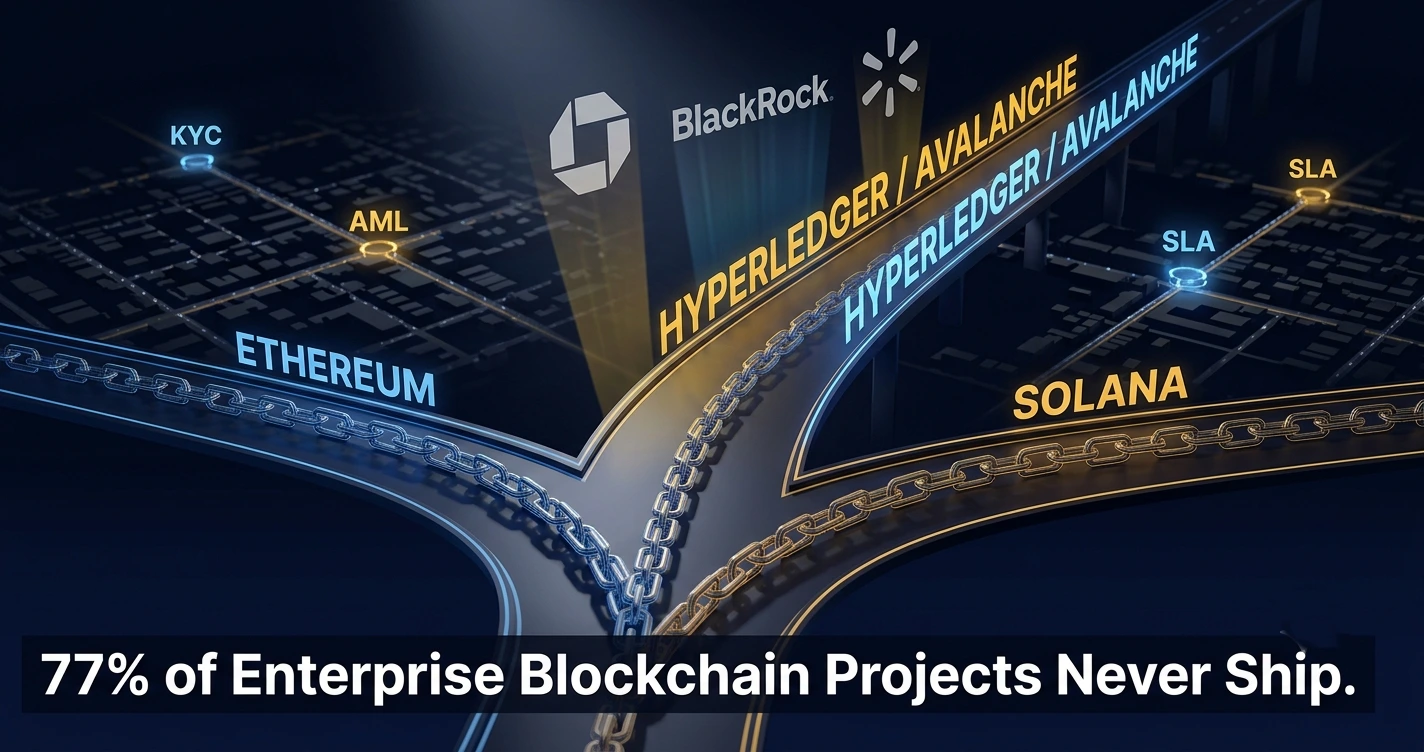
Enterprise development teams have quietly abandoned the Ethereum-versus-Solana debate. While public discourse frames blockchain as a binary between Ethereum’s security and Solana’s speed, the teams actually shipping production infrastructure in 2026 are choosing a third category: purpose-built, permissioned, and subnet-based architectures that offer compliance controls, data privacy, and governance models that neither public chain can deliver. JPMorgan, Walmart, BlackRock, and FIS Global have all deployed on non-Ethereum, non-Solana infrastructure. And the data is damning: 77% of enterprise blockchain projects never make production, with wrong platform selection cited as the primary reason.
In This Article
In December 2025, JPMorgan arranged a $50 million commercial paper issuance for Galaxy Digital, settled entirely in USDC on Solana. The headline wrote itself: Wall Street has chosen its blockchain. The reality is considerably more complicated.
JPMorgan runs its primary daily tokenized transactions on Onyx, a permissioned blockchain that runs on private infrastructure. It pilots on Avalanche for Project Guardian. It experiments on Solana for settlement. It doesn’t have a single blockchain. It has a portfolio. And so does every other Tier 1 institution making production decisions in 2026.
This is the conversation the Ethereum-versus-Solana debate has been crowding out. The enterprise blockchain platform decision in 2026 is not a coin flip between two public chains. It’s a multi-layer architectural question with a $500,000 to $2 million penalty if you get it wrong, per Deloitte’s 2025 Global Blockchain Survey.
77%
of enterprise blockchain PoCs never reach production (Gartner, 2025)
$2M
average cost to migrate platforms mid-stream (Deloitte, 2025)
589%
growth in tokenized RWA market, early 2025 to June 2026 (Binance Research)
Ethereum: The Institutional Trust Play
Ethereum commands approximately 75% market share in decentralized applications and holds roughly 60% of total DeFi total value locked, which stood at $160 billion globally as of early 2025, according to Chainalysis. Its developer ecosystem is the largest in blockchain: 31,869 total active developers as of September 2025, adding over 16,000 new contributors in that year alone, per Electric Capital data cited by the Ethereum Foundation.
BlackRock’s tokenized fund BUIDL launched on Ethereum in March 2024 and surpassed $1 billion by 2025. That was the landmark: the world’s largest asset manager building directly on a public chain at institutional scale. Visa, PayPal, and BlackRock all actively use Ethereum for settlement experiments, stablecoin issuance, and tokenized fund products. Average gas fees dropped roughly 70% since 2022 peaks, landing around $0.05 on mainnet by 2025.
Ethereum’s value proposition for enterprise is not speed. It’s legitimacy. When Vitalik Buterin described his platform’s design philosophy in a January 2026 public debate, he articulated exactly what risk-averse enterprise architects want to hear:
“Ethereum should be designed to eventually be self-sustaining, eventually needing little developer input, prioritizing stability, decentralization, and long-term security over constant protocol upgrades.” Vitalik Buterin, Co-founder, Ethereum Foundation (January 2026 public debate, MEXC News)
That stability-first philosophy is Ethereum’s biggest enterprise advantage and its biggest enterprise limitation simultaneously. Teams building compliance-heavy applications need platforms that evolve with regulatory requirements. A protocol that explicitly aims for minimal developer input is a feature for conservative institutional investors. It’s a risk for CTOs building on top of it.
The L2 ecosystem partially addresses the scalability gap. Ethereum’s Layer 2 network, including Arbitrum, Optimism, and Polygon zkEVM, provides lower fees and higher throughput while inheriting mainnet security. For enterprise teams with existing Solidity skills, the enterprise CTO guide to Layer 2 scaling is the most important piece of reading before any platform decision. Deploying on an L2 does not require rewriting existing smart contract logic, which is a material consideration when your Solidity development team is already built out.
Solana: Speed with Strings Attached
Solana’s raw performance numbers are genuinely impressive. Theoretical maximum throughput reaches 65,000 TPS, with real-world performance confirmed at 3,400-plus TPS in production conditions and average transaction fees under $0.01 per Landbase’s 2026 data. Solana attracted 7,625 new developers in 2024, the largest share of new blockchain developer talent that year, and grew its developer base 83% year-over-year by 2025.
But Ethereum remains nearly double Solana’s total size: 31,869 developers versus approximately 17,708 on Solana. That gap matters for enterprise hiring. Rust, the language required for Solana program development, carries a steeper learning curve and a narrower available talent pool than Solidity. Every CTO building a Solana-native stack is building a specialized hiring requirement into their technical debt.
Anatoly Yakovenko, Solana’s co-founder and CEO, directly countered Buterin’s stability argument in the same January 2026 debate:
“Stopping blockchain development would eventually lead to its failure. Solana has to constantly develop to be relevant and address the needs of developers and users. Constant updates to the protocol are necessary. They will help address the real-world challenges.” Anatoly Yakovenko, Co-founder and CEO, Solana Labs (MEXC News, January 18, 2026)
For enterprise decision-makers, this framing introduces a specific governance risk: who controls the roadmap of the infrastructure you’re building on, and can they change it under you? That is not a rhetorical question. It is a board-level risk assessment item.
The reliability picture is more complicated than Solana’s official communications suggest. The Solana Foundation’s June 2025 Network Health Report confirmed the network achieved its longest streak without a major officially confirmed outage: 16-plus consecutive months since the February 6, 2024 incident, which ran for nearly five hours. That’s real progress. But an SEC Crypto Task Force filing from July 2025 put an important qualifier on that achievement:
“The network has had degraded performance as recently as February of this year [2025] as well as during the release of the TRUMP memecoin, where we saw severe network congestion. I believe it is in the best interest of the public to wait for the new validator client, Fire Dancer’s, full release to ensure diversity in validator clients to prevent potential network outages.” Kimber/Courage, Crypto Education Research (SEC CTF Written Input, July 9, 2025)
Third-party monitoring firm StatusGator detected at least nine distinct disruptions between October 2024 and February 2025 that were never officially acknowledged by the Solana team. From an enterprise SLA perspective, unacknowledged downtime is categorically worse than acknowledged outages. A 16-month streak without a “major officially confirmed outage” is not the same as 16 months of 99.99% uptime, and enterprise contracts require precise language around exactly that distinction.
The Firedancer client from Jump Crypto is expected to significantly improve validator client diversity when it reaches full production, addressing the single-client failure risk. Until that release is battle-tested at institutional scale, Solana’s reliability record carries a genuine asterisk for compliance-critical enterprise deployments. Any enterprise team navigating smart contract security and audit requirements needs to account for this directly in their platform risk assessment.
The Third Path Enterprises Are Actually Taking
Here’s what the Ethereum-versus-Solana narrative systematically ignores: the enterprise blockchain market has had a completely separate ecosystem for over a decade, and it’s the dominant one.
Hyperledger Fabric was launched in 2015 under the Linux Foundation with IBM as a primary contributor. R3 Corda was built in 2016 specifically for regulated financial services. Both were battle-tested in production enterprise environments before Solana’s whitepaper existed. According to Hyperledger Foundation data from 2025, Fabric accounts for roughly 55% of enterprise Hyperledger deployments, with Hyperledger Besu at 35% and growing. Broader market estimates from Autheo (April 2026) place Fabric at 80% of all permissioned enterprise blockchain deployments.
As TechTarget’s enterprise blockchain guide summarized in April 2026:
“For enterprise use, the decision typically comes down to four options: Hyperledger Fabric for consortium networks with complex privacy requirements, R3 Corda for financial services and regulated industries, private Ethereum networks (Besu or Quorum) for teams wanting the largest tooling ecosystem, and Avalanche Subnets for high-performance customizable blockchain instances.” Enterprise architect consensus, TechTarget Enterprise Guide, April 2026
Hyperledger Fabric: The Supply Chain and Consortium Standard
Walmart mandates that suppliers use IBM Food Trust, built on Hyperledger Fabric, for leafy greens tracking. The result is a reduction in food safety investigation time from weeks to seconds. That’s not a pilot. That’s operational infrastructure for one of the world’s largest retailers, running on a blockchain the crypto press rarely covers. The full context of Walmart’s deployment, including how it compares to TradeLens and what it means for supply chain teams, is covered in Walmart’s Hyperledger Fabric supply chain deployment.
Fabric’s core architectural advantage for enterprise is its private channels model. In a Fabric network, participants are known and credentialed. Data sharing is enforced via private channels, meaning counterparties only see the transactions relevant to them. Governance is enterprise-controlled, not determined by a decentralized validator set that can vote to change protocol rules.
The tradeoffs are real. Fabric requires substantial implementation time, specialized expertise, and persistent infrastructure investment. Its developer ecosystem is significantly smaller than Ethereum’s. The open-source model means enterprise support typically requires IBM or a certified implementation partner, which adds cost. The theoretical 100,000 TPS figure for Fabric-X is a controlled-environment benchmark, not a production-verified number at scale.
R3 Corda: Financial Services and CBDC Infrastructure
R3 Corda holds approximately 30% market share in private ledger deployments, according to Sparkco.ai’s blockchain disruption report. SWIFT chose Corda for its CBDC sandbox specifically because Corda’s transaction privacy model aligns with banking regulatory requirements: transactions are only shared between the parties involved in a given contract, not broadcast to the network.
In May 2025, R3 announced a strategic partnership with the Solana Foundation to bridge permissioned and public blockchain networks. In December 2025, R3 revealed the Corda protocol would launch on Solana in H1 2026 as a yield vault platform for tokenized real-world assets. That bridge architecture is exactly what the hybrid enterprise model demands: private, compliant internal infrastructure connecting to public chain liquidity when needed.
Avalanche Evergreen Subnets: The Enterprise Bridge
For enterprise teams that need EVM compatibility (existing Solidity talent, established tooling) combined with compliance controls (KYC, restricted validator sets, permissioned access), Avalanche Evergreen Subnets are the most architecturally specific answer available in 2026.
Evergreen Subnets are compliance-ready, permissioned blockchain networks built within the Avalanche ecosystem. They support KYC verification, restricted validator sets, and enterprise-grade governance while remaining EVM-compatible and interoperable with the broader Avalanche network. The Avalanche9000 upgrade in January 2025 cut subnet fees by 75%, making institutional subnet deployment economically viable rather than theoretically possible. The Granite upgrade activated in November 2025 introduced dynamic block times and enhanced Interchain Messaging verification for cross-chain security.
The institutional momentum is concrete. BlackRock tokenized $500 million into its BUIDL fund on Avalanche in March 2025 (it also runs on Ethereum). FIS Global, which processes $9 trillion in annual transactions, partnered with Avalanche in November 2025. JPMorgan participated in Avalanche’s Project Guardian pilots. Over 100 testnet institutional chains are already running, with projections of 200 institutional chains by 2026. Active Avalanche addresses grew 242% since January 2026 to approximately 1.6 to 1.7 million addresses.
The honest caveat: those 200 institutional chains are a forward projection, not a realized figure. The AVAX token price dropped roughly 93% from its all-time high, which directly affects subnet economics for validators posting AVAX collateral. Institutional deployments from BlackRock and JPMorgan are live but early-stage relative to their traditional infrastructure scale.
RWA Tokenization: The Forcing Function
The catalyst that turned “enterprise blockchain TBD” into urgent platform decisions is real-world asset tokenization. The tokenized RWA market surged 589% from early 2025 to June 2026, reaching $32 to $37 billion depending on measurement methodology, according to Binance Research’s June 2026 analysis. Boston Consulting Group projects the sector could reach $16 trillion by 2030. Citi’s “Money, Tokens and Games” report estimates $4 to $5 trillion in tokenized securities alone.
BlackRock, Franklin Templeton, and JPMorgan have all launched live tokenized fund products. RWA tokenization was the central theme at Davos 2026, where discussions explicitly defined 2026 as the turning point for institutional digital assets. You can’t keep deferring platform decisions when you’re tokenizing $500 million in assets on a chain you haven’t fully committed to.
RWA tokenization forces a three-part compliance requirement that no single public chain currently satisfies alone:
- Compliance: KYC/AML verification, restricted transfer rights, and investor accreditation requirements baked into the token itself.
- Privacy: Counterparty confidentiality, meaning not every participant on the network sees your fund’s cap table or transaction history.
- Public liquidity: Secondary market trading accessible to institutional investors via public chains or regulated exchanges.
This three-part requirement is precisely why production RWA deployments use hybrid stacks: a permissioned internal chain (Fabric, Corda, or Evergreen Subnet) for compliance and privacy, connected to a public chain (Ethereum mainnet or Avalanche C-Chain) for settlement and liquidity. The enterprise blockchain platform decision in 2026 is not “which chain.” It’s “which combination of chains, and how do they connect.”
Our read: The $16 trillion BCG projection for tokenized RWAs by 2030 assumes regulatory clarity, legal enforceability across jurisdictions, custodial standardization, and cross-chain interoperability. None of those four preconditions is fully resolved. The gap between $37 billion today and $16 trillion in 2030 requires regulatory tailwinds that are far from guaranteed globally. Build for the regulatory environment you have, not the one projected at Davos.
Enterprise Blockchain Platform Comparison 2026
The table below reflects production-verified characteristics, not marketing specifications. Use it as a starting framework, not a final decision matrix. Your compliance requirements, developer talent availability, and interoperability needs will determine the actual selection.
| Platform | Type | Real-World TPS | Privacy | EVM Compatible | Best For | Notable Enterprise Users |
|---|---|---|---|---|---|---|
| Ethereum Mainnet | Public L1 | ~1.5M txn/day | None | Yes (native) | Token issuance, public DeFi, institutional liquidity | BlackRock BUIDL, Visa, PayPal |
| Ethereum + L2 | Public L2 | Thousands/sec | Limited | Yes | Scaled dApps, lower-cost enterprise settlement | JPMorgan JPMD network |
| Solana | Public L1 | 3,400+ real-world | None | No (Rust/Anchor) | High-frequency apps, payments, DeFi | JPMorgan commercial paper (Dec 2025), Galaxy Digital |
| Hyperledger Fabric | Permissioned | Up to 100K TPS (Fabric-X, lab conditions) | High (private channels) | No (Go/Java) | Supply chain, consortium networks, regulated data | Walmart, IBM Food Trust |
| R3 Corda | Permissioned | Enterprise-grade | High (need-to-know basis) | No (Kotlin/Java) | Financial services, CBDC, trade finance | SWIFT CBDC sandbox, major global banks |
| Hyperledger Besu | Permissioned or Public | Ethereum-equivalent | Configurable | Yes | EVM teams wanting privacy controls | JPMorgan (Quorum successor) |
| Avalanche C-Chain | Public L1 | Thousands/sec | Limited | Yes | DeFi, tokenization, enterprise-facing dApps | BlackRock BUIDL, FIS Global |
| Avalanche Evergreen Subnets | Permissioned + Interoperable | Custom/configurable | High (KYC, validator controls) | Yes | Compliance-sensitive institutional RWA deployments | JPMorgan Project Guardian, institutional RWA |
What the Hype Gets Wrong
The enterprise blockchain market reached $12.77 billion in 2025 and is projected to hit $29.29 billion by 2033, according to Autheo’s April 2026 market report. Separately, IDC projects enterprise blockchain spending could reach $36 billion by 2026. These numbers are real. So is the context that makes them less reassuring than they look.
The 77% Failure Rate Is the Real Story
Gartner’s data showing 77% of enterprise blockchain proofs of concept never reaching production is not a caveat. It’s the headline. Enterprise blockchain has been “about to take off” since 2017. The structural failure rate has remained stubbornly high because most projects fail due to governance complexity, not technical limitations. No blockchain platform solves a bad governance model. The platform comparison table above is irrelevant if your consortium partners can’t agree on who controls the validator set.
The “60% of Fortune 500” Figure Is Misleading
TokenMinds’ 2026 data showing 60% of Fortune 500 companies “active in at least one blockchain project” includes proofs of concept, internal research studies, and vendor evaluations. It does not mean 60% of Fortune 500 companies have production blockchain deployments generating revenue. Conflating exploration with production is how blockchain hype sustains itself through multiple market cycles. The number that matters is how many of those projects cleared the Gartner 77% wall.
TradeLens: The Template Everyone Should Study
Maersk and IBM launched TradeLens on Hyperledger Fabric in 2018. At its peak, it processed 50% of global container shipments. It shut down in 2022. The reason was not a technical failure. It was insufficient adoption beyond the pilot partner network. No platform choice prevents that outcome. The lesson for enterprise architects is that blockchain consortium failures are almost always governance failures dressed up as technology failures.
Migration risk: According to Forrester Research guidance cited by ChainLaunch, expect to spend 40 to 60% of your original development budget and 6 to 12 months on a full platform migration. The only easier path is moving between Hyperledger Besu and Quorum, since both share EVM compatibility. Every other migration is a near-full rebuild. The Deloitte 2025 Global Blockchain Survey puts the average cost at $500,000 to $2 million. Platform selection is not a sprint decision.
For enterprise teams building on any of these platforms, the security layer is non-negotiable regardless of which chain they select. The smart contract audit checklist for enterprise deployments and JPMorgan’s approach to evaluating DeFi versus traditional banking risk are both required reading before any production deployment.
Frequently Asked Questions
Is Ethereum or Solana better for enterprise development?
Neither is a complete enterprise solution on its own. Ethereum offers the largest developer ecosystem and the deepest institutional trust, while Solana provides high throughput at low cost. Most enterprises in 2026, however, choose permissioned alternatives like Hyperledger Fabric or Avalanche Subnets that deliver compliance controls, data privacy, and governance models that public chains cannot provide natively.
What blockchain do enterprises actually use in production?
Hyperledger Fabric powers 40 to 80% of permissioned enterprise blockchain deployments, depending on methodology. R3 Corda dominates regulated financial services. Avalanche Subnets are gaining ground for hybrid compliance-ready deployments. Ethereum is used for public-facing settlement and tokenized asset issuance. Most production enterprise systems use a combination rather than any single platform.
Why do enterprise blockchain projects fail at such high rates?
According to Gartner’s 2025 data, 77% of enterprise blockchain proofs of concept never reach production, with wrong platform selection as the primary cited reason. Governance complexity, unmet compliance requirements, and underestimated migration costs averaging $500,000 to $2 million per the Deloitte 2025 Global Blockchain Survey are the most common compounding failure factors.
Is Solana reliable enough for enterprise use?
Solana has not experienced a major officially confirmed outage since February 2024, achieving 16-plus consecutive months of uptime by mid-2025. However, third-party monitoring by StatusGator detected at least nine unacknowledged disruptions through early 2025. The Firedancer client from Jump Crypto is expected to significantly improve reliability through validator client diversity. Until it reaches full production and battle-testing, single-client risk remains an enterprise SLA concern.
What is the difference between Hyperledger Fabric and Ethereum for enterprise use?
Ethereum is a public blockchain optimized for open participation, liquidity, and composability. Hyperledger Fabric is a permissioned blockchain where participants are known, data privacy is enforced via private channels, and governance is enterprise-controlled. Fabric suits internal consortium networks and regulated data sharing. Ethereum suits public-facing token issuance and settlement requiring open market liquidity.
What is an Avalanche Evergreen Subnet?
Avalanche Evergreen Subnets are compliance-ready, permissioned blockchain networks built within the Avalanche ecosystem. They support KYC verification, restricted validator sets, and enterprise-grade governance while remaining EVM-compatible and interoperable with the broader Avalanche network. BlackRock and JPMorgan have both piloted Avalanche in tokenized asset contexts through Project Guardian.
What blockchain does JPMorgan use?
JPMorgan uses multiple blockchain platforms. Its Onyx platform runs daily tokenized transactions on permissioned blockchain infrastructure. In December 2025, JPMorgan arranged a $50 million commercial paper issuance on Solana, settled in USDC. JPMorgan has also participated in Avalanche’s Project Guardian pilots. This multi-chain approach is standard practice for Tier 1 financial institutions in 2026.
Can Ethereum scale for enterprise applications?
Yes, through Layer 2 solutions. Ethereum’s L2 ecosystem including Arbitrum, Optimism, and Polygon zkEVM provides lower fees and higher throughput while inheriting Ethereum’s security model. Hyperledger Besu, an EVM-compatible enterprise client, enables private Ethereum deployments. Enterprise teams with Solidity expertise can deploy on L2 networks without rewriting existing smart contract logic, which is a significant cost advantage.
The Bottom Line for CTOs
The best blockchain for enterprise development in 2026 is not a single platform. It’s a stack. And the enterprise teams that understood this two years ago are now shipping production infrastructure. The ones that ran a pilot on Ethereum or Solana and expected it to solve their compliance requirements are currently absorbing the $500,000 to $2 million migration bill Deloitte documented.
Here’s what the data actually tells enterprise decision-makers heading into 2026:
- If your primary requirement is compliance and data privacy: Hyperledger Fabric or R3 Corda. Accept the smaller developer ecosystem and higher implementation cost as the price of the control you need.
- If your team has Solidity skills and you need compliance plus interoperability: Avalanche Evergreen Subnets are architecturally built for this. The FIS Global and BlackRock deployments validate the institutional trajectory.
- If you’re tokenizing assets for public markets: Ethereum mainnet or Avalanche C-Chain for liquidity, with a permissioned layer handling the compliance controls.
- If you’re experimenting with high-frequency settlement on a public chain: Solana’s performance is real. Its enterprise reliability record warrants contractual caution until Firedancer reaches full production.
The forcing function for the next 6 to 18 months is RWA tokenization. With $32 to $37 billion in tokenized assets already live and BCG projecting $16 trillion by 2030, platform decisions that were deferred through the pilot phase are now consequence-laden. Three things to watch closely: the Firedancer client’s production readiness timeline and its effect on Solana enterprise SLA viability; the Corda-on-Solana launch in H1 2026 and whether it delivers on the permissioned-to-public bridge at institutional scale; and whether Avalanche’s 200 institutional subnet projection materializes as realized deployments or remains a forward target.
The Ethereum-versus-Solana debate was always a retail investor narrative. Enterprise development teams moved past it before most of the crypto press noticed. The question in 2026 is not which public chain wins. It’s whether your architecture is built to handle the moment when regulators, counterparties, and auditors ask you to prove your compliance controls exist at the infrastructure level.
Stay current on enterprise blockchain and digital infrastructure: Subscribe to The Neural Loop at neuralwired.com/newsletter for weekly briefings built for technical decision-makers, not crypto speculators.