
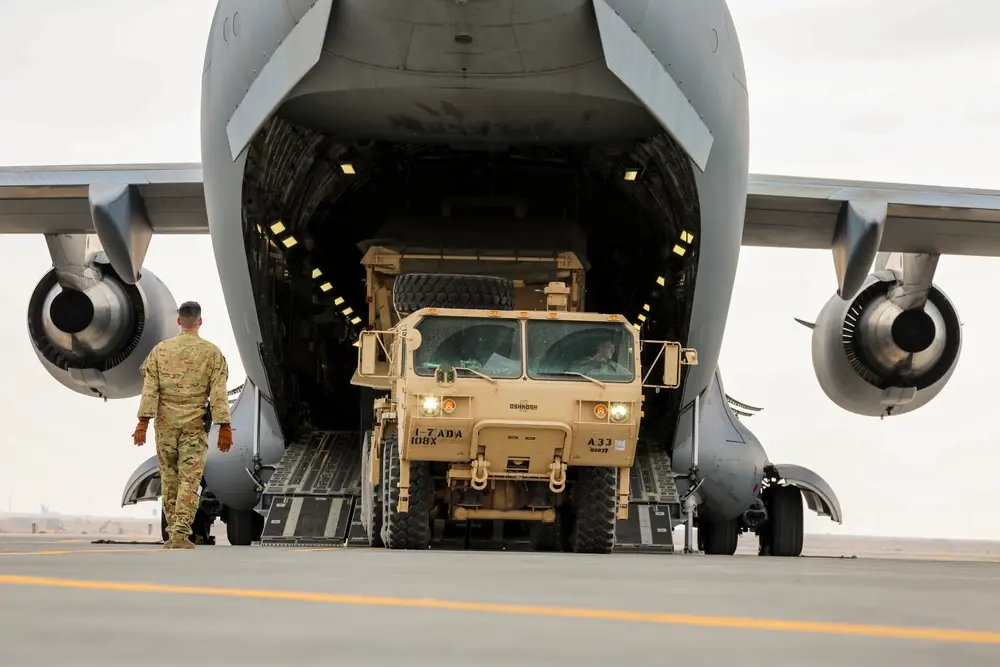
Hours after Russian forces sent 174 drones and two Zircon anti-ship missiles across Ukraine in a single overnight barrage, the United States cleared the way for one of the largest air defense packages of the year: a proposed $2.68 billion sale that could reshape how Ukraine defends its skies through the winter ahead.
The State Department’s Bureau of Political-Military Affairs notified Congress on September 18 of the possible Foreign Military Sale, formally titled an “Air Defense Development Upgrade.” The notification is not a signed contract. It is the required first step that clears a deal to move forward, and it lands at a moment when Ukraine’s air defenses are stretched thinner than at almost any point in the war.
A Package Built for Layered Defense
The proposed sale reads less like a single weapons purchase and more like an attempt to rebuild an entire defensive architecture. It includes S-300 Clone missiles, GAM-67 missiles, Range-Extended Air Defense Laser Guided Rocket systems, Improvised Transporter Erector Launcher 1.5 units, mobile launching system modification kits, RPS 202 counter-drone radars, erectable mast trailers, and the software, spare parts, and logistics support needed to keep it all running.
That mix matters. Rather than concentrating resources on one interceptor type, the package spans missile systems, radar, and counter-drone technology, suggesting a shift toward redundancy across multiple layers of defense instead of dependence on any single platform. Given how visible Ukraine’s dependence on one system has become in recent months, that shift is not incidental.
The U.S. Embassy in Kyiv framed the deal in similar terms, saying in a statement posted to X on September 19 that the equipment would help Ukraine “conduct self-defense and regional security missions with a more robust air defense capability.”
Why the Timing Matters
The notification did not arrive in a vacuum. Ukraine’s stock of Patriot interceptors, the only system in its arsenal capable of reliably shooting down Russian ballistic missiles, has been running critically low for months, and the shortage has already changed how the war is being fought and reported.
President Volodymyr Zelensky told CNN in mid-August that Ukraine needed roughly 5 percent of the U.S. Patriot interceptor stockpile to survive the winter but had access to closer to 1 percent. Reuters reported around the same time that interceptor deliveries to Ukraine in 2026 had fallen to about a third of what they were the year before. By early August, Bloomberg reported that Ukraine’s air force had quietly stopped publishing nightly missile-count data altogether, following nights when its defenses failed to intercept a single incoming ballistic missile. Part of that squeeze traces back to the parallel conflict involving Iran, which drew heavily on the same shared pool of U.S. and allied Patriot stock, leaving less available for Kyiv even as Russian strikes continued.
Against that backdrop, the overnight barrage that preceded this notification was a stark illustration of the stakes. Regional officials in Ukraine reported eight confirmed deaths from the attack, with Kharkiv region Governor Oleh Syniehubov citing five deaths and 15 injuries across 14 settlements, and Kherson region Governor Oleksandr Prokudin reporting three deaths and five injuries from shelling across 25 communities. Ukraine’s air force said on Telegram that the two Zircon anti-ship missiles launched in the barrage were intercepted, stating simply that the “[Zircon antiship] missiles did not reach the targets.”
The attack also rippled beyond Ukraine’s borders. Poland’s military scrambled fighter jets and placed its air-defense systems on heightened alert as a precaution, a step it has now taken repeatedly in response to Russian activity near its frontier. The Polish Armed Forces Operational Command confirmed on X that “military aviation operations have begun in Polish airspace,” though officials later clarified that no actual violation of Polish airspace had occurred. NeuralWired has tracked this pattern of precautionary NATO responses closely as it has become a near-routine feature of the war’s later phases.
The Money Behind the Deal
If the sale is finalized, Ukraine would pay for it through a blend of European financial contributions and U.S. Foreign Military Financing funds that were appropriated under the prior administration. The structure is notable in its own right. The State Department specified that the FMF portion will count as a U.S. capital contribution to the Ukraine Reconstruction Investment Fund, applied through a one-to-one reimbursement arrangement.
That financing model has become the standard route for U.S.-approved arms sales to Ukraine since the current administration curtailed new direct aid packages, relying instead on previously appropriated funds paired with European money. The notification itself was careful to state that the sale “will not alter the basic military balance in the region,” requires no additional American personnel on the ground in Ukraine, and carries “no adverse impact on U.S. defense readiness,” language typical of how the State Department frames sales of this scale.
For readers following the broader trajectory of Western support, NeuralWired’s continuing coverage of Ukraine’s air defense gap offers more detail on how the interceptor shortfall developed over the course of 2026.
What Happens Next
A congressional notification is a procedural gate, not a finished deal. It opens a standard review period before any contract can be finalized, though the specific timeline for this particular review has not been made public. Once that stage clears, principal contractors will be selected through competitive procurement under Federal Acquisition Regulation rules, and the State Department’s notice indicates no offset agreement has been proposed at this point.
A larger and unresolved question looms alongside this sale: Ukraine’s long-running push to secure a domestic license to produce Patriot interceptors with U.S. contractors, an ambition that would reduce its dependence on foreign stockpiles entirely. The White House has said no decisions or guarantees have been made on that front, and it remains, for now, aspirational rather than actual.
What is clear is that the interceptor math has not fundamentally changed with this single notification. A $2.68 billion package, even if it clears every remaining hurdle, will take time to manufacture, deliver, and integrate, while the barrages are happening now. The gap between the two timelines, procurement measured in months and Russian strikes measured in nights, is likely to remain the defining tension of Ukraine’s air war through the winter, regardless of what Congress ultimately approves.