



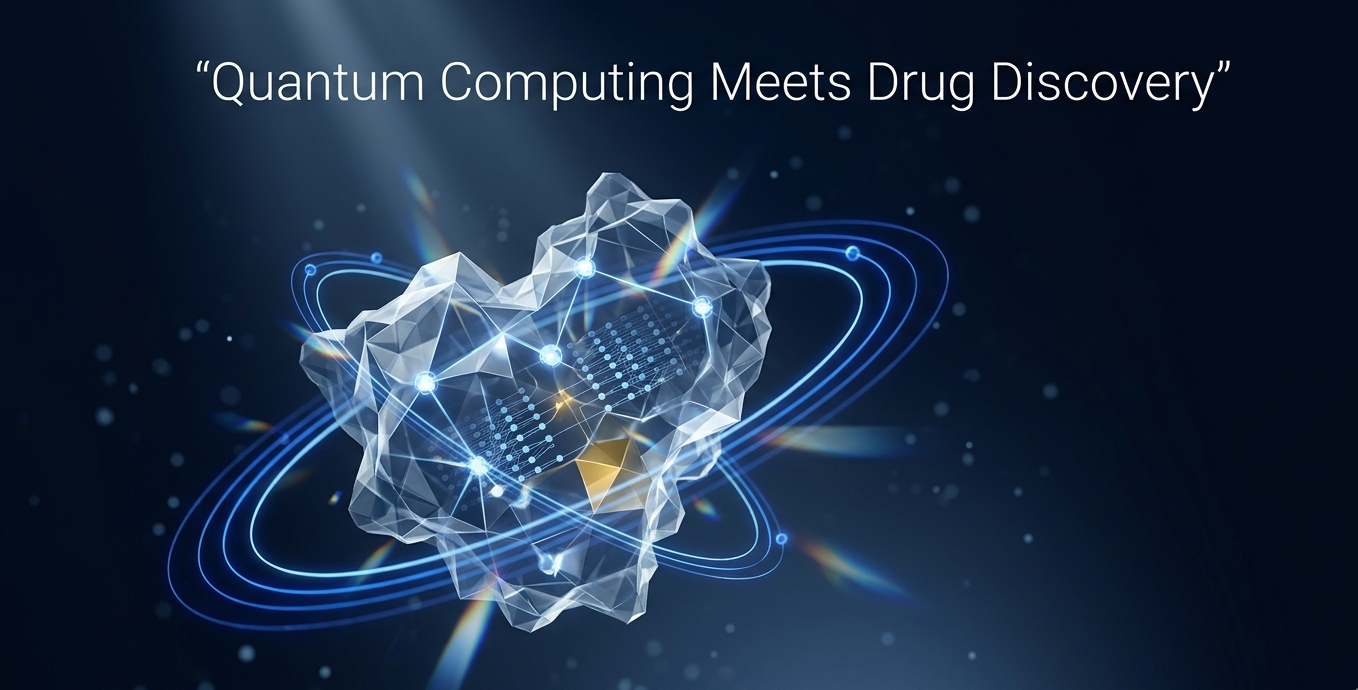
From Roche’s Alzheimer’s pipeline to St. Jude’s “undruggable” targets, quantum-assisted workflows are doing what classical supercomputers can’t. Here’s what the data actually shows, and what pharma CTOs need to decide before 2027.
Table of Contents
- Why Classical Computers Hit a Wall in Molecular Simulation
- 3 Quantum Drug Discovery Applications Already in Production Pipelines
- The NISQ Reality Check: Where Quantum Falls Short Right Now
- The Quantum Advantage Timeline: What to Expect Through 2032
- Quantum Readiness Framework for Biotech CTOs and Investors
- Frequently Asked Questions
- The Quantum Drug Discovery Race Is Already Running
Drug discovery has always been a numbers game stacked against the house. On average, it takes 12 to 15 years and more than $2 billion to bring a single molecule from lab bench to pharmacy shelf, and roughly 90% of candidates fail somewhere in that journey. Quantum computing drug discovery applications are changing that math in ways classical machines simply cannot.
Roche has already compressed candidate-generation timelines for Alzheimer’s research from years to months using a quantum-chemistry platform. St. Jude Children’s Research Hospital identified viable ligands for the notoriously “undruggable” KRAS cancer target in a fraction of the time conventional screening would have required. These aren’t press-release promises. They’re documented pipeline shifts.
This analysis unpacks why quantum methods work where classical density-functional theory hits a wall, which three breakthroughs are already in production workflows, and what a 2026-ready implementation roadmap looks like for biotech CTOs and investors deciding whether to build, partner, or wait. We draw on a January 2026 Nature review, a 2024 IEEE survey of 30+ QC chemistry projects, McKinsey’s August 2025 pharma analysis, and primary source data from Roche, St. Jude, and Caltech’s leading quantum physicists.
Key Takeaways
- Quantum-enhanced workflows reduce molecular-simulation time by 3 to 10x versus classical DFT/MD on equivalent hardware.
- 70% of current QC drug-discovery projects still run hybrid quantum-classical stacks. Standalone QC use remains below 10%.
- 15 to 20% of large pharma R&D budgets now include dedicated quantum compute or software line items.
- Full fault-tolerant quantum advantage for the most complex biomolecules likely arrives between 2028 and 2032.
- The “build vs. partner” decision should be made this year. Lead times for quantum talent are already 18 to 24 months.
Why Classical Computers Hit a Wall in Molecular Simulation
Classical computers solve molecular problems by approximating. Density functional theory (DFT) and molecular dynamics (MD) are remarkably powerful, but they’re fundamentally constrained by how electron correlations scale. Add one more electron to a system and computational cost grows exponentially. Researchers call this the “exponential wall.”
Quantum computers don’t approximate the same way. They encode molecular states directly as quantum superpositions, which means they can, in principle, represent the exact quantum state of a molecule without the approximation overhead. For protein-ligand binding, where the difference between a drug candidate and a clinical failure can hinge on just a few kilocalories of binding energy, that precision matters enormously.
The algorithm doing most of the heavy lifting today is the Variational Quantum Eigensolver (VQE). It’s a hybrid: a quantum processor estimates ground-state energy of a molecular system, and a classical optimizer adjusts the parameters. Neither machine could do this alone efficiently. Together, they can simulate systems that would stump even the most powerful classical supercomputers for certain molecular configurations.
“Quantum simulation is one of the most promising applications on the horizon, especially for quantum chemistry and materials, where exact solutions are intractable classically.”
Dr. John Preskill, Richard P. Feynman Professor of Theoretical Physics, Caltech, and pioneer of NISQ-era quantum theory
The gap between classical and quantum isn’t uniform across all drug-discovery tasks. Target identification, toxicity prediction, and administrative trial design are already addressable with classical ML. Where quantum earns its keep is in the electron-level physics of binding affinity, precisely the calculations that determine whether a candidate drug will stick to its target or slide off it.
3 Quantum Computing Drug Discovery Applications Already in Production Pipelines
The commercial narrative around quantum computing has been plagued by vague promises. What separates 2026 from every previous year is that three specific applications now have documented outcomes tied to real pipelines, real institutions, and in some cases, real revenue implications.
1. Roche and the Alzheimer’s Candidate Compression
Roche’s multi-year partnership with Cambridge Quantum Computing uses the EUMEN quantum-chemistry platform to run hybrid VQE workflows on NISQ hardware. The stated goal is Alzheimer’s-related drug design, one of pharma’s most commercially urgent and computationally brutal challenges, given the size and flexibility of amyloid-targeting molecules.
According to reporting from Fierce Biotech and The Quantum Insider, the partnership has compressed candidate-generation timelines from years to months for selected targets. That’s not a theoretical projection. It reflects real workflow restructuring. Quantum pre-screening narrows the candidate space before handing off to classical CADD pipelines, eliminating months of wet-lab dead ends.
2. St. Jude’s Breakthrough on “Undruggable” KRAS
KRAS is one of oncology’s most frustrating targets. Mutations in the KRAS gene drive roughly 25% of all human cancers, but the protein’s smooth surface has resisted conventional binding approaches for decades. St. Jude Children’s Research Hospital’s 2025 proof-of-principle study changed the framing.
Their team used quantum-enhanced ML to identify viable ligands for KRAS in what St. Jude’s own research progress report (April 2025) describes as “a fraction of the time required for purely classical screening.” The methodology combined quantum-assisted virtual screening with ML-driven ligand ranking, a workflow that would have taken months of classical supercomputer time compressed into weeks.
3. Quantum-Assisted Lead Optimization Cutting Wet-Lab Costs
Perhaps the most commercially immediate application is lead optimization, the phase where promising candidates get refined for potency, selectivity, and metabolic stability. This is where most development budgets go, and where quantum-ML hybrid systems are showing the clearest near-term return.
A January 2026 meta-analysis published in a Nature sub-journal reviewed three pharma pilot studies and found that quantum-machine-assisted workflows reduced the number of wet-lab experiments needed for lead optimization by 25 to 40%. For a mid-size biotech running 200 to 300 lead-optimization experiments per compound series, that’s a direct cost reduction of millions of dollars per program.
“Integrating quantum computing across the drug-development cycle, from molecular design to clinical-trial optimization, can significantly accelerate timelines and reduce costs, while improving the robustness of decisions.”
Dr. Yijing Zhou, lead author, “Quantum-Machine-Assisted Drug Discovery,” Nature, January 2026
The NISQ Reality Check: Where Quantum Falls Short Right Now
Every analysis of quantum computing in drug discovery needs a counterweight. The breakthroughs above are real, and so are the limits. Ignoring the latter is how organizations make expensive, premature bets.
Today’s quantum hardware operates in what researchers call the Noisy Intermediate-Scale Quantum (NISQ) era. Qubits are error-prone, coherence times are short, and quantum circuits can only run so many operations before errors accumulate beyond usefulness. That’s why, as a 2024 IEEE survey of 30+ QC chemistry projects found, 70% of quantum drug-discovery work still runs on hybrid stacks. Quantum handles the hardest electron-correlation steps; classical handles everything else. Standalone quantum computation accounts for less than 10% of workflows.
“While quantum algorithms show clear theoretical advantages for molecular simulation, current NISQ hardware requires heavy error mitigation and hybrid classical-only fallbacks for most practical workflows.”
Dr. Geeta Kumar, computational chemist and quantum-algorithm researcher, IEEE Survey on Quantum Computing in Drug Discovery, 2024
The practical implication: don’t buy the “millions of years to minutes” headline without the fine print. That performance promise, documented in a 2026 IJFMR review for certain intractable biomolecular systems, assumes fault-tolerant quantum computing (FTQC), which requires millions of physical qubits correcting for errors in real time. We’re not there yet. Best-case hardware roadmaps put practical FTQC between 2028 and 2032 for pharmaceutical-scale problems.
What’s available now is meaningful, but bounded: hybrid workflows for molecules up to roughly 50 to 100 atoms, binding-affinity improvements in the 15 to 30% range for specific protein classes, and timeline compression in lead identification for well-characterized targets like GPCRs and kinases. Anything beyond that pushes into theoretical territory.
The bottom line for decision-makers: quantum isn’t replacing classical pipelines. It’s augmenting the hardest steps within them. Organizations that understand this distinction will build realistic roadmaps. Those that don’t will fund expensive pilots that disappoint.
The Quantum Advantage Timeline: What to Expect Through 2032
One of the clearest gaps in existing coverage is a practical, hardware-anchored timeline. Here’s what the evidence actually supports, mapped to three hardware phases and the drug-discovery capabilities each unlocks.
Quantum Readiness Framework for Biotech CTOs and Investors
The market is already moving. According to McKinsey’s 2025 analysis, 15 to 20% of large pharma R&D budgets now include dedicated quantum compute or software line items. That’s a budgeted commitment, not a speculative exploration. For organizations still in “monitor mode,” the window for cheap talent acquisition and early partnership terms is closing.
The right strategic move depends on where you sit in the pharma stack. Here’s a decision framework.
| Organization Type | Recommended Posture | Priority Actions | Timeline |
|---|---|---|---|
| Large Pharma (Top 20) | Build + Partner | Hire 2 to 3 quantum chemists. Sign platform partnerships (CQC, IBM Quantum Network). Run 1 to 2 internal pilots per therapeutic area. | Start now |
| Mid-Size Biotech | Partner-First | Identify 1 to 2 platform vendors with pharma track records. Negotiate outcome-based pricing. Designate an internal QC champion from computational chemistry. | H2 2026 |
| Early-Stage Startup | Monitor + Consult | Engage with CROs offering quantum-enhanced services. Include quantum-readiness in data-architecture decisions. Avoid capital commitments until FTQC milestones clarify. | 2027 |
| Investor / Fund | Selective Bet | Back platform plays over single-application companies. Prioritize firms with hybrid QC-ML capabilities and pharma partnerships. Evaluate hardware-agnosticism. | Ongoing |
| Policy / Regulator | Framework Now | Establish computational validation standards for quantum-assisted submissions. Engage with FDA’s emerging technology programs. Monitor OECD quantum-governance working groups. | 2026 to 2027 |
Quantum Readiness Checklist
- Audit current computational chemistry stack for quantum-integration compatibility (data formats, pipeline APIs)
- Identify 1 to 2 high-value drug targets where binding-affinity uncertainty is the primary bottleneck
- Evaluate platform vendors with documented pharma case studies, not just academic publications
- Allocate 5 to 10% of computational R&D budget to hybrid QC-ML pilots in 2026
- Hire or contract at least one quantum chemist with VQE and NISQ-hardware experience
- Build 18-month runway into pilot plans. Quantum projects rarely deliver on shorter timelines.
- Define success metrics before launch: binding accuracy improvement, wet-lab experiment reduction, or time-to-candidate
Frequently Asked Questions
How is quantum computing used in drug discovery?
Can quantum computers really speed up drug discovery?
What are the limitations of quantum computing in drug discovery?
Which companies are using quantum computing for drug discovery?
How accurate are quantum simulations of molecules?
Will quantum computing replace traditional drug discovery methods?
What is the timeline for quantum advantage in drug discovery?
How much faster is quantum computing than classical in molecular simulation?
The Quantum Drug Discovery Race Is Already Running
The pattern across documented quantum drug-discovery deployments is consistent: organizations that apply quantum-enhanced workflows to precisely bounded computational bottlenecks, including binding-affinity estimation, candidate pre-screening, and lead optimization, are compressing timelines and reducing wet-lab costs in ways that directly improve program economics. Roche, St. Jude, and the 15 to 20% of large pharma R&D budgets now carrying quantum line items aren’t speculating. They’re building competitive infrastructure.
The broader implication matters beyond any single pipeline. As quantum hardware matures from NISQ toward fault-tolerant systems, the computational barrier that has defined drug discovery for decades, which is the exponential cost of simulating molecular physics exactly, becomes progressively less constraining. The companies that will capture the projected $10 to $50 billion in annual quantum drug-discovery value by 2030 aren’t the ones waiting for perfect hardware. They’re the ones building quantum-ready data architectures, hiring quantum chemists, and locking in platform partnerships while terms are still favorable.
Three developments are worth watching closely over the next 18 months: (1) IBM’s and Google’s announced qubit-count and error-rate milestones for 2026 to 2027, which will signal whether the error-mitigated phase accelerates on schedule; (2) FDA’s emerging-technology programs, where any quantum-assisted submission methodology guidance will be a major catalyst for adoption; and (3) academic-industry partnership models, as universities with quantum-chemistry capacity increasingly structure licensing deals that give mid-size biotechs access without full platform build costs. For implementation frameworks, technical benchmarks, and coverage of the next hardware milestones, subscribe to NeuralWired’s weekly quantum briefing below.