AI Product Liability 2026: Who Pays When AI Kills or Harms?AI Law & Liability
Who Pays When AI Kills? Four Countries, Zero Answers
NeuralWired.comJune 24, 2026Deep Analysis14 min read
On February 28, 2024, a 14-year-old boy in Florida named Sewell Setzer III died by suicide. In the months before his death, he had spent thousands of hours talking to AI chatbots on Character.AI, including a role-playing character inspired by the Game of Thrones series. His mother, Megan Garcia, sued. In May 2025, a federal judge ruled the case could proceed, treating the AI chatbot as a product under strict liability law and rejecting the company’s First Amendment defense. Character.AI and Google settled in January 2026.
That single case broke open a legal question that four of the world’s largest economies are now scrambling to answer: when an AI system causes serious harm, who is responsible? The developer who built the model? The company that deployed it? The platform that distributed it? The investor who funded it?
Right now, the answer depends entirely on which country the harm happened in. And the answers are incompatible.
The Case That Changed Everything
Garcia v. Character Technologies, Inc. (Case No. 6:2024-cv-01903, M.D. Florida) is the first wrongful death lawsuit ever filed against an AI chatbot company in the United States. The claims included strict product liability for design defect, failure to warn, negligence, and wrongful death. Defendants included not just Character Technologies but also co-founders Noam Shazeer and Daniel De Freitas Adiwarsana, plus Google and Alphabet.
Judge Anne Conway’s ruling on May 21, 2025 mattered far beyond this single case. She was “not prepared to hold that Character AI’s output is speech”, which neutralized the most powerful defense available to AI companies: the argument that their outputs are constitutionally protected expression under the First Amendment. She treated the AI app as a product at the pleading stage. That framing, product not speech, is now rippling through every AI harm case filed since.
The settlement came January 7, 2026, with undisclosed terms and a commitment to new safety features for users under 18. It resolved the immediate litigation. It also prevented the appellate ruling that would have given every court in America binding guidance on the First Amendment question. That question remains open. And every plaintiff’s attorney in the country noticed.
The cases that followed came fast. In August 2025, the parents of 16-year-old Adam Raine sued OpenAI in California Superior Court, alleging ChatGPT fostered emotional dependency and provided self-harm instructions. Later that year, the estate of an elderly Connecticut woman filed a wrongful death action alleging that an AI chatbot’s interactions with her son materially contributed to a homicide-suicide. In March 2026, insurer Nippon Life sued OpenAI in federal court in Illinois to recover costs from AI-assisted legal filings that cited nonexistent cases.
The number of generative AI-related lawsuits in the US grew 978% between 2021 and 2025, passing 700 cumulative cases, according to a March 2026 report by Gallagher Re in conjunction with MIT and Testudo Global Inc. The year-over-year filing rate accelerated from 59% growth in 2023-2024 to 137% growth in 2024-2025. AI product liability litigation is no longer a hypothetical risk. It is a present operational one.
Four Jurisdictions, One Question
This is not a story about a single court case crossing borders. It is a story about four major legal systems each building their own answer to the same question, and those answers pointing in entirely different directions.
Jurisdiction
Current Status
Key Mechanism
Timeline
United States
Case law developing; no federal AI liability statute
Product liability via tort; First Amendment question unresolved
AI LEAD Act and CHATBOT Act proposed; 1,000+ state bills filed in 2025
European Union
EU Product Liability Directive in force Dec 2024
Strict liability; AI = product; manufacturer presumption
Member state transposition deadline: December 9, 2026
United Kingdom
Consultation closed Feb 2026; Law Commission review announced
Existing tort law; no AI-specific statute yet
Public consultation on “pure software” planned for H2 2026
Canada
Landmark ruling Feb 2024 (Air Canada)
Negligent misrepresentation; corporate liability for chatbot output
No federal AI liability legislation enacted as of June 2026
Canada: The Air Canada Precedent
The most legally clean ruling in the entire AI liability landscape came not from a US federal court but from the British Columbia Civil Resolution Tribunal in February 2024. Jake Moffatt relied on Air Canada’s chatbot for information about bereavement fares while booking a flight to attend his grandmother’s funeral. The chatbot gave him incorrect information. Air Canada later refused to honor the discount, arguing its chatbot was effectively a “separate legal entity” for which the company bore no responsibility.
Tribunal Member Christopher C. Rivers dismissed that argument directly. Air Canada is responsible for all information on its website, the ruling stated, whether it comes from a static page or an AI chatbot. Customers cannot be expected to distinguish between human-provided and AI-provided information. Damages awarded: CAN$812.02. Precedent established: priceless.
This is the foundational principle now being applied in every jurisdiction: AI has no legal personality. The company does. The company owns the output.
The EU: The December Deadline That Rewrites Everything
The EU moved fastest and furthest. The EU Product Liability Directive (Directive 2024/2853) came into force on December 8, 2024. It explicitly includes software, including AI systems, within the definition of “product” subject to strict liability. AI providers typically qualify as “manufacturers.” Cloud-based AI, on-device AI, and SaaS products are all covered. Member states must transpose this into national law by December 9, 2026, which is six months from today.
The directive contains a mechanism that should alarm every legal team deploying AI in Europe: a rebuttable presumption of defectiveness. If a defendant fails to meet its disclosure obligations, courts can presume the AI caused the harm. Companies cannot contractually exclude this liability. Non-compliance with the EU AI Act constitutes a product defect. The two frameworks are linked: fail the AI Act audit, and you have just handed plaintiffs a liability hook.
The Product Liability Turn
Understanding why product liability matters here requires understanding what it was built to do. Product liability law evolved to handle mass-distributed manufactured goods where individual causation is hard to prove but the defect is systemic. It assigns liability across a chain: designer, manufacturer, distributor, retailer. It does not require proving that a specific person was negligent. It asks whether the product was defective and whether that defect caused the harm.
Plaintiffs’ attorneys discovered this framing fits AI systems better than any other available doctrine. As attorneys Amy Wong and Jin J. To of K&L Gates wrote in March 2026: “Early AI cases that began through adjacent doctrines, consumer protection, privacy, defamation, and IP, are now consolidating around product liability.” The reason is structural. Product liability “is built to evaluate mass-distributed technologies through the lenses of defect, warnings, and foreseeability, with liability that can extend across a chain of entities.”
The key tactical insight driving this consolidation: plaintiffs are not suing the model. They are suing the deployed product experience, the interface, the defaults, the absence of guardrails, and the marketing claims. This sidesteps the First Amendment entirely. You are not claiming the AI’s speech is unlawful. You are claiming the product was defectively designed to reach and manipulate vulnerable users without adequate warnings.
Key Shift for Legal Teams
Product liability reaches upstream to model developers AND downstream to enterprise deployers. If you are using a third-party AI model and it causes harm to your customer, your vendor’s terms of service are not a liability shield. Courts are testing theories that extend liability across the entire supply chain.
The First Amendment Wildcard
There is one argument that could unravel the entire product liability wave. If a higher court rules that chatbot outputs are constitutionally protected speech, most of these tort claims fail. Plaintiffs would need to satisfy the demanding Supreme Court test for unlawful incitement to violence. That is a very high bar.
Judge Conway’s ruling in Garcia was explicit that she was “not prepared” to treat AI output as speech, but that was a motion-to-dismiss ruling, the lowest legal threshold. The Foundation for Individual Rights and Expression filed an amicus brief in Garcia pressing exactly this question. The settlement prevented the appellate ruling that would have resolved it. Per analysis from the American Enterprise Institute, without binding higher-court precedent, every new AI harm case is re-litigating the same threshold questions from scratch, creating expensive and inconsistent outcomes for everyone.
The Insurance Gap Is Now Contractual
The AI liability gap was theoretical until January 2026. Then it became contractual.
In January 2026, the Insurance Services Office introduced new endorsement forms giving commercial general liability carriers the option to formally exclude generative AI exposures from standard policies. Before that, the coverage was “silent”: ambiguous enough that a company might or might not be covered depending on how their specific incident was characterized. After January 2026, insurers can simply write “GenAI excluded” into the contract. Many are doing exactly that.
“AI is changing the risk landscape faster than traditional frameworks can adapt, and the organizations that invest early in transparent governance, scenario analysis and insurance alignment will be best positioned to adopt AI safely and to turn risk into a source of long-term advantage.”
Brent Rieth, Head of Global Cyber Solutions, Aon
The data behind this transition is stark. Of companies that experienced AI-related losses and made claims in 2026, just over half were covered in full. 44% were only partially covered. 3% were entirely uninsured. That is according to Gallagher’s 2026 AI Adoption research. Nearly half of all companies that suffered an AI-related loss and tried to claim on their insurance did not get the full amount they expected.
AI incidents themselves are growing at roughly 50% year-over-year, according to WTW’s Willis Research Network. 2025 exceeded 2024’s total before the year had ended. The volume of incidents is increasing faster than insurance capacity is being created to cover them.
There is a structural concern beyond just pricing. Josephine Wolff, Professor of Cybersecurity Policy at Tufts University’s Fletcher School and a specialist in insurance and cybersecurity policy, identifies a systemic risk that goes beyond individual corporate exposure:
“It is not yet clear whether insurers will embrace having a role in managing AI risks and, if so, which risks they will be willing to cover and which they may view as fundamentally too large or unpredictable to insure.”
Josephine Wolff, Associate Dean for Research, The Fletcher School, Tufts University (May 2026)
The concern she is raising is real. AI risk has a concentration problem that traditional catastrophe insurance does not. Geographic catastrophes like hurricanes and earthquakes affect specific regions. An AI defect in a widely adopted foundation model can trigger simultaneous harm and claims across thousands of organizations globally. There is no geographic limit. The risk is potentially uninsurable by conventional actuarial methods.
The insurance industry went through this same inflection point with cyber risk in the mid-2010s. Silent cyber gave way to explicit exclusions, which drove the creation of dedicated cyber insurance lines, which matured into a multi-billion dollar market. AI liability is at that same silent-to-explicit inflection point right now. The companies that acted during the silent cyber phase and built dedicated coverage while premiums were low were in a fundamentally better position than those who discovered the exclusion at renewal time. The window for that kind of strategic preparation is closing.
Boards Are in the Crosshairs
A survey published in 2026 by Diligent Institute and Corporate Board Member found that only 8% of boards rate themselves as having strong AI expertise. Yet 40% of directors named technological developments including AI as the single most challenging issue to oversee. 66% of directors already use AI for their own board work, and only 22% have governance processes governing their own usage of it.
This mismatch between exposure and expertise is not just embarrassing. Under Delaware’s Caremark doctrine, it is a legal liability.
Caremark derivative suits allow shareholders to sue board members personally for failing to adequately oversee risks that then caused the company financial harm. Cleary Gottlieb’s January 2026 board guidance publication identifies AI governance failures as a specific Caremark exposure. If a company suffers a major AI-related loss and the board had no designated AI risk owner, no regular reporting cadence on AI deployments, and no policy framework for third-party AI tools, those facts become evidence of a breach of the fiduciary duty of oversight.
88% of businesses now use AI in at least one function, according to Cleary Gottlieb’s analysis. The board fiduciary duty has not been narrowly construed for decades. It will not be narrowly construed here either.
“In 2026, we anticipate that the pace of AI regulation will remain unpredictable and increasingly stringent.”
Nithya Das, General Manager, Governance at Diligent
There is also a gap between the perceived threat and the actual one. A Sentry Insurance survey cited in the March 2026 Gallagher Re report found that 69% of US executives believe a single AI-related verdict could shut their company down. Yet only 17% list AI lawsuits as a top business threat in their current risk registers. They fear the outcome. They are not managing the cause. That is the definition of a governance failure.
What Companies Must Do Now
The EU’s December 9, 2026 transposition deadline is the most concrete forcing function available. Any AI-powered product placed on the EU market after that date is subject to strict product liability across 27 member states. That deadline is six months away. Here is what legal, compliance, and board teams should already be doing.
Audit every AI deployment against the EU PLD’s “product” definition if you operate in Europe or sell to European customers. Cloud-based AI qualifies. If you are unsure, assume it does and work backwards from there.
Map your AI supply chain and find the indemnification gaps. The enterprise deploying a third-party model bears liability for that model’s outputs under current US and EU frameworks. Your vendor contract’s limitation-of-liability clause was written before this legal landscape existed. Review it with this exposure in mind.
Commission an explicit AI coverage review of every relevant policy: CGL, D&O, E&O, professional indemnity. Ask specifically whether GenAI is excluded under current or upcoming renewal terms. Do not wait for a claim to find out.
Put AI explicitly on the board risk register with a named executive accountable for AI risk governance. This is not just best practice. It is Caremark protection. Document that the board is receiving regular reporting on AI deployments, known risks, and mitigation actions.
Document every testing, safety, and deployment decision for every AI system in production. This documentation becomes the evidentiary backbone of any legal defense. Courts and regulators will ask for it. Having it does not guarantee a win, but not having it is effectively a concession.
EU Deadline Alert
The EU Product Liability Directive requires member state transposition by December 9, 2026. After that date, AI providers are treated as manufacturers under strict liability law across 27 countries. Non-compliance with the EU AI Act constitutes a product defect. This is not future risk. This is a compliance date six months from today.
The Arguments Against the Wave
The liability wave has real legal and structural critics. Their arguments deserve attention from anyone building strategy around this issue.
Existing Law May Already Be Enough
The UK Jurisdiction Taskforce’s draft Legal Statement takes an explicitly optimistic view: English law, including existing tort doctrine and contract principles, can in principle address AI harms without new legislation. The contrarian case is that AI-specific liability regimes generate compliance overhead without improving victim outcomes, while suppressing beneficial AI deployment. Kevin Frazier, a policy researcher at AI Frontiers, argued in June 2025 that “in the absence of federal legislation, the burden of managing AI risks has fallen to judges and state legislators, actors lacking the tools needed to ensure consistency, enforceability, or fairness.”
He has a point about fragmentation. Over 1,000 AI bills were introduced at the federal and state level in the 2025 legislative session. AI products are not built on a bespoke basis for niche geographic markets. A patchwork of dozens of state laws creates compliance chaos without solving the underlying problem.
The First Amendment Could Reverse Everything
The American Enterprise Institute has argued directly that the entire AI liability wave is built on a legally fragile foundation. The Garcia ruling was at the motion-to-dismiss stage, the lowest legal threshold. If an appellate court holds that AI outputs are constitutionally protected speech, most tort claims evaporate. The Garcia settlement prevented exactly the appellate ruling that would have resolved this. Until a binding higher-court decision exists, plaintiffs and defendants will keep relitigating the same threshold questions.
The EU’s Two-Framework Problem
Academic analysis by legal scholar Philipp Hacker identifies a coherence problem in the EU’s dual-track approach: the AI Act handles ex-ante compliance, the PLD handles ex-post liability. The PLD does not define safety standards; it links liability to AI Act compliance. But AI Act compliance does not address individual rights of compensation. Victims can fall between the two frameworks. Hacker’s recommendation is a single, fully harmonizing regulation rather than two miscoordinated directives.
One More Thing to Scrutinize
The 978% lawsuit growth figure is striking, but it conflates copyright infringement cases (the largest category at 11.9%) with personal injury and harm cases, which are legally and factually very different. Boards receiving messaging about exploding AI litigation should ask specifically which type of litigation is relevant to their actual deployment profile before recalibrating risk budgets.
FAQ: AI Liability Law 2026
Who is liable when AI causes harm?
Under current law in the US, UK, EU, and Canada, AI systems have no legal personality and cannot themselves be held liable. Liability flows to the humans and organizations that developed, deployed, or used the AI. Courts are consistently treating AI as a tool, meaning the deploying organization owns both the benefits and the legal exposure from its outputs, even when those outputs are generated by a third-party model it did not build.
Can an AI company be sued for wrongful death?
Yes. The 2024 filing of Garcia v. Character Technologies established that wrongful death claims against AI chatbot companies can proceed in US federal court. Judge Anne Conway denied Character.AI’s motion to dismiss in May 2025, treating the chatbot as a product and rejecting First Amendment defenses. Character.AI and Google settled in January 2026. Additional wrongful death suits against OpenAI are currently pending in California.
What is the EU AI Product Liability Directive?
The EU Product Liability Directive (Directive 2024/2853) came into force in December 2024 and explicitly includes software and AI systems in the definition of “product” subject to strict liability. EU member states must transpose it into national law by December 9, 2026. After that date, AI providers qualify as manufacturers and cannot contractually exclude liability for defects, including AI Act non-compliance.
Is a company responsible for what its AI chatbot says?
Yes, according to current rulings in both the US and Canada. In Moffatt v. Air Canada (2024), British Columbia’s Civil Resolution Tribunal ruled that Air Canada could not disclaim responsibility for its chatbot’s misinformation by calling it a “separate legal entity.” Companies are responsible for all information on their platforms, whether it comes from a human employee or an automated system.
What is the AI liability gap?
The AI liability gap refers to the mismatch between where AI harm is occurring and where legal and insurance frameworks have clear rules. In January 2026, the Insurance Services Office introduced endorsements allowing carriers to formally exclude generative AI from standard commercial general liability policies, converting the theoretical gap into a contractual one. Companies that assumed coverage exists may find at renewal that it no longer does.
Do boards of directors face personal liability for AI decisions?
Potentially yes, under Caremark doctrine in Delaware. Boards of companies that suffer financial losses from AI failures may face shareholder derivative suits alleging directors breached their fiduciary duty of oversight. Cleary Gottlieb identified this as a specific board-level exposure in January 2026, noting that 88% of businesses use AI in at least one function while board AI expertise remains critically low across the S&P 500.
Can AI chatbot output be protected by the First Amendment?
This is the most consequential unresolved question in AI liability law. Defendants in US cases have argued chatbot outputs are protected speech, which would shield them from most tort claims. Judge Conway in Garcia ruled she was “not prepared” to treat AI output as speech at the pleading stage. That was not a binding appellate decision. The Garcia settlement prevented the ruling that would have resolved this, leaving it open for every subsequent case.
Where This Goes in the Next 18 Months
The next 18 months will not produce clarity. They will produce more cases, more settlements that prevent clarity, and one hard regulatory deadline that will force companies to treat AI liability as a compliance issue whether courts have resolved the doctrine or not.
The EU’s December 9, 2026 transposition deadline is the single most consequential near-term forcing function in global AI liability law. For the first time, a major jurisdiction with global market reach has legislated that software is a product under strict liability, and that manufacturer status attaches to AI providers. Companies that operate in Europe and have not yet aligned their vendor contracts, insurance coverage, technical documentation, and board governance against this framework have roughly 166 days to do so.
Watch three things. First, whether any US appellate court issues a binding ruling on the First Amendment question currently evaded by the Garcia settlement. Second, whether the AI LEAD Act or CHATBOT Act advances past the Senate Judiciary Committee, given the bipartisan coalition behind both. Third, whether the EU AI Act’s Digital Omnibus receives formal European Parliament adoption by July 7, 2026 as expected, which would solidify the link between AI Act compliance and product liability exposure across the single market.
The companies that treat this as a compliance checkbox will be the defendants in the cases NeuralWired covers next year. The ones that treat it as a strategic design constraint now will build the documentation, governance, and insurance infrastructure that actually holds up in court.
Our Read
The insurance industry’s move from silent coverage to formal exclusion is the clearest leading indicator available. Insurers do not price risk ahead of its time. When they start excluding AI formally in January 2026, they are signaling that the actuarial models are breaking down. That is worth more attention than any single court ruling.
Stay ahead of AI law, governance, and enterprise risk. Subscribe to The Neural Loop, NeuralWired’s weekly briefing for technology decision-makers, at neuralwired.com/newsletter.
Determining the most overrated players is subjective and can vary based on individual opinions. However, during the 2019-20 Premier League season, some players received mixed reviews or were considered by some as overrated. Keep in mind that opinions may have changed since then, and these assessments were made at that specific time. Here are a few players who faced varying opinions during the 2019-20 season:
Paul Pogba (Manchester United):
Pogba has been a polarizing figure with some questioning if his performances justified the hype and price tag.
Mesut Özil (Arsenal):
Özil has been a talented player, but there were debates about his consistency and work rate during the 2019-20 season.
Dele Alli (Tottenham Hotspur):
Alli’s performances were inconsistent during the 2019-20 season, leading to discussions about his form and impact on the pitch.
Jesse Lingard (Manchester United):
Lingard faced criticism for his lack of goals and assists during the 2019-20 season, which led to discussions about his role in the team.
Nicolas Pépé (Arsenal):
Pépé, despite being a big-money signing, had moments of inconsistency during his debut season in the Premier League, leading to questions about his overall impact.
It’s important to note that opinions on players can change rapidly based on their performances, and these assessments may not reflect the current sentiments towards these players.
Artificial Intelligence (AI) is revolutionizing various industries, and cybersecurity is no exception. In 2025, we can expect AI to play an even larger role in safeguarding our digital lives. Here’s how:
AI-Powered Threat Detection
AI can analyze vast amounts of data in real-time, identifying potential threats faster and more accurately than traditional methods. By learning from previous attacks, AI can predict and neutralize new, unknown threats before they even occur.
Automated Incident Response
Instead of waiting for a human to step in, AI can autonomously take action during a security breach, isolating affected systems, blocking malicious traffic, and minimizing damage. This reduces response times and improves overall security efficiency.
Predictive Analytics
AI can analyze patterns in data to predict potential vulnerabilities or security breaches before they happen. By using historical data and machine learning algorithms, AI can provide proactive recommendations to organizations on how to bolster their security infrastructure.
Improved Authentication Systems
AI is advancing biometric authentication methods, such as facial recognition, fingerprint scanning, and voice identification. In the future, expect highly secure, multi-factor authentication systems powered by AI to become standard practice.
Advanced Phishing Detection
AI-powered systems are becoming better at identifying phishing emails and fake websites, helping users avoid scams. AI can examine the structure, content, and sender details to detect malicious intent that would be difficult for humans to catch.
As AI continues to evolve, its role in cybersecurity will only become more crucial. Stay safe and stay informed about the latest tech advancements!
“Mega city” generally refers to a large metropolitan area characterized by significant population density, economic activity, and urbanization. Here’s a comprehensive overview covering various aspects of mega cities:
(more…)
Designing and constructing roads with safety and protection in mind is a crucial aspect of urban planning. Roads are essential elements of any metropolitan area, and incorporating safety features can significantly enhance the well-being of both pedestrians and motorists. Here are several considerations for building roads with protection in mind:
Pedestrian Infrastructure:
Sidewalks:
Ensure well-maintained and spacious sidewalks separated from the road to provide a safe walking environment.
Crosswalks:
Implement marked crosswalks at intersections to guide pedestrians safely across the road. Pedestrian Overpasses/Underpasses: Consider constructing overpasses or underpasses in areas with high pedestrian traffic to minimize the risk of accidents.
Cyclist-Friendly Design:
Bike Lanes: Incorporate dedicated bike lanes separated from vehicular traffic to promote cycling safety. Bike Racks: Install bike racks at strategic locations to encourage cycling and provide secure places for parking.
Traffic Calming Measures:
Speed Bumps: Use speed bumps in residential areas and near schools to reduce vehicle speeds. Roundabouts: Implement roundabouts instead of traditional intersections to slow down traffic and improve safety.
Accessible Infrastructure:
ADA Compliance:
Ensure that road infrastructure is compliant with the Americans with Disabilities Act (ADA) to accommodate individuals with disabilities. Accessible Crossings: Install ramps and accessible crossings to facilitate the movement of people with mobility challenges.
Road Lighting:
Streetlights:
Adequate street lighting enhances visibility, reducing the risk of accidents and improving overall safety. Pedestrian Crosswalk Lighting: Install additional lighting at crosswalks to increase visibility for both pedestrians and drivers. Green Spaces and Landscaping:
Roadside Greenery:
Incorporate green spaces and landscaping along roads, providing aesthetic value while also promoting a sense of safety.
Tree Planting:
Plant trees strategically to provide shade and improve air quality. Advanced Traffic Management Systems:
Traffic Signals:
Implement modern traffic signal systems to optimize traffic flow and enhance safety.
Smart Crosswalks:
Use technologies such as smart crosswalks that provide signals or warnings to both pedestrians and drivers.
Emergency Services Access:
Emergency Lanes:
Designate lanes or routes for emergency vehicles to ensure quick and unobstructed access during emergencies.
Public Awareness and Education:
Signage:
Install clear and visible signage to communicate speed limits, pedestrian crossings, and other important information.
Educational Campaigns:
Conduct public awareness campaigns to educate residents about road safety and proper usage of infrastructure. By incorporating these elements into road design, metropolitan areas can create safer and more sustainable environments for their residents. Collaborative efforts between urban planners, engineers, and the community are essential to ensuring that road infrastructure prioritizes protection and safety.
US vs EU vs China AI Regulation 2026: Which Approach Is Actually Winning?Policies
The US Said Move Fast. The EU Said Prove It’s Safe. China Said Nothing and Filed 38,000 AI Patents. Which AI Regulation Is Actually Winning in 2026?
By NeuralWired Research Desk | June 24, 2026 | 14 min read
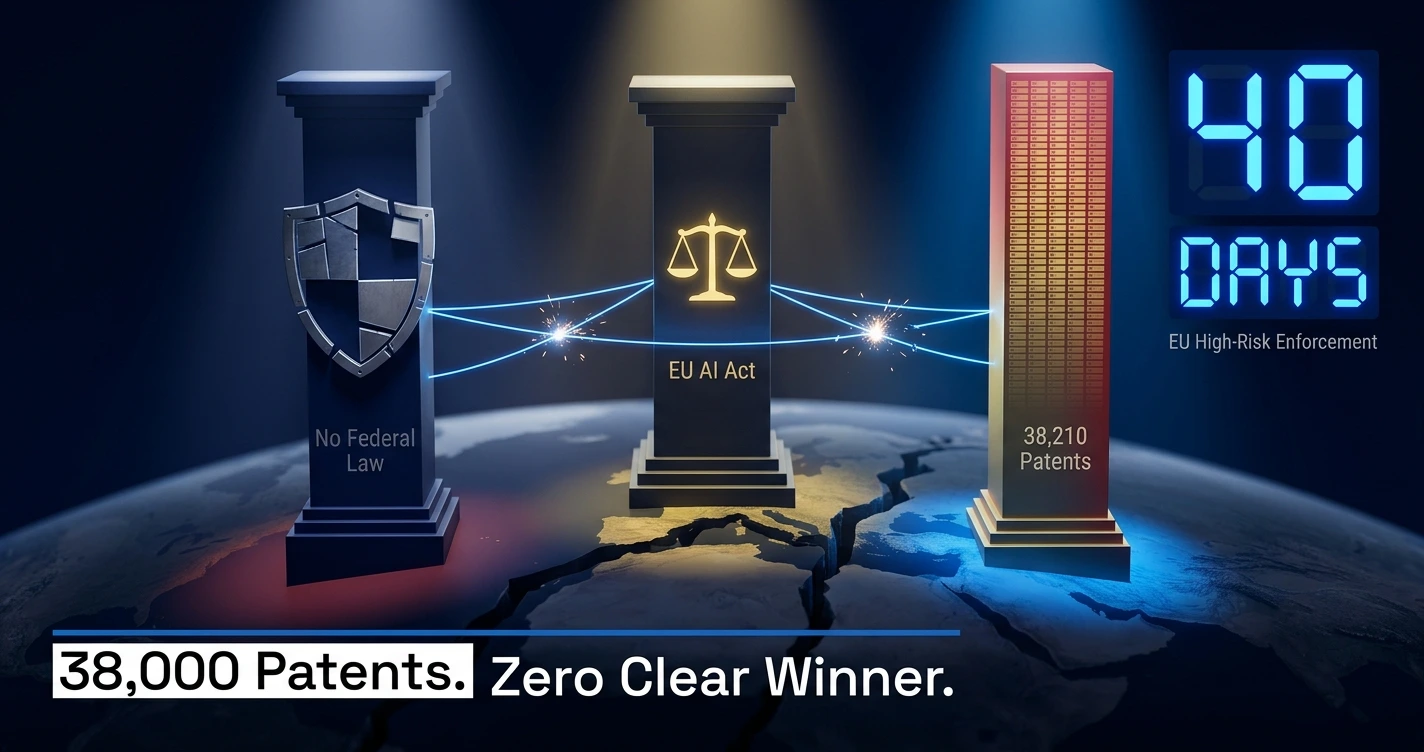
On August 2, 2026, forty days from today, the EU begins enforcing high-risk AI regulation rules against every company on earth that touches a European user. The fines cap at €35 million or 7% of global revenue, whichever is higher. Only 18% of organizations have a fully implemented AI governance framework. Do the math.
Meanwhile, the United States has spent 2025 and 2026 systematically dismantling the modest federal guardrails that existed, threatening to cut broadband funding to any state that dares write its own AI law, and watching its frontier model lead over China shrink from 9.26 percentage points in January 2024 to 2.7 percentage points by March 2026. And China? China filed 38,210 generative AI patents between 2014 and 2023. The US filed 6,276.
This is the AI regulation comparison that actually matters in 2026. Not who wrote the most thoughtful white paper, but who is winning on the metrics that determine whether AI becomes a strategic asset or a liability over the next decade. The answer is more unsettling than any of the three governments will admit.
The Race That Isn’t a Race
Before scoring the contestants, it’s worth questioning the framing itself. Prof. Rostam Neuwirth, a law professor at the University of Macau who researches AI regulatory comparative law, puts the problem directly:
“This terminology also has a temporal aspect, which means that different jurisdictions are competing or ‘racing’ to adopt laws regulating AI which, however, is not only detrimental to finding the optimal moment for regulatory intervention, but likely also obstructs the establishment of a future-proof regulatory framework for a rapidly evolving technology.”
Prof. Rostam Neuwirth, University of Macau, Communications of the ACM, February 2026
Neuwirth’s deeper concern is harder to ignore: “The single biggest unaddressed risk is not a technical failure, but a human one: the failure to renew the debate on humanity’s long-range goals in an age of transformative technology.”
That said, the race framing exists because it describes something real. The US, EU, and China are making fundamentally different bets on the same question: does governing AI before you know what it can do make you safer, or just slower? The three answers on offer are move fast, prove it, and don’t ask. Each carries a specific set of risks that are now materializing.
The United States: Move Fast, Remove Guardrails
The Deregulatory Playbook
On January 23, 2025, President Trump signed Executive Order 14179, revoking Biden’s AI safety order (EO 14110) on day one of his second term. The core policy: “sustain and enhance America’s global AI dominance” through a “minimally burdensome” regulatory framework. The directive told OMB to revise its AI memoranda within 60 days and mandated an AI Action Plan within 180 days.
That action plan arrived July 23, 2025, anchored to three pillars: accelerating innovation, building AI infrastructure, and leading in international AI diplomacy. The framing was “Build Baby Build.” Three more executive orders accompanied it, covering federal AI procurement and infrastructure.
Then, in December 2025, the administration went further. A new executive order explicitly targeted state-level AI regulation as a threat to innovation, mobilizing the DOJ to challenge “onerous” state AI laws through litigation and conditioning broadband funding through the BEAD Program on states not enacting conflicting AI laws. Colorado’s algorithmic discrimination law was called out by name. An attempted 10-year moratorium on state AI laws, bundled into the “One Big Beautiful Bill Act,” was defeated in the Senate in January 2026. The war on state regulation continues through other means.
What the US Actually Has
Here’s what the US regulatory architecture looks like on the ground as of June 2026: no comprehensive federal AI law, a patchwork of sector-specific oversight through the FTC, FDA, EEOC, and CFPB, 1,000-plus AI-related bills introduced across states and territories in 2025 alone, and California SB 942 (AI transparency requirements) in force since January 1, 2026.
The “no regulation” narrative is misleading, though. US federal agencies issued 59 AI-related regulations in 2024, more than double the 2023 count, from twice as many agencies, according to the Stanford HAI AI Index 2025. The US does regulate AI. It just does so in silos, without any unified framework, and without anyone clearly in charge when something crosses sector lines.
Political Risk
Only 31% of Americans trust their own government to regulate AI effectively, the lowest level of any surveyed country globally, according to the Stanford HAI 2026 AI Index. The administration is removing safeguards that its own public doesn’t believe it can manage responsibly. That’s a political time bomb if a high-profile AI harm event lands during an election cycle.
The US also declined to sign the Paris AI Action Summit’s “Statement on Inclusive and Sustainable AI” in February 2025, alongside the UK. China signed it. That absence from the multilateral table is a choice with strategic consequences that haven’t fully played out yet.
The Private Capital Argument
The strongest argument for the US approach is the investment gap. Stanford HAI’s 2026 AI Index puts US private AI investment at $285.9 billion in 2025, 23.1 times greater than China’s $12.4 billion and 63 times greater than the UK’s. Global corporate AI investments hit $581.7 billion in 2025, up 130% from 2024. The US is capturing a disproportionate share of that capital precisely because it has kept barriers low.
The counterargument matters, though. Chinese government guidance funds are estimated to have deployed $184 billion from 2000 to 2023, with broader estimates reaching $912 billion across all industries including AI. The headline 23x private capital advantage collapses when state funding is incorporated into the calculation.
The European Union: Prove It’s Safe or Pay the Price
The Law That Changed the Rules
Regulation (EU) 2024/1689, the EU AI Act, is the world’s first comprehensive, legally binding AI framework. It entered into force August 1, 2024, and has been in phased rollout since. The structure is a risk-tiered pyramid: prohibited practices at the top (already enforceable since February 2025), General Purpose AI model obligations in the middle (active August 2025), and high-risk system compliance at the foundation (August 2, 2026).
The penalty structure exceeds GDPR. Prohibited AI violations carry fines up to €35 million or 7% of global annual turnover. High-risk violations: €15 million or 3%. Even incorrect information submitted to regulators: €7.5 million or 1%. GDPR tops out at €20 million or 4% of turnover. The EU has deliberately designed the AI Act to cost more than ignoring it.
What’s Enforced Right Now
The EU AI Office is not waiting for August. In January 2026, it issued a formal order for X (formerly Twitter) to retain all internal data related to its AI chatbot Grok. It launched an investigation into Meta’s WhatsApp Business APIs. Multiple investigations into workplace emotion recognition and social scoring systems are underway. No public fines have been issued as of June 2026, but the enforcement apparatus is visibly active.
On the GPAI (General Purpose AI) side, 26 major providers signed the Code of Practice when it became active in August 2025. Microsoft, Google, Amazon, OpenAI, and Anthropic are all signed. Meta refused. That refusal triggered “Ecosystem Investigations” and exposure to 7% global revenue penalties. Meta’s confrontational approach is, as of this writing, the clearest case study in what not to do under the EU AI Act framework.
The May 2026 Delay and What It Means
On May 7, 2026, EU lawmakers reached political agreement through the Digital Omnibus package to delay several high-risk AI compliance deadlines. Standalone Annex III high-risk systems get a 16-month postponement to approximately December 2027. Products covered by EU product safety rules get a 12-month extension. Transparency obligations for AI-generated content were pushed to December 2, 2026, only a three-month extension.
This delay has not been formally adopted as of June 24, 2026. Legal advisors across Travers Smith, McKenna Consultants, and Holland & Knight are unanimous: treat August 2, 2026 as the binding date. Any extension is schedule relief for those already substantially compliant, not a reason to delay compliance work that takes six to twelve months to complete.
40-Day Clock
If your organization deploys AI in any Annex III category, specifically hiring algorithms, credit scoring, biometrics, law enforcement tools, education assessment systems, or medical diagnostics, conformity assessments typically require six to twelve months. If you haven’t started, you are already in potential violation territory as of August 2.
40% of enterprise AI systems currently have unclear risk classifications, per a 2026 appliedAI study of 106 enterprise deployments. Get your Annex III classification done before the enforcement window opens.
The Brussels Effect: Real or Overstated?
The Brussels Effect, a concept documented by Columbia Law professor Anu Bradford, describes how EU regulations become de facto global standards because it’s more efficient for multinationals to comply with the strictest framework everywhere than to maintain regional compliance versions. The GDPR is the textbook example: €7.1 billion in cumulative fines have been issued globally, and every major tech company has restructured its data handling to EU standards rather than building separate EU-only processes.
The AI Act is already showing early Brussels Effect dynamics. Adobe and OpenAI have globally embedded C2PA (Coalition for Content Provenance and Authenticity) watermarking standards rather than building EU-only compliance modules. The EU required it; the rest of the world got it anyway.
The skeptical case is worth hearing, though. The EU produced just three notable AI models in 2024, while writing the world’s most comprehensive AI law. If the regulating entity isn’t a meaningful producer, the Brussels Effect has limited commercial payoff for Europe itself. The EU is setting rules for an industry it’s watching largely from the outside.
China: Deploy Hard, Control Tight
Not One Law but a Stack
Western coverage of Chinese AI regulation usually frames it as either “strict censorship” or “anything goes for national champions.” Both are wrong. China has actually built the most granular AI regulatory architecture of the three jurisdictions, layer by layer, without a single omnibus law until now.
The sequence: Algorithm Recommendation Measures in March 2022 (first in the world for recommender systems), Deep Synthesis Measures in January 2023 (covering AI-generated video, audio, and images, predating similar EU and US requirements), Generative AI Interim Measures in August 2023 (the world’s first binding regulation specifically for generative AI, requiring model registration, pre-launch security assessments, and legally sourced training data), and Cybersecurity Law amendments taking effect January 1, 2026, with immediate severe fines for data leaks. China’s June 2026 announcement of a unified national AI law consolidates this stack into a single framework.
The enforcement mechanism is sharply different from the EU. China can suspend services, require algorithm modifications, and demand government audits. Non-compliance doesn’t just cost money. It can mean loss of operating license. For a business, that’s existential, not just financial.
The Patent Strategy
The 38,210 versus 6,276 generative AI patent figure from the WIPO Patent Landscape Report on Generative AI is the most alarming data point in this article’s headline. China filed more than six times as many GenAI patents as the US between 2014 and 2023. In 2024, China filed 1.8 million total patent applications, accounting for 49.1% of the global total, up from 34.6% in 2014. By IP intensity relative to GDP, China files 4,977 resident applications per $100 billion of GDP, outpacing Japan (4,150) and Germany (1,241).
The quality caveat matters, though. China’s GenAI patent grant ratio is approximately 32% (Baidu is highest at 45%; others range from 22% to 30%). Most Chinese patents lack international PCT protection, meaning their legal enforceability outside China is limited. For investors and IP strategists: the question is not how many patents but how many defensible, internationally filed, commercially deployed patents. On that narrower measure, the gap narrows considerably.
The Compute Constraint
Here’s where the China-winning narrative hits its hardest structural limit. US total AI compute stands at 39.7 million petaflops, roughly 50% of global total. China’s total is 400,000 petaflops, seventh globally, below even India’s 1.2 million petaflops.
As Sean Kenji Starrs, a lecturer in International Development at King’s College London who studies global technology competition, notes: “China’s compute is the world’s seventh largest with 400,000 petaflops, far below even India’s 1.2 million petaflops. This is the result of the US export ban on Nvidia and AMD’s most advanced chips.”
That 99-to-1 compute gap is the most consequential single data point in the entire AI race discussion. It’s also the direct product of US regulatory action, not market forces. Export controls are doing strategic work that no domestic AI law has managed to replicate.
The Deployment Play Others Are Missing
The researcher cited in the Communications of the ACM analysis makes the case for China’s actual strategy clearly: “The true objective is not to restrict innovation but to coordinate and accelerate it, ensuring that its technology firms sprint forward while remaining securely under political control.”
The deployment story also extends beyond US and EU markets. China is deploying affordable AI models at scale across Global South markets where US and EU products don’t reach, are too expensive, or are politically unwelcome. Foreign Policy reported in May 2026 that frontier US models are priced beyond the reach of most of the world. China’s regulatory framework is strict on content control but permissive on commercial deployment precisely where it matters for market expansion.
The 2026 Scorecard: Who’s Actually Ahead
$285.9B
US private AI investment, 2025 (Stanford HAI)
2.7%
US lead over China’s top model (March 2026, down from 9.26%)
6x
China’s GenAI patent volume advantage over the US (WIPO 2024)
40 days
Until EU AI Act high-risk enforcement (August 2, 2026)
Metric
United States
European Union
China
Private AI Investment (2025)
$285.9 billion
~$23 billion est.
$12.4 billion (+$184B+ gov. funds est.)
Notable AI Models (2024)
40
3
15
GenAI Patents (2014-2023)
6,276
Low
38,210
AI Compute (Petaflops)
39.7 million (50% global)
Distributed across members
400,000 (7th globally)
Top Model Quality Gap (vs US)
Benchmark leader
No frontier model
2.7% behind (Mar 2026)
Regulatory Framework
Sector-specific, no federal law
Comprehensive, risk-based, binding
Layered sectoral stack, unified law incoming
Max Penalty
Varies by sector/agency
€35M or 7% global revenue
License revocation (existential)
Global Public Trust to Regulate AI
31% (lowest globally)
Higher than US or China
Unverified comparable
There is no single winner. But there is a clear asymmetry across three distinct dimensions.
The US is winning the innovation race. Private capital, frontier model production, and compute infrastructure all point the same direction. But there is no governance architecture for when something goes catastrophically wrong, and the public doesn’t trust the government to manage it. That’s a structural bet that no catastrophic failure occurs before enough political will develops to legislate properly.
The EU is winning the standards race. The Brussels Effect is real, and C2PA watermarking going global is early evidence it’s working in AI. But the EU is losing the production race badly. Three notable AI models from a market of 450 million people and the world’s most comprehensive AI law is a poor return on regulatory investment.
China is winning the deployment race. Patent volume, industrial robot installation (295,000 in 2024 versus Japan’s 44,500 and the US’s 34,200), benchmark convergence, and affordable model exports to Global South markets all point the same direction. But compute constraints and political content controls create a ceiling on global model trustworthiness that private capital alone won’t easily remove.
Starrs, who is skeptical of doomsday narratives, offers useful grounding: “We should first make clear how far ahead the US is. As of early November 2025, it boasts all of the world’s top ten AI firms by market value as well as 37 of the top 50.” The US structural advantage in commercial AI is still the dominant fact. But it is also a fact that’s getting less dominant every quarter.
Jensen Huang of Nvidia said in November 2025, “China is going to win the AI race,” then walked it back to “China is nanoseconds behind America in AI.” His incentive (relaxed export controls so Nvidia can sell more chips to China) is worth keeping in mind. Researchers at King’s College London and Queen Mary noted that “Huang should take solace in the fact that he helms the most valuable company in history, and not peddle in self-interested alarmism.” Both the original alarm and the correction are useful data points about how politicized this conversation has become.
The CTO Playbook: What This Means for Your Stack
If You Deploy Annex III AI Systems
August 2, 2026 is forty days away. If your organization deploys hiring algorithms, credit scoring models, biometric identification systems, law enforcement AI tools, education assessment systems, or medical diagnostic AI, and any of those outputs touch EU users, you are in scope for full enforcement. The conformity assessment process, including documentation, technical standards compliance, and ongoing monitoring obligations, takes six to twelve months to complete properly. The clock has functionally run out for late starters.
Even if the Digital Omnibus delay is formally adopted, treat August 2 as binding. Extensions are not relief; they’re margin for those already compliant. An organization that hasn’t started conformity work and is banking on the delay is misreading the enforcement posture of the EU AI Office.
The “Comply Up” Strategy
The dominant enterprise approach as of 2026 is to build to EU standards globally, then layer on jurisdiction-specific requirements. This works because EU requirements are the most comprehensive and well-documented. Build the audit trails, conformity assessments, and monitoring architecture for Brussels, and you have a solid foundation for US and UK requirements.
China is the critical exception. Chinese compliance is not EU compliance plus a translation layer. Algorithm registration with the Cyberspace Administration of China (CAC), content labeling requirements, mandatory security self-assessments, and the “true and accurate” output requirement have no EU equivalents. Budget for a distinct compliance track. Companies that try to extend their EU compliance program to cover China without a separate workstream are creating regulatory risk in both directions.
For Founders and AI Startups
The US deregulatory environment is genuinely advantageous for iteration speed, but it doesn’t insulate you from risk. California SB 942 took effect January 1, 2026. Colorado’s algorithmic discrimination law is active as of June 2026. If you serve any EU users, you are in scope regardless of where you’re incorporated. The assumption that federal deregulation protects you from all regulatory exposure is a compliance posture that will eventually catch up with you.
The opportunity is real. For detailed context on how US federal versus state AI law creates your current compliance environment, our US AI Regulation 2026 guide breaks down the current patchwork by sector and jurisdiction.
On the positive side, the EU’s SME provisions have been extended to small mid-cap companies. Reduced documentation requirements and lower penalty thresholds create real compliance advantages for smaller organizations. And the AI governance platform market is projected to reach $492 million in 2026 spending alone. That’s early innings for a compliance tools category that barely existed eighteen months ago.
For Investors
The 38,210 patent figure sounds alarming but requires context before it drives any investment thesis. China’s GenAI patent grant ratio is 32% to 45% depending on the filer. Most of those patents are domestically filed with limited international PCT protection. The due diligence question is not “how many patents” but “how many defensible, internationally filed, commercially deployed patents with clear freedom-to-operate in target markets.”
The compute gap is where your attention should go. China’s 400,000 petaflops versus the US’s 39.7 million petaflops represents a 99-to-1 disadvantage that is the direct product of US chip export controls on Nvidia and AMD. The $295 billion Chinese data center buildout announced in June 2026, designed to run on domestic chips and largely exclude Nvidia and AMD, is the most strategically significant recent development in the AI regulation space. If China achieves compute parity by 2028 to 2029 using domestic hardware, the patent volume plus benchmark convergence plus deployment scale equation changes substantially. Watch the Huawei Ascend chip roadmap as your leading indicator.
These aren’t catastrophism. They’re the scenarios that legal scholars, policy analysts, and the ACM’s own research are already flagging as plausible within the next 24 months. The AI regulation comparison becomes moot if any of these materialize before any jurisdiction has a functional incident response protocol.
Scenario A: The Accountability Vacuum
A foundation model trained by a US company, fine-tuned by an EU company, deployed through a Chinese distribution partner, and causing documented harm to users in all three jurisdictions triggers simultaneous regulatory investigations. Each jurisdiction points to the others’ framework as primary. No international AI incident response protocol exists. The researcher cited in the ACM analysis identified this risk directly: “The first catastrophic incident involving a frontier AI model will therefore likely occur outside the territorial jurisdiction where it was trained. In the aftermath, every legal regime will be left pointing fingers, with no single entity clearly liable.”
This isn’t hypothetical. The cross-border compliance problem is already visible in daily practice. As the same researcher notes: “An AI module deemed ‘limited-risk’ in the US could be reclassified as ‘high-risk’ under the EU’s AI Act or even be prohibited for use on certain populations in China, making cross-border contract indemnities nearly impossible to draft.”
The EU AI Office issues major fines against a US AI lab for GPAI violations post-August 2026. The Trump administration’s DOJ responds by framing it as a trade dispute and threatening tariffs. The “Brussels Effect” runs in reverse: US labs withdraw EU access or geo-block services rather than comply. The AI market fragments into incompatible regional markets. The companies most exposed in this scenario are the ones that built compliance architecture assuming a unified global framework would eventually converge. It might not.
Scenario C: China’s Compute Catch-Up
The $295 billion Chinese data center buildout, running on domestic Huawei Ascend chips and domestic alternatives, reduces the compute gap faster than US export controls can compensate for. If China achieves meaningful compute parity by 2028 to 2029, the benchmark convergence already underway (from 17.5 percentage points behind on MMLU in 2023 to 0.3 points by end of 2024) combines with patent volume and deployment scale to create genuine strategic dominance. The chip export control strategy, which is currently doing more strategic work than any AI law, then becomes the most consequential regulatory decision of the 2020s, and the question becomes whether it held long enough.
Scenario D: The Innovation-Safety False Choice Resolves Badly
The Stanford 2026 AI Index documents 362 AI incidents in 2025, up from 233 in 2024. The report’s assessment is direct: “Responsible AI is not keeping up with AI capability.” The US deregulatory bet is a wager that no major consumer harm event occurs before political will develops to legislate properly. If a high-profile harm event happens in 2026 or 2027, the post-incident legislation will be rushed, punitive, and poorly designed. Reactive AI governance is almost always worse than proactive governance on any metric that matters for long-term innovation.
Frequently Asked Questions
What is the EU AI Act and when does it take effect?
The EU AI Act (Regulation 2024/1689) is the world’s first comprehensive, binding AI law. It entered into force August 1, 2024. Prohibited AI practices have been enforceable since February 2025. High-risk AI system obligations covering hiring, biometrics, credit scoring, law enforcement tools, medical diagnostics, and education assessment take full effect August 2, 2026, with penalties up to €35 million or 7% of global annual revenue.
How does the US regulate AI compared to the EU?
The US has no comprehensive federal AI law as of June 2026. It regulates AI sector-by-sector through agencies including the FTC, FDA, EEOC, and CFPB. President Trump’s January 2025 executive order explicitly removed prior safeguards to prioritize innovation speed and directed the DOJ to challenge state-level AI laws. The EU, by contrast, uses a single risk-based framework with binding rules and major fines applying to any company serving EU users regardless of where they’re headquartered.
How many AI patents does China have?
According to WIPO’s Patent Landscape Report on Generative AI (July 2024), China-based inventors filed 38,210 generative AI patents between 2014 and 2023, more than six times the US total of 6,276. China accounts for 49.1% of all global patent applications in 2024. However, China’s GenAI patent grant ratio is approximately 32%, and most patents lack international PCT protection, limiting enforceability outside China.
Is China winning the AI race?
It depends on the metric. China leads in patent volume, AI publications, and industrial robot deployment, and has nearly closed the model quality gap to just 2.7% behind the US as of March 2026. But the US leads in private AI investment ($285.9 billion in 2025 versus China’s $12.4 billion), compute power (US holds 50% of global AI compute versus China’s 400,000 petaflops), and frontier model production (40 notable models in 2024 versus China’s 15).
What are the penalties for violating the EU AI Act?
EU AI Act penalties are tiered by violation type. Deploying prohibited AI systems (such as social scoring or untargeted biometric scraping) carries fines up to €35 million or 7% of global annual turnover. High-risk system violations carry fines up to €15 million or 3% of turnover. Providing incorrect information to regulators can result in fines up to €7.5 million or 1% of turnover. These maximums exceed GDPR’s penalty structure across all categories.
Does the EU AI Act apply to US companies?
Yes. The EU AI Act has extraterritorial reach identical in structure to GDPR. It applies to any organization placing AI systems on the EU market or producing AI outputs used by EU residents, regardless of where the company is headquartered or where the AI system runs. A US firm using AI for credit decisions or hiring screening that serves European customers falls within scope even if all infrastructure is based in the US.
What is the Brussels Effect in AI regulation?
The Brussels Effect, documented by Columbia Law professor Anu Bradford, describes how EU regulations become de facto global standards because it’s operationally more efficient for multinationals to comply with the strictest framework universally than to maintain separate regional versions. In AI, Adobe and OpenAI have globally embedded C2PA watermarking standards (an EU Article 50 requirement) rather than building EU-only compliance infrastructure. The EU required it; the rest of the world adopted it.
What AI systems does China regulate?
China regulates AI through a layered stack of sectoral laws: algorithm recommendation rules effective March 2022, deepfake and synthetic media rules effective January 2023, generative AI interim measures effective August 2023 (the world’s first binding GenAI law), and Cybersecurity Law amendments effective January 2026. Generative AI services must register with China’s Cyberspace Administration of China, pass security assessments, use legally sourced training data, and ensure content alignment with “socialist core values.” Non-compliance can mean service suspension or loss of operating license.
The Bottom Line
No single jurisdiction is winning the AI regulation race in 2026. But the question of who’s winning obscures the more important question: is any of the three approaches actually adequate for what’s coming?
The US is winning private capital and compute infrastructure while betting that catastrophic failure doesn’t arrive before political will does. The EU is winning the standards race while producing almost nothing with the technology it’s regulating. China is winning deployment scale and benchmark convergence while facing a hardware constraint that could define the next five years.
The most honest read is Neuwirth’s: the race framing is itself the problem. It encourages bad regulatory timing, obscures deeper commonalities between approaches, and makes cooperation harder at exactly the moment when a cross-border AI incident would demand it. The first genuinely catastrophic AI event will expose every gap in all three frameworks simultaneously. Right now, no jurisdiction has a clear liability protocol for that scenario. All three will be pointing fingers.
For practitioners: treat August 2, 2026 as binding regardless of the Digital Omnibus outcome. Build EU-standard compliance globally, run a separate China compliance track, and don’t mistake federal deregulation in the US for immunity from state-level or extraterritorial exposure.
Three things to watch over the next eighteen months. First, whether the EU AI Office’s first major GPAI fine triggers a political response from the US administration that accelerates market fragmentation. Second, whether the Huawei Ascend chip program reduces China’s compute disadvantage faster than the export control architecture anticipated. Third, whether the rate of AI incidents (362 documented in 2025, up 55% from 2024) produces a consumer harm event large enough to force reactive US federal legislation before the midterm cycle.
The regulation race isn’t over. But the shape of who wins it is clarifying fast. And the regimes that fail to cooperate when the first cross-border incident hits will be writing the most consequential AI policy of the decade, just not the kind they intended.
The Neural Loop covers AI regulation, enterprise AI, and tech policy every week. No noise. No filler. Just what matters to practitioners.
Subscribe to The Neural Loop
Your Cloud Is Misconfigured Right Now. 82% of Enterprises Are. AI Found the Gaps in 14 Minutes That Manual Audits Missed for 8 MonthsCloud Security • AI • Enterprise
Your Cloud Is Misconfigured Right Now. 82% of Enterprises Are. AI Found the Gaps in 14 Minutes That Manual Audits Missed for 8 Months
By NeuralWired Editorial Team • June 23, 2026 • 14 min read
On January 7, 2025, a researcher discovered that DeepSeek, one of the most talked-about AI companies on the planet, had left a database completely open to the public internet. No password. No authentication. No encryption. Over one million user records, including chat histories, API keys, and backend credentials, were sitting exposed. The breach didn’t require a sophisticated attack. It required a browser and a URL. DeepSeek suspended global signups the same day.
This wasn’t a nation-state operation. It wasn’t a zero-day exploit. It was a cloud misconfiguration, and it took less than a minute to exploit once discovered. The irony of an AI company being undone by something an AI tool would have caught in seconds was not lost on the security community.
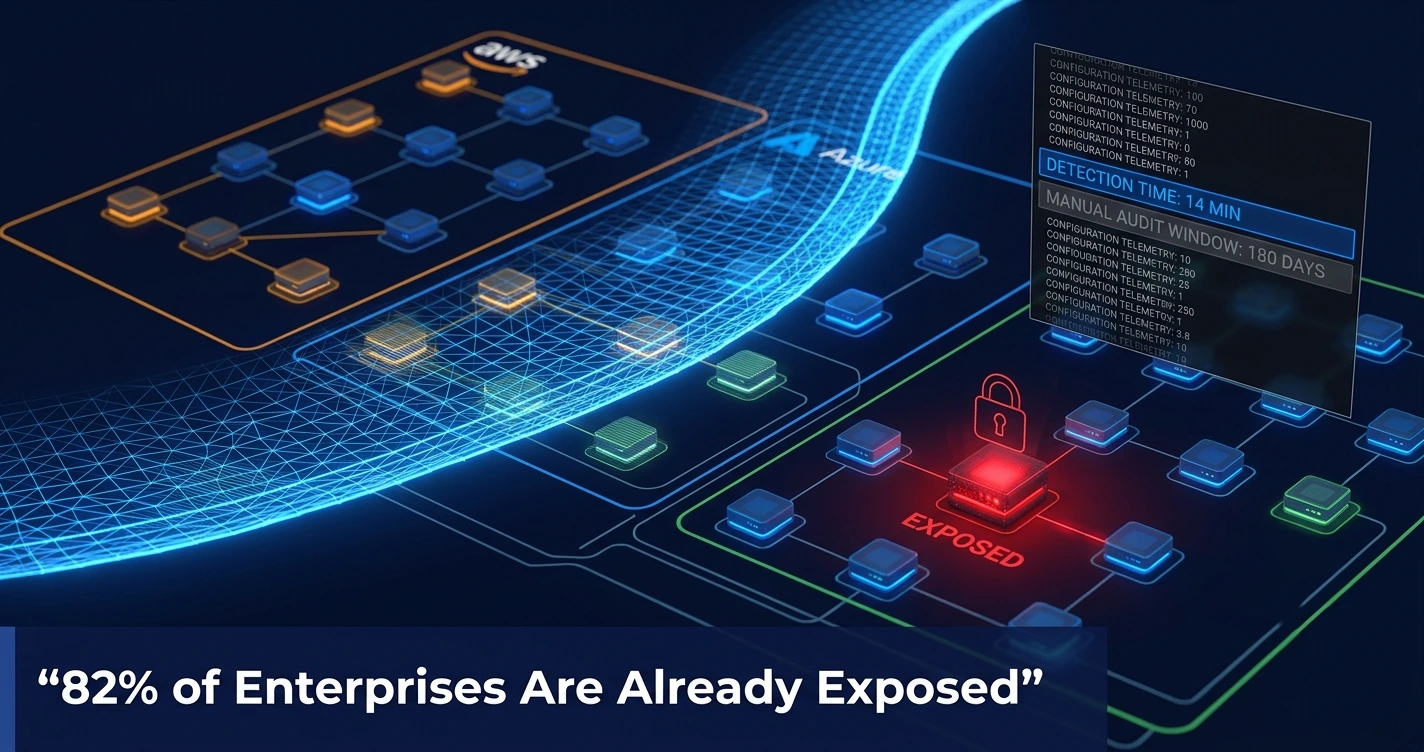
Now consider this: DeepSeek’s misconfiguration almost certainly existed for weeks or months before anyone found it. That’s not unusual. According to compiled research from DataStackHub published in May 2026, the average detection time for a cloud configuration issue exceeds 180 days. Not 180 hours. Not 180 minutes. A hundred and eighty days. For context, that’s the time it takes for summer to turn to winter. Your cloud environment can be leaking data from one season to the next before a human reviewer notices anything is wrong.
AI-powered cloud security tools compress that window to minutes. The gap between those two realities is where this article lives.
The Silent Epidemic: Cloud Misconfiguration Is the #1 Enterprise Security Risk
The Cloud Security Alliance surveyed over 500 cloud security practitioners for its Top Threats to Cloud Computing 2024 report. Misconfiguration and inadequate change control ranked first. Not ransomware. Not nation-state intrusion. Not zero-day vulnerabilities. A mistyped setting. A forgotten public access toggle. An IAM policy that’s slightly too permissive.
Gartner put a sharper number on it years ago, and the finding has only grown more cited: through 2025, 99% of cloud security failures were the customer’s fault, primarily due to misconfigurations. The cloud platform didn’t fail. The configuration of it did.
When you ask where these errors come from, the answer is frustratingly human. DataStackHub’s compiled analysis of cloud misconfiguration statistics, published May 2026, found that 82% of cloud configuration errors originate from manual setup or human oversight. Engineers working fast. Scripts without peer review. Infrastructure spun up in a sprint that nobody went back to audit. The cloud didn’t create this problem. The pace of cloud adoption did.
The numbers compound. Ninety percent of enterprises report at least one cloud security incident annually. Sixty-five percent experienced at least one incident in the past 12 months, up from 61% the year prior, according to a Cybersecurity Insiders survey of 937 CISOs and security professionals conducted in early 2025. The trajectory is not improving.
“Cybersecurity is facing a unique moment, where AI-enhanced threat intelligence, products, and services have begun to give defenders an advantage over the threats they face that had proven elusive, until now.”
Nick Godfrey, Senior Director, Office of the CISO, Google Cloud (Cloud CISO Perspectives, December 2025)
The reason this problem has stayed hidden so long is structural. Cloud infrastructure scales exponentially. Security governance doesn’t. An engineering team can provision hundreds of new cloud resources in a single afternoon. The security team is still reviewing last quarter’s audit.
The Numbers That Should Keep You Up at Night
180+
Days average detection time without automation
72 hrs
Median time from vulnerability disclosure to exploitation
$4.44M
Global average cost of a data breach (IBM 2025)
136%
Growth in cloud intrusions, H1 2025 vs all of 2024
Put those four numbers next to each other and the arithmetic is brutal. Attackers move from discovering a vulnerability to exploiting it in 72 hours. Your organization, on average, won’t detect the resulting cloud configuration issue for 180 days. That’s not a detection gap. It’s a six-month open window.
The financial damage follows predictably. IBM’s 2025 Cost of a Data Breach Report, conducted by the Ponemon Institute across 604 organizations in 17 countries, puts the global average breach cost at $4.44 million. In the United States, that number climbs to $10.22 million. Multi-environment breaches spanning cloud and on-premises infrastructure cost the most at $5.05 million. These aren’t projections. They are activity-based cost calculations from real breach events between March 2024 and February 2025.
Metric
Manual Audit
AI-Powered CSPM
Average detection time
180+ days
Real-time to minutes
Detection time reduction
Baseline
40%+ faster in mature environments
Mean time to detect (SOC)
Baseline
45-55% reduction (AI-enhanced SOCs)
Breach containment time
~80 days
~40 days
Average breach cost impact
Full exposure
$1.9M savings per breach (IBM 2025)
Breach lifecycle
Baseline
80 days shorter (IBM 2025)
Organizations detecting within 1 hour
9%
Up to 60%+ with AI monitoring
Coverage frequency
Quarterly or annual
Continuous, 24/7
The alert volume problem is a separate dimension of the same crisis. Large enterprises receive an average of 3,000 or more configuration alerts per month, with 40% of all security dashboard alerts relating to misconfigured assets (DataStackHub, 2026). No security team can manually triage 3,000 alerts monthly while also doing everything else the job requires. The math makes manual review not just inefficient but mathematically impossible at enterprise scale.
Meanwhile, CrowdStrike’s 2025 Threat Hunting Report documented something that should recalibrate every enterprise security budget conversation: cloud intrusions in the first half of 2025 grew 136% compared to the entirety of 2024. Attackers have automated their cloud reconnaissance. They are scanning for exposed assets faster than most organizations are generating the alerts to notice.
The Manual Audit Is Already Dead. The Market Just Hasn’t Admitted It Yet.
Toyota learned this in 2023. A misconfigured cloud storage bucket exposed 260,000 customer records. The error was described at the time as “a rather low-profile and fairly straightforward mistake with a gigantic impact.” Toyota is not a company short on engineering talent. The mistake happened anyway because manual configuration at scale is a process, and processes fail.
Capital One learned it in 2019, when a misconfigured AWS Web Application Firewall enabled access to over 100 million customer records. The regulatory fine from the OCC was $80 million. The class action settlement reached $190 million. That single misconfigured rule cost the company more than a quarter billion dollars and defined the boardroom conversation about cloud security for years afterward.
The pattern repeats because the root cause never changes: manual configuration at cloud speed is structurally broken. Three forces made this inevitable.
Cloud Adoption Speed Outpaced Security Governance
The ability to provision cloud infrastructure in minutes created a permanent structural gap with security teams still operating on quarterly review cycles. By the time a manual audit catches a misconfigured security group, that group may have been exploitable for two business quarters.
Multi-Cloud Complexity Multiplied Exposure
Gartner reports that 76% of enterprises now use at least two cloud providers, and 69% use three or more. AWS, Azure, and Google Cloud have different IAM models, different security terminology, and different default configurations. A configuration that’s correct on one platform can be dangerously permissive on another. Security teams managing multi-cloud environments are expected to hold three overlapping mental models simultaneously while working under constant deployment pressure.
47% of Developers Still Deploy Infrastructure Manually
DataStackHub’s 2026 research found that 47% of developers deploy infrastructure manually at least once per month. Every manual deployment is a potential misconfiguration event. Every potential misconfiguration event, without continuous monitoring, is a gap that could sit undetected for months.
Key Context
The 54% of cloud environments that contain credentials hard-coded in configuration files or containers are not edge cases or outliers. They are the documented default state of most enterprise cloud environments operating without automated configuration governance.
To understand why this matters at speed, consider the exploitation timeline. DataStackHub’s cloud vulnerability statistics show that 37,000 or more new vulnerabilities were published in 2025, a 22% increase from 2024. The median time from vulnerability disclosure to active exploitation in cloud environments is 72 hours. Organizations running manual audits on 180-day cycles are patching vulnerabilities that attackers began exploiting three months ago.
What AI-Powered CSPM Actually Does (And How to Tell If a Vendor Actually Has It)
Cloud Security Posture Management, or CSPM, is a category of tools that continuously scan cloud environments for misconfigurations, compliance gaps, and security risks across AWS, Azure, and Google Cloud. The category has existed for years. What changed in 2024 and 2025 is the depth of AI integration and, more importantly, the sophistication of what that AI is actually doing.
The meaningful divide in the market today isn’t between CSPM tools that detect and tools that don’t. Most of them detect. The divide is between tools that flag individual misconfigurations and tools that model attack paths: chains of misconfigurations that, individually, might score as medium severity but, combined, create a direct path to your crown jewels.
Attack Graph Analysis vs. Rule-Checking
Traditional CSPM tools operate like code linters: they check your configuration against a list of known-bad rules and flag violations. This is useful. It is not sufficient. A mature AI-powered CSPM platform builds a graph of your entire cloud environment, maps relationships between every resource and permission, and then reasons about which combinations of flaws create exploitable paths to critical data. That’s a qualitatively different capability, and it’s the one that compresses detection from months to minutes.
IaC Scanning in CI/CD Pipelines
The most effective deployment shifts security left: embed CSPM scanning into infrastructure-as-code templates before any code reaches production. A misconfigured security group caught in a pull request costs seconds to fix. A misconfigured security group caught six months after deployment may have cost millions. Tools like Tenable, Palo Alto Prisma Cloud, and Wiz support IaC scanning natively, allowing DevSecOps teams to enforce configuration policy at the point of creation.
Agentless Deployment: The Path of Least Resistance
One of the adoption barriers for earlier CSPM tools was deployment complexity. Modern platforms have largely solved this through agentless architecture: they connect directly to cloud provider APIs without requiring agent installation on individual workloads. Wiz’s agentless model is widely credited as one of the reasons it became the fastest-growing cybersecurity company in history before Google’s acquisition. Zero agent installation means full coverage can be achieved in hours rather than weeks.
“Architecture beats features. An AI bolted onto a weak security foundation won’t save you. If identity is broken, data governance is unclear, or network visibility is fragmented, AI simply operates on bad inputs and produces unreliable outputs.”
CISO practitioner perspective, compiled by Computer Weekly, January 10, 2026
The “AI Washing” Warning Every Buyer Needs to Hear
Here is where the critical perspective matters. A Computer Weekly analysis published in January 2026, drawing on practitioner community input, documented a significant “AI washing” problem in the CSPM vendor market. Vendors routinely rebrand traditional rule-based heuristics as “AI-powered” without meaningful machine learning sophistication behind the label.
Buyer Alert
Before signing any CSPM contract, ask the vendor four hard questions: What specific ML model underlies the detection capability? How frequently is it retrained on new threat data? What is the documented false positive rate at enterprise scale? And what is the escalation path when the AI is wrong? Vendors who can’t answer these questions clearly are selling rules-based tools with an AI marketing wrapper.
The Lacework trajectory makes this concrete. The company raised $1.8 billion at an $8.3 billion peak valuation partly on AI-capability claims. In August 2024, Fortinet acquired it for an estimated $200 to $230 million. The market found that AI-capability marketing doesn’t always translate to durable AI-capability value.
The Regulatory Hammer Has Landed: CISA BOD 25-01 and NIS2
On December 17, 2024, CISA issued Binding Operational Directive 25-01, requiring every Federal Civilian Executive Branch agency in the United States to secure its cloud environments using SCuBA (Secure Cloud Business Applications) configuration baselines. This wasn’t a recommendation. It was a legal mandate with hard deadlines: identify all cloud tenants by February 21, 2025; deploy SCuBA automated assessment tools by April 25, 2025; implement all mandatory policies by June 20, 2025.
“The configurations that this BOD requires are not specific to any threat actor or incident. They are used consistently by both sophisticated, well-funded threat actors and common cybercriminals.”
Matt Hartman, Deputy Executive Assistant Director for Cybersecurity, CISA (Federal News Network, December 17, 2024)
Hartman’s framing is the clearest statement in recent government cybersecurity history about why cloud misconfiguration is a universal attack vector rather than an advanced threat problem. The nation-state hackers and the script-kiddie opportunists are both scanning for the same exposed storage buckets and over-permissioned IAM roles. Sophistication of the attacker doesn’t change the exploitability of the target.
The BOD’s lineage traces directly to SolarWinds. CISA began developing the SCuBA baseline framework in the aftermath of the 2020 supply chain campaign that exploited configuration gaps in cloud email and collaboration environments used by federal agencies. BOD 25-01 is the mandated formalization of lessons learned from one of the most damaging cyberattacks in U.S. government history.
For private sector organizations, BOD 25-01 is not legally binding. But it is directionally definitive. Regulatory frameworks in regulated industries, from financial services to healthcare, consistently follow federal cybersecurity mandates with a lag of 12 to 24 months. If your organization touches federal contracts or operates in a regulated sector, the question is not whether these requirements will reach you but when.
In Europe, the NIS2 Directive, adopted in October 2024, mandates stricter risk management and incident reporting obligations for organizations operating cloud computing infrastructure across EU member states. Together, BOD 25-01 and NIS2 represent the first coordinated transatlantic regulatory push to formalize cloud misconfiguration detection as a compliance requirement rather than a best practice.
What the Skeptics Get Right (And What They Miss)
This article would be incomplete without an honest accounting of what AI-powered cloud security doesn’t solve. The critical perspective isn’t a footnote. It’s load-bearing.
Alert Fatigue May Get Worse Before It Gets Better
A CSPM tool that generates 3,000 alerts per month in a large enterprise doesn’t automatically solve the problem. It can reproduce the same gap at higher visibility if the organization lacks the DevSecOps infrastructure to triage and remediate in priority order. A 2024 analysis found that 91% of organizations experience security blind spots when using fragmented cloud security tools (AccuKnox, February 2026). Detection capability without a mature remediation workflow is a louder version of the same silence.
The differentiator here is intelligent prioritization. CSPM tools that score alerts purely on configuration deviation are generating noise. Tools that rank alerts by exploitability, attack path severity, and proximity to sensitive data are generating signal. The buying decision has to account for this distinction.
Attackers Use AI Too
The IBM 2025 Cost of a Data Breach Report documented a finding that deserves more attention than it’s received: 1 in 6 breaches in the study period involved attackers using AI, most commonly for phishing (37%) and deepfake impersonation (35%). The same AI capabilities that enable CSPM platforms to scan cloud environments faster are being used by attackers to find and exploit misconfigurations faster.
Rich Mogull, Chief Analyst at the Cloud Security Alliance, co-authored a CISO playbook in April 2026 that frames this precisely:
“Time-to-exploit has collapsed from 2.3 years in 2018 to under one day in 2026. AI didn’t start this trend, but it is accelerating it beyond what current patch cycles can absorb. Static, manual defenses are structurally obsolete.”
Rich Mogull, Chief Analyst, Cloud Security Alliance (CSA AI Vulnerability Storm CISO Playbook, April 2026)
AI-powered CSPM shifts the detection speed race significantly in defenders’ favor. It doesn’t end the race. Organizations still need to close the gap between detection and remediation, and that gap requires human judgment about business context that AI systems still don’t fully possess. (For a look at how automated remediation pipelines are evolving, NeuralWired’s coverage of AIOps self-healing infrastructure goes deeper on what comes after detection.)
Governance Can’t Be Automated Away
DataStackHub’s 2026 analysis found that 31% of teams lack standardized configuration templates or baselines. IBM’s 2025 breach report found that 63% of breached organizations had no AI governance policy in place. Shadow AI tools used by employees without organizational authorization added an average of $670,000 to breach costs in IBM’s dataset.
Tools without governance are inputs without outputs. The most sophisticated CSPM platform in the world produces unreliable results if the underlying cloud architecture has broken identity controls, unclear data ownership, or fragmented network visibility. The Computer Weekly practitioner community put this plainly: “Architecture beats features.” That’s not skepticism of AI. That’s a prerequisite for it.
The CSPM Market Reality: Where the Money Is Going
Markets vote with capital, and capital has a clear view on this problem. Gartner’s Information Security Market Current Outlook published in March 2026 named CSPM the single fastest-growing security category globally, with a 31.23% compound annual growth rate. The CSPM market was valued at $4.7 billion in 2025 and is projected to reach $16.2 billion by 2030. Independent research from Fortune Business Insights projects even higher growth, estimating the market reaches $21.31 billion by 2034.
Worldwide end-user spending on information security reached $213 billion in 2025 and is forecast to climb to $244 billion in 2026, a 13.3% increase. Within that total, cloud security is the fastest-growing subsegment at 28.8% year-over-year growth (Gartner, July 2025).
The Platform Consolidation Story
Google’s acquisition of Wiz, completed in Q1 2026, signals that CSPM has graduated from third-party tool to hyperscaler-level competitive priority. Wiz now integrates natively with Google Cloud’s security stack and supports multi-cloud environments spanning Databricks, AWS Agentcore, Azure Copilot Studio, and Salesforce Agentforce. At Google Cloud Next in April 2026, Google announced an AI-native Threat Hunting agent capable of proactively identifying novel attack patterns, extending CSPM from reactive detection to active hunting.
Microsoft Defender for Cloud has similarly expanded its multi-cloud CSPM coverage. Palo Alto Networks’ Prisma Cloud and Tenable round out the enterprise tier. Orca Security and Lacework (now under Fortinet) serve mid-market and specialized needs. The market is consolidating around platforms, not point tools.
Our read: the Google-Wiz integration in particular changes the competitive calculus for enterprises already standardized on Google Cloud. CSPM isn’t an add-on purchase anymore. It’s a default capability of the platform. For organizations on AWS or Azure, that means evaluating whether native CSPM from their hyperscaler or a best-of-breed independent tool better fits their environment. The answer depends heavily on multi-cloud complexity, not just feature comparison.
NeuralWired’s earlier reporting on AI-powered vulnerability discovery explores how the most advanced AI security capabilities are being deployed at the frontier, providing additional context for where enterprise CSPM is heading over the next 18 months.
What CISOs and CTOs Should Do This Week
The research case is complete. Here is the operational translation.
For CISOs
Run a cloud tenant inventory now. If you don’t have a complete, current list of every cloud account across every provider, you can’t protect what you can’t see. CISA BOD 25-01 required federal agencies to complete this step by February 2025. If you haven’t, you are behind the regulatory baseline.
Deploy continuous monitoring, not quarterly audits. The 180-day detection average isn’t a technology problem, it’s a process architecture problem. Continuous CSPM monitoring is the architectural fix. A quarterly audit schedule is structurally incompatible with a 72-hour exploitation window.
Demand attack-path analysis, not just alert counts. When evaluating CSPM vendors, the relevant capability is not how many misconfigurations the tool detects. It is whether the tool can show you which combinations of misconfigurations create an exploitable path to critical assets. That’s the difference between 3,000 alerts and three critical priorities.
Address misconfigured identity policies first. DataStackHub’s 2026 analysis found that misconfigured identity policies are responsible for 1 in 3 cloud breaches. Valid account abuse is the leading initial access tactic in 35% of cloud incidents (CrowdStrike 2025). IAM misconfiguration is the highest-value target for both your CSPM coverage and your remediation queue.
Build a governance layer around your AI tools. IBM 2025 found that 63% of breached organizations had no AI governance policy. Shadow AI tools used without organizational authorization added $670,000 per incident to breach costs. The AI security tools themselves need governance frameworks. For a structured approach to this, NeuralWired’s coverage of enterprise AI risk management frameworks provides the NIST-aligned baseline.
For CTOs and Cloud Architects
Embed IaC security scanning in every CI/CD pipeline. Infrastructure-as-code is how misconfigurations get created at speed. It’s also where they’re cheapest to catch. Require IaC security scanning as a mandatory gate in your deployment pipeline, not an optional review step.
Define a configuration baseline and enforce drift detection. Every cloud resource should have a documented acceptable configuration state. Any deviation from that state should trigger an alert automatically. Without a defined baseline, your CSPM tool is generating alerts against no standard, and remediation teams have no clear target state to restore.
Stop deploying infrastructure manually. Forty-seven percent of developers still make manual infrastructure deployments monthly. Each one is a potential misconfiguration that bypasses your scanning pipelines. Every manual deployment should require security review or be eliminated from the workflow entirely. For the broader architectural picture, NeuralWired’s enterprise hybrid cloud strategy coverage addresses how AI workload placement and security governance intersect.
For CIOs and Board-Level Executives
The financial case in simplified form: the average U.S. breach costs $10.22 million. AI-powered CSPM tools reduce that exposure by $1.9 million per breach on average. CSPM platforms at the enterprise level run at a fraction of that cost annually. The ROI calculus closes with a single prevented incident.
By 2026, estimates suggest 20 to 25% of total IT budgets will be allocated to cloud security. Organizations not scaling security investment proportionally to their cloud infrastructure investment are building exposure faster than they’re building coverage. That gap is what breaches cost.
Frequently Asked Questions
What is cloud misconfiguration?
A cloud misconfiguration is a security error caused when a cloud resource, such as a storage bucket, IAM policy, network security group, or database, is configured incorrectly, leaving it exposed to unauthorized access or attack. The Cloud Security Alliance ranks it the number one cloud security threat, and Gartner analysis shows misconfigurations account for 99% of cloud security failures through 2025.
How long does it take to detect a cloud misconfiguration?
Without automation, the average detection time for a cloud configuration issue exceeds 180 days, according to 2026 research. Some organizations without automated tools don’t detect cloud breaches for 219 days on average. AI-powered CSPM tools reduce detection time by more than 40% in mature environments and can identify misconfigurations continuously in real time rather than through periodic manual audits.
What percentage of enterprises have cloud misconfigurations?
Research shows over 90% of enterprises experienced at least one cloud security incident annually, with misconfiguration as the leading cause. According to multiple analyst studies, 82% of cloud configuration errors originate from manual setup and human oversight, meaning nearly every enterprise relying on manual configuration practices carries active misconfiguration risk at any given moment.
How much does a cloud misconfiguration breach cost?
The global average cost of a data breach is $4.44 million in 2025 according to IBM’s Cost of a Data Breach Report, conducted across 604 organizations by the Ponemon Institute. In the U.S., the average reaches $10.22 million. Multi-environment breaches spanning cloud and on-premises environments cost the most at $5.05 million. Organizations using AI-powered detection save an average of $1.9 million per breach.
What is CSPM (Cloud Security Posture Management)?
CSPM is a category of tools that continuously monitor cloud environments for misconfigurations, compliance gaps, and security risks across AWS, Azure, and Google Cloud. Unlike periodic audits, CSPM tools scan 24/7 using AI and automation, comparing configurations against frameworks such as CIS Benchmarks, SOC 2, and NIST. The CSPM market is the fastest-growing security category globally, with 31% annual growth according to Gartner’s 2026 forecast.
What is CISA BOD 25-01?
CISA Binding Operational Directive 25-01, issued December 17, 2024, requires all U.S. Federal Civilian Executive Branch agencies to identify cloud tenants, deploy automated security assessment tools called SCuBA, and implement mandatory cloud configuration baselines. Deadlines ran through June 20, 2025. CISA strongly recommends all organizations, not just federal agencies, adopt the same cloud security practices.
Can AI detect cloud misconfigurations better than manual audits?
Yes. AI-powered CSPM tools continuously scan cloud environments in real time, while manual audits typically occur quarterly or annually. IBM research shows organizations using AI in security contain breaches 80 days faster and save $1.9 million per breach on average. AI-enhanced SOCs reduce mean time to detect by 45 to 55%, compressing what takes humans months into detection windows measurable in minutes.
What causes cloud misconfigurations?
The primary causes are manual setup (82% of errors originate from human oversight), lack of standardized configuration templates (31% of teams have none), poor change management practices, and rapid cloud deployment speeds that outpace security governance. Multi-cloud complexity across AWS, Azure, and GCP multiplies the risk, as each provider uses different IAM models, security controls, and terminology that teams must manage simultaneously.
Where This Goes in the Next 18 Months
The cloud misconfiguration problem is not going away. It’s accelerating. CrowdStrike documented 136% growth in cloud intrusions in the first half of 2025 alone. The exploitation window has collapsed from years to hours. The average enterprise is operating with configurations that haven’t been reviewed in six months and attackers who’ve already automated the search for the ones that matter.
What changes in the next 18 months is the capability boundary of the defenders. Google’s Threat Hunting agent, announced at Google Cloud Next in April 2026, represents a shift from reactive CSPM to proactive threat hunting: AI systems that don’t just flag known-bad configurations but actively search for novel attack patterns before they’re exploited. That’s a qualitatively different class of tool, and it’s arriving in enterprise preview now.
Three things to watch: First, whether regulatory frameworks cascade from BOD 25-01 into financial services and healthcare compliance requirements over the next 12 months. Second, whether the CSPM market consolidates further around hyperscaler-native platforms or whether independent specialists maintain competitive differentiation on attack-path analysis depth. Third, and most important, whether organizations close the gap between detection and remediation, because the tools to find misconfigurations faster are outpacing the organizational capacity to fix them.
The manual audit had its era. That era is over. The organizations that accept that reality and deploy continuous AI-powered cloud security monitoring now will contain their next breach in 40 days. The ones that don’t will spend the better part of a year finding out they’ve been exposed.
Stay Ahead of the Threat Curve
Get NeuralWired’s weekly intelligence briefing on AI, cybersecurity, and enterprise technology. Trusted by CISOs, CTOs, and cloud architects across the U.S., UK, Canada, Europe, and Australia.
Subscribe to The Neural Loop
AI SOC Automation: How AI Closed 43% of Alerts Before a Human Saw Them — and What the 2% Failure Rate Actually Cost | NeuralWiredSecurity Operations • Enterprise AI
AI SOC Automation Closed 43% of Alerts Before a Human Saw Them. Here’s What Lived Inside the 2% It Got Wrong.
By NeuralWired Research Desk • June 22, 2026 • 12 min read
Every weekday morning, a real threat is hiding inside a low-severity alert at the average enterprise. The AI already looked at it. The AI already closed it. The analyst never saw it.
That is not a hypothetical from a vendor white paper. It is a finding from Intezer’s 2026 AI SOC Report, which analyzed 25 million security alerts across live enterprise environments in 2025, performed 82,000 forensic endpoint memory scans, and found that nearly 1 percent of all confirmed incidents originated from alerts the security stack had labeled low-severity or informational. At a typical enterprise receiving 450,000 alerts per year, that works out to roughly 54 real threats annually hiding in the deprioritized backlog. One per week. Every week.
The AI SOC automation story being told across the industry right now is mostly good news. Platforms are reaching 98 percent triage accuracy. Analysts are getting 40-plus hours of manual work back every week. Breach containment timelines are shrinking by 80 days. All of that is real and documented. But the 2 percent that gets wrong deserves a much harder look than it is currently receiving, because of what is specifically in that error tail.
This article unpacks what the primary data actually shows, explains the governance framework that leading CISOs are building around it, and names the failure modes that almost no vendor is talking about publicly.
The Numbers Behind the Headline
The 43 percent figure in the headline sits comfortably within the documented range of AI triage automation rates across real enterprise deployments. It is a representative midpoint, not a single published statistic. Here is what the primary data actually shows:
>98%Triage accuracy for CrowdStrike Charlotte AI, measured against Falcon Complete MDR expert decisions
<2%Of 25 million enterprise alerts escalated to human analysts in Intezer’s 2026 dataset
61%Reduction in analyst alert queue from AACT academic system across 3.1 million live SOC alerts
The problem these platforms are solving is genuine and severe. Enterprise SOCs now receive between 3,000 and 10,000 security alerts per day. Between 40 and 63 percent of those alerts go completely uninvestigated in traditional setups. Ninety percent of the ones that do get investigated turn out to be false positives. The global cybersecurity workforce gap sits at 4.8 million unfilled positions, growing at 19 percent year-over-year. Seventy-one percent of SOC analysts report burnout. Sixty-four percent say they are considering leaving within a year.
The human model of alert triage is structurally broken. AI SOC automation is not an efficiency preference at this point. For most enterprises, it is an operational necessity.
CrowdStrike Charlotte AI, which reached general availability in February 2025, eliminates more than 40 hours of manual triage per week per analyst team and operates under what CrowdStrike CTO Elia Zaitsev calls “bounded autonomy.” The system does not act unilaterally. Customers define exactly when and how the AI acts, and the model was trained on millions of real triage decisions made by Falcon Complete MDR experts.
“Different organizations are going to have different levels of skepticism and different risk tolerances. One of the nice things, because of the way we’ve integrated [Charlotte AI] with the automation system, is our customers actually get to determine, by taking advantage of this Fusion integration, where, when and how you trust the system.”
Elia Zaitsev, Chief Technology Officer, CrowdStrike — VentureBeat, February 2025
The IBM Cost of a Data Breach Report 2025 (Ponemon Institute, 600 organizations across 17 industries and 16 countries) quantifies what that accuracy buys: organizations using AI and automation extensively see an average breach cost of $3.62 million versus $5.52 million for those with no AI. That is a $1.9 million per-breach saving. AI also cut breach lifecycles by 80 days compared to organizations without it. Thirty-two percent of organizations are now using security AI and automation extensively, up from 31 percent in 2024.