

Tag: Bitcoin

  • Binance Hack: How $6.3 Billion Disappeared in 20 Minutes, and Why the FBI Points to North Korea

    Binance Hack: How $6.3 Billion Disappeared in 20 Minutes, and Why the FBI Points to North Korea

    Most of the money left in about twenty minutes. Starting at 20:05 UTC on October 29, an attacker drained roughly $6.36 billion from Binance wallets spread across ten blockchains, according to TRM Labs’ technical analysis. TRM calls it the largest crypto theft on record, about four times the size of the $1.5 billion Bybit hack in February 2025.

    Binance, which AP describes as the world’s largest crypto exchange, put the damage at about $6.3 billion and froze all deposits and withdrawals while it worked with law enforcement. Four days later, the exchange is reopening in phases, the FBI has named a culprit, and the harder questions about how this happened are still open.

    What Binance Says Happened

    Binance’s early account pointed to a compromised laptop belonging to a DevOps engineer. That machine, the company said, gave an attacker a way into a service container that could submit unauthorized withdrawals. It reported no evidence that any wallet private key had leaked.

    That explanation has already grown. Binance later said investigators had found additional points of breach beyond the laptop, without saying what they were. Co-CEO Richard Teng said the attacker did not simply borrow one engineer’s permissions. No root cause has been published, and Binance has said its investigation has not attributed responsibility to any individual.

    What the Blockchain Shows

    TRM’s analysis suggests this was patient work. The attacker’s wallet received three small withdrawals from Tornado Cash on the morning of October 28, at least 36 hours before the main theft. That staging pattern is a signature TRM says it has seen before.

    On Ethereum, the attacker used an EIP-7702 delegation, backed by 50 pre-signed authorizations, to turn a Binance hot wallet into a sweeper under the attacker’s control. On the other nine chains, Binance wallets simply sent funds through ordinary signed transfers. TRM reads that as evidence that Binance’s hot-wallet signing infrastructure itself was compromised, rather than individual keys being stolen.

    Blockchain analytics firm Elliptic reached a similar conclusion: the attacker appears to have gotten Binance’s own systems to sign the transactions. Elliptic’s framing is worth underlining. As with Bybit, it was the infrastructure and the people around the wallets that failed, not the cryptography.

    The North Korea Question

    TRM attributed the attack to North Korea’s TraderTraitor group and said it made that judgment with high confidence. Chainalysis CEO Jonathan Levin said the group likely carried it out. On October 31, the FBI made it official, stating that North Korea stole more than $6 billion on or about October 29. The FBI, Secret Service and IRS-CI asked crypto services to block transactions tied to a published list of addresses. BleepingComputer counts 628 of them: 608 on Ethereum, 19 on Bitcoin and one on Solana.

    Elliptic also assessed that North Korea-linked actors were involved, but urged caution. The speed and method of the laundering differ from past cases, it noted, and without a confirmed root cause, certainty is premature. Binance itself has not named an attacker.

    For Cynthia Kaiser, a former deputy director of the FBI’s Cyber Division, the attribution changes how the theft should be understood. She called it a national security issue, not just a financial crime.

    There is also a possible link to an earlier incident. Chainalysis and Elliptic both say funds from a Bitget exploit in October, reported at about $387 million or $388 million depending on the source, were sent to the same Ethereum address as Binance funds.

    Freezes, Recovery and Reopening

    The scale of the theft was matched by an unusually fast response from stablecoin issuers. TRM counts about $2.7 billion frozen, including roughly 1.77 billion USDT from Tether, about 825 million USDC from Circle, and smaller amounts of RLUSD and USD1. Arbitrum’s Security Council froze about $30 million in ETH and ARB. Elliptic counts $2.84 billion frozen, while Binance says about $3 billion.

    Not everything could be reached. TRM estimates around $2.4 billion sits beyond any issuer’s power to freeze, including more than 420,000 ETH and 18,270 BTC. Elliptic puts the figure at about $3.33 billion across roughly 43 addresses. These totals differ because tracing is ongoing and prices keep moving.

    Meanwhile, Binance moved to make users whole. It said it had replenished 80% of affected assets by Friday, 90% by Saturday and about 95% by November 1. Teng said, “Our users will not bear the financial impact of this incident.” Founder Changpeng Zhao said, “As a shareholder, I expect all user funds will be fully covered.” The remaining 5% covers less-liquid tokens that are harder to buy.

    Withdrawals restarted in phases at 06:00 UTC on November 1, and all 15 networks and assets in the first phase were live by 12:36 UTC. The first day tested confidence. Between 06:00 and 15:30 UTC, Binance processed $4.649 billion in withdrawals against $1.01 billion in deposits, a net outflow of about $3.64 billion. That is 2.1% of the $171 billion in assets shown in its latest proof-of-reserves data as of October 28.

    Markets, Regulators and an Uncomfortable Debate

    Bitcoin fell to about $77,000, and shares of Coinbase and Robinhood slid on Friday. Fundstrat’s Sean Farrell said the hack does not currently appear to create meaningful solvency risk for Binance.

    The policy fallout has begun. CFTC Chair Michael Selig said the hack “proves our exact point” about offshore exchanges, arguing it supports the agency’s push for a federal registration option. The CFTC proposed a framework for exchange registration and leveraged retail crypto trading on October 5.

    A quieter argument concerns freezing power itself. Experts are asking why issuers acted so quickly here, when Circle was criticized for not freezing USDC during April’s roughly $290 million Drift hack. Tether CEO Paolo Ardoino said protecting the industry and its partners was his company’s main priority, which sidesteps the question of consistency. How much power stablecoin issuers should wield, and when, is now a live issue.

    What to Watch Next

    Binance has promised a post-incident report once its investigation concludes, and it says details of the next withdrawal phase are coming soon. That report matters more than any single dollar figure. It will say whether the “DevOps laptop” was the entry point or only the first thread, and whether the weakness was one engineer’s machine or the way the exchange approves transactions.

    On the money, TRM expects the attacker’s next stage to rely on cross-bridges, swap services and OTC brokers, while the FBI expects conversion through DeFi and instant-swap services. Roughly $2.4 billion or more is still in the attacker’s hands, and how much of it can be traced, blocked or recovered will define whether this theft ends as a record loss or as a record success for a state-backed hacking program.
  • SEC Clears the Way for 3x Bitcoin and Ether ETPs, but None Can Be Traded Yet

    On October 2, the SEC approved a rule that would let triple-leveraged bitcoin and ether funds list on a U.S. exchange. Anyone hoping to buy one on Monday morning will be disappointed, because the funds have not started trading and no launch date has been announced.

    The distinction matters because several headlines have blurred it. The approval clears the exchange’s listing rule. It does not put a product on the market.

    What the SEC actually approved

    The regulator signed off on a rule change from Cboe BZX Exchange (File No. SR-CboeBZX-2026-065) that allows six funds to list and trade. Each is a series of the VS Trust: 3x Gold, 3x Silver, 3x Bitcoin, 3x Ether, 3x Crude Oil and 3x Natural Gas. The SEC’s order shows Cboe filed on August 10. The notice went out August 14 and appeared in the Federal Register on August 19. The agency received no public comments.

    The decision came from the SEC’s Division of Trading and Markets under delegated authority, signed by Assistant Secretary Sherry R. Haywood. The Commission itself did not vote. The order concluded the proposal was consistent with the requirement to “prevent fraudulent and manipulative acts and practices.”

    A rule filing was needed because of how the exchange’s own standards work. Under BZX Rule 14.11(e)(4)(F), leveraged commodity-based trust shares cannot use the generic listing process that the SEC approved for commodity trusts in September 2025. Anything leveraged has to be reviewed individually, and this approval is the step that cleared these six.

    Not quite an ETF

    The names say “ETF,” but the SEC’s order treats them as commodity-based trust shares, which makes them exchange-traded products. They are not regulated under the Investment Company Act of 1940, the law that governs traditional ETFs and mutual funds. The legal wrapper is different, and so is the set of protections that comes with it.

    The bitcoin and ether funds also never touch the coins. Each aims to deliver three times the daily performance of its reference asset, before fees and expenses, using a portfolio of first- and second-month futures contracts. Futures are paired with cash and equivalents held as collateral or margin. Volatility Shares LLC is the sponsor, Wilmington Trust is the trustee and U.S. Bank is the custodian.

    The 3x Ether fund will not stake ether or collect staking rewards, according to the sponsor’s filing.

    Why the funds are not live

    The sponsor’s preliminary Form S-1, filed August 17, says shares cannot be sold until the registration statement becomes effective. It also states plainly that the funds have not begun trading. The prospectus date is still blank (“September [ ], 2026”), a sign the document is being finalized.

    The filing lists proposed tickers, though they are preliminary. The bitcoin fund would trade as BITH and the ether fund as ETHK. The other four are GLDU, SLVK, OILY and NATX. Neither the SEC order nor the S-1 offers a timeline.

    A first, according to reporting

    Several outlets have called this the first U.S. approval of 3x crypto products. The SEC does not make that claim itself. Its order does cite existing leveraged ETPs on other commodities, including ProShares Ultra Gold and the MicroSectors Gold 3x ETN, along with Volatility Shares’ own 2x bitcoin and ether products. The only crypto funds on that list are 2x.

    Those 2x funds, BITX and ETHU, are already run by the same sponsor. Volatility Shares says it introduced BITX in June 2023 as the first U.S. fund offering leveraged crypto exposure, though that is the company’s own claim.

    Bloomberg ETF analyst Eric Balchunas reacted the day of the approval, writing on X: “Big win for VolatilityShares.” He noted the SEC appeared to have approved the full slate of 3x products under the ’33 Act. The sponsor has not issued a public statement on the approval that NeuralWired has seen.

    What the sponsor says about the risks

    The most striking material in this story comes from the fund’s own paperwork. The S-1 warns that an investor “could lose the full principal value of their investment within a single day or overnight.” It adds that a one-day adverse move approaching 33% in the underlying asset could produce a total or near-total loss.

    Holding for longer is not a simple fix. The filing says that over any period longer than a day, returns can differ in size, and even in direction, from three times the asset’s move. Its hypothetical example is easy to follow. If an asset rises 10% and then falls back to where it started, a 3x fund would be down about 5.45% after two days, even though the asset itself went nowhere.

    A more extreme table in the filing shows how volatility can eat away at a leveraged fund. An asset that finishes a year at a 0% return, after swinging with 100% volatility, would leave a hypothetical 3x fund down about 95.0%. The sponsor labels that table illustrative, not a forecast.

    The S-1 also cites recent turbulence. It says silver futures fell about 26% in a single session on January 30, 2026, and gold fell about 11% on January 31, and that a 3x fund would have lost roughly three times those amounts. Those figures come from the sponsor’s filing and have not been independently verified.

    Costs are a factor too. The preliminary filing estimates the annual breakeven at 1.98% for the 3x Bitcoin fund ($0.30 per share) and 2.78% for the 3x Ether fund ($0.42), assuming a $15.00 share price. Like the tickers, those numbers could change before the filing takes effect.

    Rules for brokers and advisers

    The SEC’s order notes that Regulation Best Interest, FINRA sales-practice and margin requirements, and BZX suitability rules apply to recommendations of these products. In practice, that puts the burden on the firms that sell them. It does not change what the funds are, a complex, short-horizon instrument that the sponsor itself describes in stark terms.

    The market they would enter

    Demand for crypto exposure looks mixed. According to Farside data relayed by KuCoin, U.S. spot bitcoin ETFs took in a net $102.7 million on October 1. BlackRock’s IBIT drew $195.6 million, while the other funds combined lost $92.9 million. Ether ETFs lost $55.4 million, their third straight session of outflows. The IBIT figure has been matched by a second outlet, but the net and ether totals come from a single relay.

    The spot bitcoin ETP era began in January 2024, when the SEC approved listing and trading of products holding bitcoin directly. Then-Chair Gary Gensler’s statement at the time stressed that the action was limited to products holding bitcoin, a single non-security commodity. Leverage was never part of that decision. It took nearly three years, and a rule change at a single exchange, to bring triple-leveraged versions this close to market.

    What to watch next

    The next signals will come from the sponsor, not the SEC. Look for an amended S-1 with a finished prospectus date, a notice that the registration is effective, final tickers and fee disclosures, and a launch announcement. Until those arrive, the approval is a green light for a listing rule and nothing more.

    The larger question is whether fund flows broaden across the spot bitcoin ETF lineup, or stay concentrated in one product. That will shape how much appetite exists when the first 3x crypto fund finally appears on a ticker screen. When it does, the sponsor’s warning will be right there in its own prospectus, in plain language.

  • CLARITY Act Fails Senate Cloture Vote: What’s Next

    CLARITY Act Fails Senate Cloture Vote: What’s Next

    CLARITY Act Fails Senate Cloture Vote: What Happens Next
    NeuralWired
    Crypto Policy

    CLARITY Act Fails Senate Cloture Vote: What’s Next

    At 2:15 p.m. ET on September 15, 2026, the Senate floor felt like the end of an 18-month sprint. Fourteen months of committee markups, a Lummis rewrite, and a summer of lobbying all came down to one roll call. It failed.

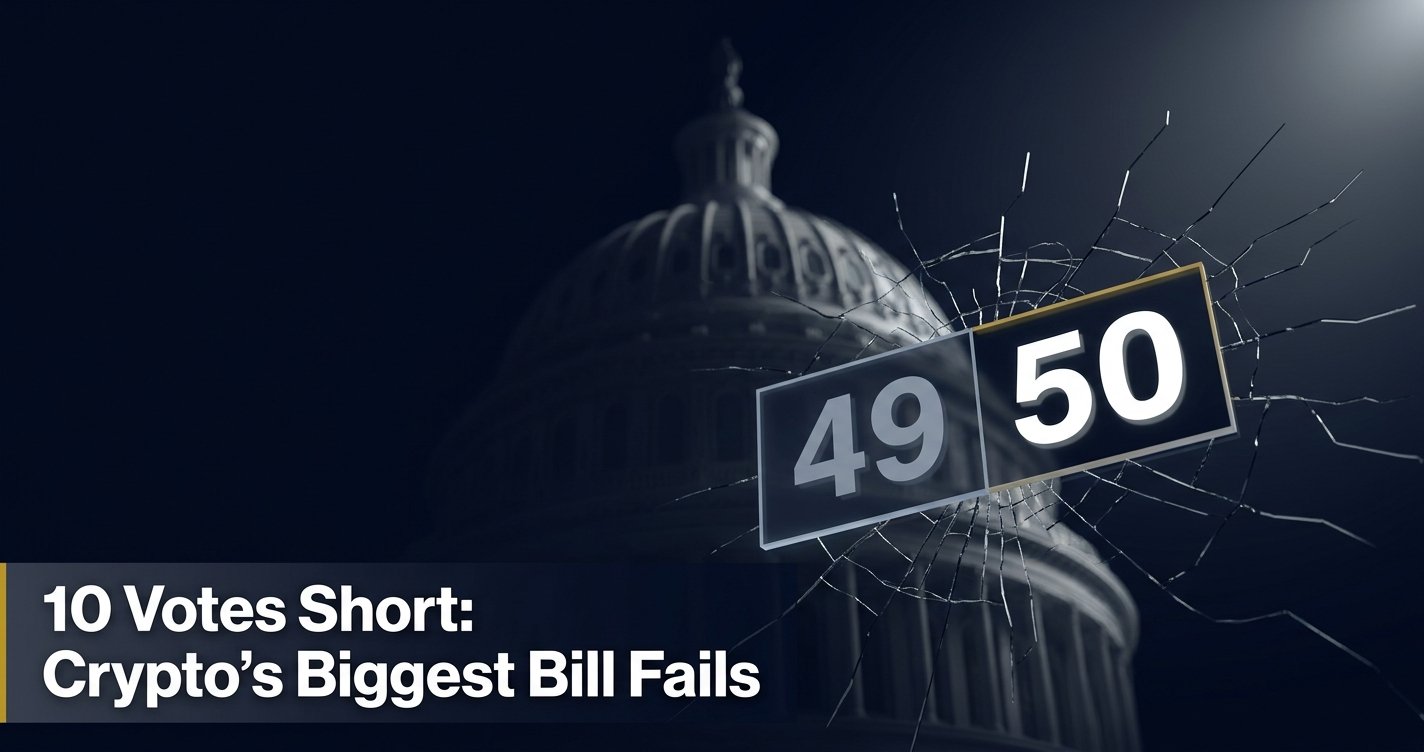
    The CLARITY Act, crypto’s biggest shot at a real federal rulebook, fell 49-50 on a cloture vote, ten to eleven votes short of the 60 it needed. If you run compliance at an exchange, build DeFi protocols touching U.S. users, or just hold a bag of ETH and want to know what the government thinks it is, this is the vote that decides your regulatory reality for at least the next year. Here’s exactly what happened, why it collapsed, and what fills the vacuum now.

    What Happened on September 15

    The motion was procedural on paper: a cloture vote to end debate and proceed to H.R. 3633, the Digital Asset Market Clarity Act. In practice, it was the only vote that mattered. The tally landed at 49 yes to 50 no in most reports (some outlets flip the numbers to 50-49), but either way, the bill missed the 60-vote threshold by double digits, not by a hair.

    Four Republicans broke ranks. Jerry Moran, Rand Paul, and Josh Hawley voted no outright, while Thom Tillis switched his vote to no as a procedural maneuver under Senate Rule XIII, which preserves his right to file a motion to reconsider later. A competing tally from Coinpedia’s live blog names Susan Collins instead of Paul among the defectors, so the exact final roster should be checked against the official roll call at congress.gov before you cite specific names in follow-up coverage.

    Zero Democrats crossed over. That’s the number that actually killed the bill. Republicans hold 53 seats, meaning at least seven Democrats needed to vote yes, and none did.

    How We Got Here

    DateMilestoneResult
    July 17, 2025House floor vote294-134, including 78 Democrats
    January 2026Senate Agriculture Committee markup12-11
    May 14, 2026Senate Banking Committee markup15-9
    July 22, 2026Lummis releases merged floor textN/A
    August 8, 2026Senate adjourns, Thune files clotureVote set for Sept. 15
    September 15, 2026Senate cloture vote49-50, fails 60-vote threshold

    Notice the pattern: every committee stop was bipartisan and comfortable. The floor vote was neither. That gap between committee math and floor math is exactly where the bill’s three unresolved fights lived.

    Why the CLARITY Act Actually Failed

    Republicans added more than 100 revisions Democrats had asked for, including tougher ethics guardrails, according to Yahoo Finance’s reporting. It wasn’t enough. Three disputes stayed unresolved to the end.

    1. President Trump’s Crypto Income

    The president has disclosed crypto-related income reported at roughly $1.4 billion. Democrats wanted ethics language strong enough to prevent a sitting president from directly benefiting from a law he’d sign. Republicans added enforcement powers for state attorneys general as a partial concession. Senator Elizabeth Warren wasn’t satisfied.

    2. DeFi Developer Liability

    Section 604-style language on whether developers of non-custodial protocols could face personal or entity liability never reached a version both parties could accept. For anyone shipping smart contracts that touch U.S. users, this is the fight to watch when legislation returns, because it decides whether writing code is a legal exposure.

    3. Coinbase’s Stablecoin Yield

    A provision touching stablecoin-yield rules threatened an estimated $1.35 billion in annual USDC rewards revenue for Coinbase. The American Bankers Association sent more than 8,000 letters to Senate offices opposing the yield language between May 9 and 13, 2026. That kind of volume from the banking lobby doesn’t move quietly through a markup. It shows up on the floor.

    Key insight: None of these three fights are technical footnotes. Ethics, developer liability, and stablecoin economics are the exact three questions that determine who profits and who’s exposed once a market-structure law exists. That’s why compromise language kept collapsing right up to the vote.

    What Washington and Wall Street Are Saying

    “This one stings.” Brad Garlinghouse, CEO, Ripple, via The Block
    “Congress should vote to advance the Clarity Act and send it to the president’s desk as soon as possible. But with or without that legislation, this administration will deliver for American investors and technological innovators.” Paul Atkins, Chairman, U.S. Securities and Exchange Commission, via CoinDesk
    “Fails to adequately protect investors, our financial system, and our national security.” Senator Elizabeth Warren (D-MA), Senate Banking Committee, via TheStreet Crypto

    Mike Novogratz, CEO of Galaxy Digital, warned that a failed vote could push comprehensive crypto regulation off the table for years and send more of the industry offshore, while Senator Cynthia Lummis (R-WY), the bill’s lead Senate author, made her closing pitch blunt: “Let’s not only join the 21st century economy. Let’s not only join the digital age. Let’s lead it.” Grayscale, more measured, called the outcome “not the outcome we hoped for” while committing to keep working with regulators as policy matures.

    Even among Republicans, there’s disagreement about whether the bill is actually dead. One Senate GOP aide told The Block it’s finished for the year. Senator Tillis, whose procedural “no” vote keeps a reconsideration motion technically alive, said there’s still life in it. Treat “CLARITY is dead” as a developing claim, not a settled one, until the Senate calendar proves it either way.

    What Happens to Crypto Regulation Now

    Here’s the part that actually matters for your compliance calendar: no statute doesn’t mean no rules. It means the SEC and CFTC become the primary rulemakers by default.

    SEC Chairman Paul Atkins has been running “Project Crypto” since a January 28, 2026 staff statement laid out a taxonomy for tokenized securities. The agency’s broader 2026 agenda, informally dubbed “Regulation Crypto,” covers registration exemptions, a decentralization safe harbor, custody rules for broker-dealers, and trading-venue structure. Over at the CFTC, Acting Chairman Caroline Pham’s 12-month “Crypto Sprint” already produced the first listed spot crypto trading on CFTC-regulated exchanges, and Michael Selig, previously chief counsel of the SEC’s Crypto Task Force, has since been confirmed as CFTC chairman.

    The catch: agency rules aren’t statutes. A future SEC or CFTC chair can rewrite them. A federal court can strike them down under major-questions-doctrine theories. Atkins himself has said repeatedly that legislation “remains indispensable” for durability, which undercuts the industry’s own comfort blanket that agency guidance is a fine substitute for a law.

    The Market Already Voted

    Bitcoin slid from above $81,000 earlier in September to below $75,000 in the days around the vote, per CoinDesk’s live coverage. Crypto-adjacent equities took a sharper hit the same day: Coinbase fell 6.7%, Circle dropped 8%, Bullish slid 4.6%, and Robinhood declined 3.6%.

    Prediction markets had been pricing this in for months. Polymarket-implied odds of CLARITY becoming law in 2026 peaked near 82% in February and had collapsed to roughly 11-20% by the days before the vote. Galaxy Digital Research’s independent estimate landed even lower, around 10%, which matters because it shows the pessimism wasn’t just retail sentiment on a thin-volume betting market. It was showing up in institutional research too.

    What This Means for You

    If you’re building, trading, or investing in this space, here’s the practical fallout.

    • Compliance teams: Track SEC and CFTC rulemakings directly, not just Congress. The operative rulebook for the next 12 to 18 months is agency guidance, and it can shift with a new chairman.
    • Founders and token issuers: Treat any exemption or safe harbor you’re relying on as provisional. Budget for the possibility that a future administration rewrites Project Crypto guidance entirely.
    • DeFi developers: Personal and entity liability for non-custodial code remains legally unsettled. This is still an open exposure, not a solved problem.
    • Exchanges with yield products: Coinbase’s USDC rewards model and similar structures should not be treated as safe long-term. The yield fight that helped sink CLARITY will resurface in any future bill or rulemaking.
    • Traders: Expect continued volatility around political catalysts. Future Senate action, FOMC decisions, and SEC rulemaking announcements are scheduled volatility events now, not background noise.
    • U.S. vs. offshore decisions: Multiple industry voices are explicitly framing continued uncertainty as an offshoring risk. If you’re weighing incorporation and licensing strategy, this vote just tipped that calculation.

    One scheduling reality worth building into your roadmap now: with the fall Senate calendar and the 2026 midterms ahead, another serious legislative attempt is unlikely before 2027. Plan as if there’s no statute for at least a year, possibly longer.

    Our Read: The Overstated Panic and the Real Risk

    Not every reaction to this vote deserves equal weight. Novogratz’s “off the table for years, if ever” framing is a forecast dressed up as a fact. Atkins and Pham have both made clear that SEC and CFTC rulemaking continues regardless of what Congress does, so U.S. crypto regulation doesn’t fall to zero just because a bill stalled.

    At the same time, dismissing Warren’s investor-protection critique as pure obstruction misses the point. Her argument, that the bill could let companies move assets onto a blockchain specifically to sidestep securities-law protections, is a structural concern, not political theater. It deserves an actual counterargument, not a shrug.

    And the ethics dispute isn’t manufactured partisanship either. Senator Ted Cruz framed the failure as Democrats “playing politics,” but that framing skips over the fact that the trigger is a sitting president with more than a billion dollars in disclosed crypto income who would personally benefit from the law he’d sign. That’s an unusual governance question on its own merits, independent of which party is asking it.

    Our read: the realistic timeline here is longer than the optimistic “it’ll pass eventually” framing suggests. A failed cloture vote layered on top of a midterm election cycle has historically pushed complex financial legislation out by years, not months. Lummis herself has floated a window stretching toward 2030 for comprehensive reform. Plan accordingly.

    Frequently Asked Questions

    What is the CLARITY Act?

    The CLARITY Act (H.R. 3633) is proposed U.S. legislation that would create the first federal market-structure framework for crypto, splitting oversight between the SEC and CFTC and defining when a token counts as a security versus a commodity.

    Did the CLARITY Act pass the Senate?

    No. On September 15, 2026, the Senate voted 49-50 on a cloture motion to proceed, falling short of the 60 votes required. All Democrats plus several Republicans voted against advancing it.

    What happens if the CLARITY Act fails?

    Crypto regulation defaults to SEC and CFTC rulemaking under existing law rather than a new statute. SEC Chair Paul Atkins has said the agency will proceed with Project Crypto rules regardless, though agency rules can be reversed by a future administration or challenged in court.

    Why did the CLARITY Act fail in the Senate?

    Negotiators couldn’t resolve three disputes: ethics restrictions tied to President Trump’s disclosed crypto income, DeFi developer liability, and a stablecoin-yield provision affecting Coinbase’s USDC rewards revenue, despite Republicans adding more than 100 requested revisions.

    How did Bitcoin react to the CLARITY Act vote?

    Bitcoin fell from above $81,000 earlier in September to below $75,000 following the failed vote, with crypto-linked stocks like Coinbase and Circle also declining sharply the same day.

    Where This Goes From Here

    The CLARITY Act didn’t die of complexity. It died of three specific, nameable disputes that nobody was willing to lose on: presidential ethics, developer liability, and stablecoin yield economics. Understanding that is more useful than any “crypto regulation collapses” headline, because it tells you exactly what has to change before a bill like this gets 60 votes.

    Watch three things over the next six to eighteen months. First, whether the SEC finalizes Regulation Crypto Assets and whether it survives a court challenge. Second, whether Tillis’s procedural “no” vote turns into an actual motion to reconsider before the year is out. Third, whether the stablecoin-yield fight resurfaces in a narrower, standalone bill now that comprehensive reform has stalled.

    None of this happens on a predictable schedule, which is exactly why it’s worth having someone track it for you.

    Subscribe to The Neural Loop at neuralwired.com/newsletter for the next move, the moment it happens.


    Related reading: Trump’s CLARITY Act Faces Senate Cloture Vote Today and Crypto Regulation by Country 2026: GENIUS Act, MiCA and Global Laws.

  • Strategy vs BlackRock: Bitcoin Treasury 2026

    Strategy vs BlackRock: Bitcoin Treasury 2026

    Strategy Has 843,000 Bitcoin. BlackRock Has More Than Most Countries. Your Treasury Has Zero.
    Institutional Bitcoin Adoption 2026

    Strategy Has 843,000 Bitcoin. BlackRock Has More Than Most Countries. Your Treasury Has Zero.

    The largest corporate Bitcoin holders are now navigating a bear market, broken flywheels, and quiet reversals of their founding doctrine. Here is what the June 2026 reality actually teaches CFOs about waiting.


    On April 17, 2026, Strategy quietly crossed a threshold that almost no one outside the Bitcoin-treasury niche noticed. The company — formerly known as MicroStrategy — completed a $2.54 billion Bitcoin purchase, pushing its total holdings to 815,061 BTC. In doing so, it passed BlackRock’s iShares Bitcoin Trust (IBIT) to become the single largest institutional Bitcoin holder on the planet. For the first time since Q2 2024, a corporate treasury outranked an ETF giant in raw coin count.

    That same week, Bitcoin was trading around $63,000. The Fear and Greed Index sat at 17: Extreme Fear. And the stock of that very company, Strategy, had already lost roughly 66% of its value from its July 2025 peak.

    This is the story of institutional Bitcoin adoption in 2026. It is not the story most of the headlines told in late 2025. It is more complicated, more instructive, and frankly more useful to any CFO or board-level finance committee that is now being asked to formally document a position on digital asset treasury strategy.


    843,706
    BTC held by Strategy (June 2026)
    $47.36B
    BlackRock IBIT net assets (June 10, 2026)
    172+
    Public companies holding BTC (Q3 2025)
    $61,274
    Bitcoin price, June 25, 2026

    The Leaderboard That Changed in April 2026

    Walk into any institutional investor’s office in Q4 2025 and the Bitcoin conversation was dominated by a single data point: BlackRock’s IBIT had crossed $60 billion, then briefly flirted with figures near $100 billion in AUM as Bitcoin hit its all-time high of roughly $126,000 in October 2025. Financial media ran stories about the ETF sucking in capital at a rate that had not been seen in investment product history. Treasury teams at mid-sized corporates were receiving board memos with subject lines like: “Should we be doing what BlackRock is doing?”

    Here is what those memos got wrong. BlackRock was not buying Bitcoin for its own treasury. IBIT is a passthrough vehicle. Every dollar of AUM in that fund belongs to BlackRock’s clients, not BlackRock itself. The ETF’s Bitcoin holdings fluctuate with creations and redemptions. When Bitcoin’s price falls 50%, so does the dollar AUM figure, even if the actual coin count stays flat. This distinction between BTC-denominated and dollar-denominated reporting is how the $102 billion figure circulating in early 2026 became a $47.36 billion figure by June 10, 2026, per SEC filings reviewed against the iShares fund page.

    Strategy’s position is structurally different. Those 843,706 Bitcoin sit on a corporate balance sheet. They are an asset of the company, not of external investors. That distinction is what makes Strategy’s overtaking of IBIT in April 2026 genuinely meaningful for the corporate treasury conversation.


    What Actually Happened to the $102B Number

    The $100 billion-plus figures that dominated Bitcoin treasury coverage in late 2025 were accurate for a brief window. Bitcoin peaked near $126,000 in October 2025. At that price level, large holdings produced enormous dollar AUM numbers. IBIT briefly crossed into nine-figure territory. Headlines froze those numbers.

    Then Bitcoin fell. As of June 25, 2026, Bitcoin trades at approximately $61,274, roughly $46,100 below where it stood a year ago, according to Fortune’s market data. That is approximately a 50% drawdown from the October 2025 high. Dollar AUM figures at every Bitcoin-holding institution have roughly halved alongside that price move, even where coin counts stayed flat or grew.

    Editorial Accuracy Note Any article, pitch deck, or board memo citing “$100 billion in BlackRock Bitcoin holdings” as of mid-2026 is anchoring on a peak-price figure. The verified net assets of IBIT as of June 10, 2026, per SEC filings, are $47.36 billion across approximately 1.35 billion shares outstanding. Verify this figure at ishares.com/IBIT before any publication or presentation.
    This is not a trivial distinction for a CFO. A treasury committee modeling Bitcoin allocation off 2025 peak figures is doing the analytical equivalent of evaluating a prospective real estate purchase using the last sale price from a bubble year. The asset is the same. The entry point is not.


    The Flywheel Is Broken. Here Is What That Means.

    To understand why the corporate Bitcoin treasury conversation shifted so sharply in 2026, you need to understand the mechanism that powered it in the first place.

    Strategy built its model on what analysts call the “Bitcoin flywheel.” The mechanics: when Strategy’s market capitalization trades at a premium to the value of its Bitcoin holdings (a multiple called mNAV, or market-cap-to-net-asset-value), the company can issue new shares at an elevated price, use those proceeds to buy more Bitcoin, and increase the Bitcoin per share for existing holders. In November 2024, Strategy’s mNAV reached 3.89x. The flywheel was spinning fast.

    By early 2026, with Bitcoin’s price falling and market sentiment shifting, Strategy’s mNAV fell below 1.0x. Below 1x, new share issuance to buy Bitcoin is dilutive, not accretive. The flywheel stops. The company can no longer issue equity at a premium to add to its stack. The mechanism that turned Strategy into the world’s largest corporate Bitcoin holder essentially stalled.

    What mNAV Below 1x Actually Signals

    When a company’s market cap falls below the value of the assets it holds, the market is effectively telling you one of two things. Either it doubts the company’s ability to hold those assets (debt obligations, forced selling risk), or it sees the company itself as a liability sitting on top of those assets. For Strategy, with its layered convertible debt structure, both readings are plausible.

    This has direct implications for any company considering a Strategy-style treasury approach. The model’s leverage and appeal depended on the premium. Without the premium, the model is just: borrow money, buy a volatile asset, and service the debt while the asset fluctuates. That is a very different risk profile from what the 2024 and early 2025 headlines implied.

    “I think what people may have miscalculated is that institutional adoption is very slow. The ETFs got bought, but when BlackRock is saying they recommend 2% to 4% allocation in their general stock portfolio, the fund managers haven’t done that yet. And they will, but it’s slower than people anticipate.”

    Adam Back, CEO and Co-Founder of Blockstream, speaking to CoinDesk, April 29, 2026
    Back is not a Bitcoin skeptic. He is one of the longest-tenured technical contributors in the Bitcoin ecosystem, and he runs his own Bitcoin treasury company. His point is structural: the access infrastructure exists, the institutional mandate to act on it has not yet caught up.


    The Institutions Now Selling, Not Buying

    Corporate Bitcoin treasury coverage tends to focus on purchases. The press releases are easier to write. But the 2026 bear market has produced a quieter and more instructive data set: significant institutional sales.

    In March 2026, Bitcoin mining company MARA Holdings sold approximately 15,133 BTC, raising roughly $1.1 billion. The stated purpose was to repurchase convertible debt and fund a strategic pivot into energy infrastructure and AI data-center development. A month later, Riot Platforms disclosed it had sold more than $250 million in Bitcoin during Q1 2026 as part of what it called a “strategic evolution” into data-center operations.

    These are not fringe companies. MARA and Riot were among the most Bitcoin-forward public companies in the world during the 2020 to 2025 accumulation phase. Their selling in 2026 reflects something the headline narratives routinely underplay: for many institutional holders, Bitcoin is still a financial instrument to be managed, not an ideology to be maintained. Debt obligations, pivot capital, balance-sheet management. These are CFO-level decisions, not ideological retreats.

    Strategy’s Own “Never Sell” Reversal

    Even more instructive is what happened at Strategy itself. For years, the company’s defining characteristic was an absolute commitment to never selling Bitcoin. Executive Chairman Michael Saylor framed it in near-religious terms.

    That framing shifted on the Q1 2026 earnings call. CEO Phong Le stated explicitly:

    “We will sell Bitcoin when it’s advantageous to the company. We’re not going to sit back and just say, ‘We’ll never sell the Bitcoin.’”

    Phong Le, CEO of Strategy, Q1 2026 Earnings Call, reported via Yahoo Finance
    Saylor’s own comments in May 2026 were more nuanced but still notable. He suggested the firm might sell Bitcoin to “inoculate the market” before clarifying that Strategy’s broader goal remains to “never be a net seller.” (Our read: that clarification is doing a lot of work. “Never be a net seller” is meaningfully different from “never sell.” One is a doctrine. The other is an accounting outcome.) The distinction matters enormously for any CFO who was told by their investment advisors that the Strategy model was a buy-and-hold-forever commitment.


    The CFO’s Real Question in a Bear Market

    Here is the thing about the “your treasury has zero Bitcoin” framing that dominated financial media through 2025: it was a FOMO argument dressed in competitive-pressure clothing. It worked when Bitcoin was at $126,000 and every headline showed institutions piling in. It is harder to sustain at $61,274, with the Fear and Greed Index sitting at 17 and the poster-child adopter down 66% from its stock peak.

    But that does not mean the underlying argument is wrong. It means it needs to be made more precisely.

    The actual shift that has occurred in corporate treasury governance is this: 172 or more publicly traded companies disclosed Bitcoin holdings as of Q3 2025, up 40% quarter-over-quarter, collectively holding approximately 1 million BTC or about 5% of total circulating supply, according to Bitwise research cited in the SVB 2026 Crypto Outlook. Across the 94 weeks following the April 2024 Bitcoin halving, corporate treasuries accumulated Bitcoin at 2.8 times the rate of new mining supply, per BitcoinTreasuries.net data reported in Bitcoin Magazine.

    That accumulation pace has a governance consequence entirely separate from price performance. When 172 companies have disclosed a position, the CFOs and treasury committees who have not disclosed one are now the ones with a documentation gap. Not because they made a bad decision. Because they made no documented decision. In a world where peers are filing formal treasury policies on digital assets, silence looks like oversight rather than discipline.

    What Changed Operationally Since 2021 The “it’s too hard to custody and account for” objection that blocked most corporate Bitcoin conversations in 2021 through 2023 is largely resolved. Spot Bitcoin ETFs, launched after the January 2024 SEC approval, gave institutional treasuries a regulated, auditable, custody-free way to hold BTC exposure. Accounting treatment under current FASB guidance has become significantly more settled. The operational barrier is lower than it has ever been. What remains is a risk-tolerance and board-mandate question.

    The Morgan Stanley Signal

    In April 2026, Morgan Stanley’s wealth-management network reportedly entered the spot Bitcoin ETF market. The significance is not that Morgan Stanley is necessarily a Bitcoin bull. It is that one of the most conservative wealth-management distribution networks in the world decided the asset class had crossed a compliance and reputational threshold sufficient for client offerings. That is a structural change in the market’s architecture, not a price prediction.


    What the Skeptics Are Getting Right

    A credible analysis of institutional Bitcoin adoption in 2026 requires acknowledging what the bear market has validated on the skeptical side.

    “Bitcoin and other cryptocurrencies’ latest plunge further underscores the highly volatile nature of this pseudo-asset class; one only hopes that policymakers will wake up to the risks before it’s too late.”

    Nouriel Roubini, Professor Emeritus of Economics, NYU Stern School of Business, Benzinga via Yahoo Finance, February 2026
    Roubini, known as “Dr. Doom” for his accurate prediction of the 2008 financial crisis, made a specific comparative point worth noting: gold rose more than 60% in the year prior to his February 2026 comment, while Bitcoin fell 7% over the same period. For any CFO building the “digital gold” case to their board, that comparison requires a direct answer.

    There is also an analytical trap in how institutional adoption gets reported. Unit counts (BTC held) and dollar AUM tell different stories. Headline BTC holdings at major institutions have stayed relatively flat or grown slightly through 2026, because holders did not sell. But the dollar-denominated value of those holdings fell by roughly half. Coverage that cites coin counts without noting the dollar AUM decline is not wrong, but it presents a picture that is more bullish than the numbers warrant.

    The block trade data from May 26, 2026 is the sharpest single data point in this category. A $1.26 billion sale of IBIT shares was executed at a 2.3% discount, costing the seller approximately $29.5 million in execution slippage, according to NYDIG analysis reported by CoinDesk. Someone was willing to pay $29.5 million to exit fast. That is what institutional conviction looks like on the other side of a trade.


    The Current State of Corporate Bitcoin Holdings

    Entity BTC Holdings Dollar Value (Approx.) Structure Key 2026 Development
    Strategy (MSTR) 843,706 BTC ~$53.53B Corporate treasury (direct hold) mNAV fell below 1x; CEO reversed “never sell” stance
    BlackRock (IBIT) 577K–805K BTC (range, snapshot-dependent) $47.36B net assets (June 10) Spot ETF (client assets, not BlackRock’s own) $1.26B block sale at 2.3% discount in May 2026
    MARA Holdings Reduced in Q1 2026 Sold ~$1.1B worth Mining company treasury Sold ~15,133 BTC to repurchase debt and pivot to data infrastructure
    Riot Platforms Reduced in Q1 2026 Sold $250M+ worth Mining company treasury Sold BTC as part of “strategic evolution” into data centers
    All public companies ~1,306,099 BTC (85 tracked companies) ~$81.2B Bitcoin NAV (June 10) Mixed (direct, ETF, mining) 172+ companies disclosed holdings as of Q3 2025; 40% QoQ increase
    Sources: Yahoo Finance / company disclosures; The Block Bitcoin Treasury Tracker; SEC filings via SpotedCrypto (June 10, 2026).


    FAQ: Bitcoin Treasury Companies 2026

    How much Bitcoin does BlackRock hold?
    As of June 10, 2026, BlackRock’s iShares Bitcoin Trust (IBIT) held $47.36 billion in net assets across approximately 1.35 billion shares outstanding, per SEC filings. BTC unit counts have ranged from roughly 577,000 to 805,000 BTC across 2026 snapshots as investor flows shifted with the market. The frequently cited $100 billion figures date to October 2025 when Bitcoin was near its all-time high of $126,000. Verify the current figure at ishares.com/IBIT.

    What company holds the most Bitcoin?
    As of June 2026, Strategy (formerly MicroStrategy) is the largest corporate and institutional Bitcoin holder, with approximately 843,706 BTC valued at roughly $53.53 billion. Strategy overtook BlackRock’s IBIT in coin count on April 17, 2026, after a $2.54 billion purchase. It is the first time a corporate treasury has outranked a major ETF vehicle in raw BTC held since Q2 2024.

    How many public companies hold Bitcoin?
    At least 172 publicly traded companies disclosed Bitcoin holdings as of Q3 2025, up 40% quarter-over-quarter, collectively holding approximately 1 million BTC, or about 5% of total circulating supply, according to Bitwise research. The Block’s live tracker shows 85 actively tracked Bitcoin-holding companies with combined holdings of 1,306,099 BTC as of June 10, 2026.

    Is now a good time for a company to add Bitcoin to its treasury?
    Opinion is genuinely divided. Bitcoin is down approximately 50% from its October 2025 peak, and the largest corporate adopter, Strategy, has seen its stock fall roughly 66% from its July 2025 high and its premium-to-NAV model break down below 1x. Adoption-side voices argue that slow institutional buildout is still underway and access is now more operationally straightforward than at any prior point. This is not investment advice. A qualified financial advisor and your legal team should be central to any treasury policy decision.

    What is mNAV in Bitcoin treasury companies?
    mNAV (market-cap-to-net-asset-value) compares a company’s total market capitalization to the current market value of its Bitcoin holdings. When mNAV is above 1x, a company can issue shares at a premium to buy more Bitcoin, growing Bitcoin-per-share for existing holders. When it falls below 1x, new share issuance is dilutive. Strategy’s mNAV peaked at 3.89x in November 2024 and fell below 1.0x in early 2026, effectively stalling its core accumulation mechanism.

    What is the Bitcoin corporate treasury accumulation rate versus new supply?
    Across the 94 weeks following the April 2024 Bitcoin halving, corporate treasuries collectively accumulated Bitcoin at 2.8 times the rate of new mining supply, according to BitcoinTreasuries.net data reported in Bitcoin Magazine as of March 2026. This supply-demand dynamic is separate from price performance and is one of the structural arguments made by long-term institutional holders for continued accumulation regardless of short-term price cycles.


    What to Watch in the Next 18 Months

    The institutional Bitcoin adoption story in 2026 is not over. It has entered a phase that is more complex, more honest, and more instructive than the 2025 euphoria cycle. Here is what the next 18 months will likely clarify:

    Strategy’s debt structure under pressure. The company holds layered convertible notes and preferred equity instruments. With mNAV below 1x and the flywheel stalled, the market will be watching whether debt servicing forces a net-selling event that Saylor has publicly said the company wants to avoid. A forced sale at scale, even a partial one, would be the most significant stress test the corporate treasury model has ever faced.

    Whether ETF flows resume at a meaningful rate. Spot Bitcoin ETFs collectively held more than $130 billion at their mid-2026 peak. The question is whether the broader wealth-management adoption that Adam Back described as “coming, but slower” actually accelerates as advisors move toward the 2% to 4% Bitcoin allocation ranges that BlackRock itself has recommended internally. Morgan Stanley’s entry into the distribution chain in April 2026 is a genuine signal that that process is moving forward.

    How corporate treasury policy documents change. The governance shift here is durable regardless of price. Once 172 companies have disclosed positions, boards at non-holders face direct peer-pressure cycles at annual strategy reviews. The question is not whether Bitcoin treasury policy becomes a standard agenda item. It already has. The question is how companies document “we considered it and chose not to” versus “we have not considered it.”

    The CFOs who navigate this most effectively will be the ones who engage with the actual 2026 data rather than the 2025 headlines. They will build a documented position based on verified current figures, understand the difference between ETF exposure and direct treasury holding, model the mNAV mechanism and its limitations, and separate the supply-demand structural thesis from the short-term sentiment cycle.

    Strategy has 843,000 Bitcoin. BlackRock manages more than most countries hold in foreign reserves. Your treasury, statistically, has zero. What that fact requires of you is not panic-buying. It requires a documented analysis of why zero is the right answer for your balance sheet, or why it is not. That analysis, in June 2026, is no longer optional.

    Stay Ahead of Institutional Crypto Moves

    The Neural Loop covers institutional tech adoption, AI infrastructure, and corporate digital strategy every week, without the noise.

    Subscribe to The Neural Loop