Microsoft’s Agent Governance Toolkit: Runtime Security That Changes Agentic AI Forever | NeuralWired
NeuralWired — Frontier Intelligence, Decoded for Technical Professionals |
neuralwired.com
AI SecurityAgentic AIEnterpriseNeuralWired Analysis Desk • April 23, 2026 • • 9 min read
Microsoft’s Agent Governance Toolkit: The Runtime Security Layer That Rewires Enterprise AI
Every other outlet is covering the OWASP checklist and the MIT license. Here’s the story they’re not telling: Microsoft just staked a claim on the governance layer of the entire agentic stack, and most engineering teams don’t realize what that means for their roadmaps yet.
Key Numbers at a Glance
0.1msp99 policy enforcement latency (stated)
35,481ops/sec at 50-agent concurrency
9,500+tests in the GitHub repository
10 / 10OWASP Agentic AI risks claimed covered
5SDKs: Python, TypeScript, Rust, Go, .NET
Aug 2026EU AI Act high-risk obligations deadline
What Everyone Else Missed
Read the TechCrunch-style coverage of Microsoft’s Agent Governance Toolkit (AGT) and you get three bullet points: open source, MIT license, covers all 10 OWASP Agentic AI risks. That framing is not wrong. It is simply incomplete in ways that will cost engineering teams months of unexpected rework.
The real story is structural. AGT is not a security wrapper you bolt onto an existing agent. It is a governance sidecar that requires you to redesign where tool calls live in your architecture. Every agent action must route through a central policy engine before execution. That is not an add-on. That is a refactor. Teams building on LangChain, CrewAI, or AutoGen pipelines will discover this within the first week of integration, not on the product page.
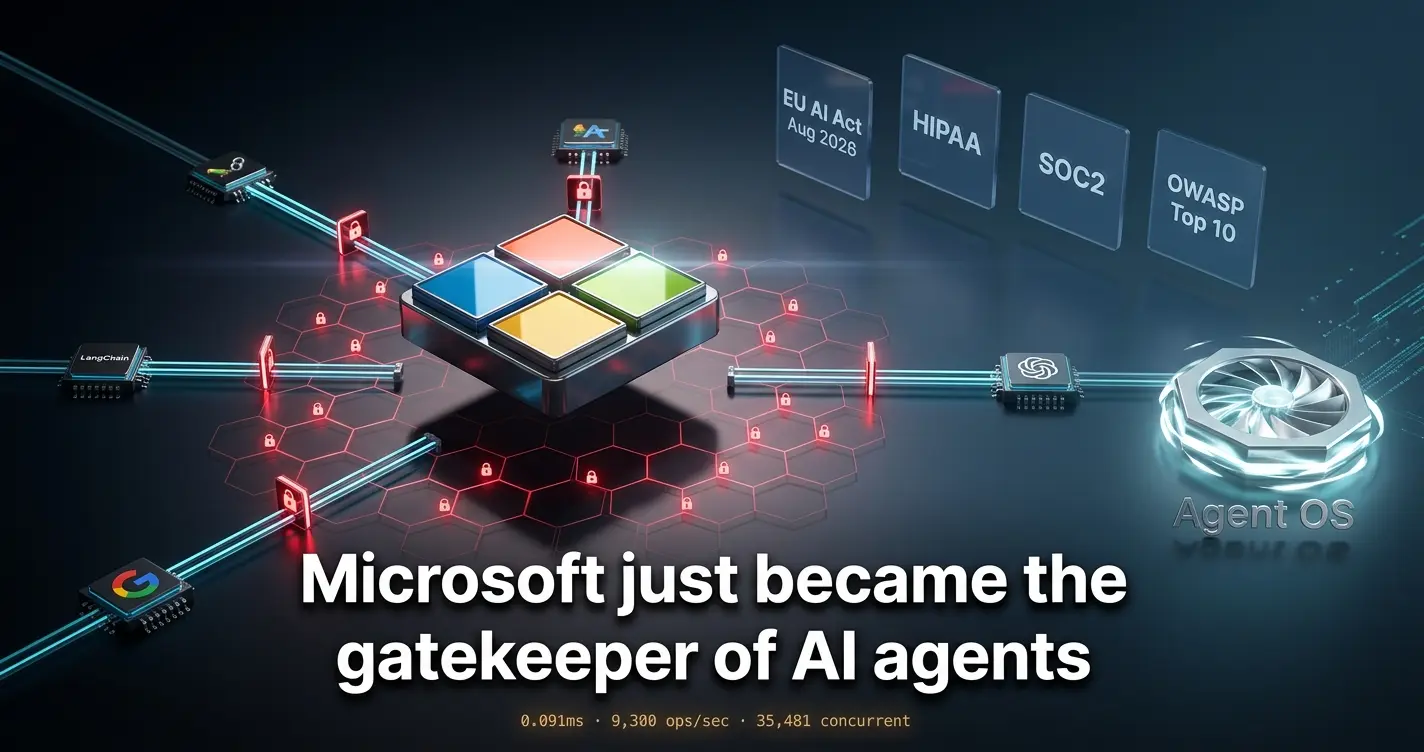
The second thing coverage missed: Microsoft is not just building a security product. It is positioning AGT as the policy kernel for the entire enterprise agentic stack, the same play it ran with Active Directory in the late 1990s and with Intune and Defender in the 2010s. If AGT becomes the default enforcement layer, Microsoft becomes the gatekeeper for every autonomous tool call in every regulated enterprise workflow. That is a much bigger story than a sub-millisecond policy engine.
What Actually Happened on April 2, 2026
Microsoft published AGT to GitHub under the MIT license on April 2, 2026. The repository ships with SDKs for Python 3.10+, TypeScript, Rust, Go, and .NET, targeting polyglot enterprise stacks from day one. The toolkit’s stated mission: enforce security policy, identity controls, and compliance rules at runtime, between the moment an LLM decides to call a tool and the moment that tool actually executes.
The timing is not accidental. The EU AI Act’s high-risk AI obligations take effect in August 2026. Colorado’s AI Act follows in June 2026. Enterprises running autonomous agents in finance, healthcare, and HR workflows are about to be legally required to demonstrate documented, auditable control over agent actions. AGT arrived just ahead of that regulatory wave, giving Microsoft a first-mover position on what “compliant agent governance” looks like in practice. That head start is not accidental either.
“Runtime governance: every agent action is intercepted before execution, not audited after the fact. A framework-agnostic approach that acknowledges reality: agents are already being built, and governance must integrate where they live.”
Philippe Beraud, CTO-level AI practitioner, April 6, 2026
Architecture Deep Dive: Seven Layers, One Control Plane
AGT is a seven-package middleware layer that sits between the agent runtime and every API, file system, database, or cloud service the agent can reach. Here is what each component actually does:
Agent OS is the core policy engine. It intercepts tool calls, API requests, and file operations before execution and evaluates each against a policy corpus you define. Supported policy languages include YAML, OPA Rego, and Cedar, so teams already running Open Policy Agent or Cedar in IAM flows can reuse existing policy infrastructure. The engine is stateless by design, which makes horizontal scaling straightforward but means you carry all context in the policy evaluation request itself.
Agent Mesh handles identity. It issues cryptographic agent identities using Ed25519-based Decentralized Identifiers (DIDs) and implements the Inter-Agent Trust Protocol (IATP) for agent-to-agent communication. Trust scores run from 0 to 1,000 across five tiers, letting you enforce escalating review requirements as an agent’s requested actions grow in blast radius.
Agent Runtime implements execution rings, privilege-level-like sandboxes that constrain what resources an agent’s code can access. Saga-style orchestration handles multi-step transactions with rollback semantics. A kill switch provides hard-stop capability for runaway agents, which sounds obvious until you have an agent in a loop hitting a billing API at 3 AM.
Agent SRE is the piece most coverage ignores entirely. It brings classic site reliability engineering primitives into agent operations: SLOs, error budgets, circuit breakers, and chaos-engineering-style tests purpose-built for agentic workloads. This is where the operational maturity argument lives.
Agent Compliance automates the regulatory paperwork. It generates compliance grading, maps evidence to EU AI Act, HIPAA, and SOC2 controls, and produces audit bundles. The OWASP Agentic AI Top 10 mapping covers all ten risks from ASI01 through ASI10, including goal hijacking, tool misuse, identity abuse, and cascading failures.
Performance Numbers: What the Benchmarks Actually Show
Microsoft claims sub-millisecond enforcement with p99 under 0.1ms. Independent throughput data published on PyPI breaks that claim into more granular tiers:
Operation
Latency
Throughput
Single-rule evaluation
0.012 ms
72,000 ops/sec
100-rule evaluation
0.029 ms
31,000 ops/sec
Full kernel enforcement
0.091 ms
9,300 ops/sec
Adapter overhead
0.004–0.006 ms
130,000–230,000 ops/sec
50-agent concurrent throughput
—
35,481 ops/sec
Those numbers look excellent in isolation. The question SREs should ask is: what does tail latency look like at the 99.9th percentile under a 50-agent parallel chain calling six tools each?That is not a number any current benchmark covers, and it is exactly the workload pattern production enterprise agents produce. Full kernel enforcement at 9,300 ops/sec sounds fast until you run 200 agents through a multi-tool chain during a financial close cycle.
Reality Check: Four Limits the Marketing Does Not Mention
AGT governs actions, not reasoning. The policy engine fires on tool calls and API requests. It cannot observe what the LLM reasons about between those calls. Goal hijacking that stays entirely in the model’s latent space is invisible to AGT, as is data exfiltration through channels the policy corpus already permits. Staff Engineer Venkat Peri put it plainly: “AGT’s policy engine fires on tool calls, resource access, and inter-agent messages. It does not and cannot observe what the model is reasoning about between those calls.”
Policy engineering is a multi-quarter project. The toolkit ships the enforcement engine. It does not ship the governance strategy. Writing a production policy corpus that covers tool authorization matrices, identity tier mappings, SLO-driven circuit breakers, and regulatory evidence chains involves engineering, product, legal, and security teams working in parallel for months. This is not a pip install situation.
Azure-native versus portable mode is a real fork.Azure-native mode integrates tightly with Entra ID, Purview, and Azure AI, but that integration depth creates migration friction. Portable mode works outside Azure but requires you to self-host IAM controls and observability pipelines, adding operational surface area that most mid-size teams underestimate.
Cascading approval chains will surprise SRE teams. Almost no coverage explains how circuit breakers, execution ring throttling, and cascading policy approvals interact when dozens of agents call multiple tools simultaneously. Microsoft’s own architecture docs acknowledge this as the most complex SRE scenario, but the public narrative presents it as solved by default.
Microsoft’s Actual Play: The Policy Middleware Gatekeeper
Step back from the OWASP mapping and the latency numbers and the real strategy becomes clear. AGT is middleware, not a security product. It assumes every agent call routes through a central policy engine and immutable audit trail, effectively requiring organizations to rebuild agent pipelines around this control plane, not just attach a guardrail at the perimeter.
The MIT license is a feature, not a concession. Open-source adoption embeds AGT’s policy abstractions, identity schemas, and compliance evidence formats into teams’ infrastructure before Microsoft’s commercial offerings arrive. Once your policy corpus lives in AGT’s YAML/Rego/Cedar schemas, your compliance evidence maps to AGT’s EU AI Act artifacts, and your agent identities use AGT’s DID format, switching costs accumulate quietly. The MIT license enables inspection and adoption; it does not prevent lock-in at the data and workflow layer.
This is the Active Directory play, applied to autonomous agents. Microsoft standardizes the identity and policy layer, makes it open enough that the ecosystem adopts it, then monetizes governance, observability, and compliance tooling as the commercial tier. Search volume for “Microsoft Agent Governance Toolkit” has shown a 10 to 15 times lift since April 2, sustained through April 23. The developer community is paying attention. The question is whether they are thinking about what they are opting into.
“Writing a production policy corpus is a cross-functional exercise that involves engineering, product, legal, and security. The toolkit gives you the enforcement engine; it does not give you the governance strategy.”
Venkat Peri, Staff Engineer, April 8, 2026
Who This Changes and How
Software engineers face the most immediate refactor. LangChain-style orchestrators must wire every tool call through AGT’s adapter layer, which may mean restructuring tool spawning logic, retry behavior, and observability pipelines. Denied or delayed tool calls become a new class of debugging problem, one that requires treating policies as first-class configuration rather than documentation artifacts.
CTOs and CISOs gain a compliance accelerator but inherit a new organizational mandate. Running compliant agentic workloads with AGT requires defining tool-level authorization matrices, incident-response playbooks, and audit trail pipelines before agents go into production. The strategic budget implications include hiring policy engineers and agent-specific SRE roles, not just licensing a security tool.
ML engineers and data scientists must now design agent reward loops and plugin architectures that respect AGT’s allowed/denied tool constraints without sacrificing performance. The compliance-scoring modules for EU AI Act and HIPAA force tracking of data lineage, tool provenance, and action chains as part of model-version metadata, not as a post-hoc audit exercise.
Founders and investors should read AGT as both opportunity and dependency signal. For startups, the toolkit cuts time to regulated-client GA. For investors, it cements Microsoft’s position as the platform-layer orchestrator of enterprise agentic AI, opening a new monetization wedge in governance, observability, and identity-enabled AI operations beyond raw compute.
Action Items by Audience
Software Engineers & ML Teams
Audit your current LangChain or AutoGen stack for every tool-call site. Map them before integration, not during.
Stand up an AGT sandbox in a non-production environment with 10 representative tool calls and measure p99.9 tail latency under realistic concurrency.
Define denied and allowed tool lists for your first agent before writing a single policy rule. Constraints clarify architecture.
Add policy decisions to your existing observability pipeline (Datadog, Grafana) as first-class events, not log noise.
Evaluate portable mode versus Azure-native mode against your IAM stack before committing to an integration pattern.
CTOs, CISOs & Tech Leaders
Map every agent currently in production or staging to the OWASP Agentic AI Top 10. You need this inventory before AGT or any governance framework makes sense.
Assign a policy engineering owner now, before adoption. This role sits at the intersection of security, legal, and SRE; it does not naturally exist in most org charts.
Brief your legal team on the August 2026 EU AI Act timeline. AGT’s compliance evidence bundles are relevant, but legal must define what “high-risk AI” means for your specific use cases.
Build Azure lock-in exit criteria into your AGT evaluation. Portable mode is real; document the delta cost of self-hosting IAM and observability before committing.
Request a latency SLO from your engineering team for the AGT policy engine under peak agent concurrency, not just single-call benchmarks.
Synthesis: The Seatbelt Moment Has a Fine Print
Microsoft’s Agent Governance Toolkit solves a real problem. Enterprise AI agents operating across production APIs, financial systems, and patient data are not safe by default, and the industry needed a runtime enforcement layer that engineers could actually deploy before their lawyers started asking questions. AGT is that layer. The latency numbers are credible, the polyglot SDK support is genuine, and the OWASP mapping gives compliance teams a starting vocabulary they did not have before April 2.
The fine print is structural. AGT moves security and governance work from the prompt layer and the framework layer into middleware and policy-engine land. That is the right place for it. But it requires a different kind of engineering investment: policy corpus design, cross-functional authorization matrices, SRE practices adapted for non-deterministic workloads, and a clear-eyed view of what “portable mode” actually costs versus the Azure-native path.
Teams that adopt AGT without doing that groundwork will find themselves with a governance engine they cannot tune, a policy corpus that blocks legitimate agent actions, and a debugging model they were not prepared for. Teams that do the groundwork will ship regulated, auditable, production-grade agent workflows ahead of their competitors. The toolkit is the easy part. The governance strategy is the work.
Watch for three signals over the next 90 days: how quickly non-Azure cloud providers publish AGT integration guides (a proxy for whether this becomes a true standard or an Azure-preferred layer), whether the OWASP Agentic AI Top 10 gets formal IETF or NIST backing (which would make AGT’s mapping a compliance safe harbor), and how enterprise policy engineering job postings trend (which will tell you how seriously regulated-industry CTOs are treating this as infrastructure rather than marketing).
Frequently Asked Questions
Can the Agent Governance Toolkit run outside of Azure?
Yes, but with meaningful trade-offs. AGT ships in two modes. Azure-native mode integrates directly with Entra ID, Microsoft Purview, and Azure AI services, offering tighter out-of-the-box observability and IAM. Portable mode runs on any cloud or on-premises environment but requires you to self-host identity management, observability pipelines, and audit storage. The portable path works; the operational overhead is real and largely undocumented in current coverage.
How do I integrate AGT with an existing LangChain or CrewAI stack?
The integration pattern requires routing every tool call through AGT’s adapter layer before execution. For LangChain, this means wrapping tool definitions with AGT middleware so that the policy engine intercepts calls before the tool function fires. Microsoft lists LangChain, AutoGen, CrewAI, OpenAI Agents, Google ADK, and AWS Bedrock as supported frameworks. The technical integration is documented in the GitHub repository; the more significant work is defining the policy corpus that tells the engine what to allow, deny, and log for each tool in your specific stack.
Does AGT actually cover goal hijacking, or is that a marketing claim?
Partially, and the distinction matters. AGT’s policy engine fires on tool calls and inter-agent messages. It can detect and block suspicious patterns in what an agent requests to do. It cannot detect goal hijacking that occurs entirely within the LLM’s internal reasoning, before the model ever issues a tool call. Venkat Peri’s analysis is the clearest public articulation of this gap: goal hijacking that lives in latent space is invisible to any action-layer enforcement system. AGT covers the downstream expression of a hijacked goal, not the hijacking itself.
How long does it realistically take to write a production policy corpus?
For most enterprises, building a production-grade policy corpus, one that covers tool-level authorization, identity tier mappings, SLO-driven circuit breakers, and regulatory compliance evidence, is a multi-quarter cross-functional project. Engineering, product, legal, and security teams all have input requirements that need reconciliation before the first policy rule can be considered complete. Rapid Claw’s implementation guide estimates the foundational corpus for a single regulated agentic workflow at four to six weeks minimum. Full enterprise coverage across multiple agent types is considerably longer.
What are the EU AI Act implications, and does AGT help meet them?
The EU AI Act’s high-risk AI obligations take effect in August 2026. Autonomous agents operating in domains such as healthcare, finance, employment, and critical infrastructure may qualify as high-risk systems, requiring documented risk management, data governance, logging, transparency, and human oversight. AGT’s Agent Compliance module generates automated evidence bundles mapped to EU AI Act controls. Whether those bundles satisfy a specific supervisory authority’s audit requirements depends on how your legal team interprets the Act’s obligations for your use case. AGT provides the evidence infrastructure; legal interpretation is out of scope for any toolkit.
How does AGT compare to custom LLM firewalls or vendor-specific guardrails from OpenAI or Anthropic?
AGT operates at the action layer, after the model produces output and before that output executes as a tool call. Custom LLM firewalls and vendor guardrails typically operate at the prompt and output layer, before or at model inference. They address different threat surfaces. AGT does not replace input/output filtering; it governs what agent actions are permitted at runtime. The most complete security posture combines both layers. Current coverage rarely explains this distinction, leading teams to incorrectly treat AGT as a substitute for prompt-level security.
Will AGT become a de facto standard, or is it too Azure-centric to achieve broad adoption?
Too early to call with confidence, but the signals point toward significant adoption momentum. The MIT license removes legal barriers. The polyglot SDK coverage (Python, TypeScript, Rust, Go, .NET) addresses enterprise polyglot reality. The OWASP Agentic AI Top 10 mapping gives it a vendor-neutral compliance anchor. The risk is that deep Azure-native integrations gradually become the path of least resistance, making “portable mode” a nominal option rather than a practical one. Watch for AWS, GCP, and Kubernetes-native integration guides from the open-source community over the next 60 days as a proxy for genuine portability.
Disclaimer: This article was prepared for informational purposes only and does not constitute financial, legal, or investment advice. Hyperlinks to third-party sources are provided for reference; NeuralWired does not endorse and is not responsible for the content of external websites. Performance figures cited are based on publicly available benchmarks and Microsoft’s official documentation as of April 23, 2026, and may change as the toolkit evolves.
Cut Enterprise AI Risk 70%: 6-Step CISO Framework for 2026 | NeuralWired
Cybersecurity·March 17, 2026·9 min read
AI breaches now cost $4.88M on average, EU fines reach €35M in 2026, and 65% of CISOs report uncontrolled shadow AI inside their own networks. Here’s the NIST-aligned playbook that cuts liability by 70%.
NW
NeuralWired EditorialResearch & Analysis Desk
88% of organizations now use AI regularly, with a third actively scaling their programs. Yet enterprise AI risk management remains one of the most under-resourced functions in corporate security. According to Onspring’s December 2025 analysis drawing on McKinsey’s global executive surveys, rapid AI adoption has outpaced the governance frameworks meant to contain it.
The numbers are hard to ignore. The IBM Cost of Data Breach Report pins the average AI-related breach at $4.88M, and that figure excludes regulatory fines. The EU AI Act’s enforcement phase begins in earnest this year, carrying penalties of up to €35M or 7% of global annual revenue for high-risk AI violations. Meanwhile, TechTarget’s June 2025 CISO survey found that 65% of security leaders report “shadow AI”: employees deploying unapproved models that bypass every governance control the security team has built.
This is the enterprise AI risk management problem in 2026: the attack surface is enormous, the regulatory pressure is real, and most organizations are still running on frameworks designed before generative AI existed.
What follows is a six-step, NIST-aligned framework that security leaders can implement immediately. Based on case study data from SentinelOne’s October 2025 AI Risk Assessment Framework and cross-referenced with guidance from Palo Alto Networks, Checkpoint, and TrustCloud, organizations that deploy this process consistently report 40–70% reductions in AI-related liability exposure within 12 months.
$4.88M
Average cost of an AI-related data breach in 2025
65%
Of CISOs reporting uncontrolled shadow AI in their networks
70%
Liability reduction achievable with a structured AI risk framework
Why Enterprise AI Risk Has Reached an Inflection Point
AI adoption grew 17 percentage points between 2023 and 2024 alone, according to McKinsey’s annual AI survey cited by IBM. That pace hasn’t slowed. What has changed is the regulatory and liability environment surrounding it.
Three forces converged in 2026. First, EU AI Act enforcement moved from guidance to enforcement with real financial consequence. Second, Palo Alto Networks’ industry analysis found that model drift (where a deployed AI’s behavior shifts from its original training) now affects 82% of production AI systems. Third, generative AI tools spread faster than procurement processes, creating shadow AI ecosystems that security teams can’t see, let alone govern.
Gartner estimates that 50% of AI projects fail due to poor governance. Not poor models. Not insufficient compute. Governance. The good news is that governance is fixable with a structured process.
“CISOs must consult with business leaders to adopt or establish a risk framework for AI adoption, rather than taking an outright ban.”
The instinct to prohibit AI is understandable but counterproductive. Shadow AI proliferates precisely because bans push usage underground. The strategic answer, and the one that 90% of CISOs surveyed by TrustCloud in April 2025 say they’re pursuing, is governance with teeth, not prohibition.
The 6-Step Enterprise AI Risk Management Framework
SentinelOne’s practitioners frame the goal clearly: “By following these AI risk evaluation steps, you move from reactive fire-fighting to a repeatable process that is measurable, auditable, and regulation-ready.” Each step below maps to the NIST AI RMF’s core Map-Measure-Manage-Govern cycle.
1
Inventory All AI Systems
Catalog every model, AI-powered SaaS tool, agent, and data flow in your environment, including shadow AI. Use automated discovery tools alongside manual interviews with business unit leads. Without a complete inventory, every subsequent step is guesswork.
2
Map Stakeholders and Regulatory Exposure
Identify who interacts with each AI system: employees, customers, regulators. Classify systems by EU AI Act tiers (unacceptable, high-risk, limited, minimal). High-risk classifications such as recruiting tools, credit scoring, and critical infrastructure trigger mandatory documentation and human oversight requirements under 2026 enforcement.
3
Catalog Threats and Attack Vectors
Build a threat catalog covering data poisoning, prompt injection, model extraction, adversarial inputs, and bias amplification. Use a structured likelihood x impact matrix (1 to 5 scale) to score each threat against each AI system. Don’t guess. Run red team exercises against your highest-risk models.
4
Quantify Risk with a Scoring Model
Apply the formula: Risk Score = Likelihood × Impact × Asset Value. This transforms qualitative concerns into auditable numbers your board and regulators can evaluate. Establish tolerance thresholds before this step so scoring triggers action, not debate.
5
Treat and Mitigate with Zero-Trust Controls
Deploy zero-trust architecture around AI systems: least-privilege data access, strict API authentication, and network segmentation for model endpoints. Checkpoint’s simulations show zero-trust cuts the AI attack surface by 60%. Layer in automated bias audits and vendor SLA reviews. The most common mistake at this stage: ignoring model drift as a risk category.
6
Monitor Continuously and Iterate Quarterly
Set hard KPIs: model drift rate below 5%, false-positive alerts below 2%, shadow AI discovery rate trending toward zero. Review and re-score all AI systems quarterly, not annually. Organizations that implement this step alongside steps 4 and 5 consistently hit the 40 to 70% liability reduction benchmarks documented in SentinelOne’s pilot case studies.
Enterprise AI Threat Matrix: What to Prioritize First
Not every AI threat deserves the same urgency. The matrix below, adapted from Palo Alto Networks’ AI governance framework, scores common enterprise AI threats by likelihood and business impact on a 1–5 scale.
Enterprise AI Risk Heatmap (Likelihood × Impact, scale 1–5)
Threat
Likelihood
Impact
Risk Score
Priority
Shadow AI / Unsanctioned Models
5
4
20
Critical
Model Drift in Production
4
4
16
Critical
Data Poisoning
3
5
15
High
Bias Amplification
4
3
12
High
Prompt Injection / Adversarial Input
3
4
12
High
Model Extraction / IP Theft
2
5
10
Medium
Vendor SLA Failure
3
3
9
Medium
Shadow AI and model drift sit at the top of this matrix for a reason. Shadow AI is ubiquitous: 65% prevalence means your organization almost certainly has unsanctioned models in active use right now. Model drift affects 82% of production AI systems and is the most overlooked vector in enterprise security reviews. Both are addressable with Steps 1 and 6 of the framework above.
EU AI Act and U.S. Regulations: What CISOs Must Do Now
The EU AI Act isn’t a future concern. It’s the present reality for any organization with EU customers, employees, or data subjects. High-risk AI systems, including tools used in hiring, credit assessment, law enforcement support, and critical infrastructure, now require mandatory conformity assessments, technical documentation, human oversight mechanisms, and post-market monitoring.
Fines for non-compliance reach €35M or 7% of global annual revenue, whichever is higher. The most expensive category, prohibited AI systems, carries up to €40M or 7% revenue.
Compliance checklist for EU AI Act high-risk systems:
Complete technical documentation before deployment · Establish human oversight with override capability · Maintain audit logs for the life of the system · Register the system in the EU database for high-risk AI · Implement post-market monitoring with annual review cycles
For U.S.-focused organizations, the regulatory picture is more fragmented but directionally similar. The Biden-era AI executive order framework remains in flux under the current administration, but sector-specific regulators (the CFPB on AI in lending, the EEOC on AI in hiring, the FDA on AI-assisted diagnostics) are actively enforcing existing authority. Waiting for a comprehensive federal AI law is not a risk management strategy.
“Governance frameworks should also define how AI-related decisions are made, documented, and reviewed.”
The practical implication: every AI governance program needs a documentation layer that can produce evidence of decision-making processes, testing results, and human oversight on demand. Build this capability now. Regulators don’t announce audits in advance.
Building the Governance Structure That Survives a Board Meeting
Frameworks are only as good as the organizational structures supporting them. TrustCloud’s 2025 CISO Guide is direct on this: “Establish an AI Governance Committee: Identify cross-functional leaders who will champion governance practices.” That committee needs representatives from security, legal, data science, HR, and at least one business unit lead with P&L accountability.
Risk expert Dan Storbaek, writing in February 2026, identified the four structural requirements that distinguish governance programs that survive pressure from those that collapse under it: clear accountability, independent oversight, pre- and post-deployment risk assessment, and continuous monitoring with defined controls.
Clear accountability means named individuals (not teams) own the risk status of each AI system. Independent oversight means someone outside the team that built or procured the model reviews its risk posture. These two requirements alone eliminate the most common failure mode: governance theater where everyone agrees risks are managed but nobody owns the outcome.
The Real Cost of Getting This Wrong
Security marketing often claims AI governance tools are plug-and-play. The total cost of ownership reality is harsher. Beyond software licensing, organizations face audit fees, mandatory retraining after model drift events (typically $500K or more per model), legal review cycles for documentation, and the opportunity cost of delayed deployments during remediation.
The 70% liability reduction figure comes from organizations that absorbed these costs upfront and built repeatable processes. Organizations that defer governance spending until after a breach or regulatory action consistently face costs 2-3x higher than proactive programs would have required.
Enterprise AI Risk Management: Implementation Checklist
Before deploying any new AI system, or formalizing governance over existing ones, verify these conditions are met:
Complete AI system inventory including shadow AI discovery sweep
EU AI Act tier classification for every system touching EU data subjects
Risk scoring applied using Likelihood × Impact × Asset Value formula
Zero-trust controls deployed around all model API endpoints
Named accountability owners documented for each AI system
Bias audit schedule in place for customer-facing models
Model drift monitoring active with 5% threshold alerting
Governance committee charter signed and meeting cadence set
Board-level reporting template approved by legal and compliance
Incident response plan updated to include AI-specific breach scenarios
Frequently Asked Questions
What is an AI risk management framework?
An AI risk management framework is a structured process for identifying, assessing, and mitigating threats specific to AI systems, including bias, model drift, data poisoning, and adversarial attacks. The most widely adopted foundation is NIST AI RMF 1.0, which organizes activities into a Map-Measure-Manage-Govern cycle. Applied consistently, NIST-aligned frameworks have reduced AI-related liability exposure by 40 to 70% in documented pilot programs.
How do you manage AI risks in an enterprise?
Start with a complete inventory of all AI systems, including shadow AI. Classify each system by regulatory exposure and threat profile, score risks quantitatively, deploy zero-trust controls around model endpoints, and establish continuous monitoring with quarterly reassessments. Organizations following this six-step process consistently achieve 70% reductions in AI-related liability within 12 months, according to case data from SentinelOne’s AI Risk Assessment Framework.
What are AI governance best practices in 2026?
The most effective programs combine cross-functional governance committees, continuous performance KPIs, documented decision-making processes for regulatory review, and explicit EU AI Act tier classifications. TrustCloud’s April 2025 CISO survey found that 90% of security leaders now treat AI governance as a top priority, up from a minority position just two years ago.
What are the main risks of AI in business?
The highest-priority threats are shadow AI (65% prevalence among enterprises), model drift affecting 82% of production systems, data poisoning, prompt injection, and bias amplification in customer-facing decisions. The average cost of an AI-related data breach reached $4.88M in 2025, according to the IBM Cost of Data Breach Report. That figure excludes regulatory fines, which now carry far greater potential exposure for EU-regulated entities.
What is the role of CISOs in AI security?
CISOs in 2026 are responsible for leading AI risk frameworks, ensuring shadow AI discovery and governance, translating regulatory requirements into security controls, and reporting AI risk posture to boards and regulators. The key shift from earlier CISO roles: the mandate is to govern innovation, not block it. Organizations whose CISOs ban AI rather than govern it consistently report higher shadow AI prevalence and greater ultimate liability.
How does NIST AI RMF apply to enterprises?
The NIST AI Risk Management Framework provides the Map-Measure-Manage-Govern cycle that forms the backbone of most enterprise AI security programs. Its Map phase corresponds to threat cataloging and stakeholder identification; Measure to quantitative risk scoring; Manage to treatment and mitigation controls; Govern to oversight structures and accountability. Practical six-step adaptations of NIST AI RMF, like the framework in this article, make the standard directly applicable to enterprise AI governance without the full compliance overhead of formal NIST certification.
How do you comply with the EU AI Act?
Compliance starts with classifying all AI systems by the Act’s four-tier risk hierarchy. High-risk systems require conformity assessments, complete technical documentation, human oversight mechanisms, EU database registration, and post-market monitoring. Prohibited systems must be decommissioned. Fines for non-compliance reach €35M or 7% of global annual revenue for high-risk violations and €40M or 7% revenue for prohibited AI use. Most organizations require 6–12 months to achieve compliance from a standing start.
The Window for Proactive Governance Is Now
The pattern across hundreds of AI deployments is clear: organizations that build governance infrastructure before incidents, not after, achieve dramatically better outcomes on every dimension. Lower breach costs. Smaller regulatory exposure. Faster AI deployment cycles because risk is understood, not feared. The 70% liability reduction figure isn’t a marketing claim; it’s the documented outcome of applying structured enterprise AI risk management with the consistency and rigor the threat environment demands.
The broader significance of this moment is worth stating plainly. The AI market is projected to reach $826B by 2030. Organizations that position themselves as trusted, compliant AI operators will win customer confidence, regulatory goodwill, and the ability to deploy AI faster. They’ve built the infrastructure that makes fast deployment safe. The gap between companies with governance programs and those without is widening every quarter.
Three developments to watch as 2026 progresses: first, vendor consolidation in the GRC and AI governance tooling market as buyers demand integrated platforms. Second, the emergence of AI observability as a standalone discipline with its own certification market. Third, sector-specific AI liability regulations in financial services and healthcare moving faster than any general federal framework. Organizations that start the six-step framework today will have auditable evidence of proactive governance when those rules land, and that evidence is worth considerably more than €35M.
Most organizations rush into AI with good intentions and end up stranded in pilot purgatory. Here’s the data on why, and the phased framework separating companies that achieve 3x ROI from those that don’t.
NeuralWired ResearchMarch 16, 202612 min read
Nearly two-thirds of organizations can’t move AI from pilot to production. That’s not a technology problem. It’s a planning one.
The global AI market is on track to hit $1.8 trillion by 2026, yet some analyses peg the project failure rate at 95%. For C-suite leaders, this gap between promise and execution isn’t abstract. It means millions in abandoned pilots, fractured engineering teams, and a board that’s increasingly skeptical of AI line items.
The problem isn’t that AI doesn’t work. The problem is that most enterprise AI implementation roadmaps are built backwards: they start with the technology and bolt strategy on later. The organizations beating those odds share a different order of operations, one grounded in data governance, disciplined gate criteria, and a ruthless focus on provable ROI before scaling.
of AI projects classified as failures in post-mortem reviews
66%
of organizations fail to move AI pilots into production
$12.9M
annual cost of data quality issues per organization
The Anatomy of Enterprise AI Failure
Before you can build an enterprise AI implementation roadmap that works, you need to understand the failure modes that sink most of them. They cluster around three root causes.
Data quality is the first and most common.Promethium AI’s 2025 analysis found that 99% of AI and ML projects run into data quality issues. The cost? $12.9 million annually per organization. That’s not an edge case. That’s table stakes.
Most organizations treat data preparation as a preliminary checkbox. It’s not. It’s the foundation your entire roadmap rests on, and skipping or rushing it is the single fastest route to pilot failure.
“This phase is critical because 99% of AI/ML projects encounter data quality issues.”
The pilot trap is the second failure mode.Lines & Circles’ February 2026 enterprise survey puts the stat in stark terms: nearly 70% of AI integrations fail because organizations can’t escape the pilot stage. They run a successful proof of concept, celebrate, and then watch the momentum die when they try to scale to production environments.
The trap isn’t technical. It’s organizational. Companies build pilots in isolated sandbox environments that don’t reflect their actual data infrastructure, security requirements, or workflow complexity. When the time comes to connect it to real systems, the gaps are too large to bridge quickly.
Governance gaps round out the top three. Q1 2026 enterprise budgets are shifting noticeably: governance spending is up 40% year-over-year as organizations scramble to address compliance exposure they ignored during earlier rollouts. The EU AI Act and its equivalents aren’t theoretical. They’re operational realities in 2026, and organizations that built AI systems without audit trails and role-based access controls are paying remediation costs now.
70%
of enterprises have deployed AI in at least one business function, yet most struggle with integration costs and governance gaps that prevent enterprise-wide value.
The pattern across successful enterprise AI deployments is consistent. Organizations that achieve measurable ROI don’t skip phases or run them in parallel to save time. They treat each phase as a quality gate: you don’t advance until you pass it.
Here’s what a defensible, research-backed enterprise AI implementation roadmap looks like in 2026.
1
4–6 WEEKS
Strategy Alignment
Secure C-suite charter, define use case prioritization criteria, and conduct an AI readiness audit across data, talent, and infrastructure. The prerequisite is explicit executive sponsorship with budget authority. The mistake to avoid: vague KPIs that can’t be measured at the pilot stage. You need baseline productivity metrics before you deploy anything.
2
6–12 WEEKS
Data and Infrastructure Preparation
Audit data quality, build governance frameworks, and establish hybrid cloud architecture. Promethium AI’s benchmarks put this phase at 6 to 12 weeks for most enterprises. The success metric is a 99% data readiness score before pilots launch. This is the phase most organizations shortcut. Don’t.
3
3–6 MONTHS
Pilot Execution
Run 3 to 5 high-ROI use cases in production-adjacent environments with real data and real users. Measure against baselines established in Phase 1. The gate criterion: a 2x productivity lift before advancing to scale. Without a hard gate, pilots become permanent. Natoma AI’s framework validates ROI within 12-week cycles.
4
6–18 MONTHS
Scale and Integrate
Phased rollout across business units with structured knowledge transfer. Each wave should target a failure rate below 5%. Traditional AI vendor integration takes 5 to 12 weeks per system, according to Natoma AI’s deployment benchmarks. Budget for that timeline, not the vendor’s optimistic sales estimate.
5
ONGOING
Optimize and Govern
Continuous monitoring, ROI reporting, and governance updates as regulatory requirements evolve. Build your ROI calculator around three inputs: cost savings realized, revenue lift attributable to AI, and total deployment cost. The three-year formula: (Impact minus Cost) divided by Cost. Aim for 3x as your benchmark.
Realistic Timeline Warning
Vendors will tell you enterprise AI can be fully operational in weeks. The honest benchmark: foundations in 4 to 12 weeks, pilots in 3 to 6 months, enterprise scale in 18 months or more. Any roadmap promising faster full-scale deployment should be challenged with specifics.
What the Enterprise AI Roadmap Success Formula Actually Requires
Techment’s December 2025 strategy analysis puts the stakes clearly: organizations without a defined enterprise AI roadmap risk stalled pilots, regulatory exposure, and ceding competitive ground to better-prepared rivals.
The organizations avoiding those outcomes share three structural commitments.
Data Governance Before Anything Else
Natoma AI’s implementation framework makes this explicit: start by auditing current AI initiatives and any shadow AI usage already running in your organization. Establish baseline productivity metrics. Without that foundation, you’re measuring nothing and optimizing nothing.
The governance architecture needs role-based access controls, comprehensive audit logs, and compliance documentation from Day 1, not bolted on later when regulators ask for it.
Provable ROI Before Scaling
The challenge in 2026 has shifted from “can we build this?” to something harder. As Lines & Circles’ AI strategy consultants put it, the real work is establishing a rigorous, defensible ROI case. Boards and investment committees are no longer accepting qualitative value stories. They want numbers, timelines, and accountability.
That means every pilot must have a predefined success metric, a measurement period, and a go/no-go threshold before the scale decision is made. Skip that gate and you’ll spend 18 months in productive-sounding activities that don’t translate to business value.
Hybrid Cloud Infrastructure
The infrastructure conversation in 2026 centers on hybrid cloud. Pure public cloud deployments hit cost and latency walls at enterprise scale. Pure on-premise deployments can’t access the model ecosystems driving the most competitive AI capabilities. The winning architecture combines on-premise data infrastructure (for governance and latency) with cloud-based model access (for capability and cost efficiency).
Enterprise AI Roadmap: Implementation Readiness Checklist
Before advancing from one phase to the next, your organization should be able to check every box in the relevant tier. This isn’t bureaucratic overhead. It’s what separates the organizations that scale from the ones that stay stuck.
C-suite charter signed with explicit budget authority and a named AI sponsor accountable for outcomes
Data quality audit completed, with documented gaps and a remediation plan before pilots launch
Baseline productivity metrics established for every use case targeted in the pilot phase
Governance framework built with role-based access controls, audit logging, and compliance documentation
Pilot gate criteria defined before pilots begin, including the specific lift required before scale approval
18-month runway budgeted for full-scale deployment, not the vendor’s optimistic timeline
Shadow AI inventory completed, with existing unofficial AI usage documented and either governed or retired
The 2026 Deployment Landscape: Traditional vs. Framework
Organizations still following ad-hoc AI deployment approaches are running into a consistent set of problems. Comparing traditional deployment patterns against the structured framework reveals where the time and budget losses accumulate.
Dimension
Traditional Approach
5-Phase Framework
Time to Foundation
Skipped or rushed (1–2 weeks)
4–12 weeks with explicit readiness gate
Vendor Integration
5–12 weeks per vendor, no orchestration
Planned in Phase 4 with parallel streams
Pilot-to-Production Rate
~33% make it to production
Gate criteria enforce quality before scale
ROI Validation
Qualitative or post-hoc
Predefined metrics, 12-week validation cycles
Governance
Retrofitted after deployment
Built in Phase 2, before any AI touches production data
Data Quality
Discovered as a problem mid-pilot
99% readiness score required before pilots launch
What the Hype Gets Wrong About Enterprise AI Timelines
The vendor ecosystem has a structural incentive to undersell implementation complexity. A realistic look at the numbers tells a different story.
ServicePath’s September 2025 implementation analysis found that 95% of AI projects “fail” in the sense that they don’t deliver the value case originally promised. That doesn’t mean AI doesn’t work. It means the planning models most organizations use don’t account for what enterprise-scale deployment actually requires.
The hidden costs compound fast. Data quality remediation runs $12.9 million annually per organization. Governance infrastructure now commands a 40% budget premium year-over-year. Each vendor integration adds 5 to 12 weeks. None of those numbers appear in the vendor’s ROI slide deck.
The contrarian view worth sitting with: the organizations achieving durable AI advantage in 2026 aren’t the ones who moved fastest. They’re the ones who slowed down long enough to build the data and governance foundations that everything else depends on. The 18-month timeline isn’t a sign of organizational friction. It’s the cost of doing this correctly.
“Organizations without a clearly defined enterprise AI roadmap risk stalled pilots, regulatory exposure.”
What are the key steps in an enterprise AI roadmap?
A defensible enterprise AI implementation roadmap follows five phases: strategy alignment (4 to 6 weeks), data and infrastructure preparation (6 to 12 weeks), pilot execution (3 to 6 months), scale and integration (6 to 18 months), and ongoing governance. Each phase has a hard quality gate: you don’t advance until you hit the criteria. Promethium AI’s 2025 benchmark guide provides detailed gate criteria for each transition.
How long does AI implementation take in enterprises?
Honest answer: foundations in 4 to 12 weeks, pilots in 3 to 6 months, and full enterprise scale in 18 months or more. Natoma AI’s deployment data shows that a 30-day foundation setup is possible with strong pre-existing data infrastructure, but enterprise-wide deployment at scale consistently takes 12 to 24 months when done correctly.
What are common AI roadmap challenges?
The three dominant failure modes are data quality problems (affecting 99% of projects), the pilot trap (nearly two-thirds of organizations can’t advance from pilot to production), and governance gaps that create regulatory exposure. Data quality alone costs organizations $12.9 million annually. These aren’t edge cases; they’re the baseline experience for most enterprises.
How do you measure ROI from enterprise AI?
Track productivity lifts against pre-established baselines, cost savings realized, and revenue impact attributable to AI deployment. Use 12-week validation cycles, as Natoma AI’s pilot metrics show. Your three-year ROI formula: (Total Impact minus Total Deployment Cost) divided by Total Cost. Target 3x as the minimum bar before committing to full-scale deployment.
What governance is needed for enterprise AI?
At minimum: role-based access controls, comprehensive audit logging, and compliance documentation aligned to applicable regulations (EU AI Act, sector-specific requirements). Governance infrastructure needs to be built before pilots touch production data, not retrofitted later. Q1 2026 budget data shows governance spending up 40% year-over-year as organizations pay the remediation cost of having skipped this step.
How do you prioritize AI use cases?
Use a business impact by feasibility matrix. Score each candidate use case on expected productivity or revenue impact, data readiness, implementation complexity, and time to value. Start with 3 to 5 pilots that score high on impact and data readiness simultaneously. Avoid the temptation to start with the most technically ambitious use case, start with the one where data is cleanest and the business case is clearest.
What’s the difference between an AI strategy and an AI roadmap?
An AI strategy defines where you’re going, the business outcomes AI should deliver, the competitive positioning, and the principles governing AI use across the organization. An enterprise AI implementation roadmap defines how you get there: phased timelines, gate criteria, resource requirements, and accountability structures. You need both. A strategy without a roadmap stays aspirational. A roadmap without a strategy optimizes for the wrong things.
The Organizations Winning With Enterprise AI in 2026
The pattern is clear across hundreds of enterprise deployments. Success doesn’t come from choosing the right model or moving the fastest. It comes from building the right foundation before any AI touches production data.
Organizations achieving 3x ROI share three structural characteristics: they treat data preparation as a non-negotiable gate rather than a preliminary checkbox, they define pilot success criteria before launching pilots rather than after, and they build governance infrastructure at the start rather than retrofitting it under regulatory pressure.
The broader implication extends beyond any single deployment. As the 2026 enterprise AI market matures past $1.8 trillion, competitive advantage shifts from access to technology, which is increasingly commoditized, to organizational readiness. The gap between prepared and unprepared organizations will define enterprise competitiveness through 2030.
Watch for three developments in the next 12 months: vendor consolidation around governance and observability platforms, regulatory requirements expanding audit trail mandates across more industries, and growing skills shortages in AI infrastructure and data engineering roles. Organizations building those capabilities now are positioning for sustained advantage. Those waiting for clearer signals will find the window narrowing.