






The gap between “having a policy” and operational compliance is wider than most boards realize. Here is the cross-jurisdictional roadmap, 5-level maturity model, and board playbook your organization needs before the clock runs out.
Somewhere between 40% and 50% of large enterprises tell auditors they have a formal AI governance program. Only 15% to 20% can actually back that claim up when regulators ask for documentation, monitoring logs, and impact assessments. That gap, between policy on paper and operational compliance, is about to become the most expensive mistake in enterprise technology.
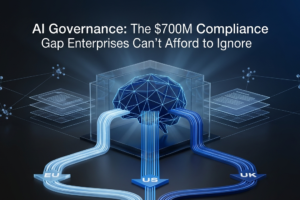
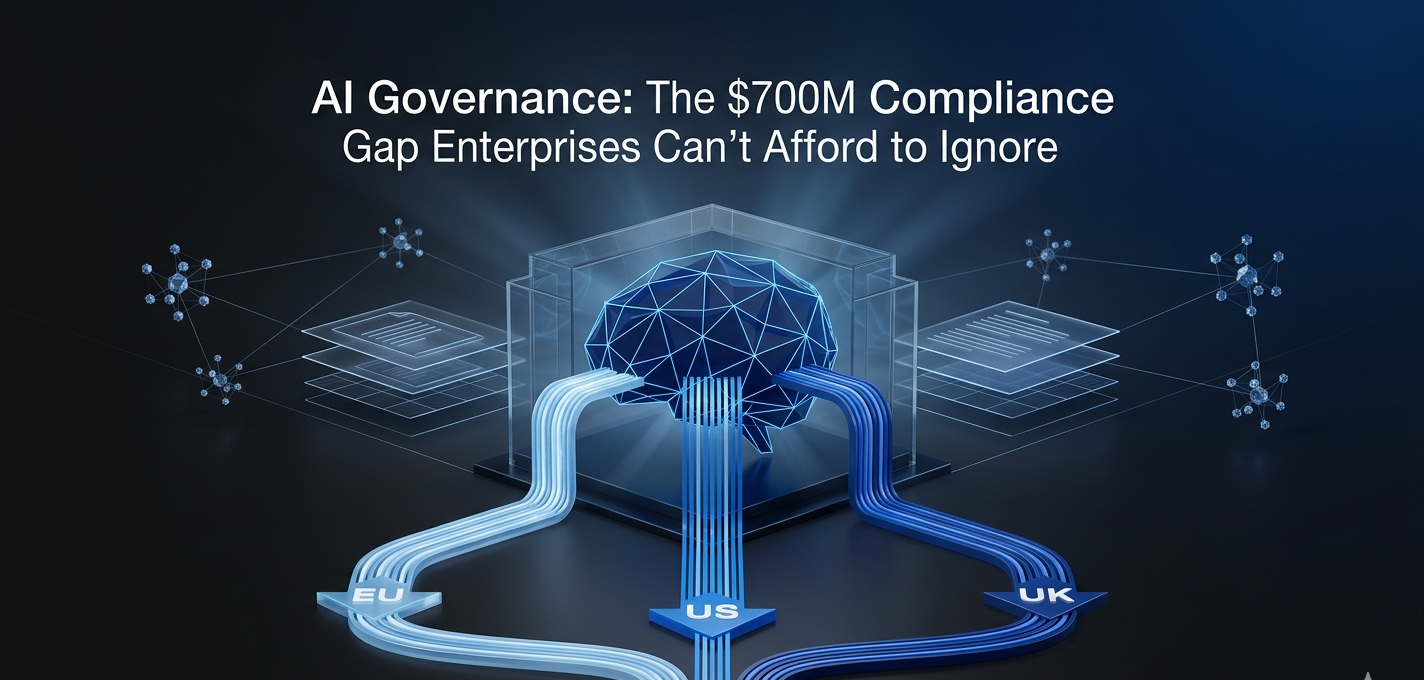
The EU AI Act’s high-risk obligations become fully enforceable in August 2026. Fines can reach 35 million euros or 7% of global annual turnover, whichever is larger. For a $10 billion revenue company, that is a $700 million exposure sitting quietly in your AI deployment backlog.
Meanwhile, U.S. federal and state governments issued over 120 AI-related laws, executive orders, and guidance documents in 2024 and 2025. More than 30 state-level AI laws are enacted or under review by early 2026. For global enterprises, this is not a single compliance problem. It is a regulatory patchwork that demands a unified governance architecture.
This analysis gives you the cross-jurisdictional roadmap that competitors’ articles skip. You will get a five-level AI governance maturity model, a board-oversight structure with concrete roles and reporting cadence, a cross-mapping of EU AI Act, NIST AI RMF, and UK AI Safety Institute requirements, and the implementation checklist that compliance officers and engineers can act on today.
Section 01
The Regulatory Landscape: Three Regimes, One Enterprise Problem
AI governance regulation and enterprise compliance don’t live in one jurisdiction. The challenge for multinational enterprises in 2026 is that three distinct regulatory philosophies are converging simultaneously, each with its own enforcement timeline, documentation standard, and penalty structure.
The EU AI Act is the most structurally demanding. It categorizes AI systems by risk level: unacceptable (banned outright), high-risk (stringent compliance), limited-risk (transparency obligations), and minimal-risk (essentially unregulated). Around 15% to 20% of regulated AI deployments in banking and healthcare are expected to land in the high-risk category, triggering the most burdensome documentation and monitoring requirements.
The EU AI Act applies to any AI system that affects EU residents, regardless of where the developer is headquartered. A fintech firm based in Singapore that operates credit-scoring models for French customers is fully subject to EU AI Act high-risk obligations. Territorial reach is one of the most consistently underestimated compliance risks in 2026.
The U.S. picture is deliberately different. The National Institute of Standards and Technology AI Risk Management Framework (NIST AI RMF) offers a voluntary governance structure built around four core functions: Govern, Map, Measure, and Manage. It doesn’t carry direct legal penalties, but it’s rapidly becoming the de facto standard that regulators, auditors, and enterprise procurement teams use to evaluate AI maturity. More than 25% of major U.S. enterprises are already running annual AI risk assessment cycles, driven largely by state-level mandates.
“We’re past the point where an AI policy document satisfies anyone. Regulators and boards want to see model inventories, impact assessments, and audit trails.”AI compliance analyst perspective, via Adeptiv.AI’s 2026 governance analysis
Section 02
The Compliance Gap That’s Costing Enterprises Millions
The numbers are blunt. Roughly 40% to 50% of large enterprises report having formal AI governance programs. Only 15% to 20% actually meet EU AI Act documentation and monitoring standards when independently assessed.
That gap has a name: documentation debt. And regulators are already finding it. Around 40% of AI system audits flag documentation gaps, even when the underlying models perform technically well. A system can have excellent accuracy, low bias metrics, and solid security controls, and still fail a compliance audit because its risk classification, training data lineage, or human-override protocols aren’t properly recorded.
Documentation gaps are treated as violations under the EU AI Act, not administrative oversights. The distinction matters because violations trigger financial penalties, while oversights typically trigger remediation timelines. In roughly 40% of audited AI deployments, technically sound systems still fail on documentation alone.
The cost of fixing this after the fact is significant. Building a minimum-viable AI governance program, including model inventory, impact-assessment tooling, and basic documentation infrastructure, runs $150,000 to $500,000 for mid- to large-sized enterprises. Do that reactively under regulatory pressure and costs compound. Do it proactively and the ROI case is straightforward: $500,000 in governance infrastructure against a potential $700 million fine is not a hard calculation.
There is a less obvious cost too. Board visibility into AI incidents is rising sharply. Around 30% to 40% of global tech firms now report AI governance incidents, including biased outputs and model-drift-related harm, to internal boards or compliance committees. That is up from under 10% in 2022. When something goes wrong and there’s no audit trail, no incident response protocol, and no documented risk classification, the liability isn’t just financial. It’s reputational.
Section 03
The 5-Level AI Governance Maturity Model
Most compliance frameworks tell you what you need. Fewer tell you where you are and what closing the gap actually looks like. Here is a five-level maturity model designed for enterprise AI governance programs, benchmarked against EU AI Act, NIST AI RMF, and UK AI Safety Institute requirements.
| Level | Name | What It Looks Like | Regulatory Status | Next Milestone |
|---|---|---|---|---|
| Level 1 | Ad Hoc | No formal AI inventory. Governance handled case-by-case. No impact assessments. | Non-compliant. High penalty exposure. | Build model inventory. Assign AI risk owner. |
| Level 2 | Documented | Written AI policy exists. Risk classifications attempted. No systematic monitoring. | Partially compliant. Audit risk remains high. | Implement impact-assessment workflow. Add monitoring tooling. |
| Level 3 | Managed | Model inventory operational. Impact assessments run for new deployments. Incident reporting in place. | EU AI Act baseline met. NIST AI RMF partially aligned. | Cross-jurisdictional mapping. Board reporting cadence established. |
| Level 4 | Optimized | Continuous model monitoring. Annual reassessment cycles. AI steering committee active. | Fully compliant across EU, UK, and U.S. state frameworks. | Pursue third-party certification. Publish transparency report. |
| Level 5 | Super-Compliance | Design to strictest global standard. Governance embedded in product development lifecycle. | 20 to 30% lower compliance overhead across jurisdictions. | Publish public AI principles. Establish governance as competitive differentiator. |
Level 5 “super-compliance” isn’t theoretical. Companies designing to the strictest available rules, typically the EU AI Act or Colorado-style state frameworks, report 20% to 30% lower compliance-operations overhead across multiple jurisdictions. When your baseline is the most demanding standard, you don’t need to rebuild governance architecture every time a new state or country enacts legislation.
Most enterprises assessed in 2025 are operating at Level 1 or Level 2. Getting from Level 2 to Level 3 is where the real work happens, and where most programs stall because they underestimate the operational lift of systematic model monitoring and documentation.
Section 04
Board-Level AI Governance: Roles, Reporting, and Escalation
AI governance can’t live exclusively in engineering. The regulatory frameworks making headlines in 2026 expect board-level accountability, and auditors are starting to ask questions about who owns AI risk at the C-suite level.
The AI Steering Committee Structure
An effective AI steering committee isn’t another bureaucratic layer. It’s the decision-making body that connects engineering risk to business risk, and business risk to regulatory exposure. Minimum composition for most enterprises:
- Chief AI Officer or CISO (chair) owns the AI risk register and escalation protocols. Responsible for quarterly board briefings on AI risk posture.
- Chief Legal Officer or General Counsel maps AI deployments to current and emerging regulatory requirements. Owns the cross-jurisdictional compliance calendar.
- Chief Data Officer manages model inventory, data lineage documentation, and training data governance. Critical for audit readiness.
- Head of Product or CTO representative ensures governance requirements are embedded in the product development lifecycle, not bolted on post-deployment.
- Independent AI ethics advisor provides external perspective on bias, fairness, and societal impact. Increasingly expected by regulators in high-risk sectors.
Reporting Cadence and Escalation Triggers
Governance without a reporting cadence is a policy document, not a program. The standard for enterprises operating high-risk AI systems in 2026:
- Monthly: Engineering team reviews model performance metrics, drift indicators, and new deployment risk classifications.
- Quarterly: AI steering committee reviews the AI risk register, outstanding impact assessments, and regulatory calendar updates.
- Annually: Full board briefing on AI risk posture. Annual impact assessments for all high-impact systems. Colorado-style state frameworks mandate these.
- Immediate escalation triggers: AI system causes demonstrable harm; regulator inquiry received; material model drift detected; third-party audit finding issued.
Enterprises that treat AI governance as a core operating model rather than a compliance checkbox report 20% to 35% faster speed-to-market on AI-driven products. Clear guardrails reduce rework, shorten approval cycles, and eliminate the late-stage legal reviews that stall product launches. Governance is an accelerant when it’s built correctly.
Section 05
The Cross-Jurisdictional AI Governance Roadmap
Most enterprise AI governance guides focus on one jurisdiction. That is the wrong unit of analysis for any company operating across borders. Here is a cross-mapping of EU AI Act, NIST AI RMF, and UK AI Safety Institute requirements into a single enterprise implementation sequence.
Phase 1: Inventory and Classification (Weeks 1 to 8)
- Build a complete AI model inventory: system name, use case, data inputs, affected populations, deployment jurisdiction, and current risk classification.
- Classify each system against EU AI Act risk tiers. Flag all systems that process decisions about individuals in hiring, credit, healthcare, law enforcement, or critical infrastructure.
- Map U.S. state-law exposure: identify which systems affect residents of Colorado, California, or other states with active AI legislation.
- Assign owners to every AI system in the inventory. No ownership means no accountability in an audit.
Phase 2: Documentation and Impact Assessment (Weeks 8 to 20)
- Run conformity assessments for all EU-exposed high-risk AI systems. Document training data sources, validation methodology, bias testing results, and human oversight protocols.
- Implement the NIST AI RMF Map and Measure functions: identify AI risks at the system level and implement quantitative and qualitative risk metrics.
- Complete impact assessments for all high-impact systems. Colorado-style frameworks require annual reassessment cycles, so build the workflow now.
- Establish data lineage documentation: training sets, preprocessing decisions, and version control for model artifacts.
Phase 3: Monitoring and Incident Response (Weeks 20 to 36)
- Deploy model monitoring tooling: track performance drift, bias indicators, and output distribution shifts in production. Enterprises with these tools answer regulator requests 50% faster than those without.
- Build an incident response protocol: define what constitutes a reportable AI incident, who gets notified, and what the remediation timeline is.
- Establish human-in-the-loop controls for all EU-classified high-risk AI systems. Document override procedures and decision log retention policies.
- Activate the board reporting cadence and AI steering committee rhythm as outlined in Section 04.
Phase 4: Certification and Continuous Improvement (Month 9 Onward)
- Pursue third-party conformity assessment for EU AI Act high-risk systems where required. Self-declaration is permitted for some categories; third-party certification is required for critical infrastructure, law enforcement, and biometric systems.
- Publish an AI transparency report. Increasingly expected by institutional investors, enterprise customers, and regulators.
- Embed governance checkpoints into the product development lifecycle so new AI deployments enter the governance program at inception, not post-launch.
- Track the regulatory calendar quarterly. With 30+ state laws active or pending in the U.S. alone, the compliance landscape will keep shifting through 2027 and beyond.
Frequently Asked Questions
What is AI governance in an enterprise?
Enterprise AI governance is the set of policies, processes, roles, and technical controls that manage how an organization develops, deploys, monitors, and retires AI systems. It covers risk classification, documentation standards, human oversight requirements, incident response, and board-level accountability.
In 2026, it is no longer optional. Regulators in the EU, UK, and increasingly U.S. states treat AI governance as a compliance function equivalent to financial controls or data privacy programs.
What are the key requirements of the EU AI Act for companies?
For high-risk AI systems, the EU AI Act requires a technical documentation file, risk management system, data governance controls, transparency and user information requirements, human oversight mechanisms, accuracy and robustness testing, conformity assessment, and registration in the EU database.
The high-risk category includes AI systems used in hiring, credit scoring, healthcare diagnostics, critical infrastructure management, biometric identification, and law enforcement. Full enforcement starts August 2026.
What are the penalties for non-compliance with the EU AI Act?
Penalties scale with the severity of the violation. Violations of prohibited-practice rules carry fines up to 35 million euros or 7% of global annual turnover, whichever is higher. Non-compliance with high-risk system obligations carries fines up to 15 million euros or 3% of turnover. Providing incorrect information to authorities can trigger fines up to 7.5 million euros or 1% of turnover.
For context: a company with $10 billion in annual revenue faces up to $700 million in exposure for prohibited-practice violations alone.
How does the NIST AI RMF apply to enterprises?
The NIST AI Risk Management Framework is voluntary at the federal level but is increasingly referenced by U.S. state regulators, federal procurement requirements, and enterprise customers. It is structured around four functions: Govern (establish AI risk policies and accountability), Map (identify AI risks in context), Measure (quantify and assess risks), and Manage (respond to and monitor risks).
Enterprises that implement NIST AI RMF typically find it maps well to EU AI Act requirements, making it a practical starting point for cross-jurisdictional compliance programs.
What is the difference between AI ethics and AI governance?
AI ethics is the philosophical and values-based dimension: fairness, transparency, human dignity, and avoiding harm. AI governance is the operational dimension: the systems, processes, roles, and documentation that translate ethical commitments into auditable, enforceable controls.
In 2026, regulators care about both but can only enforce governance. You can have a beautifully worded AI ethics statement and still fail a compliance audit for lack of a model inventory or impact assessment.
How do state AI laws like Colorado’s affect enterprise AI programs?
Colorado-style AI laws require deployers of high-impact AI systems to conduct annual impact assessments, disclose when AI is used in consequential decisions such as hiring, lending, or housing, provide individuals the ability to appeal AI-driven decisions, and manage risks of algorithmic discrimination.
With 30+ state laws active or pending by early 2026, multi-state enterprises need a governance architecture flexible enough to accommodate new requirements without rebuilding from scratch each time. The NIST AI RMF provides that flexible base layer.
Who should be responsible for AI governance in the boardroom?
Best practice in 2026 points to the Chief AI Officer (or equivalent) as the primary owner of the AI risk register and board reporting. The General Counsel owns regulatory mapping. The CDO owns documentation and model inventory. The full board receives AI risk briefings at least annually.
The critical structural requirement is that AI governance can’t live entirely in engineering. When something goes wrong and there’s no C-suite accountability, regulatory and reputational exposure is significantly higher.
How do you implement AI governance across global operations?
The most efficient approach is “harmonize upward”: design your governance program to the most demanding standard (typically the EU AI Act), then verify that lower-bar jurisdictions are satisfied. This is the mechanism behind the 20% to 30% reduction in compliance overhead reported by super-compliance firms.
Operationally, this requires a cross-jurisdictional regulatory calendar, a model inventory that tracks where each system is deployed, and a flexible impact-assessment workflow that can incorporate new jurisdictional requirements without redesigning the entire program.
The Pattern Is Clear. The Window Is Closing.
Across every governance framework, audit report, and regulatory timeline examined in this analysis, the pattern repeats: the gap between policy on paper and operational compliance is the defining AI governance risk in 2026. Enterprises that addressed it proactively are operating at Maturity Level 3 or 4. Those that haven’t are staring at August 2026 enforcement with documentation debt, no model inventory, and no board-level accountability structure.
The financial math is straightforward. Building a minimum-viable AI governance program costs $150,000 to $500,000. The alternative is exposure up to 7% of global revenue for EU AI Act prohibited-practice violations. The real leverage isn’t avoiding the fine. It’s the 20% to 35% faster product velocity that enterprises with mature governance programs consistently report. Governance built correctly is an accelerant, not a constraint.
Watch three developments through 2027: consolidation among AI governance platform vendors as enterprise demand scales; regulatory convergence between EU AI Act, UK AI Safety Institute standards, and U.S. state frameworks creating de facto global standards; and a growing premium in enterprise procurement for AI transparency reports and third-party conformity certifications. Organizations that build governance infrastructure now will answer those procurement questions with documentation, not promises.
For implementation support and detailed NIST AI RMF mapping templates, explore NIST’s AI RMF 1.0 documentation and the EU AI Act official resource portal. Subscribe to NeuralWired for weekly analysis on AI governance, enterprise compliance, and emerging technology policy.
Sources and References
- 01.Dataversity: “AI Governance in 2026: Is Your Organization Ready?” (Feb 2026)
- 02.Airia: “AI Compliance Takes Center Stage: Global Regulatory Trends for 2026” (Jan 2026)
- 03.Adeptiv.AI: “AI Governance in 2026: From Policy to Control Systems” (Jan 2026)
- 04.Gunderson Dettmer: “2026 AI Laws Update: Key Regulations and Practical Guidance”
- 05.Lumenova AI: “Top 10 AI Governance Best Practices” (2025 to 2026)
- 06.Fintech Global: “AI Regulatory Compliance Priorities Financial Institutions Face in 2026” (Jan 2026)
- 07.Ethyca: AI Governance News and Analysis (2025 to 2026)
- 08.Kong Inc.: “What Is AI Governance?” (2025 to 2026)
- 09.LinkedIn Pulse: “AI Governance Shifts 2026: From Compliance to Competitive” (2026)
- 10.LinkedIn Pulse: “AI Governance 2026: Why Compliance Alone Won’t Save You” (2026)
- 11.NIST: AI Risk Management Framework 1.0 (Official Document)
- 12.European Commission: AI Act Official Regulatory Framework