
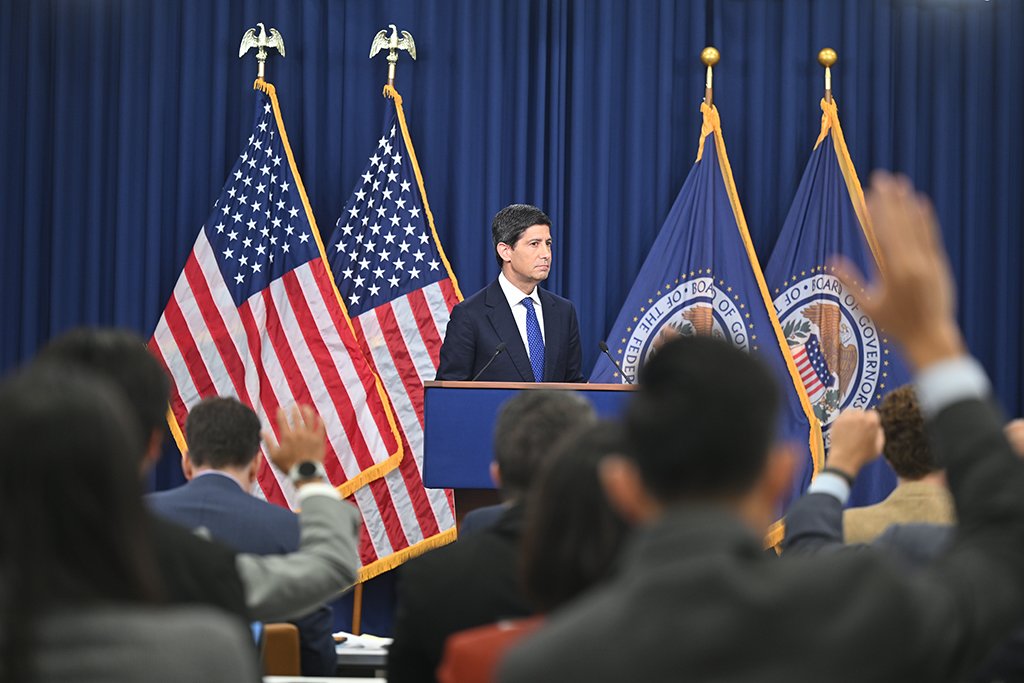
For months, Kevin Warsh promised that the Federal Reserve would move when the data demanded it and not a moment before. On Wednesday, the data won. The Fed chair that Donald Trump handpicked cast a vote the president did not want, and eleven of his colleagues voted right along with him.
The Federal Open Market Committee raised its target range for the federal funds rate by a quarter point, to 3.75 percent and 4 percent, in a unanimous 12-0 decision. It is the first rate increase since July 2023 and the first of Warsh’s tenure as chair. Trump, who nominated Warsh in January, said within hours that rates should be far lower, and later told reporters he had spoken to Warsh before the vote. Warsh, at his press conference, would not discuss it.
A Short Statement With a Blunt Message
The FOMC’s statement ran to just four paragraphs, unusually brief for a decision of this weight. It described an economy expanding at a solid pace, with resilient spending, strong productivity and job gains keeping pace with the workforce, even as uncertainty stayed elevated because of geopolitical developments. Inflation, the Committee said plainly, remains too high.
Warsh put it in his own words when he opened the press conference. “But inflation remains elevated. Today’s policy action will support a timelier return to the Committee’s 2 percent goal. This Committee will deliver price stability,” he said, according to the Fed’s own transcript of his remarks, released marked preliminary.
The mechanics moved in step with the headline number. The Fed lifted interest on reserve balances to 3.90 percent and raised the primary credit rate a quarter point to 4 percent, a request that came from the boards of the Cleveland, Richmond, Atlanta, Chicago, Minneapolis, Kansas City and Dallas regional banks. The standing overnight repo rate rose to 4 percent and the reverse repo offering rate to 3.75 percent, with a $160 billion daily cap per counterparty. The Fed’s trading desk was also told to keep rolling maturing Treasury holdings into new auctions and to shift agency-security proceeds into Treasury bills, full details laid out in the Fed’s implementation note.
The Case for Acting Now
Warsh has been building toward this decision since the summer. At last month’s Jackson Hole symposium, he set the bar for himself in public, saying he would be “hard-pressed to describe broad financial conditions as restrictive” and warning that “price stability is not self-executing, nor is inflation necessarily mean-reverting.” On Wednesday he said the Committee judged that standard had not been met, calling the state of inflation a “plain fact” that had persisted too long and adding that this summer’s readings gave him no comfort that underlying price pressure was actually easing.
The numbers behind that judgment had been piling up for two weeks. The August jobs report, released September 4, showed nonfarm payrolls up 162,000, nearly triple the roughly 53,000 to 56,000 economists expected, with June and July revised higher by a combined 55,000 and unemployment steady at 4.1 percent. A week later, August inflation data showed headline CPI up 0.4 percent for the month and 3.4 percent over the year, with core inflation, which strips out food and energy, running at 2.4 percent annually. Energy prices alone were up 16.3 percent year over year, and gasoline had jumped nearly 28 percent. Both reports are detailed in the Bureau of Labor Statistics’ August CPI release.
Warsh cited his own estimate that total personal consumption inflation, the Fed’s preferred gauge, likely ran near 3.6 percent in August, with core PCE closer to 3.2 percent, figures he derived ahead of the official release. Asked afterward to characterize the vote, he told reporters, as relayed by Reuters, that it was “a sober decision, serious decision, responsible decision.”
An Inflation Story Complicated by Oil
Much of the price pressure the Fed is fighting did not originate in the domestic economy at all. An escalating conflict involving the United States and Iran has disrupted oil flows through the Gulf for months, and on September 11 drones launched from Iraq struck a pumping station on Saudi Arabia’s East-West pipeline, a roughly 750-mile link with capacity to move about 7 million barrels a day of crude to the Red Sea without passing through the Strait of Hormuz. Riyadh shut the line down.
Brent crude traded between roughly $105 and $108 a barrel in the days that followed, and the futures market flashed real alarm: the spread between the front-month contract and the next one out widened to $4.44 a barrel, up from under a dollar just a month earlier, a classic sign traders feared an immediate supply crunch. Prices eased after U.S. Energy Secretary Chris Wright told CNBC the outage was a “brief and temporary interruption” that would be measured in days, and after Saudi officials signaled they could restore roughly half the pipeline’s capacity within days and full service in about six weeks. Independent analysts reviewing satellite imagery of the damaged site have been less certain, warning the repair could stretch into weeks rather than days.
That uncertainty sits underneath one of the more contested questions in macroeconomics right now: whether a central bank should tighten policy at all in response to a shock that originates in energy prices rather than domestic demand. Treasury Secretary Scott Bessent made the case publicly before the meeting that supply shocks typically pass through the economy without requiring a policy response. Warsh’s own reasoning is different. He has argued the Fed cannot control the price of oil, but it can and must stop a shock in one part of the economy from spreading into broader, stickier inflation. Which view proves right will not be settled this week, and Wednesday’s decision is effectively the test case.
Markets Whipsaw, Then Steady
Stocks were calm ahead of the announcement and turned sharply lower once Warsh began taking questions. The Dow Jones Industrial Average closed down about 1.2 percent, the S&P 500 fell 0.4 percent and the Nasdaq Composite finished roughly flat. The 10-year Treasury yield, which had already touched its highest level since 2007 earlier in the week, climbed back above 5 percent, and the more rate-sensitive 2-year yield rose seven basis points to 4.738 percent.
By Thursday, some of that move had reversed. The 10-year yield fell more than six basis points to 4.943 percent, snapping an eight-session climb, while the 30-year eased to 5.301 percent and the 2-year to 4.675 percent. The S&P 500 was up roughly 1 percent in Thursday trading and a closely watched index of chipmakers gained 3 percent, as Brent slipped back toward $102 to $103 a barrel on easing fears about the Saudi outage. Gold rose as well.
The Fed’s own projections suggest Wednesday was not a one-off. The median policymaker now expects the federal funds rate to end both this year and next at 4.1 percent, which implies one more quarter-point increase before the year is out. Eighteen participants submitted projections for the Summary of Economic Projections; Warsh, as he has done all year, declined to submit one of his own. Of those eighteen, sixteen see at least one more rate increase in 2026.
A President Overruled by His Own Pick
The politics of the vote are as unusual as the economics. Trump nominated Warsh in January after souring on then-Chair Jerome Powell, and as recently as February said publicly that he would not have picked Warsh had he known Warsh wanted to raise rates. On Wednesday, Warsh voted for exactly that.
Trump responded on Truth Social within hours, writing that “Interest Rates in the United States should be 1%, or less, because we are the Best Credit in the World” and demanding the Fed act fast to bring them down. Speaking to reporters that evening before leaving for a campaign event in North Carolina, he said he had told Warsh “you might as well vote with the board because it’s not going to matter,” and described the Fed’s board as hostile and political. Asked directly whether he believed Warsh’s vote was shaped by that conversation, Trump said he did not think so. Warsh, for his part, told reporters he had “got nothing for you on a discussion with the president.”
The administration’s criticism was not limited to the president. White House Senior Deputy Press Secretary Kush Desai told Fox News the decision was unfortunate and not backed by a compelling economic case, and Vice President JD Vance had said in the days before the meeting that the Fed should be cutting rates, not raising them. The episode lands in an already strained institutional moment for the Fed: Governor Lisa Cook’s position remains contested in ongoing litigation, the Justice Department has closed but reserved the right to reopen an inquiry into Powell pending an inspector general’s report, and a separate outside review of the 2023 Silicon Valley Bank failure is still underway. None of those matters has been resolved.
What Comes Next
The Fed’s next scheduled decision lands October 28, just days before the midterm elections, a meeting that will carry an inescapable political charge regardless of the outcome. Administration officials have already argued the central bank should hold off acting so close to a vote. The following meeting, December 8 and 9, comes with a fresh round of economic projections and is the point at which Goldman Sachs Asset Management has publicly said it expects the next rate increase to land, consistent with the Fed’s own dot plot.
Minutes from this week’s meeting are due in early October and should show how contested the unanimous vote actually was behind closed doors. Between now and then, the single biggest variable is likely to be oil: whether Saudi Arabia gets the East-West pipeline back to full capacity in six weeks, as officials say, or whether the damage proves more stubborn, as independent analysts reviewing the site currently suspect.
What Wednesday’s vote did not do is settle the argument underneath it. Whether a central bank should tighten policy into a shock that started in the price of oil rather than in domestic demand remains a live and legitimate dispute among economists, one that Bessent and Warsh have now staked out in public on opposite sides. That debate, not any single data point, is what the Fed will be litigating in real time over the next six weeks, with mortgage rates, corporate borrowing costs and a president’s patience all riding on the answer.