
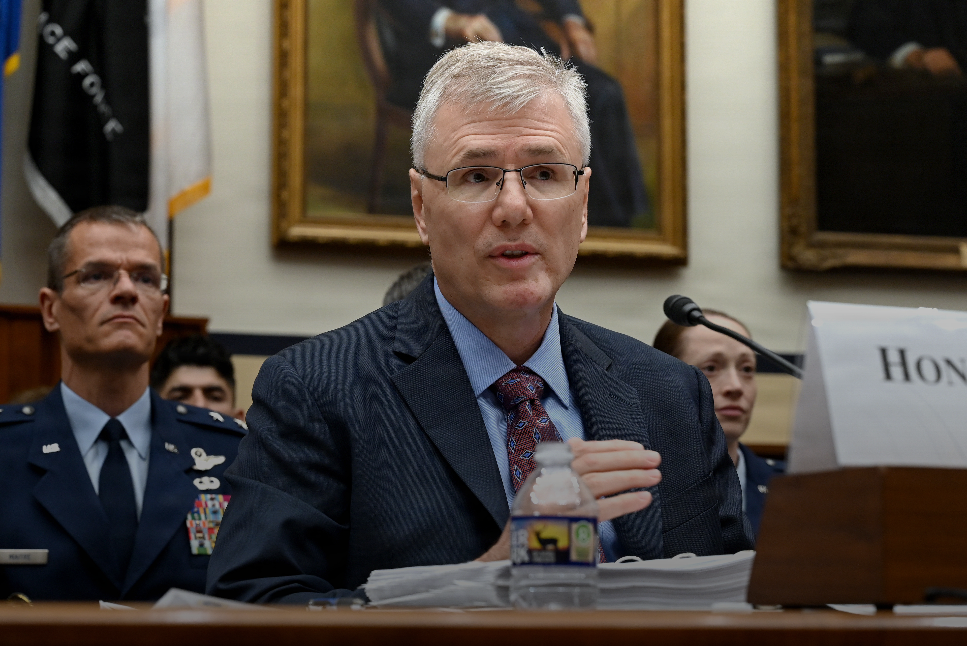
Photo by Andy Morataya / U.S. Air Force, via af.mil
For the first time in the history of American spaceflight, a senior U.S. official has said out loud what analysts have suspected for years: the United States already has weapons in space, and they are operational right now.
The admission came from Troy Meink, Secretary of the Air Force, during a keynote address at the Air, Space & Cyber Conference in National Harbor, Maryland, on September 14. “Today, we continue to ensure we remain ready to meet the challenge of evolving threats wherever they exist,” Meink told the audience. “This is why the Space Force now has on-orbit space control weapons capable of defending the joint force against hostile adversary action.”
It was a short line, delivered without fanfare, but it broke decades of deliberate American ambiguity about whether the country had crossed the threshold from developing counter-space capabilities to actually deploying them in orbit. Within a day, Beijing and Moscow had both responded, and a story that started as a conference speech turned into the latest flashpoint in a rivalry that now extends roughly 250 miles above the Earth’s surface.
What Meink Actually Said, and What He Didn’t
Meink was careful. He confirmed the existence of the weapons but declined to describe them in any way that would reveal what they actually are. He did not say how many exist, when they were deployed, or whether they strike targets physically or disable them through jamming, cyberattacks, or directed energy.
Pressed by reporters afterward, he made clear the vagueness was intentional. “We’re not going to talk about the specifics of what we’re doing, whether we’ve tested, not tested, or anything else,” he said, adding that the way the disclosure had been worded was “very well thought out.”
A Space Force spokesperson filled in a little more shading, telling ABC News that the weapons “can be employed for offensive and defensive purposes.” The same spokesperson placed the announcement in a longer arc of American concern, noting that the U.S. has been warning about Russian and Chinese weapons testing in orbit since 2007, and argued that space has effectively already become “a warfighting domain.”
Elsewhere in his keynote, Meink tied the announcement to the Pentagon’s sprawling Golden Dome missile-defense initiative. He said the program’s Space-Based Interceptor effort had moved “from initial contract to flight-ready hardware” in under a year, with an initial capability now targeted for 2028. He also confirmed that the first satellites in a $4.2 billion Space-Based Air-Moving Target Indication constellation, built by SpaceX under a contract awarded in May, were expected to launch this month.
Why This Matters Beyond the Speech
No government has ever officially confirmed fielding weapons in orbit before. The 1967 Outer Space Treaty, which both the United States and Russia have ratified, bans nuclear weapons and other weapons of mass destruction from space, but it says nothing about conventional weapons. That gap is exactly the space, in every sense, that Meink’s announcement now occupies.
Juliana Suess, a space security expert at the German Institute for International and Security Affairs, told CNBC that the lack of detail leaves enormous room for interpretation. The undisclosed capability, she said, “could be anything,” ranging “from reversible interference, such as jamming, to kinetic, permanently destructive effects.” Her broader assessment was blunt: “In general this is a very destabilizing statement by the United States.”
That framing gets at what makes this moment different from prior warnings about adversary capabilities. This is not the Pentagon flagging what Russia or China might be building. It is Washington confirming what it has already built and put into orbit, ending an era of strategic ambiguity that both sides of the U.S. political spectrum had, until now, generally preserved.
Beijing and Moscow Respond
The reaction from Beijing was swift and pointed. Asked directly about the U.S. announcement at a regular press briefing on September 15, Chinese Foreign Ministry spokesperson Guo Jiakun said China supports the peaceful use of space and opposes turning it into a battleground. “We urge the U.S. to stop expanding military build-up in outer space, and uphold global strategic stability with concrete actions,” he said, according to the ministry’s official transcript.
Russia’s response followed a similar line but leaned more heavily on the language of disarmament. Kremlin spokesperson Dmitry Peskov said Moscow believes “space must be free of any weapon” and that Russia is “counting on broad international consolidation to continue working toward the complete demilitarisation of space.”
The irony, noted by several outlets covering the story, is that both governments have spent years testing and developing their own counter-space capabilities, including what a 2024 U.S. intelligence assessment described as a new Russian anti-satellite capability, at the time characterized by the White House as not imminent. Diplomatic efforts to draw clear lines around military activity in orbit have already stalled once: in April 2024, Russia vetoed a joint U.S.-Japan resolution at the UN Security Council calling on states not to develop or deploy weapons of mass destruction in space, then proposed its own resolution banning all weapons in space outright, which also failed to pass.
The Bigger Picture: Golden Dome’s Ballooning Price Tag
Meink’s disclosure did not happen in isolation. It landed alongside a broader, and increasingly expensive, transformation of how the U.S. thinks about space as a military domain. President Trump signed an executive order in January 2025 directing the Pentagon to build what was originally called an “Iron Dome for America,” later rebranded Golden Dome. By May of that year, Trump had unveiled the program’s architecture, named Gen. Michael Guetlein as its director, and cited an initial price tag of $175 billion, with a goal of full operational capability by the end of his term in January 2029, according to reporting from Defense Scoop.
That estimate has not held up well under outside scrutiny. In May 2026, the nonpartisan Congressional Budget Office published an analysis putting a comparable system’s real cost closer to $1.2 trillion over 20 years, a figure widely reported at the time, though the CBO itself cautioned the number reflected just one illustrative approach given how little program detail the Pentagon has released publicly.
In December 2025, Trump signed a further executive order, “Ensuring American Space Superiority,” which formally expanded the Space Force’s mission beyond defense to include offensive operations, a policy shift that now looks directly connected to Meink’s announcement nine months later.
What Comes Next
The immediate next milestones are concrete. The first Space-Based AMTI satellites are expected to launch this month, though the eventual size of that constellation has not been disclosed. The Space-Based Interceptor program is moving through a staged prototype competition, with contractors having cleared the first of four planned gates as of August.
What happens diplomatically is less predictable. Chinese and Russian officials are likely to keep pressing the issue, potentially at the UN Conference on Disarmament, and there will be close attention paid to whether either country responds by disclosing, or gets caught testing, comparable capabilities of its own. For now, the technical nature of America’s orbital weapons remains classified. What has changed, irreversibly, is that their existence no longer is.