
Artificial Intelligence / Developer Focus
Prompt Engineering Is Dead. LangChain’s Data Proves It.
Published July 30, 2026 · NeuralWired Developer Focus
Your agent worked flawlessly in the demo. In production, it forgets a tool call from three steps ago, contradicts a document it retrieved 40 tokens earlier, and burns your API budget re-reading its own context window. You rewrite the prompt. Nothing changes. That’s because the prompt was never the problem.
A new discipline called context engineering has quietly become the line separating engineers who ship reliable AI agents from everyone still fiddling with instruction wording. It’s not a rebrand for the sake of a rebrand. According to LangChain’s June 2026 survey of 1,340 practitioners, 32% of teams cite quality, not cost, as the top barrier keeping agents out of production, and enterprise write-in responses point directly at context management as the root cause. This is the story of how that shift happened, what the data actually shows, and why the skeptics think the industry is getting ahead of itself.
Quick take: Context engineering means designing everything a model sees before it answers, not just how you phrase the question. Anthropic calls it “the natural progression of prompt engineering.” The data says it’s already the top reason enterprise AI agents fail in production.
In this article
The week “prompt engineering” died on X
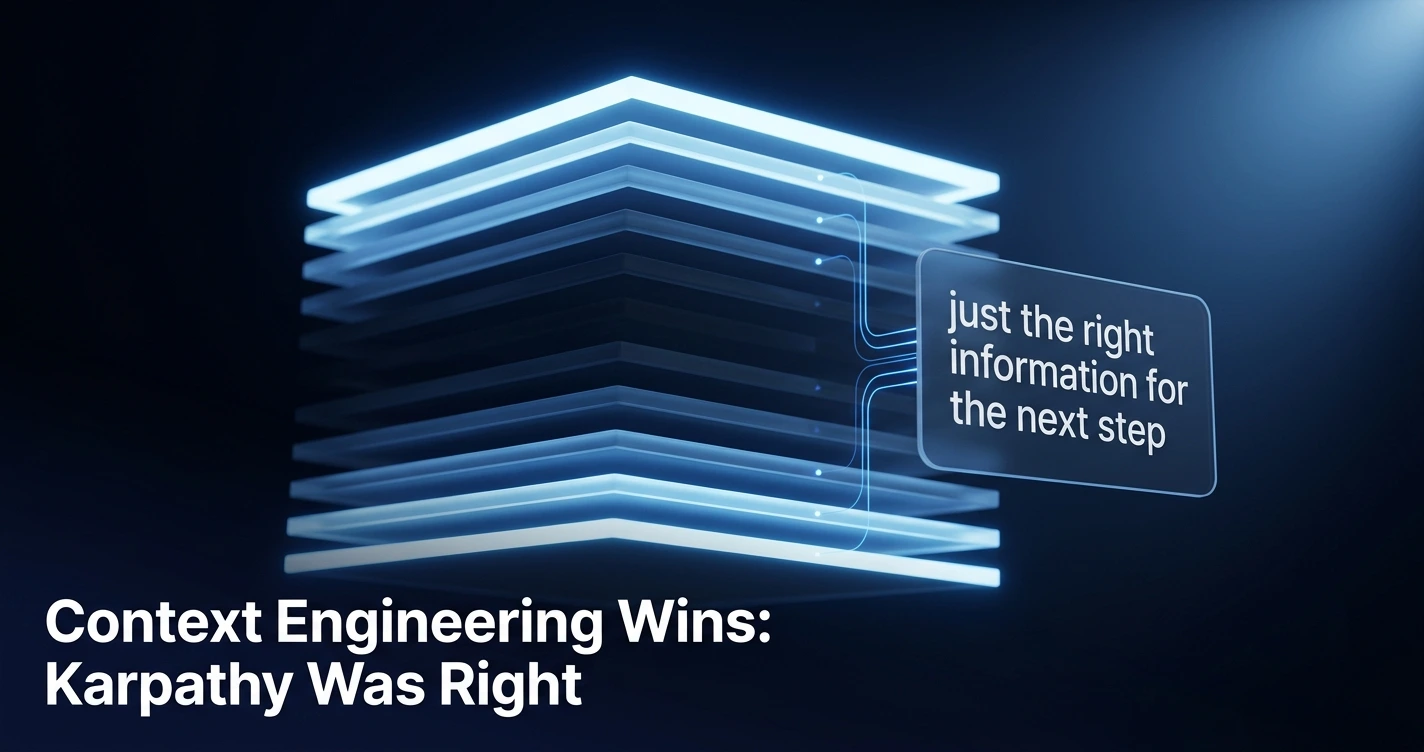
Track the timeline and the shift happened in about nine days. On June 18, 2025, Shopify CEO Tobi Lütke posted that he preferred the term “context engineering” over prompt engineering, describing it as the art of providing all the context needed for a task to be plausibly solvable by an LLM. A week later, Andrej Karpathy, OpenAI co-founder and former Tesla AI director, quote-tweeted him with a line that has since become the industry’s working definition.
“Context engineering is the delicate art and science of filling the context window with just the right information for the next step.”Andrej Karpathy, AI researcher, OpenAI co-founder · via X, June 25, 2025
The post reached roughly 14,000 likes and 2,600 reposts, which sounds like a vanity metric until you notice how fast the term propagated through actual engineering orgs. Two days later, Simon Willison, creator of Django and Datasette, wrote that the label stuck precisely because prompt engineering had degraded into what he called a pretentious way of describing typing things into a chatbot. His argument wasn’t about branding for its own sake. It was that the old term no longer described what senior practitioners actually spent their time doing.
By September 2025, Anthropic made it official. In “Effective context engineering for AI agents”, published alongside the Claude Sonnet 4.5 release, the company defined the practice as curating the optimal set of tokens available during inference, a materially different job than wordsmithing a single instruction. Gartner picked up the framing too, predicting the discipline would be embedded in 80% of AI tooling by 2028, though that figure lives behind Gartner’s paywall and is worth treating as widely reported rather than independently verified.
The data: why 32% is the number that matters
Twitter endorsements are fun. They’re not evidence. The number that actually justifies the hype arrived in June 2026, when LangChain published its State of Agent Engineering report, a survey of 1,340 professionals fielded between November 18 and December 2, 2025.
The headline figures build a clear picture. Agents are already in production at 57.3% of organizations, up from 51% a year earlier, and at 67% of companies with more than 10,000 employees. But quality, not budget, is what’s stalling the rest: 32% of respondents named quality as the single biggest barrier to production, and write-in answers from large enterprises specifically called out context engineering and context management at scale as the cause. Add the fact that 89% of organizations have some form of agent observability while only 52.4% run offline evaluations, and you get an industry that’s watching its agents fail without yet having the tooling to systematically fix why.
| Metric | Figure | Source |
|---|---|---|
| Orgs with agents in production | 57.3% (67% at 10,000+ employee firms) | LangChain |
| Cite quality as the top production barrier | 32% | LangChain |
| Run agent observability vs. offline evals | 89% vs. 52.4% | LangChain |
| Extra tokens used by isolated multi-agent context | Up to 15x a standard chat call | Anthropic |
That last row is worth sitting with. Anthropic’s own multi-agent research system burns up to 15 times more tokens than a single chat exchange, and the company built it that way on purpose. Isolating context across sub-agents rather than cramming everything into one window is what made the multi-agent approach outperform a single-agent setup. Context engineering isn’t free. It’s a trade-off between cost and reliability, and right now the data says reliability is winning.
Why a bigger context window won’t save you
There’s an obvious objection here. If context is the bottleneck, why not just buy a bigger window? Claude and Gemini both expose 1-million-token context by 2026, up roughly 100x from GPT-4’s 8K limit in March 2023. Shouldn’t that make curation obsolete?
Chroma Research tested that assumption directly. Its Context Rot study ran controlled needle-in-haystack tests across 18 frontier models, including GPT-4.1, Claude 4 Opus and Sonnet, and Gemini 2.5 Pro and Flash. Every single model got measurably less accurate as input length grew, and the degradation started well before any model hit its advertised limit. Position mattered as much as volume: when the relevant fact sat in the middle of a 20-document context, accuracy dropped more than 30 percentage points compared to placing it at the start or end, an effect sharper than earlier “lost in the middle” research had suggested.
Not everyone treats that finding as settled science. AI commentator Cobus Greyling has pointed out that Chroma runs a commercial vector database business with a direct financial stake in RAG staying relevant, which means the incentive to find that raw context length underperforms curated retrieval deserves a second look, not automatic acceptance. It’s a fair caveat. The underlying pattern, that stuffing a window doesn’t guarantee the model uses what’s in it, has also shown up independently in Anthropic’s and LangChain’s engineering writeups, which is a stronger reason to take it seriously than any single study alone.
The four strategies engineers actually use
LangChain’s July 2025 post, “Context Engineering for Agents,” gave the field a shared vocabulary that most production frameworks now build around. Four verbs cover almost everything:
- Write: persist information outside the immediate context (scratchpads, memory stores) so it doesn’t have to live in the window at all.
- Select: pull only the relevant memory, tool output, or document into context for the current step, instead of everything available.
- Compress: summarize or trim what’s already in context before it accumulates into noise.
- Isolate: split context across sub-agents or sandboxed steps so one task’s clutter doesn’t pollute another’s reasoning.
Cognition, the company behind the autonomous coding agent Devin, put it bluntly in its own engineering writeup: context engineering is effectively the number one job of engineers building AI agents. Coming from a team shipping a commercial agent rather than a lab publishing a framework, that’s a practitioner’s verdict, not a marketing line.
The skeptics: is this just a rebrand?
Not everyone is convinced this is a new discipline at all. Addy Osmani, an engineering leader at Google who writes widely on AI-assisted development, has said plainly that many experienced developers see context engineering as either rebranded prompt engineering or, worse, buzzword creation dressed up as science. He doesn’t stop there, though. He calls the criticism understandable before making his own case for why the distinction still earns its keep.
“Many experienced developers see ‘context engineering’ as either rebranded prompt engineering or, worse, pseudoscientific buzzword creation.”Addy Osmani, engineering leader, Google · via Substack, July 13, 2025
There’s a sharper version of the same complaint circulating in developer forums: context engineering is just prompt engineering with a PR budget. It’s a punchy line, and it lands because of a real gap in the data. Unlike “prompt engineer,” which briefly commanded its own job postings and reported six-figure salaries back in 2023, there is still no dedicated “context engineer” job title or salary line-item as of mid-2026. The available compensation data covers the broad “AI Engineer” title, not this specific skill, which means the labor market hasn’t caught up to the discourse yet, if it ever fully does.
Then there’s the naming treadmill itself. Within roughly a year of context engineering becoming consensus vocabulary, a third term started circulating: harness engineering, discussed by OpenAI Codex team member Ryan Lopopolo and analyzed at Martin Fowler’s site around the idea that agents aren’t the hard part, the harness around them is. If that cycle keeps compressing, a senior engineer who masters context engineering this year may be fielding interview questions about harness engineering by next.
What it means for your career
Our read: the technical practice here is real and well evidenced. The professional-identity framing, that this “separates senior engineers from everyone else,” is currently more aspirational than measured labor fact. Both things can be true at once, and knowing the difference is what actually helps you plan a career move.
The market context still favors betting on the skill. AI and ML engineer job postings are up 59% since February 2020 while general software engineering postings are down 49% over the same stretch, according to Indeed Hiring Lab data cited in Pin’s 2026 tech job market report. Median pay for the 823 AI Engineer postings analyzed by Recruiting from Scratch sits at $198,000 in 2026, ranging from $165,000 to $233,000 between the 25th and 75th percentiles. And only about 11.4% of the broader AI and ML candidate pool, across a sample of 1.7 million profiles, carries genuinely current LLM-specific skills. That’s the scarcity context engineering fluency sits inside: not a distinct job title yet, but a real edge within a labor pool that’s still mostly running on 2023-era knowledge.
If you’re building agents right now, the practical move is to stop treating quality failures as a prompting problem by default. Check where information sits in your context before you touch the wording. Then decide, deliberately, whether it needs to be written to memory, selected on demand, compressed, or isolated in its own step. That’s the actual skill under the label, whatever the label ends up being called next year.
FAQ
What is context engineering?
Context engineering is the practice of designing everything a model sees before it responds, including instructions, retrieved documents, memory, and tool outputs, rather than just refining a single prompt’s wording. Anthropic calls it the natural progression of prompt engineering.
What’s the difference between prompt engineering and context engineering?
Prompt engineering focuses on how you phrase instructions. Context engineering focuses on what information the model has access to, including memory, retrieved knowledge, tool outputs, and conversation history, when it generates a response. Most production systems need both.
Is prompt engineering dead?
Not entirely, but its scope narrowed. Phrasing still matters for single-turn tasks, but for agents and production systems, engineers now spend most of their effort managing the broader context window rather than wordsmithing instructions.
Does a bigger context window solve context engineering problems?
No. Chroma Research tested 18 frontier models, including ones with million-token windows, and found accuracy degraded as input length grew, often well before the advertised limit, which means deliberate curation still matters regardless of window size.
Who coined the term context engineering?
The term gained mainstream traction in June 2025, when Shopify CEO Tobi Lütke and researcher Andrej Karpathy both publicly endorsed it on X within a week of each other, with Karpathy’s post reaching roughly 14,000 likes.
Where this goes next
Here’s what changes once you see the pattern: agent failures that looked like prompting bugs are usually context bugs wearing a disguise. The evidence for that is no longer just a viral tweet from mid-2025. It’s a 1,340-person survey, an 18-model degradation study, and a token-cost trade-off Anthropic is willing to pay 15x for.
Over the next 6 to 18 months, watch three things. First, whether “context engineer” ever becomes an actual job title with its own salary data, or stays absorbed into the broader AI Engineer role the way this analysis suggests. Second, whether harness engineering displaces context engineering as the term of art, or turns out to be a subset of it. Third, whether Gartner’s 80% tooling-penetration prediction for 2028 holds up as more vendors ship built-in context management rather than leaving it to hand-rolled agent code.
For a deeper look at the infrastructure making this possible, our earlier piece on the Model Context Protocol and the agent economy covers the standard now underpinning most production context pipelines. If you’re choosing what to build with, our benchmarked roundup of AI developer tools for 2026 is a useful next stop, and if you’re the one signing off on enterprise rollout, our enterprise AI implementation roadmap covers exactly where teams get stuck on the way to production.
Want the next shift before it hits your feed? Subscribe to The Neural Loop at neuralwired.com/newsletter.

