
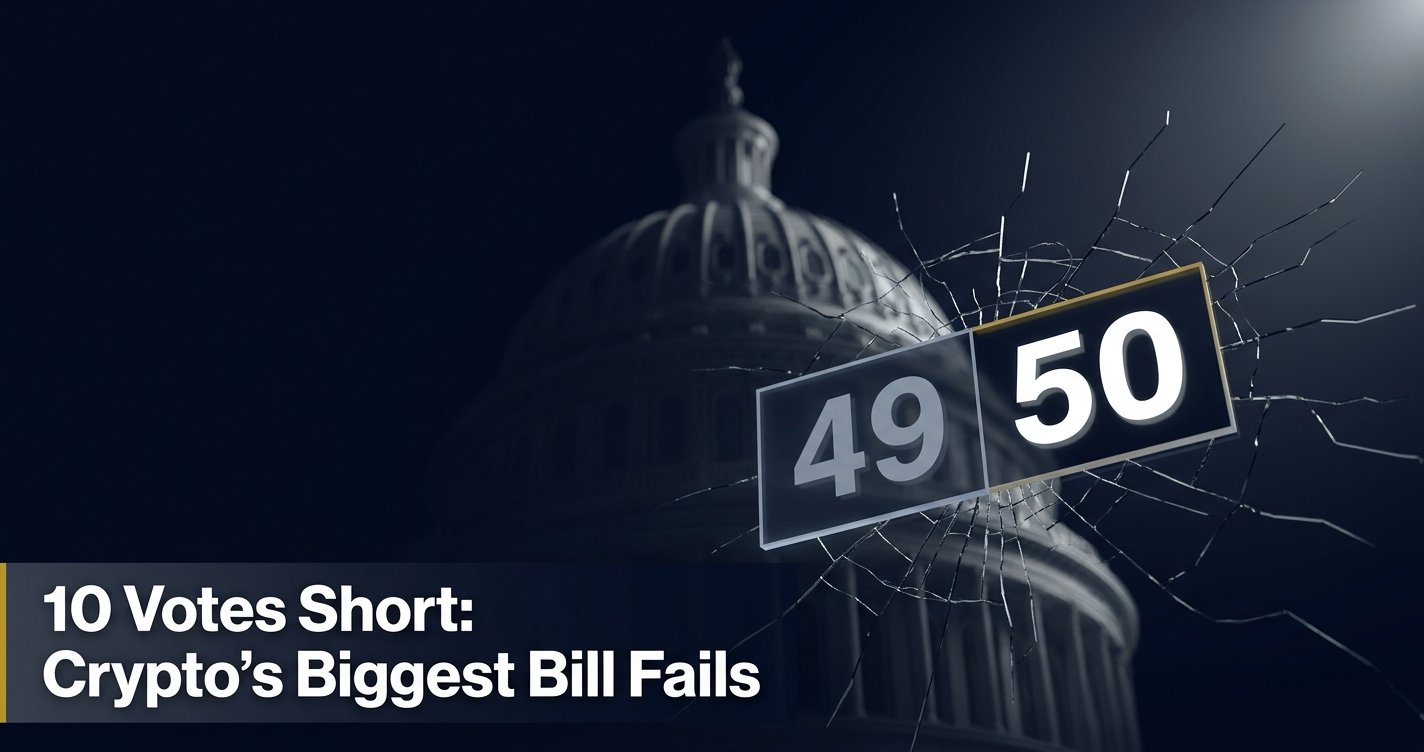
CLARITY Act Fails Senate Cloture Vote: What’s Next
At 2:15 p.m. ET on September 15, 2026, the Senate floor felt like the end of an 18-month sprint. Fourteen months of committee markups, a Lummis rewrite, and a summer of lobbying all came down to one roll call. It failed.
The CLARITY Act, crypto’s biggest shot at a real federal rulebook, fell 49-50 on a cloture vote, ten to eleven votes short of the 60 it needed. If you run compliance at an exchange, build DeFi protocols touching U.S. users, or just hold a bag of ETH and want to know what the government thinks it is, this is the vote that decides your regulatory reality for at least the next year. Here’s exactly what happened, why it collapsed, and what fills the vacuum now.
What Happened on September 15
The motion was procedural on paper: a cloture vote to end debate and proceed to H.R. 3633, the Digital Asset Market Clarity Act. In practice, it was the only vote that mattered. The tally landed at 49 yes to 50 no in most reports (some outlets flip the numbers to 50-49), but either way, the bill missed the 60-vote threshold by double digits, not by a hair.
Four Republicans broke ranks. Jerry Moran, Rand Paul, and Josh Hawley voted no outright, while Thom Tillis switched his vote to no as a procedural maneuver under Senate Rule XIII, which preserves his right to file a motion to reconsider later. A competing tally from Coinpedia’s live blog names Susan Collins instead of Paul among the defectors, so the exact final roster should be checked against the official roll call at congress.gov before you cite specific names in follow-up coverage.
Zero Democrats crossed over. That’s the number that actually killed the bill. Republicans hold 53 seats, meaning at least seven Democrats needed to vote yes, and none did.
How We Got Here
| Date | Milestone | Result |
|---|---|---|
| July 17, 2025 | House floor vote | 294-134, including 78 Democrats |
| January 2026 | Senate Agriculture Committee markup | 12-11 |
| May 14, 2026 | Senate Banking Committee markup | 15-9 |
| July 22, 2026 | Lummis releases merged floor text | N/A |
| August 8, 2026 | Senate adjourns, Thune files cloture | Vote set for Sept. 15 |
| September 15, 2026 | Senate cloture vote | 49-50, fails 60-vote threshold |
Notice the pattern: every committee stop was bipartisan and comfortable. The floor vote was neither. That gap between committee math and floor math is exactly where the bill’s three unresolved fights lived.
Why the CLARITY Act Actually Failed
Republicans added more than 100 revisions Democrats had asked for, including tougher ethics guardrails, according to Yahoo Finance’s reporting. It wasn’t enough. Three disputes stayed unresolved to the end.
1. President Trump’s Crypto Income
The president has disclosed crypto-related income reported at roughly $1.4 billion. Democrats wanted ethics language strong enough to prevent a sitting president from directly benefiting from a law he’d sign. Republicans added enforcement powers for state attorneys general as a partial concession. Senator Elizabeth Warren wasn’t satisfied.
2. DeFi Developer Liability
Section 604-style language on whether developers of non-custodial protocols could face personal or entity liability never reached a version both parties could accept. For anyone shipping smart contracts that touch U.S. users, this is the fight to watch when legislation returns, because it decides whether writing code is a legal exposure.
3. Coinbase’s Stablecoin Yield
A provision touching stablecoin-yield rules threatened an estimated $1.35 billion in annual USDC rewards revenue for Coinbase. The American Bankers Association sent more than 8,000 letters to Senate offices opposing the yield language between May 9 and 13, 2026. That kind of volume from the banking lobby doesn’t move quietly through a markup. It shows up on the floor.
What Washington and Wall Street Are Saying
“This one stings.” Brad Garlinghouse, CEO, Ripple, via The Block
“Congress should vote to advance the Clarity Act and send it to the president’s desk as soon as possible. But with or without that legislation, this administration will deliver for American investors and technological innovators.” Paul Atkins, Chairman, U.S. Securities and Exchange Commission, via CoinDesk
“Fails to adequately protect investors, our financial system, and our national security.” Senator Elizabeth Warren (D-MA), Senate Banking Committee, via TheStreet Crypto
Mike Novogratz, CEO of Galaxy Digital, warned that a failed vote could push comprehensive crypto regulation off the table for years and send more of the industry offshore, while Senator Cynthia Lummis (R-WY), the bill’s lead Senate author, made her closing pitch blunt: “Let’s not only join the 21st century economy. Let’s not only join the digital age. Let’s lead it.” Grayscale, more measured, called the outcome “not the outcome we hoped for” while committing to keep working with regulators as policy matures.
Even among Republicans, there’s disagreement about whether the bill is actually dead. One Senate GOP aide told The Block it’s finished for the year. Senator Tillis, whose procedural “no” vote keeps a reconsideration motion technically alive, said there’s still life in it. Treat “CLARITY is dead” as a developing claim, not a settled one, until the Senate calendar proves it either way.
What Happens to Crypto Regulation Now
Here’s the part that actually matters for your compliance calendar: no statute doesn’t mean no rules. It means the SEC and CFTC become the primary rulemakers by default.
SEC Chairman Paul Atkins has been running “Project Crypto” since a January 28, 2026 staff statement laid out a taxonomy for tokenized securities. The agency’s broader 2026 agenda, informally dubbed “Regulation Crypto,” covers registration exemptions, a decentralization safe harbor, custody rules for broker-dealers, and trading-venue structure. Over at the CFTC, Acting Chairman Caroline Pham’s 12-month “Crypto Sprint” already produced the first listed spot crypto trading on CFTC-regulated exchanges, and Michael Selig, previously chief counsel of the SEC’s Crypto Task Force, has since been confirmed as CFTC chairman.
The catch: agency rules aren’t statutes. A future SEC or CFTC chair can rewrite them. A federal court can strike them down under major-questions-doctrine theories. Atkins himself has said repeatedly that legislation “remains indispensable” for durability, which undercuts the industry’s own comfort blanket that agency guidance is a fine substitute for a law.
The Market Already Voted
Bitcoin slid from above $81,000 earlier in September to below $75,000 in the days around the vote, per CoinDesk’s live coverage. Crypto-adjacent equities took a sharper hit the same day: Coinbase fell 6.7%, Circle dropped 8%, Bullish slid 4.6%, and Robinhood declined 3.6%.
Prediction markets had been pricing this in for months. Polymarket-implied odds of CLARITY becoming law in 2026 peaked near 82% in February and had collapsed to roughly 11-20% by the days before the vote. Galaxy Digital Research’s independent estimate landed even lower, around 10%, which matters because it shows the pessimism wasn’t just retail sentiment on a thin-volume betting market. It was showing up in institutional research too.
What This Means for You
If you’re building, trading, or investing in this space, here’s the practical fallout.
- Compliance teams: Track SEC and CFTC rulemakings directly, not just Congress. The operative rulebook for the next 12 to 18 months is agency guidance, and it can shift with a new chairman.
- Founders and token issuers: Treat any exemption or safe harbor you’re relying on as provisional. Budget for the possibility that a future administration rewrites Project Crypto guidance entirely.
- DeFi developers: Personal and entity liability for non-custodial code remains legally unsettled. This is still an open exposure, not a solved problem.
- Exchanges with yield products: Coinbase’s USDC rewards model and similar structures should not be treated as safe long-term. The yield fight that helped sink CLARITY will resurface in any future bill or rulemaking.
- Traders: Expect continued volatility around political catalysts. Future Senate action, FOMC decisions, and SEC rulemaking announcements are scheduled volatility events now, not background noise.
- U.S. vs. offshore decisions: Multiple industry voices are explicitly framing continued uncertainty as an offshoring risk. If you’re weighing incorporation and licensing strategy, this vote just tipped that calculation.
One scheduling reality worth building into your roadmap now: with the fall Senate calendar and the 2026 midterms ahead, another serious legislative attempt is unlikely before 2027. Plan as if there’s no statute for at least a year, possibly longer.
Our Read: The Overstated Panic and the Real Risk
Not every reaction to this vote deserves equal weight. Novogratz’s “off the table for years, if ever” framing is a forecast dressed up as a fact. Atkins and Pham have both made clear that SEC and CFTC rulemaking continues regardless of what Congress does, so U.S. crypto regulation doesn’t fall to zero just because a bill stalled.
At the same time, dismissing Warren’s investor-protection critique as pure obstruction misses the point. Her argument, that the bill could let companies move assets onto a blockchain specifically to sidestep securities-law protections, is a structural concern, not political theater. It deserves an actual counterargument, not a shrug.
And the ethics dispute isn’t manufactured partisanship either. Senator Ted Cruz framed the failure as Democrats “playing politics,” but that framing skips over the fact that the trigger is a sitting president with more than a billion dollars in disclosed crypto income who would personally benefit from the law he’d sign. That’s an unusual governance question on its own merits, independent of which party is asking it.
Our read: the realistic timeline here is longer than the optimistic “it’ll pass eventually” framing suggests. A failed cloture vote layered on top of a midterm election cycle has historically pushed complex financial legislation out by years, not months. Lummis herself has floated a window stretching toward 2030 for comprehensive reform. Plan accordingly.
Frequently Asked Questions
The CLARITY Act (H.R. 3633) is proposed U.S. legislation that would create the first federal market-structure framework for crypto, splitting oversight between the SEC and CFTC and defining when a token counts as a security versus a commodity.
No. On September 15, 2026, the Senate voted 49-50 on a cloture motion to proceed, falling short of the 60 votes required. All Democrats plus several Republicans voted against advancing it.
Crypto regulation defaults to SEC and CFTC rulemaking under existing law rather than a new statute. SEC Chair Paul Atkins has said the agency will proceed with Project Crypto rules regardless, though agency rules can be reversed by a future administration or challenged in court.
Negotiators couldn’t resolve three disputes: ethics restrictions tied to President Trump’s disclosed crypto income, DeFi developer liability, and a stablecoin-yield provision affecting Coinbase’s USDC rewards revenue, despite Republicans adding more than 100 requested revisions.
Bitcoin fell from above $81,000 earlier in September to below $75,000 following the failed vote, with crypto-linked stocks like Coinbase and Circle also declining sharply the same day.
Where This Goes From Here
The CLARITY Act didn’t die of complexity. It died of three specific, nameable disputes that nobody was willing to lose on: presidential ethics, developer liability, and stablecoin yield economics. Understanding that is more useful than any “crypto regulation collapses” headline, because it tells you exactly what has to change before a bill like this gets 60 votes.
Watch three things over the next six to eighteen months. First, whether the SEC finalizes Regulation Crypto Assets and whether it survives a court challenge. Second, whether Tillis’s procedural “no” vote turns into an actual motion to reconsider before the year is out. Third, whether the stablecoin-yield fight resurfaces in a narrower, standalone bill now that comprehensive reform has stalled.
None of this happens on a predictable schedule, which is exactly why it’s worth having someone track it for you.
Subscribe to The Neural Loop at neuralwired.com/newsletter for the next move, the moment it happens.
Related reading: Trump’s CLARITY Act Faces Senate Cloture Vote Today and Crypto Regulation by Country 2026: GENIUS Act, MiCA and Global Laws.