
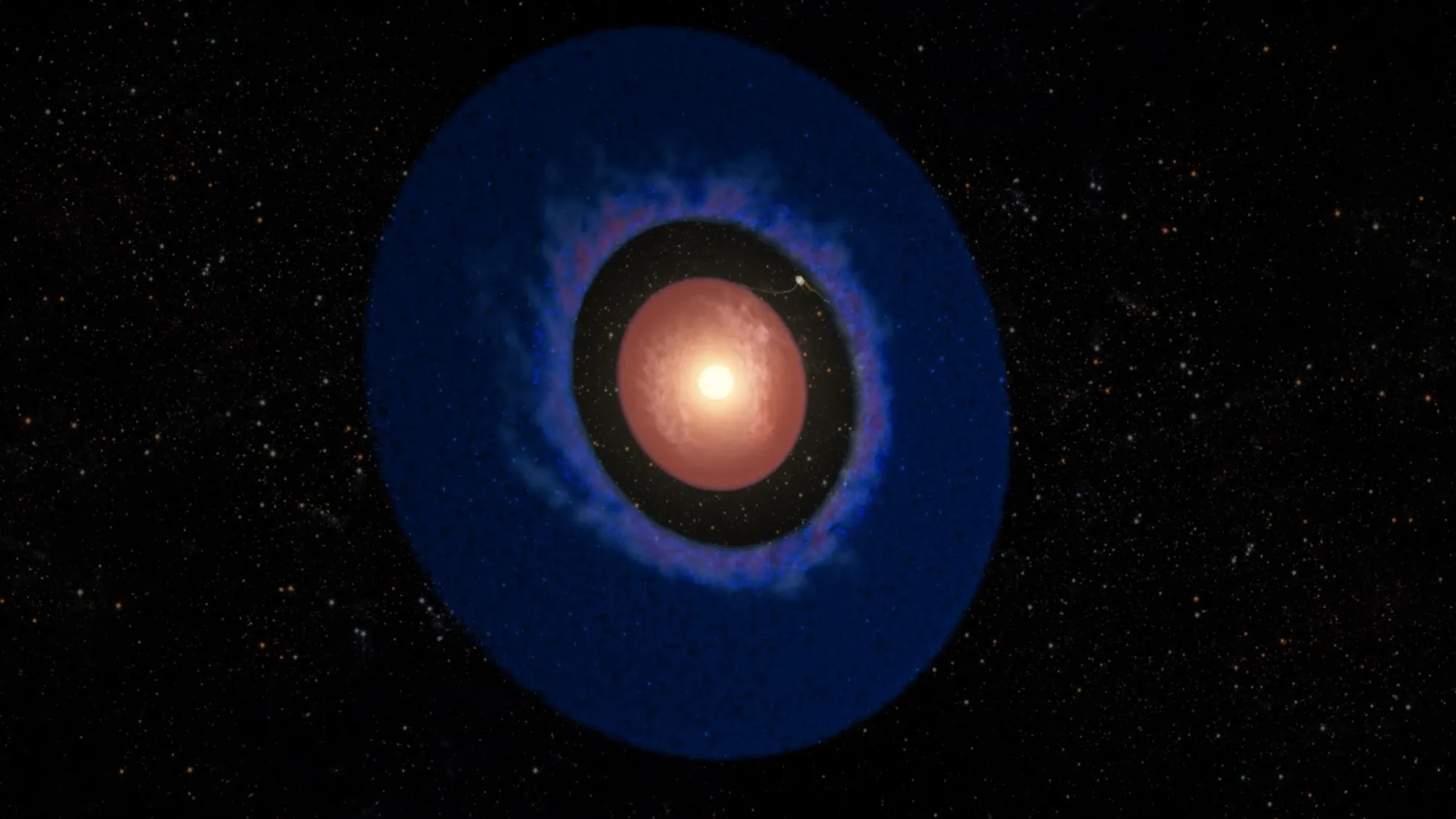
Somewhere in the constellation Ophiuchus, 450 light-years from Earth, a gas giant the size of Jupiter is still being born. Astronomers have now confirmed it as the youngest planet ever found outside our solar system, and its very existence is forcing scientists to rethink how quickly planets can actually form.
The world, designated Elias 2-24 b, is less than 1 million years old. In cosmic terms, that is barely a blink, and it shatters the previous record by a wide margin. The discovery, led by Andrea Bernardi, a doctoral candidate at the Universidad Diego Portales in Chile, was published Sept. 16, 2026, in The Astrophysical Journal Letters.
Found Hiding in Its Own Nursery
Elias 2-24 b still orbits within the swirling disk of gas and dust that formed it, a disk that surrounds its host star, a young K5-type star also called Elias 2-24. That star sits inside the Ophiuchus Molecular Cloud, one of the nearest regions of active star formation to Earth, and it has drawn scientific attention for years because its disk is unusually large and bright.
About a decade ago, observations from the Atacama Large Millimeter/submillimeter Array and the European Southern Observatory’s Very Large Telescope, both located in Chile, revealed something puzzling: a gap carved into that dusty disk. Something was clearly clearing out material along that ring, and a faint point of light turned up inside it. But nobody could confirm what that light actually was. Prevailing theory at the time held that a planet simply could not have formed that early, or that far from its star, so the case remained open for years.
Bernardi’s team went looking for an answer in an unlikely place: the archive. Working with co-author Lucas Cieza, a professor at the Instituto de Estudios Astrofísicos in Chile, the researchers combed through years-old coronagraph images of seven young stars held at the Keck Observatory Archive, a partnership between the W. M. Keck Observatory and NASA’s Exoplanet Science Institute at Caltech. Using the coronagraph built into the Keck Observatory’s NIRC2 instrument in Hawaii, which blocks out a star’s overwhelming glare so that faint nearby objects can be seen, they found that same point of light sitting inside the disk gap, this time in images captured in 2018 and 2020.
By comparing the object’s position across those two years, the team could see it moving the way an orbiting planet would, not drifting like a background star or lingering like an imaging glitch. That motion was the proof they needed.
“The planets should be found within the gaps, since they are carving them. And that’s exactly where we found Elias 2-24 b,” Bernardi said.
Why the Timing Breaks the Models
The scale of what Bernardi and Cieza found is what makes this discovery so disruptive. Elias 2-24 b sits roughly 55 times farther from its star than Earth sits from the sun, about ten times more distant than the star’s other known disk features. Current planet-formation models estimate that building a Jupiter-mass planet at Jupiter’s own distance from a star, roughly five times the Earth-sun distance, takes about 5 million years. Forming one even farther out should, in theory, take longer still.
Elias 2-24 b did it in under a fifth of that time, at a distance where formation should be slower, not faster. The previous youngest confirmed exoplanets, a four-way tie among worlds orbiting the stars PDS 70 and WISPIT 2, were each more than 5 million years old, and even those had already strained existing theory.
“Our planet-formation models already struggled to explain the previous record holders for the youngest known planet, a four-way tie between two planets orbiting the star PDS 70 and two planets orbiting the star WISPIT 2, which are all more than 5 million years old. Elias 2-24 b shows us that even our best planet-formation models are still missing some important processes,” Cieza said.
That gap between theory and observation is exactly why this single planet matters so much to the broader field. Of the roughly 6,000 exoplanets confirmed so far, the overwhelming majority are billions of years old, essentially fully grown worlds observed long after the fact. Astronomers rarely get to watch a planet actually forming, which makes direct evidence like this exceptionally rare and valuable.
“The galaxy churns out new stars and planets continuously, so there are many in every stage of evolution. That means we can see the entire process in theory, but there is a large gap in what most telescopes can detect. We are mostly blind to these baby planets right now,” Cieza said.
A Preview of What Comes Next
Part of what makes this confirmation notable is how it was done. Rather than relying on a single instrument or a single observing run, the team stitched together archival data across years and cross-referenced it with earlier ALMA and Very Large Telescope observations, essentially reconstructing a decade-old mystery using tools that were not originally built to solve it together.
“We usually hear about telescopes working separately, but this confirmation was possible only by using multiple telescopes together. Elias 2-24 b is at the limit of what current telescopes can detect, but with new instruments like NASA’s Nancy Grace Roman Space Telescope, such detections should become easier,” Bernardi said.
That telescope, which launched Aug. 30, 2026, carries a more advanced coronagraph than any NASA has flown before. Researchers expect it to make discoveries like this one easier to confirm and to eventually allow direct imaging of planets in tighter orbits, including true analogs of Jupiter that remain hidden today in the glare of their host stars. For more on the mission, NeuralWired’s Space and Astronomy coverage has tracked Roman’s rollout, and our recent piece on exoplanet detection methods breaks down how coronagraphs like the one used here actually work.
It is worth being precise about what “youngest” means in this case. Elias 2-24 b is the youngest planet astronomers have been able to confirm, not necessarily the youngest planet that exists anywhere in the galaxy. Bernardi’s own description, that this find sits “at the limit of what current telescopes can detect,” is a reminder that the record reflects the boundaries of current instruments as much as it reflects the universe itself.
Cieza framed the discovery as the start of something larger rather than a singular event. “This is just the beginning of a new era of discovery. It’s incredible that with modern technology, we are actually able to see planet formation in action, and Roman will take planet hunting to the next level,” he said.
For now, Elias 2-24 b remains a rare, direct snapshot of a gas giant still pulling itself together from the raw material of its birth disk, a process that likely shaped every planet in our own solar system billions of years ago. The team has not announced a specific follow-up observation, but with archival data from multiple observatories still to sift through and a new generation of coronagraphs coming online, this is unlikely to be the last planet found hiding in plain sight. NeuralWired’s science desk will continue following what Roman turns up next.