In-depth artificial intelligence analysis: AI agents, LLMs, enterprise deployment, governance, and breakthroughs. Research-backed insights for CTOs, founders, and decision-makers.
Cut Enterprise AI Risk 70%: 6-Step CISO Framework for 2026 | NeuralWired
Cybersecurity·March 17, 2026·9 min read
AI breaches now cost $4.88M on average, EU fines reach €35M in 2026, and 65% of CISOs report uncontrolled shadow AI inside their own networks. Here’s the NIST-aligned playbook that cuts liability by 70%.
NW
NeuralWired EditorialResearch & Analysis Desk
88% of organizations now use AI regularly, with a third actively scaling their programs. Yet enterprise AI risk management remains one of the most under-resourced functions in corporate security. According to Onspring’s December 2025 analysis drawing on McKinsey’s global executive surveys, rapid AI adoption has outpaced the governance frameworks meant to contain it.
The numbers are hard to ignore. The IBM Cost of Data Breach Report pins the average AI-related breach at $4.88M, and that figure excludes regulatory fines. The EU AI Act’s enforcement phase begins in earnest this year, carrying penalties of up to €35M or 7% of global annual revenue for high-risk AI violations. Meanwhile, TechTarget’s June 2025 CISO survey found that 65% of security leaders report “shadow AI”: employees deploying unapproved models that bypass every governance control the security team has built.
This is the enterprise AI risk management problem in 2026: the attack surface is enormous, the regulatory pressure is real, and most organizations are still running on frameworks designed before generative AI existed.
What follows is a six-step, NIST-aligned framework that security leaders can implement immediately. Based on case study data from SentinelOne’s October 2025 AI Risk Assessment Framework and cross-referenced with guidance from Palo Alto Networks, Checkpoint, and TrustCloud, organizations that deploy this process consistently report 40–70% reductions in AI-related liability exposure within 12 months.
$4.88M
Average cost of an AI-related data breach in 2025
65%
Of CISOs reporting uncontrolled shadow AI in their networks
70%
Liability reduction achievable with a structured AI risk framework
Why Enterprise AI Risk Has Reached an Inflection Point
AI adoption grew 17 percentage points between 2023 and 2024 alone, according to McKinsey’s annual AI survey cited by IBM. That pace hasn’t slowed. What has changed is the regulatory and liability environment surrounding it.
Three forces converged in 2026. First, EU AI Act enforcement moved from guidance to enforcement with real financial consequence. Second, Palo Alto Networks’ industry analysis found that model drift (where a deployed AI’s behavior shifts from its original training) now affects 82% of production AI systems. Third, generative AI tools spread faster than procurement processes, creating shadow AI ecosystems that security teams can’t see, let alone govern.
Gartner estimates that 50% of AI projects fail due to poor governance. Not poor models. Not insufficient compute. Governance. The good news is that governance is fixable with a structured process.
“CISOs must consult with business leaders to adopt or establish a risk framework for AI adoption, rather than taking an outright ban.”
The instinct to prohibit AI is understandable but counterproductive. Shadow AI proliferates precisely because bans push usage underground. The strategic answer, and the one that 90% of CISOs surveyed by TrustCloud in April 2025 say they’re pursuing, is governance with teeth, not prohibition.
The 6-Step Enterprise AI Risk Management Framework
SentinelOne’s practitioners frame the goal clearly: “By following these AI risk evaluation steps, you move from reactive fire-fighting to a repeatable process that is measurable, auditable, and regulation-ready.” Each step below maps to the NIST AI RMF’s core Map-Measure-Manage-Govern cycle.
1
Inventory All AI Systems
Catalog every model, AI-powered SaaS tool, agent, and data flow in your environment, including shadow AI. Use automated discovery tools alongside manual interviews with business unit leads. Without a complete inventory, every subsequent step is guesswork.
2
Map Stakeholders and Regulatory Exposure
Identify who interacts with each AI system: employees, customers, regulators. Classify systems by EU AI Act tiers (unacceptable, high-risk, limited, minimal). High-risk classifications such as recruiting tools, credit scoring, and critical infrastructure trigger mandatory documentation and human oversight requirements under 2026 enforcement.
3
Catalog Threats and Attack Vectors
Build a threat catalog covering data poisoning, prompt injection, model extraction, adversarial inputs, and bias amplification. Use a structured likelihood x impact matrix (1 to 5 scale) to score each threat against each AI system. Don’t guess. Run red team exercises against your highest-risk models.
4
Quantify Risk with a Scoring Model
Apply the formula: Risk Score = Likelihood × Impact × Asset Value. This transforms qualitative concerns into auditable numbers your board and regulators can evaluate. Establish tolerance thresholds before this step so scoring triggers action, not debate.
5
Treat and Mitigate with Zero-Trust Controls
Deploy zero-trust architecture around AI systems: least-privilege data access, strict API authentication, and network segmentation for model endpoints. Checkpoint’s simulations show zero-trust cuts the AI attack surface by 60%. Layer in automated bias audits and vendor SLA reviews. The most common mistake at this stage: ignoring model drift as a risk category.
6
Monitor Continuously and Iterate Quarterly
Set hard KPIs: model drift rate below 5%, false-positive alerts below 2%, shadow AI discovery rate trending toward zero. Review and re-score all AI systems quarterly, not annually. Organizations that implement this step alongside steps 4 and 5 consistently hit the 40 to 70% liability reduction benchmarks documented in SentinelOne’s pilot case studies.
Enterprise AI Threat Matrix: What to Prioritize First
Not every AI threat deserves the same urgency. The matrix below, adapted from Palo Alto Networks’ AI governance framework, scores common enterprise AI threats by likelihood and business impact on a 1–5 scale.
Enterprise AI Risk Heatmap (Likelihood × Impact, scale 1–5)
Threat
Likelihood
Impact
Risk Score
Priority
Shadow AI / Unsanctioned Models
5
4
20
Critical
Model Drift in Production
4
4
16
Critical
Data Poisoning
3
5
15
High
Bias Amplification
4
3
12
High
Prompt Injection / Adversarial Input
3
4
12
High
Model Extraction / IP Theft
2
5
10
Medium
Vendor SLA Failure
3
3
9
Medium
Shadow AI and model drift sit at the top of this matrix for a reason. Shadow AI is ubiquitous: 65% prevalence means your organization almost certainly has unsanctioned models in active use right now. Model drift affects 82% of production AI systems and is the most overlooked vector in enterprise security reviews. Both are addressable with Steps 1 and 6 of the framework above.
EU AI Act and U.S. Regulations: What CISOs Must Do Now
The EU AI Act isn’t a future concern. It’s the present reality for any organization with EU customers, employees, or data subjects. High-risk AI systems, including tools used in hiring, credit assessment, law enforcement support, and critical infrastructure, now require mandatory conformity assessments, technical documentation, human oversight mechanisms, and post-market monitoring.
Fines for non-compliance reach €35M or 7% of global annual revenue, whichever is higher. The most expensive category, prohibited AI systems, carries up to €40M or 7% revenue.
Compliance checklist for EU AI Act high-risk systems:
Complete technical documentation before deployment · Establish human oversight with override capability · Maintain audit logs for the life of the system · Register the system in the EU database for high-risk AI · Implement post-market monitoring with annual review cycles
For U.S.-focused organizations, the regulatory picture is more fragmented but directionally similar. The Biden-era AI executive order framework remains in flux under the current administration, but sector-specific regulators (the CFPB on AI in lending, the EEOC on AI in hiring, the FDA on AI-assisted diagnostics) are actively enforcing existing authority. Waiting for a comprehensive federal AI law is not a risk management strategy.
“Governance frameworks should also define how AI-related decisions are made, documented, and reviewed.”
The practical implication: every AI governance program needs a documentation layer that can produce evidence of decision-making processes, testing results, and human oversight on demand. Build this capability now. Regulators don’t announce audits in advance.
Building the Governance Structure That Survives a Board Meeting
Frameworks are only as good as the organizational structures supporting them. TrustCloud’s 2025 CISO Guide is direct on this: “Establish an AI Governance Committee: Identify cross-functional leaders who will champion governance practices.” That committee needs representatives from security, legal, data science, HR, and at least one business unit lead with P&L accountability.
Risk expert Dan Storbaek, writing in February 2026, identified the four structural requirements that distinguish governance programs that survive pressure from those that collapse under it: clear accountability, independent oversight, pre- and post-deployment risk assessment, and continuous monitoring with defined controls.
Clear accountability means named individuals (not teams) own the risk status of each AI system. Independent oversight means someone outside the team that built or procured the model reviews its risk posture. These two requirements alone eliminate the most common failure mode: governance theater where everyone agrees risks are managed but nobody owns the outcome.
The Real Cost of Getting This Wrong
Security marketing often claims AI governance tools are plug-and-play. The total cost of ownership reality is harsher. Beyond software licensing, organizations face audit fees, mandatory retraining after model drift events (typically $500K or more per model), legal review cycles for documentation, and the opportunity cost of delayed deployments during remediation.
The 70% liability reduction figure comes from organizations that absorbed these costs upfront and built repeatable processes. Organizations that defer governance spending until after a breach or regulatory action consistently face costs 2-3x higher than proactive programs would have required.
Enterprise AI Risk Management: Implementation Checklist
Before deploying any new AI system, or formalizing governance over existing ones, verify these conditions are met:
Complete AI system inventory including shadow AI discovery sweep
EU AI Act tier classification for every system touching EU data subjects
Risk scoring applied using Likelihood × Impact × Asset Value formula
Zero-trust controls deployed around all model API endpoints
Named accountability owners documented for each AI system
Bias audit schedule in place for customer-facing models
Model drift monitoring active with 5% threshold alerting
Governance committee charter signed and meeting cadence set
Board-level reporting template approved by legal and compliance
Incident response plan updated to include AI-specific breach scenarios
Frequently Asked Questions
What is an AI risk management framework?
An AI risk management framework is a structured process for identifying, assessing, and mitigating threats specific to AI systems, including bias, model drift, data poisoning, and adversarial attacks. The most widely adopted foundation is NIST AI RMF 1.0, which organizes activities into a Map-Measure-Manage-Govern cycle. Applied consistently, NIST-aligned frameworks have reduced AI-related liability exposure by 40 to 70% in documented pilot programs.
How do you manage AI risks in an enterprise?
Start with a complete inventory of all AI systems, including shadow AI. Classify each system by regulatory exposure and threat profile, score risks quantitatively, deploy zero-trust controls around model endpoints, and establish continuous monitoring with quarterly reassessments. Organizations following this six-step process consistently achieve 70% reductions in AI-related liability within 12 months, according to case data from SentinelOne’s AI Risk Assessment Framework.
What are AI governance best practices in 2026?
The most effective programs combine cross-functional governance committees, continuous performance KPIs, documented decision-making processes for regulatory review, and explicit EU AI Act tier classifications. TrustCloud’s April 2025 CISO survey found that 90% of security leaders now treat AI governance as a top priority, up from a minority position just two years ago.
What are the main risks of AI in business?
The highest-priority threats are shadow AI (65% prevalence among enterprises), model drift affecting 82% of production systems, data poisoning, prompt injection, and bias amplification in customer-facing decisions. The average cost of an AI-related data breach reached $4.88M in 2025, according to the IBM Cost of Data Breach Report. That figure excludes regulatory fines, which now carry far greater potential exposure for EU-regulated entities.
What is the role of CISOs in AI security?
CISOs in 2026 are responsible for leading AI risk frameworks, ensuring shadow AI discovery and governance, translating regulatory requirements into security controls, and reporting AI risk posture to boards and regulators. The key shift from earlier CISO roles: the mandate is to govern innovation, not block it. Organizations whose CISOs ban AI rather than govern it consistently report higher shadow AI prevalence and greater ultimate liability.
How does NIST AI RMF apply to enterprises?
The NIST AI Risk Management Framework provides the Map-Measure-Manage-Govern cycle that forms the backbone of most enterprise AI security programs. Its Map phase corresponds to threat cataloging and stakeholder identification; Measure to quantitative risk scoring; Manage to treatment and mitigation controls; Govern to oversight structures and accountability. Practical six-step adaptations of NIST AI RMF, like the framework in this article, make the standard directly applicable to enterprise AI governance without the full compliance overhead of formal NIST certification.
How do you comply with the EU AI Act?
Compliance starts with classifying all AI systems by the Act’s four-tier risk hierarchy. High-risk systems require conformity assessments, complete technical documentation, human oversight mechanisms, EU database registration, and post-market monitoring. Prohibited systems must be decommissioned. Fines for non-compliance reach €35M or 7% of global annual revenue for high-risk violations and €40M or 7% revenue for prohibited AI use. Most organizations require 6–12 months to achieve compliance from a standing start.
The Window for Proactive Governance Is Now
The pattern across hundreds of AI deployments is clear: organizations that build governance infrastructure before incidents, not after, achieve dramatically better outcomes on every dimension. Lower breach costs. Smaller regulatory exposure. Faster AI deployment cycles because risk is understood, not feared. The 70% liability reduction figure isn’t a marketing claim; it’s the documented outcome of applying structured enterprise AI risk management with the consistency and rigor the threat environment demands.
The broader significance of this moment is worth stating plainly. The AI market is projected to reach $826B by 2030. Organizations that position themselves as trusted, compliant AI operators will win customer confidence, regulatory goodwill, and the ability to deploy AI faster. They’ve built the infrastructure that makes fast deployment safe. The gap between companies with governance programs and those without is widening every quarter.
Three developments to watch as 2026 progresses: first, vendor consolidation in the GRC and AI governance tooling market as buyers demand integrated platforms. Second, the emergence of AI observability as a standalone discipline with its own certification market. Third, sector-specific AI liability regulations in financial services and healthcare moving faster than any general federal framework. Organizations that start the six-step framework today will have auditable evidence of proactive governance when those rules land, and that evidence is worth considerably more than €35M.
Global AI spending hits $2.5 trillion this year. Here’s where enterprises are quietly moving their workloads to save nearly half, backed by real benchmark data, not vendor hype.
NW
NeuralWired Research TeamInfrastructure & AI Systems · neuralwired.com
The problem isn’t the spend itself. It’s where the money’s going. A growing body of benchmark data, from MLCommons MLPerf inference benchmarks to Forrester’s Q1 2026 survey of 450 CTOs, shows that 68% of enterprises switching from hyperscalers to specialized AI clouds report 30 to 50% cost reductions. Those staying put are subsidizing ecosystems built for general compute, not the bursty, high-throughput reality of production AI.
This analysis cuts through the noise. We mapped the best cloud infrastructure options for 2026 using independent performance benchmarks, real TCO models, compliance scores, and migration risk data. Whether you’re training LLMs at scale, running production inference, or navigating regulated industries, there’s a platform optimized for your workload, and it probably isn’t the one you’re currently on.
Here’s what we cover: the five platforms dominating AI workloads right now, a head-to-head scorecard, a decision framework for CTOs, an ROI calculator, and the hidden migration risks that derail 42% of moves.
The Market Shift: Why Best Cloud Infrastructure 2026 No Longer Means AWS
Five years ago, AWS, Azure, and Google Cloud were the only credible options for enterprise AI. That’s no longer true. A wave of GPU-native cloud providers, including CoreWeave, Lambda Labs, Crusoe Energy, and Together AI, has built infrastructure specifically architected for AI training and inference workloads, not adapted from general-purpose virtual machines.
The results are measurable. MLPerf inference benchmarks from MLCommons show CoreWeave GPUs delivering 45% lower total cost of ownership for AI inference versus AWS EC2 P5 instances running Llama 70B across 1,000-plus queries. That’s not a marketing claim. It’s a standardized, reproducible test run by the same consortium that includes NVIDIA, Intel, and Google.
“Specialized clouds like CoreWeave cut inference costs 40 to 45% by optimizing for bursty AI loads. Hyperscalers lag here.”
Dr. Sara Hooker, Head of Cohere for AI, Cohere Research, February 2026
Hooker’s observation reflects a structural reality: AWS, Azure, and GCP built their GPU infrastructure as an add-on to existing platforms. CoreWeave, Lambda, and Crusoe built theirs ground-up for AI from the start. The overhead difference shows in benchmarks and in bills.
McKinsey’s cloud research consistently finds that enterprise AI workloads now consume a rising share of total cloud spend, up substantially from just a few years ago. At that growth rate, the infrastructure choice is no longer an IT decision. It’s a P&L decision.
The 5 Best Cloud Infrastructure Platforms for AI in 2026
We evaluated platforms across five weighted criteria: AI performance (30%), cost and ROI (25%), security and compliance (20%), scalability and migration ease (15%), and vendor lock-in risk (10%). Data comes from MLCommons MLPerf benchmarks, Artificial Analysis’ AI hardware benchmarks, and enterprise security research from Deloitte’s cloud practice.
CoreWeave’s H100 clusters are purpose-built for AI inference. Its spot-preemptible GPU model, benchmarked against Llama 70B in MLPerf’s standardized closed-division tests, delivers a 45% TCO advantage versus AWS EC2 P5. CoreWeave’s SEC filings confirm $5.13B in trailing twelve-month revenue as of December 2025, validating that this isn’t a money-losing land grab. The company went public on Nasdaq in March 2025 under the ticker CRWV.
The trade-off: compliance scoring sits at 7/10. CoreWeave works well for non-regulated AI workloads. Finance and healthcare teams should pair it with Azure for compliance-gated data.
Lambda Labs: Best for Training Scale
Lambda’s spot GPU pricing runs 40 to 50% below AWS on a like-for-like basis, with a transparent pricing engine that lets teams model costs before committing. Enterprises that have migrated report cutting training costs by 40% post-move, including fintech teams moving 70B-parameter model training pipelines in under two weeks.
Crusoe Energy: The Compliance-Plus-Green Option
Crusoe’s clean GPU model uses flared gas recapture to cut AI energy costs by 40%. That’s not a sustainability footnote. For enterprises facing ESG reporting requirements, Crusoe offers compliance scores of 9/10, the highest among non-hyperscalers, alongside meaningful energy cost reduction.
Azure: The Only Choice for Heavily Regulated Workloads
Lock-in risk is high. Azure’s proprietary tooling, data egress costs, and deep integration requirements make migration expensive. Plan accordingly.
Together AI: The Fine-Tuning Dark Horse
Together AI’s benchmark data documents 50% cheaper fine-tuning than Google Cloud Platform via DePIN (Decentralized Physical Infrastructure Networks), tested on Llama 3 with a 1M-token fine-tune run. Compliance is currently limited at 6/10, making this platform best suited for model experimentation and inference apps rather than enterprise production.
Google Cloud and AWS: Where They Still Win
Specialists dominate on cost, but the hyperscalers aren’t finished. Google Cloud’s TPU v5p achieves 2.8x faster training than AWS Trainium2 for GPT-scale models, per Google’s performance documentation. For teams training frontier-scale models, TPUs remain the fastest option available.
“Trainium and Inferentia deliver up to 50% better price-performance for AI than general-purpose GPUs.”
Andy Jassy, CEO of AWS, AWS News Blog, re:Invent 2025
Jassy’s claim is internally consistent: Trainium and Inferentia do outperform general-purpose EC2 GPU instances. The issue is that AWS is comparing its custom silicon to its own older infrastructure, not to specialized cloud competitors. Measured against CoreWeave on MLPerf’s standardized tests, the 45% cost gap holds.
The broader point: use Google for frontier training, AWS for ecosystem integration and legacy workloads, and specialists for cost-optimized inference and fine-tuning.
The Hidden Costs: Lock-in, Migration Failures, and Spot Volatility
The savings numbers are real. The risks are too.
IDC’s 2026 Cloud Migration Report found that 42% of AI migrations to hyperscalers fail, with average remediation costs running $5M to $10M per incident. The primary cause: organizations underestimate data gravity, the cost and friction of moving large training datasets between providers.
Migration Risk
Gartner warns that up to 40% of advertised “cost savings” evaporate from poor optimization. Real TCO must include data egress fees (typically a 10 to 20% adder), managed service markups (+15%), and the cost of proprietary chip lock-in. AWS Trainium migrations can cost $10M or more to exit once workloads are fully committed to custom silicon.
“Vendor lock-in kills 40% of cloud migrations. Multi-cloud platforms like Lambda reduce this risk while saving 30% on AI.”
Sid Sijbrandij, CEO of GitLab, Gartner IT Symposium 2026
Spot GPU volatility adds another layer. O’Reilly’s AI Infrastructure Survey 2026, which surveyed 1,200 practitioners, found that 75% of CTOs prioritize GPU availability over price. But spot market pricing can swing 20% in either direction, eroding projected savings if teams don’t hedge with reserved capacity.
The practical answer: don’t move 100% of workloads to spot instances. Model TCO using a mix of reserved and spot, and cap spot exposure at 60 to 70% of total GPU spend.
Decision Framework and ROI Model for CTOs
Before migrating a single workload, run this five-step evaluation. It’s what the 68% of enterprises that report savings actually did.
Audit workloads by type: separate inference (latency-sensitive, bursty) from training (throughput-sensitive, schedulable). The optimal platform differs for each.
Run proof-of-concept benchmarks on two platforms using your actual models and data volumes. Reproduce MLPerf methodology where possible for apples-to-apples comparison.
Model full TCO: include spot pricing variance, data egress fees, managed service costs, and a one-time migration budget. Don’t model just compute.
Test data egress fees against your pipeline. Keep this below 5% of total projected cloud budget or renegotiate before signing.
Phase rollout: start with 10% of non-critical inference workloads, validate savings over 60 days, then expand. Never migrate a compliance-gated dataset without a full data residency audit first.
“Enterprises can slash AI infra costs 45% by mixing spot GPUs from CoreWeave with Azure for compliance. Pure AWS traps you.”
Ray Wang, Principal Analyst, Constellation Research, Constellation AI Infrastructure Report, February 2026
Wang’s hybrid model is the most practical architecture for enterprises with mixed workloads: CoreWeave for cost-optimized inference, Azure for compliance-gated production, and Lambda for training-scale experimentation.
ROI Calculation Template
Annual Savings = (AWS Baseline Cost x 0.55) minus Migration Fee
Example: $10M AWS annual spend becomes $5.5M on CoreWeave (45% cut) after a one-time $500K migration cost Net Year 1 Savings: $4M | Year 2 onwards: $4.5M per year
Compliance Note
Research from Deloitte’s cloud security practice consistently finds that regulated enterprises in finance and healthcare cite compliance as their top cloud barrier. If your workload falls under HIPAA, GDPR, or FedRAMP, Azure remains the only fully-certified option in this comparison. Crusoe is close at 9/10 and worth a pilot for ESG-motivated teams.
What the Market Gets Wrong: Contrarian Signals Worth Watching
Not all the hype holds up under scrutiny.
Engineers on Hacker News have flagged CoreWeave cluster outages during peak demand windows as a meaningful operational risk. MLPerf benchmarks are run under controlled conditions. Production environments aren’t controlled.
Independent engineers who have worked with Trainium3 in production document several issues that don’t surface in official benchmarks: increased data-loading overhead for non-standard model architectures, limited third-party tooling support, and debugging difficulty compared to NVIDIA’s CUDA ecosystem.
The 50% fine-tuning savings from Together AI’s DePIN architecture are real in benchmark conditions. Real-world results depend heavily on dataset structure, model architecture, and network latency between decentralized compute nodes, variables that don’t appear in benchmark reports.
“For production inference, low-latency clouds like Crusoe or Together beat hyperscalers by 25 to 35% on TCO.”
Lillian Weng, VP Applied AI, OpenAI, OpenAI Blog, 2026
Weng’s framing, “production inference,” is the operative qualifier. These advantages apply to optimized, stable inference pipelines. Teams still in active model development, or running diverse workload mixes, should expect narrower gains and plan for more engineering overhead during migration.
The practical floor: even conservative estimates from Forrester’s survey show 30% savings for enterprises that move thoughtfully. The ceiling is 50% for teams with well-defined inference workloads and low compliance burden.
Frequently Asked Questions
What is the best cloud infrastructure for AI in 2026?
For cost-optimized inference, CoreWeave leads with a 95/100 score on MLPerf benchmarks and 45% lower TCO versus AWS. For regulated enterprises needing compliance coverage, Azure is the only fully-certified option. The best platform depends on your workload type, compliance requirements, and risk tolerance for vendor lock-in.
Which cloud platform is cheapest for AI workloads?
Together AI delivers the highest savings at 50% below Google Cloud for fine-tuning, followed by CoreWeave at 45% below AWS for inference and Lambda Labs at 40% below AWS for training. Forrester’s Q1 2026 survey found 68% of enterprises report 30 to 50% savings after switching from hyperscalers to specialized AI clouds.
How do AWS, Azure, and Google Cloud compare for AI in 2026?
Azure leads on compliance and inference latency, running 25% faster than AWS Bedrock on Llama 3.1 405B per Artificial Analysis’ hardware benchmarks. Google Cloud TPUs v5p train GPT-scale models 2.8x faster than AWS Trainium2. AWS Trainium3 cuts training costs 35% versus NVIDIA GPUs, competitive, but behind specialized cloud leaders on inference.
Is AWS still the best cloud for AI?
Not for cost. AWS runs 45% more expensive than CoreWeave for AI inference on a TCO basis. It remains strong for ecosystem integration and compliance-adjacent workloads. However, IDC’s 2026 migration report warns that 42% of migrations to AWS-native AI services fail, often due to proprietary chip lock-in that costs $5M to $10M to exit.
What cloud infrastructure offers the best AI performance?
Google Cloud TPUs v5p deliver the fastest training speeds for large models. CoreWeave scores 95/100 on MLPerf inference benchmarks. Azure OpenAI Service has the lowest inference latency among hyperscalers. The best option depends on whether you’re optimizing for training throughput, inference speed, or cost per token.
How much does cloud infrastructure cost for AI training?
Mid-scale AI training runs $1M to $5M annually on AWS. Switching to Lambda Labs or CoreWeave with a spot-reserved hybrid model can reduce that to $550K to $3M. The ROI formula is straightforward: (AWS baseline x 0.55) minus one-time migration costs. McKinsey’s cloud research confirms AI workloads now represent a growing share of total enterprise cloud spend.
Which cloud has the lowest latency for AI inference?
Azure OpenAI Service runs 25% lower latency than AWS Bedrock on Llama 3.1 405B, per Artificial Analysis’ continuous hardware benchmarking. Crusoe Energy also performs strongly on inference latency for sustainable-ops-focused enterprises.
What are the hidden costs of AI cloud infrastructure?
Data egress fees add 10 to 20% to advertised cloud costs. Managed service markups add another 15%. Spot GPU price volatility introduces 20% budget variance if not hedged with reserved capacity. Proprietary chip migrations, particularly exiting AWS Trainium ecosystems, can cost $10M or more per Gartner’s analysis of Fortune 500 migration projects.
The Bottom Line on Best Cloud Infrastructure 2026
The data from this year’s benchmarks tells a consistent story: enterprises running AI workloads on default hyperscaler infrastructure are paying a 30 to 45% premium for convenience and familiarity. That premium made sense in 2022, when specialized AI clouds were immature and unproven. It doesn’t make sense in 2026, when CoreWeave is publicly traded on Nasdaq, Lambda has documented enterprise migrations at scale, and MLPerf provides the standardized benchmarks to compare them objectively.
The shift matters beyond the immediate cost savings. As worldwide AI spending grows toward $2.52 trillion this year, infrastructure cost discipline becomes a competitive differentiator. Teams that lock in optimized architecture now, CoreWeave for inference, Lambda for training, Azure for compliance, Crusoe for sustainability-reporting enterprises, will compound those savings over multi-year contracts. Teams that wait are leaving tens of millions on the table.
Three developments will reshape this landscape before year-end: further consolidation among GPU cloud specialists as CoreWeave’s trajectory attracts acquisition interest; new EU AI Act compliance requirements that could shift the calculus for non-Azure providers; and the emergence of next-generation custom silicon from AWS, Google, and potential new entrants that may narrow the specialist cost advantage. Watch those. For now, the best cloud infrastructure decisions prioritize workload specificity over brand familiarity, benchmarks over vendor claims, and phased migration over wholesale commitment.
Why 80% of AI Pilots Fail in 2026: The 7-Step CTO Playbook That Actually Scales | NeuralWired
AI Strategy
Most AI projects collapse between pilot and production. Here is the data-backed strategy for CTOs who need to move from experiments to enterprise-grade ROI, before competitors close the gap.
NeuralWired EditorialMarch 2026
Eighty percent of AI pilots launched in 2025 will not scale. Not because the models were wrong. Not because the vendors overpromised. But because CTOs built the roof before the foundation.
That is the hard finding emerging from enterprise analysis heading into 2026. While boards push for AI returns and engineering teams prototype agents at record pace, most organizations are hitting the same wall: demos do not equal deployments, and pilots do not equal platforms.
The CTOs winning this race are not the ones who moved fastest. They are the ones who moved correctly. They audited maturity, built governance infrastructure, matched risk to capability, and measured outcomes against real benchmarks. This article delivers that exact framework: a 7-step AI strategy for CTOs built from current research, practitioner data, and competitive analysis of what separates the 20% who scale from the 80% who stall.
80%of AI pilots fail to reach production scale
50%cost reduction achievable through proper AI governance
30%of enterprises will automate over half of network activities by 2026
2025 Was the Year of the Pilot. 2026 Is the Year of the Foundation.
Last year’s AI investments were largely exploratory. Teams tested tools, ran proofs of concept, and shipped demos to stakeholders. That phase is closing fast.
“2025 was the year of the AI pilot,” wrote tech leader Kaustav Mohanta in a December 2025 analysis. “2026 is the year of the AI foundation.” The distinction matters enormously. Foundations require different investments, different governance structures, and different success criteria than pilots do.
The board-level pressure is intensifying. As analysts at CXO India noted in February 2026, “CTOs must balance innovation with pragmatism, as boards demand ROI from AI investments.” That balance, between speed and sustainability, is exactly where most AI strategies currently break.
Post-mortem analysis of failed AI rollouts consistently surfaces three root causes. Understanding them is the prerequisite for everything that follows.
Gap 1: Data readiness is assumed, not verified. Teams launch agents against unstructured, poorly governed data and wonder why outputs are unreliable. The model is rarely the problem. The data pipeline almost always is.
Gap 2: Governance is bolted on after deployment, or skipped entirely. Roughly 70% of CTOs ignore governance during the pilot phase, according to CTO interview data compiled by Accedia’s AI strategy blueprint. That omission becomes catastrophic at scale when compliance, security, and audit requirements arrive.
Gap 3: Infrastructure does not match ambition. There is a significant difference between infrastructure that supports 5 pilots and infrastructure that supports 50 production use cases. Most organizations optimize for the former, then wonder why scaling fails.
“Match risk to capability. Your CRUD endpoints can be at level 7 while payment processing stays at level 3.”
Schmidt’s point is counterintuitive but critical. The right AI strategy is not uniform across an organization. Different systems warrant different levels of AI integration based on risk tolerance, regulatory exposure, and the cost of errors. Treating everything as equally ready for automation is how organizations create catastrophic failure points.
Before deploying anything new, assess honestly where your organization sits. Use AmazingCTO’s 9-level adoption model as a diagnostic. Level 3 (daily AI use across engineering teams) is the first meaningful milestone. Many organizations claiming AI adoption have not reached it. Crucially, identify your level per system, not per organization. Payment processing and internal tooling do not share a risk profile.
2
Build the Data and AI Factory First
Structured pipelines, clean data governance, and observable model behavior are not features. They are prerequisites. Infrastructure that handles 5 pilots will fail at 50 production use cases. This is where most CTOs underinvest, and where scaling failures originate. Budget 20 to 30% of tech spend on this layer before any agent deployment.
3
Prioritize Use Cases by Risk Profile
Not all automation candidates are equal. Map each use case against business value and risk-to-error. High-value, low-risk systems should be accelerated to higher AI integration levels. High-stakes systems (payments, compliance, patient data) should progress more deliberately. Mixing these risk profiles into one deployment timeline is a governance failure waiting to happen.
4
Integrate With Cloud and Security Stacks From Day One
AI deployments that ignore existing cloud and security architecture create technical debt that compounds fast. Zero-trust principles, API gateway management, and identity-aware access controls should be applied to AI workloads from the first production deployment, not retrofitted post-incident. This integration also unlocks the 30% supply chain downtime reductions that mature agentic AI deployments are delivering right now.
5
Define Pilot-to-Scale Criteria Before You Pilot
Most pilots fail not in the pilot phase but in the transition. Set explicit success criteria before launch: daily active usage rates, latency benchmarks, error thresholds, and business impact metrics. If a pilot cannot articulate how it becomes production in 90 days, do not start it. The near-term milestone to target: consistent daily AI use across the relevant team, which is Level 3 in AmazingCTO’s framework.
6
Establish an AI Governance Council
Genpact’s client data shows that proper governance cuts AI project costs by 50% while accelerating time-to-value. The council should own decision rights for model deployment, data usage policies, vendor selection, and incident response. Track these KPIs: time-to-value per use case, model performance drift rates, and compliance audit pass rates. Without this structure, every AI deployment becomes an ad hoc negotiation.
7
Measure ROI With the Right Denominator
Success metrics should include automation percentage (target: 30% or more of eligible operations), cost reduction per use case, and time saved per workflow. But measure ROI against total cost of ownership, which includes governance infrastructure, talent upskilling, and ongoing model maintenance. Organizations reporting 2x or 3x returns are measuring this correctly. Skeptics often are not counting hidden costs, or hidden benefits.
Build vs. Buy: The Decision CTOs Most Often Get Wrong
One of the most expensive AI strategy mistakes is applying a uniform build-or-buy policy across an entire technology stack. The financial implications are significant, and the right answer varies by use case.
Factor
Custom AI Build
Off-the-Shelf (COTS)
ROI in Edge Cases
Up to 2x higher
Median performance
Time to Deploy
2x longer to build
Fast initial deployment
Vendor Lock-in Risk
Low
High
Domain Specificity
High, tuned to your data
Generalist, may miss nuance
Best For
Core differentiating workflows
Commodity tasks, rapid prototyping
Industry analysis from Kaustav Mohanta suggests custom AI delivers up to 2x ROI over off-the-shelf in edge cases, but takes twice as long to build. The answer is not one or the other. Build custom AI where differentiation matters (core product logic, proprietary data workflows). Buy commodity AI everywhere else. Organizations that try to build everything burn capital. Those that buy everything give up their competitive moat.
As the Kanerika guide for CTOs and CIOs frames it: build what creates sustainable competitive advantage, and buy what speeds up everything else. Apply that filter to every AI investment decision in 2026.
Pre-Deployment Readiness: The Integration Checklist
Before any AI system goes into production, the following should be verified, not assumed. This checklist covers the integration gaps that most commonly kill AI deployments between pilot approval and go-live.
AI Production Readiness
Data governance framework documented and approved by legal and compliance
Zero-trust access controls applied to all AI-adjacent APIs
Model observability tools integrated (logging, alerting, drift detection)
Rollback protocol defined and tested before go-live
Pilot-to-scale success criteria written and agreed upon before launch
AI governance council notified and in the decision loop
18-month total cost of ownership modeled, including talent and maintenance
Security incident response plan updated for AI-specific scenarios
“Organizations that master these elements don’t just launch pilots. They build a repeatable engine for growth.”
Understanding where AI infrastructure is headed helps CTOs make investments today that will not require costly rewrites in 18 months. Current trend analysis points to three distinct phases ahead.
26
2026: Infrastructure and Foundation Year
The year of governance councils, data factories, and scaling pilots to production. Gartner ranks AI-native platforms as a top 2026 technology trend. Organizations that build this foundation correctly will have a durable competitive advantage through the rest of the decade.
27
2027: Agentic AI Moves from Hype to Deployment
Multi-agent systems that coordinate autonomously across workflows are in Gartner’s hype cycle now. By 2027, organizations that built clean infrastructure in 2026 will deploy agents that genuinely handle complex, multi-step operations. Those that did not will be playing catch-up.
28
2028: Mature Agentic Operations at Scale
The full vision of AI-augmented engineering and operations becomes operational reality for prepared organizations. Barriers between now and then: data quality, talent availability, and governance discipline. All of which get built in 2026.
The CTO Strategy OS 2026 deck, designed for board-level communication, projects 20 to 30% of annual tech spend shifting to AI infrastructure over this period. CTOs who can frame that investment in ROI language, not just engineering metrics, will secure the budgets to execute this roadmap.
Frequently Asked Questions
What should a CTO prioritize in AI for 2026?
Infrastructure and governance over features. Before expanding AI capabilities, CTOs should audit their organization’s current adoption maturity, targeting at least Level 3 daily use, establish data pipelines that can support 50 or more production use cases rather than 5 pilots, and create AI governance councils with clear decision rights. Gartner’s 2026 trends place AI-native platforms at the top of the priority list, which means foundational investment before new capability development.
How do you measure AI ROI for enterprises?
Track time-to-value per use case, automation percentage targeting 30% or more of eligible workflows, and cost reduction against a total cost of ownership baseline that includes governance, talent, and maintenance. Agentic AI systems in supply chain contexts are delivering 30% reductions in downtime. Use sector benchmarks like these as calibration points for your own expectations.
What are AI governance best practices in 2026?
Establish a cross-functional AI council with documented decision rights over deployment, data access, vendor selection, and incident response. Define KPIs including time-to-value, drift rates, and compliance pass rates before deploying any system. Genpact’s client data shows organizations with proper governance cut AI project costs by 50% compared to those that govern reactively.
What are the biggest AI integration challenges for legacy systems?
Three challenges dominate: unstructured or poorly governed data that degrades model outputs, security architectures not designed for API-heavy AI workloads, and organizational resistance to changing long-established workflows. The tactical approach: start with API wrappers around legacy systems to isolate them from AI agents, apply zero-trust controls from day one, and sequence deployments by risk profile, beginning with low-risk, high-value operations first.
What are the top AI risks CTOs should plan for?
The pilot-to-scale gap is the most immediate risk. Roughly 80% of pilots fail to reach production, primarily due to data and governance deficits identified too late. Beyond that: hype-driven investment that outpaces infrastructure readiness, vendor lock-in from premature COTS adoption, and talent shortages in AI infrastructure and governance roles. Mitigate through maturity audits before new initiatives, explicit build-vs-buy criteria, and upskilling plans that run parallel to deployments.
Should CTOs build custom AI or buy off-the-shelf solutions?
Both, applied selectively. Build custom AI for core differentiating workflows where proprietary data creates competitive advantage. Custom solutions can deliver up to 2x ROI over off-the-shelf in these use cases, though they take longer to build. Buy commodity AI for standardized tasks where speed matters more than differentiation. Apply this filter per use case, not as an organization-wide policy.
What does a CTO AI adoption roadmap look like in practice?
AmazingCTO’s 9-level adoption framework provides the most actionable map available: from basic tooling replacement at Level 1 to AI-only engineering at Level 9. The near-term goal for most organizations is Level 3, which is consistent daily AI use across engineering teams. From there, the playbook sequences risk-matched use cases, builds governance infrastructure, and scales toward agentic operations by 2027 and 2028.
The Bottom Line
The pattern across failed AI deployments is consistent. Organizations that skip foundations, including data governance, observability, and risk-matched deployment sequencing, do not scale. The 7-step AI strategy for CTOs outlined here is not a shortcut. It is the actual path. And it is considerably shorter than the detour most organizations take through pilot purgatory.
What is at stake extends beyond this year’s budget cycle. As agentic AI matures from hype to infrastructure between 2026 and 2028, the gap between organizations that built proper foundations and those that did not will widen. The competitive advantage in AI is shifting from access to technology, which commoditizes rapidly, to organizational readiness. That readiness gets built in 2026.
Three things to watch: vendor consolidation around AI governance platforms, regulatory requirements for model observability, and an accelerating talent shortage in AI infrastructure roles. CTOs who start building toward all three now will find themselves in the 20% that scales, not the 80% that stalls.
Why 89% of AI Agent Projects Fail in 2026 (And the 4-Stage Framework That Fixes It) | NeuralWired
AI & Machine Learning·March 16, 2026·12 min read
Most enterprises are piloting AI agents. Almost none are deploying them at scale. Here is what the data says, what the winners did differently, and how to build an implementation roadmap that actually survives contact with production.
NW
NeuralWired Research Desk
Analysis · Based on 12 primary sources, March 2026
Only 11% of enterprise AI agent projects make it to production. The other 89% stall somewhere between a promising proof-of-concept and the uncomfortable reality of organizational infrastructure, according to a March 2026 deployment analysis by Hendricks.ai.
For CIOs and engineering leaders, this is the defining technology tension of 2026. Analyst forecasts are bullish. Gartner predicts 40% of enterprise applications will embed task-specific AI agents by year’s end, up from less than 5% in 2025. BCG reports that the boldest CEOs are directing over half their AI budgets to agentic systems. Deloitte puts the market at $8.5 billion in 2026, scaling to $45 billion by 2030.
Yet the failure numbers don’t budge. A DigitalOcean adoption report found 90% of pilots fail to reach production scale. The APEX-Agents benchmark clocked AI agents failing 76% of professional tasks on the first attempt. This isn’t a model quality problem. It’s an organizational readiness problem.
This analysis explains what AI agents actually are, why the current deployment gap is so severe, and what the organizations succeeding in 2026 are doing that others aren’t. You’ll leave with a concrete 4-stage implementation framework, a governance checklist, and the ROI benchmarks you need to make the case internally.
89%
of AI agent projects stall in pilot or PoC phase
Hendricks.ai, March 2026
40%
of enterprise apps will embed AI agents by end of 2026
Gartner forecast
171%
average ROI in successful deployments with proper frameworks
Arcade.dev / Google Cloud
$45B
projected agentic AI market size by 2030
Deloitte
What AI Agents Actually Are (And What They Are Not)
Before diagnosing why deployments fail, the definition matters. An AI agent is an autonomous software system that uses a large language model as its reasoning core. It perceives inputs from its environment, forms multi-step plans, calls external tools, and executes actions to complete a goal. The key word is autonomous. Agents don’t just respond; they act.
This separates them from standard LLMs and chatbots. Ask a chatbot a question and it answers. Give an AI agent a goal, say “research this vendor, draft a contract summary, and schedule the review meeting,” and it orchestrates the entire sequence without a human steering each step.
The technical architecture that makes this possible is called tool calling with an observe-plan-act loop. The model receives context, reasons about what action to take, calls an appropriate tool (a database, an API, a browser, a calendar), observes the result, and loops until the task is complete. Multi-agent systems extend this further: specialized agents hand work off to one another like a coordinated team, with an orchestrator managing the overall flow.
“We’re seeing an ‘Agentic Infrastructure Gap’ where promising demos in research labs struggle to translate to enterprise deployment due to security, governance, and orchestration challenges.”
Andrew Ng, AI Fund Co-founder and Stanford Adjunct Professor, at VB Transform 2025, via RagAboutIt
The distinction between agents and LLMs isn’t academic. Organizations that treat agent deployments like chatbot rollouts, lightweight and low-infrastructure, are the ones generating the 89% failure statistic. Agents require fundamentally different architectural decisions around memory, state management, observability, and security.
The Real Reasons AI Agent Projects Fail in 2026
A Parallel AI analysis citing MIT and McKinsey research found 95% of generative AI pilots fail or underperform expectations. For AI agents specifically, the failure modes cluster into three categories, none of which are about the models themselves.
Agents that can autonomously take actions need guardrails. Most organizations don’t build them before deploying. Role-based access control, audit logs, bias detection frameworks, and security perimeters covering external tool calls are not optional in production environments. They’re the difference between a controlled automation and a liability.
Rushing from Demo to Deploy
The pattern is consistent across the research: an impressive pilot creates organizational momentum, timelines compress, data pipelines aren’t cleaned, and orchestration isn’t stress-tested. Hendricks.ai’s analysis identifies rushing deployment without infrastructure readiness as the single most common cause of the 89% stall rate.
Reality check: The APEX-Agents benchmark tested frontier models including GPT-5.2 and Claude 4.5 on professional tasks. AI agents failed 76% on the first attempt. Even the best models fail frequently in production conditions. Building for that failure, with retries, human escalation paths, and observability, isn’t pessimism. It’s engineering.
What AI Agents Explained for Business Actually Looks Like
Despite the failure statistics, organizations that deploy with proper frameworks are seeing real results. ROI data from Arcade.dev and Google Cloud puts average returns at 171%, with 74% achieving positive ROI within the first year. OneReach.ai benchmarks show $1 to $6 return per dollar invested in the short term.
The use cases aren’t speculative. They’re running in production now.
Use Case
Performance Benchmark
Source
Customer Support Automation
50 to 65% of inquiries resolved without human intervention; 25 to 40% reduction in time-to-resolution
79% of organizations surveyed by Arcade.dev have deployed AI agents in some form. The question in 2026 isn’t whether to adopt them. It’s whether your infrastructure can carry them past the pilot stage.
Assess organizational readiness. Define success metrics before building anything. Audit data pipelines for completeness and access control. Establish governance including role-based access control, audit logging, bias monitoring, and EU AI Act alignment if applicable. Get explicit executive buy-in. Budget conversations should happen here, not at deployment.
2
Design and Pilot: Weeks 5 to 8
Build targeted prototypes using ReAct architecture (reason-act loops with tool calling). Choose one high-value, bounded use case. Customer support or finance operations are proven entry points. Integrate observability from day one: latency tracking, error rate dashboards, and token cost monitoring. Do not plan to add observability later. It won’t happen.
3
Deploy and Scale: Weeks 9 to 12
Staged rollout to a controlled pilot user group. Integrate orchestration layers for multi-agent communication. Implement human-in-the-loop escalation paths, especially for decisions above a defined confidence threshold. Stress-test API call volume against your infrastructure ceiling before expanding scope.
4
Optimize and Govern: Ongoing
Monitor KPIs weekly: task success rate above 75%, error rate below 20%, and ROI calculated as cost savings minus total costs divided by total costs. Retrain on performance drift. Build a feedback loop with end users. Agent behavior that was acceptable at launch degrades without active maintenance. Target ROI above 100% within 9 months.
Deployment Readiness Checklist
Before committing to a deployment timeline, verify all of the following:
Executive sponsorship and a confirmed 12-month budget secured
Data pipelines cleaned, structured, and access-controlled
Team skills validated: prompt engineering, orchestration architecture, and observability tooling
Governance framework in place: RBAC, audit logs, and bias detection
Security perimeter covers external tool calls and all API integrations
Human-in-the-loop escalation paths designed and tested before go-live
Observability stack deployed before agents go live, not after
Realistic first-year expectations set: sub-100% task success rates are normal and expected
The Honest Reckoning: Hype vs. Reality in 2026
Optimism about AI agents is warranted. The ROI data is real. The adoption trajectory is steep. But an honest analysis requires engaging with the limits.
VentureBeat’s coverage of enterprise AI deployment highlights that Forrester expects companies to delay roughly 25% of planned AI spend into 2027, forcing agents to prove measurable business value before budgets release. Gartner separately forecasts that more than 40% of agentic AI projects will be canceled by 2027 due to cost escalation and unproven value.
The hidden cost most marketing doesn’t mention is token economics at scale. Agent loops generate exponentially more LLM calls than static applications. An agent that runs 50 reasoning steps for a complex task might cost 30 to 50 times more per transaction than a standard chatbot interaction. Organizations that don’t model this before deployment discover it in their cloud bills.
“75% of enterprises plan agentic AI deployment within two years, but deployment has surged and retreated as organizations confront the realities of scaling complexity.”
The realistic near-term picture: task-specific agents with bounded scope, such as support automation, IT triage, and document processing, are deployable and economical today. Fully autonomous multi-agent systems handling open-ended business processes are a 2 to 5 year trajectory, constrained by reliability infrastructure and organizational skills gaps.
Frequently Asked Questions
What is an AI agent in simple terms?
An AI agent is an autonomous software program that uses a large language model to perceive its environment, form a plan, call tools like databases, APIs, or calendars, and take action to complete a goal without step-by-step human direction. Unlike chatbots that respond to prompts, agents orchestrate multi-step workflows independently. IBM’s overview of AI agents provides a solid technical foundation.
What is the difference between AI agents and LLMs?
An LLM generates text in response to a prompt. It is reactive, stateless, and bounded by the conversation window. An AI agent wraps an LLM in an action loop: it perceives inputs from live systems, plans across multiple steps, calls external tools, observes outcomes, and persists state across sessions. The LLM is the reasoning engine inside the agent, not the agent itself.
Why do AI agent projects fail?
The primary failure modes are infrastructure gaps (missing observability and inadequate data pipelines), absent governance (no RBAC, no audit trails, no security coverage for external tool calls), and rushing from pilot to deployment before readiness is confirmed. Hendricks.ai’s March 2026 analysis identifies premature scaling without orchestration and reliability infrastructure as the leading cause of the 89% stall rate.
What are real examples of AI agents in business?
The clearest production examples in 2026 include customer support agents resolving 50 to 65% of inquiries without human intervention, IT triage agents handling Level 1 incident routing autonomously, finance agents processing multi-source data for faster forecasting, and procurement agents that can search vendor databases, generate draft contracts, and schedule review meetings end-to-end. Gartner and CB Insights data quantifies the support automation gains.
How do AI agents use tools?
Through a mechanism called function calling or tool calling. The LLM receives a description of available tools, such as a calendar API, a database query function, or a web browser, and decides which to call based on its current plan. It passes parameters, receives the result, and incorporates that into its next reasoning step. This observe-plan-act loop continues until the agent completes its goal or hits a stopping condition.
What ROI can enterprises expect from AI agents?
OneReach.ai benchmarks show $1 to $6 return per dollar invested in the short term for properly structured deployments. Arcade.dev and Google Cloud ROI reports put average returns at 171%, with 74% of successful deployments achieving positive ROI within the first year. These figures apply to organizations that followed structured deployment frameworks, not to the 89% that stall in pilots.
Can AI agents replace human workers?
Not in the near term, and the framing misses the point. AI agents in 2026 excel at bounded, repetitive, high-volume tasks, freeing human workers from routine work and accelerating decision-support. Gartner notes that agentic AI will create new job categories in governance, oversight, and orchestration even as it automates others. The 74% ROI figure comes from efficiency gains, not headcount cuts. The organizations posting those returns are augmenting teams, not replacing them.
Are AI agents the future of enterprise software?
Yes, with a realistic timeline attached. Gartner’s trajectory to 40% of enterprise apps embedding agents by end-2026 represents genuine structural change. IDC forecasts a tenfold increase in agent use among G2000 companies over the near term. The path from here to fully autonomous multi-agent enterprise systems runs through a multi-year reliability and infrastructure build, not a 90-day sprint.
The Gap Between Pilot and Production Is Organizational, Not Technical
The throughline across all 2026 deployment data is consistent: AI agent technology is not the constraint. The frontier models are capable. The tool-calling architectures are mature. What fails is the organizational layer underneath, including data governance, security perimeters, observability infrastructure, and the discipline to build readiness before building agents.
Organizations deploying AI agents that achieve 171% average ROI aren’t using better models than the ones that stall. They’re applying a structured build sequence: foundation before design, pilot before scale, governance before automation. The 4-stage framework outlined above reflects what those winning organizations actually did.
Three developments to track through 2026 and into 2027: vendor consolidation around orchestration and governance platforms, making the infrastructure layer easier to buy than build; regulatory pressure, particularly EU AI Act enforcement, that will mandate the observability and audit requirements organizations currently skip; and a growing skills gap in AI agent infrastructure roles that will separate companies who invested in training from those who didn’t. The organizations building that organizational readiness now aren’t just deploying AI agents. They’re building the institutional capability that compounds through the next five years.
AI AgentsEnterprise AIAI DeploymentLLMsAI Strategy 2026Agentic AIMachine LearningROI
Most organizations rush into AI with good intentions and end up stranded in pilot purgatory. Here’s the data on why, and the phased framework separating companies that achieve 3x ROI from those that don’t.
NeuralWired ResearchMarch 16, 202612 min read
Nearly two-thirds of organizations can’t move AI from pilot to production. That’s not a technology problem. It’s a planning one.
The global AI market is on track to hit $1.8 trillion by 2026, yet some analyses peg the project failure rate at 95%. For C-suite leaders, this gap between promise and execution isn’t abstract. It means millions in abandoned pilots, fractured engineering teams, and a board that’s increasingly skeptical of AI line items.
The problem isn’t that AI doesn’t work. The problem is that most enterprise AI implementation roadmaps are built backwards: they start with the technology and bolt strategy on later. The organizations beating those odds share a different order of operations, one grounded in data governance, disciplined gate criteria, and a ruthless focus on provable ROI before scaling.
of AI projects classified as failures in post-mortem reviews
66%
of organizations fail to move AI pilots into production
$12.9M
annual cost of data quality issues per organization
The Anatomy of Enterprise AI Failure
Before you can build an enterprise AI implementation roadmap that works, you need to understand the failure modes that sink most of them. They cluster around three root causes.
Data quality is the first and most common.Promethium AI’s 2025 analysis found that 99% of AI and ML projects run into data quality issues. The cost? $12.9 million annually per organization. That’s not an edge case. That’s table stakes.
Most organizations treat data preparation as a preliminary checkbox. It’s not. It’s the foundation your entire roadmap rests on, and skipping or rushing it is the single fastest route to pilot failure.
“This phase is critical because 99% of AI/ML projects encounter data quality issues.”
The pilot trap is the second failure mode.Lines & Circles’ February 2026 enterprise survey puts the stat in stark terms: nearly 70% of AI integrations fail because organizations can’t escape the pilot stage. They run a successful proof of concept, celebrate, and then watch the momentum die when they try to scale to production environments.
The trap isn’t technical. It’s organizational. Companies build pilots in isolated sandbox environments that don’t reflect their actual data infrastructure, security requirements, or workflow complexity. When the time comes to connect it to real systems, the gaps are too large to bridge quickly.
Governance gaps round out the top three. Q1 2026 enterprise budgets are shifting noticeably: governance spending is up 40% year-over-year as organizations scramble to address compliance exposure they ignored during earlier rollouts. The EU AI Act and its equivalents aren’t theoretical. They’re operational realities in 2026, and organizations that built AI systems without audit trails and role-based access controls are paying remediation costs now.
70%
of enterprises have deployed AI in at least one business function, yet most struggle with integration costs and governance gaps that prevent enterprise-wide value.
The pattern across successful enterprise AI deployments is consistent. Organizations that achieve measurable ROI don’t skip phases or run them in parallel to save time. They treat each phase as a quality gate: you don’t advance until you pass it.
Here’s what a defensible, research-backed enterprise AI implementation roadmap looks like in 2026.
1
4–6 WEEKS
Strategy Alignment
Secure C-suite charter, define use case prioritization criteria, and conduct an AI readiness audit across data, talent, and infrastructure. The prerequisite is explicit executive sponsorship with budget authority. The mistake to avoid: vague KPIs that can’t be measured at the pilot stage. You need baseline productivity metrics before you deploy anything.
2
6–12 WEEKS
Data and Infrastructure Preparation
Audit data quality, build governance frameworks, and establish hybrid cloud architecture. Promethium AI’s benchmarks put this phase at 6 to 12 weeks for most enterprises. The success metric is a 99% data readiness score before pilots launch. This is the phase most organizations shortcut. Don’t.
3
3–6 MONTHS
Pilot Execution
Run 3 to 5 high-ROI use cases in production-adjacent environments with real data and real users. Measure against baselines established in Phase 1. The gate criterion: a 2x productivity lift before advancing to scale. Without a hard gate, pilots become permanent. Natoma AI’s framework validates ROI within 12-week cycles.
4
6–18 MONTHS
Scale and Integrate
Phased rollout across business units with structured knowledge transfer. Each wave should target a failure rate below 5%. Traditional AI vendor integration takes 5 to 12 weeks per system, according to Natoma AI’s deployment benchmarks. Budget for that timeline, not the vendor’s optimistic sales estimate.
5
ONGOING
Optimize and Govern
Continuous monitoring, ROI reporting, and governance updates as regulatory requirements evolve. Build your ROI calculator around three inputs: cost savings realized, revenue lift attributable to AI, and total deployment cost. The three-year formula: (Impact minus Cost) divided by Cost. Aim for 3x as your benchmark.
Realistic Timeline Warning
Vendors will tell you enterprise AI can be fully operational in weeks. The honest benchmark: foundations in 4 to 12 weeks, pilots in 3 to 6 months, enterprise scale in 18 months or more. Any roadmap promising faster full-scale deployment should be challenged with specifics.
What the Enterprise AI Roadmap Success Formula Actually Requires
Techment’s December 2025 strategy analysis puts the stakes clearly: organizations without a defined enterprise AI roadmap risk stalled pilots, regulatory exposure, and ceding competitive ground to better-prepared rivals.
The organizations avoiding those outcomes share three structural commitments.
Data Governance Before Anything Else
Natoma AI’s implementation framework makes this explicit: start by auditing current AI initiatives and any shadow AI usage already running in your organization. Establish baseline productivity metrics. Without that foundation, you’re measuring nothing and optimizing nothing.
The governance architecture needs role-based access controls, comprehensive audit logs, and compliance documentation from Day 1, not bolted on later when regulators ask for it.
Provable ROI Before Scaling
The challenge in 2026 has shifted from “can we build this?” to something harder. As Lines & Circles’ AI strategy consultants put it, the real work is establishing a rigorous, defensible ROI case. Boards and investment committees are no longer accepting qualitative value stories. They want numbers, timelines, and accountability.
That means every pilot must have a predefined success metric, a measurement period, and a go/no-go threshold before the scale decision is made. Skip that gate and you’ll spend 18 months in productive-sounding activities that don’t translate to business value.
Hybrid Cloud Infrastructure
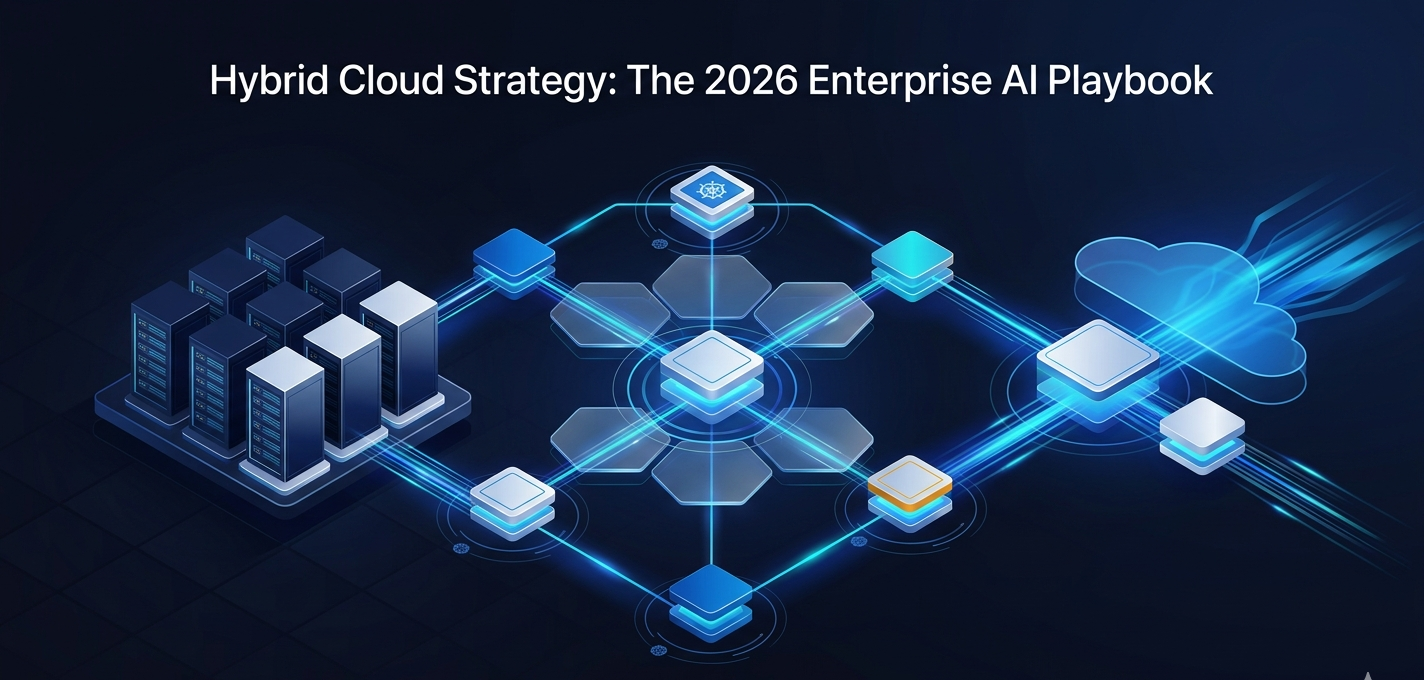
The infrastructure conversation in 2026 centers on hybrid cloud. Pure public cloud deployments hit cost and latency walls at enterprise scale. Pure on-premise deployments can’t access the model ecosystems driving the most competitive AI capabilities. The winning architecture combines on-premise data infrastructure (for governance and latency) with cloud-based model access (for capability and cost efficiency).
Enterprise AI Roadmap: Implementation Readiness Checklist
Before advancing from one phase to the next, your organization should be able to check every box in the relevant tier. This isn’t bureaucratic overhead. It’s what separates the organizations that scale from the ones that stay stuck.
C-suite charter signed with explicit budget authority and a named AI sponsor accountable for outcomes
Data quality audit completed, with documented gaps and a remediation plan before pilots launch
Baseline productivity metrics established for every use case targeted in the pilot phase
Governance framework built with role-based access controls, audit logging, and compliance documentation
Pilot gate criteria defined before pilots begin, including the specific lift required before scale approval
18-month runway budgeted for full-scale deployment, not the vendor’s optimistic timeline
Shadow AI inventory completed, with existing unofficial AI usage documented and either governed or retired
The 2026 Deployment Landscape: Traditional vs. Framework
Organizations still following ad-hoc AI deployment approaches are running into a consistent set of problems. Comparing traditional deployment patterns against the structured framework reveals where the time and budget losses accumulate.
Dimension
Traditional Approach
5-Phase Framework
Time to Foundation
Skipped or rushed (1–2 weeks)
4–12 weeks with explicit readiness gate
Vendor Integration
5–12 weeks per vendor, no orchestration
Planned in Phase 4 with parallel streams
Pilot-to-Production Rate
~33% make it to production
Gate criteria enforce quality before scale
ROI Validation
Qualitative or post-hoc
Predefined metrics, 12-week validation cycles
Governance
Retrofitted after deployment
Built in Phase 2, before any AI touches production data
Data Quality
Discovered as a problem mid-pilot
99% readiness score required before pilots launch
What the Hype Gets Wrong About Enterprise AI Timelines
The vendor ecosystem has a structural incentive to undersell implementation complexity. A realistic look at the numbers tells a different story.
ServicePath’s September 2025 implementation analysis found that 95% of AI projects “fail” in the sense that they don’t deliver the value case originally promised. That doesn’t mean AI doesn’t work. It means the planning models most organizations use don’t account for what enterprise-scale deployment actually requires.
The hidden costs compound fast. Data quality remediation runs $12.9 million annually per organization. Governance infrastructure now commands a 40% budget premium year-over-year. Each vendor integration adds 5 to 12 weeks. None of those numbers appear in the vendor’s ROI slide deck.
The contrarian view worth sitting with: the organizations achieving durable AI advantage in 2026 aren’t the ones who moved fastest. They’re the ones who slowed down long enough to build the data and governance foundations that everything else depends on. The 18-month timeline isn’t a sign of organizational friction. It’s the cost of doing this correctly.
“Organizations without a clearly defined enterprise AI roadmap risk stalled pilots, regulatory exposure.”
What are the key steps in an enterprise AI roadmap?
A defensible enterprise AI implementation roadmap follows five phases: strategy alignment (4 to 6 weeks), data and infrastructure preparation (6 to 12 weeks), pilot execution (3 to 6 months), scale and integration (6 to 18 months), and ongoing governance. Each phase has a hard quality gate: you don’t advance until you hit the criteria. Promethium AI’s 2025 benchmark guide provides detailed gate criteria for each transition.
How long does AI implementation take in enterprises?
Honest answer: foundations in 4 to 12 weeks, pilots in 3 to 6 months, and full enterprise scale in 18 months or more. Natoma AI’s deployment data shows that a 30-day foundation setup is possible with strong pre-existing data infrastructure, but enterprise-wide deployment at scale consistently takes 12 to 24 months when done correctly.
What are common AI roadmap challenges?
The three dominant failure modes are data quality problems (affecting 99% of projects), the pilot trap (nearly two-thirds of organizations can’t advance from pilot to production), and governance gaps that create regulatory exposure. Data quality alone costs organizations $12.9 million annually. These aren’t edge cases; they’re the baseline experience for most enterprises.
How do you measure ROI from enterprise AI?
Track productivity lifts against pre-established baselines, cost savings realized, and revenue impact attributable to AI deployment. Use 12-week validation cycles, as Natoma AI’s pilot metrics show. Your three-year ROI formula: (Total Impact minus Total Deployment Cost) divided by Total Cost. Target 3x as the minimum bar before committing to full-scale deployment.
What governance is needed for enterprise AI?
At minimum: role-based access controls, comprehensive audit logging, and compliance documentation aligned to applicable regulations (EU AI Act, sector-specific requirements). Governance infrastructure needs to be built before pilots touch production data, not retrofitted later. Q1 2026 budget data shows governance spending up 40% year-over-year as organizations pay the remediation cost of having skipped this step.
How do you prioritize AI use cases?
Use a business impact by feasibility matrix. Score each candidate use case on expected productivity or revenue impact, data readiness, implementation complexity, and time to value. Start with 3 to 5 pilots that score high on impact and data readiness simultaneously. Avoid the temptation to start with the most technically ambitious use case, start with the one where data is cleanest and the business case is clearest.
What’s the difference between an AI strategy and an AI roadmap?
An AI strategy defines where you’re going, the business outcomes AI should deliver, the competitive positioning, and the principles governing AI use across the organization. An enterprise AI implementation roadmap defines how you get there: phased timelines, gate criteria, resource requirements, and accountability structures. You need both. A strategy without a roadmap stays aspirational. A roadmap without a strategy optimizes for the wrong things.
The Organizations Winning With Enterprise AI in 2026
The pattern is clear across hundreds of enterprise deployments. Success doesn’t come from choosing the right model or moving the fastest. It comes from building the right foundation before any AI touches production data.
Organizations achieving 3x ROI share three structural characteristics: they treat data preparation as a non-negotiable gate rather than a preliminary checkbox, they define pilot success criteria before launching pilots rather than after, and they build governance infrastructure at the start rather than retrofitting it under regulatory pressure.
The broader implication extends beyond any single deployment. As the 2026 enterprise AI market matures past $1.8 trillion, competitive advantage shifts from access to technology, which is increasingly commoditized, to organizational readiness. The gap between prepared and unprepared organizations will define enterprise competitiveness through 2030.
Watch for three developments in the next 12 months: vendor consolidation around governance and observability platforms, regulatory requirements expanding audit trail mandates across more industries, and growing skills shortages in AI infrastructure and data engineering roles. Organizations building those capabilities now are positioning for sustained advantage. Those waiting for clearer signals will find the window narrowing.
Hybrid Cloud Strategy for CTOs: 5-Step AI Framework [2026 ROI Guide]
Cloud InfrastructureMarch 15, 2026·12 min read·NeuralWired Editorial
The hybrid cloud market hits $194 billion this year. Yet most enterprises are leaving $1.2M in annual savings on the table. Not because the technology isn’t ready, but because their strategy isn’t. Here’s the complete playbook.
Cloud IaaS spending surged to $90.9 billion in Q1 2025 alone, up 21% year over year, according to Omdia. And enterprises have little to show for it. Runaway public cloud bills, compliance gaps, and AI workloads that behave unpredictably in pure-cloud environments are forcing a fundamental rethink. The answer, increasingly, is a deliberate hybrid cloud strategy for enterprises, built not around vendor convenience but around workload economics.
For CTOs evaluating their 2026 infrastructure roadmap, the stakes are real. 90% of enterprises have already adopted some form of hybrid cloud, according to Gartner and IMARC Group data. But adoption isn’t strategy. The gap between organizations that achieve 40% ROI improvements and those stuck managing complexity without returns comes down to five architectural decisions.
This analysis covers what those decisions are, how AI workloads changed the calculus in 2025, what zero-trust security means for your architecture today, and how to build a framework that pays back in under nine months. We’ve pulled from market research, practitioner case data, and the latest analyst forecasts to give you the implementation guide that generic vendor content won’t provide.
$194B
Hybrid cloud market value in 2026, growing to $347B by 2031 at 12.37% CAGR, per Mordor Intelligence’s 2026 forecast. The primary driver is AI workload demands that no single cloud model can satisfy alone.
Why 2026 Changed the Hybrid Cloud Strategy Equation
Hybrid cloud isn’t new. What’s new is why enterprises can’t avoid it anymore.
For years, the conversation centered on cost versus flexibility: public cloud for elasticity, private cloud for sensitive data, hybrid for organizations that couldn’t fully commit to either. That framing was adequate when workloads were predictable. It falls apart when your biggest infrastructure driver is AI training runs that consume 10,000 GPU hours at a stretch.
GPU economics. Training large models on public cloud GPU instances costs 40 to 60% more than on-premises equivalents at scale, according to Iterathon’s infrastructure cost analysis. Once training volume crosses a threshold of roughly 500 GPU-hours per week, the math flips decisively toward private compute.
Latency for inference. Real-time AI inference including fraud detection, personalization, and edge robotics cannot tolerate 50ms round-trips to a distant cloud region. Edge and on-premises nodes cut that to under 5ms. The hybrid model routes inference locally while bursting training capacity to the cloud.
Compliance pressure. Regulations in financial services, healthcare, and the EU AI Act require data residency and audit trails that multi-cloud vendors can’t uniformly guarantee. Hybrid gives legal teams the control they need without grounding innovation.
“Multi-cloud and hybrid will become a strategic architecture, not a choice. Organizations will strategically place critical components in the public cloud for scalability, and private cloud for data security and cheaper hardware for AI initiatives.”
The AI Workload Placement Framework Every CTO Needs
The single biggest mistake in hybrid cloud planning is treating all workloads the same. AI changed that requirement significantly.
Each class of AI workload has a different cost profile, latency sensitivity, and data governance requirement. Placing them correctly, rather than simply splitting “some on-prem, some in the cloud,” is where the 35 to 40% cost reductions actually come from. Here’s the placement logic:
The critical trap here is data gravity. When petabytes of training data sit on-premises, moving them to a public cloud for training doesn’t just take time. It generates egress fees that can consume 15 to 20% of your anticipated cloud savings. Organizations that ignore this end up paying more in data transfer than they save in compute flexibility. Design your architecture around where the data already lives, then bring compute to it.
78%
of organizations increased edge infrastructure usage in the past 12 months, per IDC. Edge isn’t a future investment. It’s already the default for AI inference at scale.
Hybrid Cloud Strategy: The 5-Step Implementation Roadmap
Generic advice about “assessing your workloads” doesn’t get implementations done. Here’s the specific sequence that enterprise teams use to move from inventory to production-ready hybrid architecture, with typical timelines and the failure modes to avoid at each stage.
Classify and map every workloadInventory current workloads against the placement framework above. Flag AI training, inference, compliance-sensitive data, and latency-critical services separately. Tools include Kubernetes discovery agents and cloud cost dashboards. The key failure mode to avoid is treating this as a one-time exercise. Workload profiles change quarterly as AI usage grows, so build ongoing classification into your FinOps process from day one.
Design a zero-trust architecture before migrationMost hybrid failures trace back to security architectures designed for single-environment perimeters. Zero-trust means no implicit trust between nodes, whether on-prem or cloud. Implement identity-aware access controls, micro-segmentation, and encrypted east-west traffic. Per NIST Special Publication 800-207 on Zero Trust Architecture, ZTA frameworks that map to NIST and CIS controls simplify compliance by aligning network security to regulatory standards automatically rather than retroactively.
Model your TCO before committing to architectureRun the ROI math with real numbers. OpsRamp’s management ROI model shows that enterprises managing 10,000 IT resources save $1.2M annually in OPEX through unified hybrid management. For larger organizations, that figure scales. Target a payback period under nine months. If your model shows longer, revisit workload placement before committing capital.
Build compliance checkpoints into the architectureDon’t bolt compliance on after the fact. For AI-era regulations including GDPR for EU data, HIPAA for health data, and the emerging AI Act requirements, build audit trails, data lineage tracking, and confidential computing zones into your initial design. N-iX’s hybrid cloud strategy guide notes that organizations treating compliance as an architecture requirement rather than an IT ticket avoid the costly retrofits that derail migrations at the 60% completion mark.
Instrument for FinOps and AI governance from launchHybrid environments without observability become cost sinkholes. Monitor GPU utilization targets (aim above 80% on private nodes), MTTR, and deployment frequency. Integrate AI governance dashboards to track model performance, data drift, and inference cost per query. Per CTO Magazine’s DevOps analysis, the metrics that matter for hybrid success are deployment frequency, lead time, and MTTR, not just uptime percentages.
The ROI Reality Check: What Vendors Won’t Tell You
Egress fees: Data transfer between private and public environments can add 15 to 20% to your cloud bill if not planned for in architecture. Route data pipelines to minimize cross-environment movement.
Skills gap: Hybrid environments require FinOps expertise, Kubernetes orchestration skills, and zero-trust networking knowledge that most enterprise IT teams don’t have in-house. Budget for training or hiring, not just tools.
Management overhead: Without unified orchestration, hybrid can produce more operational complexity than two separate environments. Tools like Kubernetes federation and unified observability platforms are required, not optional.
Delayed payback without optimization: Organizations that deploy hybrid infrastructure but don’t actively manage workload placement often see cloud spend grow 21% without corresponding efficiency gains. Passive hybrid isn’t a hybrid strategy. It’s complexity theater.
“In 2026, multi-cloud and hybrid environments will become architectural necessities for AI and compliance workloads.”
The organizations achieving $1.2M or more in annual OPEX savings share three characteristics. They started with a full workload inventory, they built FinOps discipline before deployment rather than after, and they treated zero-trust security as an architecture requirement rather than a compliance checkbox. Organizations that skip any of these three see their hybrid ROI erode within 18 months.
Hybrid Cloud Strategy Pre-Launch Checklist for CTOs
Before committing budget to hybrid infrastructure, use this checklist to validate readiness. Each item maps to a documented failure mode in enterprise deployments.
Architecture Readiness
☐Full workload inventory completed with AI, compliance, and latency classifications
☐Data gravity mapped so training data location drives compute placement, not the reverse
☐Zero-trust IAM framework designed before migration begins
☐Network connectivity (VPN/SD-WAN) between private and public environments validated for AI burst throughput
☐Kubernetes or equivalent orchestration layer selected and tested
Financial Governance
☐TCO model built with real egress, staffing, and licensing costs included
☐Payback period target set to under 9 months for standard implementations
☐FinOps team or tooling designated before go-live
☐GPU utilization targets defined, aiming above 80% on private nodes
☐Egress cost monitoring in place from day one
Compliance and Security
☐Regulatory requirements mapped (GDPR, HIPAA, AI Act) before architecture finalized
☐Audit trail and data lineage tracking built into architecture rather than added later
☐Confidential computing zones designated for sensitive AI training data
☐NIST/CIS framework mapping completed and documented
☐Incident response plan updated for multi-environment topology
Frequently Asked Questions
What is a hybrid cloud strategy for enterprises?
A hybrid cloud strategy combines private cloud infrastructure (on-premises or co-located) with public cloud services, connected through orchestration layers that allow workloads to move between environments based on cost, latency, or compliance requirements. For enterprises in 2026, this means routing AI training to private GPU clusters, running inference at the edge for low latency, and bursting agent workloads to the public cloud for elastic scale. 82% of IT decision-makers report higher satisfaction with hybrid than with other cloud models.
What is the difference between hybrid cloud and multi-cloud?
Hybrid cloud integrates private and public infrastructure into a single operational environment, with workloads moving fluidly between them. Multi-cloud uses multiple public providers such as AWS, Azure, and GCP without deep integration. It is primarily a vendor diversification strategy rather than an architecture optimization. Hybrid is better suited for AI workloads requiring data governance and latency control, while multi-cloud reduces vendor lock-in but adds management complexity without the cost benefits of private compute.
What are the main benefits of hybrid cloud for enterprises?