In-depth artificial intelligence analysis: AI agents, LLMs, enterprise deployment, governance, and breakthroughs. Research-backed insights for CTOs, founders, and decision-makers.
US AI Regulation 2026: The State-vs-Federal Battle Every Company Must Understand Now
NeuralWired
Policy & Compliance
US AI Regulation in 2026: The State vs. Federal Battle Every Company Must Understand Now
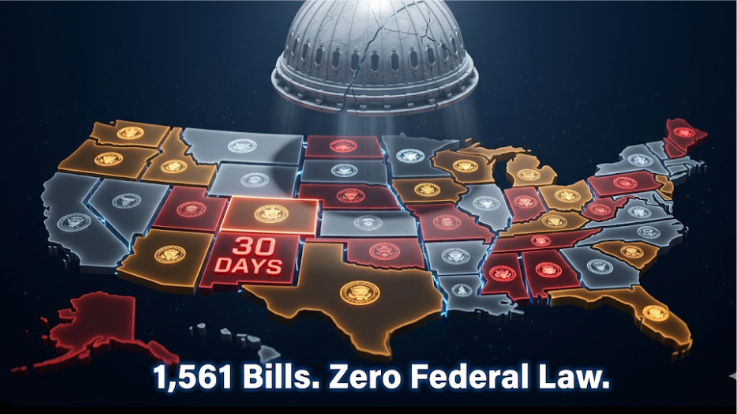
1,561 state bills, zero federal law, and a DOJ task force set to sue states into compliance. Here is the full picture, and what your legal team needs to do before June 30.
May 31, 2026 • NeuralWired Research Desk • 14 min read
1,561State AI bills introduced in 2026
45States with active AI legislation
$42BFederal broadband funds used as leverage
Your company’s AI hiring tool went live in Q1. It operates in eight states. By June 30, it will be non-compliant in at least three of them, and the enforcement machinery is already running. This is not a hypothetical risk buried in a regulatory horizon document. It is the operational reality of AI regulation in the United States right now, and most compliance teams are structurally behind.
While Washington debates preemption, Sacramento, Denver, Hartford, and Albany are already writing the rules your products must live by. As of March 2026, lawmakers in 45 states had introduced 1,561 AI-related bills, surpassing the entire volume from all of 2024. Six weeks into the year, more than 300 had already landed. This is not a wave. It is a flood with no federal levee in sight.
This article gives you the complete picture: every major law currently in force or about to be, the real scope of the federal vs. state collision, and the specific actions compliance, legal, and product teams must take now. If you are building or deploying AI in the United States, nothing here is optional reading.
The Federal Framework: What It Is (and Is Not)
On December 11, 2025, President Trump signed Executive Order 14365, titled “Ensuring a National Policy Framework for Artificial Intelligence.” The EO asserts broad federal authority over state AI laws the administration considers obstructive. It establishes a DOJ AI Litigation Task Force to challenge state requirements in court, threatens to condition $42 billion in BEAD broadband funding on states repealing “onerous” AI statutes, and instructs the Commerce Department to publish a review identifying state laws for potential federal challenge.
The stated ambition is sweeping. The legal reality is considerably narrower.
Critical Distinction
Executive orders cannot directly preempt state laws. That requires an Act of Congress. EO 14365 is a policy declaration backed by funding threats and litigation intent, not a self-executing legal override of existing state statutes.
On March 20, 2026, the administration followed the EO with its National Policy Framework for Artificial Intelligence, a legislative recommendation document built around seven pillars: child protection, AI infrastructure, intellectual property, free speech and censorship, innovation, workforce preparation, and preemption of state AI laws. It is a wish list for Congress, not a binding regulatory framework.
Congress has not delivered. The most telling signal came when the Senate voted 99-1 to strip a 10-year state AI law freeze from the “One Big Beautiful Bill Act.” The 2026 National Defense Authorization Act, signed the day before EO 14365, excluded preemption language entirely. A unified federal AI law before the 2026 midterms is, by any credible reading of congressional bandwidth, extremely unlikely.
The DOJ AI Litigation Task Force: Operational Since January 10, 2026
This is the mechanism with the most immediate legal consequence. The Task Force, operational since January 10, 2026, is responsible for challenging state AI laws in federal court on grounds including unconstitutional burden on interstate commerce and federal preemption conflicts. Legal teams must now model compliance scenarios that include the possibility of states they are currently complying with facing federal injunctions. That kind of scenario uncertainty is genuinely new territory for corporate AI governance.
One federal consumer protection development worth noting: on April 23, 2026, the Protecting Consumers From Deceptive AI Act was introduced in Congress, directing NIST to develop guidelines for watermarking AI-generated content. It has not been enacted.
State Laws Now in Force: The Compliance Map
This is the table that should be on the wall of every compliance team operating in the United States. These are not proposed bills. They are enacted laws with active or imminent enforcement dates.
Law
State
Effective Date
Who It Covers
Key Requirement
Status
AB 2013 / SB 942
California
Jan 1, 2026
Generative AI developers
Training data disclosure; latent provenance disclosures in AI-generated content
Active
ADMT Regulations
California
Compliance by Jan 1, 2027
Companies using AI for significant decisions (hiring, lending, housing, healthcare)
Impact assessments; consumer opt-out rights
Compliance Due
TRAIGA
Texas
Jan 1, 2026
Developers and deployers
Prohibits specific intentional misuses; 36-month regulatory sandbox
Active
RAISE Act
New York
Dec 19, 2025
AI developers and deployers in NY
Stricter incident reporting; new oversight office within Dept. of Financial Services
Active
Colorado AI Act
Colorado
June 30, 2026
Developers and deployers of “high-risk” AI systems
Transparency, safety, consumer protection obligations across AI lifecycle
Oct 2026
Healthcare AI Laws
Indiana, Utah, Washington
2026
Health insurers using AI for claims
AI cannot be sole basis for denying or modifying insurance claims
Active
Mental Health AI Laws
Tennessee, Delaware
2026
AI system providers
Prohibits AI from being marketed as licensed mental health professionals
Active
California’s ADMT Rules: The One Closest to Breaking Most Companies
California’s Automated Decision-Making Technology regulations cover any company that uses AI to “substantially replace” human decision-making in what the law defines as “significant decisions.” The list is broad: financial services, lending, housing, education, employment, independent contracting, and healthcare. These regulations took effect January 1, 2026, but the compliance deadline lands January 1, 2027. That sounds like time. It is not. Impact assessments, documentation infrastructure, and opt-out mechanisms take months to implement correctly.
Colorado AI Act: June 30, 2026 Is 30 Days Away
Colorado’s AI Act is the most aggressive algorithmic accountability law in the country. Originally set for February 1, 2026, Governor Polis signed a delay to June 30, 2026. Developers and deployers of “high-risk” AI systems must exercise reasonable care to prevent algorithmic discrimination, conduct impact assessments, and provide consumer disclosures. The Trump administration’s EO specifically names Colorado’s law as the kind of state regulation it intends to challenge, but no federal injunction has been issued. The law is enforceable on June 30.
Connecticut SB 5: The Latest Domino
On May 1, 2026, the Connecticut legislature passed SB 5 with a 131-17 House vote and 32-4 Senate majority, a level of bipartisan support that underscores how politically durable state AI regulation has become. The law imposes obligations on developers, deployers, and providers across the AI technology lifecycle, with most provisions effective October 1, 2026. Governor Lamont is expected to sign.
The Federal vs. State Collision
The core tension playing out right now is a preemption fight with no clear legal resolution timeline. The Trump administration wants a single national standard. Thirty-six state attorneys general have told the federal government to stay out. States read the 99-1 Senate vote stripping preemption from the One Big Beautiful Bill as a direct political endorsement of their authority to keep legislating.
What makes this operationally complicated for companies is the gap between federal aspiration and legal enforceability. Every state AI law currently in force remains fully enforceable. The DOJ Task Force can file lawsuits, seek injunctions, and apply funding pressure, but until courts rule or Congress acts, companies cannot responsibly treat the federal posture as a compliance substitute for state obligations.
“Compliance strategies for AI-enabled products and services must be nimble to accommodate diverging state and federal requirements. As these recommendations are not yet binding law, and the legal durability of executive actions remains uncertain, stakeholders should remain vigilant, monitor legislative and litigation developments, and be prepared to adapt compliance strategies as the regulatory environment evolves.”
Stephanie A. Webster, Jamie E. Darch & Chetan A. Patil, Ropes & Gray LLP (March 30, 2026)
The EO’s most coercive mechanism is the $42 billion BEAD broadband funding threat: states that maintain AI regulations the administration deems onerous risk losing previously allocated broadband infrastructure money. That is real financial leverage. It has not yet changed a single enacted state AI law.
One scenario that deserves more attention than it typically receives: even if the administration successfully challenges explicit AI-specific statutes, states will simply route AI regulation through pre-existing consumer protection, unfair competition, and civil rights frameworks. Paul Hastings flagged this plainly: “We do not believe this Executive Order will eliminate state involvement in AI regulation altogether. Instead, we think that states will diffuse AI regulation by applying existing consumer protection, unfair competition, deceptive practices and civil rights laws to AI-related conduct.”
That is not a speculative scenario. It is already happening.
The Numbers Behind the Crisis
The volume figures are striking enough on their own. 1,561 state AI bills introduced by March 2026, already surpassing all of 2024. Over 300 dropped in the first six weeks of the year alone. In 2025, states introduced over 1,100 bills total, meaning 2026 is tracking at a 42-plus percent acceleration year over year.
The compliance cost projections are also concrete, if contested. A Common Sense Institute study projects that Colorado’s AI Act alone will cost 40,000 jobs and $7 billion in economic output by 2030. The U.S. Chamber of Commerce extended that methodology nationally: a 1 percent productivity decline caused by state AI law fragmentation could cost the U.S. economy up to 713,000 jobs and $53.7 billion in GDP by 2030.
Global Context
Stanford HAI’s 2026 AI Index found that 47 countries are now legislating AI, with compliance costs varying as much as eightfold between jurisdictions. U.S. multinationals face the domestic patchwork and a 47-country global patchwork simultaneously. The compliance surface area is expanding in both directions at once.
The lobbying environment reflects how much is at stake. More than 640 companies engaged at the federal level on AI in 2024, a 141 percent increase from the prior year. The regulatory outcome is still genuinely contested, and companies not engaged in the policy process have no standing to complain about what emerges.
Public sentiment is also working against the federal “light touch” posture. In Pew Research data cited by Stanford HAI, 41 percent of U.S. respondents said federal AI regulation will not go far enough, versus 27 percent who said it will go too far. The political economy is asymmetric. The public wants more regulation than Washington is providing, which is precisely why states keep legislating regardless of federal pressure.
Expert Views: What the Lawyers and Researchers Say
Gary Marcus: “1,200 Bills, No Good Test for Any of Them”
“The U.S. now has 1,200 AI bills with no good test for any of them. Legislative volume without evaluative rigor is itself a governance failure.”
Gary Marcus, Professor Emeritus, NYU; Author, Taming Silicon Valley (2024), writing in Fortune with Jeffrey Sonnenfeld, May 15, 2026
Marcus is not anti-regulation. His argument is more pointed: the current approach fails on both ends simultaneously. Federal inaction leaves real harms unaddressed. State legislative proliferation without quality controls produces volume without accountability. Writing with Yale’s Jeffrey Sonnenfeld and Stephen Henriques, Marcus proposed a “counterfactual durability test” for evaluating AI bills, asking whether harm would occur anyway through unregulated substitutes. Almost no current bill passes that test.
EY C-Suite Survey: Non-Compliance Risk Is Now the Primary AI Risk
Ernst & Young’s 2026 global C-suite survey found that the majority of senior leaders identify non-compliance with AI regulations as the most common AI risk they face. Not model failure. Not reputational risk. Regulatory non-compliance. The boardroom has accepted this as a primary operational reality. The question is now how to manage compliance across a fragmented, rapidly evolving landscape, not whether it matters.
Paul Hastings: Federal Preemption Will Fail at the Edges
“We do not believe this Executive Order will eliminate state involvement in AI regulation altogether. Instead, we think that states will diffuse AI regulation by applying existing consumer protection, unfair competition, deceptive practices and civil rights laws to AI-related conduct.”
Paul Hastings LLP, Client Alert, December 2025
This is the contrarian view that actually deserves more mainstream attention. Even if EO 14365 succeeds in neutralizing Colorado’s explicit AI statute, companies deploying AI in Colorado still face consumer protection enforcement under pre-existing Colorado law. The EO attacks the label, not the underlying regulatory authority.
The Case Against the Mainstream Narrative
Our read: the dominant corporate narrative around AI regulation in 2026 has a blind spot. Too much attention is focused on the federal-state jurisdiction fight, and not enough on what happens if the federal side wins.
If preemption succeeds, the regulatory arbitrage problem gets worse, not better. If the administration neutralizes California and Colorado, AI companies concentrate deployments in low-regulation states. Algorithmic discrimination does not disappear. It just becomes geographically uneven, with the least-protected populations concentrated in states that did not legislate.
The economic cost figures are methodologically aggressive. The U.S. Chamber’s $53.7 billion GDP loss estimate extrapolates a Colorado-specific CSI study to the entire national economy. That is a significant methodological leap built on worst-case implementation assumptions with no discount for compliance adaptation or technology adjustment. It is the industry’s primary quantified argument against state regulation, and it deserves more scrutiny than it typically receives in policy coverage.
“Minimally burdensome” arrives at the wrong moment. AI incidents are rising, transparency scores are falling, and companies still report knowledge gaps and regulatory uncertainty as their top barriers to responsible AI implementation. A light-touch federal framework is landing precisely when governance gaps are measurably widening. The regulatory timing is backwards relative to the actual risk curve.
Open-source evasion is structurally unaddressed. A national rule that does not contemplate open-source alternatives has a built-in evasion route. Banning a frontier model within a state may not stop the underlying capability. It may shift it to jurisdictions with looser rules or to open-source systems that no regulatory framework currently reaches. The 2026 NDAA recognized this dynamic in its DeepSeek provisions, prohibiting specific systems from operating within defense networks rather than attempting to regulate adversary jurisdictions.
The litigation gridlock scenario is real. DOJ Task Force challenges could create years of legal uncertainty in which neither federal nor state standards are clearly enforceable. Compliance professionals would have no stable foundation to build on during that period, exactly when the practical need for governance infrastructure is most acute.
What Your Organization Must Do Now
Deadline Alert
Colorado’s AI Act takes effect June 30, 2026. That is approximately 30 days from publication. If you deploy “high-risk” AI systems and have not begun impact assessment documentation, you are already behind.
Across every active and pending state AI law in California, Colorado, Texas, New York, and Connecticut, documented risk assessments, bias testing results, transparency disclosures, and governance decisions are the common compliance thread. Organizations that lack documented evidence of anti-bias testing face enforcement exposure across multiple states simultaneously, not one at a time.
Compliance Actions Required Before Q3 2026
AI system inventory: Catalog every AI system by state of deployment and use case before June 30. Colorado’s “high-risk” definition is broad.
Documentation infrastructure: Impact assessments, bias testing records, and governance decisions must be written down. Verbal compliance does not survive enforcement.
Cross-functional governance committee: Legal, product, and engineering must be in the same room. Compliance built by lawyers alone will break in implementation.
Weekly legislative monitoring: The bill environment is changing faster than monthly briefings can capture. Use MultiState or BCLP’s interactive tracker on a weekly cadence.
Scenario planning for DOJ litigation outcomes: If a state law you are currently complying with faces a federal injunction, what is your posture? Model this now.
Healthcare and financial services audit: Indiana, Utah, and Washington laws now prohibit AI from being the sole basis for insurance claim denials. Automated underwriting systems require immediate review.
One thing is unambiguous: companies that pause compliance planning in anticipation of federal preemption are accepting real enforcement risk today in exchange for speculative relief tomorrow. White & Case has confirmed that all current state AI laws remain enforceable absent specific court orders or congressional action. Neither has occurred.
Frequently Asked Questions: AI Regulation USA 2026
Is there a federal AI law in the United States?
No. As of mid-2026, the United States has no comprehensive federal AI law. The Trump administration released a National Policy Framework on March 20, 2026, recommending Congress pass a unified standard, but it has not been enacted. Companies must currently comply with a fragmented patchwork of state laws while monitoring federal legislative developments.
What AI laws are in effect in the US in 2026?
Multiple state laws are active or taking effect in 2026: California’s ADMT and transparency rules (January 1, 2026), Texas TRAIGA (January 1, 2026), New York RAISE Act (December 2025), Colorado AI Act (June 30, 2026), and Connecticut SB 5 (October 1, 2026). Healthcare AI laws are also active in Indiana, Utah, and Washington. No federal AI law has been passed.
What is the Trump administration’s AI policy?
The Trump administration’s AI policy prioritizes “minimally burdensome” regulation and U.S. global AI dominance. Key elements include Executive Order 14365 (December 11, 2025) targeting state AI laws, a DOJ AI Litigation Task Force to challenge them in court, $42 billion in BEAD broadband funding conditioned on repealing “onerous” AI statutes, and a March 2026 legislative framework urging Congress to preempt state laws.
Can federal law override state AI regulations?
Not automatically. Executive orders cannot directly preempt state laws. That requires an Act of Congress. EO 14365 directs the DOJ to litigate against onerous state AI laws and threatens $42 billion in BEAD funding, but existing state laws remain enforceable absent specific court orders or congressional action. Neither has occurred as of publication date.
What is the Colorado AI Act and when does it take effect?
Colorado’s AI Act is the most comprehensive state AI law in the U.S., requiring developers and deployers of “high-risk” AI systems to conduct impact assessments, provide consumer disclosures, and exercise reasonable care to prevent algorithmic discrimination. It takes effect June 30, 2026, after being delayed from the original February 1, 2026 date.
How does US AI regulation compare to the EU AI Act?
The EU AI Act is a single, comprehensive risk-tiered framework covering all EU member states. The U.S. has no equivalent federal law, instead relying on 1,561 state bills with no harmonized definitions or enforcement mechanisms. In a 25-country Pew survey cited by Stanford HAI, 53% of respondents trusted the EU on AI regulation versus just 37% for the United States.
What is the DOJ AI Litigation Task Force?
Created by Executive Order 14365 on December 11, 2025, and operational since January 10, 2026, the DOJ AI Litigation Task Force is a federal unit established to challenge state AI laws in court on grounds including unconstitutional burden on interstate commerce or federal preemption conflict. No successful federal challenge has been completed as of this publication.
Where This Goes in the Next 12 to 18 Months
What this article should have made clear is something that was not obvious even six months ago: the enforcement phase of U.S. AI regulation has already begun. The years of proposed bills and watched legislation are over. California’s ADMT rules, Texas TRAIGA, and New York’s RAISE Act are active. Colorado hits in 30 days. Connecticut follows in October. Compliance is not a future planning exercise. It is a present operational requirement.
The next 12 to 18 months will likely resolve into one of two patterns. Either Congress passes a federal AI law with real preemption teeth, ending the patchwork at enormous political cost, or the state-by-state landscape hardens into a permanent multi-jurisdictional compliance environment that rewrites how AI products are built, tested, and deployed in the United States. The DOJ Task Force litigation will take years to produce definitive court rulings. States will not stop legislating in the meantime.
Three things to watch closely: the outcome of the first major DOJ Task Force lawsuit against a state AI law (it will set the legal temperature for every subsequent challenge); whether any state facing BEAD funding threats actually repeals AI legislation (no state has done so yet, which is the real measure of the EO’s leverage); and whether Connecticut’s SB 5 prompts a similar multi-state wave in Q3 and Q4, as Colorado did in 2025.
The companies that will navigate this environment are the ones that treat AI governance documentation as infrastructure, not overhead. The companies that will not are the ones waiting for federal clarity that may arrive three years too late.
Get AI Policy Intelligence Every Week
The Neural Loop delivers the regulatory, research, and business developments that matter to AI-forward organizations. No noise. No padding.
Subscribe to The Neural Loop
GPT-5 Capabilities: The Complete Technical Guide for Developers & Founders
Everything that actually matters about OpenAI’s flagship model — benchmarks, pricing, hallucinations, and what it means for your product in 2025–2026.
NeuralWired Research Desk
|
May 28, 2026
|
18-min read
GPT-5 CapabilitiesDeveloper GuidePricing Alert
On August 7, 2025, OpenAI didn’t just release a new model. It collapsed its entire model portfolio into one, and then the flagship feature broke on launch day. Nine months later, GPT-5 is the engine behind 900 million weekly active users and a $25 billion revenue run rate. This guide separates what GPT-5 actually delivers from what OpenAI wants you to believe it delivers.
By NeuralWired Research Desk · Updated May 28, 2026
What Is GPT-5?
GPT-5 is OpenAI’s flagship large language model, released on August 7, 2025 at 10AM PT. It’s available across ChatGPT (all user tiers), the OpenAI API platform, and the GitHub Models Playground.
The defining architectural move: GPT-5 is a unified system, a single model that houses a fast conversational sub-model for routine queries and a deep reasoning sub-model (“GPT-5 Thinking”) for complex tasks. A real-time router decides which mode engages, based on query complexity, tool requirements, and signals like a user typing “think carefully about this.”
Before GPT-5, users had to manually choose between the GPT-4o series (fast, conversational) and the o-series reasoning models (o1, o3, slower, more accurate on math and science). GPT-5 eliminates that decision entirely. Or it was supposed to, the router malfunctioned on launch day, which we’ll get to.
“It’s like talking to an expert. A legitimate, PhD-level expert in any area you need.”
Sam Altman, CEO, OpenAI, Pre-recorded press briefing, August 7, 2025
That PhD-level framing maps to specific benchmarks: 88.4% on GPQA Diamond (graduate-level science) and 67.2% on HealthBench (medical conversations). The claim isn’t hype without data. Whether the data holds up in your production environment is a different question.
94.6%
AIME 2025 Math
74.9%
SWE-bench Verified
88.4%
GPQA Diamond Science
88%
Aider Polyglot Coding
84.2%
MMMU Multimodal
67.2%
HealthBench Medical
GPT-5 Benchmark Scores: The Complete Breakdown
Benchmarks are the language enterprises use to justify procurement and the numbers engineers use to set expectations. Here’s what GPT-5 actually scored, source-attributed, with methodology noted.
Benchmark
GPT-5 Score
What It Measures
Why It Matters
AIME 2025
94.6%
High school olympiad mathematics
Stumps most adults. Signals deep reasoning without tools.
SWE-bench Verified
74.9%
Real-world software engineering (bug-fixing)
GPT-4.1 scored 54.6% four months earlier — a 20-point jump.
Aider Polyglot
88%
Cross-language coding ability
Multi-language production relevance for full-stack teams.
GPQA Diamond
88.4%
PhD-level physics, chemistry, biology
Curated to be hard even for the PhDs who wrote the questions.
MMMU
84.2%
Multimodal understanding
Image + text reasoning for document-heavy workflows.
HealthBench
67.2%
Clinical conversation quality
Benchmark for medical AI deployments in regulated settings.
The SWE-bench figure deserves special attention. OpenAI’s developer page documents the trajectory: GPT-4o scored 33.2%, GPT-4.1 reached 54.6%, and GPT-5 hit 74.9%, all within a 12-month window. For engineering teams, that isn’t a benchmark number. That’s the delta between “AI assists with code” and “AI autonomously closes GitHub issues.”
Key Insight
GPT-5’s token efficiency is a hidden financial story. OpenAI reports 50–80% fewer output tokens than o3 for equivalent performance, meaning if your pipeline previously ran on o3, switching to GPT-5 can cut token costs roughly in half before factoring in any price-per-token differences.
How GPT-5 Differs from GPT-4o and o3
The simplest framing: GPT-5 is what you’d get if GPT-4o and o3 had a child that also knew when to think slowly.
GPT-4o was fast and conversational. o3 was slow and brilliant at math and science. Users had to choose between them depending on the task, a friction point that caused constant miscategorization. GPT-5’s real-time router eliminates that choice.
Three concrete differences that change day-to-day developer experience:
No manual model selection. The router decides whether to engage fast or deep reasoning based on query complexity. In practice, this works better for ambiguous tasks than users tended to perform at self-selection.
45% fewer factual errors than GPT-4o in OpenAI’s internal testing. In reasoning mode, the figure climbs to 80% fewer errors versus o3. (Independent validation is mixed, see Section 7.)
Front-end web development outperforms o3 70% of the time in OpenAI’s internal evaluations. For developers doing full-stack work, that’s not marginal, that’s a genuine first-pass quality shift.
⚠ Launch Day Reality Check
The routing feature — GPT-5’s central innovation, malfunctioned on August 7, 2025. The flagship technical differentiator did not function correctly on day one. Additionally, OpenAI published benchmark bar charts that visually contradicted their own numerical data: the “coding deception” chart showed GPT-5 with a shorter bar than o3, despite GPT-5’s lower number indicating better performance. InfoQ documented both issues in detail. OpenAI issued corrections. Both errors raised legitimate questions about internal quality control for the company’s most important launch in two years.
GPT-5 API Pricing: What You’ll Actually Pay
This is the section that should be pinned to every startup’s engineering Slack. GPT-5 launched at a price point that made it seem like the cost curve was finally working in developers’ favor. What happened next was not that.
Model Version
Release Date
Input (per 1M tokens)
Output (per 1M tokens)
GPT-5 (launch)
August 7, 2025
$1.25
$10.00
GPT-5.4
~March 2026
$2.50
—
GPT-5.5 (“Spud”)
April 23, 2026
$5.00
$30.00
API input pricing quadrupled in eight months. Output pricing tripled. During the same period, NVIDIA CEO Jensen Huang stated that hardware costs per inference token dropped approximately 35×. OpenAI’s pricing trajectory is not following infrastructure economics. It’s following market demand and competitive positioning.
Any product with significant token throughput that was budgeted at $1.25/M input is now facing 4× the cost if it has migrated to current models. That’s not a price increase, it’s a category change in unit economics.
NeuralWired Research Desk analysis, May 2026
For ChatGPT users: Plus ($20/month) includes GPT-5 with usage limits on thinking-mode messages. Pro ($100–$200/month, restructured from launch’s $200 flat) includes GPT-5 Pro with extended reasoning and no token budget restriction. Ed Zitron, tech critic and writer, framed the launch bluntly:
“Meaningful functionality… is being completely removed for ChatGPT Plus and Team subscribers.”
Ed Zitron, Technology Critic — “Where’s Your Ed At” newsletter, August 2025, via Voiceflow
Our read: Zitron’s critique is specifically about model-selection removal and rate limits, not raw capability. Both things can be true, GPT-5 is technically more capable than GPT-4o, and Plus users received fewer choices with the upgrade. Whether that trade is acceptable depends entirely on your use case.
GPT-5 Context Window and Technical Specs
Parameter
GPT-5 (August 2025)
GPT-5.5 (April 2026)
Context Window
400,000 tokens
1,050,000 tokens (1M+)
Max Output
128,000 tokens
—
Knowledge Cutoff
September 2024
—
Latency (tokens/sec)
~77.7 (Artificial Analysis)
—
Training Infrastructure
Microsoft Azure AI supercomputers
Distribution at Launch
ChatGPT, OpenAI API, GitHub Models, Agents SDK
The 400K context window matters for enterprise document workflows, processing full legal contracts, entire codebases, or multi-year financial filings in a single call. GPT-5.5’s 1M+ token context is available via the API and makes whole-repository code analysis practically viable for the first time in the OpenAI stack.
GPT-5 vs Claude and Gemini
The short answer: neither model is comprehensively superior. Benchmark leadership is task-specific, and it’s shifting faster than procurement cycles can track.
Benchmark
GPT-5.5 (Apr 2026)
Claude Opus 4.7 (Apr 2026)
Leader
Terminal-Bench 2.0
82.7%
69.4%
GPT-5.5
ARC-AGI-2
85.0%
75.8%
GPT-5.5
SWE-Bench Pro
58.6%
64.3%
Claude Opus 4.7
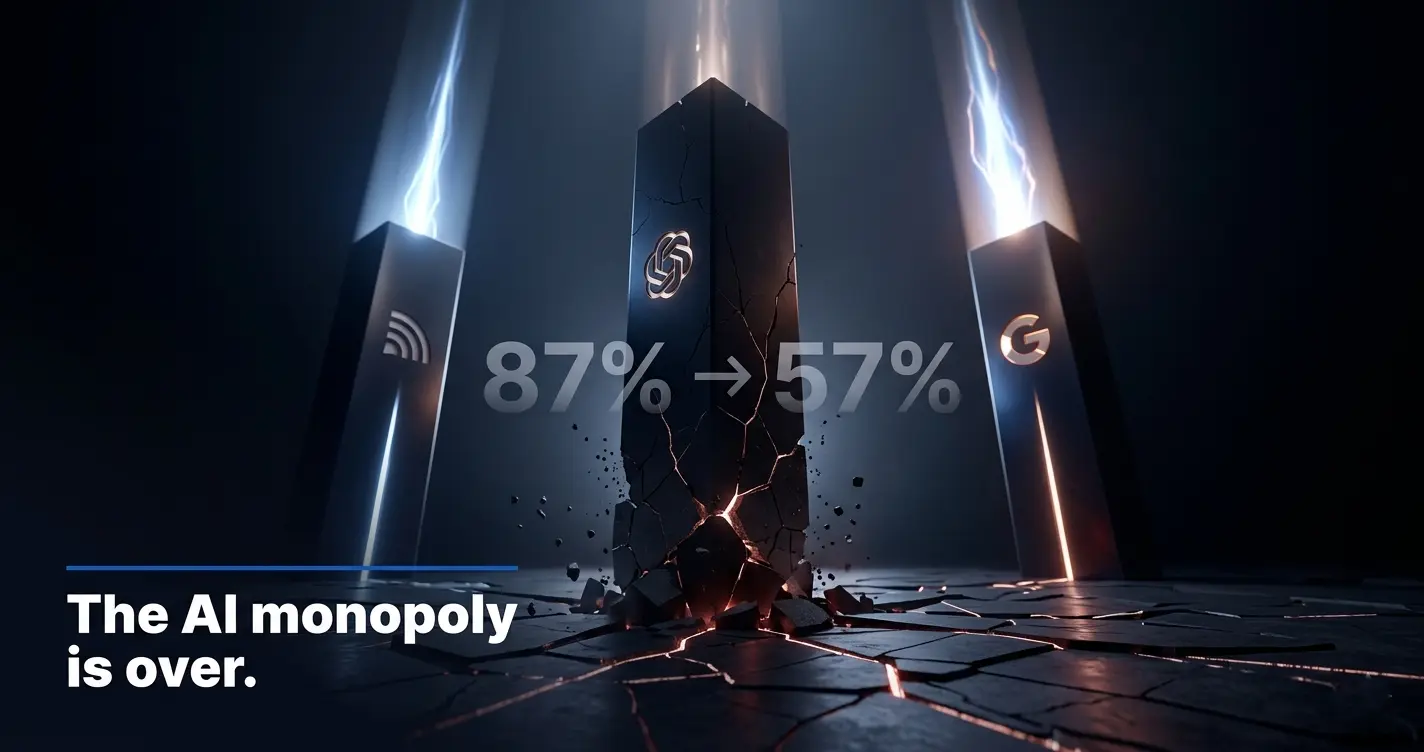
The competitive moat OpenAI held during the GPT-4 era has narrowed materially. Artificial Analysis scores GPT-5 at 45/100 on their Intelligence Index — above most models but not the categorical lead OpenAI commanded in 2023. ChatGPT’s US mobile app daily active user share fell from 69.1% in January 2025 to 38.7% by May 2026. Anthropic’s Claude app went from under 2% to 10% DAU share in three months.
GPT-5 is still the market leader by revenue and user count. It isn’t the unchallenged technical leader on every dimension.
Does GPT-5 Still Hallucinate?
Yes. Less than before — but the gap between what OpenAI claims and what independent testers find is real and worth understanding before you deploy in a regulated environment.
OpenAI’s claim: 45% fewer factual errors versus GPT-4o; 80% fewer errors in reasoning mode versus o3.
Independent testing: Vectara found GPT-5.2 had an 8.4% hallucination rate in their methodology, trailing DeepSeek. OpenAI’s own figure for GPT-5.2 was a reduction from 8.8% to 6.2%: a more modest 30% improvement, not the dramatic leap marketing suggested.
PCMag’s Ruben Circelli, who reviewed GPT-5 against real-world production tasks rather than benchmark conditions, was direct:
“GPT-5 is an ‘insignificant update.’ While it has some upgrades, it ‘doesn’t solve the problems that actually matter’ and he has not ‘noticed a significant improvement’ in areas like hallucination reduction.”
Ruben Circelli, Senior Analyst, PCMag — August 2025, via Voiceflow
That’s the practitioner gap: benchmark-measured hallucination uses controlled scenarios with defined correct answers. Production use involves open-ended, ambiguous queries where the model can’t know what it doesn’t know. GPT-5 is more reliable than GPT-4o. It’s not hallucination-free. Deploy accordingly.
One genuinely encouraging signal: a peer-reviewed study by Polat et al. (six MDs across four Turkish hospitals, published November 2025 in Letters to the Editor, NCBI) concluded that GPT-5’s measurable reduction in hallucination rates represents a meaningful milestone for medical and scientific writing, one of the first published academic assessments from clinical practitioners in a domain where errors cost lives. That’s cautious optimism, not a blanket clearance.
GPT-5 for Developers: Coding, Agents, and the Agents SDK
If you’re building software with or on AI, GPT-5 changes three things materially, and creates one significant risk.
What changes in practice
74.9% SWE-bench means autonomous issue resolution, not just code suggestions. At GPT-4o’s 33.2%, AI-assisted coding meant “AI suggests, human implements.” At 74.9%, the model can autonomously close real GitHub issues in verified test conditions. Combined with the Agents SDK (which provides orchestration, tracing, and MCP connectivity to external tools like CRM, payment, and support systems), multi-step autonomous pipelines are production-grade for the first time.
GPT-5 beats o3 at front-end web development 70% of the time. For developers doing full-stack work, that’s not marginal assistance, it’s output-quality output at first pass. The net result is that senior engineering time spent on routine implementation patterns (API integrations, UI scaffolding, documentation) can shift toward architecture and review.
What to do right now
Audit your current stack for tasks that consume disproportionate senior engineering time but follow a pattern: bug triage, code review, documentation, API integration. These are GPT-5’s highest-ROI targets. Evaluate the Agents SDK as an integration layer before building a custom orchestration system from scratch.
The risk you need to price in
⚠ API Pricing Risk
API pricing quadrupled from August 2025 to April 2026. Any product budgeted at GPT-5 launch pricing with significant token throughput is now 4× the cost if it has migrated to current models. Build pricing escalation assumptions into any business case that relies on the GPT-5 stack. A multi-vendor or open-source fallback strategy isn’t optional caution at this point — it’s basic financial hygiene.
GPT-5 for Founders: What Changes in Your Build-vs-Buy Decisions
The uncomfortable truth: GPT-5 compressed the moat of a large class of AI startups in a single launch. If your competitive advantage was “we built a better AI wrapper,” that advantage has narrowed to the point where you need to name what specifically you still do better than the base model.
The opportunity is real too. Enterprise deployments at GPT-5 launch included Morgan Stanley (financial workflows), Amgen (scientific research), and T-Mobile (customer operations). Fortune 500 procurement of AI tools has accelerated. If you serve any of those verticals, GPT-5 integration is now a procurement requirement, not a differentiator.
42% of new SaaS platforms with AI capabilities launched in 2025 relied on OpenAI models. That means GPT-5 is infrastructure. The differentiation layer has shifted up the stack, to proprietary data, domain-specific fine-tuning, and integration quality. Prompt engineering alone isn’t a moat anymore. It arguably never was, but GPT-5 made that unavoidable.
Founder Action Item
Invest now in proprietary data pipelines and fine-tuning infrastructure. The competitive question for any AI-native product is no longer “is our model good?”, it’s “do we have data the base model doesn’t?” That’s where defensible differentiation now lives.
The Skeptic’s Case: What GPT-5 Doesn’t Solve
Balanced coverage means saying the things OpenAI’s press releases don’t.
The AGI framing is marketing
Sam Altman’s description of GPT-5 as offering “PhD-level expertise” maps directly to one benchmark: GPQA Diamond. In controlled academic tests with defined answers, GPT-5 performs at a PhD level on scientific knowledge retrieval. On open-ended reasoning chains involving novel problems, ambiguous real-world data, or multi-domain synthesis, it remains significantly below expert human performance.
GPT-5 performs comparably to or better than human experts in roughly half of cases across 40+ occupations. That means it performs worse than human experts in the other half. At NeurIPS 2025, only 2 of 5,000 papers mentioned AGI. Prominent researchers including Demis Hassabis have emphasized that scaling transformers hits a cognitive scaling wall, current paradigms require paradigm-level innovation, not just larger models, to reach genuine general intelligence.
Agentic reliability isn’t solved yet
GPT-5’s agentic capabilities are real. The reliability math is not flattering for complex pipelines. A 95% success rate per tool call yields approximately 60% end-to-end success over 10 sequential steps. Enterprises deploying GPT-5 agents in customer-facing workflows without robust human-in-the-loop checkpoints are assuming a reliability threshold the model doesn’t yet consistently meet.
Regulatory exposure in regulated sectors
GPT-5’s use in healthcare, legal, and financial services creates EU AI Act exposure. OpenAI hasn’t published a conformity assessment for GPT-5 under the Act’s high-risk provisions. Companies deploying it in these domains are accepting compliance risk that OpenAI itself hasn’t fully addressed publicly. If you’re a CTO in a regulated vertical, that’s not a footnote, it’s a procurement risk factor that belongs in your security review.
The GPT-5 Model Family: From 5.1 to 5.5
GPT-5 is not a single model, it’s an ongoing release cadence. Five significant versions shipped in the nine months after launch.
Coding and agentic focus, front-end design improvements
GPT-5.5 “Spud”
April 23, 2026
1M+ token context, Terminal-Bench 2.0 at 82.7%, API pricing doubled from 5.4
The pace is deliberate. Sam Altman reportedly referred to GPT-5.5 as “the last big milestone before AGI” in internal remarks reported by the Financial Times in April 2026. Read carefully: that statement describes the current training paradigm having one or two more generations of runway before requiring a fundamental architectural shift, not a claim that AGI is imminent. It’s being read by many outlets as a promise it isn’t.
Our read: the GPT-5 series demonstrates that OpenAI has internalized the launch-iterate model from consumer software. The implication for anyone building on it is that the model you ship against today may be meaningfully different in six months, for better (capability) and worse (pricing).
Frequently Asked Questions
What is GPT-5?
GPT-5 is OpenAI’s flagship large language model, released August 7, 2025. It’s a unified system combining a fast conversational sub-model and a deep reasoning sub-model, with an automatic router that selects the right mode per query. It powers ChatGPT by default and is available via the OpenAI API. GPT-5 sets leading benchmarks in math (94.6% AIME 2025), coding (74.9% SWE-bench), and science (88.4% GPQA Diamond).
How is GPT-5 different from GPT-4o?
GPT-5 unifies GPT-4o’s conversational speed with the o-series reasoning models into one system, eliminating manual model selection. It reduces factual errors by 45% compared to GPT-4o, scores 20 percentage points higher on SWE-bench (74.9% vs. GPT-4o’s ~54%), and introduces a real-time routing system that decides when to engage deeper reasoning without user input.
What are GPT-5’s benchmark scores?
GPT-5’s official benchmark scores: 94.6% on AIME 2025 (advanced math), 74.9% on SWE-bench Verified (software engineering), 88% on Aider Polyglot (coding), 84.2% on MMMU (multimodal), 88.4% on GPQA Diamond (PhD-level science, Pro reasoning), and 67.2% on HealthBench (medical). Published by OpenAI at launch, August 2025.
How much does GPT-5 cost via the API?
GPT-5 launched at $1.25/M input tokens and $10/M output tokens (August 2025). Pricing escalated significantly: GPT-5.4 (March 2026) costs $2.50/M input; GPT-5.5 (April 2026) costs $5.00/M input and $30/M output, a 4× input increase in eight months. ChatGPT Plus ($20/month) includes access with usage limits; ChatGPT Pro ($100–$200/month) includes GPT-5 Pro with full extended reasoning.
What is GPT-5’s context window?
GPT-5 launched with a 400,000-token context window and a maximum output of 128,000 tokens per response. Knowledge cutoff is September 2024. GPT-5.5 (April 2026) extended the context window to over 1,050,000 tokens (1M+) via the API, making whole-repository code analysis and large-document processing viable in a single call.
Is GPT-5 better than Claude?
It depends on the task. GPT-5.5 leads Claude Opus 4.7 on Terminal-Bench 2.0 (82.7% vs. 69.4%) and ARC-AGI-2 (85.0% vs. 75.8%). Claude Opus 4.7 leads on SWE-Bench Pro (64.3% vs. 58.6%). Neither model is comprehensively superior, and benchmark leadership is shifting faster than it has at any prior point in the LLM competitive cycle.
Does GPT-5 still hallucinate?
Yes, less than before, but not eliminated. OpenAI reports 45% fewer errors versus GPT-4o. Independent testing by Vectara found an 8.4% hallucination rate in GPT-5.2. PCMag reviewers reported no significant improvement in real-world use. The gap between benchmark hallucination and production hallucination is real; GPT-5 is more reliable than its predecessors but not hallucination-free.
What is GPT-5 Pro?
GPT-5 Pro is the maximum-compute reasoning variant of GPT-5, exclusive to ChatGPT Pro subscribers ($100–$200/month as of April 2026). It enables extended “thinking” reasoning with no token budget restriction, producing more thorough answers on complex tasks. It scores higher than standard GPT-5 on GPQA Diamond (88.4%) and FrontierMath benchmarks.
When was GPT-5 released?
GPT-5 was officially released on August 7, 2025, at 10AM PT. OpenAI teased the launch the previous day via a post on X embedding the number “5” in the announcement text. The model launched simultaneously on ChatGPT (all user tiers), the OpenAI API platform, and the GitHub Models Playground.
What You Now Know | And Where This Goes Next
GPT-5 is the most commercially successful AI model ever released. It is also an imperfect product that malfunctioned on launch day, shipped benchmark charts that contradicted their own data, and has since quadrupled its API pricing while hardware costs fell 35×.
Both things are simultaneously true. The model is genuinely capable, 74.9% SWE-bench and 88.4% GPQA Diamond are not noise. The commercial moat is real, $25B+ ARR and 900 million weekly users are not accidents. And the operational risks are real: pricing escalation, benchmark-to-production hallucination gaps, regulatory exposure in high-risk sectors, and compounding error rates in agentic pipelines.
Three things to watch over the next 6–18 months:
The competitive parity story. Claude Opus 4.7 already leads on SWE-Bench Pro. Gemini 3.1 competes on multimodal benchmarks. ChatGPT’s US mobile market share is below 40% for the first time. GPT-5 may not hold the benchmark lead across all dimensions by the end of 2026.
The pricing ceiling. There’s no economic argument for API pricing increasing 4× in 8 months when inference costs are dropping. OpenAI is pricing against demand, not against cost. Watch for whether competition forces a reversal, or whether the market absorbs it.
Agentic deployment reliability. The gap between GPT-5’s agentic capabilities and production-grade reliability in multi-step autonomous pipelines is the defining technical question for enterprise AI in 2026. The teams that figure out human-in-the-loop architectures that are fast enough to be useful will define what enterprise AI actually becomes.
GPT-5 is infrastructure now, the same way GPT-4 became infrastructure. The question isn’t whether to use it. It’s how to build on it without being entirely at the mercy of OpenAI’s pricing decisions, and where to differentiate above the model layer.
Stay Ahead of the AI Model Cycle
The Neural Loop covers frontier model releases, benchmark analysis, and what they actually mean for your product, before the hype settles.
Subscribe to The Neural Loop →
What Is a Large Language Model? Explained Simply (2026 Guide) | NeuralWired
AI Fundamentals · 2026 Guide
What Is a Large Language Model? Explained Simply (2026 Guide)
By NeuralWired Editorial Team · May 27, 2026 · 14 min read
In 2026, 88% of enterprises have adopted AI, yet only 6% are seeing meaningful returns. The gap isn’t budget. It’s not talent. It’s that most of the people deploying large language models don’t actually understand what they are. This guide closes that gap.
A large language model (LLM) is the foundational technology behind ChatGPT, Claude, Gemini, and every AI writing tool you’ve encountered in the last three years. If you’re building a product, evaluating vendors, or just trying to understand what your engineering team is actually shipping, this is the piece you need to read first.
We’ll cover how LLMs work mechanically, how they’re trained, what makes them genuinely useful, and, critically, what they cannot do, no matter how well you prompt them. No hype. No padding. Just the technical reality, explained for people who make decisions.
The Simple Explanation: What an LLM Actually Does
Strip away the marketing and a large language model does one thing: it predicts the next word. That’s it. You give it text. It guesses what comes next. Then it takes that output, adds it to the input, and guesses again. Repeat a few hundred times and you have a paragraph. Repeat thousands of times and you have a research summary, a legal brief, or a working Python script.
The reason that feels magical, and the reason it’s not, is scale. LLMs are trained on hundreds of billions of words drawn from books, websites, scientific papers, code repositories, and conversations. Through that training, they don’t just learn vocabulary. They absorb grammar, factual associations, reasoning patterns, tone, cultural context, and the structural logic of arguments. All compressed into numerical weights, billions of them, that activate when you send a message.
The One-Line Definition
A large language model is a neural network trained on vast quantities of text to predict and generate human-like language, the foundational technology behind modern AI chatbots, coding assistants, and document tools.
One useful reframe: LLMs are more accurately described as large number models. Computers don’t understand words. They understand numbers. Every word you type is converted into a numerical token. Every token gets processed through layers of mathematical transformations. The output, which looks like language, is really just the winning number at the end of billions of calculations.
That reframe matters for something we’ll return to: when LLMs fail, they’re not being careless. They’re doing exactly what they’re designed to do. The math just doesn’t always produce truth.
How an LLM Works | Token by Token
Here’s the actual mechanism, in sequence.
You type: “What is the capital of France?” Before the model sees a single word, your message is tokenized, broken into chunks roughly 3–4 characters long. “What” becomes one token. “capital” might be one or two. “France” is one. The full sentence becomes roughly 8–10 tokens.
Each token is converted to a numerical vector, a list of numbers representing its position in a high-dimensional space where similar concepts cluster together. “Paris” and “capital” are numerically close. “Paris” and “bicycle” are far apart.
Those vectors pass through the model’s layers — stacked blocks of neural network transformations, each one adjusting the representation based on the attention mechanism (more on that shortly). At the end, the model produces a probability distribution across its entire vocabulary: token X has a 47% chance of coming next, token Y has 31%, and so on. The most probable token is selected. Added to the input. The process repeats.
1.8TEstimated GPT-4 parameters
200K+Max context window tokens (modern LLMs)
0.3 WhEnergy per GPT-4o text query
GPT-4 is estimated to contain approximately 1.8 trillion parameters, six times more than GPT-3’s 175 billion. Those parameters are the “knobs”, numerical weights tuned during training to make the predictions as accurate as possible. The model doesn’t look anything up. It doesn’t Google. It generates entirely from the patterns compressed into those weights during training.
This is exactly why LLMs are impressive and exactly why they can be wrong with total confidence. The mechanism that produces “Paris” when asked the capital of France is the same mechanism that produces a convincing-sounding but entirely fabricated legal precedent. It’s prediction, not retrieval. Fluency, not fact-checking.
How an LLM Is Trained, Step by Step
Training a frontier LLM is a multi-month, multi-hundred-million-dollar infrastructure project. Here’s the pipeline, simplified but accurate.
Data collection. Books, websites, academic papers, code repositories, and curated datasets are scraped and assembled into a corpus measured in terabytes. GPT-3 alone used 570GB of internet text.
Quality filtering. Automated classifiers and heuristic rules remove low-quality content, spam, duplicates, toxic material, boilerplate. This step is underrated; the quality of training data is a primary determinant of model quality.
Tokenization. All text is converted to numerical tokens using Byte-Pair Encoding (BPE), an algorithm that learns the most common character sequences in the corpus and merges them into single tokens. Efficient across languages, handles misspellings, and manages rare words gracefully.
Infrastructure setup. Training requires thousands of NVIDIA H100/H200 GPUs or equivalent TPUs running in parallel. Training GPT-3 required approximately 1,287 MWh of energy, equivalent to the annual consumption of around 120 average American homes.
Pre-training: next-token prediction. The model processes the entire corpus, repeatedly predicting the next token and adjusting its weights based on how wrong it was. Through billions of these adjustments, it learns grammar, world knowledge, reasoning patterns, and cultural context simultaneously, without any explicit labeling or instruction.
RLHF alignment. After pre-training, the raw model is brilliant but erratic. Human raters evaluate its responses. That feedback trains a separate “reward model,” which is then used to fine-tune the LLM toward outputs that are more helpful, accurate, and safe. This is how OpenAI, Anthropic, and Google turn base models into products.
What RLHF Actually Does
Reinforcement Learning from Human Feedback doesn’t make a model smarter, it makes it more aligned. It shifts the output distribution toward responses humans rate as good. The distinction matters: a well-aligned model can still be confidently wrong; it’s just less likely to be unhelpful or harmful.
The Transformer: The Engine Behind Every LLM
Every major LLM in production today, GPT-5, Claude 4, Gemini 2.5 Pro, Llama 4 — runs on a variation of the same architecture: the Transformer.
It was introduced in a 2017 paper from Google Brain titled “Attention Is All You Need” by Ashish Vaswani and colleagues. The paper demonstrated that an architecture based entirely on attention mechanisms, with no recurrence, no convolutions, was not only simpler but faster to train and better at the task. The authors showed it was “particularly well suited for language understanding,” outperforming both recurrent and convolutional models on major translation benchmarks.
“The Transformer is a neural network architecture that has fundamentally changed the approach to AI, the go-to architecture for deep learning models powering GPT, Llama, and Gemini.”
— Polo Club of Data Science, Georgia Tech
Before the Transformer, language models used Recurrent Neural Networks (RNNs) and LSTMs that processed text sequentially, one word at a time, left to right. Long-range context was nearly impossible to capture; the model effectively forgot what it read 50 words ago. The Transformer’s attention mechanism solves this by letting every token in a sequence attend to every other token simultaneously. “France” and “capital” can directly influence each other regardless of their distance in the sentence.
Between 2022 and 2025, the transformer architecture wasn’t replaced, it was relentlessly optimized. Mixture-of-experts (MoE) layers, sparse attention, quantization, and inference-time compute scaling transformed what was a promising research architecture into the infrastructure layer of a multi-billion-dollar industry. The chassis is the same. Everything else got a serious upgrade.
Key LLM Concepts Every Tech Professional Should Know
Term
What It Means
Why It Matters Practically
Parameters
Numerical weights tuned during training — GPT-4 has ~1.8 trillion
More parameters ≠ better for your use case; fine-tuned smaller models often outperform giants on specific tasks
Tokens
The unit of text LLMs process — roughly ¾ of a word in English
All cost, speed, and context limits are measured in tokens, not words or characters
Context window
How much text the model can “see” at once — 8K to 200K+ tokens in modern LLMs
The single most important spec for agentic tasks, long document analysis, and multi-turn workflows
RLHF
Reinforcement Learning from Human Feedback — alignment fine-tuning post pre-training
Why Claude, GPT, and Gemini behave differently from the same base architecture class
RAG
Retrieval-Augmented Generation — connecting an LLM to a live knowledge source at inference time
The primary mitigation for hallucination in production; essential for any factual-accuracy use case
Fine-tuning
Continued training on domain-specific data after pre-training
Fine-tuned domain models improve task accuracy by 30%+ over general models — a real engineering decision, not a buzzword
Hallucination
When a model generates plausible but false information with full confidence
Mathematically proven to be unavoidable at some level — architectural mitigation (RAG, verification layers) is mandatory for high-stakes deployments
Real-World LLM Applications in 2026
The enterprise LLM market reached USD 6.5 billion in 2025 and is projected to hit USD 49.8 billion by 2034 at a 25.9% CAGR. That growth reflects actual deployment across five broad categories:
Code generation and review: GitHub Copilot, powered by OpenAI models, is the most widely deployed enterprise LLM application. Developers use it for autocompletion, test generation, documentation, and bug explanation. The quality gap between a general model and a code-fine-tuned model is significant.
Document intelligence: Contract review, regulatory compliance scanning, and earnings report summarization. Law firms and financial institutions are the fastest-moving vertical, despite the highest risk exposure from hallucination.
Customer-facing assistants: LLM-powered support bots now handle first-line resolution for millions of enterprise queries. The critical architecture decision is whether to run RAG (grounding answers in live documentation) or rely on the base model, a choice with major accuracy implications.
Internal knowledge retrieval: Connecting LLMs to internal wikis, CRM systems, and policy documents. IBM’s Granite model series on watsonx.ai is designed specifically for this enterprise-internal use case.
Code infrastructure automation: Microsoft has integrated OpenAI models across Azure, GitHub, and Bing. Agentic LLM workflows, where the model takes multi-step actions, calls APIs, and executes code, are the frontier application as of 2026.
The Honest Limitations | What LLMs Cannot Do
This is the section most LLM explainers skip. Don’t skip it, your production architecture depends on it.
1. Hallucination Is Not a Bug You Can Patch
Researchers at the National University of Singapore published a formal mathematical proof in 2024 (revised February 2025) demonstrating that LLMs cannot learn all computable functions and will therefore inevitably hallucinate if used as general problem solvers. This isn’t a training quality issue or a prompting problem. It’s a hard theoretical ceiling.
Production Risk
If your application requires factual accuracy, medical, legal, financial, compliance, you need a retrieval or verification layer. Expecting the model to “not hallucinate” with better prompting is like expecting a calculator to write poetry. It’s using the tool wrong.
By 2025, 30% of all LLM research papers focused on limitations, with hallucination, reasoning failures, and out-of-distribution generalization as the top three. The scientific community is not bullish on these being resolved through scale alone.
2. Pattern Matching, Not Understanding
“One of the most profound illusions of our time is that most people see these systems and attribute an understanding to them that they don’t really have.”
— Gary Marcus, Professor Emeritus, NYU; author of Rebooting AI | The Decoder, 2025
Marcus, arguably the most credentialed persistent critic of LLMs, argues that when a model appears to know chess rules, it’s because it has seen chess text, not because it has an internal model of the game. It doesn’t reason from principles. It matches patterns. In familiar territory, this is indistinguishable from understanding. In genuinely novel situations, it breaks down.
The practical implication: LLMs are far more reliable on tasks that resemble their training data (summarizing news, writing code in Python, translating French) and far less reliable on tasks that require genuine abstraction or reasoning beyond their training distribution.
3. Interpretability at Scale Is Effectively Zero
“As LLMs scale, it becomes increasingly difficult for programmers to see what’s going wrong because the number of steps in the model’s thought process become ever larger, making it harder and harder to correct for errors.”
— Artur d’Avila Garcez, Professor of Computer Science, City University of London | The Conversation, 2025
At 1.8 trillion parameters, no human can audit why a specific output was produced. You can observe the output. You cannot trace the reasoning. In regulated industries, healthcare, finance, legal, this is a genuine liability, not a philosophical concern.
4. The AGI Timeline Is Longer Than the Headlines Suggest
Andrej Karpathy — who ran AI at Tesla and twice worked at OpenAI, stated in October 2025 that agents aren’t anywhere close to what’s promised, and that AGI remains a decade away. Our read: the 2024–2025 cycle of “AGI in two years” claims reflected investor narrative more than technical progress. Plan your roadmap accordingly.
Which LLM Should You Use in 2026?
The short answer: it depends on the task, not the benchmark. Fine-tuned domain-specific models improve task completion accuracy by over 30% compared to general models, choosing the wrong model for a production workflow is an engineering error with real cost.
Model
Provider
Best For
Deployment
GPT-5
OpenAI
General-purpose, coding, complex reasoning
API / Azure
Claude 4
Anthropic
Long documents, safety-critical, nuanced instruction-following
API / claude.ai
Gemini 2.5 Pro
Google DeepMind
Multimodal tasks, Google Workspace integration, large-context
API / Google Cloud
Llama 4
Meta AI
On-premise deployment, fine-tuning on proprietary data, cost control
The most important strategic decision isn’t which model, it’s build vs. buy vs. fine-tune. Proprietary models (GPT-5, Claude 4, Gemini 2.5 Pro) currently hold the largest enterprise market share at 42.62%, but open-source models like Llama 4 are closing the capability gap fast while offering portability and data sovereignty that proprietary APIs can’t match.
For a full evaluation across TCO, governance, and real-world coding performance, see our Large Language Models Comparison 2026, we score all four frontier models against six enterprise criteria with a decision framework for routing workloads to the right model.
The Deployment Reality Check
Enterprise AI adoption hit 88% in 2026, yet only 6% of companies are seeing real returns. The gap almost always traces to the same root cause: treating LLMs as general-purpose oracles rather than specialized prediction engines requiring retrieval layers, verification workflows, and task-specific fine-tuning. For a deeper breakdown of why most enterprise LLM deployments underperform, see our analysis at NeuralWired.com.
Frequently Asked Questions
What is a large language model in simple terms?
A large language model (LLM) is an AI system trained on billions of words of text to predict and generate human-like language. It works by guessing the next word in a sequence, billions of times over, until it can write sentences, answer questions, and hold conversations. Think of it as an extremely sophisticated autocomplete built on massive statistical patterns.
How does a large language model work?
An LLM converts your input into numerical tokens, then uses billions of internal connection weights to predict the most likely next token. It repeats this process hundreds of times per second. The model was trained on vast text data to simultaneously learn grammar, facts, reasoning patterns, and style, outputting language one token at a time until a complete response is formed.
What is the difference between AI and an LLM?
AI is a broad field covering all machine intelligence, image classifiers, recommendation engines, robotics controllers, and more. An LLM is one specific type of AI: a neural network trained exclusively on language data to understand and generate text. All LLMs are AI, but the vast majority of AI systems are not LLMs.
What are examples of large language models?
The most prominent LLMs include OpenAI’s GPT-4 and GPT-5, Google’s Gemini 2.5 Pro, Anthropic’s Claude 4, Meta’s Llama 4, and IBM’s Granite series. Each differs in parameter count, context window size, training approach, and alignment method. Open-source models like Llama 4 can be self-hosted; proprietary ones are accessed via API.
What are the core limitations of large language models?
LLMs have four structural limitations: (1) hallucination, generating plausible but false information, proven mathematically unavoidable; (2) no real-time knowledge without retrieval tools; (3) poor out-of-distribution generalization, they fail on genuinely novel tasks outside their training data; and (4) no genuine understanding, they pattern-match, not reason from principles.
How many parameters does GPT-4 have?
GPT-4 is estimated to contain approximately 1.8 trillion parameters, roughly six times more than GPT-3’s 175 billion. Parameters are the internal numerical weights adjusted during training that determine how the model responds to any input. OpenAI has not officially confirmed this figure; it comes from third-party analysis reported by Harvard Magazine.
What is RLHF in LLMs?
RLHF stands for Reinforcement Learning from Human Feedback. After initial pre-training, human raters evaluate model responses, and this feedback trains a reward model that guides the LLM toward more helpful and safer outputs. OpenAI, Anthropic, and Google all use RLHF to align their models, it’s why the same base architecture produces noticeably different behavior across providers.
What is tokenization in LLMs?
Tokenization converts raw text into numerical units called tokens before it enters an LLM. A token is roughly 3–4 characters, or about ¾ of an English word. Modern LLMs use Byte-Pair Encoding (BPE) to handle multiple languages and unusual spellings efficiently. All context window limits, API costs, and speed benchmarks are measured in tokens, not words or characters.
What You Now Know — and What Comes Next
If you’ve read this far, you understand something most LLM deployers don’t: the mechanism behind the magic. LLMs are next-token predictors trained at enormous scale on human text. Their apparent intelligence is real and useful. Their structural limitations, hallucination, distribution sensitivity, zero interpretability, are equally real and non-negotiable.
In the 6–18 months ahead, three developments are worth watching closely:
Inference-time compute scaling, the field has shifted from asking “how big can we make it?” to “how smart can we make it think at runtime?” Models that reason more carefully before answering, rather than simply scaling parameters, represent the next performance frontier.
Open-source capability parity, Meta’s Llama 4 and the models following it are closing the gap with proprietary frontier models. The enterprise build/buy/fine-tune calculus will shift significantly if open-source models reach 90% of GPT-5 capability at a fraction of the cost.
Regulation arriving in production, The EU AI Act is in force. Interpretability requirements in regulated industries will accelerate the adoption of hybrid architectures (neurosymbolic AI, RAG with audit trails) that address the verification gap LLMs alone cannot close.
The companies creating durable value from LLMs in 2026 are not the ones with the biggest models. They’re the ones who understand exactly what the technology is, and architect their systems accordingly.
Stay Ahead of the LLM Curve
The Neural Loop delivers the week’s most important AI developments, researched, contextualized, and written for people who build things.
Subscribe Free at NeuralWired.com →
EU AI Act Compliance 2026: Deadlines, Risks & What You Must Do Now
Regulation & Policy
EU AI Act Compliance in 2026: Every Deadline, Fine, and Action Step You Need Now
By NeuralWired EditorialMay 24, 2026Updated: AI Omnibus Deal Included
At 4:30 a.m. on May 7, 2026, EU legislators struck a deal that quietly reshuffled the EU AI Act compliance calendar for every AI company on the planet. Most organizations still haven’t processed what it means. Some think they’ve been handed a reprieve. They haven’t.
The EU AI Act, Regulation 2024/1689 and the world’s first comprehensive AI legal framework, has been enforcing prohibited practices since February 2025. GPAI model obligations have been live since August 2025. And the original high-risk AI deadline of August 2, 2026 is now roughly 70 days away as you’re reading this. Whether or not the Omnibus extension becomes law before that date, enforcement infrastructure is active, national authorities are operational, and the first criminal prosecution under the Act’s framework is already in the French courts.
This guide covers every deadline, every fine tier, every compliance action, updated as of May 24, 2026. If you’re a CTO, legal officer, or founder with EU users, here’s everything you need to act on Monday.
The May 7 Deal That Changed Everything
The EU AI Omnibus agreement, reached after six months of negotiations, is the most significant amendment to the AI Act since it passed. The headline change: the compliance deadline for high-risk AI systems under Annex III has been extended from August 2, 2026 to December 2, 2027. High-risk AI embedded in regulated products under Annex I gets until August 2, 2028.
Why did it happen? Latham and Watkins’ analysis puts it plainly: the extension responds to delayed harmonized standards, unclear governance structures, and heavier-than-expected compliance costs. In other words, the EU’s own implementation infrastructure wasn’t ready. The Omnibus wasn’t a strategic gift to industry. It was a rescue operation.
Critical Caveat: The Omnibus still requires formal endorsement and adoption before it becomes law. The August 2, 2026 deadline remains the operative legal deadline until formal adoption is complete. Do not treat the extension as guaranteed.
The deal also adds a new prohibition: “nudifier” AI applications capable of generating harmful intimate imagery, including CSAM, are now explicitly banned under the Act’s prohibited practices framework.
“A complete sectoral shift would fragment the AI Act’s horizontal framework into twelve separate compliance logics… I think it’s important we explore alternatives with Council.”
Brando Benifei, MEP and Lead AI Omnibus Negotiator, European Parliament (IAPP, April 2026)
Benifei’s comment reveals the deliberate architecture of the deal: the core legal structure of the Act was preserved intact. Simplification happened at the margins, on timelines, not obligations. The compliance work hasn’t changed. The clock has.
Full EU AI Act Enforcement Timeline
Deadline
What Applies
Status
Feb 2, 2025
Article 5 prohibited AI practices banned: social scoring, subliminal manipulation, real-time biometric identification in public spaces
Enforced
Aug 2, 2025
GPAI model obligations live. GPT-4, Claude, Gemini, and all foundation models must comply. EU AI Office governance active.
Enforced
Aug 2, 2026
Original Annex III high-risk AI deadline (operative until Omnibus is formally adopted)
~70 days
Dec 2, 2026
Watermarking and synthetic content disclosure for generative AI features
7 months away
Dec 2, 2027
Annex III standalone high-risk AI, under AI Omnibus deal (pending formal adoption)
Omnibus extension
Aug 2, 2028
High-risk AI embedded in regulated products (Annex I)
Omnibus extension
What’s Already Enforced Right Now
Before discussing what’s coming, understand what’s already active. Two major compliance waves have passed. If your organization hasn’t addressed them, you’re not preparing for the AI Act. You’re already in violation of it.
Prohibited Practices (Since February 2025)
Under Article 5, six categories of AI are flatly banned across the EU: social scoring systems, subliminal manipulation techniques, exploitation of vulnerable groups, real-time biometric identification in public spaces (with narrow law enforcement exceptions), emotion recognition in workplaces and schools, and, added by the Omnibus, nudifier applications. Investigations for workplace emotion recognition violations are already underway across multiple member states.
GPAI Model Obligations (Since August 2025)
If you provide or deploy a general-purpose AI model, meaning any LLM or foundation model capable of performing a wide range of tasks, you’ve been under obligation since August 2, 2025. In August 2025, 26 major AI providers signed the GPAI Code of Practice, including Microsoft, Google, Amazon, OpenAI, and Anthropic. Meta refused and now faces enhanced regulatory scrutiny from the EU AI Office.
The First Enforcement Case: Already in Court
On February 3, 2026, French prosecutors raided X’s Paris offices in a criminal investigation into Grok’s deepfake capabilities. Elon Musk and former CEO Linda Yaccarino were summoned for questioning in April. The case covers seven criminal offenses including creating sexual deepfakes, Holocaust denial, and operating an illegal platform as part of an organized criminal enterprise.
The precedent this sets: The behavior under scrutiny occurred in 2025. The criminal exposure materialized in 2026. Enforcement authorities will investigate backward in time. Your historical practices create present liability, not just your future ones.
High-Risk AI: Are You In Scope?
The most consequential classification decision your organization faces is this one: does your AI system qualify as high-risk under Annex III? Get it wrong in either direction and you either face penalties for non-compliance or waste millions over-engineering unnecessary conformity assessments.
Annex III defines eight categories of high-risk AI:
Biometric identification and categorization
Critical infrastructure management
Education and vocational training
Employment, worker management, and access to self-employment
Access to essential private and public services (credit scoring, insurance, healthcare triage)
Law enforcement
Migration, asylum, and border control
Administration of justice and democratic processes
The same underlying AI model can be minimal-risk as a customer service chatbot and high-risk if the identical model ranks job applicants or routes insurance claims. Context, deployment purpose, and actual use determine classification. Not technology architecture.
“‘It is just a chatbot’ is not a legal analysis. For Annex III systems, classification turns on intended purpose, function, use context and how the system is actually deployed… If there is no approved note explaining why a system is or is not high-risk, the decision is not strong enough to defend.”
IAPP Compliance Analyst, International Association of Privacy Professionals (IAPP, May 2026)
A 2026 study by the appliedAI Institute of 106 enterprise AI systems found 18% were clearly high-risk, while 40% had unclear classifications, concentrated in critical infrastructure, employment, law enforcement, and product safety. That 40% figure is alarming: it means nearly half of enterprise organizations genuinely cannot determine their own compliance status.
EU AI Act Fines, Penalties and Market Withdrawal
The EU AI Act doesn’t just fine companies. It can pull their products from EU markets entirely, a power GDPR never had. For SaaS companies, a single enforcement action could zero out European revenue overnight.
Violation Type
Maximum Fine
GDPR Comparison
Prohibited AI practices (Article 5)
35M euros or 7% global turnover
Exceeds GDPR ceiling
High-risk AI non-compliance
15M euros or 3% global turnover
Comparable to GDPR
Providing false information to regulators
7.5M euros or 1% global turnover
Below GDPR max
GPAI model violations
15M euros or 3% global turnover
New, no GDPR parallel
Always the higher of the two values applies. Italy’s AI Law (Law No. 132/2025, in force October 10, 2025) adds criminal liability under Decree 231, including disqualifying measures for up to one year. Finland became the first EU member state with full AI Act enforcement powers on December 22, 2025.
78%
of organizations have not taken meaningful steps toward AI Act compliance (Vision Compliance, April 2026)
18%
of organizations have fully implemented AI governance frameworks, despite 88% using AI operationally (ai2.work, Feb 2026)
40%
of enterprise AI systems have unclear risk classifications (appliedAI Institute, 2026)
50K euros
maximum cost of a conformity assessment per high-risk AI system, plus 20K to 50K euros in legal fees (SQ Magazine, April 2026)
The EU AI Act Compliance Checklist
Print this. Send it to your engineering lead. The conformity assessment process alone takes 6 to 12 months for a well-prepared organization. Starting after mid-2026, even with the Omnibus extension, means building extreme execution risk into your schedule.
Step 1: Build Your AI System Inventory
Identify every AI system in use across the organization, including third-party tools, APIs, and embedded models
Document each system’s intended purpose, deployment context, and actual use case
Flag any system touching employment decisions, credit, insurance, healthcare triage, law enforcement, or biometrics as high-risk candidates
Establish a process to capture new AI systems as they ship. Inventory is continuous, not a one-time audit.
Step 2: Classify Each System by Risk Tier
Conduct formal written classification analysis for each system. Verbal assessments do not satisfy documentation requirements.
Determine operator vs. deployer role for each system, as obligations differ significantly
Document classification rationale with approved sign-off, not just internal consensus
Step 3: For High-Risk AI, Technical Compliance
Implement automatic logging of all system events under Articles 12 and 13. Logs must enable tracing back to specific inputs and decisions.
Define log retention periods appropriate to the system’s sectoral law requirements
Design human oversight into the system architecture. The system must be stoppable, overridable, and actively monitored.
Prepare technical documentation and conformity assessment package (budget 6 to 12 months of engineering time)
Determine whether your system requires a third-party notified body, required for roughly 30 to 40% of high-risk systems
Step 4: GPAI and Generative AI, Immediate Actions
If you deploy any LLM or foundation model in the EU, compliance is required now, not in 2027
Implement watermarking and synthetic content disclosure for all generative AI features before December 2, 2026
Review copyright compliance for training data if you’re a model provider
If training compute exceeds 10 to the power of 25 FLOPs, you face systemic risk obligations including adversarial testing and incident reporting
Step 5: Governance Infrastructure
Appoint an AI compliance owner with documented authority
Establish an AI literacy program for staff interacting with AI systems (Article 4 requirement)
Build incident response and reporting procedures for AI system failures
If operating in Italy, review criminal liability exposure under Law No. 132/2025 specifically
Monitor national authority developments across all EU markets where you operate. There are 27 separate enforcement environments.
The Uncomfortable Truths About EU AI Act Compliance
Any compliance guide that only tells you what to do, without acknowledging what’s broken about the framework you’re trying to comply with, isn’t being straight with you.
The Commission Missed Its Own Deadline
The Commission was legally required to publish final guidelines on high-risk AI classification by February 2, 2026. That deadline was missed. As of late May 2026, those guidelines exist only in draft form, published 15 months after the Act entered into force. Companies are being asked to classify their AI systems according to rules the regulator hasn’t finished explaining. That’s not a compliance failure by industry. It’s a design failure by the Commission.
The SME Cost Is Existential
“These burdensome regulations put AI companies at a competitive disadvantage by driving up compliance costs, delaying product launches, and imposing requirements that are often impractical or impossible to meet.”
Oliver Roberts, Attorney, Holtzman Vogel (Bloomberg Law, February 2025)
For a startup deploying a single high-risk AI system, a 50,000 euro conformity assessment plus 20,000 to 50,000 euros in legal fees isn’t regulatory overhead. It’s potentially existential. Documentation preparation alone accounts for up to 40% of total assessment costs. The requirement for detailed logging creates genuine data storage and privacy exposure that larger enterprises can absorb and smaller ones often can’t.
Enforcement Will Be Fragmented and Unpredictable
There are 27 national enforcement authorities with different legal traditions, resource levels, and political priorities. Italy has criminal liability statutes. France has prosecutorial infrastructure that moved on X within months. Other member states are still establishing their market surveillance authorities. If you operate across the EU, you’re operating across 27 different enforcement environments under one regulation that doesn’t resolve those differences for you.
The Delay Doesn’t Mean Wait
The temptation, with a 16-month extension in hand, is to defer. That’s the wrong read. The hard compliance work, covering inventory, classification, technical documentation, and logging architecture, doesn’t get easier with time. Organizations starting compliance programs after mid-2027 won’t have months to refine. They’ll have weeks. The Omnibus extension buys time to do the work well. Not time to avoid doing it.
FAQ: What Everyone Is Searching Right Now
What is the EU AI Act compliance deadline in 2026?
The operative legal deadline for high-risk AI under Annex III remains August 2, 2026, until the AI Omnibus is formally adopted. A provisional political agreement reached May 7, 2026 would extend this to December 2, 2027, but formal adoption is still pending. Prohibited AI practices have been enforced since February 2, 2025. GPAI obligations have been active since August 2, 2025.
Does the EU AI Act apply to US, UK, and Australian companies?
Yes. The EU AI Act has extraterritorial scope identical to GDPR. Any company whose AI system’s output reaches EU users, through direct sales, SaaS subscriptions, APIs, or downstream integrations, is in scope. Non-EU companies face identical fines and the same risk of market withdrawal orders as EU-based organizations.
What are the EU AI Act fines and penalties?
Fines operate on three tiers: up to 35 million euros or 7% of global annual turnover for prohibited AI practices; up to 15 million euros or 3% for high-risk system non-compliance; up to 7.5 million euros or 1% for providing false information to regulators. Always the higher of the two values applies. These exceed GDPR maximums. Market withdrawal, unavailable under GDPR, is an additional enforcement tool.
What AI systems are considered high-risk under the EU AI Act?
High-risk AI falls into eight Annex III categories: biometrics, critical infrastructure, education and training, employment and worker management, access to essential services (credit, insurance, healthcare), law enforcement, migration and border control, and administration of justice. Context determines classification. The same model can be minimal-risk as a chatbot and high-risk if used to rank job applicants.
What is the EU AI Omnibus and what did it change?
The EU AI Omnibus is a package of amendments to the AI Act agreed provisionally on May 7, 2026. It extends the Annex III high-risk deadline from August 2, 2026 to December 2, 2027, and Annex I embedded systems to August 2, 2028. It adds a ban on nudifier applications. Core obligations, including logging, oversight, documentation, and conformity assessment, are unchanged. Formal adoption is still pending.
What is a GPAI model under the EU AI Act and do I need to comply?
A General-Purpose AI model is any large model trained on broad data capable of wide-ranging tasks, primarily LLMs and foundation models. If you provide or deploy one affecting EU users, obligations covering transparency, documentation, and copyright compliance have been in force since August 2, 2025. Models trained above 10 to the power of 25 FLOPs face additional systemic risk requirements including adversarial testing and incident reporting.
Does the EU AI Act have SME exemptions?
The AI Act includes lighter obligations for SMEs in some procedural areas, and the EU AI Office provides compliance support tools. However, the core obligations, covering risk classification, technical documentation, and conformity assessment for high-risk systems, apply to SMEs deploying or providing high-risk AI. There is no blanket SME exemption from substantive requirements.
What the Next 18 Months Actually Look Like
Here’s the honest forward view. The Commission’s classification guidelines will be finalized, probably before the end of 2026. National enforcement authorities will complete their buildout across most member states by early 2027. The first high-risk AI system enforcement actions, separate from the X/Grok criminal case, will likely arrive in the second half of 2027, targeting the clearest Annex III violators: employment AI, credit scoring systems, and biometric tools deployed without proper documentation.
The Brussels Effect will continue. Companies building for global markets will build to EU AI Act standards regardless of where they’re headquartered or where their users are concentrated. This is already shaping product decisions in San Francisco, London, and Sydney.
Three things to watch and act on now:
Commission classification guidelines final status. Still in draft as of publication; formal issuance changes your classification certainty significantly.
AI Omnibus formal adoption date. The August 2026 deadline remains operative until the deal is legally adopted; track this weekly.
Your December 2, 2026 watermarking deadline. If you ship any generative AI feature into the EU, synthetic content disclosure is a hard engineering deadline just seven months away.
The EU AI Act is the most consequential digital regulation since GDPR and by several measures more demanding. The companies that emerge from this compliance cycle in strong position won’t be the ones who started latest. They’ll be the ones who built inventory, governance, and documentation discipline before they needed it.
Stay Ahead of AI Regulation
The Neural Loop delivers the week’s most important AI policy, research, and business developments, every Friday, no noise.
Subscribe to The Neural Loop
ChatGPT vs Claude vs Gemini 2026: The Honest Head-to-Head | NeuralWiredNeuralWired
Intelligence on Artificial Intelligence
AI Comparison Guide
ChatGPT vs Claude vs Gemini 2026 | The Honest Head-to-Head Developers Actually Need
ChatGPT’s market share collapsed 30 points in 14 months. Claude tripled its share in a single quarter. Gemini quadrupled. The race is real, and the winner depends entirely on what you’re building.
NeuralWired Research Desk·May 24, 2026·Updated for Claude Opus 4.7 · GPT-5.5 · Gemini 3.1 Pro·14 min read
Fourteen months ago, ChatGPT held 87% of generative AI web traffic. As of March 2026, it’s below 57%. That’s not a blip, that’s the fastest collapse of market dominance in consumer software since Internet Explorer lost the browser wars. Gemini went from 6% to 25%. Claude went from 1.4% to over 6%. And we’re still early.
If you’re a developer routing API calls, a CTO evaluating an enterprise contract, or a founder choosing the core model for your product, the decision you make this quarter has real consequences. This guide cuts through the benchmark theater and gives you the honest comparison: what each model actually does best, what it costs, and where the traps are.
−30pt
ChatGPT market share drop, Jan 2025 → Mar 2026
4×
Gemini’s traffic share growth over same period
3×
Claude’s share gain in a single quarter
The Market Shift Nobody Predicted
The mainstream narrative going into 2025 was settled: OpenAI won. ChatGPT was the Google of AI, first-mover with a moat so deep no challenger could cross it inside five years. That narrative is now wrong.
The structural break happened in three waves. First, model quality parity arrived faster than anyone expected. Claude 3.7, Gemini 3.0, and then the jump to Claude 4.x and Gemini 3.1 Pro showed that OpenAI’s quality lead was a 12-month advantage, not a permanent one. By late 2025, independent benchmarks showed all three platforms within single-digit percentage points on general capability tests.
Second, Google’s distribution machine activated. Gemini bundled into Gmail, Docs, Sheets, and Android didn’t win users through product quality, it converted existing Google Workspace daily actives into AI users overnight. That’s how you go from 6% to 25% in twelve months without necessarily being the best model in the room.
Third, Claude’s enterprise breakout. While Gemini was winning on distribution and ChatGPT on consumer scale, Anthropic quietly captured the segment willing to pay the most: regulated industries. The Claude iOS app hit #1 on the U.S. App Store on February 28, 2026, the first time any AI app surpassed ChatGPT in daily downloads. Claude Code’s weekly active users doubled between January and April. Anthropic’s annualized revenue reached $14 billion as of February 2026, up from $1 billion in 2024. That’s a 14× increase in two years.
Our Read
This maps almost exactly to the browser wars. ChatGPT is Internet Explorer, dominant, sticky, losing ground slowly. Gemini is Chrome, distribution king, winning by presence not choice. Claude is Firefox, smaller but chosen deliberately by users who care about quality. The key difference: all three are improving simultaneously, and the market is still growing. There’s no single winner. That is the story.
Current Models at a Glance
Platform
Current Flagship
Context Window
Consumer Tier
API Input/Output (per 1M tokens)
OpenAI / ChatGPT
GPT-5.5 (Apr 2026) GPT-5.4 Pro via API
~250K tokens (Enterprise)
Free / Plus $20/mo / Pro $200/mo
$1.75 / $14.00 (GPT-5.2)
Anthropic / Claude
Claude Opus 4.7 Apr 2026
1M tokensNew
Pro ~$20/mo / Max ~$50+/mo
$5.00 / $25.00
Google / Gemini
Gemini 3.1 Pro (Feb 2026)
1–2M tokens
Advanced $19.99/mo
$2.00 / $12.00 (Flash: $0.50 / $3.00)
A few things worth flagging before we get into comparisons. Claude Opus 4.7 is the most significant recent release: it arrives with a 1M token context window (four times larger than Opus 4.6), high-resolution vision at 2,576px, and a self-verification capability that reduces hallucinations on factual tasks. GPT-5.2 is being retired June 5, 2026, any enterprise contract referencing that model needs revisiting now. And Gemini’s naming situation is still a genuine headache for API buyers: “Gemini 3 Pro” (consumer) and “Gemini 3.1 Pro Preview” (developer docs) are the same model, sold under two different labels.
Coding & Developer Benchmarks
This is the comparison developers actually search for, and it has a clearer answer than any other category in 2026.
Doubled between January and April 2026 — developer consensus forming
—
Claude’s lead on SWE-bench Verified is the single clearest differentiation in this entire comparison. A 3–4 point gap on academic benchmarks is noise. A 3–4 point gap on real GitHub issue resolution, across thousands of production repositories, is something engineering leads should care about.
That said, the cost math complicates things fast. If you’re building a production API pipeline and routing to Claude at $5/$25 per million tokens, versus GPT-5.4 Mini at roughly 6× less than GPT-5.4 Standard, you have a real ROI question to answer. For most B2C product workloads, quick code completions, light refactors, IDE copilot interactions, GPT-5.4 Mini at near-Claude-level performance for a fraction of the cost is the rational choice. Route the complex, high-stakes generation tasks to Claude. Route the volume to Mini or Gemini Flash.
“Claude is better for complex coding. Claude Opus 4.7 scores 87.6% on SWE-bench Verified, versus GPT-5.4’s approximately 84%. For full-file refactors and long-context debugging, Claude leads. For quick scripts and IDE plugin support, ChatGPT remains competitive.”
This is Gemini’s clearest win. On graduate-level science questions, the kind of reasoning required in drug discovery, materials science, and academic research, Gemini 3.1 Pro scores 94.1–94.3% on GPQA Diamond. GPT-5.4 follows at ~92.8%. Claude Opus 4.6 sits at ~91.3%. For enterprise buyers in scientific or research-heavy domains, that gap matters.
Knowledge Depth (Humanity’s Last Exam)
HLE is the hardest knowledge benchmark available, designed explicitly to resist saturation. The scores: Claude 53 | GPT-5.4 48 | Gemini 40 (BenchLM.ai, April 2026). Claude wins on the single hardest knowledge test, which counters the “Gemini is the smartest” narrative you’ll encounter in a lot of enterprise sales conversations.
Context Window Reality
Gemini 3.1 Pro offers 1–2M tokens, technically the largest. Claude Opus 4.7 now matches at 1M. ChatGPT Enterprise sits around 250K. Worth knowing: multiple engineers have noted in 2026 benchmark reviews that performance at 1M+ token contexts degrades meaningfully on most tasks. Advertised context is not reliable context. Test your specific workload at scale, don’t rely on the spec sheet.
Multimodal
Gemini has the structural advantage here, Google’s investment in vision and audio AI runs deeper than either competitor’s, and Gemini 3.1 Pro’s multimodal performance leads on most third-party evaluations. Claude Opus 4.7’s new high-resolution vision (2,576px) closes the gap on document and image analysis. ChatGPT remains competitive across all modalities but doesn’t lead on any specific visual benchmark in 2026.
API Pricing: The Number That Kills Deals
Consumer tiers have converged: all three platforms sit at $19–$20/month for their mid-range plans. The API is where the real decision lives, and where the gap is significant.
Model
Input (per 1M tokens)
Output (per 1M tokens)
Notes
Claude Opus 4.7
$5.00
$25.00
Up to 90% savings with prompt caching
GPT-5.2
$1.75
$14.00
Retiring June 5, 2026
Gemini 3.1 Pro
$2.00
$12.00
Strong default for cost-conscious builds
Gemini 3 Flash
$0.50
$3.00
Best cost-efficiency for high-volume workloads
GPT-5.4 Mini
~6× cheaper than Standard
—
~94% of Standard’s coding performance
Grok 4.1
$0.20
$0.50
Cheapest frontier API overall
Cost Reality Check
Claude is 2.5–3× more expensive than Gemini at API level. At 100M tokens/month, that’s a $300,000 annual cost difference. Claude’s prompt caching (up to 90% savings on repeated context) makes it competitive for long-context applications that reuse significant prompt context, legal document review, multi-turn research, large codebase analysis. For high-volume, low-complexity tasks, Gemini Flash or GPT-5.4 Mini is the rational default.
Enterprise Reality: Who’s Winning Where
The single-vendor AI strategy is over. Internal data from multiple enterprise surveys in 2026 shows the dominant enterprise stack as: Claude for deep analytical, legal, and compliance output + ChatGPT for research, workflow automation, and employee-facing tools + Gemini for Google Workspace-native workflows. These aren’t competing, they’re co-existing in the same organization.
“ChatGPT is the overwhelming leader in consumer AI with more than 900 million weekly active users, and over 50 million subscribers… Search usage has nearly tripled in a year, and our ads pilot reached more than $100 million in ARR in under six weeks.”
That’s the official OpenAI position. What the official position omits: OpenAI is projected to lose $14 billion in 2026, nearly triple earlier estimates, with cumulative losses of $44 billion through 2028 and profitability not expected before 2029. Only 5.5% of ChatGPT’s 900 million users pay. The ads pilot (mentioned casually in Altman’s quote) signals that the product experience for free-tier users may change fundamentally.
Meanwhile, Anthropic is concentrating on the segment willing to pay most. Claude reportedly wins approximately 70% of new enterprise AI deals in regulated industries, legal, finance, healthcare, compliance, because of its documented lower hallucination rate and its “uncertainty flagging” behavior: it declines to answer when it’s not confident rather than confabulating. In industries where an AI error has financial or legal consequences, that behavior is worth a pricing premium.
Google’s enterprise advantage is structural, not earned. 120,000+ enterprise customers and 95% of top-20 global SaaS companies use Google Cloud AI, but much of that is Gemini arriving inside Workspace by default, not the result of a competitive evaluation. CTOs in Google-heavy shops evaluating ChatGPT or Claude as Workspace replacements are solving the wrong problem. Evaluate them as additive tools for tasks Workspace doesn’t do well.