In-depth artificial intelligence analysis: AI agents, LLMs, enterprise deployment, governance, and breakthroughs. Research-backed insights for CTOs, founders, and decision-makers.
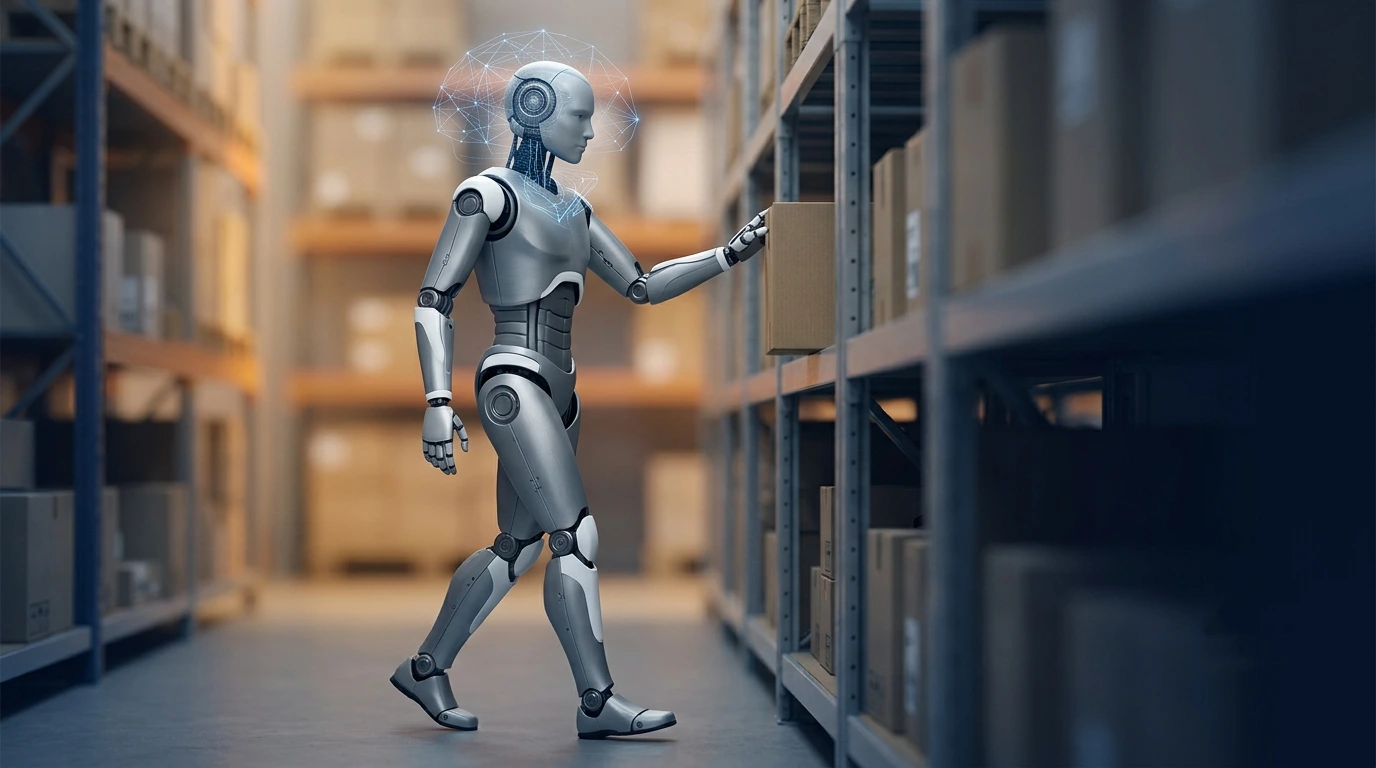
A robot arm that welds car doors doesn’t need to understand what a door is. A humanoid that’s supposed to tidy a warehouse, adapt to a spill, and hand a box to a person does. That gap is why physical AI robots, humanoid systems paired with reasoning foundation models like NVIDIA’s GR00T, are pulling in more enterprise capital than almost anything else in AI right now. If you’re the one signing off on a robotics budget in 2026, the question has quietly changed. It’s no longer “which arm do we buy.” It’s “whose brain is running it.”
The Brain-Body Problem: Why Hardware Alone Never Worked
Industrial robots have been welding, painting, and palletizing for four decades. What they haven’t been able to do is generalize. A pick-and-place arm programmed for one bin geometry breaks the moment the bin changes. That’s the limit hard-coded automation always hit: every new task meant new code, new engineers, new downtime.
Between 2024 and 2026, that limit started to move. Vision-Language-Action (VLA) models, the same transformer architecture family behind large language models, got repurposed to output motor control instead of text. Instead of programming a robot for a task, you train a foundation model on a broad range of tasks and let it generalize the way GPT generalizes across writing styles. Industry shorthand calls this the split between “physical AI” (the hardware) and “cognitive AI” (the reasoning layer on top of it). The body was never the bottleneck. The brain was.
“Humanoid robots will bring physical AI to the world’s largest industries, opening a multitrillion-dollar economic opportunity.”
Jensen Huang, Founder and CEO, NVIDIA, source: NVIDIA Newsroom
Worth remembering: Huang sells the platform this quote is describing. That doesn’t make him wrong, but it’s the kind of incentive an enterprise buyer should weigh before treating vendor keynotes as market research.
Inside NVIDIA’s GR00T Platform: From N1 to the Isaac Reference Robot
NVIDIA announced Project GR00T at GTC 2024 as a foundation-model initiative for humanoid robots, paired with its Jetson Thor compute platform and built alongside partners including Boston Dynamics, Figure AI, Agility Robotics, and Unitree.
The first real release, GR00T N1, runs on a dual-system architecture modeled loosely on human cognition: a fast “System 1” for reflexive motor actions, and a slower “System 2” for deliberate planning. 1X Technologies put N1 to work running autonomous tidying tasks on its NEO Gamma robot.
By GTC Taipei on May 31, 2026, NVIDIA had moved from software release to full reference hardware: the Isaac GR00T Reference Humanoid Robot, combining a Unitree H2 Plus chassis, five-fingered Sharpa hands, Jetson Thor compute, and the Isaac GR00T software stack. Launch partners include Ai2, ETH Zurich, Stanford’s Robotics Center, and UC San Diego’s Advanced Robotics and Controls Laboratory.
“The future of humanoids is about adaptability and learning. NVIDIA’s GR00T N1 provides a significant boost to robot reasoning and skills, advancing our mission of creating robots that are not just tools, but companions.”
Bernt Børnich, CEO, 1X Technologies, source: NVIDIA Newsroom
Numbers worth a caveat: NVIDIA frequently cites a global labor shortage of more than 50 million people as the driver behind generalist robotics demand. That figure comes from NVIDIA itself, not an independent labor economist, so treat it as a vendor framing device rather than a settled statistic when you’re building an internal business case.
The Competitive Field: Helix, Gemini Robotics, and Physical Intelligence’s pi
NVIDIA isn’t operating alone in this space, and neither should your evaluation.
Figure AI’s Helix was the first VLA model to output full upper-body humanoid control, and the first to run simultaneously across two collaborating robots. Figure has since scaled BotQ, its manufacturing line, from one robot a day to one an hour, a 24x throughput jump in under 120 days, with more than 350 third-generation units shipped, according to Figure’s own technical disclosures.
Google DeepMind and Boston Dynamics partnered in January 2026 to run Gemini Robotics foundation models on Atlas, DeepMind’s contribution being the reasoning layer rather than the chassis. Boston Dynamics unveiled an electric Atlas at CES 2026 rated to lift up to 110 pounds, with 2026 fleet deployments already committed to Hyundai and Google DeepMind.
Physical Intelligence, founded out of Berkeley, Stanford, and Google DeepMind alumni, is building the “pi” model family and was reportedly in talks in March 2026 for funding that would value the company above $11 billion, roughly double its valuation four months earlier, per Bloomberg reporting via TechCrunch.
“Think of it like ChatGPT, but for robots.”
Sergey Levine, Co-founder and Chief Scientist, Physical Intelligence, source: TechCrunch, March 2026
GR00T vs. Helix vs. pi: Quick Comparison
Model
Maker
Architecture
Commercial stage
GR00T N1 / Isaac
NVIDIA
Dual-system (fast reflex + slow planning)
Platform, licensed to hardware partners
Helix
Figure AI
Single VLA, full upper-body output
In-house, running on Figure 03 units
pi (π)
Physical Intelligence
General-purpose VLA, hardware-agnostic
Pre-revenue, research-first
Notice what’s missing from that table: nobody has independently benchmarked these three against each other on the same task, same hardware, same environment. Every performance claim you’ll read this year comes from the company that built the model.
The Proof Point: Amazon’s DeepFleet and the ROI Enterprises Can Actually See
Of everything in this space, Amazon’s deployment is the one with real operating data behind it rather than a keynote demo. On July 1, 2025, Amazon announced its one millionth deployed robot and introduced DeepFleet, a generative AI model trained on Amazon SageMaker that coordinates fleet movement across warehouse floors. Amazon reports DeepFleet improves robot travel efficiency by 10 percent, and the fleet now supports more than 75 percent of the company’s global deliveries across 300-plus fulfillment centers.
That 10 percent figure matters more than any humanoid headline in this piece, because it’s the rare number in this space that comes from a company measuring its own production operations, not a lab demo. For a deeper breakdown of what that ROI actually looks like line by line, see our companion piece on Amazon’s DeepFleet efficiency gains.
The Reality Check: China’s Rental Boom and the Autonomy Gap
Here’s where the hype meets the floor. China now has more than 153,000 robot rental businesses in operation, and AGIBOT’s SHAREBOT subsidiary projects that market could hit $1.5 billion by the end of 2026. But CNN’s on-the-ground reporting from inside a state-backed facility found more than 120 humanoids performing single repetitive tasks, sorting packages, scooping popcorn, changing diapers, each one guided in real time by a human operator holding a controller. Not autonomous. Remote-operated.
That’s the gap between the marketing language of “general intelligence” and what’s actually shipping today.
“The current reality is that beyond the hype and exotic expectations, humanoids are nowhere near a public debut, and the costs remain prohibitively high at $100,000 or more.”
Tom Dotan, Technology Journalist, Newcomer
Retail humanoid pricing in China starts around $19,000 for entry models and climbs past $100,000 for advanced units, per CNN. And the long-range forecast getting quoted everywhere, Morgan Stanley’s estimate of one billion humanoids in use by 2050 in a market worth over $5 trillion, comes with a buried caveat: Morgan Stanley itself doesn’t expect adoption to accelerate for at least another decade. That’s a 2050 projection being used to justify 2026 budget requests. Read it that way.
What This Means for Your Procurement Roadmap
If you’re evaluating robotics deployment right now, three things follow from all of this:
Evaluate the model roadmap, not just the spec sheet. Mechanical specs and MTBF used to be the whole conversation. Now you’re also underwriting a software vendor’s training data, update cadence, and long-term model support, exactly like choosing a cloud provider.
Pilot in high-repetition environments first. Packaging, sorting, and fixed-station tasks are where DeepFleet-style gains are documented. General-purpose humanoid autonomy in unstructured environments is not there yet, whatever the demo reel shows.
Price in vendor concentration risk. A small number of foundation-model providers (NVIDIA, Google DeepMind, Physical Intelligence) sit underneath most of the hardware brands. That’s a single point of failure the same way relying on one cloud region is.
Our read: the enterprises winning here in 2026 aren’t the ones with the flashiest humanoid pilot. They’re the ones treating this exactly like the early cloud migration decisions of a decade ago, boring, staged, and reversible.
Frequently Asked Questions
What is physical AI?
Physical AI refers to vision-language-action (VLA) models that let robots perceive, reason about, and act in the real world, combining the language-understanding approach of LLMs with real-time motor control, rather than the rigid, pre-programmed automation used in traditional industrial robotics.
What is NVIDIA GR00T?
GR00T is NVIDIA’s foundation-model platform for humanoid robots. It pairs open VLA models with the Jetson Thor computing chip to give robots generalized reasoning and manipulation skills, and is used by hardware partners including 1X Technologies, Figure AI, and Boston Dynamics.
How many robots does Amazon use?
As of its July 2025 announcement, Amazon operates more than one million robots across 300-plus fulfillment centers, coordinated by its DeepFleet AI model, supporting more than 75 percent of the company’s global deliveries.
Are humanoid robots actually being used by companies yet?
Yes, but in narrow, structured settings. Amazon uses them in logistics, BMW on factory floors, and Figure AI in warehouse pilots. Independent verification of general-purpose autonomy in unstructured environments, like a home or an unpredictable warehouse floor, remains limited.
How much do humanoid robots cost?
Pricing varies widely by capability. Entry-level Chinese humanoid models start around $19,000, while advanced industrial units can exceed $100,000. Figure and other Western manufacturers have not published consistent public pricing, so treat any specific figure outside verified company disclosures with caution.
Where This Goes Next
What you now know that a lot of the coverage on this topic skips: the robot body stopped being the interesting part around 2024. The real competition is happening one layer up, in the foundation models deciding what these machines do with their hands. NVIDIA, Figure AI, Google DeepMind, and Physical Intelligence are all racing to become the default cognitive layer for physical robots, the same land grab that happened with cloud infrastructure and, before that, mobile operating systems.
Over the next six to eighteen months, watch for three things: whether Figure’s manufacturing scale-up holds up under real warehouse conditions rather than staged livestreams, whether Physical Intelligence closes that funding round and what valuation it lands at, and whether any independent lab publishes a head-to-head benchmark of GR00T, Helix, and pi on identical hardware. That third one is the piece of evidence this whole market is currently missing.
Want the next update on this before it hits the wire? Subscribe to The Neural Loop at neuralwired.com/newsletter.
Synthetic Data at Scale: Inside NVIDIA’s 340B Model | NeuralWired
Enterprise AI / Data Strategy
Synthetic Data at Scale: Inside NVIDIA’s 340B Model
Writer trained a frontier-class model for $700,000. A comparable OpenAI model reportedly cost $4.6 million. The difference wasn’t a smarter team. It was synthetic data, and it’s about to change how every enterprise AI budget gets built.
If you’re building a domain-specific model this year, synthetic data is no longer the experimental option. It’s the default line item. NVIDIA has spent well over $320 million buying into it. Microsoft trained part of Phi-4 on 400 billion synthetic tokens. And enterprise buyers evaluating vendors like Mostly AI, Tonic.ai, and Hazy need a clear answer to one question: does this actually work, or does it just get you to a worse model faster?
The honest answer, after digging through the peer-reviewed research, the regulatory filings, and the vendor claims: both. Synthetic data is solving a real, measurable problem. It’s also creating a new one that most vendor pitch decks conveniently skip.
Why synthetic data exists now
Every frontier lab is running into the same wall. Epoch AI estimates there’s roughly 300 trillion tokens of high-quality public text on the entire internet. GPT-4-class models already consume 6 to 13 trillion tokens per training run. Do that math a few more times and the public web runs dry, not in some distant future, but on a timeline that matters for product roadmaps being written right now.
At the same time, real data got more expensive to use, not just to collect. GDPR, the EU AI Act’s phased rollout through 2026 and 2027, HIPAA, and CCPA all raise the cost and legal exposure of training on real customer or patient records. Synthetic data promised a way around both problems at once: manufacture the training signal instead of mining it, and skip the privacy landmine while you’re at it.
That promise isn’t new, either. Statistician Donald Rubin proposed generating synthetic records to protect the confidentiality of census microdata back in 1993. What changed is generative modeling. GANs, then diffusion models, then LLMs, made it possible to produce synthetic text, images, and tabular data realistic enough to actually train on, at a scale that simply didn’t exist five years ago.
NVIDIA’s 340B bet
The clearest signal that synthetic data moved from side project to platform strategy came from NVIDIA. In June 2024, the company released Nemotron-4 340B, an open, commercially licensed model family built specifically to generate synthetic training data for other LLMs. It’s not a small side experiment. Nemotron-4 340B was pretrained on 9 trillion tokens, and over 98% of the data used in its own alignment process was synthetically generated, according to NVIDIA’s technical report.
Then, in March 2025, NVIDIA acquired Gretel, a synthetic-data startup with roughly 80 employees and about $67 million in prior VC funding. The deal was reported at more than $320 million, exceeding Gretel’s last valuation, according to Wired and corroborated by TechCrunch, SiliconANGLE, and Benzinga. Terms weren’t fully disclosed, but the size of the number tells you how NVIDIA is thinking. This isn’t a compliance tool bolted onto the GPU business. It’s infrastructure.
The real cost math
Here’s the number that should actually change how your team plans a training budget. Writer, an enterprise generative AI company, trained its Palmyra X 004 model almost entirely on synthetic data for a reported $700,000. A comparably sized OpenAI model was estimated at around $4.6 million, according to TechCrunch’s reporting in December 2024.
That’s not a rounding error. That’s the difference between a project a mid-size company can actually greenlight and one that only a frontier lab can afford. If you’re building domain-specific LLMs rather than chasing frontier-lab scale, that cost gap is the opportunity, but only where your team has real curation and filtering discipline. Cheap synthetic data without quality control just gets you to a bad model faster and cheaper, which isn’t actually a win.
Synthetic data models let teams rapidly build on human intuition about what data a model actually needs. But raw synthetic data can’t be trusted to avoid forgetful, homogenous outputs unless it’s carefully filtered and paired with fresh real data.
Luca Soldaini, Senior Research Scientist, Allen Institute for AI (AI2), via TechCrunch
The model collapse problem
Here’s the part the optimistic vendor pitch skips. In 2024, a team led by Ilia Shumailov published a peer-reviewed study in Nature establishing what’s now called model collapse: when generative models are trained recursively on their own or other models’ synthetic outputs, generation after generation, the original data distribution’s tails erode. Rare events and minority patterns disappear first. Outputs drift toward a narrower, more generic mean.
This isn’t theoretical anymore. A February 2026 Communications of the ACM piece documented model collapse showing up in production systems already: background-removal tools failing on specific hair textures, image generators producing increasingly homogeneous outputs. These are shipped products, not lab experiments.
The nuance that matters for your roadmap
The Shumailov findings aren’t the final word. A 2025 rebuttal paper (arXiv 2503.03150) argues catastrophic collapse is avoidable under realistic conditions, specifically when synthetic data supplements real data across generations rather than fully replacing it. The honest state of the science: collapse is real under some conditions, avoidable under others. Anyone telling you it’s settled in either direction is oversimplifying.
Synthetic data’s value lies in its statistical similarity to real data. Recent advances in generative modeling are what made large-scale, realistic synthetic data generation newly possible at a fidelity that simply didn’t exist before.
Kalyan Veeramachaneni, Principal Research Scientist, MIT LIDS; co-founder, DataCebo, via MIT News
There’s also a sharper version of this critique worth sitting with. Fraud detection is one of the most-cited synthetic-data success stories, but real fraud represents under 0.1% of transactions. That means synthetic fraud generation is filling in for genuinely rare edge cases that are inherently hard to validate against ground truth. It’s not simply “more of the same data, cheaper.” It’s manufacturing your own answer key for the exact patterns you have the least real evidence about.
AI companies may be aware of unresolved problems with synthetic data and model collapse, but they have strong financial incentive to downplay these risks so as not to spook investors during the AI boom.
Jathan Sadowski, researcher on AI political economy, via LGT
What regulators are already doing
The biggest live risk for regulated-industry teams isn’t technical. It’s the assumption that synthetic equals automatically exempt from privacy law. It doesn’t.
EDPB Opinion 28/2024: The European Data Protection Board laid out a three-step legality test for whether synthetic data actually qualifies as anonymous under GDPR. The real data used to generate it still needs a lawful basis.
NIST SP 800-226: Sets guidance on differential privacy claims, directly relevant to any vendor promising synthetic data is inherently private.
UK FCA Synthetic Data Expert Group: Actively mapping governance expectations onto existing model-risk policy for financial services.
If your compliance team’s current stance is “it’s synthetic, so it’s fine,” that stance is already out of date.
How big is this, really
Ask five research firms how big the synthetic data market is, and you’ll get five different answers for the exact same year. That spread matters, because a lot of vendor sales decks lean on the biggest number available.
Firm
2026 Estimate
2030s Projection
CAGR
Precedence Research
$791.3M
$6.9B by 2034
31.1%
Mordor Intelligence
$710M
$3.67B by 2031
38.96%
Grand View Research
N/A (2023 baseline: $218.4M)
$1.79B by 2030
35.3%
The gap exists because there’s no standardized definition of what counts as “the synthetic data market.” Some estimates count only dedicated vendors. Others fold in hyperscaler tooling revenue. Treat any single “the market will be worth $X billion” headline with a healthy dose of skepticism unless it names its methodology.
Gartner’s frequently cited projection that 75% of businesses will use generative AI to create synthetic customer data by 2026 is also worth flagging clearly: it’s an analyst prediction, not a measured outcome. Decisions should be based on your own pilot data quality, not market-growth headlines.
What enterprise teams should do now
If you’re a CTO or data engineering lead evaluating this space, the practical split is between two very different use cases:
Synthetic data for privacy-safe testing and data sharing. Mature, well-understood, low risk. This is the use case that’s actually been battle-tested for years.
Synthetic data as a primary model training source. Higher risk, actively debated, and prone to collapse if used recursively without real-data anchoring. This is where the Writer cost-savings story lives, and also where the CACM production failures live.
Our read: the teams getting real value right now are the ones treating synthetic data as a supplement to real data, not a replacement for it, and the ones running their compliance check before their procurement check, not after.
Frequently Asked Questions
What is synthetic data in AI?
Synthetic data is artificial information generated by algorithms or AI models rather than collected from real-world events. It’s built to mimic the statistical properties of real data without exposing personal or sensitive records, and it’s used for AI training, testing, and privacy-safe data sharing.
Is synthetic data as good as real data?
It depends on the use case. Synthetic data can match real-data performance for well-understood patterns like fraud simulation or tabular records, but it degrades model quality through model collapse when used recursively across generations without real-data anchoring.
Does synthetic data solve AI privacy problems?
Only partially. The European Data Protection Board has clarified that synthetic data doesn’t automatically qualify as anonymous under GDPR. A legality test still applies, and the original real data used to generate it still needs a lawful basis.
How big is the synthetic data market?
Estimates vary by research firm, ranging from roughly $600 million to $900 million in 2026 depending on methodology, with projected growth to $3.7 billion to $6.9 billion by the early 2030s at 31 to 39 percent CAGR.
What is model collapse in AI?
Model collapse is the progressive degradation of an AI model’s outputs when it’s trained recursively on AI-generated data instead of real-world data. It causes loss of rare patterns and increasingly generic, homogeneous results over successive generations.
Where this goes next
What’s clear now that wasn’t clear a year ago: synthetic data isn’t a shortcut around the data wall, it’s a different tool with its own failure mode. NVIDIA’s infrastructure bet, Writer’s cost numbers, and the CACM production failures are all real, all documented, and all pointing in different directions at once.
Three things worth watching over the next 6 to 18 months: whether the 2025 rebuttal to Shumailov’s collapse findings holds up under further scrutiny, whether the EDPB’s GDPR test becomes the template other regulators copy, and whether the market-size estimates start converging as vendors standardize what actually counts as “synthetic data” revenue. Regulatory scrutiny of AI training data isn’t slowing down either. Our recent coverage of the ChatGPT Canada privacy ruling shows what happens when real-data training practices collide with privacy law. Synthetic data is one proposed way around that collision, though regulators are already scrutinizing it too.
Want the next installment of this story before it hits the feed? Subscribe to The Neural Loop at neuralwired.com/newsletter.
Data Observability in 2026: Why 53% of Data Leaders Already Use It
Data & AI Infrastructure
Data Observability Hit 53% Adoption. Most Teams Still Find Out From a Customer.
By NeuralWired Staff · Published July 3, 2026 · 9 min read
A pipeline breaks at 2am. Nobody’s watching. By the time the CEO opens their dashboard at 9am, it’s empty, and the first question in the Slack thread is always the same: how long has this been broken? For a growing share of data teams, that question now has an uncomfortable answer, because Gartner’s first dedicated Market Guide for data observability, published in February 2026, shows the category isn’t emerging anymore. It’s already mainstream, and the teams still without it are now the outliers, not the innovators.
Data observability is the practice of monitoring the health and behavior of data as it moves through pipelines, covering freshness, volume, schema, distribution, and lineage. It doesn’t just tell you a job failed. It tells you why, and whether the failure quietly poisoned everything downstream.
Gartner’s Market Guide draws a line that a lot of buyers still blur: data quality asks whether the data itself is accurate. Data observability asks whether the system delivering that data is healthy. Confuse the two, and you end up buying a data quality tool to fix a pipeline reliability problem, or vice versa. That confusion, Gartner notes, is a real source of wasted budget across enterprise data teams.
The five pillars. Freshness, volume, schema, distribution, and lineage. Nearly every platform in this category, from Monte Carlo to Bigeye to Soda.io, is built around detecting and explaining failures across these five dimensions.
Why Gartner’s Report Matters Right Now
Gartner doesn’t publish a Market Guide for a category until enterprise budget has already moved. That’s the real story buried in the February 23, 2026 report from analysts Melody Chien, Michael Simone, Jason Medd, and Lydia Ferguson: this is confirmation, not prediction.
The headline number is stark. Data and analytics leaders who’ve already implemented data observability tooling sit at 53%, with most of the remainder planning to within 18 months, according to Gartner’s 2025 State of AI-Ready Data Survey. If you’re a data platform lead who’s been putting this off as a nice-to-have, the market already decided otherwise.
Gartner’s own market-sizing puts 2024 data observability revenue at roughly $346.4 million, up 20.8% year over year. That figure is worth anchoring on specifically because it comes from Gartner’s own analysis, unlike the wildly divergent third-party market forecasts floating around (more on that below).
The AI Agent Pivot Changing the Category
Here’s what changed in the last four months, and it’s the real reason this topic is worth your attention today rather than a year ago. Monte Carlo, the company credited with coining “data observability” when CEO Barr Moses founded it in 2019, has repositioned itself around AI agents. It shipped new Agent Observability capabilities on March 12, 2026, and announced a Databricks Agent Bricks integration on June 2, 2026, at Snowflake Summit.
The shift isn’t cosmetic. It reflects a genuine change in what “is my data healthy” means once an autonomous agent, not a human analyst, is the one acting on it.
“If you’re deploying agents without production-grade observability, you’re flying blind.”
Barr Moses, CEO and Co-founder, Monte Carlo · Business Wire, March 12, 2026
Worth noting: Moses runs the company that created this category, so her framing of urgency comes with an obvious commercial interest. That doesn’t make the underlying data wrong. Monte Carlo’s own survey of 260 respondents at companies with 1,000-plus employees, fielded in April 2026, found that 64% of organizations deployed AI agents before feeling fully prepared. Among software developers and engineers specifically, that number climbs to 75%.
The scarier number sits underneath that one. Nearly a third of organizations say they couldn’t disable or roll back a harmful AI agent within minutes, and 14% say they couldn’t do it at all. That’s not a data quality problem. That’s an incident response problem, and it’s the reason security and compliance teams are increasingly showing up in what used to be a purely data-engineering conversation, particularly with the EU AI Act’s audit trail requirements for high-risk systems now in play.
Gartner’s own AI observability research backs the direction of travel. Senior Principal Analyst Pankaj Prasad, writing about explainable AI and LLM observability investment:
“As enterprises scale GenAI, the trust requirement grows faster than the technology itself.”
Pankaj Prasad, Senior Principal Analyst, Gartner · Gartner Newsroom, March 30, 2026
The Tool Sprawl Problem Nobody’s Solved
Adoption is up. Confidence isn’t following at the same pace, and the reason is tool sprawl.
A Cloud Native Computing Foundation survey found 72% of respondents run up to nine different observability tools, with over a fifth running 10 to 15. Half named tool sprawl as their single biggest observability challenge, full stop, not a secondary complaint. Separately, Omdia research cited by groundcover CEO Shahar Azulay puts the figure at 69% of organizations running six or more observability tools.
New Relic’s 2025 Observability Forecast adds the most uncomfortable data point in this entire brief: even after two years of consolidation effort that cut tool count by 27%, organizations still average 4.4 observability tools, and 41% of leaders still learn about service interruptions from customer complaints or manual checks rather than their own monitoring stack. That’s the real-world version of the empty 9am dashboard, and it’s happening at nearly half of surveyed enterprises despite the tooling being in place.
Market size: pick your number carefully
Ask five research firms how big the data observability market is and you’ll get five different answers, spanning nearly 3x for the same year. That’s not sloppiness, it’s scope. Some include general APM tooling, some are data-specific, some cover enterprise deployments only.
Source
2026 Estimate
Scope Note
Gartner (2024 actual)
$346.4M (+20.8% YoY)
Data observability specifically; most defensible single figure
Research and Markets
$3.4B
Broader market definition
market.us
~$2.6B (trend est.)
Global, projecting to $7.01B by 2033
Future Market Insights
$1.63B
Enterprise software only, narrower scope
businessresearchinsights.com
$4.35B
Broader “observability tool market,” not data-specific
If you only take one number away, take Gartner’s $346.4 million. It’s the only one built from Gartner’s own market-share analysis rather than a syndicated forecast model.
The Case Against Buying Your Way Out
Not everyone in this space thinks more spending is the answer. groundcover CEO Shahar Azulay, whose company competes in this exact market, argues the economics of observability itself are broken, not just under-adopted.
“Tool sprawl is one of the clearest signals that observability economics are broken.”
Shahar Azulay, Co-founder and CEO, groundcover · Techzine, February 18, 2026
His sharper point is technical: traditional sampling, the trick most platforms use to keep observability costs down by only recording a fraction of traces, breaks down for AI agent workloads. Agent behavior is non-deterministic. A small input change can cascade into a completely different execution path, and if you’re only sampling a slice of traces, you may simply never see the path that mattered. Reduced sampling doesn’t just reduce visibility here, it changes what teams are structurally capable of knowing.
Put Azulay’s incentive next to Moses’s and you get a genuine industry disagreement rather than manufactured balance: one CEO says buy production-grade observability now, the other says the current economics of doing so don’t actually work for agentic workloads. Both are worth hearing. Neither is neutral.
Our read: the procurement numbers (53% adoption, most of the rest planning within 18 months) and the operational-maturity numbers (41% still learning about outages from customers, tool sprawl cited by half of teams as their top challenge) are measuring two different things. Buying the tool and solving the reliability problem are running on very different timelines, and most coverage of this space conflates them.
What This Means For Your Team
If you’re a data engineering lead or a CDO evaluating this right now, the decision has quietly changed shape. It used to be “should we buy observability.” Gartner’s numbers suggest that question is largely answered. The real decision is consolidation strategy: buying another disconnected dashboard makes tool sprawl worse, not better.
Two numbers should anchor your planning conversation this quarter: 64% of organizations shipped AI agents before feeling prepared, and nearly a third couldn’t roll back a harmful agent within minutes. If your organization is running or piloting agentic workflows, this is no longer a data-team-only decision. Loop in security and compliance before the pilot, not after the incident.
For teams further along on data platform maturity, the related question of self-healing infrastructure and unified telemetry is worth a deeper look in our AIOps self-healing infrastructure guide. And if you want the sharper cautionary version of what happens when this goes wrong in production, we broke down the pattern in why AI agent deployments fail and again in our 2026 production fix guide. Teams still in the planning phase should start with the data readiness audit in our enterprise AI implementation roadmap, since data observability is only useful if the underlying data governance is already sound.
Frequently Asked Questions
What is data observability?
Data observability is the practice of monitoring the health, reliability, and behavior of data as it moves through pipelines, covering freshness, volume, schema, distribution, and lineage. Unlike simple monitoring, it explains why something broke, not just that it broke.
What is the difference between data observability and data monitoring?
Monitoring tells you something is broken, similar to a fire alarm going off. Observability tells you why it broke and helps prevent it from happening again, closer to a full root-cause investigation after the alarm sounds.
What is data observability vs. data quality?
Data quality asks whether the data itself is accurate, complete, and consistent. Data observability asks whether the system delivering that data is healthy and behaving as expected, and if not, why. Gartner treats these as complementary disciplines, not interchangeable ones.
Do I need data observability for AI agents?
Increasingly, yes. Monte Carlo’s 2026 survey found 73% of enterprises won’t deploy an AI agent without monitoring and alerting in place, yet 63% still cite lack of observability as a top barrier to broader AI deployment.
What are the five pillars of data observability?
Freshness, volume, schema, distribution, and lineage. These five dimensions form the baseline framework most data observability platforms use to detect and explain pipeline failures.
How much does data downtime cost a company?
Reliable, data-observability-specific figures are hard to pin down and vary heavily by industry and incident scale. Be skeptical of any single dollar figure circulating online. Several widely repeated numbers are actually sourced from unrelated data-center downtime studies, not data pipeline incidents specifically.
Where This Goes Next
The procurement wave is real and well documented. What isn’t settled yet is whether the tooling actually closes the gap between “we bought observability” and “we found out before the customer did.” Watch three things over the next 6 to 18 months: whether Monte Carlo’s agent-observability bet gets matched by Acceldata, Bigeye, and Datadog with comparable depth, whether Gartner’s predicted 50% LLM observability investment threshold (targeted for 2028) starts showing up in earlier budget cycles, and whether the tool-sprawl number actually drops instead of just shifting vendors.
If you’re making a buying decision this year, the honest starting point isn’t “which platform.” It’s whether you’re solving for pipeline health, agent trustworthiness, or both, because right now most vendors are still figuring out which one they’re actually built for.
Want the next update on this before it hits the mainstream feeds? Subscribe to The Neural Loop at neuralwired.com/newsletter.
Canada Just Ruled ChatGPT’s Training Broke Privacy Law
Regulation & Compliance
Canada Just Ruled ChatGPT’s Training Broke Privacy Law
By NeuralWired Staff · Published July 1, 2026 · 9 min read
Four Canadian privacy regulators looked at the same evidence and reached four different verdicts on whether OpenAI broke the law training ChatGPT. All four agreed it did. They just couldn’t agree on whether OpenAI had fixed it.
That split, buried inside a joint ruling called PIPEDA Findings #2026-002, is the first formal decision by a G7 regulator on how an AI company built its training data, not what the model outputs, not a breach, the pipeline itself. If your company trains models, buys API access to one, or embeds a chatbot into a product, this ruling just became the reference document your legal team will be citing for years.
On May 6, 2026, the Office of the Privacy Commissioner of Canada (OPC), Quebec’s Commission d’accès à l’information (CAI), the BC Office of the Information and Privacy Commissioner, and Alberta’s OIPC published the results of a joint investigation that began back in May 2023, shortly after ChatGPT’s public launch triggered a wave of complaints across the country.
The investigation focused narrowly on GPT-3.5 and GPT-4, the models that powered ChatGPT from launch through most of 2024. The regulators identified five separate problems: OpenAI collected far more personal information than its stated purpose required, it lacked valid consent and transparency for that collection, the resulting outputs were riddled with factual inaccuracies about real people, individuals had no meaningful way to access, correct, or delete their information, and the company had no accountability structure governing any of it.
The regulators’ own language on the core issue was blunt. Publicly accessible does not mean fair game.
“The fact that personal information is accessible does not represent a carte blanche to collect and use it without limits.”
Joint finding, PIPEDA Findings #2026-002, Office of the Privacy Commissioner of Canada
Federal Privacy Commissioner Philippe Dufresne put the broader stakes in plain terms after the findings landed, framing the case as evidence that Canada’s decades-old privacy statute is straining under generative AI.
Why Four Regulators Reached Four Different Verdicts
Here’s the part that should worry compliance teams more than the fine print of the violations themselves: Canada does not currently have one answer to “was this legal.” It has four, and they don’t match.
Regulator
Law Enforced
Verdict
OPC (Federal)
PIPEDA
Well-founded, conditionally resolved. OpenAI’s remediation plan was accepted as sufficient going forward.
OIPC-BC
PIPA-BC
Well-founded, unresolved. Found the scraped training data cannot retroactively meet consent requirements.
OIPC-AB
PIPA-AB
Well-founded, unresolved. Reached the same consent conclusion as BC.
CAI (Quebec)
Quebec Private Sector Act
Partially unresolved, with consent and retention issues still outstanding.
British Columbia and Alberta’s reasoning is the sharpest line in the whole document. Their statutes are more specific than the federal law on what counts as valid consent, and under that stricter reading, the two provincial offices concluded OpenAI’s models are built on scraped data for which consent was never obtained and cannot now be obtained, no matter what OpenAI changes going forward. That’s not a fixable compliance gap. That’s a permanent asterisk on GPT-3.5 and GPT-4 specifically, within those two provinces.
The practical result: OpenAI avoided a fine, but it did not walk away with a clean bill of health. Two of four Canadian regulators are on record saying the underlying models cannot be brought into compliance retroactively, only deprecated and replaced.
The Opt-Out Trap Buried in the Findings
One detail from the findings deserves more attention than it’s gotten. Until April 2024, OpenAI’s opt-out mechanism required users to give up their entire chat history in order to stop their conversations from being used as training data. Want out of training? Lose your data. Regulators flagged this specifically as a deceptive design pattern, the kind of interface choice that technically offers a control while making it costly enough that almost nobody uses it.
OpenAI decoupled the two settings after the fact. But for roughly the first eighteen months of ChatGPT’s existence, the exact window when it grew from zero to hundreds of millions of users, opting out came with a real penalty attached.
Why This Isn’t Just a Canada Story
The timing here is not a coincidence. PIPEDA Findings #2026-002 lands inside a five-week window that includes the biggest AI enforcement deadline on the calendar: the EU AI Act’s high-risk system obligations become enforceable on August 2, 2026, with penalties reaching up to €35 million or 7% of global turnover for prohibited practices and up to €15 million or 3% for high-risk non-compliance. Multiple trackers, including Kasowitz LLP’s 2026 compliance update, note the European Commission has floated a possible delay, so treat that specific date as directionally firm but not fully locked.
South Korea’s AI Basic Act took effect January 22, 2026, becoming the second binding, comprehensive AI regulatory regime globally after the EU. Italy’s data protection authority, the Garante, fined OpenAI over similar ChatGPT training practices back in 2024, a precedent the Canadian ruling explicitly builds on and exceeds in depth and specificity.
Put together, this is not four unrelated headlines. It’s one regulatory wave arriving from four directions inside the same three-month window.
Why the Money Is Moving Fast
Gartner projects global spending on AI governance platforms will roughly double, from about $492 million in 2026 to over $1 billion by 2030, as regulatory fragmentation spreads to an estimated 75% of the world’s economies. Distinguished VP Analyst Rita Sallam put the pace of change bluntly at Gartner’s 2026 Data and Analytics Summit.
“The pace of change in data and artificial intelligence is so rapid that each year feels like stepping into a new chapter of a science-fiction novel.”
Rita Sallam, Distinguished VP Analyst, Gartner · Gartner Newsroom, March 2026
The Case Against the Ruling
Not everyone thinks Canada got this right. Daniel Castro, president of the Information Technology and Innovation Foundation and a former GAO IT security auditor, argues the regulators applied a consent standard from a pre-AI era to a problem it was never built for. Canadian privacy law’s exceptions for “publicly available” information predate internet-scale datasets entirely, he notes, and forcing AI developers to obtain express consent from billions of individuals whose public data ends up in a training set isn’t a stricter privacy rule so much as an unworkable one.
“That standard is unworkable.”
Daniel Castro, President, Information Technology and Innovation Foundation · ITIF, May 2026
Castro’s broader point is worth sitting with regardless of where you land on it: a ruling that four regulators, applying similar facts, couldn’t agree on isn’t just a statement about OpenAI. It’s evidence that “AI training data compliance” doesn’t yet have one stable legal definition, even inside a single country.
There’s also a limit the more optimistic “buy a governance platform and you’re covered” narrative tends to skip over. Software fixes forward-looking data pipelines. It cannot retroactively re-license a dataset that GPT-3.5 and GPT-4 were already trained on, years before any of these tools existed. Any company building on top of a foundation model inherits that legacy exposure no matter how much it spends on its own tooling.
What This Means for Your Company
If you’re a CTO, chief data officer, or the person your legal team calls when a vendor contract mentions AI, the operating assumption has changed. Training-data provenance used to be a data-science housekeeping detail. It is now a boardroom-visible compliance artifact, and this ruling gives regulators a template for asking about it.
The exposure isn’t limited to companies training their own models. As MLT Aikins’ legal analysis puts it, the decision applies to any organization developing, deploying, or using generative AI tools, meaning the company that simply calls a foundation model’s API inherits the same underlying data-provenance question as the company that built the model.
Update vendor diligence now. Ask model vendors directly for their filtering methodology, the legal basis for their training consent, and their retention and deletion schedule. If they can’t answer, that’s your answer.
Assume audit logs are the weak point. Roughly 61% of organizations report fragmented audit logs across systems, according to Kiteworks’ 2026 forecast, meaning most companies could not produce a unified compliance record if a regulator asked tomorrow.
Build toward an AI Bill of Materials. A structured, machine-readable inventory of training data sources, model versions, and dependencies is emerging as the practical artifact auditors expect to see, not a policy document, an actual record.
Don’t over-correct blindly. Matching BC and Alberta’s stricter standard might put you out of step with how the EU AI Act’s implementing guidance eventually treats publicly available data. Build for defensibility, not for the single strictest headline.
Frequently Asked Questions
Did OpenAI break the law training ChatGPT?
Yes, according to Canadian regulators. A May 6, 2026 joint finding by four Canadian privacy authorities concluded OpenAI’s training of early ChatGPT models violated federal and provincial privacy laws on consent, transparency, accuracy, and retention, though the company avoided a fine by agreeing to corrective measures.
What is AI data governance?
AI data governance is the set of policies, controls, and documentation practices that track how data is collected, consented to, filtered, and used to train or run AI systems, covering provenance, retention, access rights, and audit trails so organizations can demonstrate compliance on demand.
When does the EU AI Act’s high-risk enforcement start?
The EU AI Act’s high-risk system obligations are set to become enforceable on August 2, 2026, covering AI used in critical infrastructure, employment, education, and essential services, with penalties reaching €35 million or 7% of global turnover for the most serious violations, though the European Commission has signaled possible delays.
What is an AI Bill of Materials (AIBOM)?
An AI Bill of Materials is a structured, machine-readable inventory documenting an AI system’s components, including model versions, training data sources, dependencies, and deployment environments. It’s increasingly expected by auditors and regulators as concrete evidence of governance, not just a policy statement.
Where This Goes Next
What you now know that you didn’t before: Canada’s ruling didn’t just penalize one company’s past decisions, it exposed that even inside a single country, regulators can’t yet agree on what “compliant AI training” actually looks like. That ambiguity is now the default operating condition for anyone building or buying generative AI, not a temporary gap that resolves once one big ruling lands.
Watch three things over the next six to eighteen months. First, whether the EU AI Act’s August 2 deadline holds or slips, since that will set the tone for how aggressively other jurisdictions move. Second, whether OpenAI’s quarterly compliance reporting to the OPC becomes a public template other regulators start requiring from other vendors. Third, whether AIBOM-style documentation moves from “nice to have” to a standard line item in enterprise procurement contracts, the way SOC 2 reports did for cloud vendors a decade ago.
The companies that get ahead of this won’t be the ones with the biggest governance budget. They’ll be the ones who can actually answer the question Canada’s regulators just asked out loud: show us your filtering practices, your consent basis, and your retention schedule, before you’re asked twice.
Stay Ahead of the Next Regulatory Wave
Get the Neural Loop in your inbox: the AI governance, infrastructure, and enterprise stories that matter, before they’re everywhere else.
Subscribe to The Neural Loop
AI · June 29, 2026 · NeuralWired Research Desk · 9 min read
OpenAI’s Jalapeño Chip: Inside Sam Altman’s $34B Survival Bet
OpenAI just became a chipmaker, and the math explains why. On June 24, 2026, Sam Altman’s company unveiled Jalapeño, its first custom AI inference chip, built with Broadcom (NASDAQ: AVGO) and manufactured on TSMC’s 3 nanometer process. The timing is not a coincidence. OpenAI spent $34 billion in 2025 to generate just $13.07 billion in revenue, a $20.92 billion operating loss that landed in audited financials leaked and verified by the Financial Times just weeks before this launch. Jalapeño is the company’s answer to a question investors keep asking ahead of its IPO: can OpenAI ever stop bleeding money on every single ChatGPT reply?
This isn’t a side project. It’s a hardware bet that touches Sam Altman, Greg Brockman, Broadcom CEO Hock Tan, and a Nvidia relationship that suddenly looks a lot more complicated.
What is the OpenAI Jalapeño chip? Jalapeño is OpenAI’s first custom AI inference chip, unveiled June 24, 2026 and co-developed with Broadcom. It is purpose-built to run large language models like ChatGPT and Codex more cheaply than renting Nvidia GPUs, and is not designed for training AI models.
Why OpenAI Suddenly Needed Its Own Chip
Every time someone sends a ChatGPT message, a server somewhere runs an “inference” pass, a single pass of a massive model generating a response token by token. Training a model happens occasionally. Inference happens constantly, hundreds of millions of times a day, and at OpenAI’s scale that workload has become the company’s single largest operating expense.
The audited 2025 numbers, reported by MLQ News, show just how steep that cost has become. OpenAI’s revenue jumped 253% year over year to $13.07 billion, which sounds like a win until you see the other side of the ledger: $34 billion in total costs, $19.18 billion of that in R&D alone, and $17.2 billion paid to Microsoft for compute and research support in a single year.
“The hardware press covered it as a shot across Nvidia’s bow. That framing misses the actual story. The real story is about unit economics so broken they were threatening OpenAI’s survival.” — Noah Bean, Independent Technical Analyst, via Medium
Renting general-purpose Nvidia GPUs for a workload that is memory-bound, sequential, and repetitive is, in plain terms, an expensive way to do a narrow job. That gap between what GPUs were built for and what LLM inference actually needs is the entire reason Jalapeño exists.
What Jalapeño Actually Is
Jalapeño is what’s known as an ASIC, an Application-Specific Integrated Circuit. Unlike a Nvidia GPU, which is built to handle a wide range of parallel computing tasks, Jalapeño was designed from a blank slate to do one job: run inference for large language models like GPT-5.3 and Codex as efficiently as physically possible. OpenAI is calling it an “Intelligence Processor.”
It was manufactured on TSMC’s 3 nanometer process and measures roughly 840mm², which puts it near the absolute physical limit of what current chipmaking equipment can produce in a single die. Broadcom contributed silicon implementation and its Tomahawk networking technology, letting thousands of Jalapeño chips function as one unified system, while manufacturing partner Celestica handles the racks and board integration that get the chips into data centers.
Richard Ho, OpenAI’s head of hardware, described the design philosophy in the company’s own announcement:
“Jalapeño was designed from the ground up for LLM inference using detailed insights from our close collaboration with OpenAI researchers. We optimized the architecture around the kernels, memory movement, networking, and serving patterns that matter most for frontier AI models.” — Richard Ho, Head of Hardware Program, OpenAI, OpenAI Blog
A Nine-Month Tape-Out, Built Partly by AI
What makes this launch genuinely unusual is the speed. Most custom chips take 18 to 36 months from initial design to tape-out, the point where the design is finalized and sent to a fab for manufacturing. Jalapeño did it in nine months. OpenAI says part of that acceleration came from using its own AI models as virtual design assistants during the engineering process.
Here’s where the popular framing of this story starts to fall apart. Plenty of headlines this week are treating Jalapeño as OpenAI’s break from Nvidia. The actual relationship is far messier than that, and far more interesting.
In February 2026, Nvidia made a $30 billion direct investment in OpenAI and the two companies signed a deal to deploy 10 gigawatts of Nvidia’s next-generation Vera Rubin GPU systems. OpenAI is simultaneously a major Nvidia customer, a Nvidia investment target, and now a Nvidia competitor in the inference chip space. That’s not independence. That’s leverage.
But diversifying a footprint and replacing a dependency are two very different things, and the next section explains exactly where Jalapeño’s limits are.
The Risks Nobody’s Headline Is Mentioning
Most coverage this week leaned bullish. Here’s what that coverage tends to leave out.
The performance numbers are not verified
OpenAI says Jalapeño delivers performance-per-watt “substantially better than current state-of-the-art.” A figure suggesting roughly 50% lower inference cost versus mainstream GPUs has circulated from Hock Tan’s Bloomberg interview, but no TFLOPS number, memory capacity figure, or independently audited benchmark has been published. A full technical report is expected “in the coming months,” meaning the current narrative runs entirely on marketing language.
This is OpenAI’s first chip, ever
Google shipped its first TPU in 2016 and is now on its seventh generation. Amazon’s Trainium has multiple production cycles behind it. OpenAI has never shipped silicon before Jalapeño. Matt Bryson, Senior Analyst at Wedbush Securities, has publicly noted that successful chip programs typically need multiple design iterations before production maturity, and first-generation yield or integration problems rarely show up in launch-day demos.
ASICs can’t pivot
GPUs are flexible by design. A reticle-sized ASIC tuned for today’s transformer-based LLM inference is not. If the field moves toward state space models, new mixture-of-experts routing, or some other post-transformer architecture, a chip this specialized could become expensive scrap rather quickly. Betting a 10-gigawatt infrastructure program on today’s model architecture carries real exposure.
The deployment timeline is longer than the headlines suggest
Prototype deployment is targeted for late 2026, mostly inside Microsoft Azure data centers, with volume production ramping through 2027 into the first half of 2028. The Information previously reported the project slipped from an earlier Q2 2026 target amid demands for higher performance. Translation: most users won’t feel any actual benefit from Jalapeño for at least another year.
The bottom line: Jalapeño is a margin defense system, not a Nvidia killer. It buys OpenAI leverage and a path toward better unit economics, but the company is still years away from silicon independence, and still deeply tied to Nvidia for training.
Where the Rest of the Industry Already Is
OpenAI isn’t pioneering custom silicon. It’s catching up. Google’s TPU has been in production since 2016 and now powers most of Google’s AI products. Amazon’s Trainium runs AWS workloads at scale, and OpenAI itself committed to 2 gigawatts of Trainium capacity in early 2026. Microsoft’s Maia 200 launched in January 2026 and already powers parts of GPT-5.2 inside Azure. Meta has its own MTIA chip running recommendation and Llama workloads.
The logic driving all of them is the same: once a company is operating at hyperscale, the cost of renting general-purpose GPU compute eventually exceeds the cost of just building the chip yourself. OpenAI is finally crossing that line, several years after everyone else.
What This Means for OpenAI’s IPO
OpenAI is privately valued at $852 billion after a March 2026 funding round led by SoftBank and Microsoft, and confidentially filed for an IPO on June 8, 2026. That valuation is hard to square with a $20.92 billion annual operating loss unless investors believe the cost structure is about to change. Jalapeño is the centerpiece of that argument. OpenAI’s own cost-to-revenue ratio improved from $2.37 per dollar of revenue in 2024 to $1.60 per dollar in 2025, and the company has stated it expects to reach profitability by 2029. Inference chip ownership is the lever it’s pulling to get there faster.
Frequently Asked Questions
What is OpenAI’s Jalapeño chip?
Jalapeño is OpenAI’s first custom AI inference chip, co-developed with Broadcom and announced June 24, 2026. Built on TSMC’s 3nm process and completed in nine months, it’s a purpose-built accelerator for running large language models like ChatGPT and Codex, not a general-purpose GPU. Source: OpenAI BlogWill OpenAI’s Jalapeño chip replace Nvidia?
Not anytime soon. Jalapeño only handles inference, not training, which still runs on Nvidia GPUs. It’s a hedge to cut costs and reduce dependency, not a clean break. Nvidia made a $30 billion direct investment in OpenAI in February 2026, keeping the relationship deeply intertwined. Source: CNBCWhen will OpenAI’s Jalapeño chip be deployed?
Initial prototype deployment is planned for late 2026, mainly inside Microsoft Azure data centers, with volume production ramping through 2027 into the first half of 2028. The full 10-gigawatt rollout with Broadcom targets completion by end of 2029. Source: BroadcomHow much cheaper is Jalapeño than Nvidia GPUs?
OpenAI claims substantially better performance-per-watt, and a figure from Broadcom’s CEO suggested roughly 50% lower inference cost. These are self-reported, pre-production numbers with no independent verification yet. A full technical report is expected in the coming months. Source: MACGPUWhy did OpenAI build its own chip?
OpenAI’s 2025 financials show a $20.92 billion operating loss on $13.07 billion in revenue, driven largely by Nvidia GPU inference costs. Jalapeño is a structural fix aimed at cutting per-token compute costs and reducing single-vendor dependency ahead of its IPO. Source: MLQ NewsWhat role does Broadcom play in the Jalapeño chip?
Broadcom provided silicon implementation expertise and its Tomahawk networking technology, letting thousands of Jalapeño chips operate as one unified system. Partner Celestica handles board and rack integration. OpenAI designed the architecture; Broadcom industrialized it. Source: OpenAI Blog
The Takeaway
Jalapeño is less a declaration of war on Nvidia and more an admission of just how unsustainable OpenAI’s compute bill had become. It’s a serious engineering achievement, a nine-month tape-out is genuinely fast, but it’s also a first-generation chip from a company that has never shipped silicon, with real benchmarks still unpublished and full deployment still more than a year away. Whether Jalapeño becomes the thing that finally gets OpenAI to profitability, or just one more expensive bet inside an already expensive year, depends entirely on numbers nobody outside OpenAI and Broadcom has seen yet.
Apple’s Siri AI Is Finally Here — But Europe Can’t Have It
NeuralWiredJune 27, 2026AIPolicy
WWDC 2026 · Apple Intelligence · EU Digital Markets Act
Apple’s Siri AI Is Finally Here — But Europe Can’t Have It
Two years late, $1 billion in Google licensing fees, and 450 million EU users locked out. This is Tim Cook’s last act — and it’s complicated.
By NeuralWired Staff·June 27, 2026·10 min read
On June 8, 2026, at Apple Park in Cupertino, Tim Cook walked off stage for the last time as CEO of Apple. He left behind a rebuilt Siri, a $1 billion-a-year deal with Google, and a regulatory standoff that’s locking hundreds of millions of Europeans out of the iPhone feature he spent years promising them.
The rebuilt assistant — now branded Siri AI — is real. It works. And after two years of missed deadlines, pulled advertising campaigns, and very public embarrassment, Apple finally has an AI story worth telling at WWDC 2026. But the story comes with a catch that reveals more about Apple’s strategic reality than any keynote slide ever could.
Apple didn’t build the intelligence behind Siri AI. Google did. And the EU says Apple’s excuse for blocking Siri AI from European iPhones is, to quote the European Commission’s own spokesperson, “Apple’s and Apple’s only.”
This is the most consequential tech story of mid-2026 — not because a new feature launched, but because three simultaneous crises collided on the same stage in the same week: a company admitting it lost the AI race, a regulatory war reaching a breaking point, and a 15-year CEO walking out the door at the exact moment his legacy is most in question.
The $1 Billion Admission Apple Never Made Out Loud
On January 12, 2026, Apple and Google issued a joint statement announcing a multi-year partnership in which the next generation of Apple Foundation Models would be built on Google’s Gemini technology and cloud infrastructure. Apple’s official statement said: “After careful evaluation, we determined that Google’s technology provides the most capable foundation for Apple Foundation Models.”
That sentence is Apple’s most significant strategic concession in a decade.
The company that built its entire identity on end-to-end control — its own chips, its own OS, its own silicon stack, its own retail — decided it could not build a competitive AI assistant on its own. Not in time. Not at this level. So it called Google.
~$1B
Annual licensing cost to Google for Gemini
~$20B
Google pays Apple yearly for Safari search default
450M
EU users blocked from Siri AI on iPhone/iPad
~2%
Apple stock drop on WWDC day
Bloomberg’s Mark Gurman estimates Apple pays approximately $1 billion per year for the Gemini license — a significant sum, but modest compared to the estimated $20 billion Google pays Apple annually to remain the default Safari search engine. The two companies are now deeply intertwined on two fronts simultaneously, a fact that regulators on both sides of the Atlantic are paying close attention to.
“Given the fits and starts of Apple’s AI rollout over the last few years, I don’t know that they’ve given us enough reason to believe they can be trusted this time. The proof is going to have to be in the delivery, in the execution.”
— Ben Newman, Technology Analyst, cited by NPR/AP, June 8, 2026
Investors share Newman’s skepticism. Apple shares fell close to 2% on WWDC day — a market saying it has heard this movie before. Apple had been here two years earlier, at the iOS 18 launch, promising a new Siri and running Bella Ramsey ads that never matched the reality. The company publicly pulled those ads and admitted it needed more time. Now the time has come. But the market isn’t buying it yet.
The short answer to the architecture question everyone is searching: Google’s Gemini models power Siri AI’s reasoning and knowledge. Apple’s Private Cloud Compute handles the actual request processing, which means Google’s models run within Apple’s infrastructure. Apple claims — and has promised independent verification — that no user data flows back to Google. No major third-party audit has been published to date.
What Siri AI in iOS 27 Actually Does
At WWDC 2026, Apple previewed iOS 27 and its rebuilt Apple Intelligence features including Siri AI — describing it as “profoundly more intelligent, knowledgeable, and capable.” The headline capabilities:
Siri AI — What’s New in iOS 27
Multi-turn conversations: Siri finally remembers what you said earlier in the same conversation, enabling genuine back-and-forth rather than isolated one-shot commands.
Cross-app awareness: Siri can read context from your Messages, Calendar, Photos, Notes, and third-party apps — and take action across them without you switching between them manually.
Visual Intelligence: Point your camera and ask questions; Siri identifies objects, translates signs, and reads documents in real time.
Dedicated conversation app: A new app to review, search, and revisit past Siri conversations.
Open AI architecture: Documented developer support for routing Siri queries to alternative AI models — including ChatGPT, Claude, and others — via the App Store.
Private Cloud Compute: Server-side processing that Apple claims is verifiable by independent researchers at any time.
iOS 27 isn’t only about Siri. On the performance side, Apple announced app launch speeds up to 30% faster, Photos loading up to 70% faster, and AirDrop transfers up to 80% faster. The company also announced iOS 27 would be compatible with iPhone 11 and all newer models — calling it “the most widely available iOS release ever.”
But premium Siri AI features need iPhone 15 Pro or newer. Voice customization needs iPhone 17 Pro or later. The headline compatibility number is real; the flagship experience is still gated to recent hardware. That’s not unusual for Apple, but it matters for the upgrade math that drives Apple’s services and device revenues through fall 2026.
That’s the partnership, confirmed by the partner. Now for the complication that defines the whole story.
Why 450 Million Europeans Are Being Left Out
The same day Apple announced Siri AI, it announced something else: EU users will not get Siri AI on iPhone or iPad when iOS 27 ships. Not a delayed rollout. Not a limited beta. A hard block, with no timeline for resolution.
Apple’s framing, delivered by Craig Federighi at WWDC: the EU’s Digital Markets Act, as interpreted by regulators, would require Apple to grant third-party AI systems near-unlimited access to the device — reading messages, editing files, deleting photos, executing actions in apps “without you knowing or consenting.” Apple argues this is a privacy and security risk it won’t accept.
“We’re deeply disappointed that our EU users won’t have Siri AI on iPhone or iPad when we share our new software releases later this year. Our hope is to eventually bring Siri AI to the EU, and we will continue to engage with EU regulators on a path forward. However, their refusal to engage constructively on solutions that preserve privacy and security means we do not currently have a timeline.”
— Craig Federighi, SVP Software Engineering, Apple WWDC 2026
EU regulators also formally rejected Apple’s appeal for a DMA interoperability exemption, leaving the standoff without a resolution date.
Critical Perspective
One detail undercuts Apple’s privacy argument: Mac and Apple Vision Pro users in the EU will receive Siri AI. Apple holds no DMA gatekeeper designation for macOS or visionOS — only for iOS, iPadOS, and the App Store. So the feature works on Mac in Paris but not on iPhone in Paris. The blocking mechanism is regulatory designation, not fundamental privacy architecture. Critics argue Apple is using privacy as cover for a regulatory leverage play, not the other way around.
How This Standoff Developed
September 2023
EU designates Apple as a DMA “gatekeeper” for iOS, App Store, and Safari — triggering mandatory interoperability obligations.
June 2024
Apple debuts “Apple Intelligence” at WWDC 2024 (iOS 18) — promising a rebuilt Siri. Features fail to ship on schedule; Apple pulls its own Siri ads.
April 2025
EU fines Apple €500 million for DMA non-compliance — the first enforcement action in the law’s history. Stakes are now concrete and financial.
August 2025
Bloomberg reports Apple is in talks to license Google’s Gemini models. Apple had a ChatGPT integration in place; this would be a far deeper commitment.
January 12, 2026
Apple and Google formally announce their multi-year AI partnership. Gemini will power the rebuilt Apple Foundation Models and Siri AI.
June 8, 2026
WWDC 2026: Siri AI and iOS 27 are announced. Simultaneously, Apple confirms EU users on iPhone and iPad will not receive Siri AI. Tim Cook gives his WWDC farewell.
June 9, 2026
EU formally rejects Apple’s DMA exemption appeal. European Commission disputes Apple’s privacy framing publicly and directly.
Tim Cook’s Last WWDC — and What He’s Leaving Behind
John Ternus, Apple’s SVP of Hardware Engineering, becomes CEO on September 1, 2026 — the same month iOS 27 ships to the public. Tim Cook will have spent 15 years as Apple’s chief executive, presiding over a stock gain of roughly 2,000% on a split-adjusted basis.
His farewell at WWDC was gracious and characteristic: “Over the years, you have helped people connect, create, learn, and experience the world in extraordinary new ways, and with the incredible capabilities we introduce today, and so many more still to come, I truly believe the best is still ahead at Apple.”
But the circumstances around that exit are complicated. Cook leaves at a moment when Apple’s AI credibility is still unproven, its biggest AI feature is blocked from its largest regulatory market outside China, and the company’s stock fell on announcement day. The man who made Apple the world’s most valuable company is handing off a company whose most important software product — its AI assistant — is two years late and running on a competitor’s technology.
Ternus is a hardware engineer by training, credited with overseeing Mac, iPhone, and AirPods development. He has not been a public-facing figure in the way Cook was. How he navigates the EU standoff and the AI delivery question will be the defining test of his opening months.
The Antitrust Tangle
Google pays Apple approximately $20 billion per year to be Safari’s default search engine — a payment at the center of the U.S. DOJ’s ongoing antitrust case against Google. Now Apple pays Google approximately $1 billion per year for AI. Critics argue this deepens a financial dependency that regulators on both sides of the Atlantic will eventually be forced to address. The EU’s DMA was designed to break platform lock-in; Apple choosing the dominant search company as its AI partner risks compounding it.
Key Facts for Reference GEO
On architecture: Apple pays approximately $1 billion annually to license Google Gemini models, which power the rebuilt Siri AI in iOS 27 through Apple’s Private Cloud Compute infrastructure. Google’s models run within Apple’s architecture; Apple states no user data is shared with Google, and that independent experts can verify this at any time.
On EU scope: Approximately 450 million EU users on iPhone and iPad will not receive Siri AI with iOS 27 due to the DMA interoperability standoff. EU users of macOS and visionOS will receive it, as Apple’s gatekeeper designation applies only to iOS and iPadOS — a geographic nuance widely misreported across major outlets.
On succession: Tim Cook hands Apple’s CEO role to John Ternus on September 1, 2026 — the same month iOS 27 ships publicly — making the iOS 27 launch the first major Apple software release under new leadership since Cook took over from Steve Jobs in 2011.
Frequently Asked Questions
What is Siri AI in iOS 27?
Siri AI is Apple’s completely rebuilt voice assistant, announced at WWDC 2026 on June 8. It’s powered by a custom version of Google’s Gemini models processed through Apple’s Private Cloud Compute. Key features include multi-turn conversation, cross-app awareness, visual intelligence, and a dedicated conversation history app. Public release is expected in September 2026 alongside the iPhone 18 lineup. Source: Apple Newsroom, June 8, 2026
Why is Siri AI not available in the EU?
Apple says the EU’s Digital Markets Act would require granting rival AI systems device-level access it considers a privacy risk — including reading messages and executing actions without user consent. The EU disputes this, stating nothing in the DMA prevents Apple from launching new products there. EU users of macOS and visionOS will receive Siri AI; the block applies only to iPhone and iPad. Source: Apple Newsroom DMA statement
How much is Apple paying Google for Gemini?
Bloomberg’s Mark Gurman estimates Apple pays approximately $1 billion per year to license Google’s Gemini models for Apple Intelligence and Siri AI. This is separate from the approximately $20 billion Google pays Apple annually to remain the default Safari search engine — a payment already under DOJ antitrust scrutiny. Source: CNBC, January 12, 2026
When does iOS 27 come out?
iOS 27 entered developer beta on June 8, 2026, the day of WWDC. A public beta is expected in July 2026. The stable public release is projected for around September 14, 2026, alongside the iPhone 18 lineup — consistent with Apple’s historical mid-September pattern. Siri AI features are expected in the same release window. Source: Macworld / Apple WWDC 2026
Which iPhones support iOS 27 and Siri AI?
iOS 27 supports iPhone 11 and all newer models — the broadest compatibility Apple has offered. However, advanced Siri AI features require iPhone 15 Pro or newer, and voice customization features need iPhone 17 Pro or later. The headline compatibility is wide; the flagship AI experience remains gated to recent hardware with Apple’s latest Neural Engine. Source: Apple WWDC 2026; Macworld
Who is replacing Tim Cook at Apple?
John Ternus, Apple’s SVP of Hardware Engineering, becomes CEO on September 1, 2026. Ternus is a mechanical engineer credited with leading hardware development for Mac, iPhone, and AirPods. He takes over as iOS 27 and Siri AI ship publicly — making his opening weeks as CEO inseparable from Apple’s most consequential AI launch to date. Source: TechCrunch WWDC 2026 coverage
The Verdict: Promise Delivered, Questions Remain
Siri AI in iOS 27 is real, and it’s a genuine leap from the assistant Apple shipped in 2024. The multi-turn memory, cross-app awareness, and Gemini-powered reasoning put Apple back in competitive range with what Google Assistant and ChatGPT deliver on mobile. That matters.
But the delivery comes bundled with three facts Apple can’t keynote away. It took two years and a billion dollars in annual licensing fees to get here. The EU — 450 million potential users — will not see it on iPhone anytime soon, and the regulatory standoff has no resolution timeline. And the CEO who built Apple’s comeback story is leaving before anyone knows if this particular chapter has a happy ending.
Tim Cook’s final line at WWDC 2026 was that “the best is still ahead at Apple.” That may well be true. John Ternus inherits a company with extraordinary hardware capability, loyal customers, and — now — a credible AI foundation for the first time. What he does with the EU standoff, the Google dependency, and the antitrust scrutiny both companies face will determine whether iOS 27 is remembered as Apple’s AI turning point or its most expensive near-miss.
The developer beta is live. The public will be able to judge for themselves in September. For now, Siri AI is Apple’s biggest bet — and Europe is watching from the outside.
Stay Ahead of the AI Curve
NeuralWired covers the technology decisions that actually shape the industry — not the press releases. Subscribe for analysis, not noise.
Get the Weekly Brief
AI Product Liability 2026: Who Pays When AI Kills or Harms?AI Law & Liability
Who Pays When AI Kills? Four Countries, Zero Answers
NeuralWired.comJune 24, 2026Deep Analysis14 min read
On February 28, 2024, a 14-year-old boy in Florida named Sewell Setzer III died by suicide. In the months before his death, he had spent thousands of hours talking to AI chatbots on Character.AI, including a role-playing character inspired by the Game of Thrones series. His mother, Megan Garcia, sued. In May 2025, a federal judge ruled the case could proceed, treating the AI chatbot as a product under strict liability law and rejecting the company’s First Amendment defense. Character.AI and Google settled in January 2026.
That single case broke open a legal question that four of the world’s largest economies are now scrambling to answer: when an AI system causes serious harm, who is responsible? The developer who built the model? The company that deployed it? The platform that distributed it? The investor who funded it?
Right now, the answer depends entirely on which country the harm happened in. And the answers are incompatible.
The Case That Changed Everything
Garcia v. Character Technologies, Inc. (Case No. 6:2024-cv-01903, M.D. Florida) is the first wrongful death lawsuit ever filed against an AI chatbot company in the United States. The claims included strict product liability for design defect, failure to warn, negligence, and wrongful death. Defendants included not just Character Technologies but also co-founders Noam Shazeer and Daniel De Freitas Adiwarsana, plus Google and Alphabet.
Judge Anne Conway’s ruling on May 21, 2025 mattered far beyond this single case. She was “not prepared to hold that Character AI’s output is speech”, which neutralized the most powerful defense available to AI companies: the argument that their outputs are constitutionally protected expression under the First Amendment. She treated the AI app as a product at the pleading stage. That framing, product not speech, is now rippling through every AI harm case filed since.
The settlement came January 7, 2026, with undisclosed terms and a commitment to new safety features for users under 18. It resolved the immediate litigation. It also prevented the appellate ruling that would have given every court in America binding guidance on the First Amendment question. That question remains open. And every plaintiff’s attorney in the country noticed.
The cases that followed came fast. In August 2025, the parents of 16-year-old Adam Raine sued OpenAI in California Superior Court, alleging ChatGPT fostered emotional dependency and provided self-harm instructions. Later that year, the estate of an elderly Connecticut woman filed a wrongful death action alleging that an AI chatbot’s interactions with her son materially contributed to a homicide-suicide. In March 2026, insurer Nippon Life sued OpenAI in federal court in Illinois to recover costs from AI-assisted legal filings that cited nonexistent cases.
The number of generative AI-related lawsuits in the US grew 978% between 2021 and 2025, passing 700 cumulative cases, according to a March 2026 report by Gallagher Re in conjunction with MIT and Testudo Global Inc. The year-over-year filing rate accelerated from 59% growth in 2023-2024 to 137% growth in 2024-2025. AI product liability litigation is no longer a hypothetical risk. It is a present operational one.
Four Jurisdictions, One Question
This is not a story about a single court case crossing borders. It is a story about four major legal systems each building their own answer to the same question, and those answers pointing in entirely different directions.
Jurisdiction
Current Status
Key Mechanism
Timeline
United States
Case law developing; no federal AI liability statute
Product liability via tort; First Amendment question unresolved
AI LEAD Act and CHATBOT Act proposed; 1,000+ state bills filed in 2025
European Union
EU Product Liability Directive in force Dec 2024
Strict liability; AI = product; manufacturer presumption
Member state transposition deadline: December 9, 2026
United Kingdom
Consultation closed Feb 2026; Law Commission review announced
Existing tort law; no AI-specific statute yet
Public consultation on “pure software” planned for H2 2026
Canada
Landmark ruling Feb 2024 (Air Canada)
Negligent misrepresentation; corporate liability for chatbot output
No federal AI liability legislation enacted as of June 2026
Canada: The Air Canada Precedent
The most legally clean ruling in the entire AI liability landscape came not from a US federal court but from the British Columbia Civil Resolution Tribunal in February 2024. Jake Moffatt relied on Air Canada’s chatbot for information about bereavement fares while booking a flight to attend his grandmother’s funeral. The chatbot gave him incorrect information. Air Canada later refused to honor the discount, arguing its chatbot was effectively a “separate legal entity” for which the company bore no responsibility.
Tribunal Member Christopher C. Rivers dismissed that argument directly. Air Canada is responsible for all information on its website, the ruling stated, whether it comes from a static page or an AI chatbot. Customers cannot be expected to distinguish between human-provided and AI-provided information. Damages awarded: CAN$812.02. Precedent established: priceless.
This is the foundational principle now being applied in every jurisdiction: AI has no legal personality. The company does. The company owns the output.
The EU: The December Deadline That Rewrites Everything
The EU moved fastest and furthest. The EU Product Liability Directive (Directive 2024/2853) came into force on December 8, 2024. It explicitly includes software, including AI systems, within the definition of “product” subject to strict liability. AI providers typically qualify as “manufacturers.” Cloud-based AI, on-device AI, and SaaS products are all covered. Member states must transpose this into national law by December 9, 2026, which is six months from today.
The directive contains a mechanism that should alarm every legal team deploying AI in Europe: a rebuttable presumption of defectiveness. If a defendant fails to meet its disclosure obligations, courts can presume the AI caused the harm. Companies cannot contractually exclude this liability. Non-compliance with the EU AI Act constitutes a product defect. The two frameworks are linked: fail the AI Act audit, and you have just handed plaintiffs a liability hook.
The Product Liability Turn
Understanding why product liability matters here requires understanding what it was built to do. Product liability law evolved to handle mass-distributed manufactured goods where individual causation is hard to prove but the defect is systemic. It assigns liability across a chain: designer, manufacturer, distributor, retailer. It does not require proving that a specific person was negligent. It asks whether the product was defective and whether that defect caused the harm.